

AC vs DC Round Trip Efficiency in Battery Energy Storage Systems
Introduction
Understanding AC vs DC round trip efficiency is essential when evaluating the performance of modern Battery Energy Storage Systems (BESS). Efficiency determines how much stored electricity can actually be delivered back to the grid or facility after charging.
Energy storage systems are increasingly used to support renewable energy integration, improve grid stability, and reduce electricity costs. However, every battery storage system experiences some level of energy loss during charging and discharging cycles.
The efficiency of a battery system is usually measured using round trip efficiency (RTE), which represents the percentage of energy recovered compared to the energy used to charge the battery.
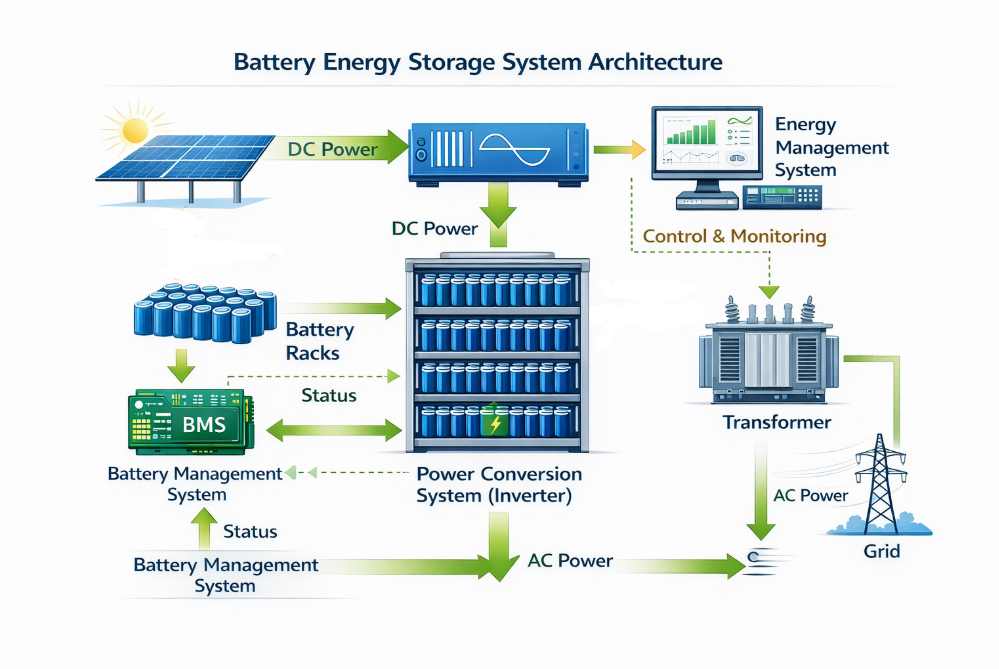
For a deeper understanding of BESS design and system architecture, read our Battery Energy Storage System Complete Guide.
What is Round Trip Efficiency in BESS?
Round trip efficiency measures the ratio of usable energy output to energy input during a full charge and discharge cycle.
The formula is:
Round Trip Efficiency = Energy Output ÷ Energy Input × 100
Example:
Energy charged into battery: 100 kWh
Energy discharged: 90 kWh
Round trip efficiency = 90%
This metric is widely used in energy storage project evaluation. If you want to understand how this value is calculated in detail, see our guide on BESS Round Trip Efficiency calculation.
According to research from the National Renewable Energy Laboratory, modern lithium battery systems typically achieve round trip efficiencies between 85% and 95% depending on system design.
What is DC Round Trip Efficiency?
DC round trip efficiency measures the energy efficiency of the battery itself, excluding most external components such as inverters and transformers.
This measurement focuses mainly on the electrochemical performance of the battery cells.
DC efficiency accounts for losses related to:
- internal battery resistance
- chemical reactions within cells
- battery management system operations
Because it excludes several system components, DC round trip efficiency is typically higher than AC efficiency.
Typical DC Efficiency Values
| Battery Type | DC Round Trip Efficiency |
|---|---|
| Lithium-ion | 95–98% |
| Lithium Iron Phosphate (LFP) | 94–97% |
| Lead-acid | 80–90% |
These values represent the intrinsic performance of the battery technology itself.
What is AC Round Trip Efficiency?
AC round trip efficiency measures the efficiency of the entire energy storage system, including all electrical conversion equipment.
Energy flow in an AC measurement typically follows this path:
Grid → Inverter → Battery → Inverter → Grid
Since electricity passes through several components, additional energy losses occur.
AC efficiency includes losses from:
- Power Conversion System (PCS)
- Transformers
- Thermal management systems
- Auxiliary equipment
As a result, AC round trip efficiency is usually lower than DC efficiency.
Typical AC efficiency values for modern lithium battery storage systems range from 85% to 92%.
Key Differences Between AC vs DC Round Trip Efficiency
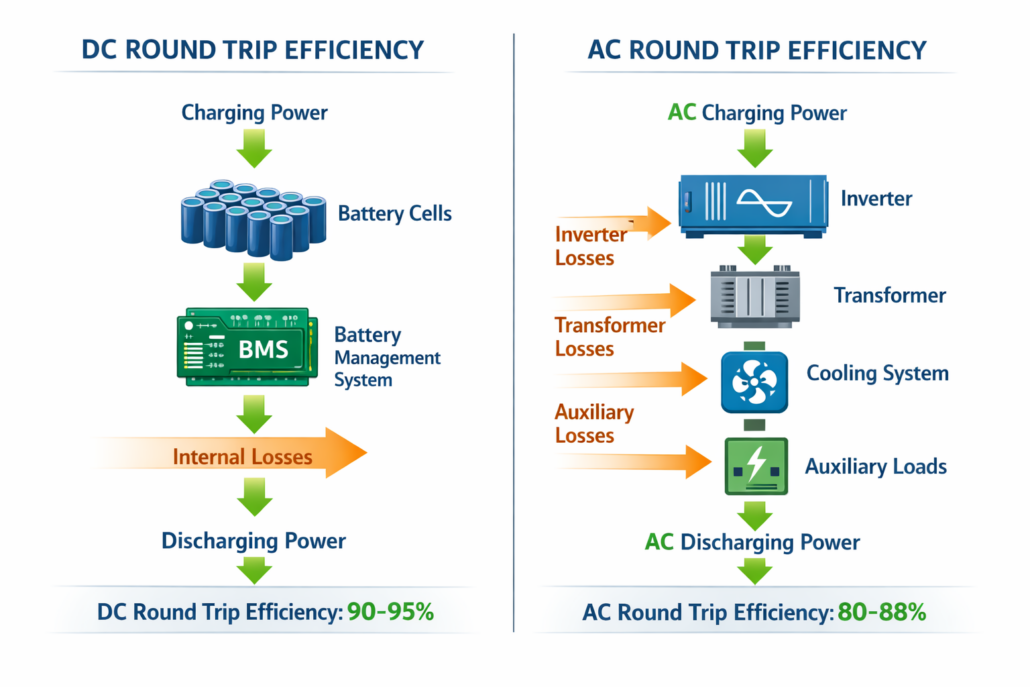
Understanding AC vs DC round trip efficiency is important when comparing energy storage solutions.
| Metric | DC Efficiency | AC Efficiency |
|---|---|---|
| Measurement scope | Battery cells only | Entire system |
| Includes inverter losses | No | Yes |
| Includes cooling loads | No | Yes |
| Typical efficiency range | 94–98% | 85–92% |
| Used for project evaluation | Limited | Yes |
While DC efficiency measures battery chemistry performance, AC efficiency reflects real-world system performance.
Where Energy Losses Occur in Battery Storage Systems
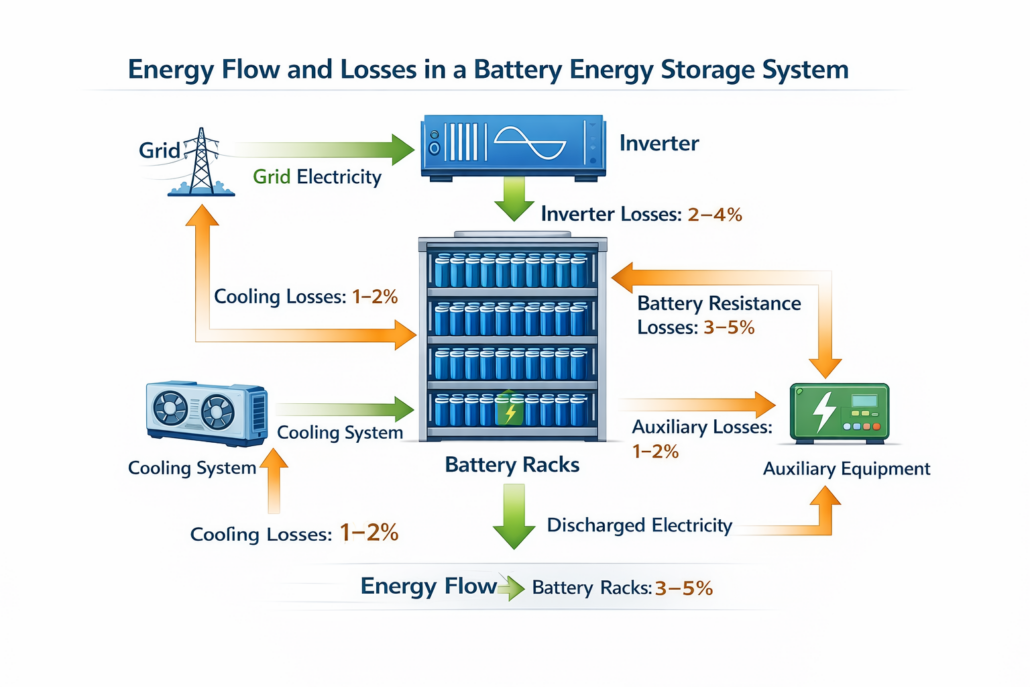
Energy losses occur at several stages within a battery energy storage system.
Power Conversion Losses
Inverters convert electricity between alternating current (AC) and direct current (DC).
Even high-performance inverters operate at 96–98% efficiency, meaning small energy losses occur during every conversion.
These losses accumulate because electricity passes through the inverter multiple times during charging and discharging.
The International Energy Agency highlights that inverter losses are one of the most important factors affecting overall energy storage efficiency.
Thermal Management Losses
Battery systems generate heat during operation. Without effective cooling, excessive temperatures can damage battery cells and reduce performance.
Thermal management systems such as:
- air cooling systems
- liquid cooling systems
- HVAC units
consume energy continuously, which reduces overall system efficiency.
Efficient cooling design is therefore critical for large-scale battery storage installations.
Auxiliary System Consumption
BESS installations include several supporting components that operate continuously.
Examples include:
- battery management systems
- monitoring equipment
- fire suppression systems
- communication hardware
Although each device consumes relatively little energy, their combined power usage contributes to overall energy losses.
AC vs DC Round Trip Efficiency in Solar + Storage Systems
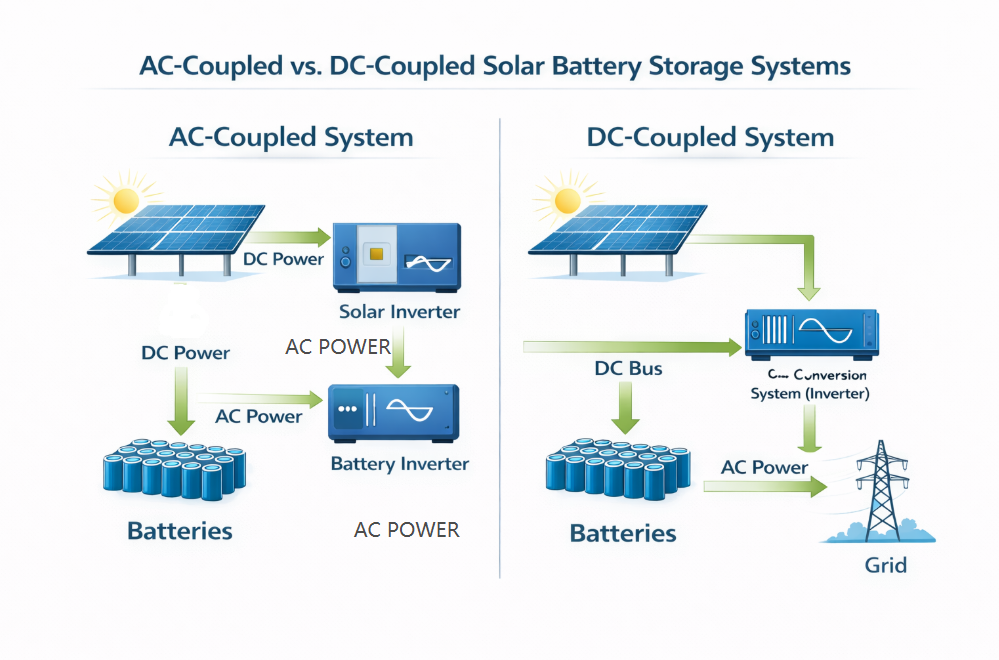
Solar energy systems combined with battery storage can be designed using AC-coupled or DC-coupled configurations.
DC-coupled systems usually achieve higher efficiency because solar energy can be stored directly in the battery without multiple conversions.
AC-coupled systems provide greater flexibility but may introduce additional energy losses due to extra inverter stages.
Choosing the appropriate architecture depends on system design goals, project scale, and grid integration requirements.
Why AC Round Trip Efficiency Matters for Energy Projects
While DC efficiency provides insight into battery chemistry performance, AC round trip efficiency is the most important metric for real-world projects.
Energy developers evaluate systems based on the amount of usable electricity delivered to the grid.
Higher AC efficiency leads to:
- increased usable stored energy
- improved project profitability
- lower operating costs
- better renewable energy utilization
This is particularly important for applications such as:
- peak shaving
- renewable energy integration
- grid stabilization
Strategies to Improve Battery Storage Efficiency
Developers can improve system efficiency through several engineering approaches.
High-Efficiency Power Conversion Systems
Modern inverters using advanced semiconductor technologies such as silicon carbide (SiC) can significantly reduce conversion losses.
Optimized Thermal Management
Efficient cooling technologies reduce auxiliary power consumption while maintaining optimal battery temperatures.
Intelligent Energy Management Systems
Advanced energy management software optimizes charging and discharging cycles to maximize system efficiency.
Conclusion
Understanding AC vs DC round trip efficiency in battery energy storage systems is essential for evaluating system performance and project economics.
DC efficiency measures the intrinsic performance of battery cells, while AC efficiency reflects the efficiency of the complete energy storage system.
For most real-world applications, AC round trip efficiency provides the most accurate indicator of system performance.
As battery technology and power electronics continue to evolve, energy storage systems will achieve even higher levels of efficiency and reliability.
FAQ About AC vs DC Round Trip Efficiency
What is AC round trip efficiency?
AC round trip efficiency measures the percentage of energy recovered from a battery after accounting for all system losses including inverters, cooling systems, and auxiliary equipment.
What is DC round trip efficiency?
DC round trip efficiency measures the efficiency of the battery cells themselves, excluding most system-level components.
Why is AC efficiency lower than DC efficiency?
AC efficiency includes losses from power conversion systems, cooling equipment, and other components that are not included in DC efficiency calculations.
What is the typical round trip efficiency of lithium battery storage systems?
Most lithium-ion battery energy storage systems achieve round trip efficiencies between 85% and 95% depending on system design.