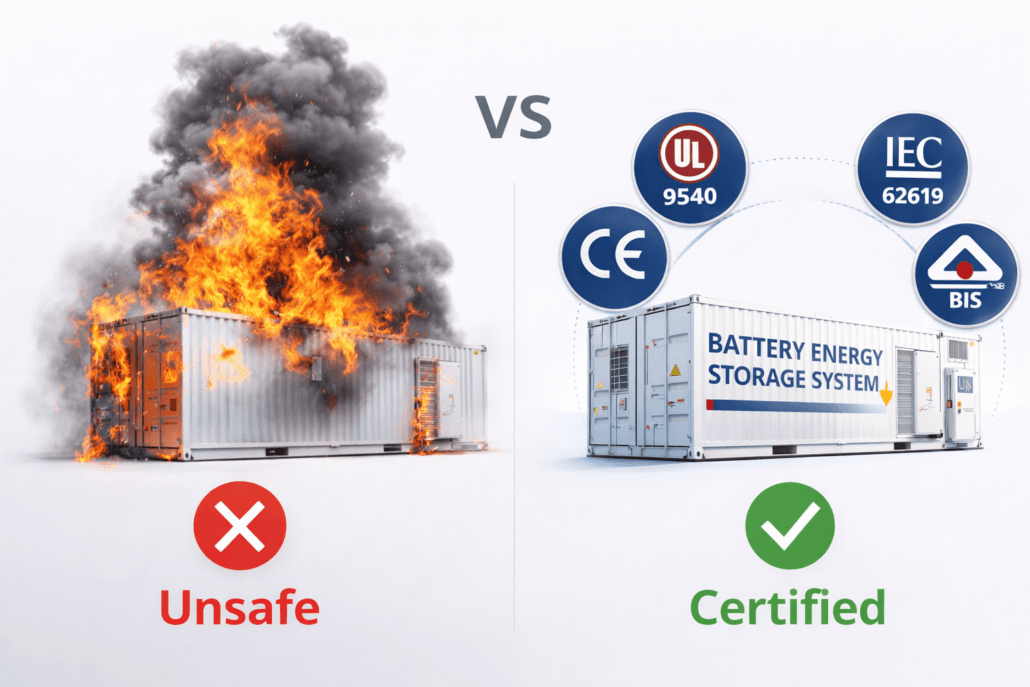
IEC Certifications for BESS: Battery Energy Storage Systems (BESS) are at the heart of modern energy transition—bridging renewables with grid reliability, enabling peak shaving, and powering homes, businesses, and microgrids. However, with great power comes great responsibility—ensuring these systems are safe, reliable, and compliant. This is where IEC certifications become non-negotiable.
Whether you’re a manufacturer, developer, investor, or end-user, understanding IEC standards for BESS is essential. Let’s explore what they are, why they matter, and how they ensure your system meets international benchmarks.
What Is IEC?
The International Electrotechnical Commission (IEC) is a global organization that prepares and publishes international standards for all electrical, electronic, and related technologies. IEC standards are widely accepted across countries, making them a crucial part of certification for global markets.
Why IEC Certification Matters for BESS
IEC certifications ensure:
Safety: Protects people and infrastructure from battery-related risks like fire, explosion, and electric shock.
Performance: Verifies that the system delivers its rated capacity, efficiency, and lifespan.
Grid Compatibility: Confirms the system won’t disrupt power quality or stability.
Global Market Access: Required for entering many regulated markets in Europe, Asia, and the Americas.
Without proper IEC certification, your BESS project could face project delays, insurance issues, or legal penalties.
Key IEC Certifications for BESS
Here’s a list of the most important IEC standards applicable to BESS, from the cell level to the complete system level.
1. IEC 62619 – Safety of Secondary Lithium Cells and Batteries for Industrial Applications
Focuses on cell and battery safety for industrial use.
Covers thermal runaway, overcharging, short-circuit protection, and more.
Mandatory for Li-ion cells and packs used in BESS.
2. IEC 62933 Series – Electrical Energy Storage Systems (EESS)
IEC 62933 is the international framework governing grid energy storage systems (ESS). Developed by the International Electrotechnical Commission (IEC), it establishes requirements for design, safety, performance, and environmental impact. Its goal is to harmonize ESS deployment worldwide.
The standard applies to all types of storage technologies, including batteries, mechanical storage, and hybrid systems. By creating a unified baseline, IEC 62933 helps reduce risks and improve investor confidence in large-scale ESS projects.
Type Test Report of Full Battery Rack or Container
If these are unavailable, it’s a red flag. You might be dealing with an uncertified, risky product.
Common Pitfalls to Avoid
Assuming cell certificates are enough
Using self-built systems without third-party testing
Mixing components without system-level integration testing
Skipping fire protection compliance
✅ Final Thoughts: IEC Certifications for BESS Is Not Optional
In the rapidly growing energy storage market, shortcuts are tempting—but dangerous. IEC certifications are not just documents; they’re your first line of defense against accidents, project rejections, and long-term failure.
So whether you’re developing a grid-scale BESS or installing a home backup system, insist on IEC-certified solutions. Your safety, investment, and reputation depend on it.
Got Questions About IEC Certifications for BESS?
As a New Energy Consultant, I help clients source, validate, and inspect certified energy storage systems across Asia. If you’re unsure about your battery supplier’s documents or want help with third-party testing, feel free to reach out.
As the world races toward a cleaner future, storing renewable energy efficiently is no longer optional—it’s essential. At the core of this transition is the Battery Energy Storage System (BESS). Among its many forms, the AC Coupled BESS stands out for its flexibility, reliability, and ease of integration. Whether you’re expanding an existing solar setup or starting fresh, this powerful configuration could be the key to true energy freedom. In this post, we’ll uncover what makes AC coupling special—and why it might just be the smarter choice for your energy journey.
AC coupling is a smart, scalable solution often used in retrofit projects, hybrid systems, and microgrids, offering flexibility in design and control.
Core Components of AC Coupled BESS
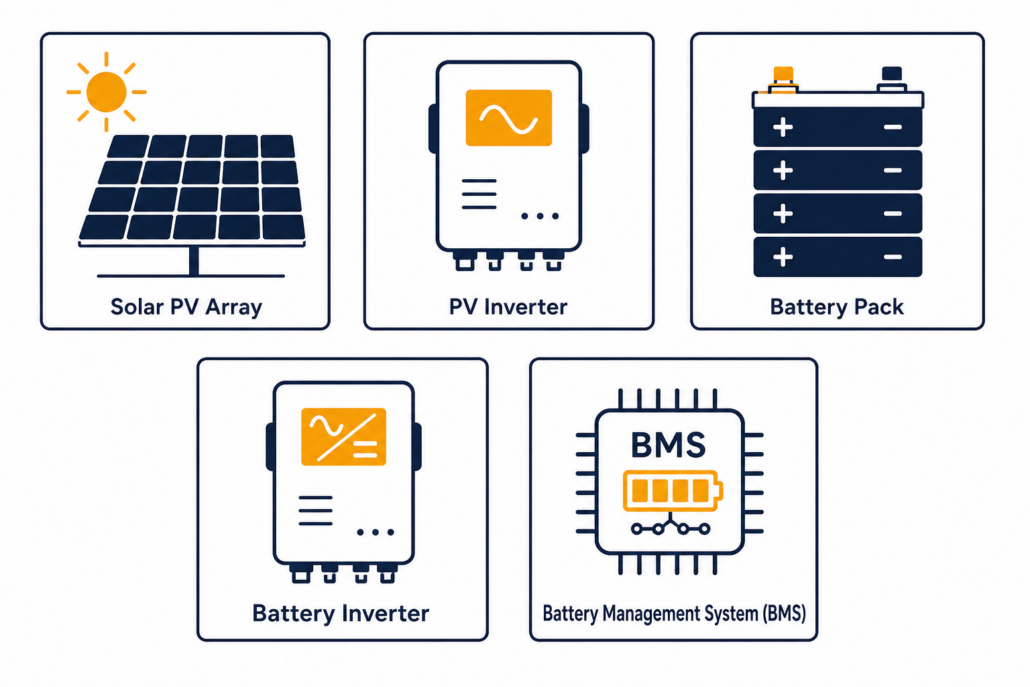
An AC Coupled BESS typically consists of the following key components:
1. Battery Pack
The heart of the system – stores energy chemically and discharges it as needed. Battery types include:
Lithium-ion (most common)
LFP (Lithium Iron Phosphate)
NMC (Nickel Manganese Cobalt)
Lead-acid (less common today)
2. Battery Management System (BMS)
Monitors and protects the battery cells by managing parameters like voltage, temperature, and charge/discharge rates. Prevents overcharging, deep discharging, and ensures system longevity.
3. Battery Inverter (Bidirectional Inverter)
This converts DC power from the battery into AC for grid compatibility, and vice versa during charging. Also known as a PCS (Power Conversion System) in utility-scale deployments.
4. Energy Meter
Monitors and measures the energy flow to and from the battery, PV system, grid, and loads. Helps in performance monitoring and utility compliance.
5. EMS (Energy Management System)
The brain of the system – it manages how and when the battery charges or discharges based on load demand, time-of-use pricing, grid signals, and PV generation.
6. Grid Connection / Load Panel
Where the system connects to the facility’s electrical infrastructure, enabling energy import/export and onsite consumption.
AC Coupled Battery Storage: How Energy Moves Through the System
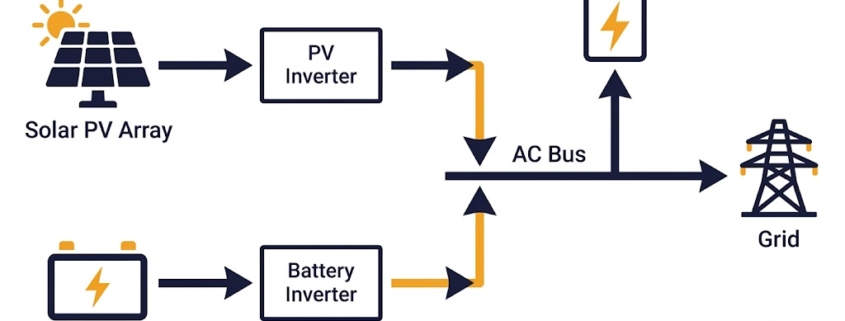
AC-coupled battery storage keeps the battery and the solar PV array on entirely separate circuits until they meet at the AC side of the system. During the day, the solar PV inverter generates AC electricity directly from the array. Any excess AC power not used on-site routes to the battery inverter, which converts it to DC to charge the battery — a process the BMS manages for safety and battery health.
When load demand exceeds generation, such as at night, the battery inverter reverses that conversion: it takes the battery’s stored DC power and converts it back to AC to supply the home or facility. Depending on how the system is configured, it can also import power from the grid or export excess energy back to it, enabling peak shaving, backup power, and participation in demand response programs.
This separation between the solar and battery inverters is what makes AC-coupled energy storage the more common retrofit choice: because the battery inverter operates independently, you can add AC-coupled battery storage to a solar system that’s already running without reconfiguring the existing PV inverter or rewiring the array. The U.S. Department of Energy has funded toolkit development specifically to simplify this kind of retrofit interconnection as battery storage adoption grows alongside existing solar installations.
The Role of the Battery Inverter in AC Coupled BESS
In an AC-coupled BESS, the battery inverter does the same core job as a hybrid inverter in a DC-coupled system, but it works alone rather than sharing duties with the solar inverter. It converts DC power from the battery to AC when discharging, and AC back to DC when charging, and it manages that conversion independently of whatever the solar PV inverter is doing at the same time.
Because the battery inverter operates on its own, AC-coupled systems can size, replace, or upgrade the battery inverter without touching the solar side at all — one of the main reasons AC-coupled storage stays the easier architecture to retrofit or expand in phases.
You can scale solar and battery systems independently. Ideal for adding more storage or generation capacity later.
3. Enhanced Redundancy
Separate inverters mean that if the solar or battery inverter fails, the other can still operate independently.
4. Flexible Control Strategies
AC coupling allows integration of diverse energy sources (wind, genset, hydro) and supports complex control logics using EMS.
5. Supports Microgrids & Off-Grid Applications
Crucial for backup power and remote areas. Works well in microgrids with multiple power sources and fluctuating load demands.
6. Time-of-Use Optimization
Charge batteries when electricity is cheap, and discharge during peak pricing. This helps reduce electricity bills significantly.
7. Grid Services Compatibility
Advanced systems can provide frequency regulation, voltage support, and participate in ancillary service markets.
AC Coupled vs. DC Coupled BESS
The core difference: AC-coupled systems use two separate inverters — one for solar, one for the battery — connected on the AC side. DC-coupled systems share a single inverter, with the battery and PV array on the same DC bus. AC-coupled is generally the easier, more flexible retrofit path; DC-coupled tends to be more efficient and lower-cost for new-build projects.
Commercial and Industrial facilities needing power backup or time-of-use optimization.
Remote microgrids with multiple sources of energy.
Retrofit projects adding batteries to an existing solar system.
Utility-scale grid support installations where power export, voltage regulation, and load shifting are required.
Frequently Asked Questions
What does “AC-coupled” mean?
AC-coupled means the solar PV array and the battery each connect to the grid through their own separate inverter, meeting only on the AC side of the system rather than sharing a DC bus.
What is an AC-coupled inverter?
An AC-coupled inverter is the dedicated inverter that connects a battery to the AC side of a solar-plus-storage system. It operates independently from the solar PV inverter, which is why AC-coupled systems use two inverters instead of one.
Is BESS the same as a PV system?
No. BESS (Battery Energy Storage System) refers specifically to the battery and its supporting hardware. A PV system refers to the solar panels and their inverter. Most solar-plus-storage projects combine both, but they’re distinct pieces of equipment with separate specifications.
What’s the difference between AC coupling and DC coupling?
Can AC-coupled batteries connect to any solar system?
In most cases, yes. Because AC-coupled batteries connect on the AC side through their own inverter, they can typically be added to an existing solar installation without modifying the PV array or its inverter, which is why AC-coupling is the more common retrofit choice.
Conclusion
AC Coupled BESS is a versatile and future-proof energy storage architecture. While it involves slightly more components and costs compared to DC coupling, the flexibility, redundancy, and modularity it offers make it a favorite for professionals designing hybrid systems, microgrids, and energy-resilient facilities.
Whether you’re an engineer, energy consultant, or business owner exploring storage solutions – understanding how AC coupled BESS works is key to making smarter energy decisions.
Need help sourcing or evaluating AC Coupled BESS systems? As a New Energy Consultant with over 13 years in China’s energy sector, I help global clients source reliable BESS products, conduct factory audits, and ensure full compliance with international standards.
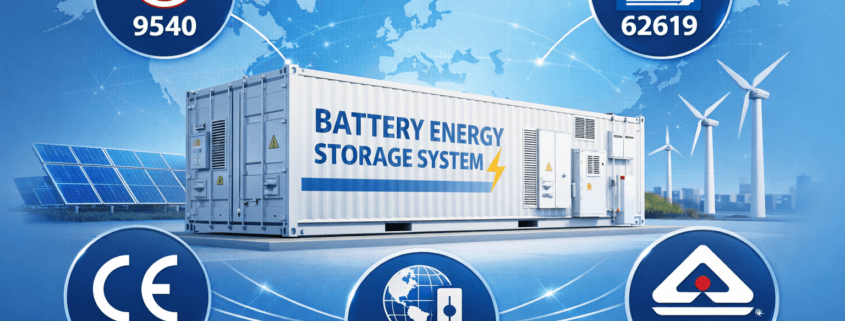
Quick Answer: BESS certifications are mandatory safety approvals for Battery Energy Storage Systems. You need UL 9540 for the USA, CE Marking for Europe, IEC 62619 globally, and BIS IS 17855 for India. Without valid BESS certifications, your system cannot be sold, insured, or grid-connected.
BESS certifications are the first thing you need when buying, selling, or installing a battery energy storage system. They decide whether your project gets permitted and financed — or blocked. As the global BESS market grows toward 500 GW by 2031, regulators everywhere are raising the bar.
This guide covers every major standard in 2026. Moreover, it explains what each certification tests, why it is required, and what it costs. Use it before you sign any BESS purchase agreement.
What This Guide Covers
To help you navigate this comprehensive 2026 compliance roadmap, use the quick-reference index below to jump directly to specific regional frameworks, testing criteria, or buyer requirements:
1. Why BESS Certifications Matter More Than Ever in 2026
BESS certifications are not just paperwork. They are your legal license to sell and operate in any serious energy market. High-profile BESS fires across the US, Europe, and Asia have pushed regulators to tighten standards. As a result, the compliance bar in 2026 is higher than at any point before.
Skipping BESS certifications leads to serious, immediate problems. Here is what happens when a system is not properly certified:
Safety failures: Fires from uncertified BESS have caused millions in damage globally
Market access blocked: Products without UL 9540 or CE Marking cannot legally be sold
Insurance denied: Most insurers reject claims involving uncertified systems
Grid connection refused: Utilities require valid certification before any interconnection
Tender disqualification: BIS (India) and CEC (Australia) are mandatory for public projects
Legal liability: Uncertified equipment leads to fines, recalls, and lawsuits
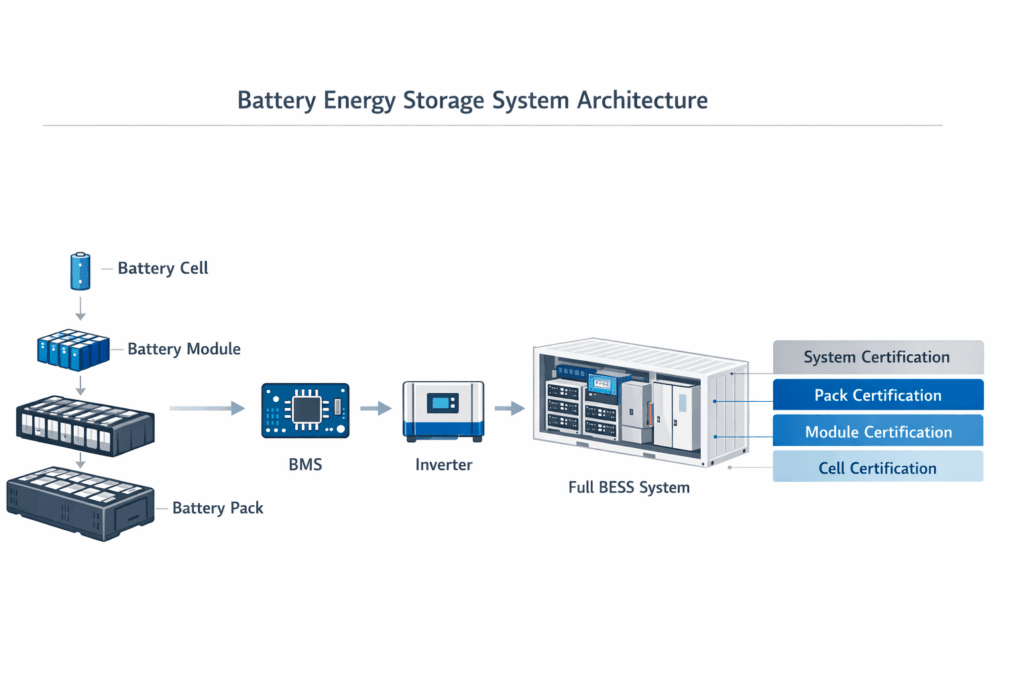
Key Rule: A certified cell does NOT mean the full BESS system is certified. The cell, BMS, PCS, enclosure, and complete assembled system each need their own independent certification. This is the most expensive mistake importers make.
2. All Major BESS Certification Standards by Region (2026)
Different markets require different BESS certifications. Below is a full breakdown of every standard you need to know. Each section explains what is tested, who issues it, and why it matters.
A. UL Standards — United States and Canada
Underwriters Laboratories (UL) issues the core BESS certifications for North America. These are enforced through state building codes, the NEC, and utility agreements. Without them, your product cannot be permitted or installed in most US states.
Standard
Full Name
Covers
Who Needs It
UL 9540
Safety for Energy Storage Systems
Full system safety — the master US standard
All BESS sellers and installers in USA/Canada
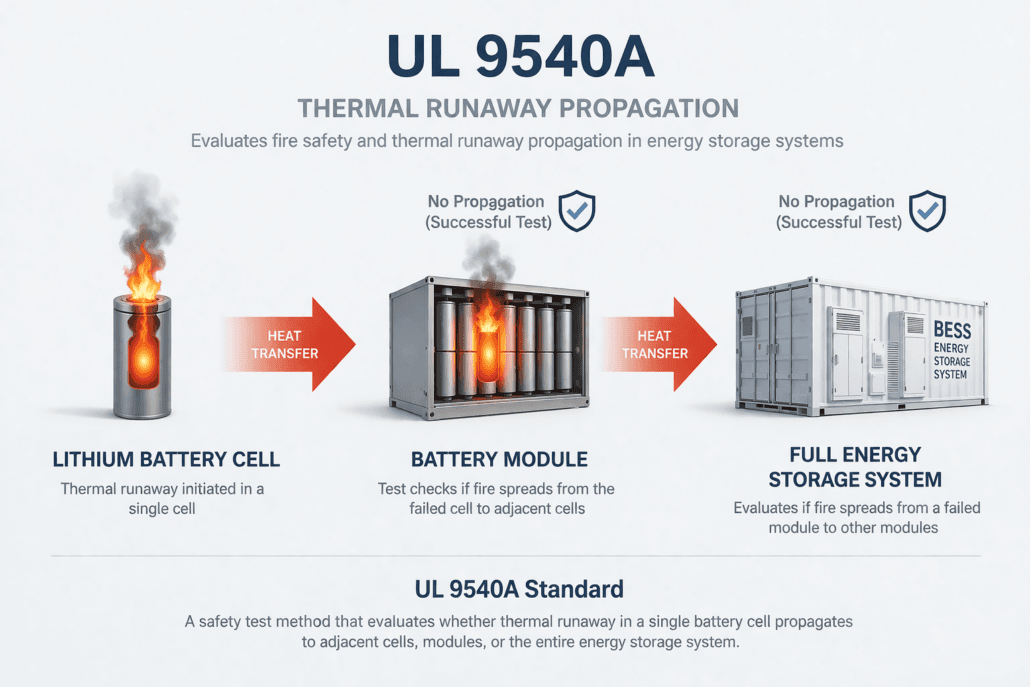
UL 9540A
Thermal Runaway Fire Propagation Test
Fire spread between battery modules
Required before UL 9540 listing
UL 1973
Stationary and Motive Battery Systems
Battery cell and pack safety
Battery pack manufacturers
UL 1741
Inverters and Power Converters
Grid-interactive inverter and PCS safety
PCS and inverter manufacturers
UL 1699B
Lithium-Ion Battery Protection
Arc fault protection in Li-ion systems
Residential and commercial BESS
UL 9540A must be completed at three levels: cell, module, and unit. Many suppliers, however, only show the cell-level report. Consequently, buyers accept incomplete documentation without knowing it. Always demand all three levels before you proceed.
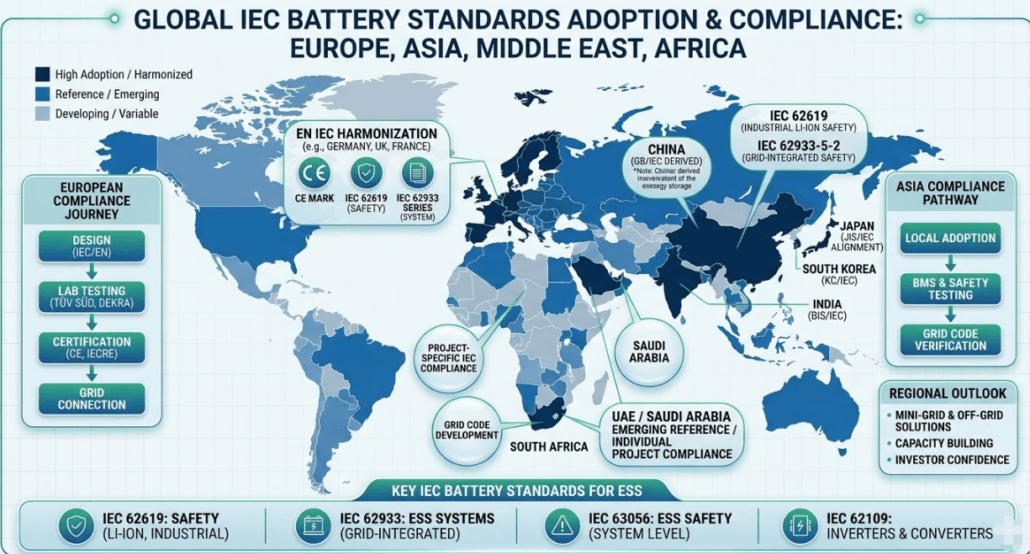
B. IEC Standards & IEC 62933 Compliance — International and European Markets
The International Electrotechnical Commission (IEC) sets globally accepted BESS certifications. As a result, IEC standards are referenced by regulators across Europe, Asia, the Middle East, and Africa. Furthermore, many utility tenders worldwide require specific IEC compliance as a minimum baseline.
Core safety: overcharge, short circuit, thermal abuse
IEC 62933-2-1
ESS unit parameters and test methods
Performance verification of a complete assembled system
IEC 62933-5-2
Safety for grid-integrated energy storage
Cybersecurity, functional safety, grid protection
IEC 61427-2
Batteries for off-grid renewables
Cycle life and performance for solar and wind storage
IEC 61508
Functional safety of electrical systems
Applies to BMS software and firmware safety logic
C. CE Marking — European Union and EEA
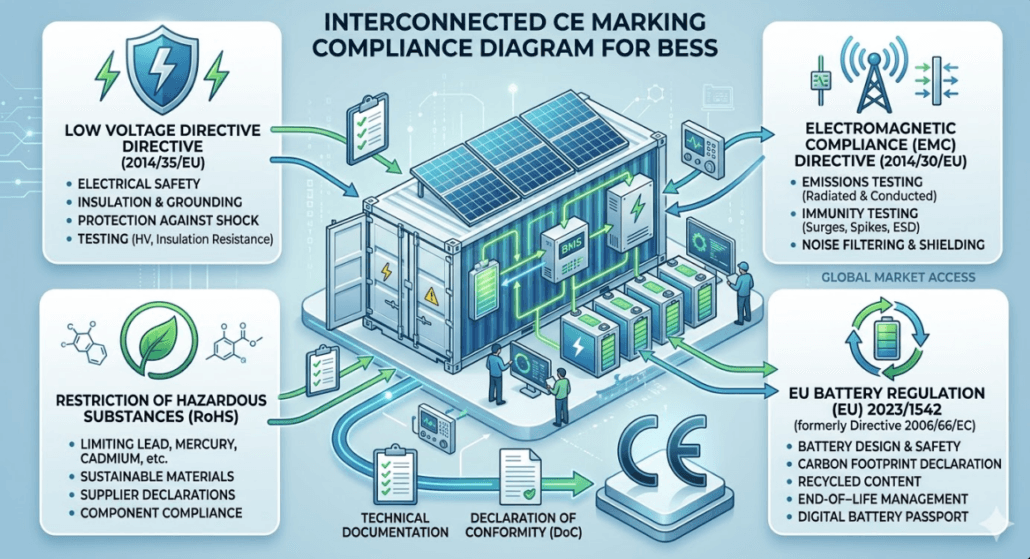
CE Marking is legally required for every battery product sold in the EU. It is not a single test. Instead, it is a Declaration of Conformity that proves compliance with several EU Directives at once. Without it, your product cannot enter the EU market legally.
Low Voltage Directive (LVD) 2014/35/EU — Electrical safety for equipment from 50V to 1000V AC
EMC Directive 2014/30/EU — Ensures BESS does not interfere with other devices
RoHS Directive 2011/65/EU — Restricts lead, mercury, cadmium, and other hazardous substances
EU Battery Regulation 2023/1542 — Adds carbon footprint declaration and Digital Battery Passport from 2024
Machinery Directive 2006/42/EC — Applies if the BESS includes any motorized or moving parts
2026 EU Update: The EU Battery Regulation adds a Digital Battery Passport for BESS above 2 kWh. From 2027, every qualifying battery needs a QR-code-linked passport with carbon footprint and supply chain data. Start compliance preparation now.
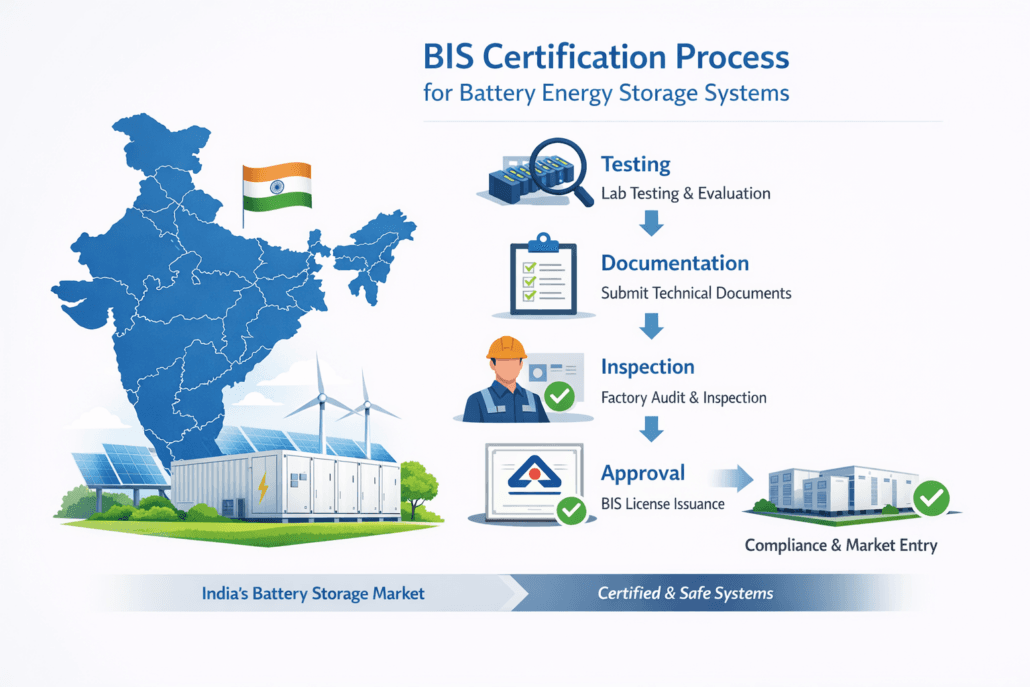
D. BIS Certification — India
In India, the Bureau of Indian Standards (BIS) manages mandatory BESS certifications under the Compulsory Registration Scheme (CRS). Without BIS registration, products cannot clear customs or qualify for government tenders. India is a fast-growing BESS market, so this certification is increasingly important.
IS 16270:2014 — Safety for lithium-ion cells, equivalent to IEC 62133
IS 17855:2022 — Stationary lithium battery safety, aligned with IEC 62619
IEC 62619 (adopted directly) — Required for large-scale utility and industrial BESS tenders
Testing must be done at BIS-approved labs or internationally accredited labs with a BIS agreement. Additionally, registration is model-specific and must be renewed. Typical timeline: three to six months.
E. CEC Approval — Australia
Australia’s Clean Energy Council (CEC) governs BESS certifications for the Australian market. CEC listing is required for grid connection and STC rebate eligibility. Without it, network operators will not approve the connection.
AS/NZS 5139:2019 — Australian standard for battery systems with power conversion equipment, updated by Amendment 1 in December 2025
CEC Approved Product List — Products must appear on this list before any grid connection; listing requirements themselves changed under AS/NZS 4777.2 Amendment 2 in 2025
Installer accreditation — CEC Battery Storage Accreditation is required for all installers
F. NFPA 855 — USA Fire Installation Standard
NFPA 855 governs how BESS certifications translate into safe real-world installations. While UL 9540 covers product safety, NFPA 855 covers how and where BESS is installed. Many US states have adopted it into local building codes.
Sets maximum energy capacity per room and building type
Requires fire suppression systems above defined energy thresholds
Mandates separation distances between battery racks and modules
Requires UL 9540A unit-level results as part of the permit application
Therefore, project developers must design installations to NFPA 855 from day one. Failing to do so results in permit denial — often after costly design work is already complete. For a deeper look into compliance steps, spacing rules, and permitting, read our Complete NFPA 855 Guide.
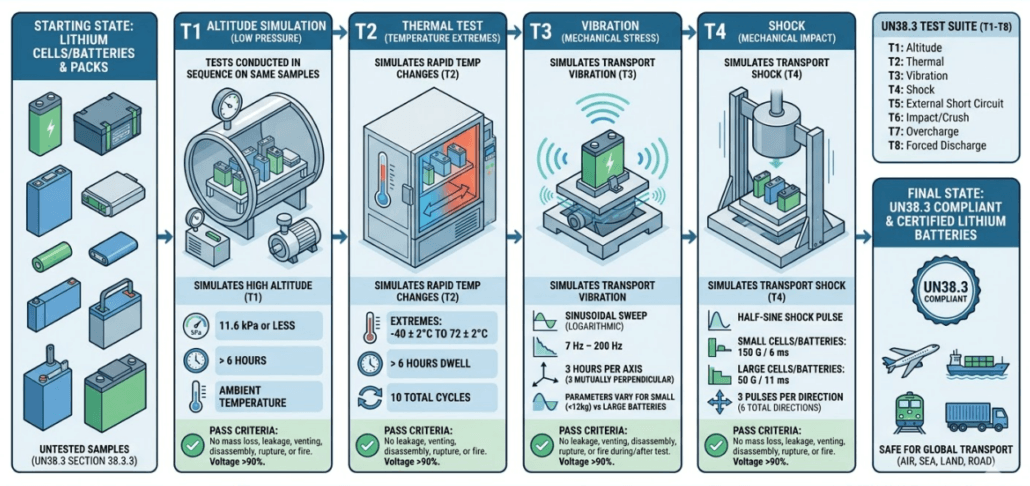
G. UN 38.3 — International Transport Certification
UN 38.3 is one of the most universally required BESS certifications — yet it is often overlooked. Simply put, it is the mandatory transport safety test for all lithium batteries shipped internationally. Without a valid UN 38.3 report, your shipment will be refused by airlines, shipping lines, and road carriers.
Tests include altitude simulation, thermal testing, vibration, shock, short circuit, and overcharge
Required under IATA (air), IMDG (sea), and ADR/RID (road) dangerous goods regulations
Cells, modules, and complete packs each need separate UN 38.3 documentation
Must be done at an accredited laboratory — self-certification is not accepted
Warning: Outdated or cell-only UN 38.3 reports are very common from lower-tier manufacturers. Any design change — including a new BMS version or different cell count — requires a fresh test. Check validity before every shipment.
4. System-Level vs. Component-Level BESS Certifications
Many buyers assume that a certified component means a certified system. In practice, this is wrong. Every level of a BESS assembly needs its own BESS certifications. Moreover, any change to a component — even a firmware update — can invalidate the existing system certificate.
Component
Relevant BESS Certifications
Why Independent Certification Is Required
Individual cells
UN 38.3, IEC 62133, UL 1973
Cell chemistry, abuse tolerance, and transport safety
Battery module
UL 9540A (cell level), IEC 62619
Module-level thermal runaway fire propagation
Battery pack / rack
UL 9540A (module level), IEC 62619
Pack-level fire propagation and structural safety
BMS
IEC 61508, UL 991
Software functional safety and fault detection logic
PCS / Inverter
UL 1741, IEC 62109, CE LVD
Grid interaction, isolation, and anti-islanding protection
Full assembled system
UL 9540, UL 9540A (unit), CE, IEC 62933
System integration, fire safety, and grid compliance
For this reason, always request the full system-level test report. It must list the exact model numbers, BMS version, cell supplier, and test configuration — matching the product you will actually receive.
5. Factory Certifications That Support BESS Certifications
Product BESS certifications are only part of the picture. The factory itself also needs to meet recognized management standards. Without factory certification, there is no reliable batch traceability — and no accountability when problems arise after delivery.
Certificate
What It Proves
Relevance to BESS Buyers
ISO 9001:2015
Quality Management System
Consistent production quality and batch traceability
ISO 14001:2015
Environmental Management System
Safe handling and disposal of hazardous battery materials
ISO 45001:2018
Occupational Health and Safety
Worker safety in battery manufacturing environments
IATF 16949
Automotive-grade quality standard
Relevant for BESS using automotive-grade LFP or NMC cells
ISO/IEC 27001
Information Security Management
Required for grid-connected BESS with SCADA or IoT systems
6. How to Spot Fake or Invalid BESS Certifications
Fraudulent BESS certifications are surprisingly common — especially in the Chinese supply chain. As a result, buyers who do not know what to check often accept invalid documents. Here are the key red flags to look for:
Cell-only report shown as a system cert: Supplier shows IEC 62619 for the cell but has no system-level UL 9540 or CE Declaration
Wrong model number: The certified model is different from the product being shipped to you
Expired documents: Check the issue date and validity period on every certificate — expired certs are invalid
Unknown test lab: Lab is not listed under ILAC mutual recognition — verify at ilac.org
Missing UL 9540A unit-level test: Only cell-level results are shown; module and unit levels are absent
No Technical Construction File for CE: Self-declaration is legal, but the Technical File must exist and be available
Supplier refuses to verify: UL certs are verifiable at iq.ul.com — refusal to verify is a serious warning sign
7. BESS Certifications Cost and Timeline Overview (2026)
Budgeting early for BESS certifications is essential. Costs vary by lab, system complexity, and region. Furthermore, any change to chemistry, BMS software, or module count after certification may trigger re-testing. These are approximate benchmarks for 2025 to 2026:
BESS Certification
Approx. Cost (USD)
Timeline
Key Notes
UL 9540 — full system
$80,000 – $200,000+
6–12 months
Includes UL 9540A at all three levels
UL 9540A — thermal runaway
$30,000 – $80,000
3–6 months
Cell, module, and unit tested separately
IEC 62619
$15,000 – $40,000
3–5 months
Available at TÜV, SGS, Intertek globally
CE Marking (LVD + EMC)
$10,000 – $30,000
2–5 months
Notified body fees vary by complexity
BIS India — IS 17855
$5,000 – $15,000
3–6 months
Testing at BIS-approved or linked labs
CEC Australia
$5,000 – $20,000
2–4 months
Requires ISO 17025 accredited lab report
UN 38.3
$3,000 – $8,000
4–8 weeks
Required per battery model and configuration
ISO 9001 factory cert
$5,000 – $20,000/yr
3–6 months
Annual surveillance audits required
8. BESS Certification Buyer’s Checklist — Before You Sign
Navigating a BESS purchase requires a structured phase-by-phase compliance review before signing any final purchase agreement or paying a deposit. The process begins at the fundamental component level, where buyers must verify cell and module abuse integrity under standards like UL 1973 and UL 2580. Ensuring your hardware meets EV-grade physical ruggedness standards heavily mitigates the risk of localized cell failures cascading into full-scale thermal runaway down the line.
Once component safety is established, the focus transitions directly to integration within the complete enclosure architecture. System developers must verify that the full assembly carries UL 9540 certification and that the manufacturer provides a comprehensive UL 9540A report detailing fire propagation limits across all three testing tiers: cell, module, and unit level. This step is critical for securing local installation permits and satisfying authority requirements.
The next milestone involves transitioning the physical hardware into an active electrical grid, which introduces strict performance and stability criteria. Developers should look to international frameworks like IEC 62933-2-1 to validate real-world parameters such as full-system round-trip efficiency (RTE) and step response time, while utilizing IEC 62933-5-2 to confirm that the internal battery management system (BMS) logic can safely handle external grid faults or sudden frequency shifts. For a complete deep dive into these electrical parameters, review our comprehensive breakdown of IEC Certifications for BESS.
For projects crossing international borders, distinct regional and maritime regulations must be cleared well before commissioning. Entering European markets requires a formal CE Marking Declaration of Conformity covering low voltage, electromagnetic compatibility, and the latest digital battery passport index mandates—detailed thoroughly in our guide to CE for BESS Certification. Concurrently, deployments targeting specific local markets must secure specialized domestic registrations, such as BIS Certification for Lithium-Ion Batteries for clearing Indian customs or Clean Energy Council (CEC) approved listing to grant grid connection and rebate eligibility in Australia.
Finally, logistics and long-term project lifecycles must be factored into the initial risk assessment. Every international lithium battery shipment—regardless of the target destination—legally requires a valid, model-specific UN 38.3 transport safety report covering severe vibration, altitude, and shock testing to prevent carrier rejection at port. Successfully validating these layers chronologically ensures that your asset arrives safely, passes inspection smoothly, and maintains accurate end-of-life calculations over its entire 10-to-15-year lifecycle.
9. Frequently Asked Questions About BESS Certifications
Here are the most-searched questions about BESS certifications, with direct and clear answers.
What certifications does a BESS need in the United States?
In the USA, BESS certifications include UL 9540 for the full system, UL 9540A at cell/module/unit levels, UL 1973 for battery packs, and UL 1741 for the inverter or PCS. Additionally, all US installations must comply with NFPA 855 and NEC Article 706.
Is UL 9540 mandatory for BESS in the USA?
Yes — in practice. UL 9540 is technically a voluntary standard. However, it is required by most state building codes, utility interconnection agreements, and insurance policies. Without it, your system will not be permitted or connected to the grid.
What is the difference between UL 9540 and UL 9540A?
UL 9540 is the full product safety standard for a complete BESS system. UL 9540A, however, is a specific test for fire propagation during a thermal runaway event. In other words, UL 9540A is a prerequisite test that must be passed before UL 9540 listing is granted.
Can I sell BESS in Europe without CE Marking?
No. CE Marking is a legal requirement for all electrical products in the EU and EEA. Products without it can be seized at the border. Furthermore, from 2024, the EU Battery Regulation adds extra compliance requirements beyond traditional CE directives.
Does IEC 62619 replace UL 9540?
No — they serve different purposes. IEC 62619 is a component-level standard for lithium battery safety. UL 9540, on the other hand, is a full system safety standard specific to the US market. For US sales you need UL 9540. For global acceptance, IEC 62619 is the recognized baseline.
What is UN 38.3 and is it required for BESS shipments?
UN 38.3 is the mandatory transport safety test for all lithium batteries. It is required for every international shipment of cells, modules, and packs — by air, sea, or road. Without a valid UN 38.3 report, freight forwarders and customs will reject the shipment.
How long does BESS certification take from start to finish?
Full UL 9540 certification takes six to twelve months. IEC 62619 takes three to six months. CE Marking can be completed in two to five months. UN 38.3 is the fastest at four to eight weeks. Most manufacturers apply for several certifications at the same time to reduce total time to market.
What is the EU Battery Passport and when does it apply?
The EU Battery Regulation (2023/1542) introduces a Digital Battery Passport for industrial BESS above 2 kWh sold in the EU. From 2027, each qualifying battery needs a QR-linked passport with carbon footprint and supply chain data. As a result, BESS manufacturers targeting Europe should start compliance preparation immediately.
Related Articles and Useful Links
Add these internal links when publishing on WordPress — they strengthen topical authority and support navigation:
As the world shifts towards renewable energy, the need for efficient energy storage systems is greater than ever. Battery Energy Storage Systems (BESS) are at the center of this transformation. But not all BESS setups are the same. One important configuration to understand is the DC Coupled BESS. In this blog post, we will explore what it is, how it works, its key components, and why it can be a smart choice for many renewable energy projects.
What is a DC Coupled BESS?
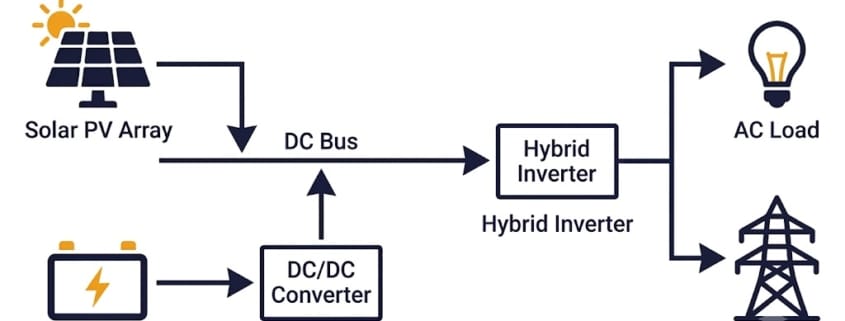
A DC Coupled Battery Energy Storage System (BESS) is an energy storage architecture where both the battery system and solar photovoltaic (PV) panels are connected on the same DC bus, before the inverter. This is different from an AC coupled BESS, where the solar and battery systems are each connected to the AC grid separately via their own inverters.
In simpler terms, in a DC-coupled system, the solar panels and battery share one inverter and connect through a DC/DC converter. This makes the system more efficient, especially in applications where solar generation is paired with energy storage.
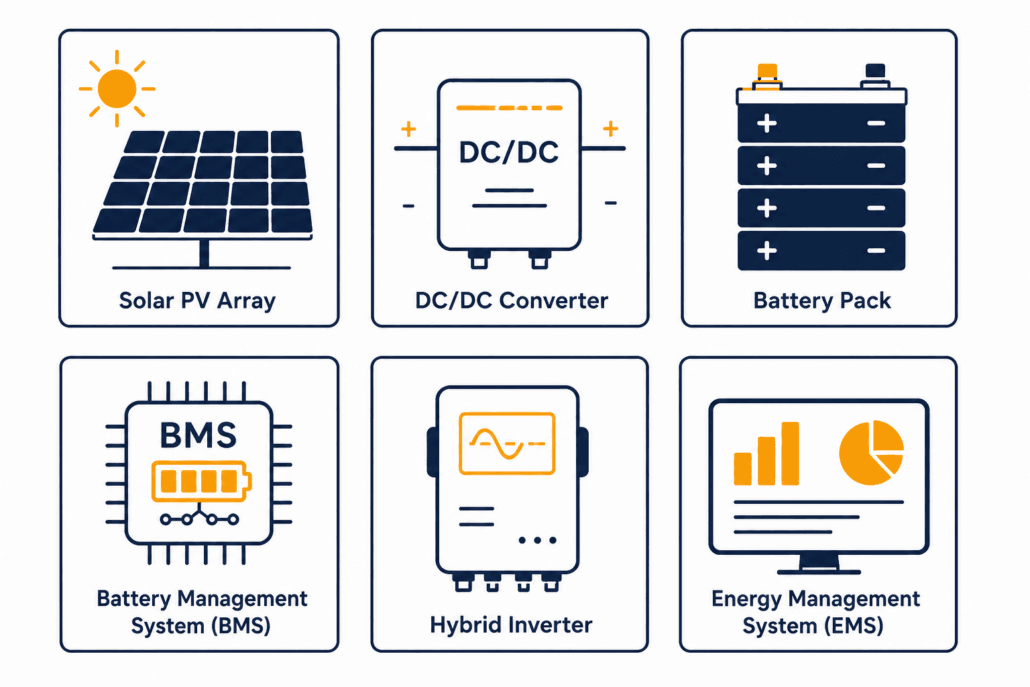
Core Components of a DC Coupled BESS System
A typical DC coupled BESS includes the following major components:
1. Solar PV Array
Captures sunlight and converts it into direct current (DC) electricity.
2. DC/DC Converter
This device regulates the voltage between the PV panels, battery, and inverter. It allows maximum power point tracking (MPPT) and enables energy flow between the PV and battery.
3. Battery Pack
Stores excess solar energy for use during periods of low generation or peak demand. Common chemistries include Li-ion (NMC, LFP) and semi-solid batteries.
4. Battery Management System (BMS)
Monitors and protects the battery cells. It manages parameters like voltage, current, temperature, and SoC (state of charge).
5. Hybrid Inverter (DC to AC)
Converts DC electricity from the battery or solar panels into AC electricity for use in homes, industries, or to feed into the grid.
6. Energy Management System (EMS)
Controls the operation of the entire system, optimizing charging/discharging, solar usage, and grid interaction based on pre-set algorithms and real-time conditions.
DC-Coupled Battery Storage: Why It’s More Efficient
DC-coupled battery storage keeps the solar array and battery on the same DC bus, so they share one inverter instead of each needing their own. That single shared conversion point is what defines DC-coupled energy storage and separates it from AC-coupled designs.
Because the battery in a DC-coupled battery storage system charges directly from the DC bus, it can also capture solar energy that would otherwise be clipped when panel output exceeds what the inverter can push to the grid — a common limitation in high-output PV arrays. That stored energy would simply be wasted in a system without DC-coupled storage in place. NREL’s 2024 Annual Technology Baseline applies a dedicated “Co-location Savings Rate of DC-Coupled Systems” in its own cost modeling for utility-scale PV-plus-battery projects, reflecting the added value this shared-inverter design captures over standalone PV and storage.
The Role of the BESS Inverter (PCS) in a DC-Coupled System
In a DC-coupled BESS, the shared inverter is often called the Power Conversion System, or PCS, in utility-scale and C&I applications. Because the solar array and battery share the same DC bus, this single BESS inverter has to manage three jobs at once: routing DC power between PV, battery, and loads; converting DC to AC at the one point where stored or generated energy leaves the DC bus; and, in some designs, forming or following grid voltage and frequency.
Because DC-coupled systems route everything through one inverter, PCS sizing and certification carry more weight here than in an AC-coupled design, where the load splits across two smaller units.
Here’s a simplified step-by-step overview of how a DC Coupled BESS operates:
During Daytime with Sunlight:
Solar PV generates DC electricity.
DC power goes to the DC/DC converter.
Part of the energy is used directly by loads (via inverter).
Excess energy charges the battery via the same DC bus.
Only one DC to AC conversion occurs when sending power to the grid or loads.
During Night or Cloudy Periods:
Stored energy in the battery is sent through the inverter to supply the AC load or the grid.
Grid-Tied and Off-Grid Modes:
Can function in both modes, depending on the design.
Can seamlessly switch between grid usage, solar generation, and battery power based on EMS logic.
Benefits of DC Coupled BESS
DC coupled systems offer several technical and economic advantages over AC coupled ones:
1. Higher Efficiency
Fewer conversions (DC-AC-DC in AC coupled vs. just DC-AC here).
Reduces energy losses, improving overall round-trip efficiency.
2. Lower Equipment Cost
Only one inverter needed.
Fewer transformers and conversion stages reduce capital expenditure.
3. Maximized Solar Harvesting
Allows solar charging even during grid outages.
Can store excess energy that would otherwise be clipped or curtailed.
4. Improved System Integration
Easier to integrate solar, battery, and EV charging into one system.
Easier to control and manage with centralized EMS.
5. Simpler Grid Interconnection
Since everything passes through a single inverter, grid interconnection rules are simpler.
Reduces the complexity of interconnection studies and permits.
6. Faster Response Time
Direct DC connection between battery and PV allows faster power adjustments in response to load changes or frequency events.
When Should You Choose a DC Coupled BESS?
A DC Coupled BESS is ideal for:
New solar + storage installations where both systems are designed together.
Remote or off-grid locations where grid stability and efficiency are critical.
Microgrid systems requiring smooth integration of multiple power sources.
Commercial and industrial setups looking for energy savings and peak load shaving.
However, if you’re retrofitting an existing solar system, an AC-coupled system is often easier to implement since it doesn’t require touching your existing PV wiring. For the full breakdown of both architectures — cost, efficiency, retrofit fit, and when to choose each — see our complete guide: AC-Coupled vs. DC-Coupled BESS: Which Architecture Is Right for Your Project?
Frequently Asked Questions
What does “DC-coupled” mean?
“DC-coupled” means the solar PV array and the battery connect to the same DC bus, ahead of a single shared inverter, rather than connecting separately on the AC side.
How does DC-coupled energy storage work?
Solar PV generates DC power that flows through a DC/DC converter, where it either charges the battery directly or passes through the shared inverter to supply AC loads or the grid. Because charging and discharging both happen on the DC side, the system converts power to AC only once, which improves efficiency compared to AC-coupled designs.
What does BESS stand for?
BESS stands for Battery Energy Storage System — any system that stores electrical energy in batteries for later use, whether paired with solar, wind, or the grid.
What is a DC-coupled battery?
A DC-coupled battery is a battery wired directly to the same DC bus as the solar array, charging and discharging through a shared DC/DC converter and inverter instead of its own dedicated inverter.
What’s the difference between AC-coupled and DC-coupled BESS?
A DC Coupled BESS offers a more efficient, cost-effective, and integrated approach to combining solar and battery storage. By reducing the number of conversions and simplifying system design, it ensures higher performance and better return on investment, especially in new or greenfield projects.
As energy needs evolve and distributed energy resources grow, understanding these architectures becomes critical. Whether you’re a developer, EPC, or energy investor—DC coupled systems could offer you the next level of performance and reliability.
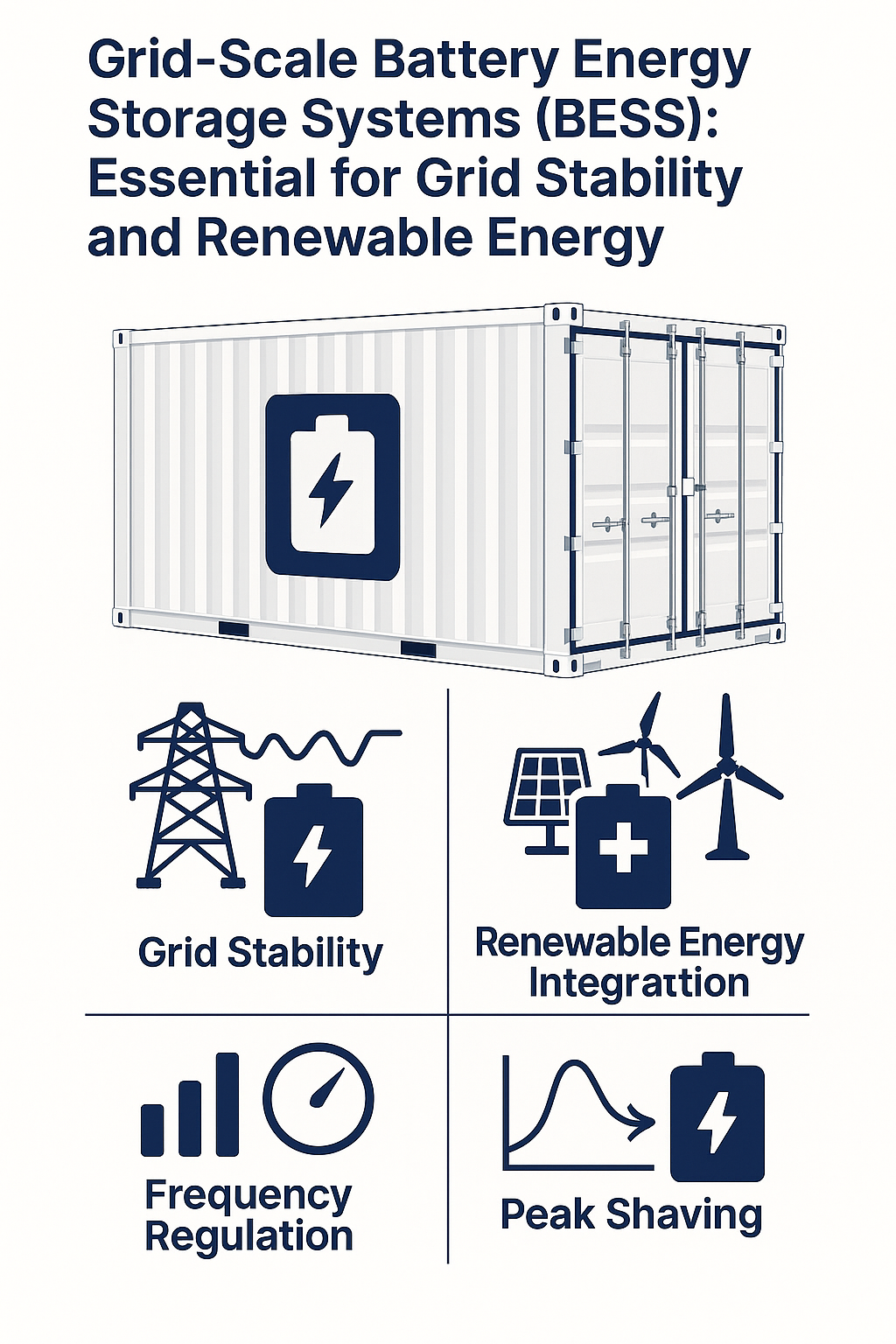
As the world moves toward clean energy, Grid-Scale BESS (Battery Energy Storage Systems) are becoming more important than ever. These systems are not just about storing energy—they are essential tools for stabilizing the grid, making better use of solar and wind power, and helping energy providers meet demand in smarter ways.
What is Grid-Scale BESS?
A Grid-Scale BESS is a large battery system connected to the power grid. It stores electricity when it’s not needed and delivers it when it is. Think of it like a giant power bank for the electricity grid. These systems can support cities, towns, or even entire regions.
Why is Grid Stability Important?
Grid stability means keeping the power system running smoothly without major ups and downs. Without stability, power outages, voltage drops, or frequency swings can happen.
Grid-scale BESS helps by:
Balancing supply and demand in real-time
Providing frequency regulation to keep the system steady
Supporting areas during peak shaving (when demand spikes)
Renewable Energy Integration: Solar + Storage, Wind + Storage
Renewables like solar and wind are clean, but they don’t always produce power when we need it. The sun doesn’t shine at night, and wind isn’t always blowing.
That’s where Battery Energy Storage comes in:
With Solar + Storage, energy from the sun can be used even after sunset.
With Wind + Storage, extra power generated at night or during windy hours can be saved for later.
This renewable energy integration helps us use more green power and less fossil fuel.
Ancillary Services: Invisible but Vital
Grid operators need backup support services to keep everything running. These are called ancillary services, and BESS can provide many of them, such as:
All over the world, countries are investing in large-scale BESS projects:
In the U.S., utility-scale battery farms are now part of the grid
In China and Europe, massive energy storage plants are under construction
Even remote areas are turning to BESS for backup and renewable power
This shows that BESS is not just a future idea—it’s happening now.
Microgrids and Distributed Energy Resources (DERs)
Microgrids are small, local power systems that can work with or without the main grid. They often include Distributed Energy Resources (DERs) like rooftop solar, small wind turbines, and local BESS.
With a grid-scale or community battery:
Microgrids can stay online during blackouts
Communities gain energy independence
Clean energy gets used more efficiently
This is especially helpful in remote villages, islands, and disaster-prone areas.
Project Financing: Making It All Possible
One challenge in building BESS systems is project financing. These systems need a lot of money upfront, but they offer long-term savings and benefits.
Today, more banks, governments, and private investors are seeing the value of:
Clean, stable power
Reduced fuel and operating costs
Lower carbon emissions
With the right policies and funding, BESS projects are becoming more affordable and widespread.
BESS stands for Battery Energy Storage System — a setup that stores electricity in rechargeable batteries so it can be released later, when it’s needed most. A BESS charges when electricity is cheap or renewable output is high, then discharges when demand peaks or the grid needs support.This guide covers what BESS means, how it works, the battery types and voltage levels involved, and the applications that make it essential to modern energy infrastructure.
Looking for a tailored energy storage solution?
Contact SunLith Energy to discuss C&I BESS, grid-scale storage, and renewable integration.
Introduction to BESS (Battery Energy Storage System)
That’s the core problem BESS solves: storing surplus energy when it’s abundant, then releasing it when the grid needs it most. It’s become a cornerstone of modern energy infrastructure, helping businesses, utilities, and entire nations move toward cleaner, more reliable power.
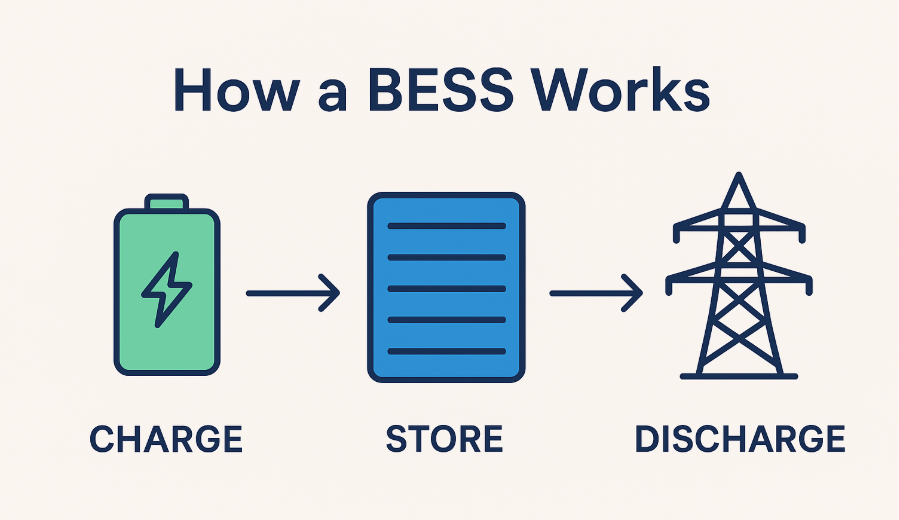
How a BESS Works
At its core, a Battery Energy Storage System follows a simple cycle:
Charging: Batteries store electricity from the grid or renewable sources.
Storing: Energy is held until needed, minimizing waste and improving flexibility.
Discharging: Electricity is released back into the grid or to power facilities.
A Power Conversion System (PCS), sometimes called an inverter, manages the conversion between direct current (DC) stored in batteries and alternating current (AC) used by the grid. This ensures seamless operation across charging and discharging cycles.
👉 Unlike traditional inverters, a Power Conversion System (PCS) in a Battery Energy storage System is designed to handle bidirectional power flow. Learn more in our guide on PCS vs Inverter for Energy Storage Systems.
Types of Batteries Used in BESS
Not all Battery Energy Storage Systems use the same battery chemistry. Each type has unique strengths and weaknesses that determine its suitability for different applications.
Lithium Iron Phosphate (LFP)
High safety and thermal stability
Long cycle life (6,000+ cycles)
Slightly lower energy density but excellent for C&I BESS and grid-scale storage
Nickel Manganese Cobalt (NMC)
Higher energy density (more power per unit weight)
Compact design makes it ideal for space-constrained projects
Shorter lifespan compared to LFP, but widely used in EVs and portable storage
Lead-Acid Batteries
Proven and cost-effective technology with decades of use
Suitable for low-power backup applications
Limited cycle life and lower efficiency compared to lithium-based chemistries
Still used in telecom, UPS, and small-scale storage systems
Emerging technology using a semi-liquid electrolyte.
Offers higher energy density with potential for lower costs.
Promising for next-generation grid and industrial storage, though still early-stage.
Comparison Table: LFP vs NMC vs Lead-Acid vs Semi-Solid
Feature
LFP BESS
NMC BESS
Lead-Acid
Semi-Solid
Safety
Excellent
Good
Medium
Good
Energy Density
Medium
High
Low
High
Lifespan
Long
Medium
Short
TBD
Cost
Medium
Higher
Low
Potentially Low
Low Voltage vs. High Voltage Energy Storage Systems
BESS can be designed as Low Voltage (LV) or High Voltage (HV) systems, depending on their intended application.
Low Voltage BESS (48V–150V):
Commonly used in residential storage and small-scale backup
Safer handling and simpler installation
Ideal for homes, small businesses, and telecom towers
High Voltage BESS (150V–1500V):
Standard for C&I and grid-scale projects
Higher efficiency and reduced energy losses
Better suited for large-scale renewable integration and industrial applications
👉 Businesses typically opt for High Voltage BESS due to better performance and scalability.
AC-Coupled vs. DC-Coupled BESS
How a Battery Energy Storage System connects to renewable energy or the grid also matters:
AC-Coupled Battery Energy Storage Systems:
Batteries connect through an inverter on the AC side.
Easy to retrofit with existing solar PV or wind systems.
Slightly lower efficiency due to multiple power conversions.
DC-Coupled Battery Energy Storage Systems:
Batteries connect directly to the DC bus of solar PV before the inverter.
Higher efficiency since fewer conversions are needed.
Ideal for new solar + storage projects, but less flexible for retrofits.
👉 For a deep dive into choosing the right architecture for your project, read our full breakdown of AC-Coupled vs. DC-Coupled BESS.
Key Applications of BESS
A Battery Energy Storage System is more than a battery bank. It’s a versatile solution for multiple applications:
1. Peak Shaving
BESS reduces electricity costs by supplying stored power during periods of high demand, lowering peak demand charges.
2. Load Shifting
Businesses can store electricity during off-peak hours when energy is cheap and use it during peak hours, improving cost efficiency.
3. Backup & Resilience
BESS provides emergency backup during power outages, keeping critical systems running.
👉 Note: While they sound similar, these two tactics serve different financial goals. Learn how to combine them in our complete guide on Peak Shaving vs Load Shifting.
4. Energy Arbitrage
A Battery Energy Storage System buys electricity when prices are low, stores it, and sells it back to the grid when prices are higher — generating direct revenue. Read more about maximizing ROI through energy arbitrage battery storage strategies.
5. Demand Response
Battery Energy Storage System participates in demand response programs, supporting grid stability and earning incentives.
United States: Incentives under the Inflation Reduction Act (IRA) and FERC’s evolving rules encourage large-scale Battery Energy Storage System deployment.
Asia-Pacific: Countries like Japan and China are investing heavily in gigawatt-scale storage to stabilize renewable-heavy grids.
Case Studies: Real-World Battery Energy Storage System in Action
Commercial Example: A 1 MW/2 MWh Battery Energy Storage System installed in a factory reduced electricity bills by 25% through peak shaving and load shifting.
Grid-Scale Example: Japan’s planned 8.1 GWh Battery Energy Storage System projects aim to balance renewable fluctuations and enhance national grid stability.
Renewable Integration Example: U.S. utilities are pairing solar farms with BESS to provide round-the-clock clean energy.
👉 While commercial and industrial projects benefit from smaller installations, grid-scale Battery Energy Storage System are becoming essential for balancing national energy systems. Explore more in our article on Grid-Scale Battery Energy Storage Systems.
BESS vs ESS: What’s the Difference?
While all BESS are ESS (Energy Storage Systems), not all ESS are Battery Energy Storage System. ESS can also use technologies like pumped hydro, compressed air, or flywheels. BESS specifically refers to battery-based systems, which are currently the fastest-growing segment thanks to cost declines and scalability.
👉 Not all energy storage systems are battery-based. To understand the broader landscape, read our breakdown of the Difference Between BESS and ESS.
FAQs About Battery Energy Storage System
What does BESS stand for?
BESS stands for Battery Energy Storage System — a system that stores electricity in rechargeable batteries so it can be used later, when demand is high or renewable generation is low.
What is BESS in simple terms?
Think of a BESS as a rechargeable battery bank for the grid or a building. It charges when power is cheap or abundant, then releases that stored power when it’s needed or expensive.
What’s the lifespan of a BESS?
Most commercial Battery Energy Storage System last 10–15 years, depending on usage cycles and chemistry.
Is Battery Energy Storage System safe?
Yes, with proper design and certifications (UL, IEC), modern Battery Energy Storage Systems are highly safe and reliable.
What’s the ROI for businesses investing in Battery Energy Storage System?
Typical payback periods range from 3–7 years, depending on local energy costs, incentives, and application strategies.
Conclusion: Why Invest in BESS Now
A Battery Energy Storage System is more than just backup power. It’s a revenue-generating, cost-saving, and grid-stabilizing technology that supports the global shift toward renewable energy.
For businesses, Battery Energy Storage System offers energy independence and resilience. For utilities, it ensures grid reliability. And for society, it accelerates the clean energy transition.
BESS is no longer optional — it’s essential to how modern grids and businesses manage energy.
Ready to Get Started?
Want to explore how a Battery Energy Storage System can benefit your business or project?
👉 Contact SunLith Energy today for tailored solutions in C&I BESS, grid-scale storage, and renewable integration.
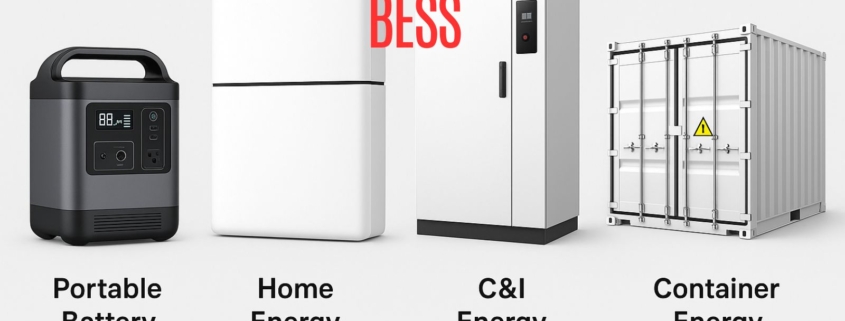
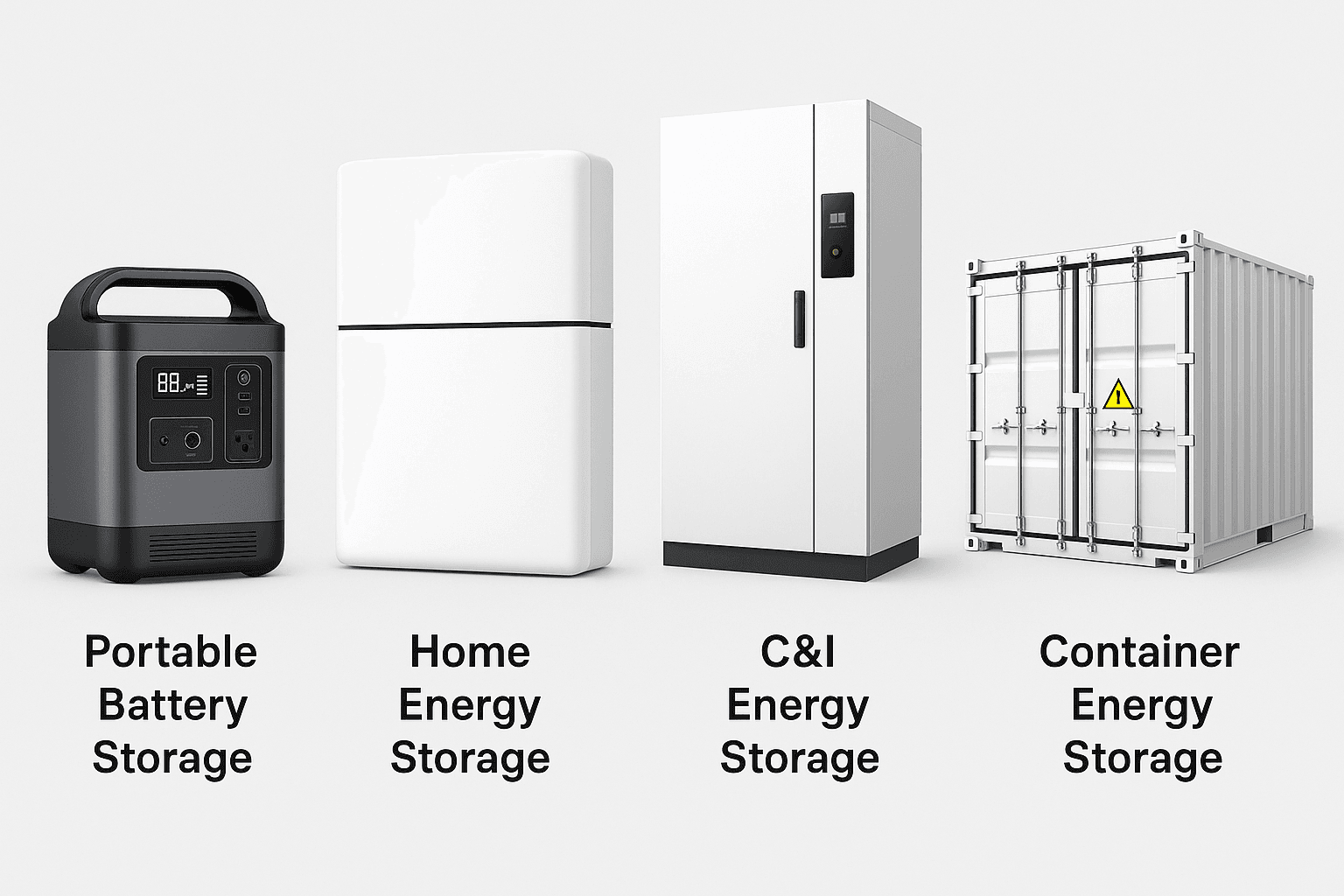
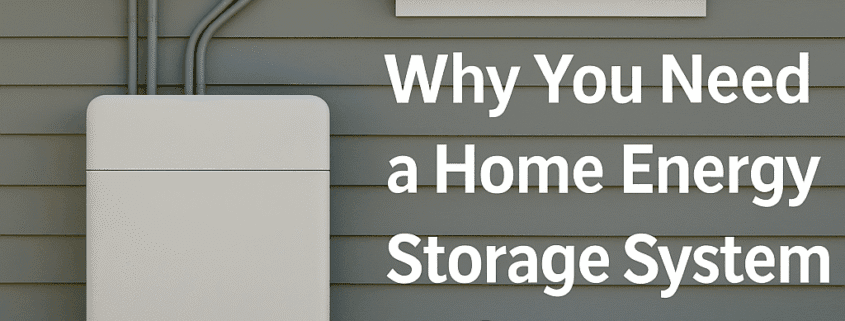
A home energy storage system is a device that stores electricity in a battery. You can use this energy later when needed—during blackouts, at night, or when electricity prices are high.
It can charge using power from:
The electric grid
Solar panels on your roof
Or both
Think of it like a big power bank for your entire home.
⚡ Why Is It So Important?
Energy is something we all need every single day. But with rising power costs and more frequent power cuts, a home energy storage system gives you more control and peace of mind.
Here are the biggest reasons to get one:
1. Save Money on Your Power Bills
You can charge your battery when electricity is cheap (like at night) and use it when prices are high (during the day). If you use solar panels, the savings are even bigger.
Save up to 50–70% on monthly electricity bills
2. Stay Powered During Blackouts
No one likes to be in the dark. With a home energy storage system, your lights, fridge, Wi-Fi, and other important things will keep running even if the grid goes down.
Enjoy peace of mind, no matter what happens outside
3. Use More of Your Solar Power
Without a battery, extra solar energy goes back to the grid. But with storage, you keep that energy and use it later, even at night.
☀️ Make the most of your solar investment
4. Help the Planet
Using more solar energy and less fossil fuel power helps reduce pollution and fight climate change.
Every stored watt is a step toward a greener world
How Does a Home Energy Storage System Work?
It’s easier than it sounds:
Charge the Battery – During the day from solar panels or the grid.
Store the Power – The battery keeps the power safe and ready.
Use the Power Later – At night, during outages, or when electricity prices go up.
The system runs automatically. Most also come with a smart app so you can check power use from your phone.
Who Should Get a Home Energy Storage System?
Homes with solar panels
Families in areas with power cuts
People who want to lower their electricity bills
Anyone who cares about using clean energy
If you use electricity, this system can benefit you.
What Size of Home Energy Storage System Do You Need?
Here’s a simple chart to help you choose:
Battery Size
What It Powers
Backup Time
5 kWh
Lights, fans, fridge
6–8 hours
10 kWh
Most home devices
12–16 hours
15+ kWh
Whole house
24+ hours
Tip: You don’t always need to power your whole house—just the important things like lights, internet, and kitchen appliances.
What Are the Best Battery Types?
The two most common types are:
Lithium Iron Phosphate (LFP)
Long life
Safe and stable
Great for homes
Lithium NMC
High energy in smaller size
Slightly more expensive
Most modern systems use LFP batteries for home energy storage.
✅ What to Look For When Buying AHome Energy Storage System
Many countries are offering subsidies or tax rebates to promote clean energy. You may be eligible to get money back when you buy a system.
Examples:
USA – Up to 30% tax credit
Europe – Grants and rebates for solar + storage
China & India – Policies to support solar homes
Check with your local energy provider or government for offers
What People Say
“We used to get power cuts almost every day. Since installing a 10kWh battery, we hardly notice outages anymore.” – Amit, Delhi
“I combined my solar panels with a storage system, and now my monthly bill is almost zero!” – Lisa, California
Why You Should Act Now
Energy prices are going up. Weather events are more extreme. Blackouts are happening more often. The sooner you install a home energy storage system, the sooner you gain control.
✅ No more high bills ✅ No more blackout worries ✅ No more waste of solar energy
Steps to Get Started
Check your electricity use
Decide if you want solar too
Get a quote from a trusted installer
Pick a battery size that fits your needs
Enjoy safe, smart, and clean energy at home
Final Thoughts
A home energy storage system is more than just a battery. It’s a way to protect your home, save your money, and help the environment.
Don’t wait for the next power cut. Start your energy journey today.
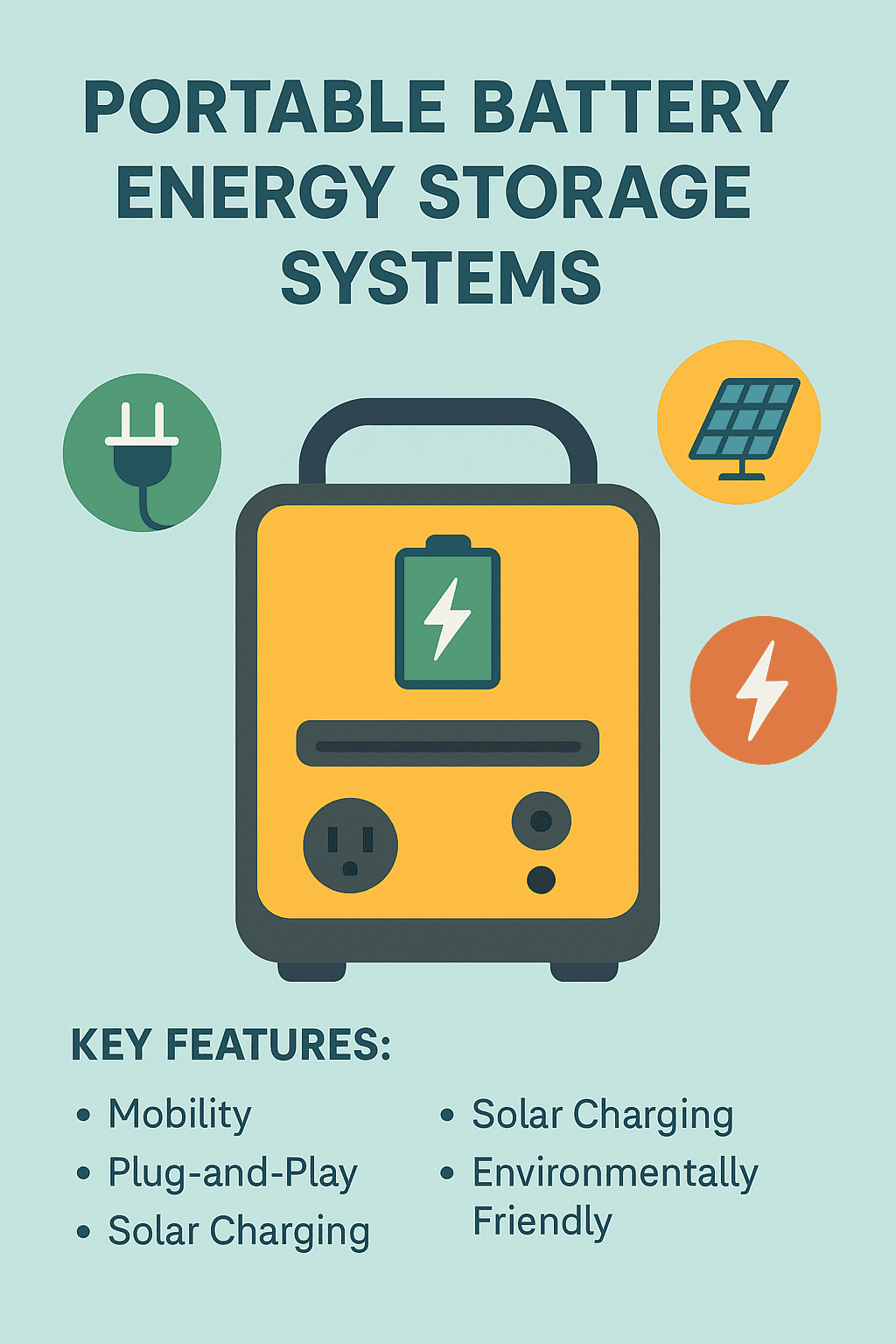
A Portable Battery Energy Storage System is a mobile energy unit that stores electricity—often sourced from the grid or renewable sources like solar panels—and delivers it when needed. Unlike fixed installations, these systems are lightweight, easy to transport, and designed for quick deployment in homes, outdoor sites, emergency zones, and small businesses.
Key Features of Portable Battery Energy Storage Systems
• Mobility: Lightweight and compact designs for easy transport
• Plug-and-Play: Simple operation with USB, AC, and DC outputs
• Solar Charging: Many models support solar input for off-grid use
• Smart Management: Equipped with BMS (Battery Management System) for safety and efficiency
• Environmentally Friendly: No emissions, noise, or fuel needed
Why Portable Energy Storage is Gaining Traction
1. Emergency Preparedness: Power outages are becoming more frequent. A portable unit ensures your essentials stay running.
2. Outdoor Adventures: From camping to off-grid travel, PBESS provides energy independence.
3. Worksite Flexibility: Ideal for temporary job sites and mobile operations.
4. Eco-Conscious Living: Reduces reliance on fossil fuels and promotes renewable energy use.
Types of Portable Battery Energy Storage Systems
1. Personal/Consumer-Grade Units (100Wh – 2000Wh): Compact power stations for phones, laptops, drones, and small appliances.
Examples: EcoFlow River, Jackery Explorer, Anker PowerHouse
2. Mid-Capacity Systems (2kWh – 5kWh): Power for refrigerators, medical devices, TVs.
4. Solar Generator Kits: Bundles of battery units and foldable solar panels.
Applications of Portable Energy Storage Systems
• Residential Backup: Keep essentials running during blackouts
• Outdoor Use: Campers, RVs, boaters
• Construction & Industrial Sites: Power tools and devices
• Emergency & Relief Operations: Communication, lights, medical gear
• Events & Exhibitions: AV equipment, lighting
How to Choose the Right PBESS
• Capacity (Wh or kWh): Estimate your daily power need
• Output Ports: Check for AC, USB, DC, inverter types
• Recharge Options: Grid, solar, car, generator
• Cycle Life: 2000+ cycles preferred
• Weight & Portability: Match your mobility needs
• Safety Certifications: UL, CE, UN38.3
Future of Portable Energy Storage
LFP and semi-solid battery technologies are improving safety, lifespan, and efficiency. App-enabled units offer diagnostics and control from mobile devices.
Final Thoughts
Portable Battery Energy Storage Systems are no longer a luxury—they’re fast becoming a necessity in our power-hungry, unpredictable world. Whether you’re braving the outdoors, preparing for emergencies, or reducing your carbon footprint, these systems give you control over your energy needs.
Looking to explore high-quality portable BESS units for personal or business use? Contact us today for expert consultation and sourcing support tailored to your needs.
Comprehensive compliance requires mastering the standard Batteries Regulation (EU 2023/1542) framework. This legislation officially came into force in August 2023, replacing the old Battery Directive 2006/66/EC across all EU member states. It sets binding rules on carbon footprint, recycling targets, battery passports, and producer responsibility — with deadlines running from 2024 through to 2031. If you sell batteries or BESS into the EU market, this regulation applies to you directly.
1. Scope and Timeline of EU Batteries Regulation (EU 2023/1542)
This regulation applies to almost all types of batteries, including:
Portable batteries in electronics and appliances
Industrial batteries used in storage systems
Automotive batteries
Electric vehicle (EV) batteries
Light means of transport (LMT) batteries, such as e-bikes and e-scooters
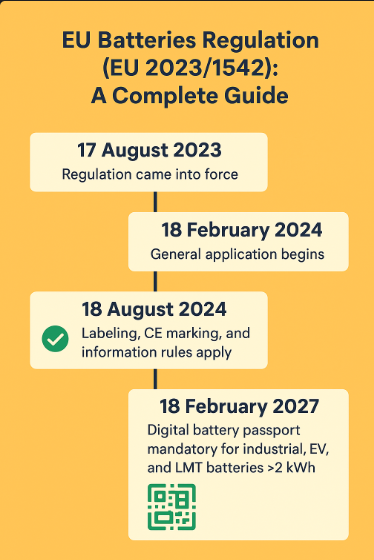
Key deadlines to note:
17 August 2023 – Regulation entered into force
18 February 2024 – General rules started to apply
18 August 2024 – Labeling, CE marking, and consumer information requirements
18 August 2025 – Waste battery management obligations
Click on any deadline phase below to view mandatory requirements for manufacturers, importers, and BESS operators.
February 2027: Digital Battery Passport & Repair Rules
Digital Battery Passport: Becomes strictly mandatory for all EV, LMT, and industrial batteries above 2 kWh. Must be accessible via an external QR code.
Right to Repair: Portable appliance batteries must be easily removable and replaceable by consumers or independent technicians.
Collection Targets: 63% collection efficiency path must be achieved for standard portable battery variants.
Applies to EV, LMT, and industrial batteries above 2 kWh
Accessible via QR code
Contains data on raw materials, lifecycle, recycling, and performance
This tool will increase traceability, reuse, and recycling efficiency.
d) EPR Rules in the EU Batteries Regulation
Producers must take back used batteries and ensure proper recycling.
Collection targets: 63% for portable batteries by 2027, rising further by 2030
Recycling efficiency goals:
Lithium: 50% by 2027, 80% by 2031
Cobalt, nickel, copper, lead: 90% by 2027, 95% by 2031
e) Removability & Repair Obligations
By 2027, portable device batteries must be easily removable by consumers.
LMT batteries must be replaceable by independent professionals. This ensures longer product lifespans and supports the right to repair movement.
f) Supply Chain Due Diligence
Battery manufacturers must assess and address environmental and social risks, especially concerning critical raw materials like lithium, cobalt, and nickel.
g) Enforcement & Penalties
EU member states must set effective and dissuasive penalties for non-compliance by 2025. Companies failing to meet obligations risk heavy fines and restricted market access.
4. Why the EU Batteries Regulation Matters
The EU Batteries Regulation 2023/1542 is a turning point for the industry:
The EU Batteries Regulation (EU 2023/1542) is more than just another piece of legislation. It sets the foundation for a sustainable battery market, from design and labeling to recycling and reuse. For businesses, early compliance is not optional—it’s the only way to remain competitive in Europe’s fast-changing energy landscape.
Frequently Asked Questions
Q1: What is EU 2023/1542?
EU 2023/1542 is the EU Batteries Regulation adopted in July 2023. It replaces the Battery Directive 2006/66/EC and sets binding rules on battery design, carbon footprint, labelling, recycling targets, and the digital battery passport. It applies directly across all EU member states without requiring national legislation.
Q2: Who does EU 2023/1542 apply to?
EU 2023/1542 applies to any manufacturer, importer, or distributor placing batteries on the EU market. This includes portable batteries, industrial batteries, EV batteries, LMT batteries such as e-bikes, and BESS above 2 kWh. If you sell into the EU market, the regulation applies to you regardless of where you are based.
Q3: What are the key deadlines under EU 2023/1542?
The main compliance deadlines are: August 2023 — regulation entered into force; February 2024 — general rules apply; August 2024 — CE marking and labelling requirements; August 2025 — waste battery management obligations; February 2027 — digital battery passport mandatory for industrial, EV, and LMT batteries above 2 kWh.
Q4: What is the digital battery passport under EU 2023/1542?
The digital battery passport is a QR-code accessible record that must accompany industrial, EV, and LMT batteries above 2 kWh from February 2027. It contains data on raw materials, carbon footprint, lifecycle performance, and recycling information. It is designed to improve traceability, support reuse, and increase recycling efficiency across the supply chain.
The battery management system is the primary data source for the passport — it logs SOH, cycle count, and temperature history throughout the battery’s life
Q5: What are the recycling targets under EU 2023/1542?
The regulation sets material-specific recycling efficiency targets. For lithium, the target is 50% recovery by 2027 rising to 80% by 2031. For cobalt, nickel, copper, and lead, the target is 90% by 2027 rising to 95% by 2031. Producers are also required to meet portable battery collection targets of 63% by 2027.
Q6: What happens if a company does not comply with EU 2023/1542?
Non-compliant companies face penalties set by individual EU member states, which must be effective and dissuasive under the regulation. Consequences include heavy fines and restricted access to the EU market. Member states were required to establish their penalty frameworks by 2025.
Fossil fuels have powered the modern world for over a century. From lighting our homes to fueling our vehicles and running industries, fossil fuels have been at the heart of global energy consumption. But what exactly are fossil fuels? How do they work, and why is there a growing movement to move away from them?
This blog post explores what fossil fuels are, their types, uses, and the environmental impact they bring.
What Are Fossil Fuels?
Fossil fuels are natural energy sources formed from the decomposed remains of ancient plants and animals. Over millions of years, heat and pressure beneath the Earth’s surface transformed these organic materials into coal, oil, and natural gas.
Coal is a black or brownish-black sedimentary rock that is burned for electricity and heat. It is the most abundant fossil fuel and has been used for centuries to power industries and generate electricity.
Types of coal include:
Peat
Lignite (brown coal)
Bituminous coal
Anthracite (hard coal)
2. Crude Oil (Petroleum)
Oil is a liquid fossil fuel that is refined into various products like gasoline, diesel, jet fuel, and lubricants. It is found deep underground and extracted through drilling.
Common petroleum products include:
Petrol (Gasoline)
Diesel
Kerosene
LPG (Liquefied Petroleum Gas)
3. Natural Gas
Natural gas is a gaseous fossil fuel made primarily of methane. It is used for cooking, heating, and electricity generation and is considered cleaner than coal and oil.
Forms of natural gas:
Compressed Natural Gas (CNG)
Liquefied Natural Gas (LNG)
Common Uses of Fossil Fuels
Deeply integrated into daily life and the global economy.
1. Electricity Generation
Coal and natural gas are widely used in thermal power plants to generate electricity.
2. Transportation
Petrol, diesel, and jet fuel power cars, trucks, ships, and airplanes.
3. Heating and Cooking
Natural gas is commonly used for residential and commercial heating, as well as cooking.
4. Industrial Applications
Fossil fuels are used in manufacturing, chemical production, steelmaking, cement production, and more.
5. Petrochemicals
Many plastic products and synthetic materials are derived from petroleum.
Why Are Fossil Fuels Problematic?
Despite their usefulness, these fuels come with serious drawbacks, especially concerning the environment.
1. Air Pollution
Burning fossil fuels releases pollutants like sulfur dioxide (SO₂), nitrogen oxides (NOx), and particulate matter into the air. These pollutants cause respiratory illnesses, smog, and acid rain.
2. Greenhouse Gas Emissions
These fuels emit large amounts of carbon dioxide (CO₂), a greenhouse gas responsible for climate change and global warming.
3. Global Warming
Excessive use of these fuels has significantly increased global temperatures, causing rising sea levels, melting ice caps, and extreme weather.
4. Water Pollution
Oil spills and coal mining operations often pollute water bodies, affecting marine life and human health.
5. Non-Renewable Nature
They are finite. Once depleted, they cannot be replenished in a human timeframe.
Renewable sources are clean, sustainable, and infinite — making them a critical part of the future energy mix.
Fossil Fuels vs Renewable Energy
Feature
Fossil Fuels
Renewable Energy
Source
Finite (coal, oil, gas)
Infinite (sun, wind, etc.)
Emissions
High CO₂ and pollutants
Minimal or zero emissions
Environmental Impact
Severe
Low
Operating Cost
Increasing over time
Decreasing with innovation
Sustainability
Not sustainable
Sustainable
Should We Stop Using Fossil Fuels Completely?
That’s not immediately possible. these fuels still provide over 70% of global energy. But a gradual reduction in their use, combined with increased investment in renewable energy, is the best path forward.
Governments, industries, and individuals all play a role in transitioning to cleaner alternatives.
FAQs About Fossil Fuels
❓ What is the main problem with fossil fuels?
They emit harmful gases that cause air pollution and climate change.
❓ Are fossil fuels renewable?
No, they are non-renewable and take millions of years to form.
❓ Can we live without fossil fuels?
Not right now, but with smart planning, technology, and investment in renewables, we can reduce our dependence over time.
❓ Which fossil fuel is the cleanest?
Natural gas is considered the cleanest fossil fuel, but it still emits CO₂.
❓ Why do we still use fossil fuels?
They are currently cheaper, widely available, and infrastructure for them already exists.
Final Thoughts
Fossil fuels helped build the modern world, but they also threaten its future. Understanding their role, benefits, and dangers is the first step toward building a cleaner, greener planet.