
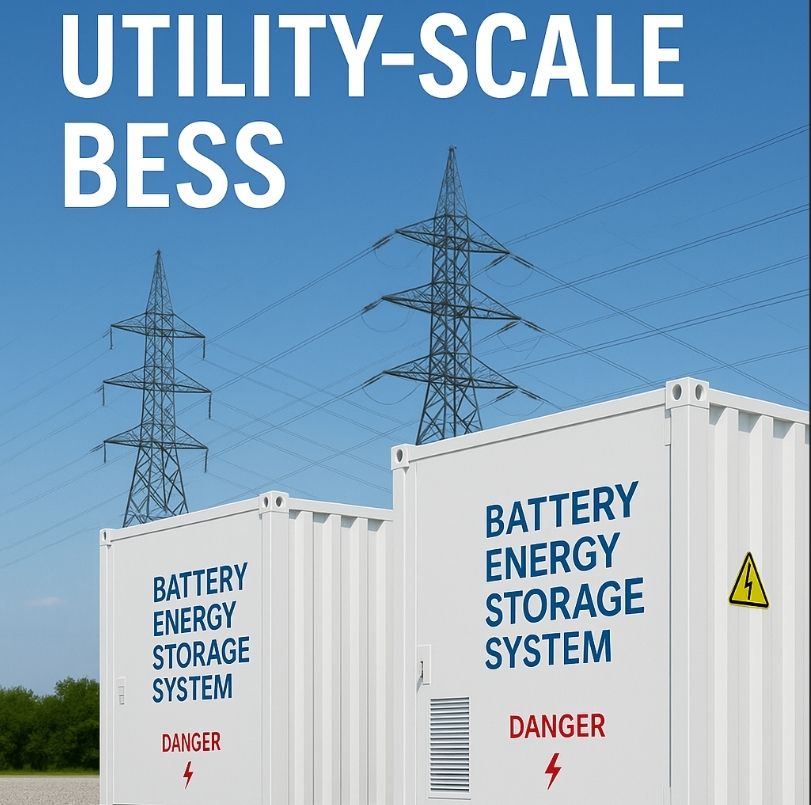
Understanding Utility-Scale BESS: The Backbone of a Resilient Energy Future
Utility-scale Battery Energy Storage Systems (BESS) are becoming an essential part of today’s power grids. As we use more renewable energy like solar and wind, grid operators have to deal with issues such as fluctuating supply and sudden peaks in demand. Utility-scale BESS solves these problems by storing extra electricity when there’s plenty of it and releasing it when it’s needed most. This makes our power supply more stable, efficient, and reliable for everyone.
What is Utility-Scale BESS?
Utility-scale BESS refers to large-scale battery storage installations typically rated in megawatts (MW) or gigawatts (GW). Unlike residential or commercial storage systems, these projects serve the grid directly and can deliver energy for hours or even days, depending on system design.
Key characteristics:
- Capacity ranges from tens of MW to several hundred MW.
- Located near generation sites or substations.
- Provide grid services like frequency response, voltage control, and peak shaving.
How Does a Utility-Scale BESS Work?
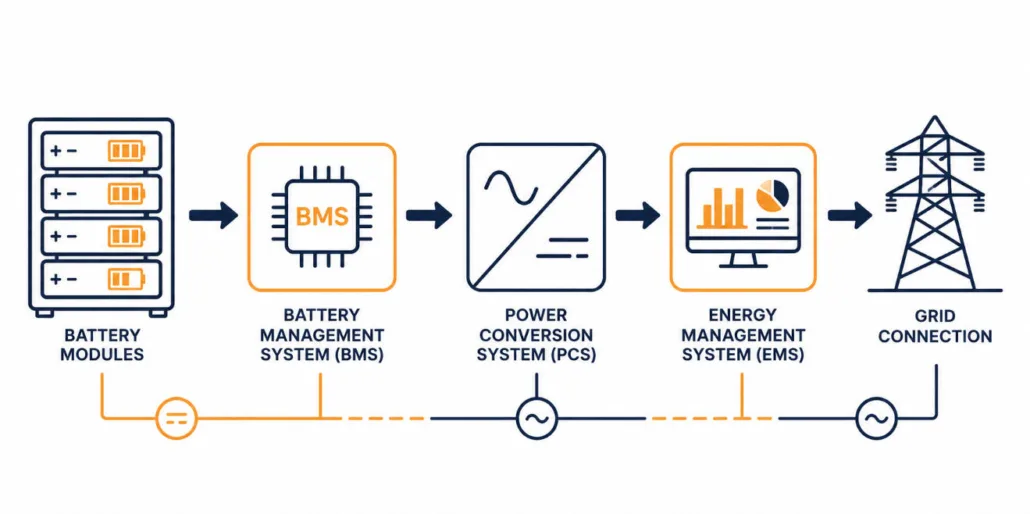
A utility-scale battery storage system typically consists of:
- Battery modules: Usually lithium-ion, but other chemistries like flow batteries or sodium-sulfur are emerging.
- Battery Management System (BMS): Monitors cell performance, state-of-charge, and safety.
- Power Conversion System (PCS): Converts DC from batteries to AC for the grid and vice versa.
- Energy Management System (EMS): Controls dispatch, optimization, and integration with other grid assets.
When generation exceeds demand (e.g., during midday solar peaks), the BESS stores excess energy. When demand surpasses generation (e.g., evening peak), the BESS discharges to stabilize the grid.
Key Benefits of Utility-Scale BESS
1. Grid Stability and Frequency Regulation
One of the primary benefits of utility-scale BESS is rapid response to frequency deviations. Unlike traditional peaker plants, batteries can react within milliseconds, maintaining grid balance.
2. Renewable Integration
Wind and solar are variable by nature. Utility-scale battery storage smooths out fluctuations, stores surplus during high production, and releases energy during lulls — helping achieve higher renewable penetration.
3. Peak Shaving and Load Shifting
BESS helps utilities defer costly grid upgrades by managing peak demand. It stores energy when electricity is cheap and abundant, then discharges when prices and demand are high.
4. Backup Power and Black Start Capabilities
Large battery storage systems can support critical infrastructure during outages and help restart a power grid after a blackout — known as “black start.”
Types of Utility-Scale BESS Technologies
| Technology | Features | Typical Use Cases |
|---|---|---|
| Lithium-Ion | High energy density, fast response | Frequency regulation, peak shaving |
| Flow Batteries | Long duration, scalable, deep cycling | Renewable firming, load shifting |
| Sodium-Sulfur | High temperature, long discharge duration | Base-load shifting, remote microgrids |
| Advanced Lead-Acid | Low cost, moderate performance | Short-term backup, frequency response |
Challenges Facing Utility-Scale BESS
While utility-scale BESS brings immense benefits, some challenges remain:
- High upfront capital costs: Though prices are falling, large installations require significant investment.
- Supply chain constraints: Dependence on critical minerals like lithium and cobalt can affect availability and cost.
- Degradation and lifespan: Batteries degrade over time, impacting performance and replacement cycles.
- Regulatory and market barriers: In some regions, market structures don’t fully value storage services yet.
Recent Trends and Global Outlook
According to industry reports, global utility-scale BESS installations are expected to grow exponentially. Markets like the US, China, Australia, and Europe lead the way with supportive policies and ambitious renewable energy targets.
Key trends include:
- Hybrid projects combining solar, wind, and storage.
- Longer-duration storage technologies (8+ hours).
- Second-life batteries and recycling solutions.
- Grid services monetization through virtual power plants (VPPs).
Case Study: Notable Utility-Scale BESS Projects
- Hornsdale Power Reserve (Australia): 150 MW/193.5 MWh — one of the world’s largest lithium-ion storage projects, providing frequency control and grid support.
- Crimson Energy Storage (California, USA): 350 MW/1,400 MWh — supports California’s push for 100% clean energy.
- UK National Grid Projects: Multiple installations delivering fast frequency response and capacity market services.
Environmental and Sustainability Considerations for Utility-Scale BESS
Raw Material Sourcing
Mining the raw materials inside a utility-scale BESS — lithium, nickel, and cobalt — carries documented ecological and social costs.
Responsible sourcing standards, including the EU’s due-diligence rules, help address some of these concerns. But the impact isn’t zero.
Manufacturers are shifting toward chemistries with fewer conflict minerals. Lithium iron phosphate, for example, skips cobalt entirely.
Second-Life Use and Recycling
Once a battery pack degrades below its usable capacity for grid duty, it doesn’t simply become waste.
Many installations enter a second-life phase first. They power smaller applications like commercial backup or residential storage before final retirement.
This extends the useful life of the materials by several years. It also delays the need for new mining.
Recycling technology is maturing quickly. Modern recovery processes can now reclaim over 90% of the critical minerals inside a spent battery.
That recovered material then feeds back into new cell production. This cuts demand for freshly mined resources over time.
Several major recycling facilities have opened in the US, Europe, and China since 2023. Capacity is scaling to handle the coming wave of retirements from early grid-storage deployments.
Carbon, Land, and Water Impact
The lifecycle math still favors large-scale storage overall. A typical installation offsets far more carbon over its operating life than its manufacturing footprint requires.
Every megawatt-hour it delivers to the grid displaces power that would otherwise come from fossil-fuel peaker plants. Over a 15-20 year lifespan, that adds up to a significant net emissions benefit.
Land use is a smaller, but real, consideration too. These projects need less physical footprint than equivalent solar or wind farms delivering the same capacity.
Siting near existing substations or brownfield sites further reduces the land impact. Many developers now prioritize these locations to minimize new land disturbance.
Water use is minimal compared to other grid technologies. Battery systems need cooling, but nowhere near the volume required by thermal power plants.
That makes large-scale storage a strong fit for water-stressed regions expanding renewable capacity.
Safety and Community Impact
Fire and thermal-runaway risk also factor into the environmental conversation.
Modern battery chemistries and containment designs cut incident rates significantly. Standards like NFPA 855 push this further.
Community and noise impact matter too. Modern inverter and cooling equipment runs far quieter than early-generation hardware.
Most projects now include acoustic buffers and setback distances from residential areas. This keeps neighboring communities largely unaffected by day-to-day operation.
Regulatory Outlook
Regulators are formalizing end-of-life requirements for utility-scale BESS too. The EU’s Batteries Regulation sets clear recycling targets.
Cobalt and nickel must hit 90% recovery by 2027, rising to 95% by 2031. Expect similar rules to spread as installed capacity grows worldwide.
Taken together, these factors paint a nuanced picture. Large-scale storage isn’t environmentally free.
But its net contribution to decarbonizing the grid still outweighs the footprint by a wide margin.
Future of Utility-Scale BESS: What’s Next?
As we aim for net-zero goals, the role of utility-scale BESS will only expand. The focus will shift toward:
- Integrating with renewable mega-projects.
- Supporting decarbonization of hard-to-abate sectors.
- Enabling community energy storage and distributed resources.
Policy support, continued cost reductions, and technological breakthroughs will be crucial to unlocking the full potential of grid-scale energy storage.
Final Thoughts
Utility-scale BESS is more than just a technological solution — it’s the backbone of a flexible, reliable, and low-carbon energy future. By bridging the gap between intermittent renewables and constant demand, these systems are paving the way for a resilient grid that works for everyone.
FAQs about Utility-Scale BESS
Q1: How long can a utility-scale BESS supply power?
Depending on the system’s energy capacity, it can range from minutes (for frequency response) to multiple hours (for peak shaving or load shifting).
Q2: Is lithium-ion the only option for utility-scale BESS?
No, while lithium-ion dominates the market today, flow batteries, sodium-sulfur, and other chemistries are gaining traction for longer-duration applications.
Q3: How is utility-scale BESS different from residential storage?
Utility-scale systems are grid assets providing large-scale services, while residential storage focuses on individual homes’ energy needs.
Q4: What’s the biggest challenge for utility-scale BESS?
High upfront costs and market barriers to monetizing all available services remain significant challenges.
Q5: How does utility-scale BESS support grid stability and frequency regulation?
Utility-scale BESS supports grid stability by detecting frequency deviations and responding within milliseconds, far faster than traditional peaker plants. The system injects or absorbs power almost instantly to keep grid frequency within a narrow target range, preventing outages and helping operators integrate more variable renewable generation without compromising reliability.
Q6: What is a utility-scale battery energy storage system and how does it work?
A utility-scale battery energy storage system is a large battery installation, typically rated in tens to hundreds of MW, that stores electricity from the grid or renewable sources and discharges it when needed. It charges during periods of excess supply and low demand, then releases stored power during peak demand or supply shortfalls.
Q7: What are the main components of a utility-scale BESS?
A utility-scale BESS has four main components: battery modules that store energy, a Battery Management System (BMS) that monitors cell health and safety, a Power Conversion System (PCS) that converts between DC and AC, and an Energy Management System (EMS) that controls dispatch and grid integration.
Are you exploring how utility-scale battery storage can transform your energy project? Let’s connect and discuss tailored solutions for your grid needs!




Trackbacks & Pingbacks
[…] For the full technical breakdown, see our guide to understanding utility-scale BESS. […]
[…] Utility-scale BESS systems managed by EMS provide daily frequency regulation […]
[…] makes VPPs the digital backbone of resilient […]
[…] For grid operators, EMS enables large BESS systems to stabilize frequency, support black start capability, and defer costly … […]
[…] Battery Management Systems (BMS): Advanced BMS units constantly monitor battery temperature and adjust charging currents accordingly. If the temperature is too low, the BMS will either prevent charging or significantly reduce the […]
[…] BESS works like a giant rechargeable battery for the grid. It stores extra power when demand is low or when there’s too much solar or wind power. Then, when demand spikes, BESS sends that stored power back into the grid. […]
[…] Black start capability (helping restart the grid after a blackout) […]
Leave a Reply
Want to join the discussion?Feel free to contribute!