
AC-Coupled vs DC-Coupled BESS: Which Architecture Is Right for Your Project?
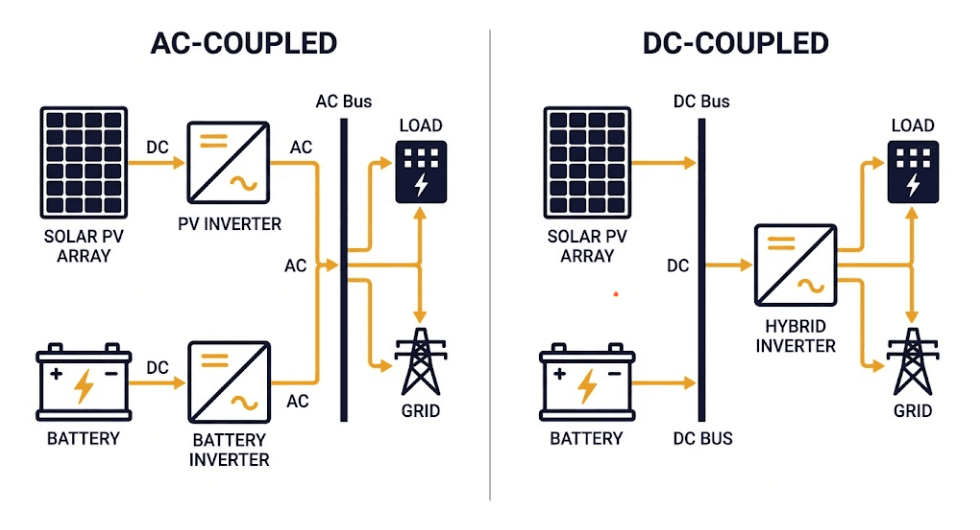
AC-coupled vs DC-coupled BESS is one of the first choices you’ll face in any solar-plus-storage project. This one decision shapes your system’s efficiency, cost, and how easily you can expand it later. Both architectures store solar energy in a battery for later use. But they connect the battery in different places relative to the inverter, and that single design choice ripples through nearly every other spec on the system. This guide walks through the differences so you can pick the right fit.
What Is AC-Coupled BESS?
An AC-coupled BESS connects the battery to the grid through its own dedicated inverter. This component sits separate from the solar PV inverter. Power from PV and power from the battery meet on the AC side of the system rather than sharing a DC bus. This makes AC-coupled storage the more common choice when you’re adding a battery to solar you already have running. For the full breakdown of components and operation, see What is AC Coupled BESS?.
What Is DC-Coupled BESS?
A DC-coupled BESS connects the battery and the solar PV array on the same DC bus, ahead of a single shared inverter. Because both share one conversion path, DC-coupled systems typically post better round-trip efficiency and lower equipment costs, at the expense of retrofit flexibility. For the full architecture and step-by-step operation, see What is DC Coupled BESS?.
AC-Coupled vs DC-Coupled BESS: Side-by-Side Comparison
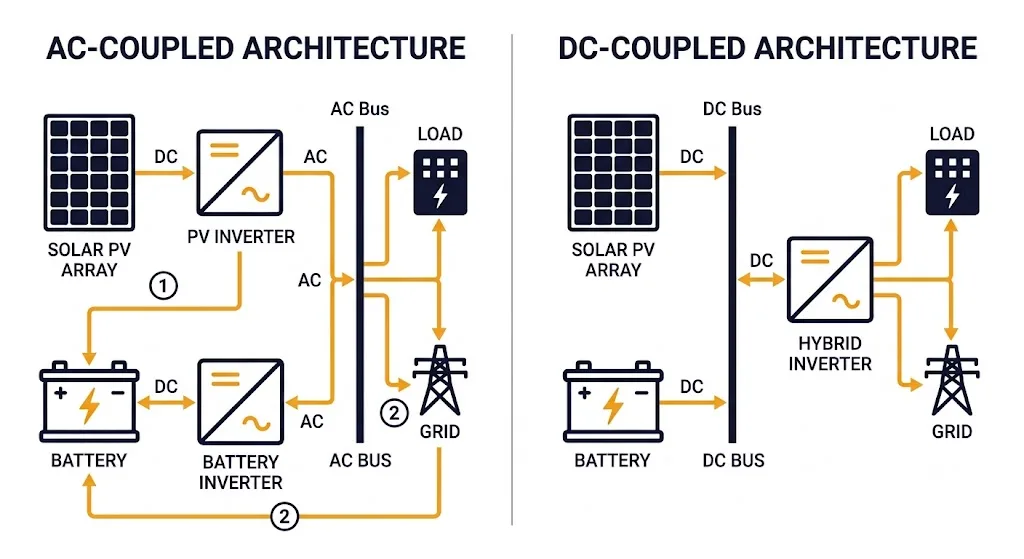
Here’s the AC-coupled vs. DC-coupled BESS comparison at a glance — the factors that matter most when you design a solar-plus-storage system:
| Factor | AC-Coupled BESS | DC-Coupled BESS |
| Connection point | Battery connects via its own inverter on the AC side | Battery and PV share one DC bus, ahead of a single inverter |
| Inverters required | Two — one for PV, one for battery | One shared hybrid inverter |
| Conversion stages | Multiple DC-AC-DC conversions on some charge paths | Single DC-to-AC conversion for grid/load power |
| Round-trip efficiency | Lower — extra conversion stages add losses | Higher — fewer conversion losses |
| Balance-of-system cost | Lower than standalone, but higher than DC-coupled (separate inverters, switchgear) | Lowest of the three — shared inverter and BOS hardware |
| Best for | Retrofitting storage onto existing solar | New-build, greenfield solar-plus-storage projects |
| Solar charging during outage | Depends on inverter design; may need extra hardware | Typically yes, in most configurations |
| Curtailment / clipping capture | Limited — PV inverter still governs PV output | Can capture otherwise-clipped PV energy behind a higher-ILR array |
| Grid response speed | Slower — control system coordinates multiple inverters | Faster — single inverter, more direct control path |
| Future expansion | Easier — PV and storage can be sized/upgraded independently | Harder — added battery capacity must match existing DC bus voltage |
No single architecture wins on every factor. The right choice depends on your project type and how much you weigh upfront cost against long-term efficiency.
AC-Coupled vs DC-Coupled BESS: Efficiency Compared
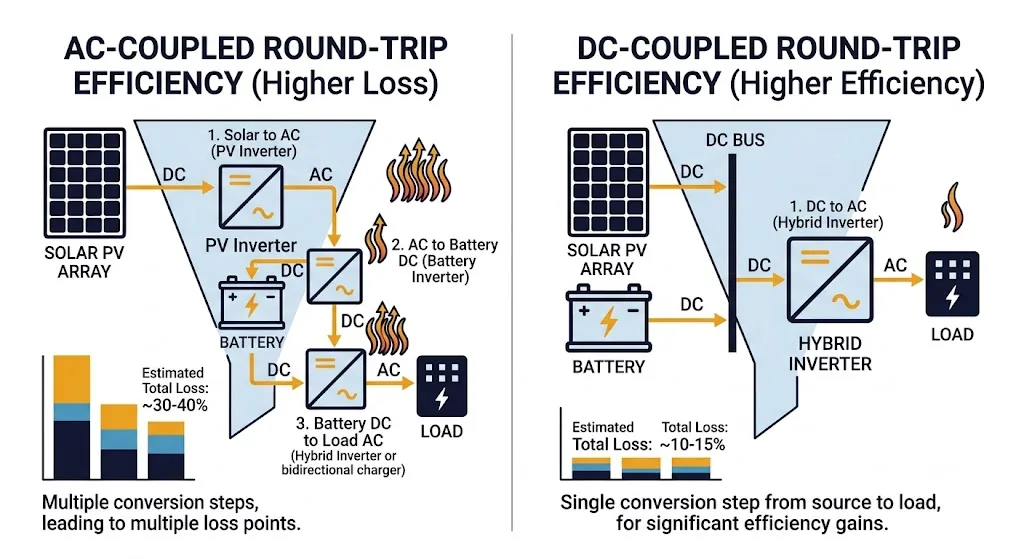
Every DC-to-AC conversion wastes some energy as heat. An AC-coupled system can convert PV energy to AC, then back to DC to charge the battery, then to AC again when you use it. That’s up to three conversion stages on some charge paths.
A DC-coupled system skips most of that. It charges the battery straight from the DC bus and converts to AC only once, when you actually need AC power. This is the core reason DC-coupled architectures tend to post higher round-trip efficiency in side-by-side testing.
We break down the exact numbers in AC vs DC Round Trip Efficiency in Battery Energy Storage Systems, and show you how to calculate round-trip efficiency for your own project in our BESS Round Trip Efficiency guide.
AC-Coupled vs DC-Coupled BESS: Cost Compared
Both architectures cost less than siting solar and storage separately. DC-coupled systems generally cost less than AC-coupled ones on new-build projects, too.
The U.S. Department of Energy’s Solar-Plus-Storage 101 resource confirms this pattern: co-locating PV and storage on the same site cuts system cost compared to siting them separately, whether you choose AC-coupled or DC-coupled. Most of the savings come from shared balance-of-plant infrastructure.
DC-coupled designs push those savings further. They eliminate a full second inverter and its switchgear. That said, retrofit constraints can narrow this advantage — if AC-coupling is your only practical option, the smaller cost gap may not matter much.
Retrofit vs. Greenfield: Matching Architecture to Project Stage
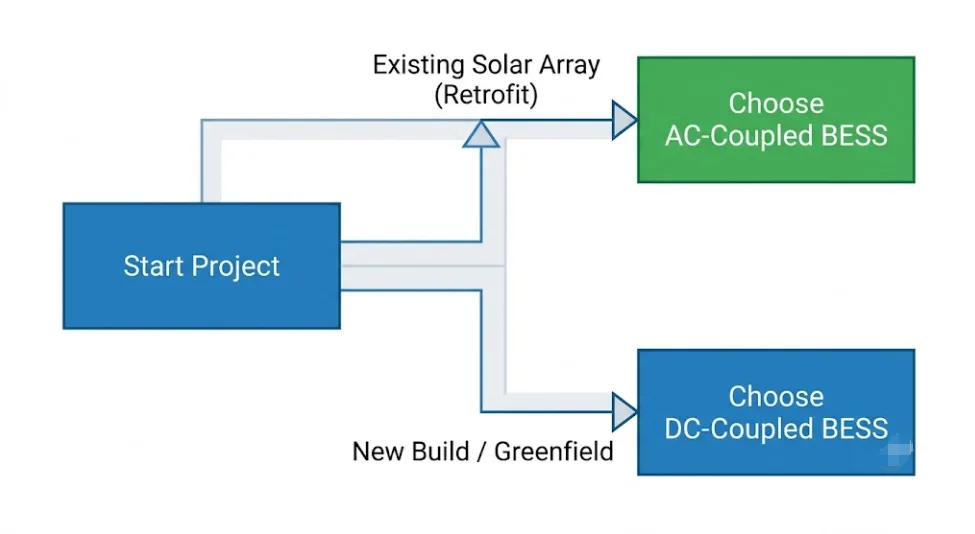
Project stage often decides the outcome before cost or efficiency even enter the conversation.
If you already run solar, adding a DC-coupled battery means tying into the existing DC bus and matching its voltage. That’s technically possible, but it usually means replacing or reconfiguring your existing inverter. AC-coupled storage sidesteps that problem entirely — the battery gets its own inverter and connects on the AC side, so your existing solar installation stays untouched.
New-build, greenfield projects don’t face that constraint, since you design PV and storage together from day one. That’s why DC-coupled architectures dominate new utility-scale and C&I builds. In the end, this AC-coupled vs. DC-coupled BESS decision usually comes down to one question: are you retrofitting, or building new?
When to Choose AC-Coupled BESS
- Adding storage to solar you already have running
- Projects where you need to size, optimize, or replace PV and battery independently
- Sites where minimizing changes to existing PV wiring and permits matters
- Phased projects that add storage well after the solar installation
- Systems needing simpler expansion of storage capacity over time
When to Choose DC-Coupled BESS
- New solar-plus-storage builds where you design PV and storage together from the start
- Utility-scale and C&I projects prioritizing round-trip efficiency
- Microgrid and off-grid systems needing solar charging during outages
- High inverter-loading-ratio PV arrays looking to capture otherwise-clipped energy
- Projects where minimizing equipment count and balance-of-system cost is a priority
AC-Coupled vs DC-Coupled BESS: Trade-offs to Weigh
Efficiency and cost aren’t the only variables to weigh.
DC-coupled systems can be harder to expand later. Additional battery capacity generally needs to match the voltage of your existing DC bus. The tighter integration between PV and storage also means a fault on one side can affect the other.
AC-coupled systems avoid that coupling risk and expand more easily. You pay for that flexibility with two inverters, two sets of switchgear, and a somewhat slower response to fast grid commands like frequency regulation, since the control system has to coordinate multiple inverters instead of one.
Weigh these trade-offs against your project’s timeline, budget, and growth plans. That usually beats picking the ‘better’ architecture in the abstract.
Can You Combine AC-Coupled and DC-Coupled BESS?
Some projects don’t have to choose only one. A hybrid architecture can pair DC-coupled storage on a new PV block with an existing AC-coupled asset elsewhere on-site. Or it can phase in DC-coupled storage over multiple project stages. You’ll see this more often on larger utility-scale sites with modular BESS designs. For a broader look at how AC-coupled, DC-coupled, modular, and hybrid designs fit together, see our guide to Understanding Energy Storage System BESS Architectures.
Frequently Asked Questions
Here are quick answers to the AC-coupled vs DC-coupled BESS questions we hear most often:
What is the main difference between AC-coupled and DC-coupled BESS?
AC-coupled systems use two separate inverters — one for solar PV and one for the battery. DC-coupled systems share a single inverter. PV and battery connect to the same DC bus before the system converts power to AC.
Which is more efficient, AC-coupled or DC-coupled BESS?
DC-coupled BESS is generally more efficient because energy converts from DC to AC only once. AC-coupled systems often involve extra conversion stages, especially when charging the battery from solar, and that raises round-trip losses.
Is AC-coupled or DC-coupled BESS cheaper?
DC-coupled systems typically cost less on the balance-of-system side, since they need only one inverter and one set of switchgear. AC-coupled systems cost more upfront, but you can add them incrementally, which sometimes offsets the gap on retrofit projects.
Can I add a DC-coupled battery to an existing solar system?
You can, but it’s more complex than AC-coupling. The battery must connect to the existing DC bus and match its voltage. For most retrofits, AC-coupled storage is the simpler, more common approach.
Does DC-coupled BESS work off-grid?
Yes. DC-coupled architectures generally support off-grid and islanded operation. They can keep charging from solar during a grid outage, which makes them a common choice for microgrid and remote projects.
Why do DC-coupled systems capture more solar energy?
In a DC-coupled system, the battery can charge directly from PV output that would otherwise get clipped when the inverter loading ratio exceeds 1. That’s because the battery sits on the DC side, before the inverter’s AC output limit applies.
Is there a hybrid option that combines AC and DC coupling?
Yes. Some larger projects use a hybrid architecture that pairs DC-coupled storage with an existing AC-coupled asset, or phases DC-coupled storage in over time. You’ll see this more often on utility-scale sites with modular BESS designs.
AC-Coupled vs DC-Coupled BESS: Final Verdict
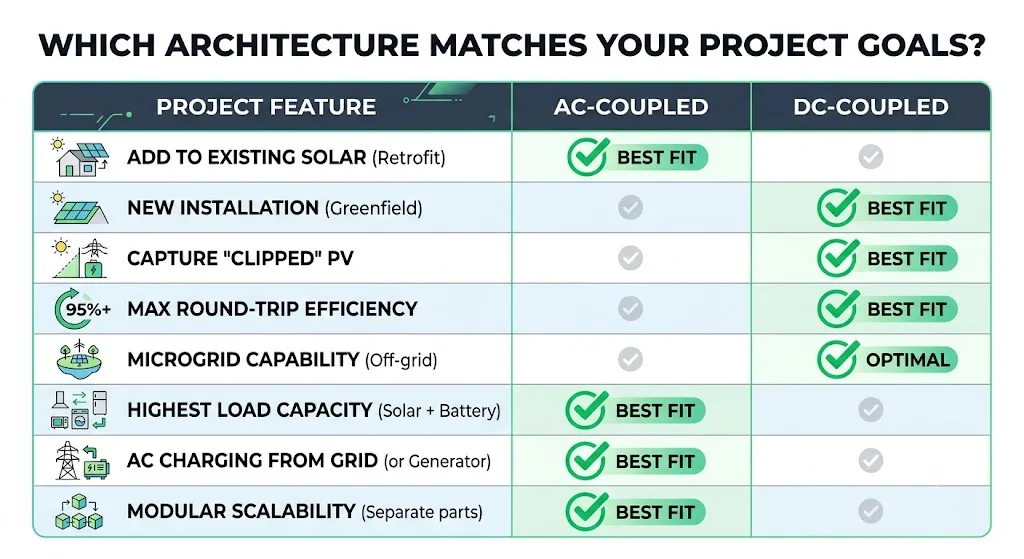
AC-coupled and DC-coupled BESS both store solar energy for later use, but they get there differently. That difference shows up in efficiency, cost, and how easily the system grows over time.
AC-coupled storage stays the more flexible choice for retrofits and phased projects. DC-coupled architectures tend to win on efficiency and cost for new-build solar-plus-storage systems. The right call comes down to where your project starts, not which architecture is objectively ‘better’.
Whichever direction fits your project, the Sunlith Energy team can help size and specify the right BESS architecture, PCS, and battery configuration for your site.






Trackbacks & Pingbacks
[…] 👉 For a deep dive into choosing the right architecture for your project, read our full breakdown of AC-Coupled vs. DC-Coupled BESS. […]
[…] the full comparison, see AC-Coupled vs. DC-Coupled BESS: Which Architecture Is Right for Your Project?, or go deeper on either architecture individually: What is DC-Coupled BESS? and What is AC-Coupled […]
[…] For a full side-by-side comparison against AC-coupled battery storage, see AC-Coupled vs. DC-Coupled BESS: Which Architecture Is Right for Your Project?. […]
[…] For a side-by-side breakdown of how this compares to a shared-inverter DC-coupled design, see AC-Coupled vs. DC-Coupled BESS: Which Architecture Is Right for Your Project?. […]
Leave a Reply
Want to join the discussion?Feel free to contribute!