
Battery Degradation in BESS: Causes, Mechanisms & Mitigation
Every battery energy storage system loses capacity over time. That process, battery degradation in BESS, is not a flaw. It is a normal part of how lithium-ion cells age. So the real question is not whether battery degradation happens. It is how fast, and how much control you have over the rate.
This guide breaks down what drives battery degradation in BESS, across grid-scale and commercial LFP systems. First, it covers what happens inside the cell. Then it covers which choices slow the process down. It also links to deeper guides on each mechanism, so you can go as deep as you need.
| Quick Answer Battery degradation in BESS is the slow, permanent loss of usable capacity and rise in internal resistance. Two things drive it. Calendar aging happens with time and is worst at high state of charge. Cycle aging happens from charging and discharging. Heat speeds up both. |
What Is Battery Degradation in BESS?
Battery degradation in BESS shows up as two signs. First, the battery holds less energy than it did when new. Second, its internal resistance goes up. So more energy is lost as heat during use.
Both signs share one root cause. Lithium ions get used up by side reactions instead of doing real work. Some get trapped in a growing layer on the anode. Then others get lost when the electrode structure breaks down. So once a lithium ion is lost, that capacity does not come back.
For LFP systems, the news is fairly good. A well-run, grid-scale LFP battery typically loses 20% to 30% of its capacity over ten years. But numbers like these take real operating discipline. They do not happen by luck.
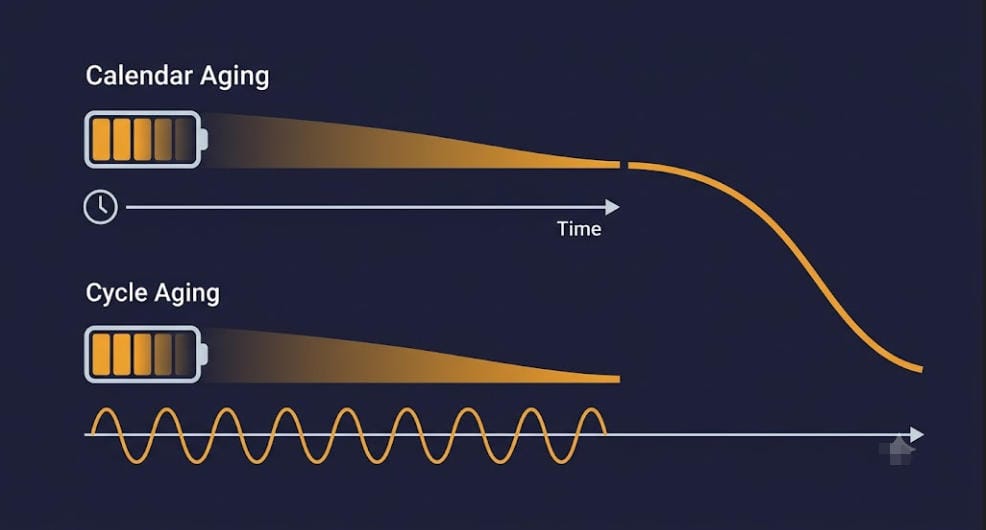
Two Degradation Pathways: Calendar Aging vs. Cycle Aging
Every BESS ages through two paths at once.
Calendar Aging
Calendar aging happens purely with time. Then it keeps going even while a battery sits idle. State of charge is the biggest driver. Temperature is a close second. So cells stored at high state of charge age faster, especially above 80%.
Cycle Aging
Cycle aging comes from charging and discharging. Also, it scales with cycle count, discharge depth, and charge rate. But use temperature matters too. A battery run hard at high current takes more stress per cycle than one run gently.
Field data backs this up. Tests on large-format LFP cells built for stationary storage found something clear. Temperature has the biggest effect on aging. Still, the cycling pattern matters less by comparison. So thermal management should come first in any BESS design.
For a deeper look at how to split these two effects in real data, see our full guide on Calendar Aging vs. Cycle Aging in LFP Batteries.
What’s Happening Inside the Cell: SEI Growth and Lithium Plating
Battery degradation in BESS is at its core a chemistry problem. Two mechanisms cause most of the damage inside an LFP cell.
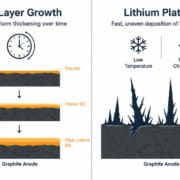
The first is growth of the solid electrolyte interphase, or SEI. This is a thin layer that forms on the anode surface. Also, some SEI growth is normal, even needed at first. Yet it keeps growing slowly over the battery’s life. Each time it thickens, it uses up lithium ions and electrolyte. At high state of charge, SEI growth speeds up. Then that growth also raises internal resistance. So aging cells run hotter and less efficiently than new ones.
The second mechanism is lithium plating. Instead of moving cleanly into the anode, lithium ions build up as metal on the surface. First, this mostly happens during fast charging in cold weather. Then the anode simply cannot take in lithium fast enough. So plated lithium is mostly lost capacity for good. In bad cases, it can also raise safety risks.
Both mechanisms show why how you charge matters as much as how much. For the full picture, read our guide on SEI Layer Growth and Lithium Plating in LFP Cells.
Temperature’s Outsized Role in Battery Degradation in BESS
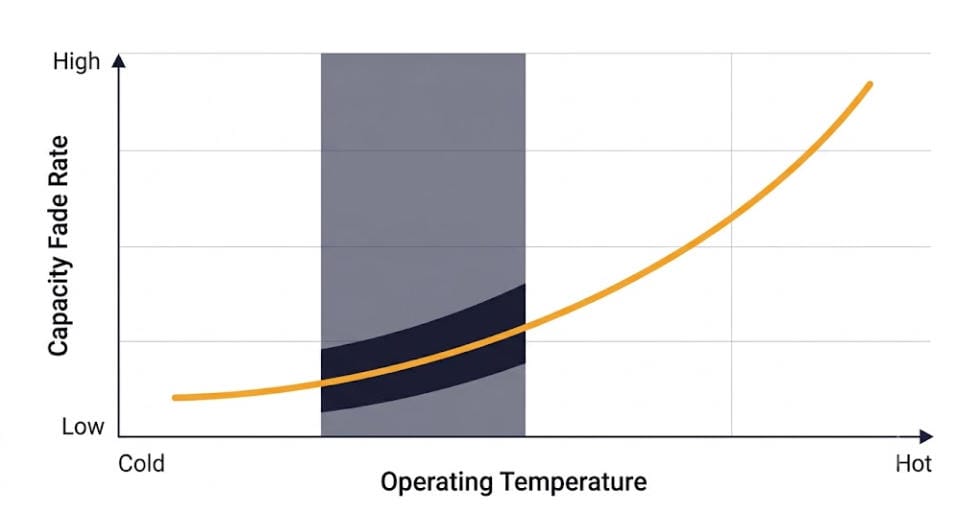
One factor beats every other factor: temperature. Heat speeds up SEI growth. It speeds up calendar aging. Also, it raises the rate of unwanted side reactions across the board. This holds true whether the battery sits idle or runs hard.
Cold brings a different problem. First, below a certain point, an LFP cell cannot take a charge quickly. Fast charging in the cold pushes cells toward the plating risk covered above. This is a design issue, not just a chemistry issue. So it shapes everything from enclosure size to winter charge-rate limits.
This section covers the general heat effect. If you run a system in a cold climate, our guide on Cold-Climate BESS Design covers cutoff behavior in full detail. For the underlying temperature/cycle-life relationship, see our existing guide, Impact of Temperature on LiFePO₄ Batteries Cycle Life. For the underlying mechanism behind why heat and cold both accelerate degradation, see our guide on How Temperature Accelerates Battery Degradation: The Arrhenius Relationship.
Operating Choices That Speed Up or Slow Down Degradation
Battery degradation in BESS is not fully out of your hands. Several choices have a direct, real effect on how fast it happens.
Depth of Discharge and C-Rate
First, deeper discharges add more stress per cycle than shallow ones. But they also deliver more usable energy, so there is a real tradeoff. So many operators run at 0.5C or lower to cut this stress. Still, going past 80% discharge depth often adds up over thousands of cycles.
State of Charge Operating Window
High state of charge speeds up calendar aging through faster SEI growth. Very low state of charge, below about 20%, brings a different risk. Also, it can dissolve current collectors and weaken the electrode. So most operators keep cells inside a 20% to 80% band. So they skip the full 0% to 100% range in daily use.
For the full breakdown of how these variables interact at the particle level, read our guide on Why Deep Discharge and High C-Rate Stress LFP Cells.
Tracking Battery Degradation in BESS: State of Health Estimation
You need a solid way to track battery degradation in BESS before you can manage it. That is harder for LFP cells than for most other chemistries.
LFP cells have a nearly flat voltage curve across the 20% to 80% state-of-charge range. So voltage barely moves across that wide middle band. So voltage-based tracking is not reliable on its own. LFP cells also show hysteresis. Also, voltage during charge and discharge differs by roughly 5 to 25 millivolts at the same state of charge. So both quirks make simple voltage checks a poor tool for tracking degradation.
Coulomb counting is the most common baseline method. It skips the voltage problem, but it still drifts over time from small sensor errors. But left alone, that drift adds up across thousands of cycles. So better systems add regular recalibration. But some also track internal resistance. Still others use model-based tools like an Extended Kalman Filter to keep the estimate honest as cells age.
This ties right into your BMS. For the full comparison of methods, see our guide on BMS SOC Estimation Methods Explained. For a closer look at tracking degradation itself, read Advanced SOH Estimation for BESS.
How to Slow Battery Degradation in BESS: A Practical Summary
| Strategy | Why It Helps |
| Keep SOC in a 20-80% operating band | Cuts both calendar aging and low-SOC electrode stress |
| Manage temperature actively | Temperature is the top driver of aging in most studies |
| Limit fast charging in cold weather | Cuts lithium plating risk at the anode |
| Avoid needless deep discharges | Cuts mechanical and chemical stress per cycle |
| Track SOH with more than coulomb counting alone | Catches drift before it skews dispatch decisions |
| Recalibrate BMS capacity estimates often | Keeps SOC and SOH readings accurate as cells age |
Frequently Asked Questions
How much does a BESS degrade per year?
A well-run, grid-scale LFP system typically loses 20% to 30% of its capacity over ten years under good operating conditions. Fade is not perfectly linear year to year, so treat this as a decade-scale range rather than a fixed annual number.
What causes the most battery degradation in BESS?
Temperature and state of charge are the two biggest drivers, by far. High temperature speeds up nearly every aging mechanism at once. High state of charge speeds up calendar aging too, even when the battery sits idle.
Does battery degradation in BESS ever stop?
No. Degradation is steady and permanent. Good thermal management and SOC discipline can slow it a lot. But nothing stops it entirely.
Is LFP more resistant to degradation than other lithium-ion chemistries?
Yes. LFP is more stable than nickel-based chemistries like NMC. That is a big reason it leads in stationary storage. It still degrades, just more slowly and more predictably under the same conditions.
Further Reading
Calendar Aging vs. Cycle Aging in LFP Batteries
Advanced SOH Estimation for BESS
SEI Layer Growth and Lithium Plating in LFP Cells
How Temperature Accelerates Battery Degradation: The Arrhenius Relationship
Why Deep Discharge and High C-Rate Stress LFP Cells
BMS SOC Estimation Methods Explained: OCV vs Coulomb Counting vs Kalman Filter
Cold-Climate BESS Design: Discharge-Side DCIR and Premature Cutoffs
Battery Management System (BMS) Explained
Impact of Temperature on LiFePO₄ Batteries Cycle Life







Trackbacks & Pingbacks
[…] For the bigger picture on how SEI layer growth and lithium plating fit into overall battery degradation, see our guide on Battery Degradation in BESS: Causes, Mechanisms & Mitigation. […]
[…] are different. For more on how temperature interacts with degradation broadly, see our guide on Battery Degradation in BESS: Causes, Mechanisms & Mitigation. It covers the full picture beyond calendar aging vs cycle aging […]
Leave a Reply
Want to join the discussion?Feel free to contribute!