
BESS Augmentation: AC Block Addition vs. DC Shuffling — How Mid-Life Capacity Upgrades Actually Work
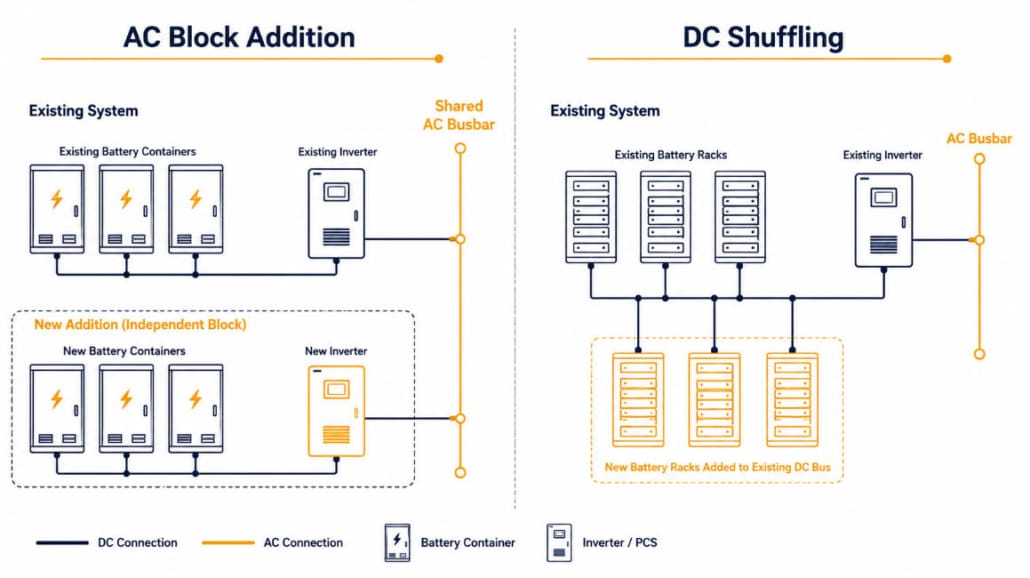
AC block addition is one of two ways to carry out BESS augmentation. BESS augmentation, in short, restores capacity a battery loses over time. Every charge and discharge cycle wears the cells down. So, after a few years, the system can no longer deliver its full contracted energy or power. AC block addition fixes this by adding new inverters and battery racks on the AC side. DC shuffling, the other path, instead reallocates existing modules behind the inverters already on site. Each approach, however, solves the same problem differently.
| Quick Answer AC block addition installs a new, independent power block behind its own connection point. It costs more and needs more space. However, it works with any battery chemistry, and it skips synchronization headaches with old cells. DC shuffling, by contrast, reorganizes and adds battery modules behind the existing inverters. It costs less, and it often avoids new interconnection permits. But busbar ratings, breaker capacity, and voltage matching all limit how much capacity it can add. |
Why BESS Augmentation Needs a Capacity-Adding Strategy
This guide focuses on the technical mechanics of the two paths. For the full picture on BESS augmentation as a strategy, including how it compares to oversizing capacity upfront, see our BESS Augmentation: The Complete Guide.
Lithium-ion cells degrade with use. So does calendar time alone. Each cycle stresses the electrode material. Specifically, the protective SEI layer on the anode cracks and reforms. This, in turn, consumes active lithium every time. High charge rates and cold temperatures make it worse.
Fade rates vary by chemistry and duty cycle. Many grid-scale LFP systems, for instance, lose roughly 2 to 3 percent of usable capacity per year. As a result, after five to seven years, a project can fall short of its contracted energy or power. That, in turn, threatens revenue under tolling agreements and capacity contracts.
BESS augmentation exists to close that gap. It adds capacity back, either instead of, or alongside, overbuilding extra capacity at day one. Modo Energy’s research on the topic frames it simply: augmentation restores or increases capacity, and both outcomes improve a project’s revenue potential.
Cycle Aging and the Restore Buffer
BESS augmentation is not a one-time fix. Instead, most projects restore capacity to a buffer above nameplate, not just back to nameplate. That buffer, in turn, gives headroom before the next augmentation cycle is needed.
Here is the catch. That buffer is defined in AC terms, at the point of interconnection. See our guide to understanding BESS specifications for how nameplate, usable, and contracted energy differ. But the actual work is a DC decision, since operators install battery cells, not AC megawatts. So, converting between the two requires accounting for round-trip losses across the inverter and transformer.
AC Block Addition Explained
How the AC Path Works
AC block addition adds a self-contained power block next to the existing system. New battery racks, a new PCS, and often a new transformer, arrive as one unit. The block then synchronizes independently at the AC bus, or at a new point of interconnection. Because the new block does not share a DC bus with old batteries, voltage and state-of-charge mismatches between aged and fresh cells never become a problem.
Pros and Cons of the AC Path
Advantages:
- Works with any battery chemistry — operators can add a sodium-ion or next-generation LFP block next to an aging system.
- Needs no voltage or state-of-charge synchronization with degraded cells.
Offers a chance to upgrade PCS technology, such as adding grid-forming capability, alongside the capacity add.
- Creates a clean equipment and warranty boundary between old and new hardware.
Drawbacks:
- Costs more, since a new PCS, transformer, and switchgear all add expense.
- Needs more physical footprint.
- Often triggers a new interconnection study or re-permitting, since new grid-connected hardware is involved.
Adds a new fault-current source, so protection settings must be re-coordinated.
DC Shuffling Explained
DC shuffling reorganizes existing battery modules behind the inverters already in service. Modules with similar degradation profiles get grouped together. This, in turn, spreads energy more evenly across the stack. On its own, however, shuffling does not add any capacity. It just rebalances what is already there.
Real capacity gets added only when new racks are added behind the same PCS, after the existing fleet has been shuffled and rebalanced. Because the new capacity shares the existing inverter and bus, the project may be able to avoid a new grid interconnection point. However, permitting and approval requirements still depend on the scope of the modification and the applicable jurisdiction. A DC-to-DC converter can help reconcile the voltage gap between old and new modules. The converter itself, though, adds no capacity on its own.
Technical Limits of DC Shuffling
DC shuffling looks cheap on paper. However, it runs into hard technical ceilings. As Energy-Storage.News has reported, auxiliary load breakers and busbars were sized for the original system. So, adding capacity behind them can exceed that rating.
Adding capacity also raises the available fault current the busbar must survive, measured against its short-time withstand rating. As a result, retrofitting an undersized bus is expensive and disruptive.
Old and new modules, moreover, rarely match perfectly in voltage, capacity, resistance, SOC, or SOH. Without careful matching and appropriate BMS coordination, the newer modules may be limited or taken offline to protect the string. That, in turn, can reduce the usable capacity gain.
For a detailed look at the electrical, thermal, BMS, and string-level challenges of combining different-age modules, see our guide to Mixed-Age String Design After BESS Augmentation.
Sizing the Restore Buffer: AC Target to DC Install
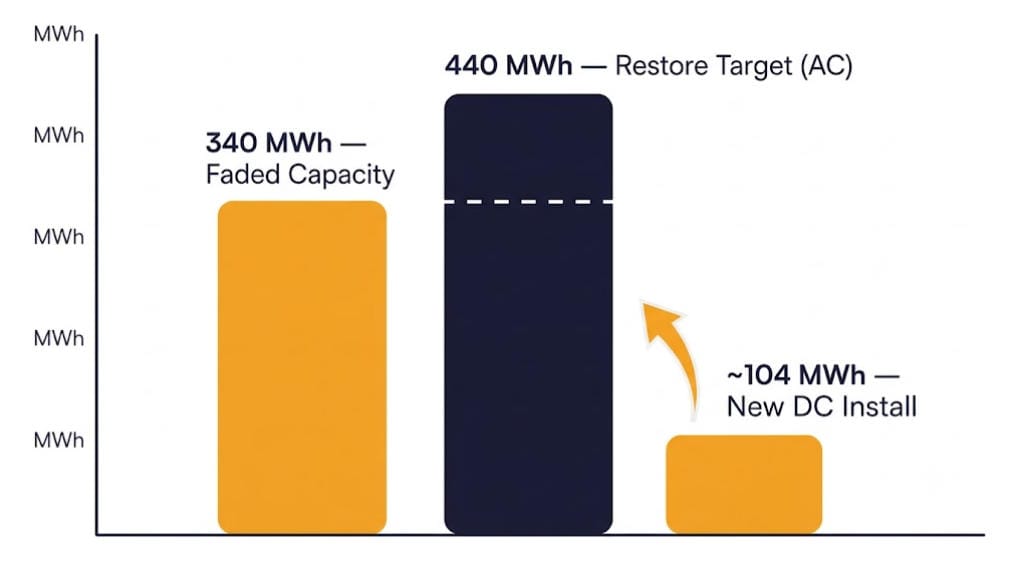
Sizing starts at the point of interconnection, not at the battery rack. Consider a 100 MW, 400 MWh project. After five years, it has faded to 340 MWh of usable energy at the AC side. The operator, in this case, wants to restore headroom to 110 percent of nameplate, or 440 MWh.
That means the project needs 100 MWh of additional AC-side energy. Because DC-to-AC conversion is not lossless, the DC installation must be larger than the AC target. At a typical round-trip factor near 96.5 percent, for example, the operator installs about 104 MWh of new DC capacity to deliver 100 MWh at the AC side.
This buffer-based approach, in short, avoids a common trap. Sizing an augmentation exactly to today’s shortfall just guarantees another shortfall, and another expensive site visit, a year or two later.
AC Block Addition vs. DC Shuffling: At a Glance
| Dimension | AC Block Addition | DC Shuffling |
| New grid connection required | Usually, yes | Usually, no |
| Typical capital cost | Higher | Lower |
| Footprint | Larger — new PCS, transformer, switchgear | Smaller — reuses existing enclosures |
| Chemistry flexibility | Any chemistry | Must match voltage/SOC with existing cells |
| PCS / protection impact | New PCS; new fault-current source to coordinate | Existing PCS; busbar and breaker ratings cap headroom |
| Typical permitting timeline | Months — new interconnection study | Weeks to months — often no new grid approval |
| Best fit | Later-life projects, chemistry upgrades, PCS refresh | Earlier-life projects with headroom in the existing bus |
Choosing Between AC Block Addition and DC Shuffling
When AC Block Addition Makes Sense
AC block addition tends to make sense later in a project’s life, once the original PCS is also due for a technology refresh. It is also the better fit when an operator wants to introduce a different battery chemistry, such as pairing a sodium-ion block with an existing LFP fleet.
When DC Shuffling Makes Sense
DC shuffling, on the other hand, fits best earlier in a project’s life, while the existing busbar and breakers still have headroom. It also suits sites where a new interconnection study would be slow or costly. As cell sizes grow past 500 Ah and system voltages rise, some integrators expect DC block designs, and DC shuffling along with them, to look different in the next generation of projects.
Key Takeaways: AC Block Addition vs. DC Shuffling
1. Degradation is inevitable — plan for it before contracted capacity is at risk.
2. Restore buffers are set in AC terms at the point of interconnection, but installed as DC energy.
3. AC block addition costs more but sidesteps chemistry-matching and synchronization limits.
4. DC shuffling costs less but is capped by busbar, breaker, and voltage-matching limits.
5. The right path depends on project age, available headroom, and permitting timeline.
FAQ About AC Block Addition and DC Shuffling
What Is AC Block Addition?
AC block addition is one way to carry out BESS augmentation. It installs a new, independent power block, complete with its own inverters, next to an existing system, to restore or increase capacity lost to degradation.
Does DC Shuffling Alone Add Capacity?
No. Shuffling alone just reorganizes existing modules for better balance. Capacity, however, is only added when new racks get installed behind the shuffled system.
How Much Does This Augmentation Path Cost?
Cost varies by project size, chemistry, and the path chosen. DC shuffling generally costs less per MWh added, since it reuses the existing PCS and transformer. AC block addition, by contrast, costs more, but it includes new power conversion equipment.
Does DC Shuffling Require New Interconnection Permits?
Usually not. Since no new physical connection is made to the grid, DC shuffling can often bypass a fresh interconnection study. AC block addition, on the other hand, usually cannot.
Can AC Block Addition Mix Battery Chemistries?
Yes. Because the new block has its own PCS and DC bus, it does not need to match the voltage or chemistry of the existing system.
Further Reading
- BESS Augmentation: The Complete Guide
- Mixed-Age String Design After BESS Augmentation
- BESS PCS Functions and Features
- Grid-Forming vs. Grid-Following BESS
- BESS Short Circuit Protection
- PCS Overvoltage Protection
- Understanding BESS Specifications
- AC and DC Augmentation in BESS — Energy-Storage.News
- Augmentation: What Is It and Why Is It Important to BESS? — Modo Energy







Trackbacks & Pingbacks
[…] decision sits downstream of the AC-vs-DC augmentation choice covered in our AC block addition vs. DC shuffling guide. AC block addition sidesteps mixed-age string design entirely, since the new block runs on its own […]
[…] more detail, our AC block addition vs. DC shuffling guide walks through the full technical comparison. It includes a worked example for sizing the restore […]
Leave a Reply
Want to join the discussion?Feel free to contribute!