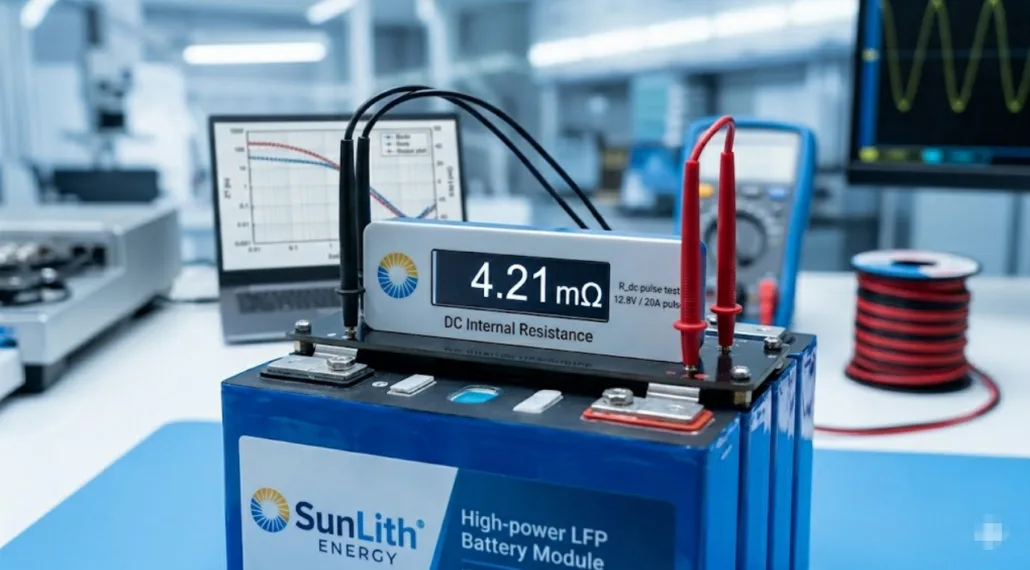
ACIR gives us a snapshot of a cell’s physical integrity. However, DC Internal Resistance (DCIR) tells us how that cell performs when the grid calls for power.
Understanding DC Internal Resistance LFP metrics is critical for managing grid-scale BESS . ACIR provides a snapshot of physical integrity. However, DCIR determines performance during immediate power demands
This article breaks down the fundamentals of DCIR. Moreover, it explains why this is the definitive metric for grid-scale storage and how we engineer around it.
Why DC Internal Resistance LFP Metrics Matter
Specifically, DCIR measures the voltage drop during a high-current DC pulse. ACIR uses a 1 kHz frequency to bypass electrochemical reactions. In contrast, DCIR forces the battery to move ions. This provides a “real-world” measurement of the battery’s actual ability to deliver power under load.
Mathematically, it is calculated from the change in voltage (ΔV) over the change in current (ΔI):
DCIR FORMULA R₂ₙ = (Vᵢₙᵢₜᵢₐₗ − Vₗₒₐ₂) / Iₗₒₐ₂ R₂ₙ = DC Internal Resistance Vᵢₙᵢₜᵢₐₗ = Open circuit voltage Vₗₒₐ₂ = Voltage under load Iₗₒₐ₂ = Applied current
This single measurement captures two distinct resistance sources:
DCIR includes:
Ohmic Resistance — The physical resistance of tabs, current collector foils, and the electrolyte itself. Furthermore, this is what ACIR also measures.
Polarization Resistance — The “chemical friction” lithium ions face as they diffuse through the electrolyte and intercalate into electrode particles. Specifically, this is invisible to ACIR, and it’s where the real performance story lives.
Why DC Internal Resistance LFP Is the “Real-World” Metric for BESS
In a Battery Energy Storage System, cells are never sitting idle — they are responding to dynamic, unpredictable grid demands. Here is why DCIR monitoring is non-negotiable for any serious integrator.
1. Predicting Heat Generation
Thermal stress is driven by DCIR, not ACIR Furthermore, according to Joule’s Law (P = I²R), heat generation is directly proportional to resistance. Because DCIR is significantly higher than ACIR, it is the primary driver of thermal stress in a running cell. High DC Internal Resistance LFP leads to hot spots. Therefore, it can trigger BMS shutdowns or accelerate aging This relationship is defined by Joule’s Law, which states that heat increases with the square of the current
2. Eliminating Voltage Sag
In addition, high DC Internal Resistance LFP causes trips even at 20% SOC Have you ever seen a BESS unit trip even though the State of Charge showed 20%? That is often due to high DCIR. For instance, under a heavy load, high resistance causes the voltage to “sag.” This often drops below the inverter’s cutoff threshold even though charge remains. Therefore, lower DCIR ensures a stable power delivery curve that your inverter can trust.
3. State of Health (SOH) Tracking
DC Internal Resistance LFP rises before capacity degrades visibly While ACIR is great for initial cell grading, DCIR is a superior indicator of aging. As LFP cells age and the SEI layer thickens, DCIR increases significantly — long before capacity degrades visibly. In addition, monitoring this trend allows for predictive maintenance and avoids unexpected field failures. Specifically,, monitoring these trends allows for predictive maintenance.
DC Internal Resistance LFP vs. ACIR: A Quick Comparison
Both measurements have a role to play in a rigorous quality program. The key is knowing which question each one actually answers.
Feature
ACIR (1 kHz)
DCIR (Pulse Test)
Method
Small AC sine wave
Large DC current pulse
What it captures
Ohmic / physical resistance only
Ohmic + polarization resistance
Primary focus
Physical & mechanical cell health
Chemical & kinetic performance
Best used for
Cell sorting & incoming QC
System modeling & thermal planning
Aging sensitivity
Low – changes slowly with age
High – rises with SEI layer growth
Measurement speed
Very fast (<1 second)
Seconds to minutes per cell
Real-world accuracy
Indicative only
Directly predictive of field behavior
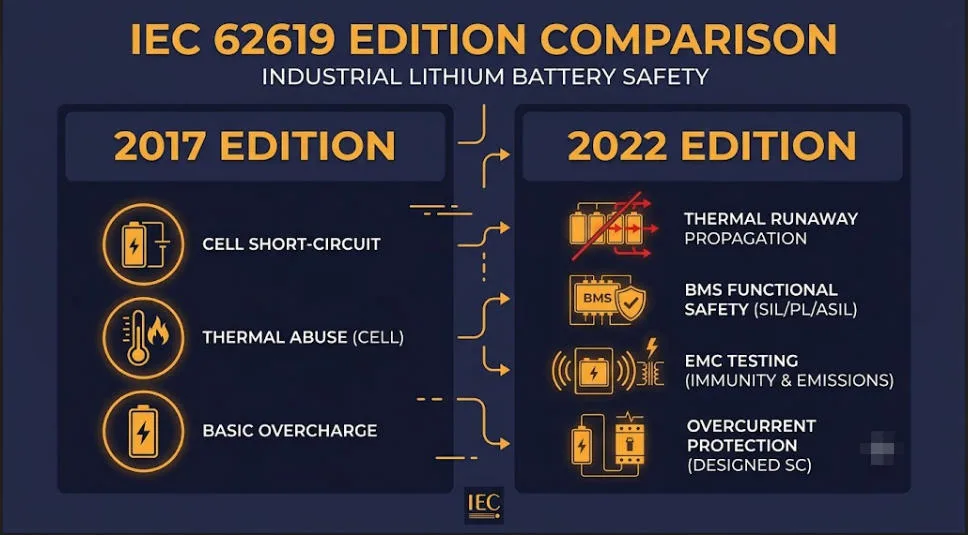
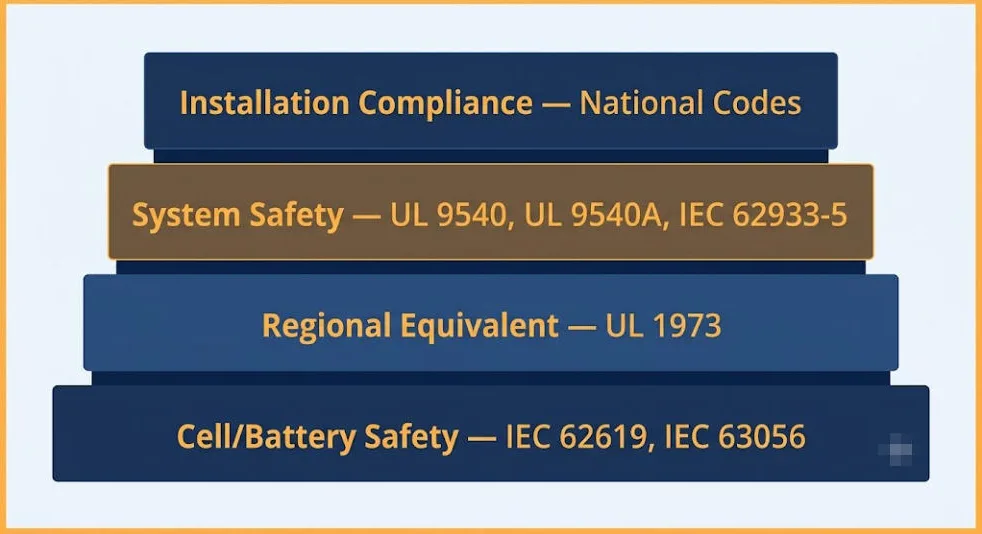
Engineering for Reliability at SunLith Energy Our integration process goes beyond simple module assembly. Specifically, we implement rigorous testing protocols to ensure every module meets strict DCIR benchmarks. — aligning our practices with global standards including IEC 62619 and UL 1973, as well as BIS and GB/T requirements for grid-scale safety.6,000+ target cycles <20% max resistance growth 0.5C peak C-rate optimized Our DCIR-optimized systems deliver: Thermal stability at high C-rates 6,000+ cycles with minimal resistance growth Full compliance: IEC 62619 · UL 1973 · BIS · GB/T
The Bottom Line: ACIR is the heartbeat — it tells you the cell is physically alive. In contrast, DCIR is the stamina—it tells you whether that cell can perform. when the grid calls. Ultimately, to build a truly bankable BESS, you must master both.
Want to learn more about how we optimize LFP performance?
⚡ Quick Answer: BESS Supplier BMS Evaluation in Brief In any BESS supplier BMS evaluation, ask for cell-level monitoring, SOC algorithm type, balancing current, fault response speed, SOH logging, certifications, and full test reports. A quality supplier answers all seven without hesitation. Vague answers, missing test data, or refusal to name the SOC algorithm are the clearest red flags.
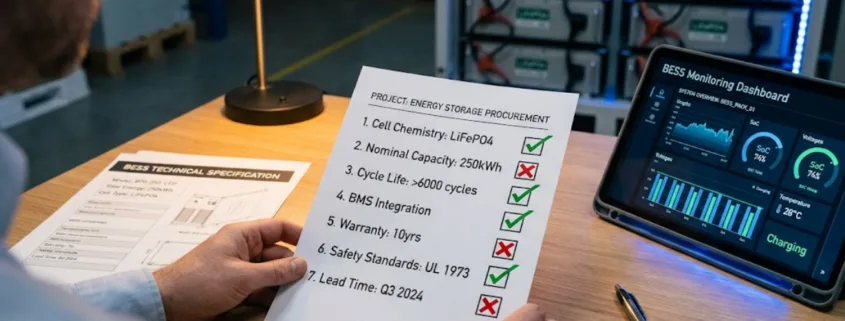
A thorough BESS supplier BMS evaluation is one of the most important steps in any energy storage procurement. Most buyers spend hours comparing cell chemistry, capacity, and cycle life. Then they spend five minutes on the BMS. That gap is where expensive mistakes happen.
The battery management system determines whether a BESS is safe and whether its cells reach their rated life. Yet BMS quality is hard to verify from a spec sheet. Many suppliers use the same headline numbers — regardless of whether the implementation delivers those claims.
This guide gives you a practical BESS supplier BMS evaluation framework. Specifically, it covers the questions to ask, the documentation to request, and the red flags that reveal when a BMS falls short.
1. Why BESS Supplier BMS Evaluation Matters More Than Most Buyers Realise
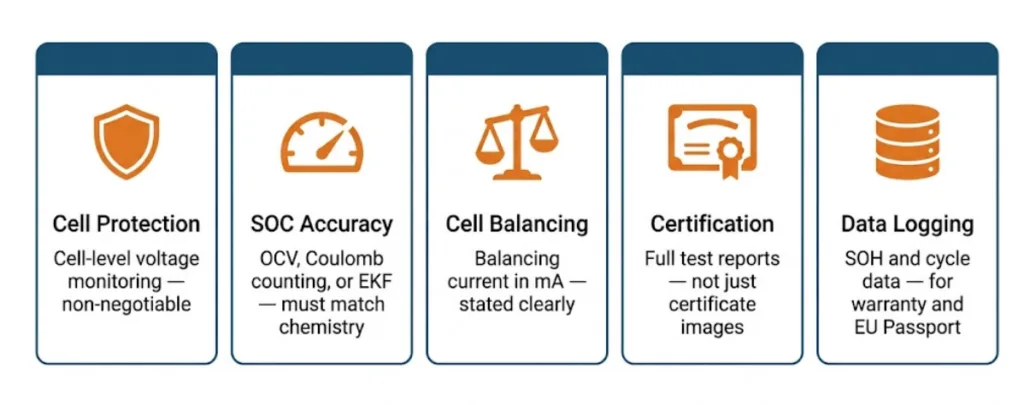
A thorough BESS supplier BMS evaluation covers five areas: SOC accuracy, protection, balancing, certification, and data logging
The BMS is the hardest BESS component to evaluate from a spec sheet. Cells have measurable characteristics — capacity, internal resistance, cycle life. A BMS spec sheet, in contrast, often contains claims that are hard to verify without test data.
Consider two BMS platforms with identical spec sheets. Both claim 6,000-cycle compatibility, active balancing, and EKF SOC. One uses a properly calibrated EKF with cell-level monitoring. The other uses Coulomb counting relabelled as EKF and pack-level monitoring relabelled as cell-level.
In the field, the first system protects cells correctly and reaches its rated cycle life. The second degrades faster, shows erratic SOC readings, and fails early. Both had identical spec sheets.
Consequently, a structured BESS supplier BMS evaluation is the only way to tell them apart. Asking the right questions and requesting the right documentation must happen before you sign.
2. The Seven Questions Every BESS Supplier BMS Evaluation Must Include
These seven questions form the core of any BESS supplier BMS evaluation. Specifically, a credible supplier answers all of them without hesitation. Vague or evasive answers are red flags.
Question 1: Is Monitoring at Cell Level or Pack Level?
Cell-level monitoring tracks every individual cell voltage. Pack-level monitoring, however, tracks only the total pack voltage. These are fundamentally different levels of protection.
In a 16-cell LFP pack, one weak cell can hit its 2.5V limit while the pack reads 49V. A BMS monitoring only pack voltage misses this. As a result, the weak cell gets damaged and the pack degrades faster.
Cell-level monitoring is non-negotiable. Ask specifically: does the BMS monitor each individual cell voltage — or only the total pack? Pack-level only is an immediate disqualifier. For more on why, see our BMS guide.
Question 2: Which SOC Algorithm Is Used — and Is It Calibrated for This Chemistry?
SOC estimation is where most generic BMS platforms fall short on LFP. OCV-based SOC on LFP is unreliable during operation. Coulomb counting is the minimum standard. EKF is the most accurate option for systems above 200 kWh.
Ask two sub-questions. First: which method — OCV, Coulomb counting, EKF, or hybrid? Second: was the cell model calibrated for the specific cells in this system? An EKF with a mismatched model is often less accurate than well-implemented Coulomb counting.
Question 3: What Is the Balancing Current and Method?
Ask whether balancing is passive or active, and what the current is in milliamps. Residential systems under 30 kWh need 100 mA passive balancing. Commercial systems above 200 kWh need 200 mA or more. Active balancing is preferred above 500 kWh.
Indeed, a supplier who cannot state the balancing current either uses a low-quality BMS or does not know their product. Both are red flags.
Question 4: How Fast Does the BMS Respond to Faults?
Short circuit protection must activate in microseconds. This uses hardware circuits, not software. Thermal runaway protection must disconnect in under 100ms. Ask specifically for fault response times in the spec document.
A vague answer such as “the BMS has overcharge protection” is not enough. Response time is what matters. Slow fault response on NMC especially can mean the difference between a contained event and a fire.
Question 5: What Communication Protocols Does the BMS Support?
Confirm the BMS works with your specific inverter and EMS before signing. CAN bus and Modbus RTU are the most common protocols. Ask for a compatibility list showing which inverter models have been tested.
A protocol mismatch needs a gateway converter — adding cost, a failure point, and communication lag. Discovering this after delivery is also expensive and causes project delays.
Question 6: Does the BMS Log SOH and Cycle Data — and for How Long?
SOH logging is essential for warranty claims. Most BESS warranties guarantee a minimum SOH at a set cycle count. Without accurate SOH records, therefore, any warranty dispute becomes very hard to resolve in your favour.
Furthermore, from February 2027, EU Battery Passport compliance requires SOH history, cycle count, and energy throughput data. A BMS without adequate logging creates regulatory risk. For more on these requirements, see our EU 2023/1542 compliance guide.
Question 7: Which Certifications Does the BMS Hold — and Can You Provide Full Test Reports?
UL 1973, IEC 62619, and IEC 62933-5 are the key certifications for a BESS BMS. Always ask for full test reports — not just a certificate image. A certificate shows testing was done. A test report, however, shows what was tested, under what conditions, and what the results were.
If a supplier provides only a certificate image and cannot produce the full report, that is a serious red flag. Reputable suppliers keep test reports on hand.
3. BESS Supplier BMS Evaluation: Red Flags and Green Flags
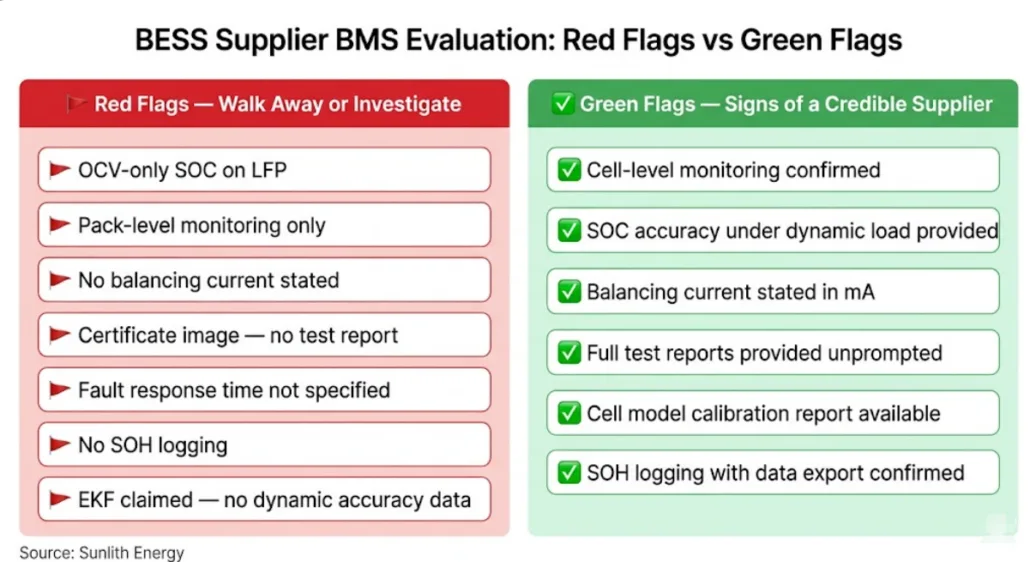
Red flags and green flags in a BESS supplier BMS evaluation — what credible suppliers provide versus what evasive suppliers avoid
Red Flags: Signs a BMS Falls Short
Red Flag
What It Means
What to Do
🚩 OCV-only SOC on LFP
SOC will be inaccurate — erratic readings, wrong shutdowns
Require Coulomb counting or EKF with LFP-calibrated model
🚩 Pack-level voltage monitoring only
Cannot detect weak cell — will miss over-discharge events
Require cell-level individual voltage monitoring as standard
🚩 Cannot state balancing current
Low-quality BMS or supplier unfamiliar with their product
Request balancing current in mA from the spec sheet
🚩 No test report — certificate image only
Cannot verify what was actually tested or under what conditions
Require full test report from the certification body
🚩 Fault response time not specified
Cannot confirm short circuit or thermal protection speed
Require fault response time in ms in the spec document
🚩 No SOH logging capability
Cannot support warranty claims or EU Battery Passport compliance
Require SOH logging with timestamped cycle data
🚩 EKF claimed but no dynamic SOC accuracy data
May be Coulomb counting relabelled — not genuine EKF
Require SOC accuracy spec under dynamic load, not just at rest
Green Flags: Signs of a Credible Supplier
Green Flag
What It Means
What to Do
✅ Cell-level voltage monitoring confirmed
Weak cells will be detected and protected before damage occurs
Verify in test report
✅ SOC accuracy data under dynamic load provided
Genuine EKF or well-calibrated Coulomb counting
Cross-check against your application’s cycle profile
✅ Balancing current stated in spec sheet
Supplier understands their product and is transparent
Verify adequacy for your system size
✅ Full certification test reports provided
BMS has been genuinely tested under fault conditions
Check test temperature and conditions match your application
✅ Cell model calibration confirmed for specific cells
SOC estimation is tuned for actual cells in the system
Request calibration test report as evidence
✅ SOH logging with data export capability
Warranty claims and EU Battery Passport compliance are supported
Confirm export format and data retention period
4. Documentation to Request in a BESS Supplier BMS Evaluation
Questions reveal what a supplier claims. Documentation, however, reveals what they can prove. Request these six documents during any BESS supplier BMS evaluation — before signing.
BMS Technical Specification Sheet
Specifically, the spec sheet should state: cell voltage monitoring level, voltage accuracy in mV, SOC algorithm type, balancing current in mA, fault response times in ms, and communication protocols.
If any parameter is missing, ask for it in writing. A supplier who cannot provide this data does not have it — and that reveals something important about BMS quality.
Certification Test Reports
Request full test reports for UL 1973, IEC 62619, and IEC 62933-5. These reports specify the test conditions — temperature, voltage range, C-rate, and fault scenarios. They also show pass/fail results for each test item.
Pay attention to the test temperature. A BMS certified at 25°C may behave differently at 45°C in an outdoor enclosure. Ask whether certification was done at your actual operating temperature.
SOC Accuracy Test Data
Ask for SOC accuracy data under dynamic load — not resting accuracy. Specifically, the test should show SOC error during charge and discharge at varying C-rates and temperatures. Genuine EKF achieves ±1–2% under these conditions. If the supplier only has resting data, the SOC method is likely OCV-based.
Cell Model Calibration Report
If the supplier claims EKF, ask for the cell model calibration report. This confirms the EKF model was built and validated for the specific cells in the system. A generic EKF model, calibrated for different cells, will underperform.
Firmware Version and Update Policy
Ask for the current BMS firmware version and update policy. Ask whether OTA updates are supported and whether cell model updates can be deployed remotely. For 10–15 year systems, OTA capability is valuable — it keeps SOC accuracy high as cells age.
Field Reference List
Also ask for a reference list of installed systems using the same BMS platform. A few direct conversations with reference customers reveals real-world BMS performance that no spec sheet captures.
5. BESS Supplier BMS Evaluation by System Size
The depth of BESS supplier BMS evaluation needed scales with system size. Specifically, a 10 kWh residential install carries different risk than a 5 MWh commercial project. This section provides a tiered evaluation framework.
Residential BESS — Under 30 kWh
Residential systems have simpler BMS requirements. Key items to verify are cell-level voltage monitoring, a 0°C charge inhibit, and IEC 62619 certification. Coulomb counting SOC with OCV resets is the minimum SOC standard.
Passive balancing at 50–100 mA is adequate at this scale. SOH logging is also good practice — however, it is less critical for warranty purposes. The main risk is a BMS that allows over-discharge or cold-temperature charging. Both cause permanent cell damage.
Commercial BESS — 30 kWh to 1 MWh
Commercial systems need all seven questions from Section 2 addressed. SOC accuracy matters more at this scale. Dispatch contracts and self-consumption both depend on knowing available energy. EKF is therefore preferred above 200 kWh.
SOH logging becomes important at this scale for warranty compliance. Communication protocol compatibility with the site’s EMS is also critical — confirm this before delivery, not after.
Utility-Scale BESS — 1 MWh and Above
At utility scale, every aspect of the BESS supplier BMS evaluation matters. EKF is strongly recommended. A 5% SOC error on a 10 MWh system means 500 kWh of uncertainty. That directly affects revenue from grid services contracts.
Additionally, require master-slave architecture documentation, slave module independence verification, and a data logging spec that meets EU Battery Passport requirements for EU market systems.
6. How to Interpret Supplier Answers in a BESS Supplier BMS Evaluation
Knowing how to interpret supplier answers is as important as knowing which questions to ask. These, therefore, are the most common responses in a BESS supplier BMS evaluation — and what they actually mean.
Supplier Answer
What It Likely Means
Follow-up Required
“Our BMS has cell-level monitoring”
Could be cell-level or pack-level — the term is used loosely
Ask: how many voltage sensors are in a 16-cell module?
“We use advanced SOC algorithms”
Could mean anything — likely Coulomb counting marketed as advanced
Ask: specifically OCV, Coulomb counting, or EKF?
“Our BMS is EKF-based”
May be genuine EKF or may be lookup table relabelled
Ask: what is the SOC accuracy under dynamic load?
“We have all the certifications”
Certifications may be for cells only, not the full BMS system
Ask: UL 1973 or IEC 62619 specifically for the BMS?
“Our BMS has active balancing”
Active balancing design varies widely in quality and current
Ask: what is the balancing current in mA or A?
Provides full test report without being asked
Supplier is confident in their product and transparent
Green flag — review test conditions carefully
7. The BESS Supplier BMS Evaluation Checklist
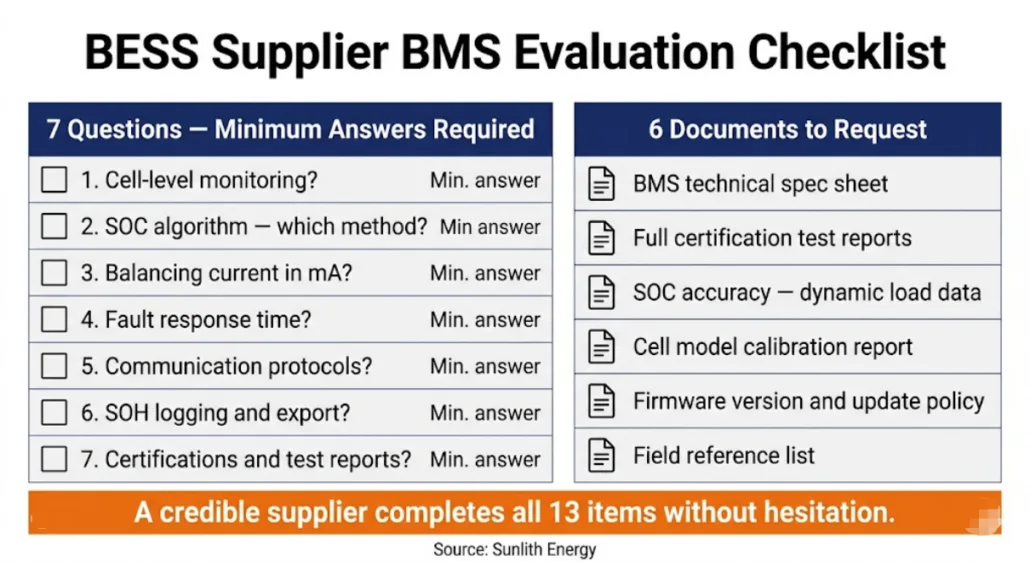
BESS supplier BMS evaluation checklist — seven questions and six documents to request before signing a purchase order
Use this checklist when evaluating any BESS supplier’s BMS. A credible supplier completes all items. Any item left blank or answered vaguely is a prompt for further investigation.
Seven Questions — Minimum Answers Required
Q1: Cell-level or pack-level voltage monitoring?
Required answer: cell-level individual voltage monitoring, confirmed in the spec sheet.
Q2: SOC algorithm — OCV, Coulomb counting, EKF, or hybrid?
Required answer: Coulomb counting minimum. EKF preferred above 200 kWh. Cell model calibration confirmed for specific cells.
Q3: Balancing method and current in mA?
Required answer: specific mA value stated. 100 mA+ for residential. 200 mA+ for commercial. Active balancing for 500 kWh+.
Q4: Fault response time for short circuit and thermal events?
Required answer: short circuit response in microseconds. Thermal disconnect under 100ms confirmed.
Q5: Communication protocols and inverter compatibility?
Required answer: specific protocols stated. Compatibility with your inverter confirmed.
Q6: SOH logging — what data, how long, and what export format?
Required answer: SOH, cycle count, energy throughput logged. Retention period stated. Export format confirmed.
Q7: Certifications held and full test reports available?
Required answer: UL 1973 and/or IEC 62619 confirmed. Full test reports available on request.
Six Documents to Request
BMS technical specification sheet — with all parameters listed above
Full certification test reports — UL 1973, IEC 62619, IEC 62933-5
SOC accuracy test data — under dynamic load at relevant temperatures
Cell model calibration report — confirming EKF is tuned for specific cells
Firmware version and update policy — including OTA capability if applicable
Field reference list — installed systems at comparable scale using the same BMS platform
8. What a Strong BESS Supplier BMS Evaluation Response Looks Like
To give context to the checklist, here is what a strong, credible supplier response looks like for each key question. Use this as a benchmark when comparing suppliers side by side.
✅ Example 1. Strong Response — Cell Monitoring “Our BMS monitors each individual cell voltage using dedicated ADC channels — one per cell. In a 16-cell module, there are 16 independent voltage measurements sampled every 500ms. Cell-level monitoring is confirmed in our IEC 62619 test report, which we can provide.”
✅ Example 2. Strong Response — SOC Algorithm “We use an Extended Kalman Filter combined with Coulomb counting. The EKF cell model was calibrated for the EVE LF280K cells used in this system, at 15°C, 25°C, and 45°C. SOC accuracy is ±1.8% under 0.5C dynamic load. We can provide the calibration test report and the dynamic load accuracy data.”
🚩 Example 3. Red Flag Response — SOC Algorithm “Our BMS uses advanced intelligent SOC estimation technology that provides highly accurate state of charge monitoring in real time.” — No algorithm type named. No accuracy figure given. No test data offered. This is marketing language, not a technical answer. Follow up with the specific sub-questions from Section 2 immediately.
Conclusion: Make BESS Supplier BMS Evaluation a Standard Step
A BESS supplier BMS evaluation is not a technical exercise reserved for engineers. It is a procurement discipline that any buyer can apply with the right questions and the right checklist.
The seven questions and six documents in Section 7 take less than an hour to work through. That hour protects against BMS failures that cost far more to fix in the field.
The clearest signal of a credible supplier is transparency. Credible suppliers answer the seven questions clearly and provide full test reports without hesitation. Evasive or vague answers, in contrast, are the most reliable red flag in any BESS supplier BMS evaluation.
☀️ Need Help with Your BESS Supplier BMS Evaluation? Sunlith Energy reviews BMS specifications and supplier documentation for BESS projects from 50 kWh upward. We apply this checklist on your behalf — identifying gaps in protection architecture, SOC accuracy, and certification compliance before you commit. Contact us
Frequently Asked Questions About BESS Supplier BMS Evaluation
What is the most important question in a BESS supplier BMS evaluation?
Cell-level voltage monitoring is the most important single question. A BMS that monitors only pack voltage cannot protect individual cells from over-discharge or overcharge. This failure mode causes faster degradation across the entire pack. Every other BMS feature is secondary to getting this protection right.
How do I know if a supplier is using genuine EKF or just claiming it?
Ask for SOC accuracy data under dynamic load — not resting accuracy. Genuine EKF achieves ±1–2% during active charge and discharge. If the supplier gives only resting data, the SOC method is likely Coulomb counting or OCV. Also ask for the cell model calibration report.
What certifications should a BESS BMS hold?
For most commercial BESS, UL 1973 and IEC 62619 are the primary certifications to require. IEC 62933-5 covers the ESS safety framework and is relevant for grid-connected systems. For EU market access after 2027, the BMS must also support the EU Digital Battery Passport data requirements. Always ask for full test reports.
Can I evaluate a BESS supplier’s BMS without technical expertise?
Yes. These questions require no engineering background. The answers either contain the information required — algorithm type, balancing current, fault response time — or they do not. A credible supplier gives specific answers. An evasive supplier gives vague, non-specific ones. That distinction is clear without technical expertise.
What happens if I skip the BESS supplier BMS evaluation?
The risks are real and specific. A BMS without cell-level monitoring allows weak cells to be over-discharged, accelerating degradation. Poor SOC estimation causes unnecessary shutdowns and wasted capacity. Missing SOH logging makes warranty disputes nearly impossible to win. For a 10-year BESS project, these failures compound significantly over time.
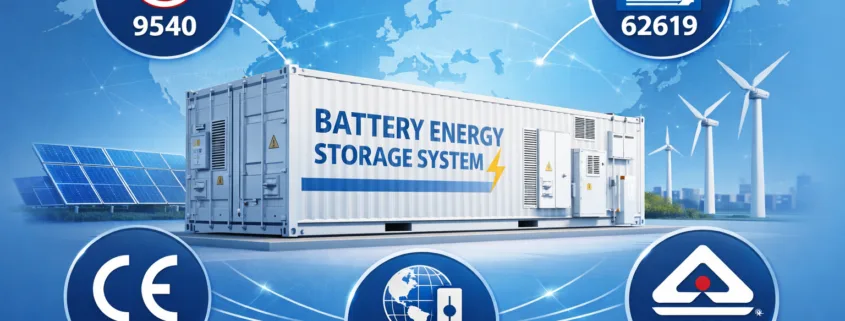
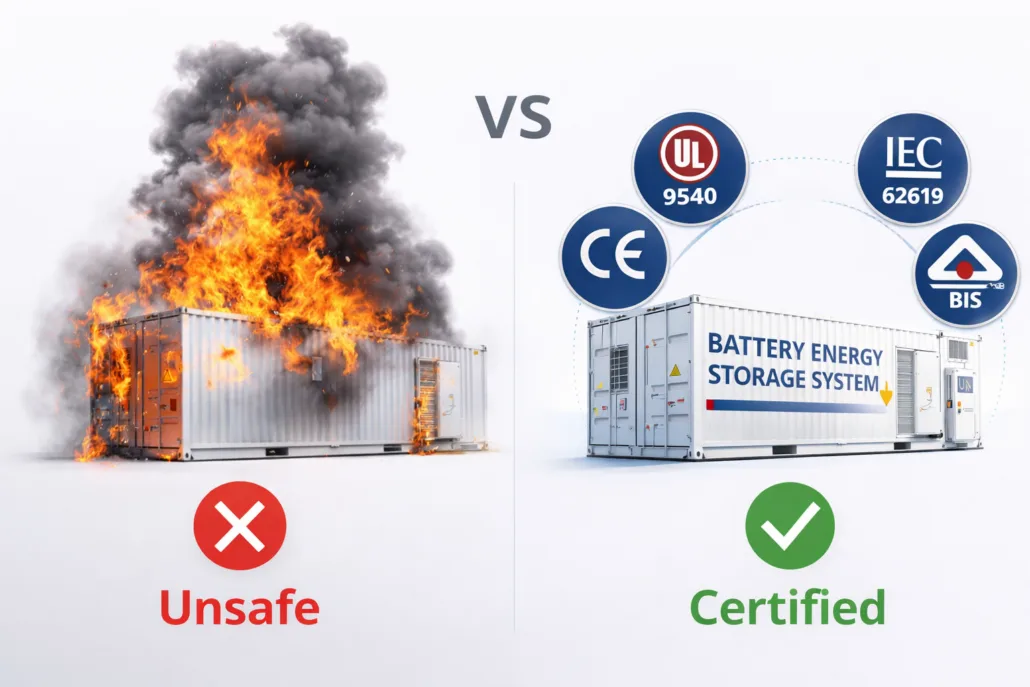
Quick Answer: BESS certifications are mandatory safety approvals for Battery Energy Storage Systems. You need UL 9540 for the USA, CE Marking for Europe, IEC 62619 globally, and BIS IS 17855 for India. Without valid BESS certifications, your system cannot be sold, insured, or grid-connected.
BESS certifications are the first thing you need when buying, selling, or installing a battery energy storage system. They decide whether your project gets permitted and financed — or blocked. As the global BESS market grows toward 500 GW by 2031, regulators everywhere are raising the bar.
This guide covers every major standard in 2026. Moreover, it explains what each certification tests, why it is required, and what it costs. Use it before you sign any BESS purchase agreement.
What This Guide Covers
Why BESS certifications matter — and the real risks of skipping them
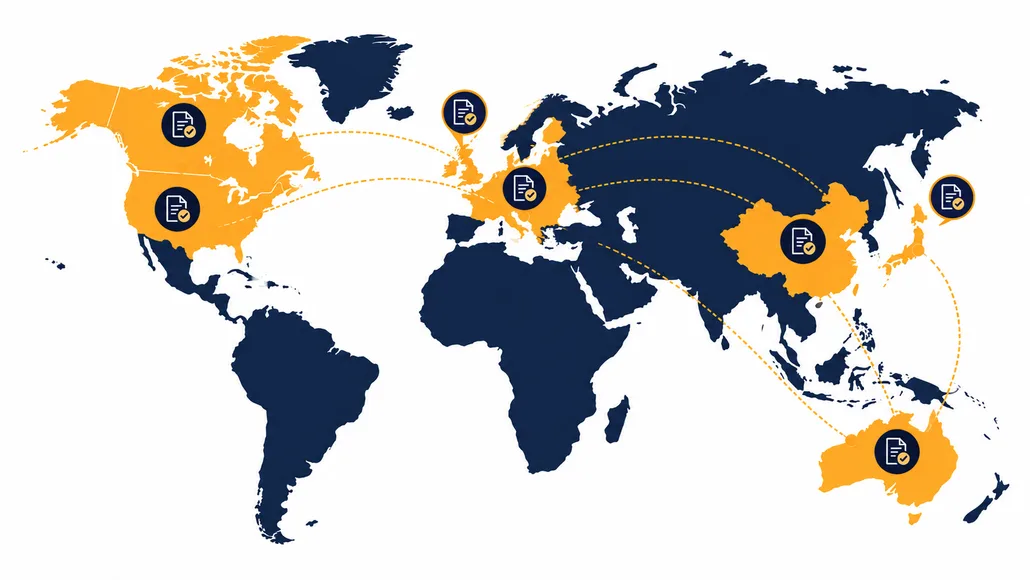
All major global standards: UL, IEC, CE, BIS, CEC, NFPA 855, UN 38.3
Quick-reference comparison table
System-level vs. component-level certification — the #1 costly mistake
Factory certifications: ISO 9001, 14001, 45001
How to spot fake or invalid reports
Cost and timeline overview
Buyer’s certification checklist
FAQ — most-searched questions answered
1. Why BESS Certifications Matter More Than Ever in 2026
BESS certifications are not just paperwork. They are your legal license to sell and operate in any serious energy market. High-profile BESS fires across the US, Europe, and Asia have pushed regulators to tighten standards. As a result, the compliance bar in 2026 is higher than at any point before.
Skipping BESS certifications leads to serious, immediate problems. Here is what happens when a system is not properly certified:
Safety failures: Fires from uncertified BESS have caused millions in damage globally
Market access blocked: Products without UL 9540 or CE Marking cannot legally be sold
Insurance denied: Most insurers reject claims involving uncertified systems
Grid connection refused: Utilities require valid certification before any interconnection
Tender disqualification: BIS (India) and CEC (Australia) are mandatory for public projects
Legal liability: Uncertified equipment leads to fines, recalls, and lawsuits
Key Rule: A certified cell does NOT mean the full BESS system is certified. The cell, BMS, PCS, enclosure, and complete assembled system each need their own independent certification. This is the most expensive mistake importers make.
2. All Major BESS Certification Standards by Region (2026)
Different markets require different BESS certifications. Below is a full breakdown of every standard you need to know. Each section explains what is tested, who issues it, and why it matters.
A. UL Standards — United States and Canada
Underwriters Laboratories (UL) issues the core BESS certifications for North America. These are enforced through state building codes, the NEC, and utility agreements. Without them, your product cannot be permitted or installed in most US states.
Standard
Full Name
Covers
Who Needs It
UL 9540
Safety for Energy Storage Systems
Full system safety — the master US standard
All BESS sellers and installers in USA/Canada
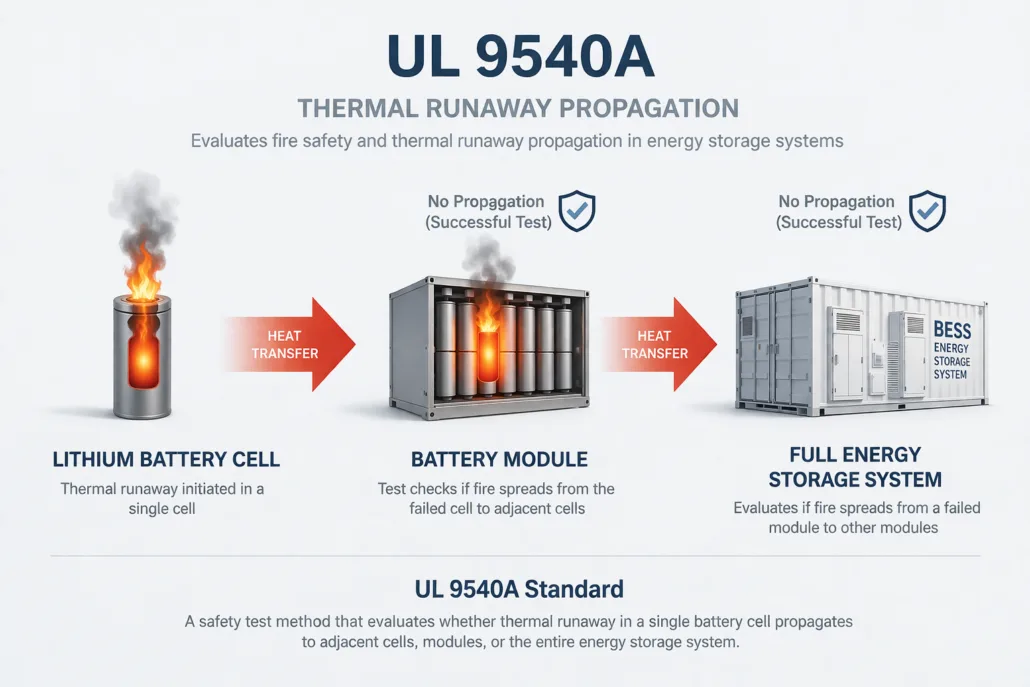
UL 9540A
Thermal Runaway Fire Propagation Test
Fire spread between battery modules
Required before UL 9540 listing
UL 1973
Stationary and Motive Battery Systems
Battery cell and pack safety
Battery pack manufacturers
UL 1741
Inverters and Power Converters
Grid-interactive inverter and PCS safety
PCS and inverter manufacturers
UL 1699B
Lithium-Ion Battery Protection
Arc fault protection in Li-ion systems
Residential and commercial BESS
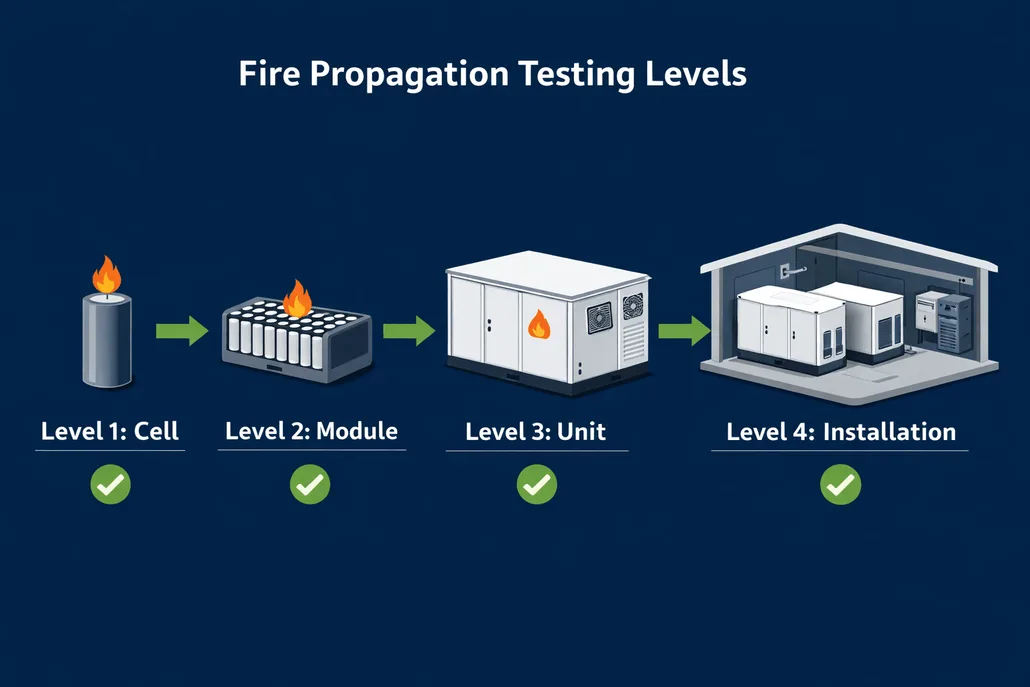
UL 9540A must be completed at three levels: cell, module, and unit. Many suppliers, however, only show the cell-level report. Consequently, buyers accept incomplete documentation without knowing it. Always demand all three levels before you proceed.
B. IEC Standards — International and European Markets
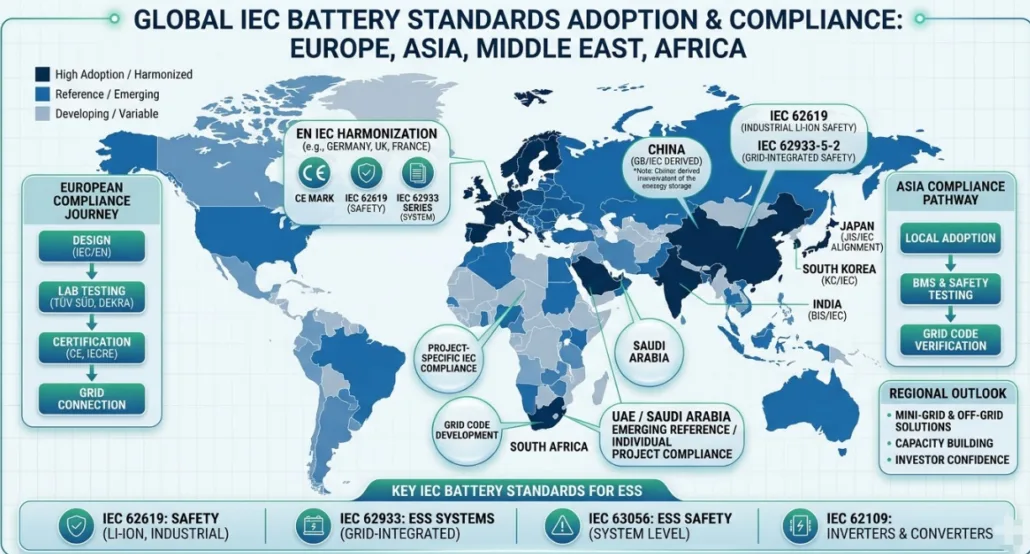
The International Electrotechnical Commission (IEC) sets globally accepted BESS certifications. As a result, IEC standards are referenced by regulators across Europe, Asia, the Middle East, and Africa. Furthermore, many utility tenders worldwide require specific IEC compliance as a minimum baseline.
Standard
Scope
Key Focus
IEC 62619
Lithium cells and batteries for stationary use
Core safety: overcharge, short circuit, thermal abuse
IEC 62933-2-1
ESS unit parameters and test methods
Performance verification of a complete assembled system
IEC 62933-5-2
Safety for grid-integrated energy storage
Cybersecurity, functional safety, grid protection
IEC 61427-2
Batteries for off-grid renewables
Cycle life and performance for solar and wind storage
IEC 61508
Functional safety of electrical systems
Applies to BMS software and firmware safety logic
C. CE Marking — European Union and EEA
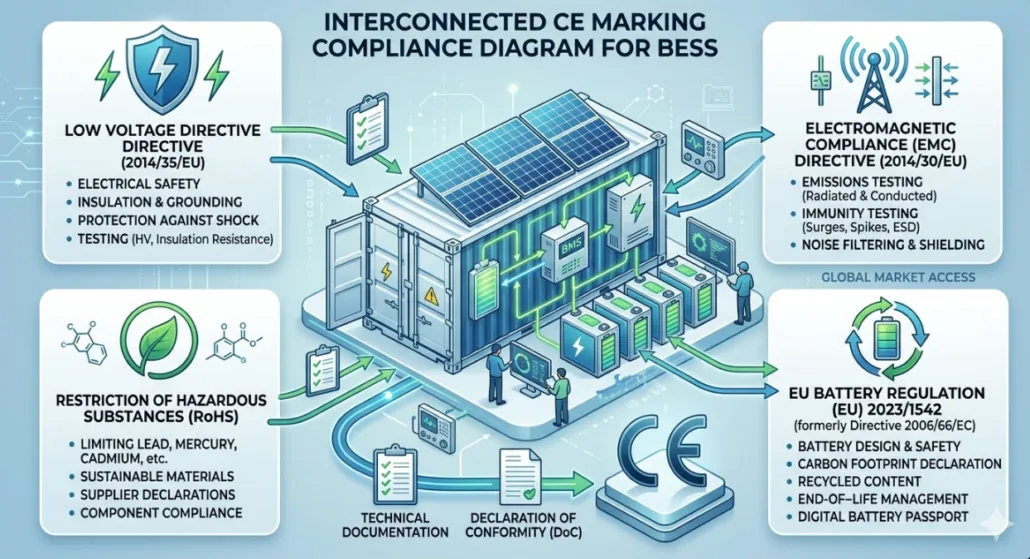
CE Marking is legally required for every battery product sold in the EU. It is not a single test. Instead, it is a Declaration of Conformity that proves compliance with several EU Directives at once. Without it, your product cannot enter the EU market legally.
Low Voltage Directive (LVD) 2014/35/EU — Electrical safety for equipment from 50V to 1000V AC
EMC Directive 2014/30/EU — Ensures BESS does not interfere with other devices
RoHS Directive 2011/65/EU — Restricts lead, mercury, cadmium, and other hazardous substances
EU Battery Regulation 2023/1542 — Adds carbon footprint declaration and Digital Battery Passport from 2024
Machinery Directive 2006/42/EC — Applies if the BESS includes any motorized or moving parts
2026 EU Update: The EU Battery Regulation adds a Digital Battery Passport for BESS above 2 kWh. From 2027, every qualifying battery needs a QR-code-linked passport with carbon footprint and supply chain data. Start compliance preparation now.
D. BIS Certification — India
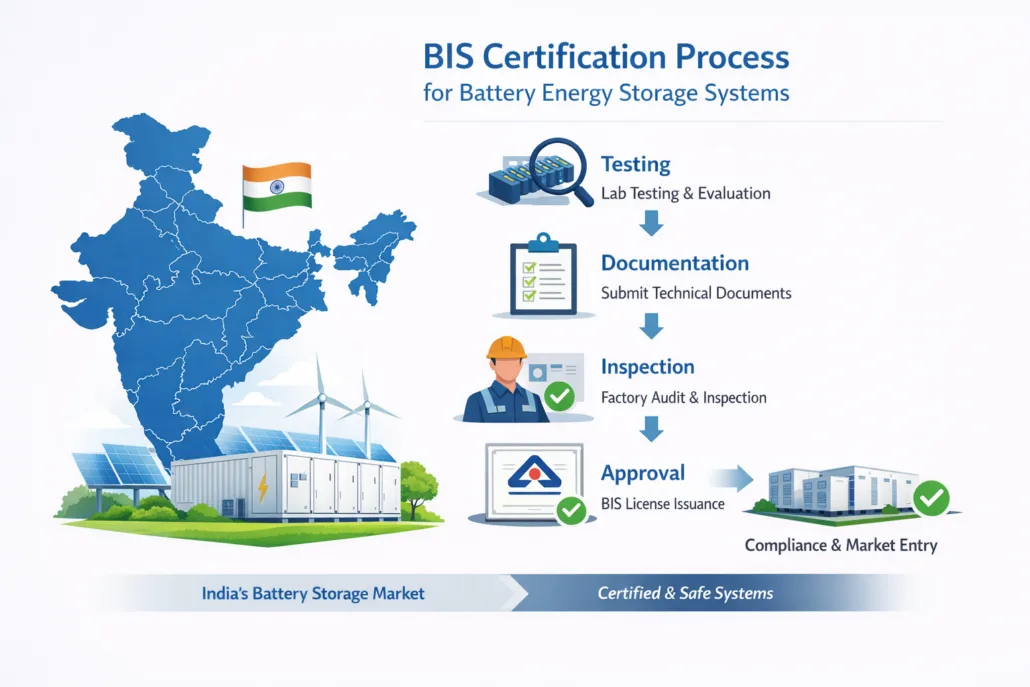
In India, the Bureau of Indian Standards (BIS) manages mandatory BESS certifications under the Compulsory Registration Scheme (CRS). Without BIS registration, products cannot clear customs or qualify for government tenders. India is a fast-growing BESS market, so this certification is increasingly important.
IS 16270:2014 — Safety for lithium-ion cells, equivalent to IEC 62133
IS 17855:2022 — Stationary lithium battery safety, aligned with IEC 62619
IEC 62619 (adopted directly) — Required for large-scale utility and industrial BESS tenders
Testing must be done at BIS-approved labs or internationally accredited labs with a BIS agreement. Additionally, registration is model-specific and must be renewed. Typical timeline: three to six months.
E. CEC Approval — Australia
Australia’s Clean Energy Council (CEC) governs BESS certifications for the Australian market. CEC listing is required for grid connection and STC rebate eligibility. Without it, network operators will not approve the connection.
AS/NZS 5139:2019 — Australian standard for battery systems with power conversion equipment
CEC Approved Product List — Products must appear on this list before any grid connection
Installer accreditation — CEC Battery Storage Accreditation is required for all installers
F. NFPA 855 — USA Fire Installation Standard
NFPA 855 governs how BESS certifications translate into safe real-world installations. While UL 9540 covers product safety, NFPA 855 covers how and where BESS is installed. Many US states have adopted it into local building codes.
Sets maximum energy capacity per room and building type
Requires fire suppression systems above defined energy thresholds
Mandates separation distances between battery racks and modules
Requires UL 9540A unit-level results as part of the permit application
Therefore, project developers must design installations to NFPA 855 from day one. Failing to do so results in permit denial — often after costly design work is already complete.
G. UN 38.3 — International Transport Certification
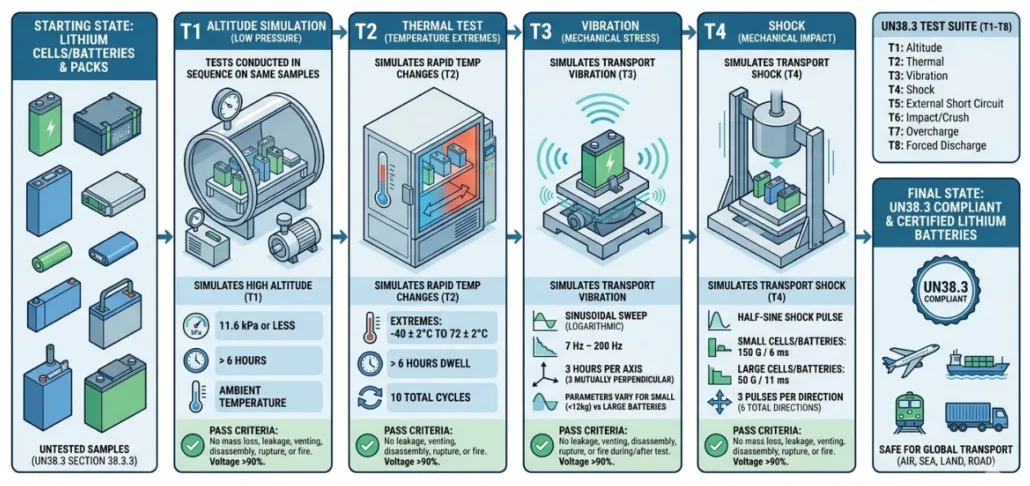
UN 38.3 is one of the most universally required BESS certifications — yet it is often overlooked. Simply put, it is the mandatory transport safety test for all lithium batteries shipped internationally. Without a valid UN 38.3 report, your shipment will be refused by airlines, shipping lines, and road carriers.
Tests include altitude simulation, thermal testing, vibration, shock, short circuit, and overcharge
Required under IATA (air), IMDG (sea), and ADR/RID (road) dangerous goods regulations
Cells, modules, and complete packs each need separate UN 38.3 documentation
Must be done at an accredited laboratory — self-certification is not accepted
Warning: Outdated or cell-only UN 38.3 reports are very common from lower-tier manufacturers. Any design change — including a new BMS version or different cell count — requires a fresh test. Check validity before every shipment.
4. System-Level vs. Component-Level BESS Certifications
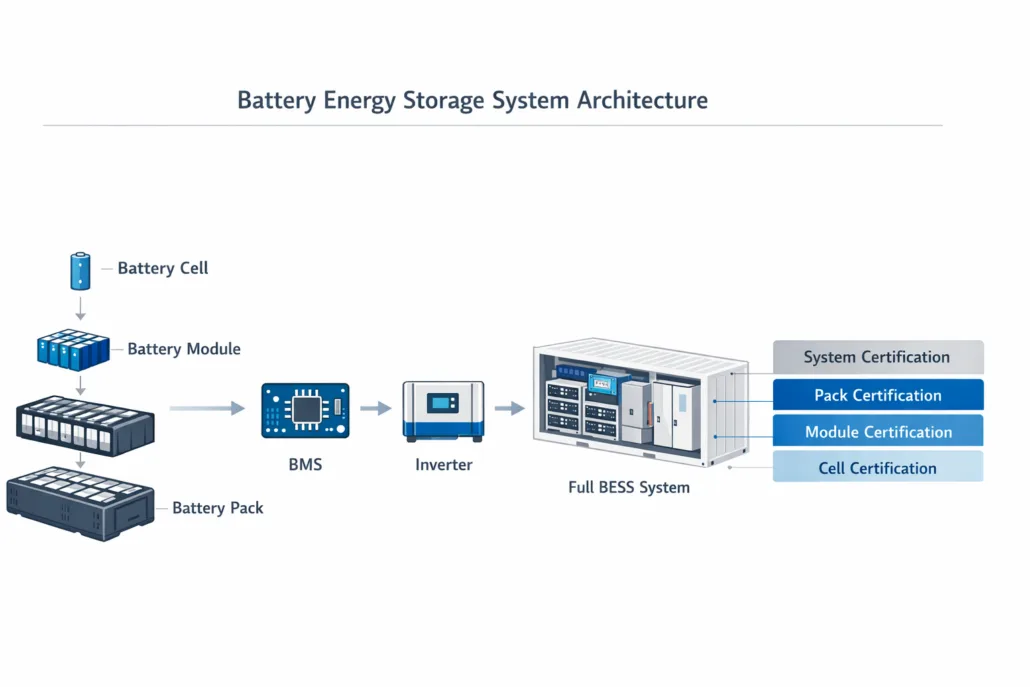
Many buyers assume that a certified component means a certified system. In practice, this is wrong. Every level of a BESS assembly needs its own BESS certifications. Moreover, any change to a component — even a firmware update — can invalidate the existing system certificate.
Component
Relevant BESS Certifications
Why Independent Certification Is Required
Individual cells
UN 38.3, IEC 62133, UL 1973
Cell chemistry, abuse tolerance, and transport safety
Battery module
UL 9540A (cell level), IEC 62619
Module-level thermal runaway fire propagation
Battery pack / rack
UL 9540A (module level), IEC 62619
Pack-level fire propagation and structural safety
BMS
IEC 61508, UL 991
Software functional safety and fault detection logic
PCS / Inverter
UL 1741, IEC 62109, CE LVD
Grid interaction, isolation, and anti-islanding protection
Full assembled system
UL 9540, UL 9540A (unit), CE, IEC 62933
System integration, fire safety, and grid compliance
For this reason, always request the full system-level test report. It must list the exact model numbers, BMS version, cell supplier, and test configuration — matching the product you will actually receive.
5. Factory Certifications That Support BESS Certifications
Product BESS certifications are only part of the picture. The factory itself also needs to meet recognized management standards. Without factory certification, there is no reliable batch traceability — and no accountability when problems arise after delivery.
Certificate
What It Proves
Relevance to BESS Buyers
ISO 9001:2015
Quality Management System
Consistent production quality and batch traceability
ISO 14001:2015
Environmental Management System
Safe handling and disposal of hazardous battery materials
ISO 45001:2018
Occupational Health and Safety
Worker safety in battery manufacturing environments
IATF 16949
Automotive-grade quality standard
Relevant for BESS using automotive-grade LFP or NMC cells
ISO/IEC 27001
Information Security Management
Required for grid-connected BESS with SCADA or IoT systems
6. How to Spot Fake or Invalid BESS Certifications
Fraudulent BESS certifications are surprisingly common — especially in the Chinese supply chain. As a result, buyers who do not know what to check often accept invalid documents. Here are the key red flags to look for:
Cell-only report shown as a system cert: Supplier shows IEC 62619 for the cell but has no system-level UL 9540 or CE Declaration
Wrong model number: The certified model is different from the product being shipped to you
Expired documents: Check the issue date and validity period on every certificate — expired certs are invalid
Unknown test lab: Lab is not listed under ILAC mutual recognition — verify at ilac.org
Missing UL 9540A unit-level test: Only cell-level results are shown; module and unit levels are absent
No Technical Construction File for CE: Self-declaration is legal, but the Technical File must exist and be available
Supplier refuses to verify: UL certs are verifiable at iq.ul.com — refusal to verify is a serious warning sign
7. BESS Certifications Cost and Timeline Overview (2026)
Budgeting early for BESS certifications is essential. Costs vary by lab, system complexity, and region. Furthermore, any change to chemistry, BMS software, or module count after certification may trigger re-testing. These are approximate benchmarks for 2025 to 2026:
BESS Certification
Approx. Cost (USD)
Timeline
Key Notes
UL 9540 — full system
$80,000 – $200,000+
6–12 months
Includes UL 9540A at all three levels
UL 9540A — thermal runaway
$30,000 – $80,000
3–6 months
Cell, module, and unit tested separately
IEC 62619
$15,000 – $40,000
3–5 months
Available at TÜV, SGS, Intertek globally
CE Marking (LVD + EMC)
$10,000 – $30,000
2–5 months
Notified body fees vary by complexity
BIS India — IS 17855
$5,000 – $15,000
3–6 months
Testing at BIS-approved or linked labs
CEC Australia
$5,000 – $20,000
2–4 months
Requires ISO 17025 accredited lab report
UN 38.3
$3,000 – $8,000
4–8 weeks
Required per battery model and configuration
ISO 9001 factory cert
$5,000 – $20,000/yr
3–6 months
Annual surveillance audits required
8. BESS Certification Buyer’s Checklist — Before You Sign
Use this checklist for every BESS certifications review before you finalize a purchase. Go through each point carefully before signing any agreement or paying a deposit:
Request the full system-level test report — confirm the model number, BMS version, and cell supplier all match
Verify certifications match your target market: UL 9540 for USA, CE for EU, BIS IS 17855 for India, CEC for Australia
Check that UL 9540A covers all three levels: cell, module, and unit
Confirm UN 38.3 covers the exact pack size and configuration being shipped
Ask for the ISO 9001 certificate scope — ensure it covers the product type you are buying
Verify all reports are current — expired documents are invalid even if they were once legitimate
Confirm the issuing lab is ILAC-accredited or recognized by the target market regulator
For the EU: request the full Declaration of Conformity and the Technical Construction File index
For India: verify the BIS registration number directly at bis.gov.in
For Australia: check the CEC approved product list before any purchase commitment
Ask whether any design changes occurred after the certification date — changes may require re-testing
9. Frequently Asked Questions About BESS Certifications
Here are the most-searched questions about BESS certifications, with direct and clear answers.
What certifications does a BESS need in the United States?
In the USA, BESS certifications include UL 9540 for the full system, UL 9540A at cell/module/unit levels, UL 1973 for battery packs, and UL 1741 for the inverter or PCS. Additionally, all US installations must comply with NFPA 855 and NEC Article 706.
Is UL 9540 mandatory for BESS in the USA?
Yes — in practice. UL 9540 is technically a voluntary standard. However, it is required by most state building codes, utility interconnection agreements, and insurance policies. Without it, your system will not be permitted or connected to the grid.
What is the difference between UL 9540 and UL 9540A?
UL 9540 is the full product safety standard for a complete BESS system. UL 9540A, however, is a specific test for fire propagation during a thermal runaway event. In other words, UL 9540A is a prerequisite test that must be passed before UL 9540 listing is granted.
Can I sell BESS in Europe without CE Marking?
No. CE Marking is a legal requirement for all electrical products in the EU and EEA. Products without it can be seized at the border. Furthermore, from 2024, the EU Battery Regulation adds extra compliance requirements beyond traditional CE directives.
Does IEC 62619 replace UL 9540?
No — they serve different purposes. IEC 62619 is a component-level standard for lithium battery safety. UL 9540, on the other hand, is a full system safety standard specific to the US market. For US sales you need UL 9540. For global acceptance, IEC 62619 is the recognized baseline.
What is UN 38.3 and is it required for BESS shipments?
UN 38.3 is the mandatory transport safety test for all lithium batteries. It is required for every international shipment of cells, modules, and packs — by air, sea, or road. Without a valid UN 38.3 report, freight forwarders and customs will reject the shipment.
How long does BESS certification take from start to finish?
Full UL 9540 certification takes six to twelve months. IEC 62619 takes three to six months. CE Marking can be completed in two to five months. UN 38.3 is the fastest at four to eight weeks. Most manufacturers apply for several certifications at the same time to reduce total time to market.
What is the EU Battery Passport and when does it apply?
The EU Battery Regulation (2023/1542) introduces a Digital Battery Passport for industrial BESS above 2 kWh sold in the EU. From 2027, each qualifying battery needs a QR-linked passport with carbon footprint and supply chain data. As a result, BESS manufacturers targeting Europe should start compliance preparation immediately.
Related Articles and Useful Links
Add these internal links when publishing on WordPress — they strengthen topical authority and support navigation: