The debate over Sodium-ion vs LiFePO4 winter performance has reached a tipping point in 2026. While Lithium Iron Phosphate (LiFePO4) is the industry leader, its struggles in the cold are well-known. Consequently, many users now want better options for cold weather.
As energy storage expands, Sodium-ion (Na-ion) is emerging as a top choice. In this guide, we break down the technical differences and why your choice depends on your local weather.
Key Takeaway
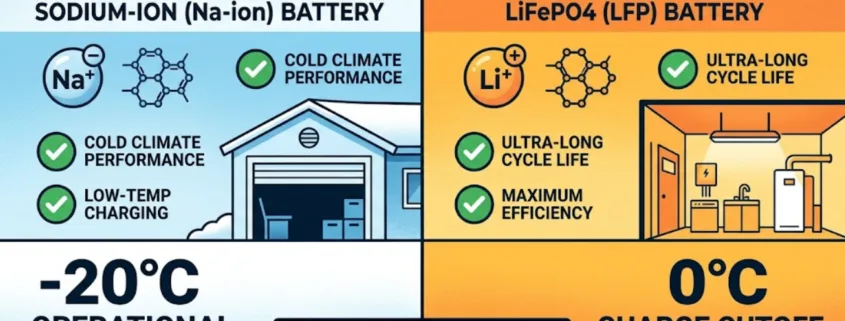
Quick Verdict: Use Sodium-ion for unheated outdoor storage in extreme cold (down to -20°C). In contrast, LiFePO4 is better for indoor or heated setups. It provides higher efficiency and a longer 10-year lifespan.
How Lithium Plating Limits LiFePO4 Winter Performance
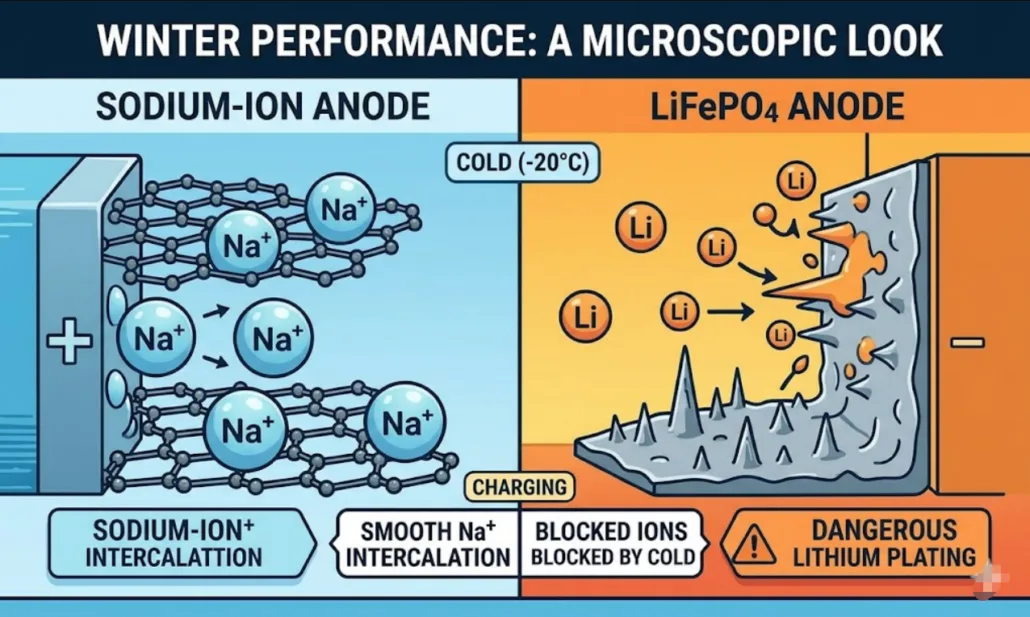
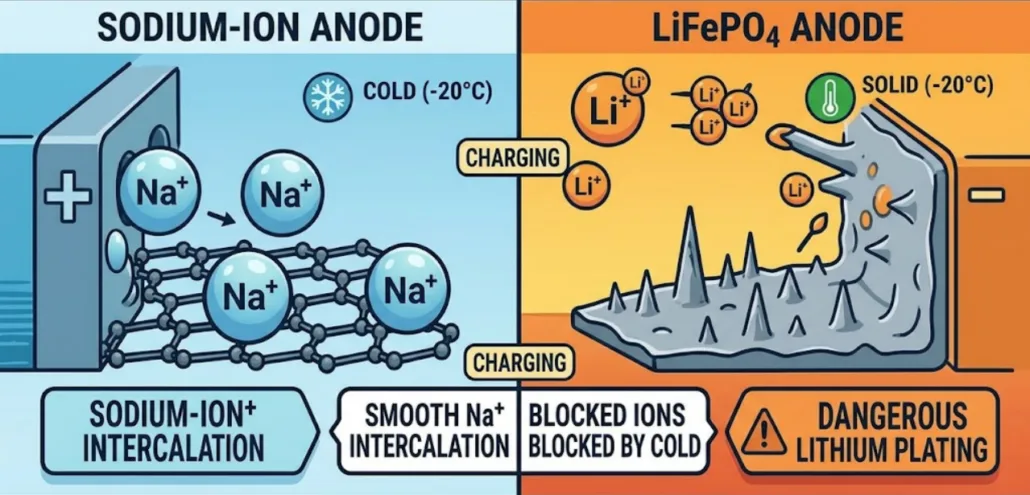
The main challenge with LiFePO4 in winter is “lithium plating.” When you charge an LFP battery below 0°C (32°F), lithium ions move too slowly. Instead of entering the anode, they coat the surface. This leads to permanent damage or shorts.
Visual comparison of ion movement at -20°C: Sodium remains stable while Lithium ‘plates’ the anode surface.
The Solution: Most BMS systems will stop the charge. Because of this, your solar system may stop working on cold days.
Why Sodium-ion vs LiFePO4 Winter Performance Favors New Tech
Unlike lithium, sodium ions move easily in freezing conditions. Furthermore, Sodium-ion batteries do not have the same plating risks. Because they are stable, they remain operational even when LFP systems fail.
Key Metrics at -20°C (-4°F):
Sodium-ion: Retains 90% of its capacity.
LiFePO4: Retains only 50-60% of its capacity.
Technical Insight: In 2026, many commercial BESS are switching to Sodium-ion. This is done to avoid the “Heating Tax,” which is the energy wasted just to keep batteries warm.
Comparing Sodium-ion vs LiFePO4 Winter Performance
When we look at the data, the differences are clear. Specifically, use this table to compare the two chemistries in extreme cold.
Feature
LiFePO4 (LFP)
Sodium-Ion (Na-ion)
Charge Temp Range
0°C to 55°C
-20°C to 55°C
Capacity at -20°C
~60%
~90%
Cycle Life
4,000 – 8,000
2,000 – 3,500
Safety State
Stable (30% SOC)
Ultra-Stable (0V Shipping)
The Efficiency Trade-Off: Is Sodium Always Better?
While Sodium-ion wins in the cold, it is less efficient overall. Moreover, this can change your total ROI.
LiFePO4 Efficiency: Offers ~96% efficiency.
Sodium-ion Efficiency: Usually hovers around 92%.
In other words, you lose more energy as heat with Sodium-ion. However, if your batteries are kept in an unheated garage, the cold-weather reliability makes Sodium-ion a better choice.
Shipping Safety: Another Win for Sodium-ion vs LiFePO4 Winter Performance
Another benefit of Sodium-ion is shipping. Because they use aluminum foil, they can be discharged to 0 Volts.
LiFePO4: Must ship at 30% charge. As a result, they are “Hazardous Goods.”
Sodium-ion: Can ship fully empty. Consequently, transport is cheaper and safer for remote winter projects.
Final Choice: Sodium-ion vs LiFePO4 Winter Performance
Ultimately, your choice depends on your location.
Choose Sodium-ion if: You have an unheated shed or garage in a very cold climate.
Choose LiFePO4 if: Your energy storage setup is in a heated basement and you want the longest lifespan.
Yes. Sodium-ion batteries charge safely down to -20°C (-4°F). They charge in the cold without heaters.
Does freezing weather damage LiFePO4 batteries?
Cold air does not hurt the battery itself. But, charging below 0°C (32°F) causes “Lithium Plating.” This creates permanent damage.
Is Sodium-ion as efficient as LiFePO4?
Sodium-ion is slightly less efficient at about 92%. In contrast, LiFePO4 is higher at 96%. Furthermore, Sodium-ion saves energy because it doesn’t need heaters.
How much capacity does Sodium-ion lose in winter?
Sodium-ion batteries keep about 90% of their power at -20°C. In contrast, standard LiFePO4 batteries may lose up to 50%.
The Ah vs Wh debate comes up every time you shop for a battery. You see both numbers on every spec sheet. However, most buyers ignore one of them. That is a costly mistake. Ah and Wh measure different things. Confusing them leads to choosing the wrong battery size.
In this guide, Sunlith Energy breaks down both measurements. You will learn the formula that links them. Additionally, you will see real conversion examples. Furthermore, we share a step-by-step method to size your own battery system correctly.
According to the International Energy Agency, battery storage is central to the global clean energy transition. Therefore, understanding how battery capacity is measured matters more than ever. Every buyer deserves to get this right.
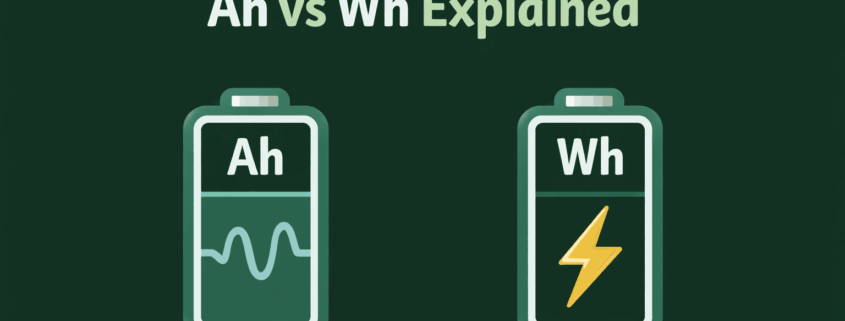
⚡ Quick Answer: Ah vs Wh Ah measures electric charge — how much current a battery delivers over time. Wh measures actual energy — charge multiplied by voltage. The formula: Wh = Ah × Voltage. For example, 100 Ah at 48V = 4,800 Wh. In contrast, 100 Ah at 12V = only 1,200 Wh. As a result, Wh is always the better metric for comparing batteries across different systems.
What Does Ah Mean? The Charge Side of Ah vs Wh
Ah stands for Amp-hours. It measures electric charge. Specifically, it tells you how many Amps a battery delivers and for how long.
The rule is simple. One Ah means 1 Amp delivered for exactly 1 hour. However, it could also mean 2 Amps for 30 minutes. Alternatively, it could be 10 Amps for 6 minutes. The total charge is always the same — only the rate changes.
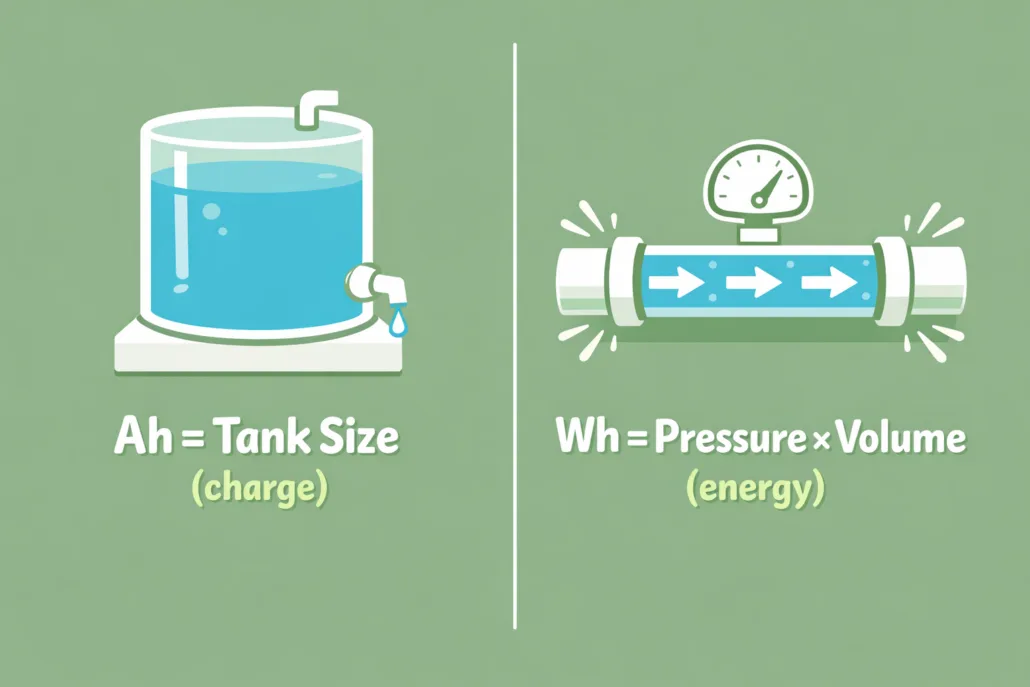
🚿 Think of Ah Like a Garden Hose Ah is the tank size. A 100 Ah battery holds enough charge for 100 Amps over 1 hour. Turn the tap up — it drains faster. Turn it down — it lasts longer. However, the total water in the tank stays the same.
When to Use Ah in the Ah vs Wh Decision
Calculating runtime — how long a battery powers a fixed-current device
Setting charge rates — C-rate is always expressed relative to Ah
Designing battery banks — when all batteries share the same voltage
Comparing batteries of identical voltage side by side
There is one important limitation. Ah is voltage-independent. Therefore, a 100 Ah battery at 12V and a 100 Ah battery at 48V have the same Ah rating. Even so, they store very different amounts of energy. That is the most common battery-buying mistake.
Wh stands for Watt-hours. It measures actual energy. Because it accounts for voltage, Wh is the more complete measurement.
Furthermore, battery energy density is expressed in Wh/kg. So understanding Wh also helps you compare weight-to-energy ratios across different chemistries.
💧 Wh = Pressure × Volume If Ah is the tank size, Wh is the total force the water delivers. That force depends on volume AND pressure (voltage). In contrast to Ah, Wh gives you the full energy picture. More voltage means more energy for the same Ah.
When to Use Wh in the Ah vs Wh Decision
Comparing batteries at different voltages — for example, 12V vs 48V
Good news: only one formula connects Ah and Wh. Voltage is the bridge between them.
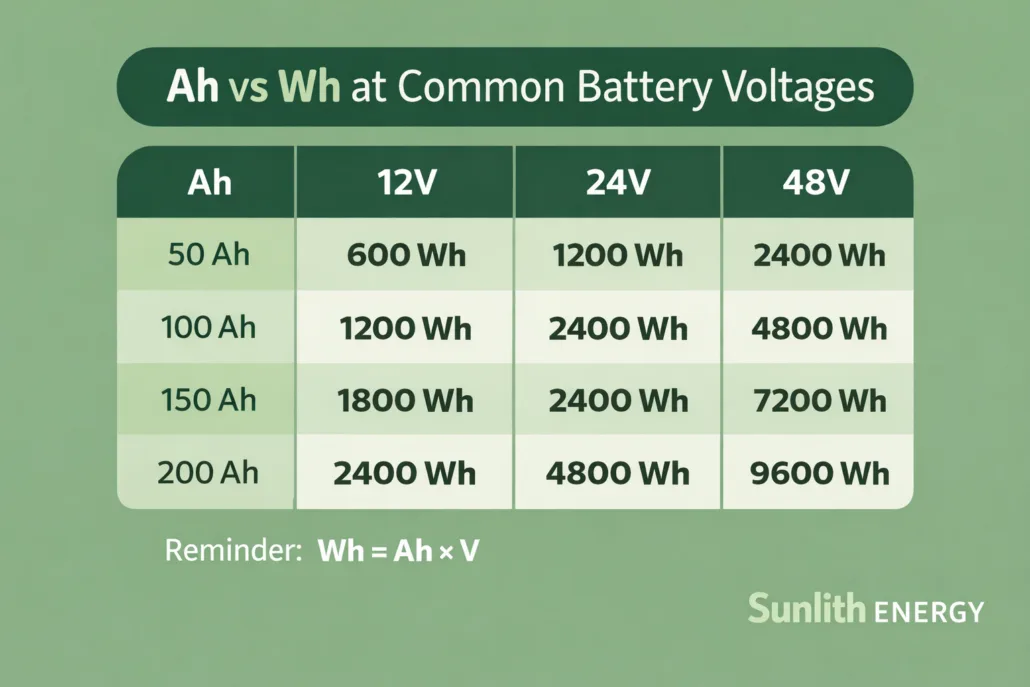
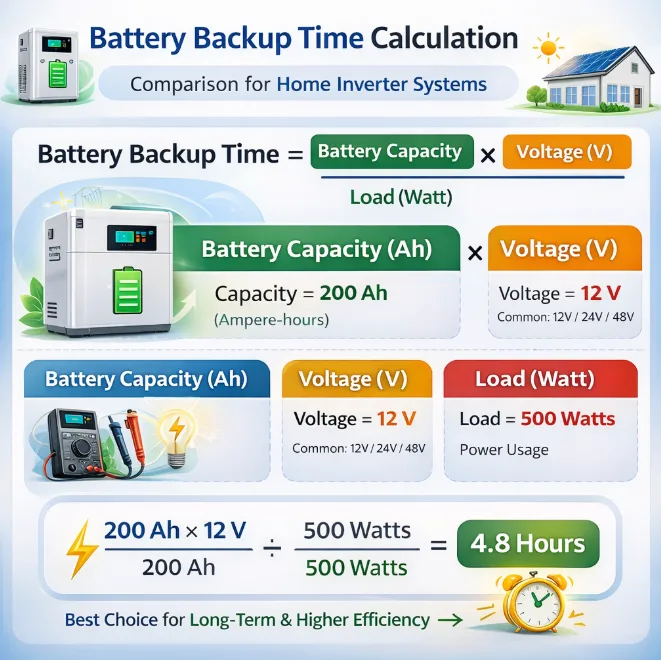
Wh = Ah × Voltage (V) Reversed: Ah = Wh ÷ Voltage For mAh: Wh = (mAh ÷ 1000) × Voltage
This explains why two batteries with the same Ah can store very different energy. Higher voltage multiplies charge into more usable Wh. As a result, 48V systems deliver far more energy per Ah than 12V setups. That is why 48V has become the standard for modern residential solar.
Ah vs Wh Conversion Examples — Real Numbers
Below are three practical examples. Each one shows how to apply the Ah vs Wh formula step by step.
Example 1 — Home Solar Battery (LiFePO4, 48V) → Battery rated: 100 Ah at 48V nominal → Formula: Wh = 100 × 48 ✅ 4,800 Wh (4.8 kWh) — runs a full-size fridge for about 2 full days
Example 2 — Portable Power Station (12V) → Battery rated: 50 Ah at 12V nominal → Formula: Wh = 50 × 12 ✅ 600 Wh — charges a laptop approximately 10 times
Example 3 — Smartphone Battery (mAh to Wh) → Battery rated: 5,000 mAh at 3.7V → Step 1: 5,000 ÷ 1,000 = 5 Ah → Step 2: Wh = 5 × 3.7 ✅ 18.5 Wh — a typical mid-range smartphone battery
⚡ Quick mAh Shortcut For 3.7V lithium cells: Wh ≈ mAh × 0.0037. Therefore, a 10,000 mAh power bank ≈ 37 Wh. Never compare mAh values from batteries with different voltages. Because voltage differs, the mAh number alone tells you nothing about energy.
Ah vs Wh — Which Metric Should You Use?
Both measurements are useful. However, the right choice depends on your question. Use this table as a quick reference:
Your Question
Use
Why
How long will my device run?
Ah
Runtime = Ah ÷ current draw
Which battery stores more energy?
Wh
Wh compares across voltages
Can I run a 100 W device for 3 hrs?
Wh
300 Wh needed — easy math
How fast can I charge this battery?
Ah
C-rate is always Ah-based
LiFePO4 vs NMC — which has more?
Wh
Different voltages make Ah wrong
Sizing solar panels and controller?
Ah
Fixed-voltage design uses Ah
Airline carry-on battery limits?
Wh
IATA rules: 100 Wh / 160 Wh
In summary: use Ah for current and time calculations within a fixed-voltage system. For everything else, use Wh. Comparing batteries across voltages or chemistries? Wh is always the right choice.
Same Ah, Very Different Energy — Why Voltage Changes Everything
Many buyers compare batteries on Ah alone. This is a common and expensive mistake. Voltage changes everything. Below is a clear example:
Battery
Ah
Voltage
Energy (Wh)
Powers…
Van / camping pack
50 Ah
12V
600 Wh
Laptop ~10×
Home 12V bank
100 Ah
12V
1,200 Wh
Fridge ~12 hrs
Home 24V bank
100 Ah
24V
2,400 Wh
Fridge ~24 hrs
Solar 48V system
100 Ah
48V
4,800 Wh
Fridge ~2 days
C&I 48V system
200 Ah
48V
9,600 Wh
Office ~1 day
As the table shows, identical Ah ratings hide very different energy levels. Consequently, always convert to Wh before comparing. For more on how chemistry affects this, see our LiFePO4 vs NMC battery guide.
What Reduces Your Real-World Ah vs Wh Capacity?
Battery labels show the theoretical maximum. In practice, usable capacity is always lower. Several factors reduce what you actually get. Understanding them is essential for accurate sizing.
1. Depth of Discharge (DoD)
Most batteries should not be fully drained. Doing so permanently damages cells. The safe depth of discharge varies by chemistry:
LiFePO4: 80–90% DoD — consequently, usable Wh = 80–90% of rated Wh
Lead-acid: only 50% DoD — therefore, you lose half your rated capacity
NMC: typically 80–85% for a long cycle life
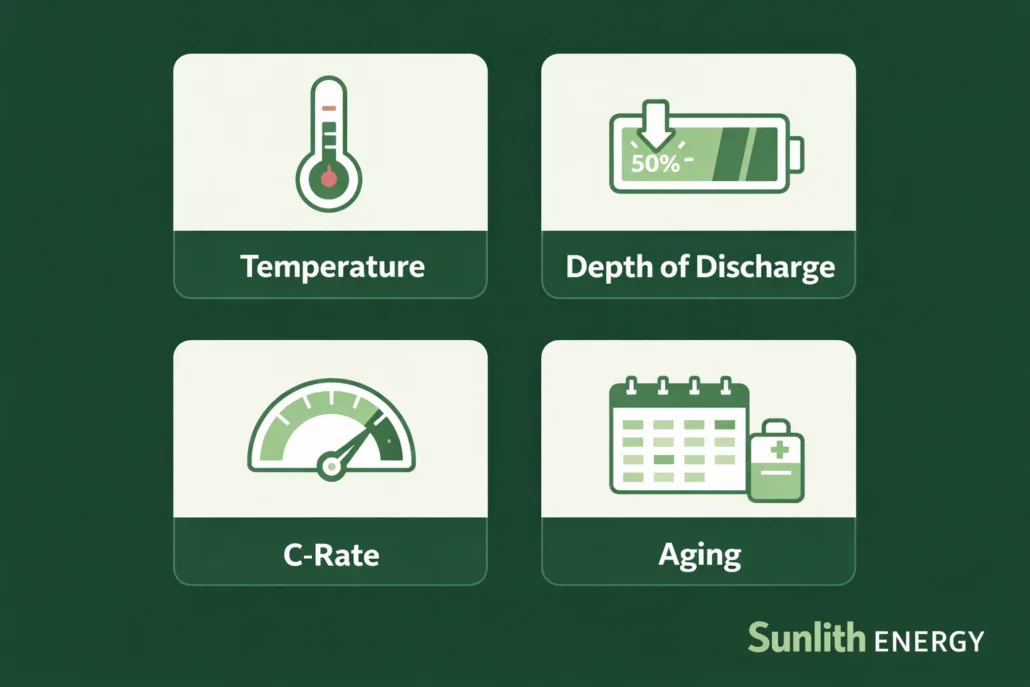
2. Temperature
Cold weather hurts batteries significantly. Below 10°C, deliverable Ah drops by 20–30%. Temperature directly impacts LiFePO4 cycle life — a rise of 10°C above 25°C can halve total cycle life. Heat, on the other hand, temporarily boosts apparent capacity. However, it accelerates permanent degradation at the same time.
3. Discharge Rate (C-Rate)
Drawing current too fast reduces total Wh delivered. For example, a battery discharged at 2C gives fewer Wh than the same battery at 0.5C. Always check the C-rate used during the manufacturer’s Ah test. Because a 0.2C rating looks far better than real-world 1C performance.
4. Battery Aging
Every cycle causes a small, permanent capacity loss. At 500 cycles, most batteries retain about 90%. At 1,000+ cycles, the best LiFePO4 cells still retain 70–80%. Consequently, factor aging into your long-term Wh budget when sizing.
5. System Efficiency Losses
Inverters, charge controllers, wiring, and BMS all consume energy. Modern lithium systems typically achieve 85–95% round-trip efficiency. Therefore, add a 10–15% buffer on top of your calculated Wh need. This protects you from real-world losses.
This efficiency depends heavily on how well the battery management system manages charge and discharge cycles — learn how a BMS works
How to Size Your Battery System Using Ah vs Wh
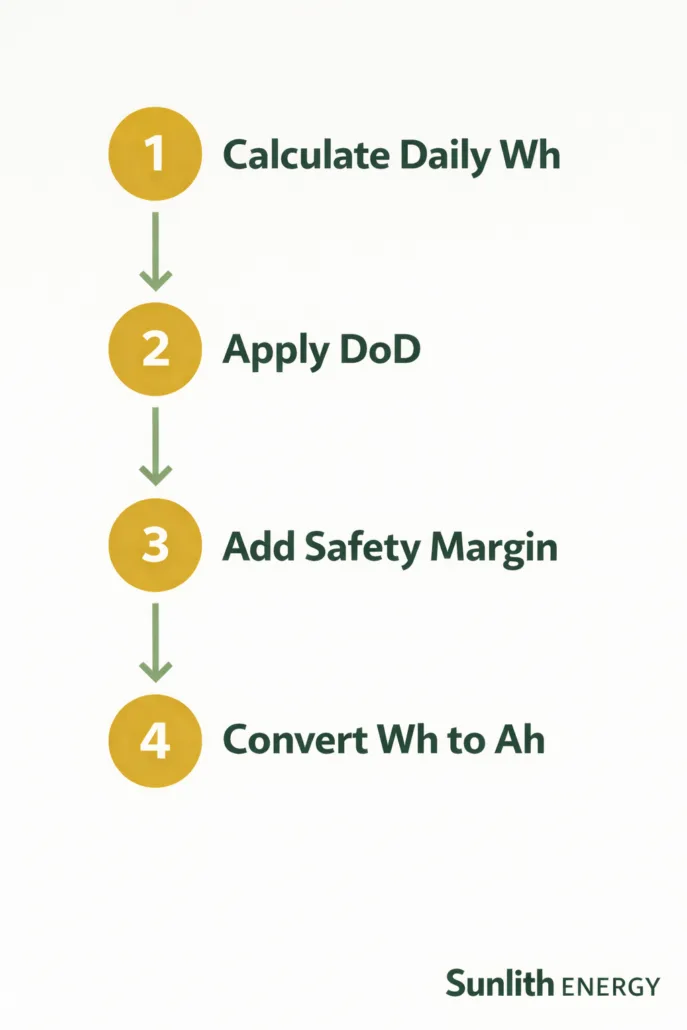
Now let’s put it all together. Below is a simple four-step sizing method. It is the same approach used in our solar battery sizing guide.
Step 1 — Calculate Your Daily Wh Requirement
List every appliance you want to power. Write down its wattage and daily run hours. Multiply watts by hours for each device. Then add them all together. For example: a 50W fridge runs 24 hours = 1,200 Wh. Four 25W LED lights run 5 hours = 500 Wh. Total: 1,700 Wh per day. Additionally, add 10% for hidden standby loads — bringing the total to about 1,870 Wh.
Step 2 — Apply the Depth of Discharge
Divide your daily Wh by the safe DoD. For LiFePO4 at 80% DoD: 1,870 ÷ 0.80 = 2,338 Wh of rated capacity needed. This step is essential. It ensures you never drain the battery below its safe limit. As a result, both lifespan and warranty are protected.
Step 3 — Add a Safety Margin
Multiply your result by 1.15 to 1.20. This covers system losses, aging, and seasonal variation. In our example: 2,338 × 1.20 = 2,806 Wh minimum rated capacity. Therefore, look for a battery bank rated at or above 2,800 Wh.
Step 4 — Convert Wh Back to Ah
Use Ah = Wh ÷ Voltage. At 48V: 2,806 ÷ 48 ≈ 58 Ah. At 24V: 2,806 ÷ 24 ≈ 117 Ah. At 12V: 2,806 ÷ 12 ≈ 234 Ah. As a result, higher-voltage systems need far fewer Ah. That is why 48V has become the industry standard for residential solar.
☀️ Sunlith Off-Grid Tip For solar or off-grid systems, size for at least 2 days without sun. Multiply your daily Wh by 2 before applying DoD and the safety margin. This protects against cloudy days and seasonal dips. → Read more: Ultimate Guide to Battery Energy Storage Systems (BESS)
Ah vs Wh — Frequently Asked Questions
Q: Is a higher Ah battery always better?
No — not always. A higher Ah means more charge, not more energy. Voltage is the missing piece. For example, 200 Ah at 12V = 2,400 Wh. However, 100 Ah at 48V = 4,800 Wh. Therefore, always compare Wh — not Ah alone.
Q: Can I compare a 12V 100 Ah battery with a 24V 100 Ah battery?
No — not on Ah alone. Convert both to Wh first. 100 × 12 = 1,200 Wh. In contrast, 100 × 24 = 2,400 Wh. The 24V battery stores twice the energy. For a full chemistry breakdown, see our LiFePO4 vs NMC battery guide.
Q: What does 100 Ah mean in practical terms?
A 100 Ah battery delivers 100 Amps for 1 hour. Alternatively, it delivers 10 Amps for 10 hours. Furthermore, it delivers 1 Amp for about 100 hours. In a 12V system, 100 Ah = 1,200 Wh. In a 48V system, 100 Ah = 4,800 Wh. Additionally, apply the DoD to find the safe, usable portion.
Q: How many Wh do I need for an off-grid solar system?
A small cabin typically needs 1–3 kWh per day. A home averages 10–30 kWh per day. Furthermore, size for 2 days of autonomy for cloudy periods. Our detailed solar sizing guide walks through the full calculation with examples.
Q: Does temperature affect Ah vs Wh?
Yes — it affects both. Cold temperatures reduce deliverable Ah. Consequently, usable Wh also drops. High heat temporarily boosts apparent capacity. However, it causes permanent degradation over time. LiFePO4 handles temperature extremes better than NMC. For the full data, see our post on temperature impact on LiFePO4 cycle life.
Q: What is the difference between mAh and Ah?
mAh means milliamp-hours. There are 1,000 mAh in 1 Ah. Consumer devices use mAh because the numbers are easier to read. To convert: divide mAh by 1,000 to get Ah. Then multiply by voltage to get Wh. For example: 5,000 mAh ÷ 1,000 × 3.7V = 18.5 Wh.
Q: What Wh limits apply to lithium batteries on aeroplanes?
According to IATA’s Lithium Battery Guidance, passengers may carry batteries up to 100 Wh without airline approval. Batteries between 100 Wh and 160 Wh require specific approval. Batteries above 160 Wh are generally not allowed in carry-on. Because rules vary by carrier, always confirm with your airline before travelling.
Q: Is LiFePO4 better than NMC for solar storage?
In most cases, yes. LiFePO4 offers better thermal safety and a longer cycle life. Its thermal runaway threshold is ~270–300°C, versus ~150°C for NMC. Furthermore, LiFePO4 performs more consistently in extreme temperatures. In contrast, NMC offers higher energy density — so it suits weight-constrained applications better. Compare both in our NMC vs LFP safety guide.
Q: Do BESS systems need certifications?
Yes — especially for commercial or grid-connected installations. Key certifications include UL 9540, IEC 62619, and CE Marking. Our BESS certifications guide covers every major standard required in 2026, what each tests, and the cost of skipping them.
Q
Conclusion — Ah vs Wh Made Simple
Knowing the Ah vs Wh difference saves you from bad battery decisions. Ah measures charge. Wh measures energy. The formula Wh = Ah × Voltage connects them. Use Ah for runtime and charge rate calculations. For everything else — especially cross-voltage comparisons — use Wh.
Additionally, always apply DoD, temperature effects, C-rate, and aging when estimating real-world usable capacity. The number on the label is a theoretical maximum. Your actual usable capacity will always be lower.
Whether you are planning a home solar install or a commercial BESS project, the Ah vs Wh distinction is the right place to start. Get it right — and every other sizing decision becomes easier.
Need Help Choosing the Right Battery? Our Sunlith Energy experts size your system — solar, BESS, off-grid, or C&I. No jargon. No pressure. Contact us: sunlithenergy.com/contact Browse our solutions: sunlithenergy.com
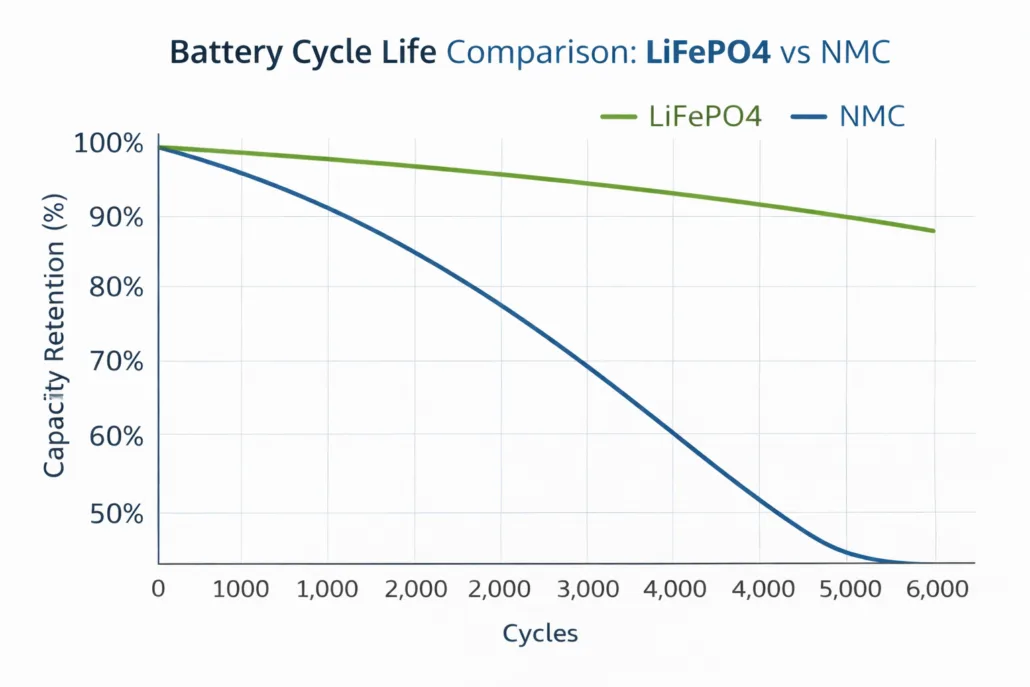
LiFePO4 vs NMC battery cycle life tells the real story: LFP delivers 3,000–10,000+ cycles, NMC typically 1,000–3,000 under the same conditions. That gap determines your total cost of ownership, replacement schedule, and real-world BESS performance over a 10–20 year project life.
In this guide, we compare LiFePO4 vs NMC battery performance across cycle life, State of Health (SOH), Depth of Discharge (DOD), temperature sensitivity, and End of Life (EOL). As a result, you’ll be able to compare options accurately — and avoid expensive mistakes.
Already familiar with SOH, DOD, and EOL? Jump straight to the comparison table below. New to these terms? Start with our Battery Cycle Standards Explained guide.
What Are LiFePO4 and NMC Batteries?
LiFePO4 (Lithium Iron Phosphate — LFP)
LiFePO4 uses an iron-phosphate cathode. It has a lower energy density than NMC. However, it is chemically far more stable. This stability gives LFP its well-known safety and longevity advantages.
Common applications: Solar energy storage, BESS, backup power, C&I storage, off-grid systems.
NMC (Nickel Manganese Cobalt)
NMC uses a combination of nickel, manganese, and cobalt in the cathode. Therefore, it delivers higher energy density per kilogram. This makes it popular in applications where space and weight matter most.
Common applications: Electric vehicles, portable electronics, space-constrained C&I BESS.
LiFePO4 vs NMC Battery: Cycle Life
LiFePO4 vs NMC Battery cycle life comparison
This is where most buyers start — and where most buyers get misled.
LiFePO4 Cycle Life
LFP cells tested under standard conditions (25°C, 80–100% DOD, EOL at 80% SOH) typically deliver:
3,000–6,000 cycles for standard-grade cells
6,000–10,000+ cycles for premium-grade cells (e.g., CATL, BYD, EVE)
The reason LFP lasts longer is its chemistry. The iron-phosphate bond is extremely stable. As a result, it does not break down as quickly during repeated charge-discharge cycles.
NMC Cycle Life
NMC cells tested under comparable conditions typically deliver:
1,000–3,000 cycles for standard-grade cells
2,000–4,000 cycles for premium-grade cells
The cobalt and nickel cathode structure is less stable than iron-phosphate. Therefore, each cycle causes slightly more lattice degradation. Over time, this accumulates faster.
The Spec Sheet Trap
Both chemistries suffer from the same problem. Manufacturers test at favourable conditions to inflate the published cycle number. For example, a common tactic is to test NMC at shallow DOD (e.g., 50%) to produce an impressive cycle count. They then compare that figure against LFP tested at full DOD. The result is a misleading comparison.
✅ Always compare cycle life tested under the same DOD, temperature, and EOL threshold. If these three conditions don’t match, the comparison is meaningless.
✅ The battery management system is also tested under these conditions — understanding what it monitors helps you read those numbers more critically.
LiFePO4 vs NMC Battery: State of Health (SOH)
SOH tells you how much capacity a battery retains compared to when it was new. A battery starts at 100% SOH. It then degrades with each cycle.
How LFP Ages
LFP degrades slowly and predictably. The capacity fade curve is relatively flat. In other words, most degradation happens gradually across the full lifespan. It does not drop sharply at a certain point.
A typical LFP cell looks like this over its life:
Cycles
SOH
0
100%
1,000
96–97%
3,000
90–92%
6,000
80% (EOL)
This predictability makes LFP ideal for long-term performance planning. For example, it works well for BESS ROI models, warranty structuring, and grid contracts.
How NMC Ages
NMC degrades faster. In addition, its degradation curve is less linear. In particular, NMC experiences accelerated degradation when operated at high temperature, high SOC (above 90%), or deep DOD. These conditions are all common in energy storage applications.
A typical NMC cell under similar conditions:
Cycles
SOH
0
100%
500
94–95%
1,500
85–87%
2,500
78–80% (approaching EOL)
For storage applications that cycle daily — such as solar self-consumption or peak shaving — NMC will therefore reach EOL significantly faster than LFP.
LiFePO4 vs NMC Battery: Depth of Discharge (DOD)
DOD directly affects how long your battery lasts. The deeper you discharge, the fewer total cycles you get.
LFP and DOD
LFP handles deep discharge well. Most LFP systems are designed for 80–100% DOD in daily operation. As a result, there are no dramatic cycle life penalties.
Practical guidance for LFP:
100% DOD: Full rated cycle life (e.g., 6,000 cycles)
NMC is much more sensitive to deep discharge. Operating NMC at 100% DOD regularly will substantially shorten its life. Because of this, many NMC-based storage systems are deliberately limited to 80–90% usable capacity to protect the cells.
Practical guidance for NMC:
100% DOD: Significantly accelerates degradation — not recommended for daily cycling
80% DOD: Standard operating range; spec sheet cycle figures often assume this
50% DOD: Can double the effective cycle count vs. 100% DOD
⚠️ If your application requires deep daily discharge — solar storage, overnight backup, peak shaving — LFP’s tolerance for high DOD is therefore a major practical advantage.
LiFePO4 vs NMC Battery: Temperature Sensitivity
Temperature impact on LiFePO4 vs NMC battery lifespan
Temperature is one of the biggest hidden variables in battery lifespan. Furthermore, it is where the LiFePO4 vs NMC battery gap widens most dramatically.
LFP and Temperature
LFP is thermally stable. The iron-phosphate chemistry has a higher thermal runaway threshold. As a result, it degrades less when exposed to elevated temperatures.
Optimal range: 15°C–35°C
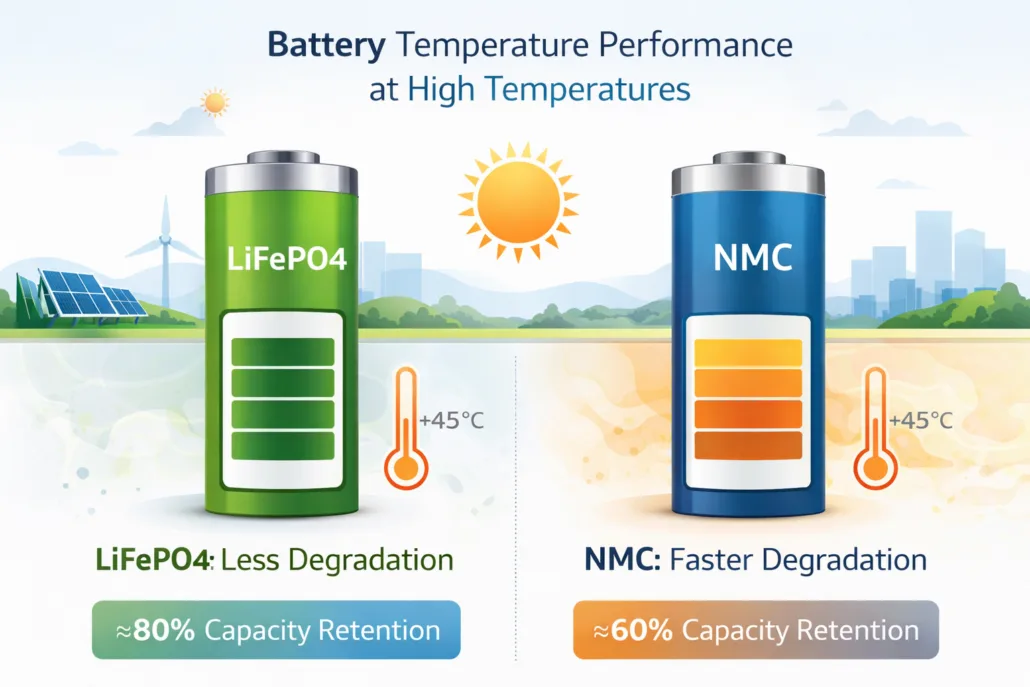
Performance at 45°C: Cycle life reduces by roughly 20–30% vs. 25°C test conditions
Safety: LFP does not combust easily, even under abuse conditions
For outdoor BESS installations, rooftop solar storage, or warm-climate deployments, LFP’s thermal resilience is therefore a critical advantage.
NMC and Temperature
NMC is more sensitive to heat. At elevated temperatures, the cobalt-rich cathode degrades faster. In addition, the risk of thermal runaway — while still manageable with a proper BMS — is higher than with LFP.
Optimal range: 15°C–30°C
Performance at 45°C: Cycle life can reduce by 40–50% vs. 25°C test conditions
High-temperature risk: Accelerated electrolyte decomposition and faster capacity fade
Most NMC spec sheets are tested at 25°C in a controlled lab. However, if your installation is in a warm climate or poorly ventilated enclosure, the actual lifespan will be considerably shorter than the published figure. A properly configured battery management system with active thermal monitoring is what catches these conditions before they damage cells.
EOL is typically defined as the point when a battery’s capacity drops to 70% or 80% of its original rated capacity. However, the practical implications differ between LFP and NMC.
LFP at EOL
When LFP reaches 80% SOH, it still behaves predictably. The capacity has declined. Nevertheless, the battery remains safe, functional, and usable for second-life applications — such as backup power or stationary storage with reduced capacity requirements.
LFP cells at EOL often still have 10+ years of second-life ahead of them.
NMC at EOL
NMC reaching EOL is a different situation. Some NMC cells experience non-linear degradation after 80% SOH. As a result, capacity can drop faster than expected and internal resistance increases more sharply. This reduces power delivery and makes the battery less predictable in operation.
Second-life applications for NMC are possible. However, they require more careful vetting and BMS management.
LiFePO4 vs NMC Battery: Head-to-Head Comparison
Factor
LiFePO4 (LFP)
NMC
Typical cycle life (EOL 80%, 100% DOD, 25°C)
3,000–6,000+
1,000–2,500
Premium cell cycle life
6,000–10,000+
2,000–4,000
SOH degradation curve
Slow and linear
Faster, less predictable
Deep DOD tolerance
Excellent (handles 100% DOD well)
Moderate (80% DOD recommended)
Temperature sensitivity
Low — handles heat well
High — significant life reduction at >35°C
Thermal safety
Very high — low runaway risk
Moderate — requires robust BMS
Energy density
Lower (~120–180 Wh/kg)
Higher (~180–280 Wh/kg)
Cost per kWh (upfront)
Slightly lower to comparable
Slightly higher
Cost per kWh over lifetime
Significantly lower
Higher
Best for
Solar storage, BESS, C&I, long-duration use
EVs, space-constrained apps
Second-life potential
Excellent
Moderate
Which Chemistry Should You Choose?
Choose LFP if:
You’re building a solar storage, C&I BESS, or utility-scale project
Your system will cycle daily (peak shaving, self-consumption, backup)
Your installation is in a warm climate or non-climate-controlled environment
You need predictable, long-term performance for ROI modelling and warranties
You’re comparing total cost of ownership over 10+ years, not just upfront price
Safety and reduced maintenance are priorities
Consider NMC if:
Space and weight are the primary constraints (e.g., mobile applications, small footprint)
The system will cycle infrequently and at shallow DOD
Temperature is well-controlled throughout the system’s life
You need maximum energy density in a fixed physical volume
The Bottom Line
For the vast majority of stationary energy storage applications, LFP wins on total cost of ownership. The higher cycle life, better temperature resilience, and predictable degradation mean you get more energy throughput per dollar over the system’s life.
NMC’s energy density advantage is real. However, it matters most where weight and volume are the primary constraints. That is why NMC dominates electric vehicles and consumer electronics — not grid storage.
A Word on Spec Sheet Claims
Everything in this article assumes you’re comparing batteries tested under the same conditions. In practice, manufacturers don’t always make this easy.
Before trusting any cycle life claim — LFP or NMC — always verify:
✅ Test temperature (25°C is standard; higher = fewer cycles)
✅ DOD used in testing (80% DOD inflates cycle count vs. 100% DOD)
✅ EOL threshold (80% SOH vs. 70% SOH gives very different numbers)
For stationary storage with daily cycling, LFP typically offers better total cost of ownership. This is because LFP has longer cycle life, better DOD tolerance, and lower temperature sensitivity. However, NMC remains competitive where energy density is the primary constraint.
Can I compare LFP and NMC cycle life directly from spec sheets?
Only if both are tested at the same DOD, temperature, and EOL threshold. A common mistake is comparing LFP at 100% DOD vs. NMC at 80% DOD. As a result, the NMC figure looks artificially strong.
Why does NMC have higher energy density than LFP?
NMC’s cathode chemistry allows more lithium ions to be stored per unit of weight and volume. However, the tradeoff is lower stability and shorter cycle life under equivalent conditions.
What happens to NMC batteries in hot climates?
Elevated temperatures above 35°C significantly accelerate NMC degradation. At 45°C, NMC cycle life can be 40–50% lower than the spec sheet figure. LFP is therefore considerably more resilient to heat.
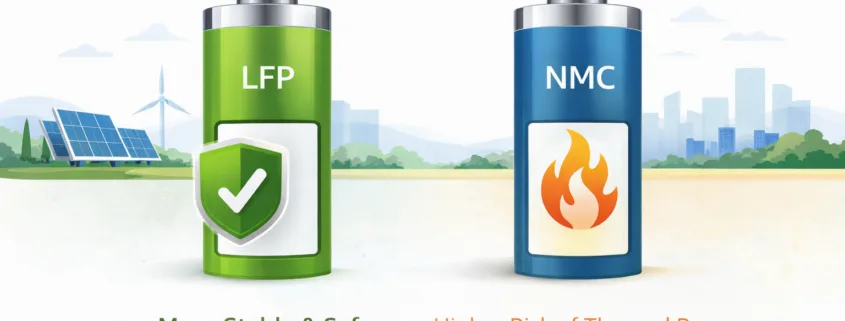
Is LFP safer than NMC?
Yes. LFP has a higher thermal runaway threshold. In addition, it is less prone to fire under abuse conditions such as overcharging, physical damage, or extreme heat. As a result, LFP is preferred for large-scale BESS where safety certifications and insurance requirements are strict.
What is the real-world lifespan difference between LFP and NMC?
For a system cycling once daily, a quality LFP system can last 15–20+ years before reaching EOL. A comparable NMC system in the same application might reach EOL in 6–10 years. Therefore, over a 20-year project life, that could mean one LFP system vs. two or more NMC replacements.
Final Thoughts
When comparing a LiFePO4 vs NMC battery for stationary storage, LFP is the stronger choice in most scenarios. It offers longer cycle life, superior temperature tolerance, better deep discharge handling, and lower lifetime cost. As a result, it is the dominant chemistry for solar storage, BESS, and C&I applications.
NMC earns its place where energy density is non-negotiable — primarily EVs and space-constrained installations. However, for stationary storage where the battery will cycle hard, in variable temperatures, over a decade or more, LFP is the more bankable choice.
The rule is simple: compare under the same conditions, ask for the full test report, and plan for real operating conditions — not lab results.
A lithium battery for inverter systems is becoming the most popular solution for home backup power. Many households and small businesses are replacing traditional lead-acid batteries with lithium batteries because they last longer, charge faster, and require almost no maintenance.
Today, a lithium battery for inverter applications is widely used in homes, small offices, and shops to provide reliable electricity during power outages. These batteries store energy and supply it to an inverter, which converts DC electricity into AC power for household appliances.
As electricity outages continue in many regions, choosing the right lithium battery for inverter backup systems has become an important decision for homeowners.
Overview
A lithium battery for inverter systems is a compact energy storage solution used in homes and small businesses to provide electricity during power outages. These batteries store electrical energy and supply it to an inverter, which converts the stored DC energy into AC electricity for household appliances. Lithium inverter batteries offer longer lifespan, faster charging, higher efficiency, and maintenance-free operation compared with traditional lead-acid inverter batteries.
What Is a Lithium Battery for Inverter Systems
A lithium battery for an inverter stores electrical energy and supplies power when the grid fails.
In a typical backup system, the battery charges while electricity from the grid is available. When a power outage occurs, the inverter automatically switches to battery power and supplies electricity to appliances.
Most modern inverter batteries use Lithium Iron Phosphate (LiFePO4) chemistry because of its safety and long lifespan.
Lithium batteries also include a Battery Management System (BMS) that monitors battery performance and protects the cells.
Key BMS protections include:
over-charge protection
over-discharge protection
temperature monitoring
short-circuit protection
These safety systems ensure reliable operation for residential energy storage applications.
How a Lithium Battery for Inverter Systems Works
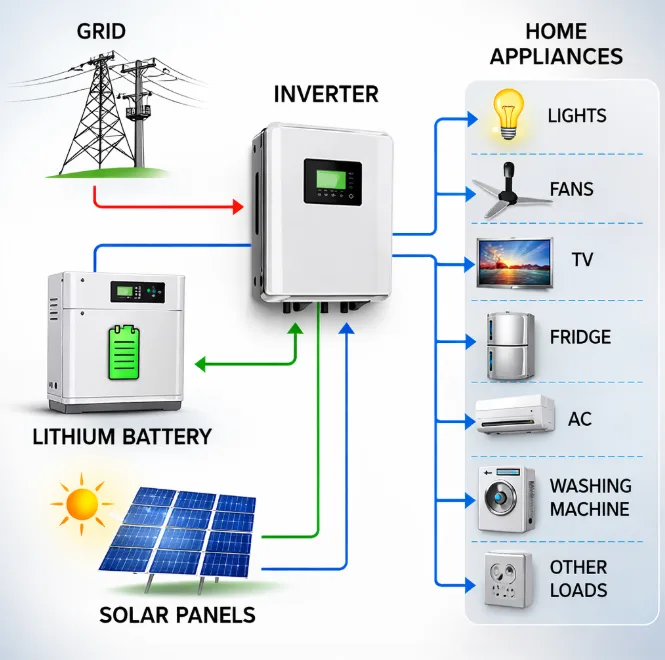
A residential inverter system typically consists of four main components:
inverter
battery
grid or solar power source
household loads
Energy flow usually follows this sequence:
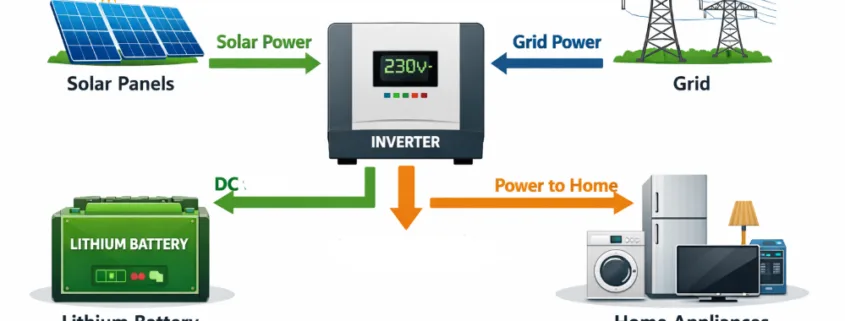
Grid or Solar Power → Inverter Charger → Lithium Battery → Home Appliances
When grid power is available, the inverter charges the lithium battery.
During a power outage, the inverter automatically draws energy from the battery and converts it into AC electricity for household appliances such as lights, fans, refrigerators, and computers.
Because lithium batteries maintain stable voltage during discharge, they provide smoother power output compared with lead-acid batteries.
Lithium Battery vs Lead Acid Inverter Battery
Lithium vs Lead Acid Inverter Battery
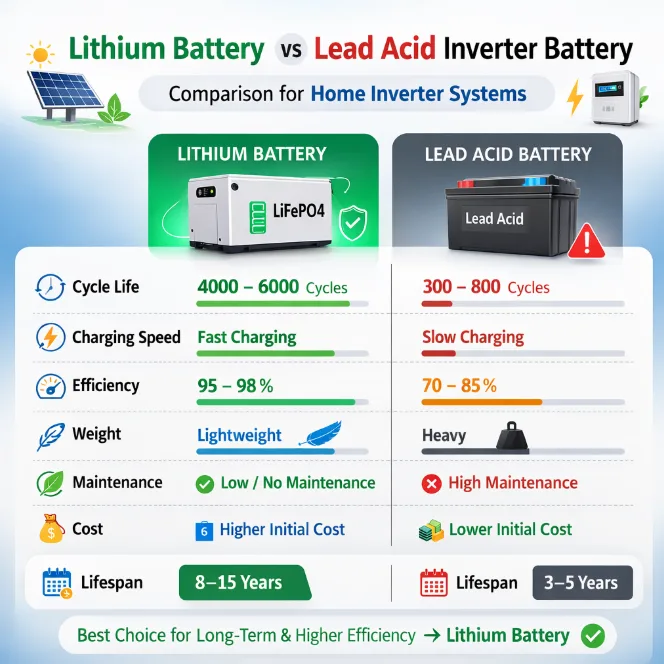
Many older inverter systems still use lead-acid batteries. However, lithium batteries offer several major advantages.
Feature
Lithium Battery
Lead Acid Battery
Cycle life
4000–6000 cycles
500–1200 cycles
Charging speed
Fast
Slow
Efficiency
90–95%
70–80%
Maintenance
Maintenance-free
Requires maintenance
Depth of discharge
Up to 90%
About 50%
Weight
Lightweight
Heavy
Although lithium batteries have a higher initial cost, they last significantly longer.
Over the system lifetime, lithium batteries often deliver lower cost per kWh of stored energy.
A detailed explanation of storage cost calculations can be found here:
Many modern inverters support lithium batteries. However, compatibility depends on charging voltage and battery communication protocols.
Older inverter models may require configuration adjustments.
How long does a lithium inverter battery last?
Most lithium inverter batteries last 10 to 15 years and can deliver 4000 to 6000 charge cycles.
This is significantly longer than traditional lead-acid batteries.
What size lithium battery is needed for a home inverter?
Battery size depends on household load and desired backup time.
Load
Recommended Battery
Small home (300–500W)
1–2 kWh battery
Medium home (500–1000W)
2–4 kWh battery
Small shop or office
3–5 kWh battery
Are lithium inverter batteries safe?
Yes. Lithium batteries designed for residential backup systems follow international safety standards such as IEC 62619 and UL 1973.
These certifications ensure safe operation.
Conclusion
Lithium batteries are transforming residential inverter systems by offering longer lifespan, higher efficiency, and faster charging.
Compared with traditional lead-acid batteries, a lithium battery for inverter systems provides better reliability and lower lifetime storage cost.
As battery technology continues to improve, lithium batteries are becoming the standard solution for home backup power and small commercial inverter applications.
Overall, a lithium battery for inverter backup systems provides reliable energy storage for homes and small businesses.
LiFePO₄ batteries are known for their long lifespan, stable chemistry, and safety. However, like all lithium-based chemistries, their cycle life is highly influenced by operating temperature.
If you want your LiFePO₄ battery to last thousands of cycles, understanding the impact of temperature is critical.
Example: If a LiFePO₄ battery starts at 100 Ah capacity and is considered “end-of-life” at 80 Ah, the number of cycles to reach this point is its cycle life.
Why Temperature Matters
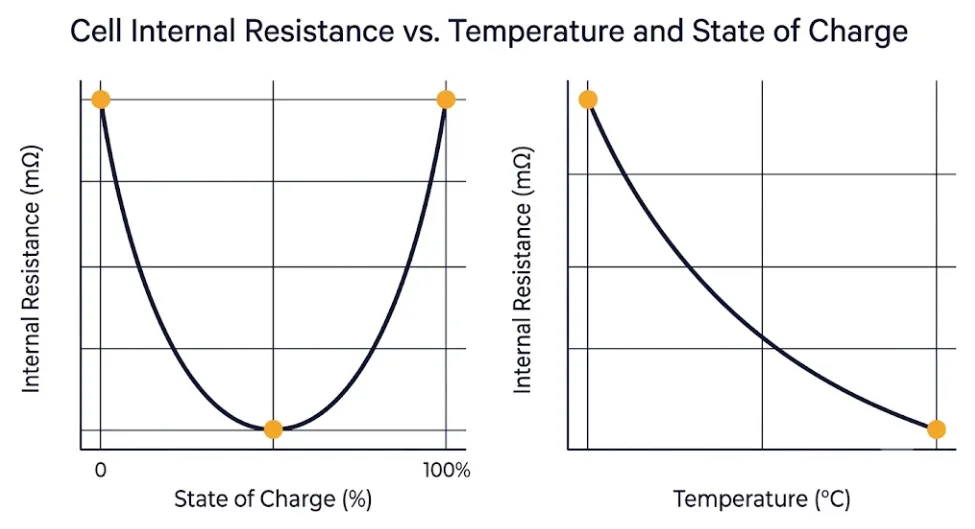
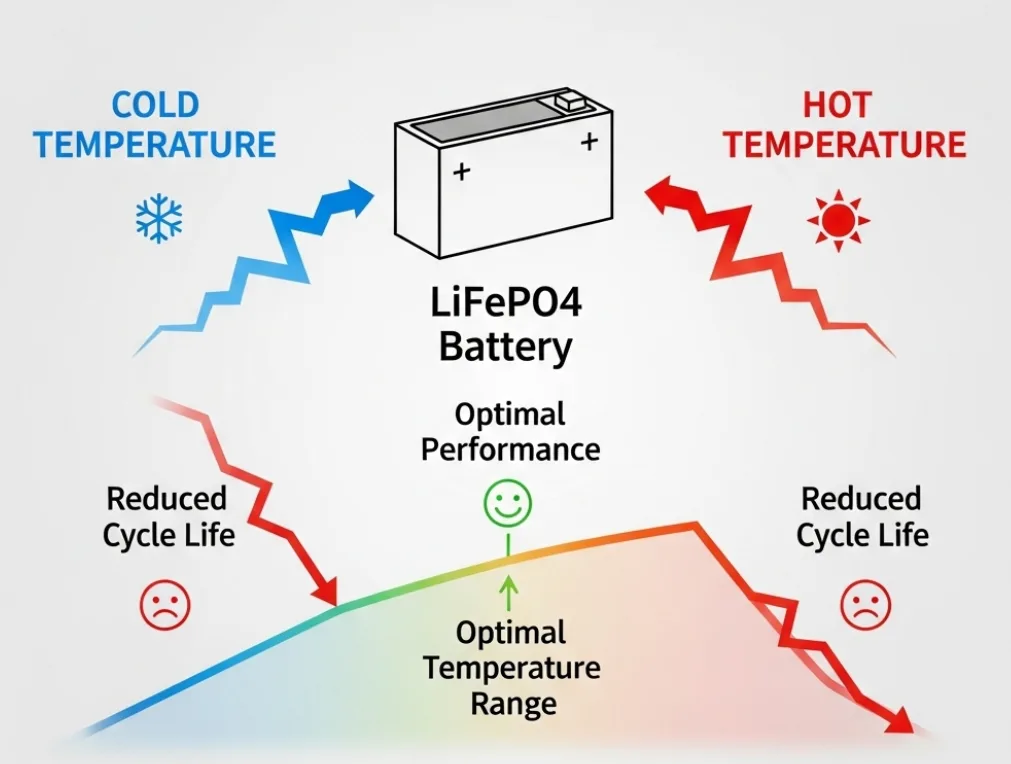
Temperature affects the electrochemical reactions, internal resistance, and degradation rate of LiFePO₄ cells:
High Temperatures (>40 °C)
Speeds up electrolyte decomposition.
Causes lithium plating and faster SEI (Solid Electrolyte Interface) growth.
Shortens cycle life drastically.
Low Temperatures (<0 °C)
Reduces ionic mobility.
Increases internal resistance.
May cause lithium plating during charging.
Optimal Range (15 °C – 30 °C)
Best balance between performance and longevity.
Minimal degradation rate.
Cycle Life at Different Temperatures – Datasheet Example
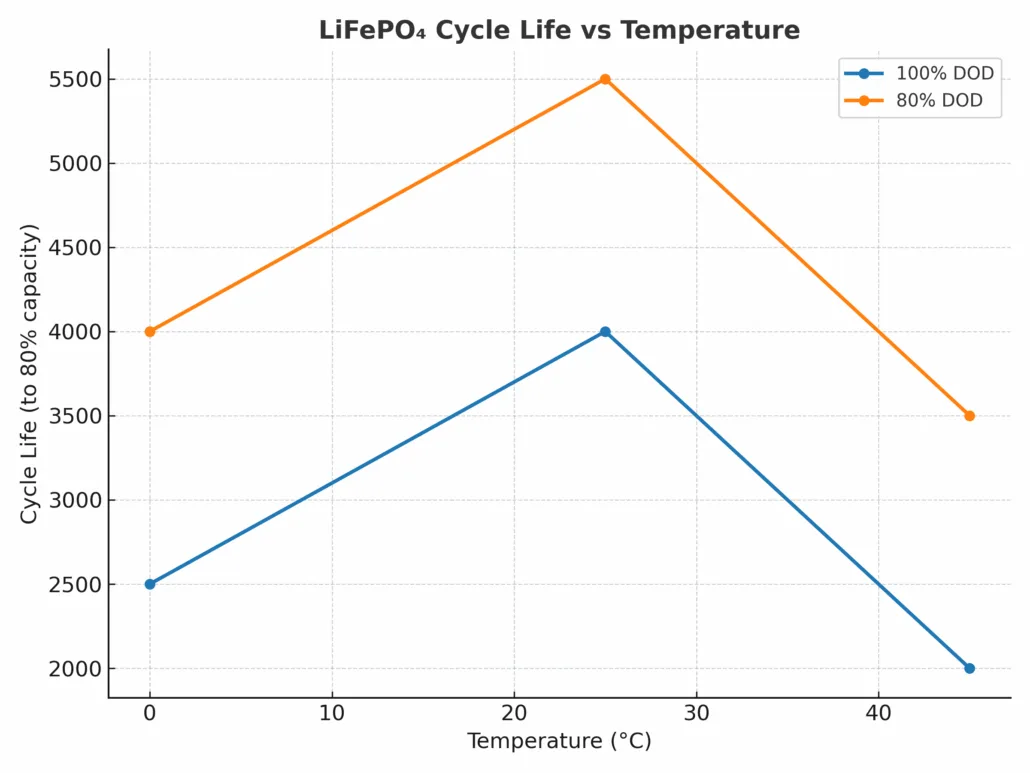
Let’s take an example from a typical LiFePO₄ cell datasheet (values are representative of many commercial cells):
Temperature
Depth of Discharge (DOD)
Cycle Life (to 80% capacity)
25 °C
100% DOD
3,500 – 4,000 cycles
25 °C
80% DOD
5,000 – 6,000 cycles
45 °C
100% DOD
~2,000 cycles
45 °C
80% DOD
~3,500 cycles
0 °C
100% DOD
~2,500 cycles
0 °C
80% DOD
~4,000 cycles
Key Takeaways from the Table:
Going from 25 °C to 45 °C can cut cycle life almost in half.
Shallower depth of discharge (DOD) greatly extends life at any temperature.
Low temperatures reduce cycle life but not as severely as high heat.
Formula – Estimating Temperature Impact on Cycle Life
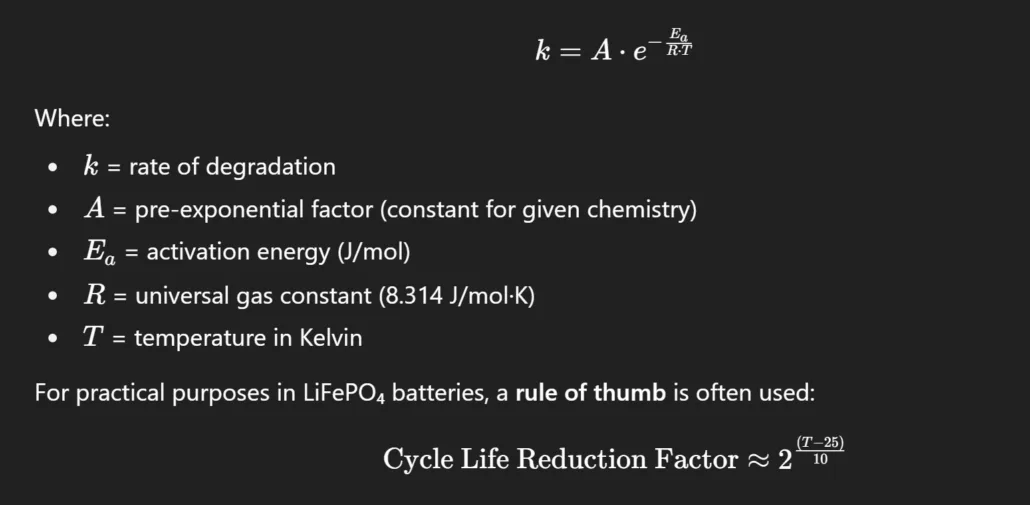
Many battery engineers use a simplified Arrhenius equation to estimate how temperature affects degradation:
Meaning:
Every 10 °C increase above 25 °C halves the cycle life.
Every 10 °C decrease below 25 °C increases life slightly, but at the cost of lower performance.
Example Calculation: If a LiFePO₄ battery has 4,000 cycles at 25 °C: At 45 °C
Practical Recommendations for Maximizing LiFePO₄ Batteries Cycle Life
Keep Batteries Cool
Maintain temperature between 15 °C and 30 °C during charging and discharging.
Use ventilation or active cooling for large battery banks.
Avoid Charging in Extreme Cold
Below 0 °C, charge rates must be reduced or avoided entirely to prevent lithium plating.
Ensures cells are operated within safe voltage and temperature limits.
Final Thoughts
Temperature has a direct, measurable impact on LiFePO₄ cycle life. While the chemistry is far more temperature-tolerant than other lithium-ion types, excessive heat is still the fastest way to kill a battery.
By keeping your batteries in the optimal range, using a good BMS, and managing DOD, you can achieve 5,000+ cycles and over 10 years of reliable performance.