
What is AC Coupled BESS? Core Components, How It Works & Its Advantages
As the world races toward a cleaner future, storing renewable energy efficiently is no longer optional—it’s essential. At the core of this transition is the Battery Energy Storage System (BESS). Among its many forms, the AC Coupled BESS stands out for its flexibility, reliability, and ease of integration. Whether you’re expanding an existing solar setup or starting fresh, this powerful configuration could be the key to true energy freedom. In this post, we’ll uncover what makes AC coupling special—and why it might just be the smarter choice for your energy journey.
What is AC Coupled BESS?
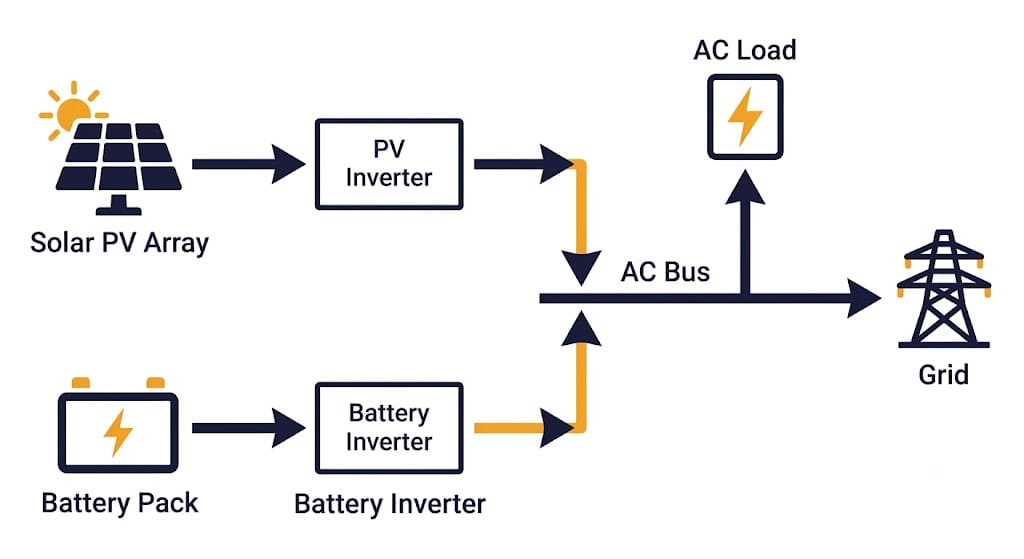
AC Coupled BESS (Battery Energy Storage System) refers to a type of energy storage architecture where the battery system is connected to the electrical grid or load side through an alternating current (AC) interface. Unlike DC-coupled systems, where the battery shares a common DC bus with solar inverters, AC-coupled systems require separate inverters for both solar (or other generation sources) and battery storage.
AC coupling is a smart, scalable solution often used in retrofit projects, hybrid systems, and microgrids, offering flexibility in design and control.
Core Components of AC Coupled BESS
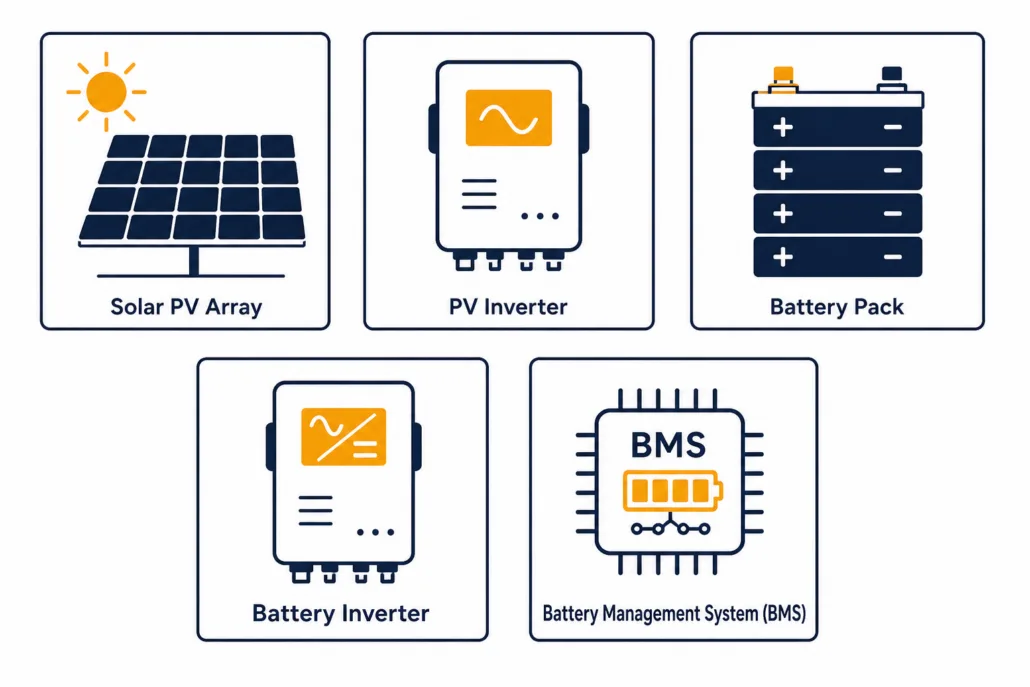
An AC Coupled BESS typically consists of the following key components:
1. Battery Pack
The heart of the system – stores energy chemically and discharges it as needed. Battery types include:
- Lithium-ion (most common)
- LFP (Lithium Iron Phosphate)
- NMC (Nickel Manganese Cobalt)
- Lead-acid (less common today)
2. Battery Management System (BMS)
Monitors and protects the battery cells by managing parameters like voltage, temperature, and charge/discharge rates. Prevents overcharging, deep discharging, and ensures system longevity.
3. Battery Inverter (Bidirectional Inverter)
This converts DC power from the battery into AC for grid compatibility, and vice versa during charging. Also known as a PCS (Power Conversion System) in utility-scale deployments.
4. Energy Meter
Monitors and measures the energy flow to and from the battery, PV system, grid, and loads. Helps in performance monitoring and utility compliance.
5. EMS (Energy Management System)
The brain of the system – it manages how and when the battery charges or discharges based on load demand, time-of-use pricing, grid signals, and PV generation.
6. Grid Connection / Load Panel
Where the system connects to the facility’s electrical infrastructure, enabling energy import/export and onsite consumption.
AC Coupled Battery Storage: How Energy Moves Through the System
AC-coupled battery storage keeps the battery and the solar PV array on entirely separate circuits until they meet at the AC side of the system. During the day, the solar PV inverter generates AC electricity directly from the array. Any excess AC power not used on-site routes to the battery inverter, which converts it to DC to charge the battery — a process the BMS manages for safety and battery health.
When load demand exceeds generation, such as at night, the battery inverter reverses that conversion: it takes the battery’s stored DC power and converts it back to AC to supply the home or facility. Depending on how the system is configured, it can also import power from the grid or export excess energy back to it, enabling peak shaving, backup power, and participation in demand response programs.
This separation between the solar and battery inverters is what makes AC-coupled energy storage the more common retrofit choice: because the battery inverter operates independently, you can add AC-coupled battery storage to a solar system that’s already running without reconfiguring the existing PV inverter or rewiring the array. The U.S. Department of Energy has funded toolkit development specifically to simplify this kind of retrofit interconnection as battery storage adoption grows alongside existing solar installations.
For a side-by-side breakdown of how this compares to a shared-inverter DC-coupled design, see AC-Coupled vs. DC-Coupled BESS: Which Architecture Is Right for Your Project?.
The Role of the Battery Inverter in AC Coupled BESS
In an AC-coupled BESS, the battery inverter does the same core job as a hybrid inverter in a DC-coupled system, but it works alone rather than sharing duties with the solar inverter. It converts DC power from the battery to AC when discharging, and AC back to DC when charging, and it manages that conversion independently of whatever the solar PV inverter is doing at the same time.
Because the battery inverter operates on its own, AC-coupled systems can size, replace, or upgrade the battery inverter without touching the solar side at all — one of the main reasons AC-coupled storage stays the easier architecture to retrofit or expand in phases.
For a full breakdown of how the PCS works and what it does in a BESS, see our guide: Power Conversion System (PCS): The Brain Behind Battery Energy Storage Systems.
Advantages of AC Coupled BESS
AC Coupled systems offer several compelling advantages:
1. Retrofit-Friendly
Easier to integrate into existing solar PV systems. No need to modify the existing DC infrastructure.
2. Modular & Scalable
You can scale solar and battery systems independently. Ideal for adding more storage or generation capacity later.
3. Enhanced Redundancy
Separate inverters mean that if the solar or battery inverter fails, the other can still operate independently.
4. Flexible Control Strategies
AC coupling allows integration of diverse energy sources (wind, genset, hydro) and supports complex control logics using EMS.
5. Supports Microgrids & Off-Grid Applications
Crucial for backup power and remote areas. Works well in microgrids with multiple power sources and fluctuating load demands.
6. Time-of-Use Optimization
Charge batteries when electricity is cheap, and discharge during peak pricing. This helps reduce electricity bills significantly.
7. Grid Services Compatibility
Advanced systems can provide frequency regulation, voltage support, and participate in ancillary service markets.
AC Coupled vs. DC Coupled BESS
The core difference: AC-coupled systems use two separate inverters — one for solar, one for the battery — connected on the AC side. DC-coupled systems share a single inverter, with the battery and PV array on the same DC bus. AC-coupled is generally the easier, more flexible retrofit path; DC-coupled tends to be more efficient and lower-cost for new-build projects.
For the full side-by-side comparison — efficiency, cost, curtailment capture, grid response, and a breakdown of when to choose each — see our complete guide: AC-Coupled vs. DC-Coupled BESS: Which Architecture Is Right for Your Project?
Where is AC Coupled BESS Used?
- Commercial and Industrial facilities needing power backup or time-of-use optimization.
- Remote microgrids with multiple sources of energy.
- Retrofit projects adding batteries to an existing solar system.
- Utility-scale grid support installations where power export, voltage regulation, and load shifting are required.
Frequently Asked Questions
What does “AC-coupled” mean?
AC-coupled means the solar PV array and the battery each connect to the grid through their own separate inverter, meeting only on the AC side of the system rather than sharing a DC bus.
What is an AC-coupled inverter?
An AC-coupled inverter is the dedicated inverter that connects a battery to the AC side of a solar-plus-storage system. It operates independently from the solar PV inverter, which is why AC-coupled systems use two inverters instead of one.
Is BESS the same as a PV system?
No. BESS (Battery Energy Storage System) refers specifically to the battery and its supporting hardware. A PV system refers to the solar panels and their inverter. Most solar-plus-storage projects combine both, but they’re distinct pieces of equipment with separate specifications.
What’s the difference between AC coupling and DC coupling?
AC coupling uses two inverters, one for solar and one for the battery, connected on the AC side. DC coupling shares a single inverter, with solar and battery on the same DC bus. See our full comparison in AC-Coupled vs. DC-Coupled BESS: Which Architecture Is Right for Your Project?.
Can AC-coupled batteries connect to any solar system?
In most cases, yes. Because AC-coupled batteries connect on the AC side through their own inverter, they can typically be added to an existing solar installation without modifying the PV array or its inverter, which is why AC-coupling is the more common retrofit choice.
Conclusion
AC Coupled BESS is a versatile and future-proof energy storage architecture. While it involves slightly more components and costs compared to DC coupling, the flexibility, redundancy, and modularity it offers make it a favorite for professionals designing hybrid systems, microgrids, and energy-resilient facilities.
Whether you’re an engineer, energy consultant, or business owner exploring storage solutions – understanding how AC coupled BESS works is key to making smarter energy decisions.
Need help sourcing or evaluating AC Coupled BESS systems?
As a New Energy Consultant with over 13 years in China’s energy sector, I help global clients source reliable BESS products, conduct factory audits, and ensure full compliance with international standards.
Let’s connect on LinkedIn or reach out to discuss your project requirements.




Trackbacks & Pingbacks
[…] An AC-coupled BESS connects the battery to the grid through its own dedicated inverter. This component sits separate from the solar PV inverter. Power from PV and power from the battery meet on the AC side of the system rather than sharing a DC bus. This makes AC-coupled storage the more common choice when you’re adding a battery to solar you already have running. For the full breakdown of components and operation, see What is AC Coupled BESS?. […]
[…] 👉 Learn how energy storage systems work:https://sunlithenergy.com/ac-coupled-bess-explained/ […]
[…] https://sunlithenergy.com/ac-coupled-bess-explained/ […]
[…] In AC-coupled BESS systems, the battery storage is connected to the grid through an inverter separat… This design is popular for retrofitting existing solar systems. […]
Leave a Reply
Want to join the discussion?Feel free to contribute!