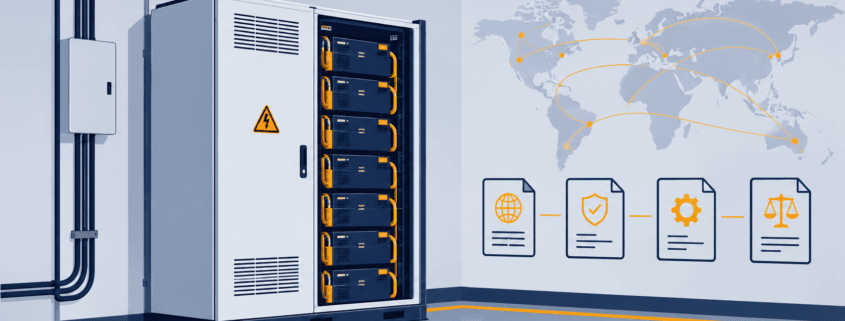
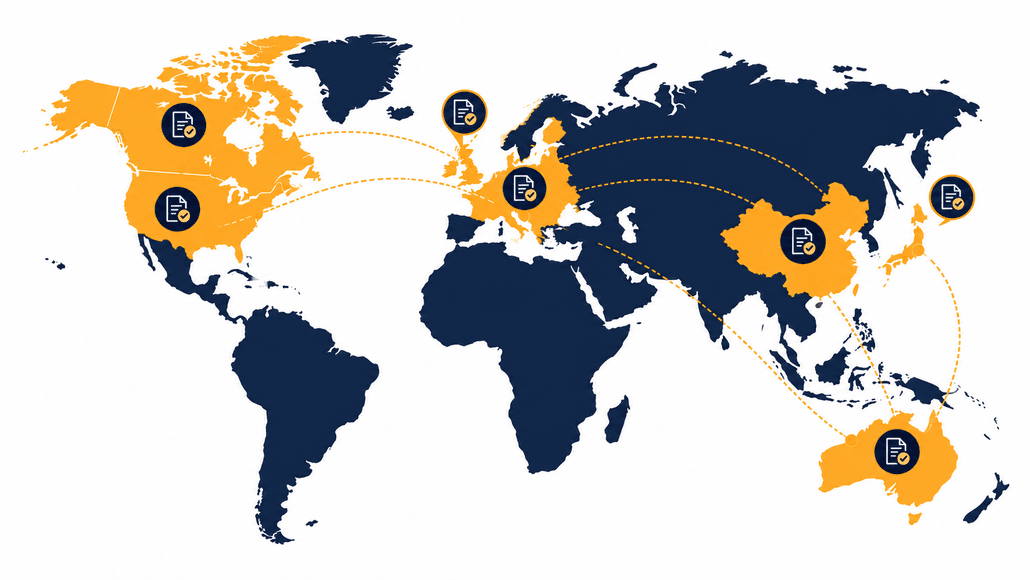
Indoor battery installation regulations differ by country, and often by state, province, or city within that same country. Because of this, a lithium battery system approved for sale in one market isn’t automatically approved for indoor installation there.
Two separate questions decide compliance. First, does the hardware meet a recognized safety standard? Second, is it sited, separated, and protected correctly for that room, under the code edition the local area has actually adopted?
This guide is for ESS manufacturers, distributors, installers, developers, and facility owners, and covers residential, commercial, and light-industrial indoor installations. Even so, it is not a substitute for project-specific engineering, code review, or sign-off from the authority having jurisdiction (AHJ).
Quick Answer
Indoor lithium-ion battery storage must meet the electrical, building, and fire-safety rules where the project sits. It must also meet the certification terms tied to that product. System certification and fire-test data support compliance. Neither replaces project-specific design review or sign-off from the authority having jurisdiction (AHJ).
Important
This article gives a high-level regulatory overview. It is not engineering, legal, fire-safety, or permitting advice. Rules depend on the locally adopted code edition. They also depend on ESS chemistry and capacity, building occupancy, manufacturer instructions, product listing, and the local authority’s judgment. Confirm project rules with qualified local professionals before installation.
Why Indoor Battery Installation Regulations Vary by Country
Every framework below regulates the same failure mode: a lithium cell in thermal runaway releases heat, flammable off-gas, and, in a confined space, pressure.
What differs is how each system of codes assigns responsibility for that risk. Some lean on cell-level certification. While others lean on system-level test data, installation separation rules, building and fire code, or a mix of all four. For example, the U.S. National Fire Protection Association publishes the installation standard most American areas reference. Its scope shows how differently one country can frame the same physics problem.
Quick Reference: Indoor Battery Installation Regulations by Region
The table below summarizes each market’s main framework, plus the key product evidence and the practical sign-off authority.
Region
Main installation framework
Key product/system evidence
Practical approval authority
United States
NFPA 855 (where adopted), IFC/IBC rules, NEC Article 706
UL 9540 listing; UL 9540A test data where required
Local AHJ
Canada
Canadian Electrical Code (CSA C22.1), provincial/territorial codes
ANSI/CAN/UL 9540; ANSI/CAN/UL 1973 where applicable
Provincial or municipal authority
European Union
National electrical, building, and fire rules
IEC 62619 and related EN standards; CE conformity
National or local regulator
Germany
National rules plus VDE practice
IEC standards and VDE-AR-E 2510-50 where specified or expected
Installer, insurer, local authority
United Kingdom
PAS 63100, BS 7671 Chapter 57, relevant building/fire rules
Relevant product standards and installer paperwork
Installer, building control, MCS scheme rules
Australia / NZ
AS/NZS 5139 plus electrical/grid standards
Relevant battery and inverter certifications
Licensed installer and local regulator
China
GB 51048, GB/T 42288 — mainly station-scale
Certification path varies by product category; verify locally
Local fire and regulatory authorities
Japan
Fire Service Act, Electrical Appliances and Materials Safety Act
Product-specific METI/PSE/JIS/IEC review
Local fire authority and relevant regulator
Treat the China and Japan rows as directional starting points, not final answers, because those sections below explain why.
United States: NFPA 855, UL 9540A, and NEC Article 706
UL 9540A Is a Test Method, Not a Certification
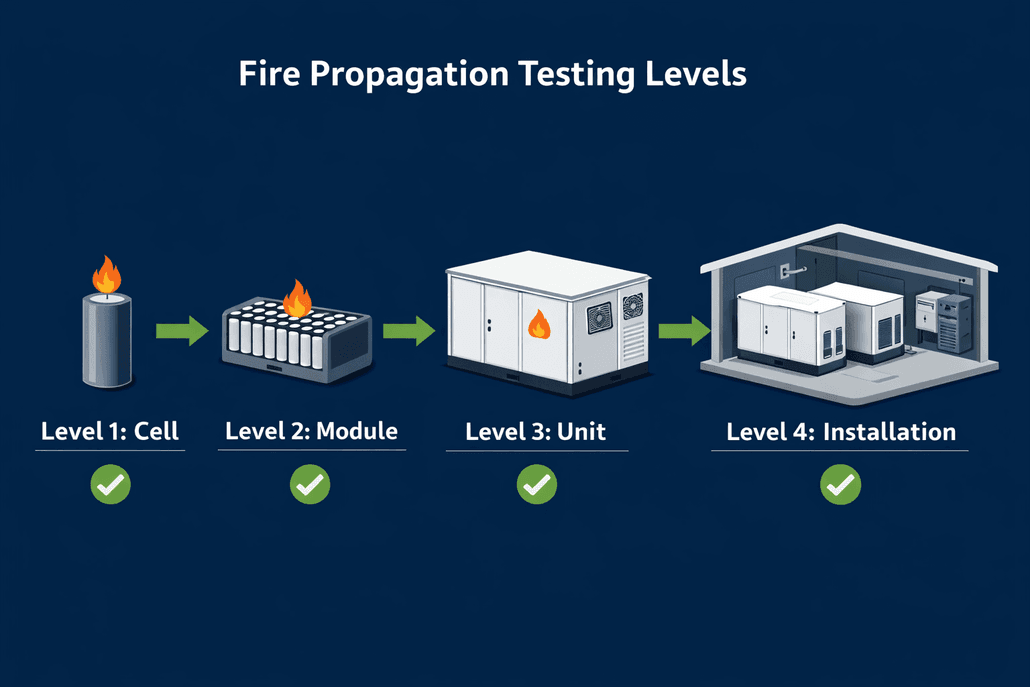
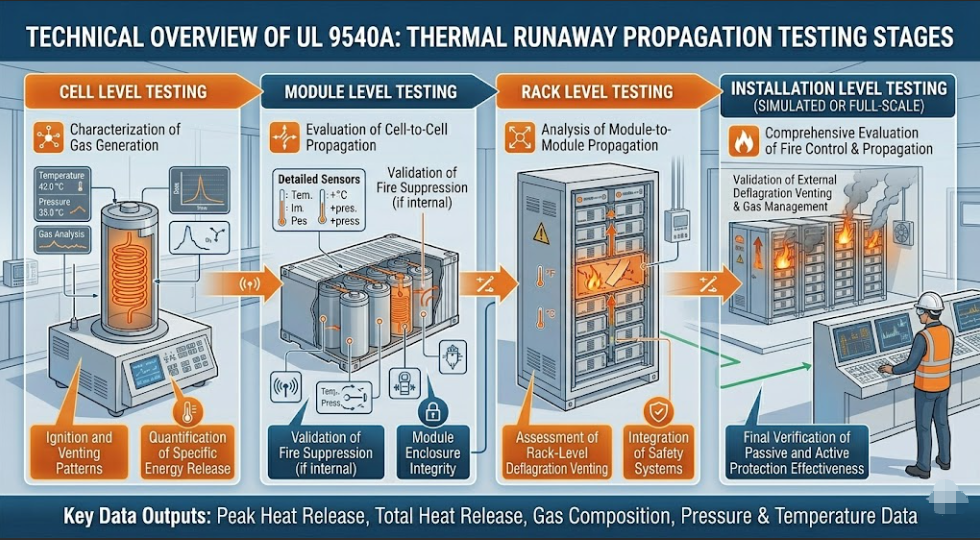
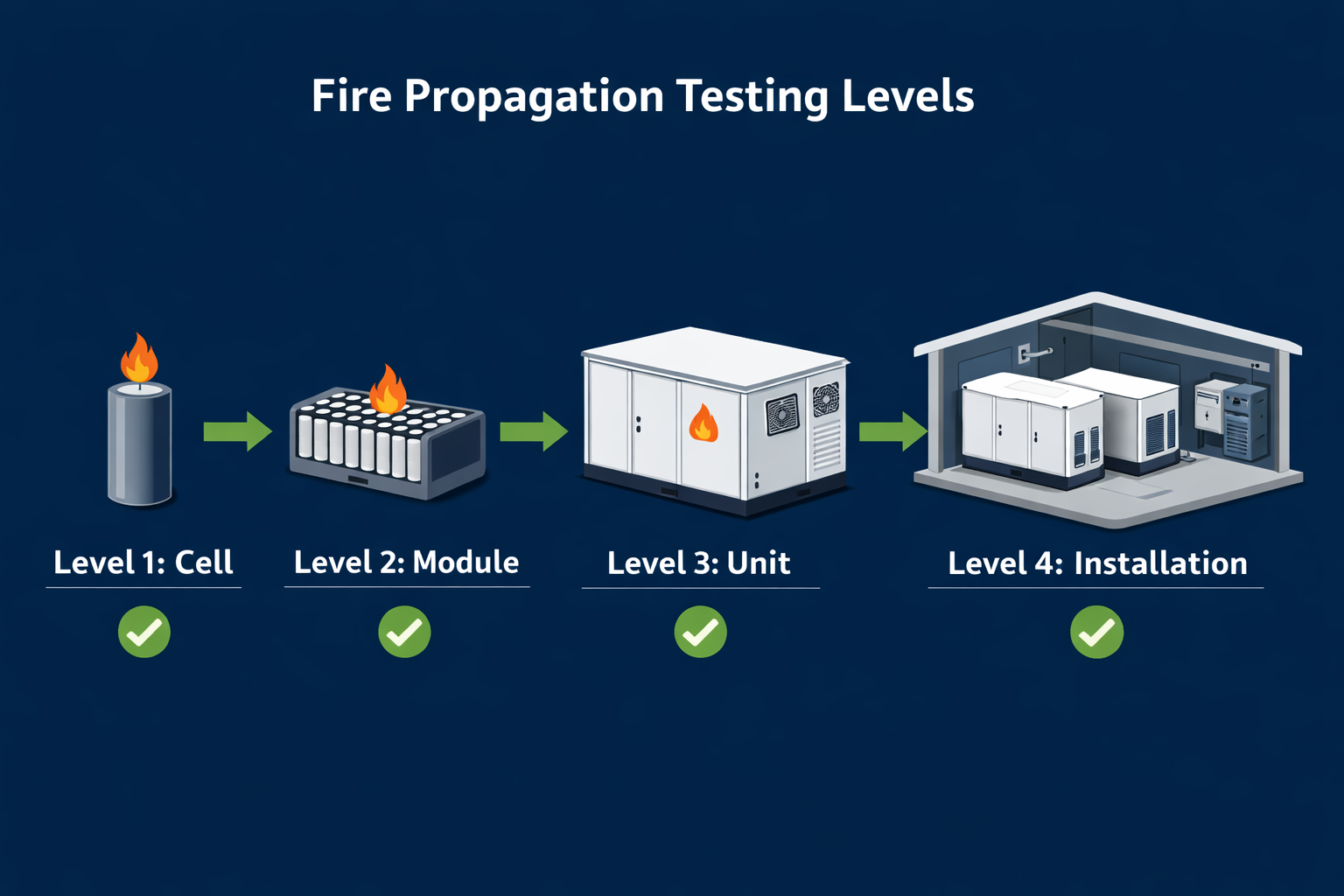
UL 9540A evaluates thermal-runaway fire propagation through escalating test levels: cell, module, unit, and, where needed, installation-level testing.
Its reports give product-specific fire and gas-release data. For example, engineers and the AHJ may use it to check spacing, aggregation, explosion control, ventilation, and fire-protection measures. That data informs the design and the AHJ’s decision. But it doesn’t replace the installation code or substitute for AHJ sign-off.
NFPA 855 Sets the Installation Rules
NFPA 855, Standard for the Installation of Stationary Energy Storage Systems, is the installation-level standard most U.S. areas reference for separation and fire-protection rules.
The 2026 edition, where adopted, significantly expands the default requirement for a documented Hazard Mitigation Analysis (HMA). “Where adopted” matters here, since code adoption is local and areas can lag the current edition by a cycle or more. So design to whichever edition the specific AHJ has actually put into force, not the newest one published.
NEC 706 Governs the Electrical Side
NEC Article 706, within NFPA 70, governs disconnects, labeling, and interconnection, no matter indoor or outdoor placement.
The International Fire Code and International Building Code incorporate NFPA 855 by reference in most adopting areas. But the AHJ still has final say. As a result, rulings vary between otherwise-similar properties depending on room construction and proximity to occupants.
Canada’s Indoor Battery Installation Regulations: Electrical Code and UL/CSA Marks
Canadian installation rules come from the Canadian Electrical Code (CSA C22.1), together with provincial or territorial electrical and fire codes, local authority rules, and the product’s certification and listing terms.
Recent editions of CSA C22.1 address energy storage systems in Section 64. Updates add a dedicated subsection for homes and raise the permitted capacity for a single residential ESS compared with earlier editions.
NFPA 855 may serve as a project, insurer, or engineering benchmark in some circumstances. But Canada’s code-adoption system is provincial and territorial, so don’t present NFPA 855 as a universally adopted Canadian installation standard. Instead, confirm the relevant provincial fire code for any specific project.
Product Certification: ANSI/CAN/UL 9540 and 1973
Product-level safety runs through the shared ANSI/CAN/UL 9540 (system) and ANSI/CAN/UL 1973 (battery) standards. A single test program can support evaluation for both the U.S. and Canadian markets.
Certification still has to come from an accredited body and be accepted by the relevant local authority. So don’t assume a U.S. listing alone is sufficient for a Canadian installation; confirm the Canadian mark or equivalent acceptance first.
European Union: IEC 62619 as the Base, Plus National Overlays
At the EU level, IEC 62619 anchors product safety for stationary lithium battery systems as the cell- and battery-level safety standard. Meanwhile, shared standards cover the power conversion and control gear, commonly cited alongside EN 62477 (power electronics) and EN 62109 (PV inverter safety, for hybrid systems).
CE marking demonstrates compliance with the relevant EU directives, but it is not itself an installation permit. Instead, siting, separation, and fire protection get set at the national or municipal level. This is where the EU differs most from the U.S. model of one widely referenced installation standard.
Germany’s Indoor Battery Installation Regulations: The VDE-AR-E 2510-50 Overlay
Germany is the clearest example of a national overlay with real market weight: VDE-AR-E 2510-50 sets safety rules for stationary lithium battery storage across its full lifecycle, from storage and transport through installation, operation, and end-of-life.
It’s commonly requested or expected in parts of the German residential and light commercial market. There, installers and some insurers treat it as a practical benchmark alongside the underlying IEC standards.
A product tested to VDE-AR-E 2510-50 may satisfy some expectations in other EU member states. But that doesn’t establish compliance with another country’s installation rules. Each national or local framework still needs its own check.
United Kingdom’s Indoor Battery Installation Regulations: PAS 63100, BS 7671, and MCS
The UK’s domestic battery framework combines fire-siting guidance, electrical-installation rules, product standards, and installer-scheme rules, built up in stages rather than as one document.
PAS 63100 and BS 7671 Chapter 57
PAS 63100:2024 provides domestic battery fire-safety guidance covering siting, fire separation, and detection, and is understood to treat bedrooms and unprotected escape routes as unsuitable locations.
A 2026 amendment to BS 7671 introduced Chapter 57, covering stationary secondary battery installations, and references PAS 63100 for domestic siting. Even so, installers should verify the exact current wording of that cross-reference against the licensed standard rather than relying on a summary.
MCS and the IET Code of Practice
MCS, the scheme relevant to specific UK incentive and export-payment programs, sets its own battery storage installation standard (MIS 3012). This points installers to the current edition of the IET Code of Practice for Electrical Energy Storage Systems.
The Code of Practice is the document that recommends following PAS 63100 for domestic siting. Because amendment and scheme language can change between code cycles, confirm the exact current rules against the licensed BS 7671 text and current MCS paperwork.
Australia and New Zealand: AS/NZS 5139
AS/NZS 5139 is Australia and New Zealand’s dedicated installation and safety standard for battery energy storage, covering siting, separation, ventilation, and protection rules in one document. By contrast, the UK and Canada use a multi-document approach.
It works alongside the broader inverter and grid-connection standards that already govern solar-plus-storage installs in the region. For the full detail on Australia’s compliance stack, including AS/NZS 4777.2 and AS/NZS 3008.1.1, see our dedicated Australian compliance hub.
China: Verify Scope and Certification Pathway Before Relying on a Summary
China’s framework for electrochemical energy-storage stations includes GB 51048 for design and GB/T 42288 for safety. Though both are principally relevant to station-scale projects rather than ordinary residential installations.
Rules for smaller indoor systems also depend on low-voltage electrical rules, product certification paths (CQC or CCC, depending on category), local fire-authority practice, and provincial rollout.
This is an area where a general summary is genuinely risky. So confirm the current edition, effective date, and scope threshold of GB 51048 with a qualified China-market compliance adviser. Also confirm whether your product category requires CCC, CQC, or another pathway before market entry. Always work from current Chinese-language official standards before any market-entry decision.
Japan: Fire Service Act Classification and Product-Specific Certification
Japan’s regulatory starting point differs from the markets above. Under the Fire Service Act, lithium-ion battery electrolyte can classify as a hazardous flammable liquid. The specific regulatory treatment depends on electrolyte composition, quantity, and the relevant hazardous-materials classification. So it isn’t a single blanket rule applied identically to every product.
METI, PSE, and IEC 62133-2
At the product level, certification runs through Japan’s METI framework. PSE marking under the Electrical Appliances and Materials Safety Act also applies. Both are product-specific rather than a blanket ESS-system certification comparable to UL 9540.
IEC 62133-2 may apply to certain portable or small stationary battery products. But don’t treat it as a general ESS system-level compliance pathway without confirming its applicability to the specific product and category under Japan’s rules.
Japan has no single dedicated residential-BESS installation standard like NFPA 855 or PAS 63100. Instead, it leans on the Fire Service Act’s hazardous-materials framework and local fire-authority discretion. This makes early talk with the local fire department a central part of Japanese project planning. Because of this, manufacturers should get Japan-specific regulatory review rather than treat PSE or IEC 62133-2 as a universal sign-off route.
What’s Consistent Across Every Country’s Indoor Battery Installation Regulations
Underneath the different document names, every framework above answers the same five questions. So it’s worth designing to all five no matter which area’s paperwork sits on top.
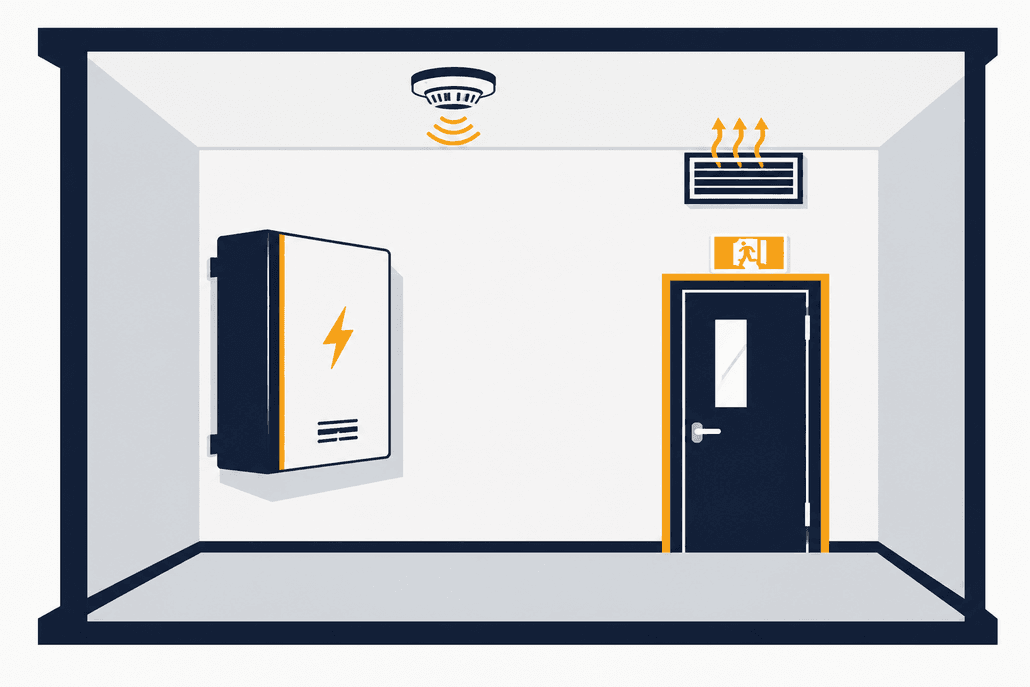
Where Can the Unit Go?
Many frameworks impose tighter restrictions around bedrooms, escape routes, and high-occupancy areas. While garages, plant rooms, and detached structures usually face fewer limits. Because the exact restriction, and how it’s enforced, varies, check it against the locally adopted rules rather than assuming.
How Much Aggregate Capacity Is in the Room?
Several frameworks cap the sum of every unit present, not the rating of a single unit. That’s why systems added in stages sometimes fall out of compliance without anyone re-checking.
How Will an Early Fault Get Detected?
Depending on the system, occupancy, room layout, and local code, this may involve smoke detection, heat detection, battery-management-system alarms, off-gas detection, or a mix. Off-gas detection is increasingly considered for enclosed lithium-ion systems. But it isn’t a universal requirement across every area and product category.
What Fire Protection Fits This Specific Product?
This is where system-level test data, such as UL 9540A results or VDE-AR-E 2510-50 test reports, earns its keep: it can support a project-specific risk review and design choice. Instead, this avoids defaulting to the most conservative, most expensive option automatically.
Who Signs Off, and What Do They Need to See?
Whether it’s a U.S. AHJ, a UK MCS-certified installer working to PAS 63100, or a fire department talk under Japan’s Fire Service Act, every market ends the same way: the responsible authority or a qualified professional confirms project-specific compliance. No rulebook applies itself automatically.
A Practical Workflow for Meeting Indoor Battery Installation Regulations
Follow these six steps below for any indoor battery project, no matter the market.
Identify the exact installation country, state or province, municipality, and building occupancy type. Rules can differ between neighboring areas in the same country.
Confirm the locally adopted edition of the relevant electrical, building, and fire codes. Publication of a new standard edition doesn’t mean every area has adopted it yet.
Confirm the product has the required system-level listing and component certifications for that specific market, not just the market where it was originally developed or tested.
Review the manufacturer’s installation instructions, listing conditions, and any relevant UL 9540A (or equivalent) fire-test evidence referenced in the product’s certification.
Assess aggregate installed energy, room configuration, egress proximity, ventilation, and fire-protection rules against the locally adopted rules.
Engage the AHJ, fire authority, qualified installer, engineer, insurer, or local compliance adviser before finalizing the layout, ideally before the room gets built out, not after.
Frequently Asked Questions
A few questions about indoor battery installation regulations come up on almost every cross-border project.
Does a UL 9540-Certified Product Meet Other Countries’ Indoor Battery Installation Regulations?
No. UL 9540 shows the product meets U.S. and Canadian system-safety rules evaluated under that specific standard. But it says nothing about IEC 62619, VDE-AR-E 2510-50, PAS 63100, or GB 51048 compliance.
Cross-market projects generally need separate certification, or a documented equivalence assessment, for each target market.
Is There a Single Global Set of Indoor Battery Installation Regulations?
No, and there isn’t likely to be one soon, though IEC 62619 functions as a widely referenced cell-level standard.
Installation siting, separation, and fire-protection rules stay set nationally or sub-nationally. Each country’s own building and fire code tradition, and its adoption timeline, shapes them.
Which Country’s Indoor Battery Installation Regulations Are Strictest?
It depends on what’s being measured. Germany’s VDE-AR-E 2510-50 is often described as a very strict product-level lifecycle standard. While the UK’s PAS 63100 is unusually explicit about treating specific rooms as unsuitable. The U.S. 2026 NFPA 855 edition, where adopted, stands out too. Since it broadly expands the requirement for a documented Hazard Mitigation Analysis.
None is uniformly stricter than the others across every category. That’s because enforcement in practice depends heavily on local adoption and the responsible authority.
Grid-scale batteries rarely fail from one single problem. A small fault grows step by step until it becomes a fire — that is the real story behind BESS short circuit protection.
It is not one part. It is not one sensor.
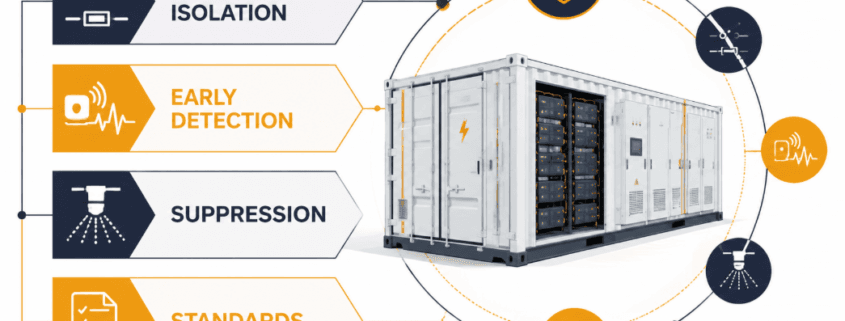
Good BESS short circuit protection is four layers working together: electrical isolation, early detection, suppression, and design standards. Miss one layer, and the rest have to work much harder to catch the fault in time.
For more on how the power conversion system contributes to fault behavior, see our guide on BESS PCS functions and features.
Quick Answer: What Is BESS Short Circuit Protection?
Quick Answer BESS short circuit protection combines four layers. First, fast electrical isolation (fuses, contactors, gate drivers) stops a fault at the source.Second, early detection (off-gas sensors, thermal imaging, cell-level BMS) catches trouble minutes before flames appear.Third, suppression systems (venting, clean-agent, water-mist) contain what detection could not prevent.Fourth, design standards (NFPA 855, UL 9540/9540A) govern how the first three layers get specified, tested, and installed.
Key Takeaways
Layer
What It Does
Example Components
Electrical isolation
Stops the fault before it makes enough heat to ignite anything
Governs how every other layer is tested and installed
NFPA 855, UL 9540, UL 9540A
Why “Short Circuit” Isn’t the Whole Story in BESS Short Circuit Protection
Most large battery fires get called short-circuit fires. But that label is a bit misleading.
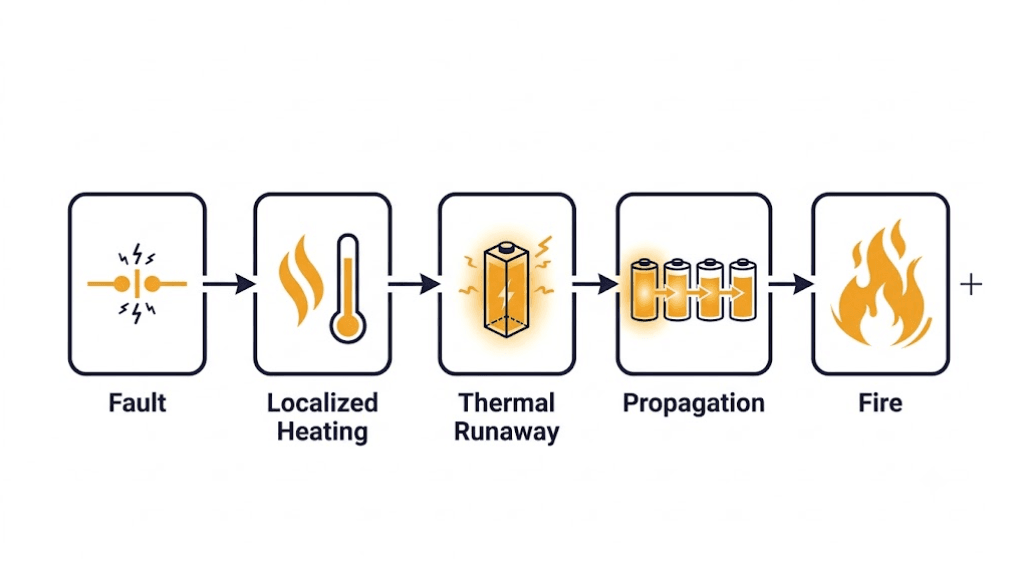
What actually happens is thermal runaway that spreads from cell to cell, like dominoes falling.
A short circuit is often the trigger, whether it comes from an internal cell defect, an external fault, or a loose connection.
Still, the real danger comes later, once heat from that one cell starts moving outward. Good BESS short circuit protection has to account for both stages, not just the initial fault.
This distinction shapes how each protective layer gets designed. For example, off-gas detection is not really a short-circuit sensor.
It is a thermal-runaway precursor sensor instead. It picks up gases vented during early cell decomposition.
Often, this happens before a short circuit or flame shows up on any other instrument.
Once you see the full chain — fault, then localized heating, then thermal runaway, then propagation, then fire — it becomes clear where each layer of BESS short circuit protection actually steps in.
Layer 1: Electrical Isolation for BESS Short Circuit Protection
The first job of electrical isolation is simple: keep a fault from ever reaching the point of ignition.
Fast-Acting Fuses and Rack-Level Disconnects
High-speed fuses at the string and pack level interrupt overcurrent fast. They act before it builds up enough localized heat to start thermal runaway.
Also, many newer systems add rack-level contactors and disconnects. As a result, a single faulted rack can be isolated without shutting down the whole container.
This cuts both fire risk and downtime at the same time.
IGBT Protection and Physical Separation
Active gate drivers watch the IGBTs (insulated-gate bipolar transistors) in the power conversion system. If overcurrent shows up, they shut the IGBTs down fast and safely.
This protects both the PCS and the battery side of the connection.
Keeping power conversion gear apart from the battery blocks matters too. A PCS-side fault tends to carry more energy, so keeping it separate makes it less likely to ignite the battery enclosure.
Cell-to-Cell Propagation Barriers
Thermally insulating materials sit between cells and modules. Mica sheets, aerogel layers, and phase-change barriers are common choices.
Even so, if one cell enters thermal runaway, these barriers slow the heat transfer. That extra time often lets detection and suppression systems do their job.
Layer 2: Early Detection Catches the Fault Before It Spreads
A detection layer only matters if it catches trouble minutes, not seconds, before ignition. This is where BESS short circuit protection depends most on speed.
Off-Gas Detection
Specialized sensors pick up gases released during early battery decomposition. Carbon monoxide, hydrogen, and various volatile organic compounds are the usual signs.
Often, this happens minutes before any smoke or measurable temperature rise. So most safety engineers treat off-gas detection as the earliest reliable warning inside a BESS enclosure.
Thermal Imaging and Smart BMS
Continuous infrared monitoring flags hot spots on busbars, connections, and power electronics. These are common origin points for electrical faults.
At the same time, a smart Battery Management System watches voltage and temperature at the individual cell level. It does not stop at the module or rack level.
That granularity lets a developing imbalance get caught and isolated before it touches neighboring cells.
Layer 3: Fire Suppression Contains What Detection Could Not Prevent
Even strong prevention and detection will not stop every event. Suppression systems act as the last line of defense.
Also, code increasingly treats them as mandatory rather than optional.
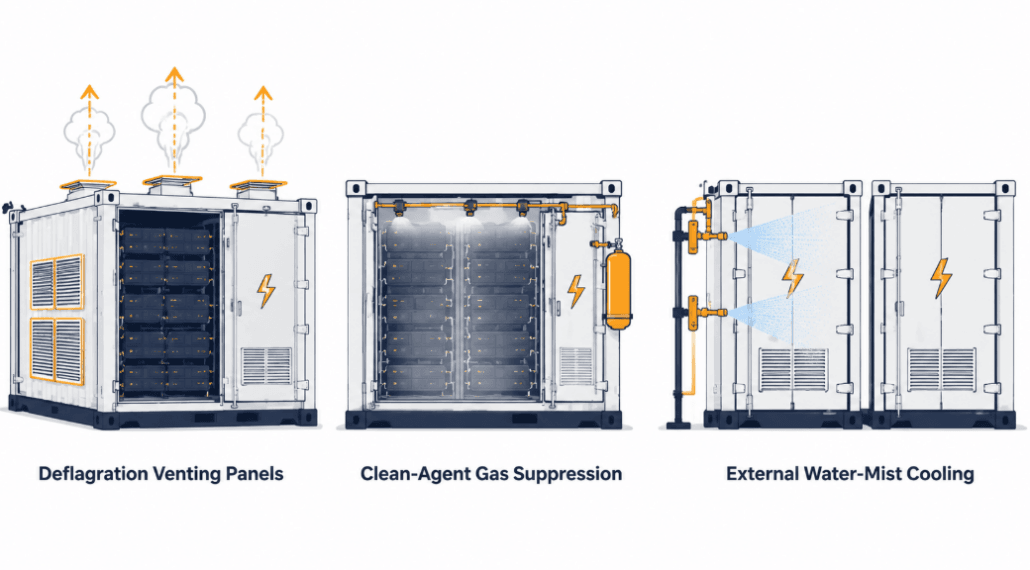
Deflagration Venting
Explosion venting panels direct overpressure from vented battery gases safely upward. This keeps pressure away from people and nearby equipment.
As a result, pressure cannot build up inside the enclosure in the first place.
Clean-Agent Suppression Within BESS Short Circuit Protection
Clean-agent systems flood the compartment and interrupt the fire’s chemical reaction. Unlike sprinklers, they avoid water damage and electrical risk.
But not all agents work the same way. Novec 1230 is a clean gaseous agent that displaces oxygen and absorbs heat.
Stat-X, on the other hand, is a condensed aerosol that suppresses fire through a different chemical mechanism.
So the right choice depends on compartment size, ventilation design, and re-entry time requirements.
Water-Mist and Deluge Cooling
External water-mist or deluge systems usually do not stop the fire that started the event. Instead, their job is cooling adjacent containers.
This keeps the fire from jumping to the next unit. Since container-to-container spread is where the largest-scale incidents tend to originate, cooling matters as much as suppression.
Suppression Type
Primary Function
Best Suited For
Deflagration venting panels
Relieve gas overpressure safely
Preventing explosion or enclosure rupture
Clean-agent (Novec 1230, Stat-X)
Interrupt fire chemistry, no residue
In-compartment suppression, electronics-safe
Water-mist / deluge
External cooling
Preventing container-to-container propagation
Layer 4: NFPA 855 and UL 9540A Set the Rules for BESS Short Circuit Protection
Each safety part only works as a system if it follows a recognized standard. That is where NFPA 855 and UL 9540/UL 9540A come in for BESS short circuit protection.
What NFPA 855 Covers
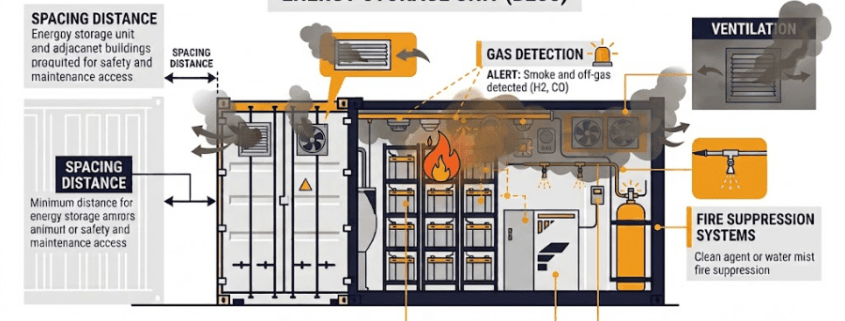
NFPA 855 covers siting, spacing, detection, and suppression. It also covers ventilation and emergency response planning.
One common example is the minimum 3-foot (914 mm) gap required between ESS units. This can shrink if large-scale fire testing shows a closer gap is safe.
Also, the 2023 edition made fire suppression mandatory for nearly all ESS installations.
The 2026 edition goes further still. It expands formal Hazard Mitigation Analysis to most BESS sites, not just large ones.
For the full breakdown of scope, thresholds, and the 2026 changes, see our NFPA 855 guide.
UL 9540 vs. UL 9540A in BESS Short Circuit Protection
These two standards sound alike but do different jobs. UL 9540 is a system-level product certification.
A large-scale fire test method, UL 9540A generates the propagation data regulators use to set spacing, suppression, and ventilation rules under NFPA 855. It is not a certification by itself.
NFPA 855 also requires written emergency plans. These cover safe shutdown steps and coordination with local fire crews.
It is easy to treat this requirement as an afterthought. But it gets flagged often during AHJ review and insurance underwriting.
FAQ: BESS Short Circuit Protection
What is BESS short circuit protection?
BESS short circuit protection combines electrical isolation, early detection, and suppression. Together, they stop a short circuit fault from turning into thermal runaway and fire.
Is a short circuit the same thing as thermal runaway?
No, they are different things. A short circuit is one possible trigger for thermal runaway.
But thermal runaway itself is the underlying cascading failure. So the real fire risk in BESS short circuit protection comes from propagation between cells, not the short circuit event alone.
Is UL 9540A certification required for every BESS project?
Not exactly. UL 9540A is a test method, not a certification. So there is no such thing as being “UL 9540A listed.”
Even so, most commercial and utility-scale projects in the U.S. need UL 9540A test data. Then this data satisfies NFPA 855 and local fire code requirements for permitting.
What is the minimum spacing required between BESS units under NFPA 855?
The commonly cited baseline is 3 feet (914 mm) between individual units.
Even so, this can shrink if large-scale fire testing under UL 9540A documents that a smaller separation is safe for that specific system. Spacing is one of the simplest parts of BESS short circuit protection to verify during a site walk.
Does off-gas detection replace the need for a BMS?
No, the two serve different roles. Off-gas detection is an early warning system inside the enclosure.
It watches for thermal-runaway gases before flames show up.
A cell-level BMS, by contrast, watches voltage and temperature. So it catches a developing fault before it produces measurable off-gas at all. Together, they cover both ends of BESS short circuit protection.
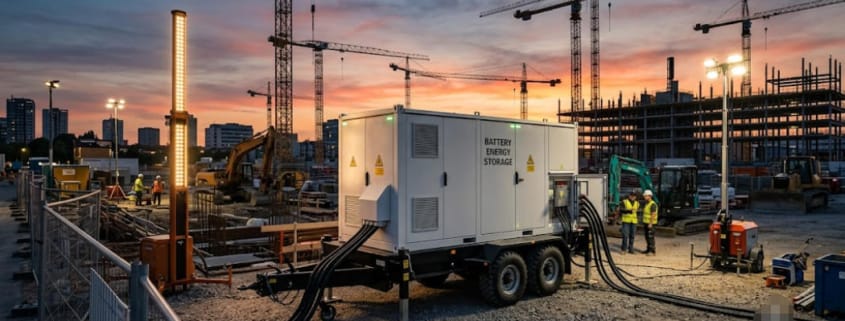
⚡ Quick Answer A Mobile BESS is a battery energy storage system built onto a trailer, truck bed, or skid. It stores electricity and discharges it on demand, so it can power a site with no fuel, no exhaust, and almost no noise.
What Is a Mobile BESS?
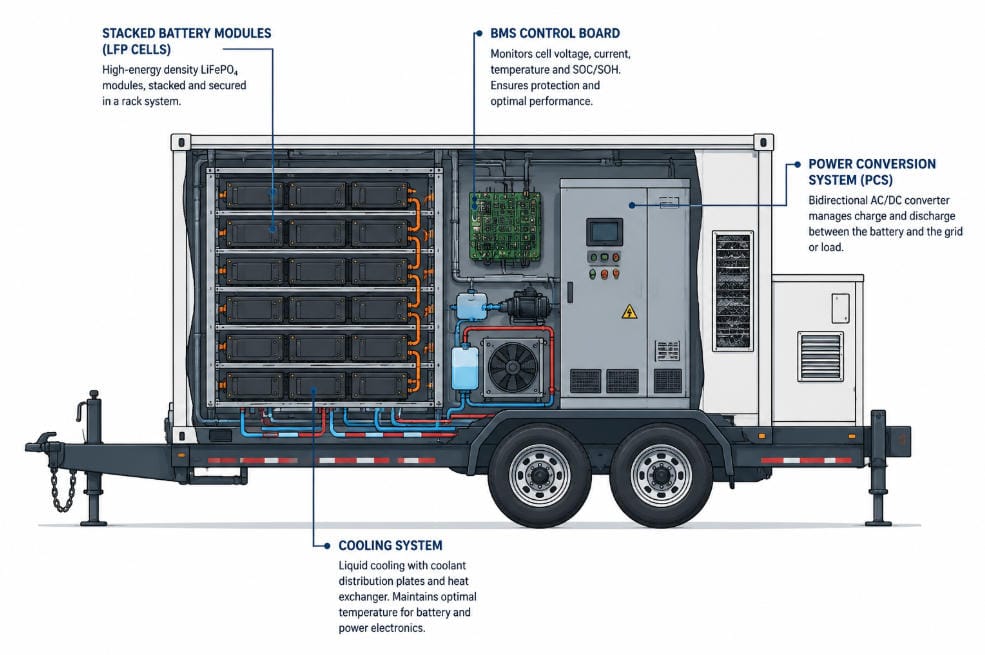
A Mobile BESS packs the same core parts as a fixed installation into a towable unit. Battery modules sit inside a weatherproof enclosure. Meanwhile, a power conversion system (PCS) turns stored DC energy into usable AC power, and a battery management system (BMS) tracks voltage, temperature, and charge level in real time.
In some designs, manufacturers split the battery pack and the PCS into separate trailers. As a result, an operator can pair several battery trailers with one shared PCS unit and add capacity without buying a new inverter each time.
Mobile BESS vs. Diesel Generators
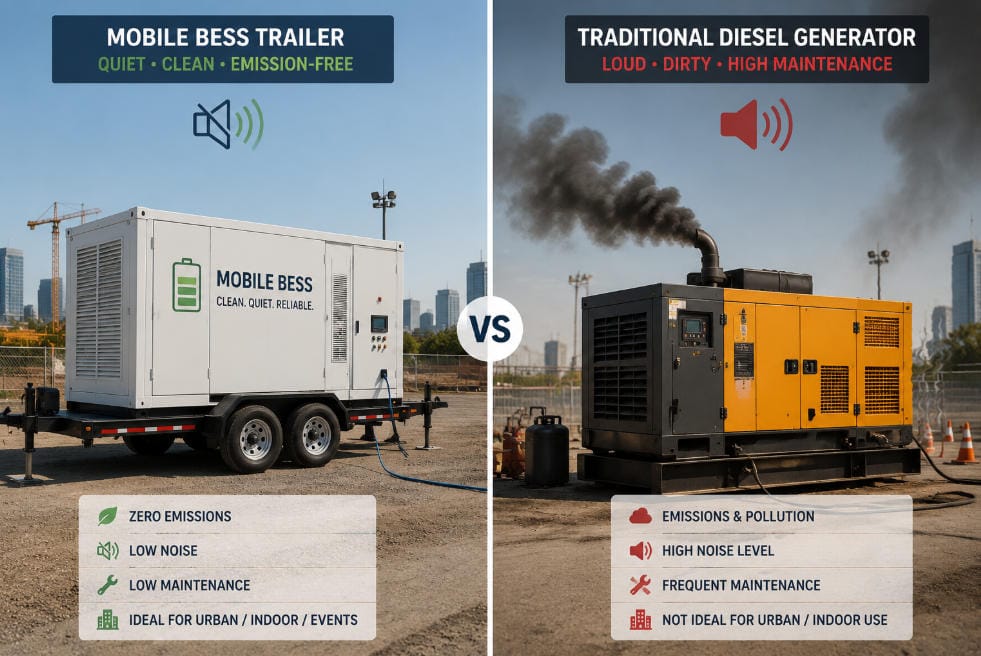
Diesel generators have powered temporary sites for decades. Today, though, a Mobile BESS competes for many of the same jobs. Since it works in a very different way, the table below compares the two side by side.
Factor
Mobile BESS
Diesel Generator
Emissions
Zero exhaust during discharge
Combustion exhaust, particulates, NOx
Noise
Near-silent operation
60-90+ dB at typical load
Fuel logistics
None during discharge; recharges from grid or solar
Ongoing diesel delivery and storage
Response time
Instant power, no warm-up
Seconds to minutes to reach stable output
Runtime
Fixed by battery capacity, then needs recharge
Runs as long as fuel supply lasts
Best fit
Short-duration, indoor, or noise-restricted sites
Long, continuous loads with no grid access
In practice, many sites pair the two instead of choosing one. First, a generator recharges the battery at its most efficient load point. Then it steps back while the Mobile BESS carries the load alone.
Because of this, the hybrid pattern can cut diesel use by roughly half. A generator that idles at partial load burns fuel poorly, so shifting the everyday load onto the battery saves real money over a multi-week job.
Mobile BESS Use Cases
Mobile BESS units solve an old problem in a new way. They provide temporary power where the grid hasn’t arrived yet, isn’t reliable, or isn’t allowed. Overall, six use cases account for most deployments today.
Construction Sites
Construction is the largest single market for mobile storage. Grid interconnection applications often take three to nine months, so a Mobile BESS closes that gap right away.
It can power tower cranes, welding gear, site offices, and electric machinery from day one. Because it makes no exhaust, crews can also run it in tunnels and basements, where diesel fumes would be unsafe.
Events and Film Production
Concerts, festivals, and film sets need power that stays out of the way. A Mobile BESS delivers clean sine-wave output and stays under roughly 55 dB, so it won’t hum in a live recording or flicker a sensitive light rig.
Simply put, a generator can’t match that at the power levels these shoots need.
Mobile BESS for Disaster Relief
When storms or wildfires knock out power lines, crews can truck in units within hours. They power emergency radios, medical gear, and temporary shelters, often arriving before utility crews finish permanent repairs.
Data Center Maintenance Windows
Data centers sometimes need to take a UPS or switchgear segment offline for maintenance without losing backup coverage. A Mobile BESS can stand in during that window, then leave once the permanent system is back online.
Mobile BESS for Grid Support
Utilities and developers increasingly use these units for temporary grid services: voltage support, short-term capacity, or bridging power for a solar or wind project still waiting on its permanent interconnection agreement. As a result, a finished generation asset keeps earning instead of sitting idle.
EV Charging Support
Pop-up EV charging is one of the fastest-growing uses. Because a Mobile BESS can buffer a weak grid connection, it can still deliver fast-charging bursts at events or in areas the grid hasn’t fully reached.
Mobile BESS Sizing and Chassis Configurations
Capacity varies widely, and the right size depends entirely on the job. Understanding a few typical bands makes it much easier to spec the right unit.
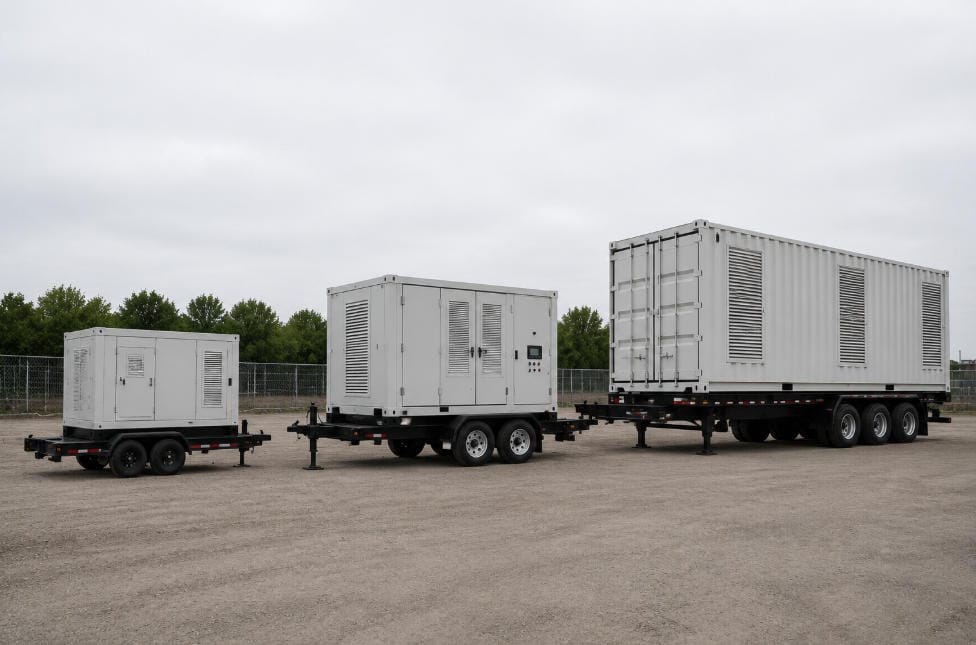
Chassis Types and Capacity
Compact truck-mounted units typically sit around 90 kWh. Power Up Connect’s Green Grid trailer is a good example: it carries UL 9540 and UL 9540A certification, and operators can daisy-chain up to 10 units for bigger jobs.
Meanwhile, mid-size trailer units generally run from about 250 kWh to 650 kWh. This band covers most construction and event work.
Utility-scale trailers sit at the top end. They often exceed 800 kWh and sometimes reach 2 MWh per unit. These usually ride on a 20-foot container platform or a dedicated semi-trailer, so teams can string several together for multi-megawatt-hour jobs.
Chassis Type
Typical Range
Best Fit
Compact flatbed / skid
~90 kW – 300 kWh
Small job sites, single-piece equipment, light-load events
Drawbar trailer
~250 kW – 650 kWh
Mid-size construction sites, festivals, multi-generator replacement
Container semi-trailer
800 kWh+ up to ~2 MWh
Utility-scale temporary power, large events, grid-support deployments
Road weight limits usually cap a single trailer’s size, not the battery technology itself. So past roughly 1-2 MWh, it’s typically easier to deploy multiple units side by side than to push one chassis larger.
Battery Chemistry and Cooling
LFP (lithium iron phosphate) leads this segment for good reason. It handles the shaking and heat swings of repeated transport well. Plus, its long cycle life (commonly rated 6,000-8,000+ cycles) suits frequent redeployment far better than higher-energy but less forgiving chemistries.
Smaller units, roughly under 300 kWh, typically use air cooling. It keeps the system light and easy to fix in the field.
Larger, higher-power trailers, however, generally switch to liquid cooling instead, since it manages heat better. This is the same crossover point used in stationary BESS design.
Chassis engineering: Dual-axle running gear, mechanical braking, and vibration-dampening brackets protect the battery pack through highway travel and rough job-site terrain. The chassis itself needs proper axle load ratings, DOT-compliant lighting and braking, and secure tie-down points.
Mobile BESS Safety and Compliance
A Mobile BESS still has to meet the same fire-safety and transport rules as any lithium battery system. However, it does earn a few specific carve-outs because it moves.
NFPA 855 Rules
NFPA 855, the Standard for the Installation of Stationary Energy Storage Systems, defines mobile ESS in Section 3.3.9.5. It then sets installation rules in Section 4.5. The most important carve-out is this: wheeled or trailer-mounted units don’t need to meet the seismic and structural load rules that apply to permanent installations.
Even so, standard separation distances still apply. Deployments need at least 10 ft (3 m) from public ways, stored combustibles, and hazardous materials. They also need 50 ft (15 m) from tents or seating areas holding 30 or more people.
That said, an Authority Having Jurisdiction (AHJ) can reduce these distances if large-scale UL 9540A fire test data backs it up. Regardless, deployed mobile ESS still can’t go indoors, in covered parking garages, on rooftops, below grade, or under building overhangs.
UL 9540 Listing for Mobile BESS
Mobile units still need UL 9540 listing, the core safety standard for energy storage systems. They typically undergo UL 9540A large-scale fire testing too, just like a stationary installation.
In short, mobility doesn’t exempt the battery system from certification — it only changes the foundation and seismic rules. For the full installation breakdown, see our NFPA 855 guide.
Transport Testing Under UN 38.3
Before a Mobile BESS can ship, its cells and battery packs must pass UN 38.3. This set of eight tests simulates real transport conditions: altitude, thermal cycling, vibration, mechanical shock, short circuit, impact, overcharge, and forced discharge.
The vibration test alone runs a sweep from 7 Hz to 200 Hz for three hours. Next, a shock test simulates a 150g/6ms or 50g/11ms impact. That’s a tough bar, since this system gets driven over real roads again and again, not installed once and left in place.
Road Transport Rules
In the US, moving an assembled lithium battery system by highway falls under 49 CFR 173.185, part of the DOT’s Hazardous Materials Regulations. Since it classifies lithium batteries as Class 9 dangerous goods, compliance means UN-spec packaging, correct labels, and proper shipping papers.
A good provider keeps UL 9540 listing documents and UN 38.3 test summaries ready on request. You shouldn’t have to wait while a provider scrambles for paperwork after a jurisdiction asks for it.
Certification Varies by Export Market
It’s also worth noting that certificates differ by market, not just by product. US and Canadian buyers look for UL 1973, UL 9540, and UL 9540A. EU buyers need CE marking plus IEC 62619 or IEC 62933. China requires CCC, Korea requires KC, India requires BIS, and Japan requires PSE. UN 38.3 applies everywhere, since it covers transport rather than installation. For the full regional breakdown, see our BESS certifications guide.
Mobile BESS vs. Stationary BESS
Factor
Mobile BESS
Stationary BESS
Installation
Deployed in hours; no permanent foundation
Weeks to months; foundation and permitting
Relocation
Built to move between sites
Fixed for the life of the asset
Typical use case
Temporary power, events, emergency response
Long-term grid support, solar firming
Seismic requirements
Exempt when on a wheeled chassis
Full seismic design required
Capacity ceiling
Practical limit near 1-2 MWh per trailer
Scales to tens or hundreds of MWh
Cost structure
Often rented per deployment
Capital asset with long depreciation
Choosing a Mobile BESS Provider
Providers increasingly sell Mobile BESS as a service rather than as a capital purchase. Because of that, the ownership model matters just as much as the hardware spec sheet.
Rental / deployment-based pricing — pay per project or per month, and the provider handles maintenance and recharge logistics
Battery-swap service — the provider delivers a fully charged replacement unit and takes the depleted one away, so on-site recharging is never your problem
Hybrid generator pairing — for sites where full battery replacement isn’t practical yet, running the BESS alongside a generator can still cut fuel use by roughly half
Outright purchase — makes sense when your organization deploys often enough that utilization beats rental economics
Before committing, it’s worth asking any provider a few direct questions:
Is the unit UL 9540 listed and UN 38.3 tested, with documentation available on request?
What is the actual site commissioning time, door-to-power-on, not just “rapid deployment” marketing language?
What is the noise rating at rated load, and is it independently measured or a vendor estimate?
Is the enclosure rated for indoor or enclosed-space use, or is it outdoor-only?
What happens if the unit needs service mid-deployment? Is there a swap or backup unit guarantee?
What’s included in the rental rate: transport, commissioning, decommissioning, and recharge, or are these billed separately?
Does the chassis carry standard DOT lighting, braking, and axle certifications for your transport route?
Mobile BESS Market Outlook
Fortune Business Insights values the mobile energy storage system market at $58.28 billion in 2025, and projects it will reach $207.03 billion by 2034. That’s a compound annual growth rate above 15%.
Several trends are driving this growth. For one, utilities and developers are swapping out diesel generators to cut emissions and noise complaints. At the same time, falling LFP battery costs make the switch more affordable each year.
Longer grid interconnection queues are pushing more projects toward temporary bridging power, too. And a growing rental and battery-swap model is lowering the barrier for construction and events firms that don’t want to own the asset outright.
So for project developers, the takeaway is simple. Mobile BESS has moved from a niche disaster-relief tool to a mainstream option, one worth considering any time a site needs power before, instead of, or alongside a permanent grid connection.
Mobile BESS Key Takeaways
Aspect
Key Point
Definition
A Mobile BESS is a trailer-, truck-, or skid-mounted battery storage system built for temporary deployment.
Chemistry
LFP dominates for thermal stability and 6,000-8,000+ cycle life.
Cooling
Air cooling under ~300 kWh; liquid cooling for larger, high-power units.
Sizing
Ranges from ~90 kWh truck units to 2 MWh utility-scale trailers.
Safety code
NFPA 855 Section 4.5 governs mobile ESS; seismic rules are waived on wheeled chassis.
Listing
UL 9540 listing and UL 9540A fire testing still apply.
Transport
Cells must pass UN 38.3 testing; US highway moves follow 49 CFR 173.185.
Market
Projected to grow from $58.28B (2025) to $207.03B (2034), a 15%+ CAGR.
Frequently Asked Questions
What Is a Mobile BESS Used For?
A Mobile BESS gives temporary, emission-free power for construction sites, live events, film sets, disaster relief, data center maintenance, EV charging, and short-term grid support. In short, it fits anywhere a diesel generator would normally go, but noise, exhaust, or setup speed favor a battery instead.
How Long Does a Mobile BESS Run Before Recharging?
Runtime depends on the battery’s energy capacity relative to the connected load, not a fixed number. Typically, a mid-size unit in the 250-650 kWh range can run critical loads for several hours to a full day before it needs recharging.
Providers usually size the system to match the job’s load profile. Many also offer battery-swap or hybrid generator support for jobs that need power longer than a single charge allows.
Is It Safe to Transport on Public Roads?
Yes, as long as the system carries the right certification. Cells and battery packs must pass UN 38.3 testing before they ship. In the US, road transport then falls under 49 CFR 173.185, which classifies lithium batteries as Class 9 hazardous material.
The chassis itself also needs standard DOT lighting, braking, and axle certifications. A reputable provider keeps this paperwork ready on request.
Does NFPA 855 Apply to a Mobile BESS?
Yes. NFPA 855 defines and regulates mobile energy storage systems directly in Section 4.5. It exempts wheeled, trailer-mounted units from seismic and structural load rules, but UL 9540 listing, minimum separation distances, and site-specific electrical rules still apply.
What Battery Chemistry Do Most Units Use?
Lithium iron phosphate (LFP) leads this segment. It handles the shaking and heat swings of repeated transport well, and its long cycle life suits frequent redeployment better than most alternatives.
NFPA 855, published by the National Fire Protection Association, is the U.S. standard for safe battery energy storage installation. If you’re developing, permitting, or financing a BESS project, compliance is not optional. In fact, your local fire marshal, your insurer, and your interconnecting utility will all check it first. This guide covers what the standard requires. It also covers what changed in the 2026 edition, and how the rules differ for C&I and utility-scale projects.
Quick Answer: What This Standard Covers
In short, this fire-safety standard sets the installation rules for battery storage in the United States. It covers spacing, ventilation, detection, suppression, and hazard analysis. That applies to everything from small residential batteries to utility-scale plants. Local fire codes enforce it. In addition, most insurers and interconnecting utilities require proof of compliance before they approve a project.
At a Glance
What it is: a National Fire Protection Association standard for stationary battery energy storage systems, first published in 2020, now in its 2026 (third) edition.
Who enforces it: local Authorities Having Jurisdiction (AHJs), typically through NFPA 1 (Fire Code) Chapter 52 or the International Fire Code Section 1207.
Who it applies to: residential, commercial, industrial, and utility-scale BESS. Specifically, the scope is set by battery chemistry and stored energy, not by project type alone.
What triggers it: aggregate stored energy above chemistry-specific thresholds. For example, that’s 20 kWh for lithium-ion.
What’s new in 2026: a default requirement for Hazard Mitigation Analysis, large-scale fire testing, and stricter explosion control provisions.
What Does NFPA 855 Cover?
The standard addresses the full lifecycle of a battery energy storage system. That covers design, installation, commissioning, operation, maintenance, and decommissioning. In practice, most project teams also focus on five specific areas:
Separation and spacing — distances between battery units, and between the ESS and exposures like buildings, property lines, and other hazards
Fire detection and suppression — smoke and gas detection, plus sprinkler or other suppression systems sized to the installation
Ventilation — exhaust systems that keep flammable gas concentrations below dangerous thresholds
Explosion control — deflagration venting or prevention systems for enclosed spaces
Hazard Mitigation Analysis (HMA) — a documented assessment of thermal runaway, fire propagation, and toxic gas risks for the specific installation
Why Thermal Runaway Is the Core Hazard
Every requirement in this guide exists to control one underlying hazard: thermal runaway. It starts when a single battery cell overheats past a critical point. The cell then generates heat faster than it can dissipate it.
This can trigger a self-sustaining chain reaction, where one failing cell heats its neighbors until they fail too. In the worst case, that cascade spreads across an entire rack or unit.
NFPA 855’s core requirements each target a different stage of this chain. Spacing and separation slow how fast a failure can spread to nearby units. Gas detection catches early off-gassing before it ignites. Ventilation clears flammable gases before they reach dangerous concentrations. Suppression systems, meanwhile, cool cells enough to interrupt the cascade.
The newest layer is Thermal Runaway Propagation Prevention (TRPP). Importantly, this active system goes a step further by detecting early precursors like off-gassing or abnormal temperatures. Consequently, it automatically triggers a targeted response to stop the failure before it ever reaches a neighboring cell.
The Hazard Mitigation Analysis ties all of this together — it’s the engineering process, led by a qualified PE, that sizes each control to your project’s specific chemistry and configuration, instead of applying generic rules.
NFPA 855 Scope and Applicability
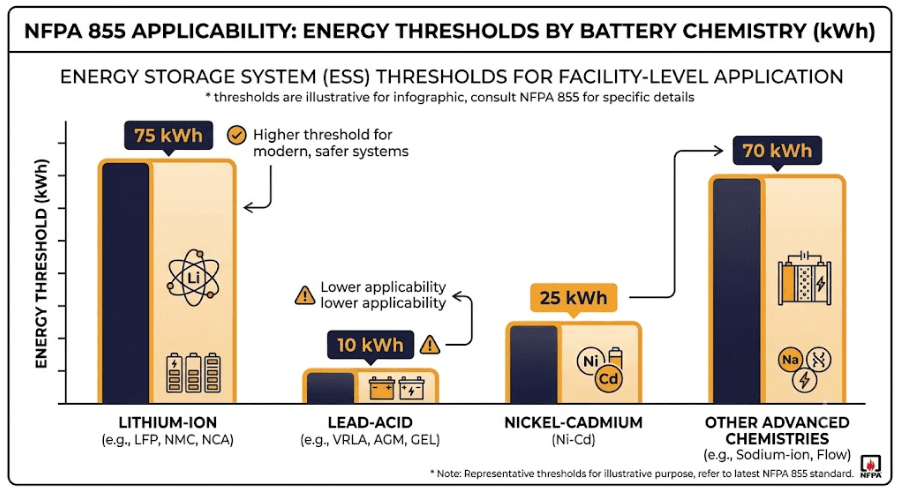
The first step is confirming the standard applies to your system at all. Applicability depends on battery chemistry and total stored energy, not project size alone. That said, below-threshold systems may fall outside full requirements. Your AHJ makes the final call.
Battery Chemistry
Below Threshold
At or Above Threshold
Lithium-ion
< 20 kWh aggregate (may be exempt)
≥ 20 kWh triggers full NFPA 855 requirements
Valve-regulated lead-acid (VRLA)
< 70 kWh aggregate (may be exempt)
≥ 70 kWh triggers full NFPA 855 requirements
Other battery chemistries
Threshold set per chemistry table (2026 lists chemistries alphabetically)
Confirm with your AHJ before assuming exemption
These thresholds still decide whether NFPA 855 applies to your system at all — that part hasn’t changed. What has changed is what happens once it does apply.
Previously, earlier editions let a project exceed the prescriptive threshold and still avoid a full Hazard Mitigation Analysis. It just had to stay under a separate “Maximum Stored Energy” cap in Chapter 9. The 2026 edition removed that cap entirely. As a result, once your system clears the Chapter 1 threshold, an HMA is the default requirement, not a fallback for oversized systems.
For example, a small server-room battery backup might still stay under 20 kWh and fall outside the standard’s full requirements. Almost any commercial, industrial, or utility-scale BESS, however, clears that threshold immediately. It now needs a documented HMA from the design stage, with no quantity-based way around it.
This standard runs on a three-year revision cycle. The 2026 edition, however, brought some of the most significant changes since its 2020 debut. Here’s what stands out for project developers, grouped by area.
Hazard Mitigation Analysis and Professional Oversight
Hazard Mitigation Analysis is now the default. Earlier editions required an HMA only in specific circumstances. The 2026 edition makes it the default requirement for most installations, with limited exceptions for well-understood chemistries like lead-acid.
A registered design professional must direct the risk assessment. Annex G now specifically names who should lead the Hazard Mitigation Analysis: a registered design professional (a licensed PE) experienced in fire protection engineering and energy storage risk assessment. The 2023 edition only referred to “parties,” with no qualification requirement attached.
New and Expanded Safety Systems
Thermal Runaway Propagation Prevention (TRPP) systems are now required. Section 9.7.6.6 introduces TRPP as a new, active fire-safety layer. Unlike passive features such as spacing or barriers, a TRPP system relies on active monitoring. Specifically, it detects early precursors like off-gas or abnormal temperatures. As a result, the system automatically triggers a targeted suppression or cooling response to stop the failure from spreading.
Large-scale fire testing (LSFT) plays a bigger role. Previous editions leaned on UL 9540A cell, module, and unit-level testing. The 2026 edition adds large-scale fire testing. In this test, a full unit burns under real-world conditions with suppression disabled. This validates worst-case performance.
Explosion-control guidance gets more specific. Annex G.8, which covers NFPA 69 evaluations for lithium-ion ESS, was revised with new engineering design and risk-mitigation considerations. Design teams now have clearer guidance for evaluating the consequences of an explosion event, not just whether one is possible.
Detection, Chemistry, and Emergency Planning
Detection methods expand for lithium-ion storage. Section 14.3.2.1.2 now allows smoke detection, thermal imaging, or radiant-energy detection installed per NFPA 72, replacing the older, narrower detection language. A related new section, 14.1.3, also lets batteries staged or stored temporarily at 50% state of charge or below skip full Chapter 14 compliance, under defined conditions.
Chemistry and application coverage expands. Additionally, the 2026 edition lists more battery chemistries. Furthermore, it drops the old subdivision between battery technologies and capacitor-based systems. It also adds two new chapters: Chapter 16 for flow batteries and Chapter 17 for energy storage systems on barges, plus expanded coverage of EV charging systems that include integrated energy storage.
Emergency planning becomes formal. The 2026 edition adds specific minimum requirements for an Emergency Response Plan and a training program. The plan must address mitigation, preparedness, response, and recovery, with an annual review and a yearly refresher training session that the AHJ is notified of.
Model fire codes take time to catch up. The 2024 International Fire Code, for example, still references NFPA 855-2023, not the 2026 edition. Many jurisdictions currently enforce that earlier version by default, even though NFPA has already published the newer standard. Because adoption timing varies by state and city, always confirm with your AHJ which edition actually governs your permit today, rather than assuming the newest edition automatically applies.
NFPA 855 Emergency Response and Backup Power Requirements
The 2026 edition adds two requirements that project teams commonly miss because they sit outside the usual spacing-and-suppression conversation.
Emergency Response Plan (ERP)
Every covered installation now needs a documented Emergency Response Plan. The plan must address four phases: mitigation, preparedness, response, and recovery. Facility operators must also run a training program for personnel, review the emergency operations plan annually, and hold a refresher training session every year. The AHJ must be notified when that training happens.
Emergency Power Supply Systems (EPSS/SEPSS)
New Section 4.10 requires that critical safety systems have reliable backup power. This applies to Emergency Power Supply Systems (EPSS) or Stored Emergency Power Supply Systems (SEPSS), built to NFPA 110 or NFPA 111. In practice, this means detection, suppression, and ventilation controls can’t silently fail during a grid outage. Per Section 4.10.22, the EPSS or SEPSS design must be available to the Fire Protection Engineer of record and the AHJ for review and approval, so this needs to enter the design package early, not as an afterthought during commissioning.
The core framework applies the same way across project types. Practical requirements, however, shift with scale.
Larger installations trigger stricter spacing and suppression requirements. Our C&I vs utility-scale BESS comparison covers the full picture. Utility-scale plants pack far more energy into open sites, so spacing tables scale up accordingly. C&I systems, meanwhile, sit next to occupied buildings and face tighter fire-marshal review instead.
C&I systems usually sit close to occupied structures. As a result, local fire marshal review and building setback rules carry extra weight alongside these requirements.
Utility-scale systems sit on purpose-built sites. Because of this, compliance centers more on large-scale fire testing data, explosion control, and emergency response planning coordinated with the local fire department.
Both project types need UL 9540A test data. Otherwise, they can’t satisfy the engineering basis for spacing and suppression design.
How NFPA 855 Relates to Other Standards
This standard doesn’t work alone. It references and depends on several other standards. Confusing them is a common, costly mistake.
Fire and Thermal Testing Standards
UL 9540 — the product-level safety certification for a complete energy storage system. Compliance also requires UL 9540-listed equipment.
UL 9540A — the test method that measures thermal runaway fire propagation. Its results set the engineering basis for spacing and suppression decisions. The 6th edition, published alongside the 2026 NFPA 855 cycle, expands the certification framework to address spacing and fire propagation directly, rather than leaving those as separate design considerations.
CSA/ANSI C800:25 — a newly published consensus standard for large-scale fire testing and ESS reliability. NFPA 855’s 2026 edition requires large-scale fire testing, but had no consensus test method to reference when it was finalized. CSA/ANSI C800:25 fills that gap, and NFPA has an open Tentative Interim Amendment (TIA Log No. 1852) proposing to formally reference it in Section 9.7. Worth tracking if you’re specifying test protocols today, since the reference may become official shortly after this guide’s publication.
Related Electrical, Grid, and Emerging Standards
IEEE 1547 — governs grid interconnection behavior for distributed energy resources. It sits outside this standard’s fire-safety scope, but it often appears in the same project approval package.
NEC Article 706 — the National Electrical Code section covering electrical installation requirements for energy storage systems above 1 kWh.
NFPA 800 (forthcoming) — a new Battery Safety Code currently under development, with public input accepted through January 2026. Once adopted, NFPA 800 is intended to address battery hazards across the full lifecycle, not just installation, and to complement NFPA 855. Over time, it may shift or replace some of the storage-specific provisions NFPA 855 currently covers. Worth watching if you’re planning a multi-year project timeline.
Use this sequence to build compliance into a project. Otherwise, you risk discovering requirements late, during permitting:
Confirm applicability — check your chemistry and stored energy against the current threshold table.
Then, select UL 9540-listed equipment with UL 9540A test data covering your configuration.
Complete a Hazard Mitigation Analysis, led by a registered design professional (PE) with fire-protection and energy-storage risk-assessment experience. The 2026 edition makes the HMA itself the default requirement, and Annex G now specifically calls for that qualification.
Also, design spacing, ventilation, detection, and suppression to the applicable chapter for your chemistry and installation type.
Add explosion control per NFPA 69, or document a performance-based alternative.
Draft an Emergency Response Plan covering mitigation, preparedness, response, and recovery, with an annual review and yearly refresher training built into your operating plan.
Confirm backup power for critical safety systems (EPSS/SEPSS per NFPA 110/111) and route the design through your Fire Protection Engineer and the AHJ before finalizing.
Finally, engage your AHJ early. Local adoption varies by state and jurisdiction. So, confirm which edition applies before finalizing your design.
Key Takeaways: NFPA 855
In short, this standard sets the fire-safety baseline for every battery energy storage system in the U.S., from a home battery to a utility-scale plant. The 2026 edition raises the bar with mandatory hazard analysis and large-scale fire testing. Compliance depends on chemistry, stored energy, and project scale. Therefore, the earlier you plan for it, the fewer surprises you’ll hit during permitting.
Frequently Asked Questions
Is NFPA 855 a Law or a Standard?
NFPA 855 is a consensus standard, not a law by itself. However, it carries legal weight once a jurisdiction adopts it, typically through NFPA 1 or the International Fire Code. Because adoption varies by state and city, always confirm which edition your local AHJ enforces.
Does It Apply to All Battery Chemistries?
Yes. The standard is technology-neutral and covers lithium-ion, lead-acid, flow batteries, nickel-based systems, and others. Each chemistry gets its own energy threshold. Consequently, the same project might qualify for an exemption under one chemistry and not another.
What’s the Difference Between UL 9540A and NFPA 855?
UL 9540A is a test method. It measures how far a fire propagates inside a battery system. NFPA 855, meanwhile, is the installation standard that uses those test results to set spacing, suppression, and separation requirements. Ultimately, you need UL 9540A data to satisfy it, not the other way around.
Does Compliance Differ for C&I vs Utility-Scale BESS?
The core framework stays the same, but practical requirements scale with the project. Utility-scale plants face larger spacing tables and heavier reliance on large-scale fire test data. C&I systems, meanwhile, face tighter scrutiny from local fire marshals, because they sit closer to occupied buildings.
When Does the 2026 Edition Take Effect?
NFPA publishes new editions on a regular three-year cycle, and 2026 follows that schedule. Model fire codes typically adopt a given edition about a year later. Because of this, check with your local AHJ to confirm which edition governs your permit application today.
Is Large-Scale Fire Testing Fully Standardized Yet?
Not completely. NFPA 855:2026 requires large-scale fire testing, but no consensus test method existed when the edition was finalized. CSA/ANSI C800:25, published shortly after, is expected to fill that role. NFPA has an open Tentative Interim Amendment proposing to formally reference it in Section 9.7. Until that TIA resolves, confirm your test protocol directly with your AHJ and testing lab.
Battery energy storage systems are expanding rapidly across the United States. As projects grow larger, safety requirements are becoming stricter. Because of this, developers must understand modern ESS codes and standards before starting a project.
Today, battery storage compliance affects:
System design and footprint layouts
Fire protection and suppression mechanics
Comprehensive thermal runaway testing
Utility interconnection agreements
Electrical installation workflows
EMS and BMS hardware integration
In addition, many utilities and authorities now require proof of compliance before approving a project.
This guide explains the most important ESS codes and standards for utility-scale battery energy storage systems in 2026.
Why ESS Codes and Standards Matter
Modern lithium-ion battery systems store large amounts of energy. Therefore, safety is one of the biggest concerns in every BESS project.
ESS codes and standards help reduce risks such as:
Fire propagation
Thermal runaway
Electrical faults
Gas explosions
Communication failures
At the same time, these standards improve system reliability and operational safety.
They also help developers:
Speed up permitting
Meet utility requirements
Improve insurance approval
Reduce project risk
Without proper compliance, projects may face delays and expensive redesigns. As a result, developers should include compliance planning during the early design stage.
Main Types of ESS Codes and Standards
Battery storage regulations are divided into several major categories.
Category
Purpose
Electrical Codes
Safe electrical installation
Fire Codes
Fire prevention and protection
Product Standards
Equipment certification
Performance Standards
Thermal runaway testing
Interconnection Standards
Grid compatibility
Communication Standards
EMS and SCADA integration
Together, these standards form the safety foundation for modern energy storage systems.
NFPA 855: The Core of ESS Codes and Standards for Installation Safety
National Fire Protection Association developed NFPA 855 for stationary energy storage systems.
Today, NFPA 855 stands as the single most critical pillar among all ESS codes and standards in the U.S. commercial market.
The standard covers:
Installation
Fire protection
Ventilation
Maintenance
Commissioning
Decommissioning
In addition, NFPA 855 defines safety distances between ESS units and nearby equipment.
The 2026 edition introduces stricter requirements for:
Large-scale fire testing
Explosion prevention
Emergency ventilation
Gas monitoring systems
Because of these updates, developers must carefully review NFPA 855 during the early project stage.
Many authorities having jurisdiction now use NFPA 855 as a primary safety reference for utility-scale BESS projects.
UL Solutions created the UL 9540 standard to evaluate complete, integrated energy storage systems.
UL 9540 evaluates:
Battery systems
PCS integration
Thermal management
Safety controls
Enclosure protection
Unlike component standards, UL 9540 focuses on the complete integrated ESS system.
As a result, most utility-scale projects require UL 9540 certification before permitting approval.
Furthermore, UL 9540 references several other standards, including:
UL 1973
UL 1741
UL 991
UL 1998
These standards work together to improve overall ESS safety.
UL 9540A Thermal Runaway Testing
UL 9540A is one of the most important fire testing standards for lithium-ion battery systems.
Unlike UL 9540, this standard does not certify the product itself. Instead, it evaluates thermal runaway fire behavior inside the ESS.
Testing occurs at four levels:
Cell level
Module level
Unit level
Installation level
According to the ACP document, utility-scale lithium-ion systems must complete cell, module, and unit-level testing.
In addition, the latest revision introduces large-scale fire testing requirements.
Because of these updates, fire safety testing is becoming much stricter for utility-scale projects.
UL 9540A testing helps engineers study:
Fire spread
Heat release
Gas generation
Explosion risk
Suppression system performance
Consequently, test results strongly affect enclosure design and site layout planning.
Why Thermal Runaway Testing Matters
Thermal runaway can spread rapidly between battery cells. Consequently, uncontrolled fires may occur inside ESS enclosures.
UL 9540A testing helps engineers evaluate:
Fire propagation behavior
Toxic gas release
Explosion hazards
Heat release rates
Suppression system effectiveness
Because of this, testing results directly affect:
Enclosure spacing
Ventilation design
Fire suppression systems
Emergency response planning
As ESS projects continue growing larger, thermal runaway testing becomes even more important.
NFPA 69 Explosion Prevention Requirements
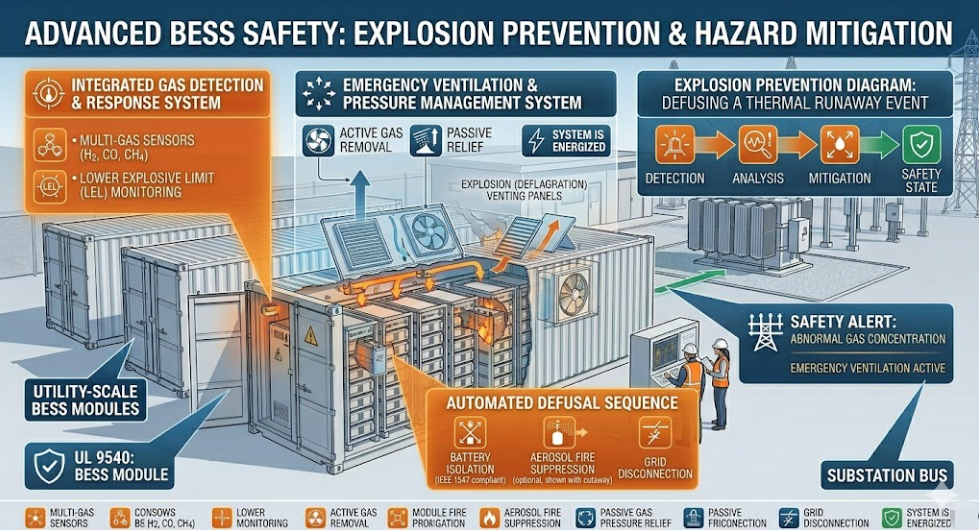
NFPA 69 focuses on explosion prevention inside ESS enclosures.
The updated 2026 NFPA 855 edition increases the importance of this standard.
Under NFPA 69, projects may require:
Emergency ventilation systems
Flammable gas monitoring
Gas concentration control
In many systems, ventilation equipment must keep gas concentration below 25% of the lower flammable limit.
Previously, some projects relied mostly on deflagration venting. However, newer requirements focus more on prevention instead of pressure relief alone.
For this reason, gas detection and ventilation systems are becoming standard features in modern ESS projects.
NFPA 68 for Deflagration Venting
NFPA 68 supports explosion pressure venting and deflagration analysis.
This standard helps engineers calculate:
Vent sizing
Pressure relief
Gas flow behavior
Today, many utility-scale projects combine:
NFPA 68 studies
NFPA 69 prevention systems
UL 9540A testing
Together, these standards improve overall ESS fire safety.
NEC Article 706 for ESS Electrical Safety
National Fire Protection Association includes ESS requirements within the National Electrical Code.
Article 706 applies to energy storage systems larger than 1 kWh.
The article covers:
Wiring methods
Disconnects
Grounding
Overcurrent protection
Equipment labeling
Therefore, NEC Article 706 is essential for electrical permitting and inspection approval.
In addition, proper NEC compliance helps reduce electrical hazards during operation and maintenance.
UL 1973 for Battery Certification
UL 1973 applies specifically to stationary battery systems.
The standard evaluates:
Cell safety
Module design
Electrical protection
Mechanical integrity
Most lithium-ion battery systems require UL 1973 certification before full ESS integration.
Consequently, UL 1973 has become a core requirement for utility-scale battery projects.
Without UL 1973 compliance, achieving UL 9540 system certification becomes difficult.
UL 1741 for PCS and Inverters
UL 1741 applies to power conversion systems and inverters.
This standard evaluates:
Grid interaction
Electrical safety
Anti-islanding protection
Converter performance
As grid-forming systems become more common, UL 1741 compliance is becoming increasingly important.
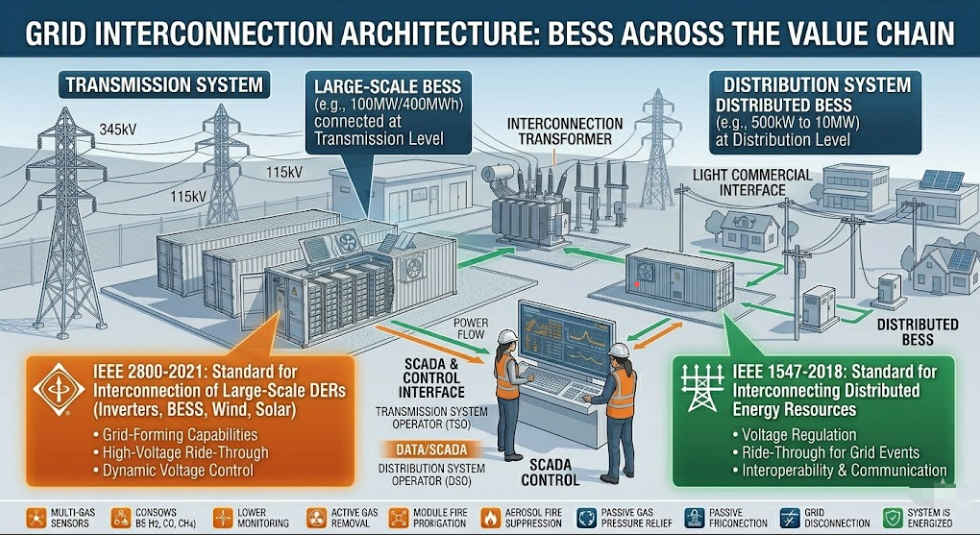
Grid interconnection standards help maintain stable operation between ESS systems and utilities.
IEEE 1547
IEEE 1547 mainly applies to distribution-connected systems.
It defines:
Voltage response
Frequency ride-through
Grid synchronization
Protection coordination
IEEE 2800
Conversely, IEEE 2800 applies explicitly to large, transmission-connected inverter-based resources.
As utility-scale projects continue growing, IEEE 2800 is becoming more relevant.
Therefore, developers should consider interconnection requirements during the early design phase.
For technical grid-interconnection rules such as voltage ride-through, frequency response, reactive-power control, protection, and country-specific requirements, see our BESS grid codes and compliance guide.
ESS Communication Standards
Modern battery storage systems depend heavily on communication networks.
These networks connect:
EMS
BMS
PCS
SCADA systems
Utility operators
As ESS projects grow larger, communication standards become more important.
Key standards include:
IEEE 1815.2
IEEE 2030.5
SunSpec Modbus models
Together, these standards improve interoperability and simplify utility integration.
In addition, they help operators monitor and control battery systems more effectively.
Battery Energy Storage Systems (BESS) are rapidly becoming a foundation of modern power grids, enabling renewable energy integration, peak shaving, and grid resilience. As BESS installations grow in size and density, safety and regulatory compliance have emerged as top priorities for utilities, regulators, insurers, and project developers worldwide.
BESS safety and compliance ensure that battery energy storage systems operate safely across design, testing, installation, and operation. Key requirements include UL 9540 certification, UL 9540A thermal runaway testing, NFPA 855 installation compliance, IEC battery safety standards, certified battery management systems (BMS), and integrated fire detection and suppression systems.
High-energy lithium battery systems introduce unique fire, thermal, and electrical risks. Without strict adherence to international safety standards, these risks can impact public safety, project approvals, insurance coverage, and long-term asset reliability. As a result, BESS safety and compliance now determine whether a project is bankable, insurable, and scalable.
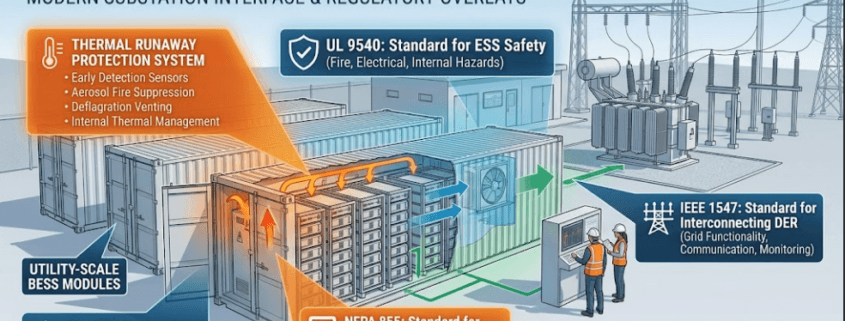
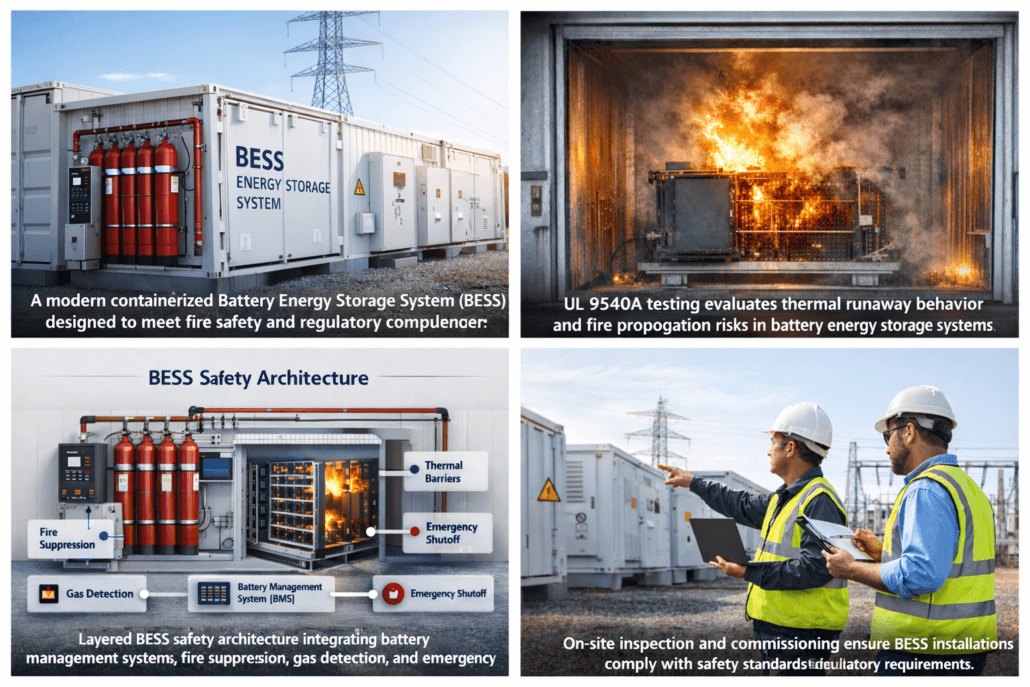
A visual overview of BESS safety and compliance, including containerized energy storage with fire suppression, UL 9540A thermal runaway testing, layered safety architecture, and on-site inspection and commissioning.
This combined visual represents the complete BESS safety lifecycle—from compliant system design and fire testing to real-world inspection and commissioning—making it ideal for Google Discover and AI answer engines.
Why BESS Safety and Compliance Matter
BESS safety directly affects people, infrastructure, and grid reliability. A single failure can result in fire incidents, forced shutdowns, regulatory penalties, or long-term reputational damage.
Compliance is essential for:
Utility interconnection approvals
Local Authority Having Jurisdiction (AHJ) permits
Insurance underwriting and project financing
Long-term operational reliability
Safety requirements also vary by system type and application. This is why understanding the difference between BESS and ESS is critical when designing systems that meet regulatory and fire-code expectations.
Why BESS Safety Is a Growing Global Concern
Battery safety incidents and tighter fire codes have prompted regulators and utilities to reassess how energy storage systems are designed, tested, and installed. Authorities now require higher levels of third-party certification, fire-risk analysis, and documented mitigation strategies.
At the same time, insurers and financiers increasingly demand proof of UL, IEC, and NFPA compliance before underwriting large-scale projects. As global energy storage capacity expands, safety compliance has become a gating factor for market growth, not just a technical requirement.
Key Safety Risks in Battery Energy Storage Systems
Thermal Runaway
Thermal runaway occurs when a battery cell overheats uncontrollably, potentially triggering fire or explosion. It remains the most significant risk in lithium-based BESS installations.
Electrical Hazards
High-voltage DC systems introduce shock and arc-flash risks during installation, operation, and maintenance.
Fire Propagation
Without proper spacing, barriers, and suppression systems, a single cell failure can spread rapidly across modules and racks.
Gas Emissions
Battery failures may release toxic or flammable gases, making gas detection and ventilation critical safety measures.
Core BESS Safety Standards and Compliance Frameworks
UL Certifications for BESS (North America)
UL 9540 – System-level safety certification for BESS
UL 9540A – Thermal runaway and fire propagation testing
UL 1973 – Safety standard for stationary battery modules
UL 9540 certification is often mandatory for commercial and utility-scale BESS projects.
Grounding, fire system validation, safety signage, and Site Acceptance Testing (SAT) confirm readiness for operation.
Operation and Maintenance
Remote monitoring, routine inspections, and BMS updates maintain long-term compliance and reliability.
How Sunlith Energy Ensures BESS Safety and Compliance
Drawing on hands-on experience across commercial, industrial, and utility-scale projects, Sunlith Energy designs and supplies compliant Battery Energy Storage Systems aligned with UL, IEC, and NFPA safety frameworks.
Our approach includes:
Compliance-driven system engineering
Integrated fire protection design
Multi-stage quality inspections
Application-specific regulatory planning
Learn more about our battery energy storage solutions at Sunlith Energy.
Key Takeaways: BESS Safety and Compliance
BESS safety addresses thermal, electrical, and fire risks
Safety spans design, testing, installation, and operation
Early AHJ engagement accelerates approvals
Frequently Asked Questions (FAQ)
What is the most important BESS safety standard?
UL 9540 is the most widely required system-level safety standard in North America.
Is NFPA 855 mandatory?
It is often adopted by local jurisdictions, making it effectively mandatory.
How does UL 9540A improve safety?
It evaluates thermal runaway behavior and fire propagation risks.
Are IEC standards accepted globally?
Yes, they are recognized across Europe, Asia, and international markets.
Who is responsible for BESS safety compliance?
Manufacturers, EPCs, system integrators, and site owners share responsibility under AHJ oversight.
Final Thoughts
As energy storage adoption accelerates, BESS safety and compliance are no longer optional. They define project approval, insurability, and long-term success. By aligning with recognized global standards and proven safety engineering, organizations can deploy battery energy storage systems with confidence and resilience.
The UL 9540A Test Method is the only national standard that measures how thermal runaway fire spreads inside a battery energy storage system. It covers everything from a single cell all the way to a full real-world installation.
Most U.S. states require this test. Both NFPA 855 and the International Fire Code reference it directly. Without UL 9540A test data, large BESS projects simply cannot receive AHJ approval.
This guide covers everything you need:
What UL 9540A tests and why it matters
All 4 test levels with pass/fail criteria
Real costs, timelines, and lab selection tips
Every change in the 2025 Fifth Edition
How UL 9540A connects to UL 9540 certification
Who needs it and exactly when
What is the UL 9540A Test Method?
The UL 9540A Test Method — formally titled “Standard for Evaluating Thermal Runaway Fire Propagation in Battery Energy Storage Systems” — measures specifically how a battery fire behaves once it starts.
Most safety certifications cover general equipment performance. This standard, however, focuses purely on fire propagation. In other words, it answers one critical question: will a failure in one cell, module, or unit spread to the rest of the system?
That narrow focus makes it the go-to reference for engineers, installers, and Authorities Having Jurisdiction (AHJs) across the United States. According to UL Solutions, the standard is widely adopted because it provides reproducible, science-based data that fire authorities can consistently apply across different projects and jurisdictions.
The standard answers three specific safety questions:
Cell propagation — whether thermal runaway in a single cell spreads to adjacent cells or the full module
Fire behaviour — how a battery module or full ESS unit reacts during a fire, including flame height, gas release, and heat output
Suppression effectiveness — whether built-in or external fire suppression systems can prevent explosion, deflagration, or reignition
No other national standard addresses all three at once.
BESS installations — whether residential, commercial, or utility-scale — fall under NFPA 855 and the International Fire Code in most U.S. states. Both codes reference the UL 9540A Test Method directly as the required fire safety test for stationary energy storage systems. Moreover, the National Fire Protection Association updates NFPA 855 regularly to reflect new battery technologies and installation environments. For a deeper dive into these installation standards, see our Complete Guide to NFPA 855.
This standard ensures three important things for the industry:
Manufacturers can prove their systems are safe using science-based, reproducible test data
Installers receive clear installation parameters — separation distances, suppression specifications, and ventilation requirements — all derived directly from test results
Authorities Having Jurisdiction gain a reliable, nationally recognised safety benchmark for permit reviews
Without UL 9540A test data, a BESS product cannot be permitted in most U.S. commercial, industrial, or utility-scale projects. Therefore, it is not simply a competitive advantage — it is the entry ticket to the market.
UL 9540A four-level test hierarchy cell module unit and installation level
The UL 9540A Test Method uses a hierarchical four-level structure. Testing stops at the earliest level where no fire propagation is detected. As a result, not every product needs all four levels. This can significantly reduce cost and time for manufacturers whose chemistry performs well at cell or module level.
Level 1: Cell-Level Testing
Cell-level testing is where every UL 9540A program begins. A heater strip or nail penetration forces thermal runaway in a single cell while sensors record what happens next.
What gets measured:
Gas volume and composition, including hydrogen, CO, and CO₂
Peak heat release rate in kilowatts and total heat energy
Flame height, duration, and whether flames self-extinguish
Surface temperature of adjacent cells
Whether neighbouring cells ignite
Pass condition: Adjacent cells do not reach thermal runaway. When no propagation is detected, the test program stops here. Consequently, the manufacturer receives cell-level data and can move toward UL 9540 certification without module or unit testing.
What triggers escalation: If heat or gas from the first cell causes a second cell to enter thermal runaway, testing moves to Level 2.
Chemistry guidance: Most modern LiFePO₄ (LFP) cells pass at this stage because of their inherently stable chemistry and lower heat release. NMC and NCA chemistries, on the other hand, release significantly more heat and gas. Therefore, they are more likely to escalate to Level 2.
When cell-level testing shows propagation risk, the UL 9540A program moves to the module — a group of cells assembled exactly as they appear in a real BESS product. The same thermal runaway trigger applies to a single cell inside the fully assembled module.
What gets measured:
Whether thermal runaway spreads from the triggered cell to all other cells
Gas volume and composition vented from the full module
Flame spread across the module casing
Peak and sustained temperature of the module exterior
Whether the module casing ignites or deforms
Pass condition: Thermal runaway does not spread beyond the module boundary. Furthermore, the casing contains the event without external flaming or structural failure. When this condition is met, the manufacturer holds module-level data and can define safe installation spacing without moving to unit-level testing.
What triggers escalation: Flames, heat, or gas that could ignite an adjacent module in a real installation will push testing to Level 3.
Design insight: Module-level testing frequently reveals weaknesses in cell spacing, busbar design, and casing vent placement. For this reason, many manufacturers make design changes after Level 2 results before spending money on unit and installation tests.
At Level 3, the complete battery system — exactly as it would ship to a customer — undergoes testing. This includes battery modules, BMS, thermal management components, enclosure, and all internal wiring. Importantly, suppression systems are typically disabled at this level unless they are permanently integrated and cannot be removed.
What gets measured:
Whether thermal runaway spreads from the triggered module to other modules
Total gas volume vented from the enclosure
Explosion and deflagration risk from accumulated vented gases
Flame spread across the enclosure exterior
Peak temperatures on all external surfaces
Structural integrity of the enclosure after the event
Pass condition: No sustained external flaming occurs. Additionally, there is no detonation or deflagration of vented gases, and the enclosure does not fail in a way that exposes people or adjacent equipment to flames or hot gas.
What triggers escalation: If the unit vents enough flammable gas to create an explosion risk, or if external surfaces reach temperatures that could ignite surrounding materials, testing proceeds to Level 4.
Why AHJs focus here: Most Authorities Having Jurisdiction review unit-level data first when evaluating a BESS permit. The unit-level report defines minimum separation distances, ventilation requirements, and suppression specifications — all of which feed directly into the installation design.
Level 4 is the most comprehensive stage of the UL 9540A Test Method. Here, the system undergoes testing exactly as it would be installed — including active fire suppression, ventilation systems, and surrounding structural elements like walls and floors. Unlike Level 3, suppression systems are fully enabled.
What gets measured:
Whether active suppression successfully controls the fire event
Explosion and deflagration of vented gases in the confined installation space
Flame spread to surrounding structural elements
Reignition within 24 hours after suppression
Gas concentration levels during and after the event
Structural integrity of the installation environment post-event
Pass condition: No detonation or deflagration occurs. The suppression system controls the event. No sustained flaming spreads to surrounding structures. Furthermore, no reignition appears during the 24-hour post-test monitoring window.
What a pass unlocks: Installation-level data is the gold standard for AHJ approvals at commercial and utility scale. In addition, it defines the exact suppression system specification — type, activation threshold, and flow rate — that must be replicated in every real-world installation.
The UL 9540A Test Method uses four sequential levels. Cell-level testing checks whether a single cell’s thermal runaway spreads. Module-level testing then examines propagation across a full battery module. Next, unit-level testing evaluates the complete ESS with suppression disabled. Finally, installation-level testing runs the complete real-world scenario with suppression fully active. Because testing stops at the earliest clean level, many manufacturers never need to reach Level 4.
UL 9540A Pass/Fail Criteria: What Does the Test Actually Measure?
A BESS system passes the UL 9540A Test Method when all of the following conditions are met during and after the induced thermal runaway event:
Criteria
Pass Condition
Fire propagation
No spread beyond the unit boundary
Detonation / deflagration
Not observed at any point
Sustained flaming
Ceases within the post-test observation window
Suppression effectiveness
Active system controls the event
Reignition
None observed 24 hours post-test
What happens on a failure? A single failed criterion requires a design modification and re-testing from that specific level — not from the beginning. Most manufacturers use the results to improve cell spacing, separator design, or suppression placement before committing to the more expensive installation-level test.
UL 9540A Test Method Costs, Timelines, and Accredited Labs
One of the first questions manufacturers ask about the UL 9540A Test Method is simple: how much does it cost and how long will it take?
Test Level
Typical Duration
Estimated Cost (USD)
Cell level
2–4 weeks
$8,000–$20,000
Module level
3–6 weeks
$15,000–$40,000
Unit level
4–8 weeks
$25,000–$60,000
Installation level
6–12 weeks
$40,000–$100,000+
Full 4-level program
3–6 months
$80,000–$200,000+
Costs vary based on system size, chemistry, and lab availability. Retesting adds time and cost at the specific level that failed.
How to Choose a UL 9540A Accredited Test Lab
Not every lab can run all four test levels. Before booking, verify these four things:
IAS or A2LA accreditation specifically covering UL 9540A scope
Physical capacity for your unit or installation test size
Experience with your battery chemistry — LFP, NMC, or sodium-ion
Hydrogen detection capability, which the Fifth Edition now requires for relevant chemistries
Well-known accredited labs include UL Solutions, Intertek, TÜV SÜD, and SGS. Importantly, the best labs book out 3–6 months in advance. Start conversations before you are ready to test, not after.
UL 9540A vs UL 9540 vs UL 9540B: Key Differences
These three standards are closely related, yet they serve very different purposes. Confusing them is one of the most common and expensive mistakes in BESS certification.
Standard
Type
Scope
Who It Applies To
UL 9540
Certification
Full ESS system safety
Manufacturers seeking UL listing
UL 9540A
Test Method
Thermal runaway fire propagation
Anyone needing AHJ / NFPA 855 compliance
UL 9540B
Test Method
Residential vent gas ignition
Home BESS installers
The critical distinction: The UL 9540A Test Method produces a test report, not a certificate. That report feeds into UL 9540 certification and satisfies NFPA 855 and IFC requirements. In practice, you can hold UL 9540A data without being UL 9540 certified. However, you cannot achieve UL 9540 certification without it.
Together, these three standards form a complete safety framework — covering fire propagation at every scale from a single residential battery to a 100 MWh grid-scale installation.
Fifth Edition (2025): What Changed and What It Means for You
UL Solutions released the UL 9540A Test Method Fifth Edition on March 12, 2025. This update is the most significant revision since the standard’s introduction. Three forces drove the changes: rapid adoption of new battery chemistries, a surge in rooftop and residential BESS deployments, and real-world fire incidents that exposed gaps in the previous edition.
Below is every major change — and specifically what each one means in practice.
Change 1: Hydrogen Detection Protocols Now Explicitly Addressed
What changed: The Fifth Edition formally adds hydrogen sensor protocols to the test setup. Previously, hydrogen monitoring was optional and inconsistently applied across different labs.
What it means for you: If your BESS uses any chemistry that off-gasses hydrogen during thermal runaway — including lead-acid, certain NMC variants, and some older lithium chemistries — your chosen lab must now have hydrogen-rated enclosures and calibrated sensors. However, not all accredited labs have upgraded their facilities yet.
Action required: Before booking, specifically ask: “Are you equipped for hydrogen detection under the UL 9540A Fifth Edition?” Discovering this gap after scheduling typically adds several weeks to your timeline.
Change 2: Rooftop and Open Garage Installations Have Dedicated Criteria
What changed: The Fifth Edition adds specific test scenarios and pass/fail criteria for rooftop-mounted BESS and open garage installations — two of the fastest-growing deployment environments in commercial solar-plus-storage.
What it means for you: Before this update, AHJs evaluating rooftop BESS had to interpret indoor criteria and apply them to rooftop conditions, which led to inconsistent approvals. Now, if your product targets commercial rooftop projects, your UL 9540A test report must explicitly cover the rooftop installation scenario. A report based only on indoor unit-level testing will therefore not satisfy AHJ requirements for rooftop deployments.
Action required: Tell your test lab upfront that you need rooftop installation scenario data in the final report. This change affects test setup, not just documentation.
Change 3: Rest Times After Conditioning and Charging Are Clarified
What changed: The Fifth Edition specifies exact rest periods between cell conditioning, charging, and the thermal runaway trigger. Previously, labs interpreted these intervals differently, which produced inconsistent results across facilities.
What it means for you: Standardised rest times make results more reproducible and comparable across labs. If you have older UL 9540A data from before March 2025, some AHJs may request updated data under the Fifth Edition protocols. Consequently, you should confirm with your certification body whether existing reports are still accepted for new project applications.
Change 4: Thermocouple Placement Is More Precisely Defined
What changed: The Fifth Edition introduces tighter specifications for sensor placement during cell-level testing, including continuous temperature ramping rather than the stepped increments some labs previously used.
What it means for you: More precise thermocouple placement captures temperature gradients more accurately — particularly at cell edges where propagation typically begins. As a result, cell-level tests may take slightly longer to set up correctly under the new specifications.
Change 5: Module Casing Temperature Limits Are Now Specified
What changed: Previously, the standard measured casing temperature but did not define a clear pass/fail threshold. The Fifth Edition now introduces specific maximum temperature limits for module casings during Level 2 testing.
What it means for you: This change directly affects module enclosure design. If your module casing reaches the new temperature threshold, the test escalates to Level 3 regardless of whether flame propagation was observed. Manufacturers using thin-wall aluminium enclosures are most likely to be affected by this change.
Action required: Review your module casing material and wall thickness against the new thresholds before testing. Adding a ceramic fibre layer or increasing casing thickness can prevent an unexpected escalation to Level 3 — and save $25,000–$60,000 in additional testing costs.
Change 6: New Chemistries — Lead-Acid, NiCd, and Flow Batteries Now Covered
What changed: The original standard focused almost entirely on lithium-ion chemistry. In contrast, the Fifth Edition adds dedicated test protocols for lead-acid, nickel-cadmium, and flow battery systems.
What it means for you: If you manufacture or integrate non-lithium BESS technology, the Fifth Edition finally gives you a clear test roadmap. Previously, testing these chemistries required significant negotiation with both the lab and the AHJ to agree on appropriate protocols. For flow battery manufacturers in particular, this is a major development — vanadium flow and zinc-bromine systems behave fundamentally differently from lithium thermal runaway, and the Fifth Edition addresses this directly.
What changed: The Fourth Edition used an NFPA 286 fire room for residential installation-level testing. The Fifth Edition replaces this with an instrumented wall assembly, which better represents how home batteries are actually mounted — on a garage or utility room wall.
What it means for you: If you sell residential BESS products, your installation-level test setup looks different now. The instrumented wall assembly is generally less expensive to construct than a full NFPA 286 fire room. Nevertheless, if you have existing residential installation-level data from before March 2025, confirm with your certification body whether the new wall assembly requirement affects your report’s validity.
Fifth Edition Changes at a Glance
Change
Who Is Affected Most
Action Required
Hydrogen detection protocols
Lead-acid, NMC, NCA chemistries
Confirm lab has H₂-rated enclosures
Rooftop & garage criteria
Commercial rooftop solar-plus-storage
Add rooftop scenario to test scope
Clarified rest times
All manufacturers with pre-2025 data
Verify older reports still accepted
Thermocouple placement
All cell-level tests
Allow extra lab setup time
Module casing temp limits
Thin-wall aluminium enclosures
Review casing design before testing
New chemistry protocols
Lead-acid, NiCd, flow batteries
Follow chemistry-specific protocols
Residential wall assembly
Home / residential BESS products
Update installation test setup
The March 2025 UL 9540A Fifth Edition introduced seven significant changes. The most impactful changes for manufacturers are the new hydrogen detection protocols — which affect lab selection for chemistries that off-gas hydrogen — and the dedicated rooftop installation criteria, which now require a separate test scenario for any product targeting commercial rooftop solar-plus-storage. Furthermore, manufacturers with test reports issued before March 12, 2025 should confirm with their AHJ and certification body whether existing data is still accepted for new project applications.
Do You Need to Retest Under the Fifth Edition?
The answer depends on three factors.
First, check when your existing report was issued. Reports from before March 12, 2025 were conducted under the Fourth Edition. Most AHJs still accept these for projects already in the permitting pipeline. However, new applications submitted after mid-2025 increasingly require Fifth Edition data.
Second, check whether your product design has changed. Any change to cell chemistry, module configuration, casing material, or suppression system after your original test date requires a new UL 9540A test — regardless of which edition is current.
Third, confirm what your AHJ specifically requires. California, New York, and Massachusetts fire authorities have been quickest to adopt the Fifth Edition. Always verify the edition requirement directly with your AHJ before scheduling any testing.
Who Is Required to Complete UL 9540A Testing?
The UL 9540A Test Method is not optional for most BESS projects in the United States. Here is a breakdown of exactly who needs it, why, and when.
1. Battery Manufacturers
Manufacturers are the first and most critical party in the UL 9540A chain. Without cell or module level test data, no downstream party can use the product in a code-compliant installation.
Specifically, manufacturers need UL 9540A data before submitting for UL 9540 system certification, before launching any product commercially in the U.S. or Canadian markets, and whenever a significant design change occurs — whether to cell chemistry, module configuration, or enclosure design.
Real example: A South Korean LFP cell manufacturer entering the U.S. market completes cell-level testing and passes with no propagation at Level 1. Because they include the test report in their product datasheet, every integrator using their cells can reference it in permit applications — significantly shortening approval timelines for everyone downstream.
2. BESS Integrators and System Builders
Integrators who assemble cells or modules into complete ESS units need UL 9540A data at the unit level. Even when the cells inside already carry cell-level data from the manufacturer, the assembled unit must still be tested separately — because different enclosures, cell spacing, and thermal management all change how the system behaves.
The most common mistake integrators make: Many assume that their cell supplier’s cell-level data covers their assembled system. It does not. AHJs want unit-level or installation-level data for the specific product being installed — not just the cells inside it.
Real example: A U.S.-based integrator builds a 500 kWh containerised system using LFP cells with existing cell-level test data. Despite this, they still need unit-level testing on the complete container. The reason is straightforward — cell-level data does not account for how heat and gas behave inside that specific enclosure design.
3. Project Developers and EPCs
Developers and EPC firms typically do not conduct UL 9540A testing themselves. Instead, they rely on the manufacturer or integrator to provide the report. However, they remain responsible for ensuring the correct report exists and covers the specific installation scenario before permit submission.
The financial risk of missing documentation: Permit delays on utility-scale projects can cost $50,000–$500,000 or more per month in carrying costs, grid connection fees, and contractor standby charges. Getting UL 9540A documentation right at the permit stage is therefore one of the most cost-effective risk management steps a developer can take.
Real example: A California solar-plus-storage developer submits a permit for a 2 MWh commercial BESS. The AHJ requests installation-level data. Unfortunately, the integrator only holds unit-level data. As a result, the permit is held for 11 weeks while the integrator arranges additional testing — delaying commercial operation and triggering a penalty clause in the PPA.
4. Commercial and Industrial Installers
C&I installers are responsible for ensuring the physical installation meets all fire code requirements. Although they do not conduct UL 9540A testing themselves, they need to understand what the test data means — because it determines the installation parameters they must follow on site.
Specifically, test data defines minimum separation distances, required suppression system type and specifications, ventilation requirements, and whether the system can be installed in occupied spaces.
Real example: A C&I installer receives a BESS unit with a UL 9540A report covering indoor ground-level installation. The customer, however, wants the unit in a rooftop plant room. After reviewing the report, the installer identifies that rooftop installation is not covered. Because this is now a separate test scenario under the Fifth Edition, the installer flags the issue to the developer before installation — successfully avoiding a failed inspection and costly remediation.
5. Residential Installers
Residential installers need to verify that the products they install carry UL 9540A data specifically covering residential installation scenarios. Under the Fifth Edition, residential installation-level testing now uses an instrumented wall assembly rather than the previous NFPA 286 fire room.
In California, New York, Massachusetts, and several other leading states, residential BESS installations above a certain capacity also require a fire marshal review. During that review, the fire marshal will specifically examine the UL 9540A report. An outdated Fourth Edition report covering only indoor ground-level scenarios may not pass that review.
6. Authorities Having Jurisdiction (AHJs)
Understanding how AHJs use UL 9540A data helps manufacturers, integrators, and developers prepare the right documentation on the first submission.
When reviewing a permit application, AHJs check four specific things. First, they confirm the test covers the specific installation type — indoor, outdoor, rooftop, or residential. Second, they verify the report is under the current edition. Third, they ensure the suppression system in the report matches what is being installed. Fourth, they check that the separation distances in the design match the test data requirements.
The most common reason AHJs reject a BESS permit: The UL 9540A report covers a different installation configuration than what is being proposed. In almost every case, this is avoidable with proper planning.
Quick Reference: Who Needs What
Party
Needs UL 9540A?
At What Level
When
Battery manufacturer
Yes
Cell + Module
Before product launch
BESS integrator
Yes
Unit level minimum
Before UL 9540 certification
Project developer / EPC
Must obtain from supplier
Unit or Installation
Before permit application
C&I installer
Must verify it exists
Unit or Installation
Before accepting product
Residential installer
Must verify it exists
Installation — residential wall
Before installation
AHJ
Reviews it
Installation level preferred
At permit application stage
How Passing UL 9540A Accelerates Project Approvals
For manufacturers and integrators new to the UL 9540A Test Method, testing can feel like a cost centre. In reality, the test data is one of the most commercially valuable documents a BESS company can hold. Here is exactly what it delivers.
1. Unlocks the U.S. and Canadian Markets
Without UL 9540A test data, a BESS product cannot receive permits for most U.S. commercial, industrial, or utility-scale installations. According to Wood Mackenzie, the U.S. utility-scale BESS market is projected to exceed 100 GWh of annual deployments by 2027. Every gigawatt-hour of that capacity requires UL 9540A documentation before installation can begin.
2. Speeds Up AHJ Approvals Dramatically
When a permit application arrives with a complete, current UL 9540A report covering the correct installation scenario, AHJ reviews move quickly. Without one — or with a report covering the wrong configuration — projects stall.
Documentation Status
Typical AHJ Review Time
Full report — correct edition and scenario
2–6 weeks
Partial report — unit level only
6–14 weeks
No UL 9540A report
3–6 months or permit denied
Wrong installation scenario
8–16 weeks while retesting is arranged
For a utility-scale developer carrying $500,000 per month in project costs, the difference between a 4-week and a 16-week AHJ review represents $6 million in carrying costs alone.
The test report tells installers and engineers exactly how to install a system safely. Specifically, it provides minimum separation distances, suppression system type and specifications, ventilation requirements, and occupancy separation rules. Without test data, engineers must apply conservative worst-case assumptions to every parameter — resulting in larger equipment rooms and more expensive suppression systems than the product actually requires.
Real example: A 1 MWh commercial BESS without test data is conservatively specced with 3-metre separations and a full FM-200 suppression system. After unit-level UL 9540A testing shows minimal gas release and no external flaming, the AHJ approves 1.5-metre separations and a standard sprinkler system instead — saving the developer $180,000 in installation costs on a single project.
4. Strengthens Credibility With Buyers and Investors
Most utility and large C&I tenders now include UL 9540A documentation as a mandatory submission requirement. Beyond procurement, project finance lenders review it during technical due diligence. BESS project insurers also base premiums and coverage terms partly on test results — systems with complete data typically receive 10–25% lower annual premiums. In competitive RFP processes where two products are technically similar, the one with more complete and current documentation consistently wins.
5. Delivers Valuable Design Feedback
The UL 9540A Test Method is not simply a pass/fail gate. Rather, it is the most rigorous thermal event simulation most BESS products will ever undergo. Manufacturers routinely learn which cells in a module are most vulnerable to propagation, whether casing vent design adequately directs hot gas away from adjacent modules, how the BMS responds when thermal runaway begins, and whether suppression activates early enough. Each test cycle generates specific, quantified data about failure modes that competitors without that test history simply do not possess.
6. Reduces Insurance Costs and Liability Exposure
Systems with complete installation-level UL 9540A data typically receive 10–25% lower annual premiums than systems with partial or no documentation. Furthermore, in the event of a fire incident, a manufacturer with complete test data has documented evidence that their product was tested to the applicable national standard. Without that documentation, liability exposure in litigation increases significantly.
7. Supports International Market Access
Beyond North America, several international markets reference or accept UL 9540A data as part of their BESS approval processes. Australia’s Clean Energy Council accepts UL 9540A reports as supporting documentation. Similarly, Japan’s Fire and Disaster Management Agency references the standard in guidance for large-scale BESS. In addition, South Korea has incorporated UL 9540A style propagation testing following high-profile fire incidents, and several Gulf states including the UAE and Saudi Arabia reference it in their developing BESS procurement standards.
The True Cost of Skipping UL 9540A Testing
Consequence
Typical Cost Impact
Permit application rejected or delayed
$50K–$500K+ per month
AHJ requires retesting mid-project
$80K–$200K + 3–6 month delay
Insurance coverage limited
15–30% higher annual premiums
Excluded from mandatory RFP requirement
Full contract value lost
Fire incident without test documentation
Unlimited liability in litigation
Project finance delayed pending documentation
Higher borrowing costs or lost financing window
A full four-level UL 9540A program costs $80,000–$200,000 and takes 3–6 months. Against any single item in the table above, that investment pays for itself many times over.
Conclusion: Is Your BESS Ready for UL 9540A Testing?
The UL 9540A Test Method is not a box to check — it is the technical foundation that determines whether your BESS project gets built or stalls at the permit stage. With the 2025 Fifth Edition now in effect, manufacturers and integrators working with newer chemistries or rooftop installations need to revisit their test plans immediately.
Here is a quick recap of everything covered in this guide:
The UL 9540A Test Method measures thermal runaway fire propagation at four levels — cell, module, unit, and installation
Testing stops at the earliest clean level, so not every product needs all four
A full four-level program costs $80,000–$200,000 and takes 3–6 months — yet the cost of not having it is far higher
The 2025 Fifth Edition introduced seven significant changes — verify your existing data is still accepted for new applications
Every party in the BESS value chain interacts with UL 9540A data at a different stage of the project lifecycle
The Three Most Expensive UL 9540A Mistakes
Mistake 1: Assuming cell-level data covers the assembled system Cell-level data from your supplier does not cover your assembled unit. AHJs require unit-level or installation-level data for the specific product being installed.
Mistake 2: Testing the wrong installation scenario An indoor ground-level report does not satisfy AHJ requirements for rooftop deployment. Under the Fifth Edition, rooftop and open garage installations are separate test scenarios entirely. Always match your test scope to your target installation environment before testing begins.
Mistake 3: Using Fourth Edition data for new Fifth Edition projects Reports issued before March 12, 2025 were conducted under the Fourth Edition. Verify the edition requirement with your AHJ before submitting any new applications.
Three Steps to Take Right Now
Step 1 — Confirm your installation scenario Indoor or outdoor? Ground-level, rooftop, or garage? Residential or commercial? The answers determine which UL 9540A test levels and scenarios your report must cover. Getting this wrong wastes months and significant budget.
Step 2 — Verify your existing test data Check the edition under which it was issued, the installation scenarios it covers, and whether any product design changes have occurred since the test date. When in doubt, confirm directly with your certification body.
Step 3 — Select an accredited lab early The best labs book out 3–6 months in advance. Start conversations before you are ready to test. Confirm hydrogen detection capability if your chemistry requires it under the Fifth Edition.
Related Guides on SunLith Energy
Before you go, these articles will help you build a complete picture of the UL certification landscape:
SunLith Energy works with BESS manufacturers and integrators at every stage of the UL 9540A process:
✅ Test scope planning — confirming which levels and scenarios your program needs to cover ✅ Lab selection and scheduling — matching your chemistry, system size, and timeline to the right accredited facility ✅ Documentation preparation — building the test report package that gets AHJ approvals on first submission ✅ Fifth Edition gap assessment — identifying what, if anything, needs updating in your existing test data
The best time to start planning your UL 9540A program is before your next project enters the pipeline — not after the permit application is submitted.
The UL 9540A Test Method is the only national standard that evaluates whether thermal runaway fire in a battery cell will spread to adjacent cells, modules, or a full BESS installation. It is required by NFPA 855 and the International Fire Code for most commercial and utility-scale energy storage projects in the United States.
Q2. Is UL 9540A a certification?
No. UL 9540A is a test method, not a certification. It produces a test report that manufacturers use to achieve UL 9540 system certification and satisfy local fire code requirements. A BESS product can hold UL 9540A test data without being UL 9540 certified, but cannot achieve UL 9540 certification without it.
Q3. What are the four levels of UL 9540A testing?
The UL 9540A Test Method uses four levels: (1) cell-level, (2) module-level, (3) unit-level, and (4) installation-level with suppression active. Testing stops at the earliest level where no fire propagation is detected, reducing cost and time for manufacturers.
Q4. How much does UL 9540A testing cost and how long does it take?
A full four-level UL 9540A test program typically costs $80,000–$200,000 and takes 3–6 months. Individual levels range from $8,000–$20,000 for cell-level testing to $40,000–$100,000+ for installation-level testing. Costs vary based on system size, battery chemistry, and whether retesting is required.
Q5. What changed in the UL 9540A Fifth Edition released in 2025?
The March 2025 Fifth Edition added hydrogen detection protocols, rooftop BESS installation criteria, new chemistry coverage for flow batteries and lead-acid, module casing temperature limits, and clarified rest times between test stages.