
Australia’s New Battery Rules: The 2026 Compliance Stack
Australia has new battery rules for 2026, and they arrived from three different directions at once. Between August 2025 and December 2025, regulators updated the inverter standard, the battery safety standard, and the cable selection standard. Two of them landed on the very same day. So anyone installing, supplying, or specifying a BESS in Australia now answers to all three of these new battery rules. Miss one, and the other two won’t save the project.
| Quick Answer Australia’s new battery rules for 2026 span three standards. AS/NZS 5139:2019 Amendment 1 (published 19 Dec 2025) covers battery system safety. AS/NZS 4777.2:2020 Amendment 2 (mandatory from 23 Aug 2025) governs inverter performance and grid behaviour. AS/NZS 3008.1.1:2025 (also published 19 Dec 2025) sets cable selection and DC ratings. In Western Australia, full compliance with both the 5139 and 3008.1.1 updates is required from 19 June 2026, following a six-month transition period — other states administer their own timelines. A compliant BESS install needs all three standards, and a battery’s international product certifications (IEC 62619, UL 1973, UN38.3) do not substitute for any of them. |
What Are Australia’s New Battery Rules?
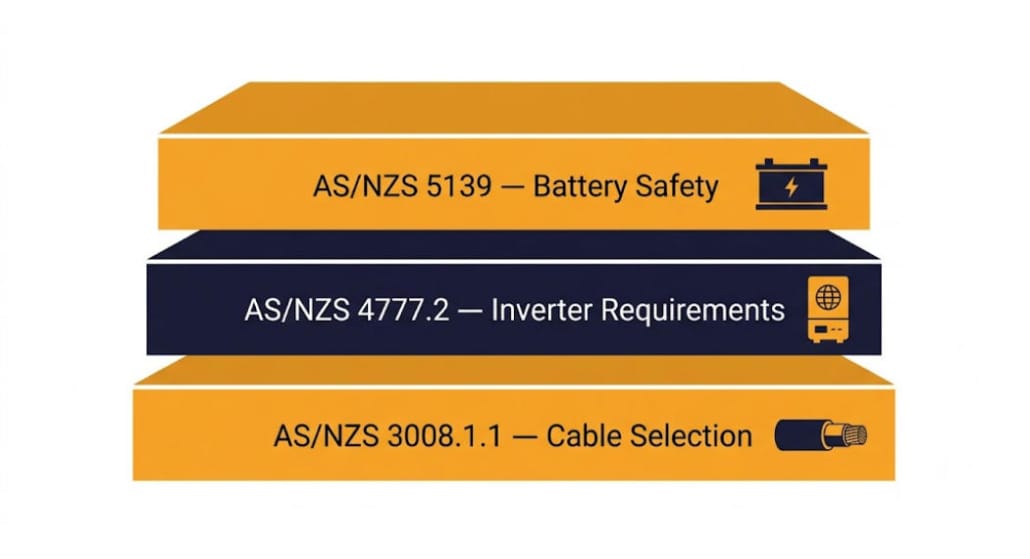
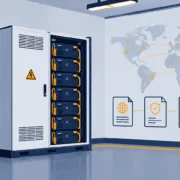
Together, Australia’s new battery rules form what’s best understood as a compliance stack, not three unrelated updates. A battery energy storage system never sits under a single rulebook. Instead, it sits at the intersection of three. AS/NZS 5139 governs how the battery gets installed, ventilated, and protected. AS/NZS 4777.2 governs how the inverter behaves once it talks to the grid. AS/NZS 3008.1.1 governs every cable that connects the two. So a design can pass one standard and still fail the job. Also, it only takes one missed layer to cause it.
It’s also worth separating two things international suppliers often conflate. So battery product certification and Australian installation compliance are not the same thing. A cell or module can carry IEC 62619, UL 1973, and UN38.3 certification and still fail an Australian project if the installation, inverter, or cable design doesn’t separately satisfy the three standards below.
This page works as a living hub, not a one-time post, since Australia’s new battery rules will keep changing. Also, each standard below links out to its own detailed guide as those go live. As amendments publish, this hub updates first, then the change log at the bottom records exactly what moved and when. Bookmark this page, not a single standard’s guide — the compliance stack shifts as a set, not one piece at a time.
Australia’s New Battery Rules: Compliance Stack Overview
The table below summarises where each standard sits today. Full detail on each one follows in its own section, and a dedicated guide for each standard is in progress.
| Standard | Governs | Published | Mandatory From | Administered By |
| AS/NZS 5139:2019 | Battery system and BESS installation safety | Amendment 1: 19 Dec 2025 | Immediate in NSW; full compliance from 19 Jun 2026 in WA (6-month transition) — confirm with your state regulator | Standards Australia / Standards NZ; state electrical safety regulators |
| AS/NZS 4777.2:2020 | Grid-connect inverter performance | Amendment 2: Aug 2024 | 23 Aug 2025 | Standards Australia / Standards NZ; Clean Energy Council; DNSPs |
| AS/NZS 3008.1.1 | Cable selection, current-carrying capacity, DC ratings to 1500V | 2025 edition: 19 Dec 2025 | Full compliance from 19 Jun 2026 in WA (6-month transition); NZ 2017 edition withdrawal ~Nov 2026 | Standards Australia / Standards NZ |
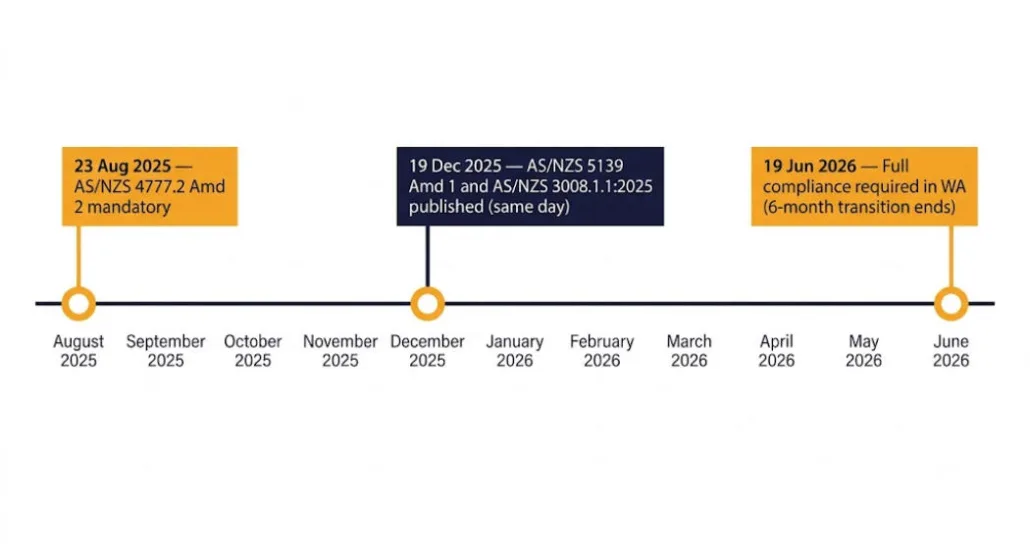
Note on dates: AS/NZS 5139 Amendment 1 and AS/NZS 3008.1.1:2025 were both published on 19 December 2025, not on separate dates. Mandatory compliance timing varies by state; Western Australia’s Building and Energy division has published the clearest specific deadline (19 June 2026, after a six-month dual-acceptance period), while NSW guidance describes the 5139 update as mandatory immediately on publication. Confirm the position in your specific state before quoting a date to a client.
Australia’s New Battery Rules, Part 1: AS/NZS 5139:2019 Amendment 1 — Battery System Safety
Amendment 1 to AS/NZS 5139:2019 was published on 19 December 2025. The NSW Building Commission confirms that a battery installation failing to meet the updated requirements no longer complies with the Standard in NSW.
Western Australia’s Building and Energy division has set a specific full-compliance date: 19 June 2026. That follows a six-month transition period, during which both the 2019 base standard and the amended version are acceptable.
So the amendment touches definitions, installation diagrams, clearances, overcurrent protection, and safety documentation.
What Changed in Amendment 1
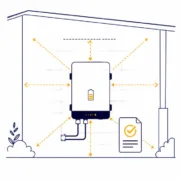
Several changes matter for day-to-day design work. First, Clause 1.3 introduces new and updated definitions. So terminology used on drawings needs a fresh check. Also, the typical BESS installation diagrams were revised — new figures 4.1A through 4.2A cover egress clearance, door and opening clearance, and unimpeded access to a pre-assembled integrated BESS.
Location, Fire Barriers, and Overcurrent Protection
Still, location rules loosened in one specific way. A battery system may now sit within 600mm of an opening, provided that opening is wider than 900mm, such as a garage door. Inverters are also now treated as an associated appliance, and are permitted inside a restricted location, which they previously were not.
Fire-barrier requirements got stricter instead. So exempt materials used as a barrier to a habitable room must now be at least 6mm thick. Building materials within 1 metre of a battery system classed as a chemical hazard also face new requirements.
Also, overcurrent protection for paralleled pre-assembled battery systems changed. The protection device’s kA rating must now match or exceed the combined fault current of every paralleled battery system, not just one. So a new Appendix I sets out how to calculate that cell short-circuit current. This pairs directly with existing short-circuit protection design work on the DC side of the system.
Safety Data Sheets
Safety Data Sheet handling was clarified too. A physical copy must stay on site, protected from damage — for example inside a sealed, durable, clear pouch. Installers should treat SDS storage as part of the handover package, not an afterthought.
AS/NZS 5139 Compliance Checklist for BESS Suppliers and Installers
- Battery enclosure design meets updated location and clearance rules
- Installation clearances reflect revised figures 4.1A–4.2A
- Fire protection strategy accounts for the 6mm minimum barrier thickness
- Overcurrent protection kA rating is calculated against combined paralleled fault current (Appendix I)
- Safety Data Sheets are on-site in a protective pouch
- Installation manuals and terminology match Clause 1.3 definitions
- Maintenance and emergency access procedures documented
Full guide: AS/NZS 5139 Battery Safety Standard — Amendment 1 Explained
Australia’s New Battery Rules, Part 2: AS/NZS 4777.2:2020 Amendment 2 — Inverter Requirements
AS/NZS 4777.2:2020 Amendment 2 governs how grid-connect inverters behave once installed. It is the second of the three new rules. Standards Australia released it in August 2024, then set a 12-month transition period. Full compliance became mandatory from 23 August 2025. So it now applies to every new low-voltage grid-connect inverter installation. That makes it the second pillar of the battery compliance stack.
CSIP-AUS and Smart Communication
First, the headline addition is CSIP-AUS, the Common Smart Inverter Profile for Australia. This communication protocol lets network operators manage dynamic export limits. In some cases, it also allows remote curtailment. A modern compliant inverter is built to be talked to by the grid, not just to push power onto it. The Clean Energy Council’s approved inverter list now reflects Amendment 2 as the current benchmark. Clean Energy Council’s approved inverter list now reflects Amendment 2 as the current benchmark.
What Installers Must Check
Older CEC listings did not carry over automatically. So manufacturers had to submit a declaration plus supporting evidence that their products met Amendment 2 before their listings kept standing. Installers should verify the exact model against the current CEC list — never trust a listing checked before August 2025.
Power quality settings still follow a region-based profile — Australia A, B, or C — set by the local distribution network service provider. This includes the ride-through behaviour covered in our LVRT and HVRT guide. This includes the ride-through behaviour covered in our LVRT and HVRT guide.
EV and V2G Provisions
Next, the amendment adds requirements supporting vehicle-to-grid and vehicle-to-building inverters. So bidirectional EV charging now shares the same grid-connect framework as solar and battery inverters. See our PCS overvoltage protection guide for how these settings interact with anti-islanding and ride-through coordination.
AS/NZS 4777.2 Compliance Checklist
- CEC approval status confirmed against the current list, not a pre-Aug-2025 listing
- Correct firmware version installed
- Grid protection settings match the DNSP’s region profile (A, B, or C)
- Anti-islanding function verified
- Export control compatibility confirmed
- CSIP-AUS capability documented
- LVRT/HVRT settings verified against ride-through requirements
Full guide: AS/NZS 4777.2 Amendment 2: What Changed for Inverter Requirements
Australia’s New Battery Rules, Part 3: AS/NZS 3008.1.1:2025 — Cable Selection
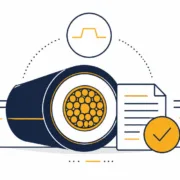
AS/NZS 3008.1.1:2025 is the third of Australia’s new battery rules. It replaces the 2017 edition that governed cable selection for eight years. Standards Australia published the new edition on 19 December 2025. That’s the same day as AS/NZS 5139 Amendment 1, not late 2024 as some secondary sources report. Both editions currently remain valid during the transition. In Western Australia, full compliance with the 2025 edition is required from 19 June 2026. This is the third and final pillar of the battery compliance stack.
New 1500V DC Cable Ratings
So the most significant scope change is new DC cable rating provisions up to 1500 volts. The 2017 edition barely covered DC circuits above 1000 volts. That left utility-scale solar strings and BESS rack-to-inverter cabling without a proper rating table. So the 2025 edition adds explicit current-rating tables for single-core DC cables, plus new provisions for DC fast-charger cabling. These new tables are already referenced alongside the DC specifications in our Understanding BESS Specifications guide.
Revised Grouping and Soil Derating Factors
Also, grouping and soil derating factors tightened. Cables on unperforated trays now carry lower derating factors than before. A six-circuit run on a solid tray, for instance, drops from a factor of 0.73 to 0.68. So that can push a cable size up a full commercial step. A new “very dry soil” row now covers desert and remote mining conditions the 2017 tables never addressed.
Transition Timeline
New Zealand runs its own transition clock. Still, the 2025 edition became available there at the same time as in Australia. But the 2017 edition is expected to be formally withdrawn around November 2026, once the standard 24-month transition period closes. Western Australia’s Building and Energy division confirms that both AS/NZS 5139 Amd 1:2025 and AS/NZS 3008.1.1:2025 were published 19 December 2025, with full compliance required from 19 June 2026 following a six-month period in which either edition is acceptable.
AS/NZS 3008.1.1 Compliance Checklist
- Cable voltage rating confirmed for the full DC operating window (up to 1500V where applicable)
- Maximum operating current calculated against the 2025 tables
- Short-circuit withstand capability checked against combined fault current
- Grouping and derating factors recalculated for unperforated trays with six or more circuits
- Soil thermal resistivity checked for underground runs, including the new “very dry soil” category
- Voltage drop calculation completed for the full cable run
Full guide: AS/NZS 3008.1.1:2025: What Changed for Cable Selection
Battery Product Certification vs. Australian Installation Compliance
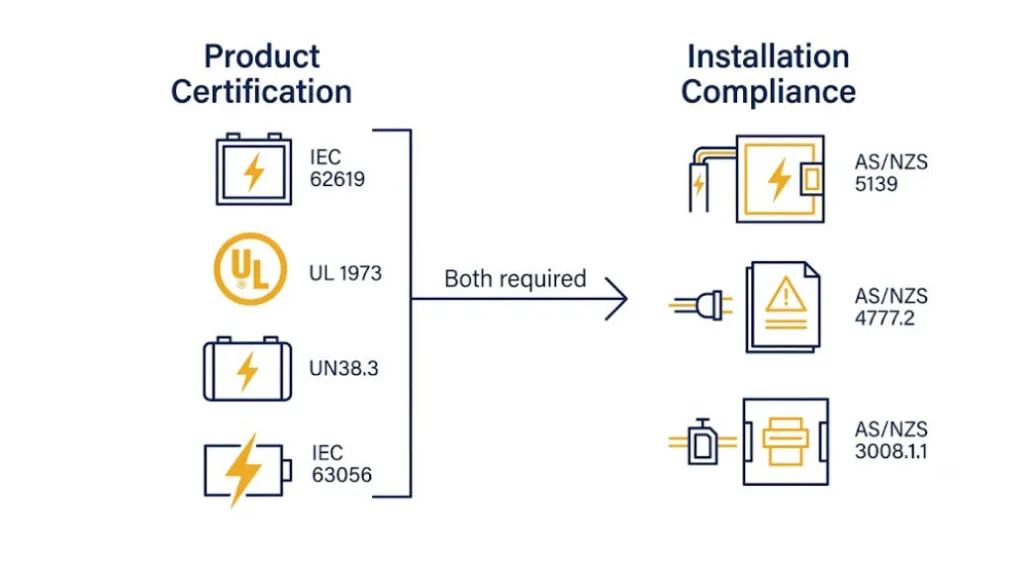
One misunderstanding shows up often among international BESS suppliers. Often, they assume battery product certification alone satisfies Australia’s new battery rules and allows market entry. It doesn’t. A battery module can pass every relevant international safety test and still fail an Australian project. That happens whenever the installation, inverter, or cable design doesn’t separately satisfy AS/NZS 5139, AS/NZS 4777.2, and AS/NZS 3008.1.1. So product certification and installation compliance are different regulatory layers, and both are required.
Common Battery Product Certifications Referenced in Australian BESS Projects
| Certification | What It Covers | Typical Use |
| IEC 62619 | Industrial lithium-ion battery safety: electrical abuse protection, thermal safety, operational reliability | Commercial and industrial BESS, telecom energy storage |
| UL 1973 | Stationary battery safety at module, rack, and system level | Utility-scale and North American-influenced BESS specifications |
| UN38.3 | Transport safety: altitude, temperature, vibration, shock, short-circuit, and overcharge testing | Required before any international lithium battery shipment |
| IEC 63056 | Secondary lithium battery safety for stationary energy storage applications | Residential and commercial ESS, increasingly requested alongside IEC 62619 |
For a full breakdown of these certifications — what each one tests, who issues it, and typical cost and timeline — see our complete BESS Certifications Guide.
So none of these substitute for AS/NZS 5139 installation compliance, AS/NZS 4777.2 inverter or CEC approval, or AS/NZS 3008.1.1 cable design. For suppliers planning an Australian entry, compliance needs to be considered during BESS design. Enclosure layout, protection settings, and documentation format all belong at the design stage. None of it works well retrofitted after manufacturing is locked in.
How Australia’s New Battery Rules Work Together on One Job
These three standards do not operate in isolation on a real job. Take a paralleled battery system as an example, since it shows how Australia’s new battery rules stack on top of one another. First, AS/NZS 5139 Amendment 1 sets the required kA rating for its overcurrent protection device, based on the combined fault current. Then that same fault current drives the short-circuit withstand check on the DC cable under AS/NZS 3008.1.1. Meanwhile, the inverter tying it all to the grid still needs a valid CEC listing under AS/NZS 4777.2 Amendment 2. Miss any one layer, and the other two will not save the design.
So treat the battery compliance stack as one system, not three separate checklists. A designer who only checks the inverter datasheet will eventually hit a cable run that neither standard alone was built to catch. The same goes for a designer who only checks enclosure clearances. Check all three, every time — and check that the underlying battery product certification is in place before any of it matters.
Change Log — Australia’s New Battery Rules Hub
| Date | Version | Update |
|---|---|---|
| 26 Jul 2026 | v1.0 | Initial publication covering AS/NZS 5139 Amendment 1, AS/NZS 4777.2 Amendment 2, and AS/NZS 3008.1.1:2025. |
| 26 Jul 2026 | v2.0 | Corrected the AS/NZS 3008.1.1:2025 publication date to 19 December 2025. Added Western Australia’s specific 19 June 2026 compliance date. Added a new section comparing battery product certification (IEC 62619, UL 1973, UN38.3) with Australian installation compliance. |
| 26 Jul 2026 | v3.0 | Updated the page framing to lead with “Australia’s new battery rules” for clarity. |
| 26 Jul 2026 | v3.1 | Finalised page details ahead of publishing. |
| 28 Jul 2026 | v3.2 | Published all three detailed guides — AS/NZS 5139 Amendment 1, AS/NZS 4777.2 Amendment 2, and AS/NZS 3008.1.1:2025 — and linked them from their respective sections above. |
Australia’s New Battery Rules Checklist for 2026
- Confirm every new BESS design references AS/NZS 5139:2019 including Amendment 1, and check your state’s specific enforcement timeline.
- Check the inverter model against the current CEC approved list for AS/NZS 4777.2:2020 Amendment 2 compliance — a pre-amendment listing did not carry over automatically.
- Specify cable sizing to AS/NZS 3008.1.1:2025 for new designs, even during the transition period.
- Recalculate DC cable sizes on unperforated trays with six or more circuits — the 2025 grouping factors are more conservative.
- Confirm battery product certifications (IEC 62619, UL 1973, UN38.3, IEC 63056 as applicable) are current, and don’t treat them as a substitute for the three installation standards above.
- Revisit this hub whenever an amendment publishes — the battery compliance stack changes faster than most single-standard guides track.
Frequently Asked Questions
What are Australia’s new battery rules?
It’s the combination of standards required for a compliant BESS installation in Australia: AS/NZS 5139 for battery system safety, AS/NZS 4777.2 for inverter/grid-connect performance, and AS/NZS 3008.1.1 for cable selection. A project needs all three — passing one doesn’t clear the others.
When did AS/NZS 5139 Amendment 1 and AS/NZS 3008.1.1:2025 take effect?
Both were published on 19 December 2025. NSW guidance treats the 5139 update as mandatory immediately on publication. Western Australia’s Building and Energy division has set 19 June 2026 as the date full compliance is required for both standards, following a six-month transition period. Confirm the position with your specific state regulator, since implementation timing is not uniform nationally.
Does every battery inverter need CEC approval in Australia?
Grid-connected inverters used in eligible Australian installations generally require approval through the Clean Energy Council’s approved inverter list, and that listing must reflect AS/NZS 4777.2 Amendment 2 compliance specifically — pre-August-2025 listings did not carry over automatically.
Are IEC 62619 or UL 1973-certified batteries automatically approved for use in Australia?
No. These certifications demonstrate battery product safety, but the complete BESS system still needs to separately satisfy AS/NZS 5139 installation compliance, AS/NZS 4777.2 inverter compliance, and AS/NZS 3008.1.1 cable design compliance.
What standard covers BESS cable sizing in Australia?
AS/NZS 3008.1.1:2025 provides current-carrying capacity, voltage drop, and derating guidance for AC and DC cables, including the new tables for DC systems up to 1500V introduced in the 2025 edition.
Further Reading
- Changes to the Battery Standard — NSW Government
- Updated Electrical Installation Standards for Battery Systems and Cable Selection — WA Government (Building and Energy)
- AS/NZS 4777.2 Inverter Standards Change — Clean Energy Council
- AS/NZS 3008.1.1:2025 Updates for Solar Cable Design — GSES
- AS/NZS 5139:2019 (incorporating Amendment 1) — Standards Australia Store
- BESS Short Circuit Protection
- PCS Overvoltage Protection
- LVRT and HVRT Ride-Through
- Understanding BESS Specifications
- VEU Rebate for Victoria: What the Program Actually Covers in 2026




Trackbacks & Pingbacks
[…] guide focuses on the AEMO/TNSP/DNSP interconnection process, not the installation-standard detail. See our full compliance-stack breakdown for that layer instead. Even a small C&I battery benefits from an early DNSP conversation, […]
[…] It works alongside the broader inverter and grid-connection standards that already govern solar-plus-storage installs in the region. For the full detail on Australia’s compliance stack, including AS/NZS 4777.2 and AS/NZS 3008.1.1, see our dedicated Australian compliance hub. […]
[…] AS/NZS 5139:2019 — Australian standard for battery systems with power conversion equipment, updated by Amendment 1 in December 2025 […]
[…] One point worth remembering: this standard tests the battery product itself. It says nothing about whether an installation is legal in a given country. In Australia, for example, a certified battery module still has to separately satisfy AS/NZS 5139 for installation safety, AS/NZS 4777.2 for inverter compliance, and AS/NZS 3008.1.1 for cable sizing. So, product certification and installation compliance are two different layers. See our full breakdown in Australia’s New Battery Rules: The 2026 Compliance Stack. […]
[…] AS/NZS 3008.1.1:2025 changed how engineers size cables across Australia and New Zealand. It’s also the fourth edition of the standard. It replaces the 2017 edition, which ran for eight years. So a cable calculation done today needs the new tables, not the old ones. This guide covers the real changes in AS/NZS 3008.1.1:2025. It also covers the new DC provisions and the transition timeline for each country. It’s one of three standards in Australia’s new battery rules. […]
[…] AS/NZS 4777.2 Amendment 2 changed how Australia approves grid-connect inverters. Standards Australia published it on 23 August 2024. It became mandatory exactly one year later. Also, it now applies to every new grid-connect install. So any inverter installed today needs to meet it. So this guide covers every real change. It also covers the region settings you need to check, and what happened to inverters already on the approved list. It’s one of three standards in Australia’s new battery rules. […]
[…] AS/NZS 5139 Amendment 1 changed how batteries get installed across Australia and New Zealand. It arrived on 19 December 2025. So if you designed a BESS install before that date, several of your default assumptions just moved. This guide walks through every real change. New definitions. New clearance figures. A genuinely useful garage exception. A new appendix for fault current calculations. It’s one of three standards in Australia’s new battery rules. […]
Leave a Reply
Want to join the discussion?Feel free to contribute!