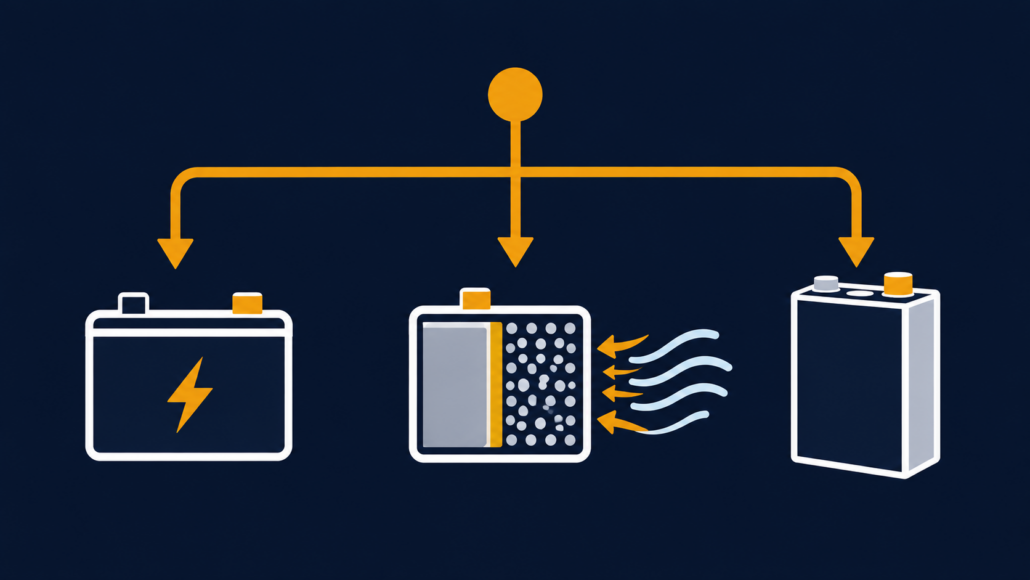
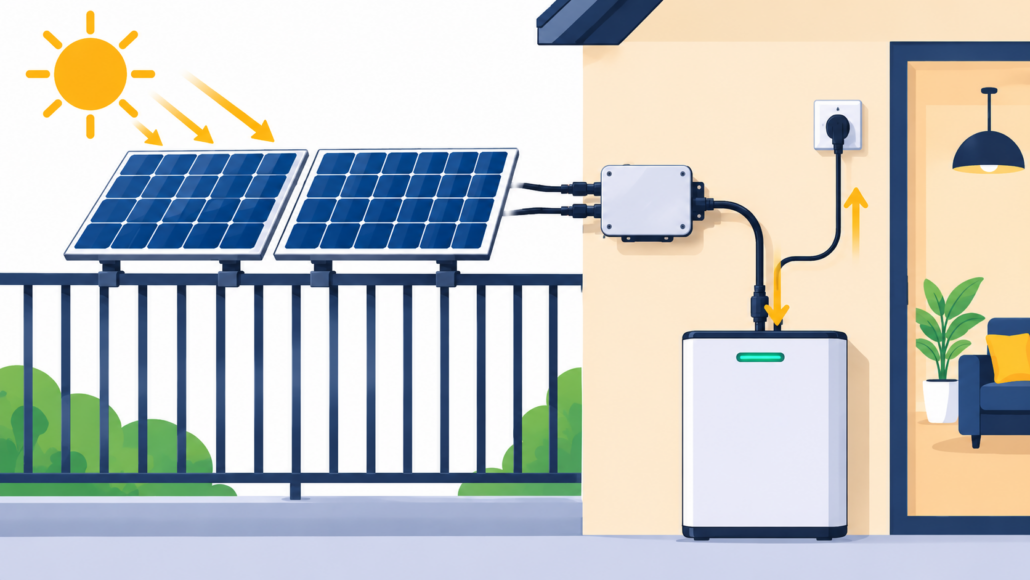
Zinc-ion vs zinc-air batteries sounds like a simple either-or choice. But the two technologies work differently and solve different storage problems.
Both use zinc, which is cheap and safe in water-based cells. A 2026 journal perspective by Oak Ridge National Laboratory researchers compares four zinc chemistries for grid storage.
Last updated: November 18, 2026.
Quick Answer: Zinc-Ion vs Zinc-Air Batteries
Quick answer: Zinc-ion vs zinc-air batteries differ in cell design. Zinc-ion cells are sealed and move zinc ions through a water-based electrolyte. Zinc-air cells pull in oxygen from outside air and are much harder to recharge. Zinc-ion suits stationary storage first, but zinc-air remains mostly at pilot scale today.
Key Takeaways
Here are five quick points on the two chemistries.
Zinc-ion cells are sealed, but zinc-air cells breathe air and need a catalyst to recharge.
Lab zinc-ion cells reach about 50 to 135 Wh/kg. But stack-level figures fall near 35 to 60 Wh/kg.
Zinc-air has a theoretical 1,086 to 1,218 Wh/kg, depending on the basis. Yet rechargeable grid units are still at pilot scale.
Zinc-ion round-trip efficiency is about 70 to 80%. Rechargeable zinc-air results range from about 40% to 70%.
Neither has yet shown LFP-level, field-proven cycle life at commercial scale.
Why Zinc-Ion vs Zinc-Air Batteries Matter for Storage
Interest in zinc-ion vs zinc-air batteries starts with supply and safety. Zinc is far more abundant than lithium, and a 2025 review in ACS Applied Energy Materials puts the gap near 300 times.
That review prices zinc metal near $3.5 per kg, while lithium costs about $19 per kg. Also, aqueous electrolytes do not burn.
A DOE-funded Sandia program frames grid needs clearly. It lists a cost target under $100/kWh and storage lasting 2 to more than 10 hours.
But the same program adds a warning. Zinc chemistries still must prove more than 5,000 cycles, or about 10 to 15 years of life.
How Zinc-Ion Batteries Work
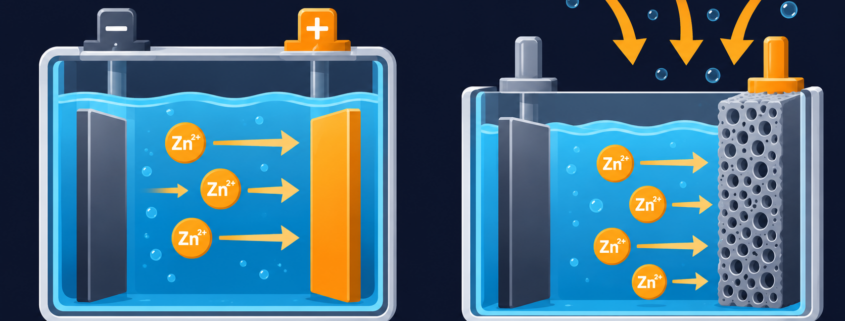
Among zinc-ion vs zinc-air batteries, zinc-ion uses the more conventional sealed-cell design. They resemble lithium-ion cells, but they use zinc and water.
Zinc-Ion Chemistry and Cell Design
A zinc-ion cell pairs a zinc metal anode with a host cathode. Manganese oxide and vanadium oxide are the most common hosts.
The electrolyte is a mild, water-based zinc salt, such as zinc sulfate. During charge and discharge, zinc ions then move between the electrodes.
Manganese oxide cathodes also take in protons alongside zinc ions. This adds capacity, but it can reduce stability.
Working voltage sits near 1.2 to 1.6 V, while lithium-ion cells run near 3.2 to 3.8 V.
Water also limits the voltage because it splits near 1.23 V. That narrows the electrolyte’s stable window.
Low voltage forces a trade-off, since the cell must hold more charge per area.
Sandia says a zinc/manganese dioxide cell needs about 15 mAh/cm² of loading. A lithium cobalt oxide cell needs only 1 to 5 mAh/cm² for similar energy.
Where Zinc-Ion Batteries Struggle
Zinc anodes face three linked problems. They are dendrite growth, hydrogen evolution and corrosion.
Cathodes add their own limits. Manganese and vanadium can dissolve, and zinc ions also move slowly through many hosts.
Lab numbers can also flatter the cells, since coin cells use extra electrolyte and thin electrodes.
A manganese oxide cathode may run thousands of cycles in a coin cell. Yet it can drop below 1,000 cycles in a pouch cell.
Energy density is modest, too. The 2025 review lists 50 to 135 Wh/kg for lab cells and 35 to 60 Wh/kg at practical stack level.
How Zinc-Air Batteries Work
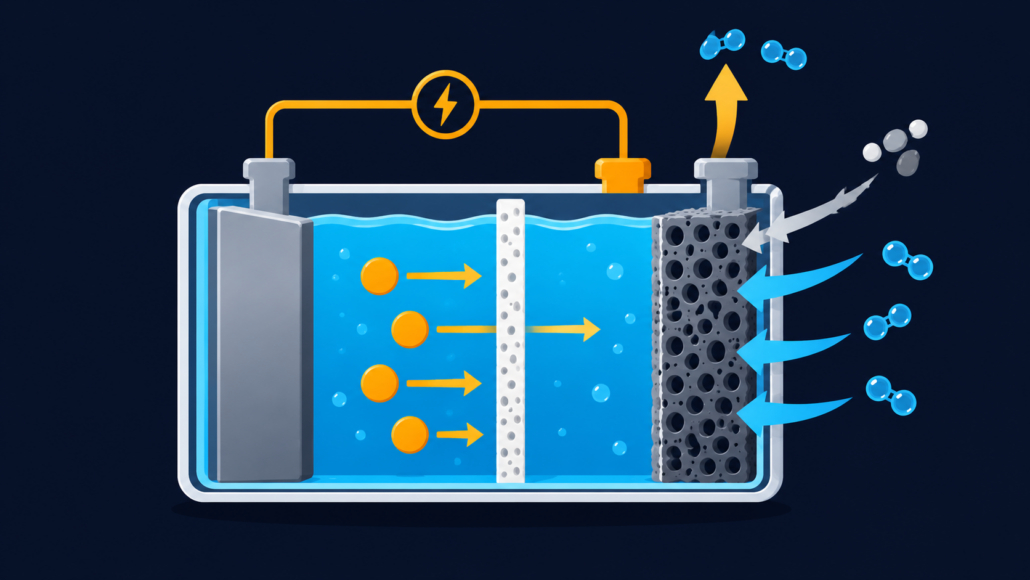
In the zinc-ion vs zinc-air batteries comparison, zinc-air is the open system. It uses outside air as part of the cell.
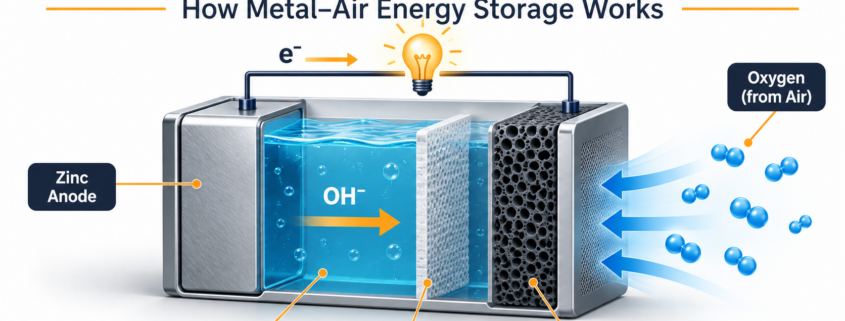
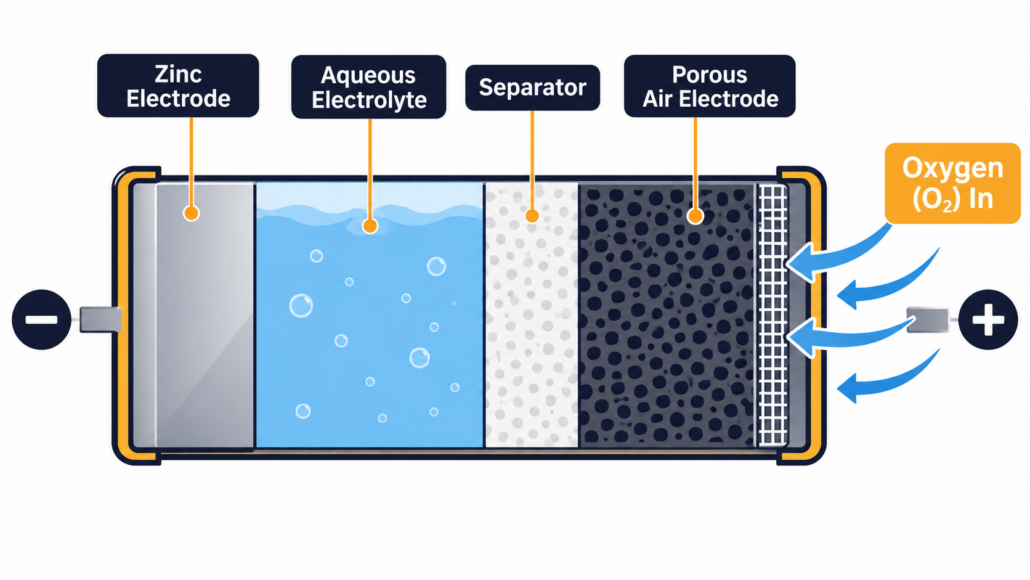
A zinc-air cell pairs a zinc anode with a porous air electrode. The electrolyte is a strong alkaline solution, usually potassium hydroxide.
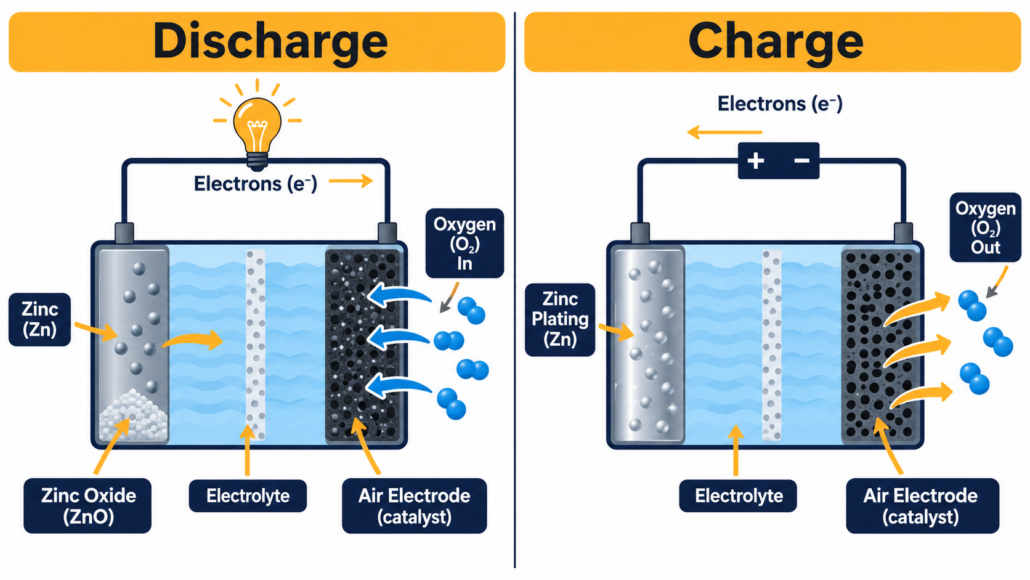
On discharge, oxygen reacts at the air electrode while zinc turns into zinc oxide. Sandia lists an open-circuit voltage of 1.65 V and an operating range of 0.9 to 1.4 V.
The theoretical energy density is 1,086 Wh/kg, counting oxygen. A Chemical Society Reviews article puts that near five times lithium-ion.
Our zinc-air guide cites about 1,218 Wh/kg from a 2024 review, so the figure depends on the basis.
Practical figures sit well below theory. Sandia lists about 100 to 400 Wh/kg for zinc-air in general.
That is a broad reference range, not a verified range for rechargeable grid-scale systems.
But Sandia adds that oxygen catalysis in both directions is still hard.
Primary zinc-air cells have been commercial since the 1930s. Rechargeable versions are still the hard part.
Electrical vs Mechanical Recharging
Electrical recharging needs one air electrode that works both ways. It must reduce oxygen on discharge, then evolve oxygen on charge.
Few catalysts do both well. That gap is the main reason rechargeable zinc-air lags.
Mechanical recharging takes another path. Operators swap in fresh zinc and process the spent zinc elsewhere.
Where Zinc-Air Batteries Struggle
Carbon dioxide in air reacts with the alkaline electrolyte. The carbonate can then block active sites on the air electrode.
A 2023 failure study traced limited cycle life to this carbonation. Catalyst wear and zinc shape change also add loss.
An arXiv study ties lost reversibility to the zinc anode, the electrolyte and the air electrode. Oak Ridge also names electrolyte evaporation.
A recent laboratory result shows progress, but it does not show grid readiness. Trade press dated October 28, 2026 covers a new catalyst from a German university. The study itself appeared on September 27, 2026.
It cycled for over 300 hours, or about 100 cycles. But the cells were small, and they ran at low current and partial depth of discharge.
So this is a catalyst advance, not a proven battery.
Zinc-Ion vs Zinc-Air Batteries: Side-by-Side Comparison
This table compares zinc-ion vs zinc-air batteries on the points that matter for storage projects.
Feature
Zinc-ion
Zinc-air
Electrolyte
Mild, water-based zinc salt
Strong alkaline solution (potassium hydroxide)
Cathode reactant
Host material, such as manganese or vanadium oxide
Oxygen from outside air
Cell design
Sealed
Open to air through a porous electrode
Voltage
About 1.2 to 1.6 V working
About 0.9 to 1.4 V operating
Energy density
50 to 135 Wh/kg lab cell; 35 to 60 Wh/kg practical stack
1,086 to 1,218 Wh/kg theoretical, basis varies; about 100 to 400 Wh/kg general reference, not verified for rechargeable grid systems
Round-trip efficiency
About 70 to 80%
About 40% (older flow-type pilot) to 70% (low-current lab cell)
Lab cycle evidence
1,000 to 6,000 cycles in lab cells
Hundreds of hours (about 100 cycles) in small lab cells
Project or projected evidence
DOE 2030 baseline projection: about 6,500 cycles (not demonstrated)
2,000 cycles reported for one older flow-type pilot
Table sources: the 2025 review, Sandia and a 2019 flow battery study. The 70% zinc-air figure comes from a low-current lab cell. Figures mix lab cells, stack-level data, projections and general references, as labeled. Cost figures vary by study and assumptions.
What the Numbers Mean for Zinc-Ion vs Zinc-Air Batteries
Comparing zinc-ion and zinc-air performance takes care, because lab and system numbers differ.
Lab claims often use thin electrodes, excess electrolyte and shallow cycles. Those choices flatter cycle life.
Many lab zinc anodes also use thick foil, so depth of discharge stays below about 5%. Real systems cannot waste zinc that way.
So ask for pouch-cell or system data at a stated depth of discharge. Also ask for round-trip efficiency at rated power.
The 2025 review also summarizes a DOE 2030 baseline for zinc batteries. It lists about 6,500 cycles, 17 years of calendar life and 74% round-trip efficiency.
That baseline is a target or modeled benchmark, not demonstrated field performance.
The baseline cost is about $0.15 per kWh, excluding energy cost. But the DOE target is $0.05 per kWh.
As of 2022, developers had targeted 24 to 48 hours of duration in planned pilots, according to trade coverage from that year. Check for newer results before relying on that.
Oak Ridge’s 2026 perspective gives rechargeable zinc-air the closest look. Then it lists three open barriers.
Those are anode dendrites and corrosion, electrolyte carbonation and evaporation, and slow oxygen catalysis.
Choosing Between Zinc-Ion and Zinc-Air Batteries
The right technology depends on duration, cycling and risk tolerance. Choosing among zinc-ion vs zinc-air batteries starts there.
Zinc-ion fits sealed stationary systems where fire risk matters more than footprint.
But expect bulkier systems. Lab zinc-ion cells top out near 135 Wh/kg, while lithium-ion cells reach 160 to 250.
Zinc-air fits best where multi-day duration matters and pilot risk is acceptable. Otherwise, wait for field data.
Ask for field-cycle data, not catalyst papers. Also ask how the design controls carbon dioxide and electrolyte loss.
LFP remains the more mature option for daily cycling. The 2025 review lists lithium-ion at 3,000 to 8,000 cycles and 85 to 95% round-trip efficiency.
It also lists zinc-ion levelized cost at about $0.15 to $0.25 per kWh. Utility-scale lithium-ion sits near $0.13 to $0.18.
Buyer Questions for Zinc-Ion vs Zinc-Air Batteries
Use these questions before you accept any zinc battery quote.
Which chemistry is it: zinc-ion, zinc hybrid cathode, zinc-bromine or zinc-air?
Is the cycle data from pouch cells or full systems?
Which depth of discharge and current density did the tests use?
What is round-trip efficiency at rated power, with auxiliary loads?
What does the warranty cover, and who carries degradation risk?
Frequently Asked Questions
These answers cover common questions about zinc-ion vs zinc-air batteries.
What is the main difference between zinc-ion vs zinc-air batteries?
Zinc-ion cells are sealed and move zinc ions between electrodes. But zinc-air cells draw oxygen from outside air and use an alkaline electrolyte.
Are zinc-ion batteries better than lithium-ion?
Not yet for most projects. They are safer and cheaper in materials, but lithium-ion leads on energy density, efficiency and proven cycle life.
Can zinc-air batteries be recharged?
Yes, but it is hard because the air electrode must work both ways. Carbonation also shortens life, so some designs swap in fresh zinc.
Which is closer to market, zinc-ion or zinc-air?
Rechargeable grid zinc-air is at pilot scale. A 2025 review rates zinc-ion at TRL 5 to 7, but both still lag LFP.
Further Reading on Zinc-Ion vs Zinc-Air Batteries and Storage Costs
These SunLith guides add cost and procurement context to the zinc-ion vs zinc-air batteries comparison.
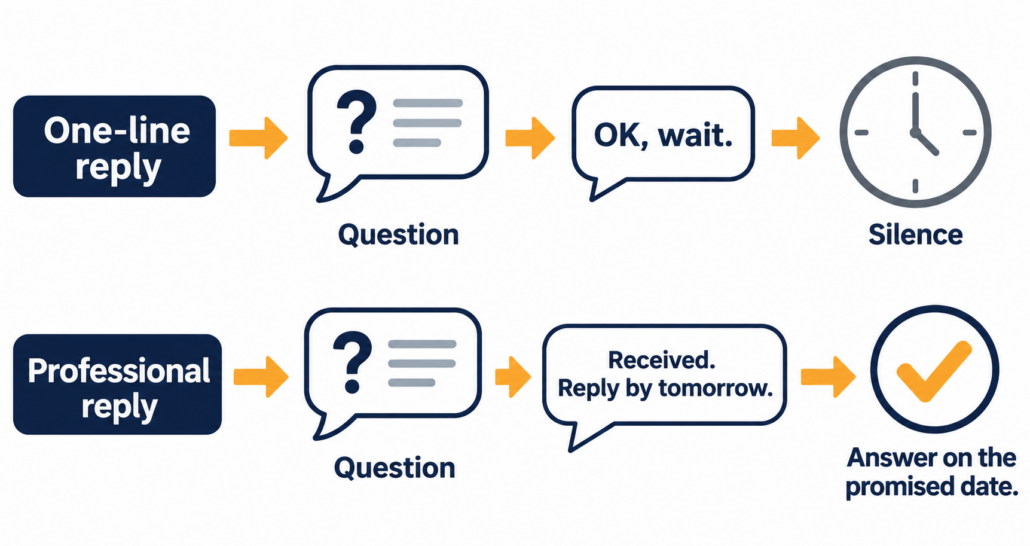
Supplier response time is not only about speed. The bigger issue is a salesperson who starts a conversation, disappears, and returns later with “Sorry, I was busy.”
You ask a real question about price, specifications, lead time or certification. Then you get one line, such as “Will check.” Then nothing.
Hours or days later, the message arrives: “Sorry, we are very busy.” Nobody expects instant answers. But busy with what?
Also, as a new buyer, you are left wondering whether your inquiry has an owner at all.
What Does Supplier Response Time Tell Buyers?
Quick answer: One slow reply proves little. But repeated, unexplained silence gives a new buyer reason to doubt the company can manage another customer. Supplier response time cannot reveal the cause. Ask for a date and a backup contact, then see if the supplier follows through.
What Supplier Response Time Looks Like in Practice
Supplier response time is more than how fast the first reply arrives. It is also whether the supplier keeps the conversation moving.
Buyers often describe the same pattern in four steps:
First, you send a detailed question about specifications, price or lead time.
Next, the salesperson replies with one line, such as “Will check.”
Then the conversation stops without an explanation or a date, so you have to chase.
Finally, the salesperson returns with “Sorry, busy” and a partial answer.
Each step looks small. But together they leave the buyer with no update and no clear owner.
Yet this is not only a China problem. A Harvard Business Review audit of more than 2,000 U.S. companies found that many were slow to answer web inquiries.
Some never answered at all. Because of this, judge each supplier by its own pattern, not by its country.
Why Disappearing Is Worse Than a Slow Reply
A slow reply that answers the question is a small problem. Still, you at least know the supplier engaged.
But a disappearing salesperson is different. You cannot tell whether the supplier is working on it, stuck, or has dropped your inquiry.
Because you cannot tell, you must chase. That puts the work on the buyer, which is the wrong way around.
Also, nobody expects 24-hour availability. A technical question may need input from engineering or production.
But needing time is different from leaving a buyer without an update. Good supplier response time means setting expectations, not answering instantly.
What Good Supplier Response Time Looks Like
A simple acknowledgment is enough:
Sample reply: Thank you for your inquiry. I need to check this with our engineer. I will get back to you tomorrow afternoon.
Then the buyer knows the message arrived and when to expect an answer.
Compare that with “Sorry, busy.” Here the first reply sets an expectation, but the second does not.
Use this as your standard when you judge supplier response time.
Is This One Salesperson’s Problem or a Company Problem?
When the same behavior repeats, the question becomes bigger than one employee. Then supplier response time reflects how the company is run.
First, does management know inquiries go unanswered? Next, is anyone tracking open quotations?
Also, is there a backup contact when the salesperson is away? Can it support another customer without neglecting existing ones?
If the Company Is Always Busy, Where Is the Capacity for Your Order?
If demand keeps exceeding the team’s capacity, what is management doing about it? Hiring may be one answer.
But better coordination, clearer responsibilities and a workable follow-up process may be others. What matters to the buyer is whether the company closes that gap.
A company does not have to explain every internal decision. But “we are busy” does not show that it can handle your account.
Could the Team Be Busy With Existing Problems?
A full workload does not tell a buyer what is creating it. Instead, separate what you can observe from what you can only suspect.
What You Can Observe
The conversation stops without an explanation.
No date is given for the next reply, so you cannot plan.
Nobody else steps in when the salesperson is away.
Explanations change from one message to the next.
Then the same pattern repeats.
What You Can Only Suspect
Possible causes include understaffing, poor coordination, delayed shipments, quality complaints, warranty claims or financial constraints. Some may indicate a product or business issue.
But these are possibilities, not conclusions. Slow communication alone does not establish a production problem, a quality failure or cash-flow trouble.
Whatever the cause, supplier response time leaves the buyer with one question: who will take responsibility for this account?
For a new buyer, this matters. Also, communication habits before the order are often the best evidence of how a supplier will handle problems after payment.
Questions That Replace Guesswork
Who will manage the account, and who provides backup?
What delivery commitments can the company realistically make?
How do technical questions and quality complaints get escalated?
What happens if the main contact is unavailable?
Can the company also provide relevant customer references?
How to Test Supplier Response Time Before You Order
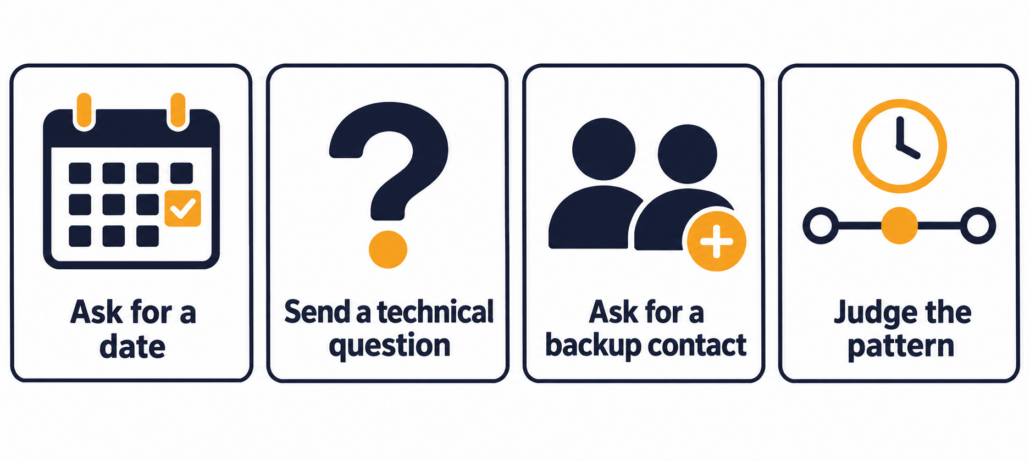
Testing supplier response time takes little effort, and four habits cover most of it.
Ask for a Date, Not a Promise
When a salesperson says “Will check,” reply with one polite line. For example: “Thank you. Can you confirm the date I will receive the answer?”
Then track whether the supplier keeps that date.
Send One Technical Question Early
Choose a question that needs a specific answer, such as cycle-life test conditions or lead time. Then note how fast and how clearly the supplier replies.
Ask Who Owns Your Account
Request a named contact and a backup, such as a sales manager or technical lead. A supplier with a real process will name both.
Judge the Pattern, Not One Delay
One late reply means little. But repeated late replies with no explanation mean a lot.
Check the quality of the answer too. A fast but vague reply is not a good one.
Questions Suppliers Should Ask Themselves
Owners can use the same lens on their own business, because supplier response time affects every inquiry they receive.
How long does your team take to answer a new inquiry?
Today, how many buyers are waiting for a quote or technical answer?
How many inquiries are lost because nobody follows up?
Does anyone review response times each week?
If the team is always busy, who has capacity for a new customer?
Then the answers show whether the company is organized to grow.
Frequently Asked Questions About Supplier Response Time
These answers cover common buyer questions about supplier response time.
What Is a Good Supplier Response Time?
A reasonable target is a first reply within one business day. But if the full answer takes longer, the supplier should confirm receipt and name a date.
Does a Slow Reply Mean the Supplier Is Bad?
Not by itself. A holiday or a technical check can cause a delay. But those delays come with an explanation and a date. Repeated silence does not.
Does Being Busy Mean the Supplier Has Problems?
Not necessarily, since busy can mean healthy demand. But it does not show capacity for your order, so ask for a date and a named contact.
How Many Follow-Ups Are Too Many?
If you must chase twice for a basic answer, note it. Then, if it happens again, treat it as a pattern.
Should Poor Supplier Response Time End the Conversation?
Not always. First, send a polite message asking for a date and a backup contact. If the supplier still goes quiet, look elsewhere or limit your risk with a small trial order.
Final Thoughts on Supplier Response Time
Being busy is understandable. Repeatedly leaving a buyer without an update is the issue.
A new customer should not have to discover a company’s capacity problems after placing an order.
Also, if a company is too busy to develop new business today, how will it manage your business tomorrow?
Have you ever dropped a supplier after a one-line reply and silence? Share your experience in the comments.
Need Help Checking a Supplier?
Are you sourcing batteries, BESS, inverters or PCS from overseas? Supplier response time is one check, but not the only one. Contact SunLith Energy to talk through the rest.
Further Reading
These guides also add context on supplier response time and supplier risk.
A zinc-air battery makes power by reacting zinc with oxygen from the surrounding air. In theory, it can store a lot of energy using fairly common materials.
Disposable cells already power hearing aids. But rechargeable versions are far harder to build, so most new research targets that gap.
First, this guide explains how the technology works and why recharging is hard. Then it covers what changed in 2025 and 2026, and where it fits next to lithium iron phosphate (LFP).
Quick Answer: What Is a Zinc-Air Battery?
Quick answer: A zinc-air battery makes electricity when zinc reacts with oxygen from the air. Disposable cells are mature and common in hearing aids. But rechargeable versions still lose energy, grow dendrites, and wear out the air electrode. Even so, new catalysts now show thousands of lab cycles.
How a Zinc-Air Battery Works
A zinc-air battery is an open system. Oxygen enters through a porous air electrode, while zinc supplies the electrons.
Discharge Chemistry
In a standard alkaline cell, zinc oxidizes at the negative electrode. It passes through dissolved zincate and then forms zinc oxide.
Next, oxygen takes up electrons at the air electrode and reacts with water. This makes hydroxide ions, which carry charge through the electrolyte.
Negative electrode: Zn + 2OH⁻ → ZnO + H₂O + 2e⁻
Air electrode: O₂ + 2H₂O + 4e⁻ → 4OH⁻
Overall reaction: 2Zn + O₂ → 2ZnO
Here, e⁻ is an electron and OH⁻ is a hydroxide ion. Also, these equations are simplified, since other electrolytes can follow different paths.
What Happens During Recharging
During charging, outside power pushes zinc back onto the negative electrode. The air electrode then releases oxygen.
On paper, this just reverses discharge. But in practice, zinc rarely redeposits evenly, and the air electrode must handle two hard reactions.
Main Components of a Zinc-Air Battery
A standard zinc-air cell with liquid electrolyte has four main parts. The table below shows what each part does.
Component
Function
Zinc electrode
Supplies electrons as zinc oxidizes during discharge.
Air electrode
Gives oxygen a porous, catalytic surface to react on.
Electrolyte
Moves ions between electrodes. Most designs use aqueous potassium hydroxide.
Separator
Keeps the electrodes apart while letting ions pass.
The air electrode typically includes a gas-diffusion layer, a catalyst layer, and a current collector. It must admit oxygen without leaking or flooding.
Some gel designs combine the separator and electrolyte roles.
Because the cell is open, humidity and carbon dioxide can reach it. Both are major causes of performance loss.
Three Types of Zinc-Air Battery Systems
The word “rechargeable” means different things for a zinc-air battery. So it helps to separate three system types.
Primary Cells
Primary cells are designed for a single discharge life, not repeated electrical recharging. This helps them avoid many durability problems.
Electrically Rechargeable Cells
These cells restore energy with electricity. Labs are testing planar, gel, flexible, and flow designs, but each needs better efficiency, life, and stability.
Mechanically Rechargeable Systems
Mechanical recharging swaps in fresh zinc material. Regeneration happens outside the cell, so treat it as fuel replacement, not plug-in charging.
Why the Zinc-Air Battery Attracts Interest
Three traits keep drawing researchers and investors to the zinc-air battery. But each one comes with a caveat.
That is not a complete-cell or pack figure. Practical devices also contain electrolyte, separators, catalysts, and packaging. Incomplete zinc use can also cut delivered energy.
Low-Cost Materials
Zinc is abundant and recyclable, and the cell takes its oxygen from the air. But cheap active material does not guarantee a cheap system.
Still, catalysts, special electrolytes, manufacturing, and short component life can all erase the savings.
Aqueous Electrolyte Safety
Water-based zinc-air cells avoid the flammable organic electrolytes in many lithium-ion cells. But alkaline liquid can be corrosive. Side reactions can make hydrogen, and dendrites can cause internal shorts.
Why a Rechargeable Zinc-Air Battery Is Hard to Build
A rechargeable zinc-air battery must fix several problems at once. These failure modes interact, so fixing one part may not fix the whole cell.
Slow Oxygen Reactions and Low Efficiency
The air electrode must reduce oxygen on discharge and release it on charge. But the best catalyst for one is rarely best for the other.
This creates a voltage gap between charge and discharge. The same review reports energy efficiencies commonly around 55–65%, with research results above 70%.
Results vary with design and test conditions, so treat them as lab values, not guarantees.
Zinc Corrosion, Dendrites, and Shape Change
Zinc reacts with the liquid even when no power is drawn. That wastes zinc and also releases hydrogen.
Next, zinc can grow needle-like dendrites on charging, and these can pierce the separator. Repeated plating also reshapes the electrode and strands active zinc.
Zinc Oxide Passivation
Zinc oxide is the expected product, but it can block further reaction. Good design controls where it forms and how it packs.
Carbon Dioxide and Water Management
Carbon dioxide from the air reacts with alkaline electrolyte to form carbonates. These change the electrolyte and can clog the air electrode.
Water loss or uptake also shifts electrolyte strength. Also, repeated charging wears down the catalysts and carbon parts.
Latest Zinc-Air Battery Developments in 2025 and 2026
Recent zinc-air battery examples from 2025 and 2026 focus on the air electrode. The results are promising, but they are still lab results.
Atomic-Scale Catalysts Extend Cycle Life
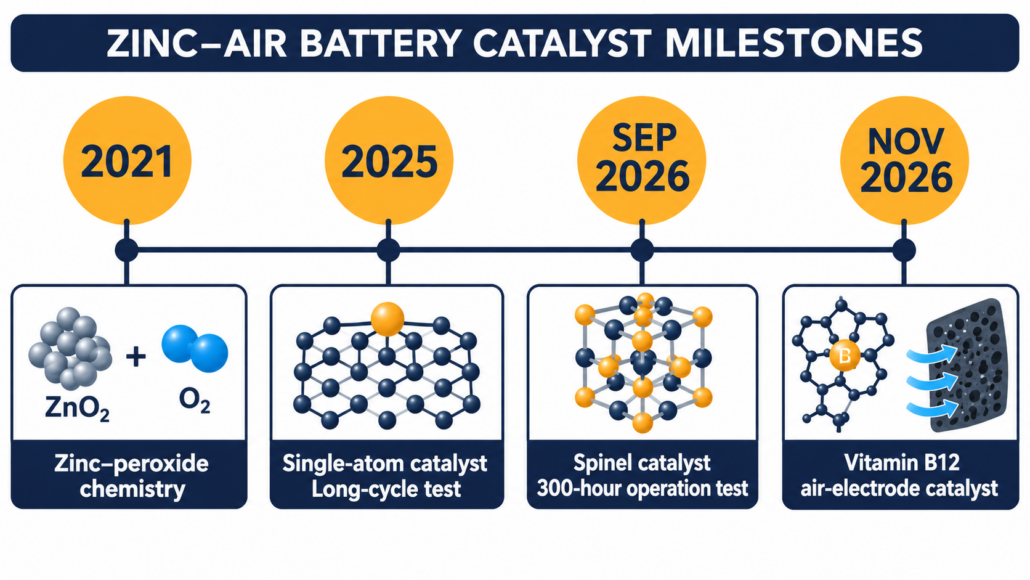
Monash University researchers reported a catalyst of single cobalt and iron atoms on 2D carbon sheets. Their lab cell held stable cycling for 74 days, or 3,552 reported cycles.
The researchers reported better performance than the benchmark catalysts in their own tests. Do not treat the cycle count as a commercial full-depth cycle-life rating without checking the study’s cycling protocol.
Precious-Metal-Free Spinel Catalyst From TU Darmstadt
TU Darmstadt researchers first published a precious-metal-free catalyst on September 27, 2026, in Advanced Science. It pairs nickel ferrite with functionalized carbon nanohorns.
Their lab cell ran for up to 300 hours. The team ties this to a stable “triple junction,” since catalyst, electrolyte, and air must meet there.
A Vitamin B12 Air-Electrode Catalyst
In November 2026, the University of Córdoba shared a new zinc-air prototype. It uses vitamin B12 anchored to single-walled carbon nanotubes as an air-electrode catalyst.
The team reported up to 250 cycles in the Journal of Materials Chemistry A. The vitamin acts as a catalyst, not as fuel, and this is a proof of concept.
These results are not directly comparable. Operating hours and cycle counts depend on current density, cycle length, depth of discharge, and other test conditions.
Alternative Zinc-Air Battery Designs Beyond Catalysts
Some zinc-air battery work changes the chemistry or the cell design, not just the catalyst. These approaches change the reaction pathway, electrolyte, or cell architecture, not only the air-electrode catalyst.
A Different Reaction Path: Zinc Peroxide
A 2021 paper in Science by Wei Sun and colleagues took another route. It used a nonalkaline electrolyte to enable a two-electron zinc–peroxide path.
This changed the reaction itself, not just the catalyst. It improved reversibility, but it did not prove commercial readiness.
Gel and Flow Designs
Gel electrolytes cut leaks and hold water, which suits flexible devices. Flow designs refresh the liquid, which may ease carbonate buildup in fixed systems.
But neither fully solves water balance or durability. Both still need testing at full-system scale.
Zinc-Air Battery Commercial Maturity
Primary and rechargeable zinc-air cells are at very different stages. Treat them apart.
Primary cells are established in uses such as hearing aids. Rechargeable systems still struggle in four areas. These are efficiency, zinc reversibility, electrolyte and water management, and electrode durability.
A 2023 DOE assessment calls the market for zinc batteries still young. A 2021 Sandia handbook chapter lists only a few firms with grid-ready products. Both are background sources, not a 2026 market survey.
When you read a commercial claim, check the chemistry, the deployment scale, and the operating record. Many zinc-based batteries are not zinc-air.
Where a Zinc-Air Battery Could Fit
Each zinc-air battery use case sits at a different stage. Also, do not read primary-cell success as proof that large rechargeable systems are ready.
Application
Why it fits
Main limit
Hearing aids and small devices
Compact primary cells are proven.
Not built for repeated recharging.
Stationary storage
Low-cost zinc and scalable designs.
Efficiency, life, and air management.
Flexible electronics
Thin zinc and gel electrolytes bend.
Water retention and durability.
Electric transport
High theoretical energy; swappable zinc.
Power, rechargeability, and infrastructure.
Compare zinc-air proposals with alternatives using measured efficiency, operating life, installed cost, and maintenance needs. Our BESS guide covers that field.
Many zinc-air battery headlines quote numbers without context. Ask these questions before you trust a number.
Is energy density per zinc mass, per cell, or per system?
How deep was each cycle?
What current density and active electrode area were used?
Was the test run in ambient air or pure oxygen?
Was water, electrolyte, or zinc refilled during the test?
Did the report give efficiency and capacity retention?
Did the test use practical material loadings and a representative cell format?
A self-contained device that runs for months without refills answers a harder question than a long, shallow test. So compare conditions, not headlines.
Frequently Asked Questions About the Zinc-Air Battery
These short answers cover common questions about the zinc-air battery.
What is a zinc-air battery?
It pairs a zinc electrode with an air electrode that draws in oxygen. Disposable primary versions are common, and rechargeable versions are an active research area.
Can a zinc-air battery be recharged?
Rechargeable zinc-air batteries have been demonstrated. Their real performance depends on zinc reversibility, air-electrode durability, electrolyte stability, and efficiency. Do not assume primary cells can be recharged.
How does it compare with lithium-ion?
Zinc-air chemistry has high theoretical specific energy. Do not compare it directly with a finished lithium-ion cell. Rechargeable zinc-air systems still face efficiency and durability limits, so compare them under matched conditions.
Are zinc-air batteries safe?
Water-based zinc-air batteries avoid the flammable organic solvents found in many lithium-ion cells, making them inherently safer against thermal runaway. However, they use alkaline electrolytes that can be corrosive, and secondary concerns like hydrogen gas formation or dendrite growth still require proper system design.
Are zinc-air batteries on the market?
Primary zinc-air batteries are already commercial. For rechargeable systems, timing depends on the application and on proof of operating life, efficiency, cost, and scalable manufacturing.
Conclusion: Where the Technology Stands
The zinc-air battery pairs a strong concept with a hard engineering problem. New catalysts in 2025 and 2026 are real progress, but they are not the finish line.
But four things must work together in one device: fast oxygen reactions, reversible zinc, stable water balance, and CO₂ resistance. Until they do, treat zinc-air as a promising family of systems, not a proven replacement.
Further Reading
These SunLith Energy guides add context to the zinc-air battery topic.
The 314Ah vs 587Ah question is not a choice between old and new. A 587Ah cell holds about 87% more energy, but the finished system sets cost, cooling, service and safety.
The 587Ah cell is one of several large LFP prismatic cells that challenge the 314Ah format. It is also part of a wider move to bigger cells in containerized storage.
Capacity also changes string energy and current at a given C-rate. Research on parallel-connected grid storage modules examines how resistance differences affect current and temperature imbalances in directly paralleled LFP cells.
This guide first compares both capacities on engineering grounds. Then it shows how to judge each format for different projects.
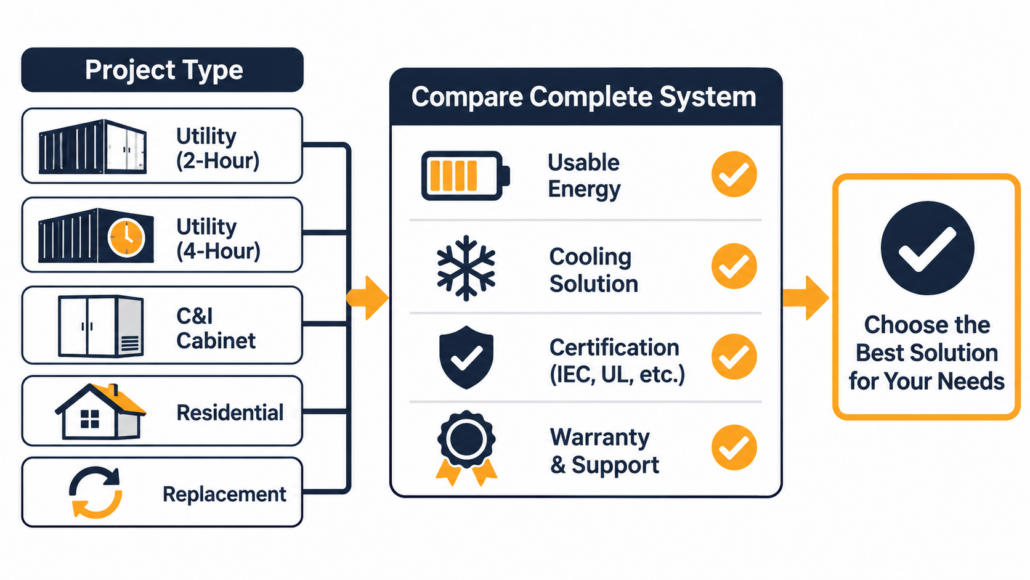
Quick answer: Consider 587Ah systems for utility projects that value density and fewer parts. Compare 314Ah systems where modular sizing, fleet fit and operating history matter. Neither capacity alone sets cost or safety. So judge the whole system on usable energy, power, test evidence, warranty and lifecycle cost.
Key Takeaways: 314Ah vs 587Ah at a Glance
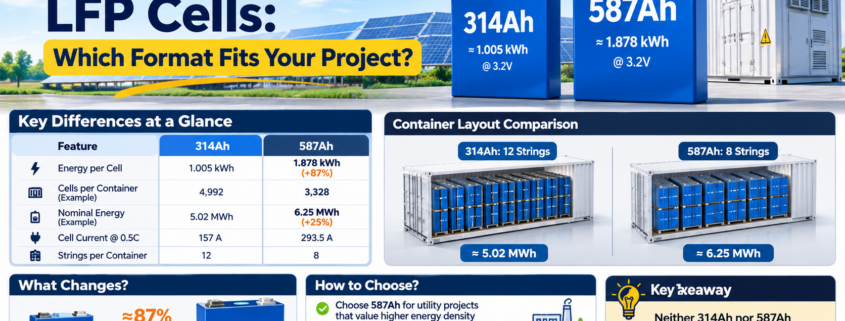
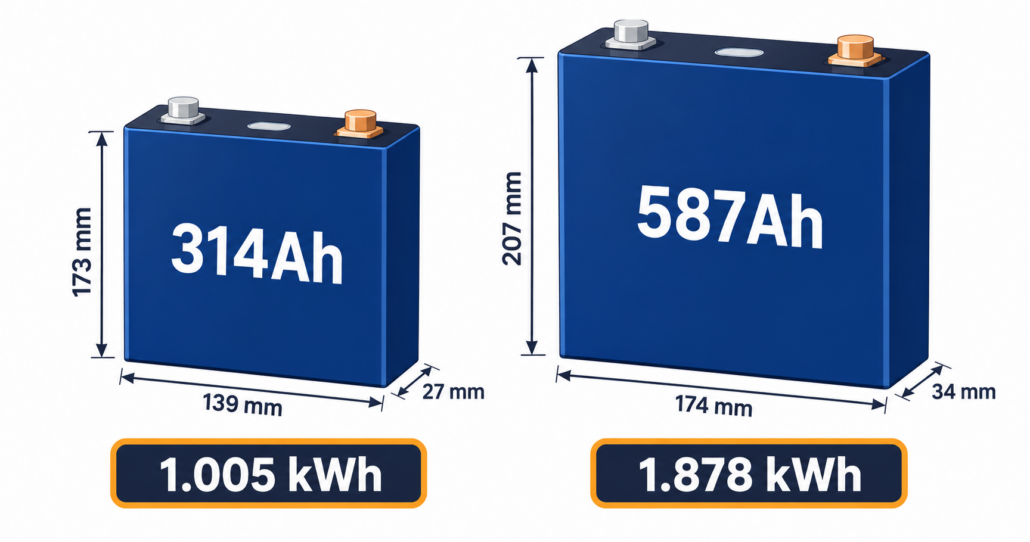
At 3.2 V nominal, a 314Ah cell stores about 1.005 kWh. A 587Ah cell stores about 1.878 kWh, roughly 87% more.
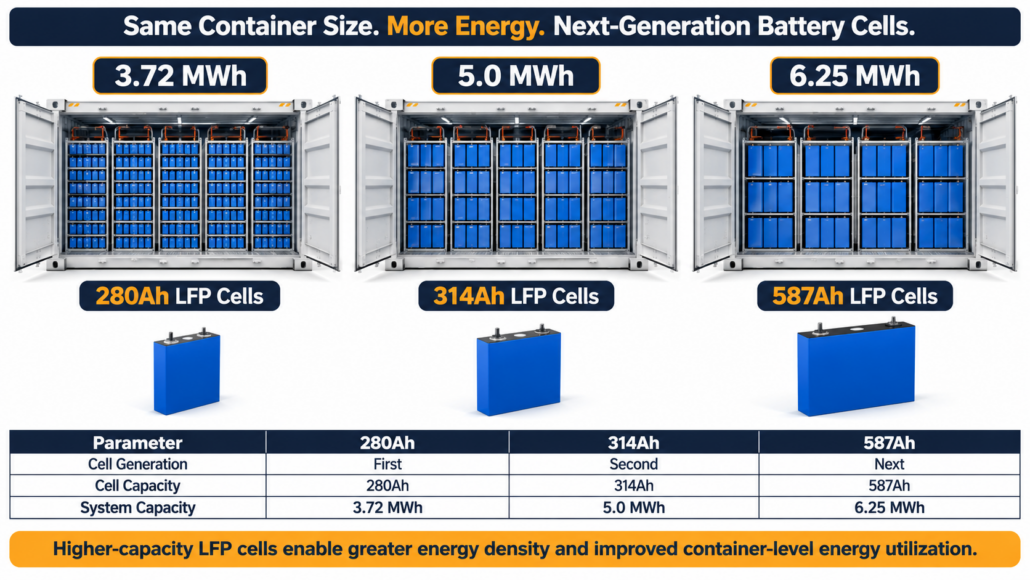
In the layouts below, twelve 314Ah strings give about 5.02 MWh. Eight 587Ah strings give about 6.25 MWh.
That means one-third fewer cells and about one-quarter more nominal energy.
At 0.5C, current is 157 A per 314Ah cell and 293.5 A per 587Ah cell. But real connection losses also depend on resistance.
More energy per cell does not fix a heat-release ratio for thermal runaway. Instead, compare the tested cell, module and container designs.
In the 314Ah vs 587Ah choice, project fit depends on the full product. Do not assume every 587Ah system costs less, or that 314Ah cells cannot serve homes.
What Changes in a 314Ah vs 587Ah Comparison?
Since both cells share a 3.2 V nominal voltage, cell energy scales with amp-hour capacity. Also see our Ah vs Wh guide for the basic conversion.
Ecell = Vnominal × Q
Where Ecell is nominal cell energy in Wh, Vnominal is nominal voltage in V, and Q is rated capacity in Ah.
In short, the 314Ah vs 587Ah energy ratio is about 1.87. But this compares electrical energy only, not usable AC energy, cycle life or heat behavior.
For a 314Ah example, see our 314Ah cell product page. Also buy against the exact datasheet and revision for the cell supplied.
An Illustrative Container Layout Comparison
First, the table uses strings of 416 cells in series, with no directly paralleled cells (1P416S). Then it compares twelve 314Ah strings with eight 587Ah strings.
But these are electrical examples, not specifications for a named container.
Parameter
314Ah layout
587Ah layout
Assumed nominal cell voltage
3.2 V
3.2 V
Nominal energy per cell
1.005 kWh
1.878 kWh
Cells in series per string
416
416
Nominal string voltage
1,331.2 V
1,331.2 V
Nominal energy per string
418.0 kWh
781.4 kWh
Strings per container
12
8
Cells per container
4,992
3,328
Nominal container energy
5.016 MWh
6.251 MWh
Cell/string current at 0.5C
157 A
293.5 A
Aggregate DC current at 0.5C (common bus)
1,884 A
2,348 A
Nominal DC power at 0.5C
2.508 MW
3.126 MW
In this layout, cell count falls 33.3% while nominal energy rises about 24.6%.
Now, at equal nominal energy, the cell-count cut is about 46.5% before rounding to whole strings. That is a different comparison, so do not mix the two.
Also, industry coverage links 314Ah cells to roughly 5 MWh containers and 587Ah cells to roughly 6.25 MWh containers. Still, those are supplier designs, not proof that every design uses this layout.
Check Maximum Voltage, Not Just Nominal Voltage
A 1,331.2 V nominal string does not prove fit with every 1,500 V part. But the charge limit matters too.
Next, our 314Ah product page lists a 3.65 V maximum charge voltage per cell. Multiplied by 416, that then gives 1,518.4 V.
As a result, check cell limits, BMS settings, PCS input limits and part ratings together. Since the real ceiling must fit all of them, no single limit is enough.
Also, IEC 63056 covers battery systems within a 1,500 V nominal DC scope. Yet it does not pick a series count for you, and our IEC 62619 guide compares it with related standards.
Seven Engineering Differences in 314Ah vs 587Ah Cells
These seven differences matter most when you weigh 314Ah vs 587Ah cells. Also, each one ties back to the complete system, not the cell alone.
1. Component Count and Balance-of-System Cost
Larger cells can cut the cell count per MWh. As a result, a design may need fewer links and less assembly work.
Still, do not assume every part count falls in step with cell count. In fact, sensor layout, compression hardware, protection devices and service limits are design choices.
Now, the useful question is simple. Does the complete system give a lower installed cost per usable kWh at the required power and warranty?
That said, fewer parts are a possible edge, not a sure saving. For the wider cost picture, see our BESS CAPEX calculation guide.
2. Current per Cell, Terminals and Busbars
At the same C-rate, current rises with capacity. A 314Ah cell at 0.5C carries 157 A, while a 587Ah cell carries 293.5 A.
If connection resistance stays the same, heating follows this rule:
Ploss = I2 × R
Where Ploss is resistive heating in W, I is current in A, and R is connection resistance in ohms.
However, larger cells may use different terminals, welds and busbars. Current alone does not show which connection runs hotter.
Also, the study’s sensitivity analysis identifies cell and contact resistance variation as strong contributors to temperature differences between paralleled cells. Instead, check connection design and build quality, not just amp-hour capacity.
3. Heat Generation and Cooling
Capacity alone does not show how heat travels from a cell’s core to its cooled faces. Size, internal build, cooling direction and contact quality all matter as well.
Studies of prismatic-cell cooling use shape-based heat parameters for this reason. Thus, a fair comparison needs more than nominal capacity.
Ask each supplier for this data:
Heat rejection at the stated charge and discharge duty
At a fixed series count, a larger-capacity cell raises nominal energy per string. Then fewer strings may reach a target energy.
But this is an energy-sizing relationship, not evidence of better current sharing. Three different layouts exist:
Cells connected directly in parallel within a module
Complete strings connected to a shared DC bus
Strings connected through separate, independently controlled PCS channels
The layouts in this article use 1P416S strings. Thus they have no directly paralleled cells within a string.
A study of parallel-connected grid-storage modules tested four directly parallel-connected 280Ah LFP cells. Added connection resistance produced large differences in cell currents and temperatures during discharge.
The researchers then used a model fitted to the test data. It explored how differences in cell resistance and capacity affect current sharing.
The paper explains that LFP’s flat open-circuit-voltage curve can let SOC differences persist through the middle of the SOC range.
In the two resistance-fault experiments, rapid rebalancing at low SOC produced high individual cell currents. Each test stopped when a cell reached its current limit.
These were deliberately introduced fault conditions, not evidence that every parallel module behaves this way.
The study does not compare 314Ah with 587Ah cells. So it does not show that either capacity shares current better.
Its quantitative results should not be applied directly to complete parallel strings or independently controlled containers without more analysis.
Ask each supplier to name the actual topology. Then ask how branch-current distribution, isolation, protection and monitoring work.
5. Stored Energy and Single-Cell Failure
A 587Ah cell stores about 87% more nominal energy than a 314Ah cell at the same voltage. But that does not mean it releases exactly 87% more heat in thermal runaway.
A lower cell count also does not prove a lower failure chance. Yet the evidence here does not show that either capacity is safer by nature.
Instead, compare the exact product’s test evidence, including setup, state of charge and operating conditions. Then ask for cell, module and unit-level reports, not a capacity or chemistry claim.
Do not compare headline cycle counts unless the test conditions match. Ask the supplier to state:
Test temperature
Charge and discharge rates
Depth of discharge and operating SOC window
End-of-life capacity threshold
Compression and cooling conditions
Whether the result is measured, projected or warranted
Also split cell efficiency, DC system efficiency and AC round-trip efficiency. Then ask for guaranteed results on the same measurement boundary and duty cycle.
Cost per usable kWh at the required duration, efficiency, degradation and augmentation
C&I cabinets, about 100–500 kWh
Include 314Ah-based cabinets as a baseline
Actual cabinet increments, footprint, power, serviceability and certification
Residential and small commercial
Product-dependent; do not exclude 314Ah
Required energy and power, installation limits and complete-system suitability
Replacement within an existing string
Follow the OEM-approved specification
Electrical and mechanical fit, matching and warranty
Added strings or containers at an existing plant
Assess separately
PCS, controls, protection, operating strategy and warranty fit
Projects that prioritize operating history
Request model-specific evidence
Commissioning dates, operating fleet, duty cycles and documented performance
Remote or lifting-constrained sites
Compare complete equipment
Shipping mass, lifting arrangements, transport limits and service access
For example, our 314Ah product page lists home backup and off-grid use. As a result, a blanket claim that this capacity suits no homes would contradict it.
Next, for operating history, use dated, model-specific evidence. One manufacturer reported mass production and first deliveries of its 587Ah cell on August 28, 2025. The same release covered a 6.25 MWh two-hour system.
Worked Example: 100 MWh Using 314Ah vs 587Ah Containers
First, this 314Ah vs 587Ah example reuses the container energies from the table above. Next, at 5.016 MWh per container, 100 MWh needs 20 containers after rounding up.
Then at 6.251 MWh per container, the same target needs 16. As a result, the larger-cell layout uses four fewer containers in this nominal-energy case.
Still, this is not yet a comparison of guaranteed usable AC energy, or of 50 MW for two hours. Before any commercial call, also ask both bidders to quote:
Usable energy at the same measurement boundary
Guaranteed discharge power and duration
Auxiliary power use
Round-trip efficiency
Ambient conditions and derating
Beginning-of-life and end-of-warranty performance
Only then does the container-count cut become a real project comparison.
Questions to Ask Before Choosing Between 314Ah vs 587Ah
Put these twelve questions into your RFQ for any 314Ah vs 587Ah system.
Which exact cell model, datasheet revision, factory and production status apply?
Which dimensions, mass, rated capacity and voltage limits does the cell have?
How was cycle life tested, and which figures are warranted?
How much continuous current is allowed across the temperature and SOC range?
Which compression force and swelling allowance does the module need?
Which heat rejection and cooling load apply at the project duty cycle?
Do test reports and certificates cover the exact supplied configuration?
Are cells paralleled directly, are strings paralleled, or does each string run on its own?
Which usable energy and power are guaranteed at the point of connection?
Is there a replacement and augmentation plan if the cell model is discontinued?
Will batch traceability and incoming inspection records come with the order?
Which service work can happen on site, and which needs module or container replacement?
Frequently Asked Questions About 314Ah vs 587Ah Cells
These answers cover what buyers ask most about 314Ah vs 587Ah cells.
Can I mix 314Ah and 587Ah cells in one series string?
Do not treat them as interchangeable. Instead, use the OEM-approved cell and module specification for swaps inside an existing string.
But adding separate engineered strings or containers is a different question. It then needs a system-level fit review.
In 314Ah vs 587Ah, is the larger cell safer?
Yet the evidence here does not show that either capacity is safer by nature. Also, more energy per cell is not a full safety review.
Instead, judge the tested design and the exact configuration supplied.
Is a 587Ah-based container always cheaper?
No. Fewer cells per MWh can create savings. But total cost also depends on cell price, cooling, electrical parts, installation, service and warranty.
Then compare cost per usable kWh under the same conditions.
Does running a 587Ah cell at 0.25C waste its power capability?
Not always. The project may instead need a longer discharge time rather than top power.
Also, a lower C-rate eases current and heating demands on terminals and busbars.
Which capacity should a C&I project choose in the 314Ah vs 587Ah decision?
First, compare whole cabinets against the power, usable energy, footprint and duty profile you need. Then use real product steps and guarantees, not cell capacity alone.
Bottom Line: 314Ah vs 587Ah Is a System Decision
Moving from 314Ah to 587Ah lifts nominal energy per cell by about 87%. As a result, it can cut the cells and strings needed for a given energy target.
But it also changes current at a given C-rate and what the surrounding design must handle.
In short, choose through the system the cell enables. Then compare usable energy, power, cooling, safety evidence, serviceability and lifecycle cost.
Further Reading
These guides expand on the topics behind the 314Ah vs 587Ah decision.
Chinese supplier verification starts with three questions before you pay a deposit. Who are we contracting with, who will make the goods, and what shows they can deliver?
These questions are connected, but they are not interchangeable. A company may be registered without running a factory.
A factory may have equipment but lack the capacity or quality controls your order needs. Some suppliers also sell through a separate trading or export company.
Chinese supplier verification brings these checks together. It covers the legal company, credit and court records, the production site, and the payment arrangements before money moves.
The goal is not a clean-looking profile. It is to spot inconsistencies, learn who controls production, and decide if the risk is acceptable for your order.
Quick answer
Chinese supplier verification works in three layers. First, confirm the legal entity in the official registry. Then check court and credit records. Finally, audit the factory that will make your product. Before paying, match the license name to the invoice, contract, and bank account name.
Why Chinese Supplier Verification Helps Reduce Sourcing Risk
Supplier failures usually become costly after the money is paid. That is why Chinese supplier verification belongs before the deposit, not after the first problem.
A shipment runs late, the product misses the approved sample, or the work moves to a factory you never saw. In the worst case, the company vanishes with your deposit.
Because each check answers a different question, no single step of Chinese supplier verification is enough. Together, they show who you pay and who makes your goods.
Behavior also tells you something before you verify anything. Our supplier red flags guide lists 30 warning signs buyers can spot early. Slow replies and silence are covered in our supplier response time guide.
Manufacturer or Trading Company? Know Who You Are Buying From
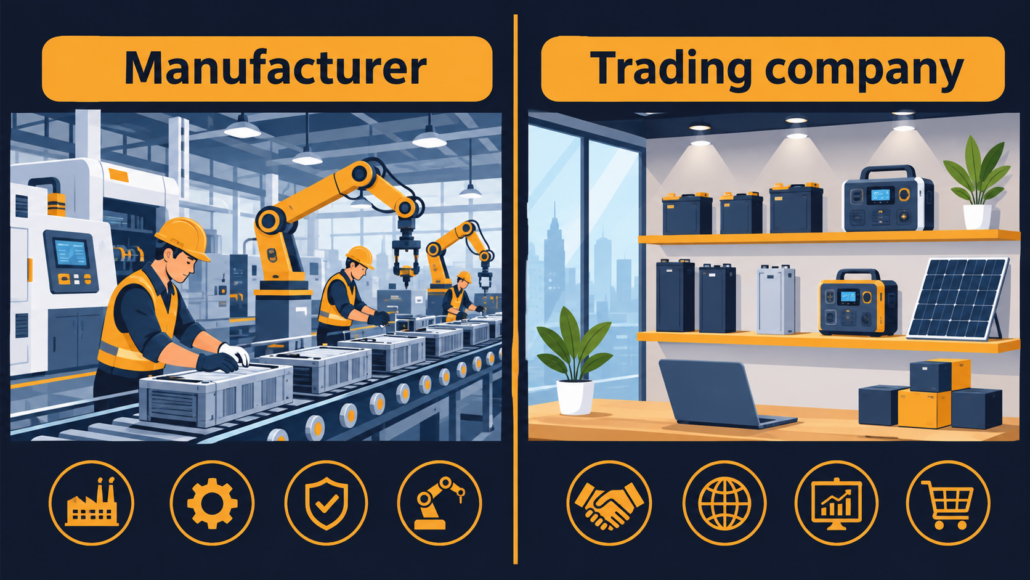
Chinese supplier verification begins by sorting suppliers into two types. A manufacturer owns or runs the production line, while a trading company buys from factories and resells the goods.
Neither type is automatically bad. A trader can help with small orders, mixed products, and combined shipments.
But you need to know which one you have. The type affects price, lead time, quality control, and who answers when something fails.
Check
Typical manufacturer indicators
Typical trading-company indicators
Business scope
License includes production terms such as 生产 or 制造
License mainly lists sales, wholesale, or import and export
Product range
One product family or a related process
Unrelated categories, such as electronics, kitchenware, and toys
Technical answers
Specific, consistent answers on materials, molds, machinery, tolerances, and capacity
Delays answers, says it will “check with production,” or gives generic replies
Factory evidence
Live video of the relevant line, with equipment, workers, and process flow
A showroom, finished goods, or a generic facility instead of the line
Pricing
Closer to factory-gate cost, but order minimums are less flexible
Includes a coordination margin; may accept smaller orders by pooling
Accountability
You deal with the party that controls production
Quality depends on the trader’s link to a factory you cannot see
Many suppliers are both. A factory may run its own lines and also resell goods from partner plants.
Some factories also sell through a separate trading entity for tax or export reasons. If so, ask for both licenses and a written explanation.
Chinese Supplier Verification Step One: Verify the Legal Company
This step of Chinese supplier verification relies on official records, not an English trade name or a storefront. Ask for the business license and its 18-character Unified Social Credit Code.
Search the Official Registry for Chinese Supplier Verification
Enter the code or the exact Chinese name into GSXT. The record shows the status, legal representative, registered capital, address, and business scope.
Active companies appear as 存续 or 在营. Cancelled or revoked ones appear as 注销 or 吊销, and you should stop there.
Next, check the same record for penalties and abnormal-operation listings. Also confirm that the code matches the one on the license.
A code can look valid and still not exist. Always confirm the live record, because a format check alone proves nothing.
Read the Business Scope Closely
The scope lists what the company may legally do. Look for production terms such as 生产 or 制造 that match your product category.
A scope that lists only trading, wholesale, or import and export points to a middleman. Even so, scope shows permission, not skill.
Match Names, Capital, and Dates
Compare the registered name, address, and legal representative with what the supplier told you. Then check the incorporation date against the supplier’s claimed history.
If the company is new but claims many years of experience, ask whether that experience belongs to its team, a predecessor business, or a related factory. Request supporting evidence.
Registered capital is not cash available to fund your order. It is shareholders’ subscribed contributions, which may not be fully paid.
Under China’s revised Company Law, shareholders of new limited liability companies generally must pay subscribed contributions within five years of establishment. Older companies follow transitional arrangements, so do not assume one deadline fits every supplier.
Review subscribed and paid-in capital separately. Neither figure alone proves the supplier can finance your order or repay a deposit.
Last, compare the license name with the proforma invoice, contract, and bank beneficiary. Investigate any unexplained mismatch, since it can signal a middleman or fraud risk.
Check Credit and Legal Risk in Chinese Supplier Verification
A credit record adds a second layer to Chinese supplier verification. It can show financial stress, disputes, and a pattern of poor performance before you commit capital.
Court judgments: Search the registered Chinese name on China Judgments Online. Look for disputes over contracts, product quality, patents, and labor.
Enforcement records: Check if the company or its legal representative is a dishonest judgment debtor. Also look for unpaid court-enforced debts.
Credit and penalty records: Review Credit China and regulatory listings. Look for fraud, tax problems, and administrative penalties.
Related parties: Search the legal representative’s name too. Repeated disputes across several firms deserve a closer look.
A clean record is not a guarantee, because many disputes settle before judgment. Repeated adverse findings on product quality, unpaid obligations, or IP infringement deserve closer investigation. Ask the supplier to explain the cases and provide supporting documents.
Do not judge a supplier by case count alone. Read whether it was the claimant or defendant, what the dispute concerned, and whether the court found liability.
Also check whether any judgment was paid. Record the case date and amount, and separate allegations from court findings.
Access to some Chinese court and credit sites can be hard from abroad. If so, use a local agent or a commercial credit report.
Such reports can also show ownership and paid-in capital.
Check the Credit Report, Not Just the Score
Ask which organization produced the supplier’s credit score and when the report was last updated. Also ask what information the assessment covers.
Treat the score as a screening tool. It is not a guarantee of financial strength or reliable delivery.
Review the evidence behind it: ownership, available financial information, paid-in capital, penalties, court judgments, and enforcement records. Investigate inconsistencies instead of trusting one rating.
Also separate commercial credit assessments from official records. GSXT shows company disclosures and regulatory information, but it cannot show whether the supplier can perform your contract.
Verify the Production Site as Part of Chinese Supplier Verification
A company can be legally registered and still lack the equipment, staff, or capacity to make your product. Chinese supplier verification should use evidence proportionate to your order risk.
Start with a live walkthrough and supporting records. Arrange an independent on-site audit when the potential loss or technical complexity justifies it.
Start with a Live Video Walkthrough
Ask for an unscripted video of the specific line that will make your product, ideally during a working shift. Then direct the camera yourself.
For example, ask to see a named machine, its nameplate, and a worker station you choose. Prepared footage cannot answer those live requests.
Also ask to speak with the technical or production team. Judge whether answers on materials, tolerances, and capacity are specific, consistent, and backed by evidence.
What an On-Site Audit Should Confirm
The address is a real industrial site, not only an office or showroom.
Machinery, staffing, inventory, and production records check out, and available capacity can support your order.
The factory runs incoming, in-process, and final quality checks.
You know which stages happen in-house and which go to subcontractors.
Each batch can be traced back to its materials and test records.
For battery products, also inspect the test equipment and the records behind safety reports. Our guide to evaluating a BESS supplier’s BMS shows what technical evidence to request.
Verify Certificates at the Source
A certificate in a brochure proves nothing by itself. Check that it is current, and that its scope covers your product and the factory address.
For accredited management-system certificates, such as ISO 9001 or ISO 14001, use IAF CertSearch to check the certified company, status, scope, and locations.
This database does not verify product certifications or test reports. Check those separately with the issuing certification body or laboratory.
Certificates from non-accredited bodies may carry little weight.
For product test reports, check the report number and issuing laboratory. Also check the tested model, applicant, manufacturer, standards, and production locations.
Confirm with the laboratory that the report is authentic and covers the product you plan to buy. Our guide to BESS specifications explains which figures to compare.
Use Third-Party Audits for Larger Orders
For a large, custom, or tooling-heavy order, hire an independent auditor before you pay a major deposit. Choose one who works for you, not the supplier.
For social compliance and reputation risk, buyers can use SMETA. It covers labor standards, health and safety, environment, and business ethics.
But SMETA is an assessment, not a certification. It ends in a corrective action plan, not a pass or fail.
It also does not test product quality, so pair it with a technical audit.
Match Payment Details to the Verified Company
Chinese supplier verification should reach the payment step, because that is where fraud pays off. Normally, the payment beneficiary should be the verified contracting company.
Be wary of personal accounts and unexplained accounts in another company’s name. Also treat any late change in bank details as a red flag.
Confirm the change using a previously verified telephone number or an independently established contact. Do not use contact details supplied in the message requesting the change.
If the supplier asks you to pay a separate trading, export, or collection entity, pause and verify that entity too. Get a written explanation of the relationship.
Make sure the contract names the seller, the payment recipient, and the party responsible for delivery, quality, and refunds. Do not accept an unexplained mismatch.
Finally, check that the contract carries the company’s official seal and the name and code you verified.
Match Chinese Supplier Verification Effort to Order Risk
Not every order needs a full audit. Chinese supplier verification should match what you stand to lose.
Order type
Minimum checks
Small or low-value order
Registry check, license match, and a live video walkthrough
Repeat or mid-size order
All of the above, plus court and credit search, certificate checks, and a pre-shipment inspection
Large, custom, or tooling-heavy order
All of the above, plus an independent on-site audit before the deposit, and contract protections
These tiers are a starting point, not a rule. Raise the level if any check turns up a mismatch.
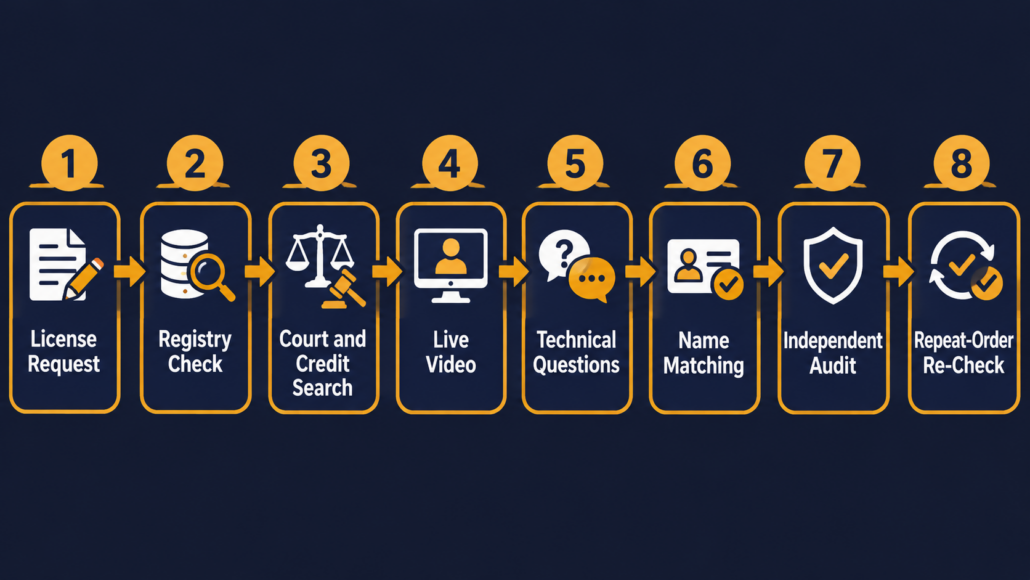
A Practical Chinese Supplier Verification Checklist
Use this order for Chinese supplier verification so each step builds on the last.
Request the Chinese business license, Unified Social Credit Code, factory address, and export credentials.
Verify the legal entity and its manufacturing scope in the official registry.
Search court judgments, enforcement records, and credit-blacklist databases.
Request a live, unscripted video walkthrough of the specific production line.
Ask about materials, machines, capacity, defect rates, and quality checks.
Compare the license, invoice, contract, and bank beneficiary names, and investigate any unexplained mismatch.
For large or custom orders, commission an independent audit before the deposit.
Before each repeat order, re-check the registry for changes in address, capital, or legal representative.
Write the Findings into the Contract
Name the legal entity and the factory address in the contract. Ban unapproved subcontracting, reserve the right to audit, and stage payments against milestones.
A business license answers one question: is the company registered? A factory audit answers another: does the site have the people, equipment, and systems your order needs?
Credit and court checks add context about the risks of doing business with that company. Chinese supplier verification works only when you use these checks together.
None of them works as a guarantee. Their value comes from investigating inconsistencies before you pay.
A reliable supplier should explain its legal identity and its role in production. It should also explain how the contracting company, factory, and payment beneficiary relate.
Your job is to verify those explanations and document the agreed responsibilities.
Frequently Asked Questions About Chinese Supplier Verification
These answers cover the most common Chinese supplier verification questions.
How Does Chinese Supplier Verification Work?
Confirm the legal entity in GSXT using the Unified Social Credit Code. Then check court and credit records, view the production line live, and audit the factory for larger orders.
How Can I Tell a Manufacturer from a Trading Company?
Read the business scope on the license. Then ask to speak with the technical team and judge whether its answers are specific, consistent, and backed by evidence.
Is a Trading Company Always a Bad Choice?
No. Traders suit small orders and mixed products, but you must know who actually makes your goods.
What Is a Unified Social Credit Code?
It is the 18-character ID assigned to every registered legal entity in China. It appears on the business license and must match the registry record.
When Is Chinese Supplier Verification Worth a Paid Audit?
Commission an independent audit before a major deposit on a large, customized, or tooling-heavy order. It is the most reliable way to confirm production reality.
Further Reading
These guides add technical and contract detail to your Chinese supplier verification.
The risks of a price-first pitch from a cheaper supplier who does not know your business
“Hello, we can offer you a better price. Give us a chance.” The message comes from a cheaper supplier you have never worked with, often through WhatsApp, LinkedIn, or another messaging platform.
The salesperson wants a place on your vendor list. They want to compete with your existing suppliers and win your business.
Yet they have asked almost nothing about how your business works.
They do not know your quality needs, delivery promises, approval steps, or tolerance for mistakes. They also do not know what your current suppliers do well, or whether you want a new vendor at all.
Still, they present a lower price as if it settles the question.
The problem is not that they contacted you, or that they claim to be cheaper. The problem is that they propose a solution before they understand your requirements.
Buyers notice this approach. In a survey of 632 B2B buyers by Gartner, 73% said they actively avoid suppliers that send irrelevant outreach.
Is a Cheaper Supplier Worth Considering?
Quick answer: A cheaper supplier deserves a fair hearing, not a free pass. A lower price is only a claim until the supplier shows what it includes and how it achieves it. Compare scope, quality, delivery, payment terms, and switching costs. Then check the supplier’s skills with a small trial.
Yes, a lower quote deserves consideration. It does not deserve an exemption from scrutiny.
This guide also shows how to test a price claim, find the hidden costs, and run a fair trial.
A Cheaper Supplier Quote Is Not Always a Comparable Offer
Before any supplier claims better value, both sides must agree on what they are comparing.
Does the price cover the same specifications, delivery schedule, and quality checks? Does it cover the same payment terms, support, warranty, and responsibility when something goes wrong?
Without those answers, “we are cheaper” may mean little more than “our number is smaller.”
Compare Whole-Life Cost, Not the Headline Price
Good procurement practice looks past the number on the quotation. UK government guidance on should-cost modeling says the key factor is whole-life cost, not the initial purchase price.
The UK Consultancy Playbook (Version 2.0, November 2026) likewise asks buyers to understand the whole-life cost of each delivery option. A supplier review should also weigh quality, on-time delivery, and skill.
A Cheaper Supplier Quote May Hide Different Incoterms
Global quotes add one more trap. The ICC’s Incoterms rules define who handles delivery tasks, costs, and risks under a sales contract.
Under EXW, the seller only makes the goods available at its own premises. Under DDP, the seller delivers the goods cleared for import.
An $880 EXW price and a $1,000 DDP price are not yet comparable.
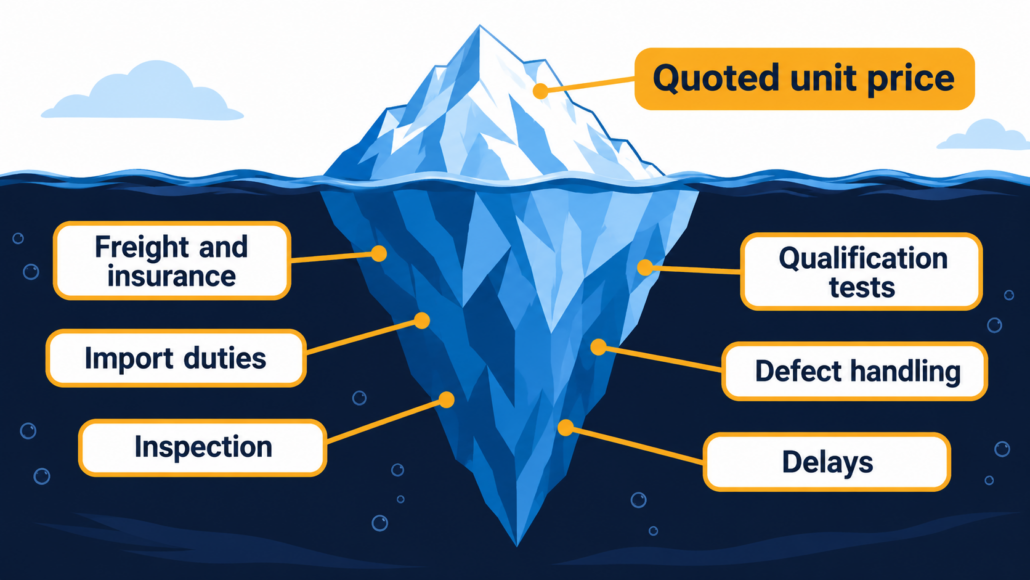
Worked Example: 12% Cheaper on the Quote, 4.7% Higher in Total
The table below uses illustrative numbers, not market data. Replace them with your own quotes.
Cost item (order of 100 units)
Current supplier (DDP)
Cheaper supplier (EXW)
Unit price
$100,000
$88,000
Freight and insurance to your site
Included
$4,500
Import duties and clearance
Included
$5,000
Pre-shipment inspection
Included
$1,200
Sample approval and qualification tests
$0 (already approved)
$3,000
Defect handling and returns
$1,000
$4,000
Total comparable cost
$101,000
$105,700
The cheaper supplier is not wrong or dishonest here. Its quote simply leaves more costs with you.
On a one-off order, the new supplier costs more. Spread the qualification cost over repeat orders, and the result may change. But that holds only after quality, delivery, and support are proven.
Why a Cheaper Supplier’s Price-First Pitch Undermines Trust
A salesperson cannot know every detail of your business before first contact. Some information is private, and learning it takes a conversation.
But approaching a buyer to learn differs from approaching a buyer with an unsupported promise. A professional opening might read: “We supply businesses in your sector. I would like to understand your requirements and see whether we can improve cost, delivery, or service.”
But compare that with: “Whatever your current supplier charges, we can do it for less.”
The first message admits uncertainty. The second claims an advantage before anyone has built a basis for comparison.
That survey shows what buyers want instead. They still seek seller input when they need help judging whether a product fits their needs.
It also found that 69% of buyers see gaps between a supplier’s website and what its salespeople say. That gap is a trust problem before the first order.
The messaging platform is not the issue. The quality of the approach is. Asking before promising earns trust, even for a cheaper supplier.
Six Risks Behind an Unexplained Cheaper Supplier Quote
A low price does not prove poor quality or bad intent. Yet a supplier may truly operate more efficiently.
But when a salesperson cannot explain how the price fits your needs, six risks deserve a closer look.
1. Important Requirements May Be Missing From the Quote
A supplier who has not understood the work may underestimate what delivery needs. The quote might leave out inspections, documentation, packaging, revisions, or technical support that your current supplier includes.
Those gaps can later surface as extra charges, reduced service, or disputes over scope.
In battery storage, for example, a quote may exclude commissioning, firmware support, or cell test reports. Our C&I BESS quote checklist lists what a supplier needs before it can price the job.
Ask a better question than “How much cheaper are you?” Try: “What exactly does your price include, and what does it exclude?”
2. Savings May Disappear in Quality Failures
A lower invoice becomes expensive when you must inspect, correct, reject, or replace the supplier’s work. Quality problems also hurt production, returns, and your reputation.
Those costs belong in the comparison, even when they never appear on the supplier’s invoice.
Instead, ask whether the supplier can meet your standard every time, not whether it can make one good sample.
3. Delivery and Capacity May Not Support the Promise
Winning an order and filling it well take different skills. A supplier needs the people, processes, and capacity to back its commitments.
Check delivery history, financial health, and spare capacity. Those checks separate a persuasive promise from a dependable supply.
The UK Consultancy Playbook tells evaluators to check that the bid team does the work. Apply the same test to factories: the plant you audit should build your order.
For time-sensitive operations, one late shipment can cost more than the saving.
4. The Price May Change Once You Depend on the Supplier
An attractive entry price may be temporary. A supplier could later recover margin through surcharges, change orders, or price increases once switching gets costly.
This is a risk to examine, not an accusation that fits every discounted offer.
The Consultancy Playbook raises a related concern. It warns against £1 or free offers on the supplier’s terms. They can create dependency on a supplier whose long-term terms are less favorable. It names the pattern “landing and expanding.”
Before you rely on a saving, confirm how long the price holds. Then check volume commitments, adjustment rules, and exit terms.
Keep at least one approved backup supplier. The Playbook’s taxi-rank model rotates work among several suppliers to preserve competition and avoid lock-in.
5. Switching Creates Work
Replacing a supplier is more than a buying decision. It may need testing, sample approval, system changes, and staff time.
But those transition costs are real. A lower quoted price does not cover them.
Still, an established vendor should not win just because it is familiar. The Playbook itself warns buyers against the trap of only choosing known suppliers.
Instead, judge a challenger against the full cost of changing, not an imaginary world where switching is free.
6. Identity and Payment Risk Rises With Unsolicited Offers
Most cheaper suppliers are honest. Still, verify the company, its factory, and its bank account before money moves. Our supplier red flags guide explains how.
What a Cheaper Supplier’s Pitch Reveals About the Company
First, an uninformed pitch is evidence about the sales interaction. It is not proof that the whole company is incompetent or dishonest.
The rep may be new, poorly trained, or following a generic script. The supplier may still have strong operations.
Still, the pitch gives you a reason to test how the company handles customer requirements. Ask yourself:
Does the salesperson ask questions before making firm commitments?
Can the company explain what creates its cost advantage?
Does it disclose exclusions and limits clearly?
Can operations staff verify what sales promised?
Will it follow your formal approval process?
These questions separate a weak opening message from a deeper inability to deliver the work.
The strongest criticism is not that a cheaper supplier is bad. It is that price claims without evidence cannot prove suitability.
Judge Your Current Supplier and the Cheaper Supplier by the Same Rules
A price-first pitch treats your current supplier’s invoice as the whole relationship. Your supplier also brings steady quality, reliable lead times, fast answers, and technical help.
The same discipline applies to incumbents. Being familiar is not proof of value. A long bond does not excuse weak work or high prices.
Use the new quote as a benchmark. Ask your current supplier to itemize its price, then compare line by line.
Treat the cheaper supplier and the incumbent alike. The goal is neither loyalty at any cost nor switching at the first discount. It is fair competition, backed by evidence, on like-for-like terms.
How to Test a Cheaper Supplier’s Price Claim
Governments face this problem daily, so their guidance helps when you assess a cheaper supplier. Their lessons also fit private buyers. The UK Government Commercial Function publishes guidance on abnormally low tenders under the Procurement Act 2023.
Let the Supplier Prove the Price
The guidance starts with fairness. It says not to reject a low price automatically. A supplier may have real efficiencies, supply chain deals, or a better grasp of the buyer’s needs.
What matters is evidence. The supplier must show it can deliver at the price offered. It should share a clear cost model on request.
Section 19(3)(c) of the Act lets an authority disregard an abnormally low tender. Section 19(4) first requires a fair chance for the supplier to show it can perform.
Warning Signs That a Price Does Not Add Up
The same guidance lists indicators that a price may be unrealistic:
A premium service offered at a budget price.
An incomplete price breakdown.
A delivery plan that does not match the resources offered.
Missing start-up costs, or savings with no credible plan.
Low supply chain costs without supporting evidence.
Central government buyers must refer any bid over 10% below the average bid, or the should-cost estimate, to the Cabinet Office. Private buyers face no such rule. Still, the idea works as a trigger for a closer look.
What a Credible Cheaper Supplier Should Demonstrate
A serious supplier should move beyond “try us” and give you a basis for evaluation.
Scale the review to the importance and risk of buying from a cheaper supplier. The table shows what to request.
Area
Evidence or explanation to request
Requirements
Written confirmation of specifications, scope, volumes, timelines, and acceptance criteria
Cost advantage
A credible cost model that explains how the lower price is achieved
Quality
Quality controls, performance records, samples, or test results that match your product
Delivery
Lead times, free capacity, delivery history, and contingency plans
Commercial terms
Clear inclusions, exclusions, payment terms, price validity, and remedies
Business reliability
Checks on legal identity, financial stability, factory ownership, and bank account
Trial performance
A limited evaluation with success measures agreed in writing
Where a trial fits, “give us a chance” should become a defined test, not an open-ended transfer of risk to you.
Set the Quality Threshold Before You Compare Price
One useful principle is to set a minimum standard before you compare prices.
The Consultancy Playbook says evaluation should balance quality and price. No supplier should bypass quality rules by offering the lowest day rate. Every bid should meet a quality threshold first.
It also advises testing your evaluation to see whether abnormally low bids change the outcome. That advice covers consultancy buying, but the logic fits any vendor decision.
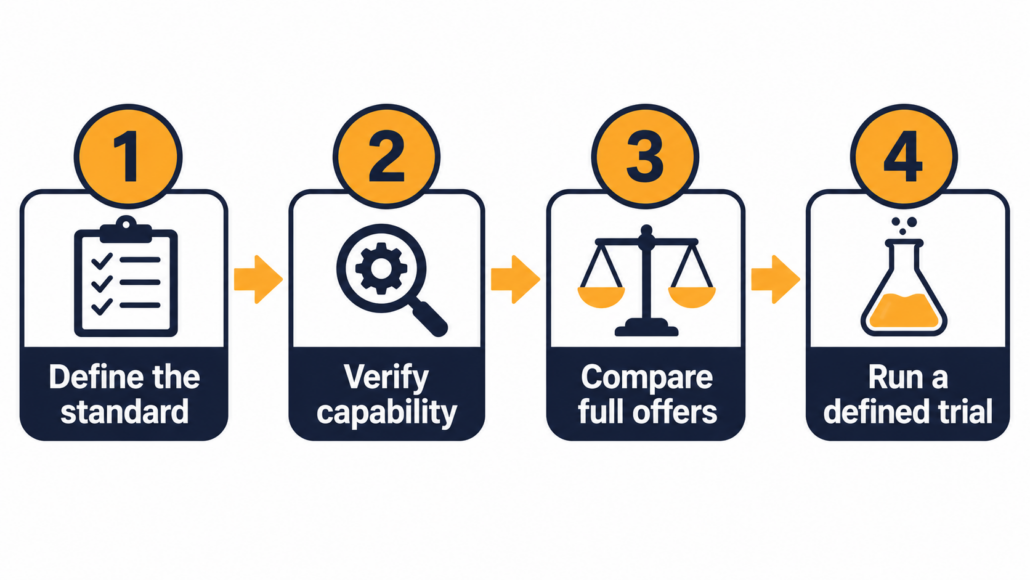
Apply it to any cheaper supplier in four steps:
Define what acceptable performance requires.
Establish whether the supplier can meet it.
Compare the full offers side by side.
Test what you cannot verify before a big order.
Price still matters. It simply becomes meaningful inside a defined standard of performance.
Give the Cheaper Supplier a Defined Trial, Not an Open-Ended Chance
What a Good Trial Includes
“Give us a chance” should become a short, written test. Agree the scope, volume, schedule, and success measures before the first order from the cheaper supplier ships.
An order small enough to absorb if the trial fails.
Written specs and clear pass-or-fail rules.
Success measures such as on-time delivery, defect rate, and response time.
A review date and a clear exit.
Payment terms that avoid a large prepayment.
Keep your current supplier active during the trial. This limits disruption if the trial does not meet the agreed standard.
A Sample Reply to a Price-First Message
You do not need to be rude. A short, firm reply sets the terms.
Sample reply: Thank you for reaching out. Before we compare prices, please send your specifications, certificates, lead times, and payment terms. Please also list what your quote excludes.
If your offer looks suitable, we can discuss a small trial with agreed success measures.
Key takeaway: A lower price can open the conversation. It cannot replace the evidence needed to earn the business.
The Real Question About a Cheaper Supplier Is Not “Can You Charge Less?”
A new supplier has every right to compete. An existing supplier has no automatic right to stay.
Welcome real savings, better service, and strong alternatives. But an invitation to compete is not permission to skip qualification.
The question is not whether a cheaper supplier can charge less. It is whether that supplier can meet your requirements at a lower overall cost, with acceptable risk and clear accountability.
Key takeaway: A lower price can open the conversation. It cannot replace the evidence needed to earn the business.
Need Help Comparing Supplier Quotes?
Are you weighing a cheaper supplier for batteries, BESS, inverters, or PCS? A structured comparison protects your budget.
Contact SunLith Energy to talk through your sourcing needs.
Cheaper Supplier FAQs
These answers cover what buyers ask most about a cheaper supplier.
Should I ignore a cheaper supplier who messages me out of the blue?
No, but do not take the claim at face value. Reply with a request for specifications, an itemized price, and proof of capability.
How much cheaper is too cheap?
No fixed number fits every purchase. Compare the quote with your should-cost estimate and other bids, then look closer at clear outliers.
What should I ask a cheaper supplier first?
First, ask what the price includes and excludes. Then ask how the supplier achieves the lower cost.
Is switching suppliers worth a small saving?
Rarely, unless the saving covers testing, setup, and risk. Compare total delivered cost, with one-time switching costs, over several orders.
How do I run a supplier trial?
First, use a small order, written pass-or-fail rules, and agreed success measures. Keep your current supplier active until the trial ends.
Further Reading
These SunLith guides help you judge a cheaper supplier before you switch.
A balcony solar system gives apartment residents a small way to generate electricity without a full rooftop array. It typically combines panels, a microinverter, and a connection to the household circuit.
But permitted equipment and rules vary by location. This guide explains why the idea spread, where it is legal, what it needs, and its limits.
Quick Answer: A balcony solar system is a one- or two-panel kit with a microinverter that plugs into a household circuit. It is popular because it is affordable and renter-friendly. Germany and Great Britain both cap inverters at 800 VA. Shade, building rules, and local law limit results.
What Is a Balcony Solar System?
A balcony solar system turns sunlight into home power without a full rooftop setup. Panels attach to a railing, wall, or patio.
A typical kit has four parts:
One or two solar panels
A microinverter that matches the grid
A pre-assembled cable with a plug
A mounting frame for a railing, wall, or ground stand
A small inverter converts the power for home use. The power flows into your home circuit first.
Your appliances use it, and then the grid covers any gap. In Germany these kits are called Balkonkraftwerke, or balcony power plants.
The inverter must also shut down if the grid fails. This safety feature protects utility workers, too.
Panel Capacity, Inverter Output, and Energy
A kit has two key ratings. Panel capacity (Wp) is the peak power of the panels.
Inverter output is the most AC power the device can deliver. Rules may state it in watts or volt-amperes, so check the unit in your local rules.
Annual energy production is a third measure. It is counted in kilowatt-hours (kWh), and it depends on sun, tilt, and shade.
Germany, for example, permits an inverter limit of 800 VA. Its dedicated standard allows 960 Wp of panels with a household plug.
A special energy plug allows 2,000 Wp. That means an “800 W system” can mean different things, so check which rating a seller means.
Why Is Balcony Solar Becoming Popular?
The balcony solar system took off because it solves four problems at once.
Low Cost and Fast Payback
First, a kit costs far less than a rooftop system. Also, you often skip installer labor and some permit fees.
But payback depends on your power price and your daytime use. High electricity prices shorten it, which is why the idea thrived in Europe.
Balcony Solar System Access for Renters
Renters rarely control the roof. A balcony kit gives them a way to generate power anyway.
Some places offer simple rules for approved plug-in kits. Whether electrical work is needed depends on several things.
These include the kit, the connection method, the wiring, and local rules. Germany, for example, needs only one free online entry.
Energy Prices and Policy Momentum
High power prices and climate goals also pushed governments to act. In April 2026, the European Commission urged member states to ease permits for small solar and storage.
Then the idea spread by example. Each new country that legalized it made the next debate easier.
Where Is the Balcony Solar System Legal and Popular?
The balcony solar system is legal in a growing list of countries, but the rules differ.
The examples below are not a complete list of countries where balcony solar is allowed. They show how differently places regulate the same basic idea.
Germany: The Global Leader
Germany is the most mature market. A 2024 reform raised the inverter limit from 600 W to 800 W and cut registration to one online entry.
The specification bars timber balconies and some cladding types. It also says kits are not meant for use with a battery, and Northern Ireland has separate rules.
Most state laws cap systems near 1,200 W, and Colorado allows up to 1,920 W. Some laws start in 2027, so check your state legislature for status and dates.
Several laws also require a safety listing from an approved test lab. Colorado’s HB26-1007 and Vermont’s S.202 both do.
One consumer guide reports that no complete kit had been found to meet the required standards. Legal does not always mean you can buy a kit.
Rules summarized as of November 2026; confirm current requirements locally. Use this table as a starting point.
Jurisdiction
Inverter Limit
Panel Limit
Registration or Notice
Status
Germany
800 VA
960 Wp with a household plug; 2,000 Wp with a special energy plug
One entry in the federal register within one month
In force; product standard published December 2025
Great Britain
800 VA (3.5 A maximum)
Up to 2,000 W of panels; professional assessment advised above 960 W
Notify the network operator of connection and disconnection; one device per household
In force since August 27, 2026
United States
Varies by state; 1,200 W in most, 1,920 W in Colorado
Varies by state
Varies by state and utility
Signed laws reported in ten states; some take effect in 2027
How to Check Balcony Solar System Rules in Your Country
Balcony solar rules are still developing, so there is no single worldwide answer. Before you buy, check if your country or utility allows plug-in solar.
Also check which kits it permits and if you must register. Then ask whether a qualified electrician must connect or approve the system.
Most places fall into one of four categories:
Category
What It Means
What to Do
Explicitly permitted
The place has a rule or utility process for plug-in solar
Follow the stated equipment, connection, and registration rules
Permitted under general rules
There is no dedicated plug-in law, but small grid-connected solar may be allowed
Ask the utility or a qualified electrician before connecting
Not clearly addressed
The rules do not mention plug-in kits
Do not connect until the utility or regulator confirms the position
Restricted or prohibited
The place or utility does not allow the connection
Do not install a plug-in kit without official approval
Three examples show the range:
Explicitly permitted (Austria): the regulator E-Control says kits up to 800 W need no grid operator approval. The operator must be told at least two weeks before start-up.
Not clearly addressed (France): Enedis says every self-consumption installation must be declared. A May 2026 government answer says the revised wiring standard bars plugging a generator into a standard socket.
Restricted (Hungary): a building-requirements decree in force since January 1, 2025 bars panels on balconies, according to a law-firm briefing.
Ask your regulator or local utility first. Their advice beats any general article, including this one.
Balcony Solar System Requirements: What to Check in Your Country
A balcony solar system must meet technical, legal, and site requirements, and these vary by country. Answer these questions for your location.
Technical Requirements for a Balcony Solar System
Is a plug-in connection to a household socket permitted?
Must the kit be certified as a complete product?
Must the inverter meet local grid-protection and anti-islanding rules?
Does a dedicated circuit, RCD, or GFCI protection apply?
Are batteries, second systems, or higher-capacity kits treated differently?
For example, Germany’s standard, DIN VDE V 0126-95, sets the plug rules and the 800 VA inverter limit. The inverter must also stop feeding power when the grid drops.
Legal and Administrative Requirements
Must a qualified electrician inspect or connect the system?
Must you register with the grid operator?
Is exported electricity credited, limited, or not paid for?
Is landlord, condominium, heritage, or building approval needed?
Germany, for example, wants you to register the system within one month of start-up. In Great Britain, buy only kits that meet the interim specification, and tell your network operator.
In the US, confirm your state law and utility rules. These differ widely.
Site Requirements
You need sun, a safe mount, and a suitable outlet. Check direction, tilt, and shade together with a yield tool before you pick a spot.
Also check railing strength and wind exposure. Then confirm the outlet sits on a properly protected circuit.
Balcony Solar System Limitations
Because a balcony solar system is small, its limits matter as much as its benefits.
Limited Power Output
Where an 800 W inverter limit applies, the system is meant to offset part of household demand. It does not replace the grid connection, and it mostly offsets always-on loads such as fridges and routers.
But real output is usually lower than the label. Season, tilt, and shade all cut it, too.
Shading and Orientation Losses
A balcony is often a poor solar site because vertical railing mounts catch less sun than tilted roof panels. Nearby buildings also add shade.
One MDPI study found that vertical self-shading between floors limits balcony panels in dense housing. Another MDPI study, however, found that east- or west-facing vertical panels can match household demand better than south-facing ones.
Self-Consumption and Export Limits
Most value comes from using the power as it is made. But under many plug-in rules, surplus power earns little or nothing.
Adding a Battery Can Change the Compliance Requirements
Simple rules often cover panels and inverters only. A battery can change which standards and approvals apply.
In Germany, the plug-in standard does not cover devices with storage, so they must meet extra requirements. In Great Britain, the specification says kits are not meant for use with a battery.
US state laws differ, so check how your state treats storage.
Building, Rental, and Safety Limits
Landlords, owner groups, and heritage rules can still shape where panels go. Also, counterfeit or uncertified kits create shock and fire risk.
In the US, dedicated plug-in standards are still developing. Since requirements shift, always confirm what your utility and state accept.
How to Estimate Balcony Solar System Output Before Buying
Rated power alone cannot predict what a balcony solar system will produce. Check these five factors first:
The balcony’s compass direction and the panel tilt
Shade from floors above, neighboring buildings, and railings
The planned panel capacity
Estimated annual generation from a balcony-specific calculator
Still, treat any single published example as one case, not a typical yield. Each balcony is different.
Balcony Solar System Buying Checklist
Use this checklist to test whether a specific balcony solar system fits your home.
Is this exact kit permitted under my local rules?
Does its documentation name the product and grid-connection standards it meets?
Is my planned plug and socket arrangement allowed?
Is the mount suitable for my railing and wind exposure?
Do I need landlord or building-association approval?
What registration or network notice is required?
What happens to the electricity I do not use?
Does adding storage change the requirements?
Is a Balcony Solar System Worth It?
Payback depends on three things. These are installed cost, electricity production, and how much of that power your household uses. Start with the total installation cost, then estimate annual savings.
What Counts as System Cost
The advertised kit price may not include every cost of your installation. Check each category below, but not every project needs every item.
Cost Category
What to Check
Core equipment
Whether panels, inverter, and connection cable are included
Mounting
Whether the supplied brackets fit your balcony
Electrical work
Whether the connection needs assessment or changes
Administration
Whether any registration or approval has a cost
Optional extras
Monitoring, storage, or alternative mounting
Payback With Self-Consumption
This simple math assumes no payment for exported power and ignores ongoing costs. Use these formulas:
Where generated kWh is annual output, self-consumption share is the part your home uses as it is made, and electricity price is what you pay per kWh.
Suppose a kit generates 600 kWh per year, and your home uses 70% of it as it is made. That leaves 420 kWh that replaces grid power.
At $0.30 per kWh, savings are $126 per year, with no payment for exports. A $600 installation then pays back in about 4.8 years.
These are hypothetical assumptions, not a price or output forecast. Maintenance, replacement costs, and price changes would also shift the result.
Balcony Solar System With Battery Storage
Many buyers ask whether a balcony solar system should include a battery.
A battery lets you use midday solar at night. But it adds cost and can change the compliance requirements.
A grid-linked kit with a battery is not always backup power. Check that the full system clearly supports backup use.
If you add storage, treat it as a separate project. Then look for LFP cells, certified gear, and a qualified electrician.
Final Thoughts on the Balcony Solar System
The balcony solar system works because it is simple, affordable, and open to people without a roof. Since Germany proved the model, the UK and many US states are now following it.
It will not replace a full rooftop system. But for renters and apartment owners, it is a practical first step into solar.
Frequently Asked Questions About the Balcony Solar System
These answers cover the questions we hear most about the balcony solar system.
Is a balcony solar system legal everywhere?
No, because rules vary by country and, in the US, by state. Check your local law and utility rules.
How much power can a balcony solar system produce?
Germany and Great Britain cap inverter output at 800 VA. But most US state laws cap it near 1,200 W, and daily energy depends on sun, tilt, and shade.
Can renters install plug-in solar?
Often yes, since Germany gives tenants a legal right to request one. But building rules still apply, so check your lease first.
Do I need an electrician for plug-in solar?
Not always. Some places allow approved kits without an electrician. But it depends on the kit, the wiring, and local rules.
Does a balcony solar system work during a power outage?
No. A standard grid-connected kit is not backup power, and its inverter stops feeding power when the grid fails. Do not assume a battery adds outage protection.
Does plug-in solar work in winter?
Yes, but output drops sharply because low sun and short days cut winter yield.
Further Reading
These SunLith guides also cover solar basics and storage costs that sit beside the balcony solar system topic.
Supplier red flags often appear long before you place a purchase order. How a supplier behaves after a trade exhibition shows how it may treat your order after it receives your money.
Imagine you meet a supplier at an international exhibition. You explain your requirements, discuss technical specifications, and exchange business cards.
You expect a professional follow-up. Instead, nothing happens.
A week later, a generic catalog arrives with one line: “If you need any products, please feel free to contact us.”
Nothing refers to your discussion. Nobody asks about your project or tries to build a business relationship.
This is more than poor salesmanship, because it may reveal weak management, loose customer processes, and low operational discipline.
Fraud adds another risk. The FBI warns that business email compromise targets businesses that work with foreign suppliers.
In international B2B sourcing, price alone is not enough because you need a partner who delivers what they promise.
This guide covers 30 numbered supplier red flags, eight critical risk areas, and a 9-step qualification process. Use it before your first purchase order (PO).
What Are the Most Important Supplier Red Flags?
Quick answer: The most important supplier red flags include silence after an exhibition, vague answers, hidden subcontracting, uncontrolled design changes, mismatched payment accounts, and weak corrective action. One flag is only a warning. Several together mean you should verify supplier identity, production capacity, documents, and payment details before ordering.
1. Supplier Red Flags After the Exhibition: Poor Follow-Up
These supplier red flags appear right after the show, while your inquiry is still fresh.
Early Supplier Red Flags: Silence and Generic Catalogs
Red flag 1: Complete silence after the exhibition. You showed interest, discussed requirements, and shared contact details. Yet the supplier never contacts you.
What it reveals: Poor lead management, no structured customer relationship management (CRM), and weak sales accountability.
A busy exhibition produces hundreds of leads, so a short delay is fine. Still, continued silence without any acknowledgment is a warning.
If a company cannot manage your inquiry, can you trust it to manage your production schedule?
Red flag 2: The copy-paste catalog approach. You receive a generic catalog unrelated to your discussion. Nobody mentions the product or project you discussed.
What it reveals: The sales representative processes contacts instead of developing opportunities. As a result, your specifications, packaging instructions, and commercial terms may not get the attention they deserve.
Weak Research and Passive Selling
Red flag 3: Zero research about the buyer. The supplier asks basic questions that your business card or website already answers. As a result, they do not understand your business, market, or buying needs.
What it reveals: A lack of preparation and weak B2B account management.
Good suppliers know that buyers differ. For example, importers, distributors, developers, and Original Equipment Manufacturer (OEM) customers need different approaches.
Red flag 4: The passive salesperson. The conversation ends with “If you need anything, please contact us.” Then nothing follows.
There is no follow-up, no talk about your timeline, and no product recommendation.
What it reveals: The company may lack a structured business development process. A professional representative stays in touch without pressuring you.
Red flag 5: The catalog-and-wait mentality. Sending a catalog is not relationship building. Instead, a serious supplier asks about your needs, suggests suitable products, and answers questions.
If the supplier expects you to do all the work, why would it take responsibility when problems arise?
2. Supplier Red Flags You Can Spot at the Exhibition
Your evaluation starts at the booth, not after you return home. Watch for these supplier red flags during the show.
Red flag 6: Booth representatives cannot answer technical questions. Every technical question gets the same reply: “I will check with our engineer.” Involving engineers is fine. But repeated failure to return with answers signals weak coordination or limited product knowledge.
This becomes serious when you buy lithium batteries or battery energy storage systems (BESS). It also applies to solar inverters, power conversion systems (PCS), and battery management systems (BMS).
Red flag 7: The booth does not match the company. The displayed products look impressive, but the website, factory information, and business profile tell a different story.
Ask yourself:
Are these actually their products?
Do they manufacture them?
Do they have their own engineering team?
Can they show their production facilities?
Do the displayed products come from other manufacturers?
However, a polished booth does not prove production skill.
Red flag 8: Nobody owns your inquiry. You talk to one representative, but later you get a different contact and discover nobody knows your discussion.
What it reveals: Poor internal communication and unclear responsibility. Instead, a serious supplier assigns an accountable person to your inquiry.
3. Communication Problems That Predict Operational Issues
Communication habits are supplier red flags too, because they predict how the supplier will run your order.
Red flag 9: Inconsistent response times. The first reply arrives in minutes. The next takes three days, and then another week passes.
A busy sales team is fine. However, unexplained delays create doubt. Our guide to supplier response time explains what one-line replies and silence reveal.
Red flag 10: Vague answers without commitments. You ask about delivery, specifications, or customization. The answer is always “Yes, no problem,” with no numbers, dates, or written commitments.
But a good supplier separates what is possible, what is affordable, and what is confirmed.
Red flag 11: Avoiding written communication. The representative prefers informal chats on instant messaging apps but avoids formal quotations, proforma invoices, specifications, and written agreements.
Informal communication is normal in international trade. However, all important commercial and technical commitments should be documented.
Red flag 12: Contradictory information. The catalog states one specification, the website shows another, and the salesperson gives a third.
This can signal poor document control or outdated product data. Never assume the latest verbal answer is correct. Instead, request an approved technical datasheet.
4. Manufacturing and Technical Capability: What Buyers Should Verify
This is where buyers must be especially careful. Weak answers here are supplier red flags that separate real factories from polished presentations.
Identity and Documentation
Red flag 13: Unclear factory or trading company identity. The supplier presents itself as a manufacturer but avoids direct questions about its production facilities.
Trading companies are not a problem in themselves, and many provide valuable sourcing services. The problem is misrepresentation, so you must know who makes your products.
Red flag 14: No genuine technical documentation. The supplier cannot provide:
Product datasheets.
Material specs.
Certifications and supporting reports.
Quality inspection records.
Product test reports.
Production and process information.
For battery and energy storage projects, also examine cell traceability, BMS specifications, protection functions, cycle-life test conditions, and safety certifications.
But a certificate alone does not prove that the supplied product matches the tested product.
Claims, Audits, and Capacity
Red flag 15: Unrealistic product claims. The supplier promises exceptional performance, extremely long cycle life, or unusually low prices. Yet it cannot provide reliable evidence.
For example, a battery maker claims 8,000 cycles. Yet it cannot explain the test temperature, charge and discharge rate, depth of discharge (DOD), or end-of-life capacity.
Claims without test conditions are marketing, not engineering evidence.
Red flag 16: Resistance to factory audits and video inspections. The supplier makes repeated excuses when you ask for a live video inspection or factory audit. A legitimate manufacturer may have confidentiality limits but should offer a reasonable alternative.
Red flag 17: No clear production capacity. The supplier promises large orders but cannot explain:
Monthly output.
Current production loading.
Available production lines.
Raw-material supply.
Typical production lead times.
Subcontracting plans.
Paper capacity is not free capacity, so check it against your order size and delivery date.
5. Supplier Red Flags in Commercial Behavior
Commercial pressure is one of the clearest supplier red flags. Watch how the supplier handles price, payment, and warranty.
Red flag 18: Price is the only selling point. The supplier focuses on the lowest price. Yet it rarely discusses quality, materials, engineering, certifications, warranty, or support.
An unusually low price deserves investigation, so understand exactly what the quote includes and excludes.
Red flag 19: Pressure for an advance payment. You receive special discounts, urgent payment requests, or claims that prices rise tomorrow. The supplier wants a deposit before technical verification and secure contract terms.
Never let sales pressure replace due diligence, because rushed payments are hard to reverse.
Red flag 20: No meaningful warranty or after-sales support. The supplier speaks enthusiastically about sales but turns vague about defects, replacements, warranty, and technical support.
Ask who handles claims, who pays freight, what evidence is required, and how fast problems get resolved.
Red flag 21: Unclear payment beneficiary. The quotation, company registration, and bank account details do not match. The supplier asks you to pay an unrelated company or an individual without a documented reason.
This is a serious payment-fraud warning, so verify the beneficiary independently before you transfer funds. Section 10 explains how.
6. The Hidden Problem: Order Takers Instead of Business Developers
Many companies employ sales representatives who act as order takers instead of account managers. Order takers create many supplier red flags, because they never look beyond the quotation.
An order taker waits for requests and sends quotations. But a professional B2B salesperson understands your business, finds opportunities, builds relationships, and solves problems internally.
Common skill gaps include:
Weak understanding of customer value: They treat an importer with long-term potential like a one-time retail buyer.
No relationship management: They send a catalog and forget the lead if you do not reply.
Little grasp of vendor onboarding: They expect an immediate PO but ignore supplier qualification, compliance documents, factory audits, and approved vendor list (AVL) procedures.
No ability to add value: They discuss only price and standard products.
No ownership: They cannot coordinate engineering, production, and quality control.
International B2B business is not about sending quotations. Instead, it is about becoming a reliable, approved partner.
7. The Human Factor: When an Unhappy Salesperson Affects Your Business
Not every communication problem comes from company process. Sometimes the salesperson is simply unhappy, and that creates supplier red flags too.
The person may be underpaid, overworked, denied commission, overlooked for promotion, or planning to leave. As a result, disengaged employees may stop following up or give only minimum service.
Possible warning signs include:
Communication was excellent, then suddenly got worse.
Replies become short and mechanical.
Promised quotations, samples, or documents never arrive.
The representative cannot resolve basic issues.
Another employee or a manager answers much faster.
These signs do not prove the salesperson is unhappy. However, other explanations exist.
The real issue is accountability. A well-run company protects customer relationships even when an employee leaves, so your business should never depend on one salesperson. Section 10 also shows how to prevent this.
8. The Root Cause: Companies That Do Not Invest in Their People
A company that will not invest in employees may struggle to invest in customer success. Supplier red flags can appear at every stage of the order.
High employee turnover: The person handling your inquiry leaves. The replacement does not know your history, requirements, or earlier commitments.
No authority to solve problems: The salesperson cannot challenge wrong production decisions, escalate quality issues, or win management support.
This worries buyers most when they order customized products. Therefore, a good salesperson should act as your representative inside the supplier.
9. Additional Supplier Red Flags Many International Buyers Overlook
These supplier red flags matter most when you source from overseas manufacturers.
Identity, Subcontracting, and Quality Control
Red flag 22: Frequent changes in company identity. The company name, registered address, quotation details, or contracting entity change during negotiations without explanation.
Red flag 23: Unapproved subcontracting. The supplier promises in-house manufacturing, then moves production to another factory without your knowledge or approval. Section 10 lists contract terms that prevent this.
Red flag 24: No proper quality-control system. The supplier cannot explain incoming quality control (IQC), in-process quality control (IPQC), final quality control (FQC), or outgoing quality control (OQC).
Red flag 25: No production traceability. The supplier cannot trace materials, components, batches, or finished products when a quality issue occurs.
Change Control, Delivery, and Complaints
Red flag 26: Unclear change-control procedures. The supplier changes components, materials, firmware, cell brands, or processes without telling you.
This is especially dangerous in battery and energy storage projects.
Red flag 27: No realistic delivery planning. The supplier promises very short lead times but has not checked material supply, production schedules, or testing needs.
Red flag 28: Poor packaging and export preparation. The supplier cannot explain export packaging, labeling, shipping documents, or dangerous-goods requirements.
Red flag 29: No clear complaint-handling process. There is no defined procedure for defective products, corrective actions, root-cause analysis, or replacement claims.
Red flag 30: Unwillingness to accept independent inspection. The supplier resists third-party inspection, pre-shipment inspection, or an agreed factory acceptance test (FAT).
A supplier should also prove that delivered products meet the agreed specifications.
10. Eight Critical Supplier Risk Areas Most Buyers Overlook
These eight risk areas reveal deeper supplier red flags than poor exhibition follow-up. Each one hides a risk that only appears after you place the purchase order.
Together, they show whether a supplier can protect your project when people, factories, parts, and payments change.
Account Ownership: Dependence on One Salesperson
Many suppliers run your project through a single salesperson. That works until the person leaves, changes roles, or stops caring.
Then your specifications, price agreements, and promises vanish with them. As a result, a replacement often starts from zero.
Watch for these warning signs:
Only one person knows your technical requirements.
Quotations and approvals sit in private chat threads.
No manager or engineer appears on key emails.
The supplier refuses to name a backup contact.
A colleague cannot answer simple questions about your order.
Ask the supplier to assign three named roles:
A sales contact for commercial questions.
A technical contact for specs and changes.
A senior contact for urgent problems.
Also keep your own project file. Store the approved specification, quotation history, and meeting notes in your records, not only theirs.
Unauthorized Subcontracting: Who Really Builds Your Order?
Some suppliers promise in-house production, then outsource the work to another factory. The quotation looks identical, but quality control changes completely.
Hidden subcontracting also breaks traceability. You cannot audit a factory when you do not know it exists.
Watch for these warning signs:
The factory audit covers a site that never produces your order.
Production photos show a different workshop each time.
The supplier cannot name the plants that make critical components.
Lead times shrink without a clear explanation.
Labels or serial numbers show another factory’s name.
Protect yourself with clear contract terms:
List the approved manufacturing sites in the purchase contract.
Require written approval before the supplier uses another factory.
Reserve the right to audit every site that handles your order.
Define the remedy, such as rejection or replacement at the supplier’s cost.
Ask your legal adviser to review the final wording.
Engineering Change Management: The Silent Risk in Batteries, BESS, and Inverters
Engineering change management controls how a supplier changes materials, parts, firmware, or processes. Without it, the product you approved is not the product you receive.
This matters most when you buy lithium batteries, BESS, solar inverters, PCS, or BMS. For example, a small substitution can change safety, performance, or certification status.
Uncontrolled changes can look like this:
A different cell brand or cell grade.
New BMS firmware without validation.
A replacement contactor, fuse, or sensor.
Altered busbar, enclosure, or cooling design.
A new production line with different process settings.
Look for these good practices:
A formal change request and approval procedure.
A revision-controlled bill of materials (BOM) and datasheet.
Written notice before any change to a critical item.
Retesting after a change.
A check that the change stays inside the certified design.
OEM and Original Design Manufacturer (ODM) projects need extra care. Your custom design stays safe only when the supplier cannot change it without your signature.
Payment Beneficiary Verification: Protect Every Transfer
Payment fraud often strikes right before a deposit or final payment. Fraudsters copy a real supplier’s emails, then swap in a different bank account.
The FBI describes business email compromise (BEC) as a scam that targets businesses working with foreign suppliers. It advises a second sign-off on vendor payment changes and phone checks using previously known numbers.
Watch for these warning signs:
Bank details arrive late, by email, with urgent wording.
The account name differs from the company on the contract.
The payee is a person or an unrelated firm.
Bank details change after the proforma invoice is issued.
The sender uses a look-alike email domain.
Use this simple routine:
Match the beneficiary name to the business license and signed contract.
Confirm any bank detail change by phone, using a number you already know.
Require a second internal approver before you release funds.
Keep bank details inside the signed contract or proforma invoice, not only in a chat message.
Root-Cause Analysis and Corrective Action: Can the Supplier Fix Recurring Problems?
Every factory ships a bad unit sooner or later, but what matters is how the supplier responds.
An 8D problem-solving report is a structured, eight-step method for solving one specific problem. But corrective and preventive action (CAPA) is a wider quality process that fixes the cause and stops it from returning.
Watch for these warning signs:
The supplier blames shipping or the customer without proof.
Replacement parts arrive, but nobody explains the failure.
The same defect returns in the next batch.
Reports are vague, late, or missing photos and test data.
Nobody owns the corrective action.
Before you order, ask for:
A sample 8D or CAPA report with sensitive data removed.
Target response times for containment, root cause, and the final report.
Details of the failure analysis equipment and test records.
The process for tracing a defect to a batch, material lot, and production date.
A strong answer shows evidence, not promises.
Intellectual Property and Design Ownership: Who Controls Your Custom Design?
Custom products create intellectual property (IP) risk. For example, a supplier may reuse your design, share your drawings, or claim ownership of tooling and firmware.
This matters most for OEM and ODM projects. Watch for suppliers that:
Reuse customer designs for other buyers without permission.
Share confidential drawings with subcontractors.
Refuse to clarify who owns tooling, molds, firmware, or custom designs.
Have no NDA or confidentiality process.
Protect yourself with these steps:
Sign a non-disclosure agreement (NDA) before you share drawings.
State ownership of designs, tooling, molds, and firmware in the contract.
Limit which subcontractors may see your files.
Ask a legal adviser who knows local law to review the wording.
Certification Validity and Traceability: Does the Certificate Cover Your Exact Model?
A supplier may show a genuine certificate that does not cover the exact model it offers. Because of this, always match the certificate to the product you will receive.
Verify these points:
Certificate holder and manufacturer identity.
Exact model and product configuration.
Applicable market and standards.
Validity date and issuing organization.
Whether engineering changes affect certification.
Request the full certificate and test report, not only a summary page.
Contingency Planning: What Happens When Production Is Disrupted?
Even good factories face power outages, material shortages, production failures, and logistics delays. A strong supplier plans for these events before they affect your order.
Ask suppliers about:
Alternative material sources.
Business continuity planning.
Emergency production arrangements.
Critical component availability.
Recovery plans for delayed shipments.
This matters most for long-term supply agreements, because delays compound over time.
Key takeaway: None of these eight supplier red flags proves bad intent. Together, they show whether a supplier controls its people, production, design, money, and quality.
11. Why These Supplier Red Flags Become Expensive Problems
Poor exhibition follow-up does not prove poor manufacturing. However, when several supplier red flags appear together, investigate before you proceed.
The potential consequences include:
Wrong product specs.
Delayed production and shipment.
Hidden subcontracting.
Poor material quality.
Certification and compliance problems.
Payment disputes and financial losses.
Unresolved warranty claims.
Broken communication.
Damage to your company’s reputation.
Loss of valuable time and business opportunities.
The real cost of the wrong supplier is often far higher than the gap between two quotations.
12. How to Screen Out Supplier Red Flags: A 9-Step Process
Reliable suppliers pass a structured qualification process, not just a price comparison. Use these steps to screen out supplier red flags early.
Step 1: Evaluate the first response. Did the supplier remember your discussion, understand your requirements, and ask relevant questions?
Step 2: Test technical understanding. Include a specific technical question in your inquiry. Then check whether the answer is accurate, detailed, and documented.
Step 3: Verify company identity. Check business registration, legal entity, factory address, and who actually makes the product.
Step 4: Request supporting documents. Next, obtain datasheets, certificates, test reports, quality documents, and references.
Step 5: Conduct a factory assessment. Arrange a visit or live video inspection. Then evaluate equipment, test facilities, staff, and quality-control procedures.
Step 6: Verify production capacity. Check real workload, material supply, lead times, and subcontracting.
Step 7: Evaluate the commercial proposal. Then compare quotations on an equal technical and commercial basis. Examine payment terms, delivery, warranty, and commitments.
Step 8: Start with a controlled order. Where practical, begin with samples, a pilot order, or a smaller first purchase. Review performance before you raise volumes.
Step 9: Establish communication accountability. Finally, identify the sales contact, technical contact, and management escalation point. Never let your project depend on one person, since staff can leave.
13. The Supplier Evaluation Checklist
Before you add a supplier to your AVL, check each item below. Each unanswered item may be one of the supplier red flags covered above, so note it before you proceed.
Did they follow up after the exhibition?
Do they understand your actual requirements?
Have they researched your company?
Can their representatives answer technical questions?
Is their factory or trading identity transparent?
Can they provide real technical documents?
Are their certificates real and relevant?
Can they show real production capacity?
Is their quality control documented?
Do they have material and product traceability?
Are they transparent about subcontracting?
Do they provide realistic delivery schedules?
Are quotations detailed and consistent?
Have you verified each payee?
Are warranty and after-sales terms clear?
Are they willing to accept independent inspections?
Can they demonstrate export experience?
Do they have a proper complaint-handling process?
Is one person clearly responsible for your project?
Can they maintain consistent communication?
Do they protect your designs and confidential files?
Are their certificates valid for your exact model?
Is there a contingency plan for disruptions?
Important: One red flag does not automatically disqualify a supplier. Judge the severity, frequency, and combination of warning signs. Act at once on fraud, misrepresentation, safety, or payment security issues.
Final Thoughts: Spot Supplier Red Flags Before the First Order
Trade exhibitions are an excellent place to find manufacturers and technologies. However, the best defense against supplier red flags is attention to what happens after the handshake.
A beautiful booth does not guarantee a professional factory. Likewise, a competitive quotation does not guarantee manufacturing capability. Nor does a friendly salesperson guarantee reliable after-sales support.
Ask yourself four questions. Does the supplier remember your requirements? Does it communicate professionally? Can it provide evidence? Does it take responsibility?
Do not choose a supplier for the lowest price or the biggest promises. Instead, choose one that can show what it is capable of delivering.
The best supplier is not the one that promises everything. Instead, it is the one that understands your requirements, proves its capabilities, and takes responsibility for its commitments.
A Question for International Buyers
Which supplier red flags have you seen? Perhaps a supplier looked highly professional at the booth but disappeared afterward.
Or perhaps one was excellent at winning the PO but unavailable when quality or delivery problems appeared. Share your experience in the comments, because your lessons can help other buyers avoid expensive sourcing mistakes.
Need Help Evaluating a Chinese Supplier?
Whether you are sourcing lithium batteries, BESS, solar inverters, PCS, or customized energy solutions, supplier verification and technical due diligence protect your investment.
Contact SunLith Energy to discuss your China sourcing and procurement requirements.
Supplier Red Flags: Frequently Asked Questions
These answers cover the supplier red flags buyers ask about most often.
What are the most serious supplier red flags?
The most serious supplier red flags involve fraud, false claims, safety, and payment security. For example, a mismatched bank account, hidden subcontracting, or unapproved design changes can qualify. Verify these before you pay any deposit.
Do supplier red flags after an exhibition prove a bad factory?
Not always. One slow reply may simply reflect a busy team. However, repeated silence, generic catalogs, and vague answers together suggest weak processes that may also affect production and service.
How do I verify a supplier’s bank account?
Match the beneficiary name to the business license and contract. Then confirm any bank detail change by phone, using a number you already know. Finally, add a second internal approval before you release funds.
What is the difference between 8D and CAPA?
An 8D report is an eight-step method for solving one specific problem. But CAPA is a wider quality process that corrects the cause and prevents it from returning across the system.
How many red flags are too many?
There is no fixed number, so judge severity, frequency, and combination. But one critical issue, such as payment fraud or misrepresentation, can justify walking away.
Further Reading
These SunLith guides complement this list of supplier red flags when you buy battery storage.
0.25C battery storage usually means four hours of discharge at system level, against two hours for 0.5C. Developers increasingly choose it where revenue depends on shifting solar into the evening or meeting sustained capacity obligations.
The trend is significant but not universal. The commercial case is clearer than the safety claim. Evidence reviewed here does not show that a 0.25C rating alone makes a site safer.
This guide covers grid-scale stationary storage. It draws on the U.S. Energy Information Administration survey, California data, and Chinese tenders. Research runs through November 4, 2026.
Quick answer: Moving to 0.25C battery storage mostly means moving from two-hour to four-hour systems. Energy shifting, capacity rules, and cheaper energy-heavy designs drive it. Documented fires point to site design, controls, and emergency response. The evidence reviewed does not show that 0.25C alone lowers risk.
What Is 0.25C Battery Storage?
At system level, the power-to-energy ratio gives an approximate duration: 0.5C corresponds to two hours, and 0.25C to four. Our C-rate guide covers the cell-level definition.
Where Ecap is usable energy capacity in MWh and Prated is rated power in MW.
Energy and power ratings must use a consistent measurement basis. Cell-level C-rate and guaranteed AC delivery duration are not interchangeable.
Doubling duration creates no free energy. You must add energy capacity or cut power.
Configuration
Rated power
Energy capacity
Duration
What changed
0.5C baseline
100 MW
200 MWh
2 hours
Reference case
0.25C, bigger battery
100 MW
400 MWh
4 hours
Twice the energy, same power
0.25C, lower power
50 MW
200 MWh
4 hours
Same energy, half the power
The first path adds cost and revenue potential. The second keeps the battery but halves the MW you can sell.
Why Energy Shifting Favors Four-Hour Systems
Energy shifting drives most 0.25C battery storage decisions. Buyers want to move cheap midday energy into the evening peak.
Arbitrage Overtook Frequency Regulation
The EIA survey found that 66% of U.S. utility-scale battery capacity listed arbitrage among its uses in 2024. For 41% of capacity, arbitrage was the primary use.
Frequency regulation was primary for 24%. Before that, surveys had named it the most common use.
One caution applies: the primary-use split was similar in the 2023 survey, so the shift began before 2024.
IEA analysis shows a strong shift toward energy-shifting applications. It also shows average duration of new utility-scale batteries rising from about two hours in 2023 to three in 2025.
Why 0.25C Battery Storage Suits Evening Peaks
California shows the pattern. The market monitor’s 2025 annual report counts about 25,700 MW of batteries at the end of 2025. That covers the CAISO and Western Energy Imbalance Market footprint.
The report puts average evening discharge at a peak near 9,100 MW, up from about 5,700 MW in 2024.
Most batteries in the CAISO market have about four hours of duration. They charge when solar is abundant and discharge once solar fades.
A two-hour unit covers the steepest part of that window, while a four-hour unit covers more of it.
But extra hours pay only if prices in those hours justify them. That is a market question, not a technology rule.
Regulation Revenue Is a Thin Slice
Regulation markets are small next to battery fleets. In the CAISO balancing area, batteries with a full year of operation earned about $35/kW-year from energy in 2025. They earned $9/kW-year from regulation, per the same report.
In 2024 the split was nearly $43 and $7. Because of that, new projects have a thin base to rely on.
How Capacity Rules Shape Battery Duration
Rules, not physics, often settle 0.25C battery storage choices. Since capacity programs pay for power a battery can sustain, duration follows the rule.
How Four-Hour Accreditation Shaped California Projects
California has rated batteries by testing sustained output over four hours. The market monitor’s 2023 report said longer batteries received no extra credit.
NREL describes a four-hour accreditation framework. A battery that sustains its rated power for four hours can receive full capacity credit. Extra duration does not necessarily raise that credit.
NREL also found that about 40% of new U.S. storage capacity in 2021 and 2022 was exactly four hours.
Now test a 100 MW/200 MWh battery under a four-hour rule. It can sustain only 50 MW for four hours, while a 100 MW/400 MWh battery sustains all 100 MW.
Texas shows the opposite case. SEIA reports that typical duration there is two hours, versus four in California.
The Economics of 0.25C Battery Storage
In 0.25C battery storage, four hours costs less per kWh but more per project. Both facts matter for the investment case.
Cost per kWh Falls as Duration Rises
Power-related equipment spreads over more stored energy. That equipment includes inverters, transformers, and grid-connection hardware.
Chinese data show the effect. In early 2026, CNESA put average winning bids at CNY 599.3/kWh for two-hour systems and CNY 541.3/kWh for four-hour systems.
TrendForce data for August 2026 point the same way. Two-hour awards averaged about CNY 0.75/Wh, and four-hour awards about CNY 0.60/Wh.
Lower Cost per kWh Does Not Mean Lower Project Cost
Apply the first-half 2026 averages to a 100 MW project. The table shows the result.
Duration
Energy
Average bid
Illustrative procurement value
Cost per MW
2 hours (0.5C)
200 MWh
CNY 599.3/kWh
CNY 120 million
CNY 1.20 million
4 hours (0.25C)
400 MWh
CNY 541.3/kWh
CNY 217 million
CNY 2.17 million
Illustration using separate reported procurement averages, not matched quotations. Differences may reflect scope, supplier mix, technical requirements, and timing as well as duration.
In this illustration, twice the energy carries about 81% more procurement value. Whether the extra hours earn that back is the key question.
For a deeper look at cost metrics, see CAPEX vs LCOS.
Chinese Tenders Buy 0.25C Battery Storage and 0.5C
Tenders show coexistence, not replacement. A 2025 framework tender from a state-owned oil and gas buyer had four sections: 0.25C, 0.5C, grid-forming 0.5C, and 1C.
In 2026, a state-owned power group’s 12 GWh tender covered both 0.5C and 0.25C systems. It also required cells of at least 314 Ah.
Another buyer’s 6 GWh procurement was 83% four-hour and 17% two-hour. Demand also varies by region.
Reports on a 2026 industry conference say that four-hour-plus projects exceed 90% in Inner Mongolia and Xinjiang. But East and Central China mainly use two-hour systems.
Policy adds a push. Since early 2026, China has had Document No. 114. It is the first national capacity-pricing rule for standalone storage.
CNESA reports that new projects averaged 2.69 hours in the first half of 2026. The IEA says the cumulative average rose from about 2.1 hours in 2021 to about 2.6 hours in 2025.
What Operating Results Show About Four-Hour Batteries
Operating fleets give better evidence on 0.25C battery storage than product launches do. California has the deepest record.
Fleet Output Rose While Revenue per kW Fell
California’s market monitor tracks annual net market revenue for batteries in the CAISO balancing area. Its battery reports show a steady decline.
Operating year
CAISO balancing area net market revenue ($/kW-year)
2022
About 103
2023
About 78
2024
About 53
2025
About 45
Net market revenue is not total project profit. It leaves out contracted capacity income.
The monitor tied the 2023 and 2024 drops largely to lower loads and lower peak energy prices.
Together, these results show a paradox. A growing four-hour fleet can serve the grid well, yet wholesale returns shrink.
More duration is no shield against narrower price spreads.
A Four-Hour Label Is Not Four Deliverable Hours
The 2025 annual report says batteries providing resource adequacy often lack enough charge for three or four straight peak hours.
It adds that, still, current rules give operators little reason to ensure a full charge when peak hours start.
So duration on paper is not duration in the market. Dispatch strategy matters as much as C-rate.
What Failures Reveal About 0.25C Battery Storage Safety
Fire data do not support a simple C-rate story for 0.25C battery storage. The best recent evidence is EPRI’s October 2026 failure study.
Failure Rates Have Fallen Sharply
EPRI found that failures per deployed GWh fell 98% from 2018 to 2025. In 2025 it logged 24 incidents across 634 GWh of global capacity.
EPRI rates the failure rate as comparable to large oil-filled transformers. In EPRI’s dataset, about 93% of recorded incidents involved no injuries. In the incidents captured, no member of the public experienced acute injury from a BESS arc flash, fire, or explosion.
This is a recorded thermal-incident metric, not a project-level failure probability. The dataset is not a complete census, reporting is incomplete, and each incident counts equally regardless of the damage.
The study examines site architecture, age, and chemistry. But it does not examine C-rate or duration as risk factors.
Architecture Influenced How Far Incidents Spread
EPRI found that indoor facilities are overrepresented in failures. They also lose more capacity once an incident starts.
Compare two four-hour sites. Elkhorn (182.5 MW/730 MWh) used outdoor containers. Its 2022 fire damaged one container, about 0.4%.
Moss Landing Phase I (300 MW/1,200 MWh) sat in one indoor building. Its 2025 fire damaged about 55%.
EPRI attributes the difference in loss extent largely to architecture. These are two incidents, not a controlled comparison.
Control Failures and Accumulated Gases Created Different Hazards
The September 2021 Moss Landing event began with smoke from a failed air-handling bearing. An apparent programming error let the water-based heat suppression arm below its design smoke level.
Failed hose couplings then sprayed water onto racks. Cell temperatures were normal when the water began, but about 7% of modules suffered damage. Here a control fault, not cell overheating, started the chain.
A different hazard arose at McMicken, near Surprise, Arizona, in 2019. Flammable gas built up during thermal runaway, and four firefighters were critically injured.
EPRI notes that explosions there and in a 2024 German incident followed the opening of enclosures during response.
A further fire on September 18, 2026 prompted a shelter-in-place order, later lifted, CalMatters reports.
Until a verified cause appears, no one should blame C-rate.
Does 0.25C Battery Storage Last Longer?
Cell life is the claim most often attached to 0.25C battery storage. Yet no independent study reviewed here isolates 0.5C from 0.25C in large LFP cells.
What Cell-Aging Studies Tell Us About 0.25C Battery Storage
LFP lifetimes ran from roughly 2,500 to 9,000 equivalent full cycles, with some values extrapolated. Within the LFP data, fade rose with temperature between 15°C and 35°C.
Discharge rate showed little clear effect from 0.5C to 2C. But 3C looked worse.
Round-trip efficiency fell as discharge rate rose. Since the cells were small 1.1 Ah cylinders, treat the result as a caution.
Manufacturer datasheets may list different cycle counts at different rates. But those figures are not a controlled comparison.
Lower Current Cuts Resistive Heat
Resistive heat in a cell scales with current squared. Take a simplified case: identical cells, the same DC voltage, twice the parallel strings, and constant total power.
Current per cell halves, so instantaneous resistive loss falls by about half. Because the discharge lasts twice as long, total loss energy is approximately unchanged.
As a share of delivered energy, however, loss falls by about half. This is not a prediction of whole-system efficiency or lifetime.
The shift toward 0.25C battery storage does not make two-hour systems obsolete. Four hours is also not the final answer.
Where Two Hours Fits
In Australia’s National Electricity Market, 95% of post-2024 capacity is designed for two hours or more. Even so, average duration should rise from 1.5 hours in 2024 to 2.5 hours in 2027.
U.S. average project duration slipped to 3.08 hours in 2025 from 3.15 in 2024, per SEIA. That happened because California’s share of new builds fell.
When a discharge obligation is short, four hours is not needed. Buy the duration the contract pays for.
Where Four Hours Is Not Enough
NREL notes that summer peaks are narrow, while winter peaks can last eight hours or more.
It also expects the capacity credit of short-duration storage to decline as storage grows. That favors longer durations over time.
Moving to 0.25C extends daily shifting, but it does not solve multi-day shortfalls.
How to Choose Between 0.5C and 0.25C
Start with the revenue stack, not the C-rate. Use these five checks for 0.25C battery storage.
Contract rules: Does the capacity program test two, four, or more hours?
Price spreads: Do hours three and four earn enough extra revenue?
Cost split: How much of the quote is power equipment versus cells?
Availability: Can the dispatch plan hold a full charge before peak hours?
Safety design: Does the site pass large-scale fire testing, and does the layout limit propagation?
Bottom Line: Choose Duration for the Revenue Stack
Evidence supports a move to 0.25C battery storage where evening energy and capacity contracts reward four hours. But the shift is not universal.
Operating data show value and limits. CAISO-area batteries now deliver large evening output, yet net market revenue fell from about $103/kW-year to $45 in three years.
Documented incidents show that architecture, propagation control, commissioning, and emergency response are important safety factors. The evidence reviewed here does not establish that a 0.25C rating independently reduces incident risk.
The right question is not whether 0.25C beats 0.5C. Instead, ask whether extra energy earns enough, stays deliverable, and justifies its cost and risk.
Frequently Asked Questions About 0.25C Battery Storage
These answers cover common questions about 0.25C battery storage.
Is 0.25C always better than 0.5C?
No. It suits four-hour duties, but two-hour duties can still favor 0.5C.
Is 0.25C battery storage safer?
The evidence does not show that. Two four-hour California sites had very different outcomes.
Does 0.25C battery storage extend cell life?
A lifetime advantage cannot be quantified from C-rate alone. The sources reviewed here do not establish a controlled 0.25C-versus-0.5C comparison for large-format stationary LFP cells.
How do I convert C-rate to duration?
Divide 1 by the C-rate. That gives 2 hours for 0.5C and 4 hours for 0.25C.
Can a 0.5C system become 0.25C?
Yes, by adding energy or cutting power. Adding cells lowers the C-rate, but cutting power cuts sellable MW. See mixed-age string design for augmentation.
Further Reading on 0.25C Battery Storage and C-Rate
These SunLith guides expand on 0.25C battery storage and C-rate choices.
Choosing a dielectric fluid for immersion cooling in battery storage is a system decision, not a datasheet contest. That is because the fluid insulates live parts, contacts the system’s wetted components, and shapes fire behavior.
Therefore, this guide shows how to test that decision. First it covers properties, then compatibility, fire limits, maintenance, and supplier documentation.
Quick answer: A dielectric fluid for immersion cooling should be judged with the whole system. First, check insulation, viscosity, material compatibility, aging, and fire behavior. Dielectric does not mean fireproof, and a family label is not proof. Then ask suppliers for test data on the exact fluid, materials, and setup.
What Does a Dielectric Fluid for Immersion Cooling Do?
A dielectric fluid for immersion cooling is a liquid that provides electrical insulation. It also carries heat away from the cells.
New to the cooling method? Our guide to immersion cooling battery storage explains how the system works and what evidence buyers should request.
Instead, this guide asks a narrower question: does one fluid suit one battery system?
Because the fluid moves heat, insulates, and touches every wetted part, one weak property can spoil the rest. As a result, no single number settles the choice.
For example, a 2025 review in Energies notes that the industry has no clear consensus on the ideal fluid. It covers electric vehicles, but storage buyers face the same problem.
Which Properties Matter in a Dielectric Fluid for Immersion Cooling?
First, six property groups matter most for a dielectric fluid for immersion cooling. Then the table below shows why each one matters and what proof to request.
Property
Why it matters
Evidence to request
Electrical insulation and breakdown
Helps maintain electrical insulation between exposed conductive parts. Very low conductivity can also let static charge build in pumped fluid.
Breakdown voltage with test method and gap, plus resistivity and dissipation factor, new and aged.
Specific heat and thermal conductivity
Specific heat helps set temperature rise at a given mass flow and heat load. Thermal conductivity affects heat transfer through the fluid near the cell surface.
Both values across the operating temperature range, with the test method.
Viscosity across temperature
Drives pump power and cold-start flow.
Viscosity curve and pour point, from the coldest to the hottest site condition.
Material compatibility
Seals, adhesives, and coatings can swell, harden, or leach.
Exposure results for each wetted material, with temperature and duration.
Oxidation and thermal stability
Aging can raise acidity and viscosity and weaken insulation.
Aging tests with properties measured before and after, plus the method used.
Flammability and fire behavior
Flash point alone does not predict behavior in a cell failure.
Flash and fire points, plus system-level test data with the fluid present.
Thermal Properties Versus Flow Resistance
Fluid selection involves trade-offs between thermal performance and pumping demand. For example, a published modeling study of one 18650 cell found that fluid thermal conductivity and heat capacity most strongly affected thermal and electrochemical response.
That study modeled one cell, not a storage rack. Even so, it shows why thermal data alone cannot pick a fluid.
Next, viscosity sets what that heat transfer costs in pump power. It also changes with temperature.
For instance, the 2025 Energies review notes that natural-ester formulations can be more viscous, with poorer cold flow, than mineral oils. However, formulation can change this, so request temperature-dependent viscosity data for the exact products compared.
How to Evaluate Material Compatibility
Material compatibility is a critical qualification step for any dielectric fluid for immersion cooling. In fact, a fluid can have attractive electrical and thermal properties yet damage the components it contacts.
In fact, a 2022 Journal of Power Sources review found few studies on lifetime, fluid stability, and compatibility. Therefore, supplier test data matters more here than published averages.
List Every Wetted Material
First, write down everything the fluid touches. Then ask for evidence on each item.
Seals, gaskets, and hoses
Adhesives, gap fillers, and thermal interface materials
Cable insulation, connectors, and busbar plating
Coatings, labels, and enclosure plastics
Cell cases, vent seals, and terminals
Sensors and any hygroscopic parts that can release water
Also, adhesives and gap fillers deserve extra attention. Because heat and swelling both matter, our guide to gluing cells in a battery pack explains the trade-offs.
What a Credible Compatibility Test Shows
First, look for samples soaked in the exact fluid at specified temperatures and exposure durations. Then check what changed.
Mass and volume change, such as swelling or shrinkage
Hardness, tensile strength, and elongation
Compression set for seals
Substances leached into the fluid, and any shift in its insulation
Corrosion or staining on copper and other metals
For example, rubber seals are often screened with immersion methods such as ASTM D471. However, it gives comparative data, not a direct forecast of part life.
Also, metals need checking. For instance, the Energies review links some mineral oils to copper corrosion associated with corrosive sulfur species, and notes compatibility challenges with synthetic esters.
Test Both Directions and the Failure Case
Because compatibility runs both ways, the fluid can change a material, and a damp part can release water into the fluid.
Also ask what happens if a cell leaks or vents into the fluid. A battery-engineering publication advises testing the fluid against all cell materials in that case.
Red Flags in Compatibility Claims
Treat these claims as warning signs:
A claim that a fluid family suits all battery materials
Tests run only at room temperature
Results with no exposure duration or material grade
Data for a different cell format or seal supplier
Comparing Fluid Families
Although five fluid families appear most often in the research, this guide does not rank them.
Still, the best dielectric fluid for immersion cooling depends on the cell, system, and site. Fluid families offer different starting points, but properties vary with formulation, additives, condition, and test method.
Next, the table below identifies questions to investigate, not a ranking of suitability for battery storage.
Family
Potential advantages
Qualification concerns
Evidence to request
Mineral oil
Low cost, low viscosity, long transformer history
Fire resistance, oxidation behavior, corrosive sulfur species with copper, biodegradability
Corrosion and oxidation test data for the exact formulation
Silicone oil
Thermal stability, high fire points reported
Cost, biodegradability, higher viscosity
Viscosity across temperature and system-level fire test data
Synthetic ester
Tunable formulation, wide range of grades
Cost, material compatibility challenges, formulation-dependent properties
Exposure results for each wetted material and aging data
Natural ester
Readily biodegradable, high fire points reported
Oxidation and gelling with oxygen exposure, viscosity and cold flow
Sealed-system aging data and low-temperature flow data
Fluorinated fluids
Some formulations are nonflammable; low-viscosity options exist
Cost, volatility, PFAS concerns, density, gas generation when boiling
Safety data sheet, boiling behavior, and regulatory status
The table draws on the 2025 Energies review, which centers on transformer and EV fluids. Therefore, treat it as a source of questions, not qualification data.
A Family Label Is Not a Qualification
First, two fluids in one family can differ in base stock, purity, and additives. Therefore, a family label cannot replace data on the exact product.
For example, studies summarized in the review show that blending mineral oil with natural esters can change viscosity, flash point, and breakdown performance. Therefore, do not assume a top-up mixture keeps the original fluid’s qualification.
Transformer Standards Are a Baseline, Not a Qualification
Several standards cover new insulating fluids; for example, IEC 61099 covers synthetic esters, and IEC 62770 covers natural esters.
Because both target transformers and similar equipment, they give a useful base, but they do not qualify a fluid for a battery system.
Why a Dielectric Fluid for Immersion Cooling Is Not Automatically Fireproof
A dielectric fluid for immersion cooling can insulate well and still burn. Instead, the word describes electrical traits, not fire traits.
Three Questions Buyers Often Merge
Buyers often blend three separate questions, but each one needs its own evidence.
Insulation: does the fluid block current when new and when aged?
Flammability: how does the fluid ignite and burn?
System behavior: what happens to the module when a cell fails?
A fluid can pass the first question and fail the others. In fact, system-level testing is needed to evaluate the third.
What One Abuse Test Showed
For example, a 2024 study in the World Electric Vehicle Journal overcharged 10 Ah cylindrical lithium titanate cells at 4C in four fluids. The study compared two fluorinated fluids, a synthetic ester, and a silicone oil.
First, no fluid fully prevented thermal runaway. Moreover, the tested ester and silicone-oil formulations burned, even though their flash points exceeded 250 °C.
The authors note that local heat rose above those flash and fire points, and then a cell short circuit triggered ignition.
In the reported three-cell test, the lower-boiling fluorinated fluid reduced neighboring-cell peak temperatures to 57 °C and 62.5 °C, against 92.3 °C and 160.7 °C in air. No flames were recorded.
However, the abused cell exploded, and adjacent cells showed no external visible damage in either test.
Also, the fluorinated fluids boiled off and added gas. Therefore, these results show mitigation under the tested conditions, not removal of explosion hazards or proof for large LFP systems.
What to Ask for Fire Evidence
First, request the UL 9540A reports relevant to the proposed system. Then ask which edition and test levels were used, and whether the fluid and circulation system were present or operating.
Next, ask whether components were modified to start the event, and how the tested setup relates to the supplied system. Also, our UL 9540A test method guide explains the four test levels.
Then ask where the fluid goes when a cell vents, and how gas leaves the module. LFP cells also fail differently from other chemistries, as our NMC vs LFP safety comparison shows.
What Should Buyers Ask About Fluid Maintenance?
Because fluid maintenance is part of the product, a supplier should explain how the dielectric fluid for immersion cooling stays in specification for the full project life.
Because no one service interval fits every system, ask for the supplier’s interval and the data behind it.
Condition Monitoring and Sampling
Aging changes a fluid, because oxidation and contamination can change conductivity, breakdown performance, acidity, and viscosity.
Next, ask which properties the supplier monitors and what limits trigger corrective action. Common tests include:
Breakdown voltage
Water content and acidity
Dissipation factor or resistivity
Viscosity
Particles and other contamination
Transformer practice offers a starting point; for instance, IEC 61203:2025 guides the use and maintenance of synthetic esters in transformers and other electrical equipment.
It can inform fluid-care practices, but it does not by itself establish suitability for a battery system.
Accelerated-aging results need interpretation because test conditions and degradation mechanisms must suit the exact fluid and materials in the proposed system.
Contamination Control and Top-Ups
First, ask how the design keeps out moisture and air. For example, natural esters serve in sealed transformers because oxygen can cause gelling.
Also ask which fluids suit top-ups, since mixing can change flash point and breakdown voltage.
Pumped fluids with low conductivity can also build static charge. Therefore, ask how the design handles grounding.
Replacement, Handling, and Disposal
Next, ask what condition triggers replacement and who performs it. Then request the safety data sheet and the local waste classification.
For example, the review describes mineral oil as non-biodegradable and natural esters as readily biodegradable. It also flags PFAS concerns for some fluorinated fluids.
Supplier Documents for a Dielectric Fluid for Immersion Cooling
Because the list is good practice rather than a universal certification rule, use it as a due-diligence checklist for any dielectric fluid for immersion cooling.
Fluid technical data sheet and safety data sheet for the exact grade
Compatibility test results for each proposed wetted material, with temperature and duration
Electrical and thermal property data across the intended operating range
Aging test evidence, with properties measured before and after
System test reports that name the fluid, cell format, and configuration, including UL 9540A where claimed
Written maintenance, sampling, and replacement procedures
Written confirmation that the cell supplier’s warranty allows immersion in that fluid
First, request each item in writing. Then check that every document names the same fluid, grade, and setup you will receive.
Warranty terms matter because immersion changes what touches the cell. Also, our guide to reading a C&I BESS warranty shows what else to check.
Rule of thumb: If a claim has no test report naming the fluid, the materials, and the setup, treat it as unproven.
Frequently Asked Questions About Dielectric Fluid for Immersion Cooling
Because buyers ask similar questions, short answers about dielectric fluid for immersion cooling follow.
What is a dielectric fluid for immersion cooling?
It is an electrically insulating liquid that contacts battery cells directly and carries heat away. Therefore, its insulation, viscosity, compatibility, and fire behavior all affect the system.
Which dielectric fluid for immersion cooling is best?
No fluid is best for every system. Instead, the right choice depends on the cell format, operating range, materials, and test proof for that exact mix.
Is a dielectric fluid for immersion cooling fireproof?
No. Dielectric describes electrical insulation, not fire behavior, so ask for flash and fire points and system tests.
How do I check material compatibility with a dielectric fluid for immersion cooling?
First, ask for soak-test results on every wetted material at specified temperatures and exposure durations. Then check changes in size, hardness, strength, and fluid properties.
How often should a dielectric fluid for immersion cooling be replaced?
No one interval fits every system. Instead, ask the supplier for sampling limits and replacement triggers, backed by aging data.
Further Reading on Immersion Cooling Fluids
Also see these SunLith guides on the dielectric fluid for immersion cooling decision.