
BESS C-Rate Explained: Charge, Discharge Rate & How It Affects System Price
Introduction: Why BESS C-Rate Changes Everything About System Price and Performance
Every Battery Energy Storage System (BESS) datasheet carries a C-rate figure. It sits alongside capacity in kWh, chemistry type, and cycle life. Yet the BESS C-rate is almost always the least-explained number on the page — and, in practice, the most consequential one.
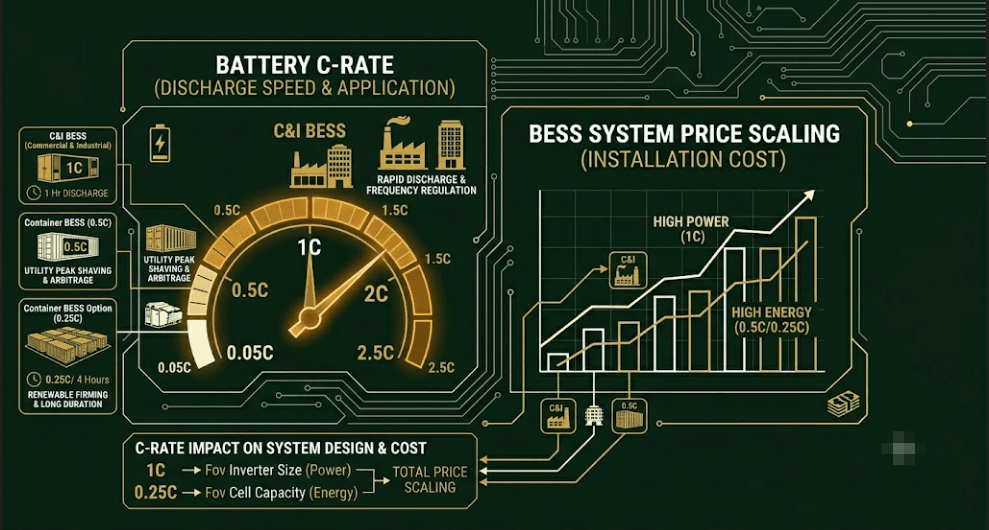
Understanding BESS C-rate matters because it governs three things at once. First, it sets how much peak power the system can deliver. Second, it controls how quickly the battery recharges between dispatch events. Third, it predicts how long cells will last under real operating conditions. As a result, BESS C-rate has a direct, measurable effect on installed system cost. In fact, the price gap can be large. Between a 0.5C energy-type system and a 2C power-type system of identical kWh capacity, the difference is often 50 to 100 per cent.
This guide explains the BESS C-rate concept from first principles. It covers both charge and discharge C-rates based on foundational National Laboratory of the Rockies (NLR) battery storage technology basics with worked examples. It also maps the full relationship between C-rate tier, application, and installed price. By the end, therefore, you can read any BESS datasheet with confidence. You will also be able to compare quotations on a like-for-like basis.
1. What Is BESS C-Rate? Definition, Formula and Notation
BESS C-rate is a standardised measure of how fast a battery is charged or discharged relative to its total storage capacity. The “C” stands for capacity. The number in front of it acts as a multiplier of that capacity.
| 📐 | BESS C-rate formula: C-rate = Current (A) ÷ Nominal Capacity (Ah) Example — 200 Ah LFP battery: • Discharged at 200 A → 1C → full discharge in 1 hour • Discharged at 400 A → 2C → full discharge in 30 minutes • Discharged at 100 A → 0.5C → full discharge in 2 hours |
Importantly, BESS C-rate is chemistry-independent and capacity-independent. For example, a 1C discharge of a 10 kWh residential BESS delivers 10 kW. In contrast, a 1C discharge of a 2 MWh grid system delivers 2 MW. In both cases, the rate is relative — it describes discharge speed as a proportion of total storage, regardless of system size.
BESS C-Rate Notation: Reading the Two Datasheet Formats
Two notation formats appear on datasheets and both describe the same BESS C-rate value. The multiplier format uses a number before C: 2C means discharge at double the 1-hour rate, giving a full drain in 30 minutes. The fractional format divides capacity: C/2 means discharge at half the 1-hour rate, giving a full drain in 2 hours.
Therefore, C/2 and 0.5C are identical. Similarly, C/10 and 0.1C are identical. When a datasheet shows a charge rate of C/5 alongside a discharge rate of 1C, the system charges five times more slowly than it discharges. As explained in Section 2, this asymmetry is a deliberate engineering choice — not a product limitation.
BESS C-Rate Quick Reference: From 0.1C to 10C
| C-Rate | Meaning | Discharge Time | Charge Time (at same rate) | Real-World Parallel |
|---|---|---|---|---|
| C/10 (0.1C) | Discharge at 1/10th capacity current | 10 hours | 10 hours | Solar trickle charge / overnight backup reserve |
| C/5 (0.2C) | Discharge at 1/5th capacity current | 5 hours | 5 hours | Long-duration island grid storage |
| C/2 (0.5C) | Discharge at half capacity current | 2 hours | 2 hours | C&I energy arbitrage, solar self-consumption |
| 1C | Discharge at full capacity current | 1 hour | 1 hour | Peak shaving, daily cycling BESS |
| 1.5C | Discharge at 1.5× capacity current | 40 minutes | — | Aggressive demand charge reduction |
| 2C | Discharge at double capacity current | 30 minutes | — | Grid frequency response, EV charging buffer |
| 3C | Discharge at 3× capacity current | 20 minutes | — | Fast-response ancillary services |
| 10C | Discharge at 10× capacity current | 6 minutes | — | Ultra-fast EV charging, power electronics |
2. BESS Charge C-Rate vs Discharge C-Rate: Why the Two Figures Differ
Most explanations of BESS C-rate focus only on discharge — how fast the battery empties. However, charge C-rate is equally important for dispatch planning and cell longevity. In most commercial BESS installations, moreover, the two figures are deliberately set at different levels.
Why BESS Charge C-Rate Must Stay Below Discharge C-Rate
Charging a lithium-ion cell forces lithium ions back into the anode. If this process happens too fast, ions arrive at the anode surface faster than the graphite lattice can absorb them. Consequently, excess lithium deposits as metallic lithium on the surface — a process called lithium plating. Lithium plating is irreversible. It permanently reduces capacity and, in extreme cases, creates internal short circuits that cause thermal runaway. For the full electrochemistry behind why lithium plating happens, how it differs from ordinary SEI layer growth, and why it’s largely preventable, see our guide on SEI layer growth and lithium plating in LFP cells.
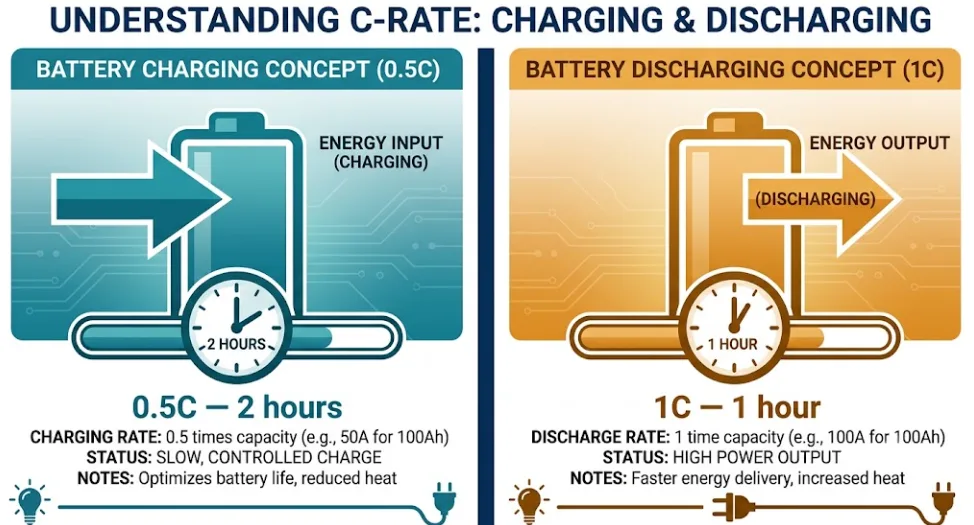
For this reason, LFP manufacturers specify a maximum continuous charge C-rate that is lower than the discharge limit. The most common commercial BESS pairing — 0.5C charge and 1C discharge — reflects this constraint directly.
| ⚡ | Standard C&I LFP BESS charge vs discharge C-rate: Charge rate: 0.5C → fills in 2 hours → protects anode, maximises cycle life Discharge rate: 1C → empties in 1 hour → delivers full rated peak power This asymmetry is intentional — not a limitation. |
The practical implication is straightforward. A 500 kWh / 1C BESS delivers 500 kW to the grid in one hour. However, it needs two hours to recharge at 0.5C. Therefore, always plan your dispatch schedule around the slower charge rate — not just the discharge figure.
BESS Charge C-Rate Worked Examples: 100 Ah LFP Cell
| Charge C-Rate | Charge Time (100 Ah cell) | Charge Current | BESS Application | LFP Cell Impact |
|---|---|---|---|---|
| C/10 (0.1C) | 10 hours | 10 A | Overnight trickle from small solar array | Excellent — maximum cycle life, zero thermal risk |
| C/5 (0.2C) | 5 hours | 20 A | Slow solar charge, low-irradiance days | Excellent — best for calendar longevity |
| C/2 (0.5C) | 2 hours | 50 A | Standard C&I BESS grid or solar charge | Very good — recommended daily charge rate for LFP |
| 1C | 1 hour | 100 A | Fast recharge between morning/afternoon peaks | Good — within spec; monitor cell temperature |
| 2C | 30 minutes | 200 A | Rapid recharge for EV charging buffer BESS | Moderate — active cooling essential; reduces cycle life |
| 3C+ | <20 minutes | 300 A+ | Ultra-fast charging stations | Risk of lithium plating — requires specialist cells only |
BESS Discharge C-Rate Worked Examples: 100 Ah LFP Cell
| Discharge C-Rate | Discharge Time (100 Ah) | Power Output | BESS Application | LFP Cell Impact |
|---|---|---|---|---|
| C/4 (0.25C) | 4 hours | 25 A | Frequency regulation support, overnight levelling | Excellent — minimal degradation, long cycle life |
| C/2 (0.5C) | 2 hours | 50 A | Residential shifting, off-grid night supply | Excellent — standard low-stress operating point |
| 1C | 1 hour | 100 A | C&I peak shaving (30–60 min demand events) | Very good — standard commercial BESS daily operation |
| 1.5C | 40 minutes | 150 A | Aggressive demand charge reduction | Good — within LFP spec with adequate thermal management |
| 2C | 30 minutes | 200 A | Grid frequency regulation, EV buffer discharge | Moderate — higher heat, faster degradation per cycle |
| 10C | 6 minutes | 1,000 A | EV ultra-fast charging station power burst | Requires high-power LFP or specialist cell chemistry |
Full BESS C-Rate Cycle: Real Charge and Discharge Example
To anchor both BESS C-rate concepts in a real project, consider a 500 kWh LFP BESS at a cold-storage facility. The site faces a peak demand charge triggered above 400 kW. Consequently, the system runs two discharge events per day:
| 🏭 | System: 500 kWh LFP | Nominal voltage: 614 V | Capacity: ~815 Ah NIGHT CHARGE (22:00–00:00) — BESS C-rate: 0.5C, from off-peak grid Current: 408 A | Power: 250 kW | Duration: 2 hours Result: fully charged at midnight using cheap off-peak tariff MORNING DISCHARGE (08:00–09:00) — BESS C-rate: 1C, peak shaving Current: 815 A | Power: 500 kW | Duration: 1 hour Result: production ramp absorbed; grid import held below 400 kW AFTERNOON CHARGE (12:00–14:00) — BESS C-rate: 0.5C, from rooftop solar Current: 408 A | Power: 250 kW | Duration: 2 hours Result: battery refilled by solar for the afternoon peak AFTERNOON DISCHARGE (15:00–16:00) — BESS C-rate: 1C, peak shaving Current: 815 A | Power: 500 kW | Duration: 1 hour Result: second demand peak suppressed — demand charge avoided |
This 0.5C charge / 1C discharge pattern keeps LFP cells within their optimal BESS C-rate operating window. As a result, cycle life typically exceeds 4,000 full cycles at 80% depth of discharge — sufficient for over 10 years of daily operation.
| 📌 | BESS C-rate rule of thumb: if your system is specified for 1C discharge, plan to charge at 0.5C. If it operates at 2C discharge, confirm that the cell chemistry and BMS support at least 1C charging without lithium plating risk. |
3. How the BMS Enforces BESS C-Rate Limits in Real Operation
The Battery Management System (BMS) is the component that enforces BESS C-rate limits at the cell level during both charge and discharge. It monitors current, cell temperature, and state of charge (SoC) in real time. Whenever any parameter approaches its safe boundary, the BMS intervenes immediately to protect the cells.
BMS Charge Control: CC/CV Protocol and BESS C-Rate Tapering
During charging, the BMS applies a constant-current / constant-voltage (CC/CV) protocol. The constant-current phase runs at the rated charge C-rate until cell voltage approaches its upper limit. At that point, the BMS transitions to constant-voltage mode and tapers current down to zero as the cell reaches full charge. This taper phase is critical — without it, sustained high-current charging causes the lithium plating described in Section 2.
BMS Discharge Control: BESS C-Rate Curtailment and SoH Tracking
During discharge, the BMS monitors current and cell temperatures continuously. When current exceeds the rated BESS C-rate, the BMS issues a curtailment command within milliseconds. This typically happens because of a load spike or an inverter fault. High-C-rate BESS systems operating at 2C or above require particularly fast BMS response. For this reason, systems designed for sustained 2C operation use BMS platforms with sub-10 ms cell-level sampling. This specification adds cost, but it also prevents thermal cascades.
In addition to real-time protection, the BMS tracks the cumulative effect of each C-rate event on State of Health (SoH). SoH is the ratio of current capacity to the original rated capacity. Understanding what a battery management system (BMS) is and how its topology handles cell balancing during high-discharge events reveals why operating consistently at or below the rated BESS C-rate is one of the most effective ways to preserve SoH while extending your warranty-covered cycle count.
4. How High BESS C-Rate Reduces Usable Capacity: The Rate-Capacity Effect
A battery discharged at a high BESS C-rate typically delivers less total energy than the same battery at a lower rate. This happens even though the nameplate capacity is identical. Consequently, this fact surprises many buyers. It is also one of the most important concepts to understand before specifying a system.
Why BESS C-Rate Affects How Much Energy You Actually Receive
Inside a lithium-ion cell, energy is released as lithium ions migrate from cathode to anode through the electrolyte. This migration has a physical speed limit, set by the ionic conductivity of the electrolyte and the diffusion rate of lithium within the electrode materials.
At low BESS C-rates, ions cross the electrolyte in an orderly process and the full stored capacity is accessible. At high C-rates, however, ions are forced to move faster than the cell structure allows. This causes electrode polarisation — a phenomenon documented in peer-reviewed research on the Nature Energy rate-capacity effect in Li-ion batteries — causing a voltage drop that pushes terminal voltage below the cutoff threshold before all stored lithium has been extracted.
The result is measurable. At 2C BESS C-rate, an LFP cell rated at 100 Ah may only deliver 88–92 Ah of usable capacity. At 0.5C, moreover, the same cell may deliver 101–103 Ah because slower discharge allows more complete lithium extraction.
| 📌 | Always ask your BESS supplier for the capacity derating curve: How much kWh does the system deliver at your operating BESS C-rate — not just at 1C nameplate? A responsible supplier provides derating figures at 0.5C, 1C, and 2C. If they cannot supply this data, treat the capacity claim with caution. |
Heat Generation at High BESS C-Rate: The I²R Effect
High BESS C-rates also increase internal heat generation through ohmic heating. The heat load follows the I²R relationship — doubling the discharge current quadruples the heat generated inside the cell. Over time, this heat degrades the electrolyte and the SEI layer, accelerating capacity fade per cycle and reducing total cycle life. Managing this heat, therefore, is the primary engineering challenge at C-rates above 1C.
Read How DCIR Estimates Battery State of Health
5. BESS C-Rate by Application: Matching Discharge Speed to Your Use Case
The correct BESS C-rate for any project is determined by the application. Specifically, it depends on how fast energy must be delivered and how long the discharge event lasts. The following subsections cover the most common commercial and grid-scale use cases, with the appropriate C-rate for each.
Solar Self-Consumption and Energy Arbitrage: BESS C-Rate 0.25C – 0.5C
Storing solar generation during the day and releasing it in the evening requires a slow, multi-hour discharge. A 0.5C BESS C-rate, discharging over two hours, maximises energy extracted per cycle and keeps cells cool. This C-rate is also appropriate for time-of-use tariff arbitrage — buying cheap overnight energy and dispatching it into high-tariff afternoon hours.
Off-Grid and Island Grid BESS: C-Rate 0.125C – 0.5C
Island grid systems — remote communities, mine sites, and island networks — typically size their BESS for 4 to 8 hours of overnight supply. Consequently, the discharge C-rate falls between 0.125C and 0.25C. The charge rate is set to match available solar or diesel generation, usually 0.2C to 0.5C. Sizing hardware for these remote, microgrid environments requires special attention, as lower C-rates in island systems also reduce the risk of frequency excursions caused by high-power discharge events on a weak grid. For a deeper dive into microgrid design, consult our island grid BESS engineering guide.
C&I Peak Shaving and Demand Charge Control: BESS C-Rate 1C – 1.5C
Commercial and industrial sites with a utility demand charge need a BESS that discharges at full power for 30 to 60 minutes. A 1C BESS C-rate delivers full rated output for exactly one hour. A 1.5C rate covers a 40-minute demand event at higher power. This is the dominant commercial BESS application globally and the segment where LFP chemistry operates most comfortably.
Grid Frequency Regulation: BESS C-Rate 1C – 3C
Frequency regulation requires the BESS to inject or absorb power within seconds of a deviation signal. Response windows of 200 ms to 2 seconds are common in the UK, Australian, and US ancillary service markets. Sustained cycling at 1C to 2C BESS C-rate is achievable with commercial LFP. Above 2C, however, specialist high-power LFP or NMC cells are needed and system cost rises sharply.
EV DC Fast Charging Buffer: BESS C-Rate 2C – 5C
A BESS behind an EV fast charging station must absorb and re-release energy in short, high-power bursts — often at 2C to 5C. The buffer prevents those bursts from appearing on the site’s utility demand meter. Standard commercial LFP cells are not rated for sustained operation at this BESS C-rate. Therefore, high-power LFP or NMC cylindrical cells are required, along with mandatory liquid cooling.
Ultra-Fast EV Charging: BESS C-Rate 5C – 10C
350 kW ultra-fast chargers require the buffer BESS to sustain 5C to 10C discharge bursts for several minutes. Lithium Titanate Oxide (LTO) chemistry handles this C-rate range thanks to its exceptional rate capability and 10,000+ cycle life. However, LTO’s cell cost of $400–$600/kWh makes it unviable for most stationary BESS applications outside ultra-fast charging.
6. How BESS C-Rate Drives System Price: Chemistry, Cooling and Power Electronics
Two BESS systems with identical kWh ratings can carry installed prices that differ by 70 to 100 per cent. The BESS C-rate specification is the primary explanation for that gap. Every component — from cell to inverter — must be engineered for the maximum current the system handles. Higher BESS C-rate means higher current. Higher current, in turn, means more expensive cells, more capable cooling, and heavier power electronics, aligning with global cost benchmarks detailed in the IRENA electricity storage report.
A. How Cell Chemistry Determines Maximum BESS C-Rate
Standard LFP prismatic cells — the foundation of most commercial BESS — are engineered for energy density first. Their thick electrode coatings store more lithium per unit volume but slow ion migration, capping continuous discharge C-rate at 1C to 2C. Cells capable of 3C to 5C use thinner coatings, higher-porosity separators, and electrolyte additives that improve ionic conductivity. Each refinement adds manufacturing cost, which flows directly into system price.
| Chemistry | Full Name | Cont. Discharge C-Rate | Max Charge C-Rate | Cycle Life | Cell Cost ($/kWh) | Best BESS Use |
|---|---|---|---|---|---|---|
| LFP | Lithium Iron Phosphate | 0.5C – 2C | 0.3C – 1C | 3,000 – 6,000+ | $80–$120 | C&I, grid storage, solar — the commercial standard |
| NMC | Nickel Manganese Cobalt | 1C – 3C | 0.5C – 1.5C | 1,000 – 2,000 | $100–$150 | High-power BESS, EV charging buffers |
| NCA | Nickel Cobalt Aluminium | 1C – 3C | 0.5C – 1C | 500 – 1,500 | $110–$160 | EV traction, high energy-density applications |
| High-Power LFP | Power-optimised prismatic | 2C – 5C | 1C – 2C | 2,000 – 4,000 | $100–$140 | Demand response, fast-response grid services |
| LTO | Lithium Titanate Oxide | 5C – 10C | 5C – 10C | 10,000–20,000+ | $400–$600 | Rail, UPS, ultra-fast charging — not cost-viable for BESS |
B. How Cooling System Cost Scales With BESS C-Rate
Heat generation scales with the square of current (I²R). Doubling BESS C-rate from 1C to 2C therefore quadruples the thermal load on the cell stack. A BESS designed for 2C continuous operation requires a proportionally more capable cooling system. As a result, thermal management is often the largest single incremental cost driver between a 1C and 2C system.
| Cooling System | C-Rate Supported | Heat Removal | System Cost Premium | Typical BESS Application |
|---|---|---|---|---|
| Passive air (natural convection) | Up to 0.5C | Low | +0% (baseline) | Residential BESS, low-cycle backup |
| Forced air (fan cooling) | 0.5C – 1C | Moderate | +5–10% | C&I BESS, standard daily cycling |
| Air-conditioned HVAC enclosure | 1C – 1.5C | Good | +10–20% | Containerised grid BESS |
| Liquid cooling (glycol plates) | 1.5C – 3C | Excellent | +20–35% | High-power BESS, EV charging hub buffer |
| Direct liquid immersion | 3C – 10C burst | Superior | +40–60% | Ultra-fast charging, power-critical grid services |
C. Power Electronics and BMS Cost at Higher BESS C-Rate
The inverter and DC/DC converters must be rated for the peak current the battery delivers. A 2C inverter requires larger switching transistors, heavier copper busbars, and more sophisticated short-circuit protection than a 1C inverter of the same kWh capacity. The cost premium for power electronics typically runs at 15 to 30 per cent between a 1C and 2C BESS system.
The BMS also costs more at higher BESS C-rates. Millisecond-level cell sampling, faster protection relay actuation, and more detailed thermal runaway prediction algorithms are all required above 2C. None of these features are standard on entry-level BMS hardware, so they represent a real and quantifiable cost premium.
D. BESS C-Rate Price Tier Framework: From 0.25C to 10C
Combining chemistry, cooling, and power electronics, the following table maps each BESS C-rate tier to its indicative installed system cost and target application.
| C-Rate Tier | Chemistry | Installed Cost ($/kWh) | Peak Power (500 kWh system) | Target Application | What Drives the Price? |
|---|---|---|---|---|---|
| 0.25C–0.5CEnergy Tier | Standard LFP prismatic | $180–$260 | 125–250 kW | Solar arbitrage, long-duration storage, off-grid | Lowest-cost cells, passive/fan cooling, simple BMS and inverter |
| 0.5C–1CCommercial Standard | LFP prismatic | $220–$320 | 250–500 kW | C&I peak shaving, daily energy shifting, grid support | Standard market spec — most competitive $/kWh segment |
| 1C–2CPower Tier | High-power LFP or NMC | $300–$450 | 500 kW – 1 MW | Demand charge reduction, fast-response grid services | Costlier cells, liquid cooling, higher-rated inverter and BMS |
| 2C–5CHigh-Power | NMC cylindrical | $450–$700 | 1 MW – 2.5 MW | Frequency regulation, EV DC fast charging (150 kW+) | Specialist cells, advanced ms-level BMS, mandatory liquid cooling |
| 5C–10C+Ultra-High-Power | LTO or specialist NMC | $700–$1,500 | 2.5 MW – 5 MW | Ultra-fast EV (350 kW+), rail, aerospace | LTO chemistry premium, extreme cooling, custom power electronics |
| 💡 | The most important buyer insight on BESS C-rate and price: Do not compare BESS quotations on $/kWh alone. Always calculate $/kW = total installed cost ÷ peak power output (kW). A 0.5C BESS delivers only half the peak power of a 1C BESS at the same kWh. If your peak shaving application needs 500 kW for one hour, the 0.5C system will fail the dispatch event — making the cheaper quote the more expensive mistake. |
E. Same 500 kWh, Three BESS C-Rates, Three Very Different Prices
| BESS Profile | Capacity | C-Rate | Peak Power | Cooling | Est. Installed Cost | Designed For |
|---|---|---|---|---|---|---|
| Energy-type LFP(solar storage) | 500 kWh | 0.5C | 250 kW for 2 hrs | Fan / HVAC | ~$130,000 | Solar self-consumption, off-grid overnight, slow energy shifting |
| Standard commercial LFP(C&I peak shaving) | 500 kWh | 1C | 500 kW for 1 hr | HVAC | ~$175,000 | Daily peak shaving, demand charge control, grid-tied C&I |
| High-power LFP / NMC(EV charging buffer) | 500 kWh | 2C | 1,000 kW for 30 min | Liquid cooling | ~$250,000 | EV DC fast charging hub, grid frequency services, rapid response |
All three systems store exactly 500 kWh and all use lithium-ion technology. However, peak power output ranges from 250 kW to 1,000 kW — a factor of four. Installed cost, moreover, varies from $130,000 to $250,000. The BESS C-rate specification alone explains both of those differences entirely.
7. BESS C-Rate vs Power-to-Energy Ratio: Converting Duration to C-Rate
When EPCs and project developers discuss BESS sizing, they rarely say ‘1C’. Instead, they say ‘1-hour system’ or ‘4-hour battery’. These two languages describe the same thing from different angles — and converting between them is essential for accurate specification.
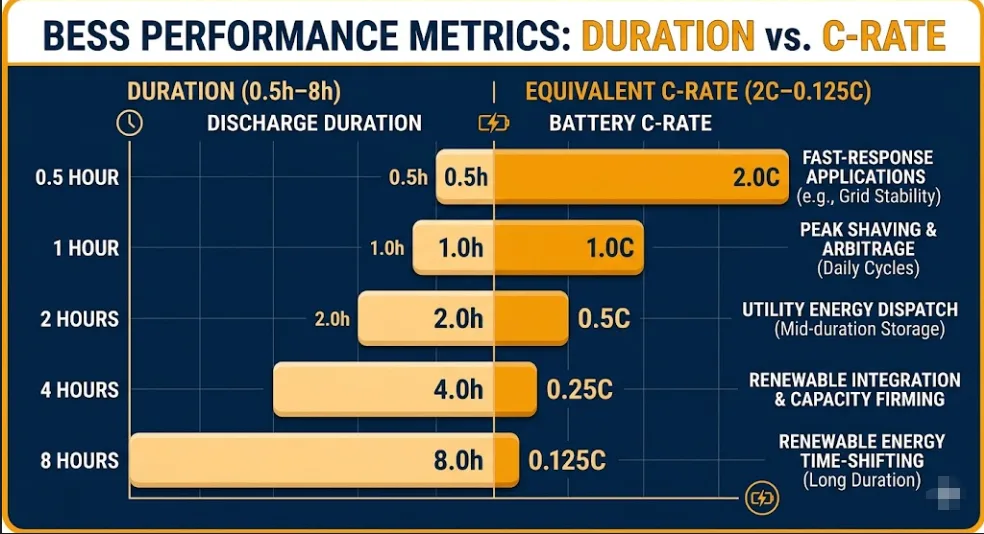
The power-to-energy ratio (P/E ratio) describes how much power (kW) a BESS delivers per unit of stored energy (kWh). A 1-hour system delivers its full energy in one hour — which is exactly a 1C BESS C-rate. As a result, duration and C-rate are mathematical inverses of each other.
| 📐 | BESS C-rate to duration conversion: C-Rate = 1 ÷ Duration (hours) | Duration (hours) = 1 ÷ C-Rate Examples: 0.5-hour system → 2C | 2C BESS C-rate → 0.5-hour duration 1-hour system → 1C | 1C BESS C-rate → 1-hour duration 2-hour system → 0.5C | 0.5C BESS C-rate → 2-hour duration 4-hour system → 0.25C | 0.25C BESS C-rate → 4-hour duration 8-hour system → 0.125C| 0.125C BESS C-rate → 8-hour duration |
| System Duration | Equivalent BESS C-Rate | Power-to-Energy Ratio (kW/kWh) | Typical Application | SEO Keyword Captured |
|---|---|---|---|---|
| 0.5-hour BESS | 2C | 2 kW per kWh | Fast-response frequency regulation, EV charging buffer | 0.5 hour battery storage, 2C BESS |
| 1-hour BESS | 1C | 1 kW per kWh | C&I peak shaving, demand charge reduction | 1 hour battery storage, 1C BESS |
| 2-hour BESS | 0.5C | 0.5 kW per kWh | C&I energy arbitrage, solar self-consumption | 2 hour battery storage, 2 hour BESS |
| 4-hour BESS | 0.25C | 0.25 kW per kWh | Grid energy arbitrage, utility time-shifting | 4 hour battery energy storage, 4 hour BESS |
| 8-hour BESS | 0.125C | 0.125 kW per kWh | Long-duration storage, island grid, overnight off-grid supply | 8 hour BESS, long duration energy storage |
| 10–12-hour BESS | 0.1C | 0.1 kW per kWh | Seasonal shifting, remote area power, hydrogen hybrid | long duration battery storage, 10 hour BESS |
This table is directly useful for RFP and tender documents. For example, when a grid operator specifies a 4-hour BESS at 100 MW, they are asking for 400 MWh of storage at 0.25C BESS C-rate. Similarly, when a C&I site asks for a 2-hour peak shaving BESS at 500 kW, they need 1 MWh at 0.5C.
| 📌 | When comparing BESS quotations, confirm both the energy (MWh) AND the power (MW or kW). The duration — which is the inverse of BESS C-rate — is the figure that ties them together. Example: ‘500 kWh BESS’ without a stated duration is an incomplete specification. 500 kWh at 1C = 500 kW for 1 hour. The same 500 kWh at 0.5C = 250 kW for 2 hours. Same energy, very different power — and a very different price. |
8. PCS Rating and BESS C-Rate: Why the Inverter Can Limit Your System Output
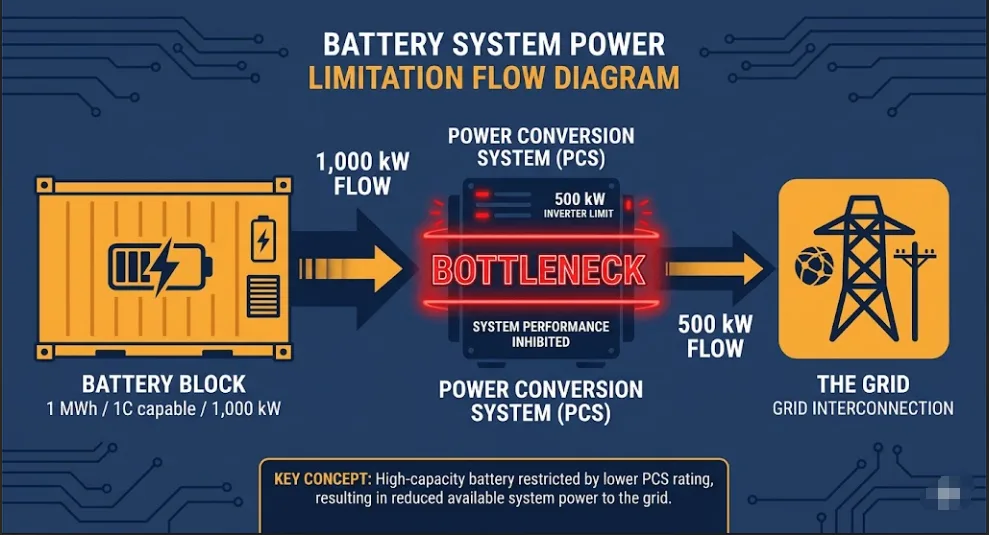
One of the most common and costly mistakes in BESS procurement is assuming that the battery’s C-rate alone determines maximum power output. In practice, this is not the case. The Power Conversion System (PCS) is the inverter or bidirectional converter that connects the battery to the AC grid. It also sets a hard ceiling on power. That ceiling can be significantly lower than the battery’s C-rate capability.
| ⚠️ | Classic BESS C-rate bottleneck example: Battery capacity: 1 MWh LFP Battery C-rate: 1C → capable of 1,000 kW (1 MW) PCS rating: 500 kW Actual system output: 500 kW (limited by PCS, not battery BESS C-rate) Effective C-rate: 0.5C (not 1C) The battery can run at 1C BESS C-rate. The system cannot. The PCS is the bottleneck. |
This situation arises when a developer uses an undersized inverter to reduce upfront cost, or when a site’s grid connection capacity limits the inverter size. In both cases, the battery is paying the price premium for a 1C BESS C-rate it cannot exercise in real operation. Additionally, whether you deploy grid-forming vs grid-following BESS inverters will dictate how the PCS handles these localized capacity constraints and dynamic grid response demands.
PCS Sizing Rules Matched to BESS C-Rate and Application
| Application | Recommended Duration | BESS C-Rate | Required PCS Rating | PCS Sizing Rule |
|---|---|---|---|---|
| Solar self-consumption | 2–4 hours | 0.25C–0.5C | 25–50% of battery kWh as kW | PCS ≥ Battery kWh × C-rate |
| C&I peak shaving | 1–2 hours | 0.5C–1C | 50–100% of battery kWh as kW | PCS must match peak shaving kW target |
| Demand charge reduction | 30–60 min | 1C–1.5C | 100–150% of battery kWh as kW | PCS sized to full 1C discharge power |
| Grid frequency regulation | 15–30 min | 2C–3C | 200–300% of battery kWh as kW | PCS and protection relays rated for peak current |
| EV fast charging buffer | 15–30 min | 2C–5C | 200–500% of battery kWh as kW | Both battery AND PCS must support full BESS C-rate |
The correct approach is to size the PCS first, matching it to the application’s power requirement. Then, size the battery to deliver that power for the required duration. Therefore, always start from the load, not from the battery specification.
- Step 1 — Define peak power (kW): what is the maximum power the system must deliver? This sets the PCS rating.
- Step 2 — Define duration (hours): how long must the system sustain that power? Combined with Step 1, this gives the energy requirement in kWh.
- Step 3 — Confirm BESS C-rate: divide peak power (kW) by total energy (kWh) to get the C-rate. Confirm the battery chemistry supports it.
- Step 4 — Verify PCS–battery match: the PCS kW rating must equal or exceed Battery (kWh) × Operating BESS C-rate. Navigating these technical boundaries is a core reason why establishing strong EPC + battery integrator partnerships in C&I energy early in the design phase prevents costly hardware mismatches.
| 📌 | PCS sizing shortcut for BESS C-rate verification: Required PCS rating (kW) = Battery capacity (kWh) × Operating BESS C-rate For a 500 kWh battery at 1C BESS C-rate: PCS ≥ 500 kW For a 500 kWh battery at 2C BESS C-rate: PCS ≥ 1,000 kW For a 500 kWh battery at 0.5C BESS C-rate: PCS ≥ 250 kW If the PCS is undersized, the effective BESS C-rate is: PCS (kW) ÷ Battery (kWh) |
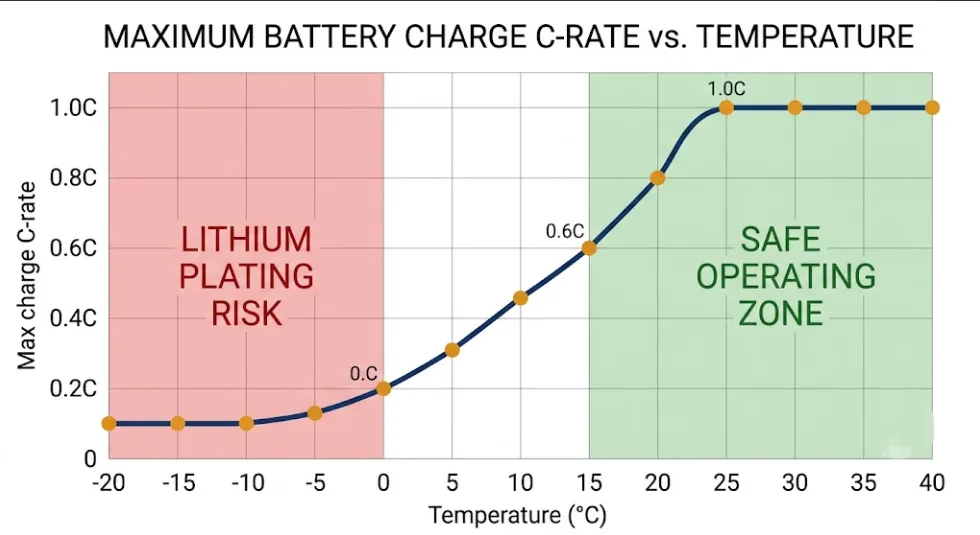
9. Temperature and BESS C-Rate: How Cold Weather Derate Your System
Laboratory BESS C-rate specifications are measured at 25°C. Real-world BESS projects operate in temperatures ranging from -30°C in Nordic and Canadian sites to +45°C in Middle Eastern and Australian installations. Temperature directly affects both the charge C-rate and discharge C-rate that the BMS will permit — and the impact can be dramatic.
How Low Temperature Reduces Charge C-Rate in BESS
Cold temperatures reduce the ionic conductivity of the electrolyte and slow lithium diffusion within the graphite anode. As a result, lithium ions cannot intercalate into the anode fast enough to accommodate a standard charge rate. The excess lithium then plates onto the anode surface instead. This is the same lithium plating risk described in Section 2. However, it is now triggered at much lower charging currents. Modern BMS platforms address this through temperature-dependent charge derating, automatically reducing the charge C-rate as cell temperature falls.
| Cell Temperature | Max Charge BESS C-Rate (LFP) | Charge Time Impact | Lithium Plating Risk | BMS Action |
|---|---|---|---|---|
| Above 25°C | 0.5C–1C (full rated) | Standard (2–1 hour) | Low | Full charge current permitted |
| 15°C–25°C | 0.3C–0.5C | +20–40% longer | Low–moderate | Mild current reduction |
| 5°C–15°C | 0.2C–0.3C | +50–100% longer | Moderate | Significant derating applied |
| 0°C–5°C | 0.1C–0.2C | 5–10 hours | High | Strong derating; pre-heat recommended |
| -10°C–0°C | 0.05C or disabled | Charging impractical | Very high | BMS may disable charging entirely |
| Below -10°C | Charging disabled | Not permitted | Severe | Cell heating required before charge |
How Temperature Affects BESS Discharge C-Rate
Discharge is less temperature-sensitive than charging because the electrochemical reactions are thermodynamically favoured during discharge. However, cold temperatures do increase internal cell resistance. Consequently, available power decreases and effective capacity falls. For example, a 100 Ah LFP cell rated at 1C discharge and 25°C may only safely sustain 0.7C at 0°C. Beyond that point, terminal voltage drops below the BMS cutoff threshold.
| Cell Temperature | Discharge BESS C-Rate Available | Capacity Available (%) | Notes |
|---|---|---|---|
| Above 25°C | Full rated (0.5C–2C) | 100% | Full performance. Monitor for overheating at 2C+. |
| 10°C–25°C | Full rated | 95–100% | Negligible impact for most commercial BESS. |
| 0°C–10°C | ~80% of rated | 85–95% | Mild derating. Pre-heat recommended for 2C BESS systems. |
| -10°C–0°C | ~60% of rated | 70–85% | Noticeable power and capacity reduction. |
| Below -20°C | ~40% of rated | 50–70% | Significant derating. Active heating system essential. |
Cold-Weather BESS Design: Four Strategies to Protect C-Rate Performance
- Insulated enclosures: containerised BESS in cold climates should use insulated steel enclosures with low-wattage heating elements to maintain cell temperature above 5°C during idle periods.
- Battery heating mats: direct cell-level heating pads activate when temperature falls below 5–10°C. The BMS controls this automatically. As a result, the system can recharge at its rated BESS C-rate even in sub-zero ambient conditions.
- Thermal buffer in C-rate spec: for projects in cold climates, specify the BESS C-rate at 10°C rather than 25°C. This gives a realistic worst-case recharge window. It also prevents dispatch planning errors.
- Liquid thermal management: Liquid-cooled systems with a heat pump can both cool cells in summer and heat them in winter. For sites with a wide temperature range, this is the most capable engineering solution.
| 💡 | Cold-climate BESS C-rate project rule: Always request the manufacturer’s charge derating curve from -20°C to +40°C. Size the recharge window based on the minimum expected cell temperature, not the standard 25°C BESS C-rate specification. A system with a 2-hour recharge at 25°C may need 5+ hours at 5°C. If the site has two peak events per day, this gap can cause missed dispatch. |
Deploying these climate control and thermal safety measures ensures your system remains compliant with international risk management protocols. For a complete breakdown of these compliance requirements, check our guide to the IEC 62933-5 safety standards for ESS frameworks.
10. BESS C-Rate and Battery Warranty: What Manufacturers Actually Guarantee
Battery warranties are frequently misread by buyers. Most manufacturers do not simply warrant a number of years or a number of cycles in isolation. Instead, they warrant a specific combination of cycles, throughput, depth of discharge, operating temperature — and BESS C-rate. Operate outside the warranted C-rate and the warranty may be void, even if every other parameter is within limits.
How BESS C-Rate Appears in the Three Main Warranty Structures
- Cycle-based warranty: warrants a number of full charge/discharge cycles (e.g. 4,000 cycles to 80% SoH). The warranted cycle count is stated at a specific BESS C-rate and depth of discharge (DoD). For example: ‘4,000 cycles at 1C / 80% DoD / 25°C’. Operating at 2C BESS C-rate and 80% DoD may reduce the warranted cycle count to 2,500.
- Throughput-based warranty: warrants a total energy throughput in MWh (e.g. 3,000 MWh per MWh of installed capacity). This approach is nominally BESS C-rate-agnostic, but manufacturers typically include a maximum continuous C-rate clause that, if exceeded, voids the throughput warranty.
- Calendar-based warranty: warrants a minimum SoH at a future date (e.g. 70% capacity retention after 10 years). Calendar warranties almost always include an operating envelope — BESS C-rate, temperature, DoD — that defines the conditions under which the warranty applies.
| Warranty Type | Typical BESS C-Rate Condition | What Changes If C-Rate Limit Is Exceeded | What to Ask the Supplier |
|---|---|---|---|
| Cycle-based | 1C charge / 1C or 2C discharge at 25°C, 80% DoD | Warranted cycle count reduces; some manufacturers publish a BESS C-rate adjustment table | Request cycle-life curve at your operating C-rate and DoD |
| Throughput-based | Max continuous BESS C-rate clause (e.g. 1C or 2C) | Throughput warranty voided if max C-rate exceeded | Confirm the maximum C-rate clause and whether burst C-rate is treated differently |
| Calendar-based | Operating envelope includes BESS C-rate, temp, DoD | Warranty void if operating envelope breached | Request the full BESS C-rate operating envelope in the warranty document — not just the summary term sheet |
| ⚠️ | Real BESS C-rate warranty example (illustrative): Supplier warranty states: ‘6,000 cycles to 80% capacity retention at 0.5C charge / 0.5C discharge / 80% DoD / 25°C’ Your project operates at: 0.5C charge / 2C discharge / 80% DoD / 25°C Warranted cycles at 2C BESS C-rate may be only 3,000–4,000 — half the headline figure. Consequently, always request the C-rate adjustment table before signing. |
BESS C-Rate Warranty Checklist: Five Questions to Ask
- Request the cycle-life warranty condition in full — BESS C-rate, DoD, temperature, and SoH end-point.
- Ask for a cycle-life vs BESS C-rate adjustment table: how does the warranted cycle count change at your operating rate?
- Confirm whether burst BESS C-rate events (e.g. 2C for 30 seconds) are counted differently from continuous C-rate.
- Verify that the PCS-enforced maximum C-rate matches the warranty’s maximum BESS C-rate clause — any gap is a warranty risk. Ensure these limits map structurally to the battery cell’s factory compliance standards, as outlined in our overview of IEC certifications for BESS, which dictate the thermal and current boundaries manufacturers are legally allowed to warrant.
- For throughput warranties, calculate total expected throughput over the project life and confirm it falls within the warranted limit at your operating C-rate.
Tracking these complex lifetime metrics is becoming highly standardized across the industry. To see how manufacturers are beginning to openly disclose this operational data, see our guide on how the battery passport drives transparency in the energy transition by providing immutable health and C-rate logs.
11. Real Utility-Scale BESS C-Rate Examples: Three Grid Project Profiles
The BESS C-rate concepts in this guide apply across all system scales — from a 50 kWh rooftop unit to a 400 MWh grid project. Reflecting utility deployment patterns tracks in the IEA battery storage report, the three utility-scale examples below show how BESS C-rate, duration, PCS rating, and application interconnect in real project structures.
Example 1 — 100 MW / 400 MWh Grid BESS at 0.25C C-Rate: 4-Hour Energy Arbitrage
| 🏭 | Project profile: Capacity: 400 MWh LFP | Power: 100 MW | Duration: 4 hours BESS C-rate: 0.25C (100 MW ÷ 400 MWh) | P/E Ratio: 0.25 kW per kWh Operation: Charges overnight at 0.125C–0.25C BESS C-rate (off-peak wholesale tariff) Discharges 08:00–12:00 at 0.25C (morning peak tariff window) Cycle target: 1 full cycle per day × 365 days × 20-year project life Why 0.25C BESS C-rate? 4-hour discharge maximises revenue capture across the full morning peak. Lower BESS C-rate reduces cell degradation and minimises thermal management cost. At this scale, 0.25C is the dominant grid arbitrage BESS specification globally. |
Example 2 — 50 MW / 100 MWh Frequency Regulation BESS at 0.5C C-Rate
| ⚡ | Project profile: Capacity: 100 MWh LFP Power: 50 MW Duration: 2 hours (nominal) C-Rate: 0.5C (50 MW ÷ 100 MWh) P/E Ratio: 0.5 kW per kWh Operation: Participates in Frequency Containment Reserve (FCR) or equivalent market. Injects or absorbs up to 50 MW in response to frequency deviations. Actual average C-rate in operation: ~0.1C–0.2C (short bursts, not full cycles). Nominally sized at 0.5C to maintain full power availability throughout the day. Why 0.5C? The 2-hour energy buffer ensures the system can sustain a prolonged frequency event without exhausting its state of charge. The PCS is sized for 50 MW regardless of how often it is called to respond. |
Example 3 — 20 MW / 20 MWh Fast-Response BESS at 1C C-Rate: 1-Hour Duration
| 🔋 | Project profile: Capacity: 20 MWh LFP Power: 20 MW Duration: 1 hour C-Rate: 1C (20 MW ÷ 20 MWh) P/E Ratio: 1 kW per kWh Operation: Paired with a large solar farm for curtailment avoidance and grid services. Discharges at up to 1C during grid frequency events or export constraint windows. An automated energy management system (EMS) for BESS orchestrates this dispatch logic, safely recharging the battery at 0.5C from solar generation within a 2-hour window. Why 1C? 1-hour BESS is the standard grid services configuration: full power for 60 minutes covers most frequency regulation and peak shaving events. 1C is LFP’s commercial sweet spot — maximum performance, competitive price. |
| Project | Capacity | Power | Duration | C-Rate | Chemistry | Primary Application |
|---|---|---|---|---|---|---|
| Grid arbitrage BESS | 400 MWh | 100 MW | 4 hours | 0.25C | LFP prismatic | Wholesale energy arbitrage, time-shifting |
| Frequency regulation BESS | 100 MWh | 50 MW | 2 hours | 0.5C | LFP prismatic | FCR / FFR grid ancillary services |
| Fast-response solar BESS | 20 MWh | 20 MW | 1 hour | 1C | LFP prismatic | Grid services, curtailment avoidance |
12. Battery Chemistry Comparison: C-Rate, Charge, Discharge and Emerging Options
The chemistry table in Section 6 covered the main commercial options. This expanded version adds sodium-ion — an emerging chemistry entering the BESS market — and separates typical charge and discharge C-rates for direct comparison.
| Chemistry | Typical Charge C-Rate | Typical Discharge C-Rate | Cycle Life | Energy Density | Cell Cost ($/kWh) | BESS Suitability | Status |
|---|---|---|---|---|---|---|---|
| LFP (LiFePO4) | 0.3C–1C | 0.5C–2C | 3,000–6,000+ | Low–medium | $80–$120 | Excellent — commercial standard for all BESS | Mature, dominant |
| NMC (LiNiMnCoO2) | 0.5C–1.5C | 1C–3C | 1,000–2,000 | High | $100–$150 | Good — high-power BESS, EV charging buffers | Mature |
| NCA (LiNiCoAlO2) | 0.5C–1C | 1C–3C | 500–1,500 | Very high | $110–$160 | Moderate — mainly EV; cost and safety limit BESS use | Mature |
| LTO (Li4Ti5O12) | 5C–10C | 5C–10C+ | 10,000–20,000 | Very low | $400–$600 | Niche — ultra-fast charging, rail; too costly for BESS | Niche, high cost |
| High-Power LFP (prismatic) | 1C–2C | 2C–5C | 2,000–4,000 | Medium | $100–$140 | Good — demand response, fast-response grid services | Growing |
| Sodium-Ion (Na-ion) | 0.5C–2C | 1C–4C | 2,000–4,000 | Low–medium | $60–$90* | Promising — emerging competitor to LFP in grid storage | Emerging (2024–) |
| 📌 | Sodium-Ion (Na-ion) — what to know for BESS procurement: Sodium-ion batteries use sodium instead of lithium as the charge carrier. Key advantages: no cobalt, no lithium, lower raw material cost, better low-temperature performance. Current limitations: lower energy density than LFP (~20–30% less); limited commercial track record. CATL and BYD have both announced sodium-ion cells for stationary storage. Typical charge C-rate: 0.5C–2C. Typical discharge: 1C–4C. Low-temperature performance is notably better than LFP — may suit cold-climate projects. * Current Na-ion cell cost structures reflect ongoing 2026 early commercial production volumes. These baseline figures are projected to compress further as gigafactory manufacturing scales and supply chains mature. |
13. BESS C-Rate Decision Matrix: Matching Application to Specification
Use this matrix as a starting point for any BESS specification. Find your primary application, read across to the recommended C-rate, chemistry, cooling type, and indicative installed cost range.
| Application | Recommended C-Rate | Duration | Chemistry | Cooling | PCS/kWh Ratio | Indicative Installed Cost |
|---|---|---|---|---|---|---|
| Solar self-consumption | 0.25C–0.5C | 2–4 hours | Standard LFP | Passive / fan | 0.25–0.5 kW/kWh | $180–$260/kWh |
| Energy arbitrage (off-peak) | 0.5C | 2 hours | Standard LFP | Fan / HVAC | 0.5 kW/kWh | $220–$280/kWh |
| Peak shaving (C&I) | 1C | 1 hour | LFP prismatic | HVAC | 1 kW/kWh | $250–$320/kWh |
| Demand charge reduction | 1C–1.5C | 40–60 min | LFP prismatic | HVAC | 1–1.5 kW/kWh | $270–$350/kWh |
| Frequency regulation | 1C–2C | 30–60 min | LFP / NMC | HVAC / liquid | 1–2 kW/kWh | $300–$450/kWh |
| Island / off-grid grid | 0.125C–0.5C | 2–8 hours | Standard LFP | Fan / HVAC | 0.125–0.5 kW/kWh | $200–$300/kWh |
| EV charging buffer | 2C–5C | 15–30 min | High-power LFP/NMC | Liquid cooling | 2–5 kW/kWh | $380–$700/kWh |
| Ultra-fast EV charging | 5C–10C | 6–15 min | NMC / LTO | Liquid / immersion | 5–10 kW/kWh | $700–$1,500/kWh |
14. Five Common C-Rate Specification Mistakes — and How to Avoid Them
While capturing the advantages of a battery energy storage system (BESS) can dramatically improve a project’s ROI, design errors during procurement can quickly erase those gains. These five errors appear repeatedly in BESS engineering and EPC tendering, but each is entirely preventable with the knowledge in this guide.
Mistake 1: Specifying a 2C C-Rate When 0.5C Is Sufficient
This is the most expensive and most common mistake. A developer specifying a 2-hour peak shaving system asks for a ‘2C BESS’ when the application actually requires 0.5C. As a result, the system costs 60–80% more than necessary. It also uses liquid cooling the application never demands, and it is built with high-power cells whose extra capability is never exercised. Therefore, always derive C-rate from duration: if you need 2 hours of discharge, you need 0.5C, not 2C.
Mistake 2: Ignoring Charge C-Rate When Planning Dispatch
A BESS specified for 1C discharge is typically limited to 0.5C charge. Yet dispatch schedules are frequently planned around the discharge rate alone. Consequently, the system cannot recharge in time for a second peak event, because the 2-hour recharge window was never accounted for. To avoid this, always plan dispatch around the slower of charge and discharge C-rates.
Mistake 3: Ignoring Temperature Derating on Charge C-Rate
Cold-climate projects often specify a 0.5C charge rate at 25°C. However, the same system may only charge at 0.2C at 5°C, tripling the recharge time. This affects both daily dispatch planning and revenue model accuracy. For this reason, always request the charge derating curve for the minimum expected ambient temperature at the project site.
Mistake 4: Comparing BESS C-Rate Quotations on $/kWh Alone
A 500 kWh system at $220/kWh and a 500 kWh system at $320/kWh look like a simple $50,000 saving in favour of the cheaper option. But the $220/kWh system may be rated at 0.5C, while the $320/kWh system is rated at 1C. In that case, the cheaper system delivers only 250 kW. The more expensive system, meanwhile, delivers 500 kW. For a peak shaving application requiring 500 kW, the cheaper system simply cannot do the job. Always compare $/kW alongside $/kWh.
Mistake 5: Forgetting PCS Limitations on BESS C-Rate
A 1 MWh battery with a 1C rating is technically capable of 1 MW output. But if the PCS is rated at only 500 kW, the system is effectively a 0.5C system, regardless of the battery’s rating. Therefore, confirm that the PCS kW rating is equal to or greater than the battery capacity (kWh) multiplied by the required operating C-rate. This check takes only 30 seconds. Yet it can save months of project rework.
| 📌 | Quick specification health-check: 1. C-Rate = Duration inverse? Duration 2 hours → 0.5C ✓ 2. PCS ≥ Battery (kWh) × C-Rate? 500 kWh × 1C = 500 kW PCS minimum ✓ 3. Charge C-rate in dispatch plan? 0.5C charge = 2 hr recharge window ✓ 4. Warranty states C-rate condition? Confirm cycle count at operating C-rate ✓ 5. Temperature derating requested? Get charge curve from -10°C to +40°C ✓ |
15. C-Rate Procurement Checklist: Eight Questions to Ask Every Supplier
Before signing any BESS supply agreement, confirm the following C-rate parameters in writing:
- 1. Rated continuous C-rate: maximum C-rate the system sustains indefinitely without thermal or SoH risk. Confirm for both charge and discharge independently.
- 2. Peak C-rate and burst duration: maximum C-rate for short bursts (typically 10–30 seconds). Confirm the burst duration before BMS curtailment activates.
- 3. Capacity derating curve: how much kWh does the system actually deliver at your operating C-rate — not just at the 1C nameplate condition?
- 4. Cycle life at operating C-rate: request the cycle-life warranty condition (C-rate, DoD, temperature) and a C-rate adjustment table in writing.
- 5. Charge derating curve vs temperature: request the charge C-rate curve from the minimum expected site temperature to +40°C.
- 6. PCS–battery C-rate match: confirm the PCS kW rating equals or exceeds Battery (kWh) × Operating C-rate.
- 7. Thermal management design C-rate: confirm the cooling system is sized for your intended C-rate, not nominal conditions.
- 8. Warranty C-rate operating envelope: request the full warranty operating envelope and confirm your project’s C-rate falls within the warranted range.
16. Frequently Asked Questions: BESS C-Rate
What is a good C-rate for a BESS?
For most commercial and industrial BESS applications, 0.5C to 1C is the optimal range. A 0.5C system (2-hour duration) suits solar self-consumption and energy arbitrage. A 1C system (1-hour duration) is the standard for peak shaving and demand charge reduction. Higher C-rates are only justified for grid frequency regulation (1C–2C) or EV fast charging buffers (2C–5C).
Is a higher C-rate always better?
No. A higher C-rate means higher peak power output — but it also means higher system cost, faster cell degradation, and greater thermal management requirements. Specifying a higher C-rate than your application requires wastes capital and shortens battery life. Match the C-rate to the application, not to the maximum available specification.
What C-rate is used for peak shaving?
Peak shaving typically uses a 1C discharge rate, which delivers full rated power for one hour. Sites with sharp, short demand spikes may specify 1.5C for a 40-minute discharge window. Sites with longer, flatter demand peaks may use 0.5C for a 2-hour window. The correct C-rate depends on the duration and shape of the demand event, not a single standard answer.
What C-rate is used for solar energy storage?
Solar self-consumption BESS typically operates at 0.25C to 0.5C — discharging over 2 to 4 hours through the evening peak. This slow discharge maximises the energy extracted per cycle, minimises heat generation, and extends cycle life. LFP cells at 0.5C can sustain over 6,000 – 8,000 cycles — enough for 16+ years of daily operation at 80% depth of discharge.
How does C-rate affect battery lifespan?
Higher C-rates accelerate three degradation mechanisms. These are electrolyte oxidation from heat (I²R), mechanical stress from rapid lithium intercalation, and SEI layer growth from elevated temperatures. For the full mechanism behind that mechanical stress — including why deep discharge and high C-rate damage electrode particles through different pathways — see our guide on Why Deep Discharge and High C-Rate Stress LFP Cells. As a result, a battery cycled at 2C will typically reach 80% SoH in only 2,000–3,000 cycles. The same battery at 0.5C, however, may sustain 5,000–6,000 cycles. Overall, operating at or below 1C is the single most effective way to extend LFP battery life.
What Is the Difference Between a 0.5C and 1C BESS C-Rate?
A 0.5C system takes twice as long to discharge as a 1C system. For a 500 kWh battery, 0.5C delivers 250 kW for 2 hours, while 1C delivers 500 kW for 1 hour. Both deliver the same total energy of 500 kWh. However, the 1C system delivers it at twice the power. Consequently, a 1C system costs roughly 20–40% more than a 0.5C system of the same kWh capacity. This premium reflects higher-rated power electronics and more capable thermal management.
Does a higher C-rate increase battery cost?
Yes, and the increase is significant. Every major cost component scales with C-rate. Cell chemistry costs more for higher-power cells. Thermal management shifts from air to liquid cooling above 1.5C. The inverter and PCS need larger transistors and busbars for higher current. The BMS also needs faster sampling and protection. Overall, a 2C system typically costs 50–80% more per kWh than a 0.5C system of identical capacity.
What C-rate is common in utility-scale BESS?
Utility-scale BESS varies widely by application. Grid arbitrage projects, which are typically 4-hour systems, operate at 0.25C. Frequency regulation projects, usually 2-hour systems, operate at 0.5C. Meanwhile, grid services BESS paired with solar farms commonly use 1C. In 2024–2025, the dominant global configuration is 2-hour to 4-hour LFP at 0.25C to 0.5C. This trend is largely driven by the falling cost of large-format LFP prismatic cells.
Conclusion: Getting BESS C-Rate Right From the Start
BESS C-rate is not a secondary datasheet figure. Instead, it is the specification that determines how much power your system delivers, how quickly it recharges, and how long the cells last. Directly, it also determines how much the system costs. Furthermore, it connects to the duration language EPCs use, such as 1-hour or 4-hour systems. It links to the PCS sizing your electrical engineer specifies. It links, too, to the warranty conditions your finance team relies on. Finally, it links to the temperature performance your operations team will encounter on site.
For LFP BESS in commercial and grid-scale applications, the 0.5C to 2C range covers the vast majority of real-world deployments. Before selecting a chemistry, a PCS, or a cooling system, map your application to the correct C-rate tier first. This single step is the highest-value part of the procurement process.
Need help sizing a BESS to the right C-rate for your load profile and grid requirements? Contact SunLith Energy to speak with a storage engineer.





Trackbacks & Pingbacks
[…] over 10 to 15-plus years. Since duration and C-rate choices drive this trade-off too, see our BESS C-Rate guide for how sizing affects cost and cycle […]
[…] Sunlith’s BESS C-rate guide explains, size the PCS first, to the peak power you need. Then size the battery for the required […]
[…] is defined here using the standard BESS C-rate definition — the ratio of power to energy capacity expressed as a multiple per hour. A 1C rate on a 1,000 […]
[…] Although LFP batteries are known for durability, excessive charging currents still reduce lifespan. Therefore, moderate charging rates are usually recommended to preserve your system’s State of Health. For a complete deep-dive on how current affects system performance and pricing, see our comprehensive guide on BESS C-Rate Explained. […]
[…] sunset. Therefore, matching solar kWp with the right battery kWh is critical. See our guide on BESS C-Rate Explained for more on this […]
[…] Chemistry is not the only factor that shapes how hard a cell can be pushed, though. Charge and discharge rate matters too, which we cover in our guide to BESS C-rate. […]
[…] Therefore, for a deeper technical breakdown of how C-rate affects performance across battery chemistries, see our guide on Battery C-Rates Explained for BESS Buyers. […]
Leave a Reply
Want to join the discussion?Feel free to contribute!