
 SunLith Energy
kWp vs kWh in Solar Energy: What’s the Difference and Why It Matters
kWp vs kWh — these two units appear on every solar quote and datasheet. Yet they are often confused. Confusing them leads to undersized systems, missed savings, and wrong payback estimates.
This guide explains exactly what kWp and kWh mean in solar. You will learn how they differ, how to convert one to the other, and how both affect your system design.
If you need a quick refresher on kW vs kWh first, see our guide on kWh vs kW explained. Otherwise, read on for the full kWp vs kWh breakdown.
| What You Will Learn Core definitions: Understand what kWp (kilowatt-peak) means and how STC conditions are defined. Energy metrics: Discover what kWh (kilowatt-hour) measures in a solar context. Conversion formula: Learn the mathematical calculation for converting kWp to annual kWh output. Environmental impacts: See how peak sun hours, NOCT, and system losses affect real-world yield. Practical scenarios: Review real kWp vs kWh sizing examples for residential, C&I, and utility solar. Battery storage dynamics: Explore how kWp and kWh relate when solar is paired with a BESS. Buying protection: Avoid common mistakes buyers make when comparing solar quotes. |
kWp vs kWh: What Does kWp (Kilowatt-Peak) Mean?
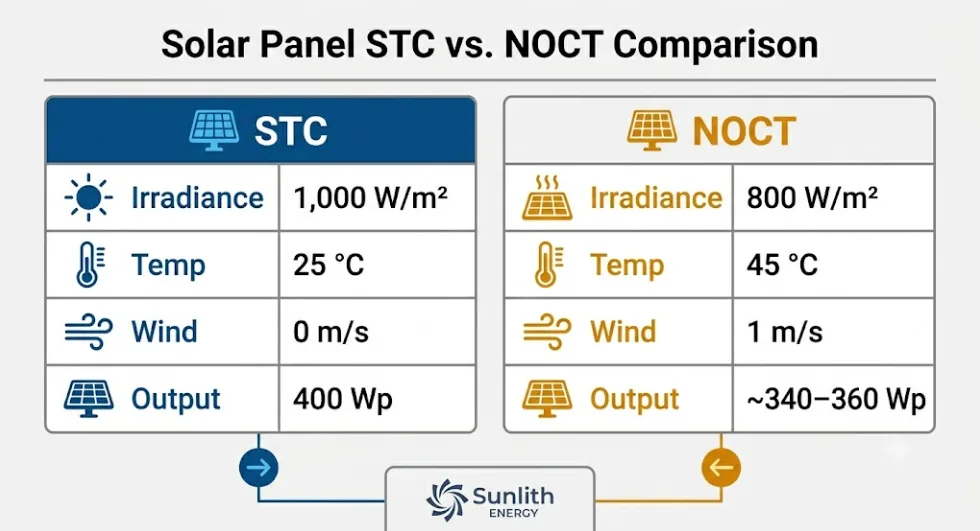
kWp stands for kilowatt-peak. It is the rated maximum power output of a solar panel or array. This rating is measured under controlled laboratory conditions called Standard Test Conditions (STC). Therefore, kWp tells you the best-case output — not real-world output.
STC are used by every solar module manufacturer. They create a level playing field so buyers can compare panels from different brands on equal terms.
kWp STC Conditions — What the Rating Is Based On
- Solar irradiance: 1,000 W/m² — equivalent to full midday sun at sea level
- Cell temperature: 25 °C — cooler than most real rooftop conditions
- Air mass: AM 1.5 — a standard mid-latitude atmospheric path
Under these conditions, a 400 Wp panel produces exactly 400 W. Ten such panels form a 4 kWp array. However, these conditions rarely exist on a real rooftop.
| Why kWp Overstates Real-World Output On a hot summer day, rooftop cell temperatures reach 45–65 °C. This is well above the 25 °C STC benchmark. As a result, real output drops 10–25% below the kWp rating. This is why kWp alone does not tell you how much electricity you will actually generate. That is where kWh comes in. |
kWp vs kWh: NOCT Gives a More Realistic kWp Figure
NOCT (Normal Operating Cell Temperature) tests panels at 800 W/m² irradiance, 45 °C cell temperature, and 1 m/s wind — conditions much closer to a real rooftop. Consequently, NOCT power ratings run 10–15% lower than STC kWp figures. When comparing panels, always check both ratings on the datasheet.
The IEC 61215 standard governs how manufacturers measure both STC and NOCT performance, making these ratings internationally comparable.
What is the difference between specific yield (kWh/kWp) and panel efficiency?
While both terms appear frequently on datasheets, they measure entirely different variables. Panel efficiency represents how effectively a solar cell converts sunlight into electricity within a fixed square meter of physical space—essentially telling you how compact the technology is.
On the other hand, specific yield (kWh/kWp) measures how much total energy (kWh) your entire system delivers over a year for every kilowatt of capacity (kWp) installed. While panel efficiency is fixed by the manufacturer, specific yield is heavily dependent on your geographic location, tilt angle, and climate.
kWp vs kWh: What Does kWh (Kilowatt-Hour) Mean in Solar?
kWh stands for kilowatt-hour. It measures the actual energy your solar system generates over time. While kWp is the rated capacity, kWh is the real-world output.
Think of it this way: kWp is the engine size of a car. kWh is the distance it actually travels. A powerful engine is useless if it only runs for one hour a day.
How to Calculate kWh Output from a kWp Solar System
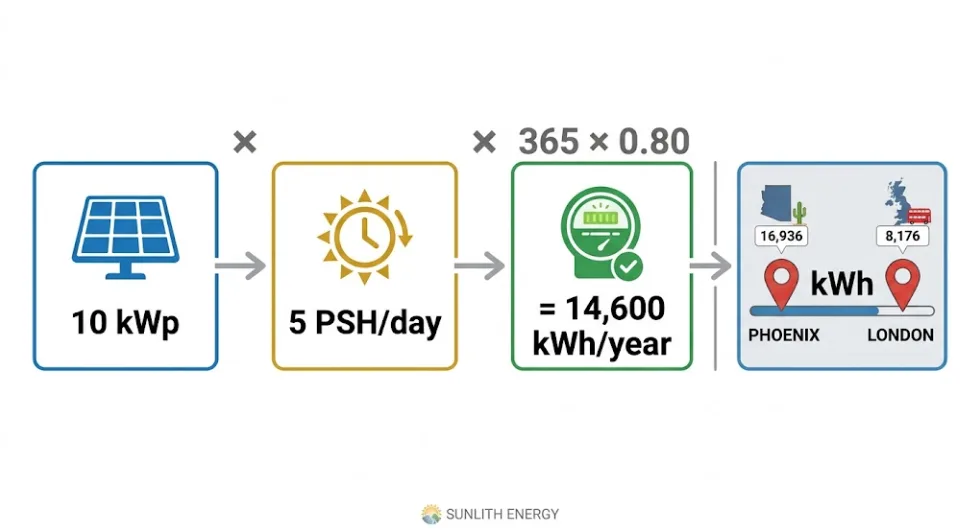
The formula below converts kWp into expected annual kWh generation:
| Annual kWh = kWp × Peak Sun Hours/day × 365 × System Efficiency |
How do I calculate how many solar panels I need based on my kWh usage?
If you are trying to size an array to match your electricity bill, you can reverse-engineer our calculation formula. First, look at your annual energy bill to find your total consumption in kWh. Next, divide that number by your local annual specific yield (for instance, 1,500 kWh/kWp).
The resulting number gives you your required system size in kWp. To find the physical number of panels needed, simply divide that total kWp by the individual wattage of your preferred panel (e.g., dividing a 5 kWp requirement by a 400 Wp or 0.4 kWp panel yields exactly 13 panels).
Peak Sun Hours (PSH) measure how many hours per day a location receives the equivalent of 1,000 W/m² irradiance. For example, Dubai averages 6.1 PSH/day. London averages 2.8 PSH/day. Therefore, the same kWp system produces far more kWh in Dubai than in London.
You can look up PSH for any location using NREL’s PVWatts Calculator, which is a free and reliable tool from the US Department of Energy.
System Efficiency accounts for inverter losses, wiring resistance, soiling, and temperature derating. A well-designed system typically runs at 78–85% overall efficiency. However, shading or poor installation can push this below 70%.
kWp vs kWh Worked Example: Same System, Two Locations
| Parameter | Phoenix, Arizona | London, UK |
| System Size | 10 kWp | 10 kWp |
| Peak Sun Hours / Day | 5.8 hours | 2.8 hours |
| System Efficiency | 80% | 80% |
| Annual Output (kWh) | 10 × 5.8 × 365 × 0.80 = 16,936 kWh | 10 × 2.8 × 365 × 0.80 = 8,176 kWh |
| Specific Yield (kWh/kWp) | 1,694 kWh/kWp | 818 kWh/kWp |
The result is striking: the same 10 kWp system generates over twice as many kWh in Phoenix as in London. As a result, quoting kWp without specifying location is meaningless for project economics.
kWp vs kWh: A Direct Side-by-Side Comparison
The table below shows the core differences between kWp and kWh in solar:
| kWp (Kilowatt-Peak) | kWh (Kilowatt-Hour) | |
| What it measures | Power capacity (rate) | Energy output (total) |
| What it tells you | Maximum potential output at STC | Actual electricity generated over time |
| Conditions | Laboratory (STC: 1,000 W/m², 25 °C) | Real-world (varies by location, season, losses) |
| Appears on | Solar panel datasheet, system quote | Energy bill, yield model, project audit |
| Analogy | Engine horsepower | Kilometres driven |
| Location-dependent? | No — fixed at STC | Yes — higher kWh in sunnier locations |
| Used for | Comparing panels, sizing the array | Calculating savings, ROI, payback period |
5 Factors That Affect How Much kWh Your kWp System Delivers
Several real-world factors determine how many kWh a given kWp system produces. Understanding these is essential for accurate yield forecasting.
1. Location and Solar Irradiance Affect kWh Output Most
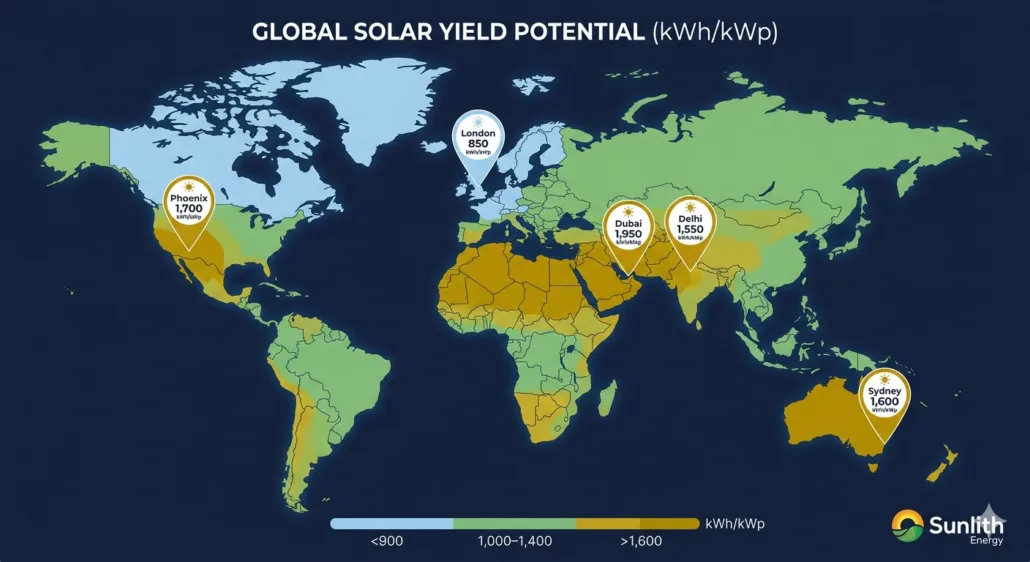
Solar irradiance varies enormously by region. The Middle East, Australia, and the US Southwest receive 1,800–2,500 kWh/m² annually. Northern Europe receives 900–1,200 kWh/m². Consequently, a solar project in Dubai generates two to three times more kWh per kWp than the same system in Scotland.
For detailed peak sun hours data by country, see our guide on peak sun hours by location. Furthermore, the Global Solar Atlas provides free, downloadable irradiance maps for any location worldwide.
2. Panel Orientation and Tilt Angle Change kWh Yield
South-facing panels at a tilt angle matching the site latitude produce the highest annual kWh. East or west-facing installations lose 15–20% of yield compared to south-facing. In addition, north-facing installations at high latitudes can lose 30–40% of potential kWh output.
3. Shading and Soiling Reduce kWh Production
Partial shading cuts kWh output significantly. In conventional string-wired systems, one shaded panel reduces output across the whole string.
Soiling — dust, pollen, bird droppings — causes a further 2–6% loss in temperate climates. However, in dry desert regions, soiling losses can reach 15–25% without regular panel cleaning.
4. Temperature Coefficient Lowers kWh in Hot Climates
Solar panels lose power as cell temperature rises above 25 °C. A typical monocrystalline silicon panel loses approximately 0.35% of its kWp output for every degree above 25 °C.
At 60 °C cell temperature — common on hot rooftops — that is a 12% reduction from the STC kWp rating. As a result, hot climates produce fewer kWh per kWp than cool climates, despite having more sunlight.
5. Inverter and System Losses Reduce Final kWh
The inverter converts DC solar power to AC. It operates at 94–98% efficiency. Additional losses come from wiring resistance, transformer losses, and module mismatch.
Combined, these losses typically reduce kWh output by 15–25% from the theoretical kWp-based maximum. Therefore, always factor in a realistic loss value — not the best-case figure — when modelling project yield.
| kWp vs kWh Specific Yield by Region (kWh/kWp/year) MENA Region: Expect roughly 1,600–2,000 kWh/kWp/year across the Middle East and North Africa. Asia Territories: Systems in South and Southeast Asia average 1,300–1,700 kWh/kWp/year. Southern Europe & Australia: These sunny climates deliver 1,200–1,600 kWh/kWp/year. USA Sun Belt: Expect an average yield of 1,400–1,800 kWh/kWp/year. Northern Europe & UK: Lower irradiance limits yield to 700–1,100 kWh/kWp/year. These figures assume south-facing, optimally tilted panels with no shading and standard system losses of 15–20%. |
kWp vs kWh in Solar System Sizing: Three Real Examples
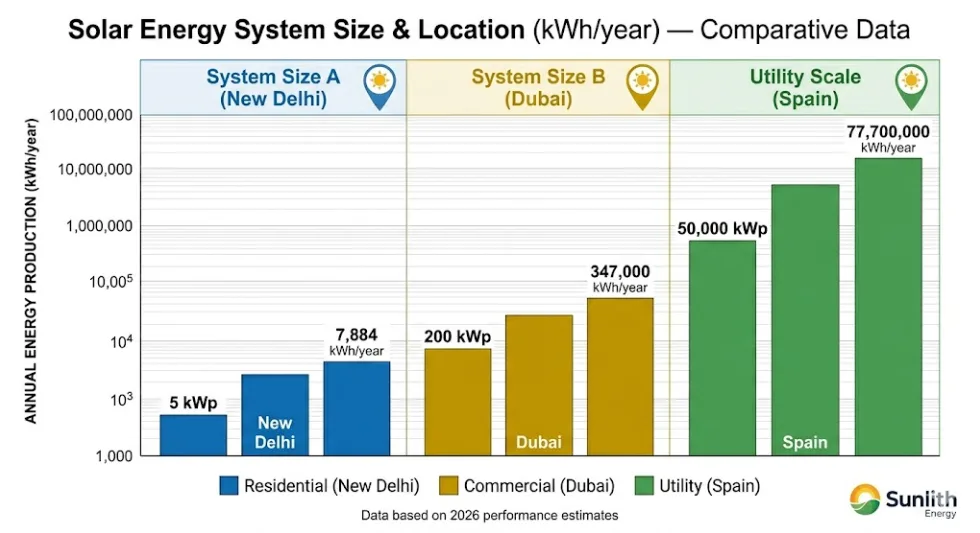
These examples show how kWp and kWh interact in real projects at different scales.
Residential kWp vs kWh Example: 5 kWp System in New Delhi
- Location: New Delhi (5.4 peak sun hours/day)
- System size: 5 kWp — approximately 12–13 panels at 400 Wp each
- System efficiency: 80%
- Annual output: 5 × 5.4 × 365 × 0.80 = 7,884 kWh/year
- Monthly average: approximately 657 kWh/month
- Typical household consumption: 300–500 kWh/month — system covers 130–220% of demand
Result: The 5 kWp system comfortably covers an average household’s electricity needs. Furthermore, it generates surplus kWh for export or battery storage on most days.
Why doesn’t my 5 kWp system show 5 kW on my inverter app?
A common point of confusion for homeowners post-installation is opening their monitoring app on a sunny day and seeing an instantaneous output of only 3.5 kW to 4 kW. This is completely normal.
Remember that your 5 kWp rating is calculated under perfect laboratory conditions ($25^\circ\text{C}$). In the real world, rooftop heat (which degrades panel efficiency), inverter conversion losses, and slight angle misalignments naturally reduce your real-time performance. This is precisely why we design systems based on cumulative kWh energy yield over time rather than looking solely at the peak kW capacity.
Commercial kWp vs kWh Example: 200 kWp System in Dubai
- Location: Dubai (6.1 peak sun hours/day)
- System size: 200 kWp
- System efficiency: 78% — lower due to desert soiling losses
- Annual output: 200 × 6.1 × 365 × 0.78 = 347,334 kWh/year (347 MWh/year)
- Specific yield: 1,737 kWh/kWp/year
- Estimated saving: At AED 0.30/kWh — approximately AED 104,200/year (USD 28,300)
Result: The 200 kWp system delivers strong kWh yield. However, soiling management is essential to maintain this specific yield over time.
Utility-Scale kWp vs kWh Example: 50 MWp Farm in Spain
- Location: Spain (5.2 peak sun hours/day)
- System size: 50,000 kWp (50 MWp)
- System efficiency: 82% — bifacial panels with single-axis trackers
- Annual output: 50,000 × 5.2 × 365 × 0.82 = 77.7 GWh/year
- Specific yield: 1,555 kWh/kWp/year — enhanced by tracking
- Equivalent households: approximately 22,000 Spanish homes at 3,500 kWh/year each
Result: Single-axis trackers boost kWh yield by 20–30% over fixed-tilt systems. As a result, they significantly improve the kWh economics of large solar farms.
kWp vs kWh When Solar Is Paired with Battery Storage
When solar is paired with a Battery Energy Storage System (BESS), both kWp and kWh take on new roles. Correctly matching them is the foundation of a good solar-plus-storage design.
kWp Controls How Fast the Battery Charges
The kWp rating sets the maximum power available to charge the battery at any moment. For example, a 100 kWp array with 80% system efficiency delivers roughly 80 kW to the battery in peak conditions.
Consequently, a 200 kWh battery paired with this array takes a minimum of 2.5 hours to charge from empty. This determines whether the battery completes a full cycle before sunset.
kWh Controls How Long the Battery Can Supply Load
The battery’s kWh capacity sets dispatch duration — how many hours it can supply load after solar drops. A 200 kWh BESS at 50 kW discharge sustains load for four hours after sunset. Therefore, matching solar kWp with the right battery kWh is critical. See our guide on BESS C-Rate Explained for more on this relationship.
kWp vs kWh Mismatch: What Happens When Solar Is Oversized
In systems with limited grid export, too much solar kWp relative to battery kWh causes curtailment — wasted solar energy.
For example, a 50 kWp array at 80% efficiency producing 40 kW fills a 50 kWh battery in just 1.25 hours. After that, excess kWh is wasted. Our guide on choosing solar panels and batteries for a 100 kWh load shows how to avoid this in a full worked example.
For a broader view of how storage losses affect kWh throughput, see our article on energy storage losses in BESS.
| kWp vs kWh Solar + Storage Design Rule of Thumb Target battery kWh = 1–2 × average daily solar kWh generation Example: A 10 kWp system in Delhi generating 27 kWh/day pairs well with a 25–50 kWh BESS. This covers one overnight discharge cycle with buffer for low-sun days. Off-grid systems or multi-day low-sun locations need a higher storage ratio. |
4 Common kWp vs kWh Mistakes in Solar Quotes
These are the most frequent errors buyers make when reading and comparing solar proposals.
Mistake 1: Comparing kWp Without Factoring in Location
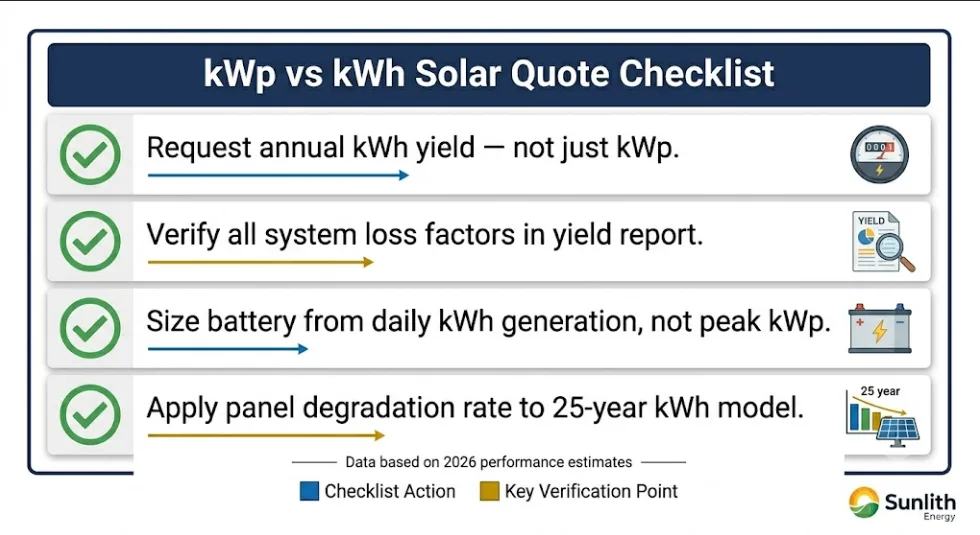
Two quotes showing ’10 kWp’ are not equal if the systems are in different locations. Always request an annual kWh yield estimate alongside the kWp figure.
Reputable suppliers use tools such as PVWatts or PVGIS from the EU Joint Research Centre to produce site-specific yield reports. Insist on seeing these before signing.
Mistake 2: Accepting kWh Estimates With Unrealistic Losses
Some suppliers inflate kWh projections by assuming only 5–10% system losses instead of the more realistic 15–25%.
Always ask which loss factors are included: temperature derating, soiling, inverter efficiency, wiring resistance, shading, and module mismatch. A credible yield report lists each factor explicitly.
Mistake 3: Sizing Battery Storage from kWp Instead of kWh
Sizing a battery based on peak kWp — rather than actual daily kWh generation — leads to oversized and overpriced storage. The battery must match the actual kWh generated each day, not the theoretical maximum.
Furthermore, use hourly generation profiles rather than peak values when sizing storage. This avoids undersizing the battery for mornings and evenings when kWp output is low.
Mistake 4: Ignoring kWp Degradation and Its Effect on kWh
Solar panels degrade annually — typically 0.5–0.8% per year for monocrystalline silicon. Consequently, a panel with 0.7%/year degradation retains about 82.5% of its kWp rating after 25 years.
This means fewer kWh per year as the system ages. Financial models must incorporate this degradation into their annual kWh projections. Ignoring it overstates long-term savings.
kWp vs kWh Quick Reference Summary
| Question | kWp Answer | kWh Answer |
| What does it measure? | Peak power capacity under STC | Actual energy generated over time |
| Is it location-dependent? | No — STC conditions are fixed | Yes — varies with irradiance, temp, losses |
| Typical residential value | 3–10 kWp rooftop system | 3,000–14,000 kWh/year (location-dependent) |
| How is it calculated? | Number of panels × panel Wp rating | kWp × PSH/day × 365 × system efficiency |
| Does it appear on your bill? | No — it is a system specification | Yes — as kWh consumed or exported per month |
| Why does it matter? | Comparing panels, sizing the array | Calculating savings, ROI, and payback period |
Frequently Asked Questions (FAQs)
Can a solar panel produce more than its kWp rating?
Yes, but only temporarily. This usually happens due to the “edge-of-cloud effect,” where passing clouds magnify sunlight, or in extremely cold, high-altitude environments where cold temperatures boost solar cell efficiency above standard test conditions.
Why doesn’t my solar system ever show its full kWp rating on my inverter app
This is completely normal. Your 5 kWp rating is measured in a perfect laboratory. In the real world, rooftop heat, inverter conversion losses, minor shading, and dirty panels typically reduce your real-time instantaneous output (kW) by 20% to 30% compared to the peak capacity.
Does a higher kWp rating mean better performance in cloudy weather?
Not necessarily. A higher kWp just means a larger system or higher-efficiency panels. For strong performance in overcast conditions, you should look at a panel’s NOCT rating and low-irradiance specs rather than its standard kWp rating.
Conclusion: kWp vs kWh — Use Both for Better Solar Decisions
kWp and kWh answer two completely different questions. kWp tells you what the system is rated to produce under ideal lab conditions. kWh tells you what it actually delivers at your location, accounting for losses, temperature, and seasonal irradiance.
For any solar investment, both metrics are essential. kWp helps you compare panels and size the system. kWh helps you calculate real energy savings and payback period. Therefore, never evaluate a solar quote on kWp alone.
At Sunlith Energy, every solar proposal includes a site-specific kWh yield model using validated irradiance data — so you see what the system will actually deliver. Contact our team to request a free yield assessment for your project.









Trackbacks & Pingbacks
[…] kWp vs kWh: What’s the Difference in Solar Energy? […]
[…] Before sizing your array, it is important to understand how raw panel ratings translate into energy output. For a full breakdown, check out our kWp vs kWh Solar Guide. […]
[…] panel capacity translates into actual daily and annual energy generation. Read our comprehensive kWp vs kWh Solar Guide to see exactly how these metrics work […]
[…] kWp vs kWh in Solar Energy – Master the difference between raw system capacity and actual real-world energy generation. […]
[…] (Avoid confusing a panel's peak laboratory rating with its actual energy output by reviewing our kWp vs kWh in Solar Energy […]
Leave a Reply
Want to join the discussion?Feel free to contribute!