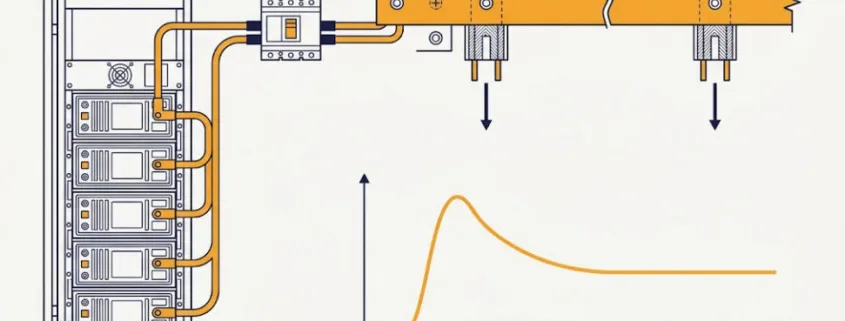
A short circuit on a DC bus behaves very differently from one on an AC grid. IEC 61660 is the standard engineers use to calculate those DC fault currents in battery storage systems and substations. That way, protection devices get sized right.
Quick Answer IEC 61660 is a three-part IEC standard for calculating short-circuit currents on DC auxiliary buses. It covers rectifiers, batteries, capacitors, and DC motors. BESS engineers still use it today, even though it predates lithium-ion and was written for lead-acid batteries.
What Is IEC 61660?
IEC 61660 first appeared in 1997. Its full title is “Short-circuit currents in d.c. auxiliary installations in power plants and substations.” IEC Technical Committee 73 developed it. That same committee owns IEC 60909, the equivalent standard for AC systems.
The standard exists because DC faults don’t behave like AC ones. An AC fault current oscillates and decays in a set way.
A DC fault current rises and falls on its own curve instead. Each source shapes that curve in its own way.
IEC 61660-1 is still listed by the IEC as active and current, even though no revision has replaced it since 1997.
This matters for BESS design. Every battery rack, busbar, and DC disconnect on the storage side of the inverter sits on a DC bus.
So when a fault happens there, protection devices must clear a current whose shape this standard was built to predict.
The Three Parts of IEC 61660
The standard is split into three linked documents. Each one covers a different piece of the fault-current picture.
Part
Title
What It Covers
Part 1
Calculation of short-circuit currents
The core method: peak current, quasi-steady-state current, and how to combine several sources
Part 2
Calculation of effects
Mechanical and thermal stress on rigid conductors and busbars, caused by the current from Part 1
Part 3
Examples of calculations
A technical report with worked examples, so engineers can check their own math against a known result
Part 1 does the heavy lifting for most BESS projects. From there, Part 2 turns that current into a mechanical design check, while Part 3 serves as a reference for checking the numbers.
Part 3 wasn’t even finished when Part 1 published in 1997. The original foreword lists it as “in preparation,” and it only appeared a few years later as a technical report.
How IEC 61660-1 Calculates DC Short-Circuit Current
Two values matter most to a protection engineer.
Two Values That Matter: Peak and Quasi-Steady-State Current
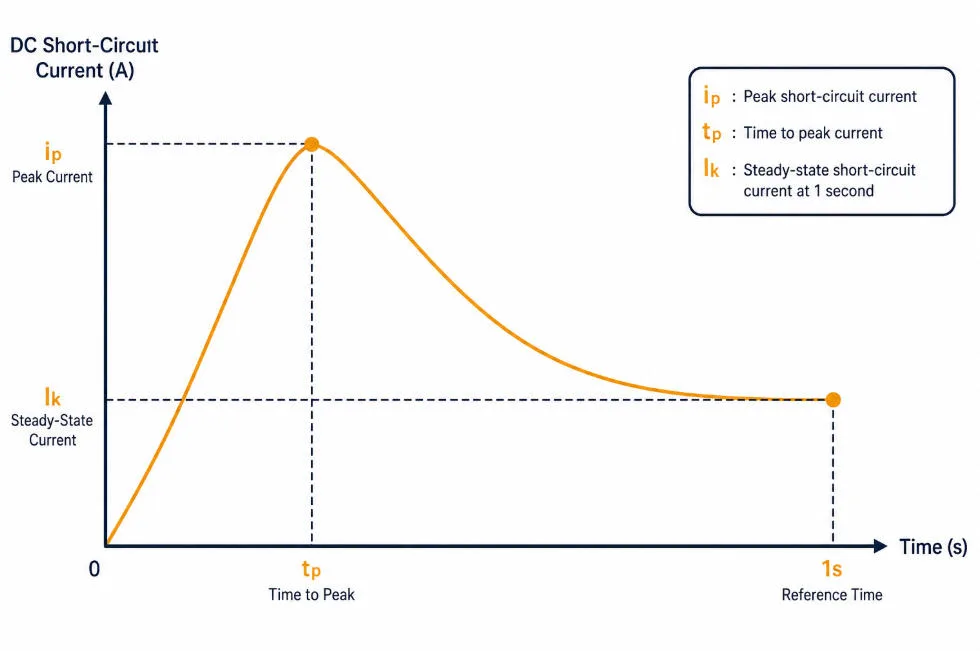
The peak short-circuit current, written as ip, is the highest instant current a fault ever reaches. So this value sets the rating for breakers, fuses, and busbars, since they must survive that first spike without failing.
The quasi steady-state current, written as Ik, is the current level one second after the fault starts.
Engineers then use this lower, settled value to set fuse and relay trip points, since it reflects what a slower device actually has to clear.
Between those two points sits the time to peak, tp. It tells engineers how fast the current climbs before it starts to fall.
Maximum and Minimum Short-Circuit Current
The standard actually calls for two separate calculations, not one. For equipment ratings, engineers work from conditions that produce the highest possible fault current: cooler conductor resistance and a fully charged battery.
For fuse and protection settings, they work from conditions that produce the lowest fault current instead: conductor resistance at the system’s maximum operating temperature, and a battery closer to fully discharged. Each case still has its own peak and quasi-steady-state current, so a full study runs through both.
Four Sources of DC Fault Current
The method models four types of equipment that can feed a DC short circuit:
Rectifiers in a three-phase AC bridge connection
Stationary lead-acid batteries
Smoothing capacitors
DC motors with independent excitation
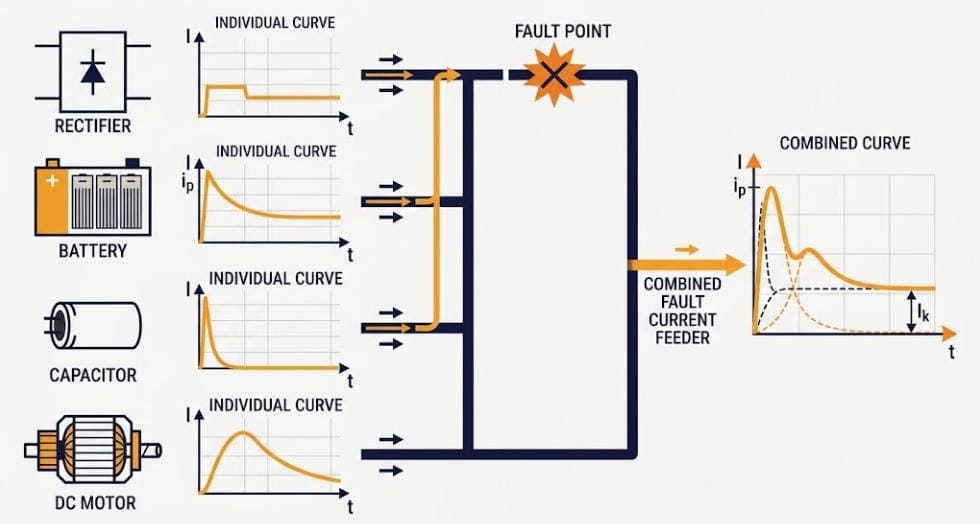
Each source has its own current shape. A rectifier’s fault current follows the AC network behind it.
Meanwhile, a battery’s current rises with a time constant set by its own resistance and inductance, and a capacitor discharges fast, then decays.
A motor is different again, since it keeps feeding current for a short time while its stored mechanical energy converts back into electrical energy.
When more than one source can reach the same fault point, a correction factor (the standard calls it sigma) combines their peaks into one worst-case total. This matters because the individual peaks don’t always line up in time.
Picture a substation battery room with a rectifier charger and a battery bank feeding the same DC bus. The rectifier’s current might peak in a few milliseconds, while the battery’s current keeps climbing for longer, since its inductance slows the rise. Because of that timing gap, the correction factor keeps the combined peak from being just a simple sum of two separate maximums.
Why IEC 61660 Still Matters for Lithium-Ion BESS
The standard was written in 1997, years before lithium-ion reached grid-scale storage. That gap still matters for BESS engineers today.
The Lithium-Ion Gap
The battery clause only models stationary lead-acid cells, and it gives no official method for lithium iron phosphate or other lithium-ion chemistries. So a literal reading of the standard doesn’t cover the battery technology in most BESS projects built today.
How Engineers Work Around It Today
In practice, the industry leans on two workarounds.
First, many engineers treat a lithium-ion string’s short-circuit response like a capacitor discharge. Both show a fast spike, then a decay, and the standard already has a capacitor method built in.
Second, most BESS integrators pull short-circuit current data straight from the cell or rack maker’s datasheet. They then feed those figures into the rest of the calculation, alongside the rectifier and capacitor terms.
Commercial short-circuit analysis software built around this method now adds lithium-ion battery models as an extension beyond the base document. Engineers keep the same combination approach while plugging in a chemistry-correct source model.
IEC 61660 vs. Related DC and BESS Standards
This standard doesn’t work alone, since a few other documents reference it or cover nearby ground.
Standard
Relationship to IEC 61660
IEC 60909
The AC equivalent. This standard’s own foreword names IEC 60909 as a companion reference for the rectifier’s AC-side contribution.
The BESS safety standard covers electrical safety more broadly, including how DC-side fault-current figures feed into protection design.
IEC 62619
Covers cell and battery safety testing rather than system-level fault current, so it complements this standard instead of overlapping it.
What This Means for BESS DC Bus Protection Design
For a project engineer, the takeaway is simple: first, size DC breakers and busbars to the peak current, ip.
Set fuse and relay trip points from the quasi-steady-state current, Ik. Then combine every source that can feed the same fault point, not just the battery.
Since the method predates lithium-ion, document which battery-current approach the design used. Note whether it was capacitor-equivalent modeling or manufacturer datasheet figures, so the calculation can be reviewed and repeated later.
Also check Part 2 once the current is known. A busbar sized only for steady-state load current can still fail mechanically under a DC fault it was never checked against.
Frequently Asked Questions
Does IEC 61660 apply to lithium-ion BESS?
Not directly, since the battery clause only covers stationary lead-acid batteries. Engineers commonly adapt the capacitor model instead, or use manufacturer-supplied short-circuit data for lithium-ion strings.
What’s the difference between IEC 61660 and IEC 60909?
IEC 60909 calculates short-circuit currents in three-phase AC systems. This standard calculates them on the DC side instead, where fault currents don’t oscillate and decay the same way.
Is there a newer edition of IEC 61660?
The first edition dates to 1997, with corrigenda issued in 1999 and 2000. Even so, no second edition has replaced it as of 2026.
What does Part 2 cover that Part 1 doesn’t?
Part 1 calculates the fault current itself, while Part 2 uses that current to calculate the mechanical and thermal stress it puts on rigid conductors and busbars.
Who uses IEC 61660 in a BESS project?
Protection and electrical engineers use it to size DC breakers, fuses, and busbars during the design phase, well before commissioning.
IEC 61660-1:1997, Short-circuit currents in d.c. auxiliary installations in power plants and substations – Part 1: Calculation of short-circuit currents. International Electrotechnical Commission (with Corrigenda 1:1999 and 2:2000).
IEEE Industry Applications Society, “DC Arc Flash: History, Physics, and Modeling for Battery, Capacitor, and PV Systems,” first presented at the IEEE Electrical Safety Workshop (ESW) 2023 — covers DC incident-energy modeling approaches for large battery systems, including lithium-ion, and their relation to standards-based short-circuit current models.
Iron Air Battery LCOS: Why This Number Defines Grid Storage Economics
Iron air battery LCOS — the Levelised Cost of Storage — is the single most important number for evaluating 100-hour grid energy storage. Most analysts start with capital cost per kWh. However, capital cost alone tells only part of the story. LCOS captures everything: upfront cost, operating expenses, charging cost, efficiency losses, and project life. Together, these inputs produce one number: the minimum revenue per MWh a storage project must earn to break even.
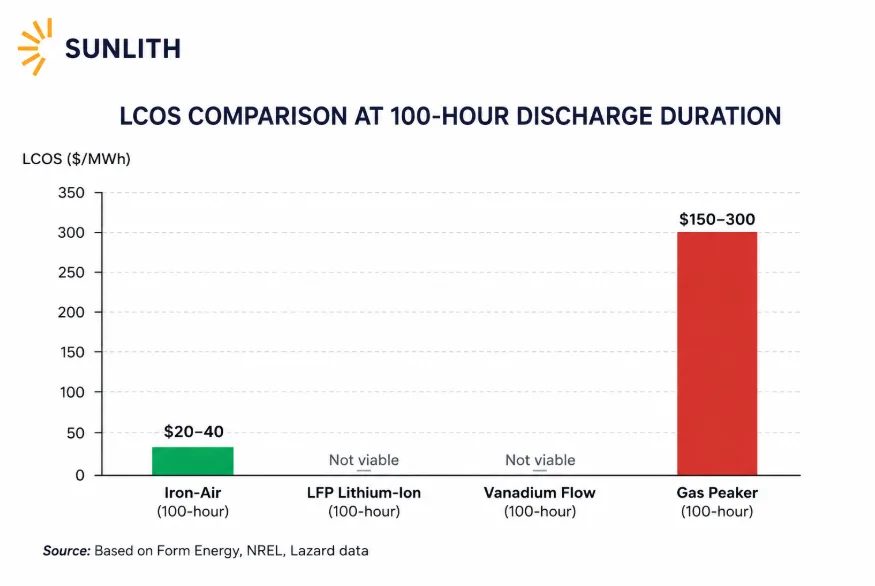
Iron-air batteries target an LCOS of $20–40/MWh for 100-hour discharge. That figure would place iron-air below natural gas peaker plants, below pumped hydro in most regions, and at roughly one-fifth the LCOS of lithium-ion at equivalent duration. Furthermore, it would do this without relying on lithium, cobalt, or any scarce critical mineral.
This article breaks down the iron air battery LCOS from first principles. Specifically, it covers the formula, each cost component, how iron-air compares to competing technologies, and what real-world project data shows. For a foundation on how iron-air cells work, see our guide on what is an iron-air battery.
Why Iron Air Battery LCOS Matters More Than CapEx
Capital expenditure is easy to compare. Iron-air targets $20/kWh system cost. LFP lithium-ion costs $125–200/kWh fully installed. That gap is real. However, CapEx alone does not drive the right procurement decision.
Four Costs CapEx Misses in Iron-Air Battery LCOS
Consider what CapEx fails to capture:
Round-trip efficiency (RTE) penalty: Iron-air runs at 50–60% RTE. Consequently, developers must buy roughly twice the charging energy to deliver each MWh.
Charging cost: A gas generator pays for fuel only when it runs. A battery must purchase or generate the electricity it stores. Therefore, charging cost per MWh delivered rises as RTE falls.
Cycle count: Lithium-ion cycles 250–365 times per year. Iron-air cycles just 20–50 times. As a result, each dollar of iron-air CapEx spreads across far less energy throughput.
Project life: A 20-year asset life spreads CapEx further. Nevertheless, O&M costs accumulate and must be discounted. Net present value of all costs determines the true LCOS.
How LCOS Combines All Four Factors
LCOS captures every dynamic in one number. According to PNNL’s LCOS Estimates database, LCOS equals total lifetime costs divided by cumulative delivered energy — both discounted to present value. In other words, it shows the minimum revenue per MWh the system must earn to achieve a net present value of zero.
This makes LCOS the right basis for comparing iron-air to gas peakers. Developers compare the iron air battery LCOS against the LCOE of the asset the battery replaces. For more context on how long-duration energy storage (LDES) technologies compete with firm generation assets, see our full LDES guide.
The Iron Air Battery LCOS Formula: How Costs Break Down
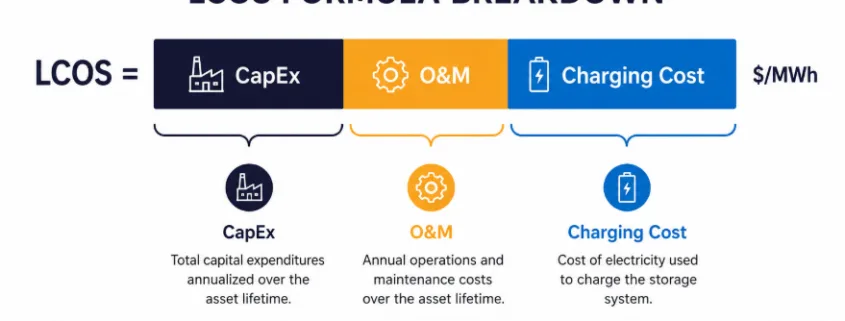
The LCOS formula — as applied by Lazard, NREL, and PNNL — follows this structure:
💡 Key insight: Iron-air batteries target curtailed renewable energy for charging — solar and wind output that grids would otherwise waste. In high-renewable regions, curtailed energy costs $3–15/MWh. This near-zero charging cost is the assumption behind the $20–40/MWh LCOS target. If iron-air must charge from the wholesale grid at $40–60/MWh instead, LCOS rises to $80/MWh or above.
The BESS PCS functions that manage charge/discharge cycles also affect LCOS. Specifically, PCS efficiency losses add to the effective charging cost per MWh delivered. Modern utility PCS units achieve 97–98.5% efficiency at full load, contributing a small but measurable input to the total LCOS calculation.
Iron-Air Battery CapEx: Where the $20/kWh Target Comes From
Form Energy targets a system cost of approximately $20/kWh. This is a system-level figure — it includes not just cell hardware, but civil, interconnection, and soft costs. Below, the table shows how iron-air’s $20/kWh cost divides across components, and where it differs from lithium-ion.
CapEx Component
Estimated Share
Iron-Air vs LFP Difference
Cell Stack (iron anode + air cathode + electrolyte)
35–45%
Iron-air cells target ~$7–10/kWh vs LFP’s $55–110/kWh. This cell-level gap is the entire basis of iron-air’s cost case.
Balance of System (civil, cabling, enclosures)
20–28%
Higher for iron-air due to larger land footprint and more enclosures per kWh. This partially offsets the cell cost advantage.
Power Conversion System (PCS)
12–18%
Similar to LFP. Standard utility PCS equipment applies to both chemistries. No meaningful difference exists at this layer.
EPC & Engineering (permitting, studies, labour)
10–15%
Currently elevated for iron-air. The limited pool of LDES-experienced EPC firms drives up soft costs. Costs will normalise as deployments scale.
Grid Interconnection
8–12%
Identical to LFP. ISOs charge the same interconnection fees regardless of storage chemistry or duration.
Contingency & Financing Costs
5–8%
Higher for iron-air. Lenders apply a technology risk premium to early-commercial assets. This premium will fall as operating data accumulates.
The Cell Stack Is Where Iron-Air Wins
Iron-air’s cost advantage concentrates almost entirely at the cell level. For context, iron metal costs roughly $0.10–0.15/kg. The quantity of iron per kWh of capacity is modest. As a result, cell stack cost targets $7–10/kWh at commercial scale. By contrast, LFP cells alone cost $55–110/kWh — six to fifteen times more.
However, the BOS cost per kWh runs higher for iron-air than for lithium-ion. Lower energy density means more land, more enclosures, and more civil work per kWh of capacity. This partially offsets the cell-level advantage. According to NREL grid storage benchmarks, balance-of-system costs represent 20–28% of total installed cost for utility-scale storage. For iron-air, the larger footprint pushes this toward the upper end of that range.
The full BESS specifications guide covers how system-level specs — including C-rate, DoD, and RTE — shape total project cost at the procurement stage.
Iron Air Battery LCOS vs Lithium-Ion, Flow, and Gas Peakers
The table below compares iron-air battery LCOS against three competing technologies. Importantly, the comparison centres on the 100-hour discharge window — the duration iron-air specifically targets.
Metric
Iron-Air
LFP Li-ion (4hr)
Vanadium Flow (10hr)
Gas Peaker
System CapEx ($/kWh)
~$20 (target)
$125–200
$300–500
$800–1,200/kW
Discharge Duration
100+ hours
4–8 hours
8–12 hours
Unlimited (fuel-dependent)
Round-Trip Efficiency
50–60%
85–95%
65–75%
N/A (heat rate ~7–10 MMBtu/MWh)
Cycles per Year
20–50
250–365
200–300
As dispatched
Project Life (years)
20+
15
20+
30+
Annual O&M
Low — no thermal management cost
$6–10/kW-year
$8–12/kW-year
$15–25/kW-year + fuel
LCOS at 4hr / daily ($/MWh)
Not applicable
$78–150
$110–190
$120–200
LCOS at 100hr / event-based ($/MWh)
$20–40 (target)
Not viable
Not viable
$150–300+ incl. carbon
Carbon Cost Risk
None
None
None
High — stranded asset risk
Critical Mineral Risk
None — iron, air, water only
Moderate — lithium supply
Moderate — vanadium supply
High — gas price exposure
Technology Selection Is Entirely Duration-Dependent
Importantly, no single technology dominates across all discharge durations. LFP lithium-ion, in particular, suits 2–8 hour daily cycling well. Its high RTE and mature supply chain produce an LCOS of $78–150/MWh for 4-hour discharge, according to BloombergNEF’s 2026 LCOE report. However, at 100-hour durations, lithium-ion CapEx is simply too high. The low cycle count of multi-day storage events cannot spread that cost across enough energy throughput.
Iron-air, by contrast, carries low enough CapEx that even 20–50 full cycles per year produce a competitive iron air battery LCOS. This is the same logic that makes pumped hydro economic: low capital cost per kWh and low-cost energy input outweigh moderate efficiency losses. For a broader view of how grid-scale BESS procurement decisions frame technology selection, see our grid-scale BESS guide.
⚖️ The gas peaker comparison: Gas peaker LCOE runs $120–200/MWh for short-duration peak events. Add fuel volatility, carbon pricing, and stranded asset risk over a 20-year horizon and the figure rises to $150–300/MWh. Iron-air’s $20–40/MWh target for 100-hour discharge represents an 80–90% cost reduction against that benchmark. This is the commercial case behind Xcel Energy and Georgia Power’s agreements with Form Energy.
Iron Air Battery LCOS Sensitivity: Bear, Base, and Bull Cases
The $20–40/MWh iron air battery LCOS target is not guaranteed. It depends on specific assumptions — some within developers’ control, others not. The table below shows the full range of outcomes.
Variable
Bear Case
Base Case
Bull Case
Cell Stack CapEx
$30/kWh
$20/kWh
$12/kWh
Round-Trip Efficiency
45%
55%
65%
Charging Cost (curtailed renewables)
$20/MWh
$10/MWh
$3/MWh
Discount Rate (cost of capital)
12%
9%
7%
Full Cycles per Year
15
30
50
Project Life
15 years
20 years
25 years
Resulting LCOS ($/MWh)
$55–80
$20–40
$10–20
Cell Stack CapEx: The Biggest Lever
Cell stack CapEx and charging cost drive the widest LCOS range of any variable. Essentially, manufacturing scale determines cell cost. As Form Energy’s Weirton, WV facility ramps production, learning-curve effects push costs from $12–18/kWh toward the $7–10/kWh long-run target. LFP manufacturing achieved a 90% cost reduction over 15 years of scaled production. Iron-air follows a similar trajectory, though the timeline remains uncertain.
Charging Cost: A Market Design Question
Charging cost depends on grid design, not just battery technology. Iron-air generates its strongest economics when developers site projects near solar or wind assets that regularly produce curtailed energy. In California, ERCOT, and parts of the Midwest, curtailment already exceeds 10–15% of generation. The near-zero charging cost assumption holds in those regions. Where iron-air must charge from the wholesale market, LCOS rises toward the bear case.
Round-Trip Efficiency: The Medium-Term Opportunity
RTE improvement offers a clear LCOS reduction path. Research at Argonne National Laboratory and MIT targets bifunctional air cathode catalyst improvements. A 10 percentage point RTE gain — from 55% to 65% — reduces LCOS by roughly $5–8/MWh at the base charging cost. Furthermore, the DOE long-duration energy storage programme sets 70%+ RTE by 2030 as an explicit target under the Long Duration Storage Shot initiative.
Real-World Iron Air Battery LCOS: Projects and Commercial Data
As of mid-2026, iron air battery LCOS remains largely a projection. However, the first commercial deployments now generate real operating data. Specifically, these projects will either validate or revise the $20–40/MWh target.
Project
Capacity
Partner
LCOS Significance
Cambridge Energy Storage (MN)
150 MWh
Great River Energy
First commercial iron-air system; commissioned late 2025. Multi-year performance study generates real cycle efficiency, degradation, and O&M cost data — the bankability foundation for all future projects.
Sherco Coal Plant Replacement (MN)
10 MW / 1,000 MWh
Xcel Energy
Flagship 100-hour GWh-scale deployment replacing retiring coal. Sets the real-world LCOS benchmark for US utility procurement decisions.
Darbytown Station (VA)
TBA
Dominion Energy Virginia
PJM market test alongside Eos zinc-hybrid batteries. Generates direct comparative performance data vs alternative LDES technologies.
Crusoe AI Data Center Portfolio
12,000 MWh (12 GWh)
Crusoe Energy Systems
March 2026 — largest single iron-air deal globally. Demonstrates firm power for AI data centers as a new iron-air use case at undisclosed but commercially agreed LCOS.
Why the Cambridge Project Matters for LCOS Validation
The Cambridge Energy Storage Project with Great River Energy is the most important near-term data source. Great River Energy runs a multi-year performance study. Specifically, this study measures cycle efficiency, degradation rates, and O&M costs under real grid conditions. Additionally, lenders need this data to move from technology-risk financing (10–12% discount rate) to infrastructure-grade terms (7–8%). That shift alone reduces iron air battery LCOS by $4–8/MWh at the base case.
The Crusoe AI data center agreement signals a new application for iron-air. AI data centers need continuous, uninterrupted power — not just grid firming. Notably, iron-air’s 100-hour duration enables it to bridge multi-day grid contingencies for critical infrastructure. According to Form Energy’s battery technology overview, those grid studies show that hitting cost targets unlocks tens of GWh of multi-day storage demand in the US alone.
IRA Incentives: How Tax Credits Reduce Iron Air Battery LCOS
Notably, the US Inflation Reduction Act (IRA) improves iron air battery LCOS through two direct mechanisms. Together, these credits can reduce effective project cost by 30–40%.
Investment Tax Credit (ITC) for Standalone Storage
The IRA provides a 30% ITC for standalone battery storage. Consequently, iron-air projects qualify without needing solar co-location. At $20/kWh system cost, the credit equals $6/kWh. Effective CapEx therefore falls to approximately $14/kWh. In turn, this reduces iron air battery LCOS by $5–8/MWh at the base case.
Advanced Manufacturing Production Credit (45X)
Additionally, the 45X credit provides per-component tax credits for domestically manufactured battery parts. Form Energy’s Weirton, WV facility qualifies for these credits on cell components, electrodes, and modules. As a result, the credit compresses the gap between early-commercial pricing and the long-run $7–10/kWh cell target. Furthermore, it supports factory ramp-up economics during the period when production volumes remain low.
📋 ITC note: The 30% ITC applies to the full installed system cost — including BOS, PCS, and interconnection, not just the battery cells. For a 100 MWh system at $20/kWh ($2M total), the ITC reduces net project cost to $1.4M. Most iron-air projects at this stage will use tax equity partnerships to monetise the credit fully.
Iron Air Battery LCOS: Frequently Asked Questions
What is the LCOS of an iron-air battery?
Iron-air batteries target an LCOS of $20–40/MWh for 100-hour discharge. This estimate comes from Form Energy’s commercial targets and NREL benchmarking. Specifically, it assumes $20/kWh system cost, 50–60% RTE, near-zero-cost curtailed renewable charging, and a 20-year project life with 20–50 full cycles per year.
How does iron-air LCOS compare to lithium-ion?
For 4-hour daily cycling, LFP lithium-ion achieves a lower LCOS of $78–150/MWh. However, at 100-hour discharge, lithium-ion CapEx is too high. Its cost cannot spread across the low cycle count of multi-day storage events. By contrast, iron-air’s low CapEx is specifically optimised for that window. Therefore, the two technologies do not compete — they serve different duration needs.
Why is iron air battery LCOS low despite poor round-trip efficiency?
Cell-level CapEx of $7–10/kWh is the answer. That is 6–15× lower than LFP. Furthermore, iron-air charges from near-zero-cost curtailed renewables. Consequently, the efficiency penalty costs relatively little. The same logic applies to pumped hydro: low capital cost and cheap energy input outweigh moderate efficiency losses.
What are the biggest risks to the $20/MWh LCOS target?
Three risks stand out. First, slower manufacturing scale-up could keep cell CapEx above $25/kWh longer than planned. Second, higher charging costs apply if projects must buy wholesale grid electricity rather than curtailed renewables. Third, lenders may maintain technology-risk discount rates of 10–12% until operating data accumulates — raising iron air battery LCOS by $5–10/MWh versus the base case.
Is iron-air LCOS competitive with gas peaker plants?
Yes, for multi-day firming applications. Gas peakers cost $120–200/MWh for short-duration events. Add fuel volatility, carbon pricing, and stranded asset risk and that figure rises to $150–300/MWh over a 20-year horizon. Iron-air’s $20–40/MWh target therefore represents an 80–90% cost reduction. As a result, Xcel Energy and Georgia Power have both signed commercial agreements with Form Energy.
Conclusion: What the Iron Air Battery LCOS Target Means for Grid Planning
The $20–40/MWh iron air battery LCOS target is the most compelling cost proposition in long-duration storage today. No other commercially advancing technology combines 100-hour discharge, Earth-abundant materials, and a cost structure that undercuts gas peakers. Moreover, iron-air achieves this without geographic constraints — unlike pumped hydro, which needs specific terrain.
However, the target remains a projection. The Cambridge and Sherco projects generate cycle efficiency, degradation, and O&M data. That data transforms iron-air from a technology-risk asset to a bankable one. A move from 10–12% to 7–8% discount rates alone reduces iron air battery LCOS by $6–10/MWh. It therefore determines whether the base case or the bear case prevails.
For grid planners, the right framework is not ‘can iron-air hit $20/MWh?’ Instead, ask: ‘What LCOS does our procurement model require, and does our site provide high-curtailment renewable charging?’ In regions with strong IRA access, high curtailment, and multi-day capacity market products, iron-air economics already work — even at current early-commercial pricing. As Form Energy scales production through 2026–2030, iron air battery LCOS will converge on the low end of the $20–40/MWh range. Consequently, the largest shift in grid storage economics since lithium-ion displaced pumped hydro for short-duration storage may be underway.
Battery Energy Storage Systems (BESS) are transforming how the world uses electricity. As global demand increases, the rapid expansion of renewable energy is more important than ever. Solar and wind power now supply a significant portion of our electricity.
However, these renewable sources are intermittent. Solar panels only generate power during the day, while wind power depends entirely on weather conditions. Consequently, modern power grids require reliable storage solutions to stay stable.
A battery energy storage system (BESS) solves this challenge by capturing excess energy and releasing it when demand is highest. As a result, battery storage improves grid reliability and makes green energy more practical for everyone. In this guide, we explain how these systems work, their core components, and their role in the future of energy.
Key Takeaways
A battery energy storage system (BESS) stores electricity in rechargeable batteries.
Battery storage helps balance electricity supply and demand.
Lithium-ion BESS systems typically achieve 85–95% round-trip efficiency.
Key components include battery modules, BMS, PCS inverter, EMS, and thermal systems.
Battery energy storage systems support renewable energy integration and grid stability.
What Is a Battery Energy Storage System (BESS)?
A battery energy storage system (BESS) stores electricity in rechargeable batteries and releases it when energy demand increases. These systems help balance electricity supply and demand across modern power grids.
For example, solar power plants may generate excess electricity during midday. Battery storage systems store this energy and supply it later when solar generation declines.
As a result, battery energy storage systems improve renewable energy reliability and grid stability.
According to the International Energy Agency, large-scale energy storage will play a key role in global energy transitions.
How Battery Energy Storage Systems Work
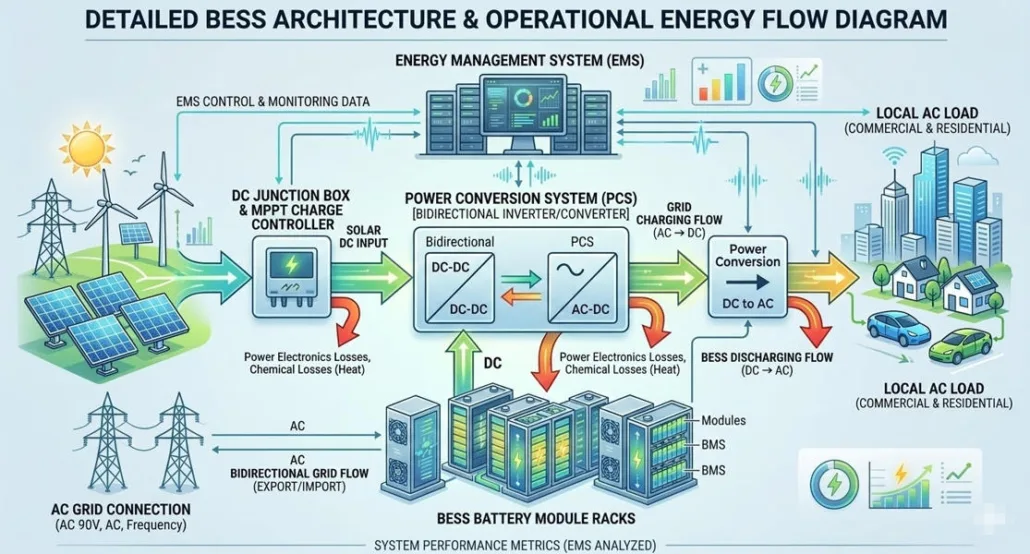
Battery energy storage systems operate through three main stages: charging, storage, and discharge.
Charging Stage
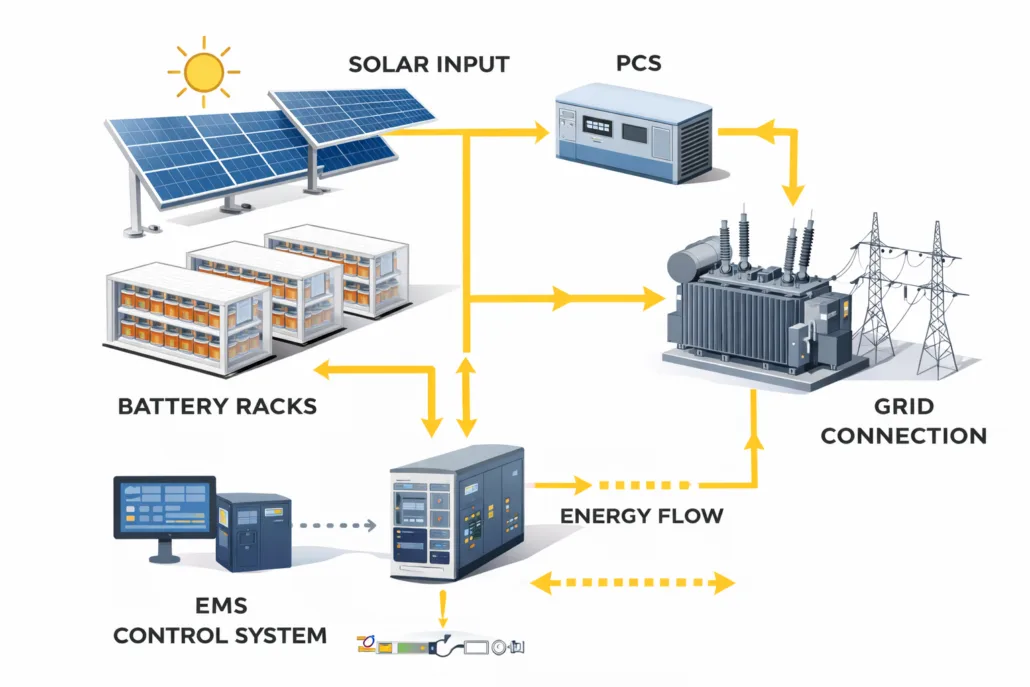
First, electricity flows from solar panels, wind turbines, or the electrical grid. The power conversion system converts this electricity into direct current (DC). The system then stores the energy inside battery cells.
Energy Storage Stage
Next, battery modules store the electricity safely inside battery racks. Meanwhile, the battery management system monitors voltage, temperature, and battery state of charge.
This monitoring ensures safe system operation.
Discharge Stage
Finally, the system releases stored electricity when demand increases. The PCS inverter converts DC electricity back into AC power so facilities or grid systems can use it.
The system operation is controlled by an energy management system in BESS, which determines when batteries should charge or discharge electricity.
Battery Energy Storage Systems Architecture
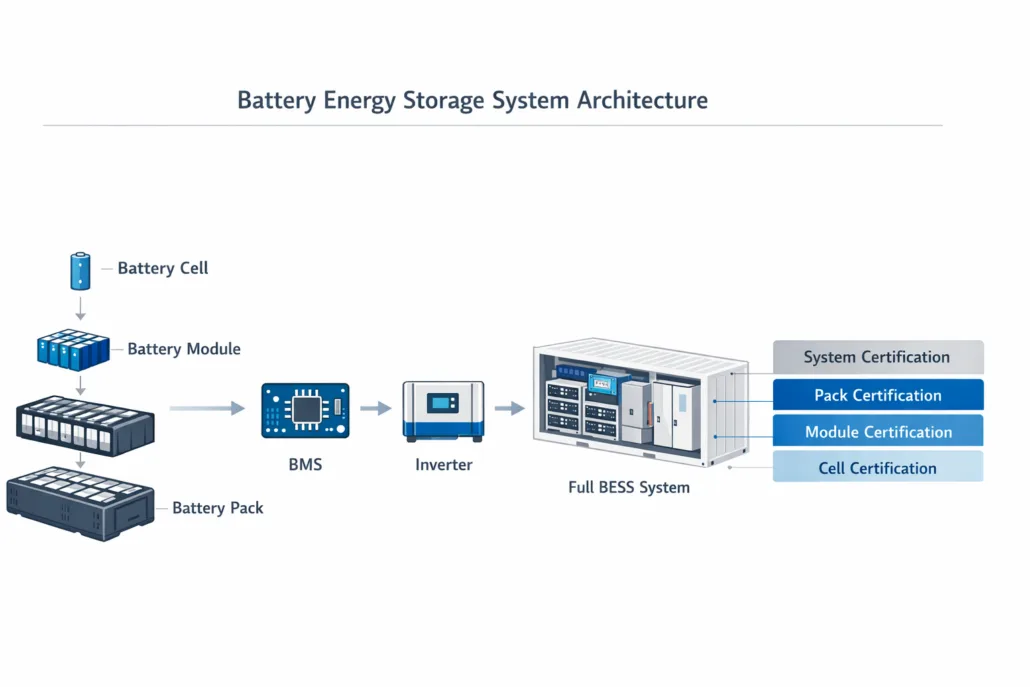
Modern battery energy storage systems include several integrated subsystems that work together to manage energy flow.
Battery cells store electrical energy through electrochemical reactions. Lithium-ion batteries are the most widely used technology in modern energy storage systems.
Battery Management System (BMS)
The BMS monitors battery voltage, temperature, and state of charge. It protects batteries from overheating, overcharging, and deep discharge.
The PCS converts electricity between AC and DC. This conversion allows batteries to charge and discharge energy efficiently.
Energy Management System (EMS)
The EMS controls system operation. It determines when the system should charge or discharge electricity.
Thermal Management System
Cooling systems regulate battery temperature to maintain safe operating conditions and extend battery lifespan.
Modern battery systems rely on advanced software platforms that deliver EMS grid services in BESS, enabling grid balancing and smart energy dispatch.
Battery Storage Efficiency
Efficiency is one of the most important performance indicators for battery energy storage systems.
Engineers measure efficiency using round-trip efficiency. This metric compares the amount of energy stored with the amount of energy delivered.
Most lithium-ion battery systems achieve 85–95% round-trip efficiency. However, efficiency varies depending on battery chemistry, system design, and operating conditions.
Research from the U.S. Department of Energy highlights the importance of optimizing system design to reduce energy losses.
Battery efficiency and lifespan depend heavily on charge cycles and depth of discharge, which are explained in detail in battery cycle standards explained.
Energy Storage Losses in Battery Energy Storage Systems
Although battery energy storage systems operate efficiently, some energy is inevitably lost during the charging and discharging cycle. Understanding these energy storage losses is critical for calculating the true round-trip efficiency and ROI of a project.
Common Sources of Inefficiency:
Battery Internal Resistance: Energy is lost as heat due to the physical resistance of the cells. This is often measured via DC Internal Resistance (DCIR).
Power Conversion Losses: Inverters and converters lose a small percentage of energy when switching electricity between AC and DC.
Thermal Management (Parasitic Loads): Fans, pumps, and HVAC systems consume electricity to keep the batteries within safe operating temperatures.
Standby & Auxiliary Consumption: The BMS and monitoring sensors require a constant, small amount of power to ensure system safety and readiness.
Despite these losses, modern battery storage systems maintain high efficiency levels. For a complete breakdown of how to minimize these inefficiencies, see our dedicated guide on where energy gets lost in BESS systems.
Applications of Battery Energy Storage Systems
Battery energy storage system solar input, PCS, EMS, and grid connection
Battery energy storage systems support many modern energy applications.
Many commercial facilities deploy battery systems for energy cost reduction through peak shaving vs load shifting strategies.
Renewable Energy Integration
Solar and wind generation fluctuate throughout the day. Battery systems store excess renewable energy and release it when production decreases.
Many commercial facilities install battery storage to reduce peak electricity demand and lower energy costs.
These systems offer significant benefits for businesses by providing a buffer against rising utility rates and improving overall power resilience.
Backup Power
Battery storage systems also provide emergency electricity during grid outages.
Types of BESS by Application
BESS comes in different forms depending on where and how it’s deployed — from a portable power bank to a utility-scale installation spanning acres. However, every type shares the same core architecture covered above, just scaled and packaged differently for its application.
See our full breakdown of the types of BESS by application — covering portable, residential, C&I, mobile, and utility-scale systems, with typical capacity ranges and where each one fits.
Advantages and Challenges of Battery Energy Storage Systems
BESS offer many benefits for modern energy infrastructure. However, they also face several challenges.
Advantages
improved renewable energy integration
enhanced grid stability
peak demand reduction
reliable backup power
Challenges
high upfront investment
battery degradation over time
thermal management requirements
recycling and environmental considerations
However, ongoing research continues to improve battery performance and reduce system costs.
Global Growth of Battery Energy Storage Systems
The global energy storage market continues to expand rapidly. Utilities and governments are investing heavily in grid-scale battery systems.
Market forecasts from BloombergNEF indicate that global battery storage capacity will grow significantly over the next decade.
Several factors drive this growth:
declining battery costs
increasing renewable energy deployment
stronger climate and energy policies
Future of Battery Energy Storage Systems
Battery technology continues to evolve. Researchers are developing new battery chemistries and advanced energy management systems.
For example, solid-state batteries may improve energy density and safety. In addition, smart energy management software can optimize system performance.
Therefore, BESS will remain essential for future electricity networks. To see how this technology is scaling down to localized grids, read our complete guide on Microgrid BESS design and applications.
Frequently Asked Questions
What is a battery energy storage system?
A battery energy storage system stores electricity in rechargeable batteries and releases it when electricity demand increases.
What is the efficiency of battery energy storage systems?
Most lithium-ion battery energy storage systems achieve 85–95% round-trip efficiency.
Why are battery energy storage systems important?
They enable renewable energy integration, improve grid stability, reduce peak electricity demand, and provide backup power.
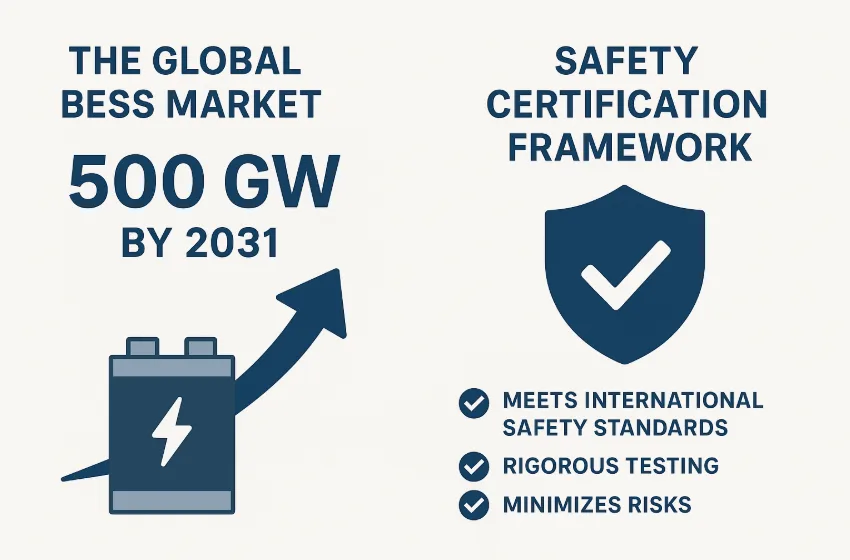
The global BESS market is projected to grow exponentially, reaching 500 GW by 2031. This forecast is a reflection of the world’s transition toward clean energy, electrification, and grid modernization. Battery Energy Storage Systems (BESS) are no longer niche technologies—they are becoming central to the stability and flexibility of modern energy networks.
But with such rapid deployment, BESS safety certification has emerged as a critical factor. Without strong certification standards, the risks of fire, explosion, or system failure increase. These risks not only threaten energy reliability but also create challenges for regulators, insurers, and investors.
In this article, we explore the drivers of global BESS market growth, the importance of safety certification, and the frameworks shaping the future of energy storage systems.
Why the Global BESS Market Is Growing So Fast
The energy storage systems projected 500 GW growth is being driven by a combination of technical, economic, and policy-related factors.
1. Renewable Energy Integration
Wind and solar are now the cheapest forms of new power generation worldwide. However, their variability creates challenges for grid operators. Battery energy storage systems solve this problem by storing excess energy and releasing it when demand rises.
2. Grid Modernization and Stability
Utilities are increasingly deploying BESS for peak shaving and load shifting, frequency regulation, and emergency backup. These applications make the grid more stable and resilient.
3. Commercial and Industrial Adoption
The C&I sector is also embracing storage. Businesses use BESS to cut peak demand charges, integrate renewable energy, and secure backup power through certified BESS installations.
4. Policy Support and Incentives
Governments are backing storage projects through subsidies, tax credits, and regulatory frameworks. For example, the U.S. Inflation Reduction Act provides tax benefits for energy storage projects, while the EU Green Deal is pushing for accelerated deployment.
The Risks of Rapid Expansion Without Certification
The market opportunity in certified BESS installations is immense. Yet, expansion without robust certification frameworks introduces serious risks.
Thermal Runaway – Poorly tested systems can overheat and cause chain-reaction fires.
Fire Hazards – Uncertified systems lack the proven ability to prevent or contain fires.
Grid Instability – Unsafe or poorly integrated BESS may destabilize the grid.
Investor Concerns – How certification improves investor confidence in BESS is by ensuring long-term reliability. Without it, projects face financing barriers.
These risks highlight why safety risks of battery energy storage without certification cannot be ignored.
Why Safety Certification Matters for BESS
As the global BESS market forecast to 2031 shows explosive growth, safety must be at the forefront. Certification ensures that BESS systems:
Meet UL 9540 certification for large-scale BESS to prove safe system integration.
Beyond safety, certification also drives global BESS market growth by creating trust.
How Certification Improves Investor Confidence in BESS
Reduces liability risks by ensuring compliance.
Streamlines project permitting and regulatory approval.
Enhances access to financing, as banks prefer certified projects.
Demonstrates compliance with regulatory requirements for battery energy storage systems 2031.
Without certification, large-scale projects could face costly delays, stricter insurance requirements, or outright rejection.
Global Trends in Energy Storage Certification and Testing
The global trends in energy storage certification and testing point toward stricter, more harmonized standards. Several developments are shaping the industry:
Harmonization of IEC and UL standards to reduce duplication.
Performance-based testing to reflect real-world conditions.
AI and digital twins for predictive safety assessments.
Third-party testing labs expanding capacity to handle growing demand.
As the market scales toward 500 GW energy storage forecast, these certification trends will define how quickly projects come online.
Looking Ahead: Balancing Growth With Safety
The global BESS market forecast to 2031 highlights a future of rapid scaling, but it comes with responsibility. The industry must prioritize best practices for BESS fire and explosion prevention to protect communities and maintain market trust.
Future growth will depend on:
Stronger collaboration between regulators and manufacturers.
By aligning market expansion with robust safety certification, the BESS industry can deliver safe, reliable, and sustainable storage solutions that support the global clean energy transition.
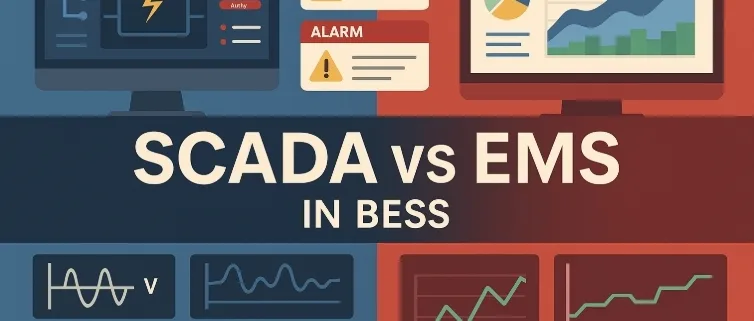
SCADA vs EMS in BESS: Battery Energy Storage Systems (BESS) are more than just batteries—they are intelligent ecosystems. At the heart of this intelligence lie two key control systems: SCADA (Supervisory Control and Data Acquisition) and EMS (Energy Management System).
But what’s the difference between them? Why do you need both in your energy storage infrastructure? Let’s break it down.
EMS is the strategic brain of the energy storage system. While SCADA controls how things operate, EMS decides what should be done to maximize efficiency, economics, and reliability.
✅ Key Functions of EMS:
Energy Flow Optimization: Determines how and when to charge/discharge the battery.
EMS optimizes cost-saving strategies across multiple sites.
⚡ Utility-Scale BESS
SCADA integrates with substation automation and DNP3/IEC 61850 protocols.
EMS participates in energy markets, frequency response, and ancillary services.
📈 Why You Need Both
Some may think EMS alone is enough, but it’s not. Without SCADA, the EMS is blind. Without EMS, the SCADA is mute.
✅ SCADA ensures the system runs safely. ✅ EMS ensures it runs profitably.
You need both for your BESS to be intelligent, safe, and profitable.
❓ FAQ: SCADA vs EMS in BESS
Q1. Can SCADA and EMS be integrated into one platform? Yes. Many vendors offer combined platforms or modular systems where EMS sits on top of SCADA.
Q2. Is EMS cloud-based and SCADA local? Generally, yes. SCADA operates locally for fast response, while EMS can be local or cloud-based for broader optimization.
Q3. Which one is more expensive? EMS often costs more due to its software intelligence, licensing, and integration needs.
Q4. Which is more important for safety? SCADA is crucial for safety and reliability. EMS focuses more on economic performance.
📌 Final Thoughts: Build a Smarter BESS with SCADA and EMS
Understanding the SCADA vs EMS in BESS distinction is not just academic—it has real business and technical consequences. If you want your Battery Energy Storage System to be both safe and smart, you need both systems.
Understanding their roles and differences is crucial for:
System integrators
Project developers
Energy consultants
Facility managers
And anyone involved in the deployment of BESS
Whether you’re building a microgrid or managing utility-scale storage, make sure your BESS includes both a robust SCADA and an intelligent EMS.
Looking for help integrating SCADA and EMS in your energy project? Reach out to a qualified consultant who understands both layers of the stack and can optimize your BESS from the ground up.
The modern power grid is under pressure. Rising electricity demand, renewable energy integration, and fluctuating prices make it harder to keep supply and demand in balance. Demand Response (DR) is a smart energy management solution that allows utilities and businesses to adjust power consumption in real-time, helping stabilize the grid while cutting costs.
At Sunlith Energy, we see demand response as a critical bridge between renewable energy, battery energy storage systems (BESS), and smarter energy use. It empowers both businesses and homeowners to play an active role in energy efficiency and sustainability.
How Demand Response Works
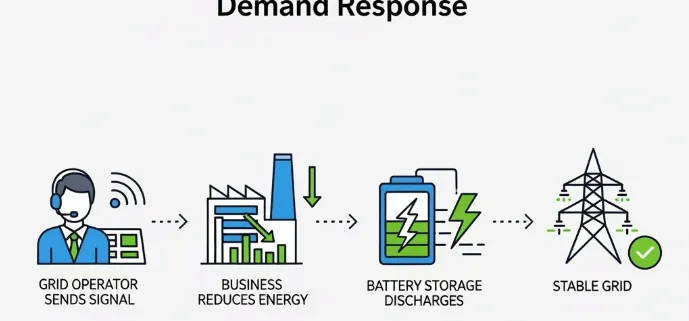
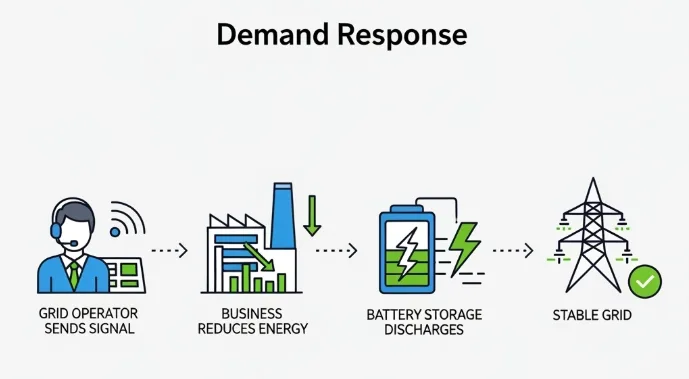
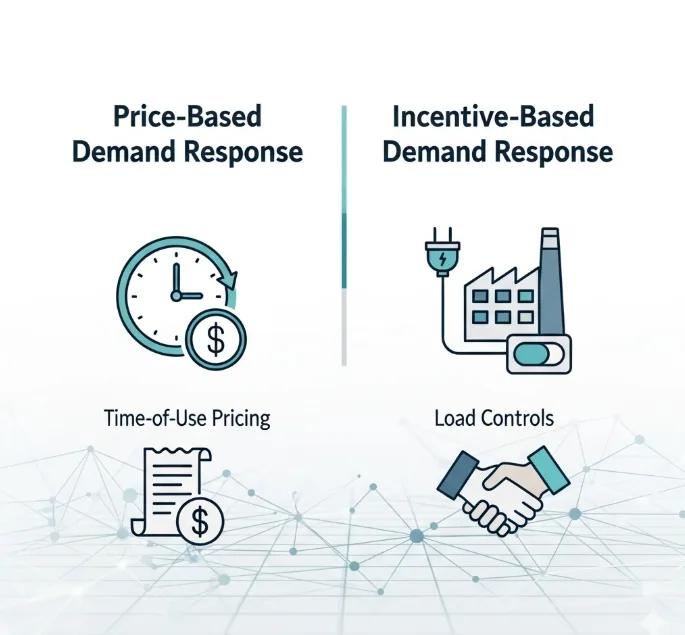
Demand response is a system where electricity consumers reduce or shift their energy usage during peak demand periods in response to signals from utilities or grid operators. These signals can be price-based (time-of-use rates) or incentive-based (payments for participation).
Here’s how it typically works:
Signal Received – The utility alerts participants of high demand or peak pricing.
Load Adjustment – Businesses and homes reduce or shift energy-intensive processes.
Support from BESS – Stored energy from battery energy storage systems covers the gap.
Grid Stabilization – Reduced stress on the grid prevents blackouts and keeps prices stable.
By integrating BESS solutions from Sunlith Energy, participants don’t just reduce demand—they optimize it by storing cheap off-peak energy and using it when it matters most.
Types of Demand Response Programs
Different markets and utilities offer various forms of demand response. The most common types include:
1. Price-Based Demand Response
Time-of-Use (TOU) Pricing: Electricity costs vary by time of day.
Real-Time Pricing (RTP): Prices shift hourly based on market conditions.
Critical Peak Pricing (CPP): Higher rates during grid stress events.
2. Incentive-Based Demand Response
Direct Load Control (DLC): Utilities remotely adjust certain equipment (like HVAC).
Interruptible/Curtailable Programs: Businesses get discounts for agreeing to reduce load.
Capacity Market Participation: Large consumers earn revenue by offering flexibility to the grid.
Benefits of Demand Response
Demand response is more than just cost savings. It brings value to businesses, households, and the power grid as a whole:
🔹 For Businesses
Lower electricity bills through avoided peak pricing.
Participation payments from utilities.
Improved sustainability credentials.
🔹 For the Grid
Reduced risk of blackouts.
Easier integration of renewable energy sources like solar and wind.
Lower need for expensive fossil-fuel peaker plants.
🔹 For the Environment
Lower carbon emissions.
Optimized use of clean energy.
Smarter, greener energy ecosystems.
Demand Response and Battery Energy Storage Systems (BESS)
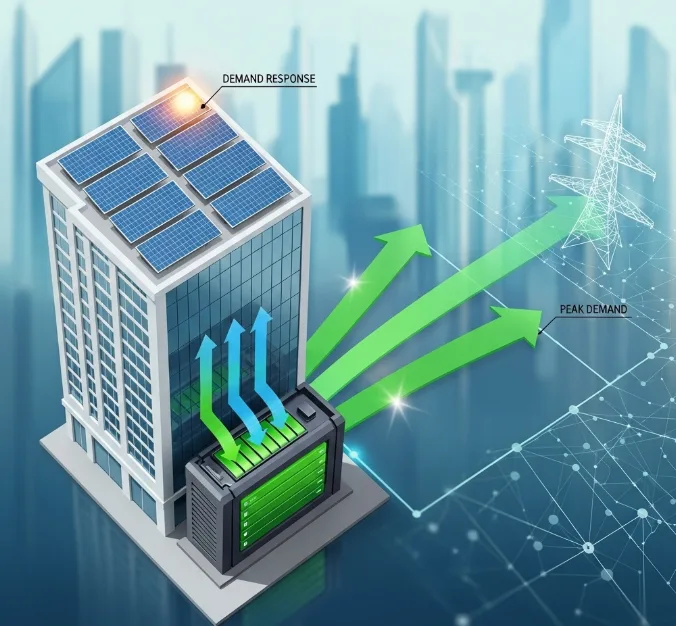
One of the most powerful enablers of demand response is battery energy storage systems (BESS). With BESS, businesses can:
Store cheap off-peak energy and use it during demand response events.
Provide grid support by discharging power when required.
Countries across the EU, US, and Asia are actively encouraging demand response programs as part of their clean energy policies. Regulations like the EU’s 2023/1542 and US market incentives through FERC and ISO programs highlight DR as a priority tool.
With Sunlith Energy’s smart BESS solutions, businesses can stay compliant, capture new revenue streams, and actively support the energy transition.
Key Takeaways
Demand Response balances supply and demand in real-time.
It offers financial benefits for businesses and households.
Battery storage systems supercharge DR by adding flexibility.
Demand response is essential for a renewable-powered, resilient grid.
Conclusion
Demand response is no longer just an option—it’s becoming a necessity. By combining smart demand management with advanced battery energy storage systems, businesses and homeowners can save money, reduce carbon footprints, and support a more resilient energy future.
At Sunlith Energy, we help organizations unlock the full potential of demand response through tailored BESS solutions that work seamlessly with grid programs.
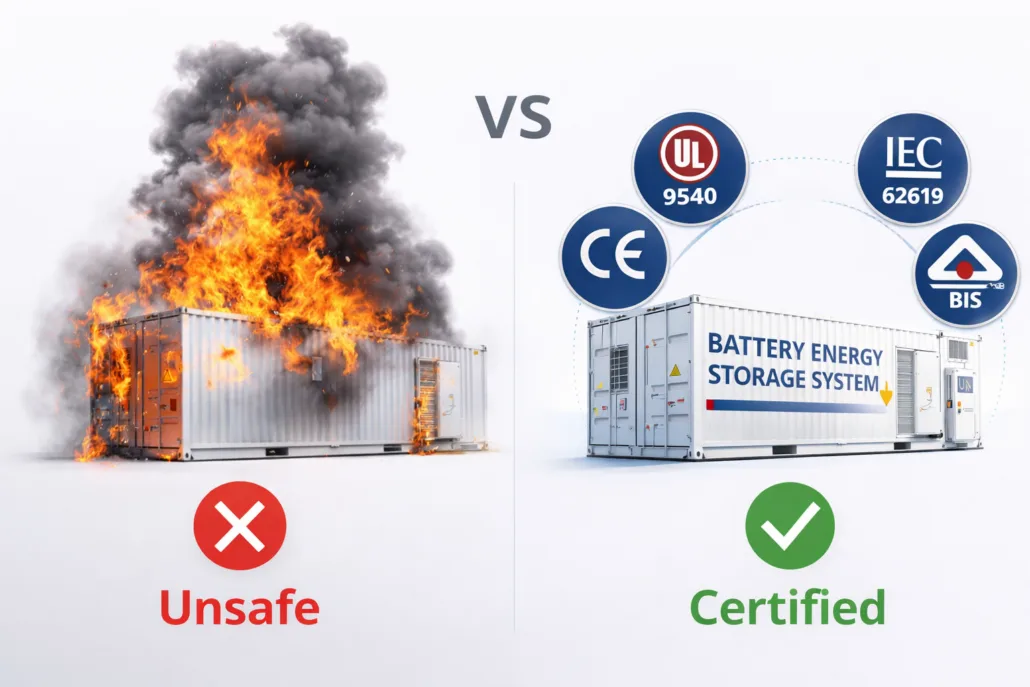
Quick Answer: BESS certifications are mandatory safety approvals for Battery Energy Storage Systems. You need UL 9540 for the USA, CE Marking for Europe, IEC 62619 globally, and BIS IS 17855 for India. Without valid BESS certifications, your system cannot be sold, insured, or grid-connected.
BESS certifications are the first thing you need when buying, selling, or installing a battery energy storage system. They decide whether your project gets permitted and financed — or blocked. As the global BESS market grows toward 500 GW by 2031, regulators everywhere are raising the bar.
This guide covers every major standard in 2026. Moreover, it explains what each certification tests, why it is required, and what it costs. Use it before you sign any BESS purchase agreement.
What This Guide Covers
To help you navigate this comprehensive 2026 compliance roadmap, use the quick-reference index below to jump directly to specific regional frameworks, testing criteria, or buyer requirements:
1. Why BESS Certifications Matter More Than Ever in 2026
BESS certifications are not just paperwork. They are your legal license to sell and operate in any serious energy market. High-profile BESS fires across the US, Europe, and Asia have pushed regulators to tighten standards. As a result, the compliance bar in 2026 is higher than at any point before.
Skipping BESS certifications leads to serious, immediate problems. Here is what happens when a system is not properly certified:
Safety failures: Fires from uncertified BESS have caused millions in damage globally
Market access blocked: Products without UL 9540 or CE Marking cannot legally be sold
Insurance denied: Most insurers reject claims involving uncertified systems
Grid connection refused: Utilities require valid certification before any interconnection
Tender disqualification: BIS (India) and CEC (Australia) are mandatory for public projects
Legal liability: Uncertified equipment leads to fines, recalls, and lawsuits
Key Rule: A certified cell does NOT mean the full BESS system is certified. The cell, BMS, PCS, enclosure, and complete assembled system each need their own independent certification. This is the most expensive mistake importers make.
2. All Major BESS Certification Standards by Region (2026)
Different markets require different BESS certifications. Below is a full breakdown of every standard you need to know. Each section explains what is tested, who issues it, and why it matters.
A. UL Standards — United States and Canada
Underwriters Laboratories (UL) issues the core BESS certifications for North America. These are enforced through state building codes, the NEC, and utility agreements. Without them, your product cannot be permitted or installed in most US states.
Standard
Full Name
Covers
Who Needs It
UL 9540
Safety for Energy Storage Systems
Full system safety — the master US standard
All BESS sellers and installers in USA/Canada
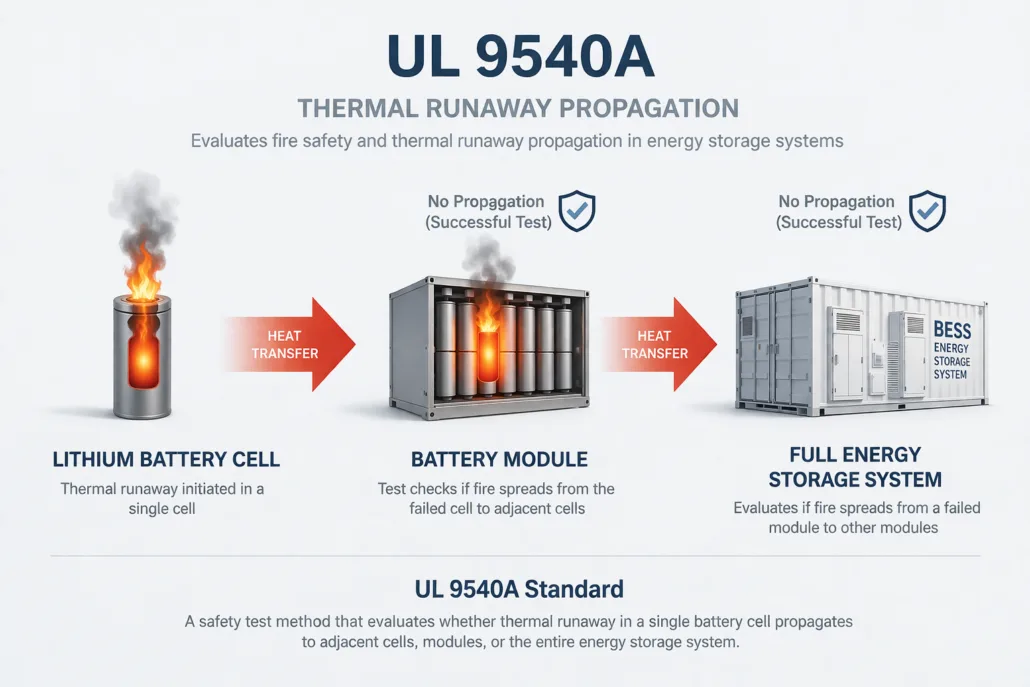
UL 9540A
Thermal Runaway Fire Propagation Test
Fire spread between battery modules
Required before UL 9540 listing
UL 1973
Stationary and Motive Battery Systems
Battery cell and pack safety
Battery pack manufacturers
UL 1741
Inverters and Power Converters
Grid-interactive inverter and PCS safety
PCS and inverter manufacturers
UL 1699B
Lithium-Ion Battery Protection
Arc fault protection in Li-ion systems
Residential and commercial BESS
UL 9540A must be completed at three levels: cell, module, and unit. Many suppliers, however, only show the cell-level report. Consequently, buyers accept incomplete documentation without knowing it. Always demand all three levels before you proceed.
B. IEC Standards & IEC 62933 Compliance — International and European Markets
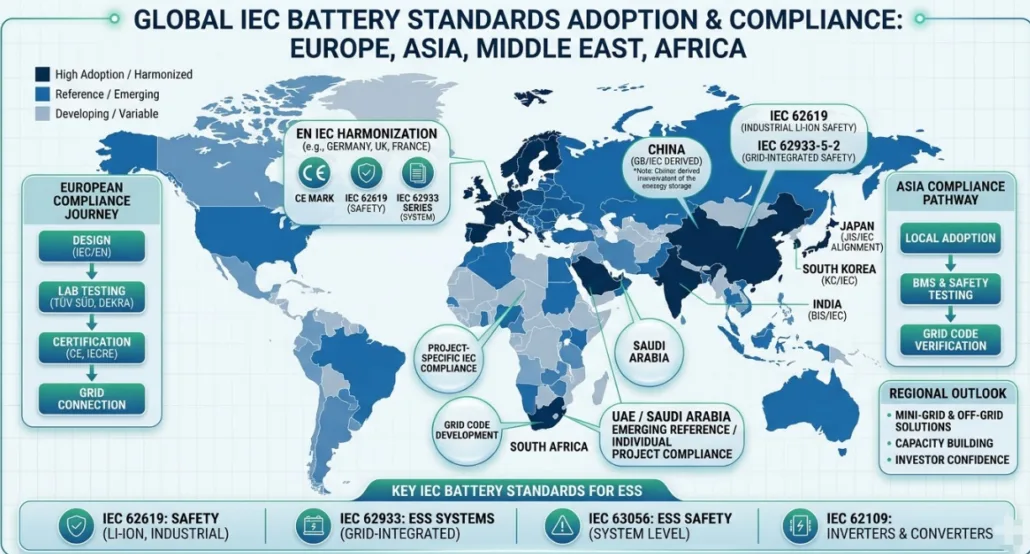
The International Electrotechnical Commission (IEC) sets globally accepted BESS certifications. As a result, IEC standards are referenced by regulators across Europe, Asia, the Middle East, and Africa. Furthermore, many utility tenders worldwide require specific IEC compliance as a minimum baseline.
Core safety: overcharge, short circuit, thermal abuse
IEC 62933-2-1
ESS unit parameters and test methods
Performance verification of a complete assembled system
IEC 62933-5-2
Safety for grid-integrated energy storage
Cybersecurity, functional safety, grid protection
IEC 61427-2
Batteries for off-grid renewables
Cycle life and performance for solar and wind storage
IEC 61508
Functional safety of electrical systems
Applies to BMS software and firmware safety logic
C. CE Marking — European Union and EEA
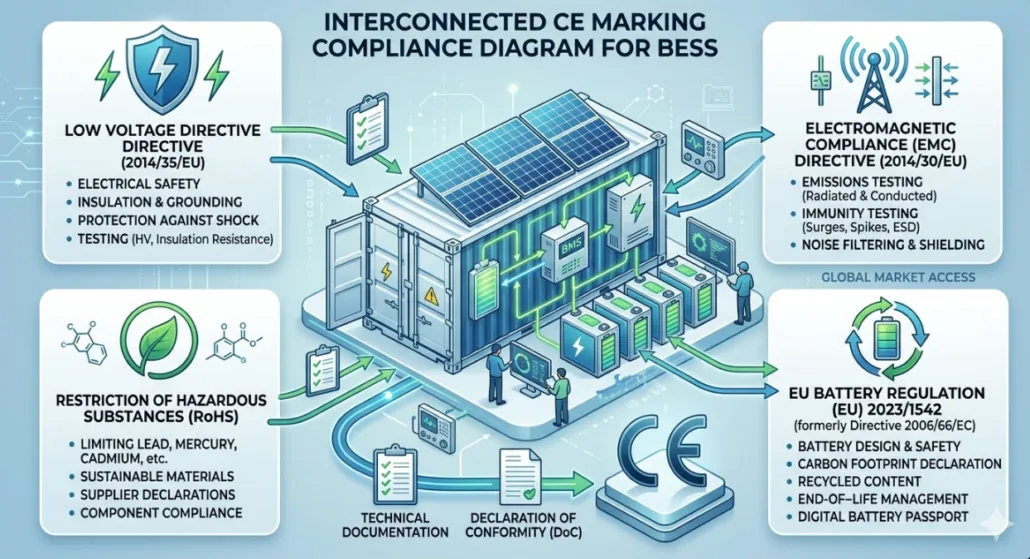
CE Marking is legally required for every battery product sold in the EU. It is not a single test. Instead, it is a Declaration of Conformity that proves compliance with several EU Directives at once. Without it, your product cannot enter the EU market legally.
Low Voltage Directive (LVD) 2014/35/EU — Electrical safety for equipment from 50V to 1000V AC
EMC Directive 2014/30/EU — Ensures BESS does not interfere with other devices
RoHS Directive 2011/65/EU — Restricts lead, mercury, cadmium, and other hazardous substances
EU Battery Regulation 2023/1542 — Adds carbon footprint declaration and Digital Battery Passport from 2024
Machinery Directive 2006/42/EC — Applies if the BESS includes any motorized or moving parts
2026 EU Update: The EU Battery Regulation adds a Digital Battery Passport for BESS above 2 kWh. From 2027, every qualifying battery needs a QR-code-linked passport with carbon footprint and supply chain data. Start compliance preparation now.
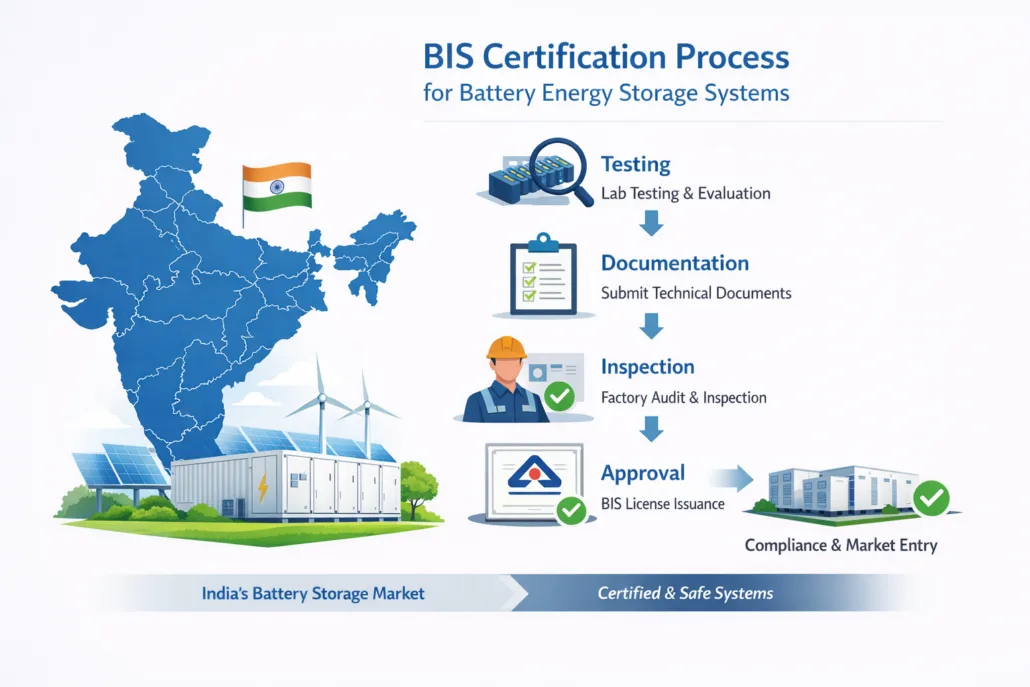
D. BIS Certification — India
In India, the Bureau of Indian Standards (BIS) manages mandatory BESS certifications under the Compulsory Registration Scheme (CRS). Without BIS registration, products cannot clear customs or qualify for government tenders. India is a fast-growing BESS market, so this certification is increasingly important.
IS 16270:2014 — Safety for lithium-ion cells, equivalent to IEC 62133
IS 17855:2022 — Stationary lithium battery safety, aligned with IEC 62619
IEC 62619 (adopted directly) — Required for large-scale utility and industrial BESS tenders
Testing must be done at BIS-approved labs or internationally accredited labs with a BIS agreement. Additionally, registration is model-specific and must be renewed. Typical timeline: three to six months.
E. CEC Approval — Australia
Australia’s Clean Energy Council (CEC) governs BESS certifications for the Australian market. CEC listing is required for grid connection and STC rebate eligibility. Without it, network operators will not approve the connection.
AS/NZS 5139:2019 — Australian standard for battery systems with power conversion equipment, updated by Amendment 1 in December 2025
CEC Approved Product List — Products must appear on this list before any grid connection; listing requirements themselves changed under AS/NZS 4777.2 Amendment 2 in 2025
Installer accreditation — CEC Battery Storage Accreditation is required for all installers
F. NFPA 855 — USA Fire Installation Standard
NFPA 855 governs how BESS certifications translate into safe real-world installations. While UL 9540 covers product safety, NFPA 855 covers how and where BESS is installed. Many US states have adopted it into local building codes.
Sets maximum energy capacity per room and building type
Requires fire suppression systems above defined energy thresholds
Mandates separation distances between battery racks and modules
Requires UL 9540A unit-level results as part of the permit application
Therefore, project developers must design installations to NFPA 855 from day one. Failing to do so results in permit denial — often after costly design work is already complete. For a deeper look into compliance steps, spacing rules, and permitting, read our Complete NFPA 855 Guide.
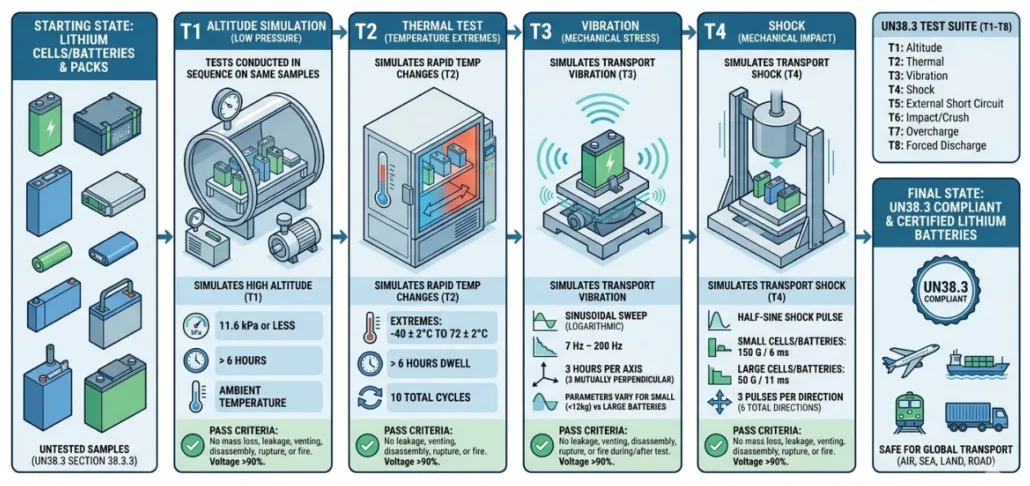
G. UN 38.3 — International Transport Certification
UN 38.3 is one of the most universally required BESS certifications — yet it is often overlooked. Simply put, it is the mandatory transport safety test for all lithium batteries shipped internationally. Without a valid UN 38.3 report, your shipment will be refused by airlines, shipping lines, and road carriers.
Tests include altitude simulation, thermal testing, vibration, shock, short circuit, and overcharge
Required under IATA (air), IMDG (sea), and ADR/RID (road) dangerous goods regulations
Cells, modules, and complete packs each need separate UN 38.3 documentation
Must be done at an accredited laboratory — self-certification is not accepted
Warning: Outdated or cell-only UN 38.3 reports are very common from lower-tier manufacturers. Any design change — including a new BMS version or different cell count — requires a fresh test. Check validity before every shipment.
4. System-Level vs. Component-Level BESS Certifications
Many buyers assume that a certified component means a certified system. In practice, this is wrong. Every level of a BESS assembly needs its own BESS certifications. Moreover, any change to a component — even a firmware update — can invalidate the existing system certificate.
Component
Relevant BESS Certifications
Why Independent Certification Is Required
Individual cells
UN 38.3, IEC 62133, UL 1973
Cell chemistry, abuse tolerance, and transport safety
Battery module
UL 9540A (cell level), IEC 62619
Module-level thermal runaway fire propagation
Battery pack / rack
UL 9540A (module level), IEC 62619
Pack-level fire propagation and structural safety
BMS
IEC 61508, UL 991
Software functional safety and fault detection logic
PCS / Inverter
UL 1741, IEC 62109, CE LVD
Grid interaction, isolation, and anti-islanding protection
Full assembled system
UL 9540, UL 9540A (unit), CE, IEC 62933
System integration, fire safety, and grid compliance
For this reason, always request the full system-level test report. It must list the exact model numbers, BMS version, cell supplier, and test configuration — matching the product you will actually receive.
5. Factory Certifications That Support BESS Certifications
Product BESS certifications are only part of the picture. The factory itself also needs to meet recognized management standards. Without factory certification, there is no reliable batch traceability — and no accountability when problems arise after delivery.
Certificate
What It Proves
Relevance to BESS Buyers
ISO 9001:2015
Quality Management System
Consistent production quality and batch traceability
ISO 14001:2015
Environmental Management System
Safe handling and disposal of hazardous battery materials
ISO 45001:2018
Occupational Health and Safety
Worker safety in battery manufacturing environments
IATF 16949
Automotive-grade quality standard
Relevant for BESS using automotive-grade LFP or NMC cells
ISO/IEC 27001
Information Security Management
Required for grid-connected BESS with SCADA or IoT systems
6. How to Spot Fake or Invalid BESS Certifications
Fraudulent BESS certifications are surprisingly common — especially in the Chinese supply chain. As a result, buyers who do not know what to check often accept invalid documents. Here are the key red flags to look for:
Cell-only report shown as a system cert: Supplier shows IEC 62619 for the cell but has no system-level UL 9540 or CE Declaration
Wrong model number: The certified model is different from the product being shipped to you
Expired documents: Check the issue date and validity period on every certificate — expired certs are invalid
Unknown test lab: Lab is not listed under ILAC mutual recognition — verify at ilac.org
Missing UL 9540A unit-level test: Only cell-level results are shown; module and unit levels are absent
No Technical Construction File for CE: Self-declaration is legal, but the Technical File must exist and be available
Supplier refuses to verify: UL certs are verifiable at iq.ul.com — refusal to verify is a serious warning sign
7. BESS Certifications Cost and Timeline Overview (2026)
Budgeting early for BESS certifications is essential. Costs vary by lab, system complexity, and region. Furthermore, any change to chemistry, BMS software, or module count after certification may trigger re-testing. These are approximate benchmarks for 2025 to 2026:
BESS Certification
Approx. Cost (USD)
Timeline
Key Notes
UL 9540 — full system
$80,000 – $200,000+
6–12 months
Includes UL 9540A at all three levels
UL 9540A — thermal runaway
$30,000 – $80,000
3–6 months
Cell, module, and unit tested separately
IEC 62619
$15,000 – $40,000
3–5 months
Available at TÜV, SGS, Intertek globally
CE Marking (LVD + EMC)
$10,000 – $30,000
2–5 months
Notified body fees vary by complexity
BIS India — IS 17855
$5,000 – $15,000
3–6 months
Testing at BIS-approved or linked labs
CEC Australia
$5,000 – $20,000
2–4 months
Requires ISO 17025 accredited lab report
UN 38.3
$3,000 – $8,000
4–8 weeks
Required per battery model and configuration
ISO 9001 factory cert
$5,000 – $20,000/yr
3–6 months
Annual surveillance audits required
8. BESS Certification Buyer’s Checklist — Before You Sign
Navigating a BESS purchase requires a structured phase-by-phase compliance review before signing any final purchase agreement or paying a deposit. The process begins at the fundamental component level, where buyers must verify cell and module abuse integrity under standards like UL 1973 and UL 2580. Ensuring your hardware meets EV-grade physical ruggedness standards heavily mitigates the risk of localized cell failures cascading into full-scale thermal runaway down the line.
Once component safety is established, the focus transitions directly to integration within the complete enclosure architecture. System developers must verify that the full assembly carries UL 9540 certification and that the manufacturer provides a comprehensive UL 9540A report detailing fire propagation limits across all three testing tiers: cell, module, and unit level. This step is critical for securing local installation permits and satisfying authority requirements.
The next milestone involves transitioning the physical hardware into an active electrical grid, which introduces strict performance and stability criteria. Developers should look to international frameworks like IEC 62933-2-1 to validate real-world parameters such as full-system round-trip efficiency (RTE) and step response time, while utilizing IEC 62933-5-2 to confirm that the internal battery management system (BMS) logic can safely handle external grid faults or sudden frequency shifts. For a complete deep dive into these electrical parameters, review our comprehensive breakdown of IEC Certifications for BESS.
For projects crossing international borders, distinct regional and maritime regulations must be cleared well before commissioning. Entering European markets requires a formal CE Marking Declaration of Conformity covering low voltage, electromagnetic compatibility, and the latest digital battery passport index mandates—detailed thoroughly in our guide to CE for BESS Certification. Concurrently, deployments targeting specific local markets must secure specialized domestic registrations, such as BIS Certification for Lithium-Ion Batteries for clearing Indian customs or Clean Energy Council (CEC) approved listing to grant grid connection and rebate eligibility in Australia.
Finally, logistics and long-term project lifecycles must be factored into the initial risk assessment. Every international lithium battery shipment—regardless of the target destination—legally requires a valid, model-specific UN 38.3 transport safety report covering severe vibration, altitude, and shock testing to prevent carrier rejection at port. Successfully validating these layers chronologically ensures that your asset arrives safely, passes inspection smoothly, and maintains accurate end-of-life calculations over its entire 10-to-15-year lifecycle.
9. Frequently Asked Questions About BESS Certifications
Here are the most-searched questions about BESS certifications, with direct and clear answers.
What certifications does a BESS need in the United States?
In the USA, BESS certifications include UL 9540 for the full system, UL 9540A at cell/module/unit levels, UL 1973 for battery packs, and UL 1741 for the inverter or PCS. Additionally, all US installations must comply with NFPA 855 and NEC Article 706.
Is UL 9540 mandatory for BESS in the USA?
Yes — in practice. UL 9540 is technically a voluntary standard. However, it is required by most state building codes, utility interconnection agreements, and insurance policies. Without it, your system will not be permitted or connected to the grid.
What is the difference between UL 9540 and UL 9540A?
UL 9540 is the full product safety standard for a complete BESS system. UL 9540A, however, is a specific test for fire propagation during a thermal runaway event. In other words, UL 9540A is a prerequisite test that must be passed before UL 9540 listing is granted.
Can I sell BESS in Europe without CE Marking?
No. CE Marking is a legal requirement for all electrical products in the EU and EEA. Products without it can be seized at the border. Furthermore, from 2024, the EU Battery Regulation adds extra compliance requirements beyond traditional CE directives.
Does IEC 62619 replace UL 9540?
No — they serve different purposes. IEC 62619 is a component-level standard for lithium battery safety. UL 9540, on the other hand, is a full system safety standard specific to the US market. For US sales you need UL 9540. For global acceptance, IEC 62619 is the recognized baseline.
What is UN 38.3 and is it required for BESS shipments?
UN 38.3 is the mandatory transport safety test for all lithium batteries. It is required for every international shipment of cells, modules, and packs — by air, sea, or road. Without a valid UN 38.3 report, freight forwarders and customs will reject the shipment.
How long does BESS certification take from start to finish?
Full UL 9540 certification takes six to twelve months. IEC 62619 takes three to six months. CE Marking can be completed in two to five months. UN 38.3 is the fastest at four to eight weeks. Most manufacturers apply for several certifications at the same time to reduce total time to market.
What is the EU Battery Passport and when does it apply?
The EU Battery Regulation (2023/1542) introduces a Digital Battery Passport for industrial BESS above 2 kWh sold in the EU. From 2027, each qualifying battery needs a QR-linked passport with carbon footprint and supply chain data. As a result, BESS manufacturers targeting Europe should start compliance preparation immediately.
Related Articles and Useful Links
Add these internal links when publishing on WordPress — they strengthen topical authority and support navigation: