
NFPA 855: The Complete Guide to Stationary Energy Storage System Fire Safety
NFPA 855, published by the National Fire Protection Association, is the U.S. standard for safe battery energy storage installation. If you’re developing, permitting, or financing a BESS project, compliance is not optional. In fact, your local fire marshal, your insurer, and your interconnecting utility will all check it first. This guide covers what the standard requires. It also covers what changed in the 2026 edition, and how the rules differ for C&I and utility-scale projects.
Quick Answer: What This Standard Covers
In short, this fire-safety standard sets the installation rules for battery storage in the United States. It covers spacing, ventilation, detection, suppression, and hazard analysis. That applies to everything from small residential batteries to utility-scale plants. Local fire codes enforce it. In addition, most insurers and interconnecting utilities require proof of compliance before they approve a project.
At a Glance
- What it is: a National Fire Protection Association standard for stationary battery energy storage systems, first published in 2020, now in its 2026 (third) edition.
- Who enforces it: local Authorities Having Jurisdiction (AHJs), typically through NFPA 1 (Fire Code) Chapter 52 or the International Fire Code Section 1207.
- Who it applies to: residential, commercial, industrial, and utility-scale BESS. Specifically, the scope is set by battery chemistry and stored energy, not by project type alone.
- What triggers it: aggregate stored energy above chemistry-specific thresholds. For example, that’s 20 kWh for lithium-ion.
- What’s new in 2026: a default requirement for Hazard Mitigation Analysis, large-scale fire testing, and stricter explosion control provisions.
What Does NFPA 855 Cover?
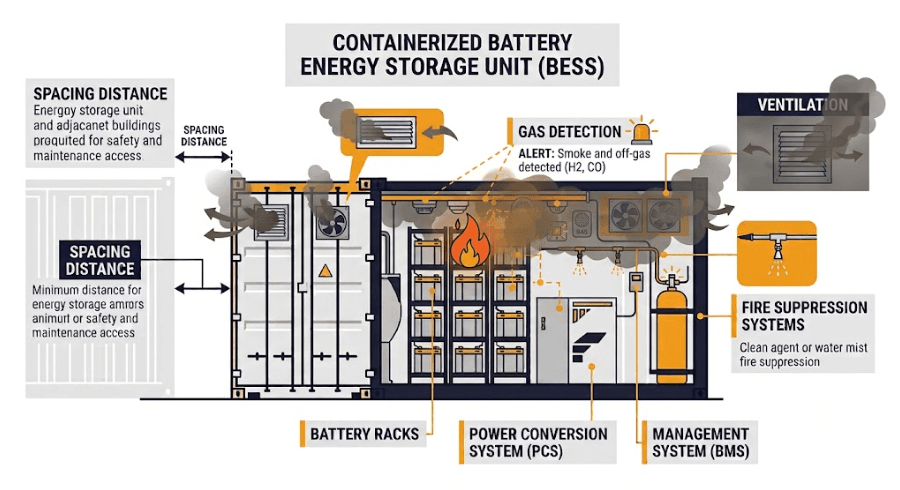
The standard addresses the full lifecycle of a battery energy storage system. That covers design, installation, commissioning, operation, maintenance, and decommissioning. In practice, most project teams also focus on five specific areas:
- Separation and spacing — distances between battery units, and between the ESS and exposures like buildings, property lines, and other hazards
- Fire detection and suppression — smoke and gas detection, plus sprinkler or other suppression systems sized to the installation
- Ventilation — exhaust systems that keep flammable gas concentrations below dangerous thresholds
- Explosion control — deflagration venting or prevention systems for enclosed spaces
- Hazard Mitigation Analysis (HMA) — a documented assessment of thermal runaway, fire propagation, and toxic gas risks for the specific installation
Why Thermal Runaway Is the Core Hazard
Every requirement in this guide exists to control one underlying hazard: thermal runaway. It starts when a single battery cell overheats past a critical point. The cell then generates heat faster than it can dissipate it.
This can trigger a self-sustaining chain reaction, where one failing cell heats its neighbors until they fail too. In the worst case, that cascade spreads across an entire rack or unit.
NFPA 855’s core requirements each target a different stage of this chain. Spacing and separation slow how fast a failure can spread to nearby units. Gas detection catches early off-gassing before it ignites. Ventilation clears flammable gases before they reach dangerous concentrations. Suppression systems, meanwhile, cool cells enough to interrupt the cascade.
The newest layer is Thermal Runaway Propagation Prevention (TRPP). Importantly, this active system goes a step further by detecting early precursors like off-gassing or abnormal temperatures. Consequently, it automatically triggers a targeted response to stop the failure before it ever reaches a neighboring cell.
The Hazard Mitigation Analysis ties all of this together — it’s the engineering process, led by a qualified PE, that sizes each control to your project’s specific chemistry and configuration, instead of applying generic rules.
NFPA 855 Scope and Applicability
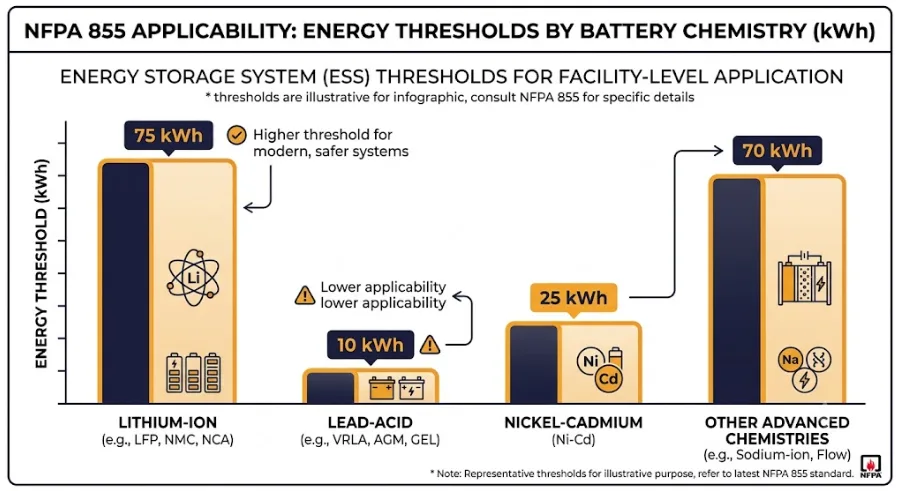
The first step is confirming the standard applies to your system at all. Applicability depends on battery chemistry and total stored energy, not project size alone. That said, below-threshold systems may fall outside full requirements. Your AHJ makes the final call.
| Battery Chemistry | Below Threshold | At or Above Threshold |
|---|---|---|
| Lithium-ion | < 20 kWh aggregate (may be exempt) | ≥ 20 kWh triggers full NFPA 855 requirements |
| Valve-regulated lead-acid (VRLA) | < 70 kWh aggregate (may be exempt) | ≥ 70 kWh triggers full NFPA 855 requirements |
| Other battery chemistries | Threshold set per chemistry table (2026 lists chemistries alphabetically) | Confirm with your AHJ before assuming exemption |
These thresholds still decide whether NFPA 855 applies to your system at all — that part hasn’t changed. What has changed is what happens once it does apply.
Previously, earlier editions let a project exceed the prescriptive threshold and still avoid a full Hazard Mitigation Analysis. It just had to stay under a separate “Maximum Stored Energy” cap in Chapter 9. The 2026 edition removed that cap entirely. As a result, once your system clears the Chapter 1 threshold, an HMA is the default requirement, not a fallback for oversized systems.
For example, a small server-room battery backup might still stay under 20 kWh and fall outside the standard’s full requirements. Almost any commercial, industrial, or utility-scale BESS, however, clears that threshold immediately. It now needs a documented HMA from the design stage, with no quantity-based way around it.
Source: Telgian Engineering & Consulting — NFPA 855 Changes in the 2026 Edition
What’s New in the 2026 Edition
This standard runs on a three-year revision cycle. The 2026 edition, however, brought some of the most significant changes since its 2020 debut. Here’s what stands out for project developers, grouped by area.
Hazard Mitigation Analysis and Professional Oversight
- Hazard Mitigation Analysis is now the default. Earlier editions required an HMA only in specific circumstances. The 2026 edition makes it the default requirement for most installations, with limited exceptions for well-understood chemistries like lead-acid.
- A registered design professional must direct the risk assessment. Annex G now specifically names who should lead the Hazard Mitigation Analysis: a registered design professional (a licensed PE) experienced in fire protection engineering and energy storage risk assessment. The 2023 edition only referred to “parties,” with no qualification requirement attached.
New and Expanded Safety Systems
- Thermal Runaway Propagation Prevention (TRPP) systems are now required. Section 9.7.6.6 introduces TRPP as a new, active fire-safety layer. Unlike passive features such as spacing or barriers, a TRPP system relies on active monitoring. Specifically, it detects early precursors like off-gas or abnormal temperatures. As a result, the system automatically triggers a targeted suppression or cooling response to stop the failure from spreading.
- Large-scale fire testing (LSFT) plays a bigger role. Previous editions leaned on UL 9540A cell, module, and unit-level testing. The 2026 edition adds large-scale fire testing. In this test, a full unit burns under real-world conditions with suppression disabled. This validates worst-case performance.
- Explosion-control guidance gets more specific. Annex G.8, which covers NFPA 69 evaluations for lithium-ion ESS, was revised with new engineering design and risk-mitigation considerations. Design teams now have clearer guidance for evaluating the consequences of an explosion event, not just whether one is possible.
Detection, Chemistry, and Emergency Planning
- Detection methods expand for lithium-ion storage. Section 14.3.2.1.2 now allows smoke detection, thermal imaging, or radiant-energy detection installed per NFPA 72, replacing the older, narrower detection language. A related new section, 14.1.3, also lets batteries staged or stored temporarily at 50% state of charge or below skip full Chapter 14 compliance, under defined conditions.
- Chemistry and application coverage expands. Additionally, the 2026 edition lists more battery chemistries. Furthermore, it drops the old subdivision between battery technologies and capacitor-based systems. It also adds two new chapters: Chapter 16 for flow batteries and Chapter 17 for energy storage systems on barges, plus expanded coverage of EV charging systems that include integrated energy storage.
- Emergency planning becomes formal. The 2026 edition adds specific minimum requirements for an Emergency Response Plan and a training program. The plan must address mitigation, preparedness, response, and recovery, with an annual review and a yearly refresher training session that the AHJ is notified of.
Source: Telgian Engineering & Consulting — NFPA 855 Changes in the 2026 Edition
Model fire codes take time to catch up. The 2024 International Fire Code, for example, still references NFPA 855-2023, not the 2026 edition. Many jurisdictions currently enforce that earlier version by default, even though NFPA has already published the newer standard. Because adoption timing varies by state and city, always confirm with your AHJ which edition actually governs your permit today, rather than assuming the newest edition automatically applies.
Source: IndexBox — NFPA 855 2026 Edition Updates
NFPA 855 Emergency Response and Backup Power Requirements
The 2026 edition adds two requirements that project teams commonly miss because they sit outside the usual spacing-and-suppression conversation.
Emergency Response Plan (ERP)
Every covered installation now needs a documented Emergency Response Plan. The plan must address four phases: mitigation, preparedness, response, and recovery. Facility operators must also run a training program for personnel, review the emergency operations plan annually, and hold a refresher training session every year. The AHJ must be notified when that training happens.
Emergency Power Supply Systems (EPSS/SEPSS)
New Section 4.10 requires that critical safety systems have reliable backup power. This applies to Emergency Power Supply Systems (EPSS) or Stored Emergency Power Supply Systems (SEPSS), built to NFPA 110 or NFPA 111. In practice, this means detection, suppression, and ventilation controls can’t silently fail during a grid outage. Per Section 4.10.22, the EPSS or SEPSS design must be available to the Fire Protection Engineer of record and the AHJ for review and approval, so this needs to enter the design package early, not as an afterthought during commissioning.
Source: Telgian Engineering & Consulting — NFPA 855 Changes in the 2026 Edition
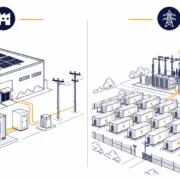
NFPA 855 for C&I vs Utility-Scale BESS
The core framework applies the same way across project types. Practical requirements, however, shift with scale.
- Larger installations trigger stricter spacing and suppression requirements. Our C&I vs utility-scale BESS comparison covers the full picture. Utility-scale plants pack far more energy into open sites, so spacing tables scale up accordingly. C&I systems, meanwhile, sit next to occupied buildings and face tighter fire-marshal review instead.
- C&I systems usually sit close to occupied structures. As a result, local fire marshal review and building setback rules carry extra weight alongside these requirements.
- Utility-scale systems sit on purpose-built sites. Because of this, compliance centers more on large-scale fire testing data, explosion control, and emergency response planning coordinated with the local fire department.
- Both project types need UL 9540A test data. Otherwise, they can’t satisfy the engineering basis for spacing and suppression design.
How NFPA 855 Relates to Other Standards
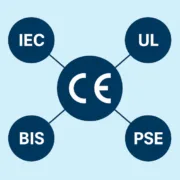
This standard doesn’t work alone. It references and depends on several other standards. Confusing them is a common, costly mistake.
Fire and Thermal Testing Standards
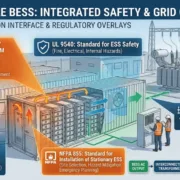
- UL 9540 — the product-level safety certification for a complete energy storage system. Compliance also requires UL 9540-listed equipment.
- UL 9540A — the test method that measures thermal runaway fire propagation. Its results set the engineering basis for spacing and suppression decisions. The 6th edition, published alongside the 2026 NFPA 855 cycle, expands the certification framework to address spacing and fire propagation directly, rather than leaving those as separate design considerations.
- CSA/ANSI C800:25 — a newly published consensus standard for large-scale fire testing and ESS reliability. NFPA 855’s 2026 edition requires large-scale fire testing, but had no consensus test method to reference when it was finalized. CSA/ANSI C800:25 fills that gap, and NFPA has an open Tentative Interim Amendment (TIA Log No. 1852) proposing to formally reference it in Section 9.7. Worth tracking if you’re specifying test protocols today, since the reference may become official shortly after this guide’s publication.
Related Electrical, Grid, and Emerging Standards
- IEEE 1547 — governs grid interconnection behavior for distributed energy resources. It sits outside this standard’s fire-safety scope, but it often appears in the same project approval package.
- NEC Article 706 — the National Electrical Code section covering electrical installation requirements for energy storage systems above 1 kWh.
- NFPA 800 (forthcoming) — a new Battery Safety Code currently under development, with public input accepted through January 2026. Once adopted, NFPA 800 is intended to address battery hazards across the full lifecycle, not just installation, and to complement NFPA 855. Over time, it may shift or replace some of the storage-specific provisions NFPA 855 currently covers. Worth watching if you’re planning a multi-year project timeline.
For the complete standards landscape, see our guide to ESS codes and standards for utility-scale BESS.
Source: CSA Group — CSA/ANSI C800:25: A New Standard for ESS Reliability and Quality Assurance
Source: NFPA — Proposed TIA Log No. 1852 to NFPA 855-2026
Source: Energy-Storage.News — NFPA 855: 2026 edition updates and what they mean for energy storage projects
NFPA 855 Compliance Checklist
Use this sequence to build compliance into a project. Otherwise, you risk discovering requirements late, during permitting:
- Confirm applicability — check your chemistry and stored energy against the current threshold table.
- Then, select UL 9540-listed equipment with UL 9540A test data covering your configuration.
- Complete a Hazard Mitigation Analysis, led by a registered design professional (PE) with fire-protection and energy-storage risk-assessment experience. The 2026 edition makes the HMA itself the default requirement, and Annex G now specifically calls for that qualification.
- Also, design spacing, ventilation, detection, and suppression to the applicable chapter for your chemistry and installation type.
- Add explosion control per NFPA 69, or document a performance-based alternative.
- Draft an Emergency Response Plan covering mitigation, preparedness, response, and recovery, with an annual review and yearly refresher training built into your operating plan.
- Confirm backup power for critical safety systems (EPSS/SEPSS per NFPA 110/111) and route the design through your Fire Protection Engineer and the AHJ before finalizing.
- Finally, engage your AHJ early. Local adoption varies by state and jurisdiction. So, confirm which edition applies before finalizing your design.
Key Takeaways: NFPA 855
In short, this standard sets the fire-safety baseline for every battery energy storage system in the U.S., from a home battery to a utility-scale plant. The 2026 edition raises the bar with mandatory hazard analysis and large-scale fire testing. Compliance depends on chemistry, stored energy, and project scale. Therefore, the earlier you plan for it, the fewer surprises you’ll hit during permitting.
Frequently Asked Questions
Is NFPA 855 a Law or a Standard?
NFPA 855 is a consensus standard, not a law by itself. However, it carries legal weight once a jurisdiction adopts it, typically through NFPA 1 or the International Fire Code. Because adoption varies by state and city, always confirm which edition your local AHJ enforces.
Does It Apply to All Battery Chemistries?
Yes. The standard is technology-neutral and covers lithium-ion, lead-acid, flow batteries, nickel-based systems, and others. Each chemistry gets its own energy threshold. Consequently, the same project might qualify for an exemption under one chemistry and not another.
What’s the Difference Between UL 9540A and NFPA 855?
UL 9540A is a test method. It measures how far a fire propagates inside a battery system. NFPA 855, meanwhile, is the installation standard that uses those test results to set spacing, suppression, and separation requirements. Ultimately, you need UL 9540A data to satisfy it, not the other way around.
Does Compliance Differ for C&I vs Utility-Scale BESS?
The core framework stays the same, but practical requirements scale with the project. Utility-scale plants face larger spacing tables and heavier reliance on large-scale fire test data. C&I systems, meanwhile, face tighter scrutiny from local fire marshals, because they sit closer to occupied buildings.
When Does the 2026 Edition Take Effect?
NFPA publishes new editions on a regular three-year cycle, and 2026 follows that schedule. Model fire codes typically adopt a given edition about a year later. Because of this, check with your local AHJ to confirm which edition governs your permit application today.
Is Large-Scale Fire Testing Fully Standardized Yet?
Not completely. NFPA 855:2026 requires large-scale fire testing, but no consensus test method existed when the edition was finalized. CSA/ANSI C800:25, published shortly after, is expected to fill that role. NFPA has an open Tentative Interim Amendment proposing to formally reference it in Section 9.7. Until that TIA resolves, confirm your test protocol directly with your AHJ and testing lab.
Related Reading
- C&I vs Utility-Scale BESS: The Complete Comparison Guide
- ESS Codes and Standards for USA Utility-Scale BESS
- UL 9540A Test Method: Complete Guide for BESS Manufacturers
- Understanding BESS Specifications: The Complete Guide
- Battery Energy Storage System Safety
- BESS Certifications: Compliance Guide & Checklist
References
- NFPA 855 — Standard for the Installation of Stationary Energy Storage Systems (official product page)
- NFPA 855: Improving Energy Storage System Safety — American Clean Power overview





Trackbacks & Pingbacks
[…] distances and layout. A preliminary estimate still needs a compliant site review. See our NFPA 855 guide for more […]
[…] NFPA 855 Guide for BESS Safety and Compliance […]
[…] does not change NFPA 855 compliance directly. But faster fault isolation in a string design can support the hazard […]
[…] example, NEC Article 706 sets the U.S. baseline for a BESS grounding system. Also, our NFPA 855 guide covers the fire-code side of siting and spacing. Meanwhile, lightning protection sits alongside a […]
[…] help ensure that your battery energy storage system operates safely and reliably. Read our detailed NFPA 855 Guide to learn more about installation and fire safety […]
[…] Therefore, project developers must design installations to NFPA 855 from day one. Failing to do so results in permit denial — often after costly design work is already complete. For a deeper look into compliance steps, spacing rules, and permitting, read our Complete NFPA 855 Guide. […]
[…] BESS installations — whether residential, commercial, or utility-scale — fall under NFPA 855 and the International Fire Code in most U.S. states. Both codes reference the UL 9540A Test Method directly as the required fire safety test for stationary energy storage systems. Moreover, the National Fire Protection Association updates NFPA 855 regularly to reflect new battery technologies and installation environments. For a deeper dive into these installation standards, see our Complete Guide to NFPA 855. […]
[…] Learn more here: SunLith Energy – Ultimate NFPA 855 Guide […]
Leave a Reply
Want to join the discussion?Feel free to contribute!