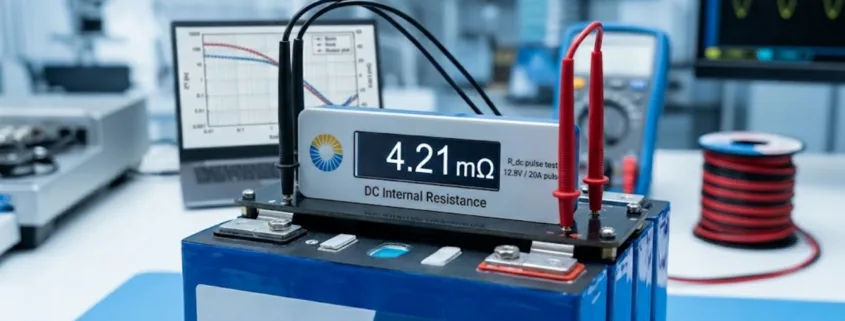
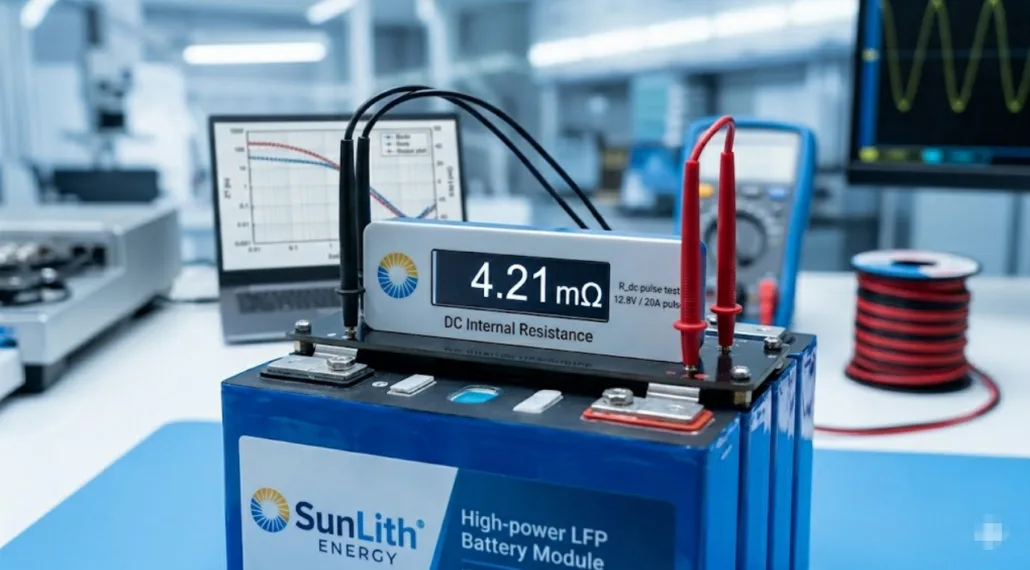
ACIR gives us a snapshot of a cell’s physical integrity. However, DC Internal Resistance (DCIR) tells us how that cell performs when the grid calls for power.
Understanding DC Internal Resistance LFP metrics is critical for managing grid-scale BESS . ACIR provides a snapshot of physical integrity. However, DCIR determines performance during immediate power demands
This article breaks down the fundamentals of DCIR. Moreover, it explains why this is the definitive metric for grid-scale storage and how we engineer around it.
Why DC Internal Resistance LFP Metrics Matter
Specifically, DCIR measures the voltage drop during a high-current DC pulse. ACIR uses a 1 kHz frequency to bypass electrochemical reactions. In contrast, DCIR forces the battery to move ions. This provides a “real-world” measurement of the battery’s actual ability to deliver power under load.
Mathematically, it is calculated from the change in voltage (ΔV) over the change in current (ΔI):
DCIR FORMULA R₂ₙ = (Vᵢₙᵢₜᵢₐₗ − Vₗₒₐ₂) / Iₗₒₐ₂ R₂ₙ = DC Internal Resistance Vᵢₙᵢₜᵢₐₗ = Open circuit voltage Vₗₒₐ₂ = Voltage under load Iₗₒₐ₂ = Applied current
This single measurement captures two distinct resistance sources:
DCIR includes:
Ohmic Resistance — The physical resistance of tabs, current collector foils, and the electrolyte itself. Furthermore, this is what ACIR also measures.
Polarization Resistance — The “chemical friction” lithium ions face as they diffuse through the electrolyte and intercalate into electrode particles. Specifically, this is invisible to ACIR, and it’s where the real performance story lives.
Why DC Internal Resistance LFP Is the “Real-World” Metric for BESS
In a Battery Energy Storage System, cells are never sitting idle — they are responding to dynamic, unpredictable grid demands. Here is why DCIR monitoring is non-negotiable for any serious integrator.
1. Predicting Heat Generation
Thermal stress is driven by DCIR, not ACIR Furthermore, according to Joule’s Law (P = I²R), heat generation is directly proportional to resistance. Because DCIR is significantly higher than ACIR, it is the primary driver of thermal stress in a running cell. High DC Internal Resistance LFP leads to hot spots. Therefore, it can trigger BMS shutdowns or accelerate aging This relationship is defined by Joule’s Law, which states that heat increases with the square of the current
2. Eliminating Voltage Sag
In addition, high DC Internal Resistance LFP causes trips even at 20% SOC Have you ever seen a BESS unit trip even though the State of Charge showed 20%? That is often due to high DCIR. For instance, under a heavy load, high resistance causes the voltage to “sag.” This often drops below the inverter’s cutoff threshold even though charge remains. Therefore, lower DCIR ensures a stable power delivery curve that your inverter can trust.
3. State of Health (SOH) Tracking
DC Internal Resistance LFP rises before capacity degrades visibly While ACIR is great for initial cell grading, DCIR is a superior indicator of aging. As LFP cells age and the SEI layer thickens, DCIR increases significantly — long before capacity degrades visibly. In addition, monitoring this trend allows for predictive maintenance and avoids unexpected field failures. Specifically,, monitoring these trends allows for predictive maintenance.
DC Internal Resistance LFP vs. ACIR: A Quick Comparison
Both measurements have a role to play in a rigorous quality program. The key is knowing which question each one actually answers.
Feature
ACIR (1 kHz)
DCIR (Pulse Test)
Method
Small AC sine wave
Large DC current pulse
What it captures
Ohmic / physical resistance only
Ohmic + polarization resistance
Primary focus
Physical & mechanical cell health
Chemical & kinetic performance
Best used for
Cell sorting & incoming QC
System modeling & thermal planning
Aging sensitivity
Low – changes slowly with age
High – rises with SEI layer growth
Measurement speed
Very fast (<1 second)
Seconds to minutes per cell
Real-world accuracy
Indicative only
Directly predictive of field behavior
Engineering for Reliability at SunLith Energy Our integration process goes beyond simple module assembly. Specifically, we implement rigorous testing protocols to ensure every module meets strict DCIR benchmarks. — aligning our practices with global standards including IEC 62619 and UL 1973, as well as BIS and GB/T requirements for grid-scale safety.6,000+ target cycles <20% max resistance growth 0.5C peak C-rate optimized Our DCIR-optimized systems deliver: Thermal stability at high C-rates 6,000+ cycles with minimal resistance growth Full compliance: IEC 62619 · UL 1973 · BIS · GB/T
The Bottom Line: ACIR is the heartbeat — it tells you the cell is physically alive. In contrast, DCIR is the stamina—it tells you whether that cell can perform. when the grid calls. Ultimately, to build a truly bankable BESS, you must master both.
Want to learn more about how we optimize LFP performance?
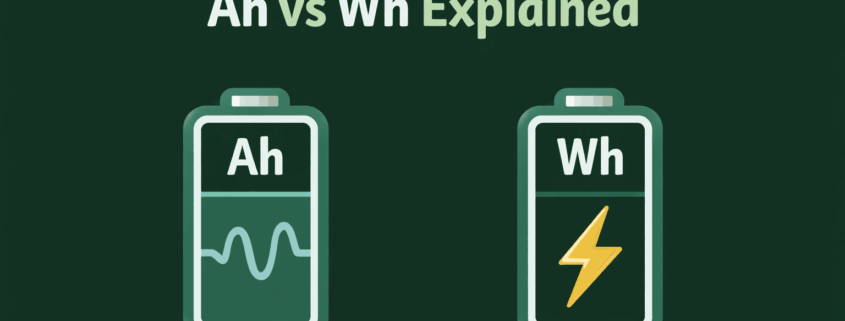
The Ah vs Wh debate comes up every time you shop for a battery. You see both numbers on every spec sheet. However, most buyers ignore one of them. That is a costly mistake. Ah and Wh measure different things. Confusing them leads to choosing the wrong battery size.
In this guide, Sunlith Energy breaks down both measurements. You will learn the formula that links them. Additionally, you will see real conversion examples. Furthermore, we share a step-by-step method to size your own battery system correctly.
According to the International Energy Agency, battery storage is central to the global clean energy transition. Therefore, understanding how battery capacity is measured matters more than ever. Every buyer deserves to get this right.
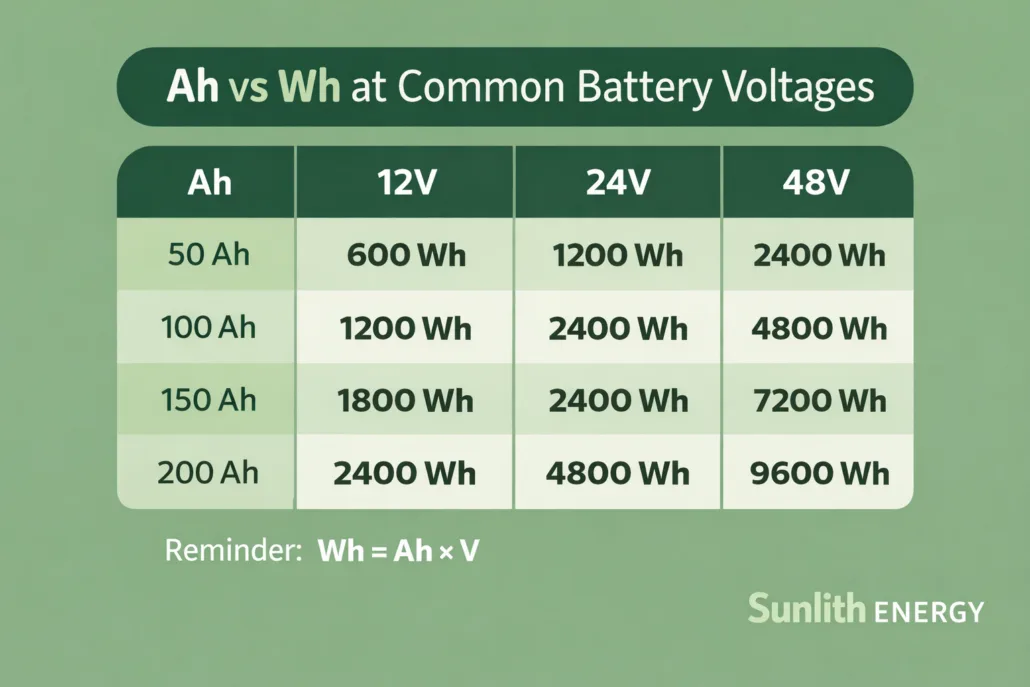
⚡ Quick Answer: Ah vs Wh Ah measures electric charge — how much current a battery delivers over time. Wh measures actual energy — charge multiplied by voltage. The formula: Wh = Ah × Voltage. For example, 100 Ah at 48V = 4,800 Wh. In contrast, 100 Ah at 12V = only 1,200 Wh. As a result, Wh is always the better metric for comparing batteries across different systems.
What Does Ah Mean? The Charge Side of Ah vs Wh
Ah stands for Amp-hours. It measures electric charge. Specifically, it tells you how many Amps a battery delivers and for how long.
The rule is simple. One Ah means 1 Amp delivered for exactly 1 hour. However, it could also mean 2 Amps for 30 minutes. Alternatively, it could be 10 Amps for 6 minutes. The total charge is always the same — only the rate changes.
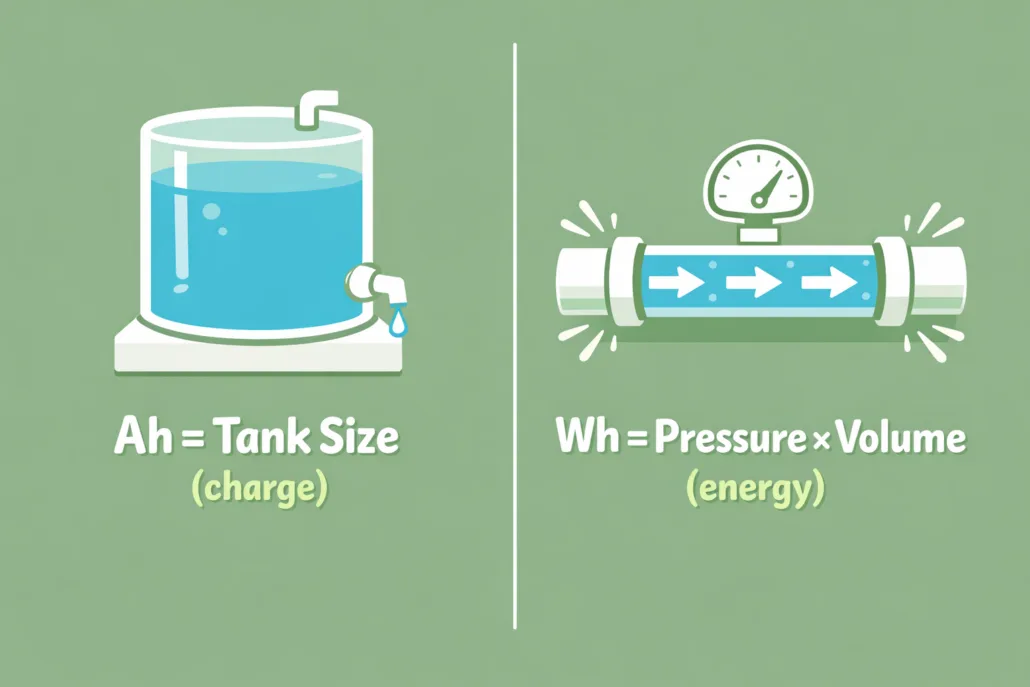
🚿 Think of Ah Like a Garden Hose Ah is the tank size. A 100 Ah battery holds enough charge for 100 Amps over 1 hour. Turn the tap up — it drains faster. Turn it down — it lasts longer. However, the total water in the tank stays the same.
When to Use Ah in the Ah vs Wh Decision
Calculating runtime — how long a battery powers a fixed-current device
Setting charge rates — C-rate is always expressed relative to Ah
Designing battery banks — when all batteries share the same voltage
Comparing batteries of identical voltage side by side
There is one important limitation. Ah is voltage-independent. Therefore, a 100 Ah battery at 12V and a 100 Ah battery at 48V have the same Ah rating. Even so, they store very different amounts of energy. That is the most common battery-buying mistake.
Wh stands for Watt-hours. It measures actual energy. Because it accounts for voltage, Wh is the more complete measurement.
Furthermore, battery energy density is expressed in Wh/kg. So understanding Wh also helps you compare weight-to-energy ratios across different chemistries.
💧 Wh = Pressure × Volume If Ah is the tank size, Wh is the total force the water delivers. That force depends on volume AND pressure (voltage). In contrast to Ah, Wh gives you the full energy picture. More voltage means more energy for the same Ah.
When to Use Wh in the Ah vs Wh Decision
Comparing batteries at different voltages — for example, 12V vs 48V
Good news: only one formula connects Ah and Wh. Voltage is the bridge between them.
Wh = Ah × Voltage (V) Reversed: Ah = Wh ÷ Voltage For mAh: Wh = (mAh ÷ 1000) × Voltage
⚡ Interactive Ah ⇄ Wh Calculator
Calculated Result
4,800 Wh (4.8 kWh)
This explains why two batteries with the same Ah can store very different energy. Higher voltage multiplies charge into more usable Wh. As a result, 48V systems deliver far more energy per Ah than 12V setups. That is why 48V has become the standard for modern residential solar.
Ah vs Wh Conversion Examples — Real Numbers
Below are three practical examples. Each one shows how to apply the Ah vs Wh formula step by step.
Example 1 — Home Solar Battery (LiFePO4, 48V) → Battery rated: 100 Ah at 48V nominal → Formula: Wh = 100 × 48 ✅ 4,800 Wh (4.8 kWh) — runs a full-size fridge for about 2 full days
Example 2 — Portable Power Station (12V) → Battery rated: 50 Ah at 12V nominal → Formula: Wh = 50 × 12 ✅ 600 Wh — charges a laptop approximately 10 times
Example 3 — Smartphone Battery (mAh to Wh) → Battery rated: 5,000 mAh at 3.7V → Step 1: 5,000 ÷ 1,000 = 5 Ah → Step 2: Wh = 5 × 3.7 ✅ 18.5 Wh — a typical mid-range smartphone battery
⚡ Quick mAh Shortcut For 3.7V lithium cells: Wh ≈ mAh × 0.0037. Therefore, a 10,000 mAh power bank ≈ 37 Wh. Never compare mAh values from batteries with different voltages. Because voltage differs, the mAh number alone tells you nothing about energy.
Ah vs Wh — Which Metric Should You Use?
Both measurements are useful. However, the right choice depends on your question. Use this table as a quick reference:
Your Question
Use
Why
How long will my device run?
Ah
Runtime = Ah ÷ current draw
Which battery stores more energy?
Wh
Wh compares across voltages
Can I run a 100 W device for 3 hrs?
Wh
300 Wh needed — easy math
How fast can I charge this battery?
Ah
C-rate is always Ah-based
LiFePO4 vs NMC — which has more?
Wh
Different voltages make Ah wrong
Sizing solar panels and controller?
Ah
Fixed-voltage design uses Ah
Airline carry-on battery limits?
Wh
IATA rules: 100 Wh / 160 Wh
In summary: use Ah for current and time calculations within a fixed-voltage system. For everything else, use Wh. Comparing batteries across voltages or chemistries? Wh is always the right choice.
Same Ah, Very Different Energy — Why Voltage Changes Everything
Many buyers compare batteries on Ah alone. This is a common and expensive mistake. Voltage changes everything. Below is a clear example:
Battery
Ah
Voltage
Energy (Wh)
Powers...
Van / camping pack
50 Ah
12V
600 Wh
Laptop ~10×
Home 12V bank
100 Ah
12V
1,200 Wh
Fridge ~12 hrs
Home 24V bank
100 Ah
24V
2,400 Wh
Fridge ~24 hrs
Solar 48V system
100 Ah
48V
4,800 Wh
Fridge ~2 days
C&I 48V system
200 Ah
48V
9,600 Wh
Office ~1 day
As the table shows, identical Ah ratings hide very different energy levels. Consequently, always convert to Wh before comparing. For more on how chemistry affects this, see our LiFePO4 vs NMC battery guide.
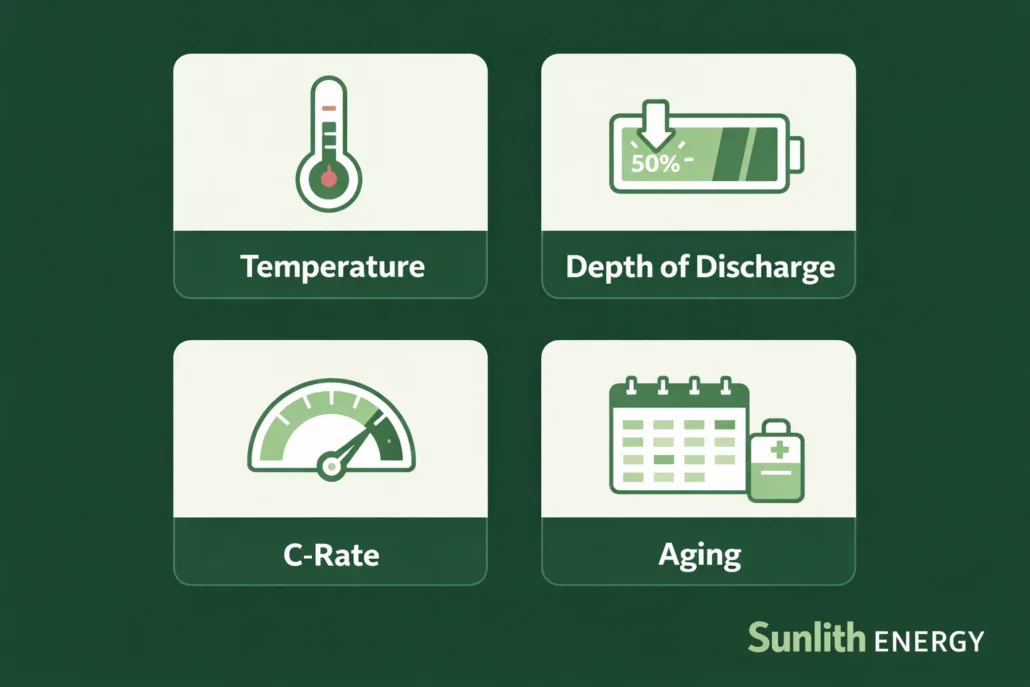
What Reduces Your Real-World Ah vs Wh Capacity?
Battery labels show the theoretical maximum. In practice, usable capacity is always lower. Several factors reduce what you actually get. Understanding them is essential for accurate sizing.
1. Depth of Discharge (DoD)
Most batteries should not be fully drained. Doing so permanently damages cells. The safe depth of discharge varies by chemistry:
LiFePO4: 80–90% DoD — consequently, usable Wh = 80–90% of rated Wh
Lead-acid: only 50% DoD — therefore, you lose half your rated capacity
NMC: typically 80–85% for a long cycle life
2. Temperature
Cold weather hurts batteries significantly. Below 10°C, deliverable Ah drops by 20–30%. Temperature directly impacts LiFePO4 cycle life — a rise of 10°C above 25°C can halve total cycle life. Heat, on the other hand, temporarily boosts apparent capacity. However, it accelerates permanent degradation at the same time.
3. Discharge Rate (C-Rate)
Drawing current too fast reduces total Wh delivered. For example, a battery discharged at 2C gives fewer Wh than the same battery at 0.5C. Always check the C-rate used during the manufacturer's Ah test. Because a 0.2C rating looks far better than real-world 1C performance.
4. Battery Aging
Every cycle causes a small, permanent capacity loss. At 500 cycles, most batteries retain about 90%. At 1,000+ cycles, the best LiFePO4 cells still retain 70–80%. Consequently, factor aging into your long-term Wh budget when sizing.
5. System Efficiency Losses
Inverters, charge controllers, wiring, and BMS all consume energy. Modern lithium systems typically achieve 85–95% round-trip efficiency. Therefore, add a 10–15% buffer on top of your calculated Wh need. This protects you from real-world losses.
This efficiency depends heavily on how well the battery management system manages charge and discharge cycles — learn how a BMS works
How to Size Your Battery System Using Ah vs Wh
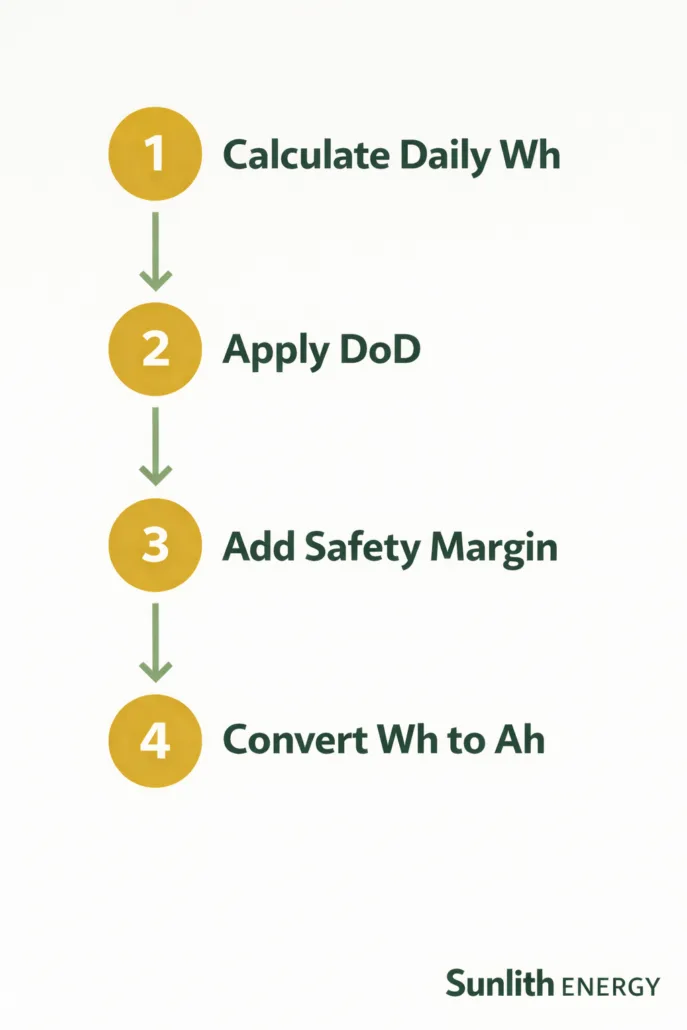
Now let's put it all together. Below is a simple four-step sizing method. It is the same approach used in our solar battery sizing guide.
For a commercial (C&I) version of this math that uses interval load data and a demand-charge target instead of daily appliance totals, see our Peak Shaving Battery Sizing guide.
Step 1 — Calculate Your Daily Wh Requirement
List every appliance you want to power. Write down its wattage and daily run hours. Multiply watts by hours for each device. Then add them all together. For example: a 50W fridge runs 24 hours = 1,200 Wh. Four 25W LED lights run 5 hours = 500 Wh. Total: 1,700 Wh per day. Additionally, add 10% for hidden standby loads — bringing the total to about 1,870 Wh.
Step 2 — Apply the Depth of Discharge
Divide your daily Wh by the safe DoD. For LiFePO4 at 80% DoD: 1,870 ÷ 0.80 = 2,338 Wh of rated capacity needed. This step is essential. It ensures you never drain the battery below its safe limit. As a result, both lifespan and warranty are protected.
Step 3 — Add a Safety Margin
Multiply your result by 1.15 to 1.20. This covers system losses, aging, and seasonal variation. In our example: 2,338 × 1.20 = 2,806 Wh minimum rated capacity. Therefore, look for a battery bank rated at or above 2,800 Wh.
Step 4 — Convert Wh Back to Ah
Use Ah = Wh ÷ Voltage. At 48V: 2,806 ÷ 48 ≈ 58 Ah. At 24V: 2,806 ÷ 24 ≈ 117 Ah. At 12V: 2,806 ÷ 12 ≈ 234 Ah. As a result, higher-voltage systems need far fewer Ah. That is why 48V has become the industry standard for residential solar.
☀️ Sunlith Off-Grid Tip For solar or off-grid systems, size for at least 2 days without sun. Multiply your daily Wh by 2 before applying DoD and the safety margin. This protects against cloudy days and seasonal dips. → Read more: Ultimate Guide to Battery Energy Storage Systems (BESS)
Ah vs Wh — Frequently Asked Questions
Q: Is a higher Ah battery always better?
No — not always. A higher Ah means more charge, not more energy. Voltage is the missing piece. For example, 200 Ah at 12V = 2,400 Wh. However, 100 Ah at 48V = 4,800 Wh. Therefore, always compare Wh — not Ah alone.
Q: Can I compare a 12V 100 Ah battery with a 24V 100 Ah battery?
No — not on Ah alone. Convert both to Wh first. 100 × 12 = 1,200 Wh. In contrast, 100 × 24 = 2,400 Wh. The 24V battery stores twice the energy. For a full chemistry breakdown, see our LiFePO4 vs NMC battery guide.
Q: What does 100 Ah mean in practical terms?
A 100 Ah battery delivers 100 Amps for 1 hour. Alternatively, it delivers 10 Amps for 10 hours. Furthermore, it delivers 1 Amp for about 100 hours. In a 12V system, 100 Ah = 1,200 Wh. In a 48V system, 100 Ah = 4,800 Wh. Additionally, apply the DoD to find the safe, usable portion.
Q: How many Wh do I need for an off-grid solar system?
A small cabin typically needs 1–3 kWh per day. A home averages 10–30 kWh per day. Furthermore, size for 2 days of autonomy for cloudy periods. Our detailed solar sizing guide walks through the full calculation with examples.
Q: Does temperature affect Ah vs Wh?
Yes — it affects both. Cold temperatures reduce deliverable Ah. Consequently, usable Wh also drops. High heat temporarily boosts apparent capacity. However, it causes permanent degradation over time. LiFePO4 handles temperature extremes better than NMC. For the full data, see our post on temperature impact on LiFePO4 cycle life.
Q: What is the difference between mAh and Ah?
mAh means milliamp-hours. There are 1,000 mAh in 1 Ah. Consumer devices use mAh because the numbers are easier to read. To convert: divide mAh by 1,000 to get Ah. Then multiply by voltage to get Wh. For example: 5,000 mAh ÷ 1,000 × 3.7V = 18.5 Wh.
Q: What Wh limits apply to lithium batteries on aeroplanes?
According to IATA's Lithium Battery Guidance, passengers may carry batteries up to 100 Wh without airline approval. Batteries between 100 Wh and 160 Wh require specific approval. Batteries above 160 Wh are generally not allowed in carry-on. Because rules vary by carrier, always confirm with your airline before travelling.
Q: Is LiFePO4 better than NMC for solar storage?
In most cases, yes. LiFePO4 offers better thermal safety and a longer cycle life. Its thermal runaway threshold is ~270–300°C, versus ~150°C for NMC. Furthermore, LiFePO4 performs more consistently in extreme temperatures. In contrast, NMC offers higher energy density — so it suits weight-constrained applications better. Compare both in our NMC vs LFP safety guide.
Q: Do BESS systems need certifications?
Yes — especially for commercial or grid-connected installations. Key certifications include UL 9540, IEC 62619, and CE Marking. Our BESS certifications guide covers every major standard required in 2026, what each tests, and the cost of skipping them.
Q
Conclusion — Ah vs Wh Made Simple
Knowing the Ah vs Wh difference saves you from bad battery decisions. Ah measures charge. Wh measures energy. The formula Wh = Ah × Voltage connects them. Use Ah for runtime and charge rate calculations. For everything else — especially cross-voltage comparisons — use Wh.
Additionally, always apply DoD, temperature effects, C-rate, and aging when estimating real-world usable capacity. The number on the label is a theoretical maximum. Your actual usable capacity will always be lower.
Whether you are planning a home solar install or a commercial BESS project, the Ah vs Wh distinction is the right place to start. Get it right — and every other sizing decision becomes easier.
Need Help Choosing the Right Battery? Our Sunlith Energy experts size your system — solar, BESS, off-grid, or C&I. No jargon. No pressure. Contact us: sunlithenergy.com/contact Browse our solutions: sunlithenergy.com
Introduction: Why Talk About the Advantages of Battery Energy Storage System (BESS)?
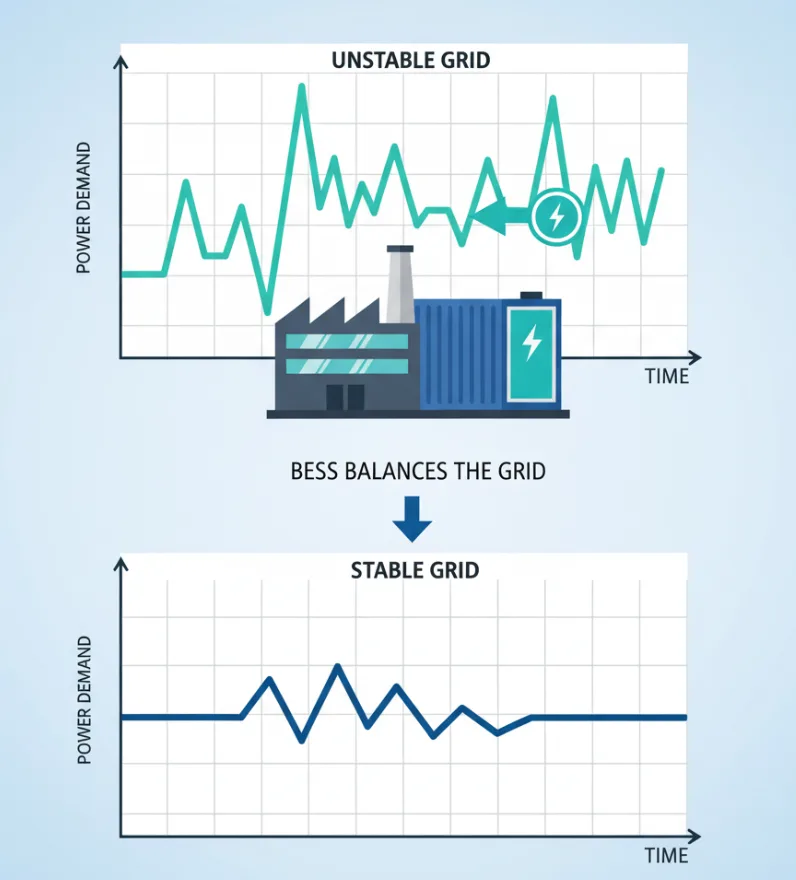
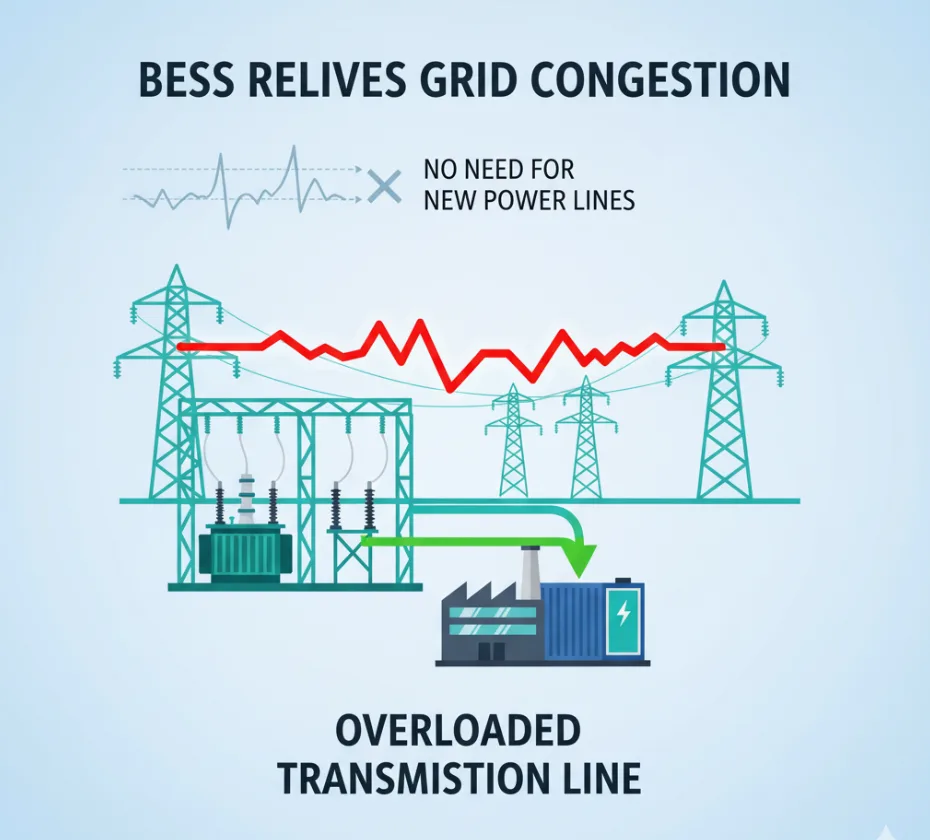
The advantages of Battery Energy Storage System (BESS) are shaping the future of clean energy. As renewable adoption accelerates, the need for reliable, flexible, and scalable energy storage has never been greater. From utilities struggling with grid fluctuations to businesses facing high demand charges, BESS offers a transformative solution.
At Sunlith Energy, we help industries, communities, and utilities realize the full advantages of Battery Energy Storage System (BESS) by providing solutions designed for safety, scalability, and sustainability. This article explores over 10 detailed advantages, supported with practical examples, financial impacts, and future trends.
What is a Battery Energy Storage System (BESS)?
Before diving into the advantages of Battery Energy Storage System (BESS), it’s important to understand what it is.
2. Renewable Energy Integration: Unlocking the Advantages of Battery Energy Storage System (BESS)
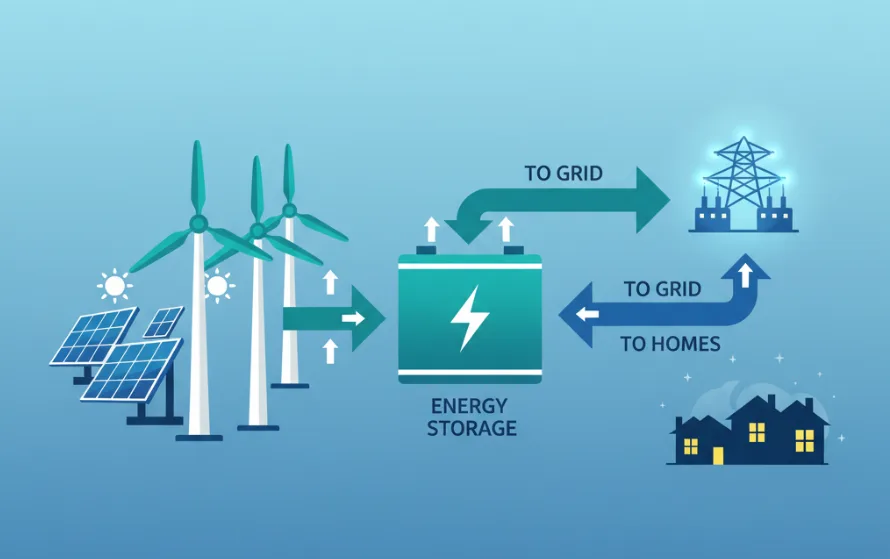
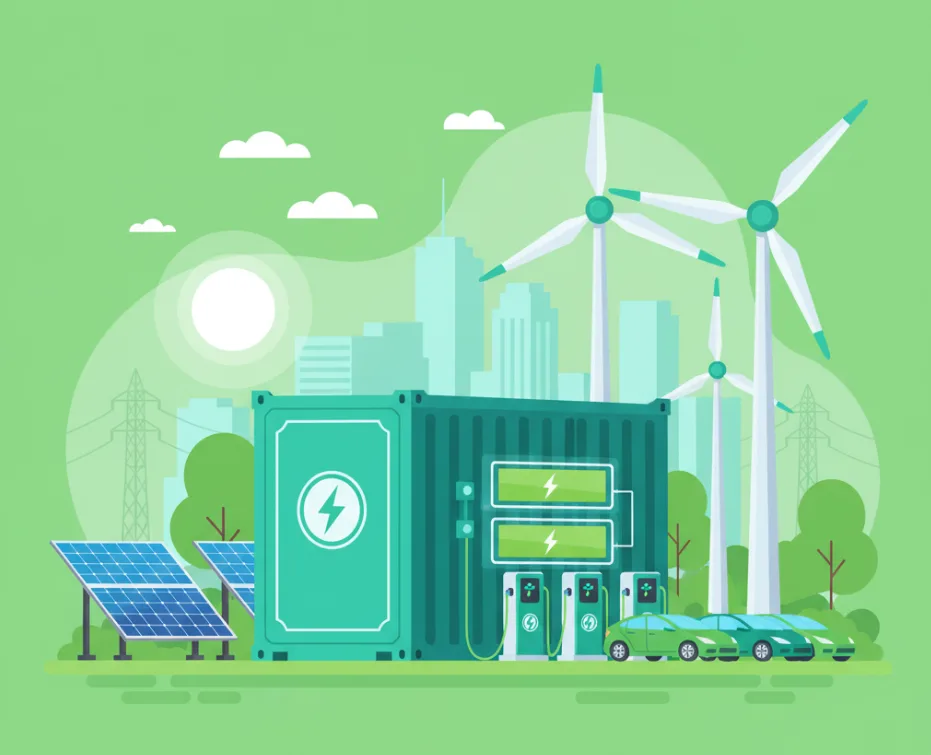
Solar and wind power are intermittent, which can cause reliability issues. One of the clear advantages of Battery Energy Storage System (BESS) is renewable integration.
Store midday solar surplus → release in evening peaks.
Smooth wind ramp-ups and sudden drops.
Reduce renewable curtailment by capturing excess generation.
👉 At Sunlith Energy, we deploy hybrid systems combining solar/wind with BESS for firm, round-the-clock renewable power.
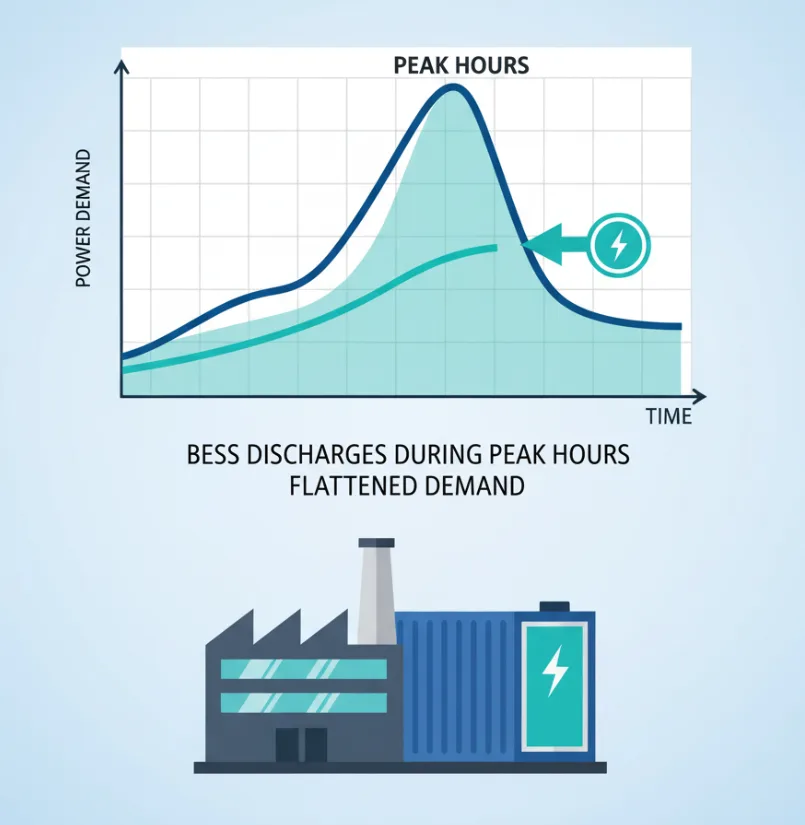
3. Peak Shaving: A Cost-Saving Advantage of Battery Energy Storage System (BESS)
For businesses, one of the most direct advantages of Battery Energy Storage System (BESS) is lowering electricity costs through peak shaving.
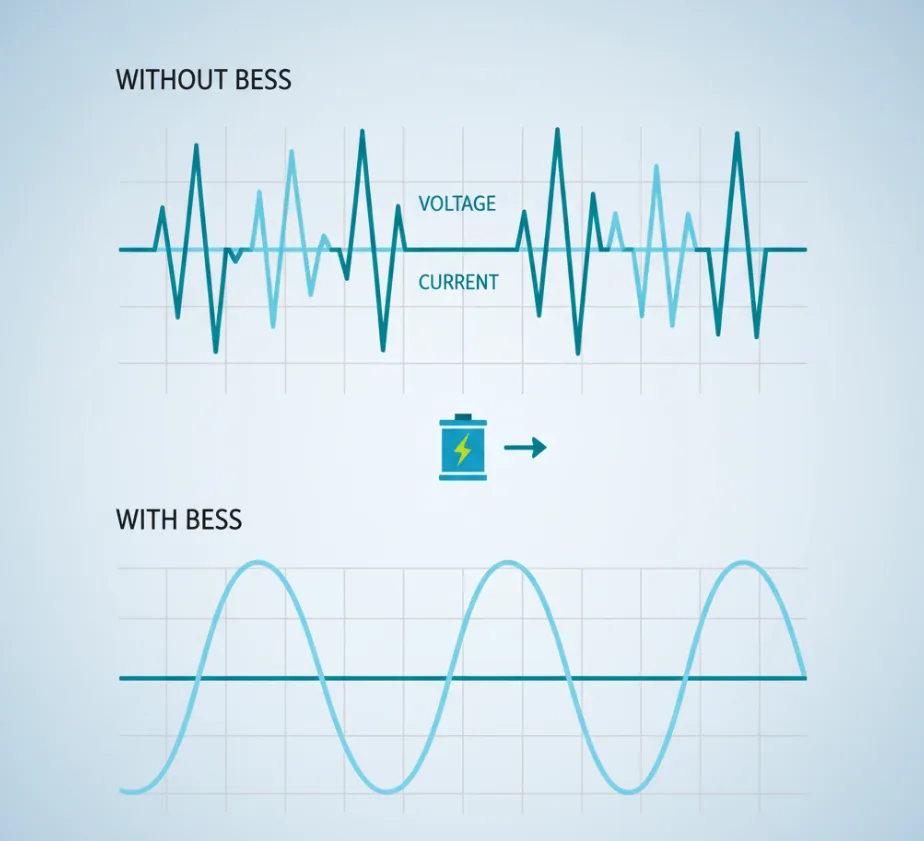
7. Power Quality: Technical Advantages of Battery Energy Storage System (BESS)
Power quality issues cause downtime and equipment damage. The advantages of Battery Energy Storage System (BESS) also include better power quality.
Harmonic filtering.
Reactive power support.
Voltage stabilization.
For industries with sensitive equipment (like semiconductor manufacturing), this is a game-changing advantage.
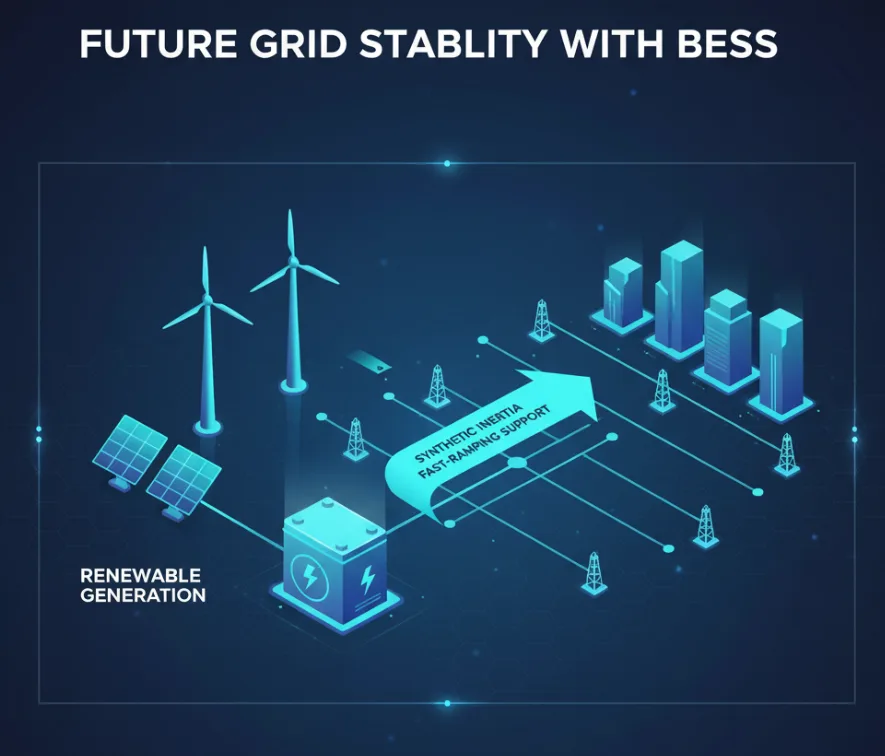
8. Synthetic Inertia: A Modern Advantage of Battery Energy Storage System (BESS)
Traditional power plants provided inertia to stabilize the grid. One of the modern advantages of Battery Energy Storage System (BESS) is providing synthetic inertia.
Advanced inverters mimic inertia.
Fast ramping balances renewable fluctuations.
Supports reliable, renewable-heavy grids.
9. Environmental Advantages of Battery Energy Storage System (BESS)
Beyond economics, the advantages of Battery Energy Storage System (BESS) extend to sustainability.
Q1: What are the main advantages of Battery Energy Storage System (BESS)?
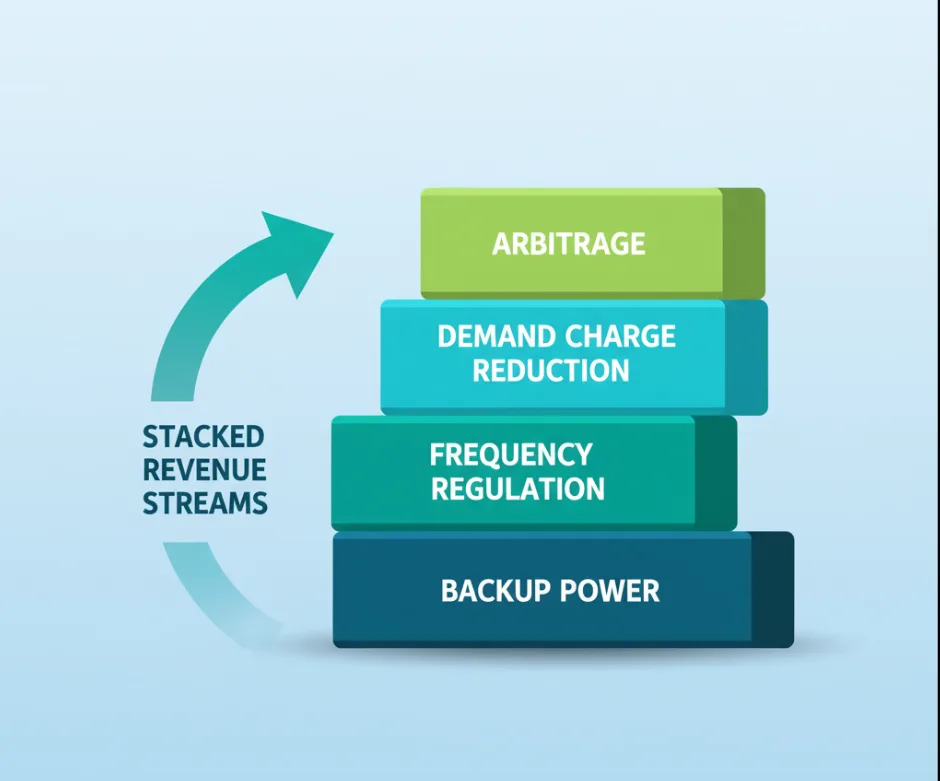
A: The main advantages of Battery Energy Storage System (BESS) are grid stability, renewable integration, peak shaving, energy arbitrage, backup power, improved power quality, and scalability.
Q2: How does BESS save money for businesses?
A: By reducing demand charges, enabling energy arbitrage, and improving power reliability, BESS lowers operational costs.
Q3: How long do the advantages of Battery Energy Storage System (BESS) last?
A: A typical BESS lasts 8–15 years, depending on usage cycles, chemistry, and maintenance.
Q5: Who benefits most from the advantages of Battery Energy Storage System (BESS)?
A: Utilities, C&I facilities, renewable developers, EV charging hubs, and critical infrastructure.
Conclusion: Why the Advantages of Battery Energy Storage System (BESS) Matter
The advantages of Battery Energy Storage System (BESS) are multi-dimensional—economic, technical, and environmental. From stabilizing grids and enabling renewables to saving costs and enhancing resilience, BESS is the backbone of the future energy system.
At Sunlith Energy, we deliver tailored BESS solutions that unlock these benefits while ensuring safety, scalability, and sustainability.
👉 Ready to experience the full advantages of Battery Energy Storage System (BESS)? Visit our Contact Page today.
UL 2054 certification is the core safety standard for complete battery packs sold in North America. Underwriters Laboratories publishes it. A cell-level standard tests one component. UL 2054, on the other hand, tests the finished pack as a whole — the housing, the wiring, and the protection circuits, all working together.
This guide covers what actually sets UL 2054 apart. First, you’ll see the Single Fault Condition test. Next, you’ll learn the two paths to certification. Then, we’ll explain why the cells inside your pack need their own approval first. For the cell-level standard this builds on, see our UL 1642 certification guide. Or, browse our full UL certifications overview for the complete compliance picture. The U.S. Consumer Product Safety Commission also lists UL 2054 as a recognized voluntary standard for household and commercial batteries.
What UL 2054 Covers — and What It Doesn’t
UL 2054 applies to complete battery packs. This includes both primary, non-rechargeable batteries and secondary, rechargeable ones. It covers several chemistries too: lithium-ion, lithium-polymer, NiMH, and NiCd.
However, the standard doesn’t test individual cells on its own. Instead, it points to UL 1642 for the lithium cells used inside a pack. In practice, this means the cells need UL 1642 approval first, before the finished pack goes to a lab for UL 2054 testing. Skipping this step doesn’t skip the requirement. It just shifts the burden. If a pack arrives with uncertified cells, the lab has to run the full UL 1642 cell tests too. As a result, this roughly doubles both the testing cycle and the cost.
UL 2054 also stops at a certain scale. It doesn’t cover electric vehicle batteries, since those fall under UL 2580. It doesn’t cover industrial or stationary storage batteries either, since those fall under UL 1973. Think of UL 2054 as the standard for everything in between: the packs inside laptops, power tools, e-bikes, medical devices, and household energy storage products.
The Testing Categories
UL 2054 groups its requirements into four areas. Each one targets a different way a pack can fail.
Electrical — short-circuit testing at multiple temperatures, an abnormal charging test, an abusive overcharge test at an elevated charge rate, a forced-discharge test for multi-cell configurations, and a Limited Power Source (LPS) test.
Mechanical — a crush test using a hydraulic ram, an impact test with a drop weight, shock testing, and vibration testing that simulates shipping and handling.
Environmental — temperature cycling, humidity exposure, and low-pressure altitude simulation.
Enclosure — a mold stress test, a drop test, and a static force test on the housing itself. After all, the casing is the pack’s first line of defense if something goes wrong internally.
Across every category, the underlying requirement stays the same: no fire, and no explosion. For pack-level samples specifically, the pack also can’t leak electrolyte through a cracked or ruptured cell casing. For a broader look at how labs approach battery testing generally, UL’s own battery safety testing overview is a useful reference.
The Single Fault Condition Test
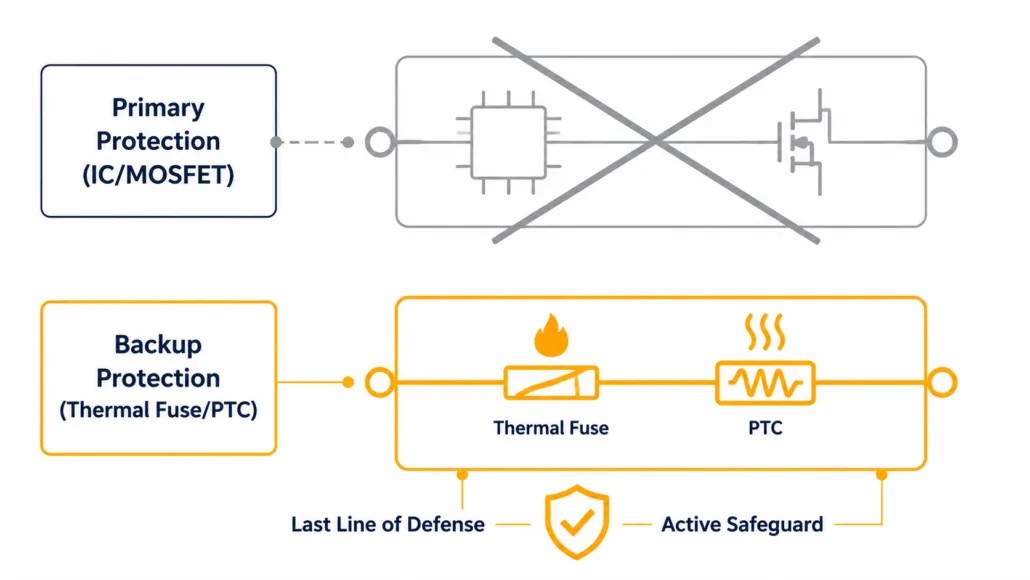
This is the detail that most separates UL2054 from a simpler pack test. Yet it rarely gets explained clearly. Most battery packs ship with two layers of protection: a primary IC-based circuit, and a secondary fuse or protection device.
During testing, the lab doesn’t just check that both layers work. Instead, it deliberately disables one. Typically, this means intentionally shorting the primary protection MOSFET or IC, to simulate a real-world failure of that first layer. The pack then has to survive on its remaining protection alone — commonly a thermal fuse or PTC device — during an overcharge event. A pack that depends entirely on its primary IC, with no independent hardware backup, tends to fail here. In fact, this is the most common reason a first submission doesn’t pass.
Two Paths to UL 2054 Certification
Manufacturers can pursue UL 2054 compliance in two different ways. The right choice depends on where the product is sold.
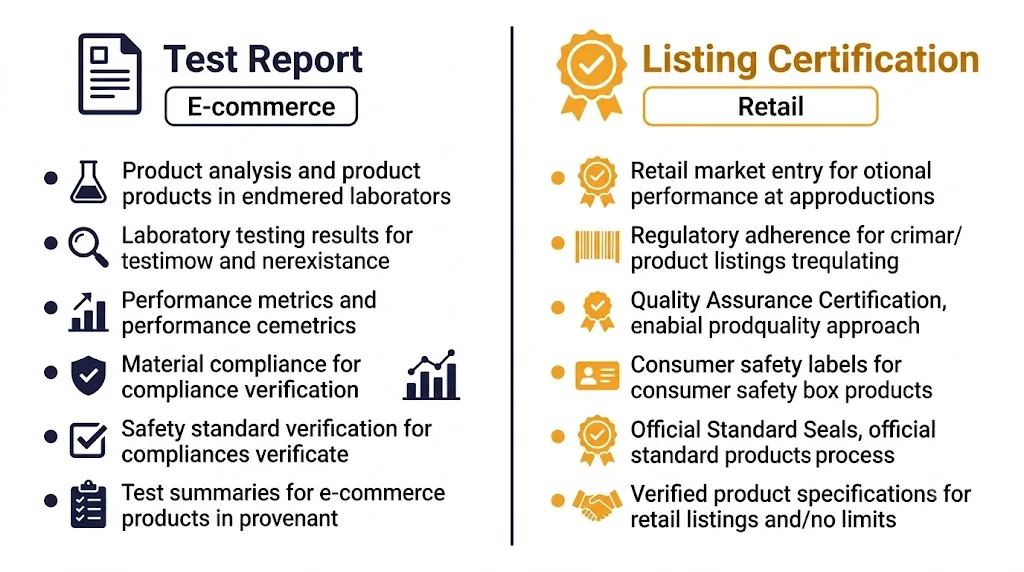
UL 2054 Test Report
UL 2054 Listing Certification
What it includes
Lab testing only, no factory audit
Lab testing plus ongoing quarterly factory inspections
Speed and cost
Faster and lower cost
Slower and more expensive, due to the audit program
Allows the UL Mark?
No
Yes
Typical use case
E-commerce platforms like Amazon
Offline retail and big-box distribution
Amazon specifically requires a UL 2054 test report from an ISO 17025-accredited lab for lithium battery listings. If a listing gets flagged for missing documentation, sellers typically get a narrow window — often 14 to 30 days — to submit a valid report. Otherwise, the listing faces removal. For manufacturers targeting physical retail instead, the full Listing Certification with the UL Mark is usually the better long-term investment. Many retail buyers specifically require it.
How UL 2054 Fits With Other UL Battery Standards
UL 2054, UL 1642, UL 1973, UL 2580, and UL 9540 get confused constantly. That’s because they all show up in battery compliance conversations. However, each one certifies a different scope.
Standard
What It Covers
UL 1642
Individual lithium-ion or lithium-metal cells
UL 2054
Complete battery packs for consumer and commercial products
UL 1973
Batteries for stationary storage (BESS), light electric rail, and similar applications
UL 2580
Battery packs and modules used in electric vehicles
UL 9540
The complete energy storage system — batteries, PCS, controls, and enclosure together
In short, UL 2054 sits between cell-level and system-level safety. It confirms the pack itself is safe, before that pack goes into a larger product or system. For the standard that governs full BESS installations, see our UL 9540A test method guide.
Why UL 2054 Certification Matters
Market access — most major retailers and e-commerce platforms require it before listing a lithium battery product.
Liability protection — a UL 2054 report demonstrates due diligence if a product safety issue is ever challenged.
Foundation for trust — for household energy storage products specifically, pack-level certification reassures buyers that the same rigor applies as it does to larger BESS installations.
At Sunlith Energy, every battery pack we source starts with UL 1642-certified cells before pack-level testing begins. See our BESS certifications overview for a buyer’s-side breakdown of what to verify before purchasing.
Frequently Asked Questions
Does UL 2054 test individual battery cells?
No. UL 2054 tests the complete pack — housing, wiring, and protection circuits. It references UL 1642 for the lithium cells inside the pack. So, those cells need separate UL 1642 approval first.
What is the Single Fault Condition test?
It’s a test where the lab intentionally disables one layer of a pack’s protection circuit. Then, it checks whether the remaining protection can still prevent fire or explosion during an overcharge event. This is one of the most common reasons a first test submission fails.
What’s the difference between a UL 2054 Test Report and Listing Certification?
A Test Report covers lab testing only. It’s typically enough for e-commerce platforms like Amazon. Listing Certification adds ongoing factory audits and allows use of the UL Mark, which offline retail distribution usually requires.
Does UL 2054 cover EV or stationary storage batteries?
No. EV battery packs fall under UL 2580. Stationary storage batteries fall under UL 1973 instead. UL 2054 covers the range in between: consumer and commercial products like power tools, e-bikes, medical devices, and household energy storage.
Solar and wind only make power when the sun shines and the wind blows. Storage closes that gap. But there are several types of energy storage systems, not just batteries.
Battery storage gets most of the attention. However, mechanical, thermal, and hydrogen storage also play real roles today.
At Sunlith Energy, we focus on battery energy storage systems (BESS). So we get this question a lot: what are the other types of energy storage systems, and when does each one make sense?
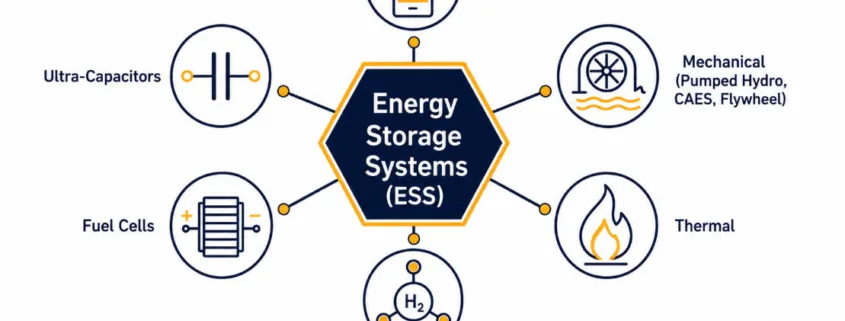
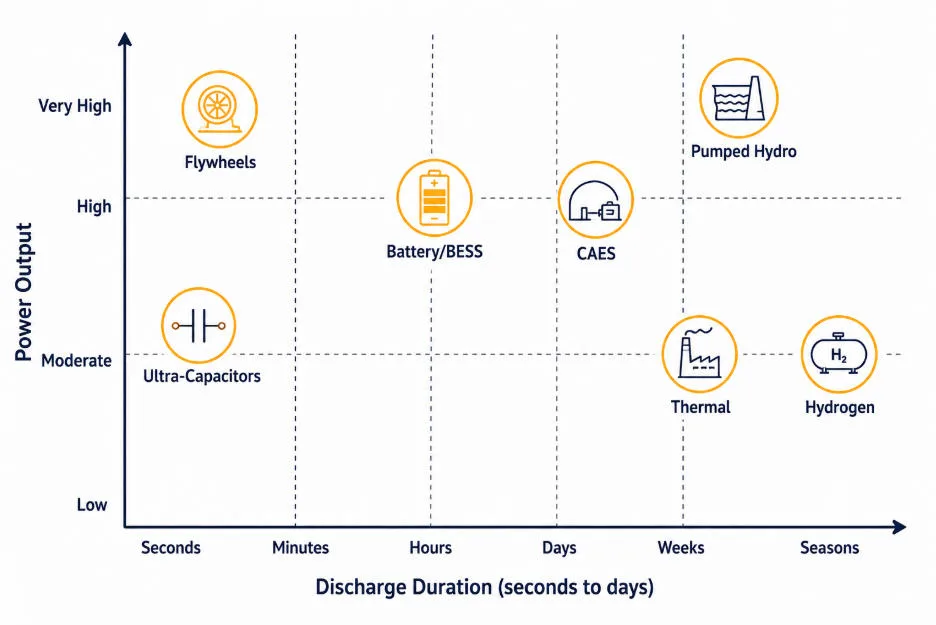
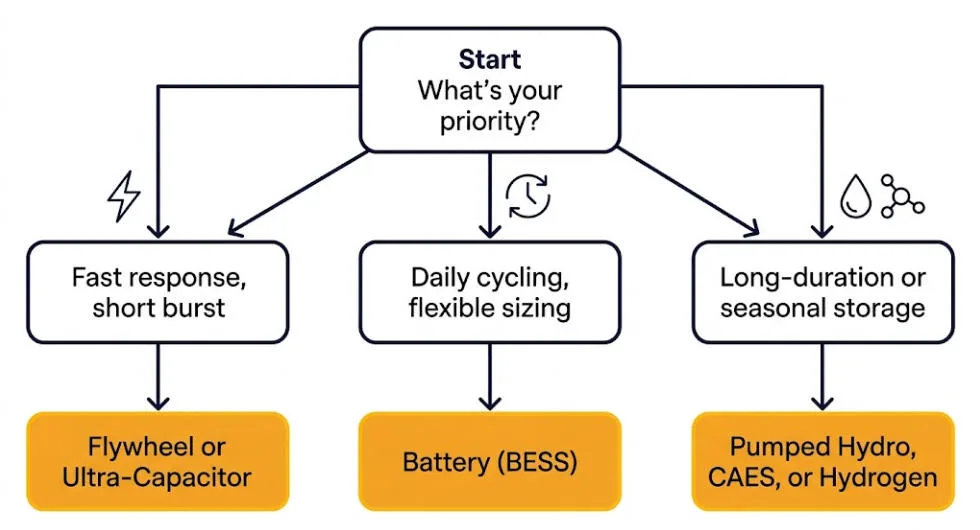
Quick Answer There are six main types of energy storage systems: battery (BESS), mechanical (pumped hydro, compressed air, flywheels), thermal, hydrogen, fuel cells, and supercapacitors. Each stores energy differently. Each also suits a different discharge time, from seconds of backup power to weeks of seasonal storage.
What Is an Energy Storage System?
An energy storage system captures energy when it’s abundant. Then, it releases that energy when it’s needed. That simple job does a lot of work for the grid. For example, it:
Balances supply and demand in real time
Reduces instability from variable renewable output
Improves renewable energy integration
Lowers energy costs through peak shaving
Provides backup power during outages
If you’re evaluating storage for a commercial site, our guide to C&I BESS applications shows how these benefits play out.
Types of Energy Storage Systems
Every storage technology makes trade-offs. Some hold more energy. Others respond faster. A few discharge for much longer. So here’s how the main types of energy storage systems compare, one by one.
1. Battery Energy Storage Systems (BESS)
Battery storage is the most widely deployed type of ESS today. Batteries scale from a few kilowatt-hours up to hundreds of megawatt-hours. They also respond in milliseconds. And costs have fallen sharply over the past decade.
Lithium-ion, especially LFP, is the industry standard. It packs in a lot of energy, lasts many cycles, and runs safely at high heat.
Lead-acid batteries stay affordable but wear out faster. So most are used in smaller backup systems.
Flow batteries store energy in liquid electrolytes. They suit longer storage jobs, since power and energy capacity can scale on their own.
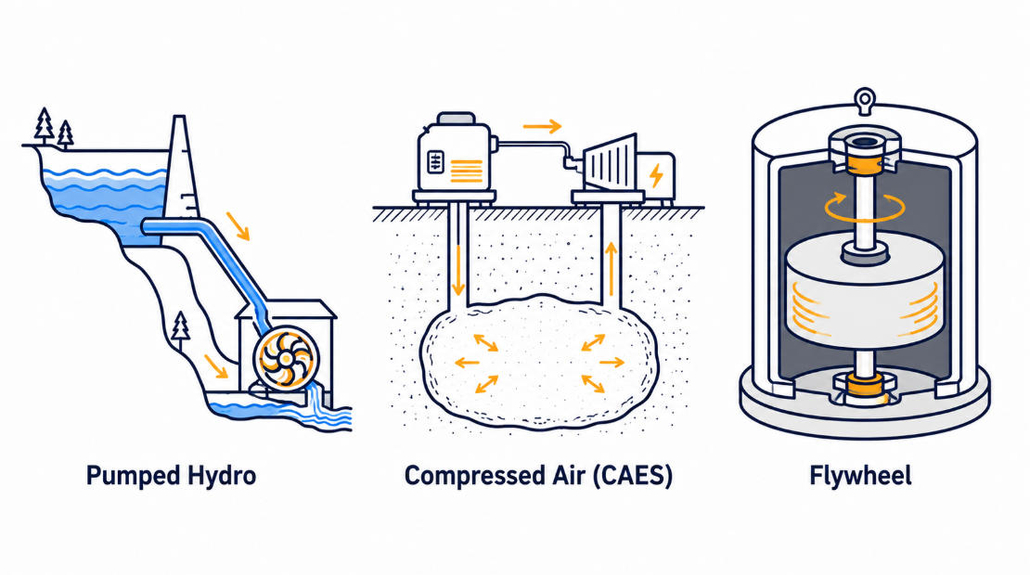
Mechanical systems store energy as motion or height, not chemistry. Three technologies lead this category. Together, they hold most of the world’s grid-scale storage capacity.
Pumped hydro storage (PHS) is the oldest storage technology still in wide use. In fact, it’s been in commercial service for over a century. First, it pumps water uphill when demand is low. Then, it releases that water through turbines when demand rises.
According to the Sandia National Laboratories, pumped hydro plants run near 80% round-trip efficiency. PHS also makes up roughly 90% of global grid storage capacity — more than every other storage type combined.
Compressed air energy storage (CAES) works on a similar idea. Instead of water, it stores compressed air in underground caverns. When power is needed, the air is released, heated, and expanded through a turbine.
CAES suits long-duration storage at large scale. But it needs the right underground geology, which limits where it can be built.
Flywheels store energy as kinetic motion in a spinning rotor. The rotor sits in a sealed, low-friction enclosure to cut losses. Flywheels can’t hold much total energy. But they respond almost instantly, and they handle huge numbers of charge cycles without wearing down.
For example, the DOE/EPRI Electricity Storage Handbook, published through Sandia National Laboratories, describes a typical flywheel system delivering 100 kW for fifteen minutes in frequency-regulation service. That’s a job batteries handle poorly, but flywheels handle well.
3. Thermal Storage
Thermal ESS stores energy as heat or cold. Then, it converts that energy back when needed.
Molten salt stores solar heat at high temperature. Because of this, concentrated solar plants can keep generating power after sunset.
Ice storage makes and stores ice during off-peak hours. Buildings then use that ice to cool down during the day. That shifts demand away from peak hours.
Phase change materials absorb and release heat as they change state. That gives buildings steady temperature control, without much added electricity.
4. Hydrogen and Power-to-X Storage
Hydrogen is one of the few types of energy storage systems suited to long, seasonal storage. That’s because it’s the kind of job batteries struggle with.
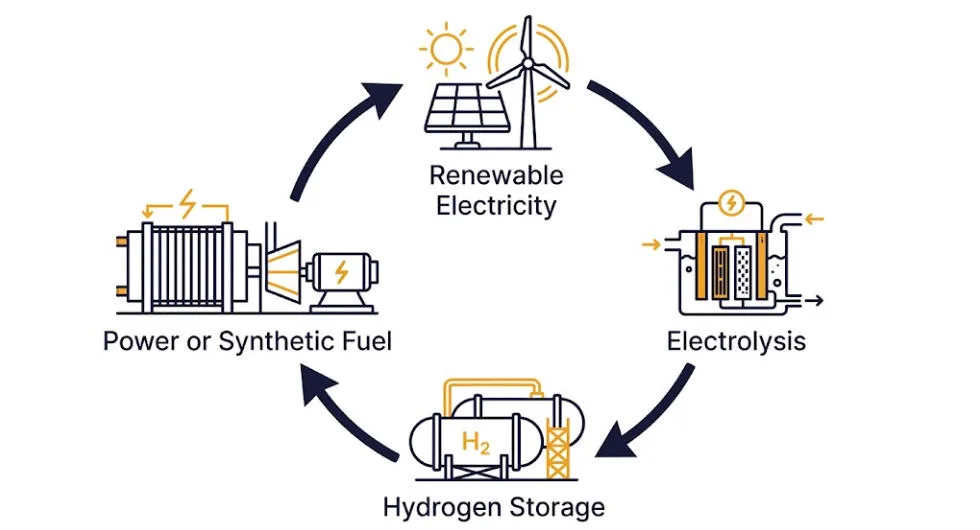
Electrolysis uses renewable power to split water into hydrogen. That hydrogen can be stored for weeks or months. See our deeper look at green hydrogen storage for how this works in practice.
Later, it can make electricity again through a fuel cell or turbine. Or, it can turn into synthetic fuel instead.
This mix of uses is called sector coupling. Because of it, extra renewable power can support heating and transport, not just the grid.
5. Fuel Cells
Fuel cells aren’t storage devices in the strict sense. Instead, they’re conversion devices. A fuel cell turns stored hydrogen, or another fuel, back into electricity through a chemical reaction. No combustion is involved.
Fuel cells run cleanly and efficiently
They scale well for backup power, mobility, and grid support
Paired with hydrogen storage, they form a complete storage-and-conversion loop
6. Ultra-Capacitors (Supercapacitors)
Ultra-capacitors store energy in an electric field, not through a chemical reaction. Because of this, they play a narrow but valuable role.
They charge and discharge in seconds — far faster than any battery
They excel at short, high-power bursts, like voltage stabilization or regenerative braking
They handle hundreds of thousands of cycles with little wear, but hold far less total energy than a similarly sized battery
Most projects pair ultra-capacitors with batteries instead of choosing one or the other. That’s because the capacitor absorbs fast power spikes, while the battery handles sustained energy delivery.
7. Emerging and Hybrid Types of Energy Storage Systems
Modern projects increasingly combine two or more types of energy storage systems to cover each other’s weak spots. For example, a battery-plus-capacitor system gives you both long-duration storage and instant response.
Similarly, a thermal-plus-hydrogen system can handle daily cycling and seasonal storage from one renewable source.
At Sunlith Energy, we design systems that meet these varied needs. We also build them to UL certifications and other global safety standards.
Types of Energy Storage Systems Compared at a Glance
Figures below are general industry ranges, meant to compare technologies at a glance — not project-specific guarantees.
How to Choose Among the Types of Energy Storage Systems
Picking the right type of energy storage system comes down to a few practical factors:
Application — backup power, renewable integration, and grid stability each favor different technologies
Discharge duration — seconds of power-quality support versus hours or days of energy shifting
Technology maturity and cost — some technologies are decades-proven; others are still coming down in cost
Safety and compliance standards — critical for any commercial or industrial deployment
For commercial and industrial BESS specifically, safety compliance isn’t optional. Standards like UL 9540, CE, and IEC certifications are the benchmarks worth understanding before you specify a system.
Conclusion
Energy storage systems are the foundation of a reliable, renewable-powered grid. Across the different types of energy storage systems, each technology fills a role the others can’t. That’s true for batteries, mechanical, thermal, hydrogen, fuel cells, and supercapacitors alike.
We help industries, businesses, and utilities pick the right storage technology. That means lower costs and a faster path to clean energy.
Frequently Asked Questions
What is an energy storage system (ESS)?
An energy storage system stores energy produced at one time. It makes that energy available later. This balances supply and demand. It also improves renewable reliability and supports grid stability.
What are the main types of energy storage systems?
The main types of energy storage systems are battery storage (BESS — lithium-ion, lead-acid, and flow), mechanical storage (pumped hydro, compressed air, and flywheels), thermal storage (molten salt, ice, and phase change materials), hydrogen storage, fuel cells, and ultra-capacitors.
What is the difference between ESS and BESS?
ESS, or energy storage system, is the broad category. It covers every storage technology.
BESS, or battery energy storage system, is one specific type that uses batteries. So every BESS is an ESS. But not every ESS is a BESS. Read more in our full breakdown of BESS vs ESS.
Why are energy storage systems important for renewable energy?
Solar and wind generation is intermittent by nature. Energy storage systems capture power when generation is high. Then they release it when demand rises. That makes renewable electricity reliable enough to replace fossil generation at scale.
What’s the best energy storage system for commercial and industrial use?
For most C&I applications, battery energy storage systems are the practical choice. They offer fast response, flexible sizing, and proven reliability. Learn more in our guide to C&I BESS components.
Is ESS safe?
Yes. Modern ESS installations follow strict safety standards. Compliance with UL 9540, CE, and IEC certifications means a system meets global safety and performance rules before it goes live.
What’s Next for These Types of Energy Storage Systems?
Expect wider use of solid-state batteries, growing adoption of hydrogen storage for long-duration needs, and more hybrid systems. These hybrids combine batteries, fuel cells, and supercapacitors to cover both short bursts and long stretches.
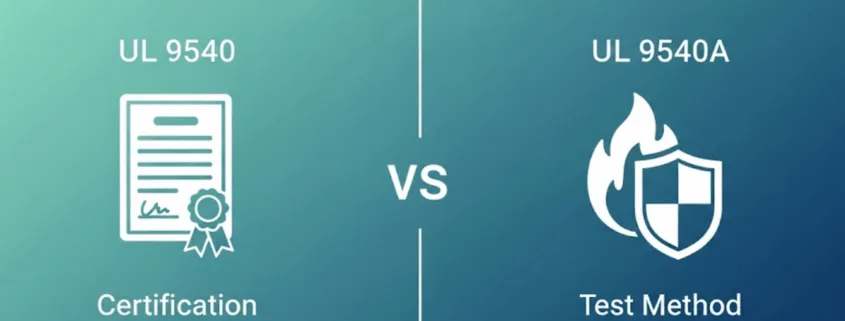
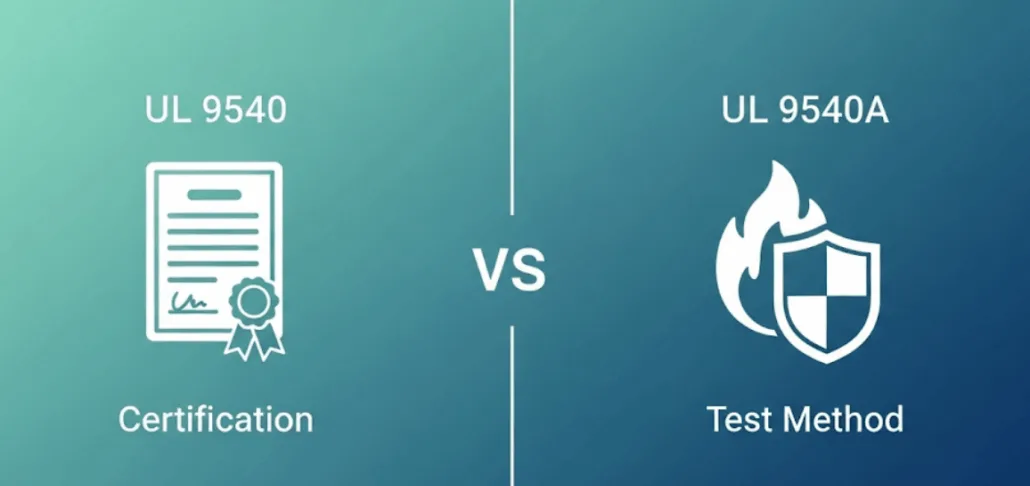
UL 9540 vs UL 9540A: As the adoption of battery energy storage systems (BESS) grows, safety and compliance remain top priorities for regulators, manufacturers, and end-users. Two of the most recognized standards in this space are UL 9540 and UL 9540A.
Scope: Applies to the entire system, not just components.
Integration: Requires batteries certified to UL 1973 and inverters certified to UL 1741.
Safety Focus: Covers electrical, mechanical, thermal, and fire safety aspects.
Market Approval: Often mandatory for utility-scale and commercial projects.
👉 If you’re exploring how PCS technology integrates into storage systems, check our detailed guide on Energy Storage PCS.
What is UL 9540A?
UL 9540A is the Test Method for Evaluating Thermal Runaway Fire Propagation in Battery Energy Storage Systems. Unlike UL 9540, it is not a certification but a test procedure.
This method provides critical data on how batteries behave under extreme conditions. It identifies risks such as fire spread, explosion potential, and gas emissions.
Testing Levels in UL 9540A:
Cell Level – Individual cell behavior under failure.
Module Level – How cells interact inside a battery module.
Unit Level – Fire propagation within a system enclosure.
Installation Level – Real-world system performance in buildings or outdoor setups.
👉 To understand why thermal management matters in these tests, see our post on Cooling Solutions for BESS.
Authorities Having Jurisdiction (AHJs) frequently demand UL 9540A reports before granting installation permits. Manufacturers, meanwhile, use test results to design safer enclosures, improve fire suppression systems, and integrate better thermal management.
Battery technology has become the beating heart of modern solar energy systems. Whether in residential rooftops, commercial facilities, or grid-scale storage projects, the ability to store energy efficiently defines both performance and cost-effectiveness. One of the most important performance metrics is battery energy density.
Put simply, energy density tells us how much energy a battery can store for its weight or volume.
For solar storage, higher energy density means more power in smaller, lighter systems. This is a total game-changer for homeowners with limited space or businesses looking to maximize efficiency.
In this guide, we’ll break down what energy density means, how different battery chemistries compare, and what the future holds for solar energy storage.
What Is Battery Energy Density?
Energy density measures how much energy a battery can hold in relation to its mass (Wh/kg) or volume (Wh/L). These two forms are known as:
Gravimetric energy density (Wh/kg): Energy per unit of mass.
Volumetric energy density (Wh/L): Energy per unit of volume.
For example:
A lithium-ion battery with 250 Wh/kg can deliver 250 watt-hours of energy for every kilogram of weight.
On the other hand, a higher-density battery, say 400 Wh/kg, could provide nearly double the energy at the same weight.
Therefore, both metrics matter in solar applications. Rooftop solar storage systems often care more about volume, whereas commercial solutions lean on mass efficiency for easier transport.
⚡ Battery Chemistry Density Comparator
Select a battery chemistry to view weight efficiency vs space requirements.
Weight Efficiency (Gravimetric):260 Wh/kg
Space Efficiency (Volumetric):650 Wh/L
*Values represent typical industry averages at the cell assembly level.
Current Energy Densities: Lithium-Ion Leads Today
Lithium-ion (Li-ion) batteries dominate the energy storage market today—and for good reason.
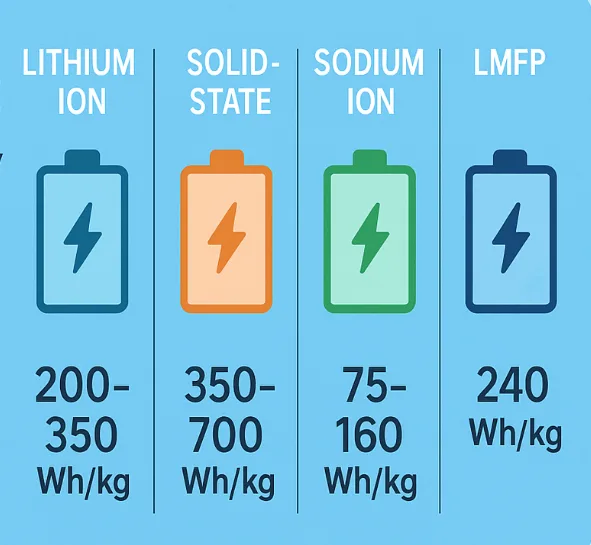
Typical range: 200–300 Wh/kg
High-performance versions: 300–350 Wh/kg
Theoretical limit: 400–500 Wh/kg
These performance values have been improving steadily over time. Thirty years ago, standard Li-ion cells were only around 80 Wh/kg.
Today, premium designs push past 300 Wh/kg. As a result, modern cells deliver more than triple the performance at dramatically lower costs.
For Sunlith Energy customers, this means that a modern lithium-based solar storage system can provide longer backup times, faster charging, and more compact designs compared to older technologies like lead-acid.
Beyond Lithium-Ion: New Chemistries on the Horizon
While lithium-ion dominates today, researchers and manufacturers are racing to improve energy density through new chemistries. Let’s explore some of the most promising options.
Challenges: Manufacturing complexity, high costs, scaling up.
Solid-state batteries are already moving from lab to pilot production, with companies like Toyota and Ion Storage Systems leading development. For solar storage, their promise lies in more compact, safer, and longer-lasting home and commercial systems.
Low-Cost Sodium-Ion Battery Energy Density
Energy Density: 75–160 Wh/kg
Advantages: Abundant raw materials, lower cost, better cold-weather performance.
Challenges: Lower density compared to lithium-ion.
Although sodium-ion cannot compete with lithium-ion in density, they shine in affordable large-scale storage and cold climates, making them ideal for certain solar projects.
Lithium Manganese Iron Phosphate (LMFP)
Energy Density: ~240 Wh/kg at cell level
Advantages: Safer and more affordable than high-density lithium chemistries.
Use Case: Perfect balance of cost, safety, and density for residential solar storage.
Semi-Solid and Sodium-Air Prototypes
Semi-solid: ~270 Wh/kg today; safer, more stable for EVs and solar systems.
Sodium-air: Theoretical >1,000 Wh/kg; still experimental, but could one day power long-duration off-grid solar or even electric aircraft.
Why Battery Energy Density Isn’t Everything
It might sound like higher energy density always equals better—but in real-world solar applications, balance matters. Consequently, we must evaluate several key trade-offs:
Safety: High-density chemistries often face overheating risks. For this reason, thermal stability may outweigh raw density in residential spaces.
Cost: A 700 Wh/kg solid-state battery may be incredible, but if it costs 10× more than today’s lithium-ion, then it won’t make sense for most solar projects.
Cycle Life: Batteries with slightly lower density but longer lifespan (like LFP or LMFP) can be more cost-effective in the long run.
Temperature Performance: Sodium-ion’s resilience in cold climates may be more valuable than high density for certain markets.
For Sunlith Energy, the real value lies in matching the right battery chemistry to each customer’s needs—whether residential, commercial, or utility-scale.
The Evolution of Battery Economics
The story of battery energy density is also a story of economics. Over the past 30 years, we have seen a massive transformation in energy storage markets.
Energy density has increased fivefold. This allows modern systems to offer significantly higher capacities without increasing physical footprints.
Battery costs have dropped by over 90%. Lower manufacturing costs make high-capacity setups commercially viable for mainstream consumers.
Global deployment has surged. Renewable storage integration is expanding exponentially across residential and utility grids.
This cost-density curve has transformed solar from a niche technology into a mainstream energy solution. Homeowners now enjoy affordable batteries that keep lights on during outages, while businesses leverage solar storage to cut peak demand costs.
What the Future Holds for Solar + Storage
Looking ahead, battery energy density will continue to shape solar energy adoption:
Compact, High-Power Home Systems – Future households may install sleek, wall-mounted systems delivering twice today’s storage in half the space.
Affordable Community Storage – Sodium-ion and LMFP could bring down costs, enabling microgrids and rural electrification.
Grid Flexibility – Higher density batteries will support longer-duration storage, balancing renewables at utility scale.
Sustainability First – Future solutions won’t just chase density; they’ll balance safety, recycling, and ethical sourcing.
For Sunlith Energy, this means staying at the forefront of new chemistries, while continuing to deliver reliable, efficient, and customer-focused solar storage solutions today.
Conclusion: Choosing the Right Battery for Your Solar Future
Battery energy density is a critical factor in designing solar + storage systems—but it’s not the only one. The best solution balances density with safety, cost, cycle life, and environmental fit.
At Sunlith Energy, we believe the future of solar storage lies in smart integration: pairing the right chemistry with each unique project. Whether it’s a compact lithium-ion battery for a city apartment, a cost-efficient sodium-ion solution for cold climates, or next-generation solid-state storage for commercial clients, our mission is to deliver power that works for your future.