
Types of Energy Storage Systems: A Complete Guide
Solar and wind only make power when the sun shines and the wind blows. Storage closes that gap. But there are several types of energy storage systems, not just batteries.
Battery storage gets most of the attention. However, mechanical, thermal, and hydrogen storage also play real roles today.
At Sunlith Energy, we focus on battery energy storage systems (BESS). So we get this question a lot: what are the other types of energy storage systems, and when does each one make sense?
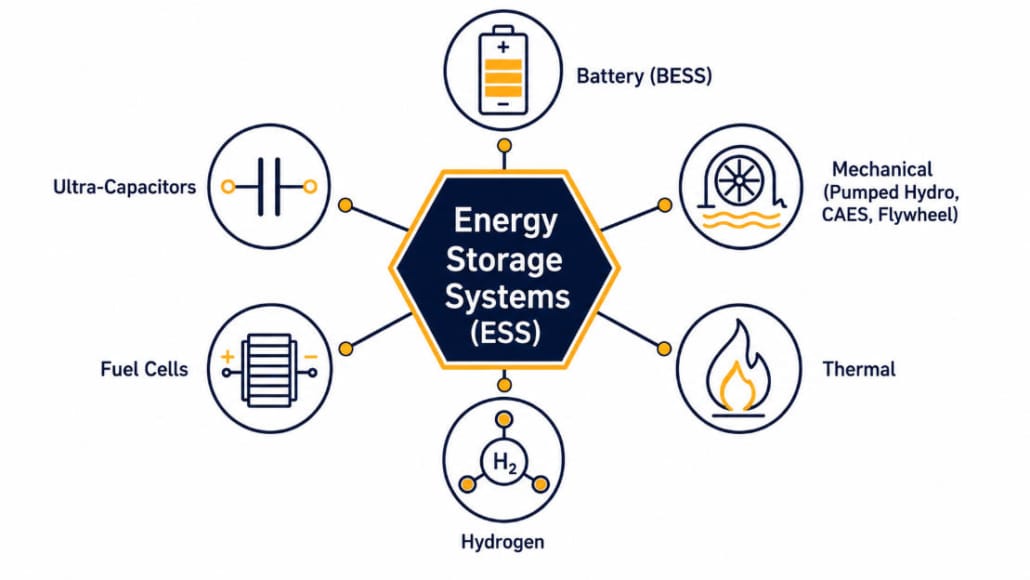
| Quick Answer There are six main types of energy storage systems: battery (BESS), mechanical (pumped hydro, compressed air, flywheels), thermal, hydrogen, fuel cells, and supercapacitors. Each stores energy differently. Each also suits a different discharge time, from seconds of backup power to weeks of seasonal storage. |
What Is an Energy Storage System?
An energy storage system captures energy when it’s abundant. Then, it releases that energy when it’s needed. That simple job does a lot of work for the grid. For example, it:
- Balances supply and demand in real time
- Reduces instability from variable renewable output
- Improves renewable energy integration
- Lowers energy costs through peak shaving
- Provides backup power during outages
If you’re evaluating storage for a commercial site, our guide to C&I BESS applications shows how these benefits play out.
Types of Energy Storage Systems
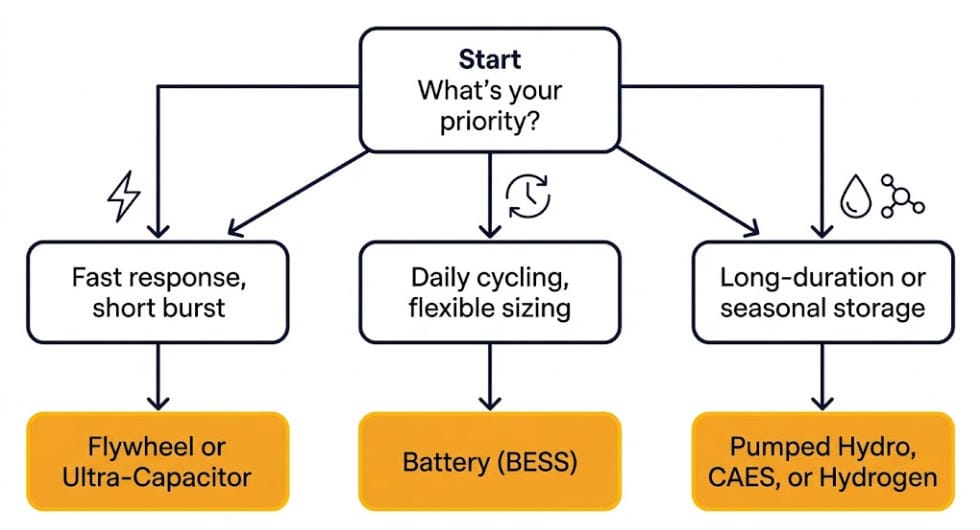
Every storage technology makes trade-offs. Some hold more energy. Others respond faster. A few discharge for much longer. So here’s how the main types of energy storage systems compare, one by one.
1. Battery Energy Storage Systems (BESS)
Battery storage is the most widely deployed type of ESS today. Batteries scale from a few kilowatt-hours up to hundreds of megawatt-hours. They also respond in milliseconds. And costs have fallen sharply over the past decade.
- Lithium-ion, especially LFP, is the industry standard. It packs in a lot of energy, lasts many cycles, and runs safely at high heat.
- Lead-acid batteries stay affordable but wear out faster. So most are used in smaller backup systems.
- Flow batteries store energy in liquid electrolytes. They suit longer storage jobs, since power and energy capacity can scale on their own.
BESS is our core focus at Sunlith. For the full picture, see our complete guide to battery energy storage systems. To see how BESS fits within the wider ESS category, read the difference between BESS and ESS.
2. Mechanical Storage
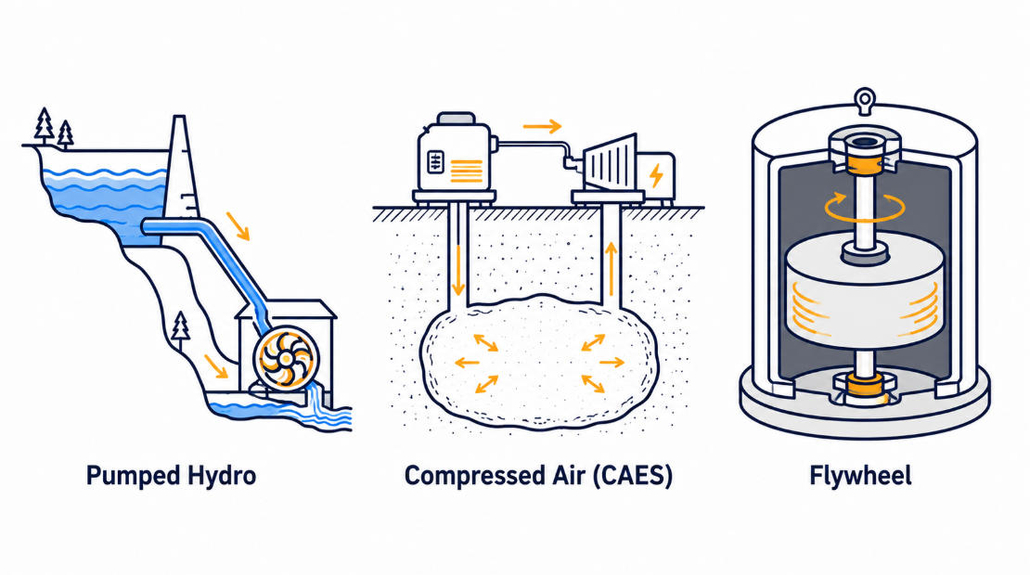
Mechanical systems store energy as motion or height, not chemistry. Three technologies lead this category. Together, they hold most of the world’s grid-scale storage capacity.
Pumped hydro storage (PHS) is the oldest storage technology still in wide use. In fact, it’s been in commercial service for over a century. First, it pumps water uphill when demand is low. Then, it releases that water through turbines when demand rises.
According to the Sandia National Laboratories, pumped hydro plants run near 80% round-trip efficiency. PHS also makes up roughly 90% of global grid storage capacity — more than every other storage type combined.
Compressed air energy storage (CAES) works on a similar idea. Instead of water, it stores compressed air in underground caverns. When power is needed, the air is released, heated, and expanded through a turbine.
CAES suits long-duration storage at large scale. But it needs the right underground geology, which limits where it can be built.
Flywheels store energy as kinetic motion in a spinning rotor. The rotor sits in a sealed, low-friction enclosure to cut losses. Flywheels can’t hold much total energy. But they respond almost instantly, and they handle huge numbers of charge cycles without wearing down.
For example, the DOE/EPRI Electricity Storage Handbook, published through Sandia National Laboratories, describes a typical flywheel system delivering 100 kW for fifteen minutes in frequency-regulation service. That’s a job batteries handle poorly, but flywheels handle well.
3. Thermal Storage
Thermal ESS stores energy as heat or cold. Then, it converts that energy back when needed.
- Molten salt stores solar heat at high temperature. Because of this, concentrated solar plants can keep generating power after sunset.
- Ice storage makes and stores ice during off-peak hours. Buildings then use that ice to cool down during the day. That shifts demand away from peak hours.
- Phase change materials absorb and release heat as they change state. That gives buildings steady temperature control, without much added electricity.
4. Hydrogen and Power-to-X Storage
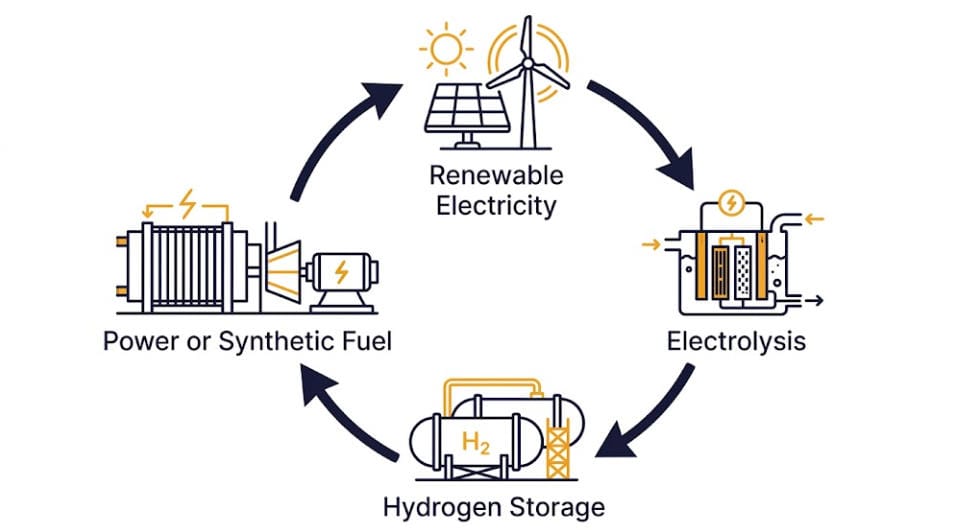
Hydrogen is one of the few types of energy storage systems suited to long, seasonal storage. That’s because it’s the kind of job batteries struggle with.
Electrolysis uses renewable power to split water into hydrogen. That hydrogen can be stored for weeks or months. See our deeper look at green hydrogen storage for how this works in practice.
Later, it can make electricity again through a fuel cell or turbine. Or, it can turn into synthetic fuel instead.
This mix of uses is called sector coupling. Because of it, extra renewable power can support heating and transport, not just the grid.
5. Fuel Cells
Fuel cells aren’t storage devices in the strict sense. Instead, they’re conversion devices. A fuel cell turns stored hydrogen, or another fuel, back into electricity through a chemical reaction. No combustion is involved.
- Fuel cells run cleanly and efficiently
- They scale well for backup power, mobility, and grid support
- Paired with hydrogen storage, they form a complete storage-and-conversion loop
6. Ultra-Capacitors (Supercapacitors)
Ultra-capacitors store energy in an electric field, not through a chemical reaction. Because of this, they play a narrow but valuable role.
- They charge and discharge in seconds — far faster than any battery
- They excel at short, high-power bursts, like voltage stabilization or regenerative braking
- They handle hundreds of thousands of cycles with little wear, but hold far less total energy than a similarly sized battery
Most projects pair ultra-capacitors with batteries instead of choosing one or the other. That’s because the capacitor absorbs fast power spikes, while the battery handles sustained energy delivery.
7. Emerging and Hybrid Types of Energy Storage Systems
Modern projects increasingly combine two or more types of energy storage systems to cover each other’s weak spots. For example, a battery-plus-capacitor system gives you both long-duration storage and instant response.
Similarly, a thermal-plus-hydrogen system can handle daily cycling and seasonal storage from one renewable source.
At Sunlith Energy, we design systems that meet these varied needs. We also build them to UL certifications and other global safety standards.
Types of Energy Storage Systems Compared at a Glance
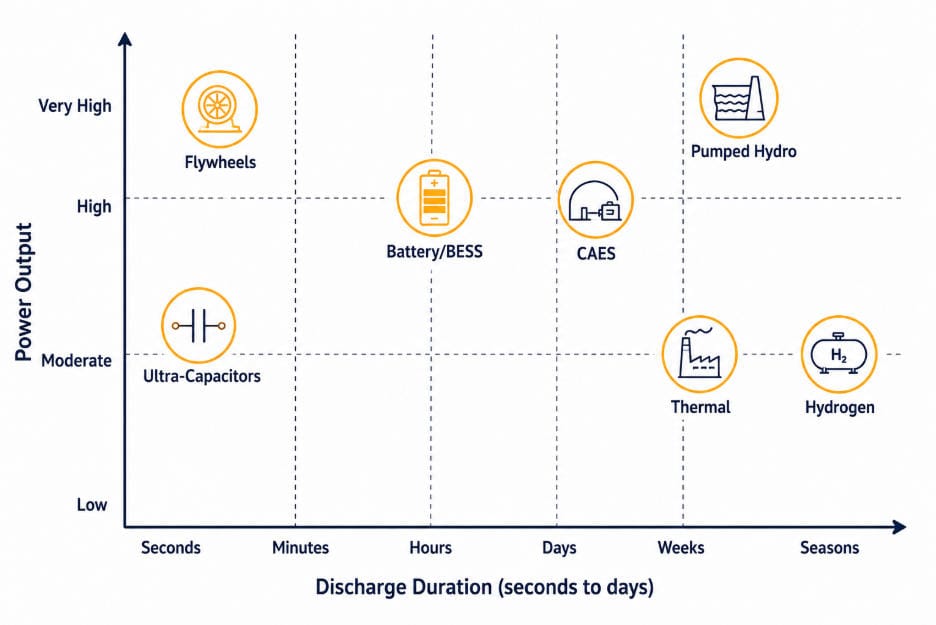
Figures below are general industry ranges, meant to compare technologies at a glance — not project-specific guarantees.
| Type | Typical Discharge Duration | Round-Trip Efficiency | Technology Maturity | Best Use Case |
|---|---|---|---|---|
| Battery (BESS) | Minutes to ~8 hours | High (~85-95%) | Mature, fast-growing | Renewable integration, peak shaving, grid services |
| Pumped Hydro (PHS) | Hours to days | ~80% | Mature (100+ years) | Large-scale, long-duration grid storage |
| Compressed Air (CAES) | Hours | Moderate (design-dependent) | Established, niche | Large-scale storage where geology allows |
| Flywheels | Seconds to minutes | High | Mature, niche | Frequency regulation, power quality |
| Thermal | Hours to seasonal | Varies by type | Mature to emerging | Solar heat retention, building cooling |
| Hydrogen | Days to months (seasonal) | Lower (multi-step conversion) | Emerging, scaling | Long-duration, seasonal, sector coupling |
| Ultra-Capacitors | Seconds | Very high | Mature, niche | Short power bursts, voltage stabilization |
How to Choose Among the Types of Energy Storage Systems
Picking the right type of energy storage system comes down to a few practical factors:
- Application — backup power, renewable integration, and grid stability each favor different technologies
- Discharge duration — seconds of power-quality support versus hours or days of energy shifting
- Technology maturity and cost — some technologies are decades-proven; others are still coming down in cost
- Safety and compliance standards — critical for any commercial or industrial deployment
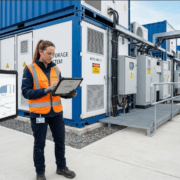
For commercial and industrial BESS specifically, safety compliance isn’t optional. Standards like UL 9540, CE, and IEC certifications are the benchmarks worth understanding before you specify a system.
Conclusion
Energy storage systems are the foundation of a reliable, renewable-powered grid. Across the different types of energy storage systems, each technology fills a role the others can’t. That’s true for batteries, mechanical, thermal, hydrogen, fuel cells, and supercapacitors alike.
At Sunlith Energy, batteries are where we focus, and it shows. Our complete guide to battery energy storage systems covers BESS architecture, applications, and selection criteria in depth.
We help industries, businesses, and utilities pick the right storage technology. That means lower costs and a faster path to clean energy.
Frequently Asked Questions
What is an energy storage system (ESS)?
An energy storage system stores energy produced at one time. It makes that energy available later. This balances supply and demand. It also improves renewable reliability and supports grid stability.
What are the main types of energy storage systems?
The main types of energy storage systems are battery storage (BESS — lithium-ion, lead-acid, and flow), mechanical storage (pumped hydro, compressed air, and flywheels), thermal storage (molten salt, ice, and phase change materials), hydrogen storage, fuel cells, and ultra-capacitors.
What is the difference between ESS and BESS?
ESS, or energy storage system, is the broad category. It covers every storage technology.
BESS, or battery energy storage system, is one specific type that uses batteries. So every BESS is an ESS. But not every ESS is a BESS. Read more in our full breakdown of BESS vs ESS.
Why are energy storage systems important for renewable energy?
Solar and wind generation is intermittent by nature. Energy storage systems capture power when generation is high. Then they release it when demand rises. That makes renewable electricity reliable enough to replace fossil generation at scale.
What’s the best energy storage system for commercial and industrial use?
For most C&I applications, battery energy storage systems are the practical choice. They offer fast response, flexible sizing, and proven reliability. Learn more in our guide to C&I BESS components.
Is ESS safe?
Yes. Modern ESS installations follow strict safety standards. Compliance with UL 9540, CE, and IEC certifications means a system meets global safety and performance rules before it goes live.
What’s Next for These Types of Energy Storage Systems?
Expect wider use of solid-state batteries, growing adoption of hydrogen storage for long-duration needs, and more hybrid systems. These hybrids combine batteries, fuel cells, and supercapacitors to cover both short bursts and long stretches.
Further Reading
- Ultimate Guide to Battery Energy Storage Systems (BESS)
- What’s the Real Difference Between BESS and ESS?
- BESS Explained: What Is a Battery Energy Storage System
- Top Applications of C&I BESS
- Green Hydrogen Storage
- UL 9540 Certification for Energy Storage Systems




Trackbacks & Pingbacks
[…] Different Types of ESS. Each Energy Storage Systems type offers unique benefits depending on usage, scale, and performance requirements. […]
Leave a Reply
Want to join the discussion?Feel free to contribute!