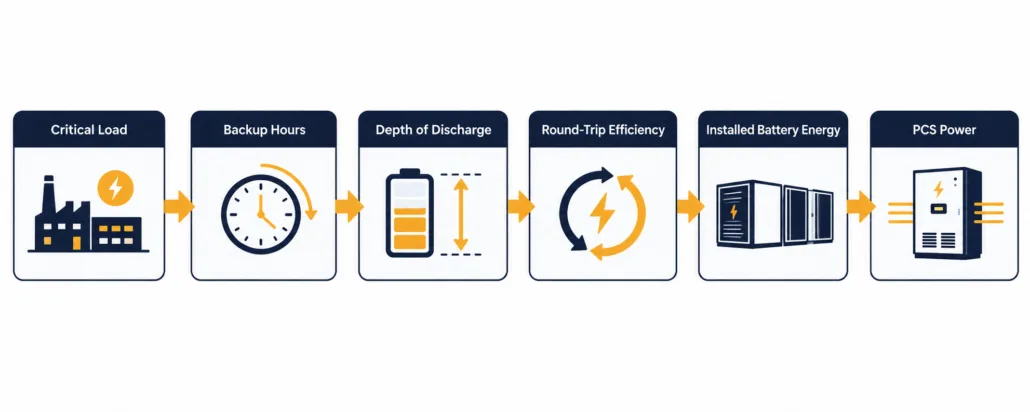
A C&I BESS sizing calculator answers one question fast. How big should the battery and inverter be?
It turns your critical load and backup hours into two numbers. First, installed battery energy in kWh. Second, PCS power in kW.
Use the free calculator below for a preliminary estimate. Then review the formulas, assumptions, and worked example before making project decisions.
Quick Answer: A C&I BESS sizing calculator turns your critical load and backup hours into two numbers. Installed battery energy in kWh factors in depth of discharge and round-trip efficiency. PCS power in kW adds a safety margin to your critical load. Still, this is a preliminary size, not a final design.
Try the C&I BESS Sizing Calculator
This calculator runs instantly in your browser. Once you enter a few numbers, it returns a preliminary size.
Enter your peak site load, critical load, and backup duration below. Then adjust depth of discharge, round-trip efficiency, and reserve margin if you have better numbers than the defaults.
C&I BESS Sizing Calculator
Estimate preliminary BESS power (kW/MW), installed battery energy (kWh/MWh), usable capacity, and backup duration.
Checks that critical load is realistic. It does not set PCS size unless whole-site backup is required.
Load that must operate during an outage.
Preliminary assumption. Final design should use discharge-path losses and auxiliary loads.
Advanced assumptions
Your preliminary C&I BESS size
Recommended BESS power—
Installed battery energy—
Estimated usable capacity—
Minimum apparent rating—
Target backup duration—
Nominal E/P duration—
Estimated required C-rate—
Installed battery energy is the nominal battery capacity required after DoD, simplified system efficiency, and reserve margin, not the nameplate size on its own.
This is a preliminary estimate. Final BESS sizing requires interval-load analysis, electrical design, site conditions, grid requirements, safety review, and product-specific warranty validation.
The results show recommended PCS power and installed battery energy. They also show usable capacity, minimum apparent power, and the required C-rate.
It works on desktop and mobile browsers alike, with no signup and no limit on how many times you recalculate.
Preliminary sizing only. This calculator estimates battery energy and PCS power from the inputs you provide. It is not a final design, quotation, or performance guarantee. It also does not replace an interconnection study, fire-safety review, or full interval-load analysis.
Why C&I BESS Sizing Matters for Commercial and Industrial Sites
Demand charges and outage risk both push sites toward battery storage. So a C&I BESS sizing calculator earns its place from the first estimate.
But get the size wrong, and the cost shows up either way.
Demand charges can be steep. In fact, research from the National Renewable Energy Laboratory (NREL), cited in this NYSERDA research summary, puts them at 30 to 70 percent of a typical commercial bill.
For example, an undersized battery cannot cover the critical load for the full outage. An oversized one, meanwhile, ties up capital that could fund other work.
A sizing calculator will not replace formal engineering design. But it still gives you a fast, defensible starting point.
Many C&I storage decisions, in turn, weigh demand-charge savings alongside backup value, though actual payback varies widely by project, utility rate structure, and site load profile.
What This C&I BESS Sizing Calculator Estimates
This calculator has one job: outage backup. Enter a critical load and a backup duration. Then it returns a preliminary size.
It is not a peak-shaving calculator. Instead, peak shaving needs interval load data and your utility’s demand-charge structure, not just a critical load.
Cutting demand charges is a different goal. See our guide to C&I BESS peak shaving instead.
Facility managers, EPCs, and asset owners typically use this stage of sizing before requesting formal quotes from vendors.
How to Find Your C&I BESS Sizing Calculator Inputs
Most sizing mistakes start with the inputs, not the formulas. Get these right first, and the C&I BESS sizing calculator results are far more reliable. Rough numbers are fine at this stage; precise numbers can wait for the engineering phase.
Critical load: list every circuit that must run through an outage. Think life-safety systems, refrigeration, servers, security, and any process equipment that cannot tolerate downtime. Then sum their running kW, not nameplate or inrush kW.
Peak site load: pull this from 12 months of utility interval data if you have it. Otherwise, use your utility bill’s peak demand figure as a starting point.
Backup duration: match this to your actual outage risk, not a round number. A site with frequent short outages needs a different duration than one preparing for extended grid events, so review recent outage history if it exists.
Site documentation, meanwhile, helps too. Single-line diagrams, panel schedules, and recent utility bills all help validate your critical-load list before you finalise it.
Power factor and reserve margin, by contrast, are usually starting assumptions rather than measured figures. Adjust them once your battery vendor or EPC confirms real numbers.
The Sizing Formulas Behind the Calculator
Every result from this C&I BESS sizing calculator comes from one of the formulas below. Here is what each one does, and why it matters.
Delivered Backup Energy
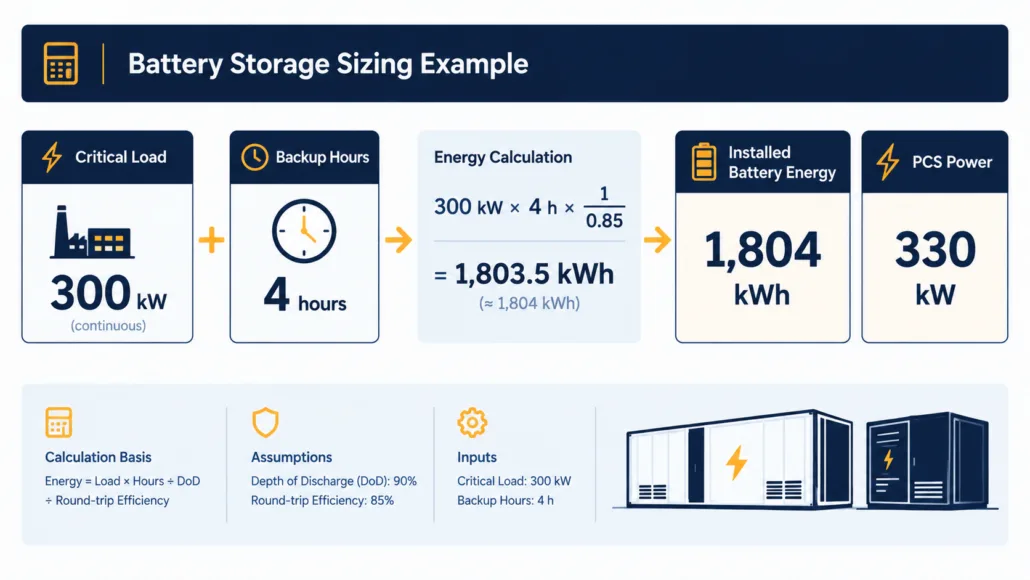
Delivered backup energy is critical load multiplied by backup hours. A 300 kW critical load for four hours, for example, needs 1,200 kWh delivered.
In short, this is the energy your equipment actually uses. It is not yet the battery size, since no battery discharges every stored kWh.
A facility with several critical circuits should sum them before running this figure.
Installed Battery Energy
Installed battery energy has three steps. First, divide delivered energy by depth of discharge. Then divide again by round-trip efficiency. Finally, add a reserve margin.
Together, DoD and RTE shrink how much nameplate capacity you can actually use. The reserve margin, meanwhile, covers degradation, temperature, and load uncertainty.
Most C&I LFP batteries run 85 to 95 percent depth of discharge. Round-trip efficiency usually sits between 90 and 95 percent at the system level. Always confirm this with your manufacturer’s datasheet.
Round-trip efficiency is a simplified, conservative assumption for a preliminary calculator. Final backup sizing should instead use discharge-path efficiency. That includes PCS, transformer, cable, battery, and auxiliary-load losses at the actual operating condition.
A wider site temperature range usually pushes real-world RTE toward the lower end of that band.
Recommended PCS Power and Apparent Power
Similarly, recommended PCS power is critical load times one plus a power margin. A 10 percent margin is a preliminary allowance only, and motor starting or other transient loads still need separate review.
Minimum apparent power in kVA, meanwhile, divides that PCS power by your system power factor. This is the screening figure for PCS and transformer ratings.
A lower power factor raises the apparent-power requirement, which can affect transformer selection.
C-Rate and Nominal E/P Duration
Finally, required C-rate is PCS power divided by installed battery energy. It shows how hard you are asking the battery to discharge.
Nominal E/P duration, by contrast, is installed battery energy divided by PCS power. Watch this figure closely. It often differs from your target backup hours, since DoD, RTE, and reserve margin all pull it away from a clean match.
A lower target C-rate generally means a larger, more conservative battery for the same PCS power.
Calculation
Formula
Meaning
Delivered backup energy (kWh)
Critical load (kW) × backup duration (hours)
Energy the critical load needs during the outage.
Installed battery energy (kWh)
(Delivered ÷ (DoD × RTE)) × (1 + reserve margin)
Nominal capacity required after DoD, system efficiency, and reserve margin.
Usable battery capacity (kWh)
Installed battery energy × DoD
Energy within the chosen discharge window.
Recommended PCS power (kW)
Critical load × (1 + power margin)
Suggested continuous PCS output rating.
Minimum apparent power (kVA)
Recommended PCS power ÷ power factor
Screening value for PCS and transformer rating.
Required C-rate
Recommended PCS power ÷ installed battery energy
Power-to-energy relationship indicator.
Nominal E/P duration (hours)
Installed battery energy ÷ recommended PCS power
Configuration indicator, not a runtime guarantee.
A C&I BESS Sizing Calculator Worked Example: 300 kW Critical Load
This worked example uses an 800 kW peak load and a 300 kW critical load. Backup duration is four hours.
Assumptions: 85% depth of discharge, 90% round-trip efficiency, 15% reserve margin. Also: 10% power margin, 0.90 power factor.
Nominal E/P duration: 1,804 ÷ 330 = 5.5 hours. That’s longer than the 4-hour target. DoD, RTE, and reserve margin together explain the gap.
This C&I BESS sizing calculator worked example uses one input combination. Change the backup duration to 2 hours, and installed battery energy roughly halves.
Push reserve margin to 20 percent instead, and it grows a little further. Run a few combinations of your own before settling on a target range.
Common C&I BESS Sizing Calculator Mistakes
These mistakes show up again and again in early estimates. But each one is easy to avoid once you know to check for it, and most take only a few extra minutes to correct before you share a number with anyone.
Ignoring DoD and RTE. In practice, sizing straight off delivered energy leaves a battery that cannot actually deliver the promised backup.
Skipping the reserve margin. Batteries lose usable capacity over time. A 10 to 15 percent margin, therefore, buys headroom for later years, not just day one.
Confusing power and energy. In short, a 330 kW PCS and a 1,804 kWh battery answer two different questions. Size both instead of just one.
Ignoring the required C-rate. For instance, a high C-rate can raise thermal stress and cut usable capacity under load. It can also affect cycle life and fall outside warranty limits. Confirm your chosen battery and PCS support the required rate.
Skipping fire code and siting review. NFPA 855, local fire and building codes, the authority having jurisdiction, and UL 9540A test evidence can all affect separation distances and layout. A preliminary estimate still needs a compliant site review. See our NFPA 855 guide for more detail.
Using nameplate load instead of running load. Nameplate and measured running load serve different purposes. Size the C&I BESS sizing calculator energy inputs off measured running kW, but review starting and transient loads separately for PCS sizing.
Skipping a sensitivity check. Run the calculator twice: once with conservative assumptions, once with optimistic ones. The gap between the two shows how much margin your estimate really has.
When You Need More Than a C&I BESS Sizing Calculator
Peak shaving, tariff optimisation, solar shifting, and generator integration all need more than one critical-load input. So do data centres and microgrids.
Peak shaving needs interval load data and your target demand level. Our demand charge guide covers why that line item is often 30 to 70 percent of a commercial bill.
Treat this calculator’s output as a starting point instead. Overall, bring it to an engineer, not to a procurement order.
Solar-plus-storage sizing is another case this C&I BESS sizing calculator does not cover. A hybrid system needs production profiles, self-consumption targets, and export limits alongside backup requirements.
Multi-building campuses work differently too. Size each building’s critical load separately, then combine the installed-energy totals rather than averaging duration targets across buildings.
Frequently Asked Questions
Quick answers to the most common C&I BESS sizing calculator questions, covering inputs, assumptions, and accuracy.
What inputs does a C&I BESS sizing calculator need?
At minimum: peak site load, critical load, and backup duration. Depth of discharge, round-trip efficiency, reserve margin, power margin, and power factor refine the estimate further.
What depth of discharge and round-trip efficiency should I use for LFP?
Most C&I LFP systems run 85 to 95 percent usable depth of discharge. Round-trip efficiency is usually 90 to 95 percent at the system level. Still, confirm exact figures with your manufacturer’s datasheet.
How much reserve margin should I add?
10 to 15 percent is a common starting point. It covers degradation, temperature swings, and load uncertainty. Still, longer contracts or harsher climates justify a larger margin.
Is a C&I BESS sizing calculator accurate enough for procurement?
No. Treat it as a preliminary estimate instead. Final sizing needs interval-load analysis, electrical design, site conditions, grid requirements, and product-specific warranty terms.
What’s the difference between installed and usable battery capacity?
Specifically, installed capacity is the nominal or nameplate energy capacity selected for the system. It is sized above the delivered-load requirement to account for DoD, system efficiency, and reserve margin. Usable capacity, by contrast, is the portion available within the selected DoD window.
Can this calculator size a multi-building campus?
Not directly in one pass. Run it once per building using each building’s own critical load and backup duration, then combine the installed-energy results before selecting a shared BESS.
How often should I re-run the calculator during a project?
Re-run it whenever a key input changes, such as an updated critical-load list, a revised backup target, or new DoD and RTE figures from a vendor quote. Treat early results as a starting range, not a fixed number.
Does this calculator account for battery degradation over time?
The calculator does not explicitly model year-by-year degradation. Its reserve margin is a user-selected allowance, not a validated end-of-life guarantee. Actual fade depends on chemistry, duty cycle, temperature, and your warranty terms.
Further Reading
More Sunlith guides pair well with this C&I BESS sizing calculator, covering fire code compliance, demand charges, and cost planning for C&I storage projects generally.
Disclaimer: This calculator and article provide preliminary estimates only. Final BESS sizing requires interval-load analysis, electrical engineering design, site assessment, applicable grid and fire codes, and manufacturer-specific validation.
Every LFP datasheet gives a depth of discharge number and a C-rate limit, the two levers behind DoD C-rate stress. Still, fewer explain what actually happens inside the cell when you push past them. DoD C-rate stress is the physical reality behind those two numbers. It is not an arbitrary warranty term. Instead, it is real mechanical and electrochemical strain on the electrode itself.
So this guide skips the buyer’s-guide framing. It explains the mechanism instead. First, it covers what happens to an electrode particle during a single lithium insertion and extraction cycle. Then it covers why deep discharge makes that worse. Then it covers why high C-rate makes it worse again, through a different pathway. Finally, it covers what happens when both combine at once.
Quick Answer DoD C-rate stress is the mechanical and electrochemical strain that deep cycling and fast charging place on an LFP cell’s electrode particles. Deep discharge causes larger volume changes inside each particle, leading to particle cracking over time. High C-rate creates steep lithium concentration gradients. This adds mechanical stress. It also raises the risk of local lithium plating, even when the average current looks safe.
DoD C-Rate Stress: What Happens Inside a Particle
Every time an LFP cell charges or discharges, lithium ions move in and out of the electrode particles. But that movement is not free. It changes the particle’s volume every time.
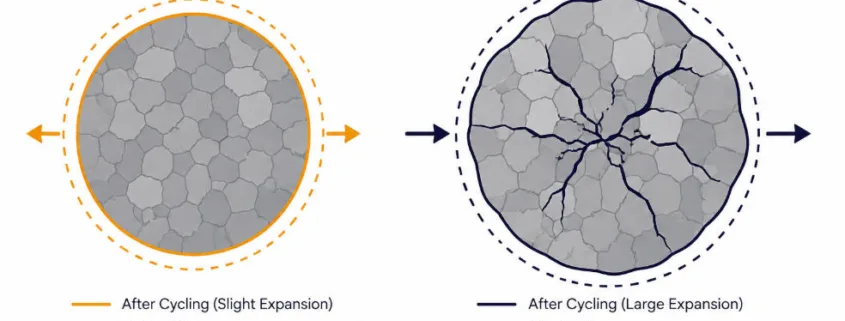
LFP and its delithiated counterpart, FePO4, differ in volume by about 6.8%. So every full cycle pushes a particle through that volume change and back. This is not a smooth, uniform process either. Lithium moves through the particle unevenly, especially at speed, creating internal concentration gradients between lithium-rich and lithium-poor regions. So those gradients generate real mechanical stress inside the particle.
Researchers have a specific name for the resulting damage in LFP cells: electrochemical milling. This is the process where LFP particles crack and crumble. Repeated volume change causes the mechanical stress behind it. First, early in a cell’s life, this cracking is not entirely bad. It exposes fresh surface area. It can even help ion transport briefly. But over time, continued milling causes particles to detach from the conductive carbon network entirely. So that detached material becomes electrically isolated. It stops contributing capacity for good.
DoD C-Rate Stress: Why Deep Discharge Makes It Worse
Depth of discharge is not just a capacity number. Instead, it is a direct measure of how far each particle gets pushed through its volume-change cycle, every single time.
Take a shallow cycle, say 20% to 80% state of charge. It keeps particles moving through a smaller slice of that range. A deep cycle from close to 0% up to 100% is different. It pushes particles through nearly the entire range, every time. So recent research using direct imaging of individual LFP particles confirms this link concretely. Operando imaging studies show something specific. Lithium concentration distribution and the resulting internal stress fields are directly tied to how far a particle gets cycled. So deeper excursions create larger, more damaging stress fields.
So this is exactly why partial state-of-charge cycling extends cycle life so reliably. It is not a soft recommendation. Instead, it reflects less particle-level strain, cycle after cycle. So shallow cycling protects the electrode structure directly. It works at the mechanical level, not just at the voltage level.
Why High C-Rate Makes This Worse Again
C-rate adds a second stress pathway on top of depth of discharge. It works through a different mechanism.
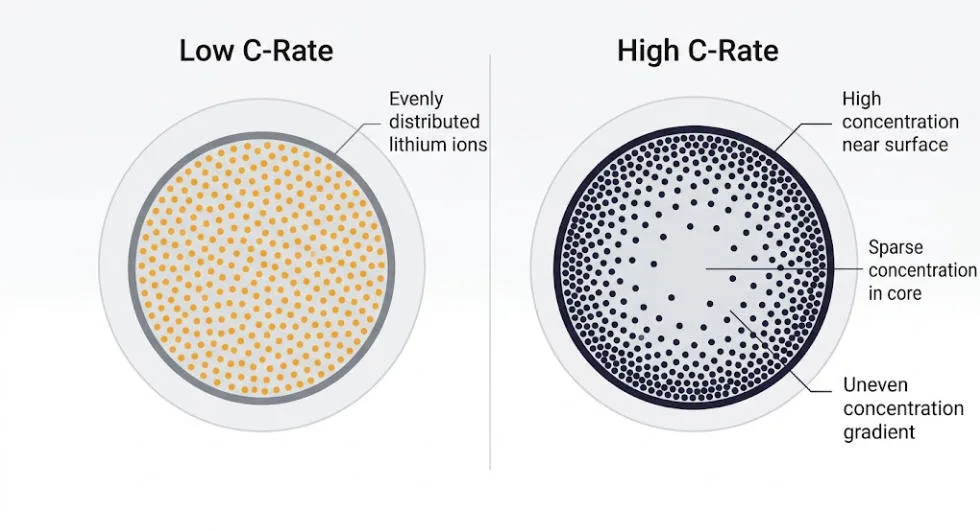
At low C-rates, lithium has time to distribute fairly evenly through a particle as it moves in or out. But at high C-rates, it does not. Instead, ions pile up near the particle surface faster than they can diffuse toward the center. This creates a steep internal concentration gradient, even if the overall depth of discharge stays the same. So that steep gradient adds mechanical stress independent of how deep the cycle actually goes. Research modeling particle-level behavior confirms this directly. Cracking occurs more severely at higher currents. It worsens further with larger particle sizes.
So high C-rate creates a second, separate risk beyond mechanical stress. At the electrode surface, fast charging causes concentration polarization. That is a buildup of lithium ions that outpaces how quickly the surrounding electrolyte and electrode structure can absorb them. This local buildup can push the anode’s surface potential down toward the plating threshold. That can happen even when the average current across the whole cell looks perfectly safe on paper. For the full mechanism behind that plating threshold, see our guide on SEI Layer Growth and Lithium Plating in LFP Cells.
DoD C-Rate Stress: When Both Combine
DoD C-rate stress is worst when both factors stack together, and that combination is common in real BESS operation, not just a lab edge case.
A cell cycled deep and fast gets hit twice. It experiences the largest volume-change stress from depth of discharge. At the same time, it faces the steepest concentration gradients from high current. But these two stress sources do not simply add. The uneven lithium distribution from fast charging concentrates strain in specific regions of the particle. Those same regions then get pushed through the largest volume swings from the deep discharge on top. So that combination accelerates electrochemical milling faster than either factor alone would predict.
This is one reason cycle life ratings drop sharply when both depth of discharge and C-rate increase together. The drop is not simply additive. A cell rated for thousands of cycles at shallow depth and moderate current can lose a large fraction of that rating. This happens when it gets pushed to both extremes at once.
How This Connects to the Bigger Degradation Picture
DoD C-rate stress is one of the concrete mechanisms behind cycle aging specifically, as distinct from the calendar aging that happens purely with time.
The mechanical stress covered here scales with cycle count and depth. It does not scale with elapsed time at rest. So that is exactly the signature of cycle aging. For the full breakdown of how cycle aging and calendar aging interact, and how operators separate the two using the Equivalent Full Cycle method, see our guide on Calendar Aging vs Cycle Aging in LFP Batteries. The particle cracking mechanism explained here is a major reason why that range exists. Cycling conditions like depth of discharge and C-rate explain a wide spread in EFC-based end-of-life ratings.
Particle cracking also creates fresh surface area. That fresh surface needs new SEI to cover it. So DoD C-rate stress connects directly to SEI growth too. Every cracking event is not an isolated capacity loss. Instead, it triggers a small amount of additional SEI-driven capacity loss on top.
Why This Matters More for Some BESS Applications Than Others
DoD C-rate stress does not hit every BESS application equally. Usage pattern determines how much this mechanism matters for a given system.
Take a solar-paired storage system that charges and discharges once a day at a moderate rate. It sits at the low-stress end of this spectrum. It rarely pushes into deep discharge territory, and its C-rate stays modest across a typical cycle. A frequency-regulation asset looks very different. It cycles constantly, often at higher C-rates, though usually across a shallower depth of discharge window. So the DoD C-rate stress mix differs by application, even before considering total cycle count.
The worst-case combination shows up in applications that need both deep discharge and high C-rate at once. Backup power systems sized tightly against peak demand are a good example. Those systems have less room to avoid the combined stress case covered above. Both extremes may be operationally necessary rather than optional. Understanding this mechanism helps explain something useful. Identical nameplate systems in different applications can show meaningfully different real-world cycle life, even under the same warranty terms.
What This Means in Practice
None of this changes the practical guidance much. Still, it explains why that guidance exists.
Keeping cycles shallow, inside a window like 20% to 80%, is not an arbitrary rule. Instead, it directly limits how far electrode particles travel through their volume-change cycle. Keeping C-rate moderate limits how steep the internal concentration gradients get, on top of that. For the buyer-facing numbers behind these two levers, see our guides on BESS C-Rate Explained and 20/80 Rule for Batteries. Both include specific cycle-life figures at different depth of discharge and C-rate combinations. Both cover the practical operating windows this guide explains the mechanism behind.
DoD C-Rate Stress: Quick Reference
Factor
What Happens at the Particle Level
Deep discharge
Larger volume-change swing per cycle, more particle cracking over time
Local concentration polarization can push toward plating risk
Combined deep + fast cycling
Stress sources compound rather than simply add
Resulting damage
Electrochemical milling, particle detachment, exposed surface for new SEI growth
Practical lever
Shallow SOC window and moderate C-rate both reduce particle-level strain directly
Frequently Asked Questions
In DoD C-rate stress, is particle cracking the same thing as SEI growth?
No, but the two are connected. Particle cracking is a mechanical process driven by volume change and internal stress. It exposes fresh surface area, which then triggers new SEI growth on that surface. One mechanical event causes a follow-on chemical one.
Under DoD C-rate stress, does shallow cycling eliminate particle cracking entirely?
No. Some degree of volume change and internal stress happens on every cycle, even a shallow one. Shallow cycling reduces the stress substantially rather than eliminating it.
Why does high C-rate matter even if depth of discharge stays the same?
C-rate affects how evenly lithium distributes inside a particle during a given cycle. This holds independent of how deep that cycle goes. Faster currents create steeper internal concentration gradients, adding stress on top of whatever depth of discharge is in use.
Can this mechanism cause sudden capacity loss, or is it always gradual?
It is usually gradual, showing up as steady capacity fade. But accumulated particle cracking and detachment can contribute to an accelerated fade phase later in a cell’s life. This is sometimes described as a knee point in the capacity curve.
Every Battery Energy Storage System (BESS) comes with a datasheet full of numbers. These include kW, kWh, C-rates, efficiency percentages, cycle life figures, and operating temperature ranges. For buyers, developers, and engineers, understanding BESS specifications is essential. In short, it is the difference between choosing a system that performs well for 15 to 20 years and one that underdelivers from day one. If you are new to energy storage, our introductory guide on What Is BESS? Understanding Battery Energy Storage Systems covers the fundamentals first.
This guide walks through every major BESS specification you will find on a datasheet. For each one, we explain what it means, how it is measured, and why it matters for your project. We also show how to compare BESS specifications across suppliers on a like-for-like basis. Whether you are evaluating a containerized utility-scale system or a smaller commercial and industrial (C&I) installation, the same core principles apply throughout this guide.
1. Power Rating vs. Energy Capacity: Core BESS Specifications
The single most important pair of BESS specifications is the distinction between power rating (kW or MW) and energy capacity (kWh or MWh). These two values are independent. Therefore, confusing them is the most common mistake made by first-time buyers. For a deeper look at how these standardized baselines are regulated, you can review the U.S. DOE — Lithium-ion Battery Storage Technical Specifications.
Power Rating (kW/MW): The maximum rate at which the system can charge or discharge electricity at any instant.
Energy Capacity (kWh/MWh): The total amount of energy the system can store and deliver over time.
A useful way to think about this is the bathtub analogy. In other words, power rating is the size of the tap (how fast water flows), while energy capacity is the size of the tub (how much water it holds).
The Power-to-Energy Ratio in BESS Specifications
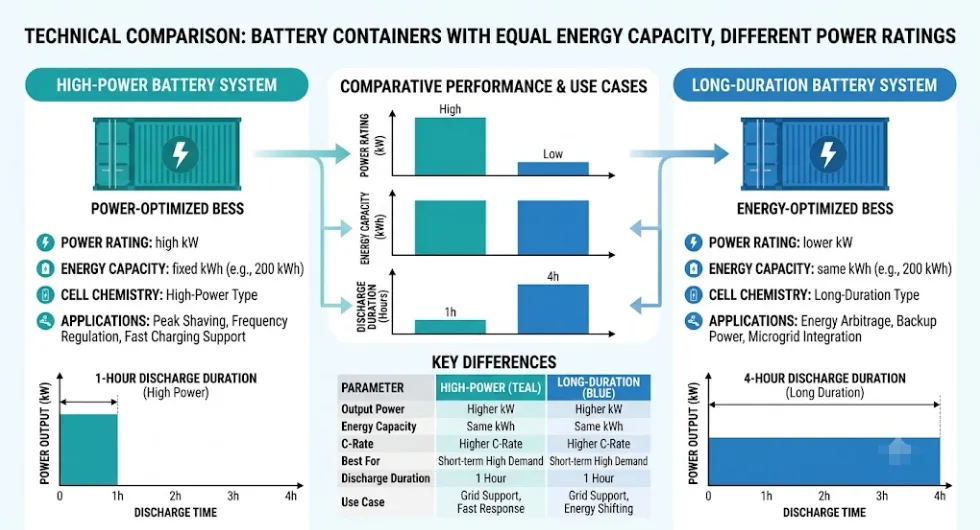
Dividing energy capacity by power rating gives the duration of the system, expressed in hours. For example, a 2 MW / 4 MWh BESS has a 2-hour duration, while a 1 MW / 4 MWh BESS has a 4-hour duration. Both store the same total energy. However, they serve very different applications.
System Configuration
Duration
Typical Application
1 MW / 1 MWh
1 hour
Frequency regulation, fast response
1 MW / 2 MWh
2 hours
Peak shaving, short-duration arbitrage
1 MW / 4 MWh
4 hours
Solar shifting, demand charge reduction
1 MW / 8 MWh+
8+ hours
Overnight backup, island grid applications
When evaluating a quote, always check both numbers separately. For instance, a supplier advertising a “2 MWh system” without specifying the power rating has not given you a complete set of BESS specifications.
Figure 1: Power rating and energy capacity together determine discharge duration.
2. C-Rate Specifications: Linking Power and Energy Together
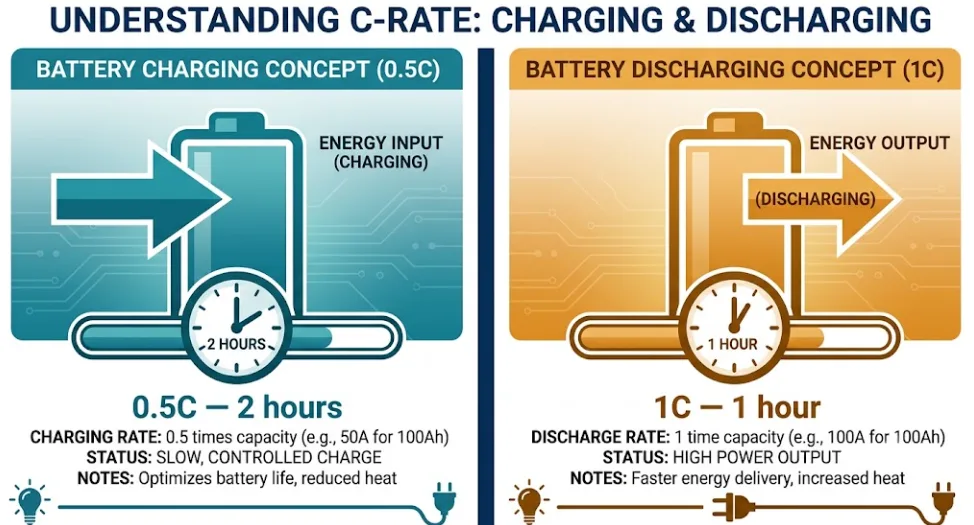
Among the key BESS specifications, the C-rate expresses the charge or discharge current relative to the battery’s total capacity. For example, a 1C rate means the battery can be fully charged or discharged in one hour. Similarly, a 0.5C rate means two hours, while a 2C rate means 30 minutes.
C-rate = Power (kW) ÷ Energy Capacity (kWh)
For most stationary BESS applications — such as peak shaving, solar shifting, and frequency regulation — systems are designed in the 0.25C to 1C range. As a result, higher C-rates increase heat generation, accelerate degradation, and typically require more robust thermal management.
LFP cells: commonly rated for continuous operation up to 1C, with short bursts to 2–3C
NMC cells: often support slightly higher continuous C-rates but with faster capacity fade at high rates
High C-rate specifications (>1C) should always be cross-checked against the cell manufacturer’s datasheet and thermal design
Therefore, for a deeper technical breakdown of how C-rate affects performance across battery chemistries, see our guide on Battery C-Rates Explained for BESS Buyers.
3. Round-Trip Efficiency: A Critical BESS Specification
Round-trip efficiency measures how much of the energy used to charge a battery is recovered on discharge. As a result, it is one of the most commercially significant BESS specifications, because it directly affects the revenue and savings a system can generate over its lifetime.
RTE (%) = Energy Discharged ÷ Energy Charged × 100
Battery Technology
DC Efficiency
AC Efficiency
Lithium Iron Phosphate (LFP)
96–98%
88–94%
Lithium NMC
95–97%
87–92%
Sodium-ion
90–94%
82–90%
Flow Batteries
70–85%
65–80%
Lead-Acid
80–90%
70–85%
Always confirm whether a quoted RTE figure is AC (system-level) or DC (battery-level). AC efficiency includes inverter, transformer, and auxiliary losses. Therefore, it is the figure that matters most for project economics. For the full formula, worked examples, and an interactive calculator, see our dedicated guide on BESS Round Trip Efficiency (RTE).
4. Depth of Discharge and Usable Energy BESS Specifications
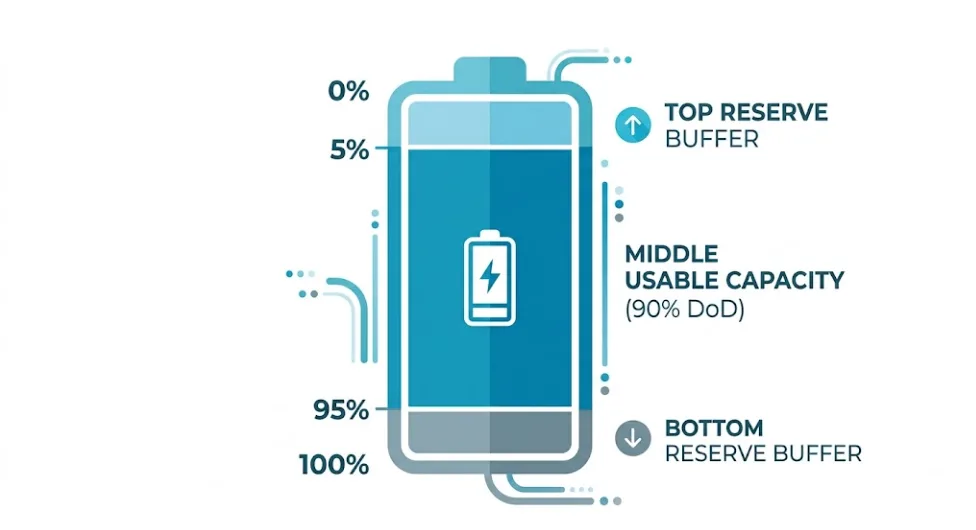
Depth of Discharge (DoD) describes how much of the battery’s total (nameplate) capacity is used during normal operation. It is expressed as a percentage. The remaining portion is reserved to protect the battery from degradation. This degradation is caused by very high or very low states of charge. As a result of applying DoD to nameplate capacity, we get Usable Energy — the figure that actually matters for sizing and project economics.
Nameplate Capacity: The total rated energy storage of the system (e.g., 4,000 kWh)
LFP systems commonly operate at 90–95% DoD due to their flat voltage curve and stable chemistry
NMC and older lead-acid systems often specify lower DoD limits (50–80%) to preserve cycle life
Usable Energy is also a moving target over the system’s lifetime. Specifically, as the battery degrades, both nameplate capacity and usable energy decline. For this reason, project sizing should be based on usable energy at end-of-life (EOL), not at beginning-of-life (BOL). Otherwise, a system that meets duration requirements in year one may fall short by year ten.
When comparing two quotes with identical nameplate capacity, the system with the higher usable DoD effectively delivers more usable energy. In other words, it delivers more value per dollar, assuming cycle life and warranty terms are comparable.
Figure 2: Nameplate capacity vs. usable capacity under a typical 90% DoD specification.
5. State of Charge and State of Health BESS Specifications
State of Charge (SoC) Specification
SoC is a real-time measurement of how much energy is currently stored in the battery. It is expressed as a percentage of usable capacity. The Battery Management System (BMS) manages SoC continuously. As a result, it sets safe operating windows. For example, cycling may be restricted to a 10–95% SoC band to protect cell longevity.
State of Health (SoH) Specification
SoH indicates how much capacity and performance the battery retains compared to when it was new. It is typically expressed as a percentage. For instance, a battery at 80% SoH can store only 80% of its original rated energy. Most BESS warranties therefore guarantee a minimum SoH — commonly 70–80% — at the end of a stated warranty period, such as 10 years.
SoH is most commonly estimated using DC Internal Resistance (DCIR) measurements. This is because internal resistance increases predictably as cells age. For a detailed explanation of how this works in practice, see our guide on DCIR-Based State of Health Estimation for BESS.
6. Battery Management System (BMS) Specifications
The BMS is the electronic brain of the battery. Therefore, its specifications deserve as much scrutiny as the cells themselves. Key BMS specifications to evaluate include the following:
Cell-level voltage and temperature monitoring resolution (number of monitored points per module/rack)
Cell balancing method — passive vs. active balancing, and balancing current capability
Communication protocol — CAN bus, Modbus TCP/RTU, or proprietary protocols, and compatibility with the EMS
Insulation resistance monitoring and ground fault detection
State estimation algorithms for SoC and SoH accuracy (typically ±2–3% for quality systems)
A well-specified BMS should provide granular cell-level data, not just pack-level averages. This granularity is essential for early fault detection. In addition, it ensures accurate SoH tracking over the system’s lifetime.
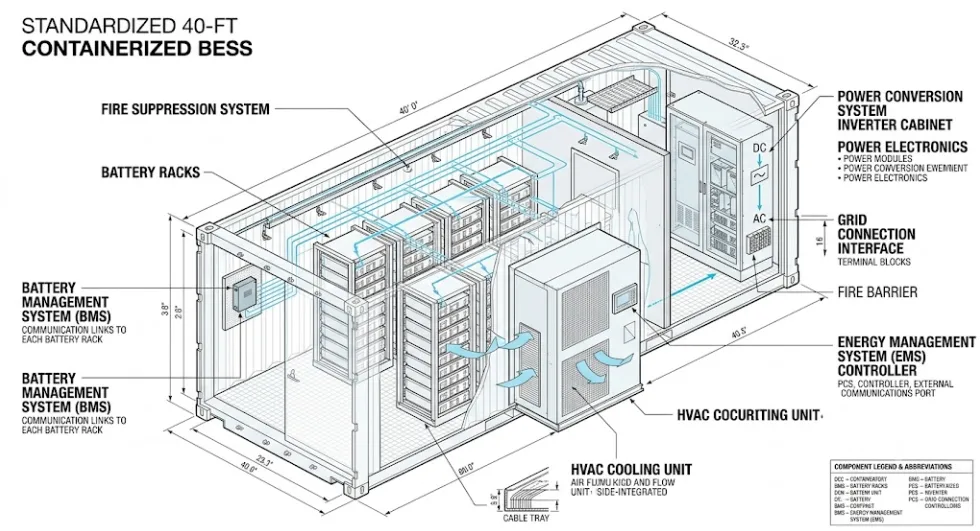
The BMS is just one subsystem within the overall system design. For a complete picture of how the BMS, PCS, EMS, and thermal systems are arranged together, see our guide on Understanding Energy Storage System BESS Architectures.
7. Power Conversion System (PCS) Specifications
The Power Conversion System (PCS), or inverter, converts DC battery power to AC grid power and back. Therefore, key PCS specifications include the following:
Rated AC power output (kW/MW) and overload capability (e.g., 110% for 10 minutes)
Conversion efficiency — typically 96–99% for modern PCS units
Control mode — grid-following (GFL) or grid-forming (GFM)
Power factor range and reactive power capability (kVAR)
Total Harmonic Distortion (THD) — typically below 3% for grid-compliant systems
The choice between grid-following and grid-forming PCS specifications has become one of the most consequential decisions in modern BESS procurement. This is especially true for projects with high renewable penetration or islanded operation. For a full comparison, see Grid Forming vs Grid Following BESS: What Is the Difference?, and our complete reference on Power Conversion System (PCS) for BESS.
Figure 3: Major subsystems referenced across a typical BESS specification sheet.
8. Cycle Life and Calendar Life BESS Specifications
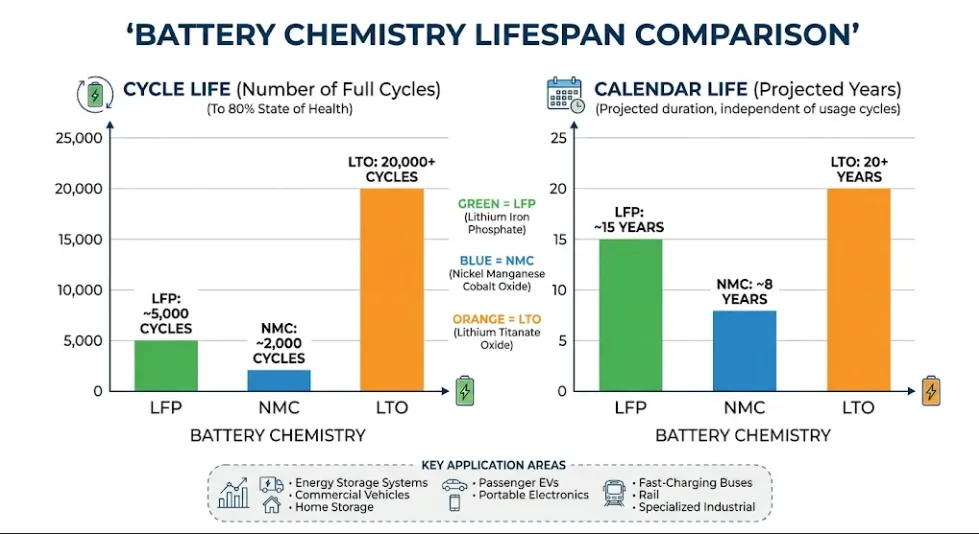
Cycle life specifies the number of full charge-discharge cycles a battery can complete. After this number is reached, capacity falls to a defined end-of-life threshold, commonly 80% of original capacity. By contrast, Calendar life specifies the expected service life in years. This is independent of cycling, and is due to chemical aging over time.
Therefore, always request the test conditions behind any cycle life claim. You can also consult the NREL — Grid-Scale Battery Storage FAQs to see how baseline degradation model assumptions impact long-term project planning.
Battery Chemistry
Typical Cycle Life (to 80% SoH)
Typical Calendar Life
LFP (Lithium Iron Phosphate)
4,000–8,000 cycles
10–15 years
NMC (Lithium Nickel Manganese Cobalt)
3,000–6,000 cycles
8–12 years
LTO (Lithium Titanate)
10,000–20,000 cycles
15–20 years
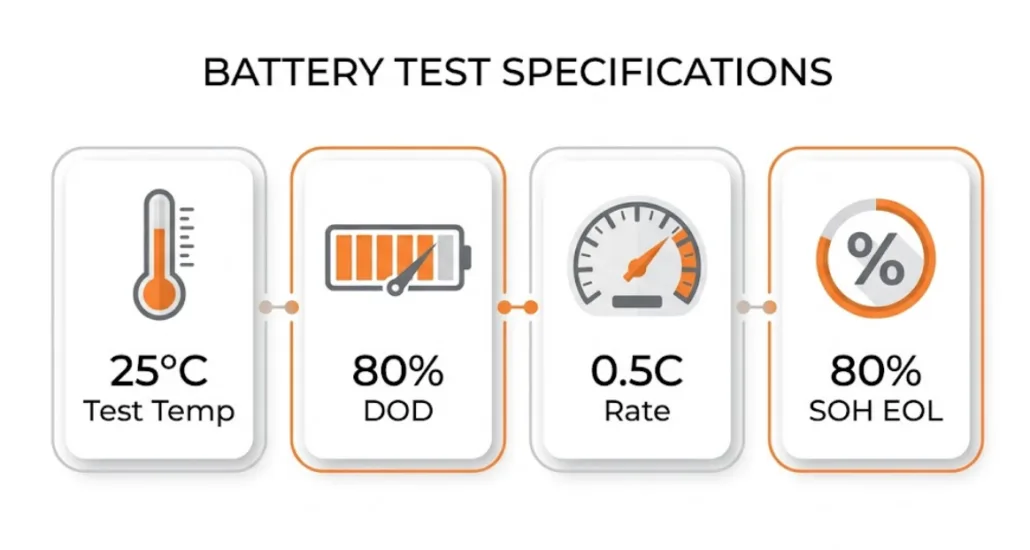
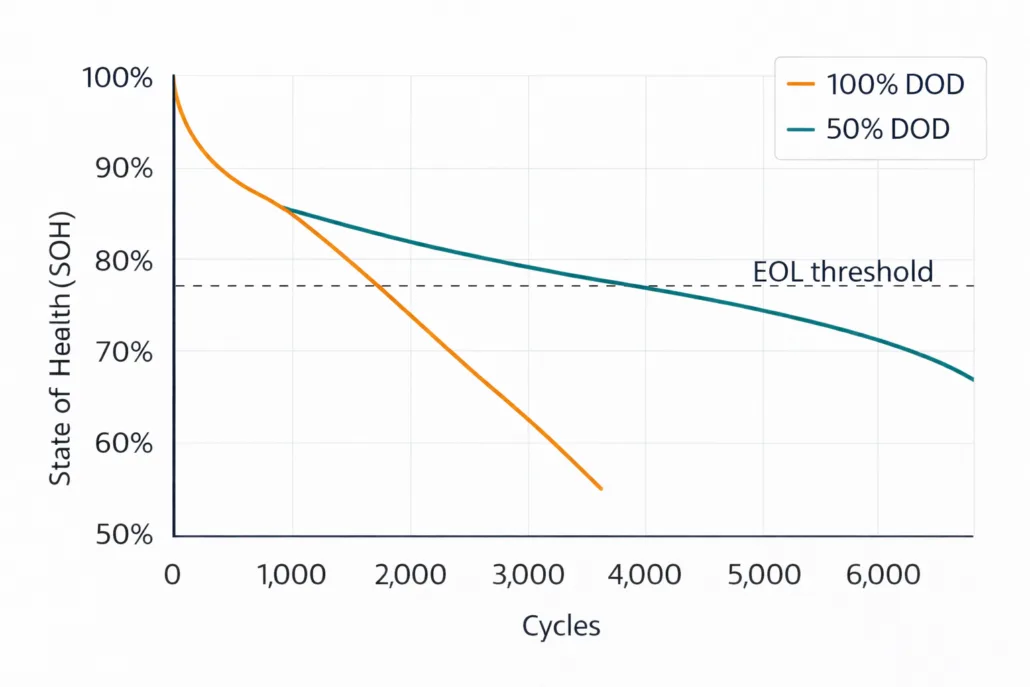
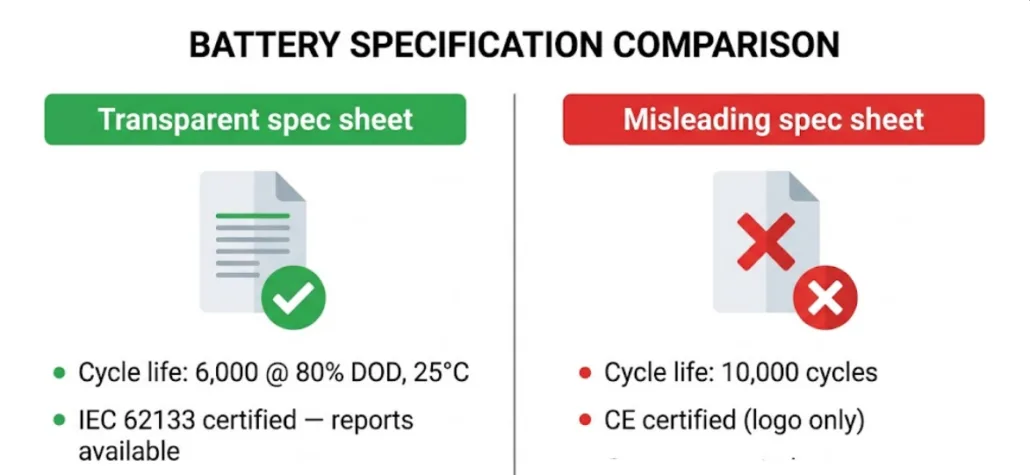
Cycle life ratings are always tied to specific test conditions, such as DoD, C-rate, and temperature. For example, a cycle life figure quoted at 100% DoD and 1C will be significantly lower than the same cell’s life at 80% DoD and 0.5C. Therefore, always request the test conditions behind any cycle life claim.
9. Thermal Management BESS Specifications
Thermal management directly affects safety, efficiency, and degradation rate. As a result, specifications to review include the following:
Cooling method — air cooling, liquid cooling, or hybrid systems
Operating temperature range — typically -20°C to 55°C for the enclosure, with cell-level targets of 15–35°C
Temperature uniformity across racks (a key driver of uneven degradation); see our analysis on gradient-limit depth)
HVAC redundancy (N+1 configurations for utility-scale projects)
Thermal runaway detection and suppression systems (aerosol, water mist, or other agents)
Liquid cooling has become the default for high-density utility-scale systems, mainly due to better temperature uniformity. Meanwhile, air cooling remains common and cost-effective for smaller C&I systems. For a detailed comparison, see Liquid vs Air Cooling Systems in BESS.
10. Ingress Protection and Operating Condition BESS Specifications
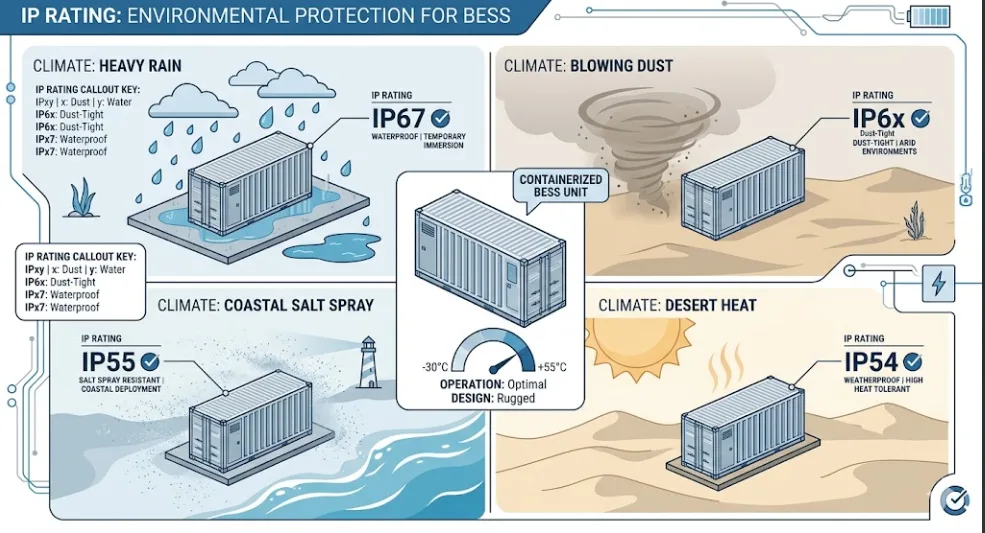
The IP (Ingress Protection) rating describes how well the BESS enclosure resists solid objects, dust, and water. As a result, it is a critical specification for outdoor and harsh-environment installations. The rating is expressed as IP followed by two digits. The first digit indicates protection against solids, such as dust and debris. The second digit indicates protection against liquids, such as moisture, rain, and washdown.
IP Rating
Solids Protection
Liquids Protection
Typical Application
IP54
Dust-protected (limited ingress)
Splash-protected from any direction
Sheltered or indoor C&I installations
IP55
Dust-protected
Protected against low-pressure water jets
Outdoor C&I, moderate exposure
IP65
Dust-tight
Protected against water jets from any direction
Utility-scale outdoor containers, coastal sites
IP67
Dust-tight
Protected against temporary immersion
Flood-prone or extreme weather sites
Beyond the enclosure rating, the broader operating conditions specification defines the environmental envelope. Within this envelope, the BESS is warranted to perform. Key items to check include the following:
Ambient operating temperature range — commonly -20°C to 55°C for the container, narrower (15–35°C) for the cells themselves
Storage temperature range (for the system when not in active operation)
Relative humidity range — typically 5–95% non-condensing
Altitude derating — power output may be derated above 1,000–2,000 m due to reduced cooling performance
Corrosion protection — coastal or high-salinity sites typically require C3–C5 corrosion class enclosures and coatings
Wind and snow load ratings for the container or enclosure structure
For projects in tropical, coastal, desert, or high-altitude locations, these BESS specifications should be checked carefully against local climate data. Otherwise, a system rated for temperate climates may require derating, additional cooling capacity, or enhanced corrosion protection to meet its advertised performance and warranty terms.
11. Safety and Compliance BESS Specifications
Safety certifications are non-negotiable BESS specifications. In fact, they should appear on every datasheet:
UL 9540 / UL 9540A Test Method — fire safety and thermal runaway propagation testing
UN 38.3 — transportation safety for lithium batteries
NFPA 855 — installation standards for energy storage systems (US)
Seismic certification where applicable (e.g., IBC seismic design categories)
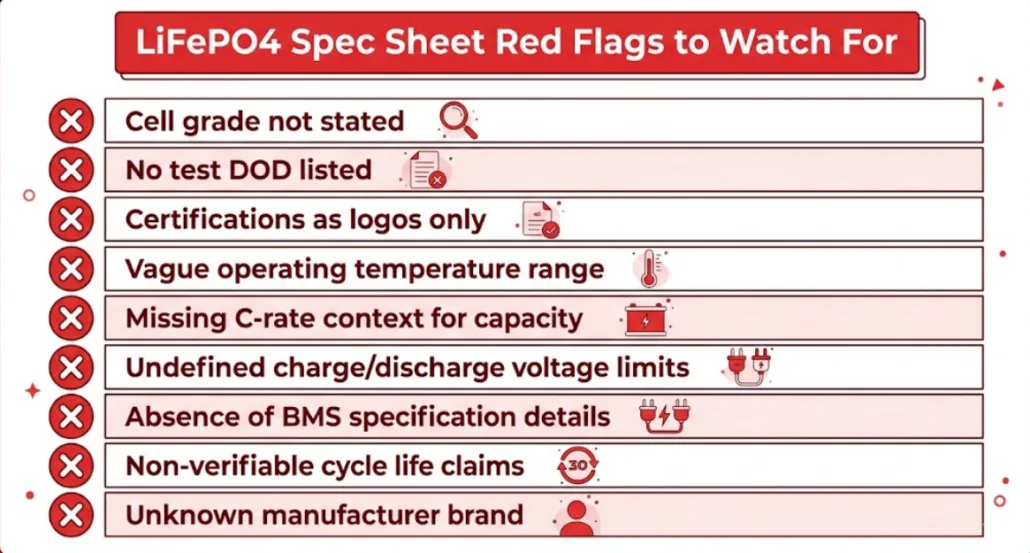
Missing certifications are a red flag. This is particularly true for utility interconnection and insurance underwriting, where documentation of UL 9540A test results is increasingly a hard requirement. To streamline your evaluation, you can reference the U.S. DOE — BESS Procurement Checklist to verify required project documentation.
12. BESS Specifications Comparison Checklist
When comparing quotes from multiple suppliers, build a side-by-side table using the BESS specifications below. As a result, this ensures you are comparing systems on equal terms, rather than being swayed by a single headline number.
Specification
Why It Matters
What to Ask For
Power rating (kW/MW)
Determines instantaneous load-serving capability
Continuous and peak (overload) ratings
Energy capacity (kWh/MWh)
Determines total stored energy and duration
Nameplate vs. usable capacity, BOL vs. EOL
C-rate
Affects degradation and thermal design
Continuous and pulse C-rate limits
Round-trip efficiency
Drives lifetime energy losses and revenue
AC vs. DC efficiency, test conditions
Depth of Discharge / Usable Energy
Determines real usable energy at BOL and EOL
Recommended cycling band (e.g., 10–95%); usable kWh at year 1 and year 10
Cycle life / Calendar life
Drives augmentation and replacement schedule
Test conditions (DoD, C-rate, temperature)
Warranty SoH guarantee
Protects against early degradation
Guaranteed SoH at 10/15/20 years
Thermal management
Affects safety and long-term performance
Cooling method, redundancy, operating range
IP rating & operating conditions
Determines suitability for site climate and exposure
IP rating, temperature/humidity range, corrosion class, altitude derating
PCS efficiency & control mode
Affects conversion losses and grid compatibility
GFL vs. GFM, THD, grid code compliance
Safety certifications
Required for permitting, insurance, financing
UL 9540A test reports, IEC 62619
Frequently Asked Questions About BESS Specifications
Which BESS specification should a buyer understand first?
Power rating and energy capacity, along with the relationship between them (duration), form the foundation of every other specification. If you get this wrong, the system either cannot meet peak demand or cannot supply energy for long enough. As a result, the other specifications matter much less.
Is a higher round-trip efficiency always better in BESS specifications?
Generally yes, but it should be weighed against cost, chemistry, and application. For example, a 2–3 percentage point difference in AC round-trip efficiency can meaningfully affect lifetime revenue for high-cycling arbitrage projects. However, it matters less for systems used primarily for backup power.
Why do nameplate capacity and usable energy differ in BESS specifications?
The difference comes from the Depth of Discharge (DoD) reserve. This reserve protects the battery from operating at extreme states of charge, which would otherwise accelerate degradation. Therefore, this reserve is intentional and is factored into warranty terms.
How do I verify a supplier’s cycle life specifications?
Request the specific test conditions — DoD, C-rate, and ambient temperature — used to derive the cycle life figure. In addition, ask for third-party cell-level test data where available. Then, compare these conditions to your expected operating profile.
What BESS specifications matter most for island grid or off-grid projects?
For islanded systems, grid-forming PCS capability, black start capability, and energy duration (MWh, not just MW) become critical BESS specifications. By contrast, these may not matter for grid-connected projects. See our Island Grid BESS Engineering Guide for a full sizing methodology.
Conclusion: Why BESS Specifications Matter
BESS specifications are not just numbers on a datasheet. Instead, each one represents a design decision with direct consequences for performance, safety, and lifetime economics. By understanding power rating, energy capacity, C-rate, round-trip efficiency, depth of discharge, State of Health, and the supporting BMS, PCS, thermal, IP rating, and safety specifications, buyers and engineers can compare systems meaningfully. As a result, they can avoid costly mismatches between design intent and real-world performance.
Introduction: Why BESS C-Rate Changes Everything About System Price and Performance
Every Battery Energy Storage System (BESS) datasheet carries a C-rate figure. It sits alongside capacity in kWh, chemistry type, and cycle life. Yet the BESS C-rate is almost always the least-explained number on the page — and, in practice, the most consequential one.
Understanding BESS C-rate matters because it governs three things at once. First, it sets how much peak power the system can deliver. Second, it controls how quickly the battery recharges between dispatch events. Third, it predicts how long cells will last under real operating conditions. As a result, BESS C-rate has a direct, measurable effect on installed system cost. In fact, the price gap can be large. Between a 0.5C energy-type system and a 2C power-type system of identical kWh capacity, the difference is often 50 to 100 per cent.
This guide explains the BESS C-rate concept from first principles. It covers both charge and discharge C-rates based on foundational National Laboratory of the Rockies (NLR) battery storage technology basics with worked examples. It also maps the full relationship between C-rate tier, application, and installed price. By the end, therefore, you can read any BESS datasheet with confidence. You will also be able to compare quotations on a like-for-like basis.
1. What Is BESS C-Rate? Definition, Formula and Notation
BESS C-rate is a standardised measure of how fast a battery is charged or discharged relative to its total storage capacity. The “C” stands for capacity. The number in front of it acts as a multiplier of that capacity.
📐
BESS C-rate formula: C-rate = Current (A) ÷ Nominal Capacity (Ah) Example — 200 Ah LFP battery: • Discharged at 200 A → 1C → full discharge in 1 hour • Discharged at 400 A → 2C → full discharge in 30 minutes • Discharged at 100 A → 0.5C → full discharge in 2 hours
Importantly, BESS C-rate is chemistry-independent and capacity-independent. For example, a 1C discharge of a 10 kWh residential BESS delivers 10 kW. In contrast, a 1C discharge of a 2 MWh grid system delivers 2 MW. In both cases, the rate is relative — it describes discharge speed as a proportion of total storage, regardless of system size.
BESS C-Rate Notation: Reading the Two Datasheet Formats
Two notation formats appear on datasheets and both describe the same BESS C-rate value. The multiplier format uses a number before C: 2C means discharge at double the 1-hour rate, giving a full drain in 30 minutes. The fractional format divides capacity: C/2 means discharge at half the 1-hour rate, giving a full drain in 2 hours.
Therefore, C/2 and 0.5C are identical. Similarly, C/10 and 0.1C are identical. When a datasheet shows a charge rate of C/5 alongside a discharge rate of 1C, the system charges five times more slowly than it discharges. As explained in Section 2, this asymmetry is a deliberate engineering choice — not a product limitation.
BESS C-Rate Quick Reference: From 0.1C to 10C
C-Rate
Meaning
Discharge Time
Charge Time (at same rate)
Real-World Parallel
C/10 (0.1C)
Discharge at 1/10th capacity current
10 hours
10 hours
Solar trickle charge / overnight backup reserve
C/5 (0.2C)
Discharge at 1/5th capacity current
5 hours
5 hours
Long-duration island grid storage
C/2 (0.5C)
Discharge at half capacity current
2 hours
2 hours
C&I energy arbitrage, solar self-consumption
1C
Discharge at full capacity current
1 hour
1 hour
Peak shaving, daily cycling BESS
1.5C
Discharge at 1.5× capacity current
40 minutes
—
Aggressive demand charge reduction
2C
Discharge at double capacity current
30 minutes
—
Grid frequency response, EV charging buffer
3C
Discharge at 3× capacity current
20 minutes
—
Fast-response ancillary services
10C
Discharge at 10× capacity current
6 minutes
—
Ultra-fast EV charging, power electronics
2. BESS Charge C-Rate vs Discharge C-Rate: Why the Two Figures Differ
Most explanations of BESS C-rate focus only on discharge — how fast the battery empties. However, charge C-rate is equally important for dispatch planning and cell longevity. In most commercial BESS installations, moreover, the two figures are deliberately set at different levels.
Why BESS Charge C-Rate Must Stay Below Discharge C-Rate
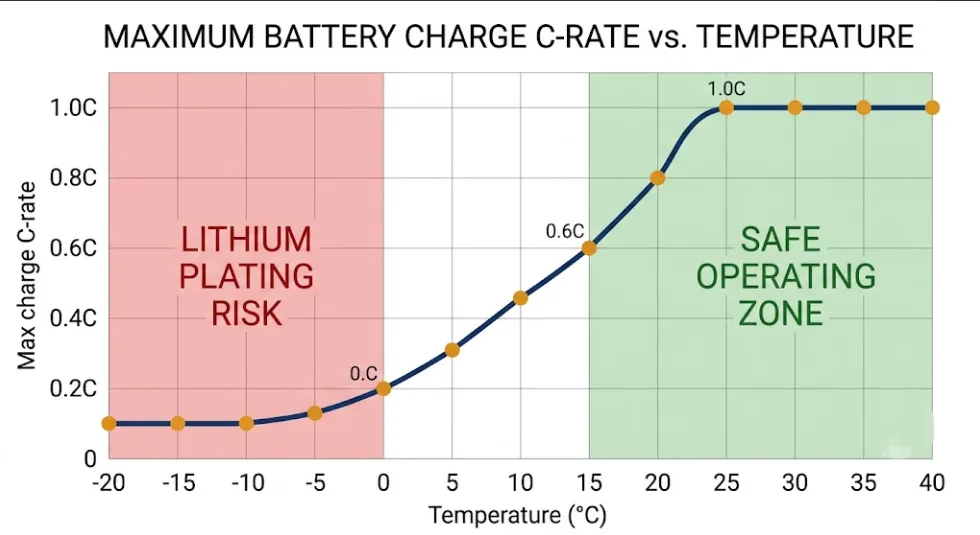
Charging a lithium-ion cell forces lithium ions back into the anode. If this process happens too fast, ions arrive at the anode surface faster than the graphite lattice can absorb them. Consequently, excess lithium deposits as metallic lithium on the surface — a process called lithium plating. Lithium plating is irreversible. It permanently reduces capacity and, in extreme cases, creates internal short circuits that cause thermal runaway. For the full electrochemistry behind why lithium plating happens, how it differs from ordinary SEI layer growth, and why it’s largely preventable, see our guide on SEI layer growth and lithium plating in LFP cells.
For this reason, LFP manufacturers specify a maximum continuous charge C-rate that is lower than the discharge limit. The most common commercial BESS pairing — 0.5C charge and 1C discharge — reflects this constraint directly.
⚡
Standard C&I LFP BESS charge vs discharge C-rate: Charge rate: 0.5C → fills in 2 hours → protects anode, maximises cycle life Discharge rate: 1C → empties in 1 hour → delivers full rated peak power This asymmetry is intentional — not a limitation.
The practical implication is straightforward. A 500 kWh / 1C BESS delivers 500 kW to the grid in one hour. However, it needs two hours to recharge at 0.5C. Therefore, always plan your dispatch schedule around the slower charge rate — not just the discharge figure.
BESS Charge C-Rate Worked Examples: 100 Ah LFP Cell
Charge C-Rate
Charge Time (100 Ah cell)
Charge Current
BESS Application
LFP Cell Impact
C/10 (0.1C)
10 hours
10 A
Overnight trickle from small solar array
Excellent — maximum cycle life, zero thermal risk
C/5 (0.2C)
5 hours
20 A
Slow solar charge, low-irradiance days
Excellent — best for calendar longevity
C/2 (0.5C)
2 hours
50 A
Standard C&I BESS grid or solar charge
Very good — recommended daily charge rate for LFP
1C
1 hour
100 A
Fast recharge between morning/afternoon peaks
Good — within spec; monitor cell temperature
2C
30 minutes
200 A
Rapid recharge for EV charging buffer BESS
Moderate — active cooling essential; reduces cycle life
3C+
<20 minutes
300 A+
Ultra-fast charging stations
Risk of lithium plating — requires specialist cells only
BESS Discharge C-Rate Worked Examples: 100 Ah LFP Cell
Discharge C-Rate
Discharge Time (100 Ah)
Power Output
BESS Application
LFP Cell Impact
C/4 (0.25C)
4 hours
25 A
Frequency regulation support, overnight levelling
Excellent — minimal degradation, long cycle life
C/2 (0.5C)
2 hours
50 A
Residential shifting, off-grid night supply
Excellent — standard low-stress operating point
1C
1 hour
100 A
C&I peak shaving (30–60 min demand events)
Very good — standard commercial BESS daily operation
1.5C
40 minutes
150 A
Aggressive demand charge reduction
Good — within LFP spec with adequate thermal management
2C
30 minutes
200 A
Grid frequency regulation, EV buffer discharge
Moderate — higher heat, faster degradation per cycle
10C
6 minutes
1,000 A
EV ultra-fast charging station power burst
Requires high-power LFP or specialist cell chemistry
Full BESS C-Rate Cycle: Real Charge and Discharge Example
To anchor both BESS C-rate concepts in a real project, consider a 500 kWh LFP BESS at a cold-storage facility. The site faces a peak demand charge triggered above 400 kW. Consequently, the system runs two discharge events per day:
NIGHT CHARGE (22:00–00:00) — BESS C-rate: 0.5C, from off-peak grid Current: 408 A | Power: 250 kW | Duration: 2 hours Result: fully charged at midnight using cheap off-peak tariff
MORNING DISCHARGE (08:00–09:00) — BESS C-rate: 1C, peak shaving Current: 815 A | Power: 500 kW | Duration: 1 hour Result: production ramp absorbed; grid import held below 400 kW
AFTERNOON CHARGE (12:00–14:00) — BESS C-rate: 0.5C, from rooftop solar Current: 408 A | Power: 250 kW | Duration: 2 hours Result: battery refilled by solar for the afternoon peak
This 0.5C charge / 1C discharge pattern keeps LFP cells within their optimal BESS C-rate operating window. As a result, cycle life typically exceeds 4,000 full cycles at 80% depth of discharge — sufficient for over 10 years of daily operation.
📌
BESS C-rate rule of thumb: if your system is specified for 1C discharge, plan to charge at 0.5C. If it operates at 2C discharge, confirm that the cell chemistry and BMS support at least 1C charging without lithium plating risk.
3. How the BMS Enforces BESS C-Rate Limits in Real Operation
The Battery Management System (BMS) is the component that enforces BESS C-rate limits at the cell level during both charge and discharge. It monitors current, cell temperature, and state of charge (SoC) in real time. Whenever any parameter approaches its safe boundary, the BMS intervenes immediately to protect the cells.
BMS Charge Control: CC/CV Protocol and BESS C-Rate Tapering
During charging, the BMS applies a constant-current / constant-voltage (CC/CV) protocol. The constant-current phase runs at the rated charge C-rate until cell voltage approaches its upper limit. At that point, the BMS transitions to constant-voltage mode and tapers current down to zero as the cell reaches full charge. This taper phase is critical — without it, sustained high-current charging causes the lithium plating described in Section 2.
BMS Discharge Control: BESS C-Rate Curtailment and SoH Tracking
During discharge, the BMS monitors current and cell temperatures continuously. When current exceeds the rated BESS C-rate, the BMS issues a curtailment command within milliseconds. This typically happens because of a load spike or an inverter fault. High-C-rate BESS systems operating at 2C or above require particularly fast BMS response. For this reason, systems designed for sustained 2C operation use BMS platforms with sub-10 ms cell-level sampling. This specification adds cost, but it also prevents thermal cascades.
In addition to real-time protection, the BMS tracks the cumulative effect of each C-rate event on State of Health (SoH). SoH is the ratio of current capacity to the original rated capacity. Understanding what a battery management system (BMS) is and how its topology handles cell balancing during high-discharge events reveals why operating consistently at or below the rated BESS C-rate is one of the most effective ways to preserve SoH while extending your warranty-covered cycle count.
4. How High BESS C-Rate Reduces Usable Capacity: The Rate-Capacity Effect
A battery discharged at a high BESS C-rate typically delivers less total energy than the same battery at a lower rate. This happens even though the nameplate capacity is identical. Consequently, this fact surprises many buyers. It is also one of the most important concepts to understand before specifying a system.
Why BESS C-Rate Affects How Much Energy You Actually Receive
Inside a lithium-ion cell, energy is released as lithium ions migrate from cathode to anode through the electrolyte. This migration has a physical speed limit, set by the ionic conductivity of the electrolyte and the diffusion rate of lithium within the electrode materials.
At low BESS C-rates, ions cross the electrolyte in an orderly process and the full stored capacity is accessible. At high C-rates, however, ions are forced to move faster than the cell structure allows. This causes electrode polarisation — a phenomenon documented in peer-reviewed research on the Nature Energy rate-capacity effect in Li-ion batteries — causing a voltage drop that pushes terminal voltage below the cutoff threshold before all stored lithium has been extracted.
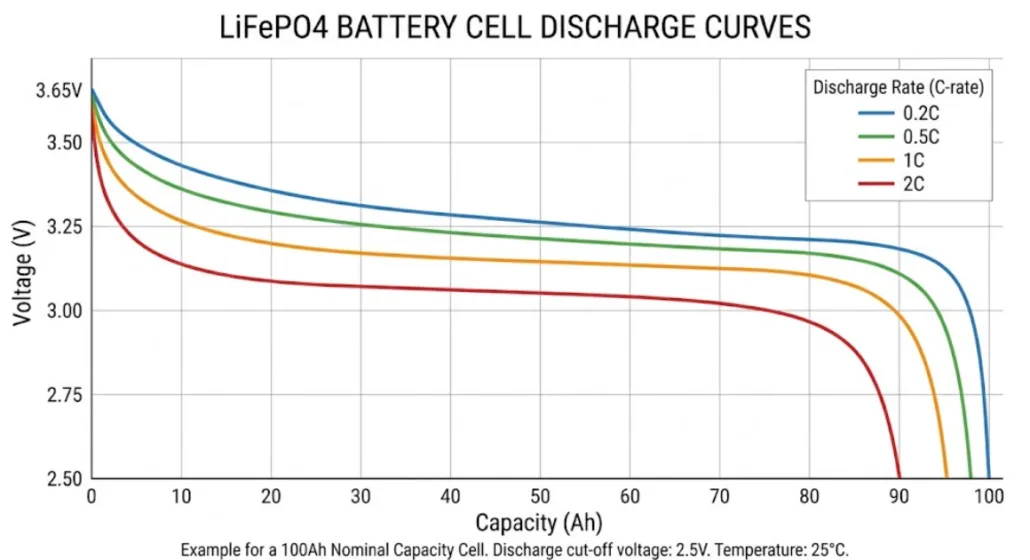
The result is measurable. At 2C BESS C-rate, an LFP cell rated at 100 Ah may only deliver 88–92 Ah of usable capacity. At 0.5C, moreover, the same cell may deliver 101–103 Ah because slower discharge allows more complete lithium extraction.
📌
Always ask your BESS supplier for the capacity derating curve: How much kWh does the system deliver at your operating BESS C-rate — not just at 1C nameplate?
A responsible supplier provides derating figures at 0.5C, 1C, and 2C. If they cannot supply this data, treat the capacity claim with caution.
Heat Generation at High BESS C-Rate: The I²R Effect
High BESS C-rates also increase internal heat generation through ohmic heating. The heat load follows the I²R relationship — doubling the discharge current quadruples the heat generated inside the cell. Over time, this heat degrades the electrolyte and the SEI layer, accelerating capacity fade per cycle and reducing total cycle life. Managing this heat, therefore, is the primary engineering challenge at C-rates above 1C.
5. BESS C-Rate by Application: Matching Discharge Speed to Your Use Case
The correct BESS C-rate for any project is determined by the application. Specifically, it depends on how fast energy must be delivered and how long the discharge event lasts. The following subsections cover the most common commercial and grid-scale use cases, with the appropriate C-rate for each.
Solar Self-Consumption and Energy Arbitrage: BESS C-Rate 0.25C – 0.5C
Storing solar generation during the day and releasing it in the evening requires a slow, multi-hour discharge. A 0.5C BESS C-rate, discharging over two hours, maximises energy extracted per cycle and keeps cells cool. This C-rate is also appropriate for time-of-use tariff arbitrage — buying cheap overnight energy and dispatching it into high-tariff afternoon hours.
Off-Grid and Island Grid BESS: C-Rate 0.125C – 0.5C
Island grid systems — remote communities, mine sites, and island networks — typically size their BESS for 4 to 8 hours of overnight supply. Consequently, the discharge C-rate falls between 0.125C and 0.25C. The charge rate is set to match available solar or diesel generation, usually 0.2C to 0.5C. Sizing hardware for these remote, microgrid environments requires special attention, as lower C-rates in island systems also reduce the risk of frequency excursions caused by high-power discharge events on a weak grid. For a deeper dive into microgrid design, consult our island grid BESS engineering guide.
Commercial and industrial sites with a utility demand charge need a BESS that discharges at full power for 30 to 60 minutes. A 1C BESS C-rate delivers full rated output for exactly one hour. A 1.5C rate covers a 40-minute demand event at higher power. This is the dominant commercial BESS application globally and the segment where LFP chemistry operates most comfortably.
Grid Frequency Regulation: BESS C-Rate 1C – 3C
Frequency regulation requires the BESS to inject or absorb power within seconds of a deviation signal. Response windows of 200 ms to 2 seconds are common in the UK, Australian, and US ancillary service markets. Sustained cycling at 1C to 2C BESS C-rate is achievable with commercial LFP. Above 2C, however, specialist high-power LFP or NMC cells are needed and system cost rises sharply.
EV DC Fast Charging Buffer: BESS C-Rate 2C – 5C
A BESS behind an EV fast charging station must absorb and re-release energy in short, high-power bursts — often at 2C to 5C. The buffer prevents those bursts from appearing on the site’s utility demand meter. Standard commercial LFP cells are not rated for sustained operation at this BESS C-rate. Therefore, high-power LFP or NMC cylindrical cells are required, along with mandatory liquid cooling.
Ultra-Fast EV Charging: BESS C-Rate 5C – 10C
350 kW ultra-fast chargers require the buffer BESS to sustain 5C to 10C discharge bursts for several minutes. Lithium Titanate Oxide (LTO) chemistry handles this C-rate range thanks to its exceptional rate capability and 10,000+ cycle life. However, LTO’s cell cost of $400–$600/kWh makes it unviable for most stationary BESS applications outside ultra-fast charging.
6. How BESS C-Rate Drives System Price: Chemistry, Cooling and Power Electronics
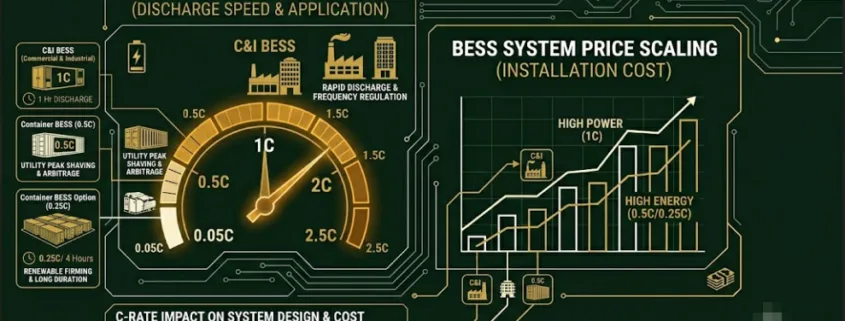
Two BESS systems with identical kWh ratings can carry installed prices that differ by 70 to 100 per cent. The BESS C-rate specification is the primary explanation for that gap. Every component — from cell to inverter — must be engineered for the maximum current the system handles. Higher BESS C-rate means higher current. Higher current, in turn, means more expensive cells, more capable cooling, and heavier power electronics, aligning with global cost benchmarks detailed in the IRENA electricity storage report.
A. How Cell Chemistry Determines Maximum BESS C-Rate
Standard LFP prismatic cells — the foundation of most commercial BESS — are engineered for energy density first. Their thick electrode coatings store more lithium per unit volume but slow ion migration, capping continuous discharge C-rate at 1C to 2C. Cells capable of 3C to 5C use thinner coatings, higher-porosity separators, and electrolyte additives that improve ionic conductivity. Each refinement adds manufacturing cost, which flows directly into system price.
Chemistry
Full Name
Cont. Discharge C-Rate
Max Charge C-Rate
Cycle Life
Cell Cost ($/kWh)
Best BESS Use
LFP
Lithium Iron Phosphate
0.5C – 2C
0.3C – 1C
3,000 – 6,000+
$80–$120
C&I, grid storage, solar — the commercial standard
NMC
Nickel Manganese Cobalt
1C – 3C
0.5C – 1.5C
1,000 – 2,000
$100–$150
High-power BESS, EV charging buffers
NCA
Nickel Cobalt Aluminium
1C – 3C
0.5C – 1C
500 – 1,500
$110–$160
EV traction, high energy-density applications
High-Power LFP
Power-optimised prismatic
2C – 5C
1C – 2C
2,000 – 4,000
$100–$140
Demand response, fast-response grid services
LTO
Lithium Titanate Oxide
5C – 10C
5C – 10C
10,000–20,000+
$400–$600
Rail, UPS, ultra-fast charging — not cost-viable for BESS
B. How Cooling System Cost Scales With BESS C-Rate
Heat generation scales with the square of current (I²R). Doubling BESS C-rate from 1C to 2C therefore quadruples the thermal load on the cell stack. A BESS designed for 2C continuous operation requires a proportionally more capable cooling system. As a result, thermal management is often the largest single incremental cost driver between a 1C and 2C system.
Cooling System
C-Rate Supported
Heat Removal
System Cost Premium
Typical BESS Application
Passive air (natural convection)
Up to 0.5C
Low
+0% (baseline)
Residential BESS, low-cycle backup
Forced air (fan cooling)
0.5C – 1C
Moderate
+5–10%
C&I BESS, standard daily cycling
Air-conditioned HVAC enclosure
1C – 1.5C
Good
+10–20%
Containerised grid BESS
Liquid cooling (glycol plates)
1.5C – 3C
Excellent
+20–35%
High-power BESS, EV charging hub buffer
Direct liquid immersion
3C – 10C burst
Superior
+40–60%
Ultra-fast charging, power-critical grid services
C. Power Electronics and BMS Cost at Higher BESS C-Rate
The inverter and DC/DC converters must be rated for the peak current the battery delivers. A 2C inverter requires larger switching transistors, heavier copper busbars, and more sophisticated short-circuit protection than a 1C inverter of the same kWh capacity. The cost premium for power electronics typically runs at 15 to 30 per cent between a 1C and 2C BESS system.
The BMS also costs more at higher BESS C-rates. Millisecond-level cell sampling, faster protection relay actuation, and more detailed thermal runaway prediction algorithms are all required above 2C. None of these features are standard on entry-level BMS hardware, so they represent a real and quantifiable cost premium.
D. BESS C-Rate Price Tier Framework: From 0.25C to 10C
Combining chemistry, cooling, and power electronics, the following table maps each BESS C-rate tier to its indicative installed system cost and target application.
C-Rate Tier
Chemistry
Installed Cost ($/kWh)
Peak Power (500 kWh system)
Target Application
What Drives the Price?
0.25C–0.5CEnergy Tier
Standard LFP prismatic
$180–$260
125–250 kW
Solar arbitrage, long-duration storage, off-grid
Lowest-cost cells, passive/fan cooling, simple BMS and inverter
0.5C–1CCommercial Standard
LFP prismatic
$220–$320
250–500 kW
C&I peak shaving, daily energy shifting, grid support
Standard market spec — most competitive $/kWh segment
LTO chemistry premium, extreme cooling, custom power electronics
💡
The most important buyer insight on BESS C-rate and price: Do not compare BESS quotations on $/kWh alone.
Always calculate $/kW = total installed cost ÷ peak power output (kW).
A 0.5C BESS delivers only half the peak power of a 1C BESS at the same kWh. If your peak shaving application needs 500 kW for one hour, the 0.5C system will fail the dispatch event — making the cheaper quote the more expensive mistake.
E. Same 500 kWh, Three BESS C-Rates, Three Very Different Prices
BESS Profile
Capacity
C-Rate
Peak Power
Cooling
Est. Installed Cost
Designed For
Energy-type LFP(solar storage)
500 kWh
0.5C
250 kW for 2 hrs
Fan / HVAC
~$130,000
Solar self-consumption, off-grid overnight, slow energy shifting
EV DC fast charging hub, grid frequency services, rapid response
All three systems store exactly 500 kWh and all use lithium-ion technology. However, peak power output ranges from 250 kW to 1,000 kW — a factor of four. Installed cost, moreover, varies from $130,000 to $250,000. The BESS C-rate specification alone explains both of those differences entirely.
7. BESS C-Rate vs Power-to-Energy Ratio: Converting Duration to C-Rate
When EPCs and project developers discuss BESS sizing, they rarely say ‘1C’. Instead, they say ‘1-hour system’ or ‘4-hour battery’. These two languages describe the same thing from different angles — and converting between them is essential for accurate specification.
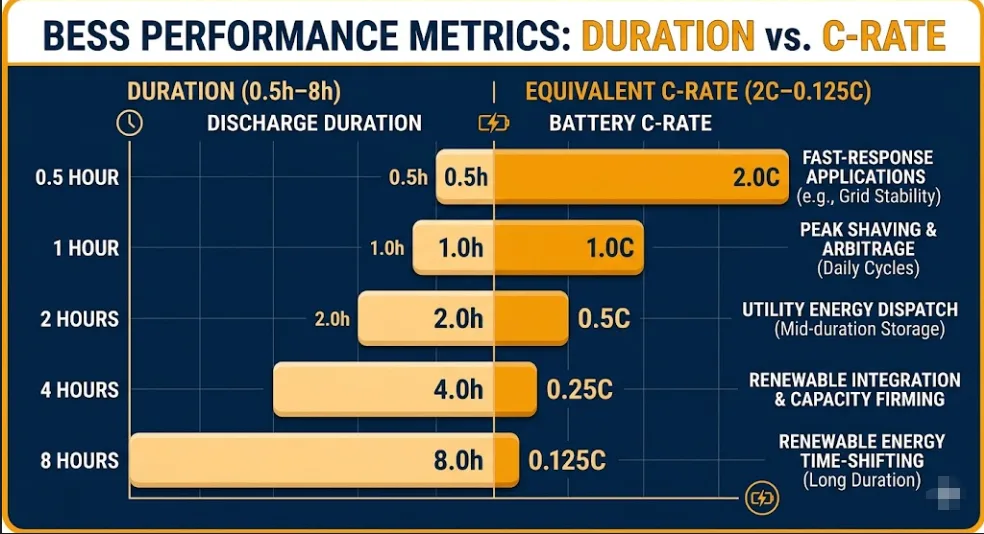
The power-to-energy ratio (P/E ratio) describes how much power (kW) a BESS delivers per unit of stored energy (kWh). A 1-hour system delivers its full energy in one hour — which is exactly a 1C BESS C-rate. As a result, duration and C-rate are mathematical inverses of each other.
Fast-response frequency regulation, EV charging buffer
0.5 hour battery storage, 2C BESS
1-hour BESS
1C
1 kW per kWh
C&I peak shaving, demand charge reduction
1 hour battery storage, 1C BESS
2-hour BESS
0.5C
0.5 kW per kWh
C&I energy arbitrage, solar self-consumption
2 hour battery storage, 2 hour BESS
4-hour BESS
0.25C
0.25 kW per kWh
Grid energy arbitrage, utility time-shifting
4 hour battery energy storage, 4 hour BESS
8-hour BESS
0.125C
0.125 kW per kWh
Long-duration storage, island grid, overnight off-grid supply
8 hour BESS, long duration energy storage
10–12-hour BESS
0.1C
0.1 kW per kWh
Seasonal shifting, remote area power, hydrogen hybrid
long duration battery storage, 10 hour BESS
This table is directly useful for RFP and tender documents. For example, when a grid operator specifies a 4-hour BESS at 100 MW, they are asking for 400 MWh of storage at 0.25C BESS C-rate. Similarly, when a C&I site asks for a 2-hour peak shaving BESS at 500 kW, they need 1 MWh at 0.5C.
📌
When comparing BESS quotations, confirm both the energy (MWh) AND the power (MW or kW). The duration — which is the inverse of BESS C-rate — is the figure that ties them together. Example: ‘500 kWh BESS’ without a stated duration is an incomplete specification. 500 kWh at 1C = 500 kW for 1 hour. The same 500 kWh at 0.5C = 250 kW for 2 hours. Same energy, very different power — and a very different price.
8. PCS Rating and BESS C-Rate: Why the Inverter Can Limit Your System Output
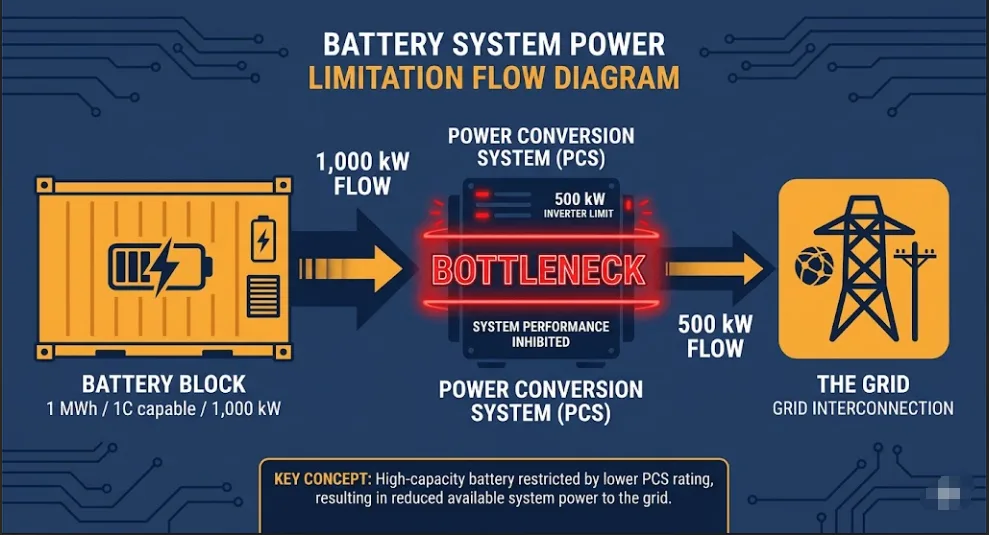
One of the most common and costly mistakes in BESS procurement is assuming that the battery’s C-rate alone determines maximum power output. In practice, this is not the case. The Power Conversion System (PCS) is the inverter or bidirectional converter that connects the battery to the AC grid. It also sets a hard ceiling on power. That ceiling can be significantly lower than the battery’s C-rate capability.
⚠️
Classic BESS C-rate bottleneck example: Battery capacity: 1 MWh LFP Battery C-rate: 1C → capable of 1,000 kW (1 MW) PCS rating: 500 kW Actual system output: 500 kW (limited by PCS, not battery BESS C-rate) Effective C-rate: 0.5C (not 1C)
The battery can run at 1C BESS C-rate. The system cannot. The PCS is the bottleneck.
This situation arises when a developer uses an undersized inverter to reduce upfront cost, or when a site’s grid connection capacity limits the inverter size. In both cases, the battery is paying the price premium for a 1C BESS C-rate it cannot exercise in real operation. Additionally, whether you deploy grid-forming vs grid-following BESS inverters will dictate how the PCS handles these localized capacity constraints and dynamic grid response demands.
PCS Sizing Rules Matched to BESS C-Rate and Application
Application
Recommended Duration
BESS C-Rate
Required PCS Rating
PCS Sizing Rule
Solar self-consumption
2–4 hours
0.25C–0.5C
25–50% of battery kWh as kW
PCS ≥ Battery kWh × C-rate
C&I peak shaving
1–2 hours
0.5C–1C
50–100% of battery kWh as kW
PCS must match peak shaving kW target
Demand charge reduction
30–60 min
1C–1.5C
100–150% of battery kWh as kW
PCS sized to full 1C discharge power
Grid frequency regulation
15–30 min
2C–3C
200–300% of battery kWh as kW
PCS and protection relays rated for peak current
EV fast charging buffer
15–30 min
2C–5C
200–500% of battery kWh as kW
Both battery AND PCS must support full BESS C-rate
The correct approach is to size the PCS first, matching it to the application’s power requirement. Then, size the battery to deliver that power for the required duration. Therefore, always start from the load, not from the battery specification.
Step 1 — Define peak power (kW): what is the maximum power the system must deliver? This sets the PCS rating.
Step 2 — Define duration (hours): how long must the system sustain that power? Combined with Step 1, this gives the energy requirement in kWh.
Step 3 — Confirm BESS C-rate: divide peak power (kW) by total energy (kWh) to get the C-rate. Confirm the battery chemistry supports it.
Step 4 — Verify PCS–battery match: the PCS kW rating must equal or exceed Battery (kWh) × Operating BESS C-rate. Navigating these technical boundaries is a core reason why establishing strong EPC + battery integrator partnerships in C&I energy early in the design phase prevents costly hardware mismatches.
📌
PCS sizing shortcut for BESS C-rate verification: Required PCS rating (kW) = Battery capacity (kWh) × Operating BESS C-rate For a 500 kWh battery at 1C BESS C-rate: PCS ≥ 500 kW For a 500 kWh battery at 2C BESS C-rate: PCS ≥ 1,000 kW For a 500 kWh battery at 0.5C BESS C-rate: PCS ≥ 250 kW
If the PCS is undersized, the effective BESS C-rate is: PCS (kW) ÷ Battery (kWh)
9. Temperature and BESS C-Rate: How Cold Weather Derate Your System
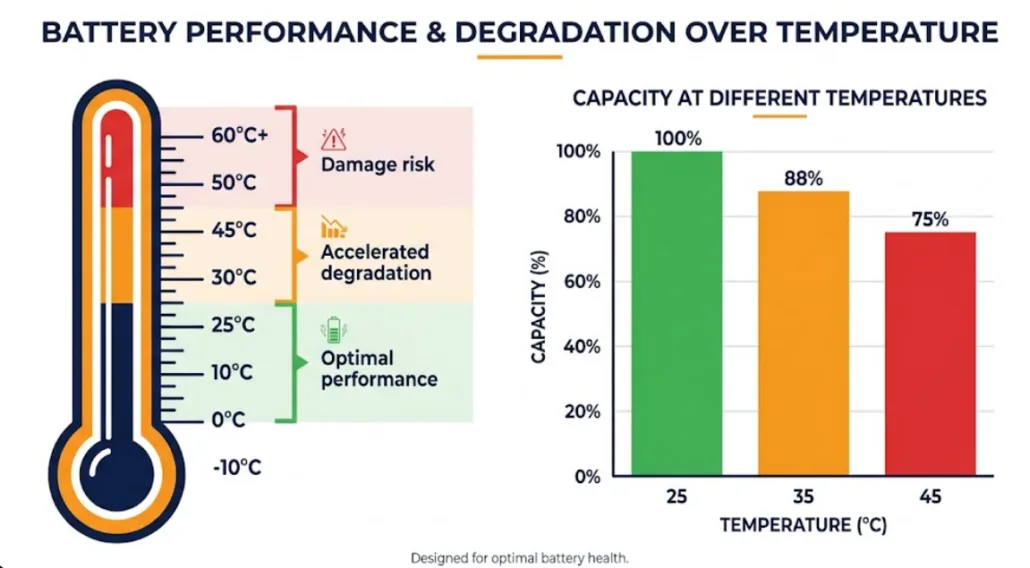
Laboratory BESS C-rate specifications are measured at 25°C. Real-world BESS projects operate in temperatures ranging from -30°C in Nordic and Canadian sites to +45°C in Middle Eastern and Australian installations. Temperature directly affects both the charge C-rate and discharge C-rate that the BMS will permit — and the impact can be dramatic.
How Low Temperature Reduces Charge C-Rate in BESS
Cold temperatures reduce the ionic conductivity of the electrolyte and slow lithium diffusion within the graphite anode. As a result, lithium ions cannot intercalate into the anode fast enough to accommodate a standard charge rate. The excess lithium then plates onto the anode surface instead. This is the same lithium plating risk described in Section 2. However, it is now triggered at much lower charging currents. Modern BMS platforms address this through temperature-dependent charge derating, automatically reducing the charge C-rate as cell temperature falls.
Cell Temperature
Max Charge BESS C-Rate (LFP)
Charge Time Impact
Lithium Plating Risk
BMS Action
Above 25°C
0.5C–1C (full rated)
Standard (2–1 hour)
Low
Full charge current permitted
15°C–25°C
0.3C–0.5C
+20–40% longer
Low–moderate
Mild current reduction
5°C–15°C
0.2C–0.3C
+50–100% longer
Moderate
Significant derating applied
0°C–5°C
0.1C–0.2C
5–10 hours
High
Strong derating; pre-heat recommended
-10°C–0°C
0.05C or disabled
Charging impractical
Very high
BMS may disable charging entirely
Below -10°C
Charging disabled
Not permitted
Severe
Cell heating required before charge
How Temperature Affects BESS Discharge C-Rate
Discharge is less temperature-sensitive than charging because the electrochemical reactions are thermodynamically favoured during discharge. However, cold temperatures do increase internal cell resistance. Consequently, available power decreases and effective capacity falls. For example, a 100 Ah LFP cell rated at 1C discharge and 25°C may only safely sustain 0.7C at 0°C. Beyond that point, terminal voltage drops below the BMS cutoff threshold.
Cell Temperature
Discharge BESS C-Rate Available
Capacity Available (%)
Notes
Above 25°C
Full rated (0.5C–2C)
100%
Full performance. Monitor for overheating at 2C+.
10°C–25°C
Full rated
95–100%
Negligible impact for most commercial BESS.
0°C–10°C
~80% of rated
85–95%
Mild derating. Pre-heat recommended for 2C BESS systems.
-10°C–0°C
~60% of rated
70–85%
Noticeable power and capacity reduction.
Below -20°C
~40% of rated
50–70%
Significant derating. Active heating system essential.
Cold-Weather BESS Design: Four Strategies to Protect C-Rate Performance
Insulated enclosures: containerised BESS in cold climates should use insulated steel enclosures with low-wattage heating elements to maintain cell temperature above 5°C during idle periods.
Battery heating mats: direct cell-level heating pads activate when temperature falls below 5–10°C. The BMS controls this automatically. As a result, the system can recharge at its rated BESS C-rate even in sub-zero ambient conditions.
Thermal buffer in C-rate spec: for projects in cold climates, specify the BESS C-rate at 10°C rather than 25°C. This gives a realistic worst-case recharge window. It also prevents dispatch planning errors.
Liquid thermal management: Liquid-cooled systems with a heat pump can both cool cells in summer and heat them in winter. For sites with a wide temperature range, this is the most capable engineering solution.
💡
Cold-climate BESS C-rate project rule: Always request the manufacturer’s charge derating curve from -20°C to +40°C. Size the recharge window based on the minimum expected cell temperature, not the standard 25°C BESS C-rate specification.
A system with a 2-hour recharge at 25°C may need 5+ hours at 5°C. If the site has two peak events per day, this gap can cause missed dispatch.
Deploying these climate control and thermal safety measures ensures your system remains compliant with international risk management protocols. For a complete breakdown of these compliance requirements, check our guide to the IEC 62933-5 safety standards for ESS frameworks.
10. BESS C-Rate and Battery Warranty: What Manufacturers Actually Guarantee
Battery warranties are frequently misread by buyers. Most manufacturers do not simply warrant a number of years or a number of cycles in isolation. Instead, they warrant a specific combination of cycles, throughput, depth of discharge, operating temperature — and BESS C-rate. Operate outside the warranted C-rate and the warranty may be void, even if every other parameter is within limits.
How BESS C-Rate Appears in the Three Main Warranty Structures
Cycle-based warranty: warrants a number of full charge/discharge cycles (e.g. 4,000 cycles to 80% SoH). The warranted cycle count is stated at a specific BESS C-rate and depth of discharge (DoD). For example: ‘4,000 cycles at 1C / 80% DoD / 25°C’. Operating at 2C BESS C-rate and 80% DoD may reduce the warranted cycle count to 2,500.
Throughput-based warranty: warrants a total energy throughput in MWh (e.g. 3,000 MWh per MWh of installed capacity). This approach is nominally BESS C-rate-agnostic, but manufacturers typically include a maximum continuous C-rate clause that, if exceeded, voids the throughput warranty.
Calendar-based warranty: warrants a minimum SoH at a future date (e.g. 70% capacity retention after 10 years). Calendar warranties almost always include an operating envelope — BESS C-rate, temperature, DoD — that defines the conditions under which the warranty applies.
Warranty Type
Typical BESS C-Rate Condition
What Changes If C-Rate Limit Is Exceeded
What to Ask the Supplier
Cycle-based
1C charge / 1C or 2C discharge at 25°C, 80% DoD
Warranted cycle count reduces; some manufacturers publish a BESS C-rate adjustment table
Request cycle-life curve at your operating C-rate and DoD
Throughput-based
Max continuous BESS C-rate clause (e.g. 1C or 2C)
Throughput warranty voided if max C-rate exceeded
Confirm the maximum C-rate clause and whether burst C-rate is treated differently
Calendar-based
Operating envelope includes BESS C-rate, temp, DoD
Warranty void if operating envelope breached
Request the full BESS C-rate operating envelope in the warranty document — not just the summary term sheet
⚠️
Real BESS C-rate warranty example (illustrative):
Supplier warranty states: ‘6,000 cycles to 80% capacity retention at 0.5C charge / 0.5C discharge / 80% DoD / 25°C’
Your project operates at: 0.5C charge / 2C discharge / 80% DoD / 25°C
Warranted cycles at 2C BESS C-rate may be only 3,000–4,000 — half the headline figure. Consequently, always request the C-rate adjustment table before signing.
BESS C-Rate Warranty Checklist: Five Questions to Ask
Request the cycle-life warranty condition in full — BESS C-rate, DoD, temperature, and SoH end-point.
Ask for a cycle-life vs BESS C-rate adjustment table: how does the warranted cycle count change at your operating rate?
Confirm whether burst BESS C-rate events (e.g. 2C for 30 seconds) are counted differently from continuous C-rate.
Verify that the PCS-enforced maximum C-rate matches the warranty’s maximum BESS C-rate clause — any gap is a warranty risk. Ensure these limits map structurally to the battery cell’s factory compliance standards, as outlined in our overview of IEC certifications for BESS, which dictate the thermal and current boundaries manufacturers are legally allowed to warrant.
For throughput warranties, calculate total expected throughput over the project life and confirm it falls within the warranted limit at your operating C-rate.
Tracking these complex lifetime metrics is becoming highly standardized across the industry. To see how manufacturers are beginning to openly disclose this operational data, see our guide on how the battery passport drives transparency in the energy transition by providing immutable health and C-rate logs.
11. Real Utility-Scale BESS C-Rate Examples: Three Grid Project Profiles
The BESS C-rate concepts in this guide apply across all system scales — from a 50 kWh rooftop unit to a 400 MWh grid project. Reflecting utility deployment patterns tracks in the IEA battery storage report, the three utility-scale examples below show how BESS C-rate, duration, PCS rating, and application interconnect in real project structures.
Example 1 — 100 MW / 400 MWh Grid BESS at 0.25C C-Rate: 4-Hour Energy Arbitrage
Operation: Charges overnight at 0.125C–0.25C BESS C-rate (off-peak wholesale tariff) Discharges 08:00–12:00 at 0.25C (morning peak tariff window) Cycle target: 1 full cycle per day × 365 days × 20-year project life
Why 0.25C BESS C-rate? 4-hour discharge maximises revenue capture across the full morning peak. Lower BESS C-rate reduces cell degradation and minimises thermal management cost. At this scale, 0.25C is the dominant grid arbitrage BESS specification globally.
Example 2 — 50 MW / 100 MWh Frequency Regulation BESS at 0.5C C-Rate
Operation: Participates in Frequency Containment Reserve (FCR) or equivalent market. Injects or absorbs up to 50 MW in response to frequency deviations. Actual average C-rate in operation: ~0.1C–0.2C (short bursts, not full cycles). Nominally sized at 0.5C to maintain full power availability throughout the day.
Why 0.5C? The 2-hour energy buffer ensures the system can sustain a prolonged frequency event without exhausting its state of charge. The PCS is sized for 50 MW regardless of how often it is called to respond.
Example 3 — 20 MW / 20 MWh Fast-Response BESS at 1C C-Rate: 1-Hour Duration
Operation: Paired with a large solar farm for curtailment avoidance and grid services. Discharges at up to 1C during grid frequency events or export constraint windows. An automated energy management system (EMS) for BESS orchestrates this dispatch logic, safely recharging the battery at 0.5C from solar generation within a 2-hour window.
Why 1C? 1-hour BESS is the standard grid services configuration: full power for 60 minutes covers most frequency regulation and peak shaving events. 1C is LFP’s commercial sweet spot — maximum performance, competitive price.
Project
Capacity
Power
Duration
C-Rate
Chemistry
Primary Application
Grid arbitrage BESS
400 MWh
100 MW
4 hours
0.25C
LFP prismatic
Wholesale energy arbitrage, time-shifting
Frequency regulation BESS
100 MWh
50 MW
2 hours
0.5C
LFP prismatic
FCR / FFR grid ancillary services
Fast-response solar BESS
20 MWh
20 MW
1 hour
1C
LFP prismatic
Grid services, curtailment avoidance
12. Battery Chemistry Comparison: C-Rate, Charge, Discharge and Emerging Options
The chemistry table in Section 6 covered the main commercial options. This expanded version adds sodium-ion — an emerging chemistry entering the BESS market — and separates typical charge and discharge C-rates for direct comparison.
Chemistry
Typical Charge C-Rate
Typical Discharge C-Rate
Cycle Life
Energy Density
Cell Cost ($/kWh)
BESS Suitability
Status
LFP (LiFePO4)
0.3C–1C
0.5C–2C
3,000–6,000+
Low–medium
$80–$120
Excellent — commercial standard for all BESS
Mature, dominant
NMC (LiNiMnCoO2)
0.5C–1.5C
1C–3C
1,000–2,000
High
$100–$150
Good — high-power BESS, EV charging buffers
Mature
NCA (LiNiCoAlO2)
0.5C–1C
1C–3C
500–1,500
Very high
$110–$160
Moderate — mainly EV; cost and safety limit BESS use
Mature
LTO (Li4Ti5O12)
5C–10C
5C–10C+
10,000–20,000
Very low
$400–$600
Niche — ultra-fast charging, rail; too costly for BESS
Niche, high cost
High-Power LFP (prismatic)
1C–2C
2C–5C
2,000–4,000
Medium
$100–$140
Good — demand response, fast-response grid services
Growing
Sodium-Ion (Na-ion)
0.5C–2C
1C–4C
2,000–4,000
Low–medium
$60–$90*
Promising — emerging competitor to LFP in grid storage
Emerging (2024–)
📌
Sodium-Ion (Na-ion) — what to know for BESS procurement:
Sodium-ion batteries use sodium instead of lithium as the charge carrier. Key advantages: no cobalt, no lithium, lower raw material cost, better low-temperature performance. Current limitations: lower energy density than LFP (~20–30% less); limited commercial track record.
CATL and BYD have both announced sodium-ion cells for stationary storage. Typical charge C-rate: 0.5C–2C. Typical discharge: 1C–4C. Low-temperature performance is notably better than LFP — may suit cold-climate projects.
* Current Na-ion cell cost structures reflect ongoing 2026 early commercial production volumes. These baseline figures are projected to compress further as gigafactory manufacturing scales and supply chains mature.
13. BESS C-Rate Decision Matrix: Matching Application to Specification
Use this matrix as a starting point for any BESS specification. Find your primary application, read across to the recommended C-rate, chemistry, cooling type, and indicative installed cost range.
Application
Recommended C-Rate
Duration
Chemistry
Cooling
PCS/kWh Ratio
Indicative Installed Cost
Solar self-consumption
0.25C–0.5C
2–4 hours
Standard LFP
Passive / fan
0.25–0.5 kW/kWh
$180–$260/kWh
Energy arbitrage (off-peak)
0.5C
2 hours
Standard LFP
Fan / HVAC
0.5 kW/kWh
$220–$280/kWh
Peak shaving (C&I)
1C
1 hour
LFP prismatic
HVAC
1 kW/kWh
$250–$320/kWh
Demand charge reduction
1C–1.5C
40–60 min
LFP prismatic
HVAC
1–1.5 kW/kWh
$270–$350/kWh
Frequency regulation
1C–2C
30–60 min
LFP / NMC
HVAC / liquid
1–2 kW/kWh
$300–$450/kWh
Island / off-grid grid
0.125C–0.5C
2–8 hours
Standard LFP
Fan / HVAC
0.125–0.5 kW/kWh
$200–$300/kWh
EV charging buffer
2C–5C
15–30 min
High-power LFP/NMC
Liquid cooling
2–5 kW/kWh
$380–$700/kWh
Ultra-fast EV charging
5C–10C
6–15 min
NMC / LTO
Liquid / immersion
5–10 kW/kWh
$700–$1,500/kWh
14. Five Common C-Rate Specification Mistakes — and How to Avoid Them
While capturing the advantages of a battery energy storage system (BESS) can dramatically improve a project’s ROI, design errors during procurement can quickly erase those gains. These five errors appear repeatedly in BESS engineering and EPC tendering, but each is entirely preventable with the knowledge in this guide.
Mistake 1: Specifying a 2C C-Rate When 0.5C Is Sufficient
This is the most expensive and most common mistake. A developer specifying a 2-hour peak shaving system asks for a ‘2C BESS’ when the application actually requires 0.5C. As a result, the system costs 60–80% more than necessary. It also uses liquid cooling the application never demands, and it is built with high-power cells whose extra capability is never exercised. Therefore, always derive C-rate from duration: if you need 2 hours of discharge, you need 0.5C, not 2C.
Mistake 2: Ignoring Charge C-Rate When Planning Dispatch
A BESS specified for 1C discharge is typically limited to 0.5C charge. Yet dispatch schedules are frequently planned around the discharge rate alone. Consequently, the system cannot recharge in time for a second peak event, because the 2-hour recharge window was never accounted for. To avoid this, always plan dispatch around the slower of charge and discharge C-rates.
Mistake 3: Ignoring Temperature Derating on Charge C-Rate
Cold-climate projects often specify a 0.5C charge rate at 25°C. However, the same system may only charge at 0.2C at 5°C, tripling the recharge time. This affects both daily dispatch planning and revenue model accuracy. For this reason, always request the charge derating curve for the minimum expected ambient temperature at the project site.
Mistake 4: Comparing BESS C-Rate Quotations on $/kWh Alone
A 500 kWh system at $220/kWh and a 500 kWh system at $320/kWh look like a simple $50,000 saving in favour of the cheaper option. But the $220/kWh system may be rated at 0.5C, while the $320/kWh system is rated at 1C. In that case, the cheaper system delivers only 250 kW. The more expensive system, meanwhile, delivers 500 kW. For a peak shaving application requiring 500 kW, the cheaper system simply cannot do the job. Always compare $/kW alongside $/kWh.
Mistake 5: Forgetting PCS Limitations on BESS C-Rate
A 1 MWh battery with a 1C rating is technically capable of 1 MW output. But if the PCS is rated at only 500 kW, the system is effectively a 0.5C system, regardless of the battery’s rating. Therefore, confirm that the PCS kW rating is equal to or greater than the battery capacity (kWh) multiplied by the required operating C-rate. This check takes only 30 seconds. Yet it can save months of project rework.
📌
Quick specification health-check: 1. C-Rate = Duration inverse? Duration 2 hours → 0.5C ✓ 2. PCS ≥ Battery (kWh) × C-Rate? 500 kWh × 1C = 500 kW PCS minimum ✓ 3. Charge C-rate in dispatch plan? 0.5C charge = 2 hr recharge window ✓ 4. Warranty states C-rate condition? Confirm cycle count at operating C-rate ✓ 5. Temperature derating requested? Get charge curve from -10°C to +40°C ✓
15. C-Rate Procurement Checklist: Eight Questions to Ask Every Supplier
Before signing any BESS supply agreement, confirm the following C-rate parameters in writing:
1. Rated continuous C-rate: maximum C-rate the system sustains indefinitely without thermal or SoH risk. Confirm for both charge and discharge independently.
2. Peak C-rate and burst duration: maximum C-rate for short bursts (typically 10–30 seconds). Confirm the burst duration before BMS curtailment activates.
3. Capacity derating curve: how much kWh does the system actually deliver at your operating C-rate — not just at the 1C nameplate condition?
4. Cycle life at operating C-rate: request the cycle-life warranty condition (C-rate, DoD, temperature) and a C-rate adjustment table in writing.
5. Charge derating curve vs temperature: request the charge C-rate curve from the minimum expected site temperature to +40°C.
6. PCS–battery C-rate match: confirm the PCS kW rating equals or exceeds Battery (kWh) × Operating C-rate.
7. Thermal management design C-rate: confirm the cooling system is sized for your intended C-rate, not nominal conditions.
8. Warranty C-rate operating envelope: request the full warranty operating envelope and confirm your project’s C-rate falls within the warranted range.
16. Frequently Asked Questions: BESS C-Rate
What is a good C-rate for a BESS?
For most commercial and industrial BESS applications, 0.5C to 1C is the optimal range. A 0.5C system (2-hour duration) suits solar self-consumption and energy arbitrage. A 1C system (1-hour duration) is the standard for peak shaving and demand charge reduction. Higher C-rates are only justified for grid frequency regulation (1C–2C) or EV fast charging buffers (2C–5C).
Is a higher C-rate always better?
No. A higher C-rate means higher peak power output — but it also means higher system cost, faster cell degradation, and greater thermal management requirements. Specifying a higher C-rate than your application requires wastes capital and shortens battery life. Match the C-rate to the application, not to the maximum available specification.
What C-rate is used for peak shaving?
Peak shaving typically uses a 1C discharge rate, which delivers full rated power for one hour. Sites with sharp, short demand spikes may specify 1.5C for a 40-minute discharge window. Sites with longer, flatter demand peaks may use 0.5C for a 2-hour window. The correct C-rate depends on the duration and shape of the demand event, not a single standard answer.
What C-rate is used for solar energy storage?
Solar self-consumption BESS typically operates at 0.25C to 0.5C — discharging over 2 to 4 hours through the evening peak. This slow discharge maximises the energy extracted per cycle, minimises heat generation, and extends cycle life. LFP cells at 0.5C can sustain over 6,000 – 8,000 cycles — enough for 16+ years of daily operation at 80% depth of discharge.
How does C-rate affect battery lifespan?
Higher C-rates accelerate three degradation mechanisms. These are electrolyte oxidation from heat (I²R), mechanical stress from rapid lithium intercalation, and SEI layer growth from elevated temperatures. For the full mechanism behind that mechanical stress — including why deep discharge and high C-rate damage electrode particles through different pathways — see our guide on Why Deep Discharge and High C-Rate Stress LFP Cells. As a result, a battery cycled at 2C will typically reach 80% SoH in only 2,000–3,000 cycles. The same battery at 0.5C, however, may sustain 5,000–6,000 cycles. Overall, operating at or below 1C is the single most effective way to extend LFP battery life.
What Is the Difference Between a 0.5C and 1C BESS C-Rate?
A 0.5C system takes twice as long to discharge as a 1C system. For a 500 kWh battery, 0.5C delivers 250 kW for 2 hours, while 1C delivers 500 kW for 1 hour. Both deliver the same total energy of 500 kWh. However, the 1C system delivers it at twice the power. Consequently, a 1C system costs roughly 20–40% more than a 0.5C system of the same kWh capacity. This premium reflects higher-rated power electronics and more capable thermal management.
Does a higher C-rate increase battery cost?
Yes, and the increase is significant. Every major cost component scales with C-rate. Cell chemistry costs more for higher-power cells. Thermal management shifts from air to liquid cooling above 1.5C. The inverter and PCS need larger transistors and busbars for higher current. The BMS also needs faster sampling and protection. Overall, a 2C system typically costs 50–80% more per kWh than a 0.5C system of identical capacity.
What C-rate is common in utility-scale BESS?
Utility-scale BESS varies widely by application. Grid arbitrage projects, which are typically 4-hour systems, operate at 0.25C. Frequency regulation projects, usually 2-hour systems, operate at 0.5C. Meanwhile, grid services BESS paired with solar farms commonly use 1C. In 2024–2025, the dominant global configuration is 2-hour to 4-hour LFP at 0.25C to 0.5C. This trend is largely driven by the falling cost of large-format LFP prismatic cells.
Conclusion: Getting BESS C-Rate Right From the Start
BESS C-rate is not a secondary datasheet figure. Instead, it is the specification that determines how much power your system delivers, how quickly it recharges, and how long the cells last. Directly, it also determines how much the system costs. Furthermore, it connects to the duration language EPCs use, such as 1-hour or 4-hour systems. It links to the PCS sizing your electrical engineer specifies. It links, too, to the warranty conditions your finance team relies on. Finally, it links to the temperature performance your operations team will encounter on site.
For LFP BESS in commercial and grid-scale applications, the 0.5C to 2C range covers the vast majority of real-world deployments. Before selecting a chemistry, a PCS, or a cooling system, map your application to the correct C-rate tier first. This single step is the highest-value part of the procurement process.
Need help sizing a BESS to the right C-rate for your load profile and grid requirements? Contact SunLith Energy to speak with a storage engineer.
Reading a LiFePO4 battery spec sheet correctly is one of the most valuable skills a buyer can have.
However, most spec sheets are written for engineers — not procurement teams.
This guide covers every field of a LiFePO4 battery spec sheet in plain language.
Furthermore, you will learn what each number means and which red flags to watch for.
In addition, understanding your LiFePO4 battery spec sheet is the first step before using our Battery Cycle Life Calculator.
📌 Key rule: Two batteries with identical spec sheet headlines can perform very differently.The difference is always in the test conditions — not the headline number.Therefore, always read the conditions first.
⚠️ Why a LiFePO4 Battery Spec Sheet Can Be Misleading
Spec sheets are marketing documents as much as technical ones.
However, that does not mean the numbers are wrong. As a result, you need to read the conditions — not just the headline.
Three issues cause the most confusion for buyers:
Issue
What it looks like
Why it matters
Optimistic test conditions
Cycle life tested at 25°C and shallow DOD
Your real project runs hotter and deeper — so lifespan is lower
Inconsistent EOL threshold
One supplier uses 80% SOH, another uses 70% EOL
In other words, the numbers are not comparable
Missing test parameters
C-rate, temperature, DOD not stated
Consequently, you cannot verify or compare the number
Therefore, always apply a conservative adjustment to any headline number.
📋 Section 1 of Your LiFePO4 Battery Spec Sheet: Cell Chemistry
First, always check the nominal voltage. For LiFePO4, this is 3.2V per cell.
In contrast, NMC cells show 3.6–3.7V. As a result, a wrong voltage means a wrong chemistry.
What the LiFePO4 Battery Spec Sheet Shows for Cell Grade
Grade A cells are new and have passed full quality screening.
Moreover, Grade B cells are factory seconds. Consequently, the grade directly determines system reliability.
Always insist on Grade A for any commercial project.
Field
What to look for
Nominal Voltage
3.2V per cell for LiFePO4. However, if it shows 3.6–3.7V, the chemistry is NMC — not LFP.
Nominal Capacity
Rated in Ah at 0.2C. For example, 100Ah at 3.2V = 320Wh per cell.
Cell Format
Prismatic, cylindrical, or pouch. Furthermore, format affects thermal design and replacement logistics.
Cell Grade
Grade A = new and full-spec. Grade B = factory second. Therefore, always confirm grade before ordering.
🚨 Red flag: A spec sheet that does not state the cell grade is hiding something.Ask directly — and request a grade certificate from the cell manufacturer.
⚡ Section 2 of Your LiFePO4 Battery Spec Sheet: Electrical Specs
Capacity, Energy, and Internal Resistance
Furthermore, the electrical section contains the numbers most often misread by buyers.
Capacity is stated at 0.2C in the lab. However, your system likely runs at 0.5C or 1C.
In addition, internal resistance is a key quality signal. Consequently, a high value often means an older or lower-grade cell.
Field
What to look for
Capacity (Ah)
Stated at 0.2C. In practice, expect 90–95% of this at 1C. Therefore, ask what C-rate was used.
Energy (Wh)
Capacity × Voltage. For example, 100Ah × 3.2V = 320Wh. However, usable energy depends on your cutoff voltage.
Internal Resistance
0.15–0.35mΩ for Grade A 100Ah prismatic. Higher values indicate age or lower cell quality.
Voltage Range and Self-Discharge
Voltage limits define the safe operating range for each cell.
Moreover, operating outside these limits permanently damages the cell. Consequently, your BMS must enforce both cutoffs at all times.
Self-discharge for LiFePO4 is typically 1–3% per month. In contrast, anything above 5% signals a quality issue.
Field
What to look for
Charge Cutoff Voltage
3.65V per cell. Overcharging even slightly above this causes permanent capacity loss.
Discharge Cutoff Voltage
2.5V per cell. Over-discharging below this causes irreversible damage. Therefore, BMS protection is mandatory.
Self-Discharge Rate
1–3% per month is normal. However, above 5% per month suggests a cell quality issue.
💡 Pro tip: Ask for the discharge curve chart at multiple C-rates.A supplier confident in their cells will share this without hesitation.In other words, transparency is the strongest quality signal.
🔋 Section 3 of Your LiFePO4 Battery Spec Sheet: Cycle Life
Cycle life is the most important section of any LiFePO4 battery spec sheet.
However, it is also the most abused. As a result, the headline number alone tells you very little.
In other words, 6,000 cycles tested at 50% DOD is very different from 6,000 cycles at 80% DOD.
How Cycle Life Is Measured on a LiFePO4 Battery Spec Sheet
Manufacturers test cycle life under the best possible lab conditions.
Consequently, four variables determine whether the number applies to your project.
For example, a 25°C test result does not apply to a 38°C deployment. Furthermore, the C-rate and DOD used in testing must match your real use.
Condition
What to check
Test DOD
The discharge depth used in the test. 80% is standard. However, some suppliers test at 50% DOD to inflate cycle counts.
Test Temperature
Always 25°C in the lab. However, every 10°C above that reduces effective lifespan by 15–25%.
Test C-Rate
0.5C is standard for both charge and discharge. As a result, tests at 0.2C will show better results than real use.
EOL Definition
80% SOH or 70% EOL? Furthermore, a 70% EOL battery has 10–15% more usable cycles than an 80% SOH one.
The 4 Questions to Ask About Cycle Life
Before accepting any cycle life number, ask all four questions below.
Moreover, a supplier who hesitates on any of them is a supplier to be cautious about.
1. What DOD was used in the cycle life test? 2. What temperature was the test run at? 3. What C-rate was used for charge and discharge? 4. Is the cycle count to 80% SOH or 70% EOL?
Converting Cycle Life Numbers on a LiFePO4 Battery Spec Sheet
Different suppliers use different EOL thresholds. Therefore, direct comparison is often misleading.
For instance, 6,000 cycles at 80% SOH and 6,000 cycles at 70% EOL are not the same number.
First, check the standard charge rate. For LiFePO4, this is typically 0.5C.
Consequently, charging faster than 0.5C every day accelerates degradation.
Sustained fast charging at 2C+ can cause lithium plating. Therefore, this permanently reduces capacity over time.
Field
What to look for
Standard Charge Rate
Typically 0.5C. This is the recommended daily charge rate for maximum cycle life.
Max Charge Rate
Often 1C or 2C. However, sustained 2C+ causes lithium plating and permanent capacity loss.
Charge Cutoff Voltage
3.65V per cell. Furthermore, overcharging even slightly above this causes irreversible damage.
Discharge Rate and Protection Limits
Standard discharge for BESS is 0.5–1C. Moreover, this is within safe limits for most applications.
Above 3C continuous discharge, significant heat is generated. Consequently, always confirm your BMS has current limiting.
Discharge cutoff is 2.5V per cell. Going below this causes copper dissolution — irreversible damage.
Field
What to look for
Standard Discharge Rate
Typically 1C. Real-world BESS applications discharge at 0.5–1C — therefore, within safe limits.
Max Continuous Discharge
Often 2C or 3C. As a result, confirm your BMS has current limiting for grid events.
Discharge Cutoff Voltage
2.5V per cell. Consequently, BMS low-voltage protection must always be active.
Peak Discharge Rate
Short-duration maximum — typically 5C for 10 seconds. In particular, important for frequency response.
🚨Discharge Cutoff Voltage: 2.5V per cell. Over-discharging below this causes irreversible damage. Therefore, BMS protection is mandatory.
🚨 Red flag: Any spec sheet showing 3C+ continuous discharge with no temperature derating chart is overstating capability.Furthermore, sustained 3C+ discharge causes heat that accelerates degradation well beyond the spec sheet cycle count.
🌡️ Section 5 of Your LiFePO4 Battery Spec Sheet: Thermal Specs
Furthermore, the thermal section is the most commonly skimmed. However, for hot climate deployments it is the most critical.
In particular, charging below 0°C causes lithium plating — permanent damage that cannot be reversed.
Above 45°C, electrolyte breakdown accelerates. Therefore, always confirm your BMS has temperature-gated charging.
Field
What to look for
Operating Temp (charge)
0°C to 45°C is typical. Charging outside this range causes permanent damage. Therefore, BMS temperature protection is mandatory.
Operating Temp (discharge)
-20°C to 60°C. However, capacity at -10°C drops to 70–80% of rated. As a result, account for this in cold climates.
Storage Temperature
-20°C to 35°C at 50% SOC. Furthermore, storing at 100% SOC above 35°C significantly accelerates calendar aging.
Thermal Runaway
Above 270°C for LiFePO4 — compared to 170–210°C for NMC. Consequently, LFP is safer in enclosed environments.
IP Rating
IP65 is standard for outdoor BESS. In contrast, anything below IP54 should not be used outdoors.
💡 For hot climates: the temperature range on a LiFePO4 battery spec sheet is a survival range — not a performance guarantee.As a result, apply a 15–25% cycle life reduction for average ambient temperatures above 30°C.
🏅 Section 6: Safety Standards and Certifications
Finally, certifications confirm the battery has been independently tested for safety.
However, logos on a spec sheet are not the same as valid certificates. Therefore, always request original test reports.
For example, UL 1973 is required for US grid-tied projects. In addition, CE marking is required for all EU market products.
Certification
What it covers
Why it matters
UN 38.3
Transport safety for lithium batteries
Required for any shipped battery — if absent, insurance may be void
IEC 62133
Cell-level safety standard
Covers overcharge, short circuit, crush, and thermal abuse tests
IEC 62619
System-level safety for stationary storage
Required for most commercial BESS projects
UL 1973
US stationary battery standard
Required for US and Canadian grid-tied projects
UL 9540 / 9540A
System-level thermal runaway standard
Required by many US and EU jurisdictions for large BESS
CE Marking
European conformity
Required for all products sold into the EU market
GB/T Standards
Chinese national standards
Present on most Chinese cells — verify equivalence to IEC
🚨 Red flag: A supplier who cannot provide original certification documents should not be trusted for any commercial project.Moreover, always request the actual test report — not a certificate copy or a logo on a brochure.
🚩 Complete LiFePO4 Battery Spec Sheet Red Flag Checklist
Use this before approving any LiFePO4 battery spec sheet for procurement.
In addition, if any of these are present, ask for clarification before placing an order.
Red Flag
Risk
What to request
Cell grade not stated
Grade B or C sold at Grade A price
Ask for grade certificate from cell manufacturer
Cycle life — no test conditions
Cannot verify or plan from the number
Ask for DOD, temperature, C-rate, and EOL threshold
DOD 50% or less for cycle test
Inflated cycle count for shallow cycling
Request 80% DOD test data instead
No discharge curve chart
Cannot assess real-load performance
Request multi-C-rate discharge curves
Certifications as logos only
May be expired or fabricated
Request original test reports from the certification body
Calendar life not stated
Unknown degradation for low-cycle use
Ask for calendar aging data at 25°C and 35°C
Thermal derating not provided
Performance at high temperature unknown
Ask for capacity vs temperature chart
Internal resistance not stated
Cannot assess cell quality
Request DC internal resistance at 50% SOC
Warranty threshold not stated
Warranty may cover fewer cycles than spec claims
Confirm warranty EOL matches the spec sheet
📋 Transparent vs Misleading: Two Real Examples
Here are two examples of how the same LiFePO4 battery spec sheet data can be presented.
Furthermore, the difference in transparency directly affects how accurately you can plan costs.
Example A — A Transparent LiFePO4 Battery Spec Sheet
In this example, all test conditions are clearly stated. As a result, the numbers are fully comparable.
Field
What it shows
Capacity
100Ah @ 0.2C, 25°C
Cycle Life
6,000 cycles @ 80% DOD, 25°C, 0.5C/0.5C, to 80% SOH
Internal Resistance
0.25mΩ @ 50% SOC, 25°C
Certifications
IEC 62133, UL 1973 — original test reports available
Calendar Life
10+ years @ 25°C, 50% SOC storage
Assessment
✅ All conditions stated. Safe to use for planning and comparison.
Example B — A Misleading LiFePO4 Battery Spec Sheet
In contrast, this example hides all test conditions. Consequently, none of the headline numbers can be trusted.
Field
What it shows
Capacity
100Ah
Cycle Life
10,000 cycles
Internal Resistance
Not stated
Certifications
CE, UL (logos only — no reports)
Calendar Life
Not stated
Assessment
🚨 10,000 cycles likely tested at 50% DOD. Cannot verify certifications. Do not use for planning.
✅ 10 Questions to Ask Before Accepting Any Spec Sheet
Send these questions to every supplier before requesting a quote.
Furthermore, a trustworthy supplier will answer all ten within 24 hours. In other words, their speed and completeness is itself a quality signal.
1.
What cell grade is this — A, B, or C? Can you provide the manufacturer’s grade certificate?
2.
What DOD, temperature, and C-rate were used for the cycle life test?
3.
Is cycle life measured to 80% SOH or 70% EOL?
4.
Can you provide the full discharge curve chart at 0.2C, 0.5C, 1C, and 2C?
5.
What is the DC internal resistance at 50% SOC and 25°C?
6.
Can you provide original certification test reports — not just certificate copies?
7.
What is the calendar aging rate at 25°C and at 35°C?
8.
Does the cell have a thermal derating chart showing capacity at different temperatures?
9.
What is the minimum and maximum operating temperature for charging?
10.
Does your warranty cycle count use the same DOD and EOL threshold as the spec sheet?
🔍 Want a second opinion on your supplier’s LiFePO4 battery spec sheet? SunLith’s engineering team reviews spec sheets and flags misleading claims.Furthermore, this service is free for qualified BESS projects above 50kWh.As a result, you go into procurement with full clarity and confidence.→ Request a free spec sheet review: Contact us
❓ Frequently Asked Questions
What is a LiFePO4 battery spec sheet?
A LiFePO4 battery spec sheet is a technical document from the manufacturer. However, it is written under optimal lab conditions. Therefore, real-world performance is typically 10–20% lower than stated. In other words, always check the test conditions behind every headline number.
What is the most important section of a LiFePO4 battery spec sheet?
Cycle life is the most critical section. However, it is only useful with all four test conditions stated. For example, the DOD, temperature, C-rate, and EOL threshold must all be present. As a result, a cycle count without these conditions cannot be used for planning.
How do I verify a LiFePO4 battery spec sheet is accurate?
First, ask for original certification test reports — not just certificate copies. Furthermore, request the full discharge curve chart at multiple C-rates. In other words, transparency is the strongest quality signal from a supplier.
What does Grade A mean?
Grade A cells are new and have passed full quality screening. In contrast, Grade B cells are factory seconds that failed one or more checks. Therefore, always insist on Grade A for any commercial BESS project.
Why do two batteries with the same Ah rating perform differently?
Several factors cause this difference. For example, internal resistance, cell grade, and test C-rate all vary between manufacturers. Moreover, two 100Ah batteries tested at different C-rates produce incomparable results. Consequently, always compare capacity figures tested at the same C-rate.