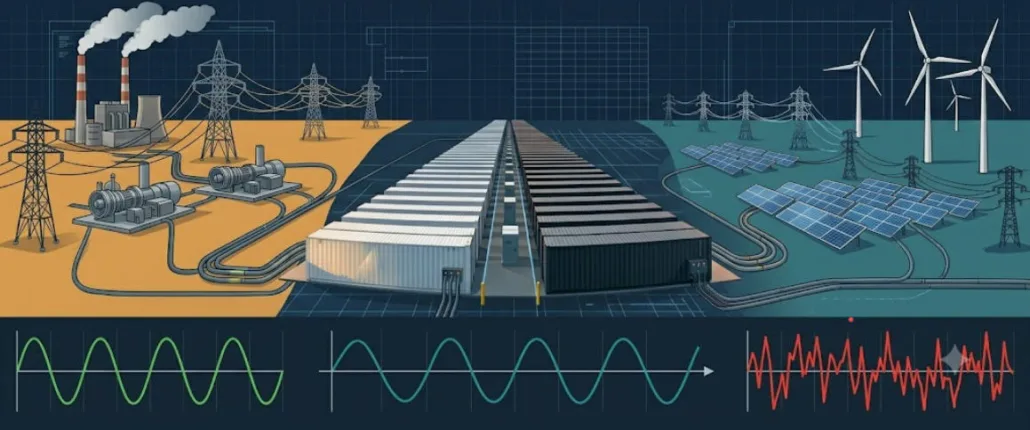
Grid frequency must stay close to its normal value at all times. This holds true whether the source is a coal plant, a wind farm, or a battery. Frequency Containment Reserve (FCR) is the automatic response that holds this balance across all of them.
So when power supply and demand drift apart, FCR assets react within seconds. Battery energy storage systems have become top Frequency Containment Reserve providers. They respond faster than almost any other technology on the grid.
Quick Answer Frequency Containment Reserve (FCR) is the fastest layer of grid balancing. It restores the power balance within 30 seconds of a frequency drop or spike. Batteries sense frequency locally and respond in milliseconds. Operators earn a steady payment for staying ready, whether the reserve activates or not.
What Is Frequency Containment Reserve (FCR)?
FCR is the first line of defense against grid frequency swings. European rules define Frequency Containment Reserve as the active power reserve that contains frequency right after an imbalance hits.
FCR is also called primary reserve. In Germany, people call it Primärregelleistung.
But it does not push frequency all the way back to 50 Hz. It only stops the drift. It buys time. Then, slower reserves step in and finish the job.
Primary, Secondary, and Tertiary Control
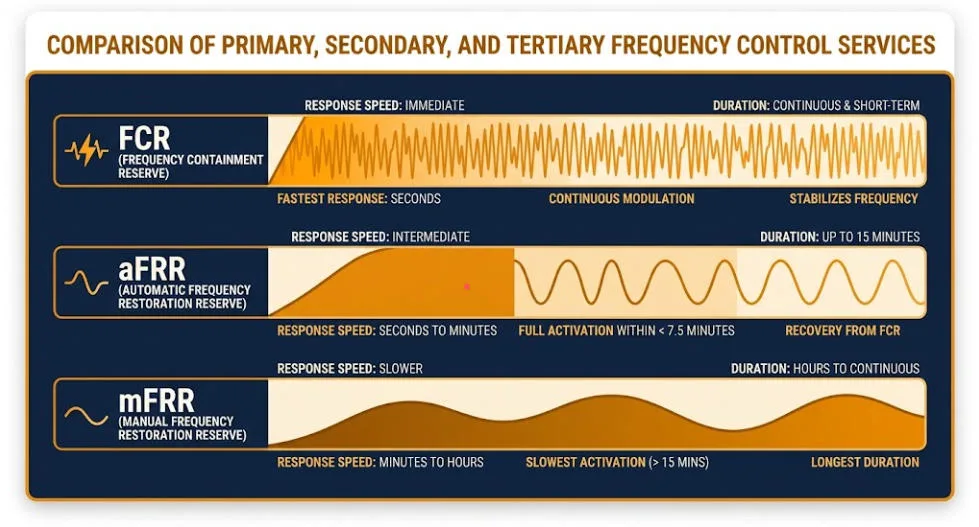
Grid operators stack three response types on top of each other. First, Frequency Containment Reserve acts, and it acts fastest of the three.
Next comes Frequency Restoration Reserve (FRR). It responds between 30 seconds and 12.5 minutes after an event. Finally, manual reserves close out the recovery over the following minutes.
Frequency Containment Reserve 30-Second Response Window
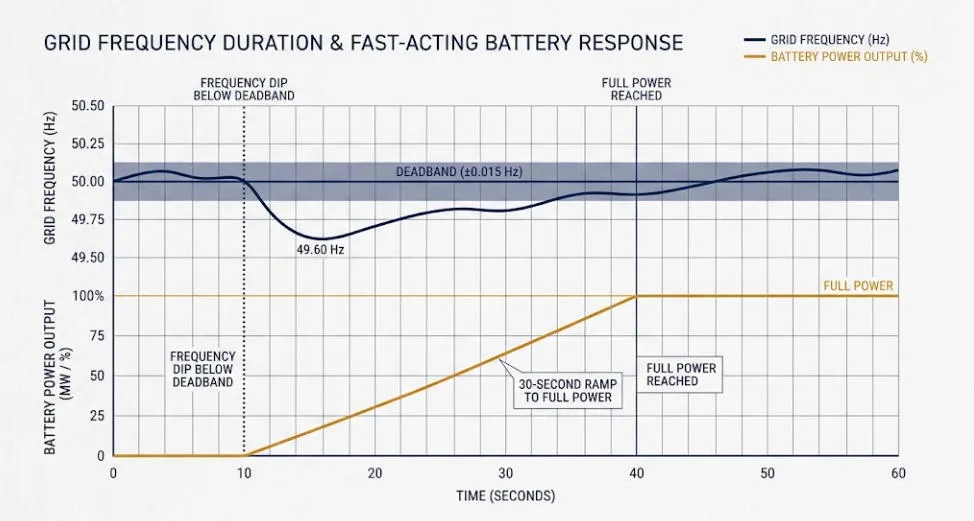
Frequency Containment Reserve assets must adjust their output based on the size of the frequency deviation. In Continental Europe, full activation kicks in once the deviation hits 200 mHz.
At that point, the asset has 30 seconds to deliver its full contracted capacity. So once activated, it must hold that output for 15 to 30 minutes, depending on the region.
Suppliers measure frequency locally, right at the point of generation or use. Because of this, the response runs on its own. No signal from the grid operator is needed first.
The Deadband
A small deadband sits around normal frequency. In the Continental Europe FCR market, this band runs from 49.99 Hz to 50.01 Hz.
Inside the deadband, no response is required. Outside it, however, providers must deliver the volume they promised.
FCR-N vs. FCR-D: The Nordic Split
Nordic countries split Frequency Containment Reserve into two separate products. FCR-N covers normal, everyday swings within about ±0.1 Hz.
FCR-D, on the other hand, covers bigger disturbances that fall outside that range. This split allows finer control across two very different event types.
So, FCR-N assets cycle often, but only shallowly. FCR-D assets sit idle most of the time. Then they respond hard during rare, larger events.
Battery duty cycles differ sharply between the two products. Because of this, the gap matters for sizing and for degradation planning.
Why Batteries Excel at Frequency Containment Reserve
Batteries hold a clear edge over generators for FCR duty. A power electronics-based asset can shift from zero to full output in milliseconds.
A generator, in contrast, needs several seconds just to change its governor setpoint. That gap matters, since FCR is a symmetric product.
Providers must move power in both directions, up and down, from the same asset. A battery handles this cleanly. It still needs a dedicated state-of-charge controller to stay ready on both sides at once.
So, FCR has become one of the strongest early revenue streams for grid-scale batteries. It often beats secondary and tertiary reserve markets on a per-megawatt basis. That is part of why so many storage developers target it first.
Market Structure and Revenue
Frequency Containment Reserve is sold as a capacity product, not an energy product. Providers get paid a set price per megawatt for the tender period.
That payment applies whether the reserve activates once, many times, or not at all. The common European group, for example, runs daily auctions for the next delivery day.
Since a 2024 reform, blocks can be sold in 30-minute chunks instead of longer windows. This shorter block length gives battery operators more scheduling freedom. So operators can now combine FCR with other revenue streams across the same day.
Prequalification Requirements
A battery cannot bid into FCR without passing prequalification tests first. The grid operator checks response speed, accuracy, and sustained delivery through a formal test sequence.
A passed test typically qualifies a unit for up to five years before retesting. The full process, however, commonly takes three to six months, from application to approval.
So, Sunlith recommends starting this process well ahead of commercial operation, because delays here push back revenue directly.
Battery Wear Under Frequency Containment Reserve Duty Cycles
FCR asks a battery to cycle constantly. The bursts are small and frequent. They track real-time frequency noise.
This pattern differs sharply from the large, planned cycles used in energy trading. Researchers describe this cycling as path-dependent: wear depends on the exact charge and discharge order, not just total energy moved.
Newer wear models built for BESS now account for FCR duty directly. They also cover peak shaving and solar profiles in the same framework.
These models weigh heat, current rate, discharge depth, and charge level together. So they no longer look at each stress factor alone.
Keeping Charge Level Balanced
An FCR asset must stay ready to respond in both directions at all times. A battery pinned near full charge, for instance, cannot absorb more energy.
A battery pinned near empty cannot deliver more power either. Either state risks a penalty from the grid operator.
So a dedicated recharge controller keeps the battery centered in its usable range. This controller balances two costs against each other. Aggressive recentering adds extra cycles of its own, so the trade-off needs care.
FCR vs. aFRR vs. mFRR
Reserve
Response Time
Duration
Payment Type
FCR
Within 30 seconds
15–30 minutes
Capacity only
aFRR
Seconds to minutes
Up to 15 minutes
Capacity and activation
mFRR
Up to 15 minutes
Longer sustained periods
Capacity and activation
Frequency Containment Reserve asks the least of an asset in energy content. But it asks the most in speed and cycling frequency. This mix is why lithium iron phosphate batteries fit the service so well.
Sizing a Battery for Frequency Containment Reserve (FCR)
Sizing starts with headroom, not raw capacity. The system needs enough usable energy for a full-power event across the required duration.
It also needs margin for charge-level recovery between events. Power electronics matter just as much as cell chemistry here. A weak inverter design can bottleneck an otherwise well-sized battery.
The inverter and battery management system must both support fast, frequent switching. Because of this, they need extra thermal design margin, so they can do it without adding excess heat.
Also, pairing Frequency Containment Reserve with a second revenue stream, like energy trading, often helps. It can offset the wear from constant small cycling and improve project economics overall.
Frequency Containment Reserve (FCR) Outside Europe
Frequency response services exist well beyond the European FCR framework, even where the acronym differs. In the United States, regional grid operators like PJM and CAISO run their own fast-frequency-regulation markets with comparable speed requirements.
Australia’s FCAS framework and the UK’s Dynamic Containment product both serve the same core purpose. They ask batteries to hold grid frequency steady within seconds. Contract terms and payment structures still vary by market.
A developer targeting FCR revenue in one region should still study the local prequalification rules closely. Response-time thresholds, penalty structures, and settlement periods differ enough between markets. A design built for one grid code rarely transfers directly to another.
FAQ
What is the difference between FCR and frequency response?
FCR is one specific type of frequency response, defined under European grid codes. Other regions use different names and slightly different rules for similar fast-acting services.
How much can a BESS earn from FCR?
Revenue depends on the local capacity price and the size of the contracted block. FCR pays as a capacity product, so income tends to be steadier than pure trading revenue.
Does this service wear batteries faster than energy trading?
FCR causes many small, shallow cycles instead of fewer deep ones. The real impact depends on charge-level management and heat control, not on cycle count alone.
What size BESS is needed for FCR?
Sizing depends on the contracted capacity, the required delivery duration, and the margin needed for charge-level recovery between events.
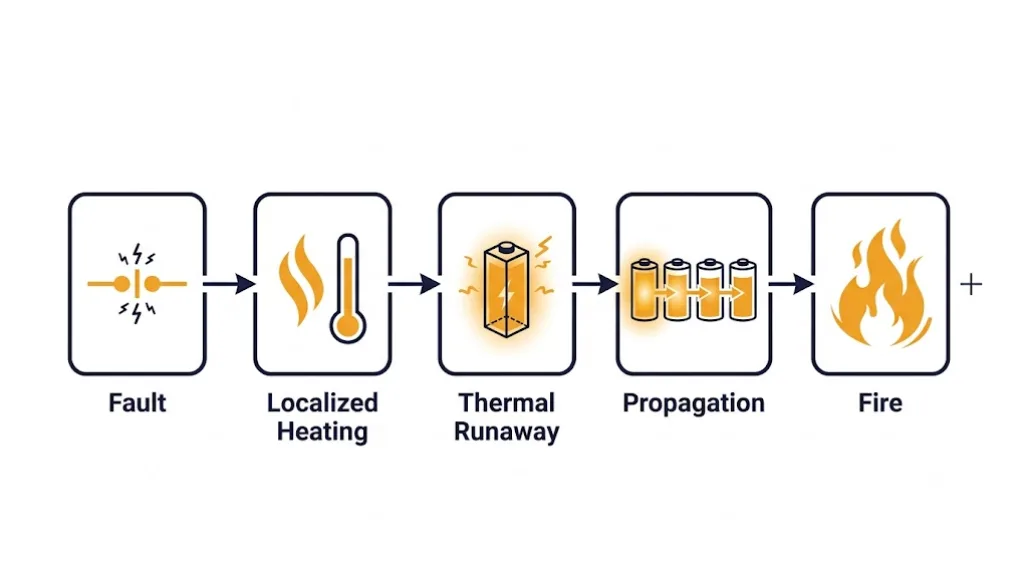
Grid-scale batteries rarely fail from one single problem. A small fault grows step by step until it becomes a fire — that is the real story behind BESS short circuit protection.
It is not one part. It is not one sensor.
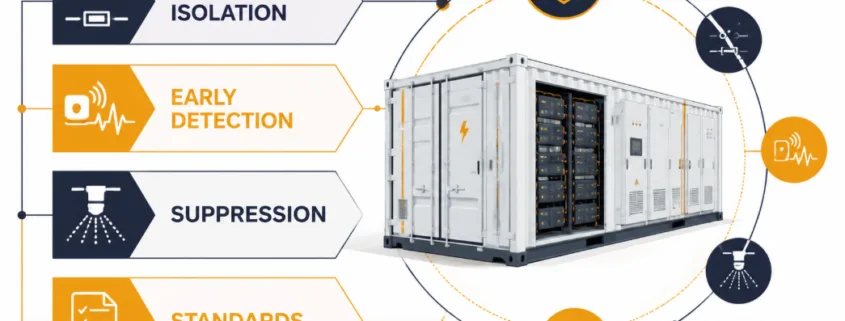
Good BESS short circuit protection is four layers working together: electrical isolation, early detection, suppression, and design standards. Miss one layer, and the rest have to work much harder to catch the fault in time.
For more on how the power conversion system contributes to fault behavior, see our guide on BESS PCS functions and features.
Quick Answer: What Is BESS Short Circuit Protection?
Quick Answer BESS short circuit protection combines four layers. First, fast electrical isolation (fuses, contactors, gate drivers) stops a fault at the source.Second, early detection (off-gas sensors, thermal imaging, cell-level BMS) catches trouble minutes before flames appear.Third, suppression systems (venting, clean-agent, water-mist) contain what detection could not prevent.Fourth, design standards (NFPA 855, UL 9540/9540A) govern how the first three layers get specified, tested, and installed.
Key Takeaways
Layer
What It Does
Example Components
Electrical isolation
Stops the fault before it makes enough heat to ignite anything
Governs how every other layer is tested and installed
NFPA 855, UL 9540, UL 9540A
Why “Short Circuit” Isn’t the Whole Story in BESS Short Circuit Protection
Most large battery fires get called short-circuit fires. But that label is a bit misleading.
What actually happens is thermal runaway that spreads from cell to cell, like dominoes falling.
A short circuit is often the trigger, whether it comes from an internal cell defect, an external fault, or a loose connection.
Still, the real danger comes later, once heat from that one cell starts moving outward. Good BESS short circuit protection has to account for both stages, not just the initial fault.
This distinction shapes how each protective layer gets designed. For example, off-gas detection is not really a short-circuit sensor.
It is a thermal-runaway precursor sensor instead. It picks up gases vented during early cell decomposition.
Often, this happens before a short circuit or flame shows up on any other instrument.
Once you see the full chain — fault, then localized heating, then thermal runaway, then propagation, then fire — it becomes clear where each layer of BESS short circuit protection actually steps in.
Layer 1: Electrical Isolation for BESS Short Circuit Protection
The first job of electrical isolation is simple: keep a fault from ever reaching the point of ignition.
Fast-Acting Fuses and Rack-Level Disconnects
High-speed fuses at the string and pack level interrupt overcurrent fast. They act before it builds up enough localized heat to start thermal runaway.
Also, many newer systems add rack-level contactors and disconnects. As a result, a single faulted rack can be isolated without shutting down the whole container.
This cuts both fire risk and downtime at the same time.
IGBT Protection and Physical Separation
Active gate drivers watch the IGBTs (insulated-gate bipolar transistors) in the power conversion system. If overcurrent shows up, they shut the IGBTs down fast and safely.
This protects both the PCS and the battery side of the connection.
Keeping power conversion gear apart from the battery blocks matters too. A PCS-side fault tends to carry more energy, so keeping it separate makes it less likely to ignite the battery enclosure.
Cell-to-Cell Propagation Barriers
Thermally insulating materials sit between cells and modules. Mica sheets, aerogel layers, and phase-change barriers are common choices.
Even so, if one cell enters thermal runaway, these barriers slow the heat transfer. That extra time often lets detection and suppression systems do their job.
Layer 2: Early Detection Catches the Fault Before It Spreads
A detection layer only matters if it catches trouble minutes, not seconds, before ignition. This is where BESS short circuit protection depends most on speed.
Off-Gas Detection
Specialized sensors pick up gases released during early battery decomposition. Carbon monoxide, hydrogen, and various volatile organic compounds are the usual signs.
Often, this happens minutes before any smoke or measurable temperature rise. So most safety engineers treat off-gas detection as the earliest reliable warning inside a BESS enclosure.
Thermal Imaging and Smart BMS
Continuous infrared monitoring flags hot spots on busbars, connections, and power electronics. These are common origin points for electrical faults.
At the same time, a smart Battery Management System watches voltage and temperature at the individual cell level. It does not stop at the module or rack level.
That granularity lets a developing imbalance get caught and isolated before it touches neighboring cells.
Layer 3: Fire Suppression Contains What Detection Could Not Prevent
Even strong prevention and detection will not stop every event. Suppression systems act as the last line of defense.
Also, code increasingly treats them as mandatory rather than optional.
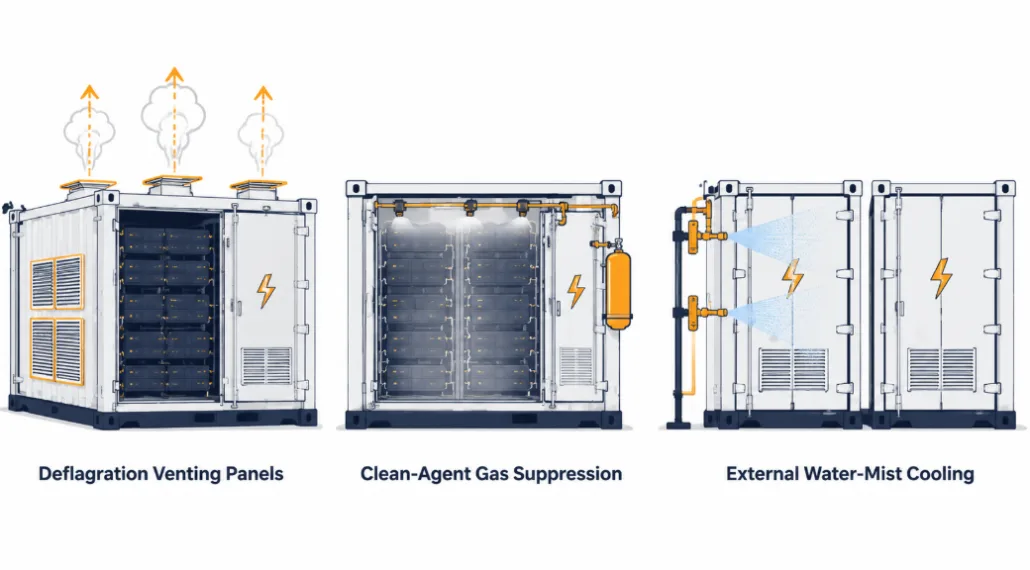
Deflagration Venting
Explosion venting panels direct overpressure from vented battery gases safely upward. This keeps pressure away from people and nearby equipment.
As a result, pressure cannot build up inside the enclosure in the first place.
Clean-Agent Suppression Within BESS Short Circuit Protection
Clean-agent systems flood the compartment and interrupt the fire’s chemical reaction. Unlike sprinklers, they avoid water damage and electrical risk.
But not all agents work the same way. Novec 1230 is a clean gaseous agent that displaces oxygen and absorbs heat.
Stat-X, on the other hand, is a condensed aerosol that suppresses fire through a different chemical mechanism.
So the right choice depends on compartment size, ventilation design, and re-entry time requirements.
Water-Mist and Deluge Cooling
External water-mist or deluge systems usually do not stop the fire that started the event. Instead, their job is cooling adjacent containers.
This keeps the fire from jumping to the next unit. Since container-to-container spread is where the largest-scale incidents tend to originate, cooling matters as much as suppression.
Suppression Type
Primary Function
Best Suited For
Deflagration venting panels
Relieve gas overpressure safely
Preventing explosion or enclosure rupture
Clean-agent (Novec 1230, Stat-X)
Interrupt fire chemistry, no residue
In-compartment suppression, electronics-safe
Water-mist / deluge
External cooling
Preventing container-to-container propagation
Layer 4: NFPA 855 and UL 9540A Set the Rules for BESS Short Circuit Protection
Each safety part only works as a system if it follows a recognized standard. That is where NFPA 855 and UL 9540/UL 9540A come in for BESS short circuit protection.
What NFPA 855 Covers
NFPA 855 covers siting, spacing, detection, and suppression. It also covers ventilation and emergency response planning.
One common example is the minimum 3-foot (914 mm) gap required between ESS units. This can shrink if large-scale fire testing shows a closer gap is safe.
Also, the 2023 edition made fire suppression mandatory for nearly all ESS installations.
The 2026 edition goes further still. It expands formal Hazard Mitigation Analysis to most BESS sites, not just large ones.
For the full breakdown of scope, thresholds, and the 2026 changes, see our NFPA 855 guide.
UL 9540 vs. UL 9540A in BESS Short Circuit Protection
These two standards sound alike but do different jobs. UL 9540 is a system-level product certification.
A large-scale fire test method, UL 9540A generates the propagation data regulators use to set spacing, suppression, and ventilation rules under NFPA 855. It is not a certification by itself.
NFPA 855 also requires written emergency plans. These cover safe shutdown steps and coordination with local fire crews.
It is easy to treat this requirement as an afterthought. But it gets flagged often during AHJ review and insurance underwriting.
FAQ: BESS Short Circuit Protection
What is BESS short circuit protection?
BESS short circuit protection combines electrical isolation, early detection, and suppression. Together, they stop a short circuit fault from turning into thermal runaway and fire.
Is a short circuit the same thing as thermal runaway?
No, they are different things. A short circuit is one possible trigger for thermal runaway.
But thermal runaway itself is the underlying cascading failure. So the real fire risk in BESS short circuit protection comes from propagation between cells, not the short circuit event alone.
Is UL 9540A certification required for every BESS project?
Not exactly. UL 9540A is a test method, not a certification. So there is no such thing as being “UL 9540A listed.”
Even so, most commercial and utility-scale projects in the U.S. need UL 9540A test data. Then this data satisfies NFPA 855 and local fire code requirements for permitting.
What is the minimum spacing required between BESS units under NFPA 855?
The commonly cited baseline is 3 feet (914 mm) between individual units.
Even so, this can shrink if large-scale fire testing under UL 9540A documents that a smaller separation is safe for that specific system. Spacing is one of the simplest parts of BESS short circuit protection to verify during a site walk.
Does off-gas detection replace the need for a BMS?
No, the two serve different roles. Off-gas detection is an early warning system inside the enclosure.
It watches for thermal-runaway gases before flames show up.
A cell-level BMS, by contrast, watches voltage and temperature. So it catches a developing fault before it produces measurable off-gas at all. Together, they cover both ends of BESS short circuit protection.
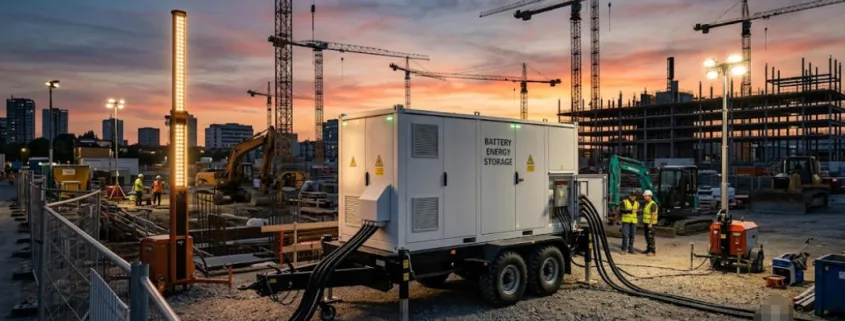
⚡ Quick Answer A Mobile BESS is a battery energy storage system built onto a trailer, truck bed, or skid. It stores electricity and discharges it on demand, so it can power a site with no fuel, no exhaust, and almost no noise.
What Is a Mobile BESS?
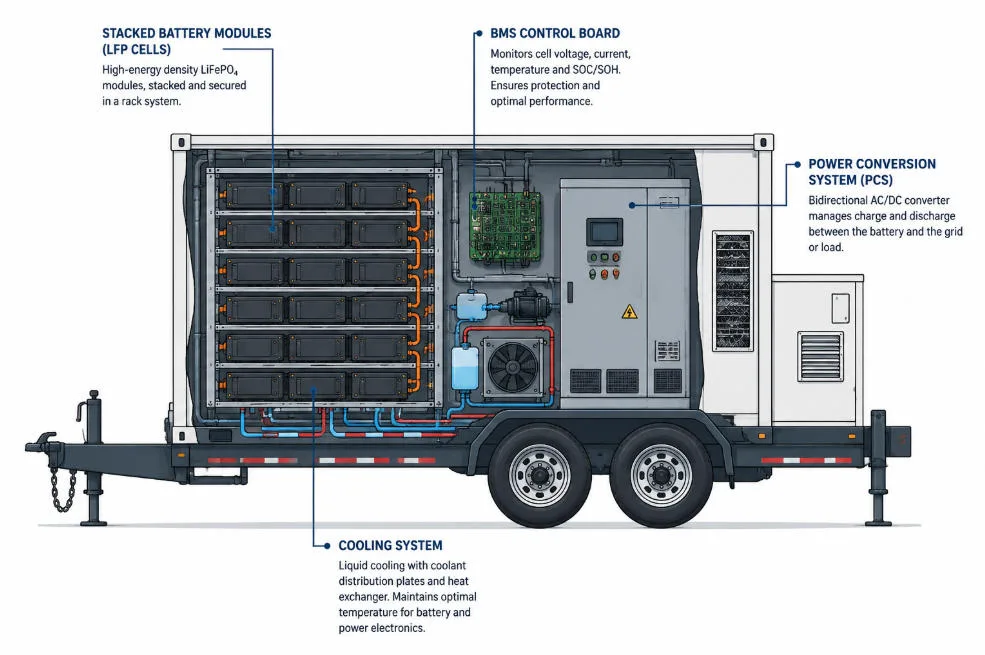
A Mobile BESS packs the same core parts as a fixed installation into a towable unit. Battery modules sit inside a weatherproof enclosure. Meanwhile, a power conversion system (PCS) turns stored DC energy into usable AC power, and a battery management system (BMS) tracks voltage, temperature, and charge level in real time.
In some designs, manufacturers split the battery pack and the PCS into separate trailers. As a result, an operator can pair several battery trailers with one shared PCS unit and add capacity without buying a new inverter each time.
Mobile BESS vs. Diesel Generators
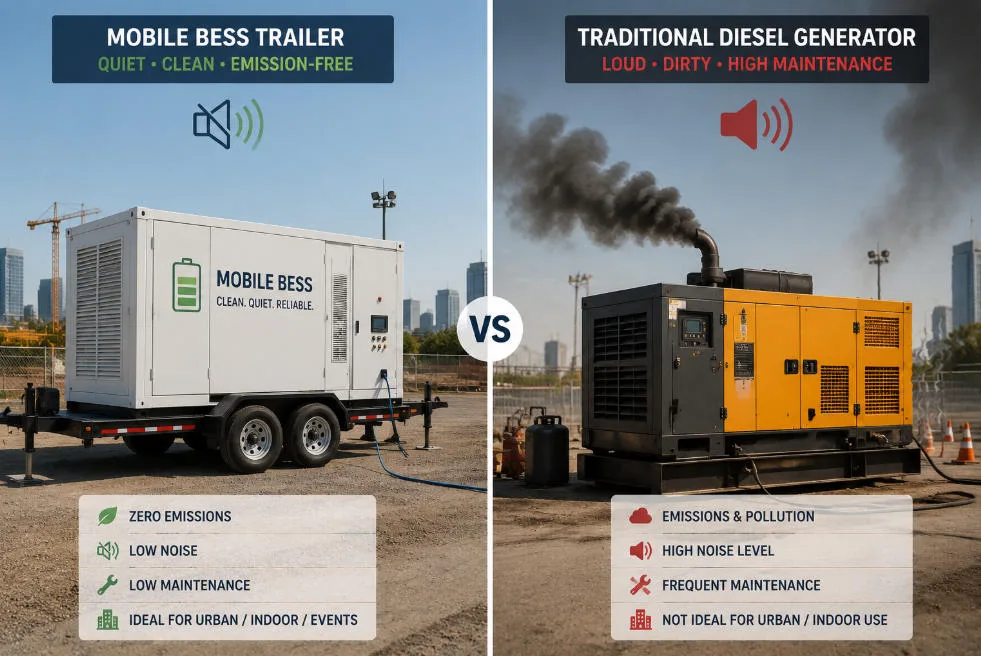
Diesel generators have powered temporary sites for decades. Today, though, a Mobile BESS competes for many of the same jobs. Since it works in a very different way, the table below compares the two side by side.
Factor
Mobile BESS
Diesel Generator
Emissions
Zero exhaust during discharge
Combustion exhaust, particulates, NOx
Noise
Near-silent operation
60-90+ dB at typical load
Fuel logistics
None during discharge; recharges from grid or solar
Ongoing diesel delivery and storage
Response time
Instant power, no warm-up
Seconds to minutes to reach stable output
Runtime
Fixed by battery capacity, then needs recharge
Runs as long as fuel supply lasts
Best fit
Short-duration, indoor, or noise-restricted sites
Long, continuous loads with no grid access
In practice, many sites pair the two instead of choosing one. First, a generator recharges the battery at its most efficient load point. Then it steps back while the Mobile BESS carries the load alone.
Because of this, the hybrid pattern can cut diesel use by roughly half. A generator that idles at partial load burns fuel poorly, so shifting the everyday load onto the battery saves real money over a multi-week job.
Mobile BESS Use Cases
Mobile BESS units solve an old problem in a new way. They provide temporary power where the grid hasn’t arrived yet, isn’t reliable, or isn’t allowed. Overall, six use cases account for most deployments today.
Construction Sites
Construction is the largest single market for mobile storage. Grid interconnection applications often take three to nine months, so a Mobile BESS closes that gap right away.
It can power tower cranes, welding gear, site offices, and electric machinery from day one. Because it makes no exhaust, crews can also run it in tunnels and basements, where diesel fumes would be unsafe.
Events and Film Production
Concerts, festivals, and film sets need power that stays out of the way. A Mobile BESS delivers clean sine-wave output and stays under roughly 55 dB, so it won’t hum in a live recording or flicker a sensitive light rig.
Simply put, a generator can’t match that at the power levels these shoots need.
Mobile BESS for Disaster Relief
When storms or wildfires knock out power lines, crews can truck in units within hours. They power emergency radios, medical gear, and temporary shelters, often arriving before utility crews finish permanent repairs.
Data Center Maintenance Windows
Data centers sometimes need to take a UPS or switchgear segment offline for maintenance without losing backup coverage. A Mobile BESS can stand in during that window, then leave once the permanent system is back online.
Mobile BESS for Grid Support
Utilities and developers increasingly use these units for temporary grid services: voltage support, short-term capacity, or bridging power for a solar or wind project still waiting on its permanent interconnection agreement. As a result, a finished generation asset keeps earning instead of sitting idle.
EV Charging Support
Pop-up EV charging is one of the fastest-growing uses. Because a Mobile BESS can buffer a weak grid connection, it can still deliver fast-charging bursts at events or in areas the grid hasn’t fully reached.
Mobile BESS Sizing and Chassis Configurations
Capacity varies widely, and the right size depends entirely on the job. Understanding a few typical bands makes it much easier to spec the right unit.
Chassis Types and Capacity
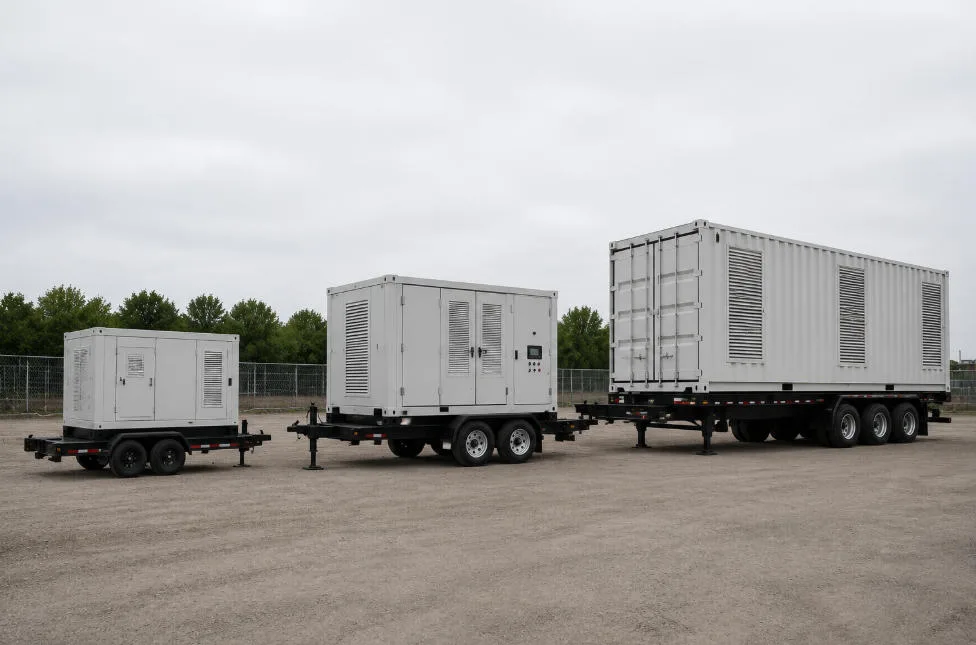
Compact truck-mounted units typically sit around 90 kWh. Power Up Connect’s Green Grid trailer is a good example: it carries UL 9540 and UL 9540A certification, and operators can daisy-chain up to 10 units for bigger jobs.
Meanwhile, mid-size trailer units generally run from about 250 kWh to 650 kWh. This band covers most construction and event work.
Utility-scale trailers sit at the top end. They often exceed 800 kWh and sometimes reach 2 MWh per unit. These usually ride on a 20-foot container platform or a dedicated semi-trailer, so teams can string several together for multi-megawatt-hour jobs.
Chassis Type
Typical Range
Best Fit
Compact flatbed / skid
~90 kW – 300 kWh
Small job sites, single-piece equipment, light-load events
Drawbar trailer
~250 kW – 650 kWh
Mid-size construction sites, festivals, multi-generator replacement
Container semi-trailer
800 kWh+ up to ~2 MWh
Utility-scale temporary power, large events, grid-support deployments
Road weight limits usually cap a single trailer’s size, not the battery technology itself. So past roughly 1-2 MWh, it’s typically easier to deploy multiple units side by side than to push one chassis larger.
Battery Chemistry and Cooling
LFP (lithium iron phosphate) leads this segment for good reason. It handles the shaking and heat swings of repeated transport well. Plus, its long cycle life (commonly rated 6,000-8,000+ cycles) suits frequent redeployment far better than higher-energy but less forgiving chemistries.
Smaller units, roughly under 300 kWh, typically use air cooling. It keeps the system light and easy to fix in the field.
Larger, higher-power trailers, however, generally switch to liquid cooling instead, since it manages heat better. This is the same crossover point used in stationary BESS design.
Chassis engineering: Dual-axle running gear, mechanical braking, and vibration-dampening brackets protect the battery pack through highway travel and rough job-site terrain. The chassis itself needs proper axle load ratings, DOT-compliant lighting and braking, and secure tie-down points.
Mobile BESS Safety and Compliance
A Mobile BESS still has to meet the same fire-safety and transport rules as any lithium battery system. However, it does earn a few specific carve-outs because it moves.
NFPA 855 Rules
NFPA 855, the Standard for the Installation of Stationary Energy Storage Systems, defines mobile ESS in Section 3.3.9.5. It then sets installation rules in Section 4.5. The most important carve-out is this: wheeled or trailer-mounted units don’t need to meet the seismic and structural load rules that apply to permanent installations.
Even so, standard separation distances still apply. Deployments need at least 10 ft (3 m) from public ways, stored combustibles, and hazardous materials. They also need 50 ft (15 m) from tents or seating areas holding 30 or more people.
That said, an Authority Having Jurisdiction (AHJ) can reduce these distances if large-scale UL 9540A fire test data backs it up. Regardless, deployed mobile ESS still can’t go indoors, in covered parking garages, on rooftops, below grade, or under building overhangs.
UL 9540 Listing for Mobile BESS
Mobile units still need UL 9540 listing, the core safety standard for energy storage systems. They typically undergo UL 9540A large-scale fire testing too, just like a stationary installation.
In short, mobility doesn’t exempt the battery system from certification — it only changes the foundation and seismic rules. For the full installation breakdown, see our NFPA 855 guide.
Transport Testing Under UN 38.3
Before a Mobile BESS can ship, its cells and battery packs must pass UN 38.3. This set of eight tests simulates real transport conditions: altitude, thermal cycling, vibration, mechanical shock, short circuit, impact, overcharge, and forced discharge.
The vibration test alone runs a sweep from 7 Hz to 200 Hz for three hours. Next, a shock test simulates a 150g/6ms or 50g/11ms impact. That’s a tough bar, since this system gets driven over real roads again and again, not installed once and left in place.
Road Transport Rules
In the US, moving an assembled lithium battery system by highway falls under 49 CFR 173.185, part of the DOT’s Hazardous Materials Regulations. Since it classifies lithium batteries as Class 9 dangerous goods, compliance means UN-spec packaging, correct labels, and proper shipping papers.
A good provider keeps UL 9540 listing documents and UN 38.3 test summaries ready on request. You shouldn’t have to wait while a provider scrambles for paperwork after a jurisdiction asks for it.
Certification Varies by Export Market
It’s also worth noting that certificates differ by market, not just by product. US and Canadian buyers look for UL 1973, UL 9540, and UL 9540A. EU buyers need CE marking plus IEC 62619 or IEC 62933. China requires CCC, Korea requires KC, India requires BIS, and Japan requires PSE. UN 38.3 applies everywhere, since it covers transport rather than installation. For the full regional breakdown, see our BESS certifications guide.
Mobile BESS vs. Stationary BESS
Factor
Mobile BESS
Stationary BESS
Installation
Deployed in hours; no permanent foundation
Weeks to months; foundation and permitting
Relocation
Built to move between sites
Fixed for the life of the asset
Typical use case
Temporary power, events, emergency response
Long-term grid support, solar firming
Seismic requirements
Exempt when on a wheeled chassis
Full seismic design required
Capacity ceiling
Practical limit near 1-2 MWh per trailer
Scales to tens or hundreds of MWh
Cost structure
Often rented per deployment
Capital asset with long depreciation
Choosing a Mobile BESS Provider
Providers increasingly sell Mobile BESS as a service rather than as a capital purchase. Because of that, the ownership model matters just as much as the hardware spec sheet.
Rental / deployment-based pricing — pay per project or per month, and the provider handles maintenance and recharge logistics
Battery-swap service — the provider delivers a fully charged replacement unit and takes the depleted one away, so on-site recharging is never your problem
Hybrid generator pairing — for sites where full battery replacement isn’t practical yet, running the BESS alongside a generator can still cut fuel use by roughly half
Outright purchase — makes sense when your organization deploys often enough that utilization beats rental economics
Before committing, it’s worth asking any provider a few direct questions:
Is the unit UL 9540 listed and UN 38.3 tested, with documentation available on request?
What is the actual site commissioning time, door-to-power-on, not just “rapid deployment” marketing language?
What is the noise rating at rated load, and is it independently measured or a vendor estimate?
Is the enclosure rated for indoor or enclosed-space use, or is it outdoor-only?
What happens if the unit needs service mid-deployment? Is there a swap or backup unit guarantee?
What’s included in the rental rate: transport, commissioning, decommissioning, and recharge, or are these billed separately?
Does the chassis carry standard DOT lighting, braking, and axle certifications for your transport route?
Mobile BESS Market Outlook
Fortune Business Insights values the mobile energy storage system market at $58.28 billion in 2025, and projects it will reach $207.03 billion by 2034. That’s a compound annual growth rate above 15%.
Several trends are driving this growth. For one, utilities and developers are swapping out diesel generators to cut emissions and noise complaints. At the same time, falling LFP battery costs make the switch more affordable each year.
Longer grid interconnection queues are pushing more projects toward temporary bridging power, too. And a growing rental and battery-swap model is lowering the barrier for construction and events firms that don’t want to own the asset outright.
So for project developers, the takeaway is simple. Mobile BESS has moved from a niche disaster-relief tool to a mainstream option, one worth considering any time a site needs power before, instead of, or alongside a permanent grid connection.
Mobile BESS Key Takeaways
Aspect
Key Point
Definition
A Mobile BESS is a trailer-, truck-, or skid-mounted battery storage system built for temporary deployment.
Chemistry
LFP dominates for thermal stability and 6,000-8,000+ cycle life.
Cooling
Air cooling under ~300 kWh; liquid cooling for larger, high-power units.
Sizing
Ranges from ~90 kWh truck units to 2 MWh utility-scale trailers.
Safety code
NFPA 855 Section 4.5 governs mobile ESS; seismic rules are waived on wheeled chassis.
Listing
UL 9540 listing and UL 9540A fire testing still apply.
Transport
Cells must pass UN 38.3 testing; US highway moves follow 49 CFR 173.185.
Market
Projected to grow from $58.28B (2025) to $207.03B (2034), a 15%+ CAGR.
Frequently Asked Questions
What Is a Mobile BESS Used For?
A Mobile BESS gives temporary, emission-free power for construction sites, live events, film sets, disaster relief, data center maintenance, EV charging, and short-term grid support. In short, it fits anywhere a diesel generator would normally go, but noise, exhaust, or setup speed favor a battery instead.
How Long Does a Mobile BESS Run Before Recharging?
Runtime depends on the battery’s energy capacity relative to the connected load, not a fixed number. Typically, a mid-size unit in the 250-650 kWh range can run critical loads for several hours to a full day before it needs recharging.
Providers usually size the system to match the job’s load profile. Many also offer battery-swap or hybrid generator support for jobs that need power longer than a single charge allows.
Is It Safe to Transport on Public Roads?
Yes, as long as the system carries the right certification. Cells and battery packs must pass UN 38.3 testing before they ship. In the US, road transport then falls under 49 CFR 173.185, which classifies lithium batteries as Class 9 hazardous material.
The chassis itself also needs standard DOT lighting, braking, and axle certifications. A reputable provider keeps this paperwork ready on request.
Does NFPA 855 Apply to a Mobile BESS?
Yes. NFPA 855 defines and regulates mobile energy storage systems directly in Section 4.5. It exempts wheeled, trailer-mounted units from seismic and structural load rules, but UL 9540 listing, minimum separation distances, and site-specific electrical rules still apply.
What Battery Chemistry Do Most Units Use?
Lithium iron phosphate (LFP) leads this segment. It handles the shaking and heat swings of repeated transport well, and its long cycle life suits frequent redeployment better than most alternatives.
Quick Answer AI data centers strain power grids in two ways. First, they need massive amounts of power. Second, that power swings wildly, second to second. In practice, training a large GPU cluster can shift facility power by tens or hundreds of megawatts within milliseconds. AI data center BESS, battery storage deployed on-site, solves both problems. It absorbs these swings, bridges long grid connection delays, and cuts peak demand charges. As a result, it often costs far less than building new on-site generation.
1. The Power Problem Driving AI Data Center BESS
AI data center BESS has moved from a niche add-on to a core design requirement. Specifically, global data center electricity demand is set to top 1,000 TWh in 2026. That is roughly double the 2023 level. In the United States, data center power demand should climb by 400 TWh by 2030. That works out to about 23% growth each year. In fact, AI workloads alone could drive 30% to 40% of that new demand.
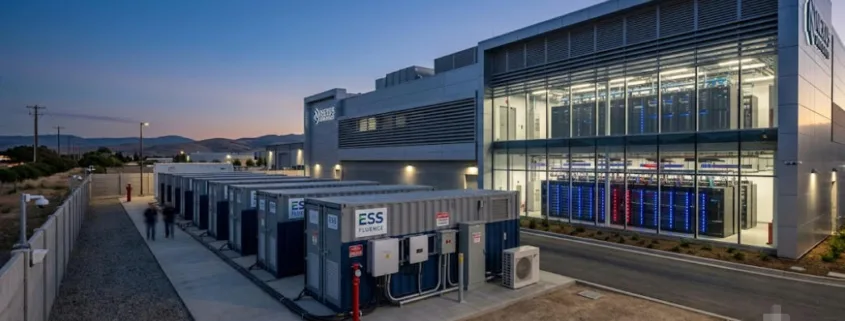
This growth has outpaced what utilities can build. Hyperscalers now sign gigawatt-scale power deals faster than new transmission lines can go up. As a result, a widening gap has formed. AI facilities need power on day one, but the grid often cannot deliver it on schedule. That is why AI data center BESS increasingly closes the gap, both on-site and in front of the meter.
2. Why Volatility Matters More Than Total Power
#image_title
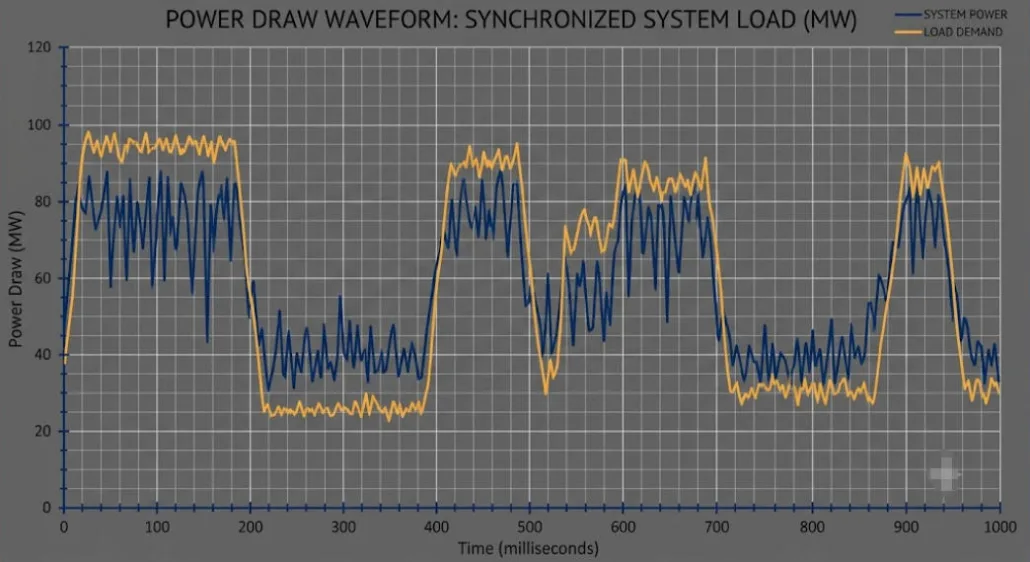
Consequently, most conversations about AI data centers focus on total megawatts. However, the harder problem is how unevenly that power arrives. For example, a traditional data center runs thousands of small, unrelated tasks. Therefore, those tasks average out into a fairly flat load. In contrast, an AI training cluster works quite differently. Specifically, tens of thousands of GPUs execute in lockstep. As a result, they synchronize computation and communication in cycles that last just milliseconds.
A large training job often pauses for a checkpoint or a data-sync step. When it does, GPU power can fall from full load to near idle in a split second. Then it snaps back just as fast. At scale, these swings can move tens or even hundreds of megawatts almost instantly. For example, Meta’s own engineers have described this exact problem on a 24,000-GPU cluster pulling roughly 30 MW. Notably, they say the problem only grows as clusters get bigger.
According to Uptime Institute, these swings can push AI compute clusters to about 150% of their normal power draw. That strains transformers, UPS units, and protection gear never built for this kind of stress. Left unmanaged, the swings can trip upstream protection or shake grid equipment through resonance. In response, fast-responding battery storage can absorb or release power within milliseconds. So, AI data center BESS is one of the few tools that can smooth these swings before they reach the utility line.
3. Interconnection Queues Are the Real Bottleneck
Even a fully funded data center still has to wait in line to connect to the grid. As of late 2025, about 2,600 GW of generation and storage capacity sat in U.S. interconnection queues. Today, the median project takes close to five years to reach commercial operation. Some PJM-area projects have waited more than eight. Meanwhile, ERCOT alone had 143.5 GW of data center load seeking connection as of October 2025. That is well above the grid operator’s all-time peak demand of 85.9 GW.
In short, only a small share of queued capacity ever gets built. In fact, Lawrence Berkeley National Laboratory found that just 13% of capacity that applied for interconnection between 2000 and 2019 had reached commercial operation by the end of 2024. For a developer who needs power within 18 to 24 months, a five-to-eight-year queue is not a delay. It is a dealbreaker. Because of this, an estimated 50 GW of behind-the-meter data center power capacity was announced in 2025 alone. Most of it pairs on-site generation with co-located battery storage. This is exactly the gap AI data center BESS is built to bridge, until the grid connection is ready.
4. Where AI Data Center BESS Fits: Four Key Roles
AI data center BESS is not a single application. Instead, it covers four distinct jobs. Often, all four stack on the same battery asset.
Sub-Second Power Smoothing
Specifically, rack-level and facility-level battery banks can absorb a sudden GPU load drop. Then they discharge just as fast when demand snaps back. This turns a millisecond-scale spike into a gradual ramp. As a result, grid equipment and on-site generators can actually keep up. Chipmakers now pair this storage with power capping and staged ramp-up controls. Together, these keep facility-wide swings within a range utilities can tolerate.
Bridge Power for AI Data Center BESS
A co-located BESS can start covering peak loads the day a facility opens. This happens long before a full grid connection is approved. So, it buys time for transmission upgrades to catch up. The project does not have to sit idle for years waiting on first power.
Peak Shaving and Demand Charge Management
Typically, utilities bill large loads heavily for their single highest demand spike each month. By charging the battery during cheap, low-demand hours and discharging during peak windows, a facility can shave that spike. This can meaningfully cut a facility’s monthly bill. For more detail, see Sunlith’s guide to peak shaving and demand charge reduction.
Grid Services and Energy Arbitrage
Additionally, a stand-alone BESS in front of the meter can also earn revenue on its own. It charges when wholesale prices are low. Then it discharges, or provides frequency regulation, when prices spike. In turn, this transforms backup infrastructure into a second income stream, not just a cost center.
5. BESS vs. Alternative Power Strategies for AI Facilities
Data center developers rarely choose one power strategy alone. Instead, the table below compares how AI data center BESS stacks up against other tools developers are using in 2026.
Strategy
Response Time
Deployment Timeline
Best For
BESS
Milliseconds to seconds
6–18 months
Power smoothing, peak shaving, bridge power
On-site gas generation
Seconds to minutes
12–24 months
Sustained bridge power at large scale
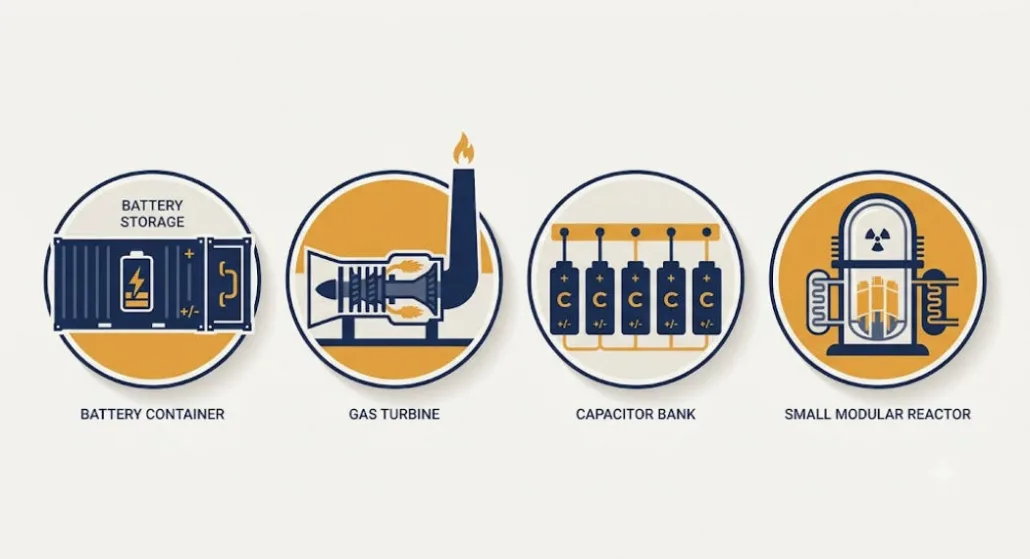
Grid-forming UPS / capacitor banks
Microseconds
Built into facility design
Ride-through for the shortest transients
Small modular reactors (SMRs)
Not applicable (baseload)
5+ years
Long-term, always-on capacity
6. Sizing AI Data Center BESS: What to Consider
Not every BESS deployment looks the same. Sizing one for an AI data center starts from a different set of questions than a typical grid-scale project.
Response Time and C-Rate
Smoothing millisecond-scale GPU swings needs a battery and inverter rated for very fast response. This matters more than raw capacity. It is a different design target than a system built purely for hours-long peak shaving.
Duration: Burst Smoothing vs. Bridge Power
A system built to absorb short, sharp swings needs little energy capacity but very high power. By contrast, a system meant to bridge months or years of interconnection delay needs the opposite. It needs sustained duration to cover real load, not just brief spikes.
AI Data Center BESS Placement: Rack vs. Facility
Some operators deploy smaller battery banks close to the rack to catch the fastest transients. They pair these with a larger facility-scale BESS for peak shaving and bridge power. The two serve different timescales. So, they are rarely substitutes for each other.
Battery Chemistry for AI Data Center BESS
AI data center duty cycles involve frequent, partial charge-discharge events, not one clean cycle a day. Lithium iron phosphate, or LFP, tends to hold up well under that kind of irregular cycling. It also offers strong thermal stability. That matters for compliance with codes covered in Sunlith’s NFPA 855 guide for large-format stationary storage.
Key Takeaways on AI Data Center BESS
Point
Why It Matters
AI data centers strain the grid two ways
Total demand is high, but the bigger design problem is millisecond-scale power swings during GPU training
Interconnection queues now stretch 5–8 years
AI data center BESS and other behind-the-meter resources bridge the gap until full grid connection
BESS covers four distinct jobs
Power smoothing, bridge power, peak shaving, and grid services can stack on one battery asset
Sizing depends on the job
Smoothing needs fast response and modest duration; bridge power needs sustained duration and real capacity
LFP suits AI data center duty cycles
Frequent partial cycling and thermal stability requirements favor LFP over other lithium chemistries
Frequently Asked Questions About AI Data Center BESS
What Is AI Data Center BESS?
BESS stands for battery energy storage system. AI data center BESS refers to on-site or co-located batteries. These batteries smooth GPU power swings, bridge grid connection delays, and manage peak demand charges.
How Much Power Do AI Data Centers Actually Use?
Individual GPU racks now draw 50 to 100 kW. That is up from just 5 to 10 kW for older server racks. At the facility level, large training clusters can pull tens to hundreds of megawatts. Notably, swings of similar size can occur within milliseconds.
Can Batteries Really Respond Fast Enough for GPU Power Swings?
Yes, when purpose-built for it. Battery and inverter combinations designed for fast response can absorb and release power within milliseconds. That is exactly the timescale GPU training swings operate on.
How Long Does BESS Deployment Take?
A dedicated BESS deployment typically takes 6 to 18 months, from order to commissioning. That is far faster than the five-plus-year interconnection queues many large loads now face.
Is BESS a Permanent Fix or a Bridge to Something Else?
It can be both, depending on the role. For instance, peak-shaving and power-smoothing functions are usually permanent.
Power outages cost businesses billions every year. Aging grid infrastructure, extreme weather, and the variable nature of solar and wind energy make centralized power systems less reliable. As a result, energy-forward organizations are turning to microgrid BESS — a combination of distributed energy resources and battery storage that can supply power independently of the utility grid.
A microgrid BESS is not simply a backup generator. Instead, it is an intelligent energy platform that stores renewable energy, dispatches it on demand, and switches smoothly between grid-connected and islanded operation. To understand the foundation of this technology, read our ultimate guide to battery energy storage systems before diving into the microgrid-specific details covered here.
This guide covers everything EPCs, project developers, and commercial energy buyers need to know. Topics include: how these systems work, core components, sizing methodology, use cases, grid-forming technology, relevant standards, and financial considerations.
What Is a Microgrid BESS?
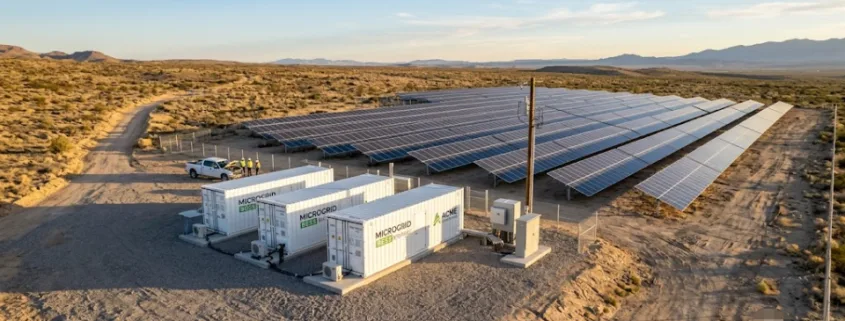
A microgrid is a local energy network. It integrates distributed energy resources — solar PV, wind turbines, diesel generators, and battery storage — into one controllable system. Crucially, it can run in two modes: grid-connected (exchanging power with the utility) or islanded (supplying loads on its own).
Battery storage is the technology that makes islanded operation practical. Without BESS, a microgrid relying on solar cannot guarantee stable voltage and frequency when it disconnects from the grid. With BESS, however, the system buffers generation gaps, sustains loads overnight, and holds the frequency reference that other devices need. For a broader look at how BESS works across sectors, see our guide on top applications of commercial and industrial BESS.
In short: BESS is the backbone of a modern microgrid. It turns a set of distributed generators into a self-sufficient power system.
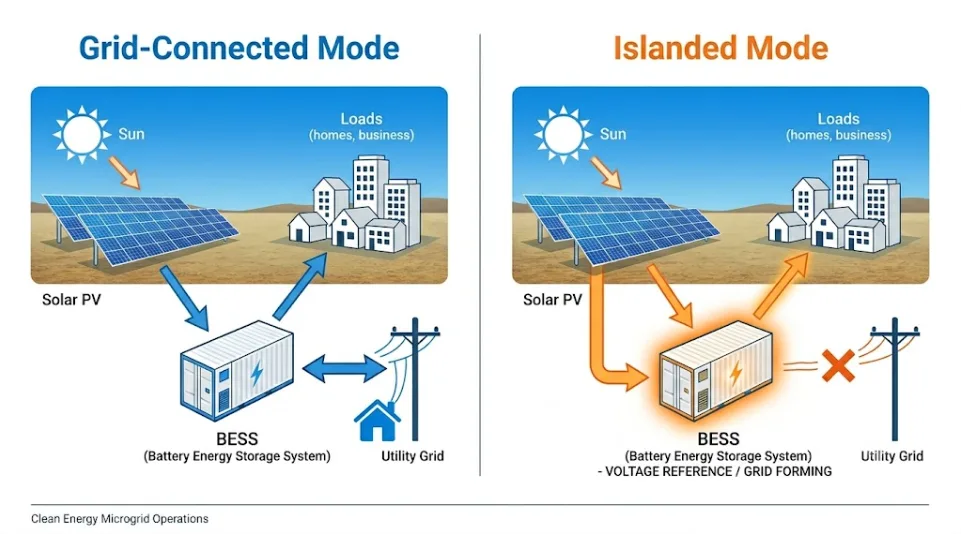
Grid-Connected vs. Islanded Microgrid BESS
Microgrid BESS Operating Modes — Grid-Connected vs. Islanded
Microgrid BESS operates in two fundamental modes. Understanding both is essential before sizing or specifying a system.
Grid-connected mode: The microgrid stays synchronized with the utility. BESS handles peak shaving, load shifting, and frequency regulation. Excess solar generation is stored or exported.
Islanded (off-grid) mode: The microgrid disconnects at the point of common coupling. BESS then acts as the voltage reference, sustaining all local loads entirely on its own.
Seamless transition between these modes is a critical performance target. Research published in Energies (2026) showed loss-of-mains detection in under 3 milliseconds — well within the 10-millisecond threshold needed for sensitive equipment to ride through without disruption.
Core Components of a Microgrid BESS System
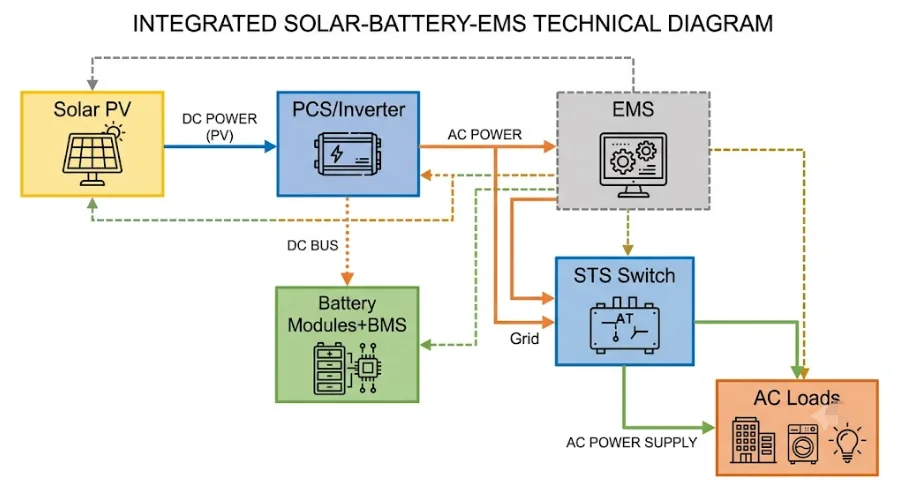
A complete microgrid BESS integrates several interdependent subsystems. Knowing each one helps EPCs design reliable systems and helps project developers evaluate vendor proposals accurately.
1. Battery Modules and Racks — LFP Chemistry
Lithium Iron Phosphate (LFP) chemistry dominates microgrid deployments today. LFP delivers over 6,000 cycles at 80% depth of discharge. It also operates safely across wide temperature ranges and avoids the thermal runaway risk seen in NMC chemistry. Battery modules are assembled into racks and housed in containerized enclosures for rapid site deployment.
2. Battery Management System (BMS)
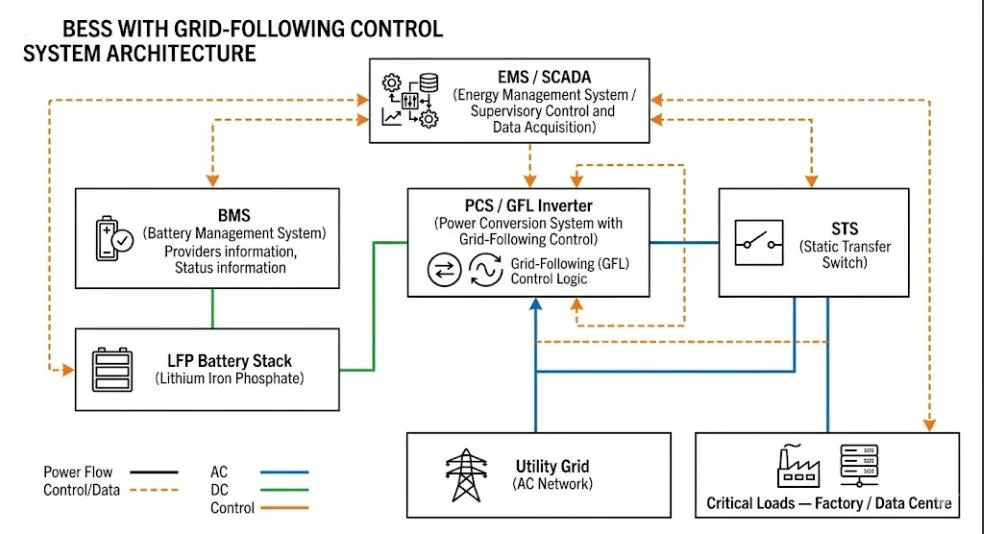
The BMS monitors cell-level voltage, temperature, and current. It enforces SoC limits (typically 20–80% under the 20/80 cycling rule), calculates State of Health (SoH), and tracks DC Internal Resistance (DCIR). Additionally, the BMS communicates with the EMS via CAN bus or Modbus. For a deeper look at how the EMS works inside a BESS, we have a dedicated technical article on the subject.
3. Power Conversion System (PCS)
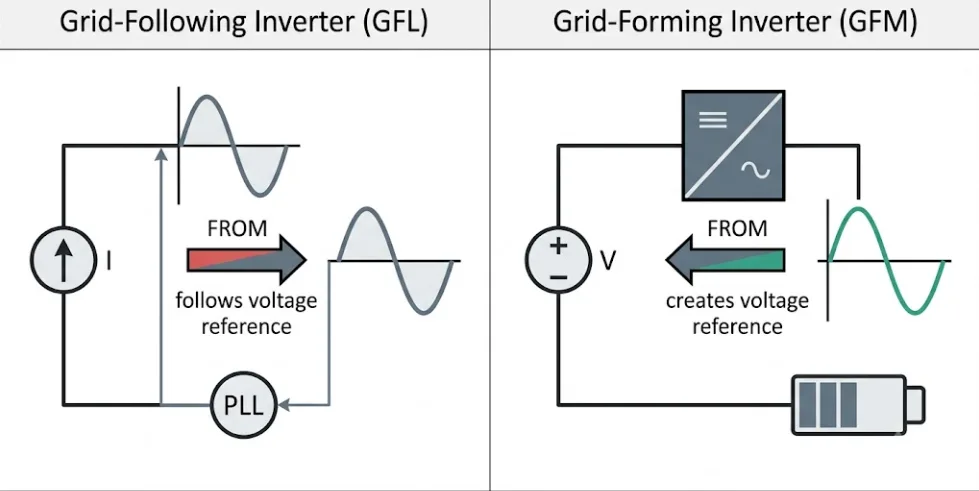
The PCS — also called the bidirectional inverter — converts DC energy from batteries into AC power for loads. It also converts AC to DC during charging. In a microgrid, the PCS can operate in grid-following or grid-forming mode. Grid-forming units synthesize voltage and frequency from scratch, which makes islanded operation possible even without a utility reference.
4. Energy Management System (EMS)
The EMS is the intelligence layer. It receives data from the BMS, PCS, solar inverters, load meters, and weather forecasts. Then it dispatches charge/discharge commands to optimize across multiple objectives simultaneously — peak shaving, renewable self-consumption, SoC management, and grid services. Moreover, it governs mode transitions and coordinates load shedding during generation shortfalls. Read our full breakdown of how EMS enables advanced grid services through BESS to see exactly how this works in practice.
5. Solar PV Array
Solar PV is the primary generation source in most microgrid BESS deployments. The PV array charges the BESS during daylight hours. As a result, the BESS can supply loads through the night or during cloud cover. Oversizing the PV-to-BESS ratio — typically 1.2× to 1.5× — ensures adequate charging under real-world irradiance conditions.
6. Point of Common Coupling (PCC) Switch / STS
The PCC switch or Static Transfer Switch (STS) is the electrical boundary between the microgrid and the utility grid. During a grid disturbance, the STS opens within milliseconds to island the microgrid. When grid power returns and stabilizes, the STS synchronizes and re-closes. Consequently, the speed and reliability of this device directly determines the quality of power continuity during transitions.
Microgrid BESS Component Summary Table
Component
Primary Function
Key Standard
Typical Technology
Battery Module
Store DC energy
IEC 62619, UL 1973
LFP, NMC
BMS
Cell monitoring, protection, SoH tracking
IEC 62133-2
Rack-level + pack-level
PCS / Inverter
DC↔AC conversion, grid forming/following
IEEE 1547, UL 1741
Grid-forming (VSM/droop)
EMS
Dispatch, optimization, mode transitions
IEC 62933-5-2
SCADA + AI forecasting
STS / PCC Switch
Grid isolation, mode transition
IEEE 1547.4
<20 ms transfer
Solar PV Array
Primary renewable generation
IEC 61215, IEC 61730
Monocrystalline TOPCon
Thermal Management
Temperature control, fire suppression
NFPA 855, UL 9540A
HVAC + liquid cooling
Microgrid BESS Components Architecture Diagram
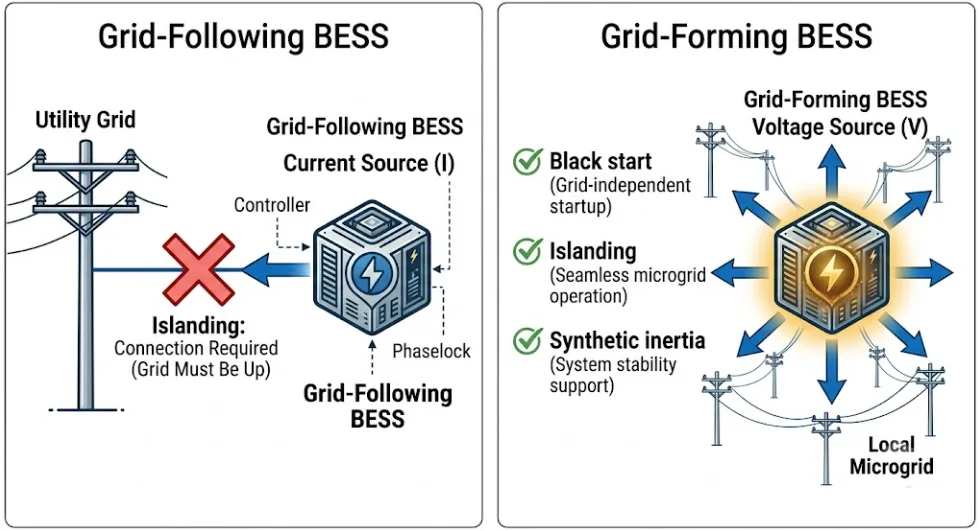
Grid-Forming BESS: The Key to True Islanding
The most important technology choice in any microgrid BESS project is the inverter control mode. Specifically, you must decide between grid-following and grid-forming. This single decision determines whether the system can operate independently of the utility at all. Our detailed grid-forming vs. grid-following BESS guide covers the full technical comparison, but the key points are summarized below.
Grid-Following BESS: Its Core Limitation
A grid-following inverter acts as a current source. It detects the voltage and frequency of an active grid and synchronizes its output to that reference. Therefore, if the grid disappears — during a blackout — a grid-following inverter cannot sustain islanded operation. It must shut down immediately per IEEE 1547 anti-islanding requirements to protect utility workers.
This means a grid-following BESS cannot black-start a dead network. Nor can it sustain an islanded microgrid on its own. As a result, it is not a viable standalone solution for resilience-critical sites.
Grid-Forming BESS: How It Creates the Grid
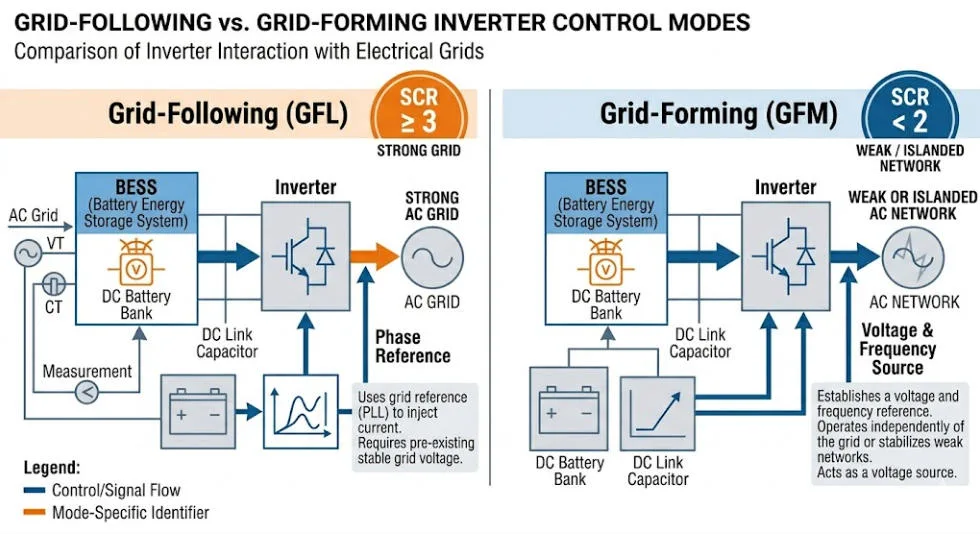
Grid-Forming vs Grid-Following BESS Inverter Comparison
A grid-forming inverter operates as a voltage source instead. Rather than following an external signal, it synthesizes its own voltage waveform and frequency using algorithms such as Virtual Synchronous Machine (VSM) or droop control. Consequently, all devices on the microgrid — other inverters, loads, generators — synchronize to the grid-forming BESS.
This fundamental shift in control architecture unlocks four critical capabilities:
Black start: The grid-forming BESS energizes a completely dead network from zero.
Sustained islanding: The microgrid runs indefinitely without any utility connection.
Synthetic inertia: The inverter emulates the rotational inertia of a synchronous generator, stabilizing frequency during rapid load changes.
Fault current contribution: The system provides enough fault current to trip protection relays, enabling conventional protection coordination.
As of mid-2025, Australia had deployed 1,070 MW of grid-forming BESS across ten sites, according to AEMO. Furthermore, a 2025 Nature Scientific Reports study confirmed that integrated grid-forming inverter strategies significantly improve microgrid resilience under fault conditions. This real-world track record proves that grid-forming technology is no longer experimental.
How to Size a Microgrid BESSSystem
Getting the size right is critical. An undersized system fails to cover loads overnight or during weather events. An oversized system wastes capital. Fortunately, the sizing methodology follows four clear, sequential steps.
Step 1 — Establish the Load Profile
Start with a complete energy audit. Measure peak demand (kW) and daily energy consumption (kWh). Identify critical loads that must run during islanding and non-critical loads that can be shed. Also account for motor start-up inrush currents, which can reach 6× running current and must be covered by the PCS peak power rating.
Step 2 — Define Autonomy Duration
Autonomy duration is the number of hours the microgrid must sustain critical loads without solar generation or grid support. For most commercial microgrids, 4–8 hours covers overnight periods. For resilience-critical facilities such as hospitals or data centers, however, 24–72 hours of autonomy is the standard design target.
Step 3 — Apply the Sizing Formula
Use this baseline formula to calculate required battery capacity:
Here: DoD = usable depth of discharge (0.80 for LFP); RTE = round-trip efficiency (0.92 for modern LFP BESS). Always add a 10–15% spinning reserve margin on top for frequency stability headroom.
Step 4 — Size the Solar PV Array
The solar PV array must fully recharge the BESS within the available daylight window. For a system that recharges overnight-depleted batteries within 6–8 hours of sunlight, a PV-to-BESS ratio of 1.3× to 1.5× is typically required. NREL’s battery storage FAQs provide reliable guidance on irradiance-based sizing methodology that you can apply directly to project scoping.
Microgrid BESS Sizing Reference Table
The table below assumes LFP chemistry, 80% DoD, 92% RTE, 10% spinning reserve, and 12-hour overnight autonomy:
Application
Critical Load (kW)
Autonomy (h)
BESS Size (kWh)
Solar PV (kWp)
Remote Village
50
12
817
1,060
Commercial Campus
250
8
2,717
3,500
Hospital / Critical Site
500
24
16,304
21,000
Mining / Industrial
1,000
12
16,304
21,000
Island Community
2,000
12
32,609
42,000
Note: These are scoping figures only. Final sizing must account for site-specific irradiance, load diversity factor, planned expansion, and local grid code requirements.
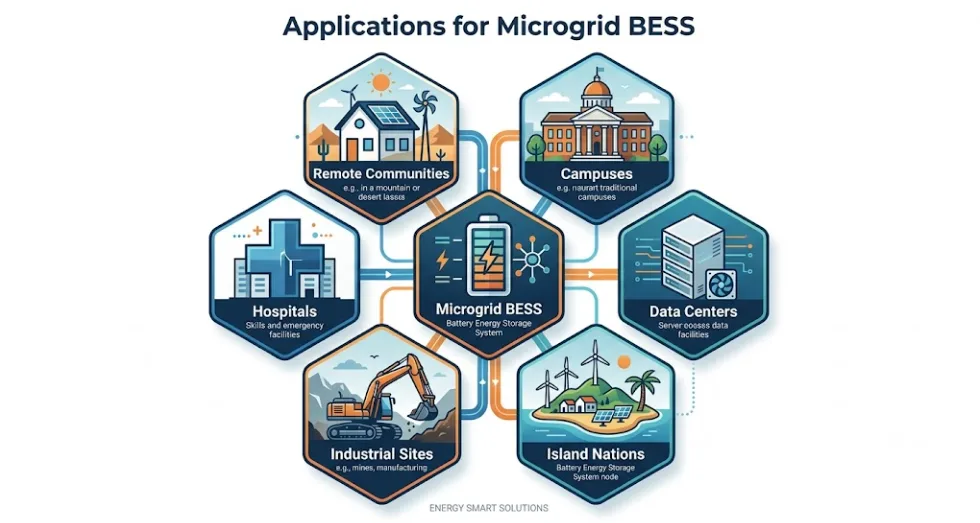
Microgrid BESS Use Cases: Six Key Applications
Six Leading Microgrid BESS Use Cases Infographic
Microgrid BESS is no longer a niche solution for remote communities. It is now essential infrastructure across a wide range of sectors. Here are the six leading applications driving global deployment today.
1. Remote and Off-Grid Communities
Approximately 770 million people still lack reliable electricity access. Many live in locations where grid extension is economically unviable. Solar-plus-BESS microgrids offer a proven alternative to diesel generation. According to IRENA’s renewable energy statistics, the levelized cost of energy from a solar-battery islanded microgrid has fallen below $0.18/kWh in high-solar-resource locations — competitive with or cheaper than diesel, even before accounting for fuel logistics costs.
2. Hospitals and Healthcare Facilities
Power interruptions in healthcare settings can have life-threatening consequences. Research published in Energy and Buildings (2025) modelled a solar-BESS microgrid for a hospital on Lombok Island. A correctly sized system supplying 7 MWh per day maintained 100% reliability across a simulated 3-day grid outage with zero diesel required. Therefore, microgrid BESS in healthcare is not just an economic choice — it is a life-safety infrastructure decision.
3. Mining and Industrial Sites
Mining operations in remote locations have historically relied on diesel generators. Diesel logistics add cost and operational risk. A documented case study from our island grid BESS resource collection shows a mining site that replaced three diesel gensets with a solar-plus-BESS microgrid using VSG grid-forming control. In year one, diesel fell by 78%. By year two, after a solar expansion, diesel was phased out entirely.
4. Commercial Campuses and Universities
Large campuses with significant on-site renewable generation are strong microgrid BESS candidates. These systems reduce utility demand charges through peak shaving. They also enable grid services revenue through frequency regulation markets. Moreover, they provide resilience against utility outages. Our overview of grid-scale BESS deployments covers how campus-scale and utility-scale systems create stacked value from a single BESS asset.
5. Data Centers and Digital Infrastructure
AI infrastructure expansion is driving unprecedented data center power demand. Many operators are deploying microgrid BESS as a dual-purpose solution: resilience insurance against grid outages and a cost-optimization tool to reduce peak demand charges. Systems rated 1 MW to 5 MW captured 42.7% of microgrid project activity in 2025, aligning closely with hospital campus, university, and data center scale requirements.
6. Island Nations and Coastal Communities
Island nations face unique energy challenges. They depend entirely on expensive imported diesel, which is vulnerable to supply chain disruption. Pacific Island countries including Fiji, Vanuatu, and Samoa are targeting 100% renewable electricity by 2030. Solar-storage microgrids are the primary technology vehicle for reaching that goal. As a result, microgrid BESS has become a sovereign energy security tool for these nations, not just a technical option.
Microgrid BESS Standards and Certifications
Compliance with the right standards is mandatory for grid interconnection, insurance approval, and project financing. The DOE BESSIE supply chain report (2024) provides a comprehensive overview of applicable standards across all BESS system layers. The core standards governing microgrid BESS are listed below.
IEEE 1547 / IEEE 1547.4: Interconnection requirements, islanding protection, and re-synchronization for DERs.
IEEE 2030.2: Interoperability guide for energy storage systems with electric power infrastructure.
IEC 62933-5-2: Safety requirements for grid-integrated energy storage systems.
IEC 62619: Safety requirements for lithium cells and batteries in stationary applications.
UL 1973: Batteries for stationary and light electric rail applications.
UL 9540: Energy storage systems and equipment.
UL 9540A: Test method for thermal runaway fire propagation in BESS.
NFPA 855: Installation standard for stationary energy storage systems (fire safety).
For grid-connected microgrid BESS in North America, IEEE 1547 is the foundational requirement. It governs voltage ride-through, frequency response, anti-islanding, and re-closing behavior. Projects exporting to utility grids also require interconnection studies including short-circuit analysis and protection coordination.
Microgrid BESS Market: Growth and Outlook
The global microgrid market is growing rapidly. According to MarketsandMarkets, the market will reach USD 95.16 billion by 2030, up from USD 43.47 billion in 2025 — a CAGR of 17.0%. This growth reflects a decisive shift toward localized, resilient, and low-carbon energy systems worldwide.
Several structural forces are driving this expansion:
Falling battery costs: LFP battery pack prices have fallen more than 80% over the past decade. As a result, solar-plus-BESS microgrids now compete economically with grid power in many markets.
Grid resilience mandates: California’s SGIP program catalyzed more than 1,200 MW of community microgrids by early 2026. Furthermore, the U.S. Department of Defense has mandated microgrid deployments at all major domestic installations by 2030.
AI and data center demand: The proliferation of AI infrastructure is driving record data center power consumption, which in turn accelerates microgrid BESS adoption in this sector.
Island and remote electrification: National governments in Pacific Island countries and Sub-Saharan Africa are deploying solar-BESS microgrids as the primary path to 100% renewable electricity targets.
Asia-Pacific is the fastest-growing region, with a projected CAGR of 23.7% — driven by rural electrification programs and industrial decarbonization across Southeast Asia. North America, meanwhile, retains the largest market share at approximately 38.6%.
Financial Considerations: LCOS, CAPEX, and Revenue
Levelized Cost of Storage (LCOS)
LCOS is the primary metric for evaluating a microgrid BESS investment. It represents total ownership cost — capital, installation, operations, and financing — divided by total energy dispatched over the system’s lifetime. For LFP BESS with 6,000+ cycle life, LCOS has fallen dramatically in recent years. In high-solar-resource locations with favorable financing, solar-plus-BESS microgrid LCOS is now below $0.18/kWh, which is competitive with retail grid tariffs in many markets.
Indicative CAPEX Range
All-in CAPEX for a fully commissioned microgrid BESS — including solar PV, BESS, PCS, EMS, STS, civil works, and grid interconnection — typically ranges from $400–$700/kWh for systems above 1 MWh. Smaller systems carry higher per-kWh costs due to fixed engineering and interconnection expenses. Battery storage costs alone have fallen to $120–$180/kWh at the pack level for utility-scale LFP procurement in 2025.
Multiple Revenue Streams
A well-designed microgrid BESS earns value from several streams at once. This stacking of revenue is one of the key reasons project economics have improved so significantly.
Demand charge reduction: Peak shaving cuts utility demand charges, which can represent 30–50% of commercial electricity bills.
Energy arbitrage: Charge during low-tariff periods and discharge during high-tariff periods.
Grid services: Frequency regulation, fast frequency response (FFR), and spinning reserve markets add additional revenue for grid-connected systems.
Diesel displacement: For off-grid sites, BESS value is measured in fuel savings. At $1.00–$1.50/liter, diesel displacement provides rapid payback on BESS capital.
Microgrid-as-a-Service (MaaS): Developers bear upfront capital in exchange for long-term PPAs, eliminating CAPEX for end-users. According to Grand View Research, the global MaaS market was valued at USD 2.87 billion in 2024 and is projected to reach USD 6.56 billion by 2030.
EPC and Developer Project Checklist
For EPCs and project developers evaluating a microgrid BESS deployment, the following checklist covers the critical design and procurement decisions in the correct sequence:
Conduct a full energy audit — peak demand (kW), daily energy (kWh), and critical vs. non-critical load segregation.
Define autonomy requirements — hours of backup for critical loads, accounting for expected solar generation gaps.
Select battery chemistry — LFP for longevity, safety, and cycle life; NMC for applications where energy density is the priority.
Choose inverter control mode — grid-forming PCS is required for islanding, black start, and renewable penetration above 60–70%.
Design the PCC switch or STS — specify less than 20 ms transfer time and determine protection coordination.
Size the solar PV array — target 1.3–1.5× PV-to-BESS ratio and use NREL PVWatts for site-specific yield estimation.
Specify the EMS — ensure multi-objective optimization across peak shaving, SoC management, renewable self-consumption, and grid services.
Confirm applicable standards — IEEE 1547, UL 9540, UL 1973, NFPA 855, and any local grid codes.
Conduct an interconnection study — short-circuit analysis, protection coordination, and harmonic assessment.
Evaluate financing structures — direct CAPEX, green bonds, development finance institutions, or a MaaS PPA arrangement.
Conclusion
Microgrid BESS has crossed from specialized niche technology into mainstream energy infrastructure. Falling battery costs, proven grid-forming inverter technology, mature EMS platforms, and well-established compliance standards have collectively removed the barriers that once limited microgrid deployment.
Today, a microgrid BESS can simultaneously reduce energy costs, generate grid services revenue, provide life-safety resilience, displace diesel, and deliver a platform for 100% renewable operation. Moreover, the market is growing at 17% CAGR globally — with Asia-Pacific exceeding 23%. For EPCs and developers, the question is no longer whether microgrid BESS works. The questions are: what size, what chemistry, what inverter architecture, and what financing model best fits your specific project. Read our broader grid-scale BESS guide to see how microgrid BESS fits into larger utility-scale energy storage strategies.
Sunlith Energy provides technical guidance, BESS system supply, and project development support for microgrid BESS projects at commercial and utility scale. Contact our team to discuss your project requirements.
Every Battery Energy Storage System (BESS) comes with a datasheet full of numbers. These include kW, kWh, C-rates, efficiency percentages, cycle life figures, and operating temperature ranges. For buyers, developers, and engineers, understanding BESS specifications is essential. In short, it is the difference between choosing a system that performs well for 15 to 20 years and one that underdelivers from day one. If you are new to energy storage, our introductory guide on What Is BESS? Understanding Battery Energy Storage Systems covers the fundamentals first.
This guide walks through every major BESS specification you will find on a datasheet. For each one, we explain what it means, how it is measured, and why it matters for your project. We also show how to compare BESS specifications across suppliers on a like-for-like basis. Whether you are evaluating a containerized utility-scale system or a smaller commercial and industrial (C&I) installation, the same core principles apply throughout this guide.
1. Power Rating vs. Energy Capacity: Core BESS Specifications
The single most important pair of BESS specifications is the distinction between power rating (kW or MW) and energy capacity (kWh or MWh). These two values are independent. Therefore, confusing them is the most common mistake made by first-time buyers. For a deeper look at how these standardized baselines are regulated, you can review the U.S. DOE — Lithium-ion Battery Storage Technical Specifications.
Power Rating (kW/MW): The maximum rate at which the system can charge or discharge electricity at any instant.
Energy Capacity (kWh/MWh): The total amount of energy the system can store and deliver over time.
A useful way to think about this is the bathtub analogy. In other words, power rating is the size of the tap (how fast water flows), while energy capacity is the size of the tub (how much water it holds).
The Power-to-Energy Ratio in BESS Specifications
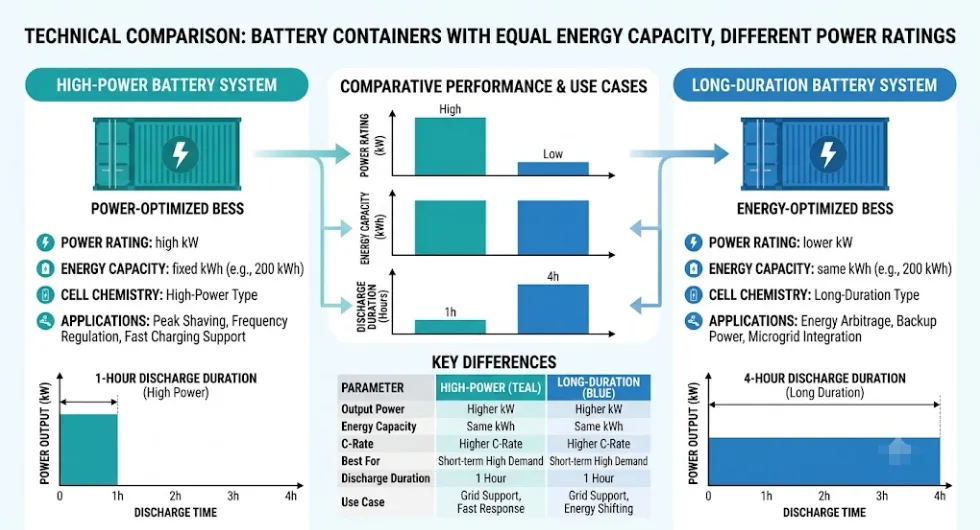
Dividing energy capacity by power rating gives the duration of the system, expressed in hours. For example, a 2 MW / 4 MWh BESS has a 2-hour duration, while a 1 MW / 4 MWh BESS has a 4-hour duration. Both store the same total energy. However, they serve very different applications.
System Configuration
Duration
Typical Application
1 MW / 1 MWh
1 hour
Frequency regulation, fast response
1 MW / 2 MWh
2 hours
Peak shaving, short-duration arbitrage
1 MW / 4 MWh
4 hours
Solar shifting, demand charge reduction
1 MW / 8 MWh+
8+ hours
Overnight backup, island grid applications
When evaluating a quote, always check both numbers separately. For instance, a supplier advertising a “2 MWh system” without specifying the power rating has not given you a complete set of BESS specifications.
Figure 1: Power rating and energy capacity together determine discharge duration.
2. C-Rate Specifications: Linking Power and Energy Together
Among the key BESS specifications, the C-rate expresses the charge or discharge current relative to the battery’s total capacity. For example, a 1C rate means the battery can be fully charged or discharged in one hour. Similarly, a 0.5C rate means two hours, while a 2C rate means 30 minutes.
C-rate = Power (kW) ÷ Energy Capacity (kWh)
For most stationary BESS applications — such as peak shaving, solar shifting, and frequency regulation — systems are designed in the 0.25C to 1C range. As a result, higher C-rates increase heat generation, accelerate degradation, and typically require more robust thermal management.
LFP cells: commonly rated for continuous operation up to 1C, with short bursts to 2–3C
NMC cells: often support slightly higher continuous C-rates but with faster capacity fade at high rates
High C-rate specifications (>1C) should always be cross-checked against the cell manufacturer’s datasheet and thermal design
Therefore, for a deeper technical breakdown of how C-rate affects performance across battery chemistries, see our guide on Battery C-Rates Explained for BESS Buyers.
3. Round-Trip Efficiency: A Critical BESS Specification
Round-trip efficiency measures how much of the energy used to charge a battery is recovered on discharge. As a result, it is one of the most commercially significant BESS specifications, because it directly affects the revenue and savings a system can generate over its lifetime.
RTE (%) = Energy Discharged ÷ Energy Charged × 100
Battery Technology
DC Efficiency
AC Efficiency
Lithium Iron Phosphate (LFP)
96–98%
88–94%
Lithium NMC
95–97%
87–92%
Sodium-ion
90–94%
82–90%
Flow Batteries
70–85%
65–80%
Lead-Acid
80–90%
70–85%
Always confirm whether a quoted RTE figure is AC (system-level) or DC (battery-level). AC efficiency includes inverter, transformer, and auxiliary losses. Therefore, it is the figure that matters most for project economics. For the full formula, worked examples, and an interactive calculator, see our dedicated guide on BESS Round Trip Efficiency (RTE).
4. Depth of Discharge and Usable Energy BESS Specifications
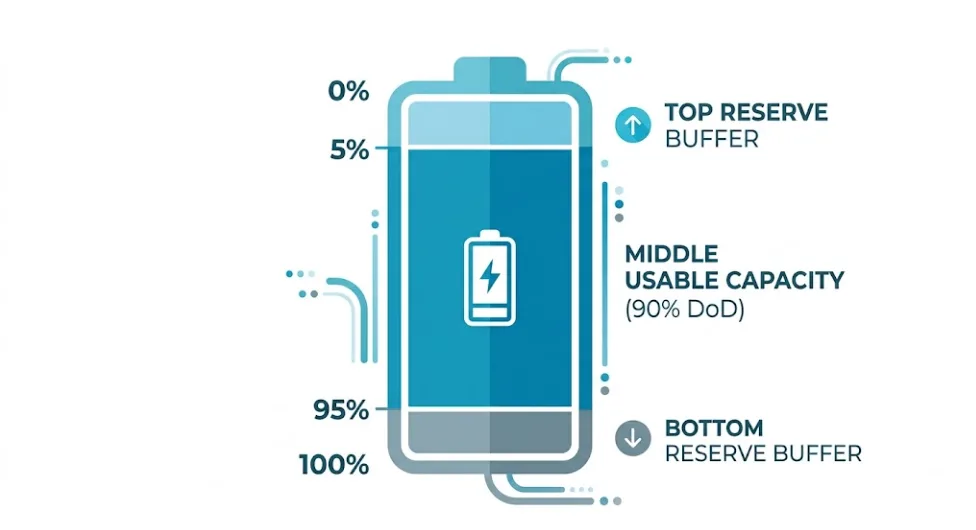
Depth of Discharge (DoD) describes how much of the battery’s total (nameplate) capacity is used during normal operation. It is expressed as a percentage. The remaining portion is reserved to protect the battery from degradation. This degradation is caused by very high or very low states of charge. As a result of applying DoD to nameplate capacity, we get Usable Energy — the figure that actually matters for sizing and project economics.
Nameplate Capacity: The total rated energy storage of the system (e.g., 4,000 kWh)
LFP systems commonly operate at 90–95% DoD due to their flat voltage curve and stable chemistry
NMC and older lead-acid systems often specify lower DoD limits (50–80%) to preserve cycle life
Usable Energy is also a moving target over the system’s lifetime. Specifically, as the battery degrades, both nameplate capacity and usable energy decline. For this reason, project sizing should be based on usable energy at end-of-life (EOL), not at beginning-of-life (BOL). Otherwise, a system that meets duration requirements in year one may fall short by year ten.
When comparing two quotes with identical nameplate capacity, the system with the higher usable DoD effectively delivers more usable energy. In other words, it delivers more value per dollar, assuming cycle life and warranty terms are comparable.
Figure 2: Nameplate capacity vs. usable capacity under a typical 90% DoD specification.
5. State of Charge and State of Health BESS Specifications
State of Charge (SoC) Specification
SoC is a real-time measurement of how much energy is currently stored in the battery. It is expressed as a percentage of usable capacity. The Battery Management System (BMS) manages SoC continuously. As a result, it sets safe operating windows. For example, cycling may be restricted to a 10–95% SoC band to protect cell longevity.
State of Health (SoH) Specification
SoH indicates how much capacity and performance the battery retains compared to when it was new. It is typically expressed as a percentage. For instance, a battery at 80% SoH can store only 80% of its original rated energy. Most BESS warranties therefore guarantee a minimum SoH — commonly 70–80% — at the end of a stated warranty period, such as 10 years.
SoH is most commonly estimated using DC Internal Resistance (DCIR) measurements. This is because internal resistance increases predictably as cells age. For a detailed explanation of how this works in practice, see our guide on DCIR-Based State of Health Estimation for BESS.
6. Battery Management System (BMS) Specifications
The BMS is the electronic brain of the battery. Therefore, its specifications deserve as much scrutiny as the cells themselves. Key BMS specifications to evaluate include the following:
Cell-level voltage and temperature monitoring resolution (number of monitored points per module/rack)
Cell balancing method — passive vs. active balancing, and balancing current capability
Communication protocol — CAN bus, Modbus TCP/RTU, or proprietary protocols, and compatibility with the EMS
Insulation resistance monitoring and ground fault detection
State estimation algorithms for SoC and SoH accuracy (typically ±2–3% for quality systems)
A well-specified BMS should provide granular cell-level data, not just pack-level averages. This granularity is essential for early fault detection. In addition, it ensures accurate SoH tracking over the system’s lifetime.
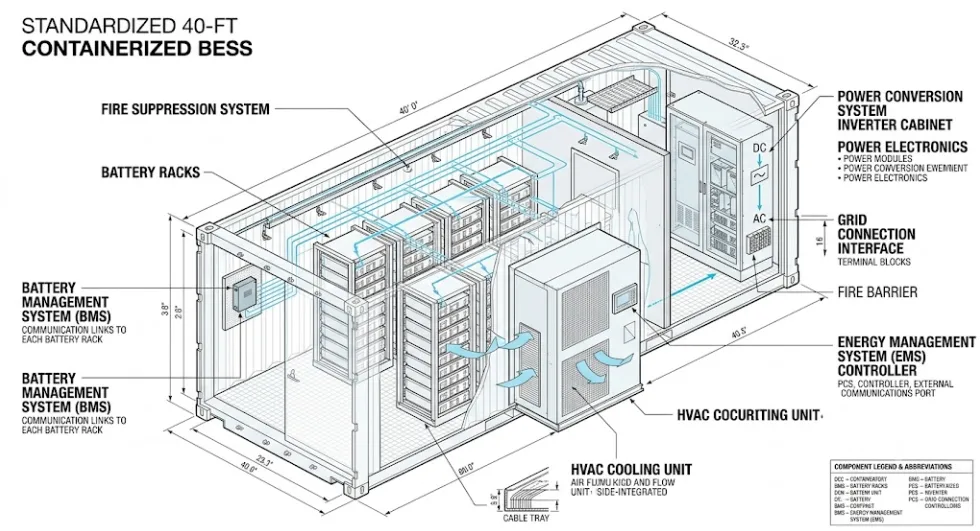
The BMS is just one subsystem within the overall system design. For a complete picture of how the BMS, PCS, EMS, and thermal systems are arranged together, see our guide on Understanding Energy Storage System BESS Architectures.
7. Power Conversion System (PCS) Specifications
The Power Conversion System (PCS), or inverter, converts DC battery power to AC grid power and back. Therefore, key PCS specifications include the following:
Rated AC power output (kW/MW) and overload capability (e.g., 110% for 10 minutes)
Conversion efficiency — typically 96–99% for modern PCS units
Control mode — grid-following (GFL) or grid-forming (GFM)
Power factor range and reactive power capability (kVAR)
Total Harmonic Distortion (THD) — typically below 3% for grid-compliant systems
The choice between grid-following and grid-forming PCS specifications has become one of the most consequential decisions in modern BESS procurement. This is especially true for projects with high renewable penetration or islanded operation. For a full comparison, see Grid Forming vs Grid Following BESS: What Is the Difference?, and our complete reference on Power Conversion System (PCS) for BESS.
Figure 3: Major subsystems referenced across a typical BESS specification sheet.
8. Cycle Life and Calendar Life BESS Specifications
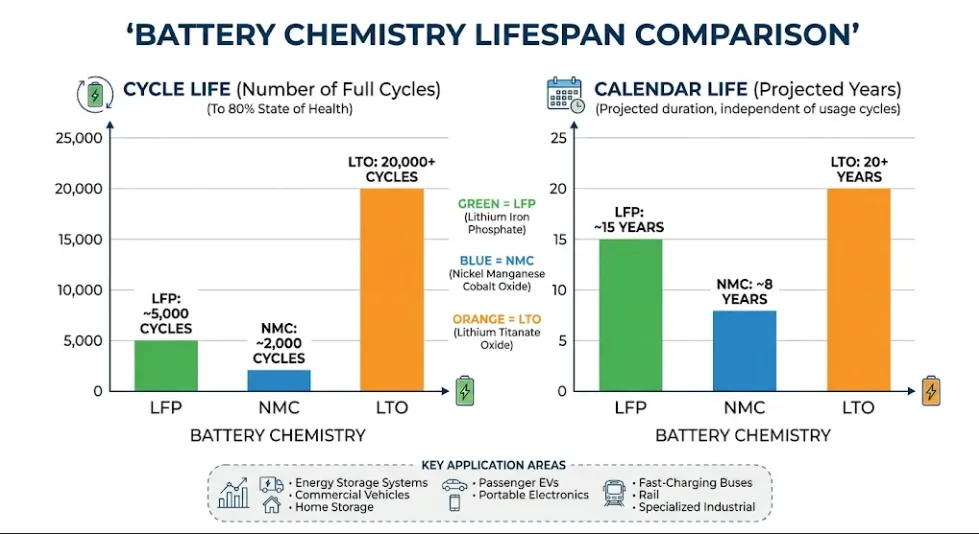
Cycle life specifies the number of full charge-discharge cycles a battery can complete. After this number is reached, capacity falls to a defined end-of-life threshold, commonly 80% of original capacity. By contrast, Calendar life specifies the expected service life in years. This is independent of cycling, and is due to chemical aging over time.
Therefore, always request the test conditions behind any cycle life claim. You can also consult the NREL — Grid-Scale Battery Storage FAQs to see how baseline degradation model assumptions impact long-term project planning.
Battery Chemistry
Typical Cycle Life (to 80% SoH)
Typical Calendar Life
LFP (Lithium Iron Phosphate)
4,000–8,000 cycles
10–15 years
NMC (Lithium Nickel Manganese Cobalt)
3,000–6,000 cycles
8–12 years
LTO (Lithium Titanate)
10,000–20,000 cycles
15–20 years
Cycle life ratings are always tied to specific test conditions, such as DoD, C-rate, and temperature. For example, a cycle life figure quoted at 100% DoD and 1C will be significantly lower than the same cell’s life at 80% DoD and 0.5C. Therefore, always request the test conditions behind any cycle life claim.
9. Thermal Management BESS Specifications
Thermal management directly affects safety, efficiency, and degradation rate. As a result, specifications to review include the following:
Cooling method — air cooling, liquid cooling, or hybrid systems
Operating temperature range — typically -20°C to 55°C for the enclosure, with cell-level targets of 15–35°C
Temperature uniformity across racks (a key driver of uneven degradation); see our analysis on gradient-limit depth)
HVAC redundancy (N+1 configurations for utility-scale projects)
Thermal runaway detection and suppression systems (aerosol, water mist, or other agents)
Liquid cooling has become the default for high-density utility-scale systems, mainly due to better temperature uniformity. Meanwhile, air cooling remains common and cost-effective for smaller C&I systems. For a detailed comparison, see Liquid vs Air Cooling Systems in BESS.
10. Ingress Protection and Operating Condition BESS Specifications
The IP (Ingress Protection) rating describes how well the BESS enclosure resists solid objects, dust, and water. As a result, it is a critical specification for outdoor and harsh-environment installations. The rating is expressed as IP followed by two digits. The first digit indicates protection against solids, such as dust and debris. The second digit indicates protection against liquids, such as moisture, rain, and washdown.
IP Rating
Solids Protection
Liquids Protection
Typical Application
IP54
Dust-protected (limited ingress)
Splash-protected from any direction
Sheltered or indoor C&I installations
IP55
Dust-protected
Protected against low-pressure water jets
Outdoor C&I, moderate exposure
IP65
Dust-tight
Protected against water jets from any direction
Utility-scale outdoor containers, coastal sites
IP67
Dust-tight
Protected against temporary immersion
Flood-prone or extreme weather sites
Beyond the enclosure rating, the broader operating conditions specification defines the environmental envelope. Within this envelope, the BESS is warranted to perform. Key items to check include the following:
Ambient operating temperature range — commonly -20°C to 55°C for the container, narrower (15–35°C) for the cells themselves
Storage temperature range (for the system when not in active operation)
Relative humidity range — typically 5–95% non-condensing
Altitude derating — power output may be derated above 1,000–2,000 m due to reduced cooling performance
Corrosion protection — coastal or high-salinity sites typically require C3–C5 corrosion class enclosures and coatings
Wind and snow load ratings for the container or enclosure structure
For projects in tropical, coastal, desert, or high-altitude locations, these BESS specifications should be checked carefully against local climate data. Otherwise, a system rated for temperate climates may require derating, additional cooling capacity, or enhanced corrosion protection to meet its advertised performance and warranty terms.
11. Safety and Compliance BESS Specifications
Safety certifications are non-negotiable BESS specifications. In fact, they should appear on every datasheet:
UL 9540 / UL 9540A Test Method — fire safety and thermal runaway propagation testing
UN 38.3 — transportation safety for lithium batteries
NFPA 855 — installation standards for energy storage systems (US)
Seismic certification where applicable (e.g., IBC seismic design categories)
Missing certifications are a red flag. This is particularly true for utility interconnection and insurance underwriting, where documentation of UL 9540A test results is increasingly a hard requirement. To streamline your evaluation, you can reference the U.S. DOE — BESS Procurement Checklist to verify required project documentation.
12. BESS Specifications Comparison Checklist
When comparing quotes from multiple suppliers, build a side-by-side table using the BESS specifications below. As a result, this ensures you are comparing systems on equal terms, rather than being swayed by a single headline number.
Specification
Why It Matters
What to Ask For
Power rating (kW/MW)
Determines instantaneous load-serving capability
Continuous and peak (overload) ratings
Energy capacity (kWh/MWh)
Determines total stored energy and duration
Nameplate vs. usable capacity, BOL vs. EOL
C-rate
Affects degradation and thermal design
Continuous and pulse C-rate limits
Round-trip efficiency
Drives lifetime energy losses and revenue
AC vs. DC efficiency, test conditions
Depth of Discharge / Usable Energy
Determines real usable energy at BOL and EOL
Recommended cycling band (e.g., 10–95%); usable kWh at year 1 and year 10
Cycle life / Calendar life
Drives augmentation and replacement schedule
Test conditions (DoD, C-rate, temperature)
Warranty SoH guarantee
Protects against early degradation
Guaranteed SoH at 10/15/20 years
Thermal management
Affects safety and long-term performance
Cooling method, redundancy, operating range
IP rating & operating conditions
Determines suitability for site climate and exposure
IP rating, temperature/humidity range, corrosion class, altitude derating
PCS efficiency & control mode
Affects conversion losses and grid compatibility
GFL vs. GFM, THD, grid code compliance
Safety certifications
Required for permitting, insurance, financing
UL 9540A test reports, IEC 62619
Frequently Asked Questions About BESS Specifications
Which BESS specification should a buyer understand first?
Power rating and energy capacity, along with the relationship between them (duration), form the foundation of every other specification. If you get this wrong, the system either cannot meet peak demand or cannot supply energy for long enough. As a result, the other specifications matter much less.
Is a higher round-trip efficiency always better in BESS specifications?
Generally yes, but it should be weighed against cost, chemistry, and application. For example, a 2–3 percentage point difference in AC round-trip efficiency can meaningfully affect lifetime revenue for high-cycling arbitrage projects. However, it matters less for systems used primarily for backup power.
Why do nameplate capacity and usable energy differ in BESS specifications?
The difference comes from the Depth of Discharge (DoD) reserve. This reserve protects the battery from operating at extreme states of charge, which would otherwise accelerate degradation. Therefore, this reserve is intentional and is factored into warranty terms.
How do I verify a supplier’s cycle life specifications?
Request the specific test conditions — DoD, C-rate, and ambient temperature — used to derive the cycle life figure. In addition, ask for third-party cell-level test data where available. Then, compare these conditions to your expected operating profile.
What BESS specifications matter most for island grid or off-grid projects?
For islanded systems, grid-forming PCS capability, black start capability, and energy duration (MWh, not just MW) become critical BESS specifications. By contrast, these may not matter for grid-connected projects. See our Island Grid BESS Engineering Guide for a full sizing methodology.
Conclusion: Why BESS Specifications Matter
BESS specifications are not just numbers on a datasheet. Instead, each one represents a design decision with direct consequences for performance, safety, and lifetime economics. By understanding power rating, energy capacity, C-rate, round-trip efficiency, depth of discharge, State of Health, and the supporting BMS, PCS, thermal, IP rating, and safety specifications, buyers and engineers can compare systems meaningfully. As a result, they can avoid costly mismatches between design intent and real-world performance.
Deploying an Island Grid BESS is the definitive technology fixing one of the most overlooked power problems in the world. More than 10,000 inhabited islands still run on diesel generators. Add remote mining camps, offshore platforms, and rural areas with no grid access — and the scale of the challenge becomes clear.
All of these locations share the same problem. They need a stable, reliable grid, but they have no utility to rely on. For decades, diesel was the only answer. Today, in 2026, Island Grid BESS is replacing diesel as the backbone technology. It does so faster, more reliably, and at a lower lifetime cost.
This guide covers everything you need. It explains how Island Grid BESS works and how it differs from standard storage. It also shows you how to size a system, which control architecture to pick, and how to build a strong financial case.
📌 QUICK DEFINITION
What is Island Grid BESS?
Island Grid BESS is a Battery Energy Storage System that acts as the main voltage and frequency source on an isolated network. It has no connection to a utility grid. Unlike a grid-connected BESS that follows an existing grid signal, an Island Grid BESS creates the grid itself. It keeps power stable for all loads using stored energy, renewables, or both.
01 — Why Island Grids Are a Different Engineering Problem
A standard grid-connected BESS has a utility grid behind it as backup. If renewable generation drops or demand spikes, the utility absorbs the imbalance. Frequency and voltage stay stable because thousands of generators share the load.
Island grids, however, have none of that.
No Backup, No Room for Error
On an island grid, every watt consumed must be generated or discharged locally. There is no utility to fill the gap. When a cloud shadow crosses a solar array, the BESS must respond in milliseconds. When a pump starts, the island grid must match that load instantly.
This is why Island Grid BESS is a different engineering discipline. The physics are harder. The control requirements are stricter. Also, the cost of failure is much higher — a blackout means the entire island or facility loses power.
The Good News: The Technology Has Matured Fast
Despite those challenges, Island Grid BESS technology has improved a great deal since 2022. Systems now running on remote islands in Australia, the Pacific, and Scandinavia are hitting 99.98% availability. That figure is better than the diesel generators they replaced.
02 — Island Grid BESS vs Grid-Connected BESS: Core Differences
The difference between these two systems matters greatly for engineering and procurement. The table below shows the ten most important distinctions.
Dimension
Grid-Connected BESS
Island Grid BESS
Voltage reference
Utility grid provides it
BESS creates it internally
Inverter control mode
Grid-following (GFL)
Grid-forming (GFM) required
Frequency regulation
Supports grid frequency
IS the frequency — no backup
Black start
Not typically required
Mandatory
Fault current
Utility provides it
BESS must supply it
Spinning reserve
Not required
Required at all times
Load sensitivity
Low — utility absorbs swings
High — every load step must be matched
Renewable integration
Flexible
Precise EMS essential
Comms loss tolerance
High
Low — latency affects stability
Design complexity
Moderate
High — full power system design needed
In short: a grid-connected BESS follows the grid. An Island Grid BESS is the grid.
03 — The Four Critical Functions of Island Grid BESS
A well-designed Island Grid BESS must carry out four functions at the same time. These are not extras — they are core requirements.
Function 1 — Voltage and Frequency Formation
The BESS inverter must create a stable AC voltage — typically 50 Hz or 60 Hz — with no external signal to copy. This is the grid-forming function. Without it, nothing on the island can run. That is why grid-forming BESS technology is the baseline spec for any Island Grid BESS project.
Function 2 — Real-Time Power Balance
At every moment, generation must equal consumption. When solar output falls due to cloud, the BESS must discharge the difference right away. When a load switches off, the BESS must absorb the surplus. Otherwise, frequency drifts and the grid becomes unstable.
Function 3 — Energy Shifting and Overnight Supply
Beyond second-by-second balancing, the BESS must also store enough energy to carry the island through long periods of zero generation. In a solar-only system, that means overnight. In a wind-heavy setup, it can mean multi-day low-wind periods. This need drives the MWh capacity spec — which is separate from the MW power spec.
Function 4 — Black Start and Grid Restoration
If the island grid goes down — due to a fault, a protection trip, or a battery shutdown — the BESS must restart the entire network with no outside help. This black start capability is a must-have for Island Grid BESS. A standard grid-following inverter cannot do it.
04 — Control Architecture: Why Island Grids Need Grid-Forming BESS
This is the area where most Island Grid BESS projects go wrong. The mistake often shows up late — at commissioning — and it is expensive to fix.
Why Grid-Following Inverters Fail Alone on an Island
A grid-following BESS uses a Phase-Locked Loop (PLL) to lock onto an existing grid voltage signal. If there is no grid signal — which is always the case at black start — the PLL has nothing to lock to. As a result, the inverter shuts down.
For a grid-connected project, this is fine. The utility is always there as a backup. For an Island Grid BESS, however, there is no utility. The battery is the only power source. So a grid-following inverter alone is not suitable.
Grid-Forming Control: The Right Architecture for Island BESS
A grid-forming inverter creates its own internal voltage and frequency reference. Everything else on the network — loads, other inverters, generators — then syncs to that reference. Because of this, it can:
Black-start a fully de-energised island network
Hold stable frequency with no external signal
Respond to load steps in milliseconds — far faster than a PLL-based inverter
Keep running during faults that would trip a grid-following inverter
Three Control Strategies: Which One to Specify?
Choosing the right strategy depends on your island’s size, renewable mix, and load profile. Here is how the three main options compare.
Droop Control is the simplest option. It mimics a generator’s governor — it adjusts power output in line with frequency changes. Droop control works well for smaller islands with stable loads and modest renewable penetration.
Virtual Synchronous Generator (VSG) goes further. It copies the inertial response of a real synchronous generator. It reacts to both frequency deviation and Rate of Change of Frequency (ROCOF). Because of this, it works best on islands with high renewable penetration, where frequency can shift fast. Moreover, it replicates the behaviour that protection systems were designed around when diesel was the primary source.
Power Synchronisation Control (PSC) is the most advanced option. Instead of using frequency as the sync signal, it uses active power. This makes it the most stable choice for very weak or very small island grids — especially where the Short Circuit Ratio (SCR) falls below 1.5.
For most Island Grid BESS projects, VSG mode is the best default. It mimics diesel generator behaviour closely, so commissioning and protection coordination are simpler.
05 — Island Grid BESS Sizing: A Four-Step Method
Sizing an Island Grid BESS involves two dimensions: power capacity (MW or kW) and energy duration (MWh or kWh). Getting either one wrong causes serious operational and financial problems down the line.
Step 1 — Establish Peak Load and Load Profile
First, the BESS must meet peak demand with room to spare. A standard design rule is to size BESS power at 120–130% of peak island load. That extra headroom is your spinning reserve — the buffer that stops frequency from collapsing when demand spikes.
Example: An island with 500 kW peak demand needs a BESS rated at 600–650 kW minimum.
Step 2 — Determine Energy Duration Requirements
Next, consider how long the BESS must run on stored energy alone. For a solar-only island, that is typically 10–14 hours overnight. For a mixed solar-wind island, it can stretch to 48–72 hours during low-generation periods.
Design rule: Size the BESS to carry 100% of average island load through the worst-case zero-generation window. Then add a 20% safety margin on top.
Worked example — solar-only island, 200 kW average load, 12-hour overnight period:
Unlike a grid-connected BESS, Island Grid BESS has no utility backup if the battery runs low. SoC management must therefore be strict:
Minimum SoC: 20% — load shedding starts below this point
Maximum SoC: 95% — renewable generation is curtailed above this level
Normal cycling band: 20–95%
Emergency reserve: Keep 10% SoC set aside exclusively for black-start restoration
Step 4 — Define Spinning Reserve Allocation
Finally, set your spinning reserve. This is the share of BESS capacity that stays ready but does not discharge. It must be large enough to cover the biggest single generation loss on the island without letting frequency fall below relay trip thresholds.
Rule of thumb: Spinning reserve ≥ the rated output of the largest single renewable unit on the island.
06 — Battery Chemistry: Why LFP Dominates Island Grid BESS in 2026
Battery chemistry for Island Grid BESS has largely settled on one answer. As of 2026, Lithium Iron Phosphate (LFP) accounts for about 95% of new island grid BESS procurement globally. That figure comes from BloombergNEF and IEA tracking data. The reasons make sense for island grid conditions specifically.
Why LFP Wins for Island Grid BESS
Thermal stability is the top reason. Many island grid sites sit in tropical climates where ambient temperatures exceed 40°C. LFP cells have a thermal runaway threshold of around 270°C. NMC cells, by contrast, run into trouble at 150–180°C. Furthermore, LFP releases far less heat if a cell does fail. In a remote location where fire response is slow, that difference is critical.
Cycle life is the second major factor. Island Grid BESS systems cycle daily, often deeply. LFP cells rated for 4,000–6,000 full cycles at 80% DoD give 10–15 years of service before capacity augmentation is needed. NMC degrades faster under the same conditions.
Cost per cycle has also shifted in LFP’s favour. LFP manufacturing capacity expanded a great deal between 2022 and 2025. As a result, prices dropped, and the per-cycle economics are now clearly better for high-cycle island grid use.
Simpler thermal management is a practical bonus. LFP is less sensitive to temperature than NMC. Therefore, the HVAC system can be simpler — an advantage on remote islands where air conditioning maintenance is hard to schedule.
The one exception: very space-constrained sites, such as offshore platforms, may justify NMC for its higher energy density per cubic metre. In all other island grid cases, however, LFP is the correct default.
07 — Solar-Plus-BESS Island Grid Architecture
Solar-plus-BESS is the most common Island Grid BESS setup. It also has the longest track record in the field. Solar PV replaces diesel as the primary energy source. The BESS then provides grid stability and overnight energy supply.
AC-Coupled vs DC-Coupled: Which Is Right for Your Project?
DC-coupled architecture links the solar array directly to the BESS DC bus via a charge controller. The solar array and battery share the same inverter. This approach captures energy before conversion losses. It also uses solar power that would otherwise be clipped and wasted. As a result, DC-coupled systems typically cut installed cost by 5–8% and improve overall round-trip efficiency.
AC-coupled architecture connects the solar inverter to the island AC bus. The BESS connects to the same bus through a separate inverter. This setup is more flexible. Existing diesel generators integrate more easily because they simply plug into the same AC bus. For this reason, AC-coupled is usually the better choice for retrofit projects.
In summary: use DC-coupled for greenfield Island Grid BESS projects with high solar penetration. Use AC-coupled when you are transitioning away from diesel and need to keep the generators running during the process.
Renewable Penetration Targets by Project Stage
Renewable Penetration
BESS Configuration
Diesel Role
Up to 50%
BESS supports frequency; diesel is primary
Diesel runs continuously
50–80%
BESS is primary; diesel backs up
Diesel starts on demand
80–100%
BESS is sole grid-forming source
Diesel on emergency standby
100% + storage
Full diesel replacement
Diesel removed or cold standby
At 80–100% renewable penetration, grid-forming BESS technology becomes operationally essential. At that point, the diesel generator can no longer serve as the frequency reference.
08 — Wind-Plus-BESS Island Grid Architecture
Wind-plus-BESS island grids work differently from solar setups. In many island locations, they also perform better. Wind is not limited to daylight hours. Moreover, many islands have steady trade winds that deliver higher annual capacity factors than solar PV.
Three Unique Challenges of Wind-Plus-BESS Island Grids
Rapid generation variability is the first challenge. Wind output can shift a great deal within seconds due to gusts or direction changes. Consequently, the BESS must respond faster to wind variability than it typically does to solar variability. Solar output changes more gradually, except during sudden cloud shadow events.
Frequency interaction with wind turbines is the second challenge. Modern variable-speed wind turbines use power electronics interfaces. This makes them inverter-based resources (IBR) — not rotating machines with physical inertia. Therefore, when every generation source on the island is IBR, the Island Grid BESS must provide all synthetic inertia on its own. That is a harder job than in systems where some diesel generation is still running.
Extended low-wind periods are the third challenge. Unlike solar droughts, which reset each morning, wind droughts can run for multiple days. As a result, energy duration sizing for wind-plus-BESS island grids must account for multi-day low-generation periods. This pushes BESS capacity much higher than in equivalent solar designs.
09 — Diesel Hybrid Island Grids: The Three-Phase Transition Path
Most Island Grid BESS projects in 2026 are not greenfield builds. Rather, they are retrofits of existing diesel-dependent island grids. Understanding the three phases of transition is therefore essential for developers and asset owners.
Phase 1 — Diesel-Dominant with BESS Support (0–40% Renewable)
In this first phase, diesel generators still provide the voltage and frequency reference. The BESS operates in grid-following mode. It handles peak shaving, frequency regulation, and spinning reserve. As a result, diesel runtime drops, fuel costs fall, and maintenance intervals lengthen. This phase only needs a grid-following BESS. It is also the simplest and cheapest entry point.
Phase 2 — Diesel-Backup with BESS Primary (40–80% Renewable)
In this second phase, solar or wind capacity grows. The BESS then takes over as the main generation source for larger parts of each day. Diesel generators shift from continuous running to demand-start mode. At this stage, the BESS inverter must also be able to switch into grid-forming mode whenever the diesel is offline. This requires either a grid-forming capable inverter or a static transfer switch.
Typical outcomes: 50–70% diesel fuel reduction; diesel-on to diesel-off transitions in under 10 seconds.
Phase 3 — Full Diesel Replacement (80–100% Renewable)
In this third and final phase, diesel generators move to emergency-only standby or are removed. The Island Grid BESS runs continuously as the sole grid-forming source. Before commercial operation, the system needs full grid-forming BESS specification and comprehensive black start testing.
Typical outcomes: 85–95% diesel fuel reduction; full energy independence with diesel as last-resort backup only.
10 — Real-World Island Grid BESS Case Studies
Case Study 1 — El Hierro, Canary Islands (Spain)
El Hierro has run a wind-hydro-BESS hybrid island grid since 2014. Since then, it has steadily raised renewable penetration to above 90% for extended periods. The BESS absorbs wind variability and manages the link between turbines and pumped hydro storage. Peak demand on the island is about 7 MW. In short, El Hierro shows that 100% renewable island grids are viable at community scale.
Key results: Over 90% renewable penetration sustained over multiple consecutive days; diesel fuel use cut by more than 60%.
Flinders Island in Tasmania installed a solar-plus-BESS system that has cut diesel dependency sharply. The Island Grid BESS runs in grid-forming mode. Diesel generators have moved to demand-start backup. The Horizon Power-managed grid shows that grid-forming BESS can serve as the primary voltage and frequency source for a real remote community.
Key results: Diesel use down roughly 55%; Island Grid BESS availability above 99.5% since commissioning.
Case Study 3 — Hospital Microgrid, Lombok (Indonesia)
Research published in Energy and Buildings (2025) modelled a PV-BESS microgrid for a hospital on Lombok Island. The study tested a 3-day outage scenario. A correctly sized Island Grid BESS — supplying 7 MWh per day of critical load — maintained 100% hospital reliability with no diesel. The findings highlight the life-critical value of Island Grid BESS beyond day-to-day economics.
Case Study 4 — Mining Operation, Western Australia
A remote mining site replaced three diesel gensets with a solar Island Grid BESS. The system uses VSG grid-forming control. Droop settings were calibrated to match the frequency response that the mining equipment’s protection relays were designed around. In year one, diesel use fell by 78%. By year two, after a solar expansion, diesel was phased out entirely.
11 — Island Grid BESS Sizing Reference Table
Use the table below as a starting point for project scoping. All figures assume LFP chemistry, 90% depth of discharge, 10% spinning reserve headroom, and a solar-plus-BESS setup with 12-hour overnight supply duration.
Island Peak Load
Min BESS Power
Min BESS Energy
Typical Solar PV
Target Renewable %
50 kW
65 kW
400 kWh
80 kWp
80%
100 kW
130 kW
800 kWh
150 kWp
80%
250 kW
325 kW
2,000 kWh
380 kWp
80%
500 kW
650 kW
4,000 kWh
750 kWp
80%
1 MW
1.3 MW
8 MWh
1.5 MWp
80%
5 MW
6.5 MW
40 MWh
7.5 MWp
80%
10 MW
13 MW
80 MWh
15 MWp
80%
These are indicative scoping figures only. Final sizing must be based on measured load profiles, site-specific resource data, and full power systems modelling. Contact SunLith Energy for a project-specific Island Grid BESS analysis.
12 — Financial Case: Island Grid BESS vs Diesel Over 25 Years
The financial case for Island Grid BESS has shifted a great deal since 2022. LFP battery costs have fallen to $90–130/kWh installed in competitive markets. Meanwhile, diesel delivery costs to remote islands have risen — when you include logistics, shipping, and storage. Together, these trends make Island Grid BESS the economically dominant choice in almost every isolated grid context.
The Diesel Costs That Most Analyses Miss
Simple comparisons often undercount the true cost of diesel on island grids. A full cost assessment must include all of the following:
Fuel logistics: Diesel price plus shipping, handling, and on-island storage
Generator replacement: Diesel gensets need full replacement every 15,000–25,000 running hours
Maintenance and travel: Regular servicing requires technicians to travel by air or sea to remote sites
Environmental liability: Diesel storage creates spill risk, especially in ecologically sensitive island areas
Carbon costs: Where carbon pricing applies, diesel grids face costs that grow each year
Why Island Grid BESS Wins on Lifetime Cost
Island Grid BESS offers several clear cost advantages over diesel. First, there is no ongoing fuel cost — solar and wind energy have zero marginal cost. Second, LFP BESS have no moving parts, so maintenance is far cheaper than for diesel generators. Third, modern LFP BESS are built for 20–25-year project life. Battery capacity augmentation at year 10–12 is the main lifecycle cost event. Finally, for islands weighing a submarine cable connection against Island Grid BESS, the battery solution is typically cheaper at scales below 10 MW peak demand.
Indicative 25-Year Cost Comparison: 500 kW Island Grid
Cost Item
Diesel Island Grid
Solar + Island Grid BESS
Fuel cost per year (Year 1)
$350,000–500,000
$0
Annual maintenance
$80,000–120,000
$15,000–25,000
Capital replacement at Year 10
$400,000–600,000 (gensets)
$150,000–250,000 (augmentation)
Carbon cost exposure
High and rising
None
25-year NPV advantage
Baseline
$3–6 million in BESS’s favour
These figures are indicative, based on 2026 market pricing. Site-specific financial modelling is required before any investment decision.
13 — Key Technical Challenges and Practical Solutions
Challenge 1 — Protection Coordination
Standard relay settings are built around the fault current that synchronous generators produce. Island Grid BESS inverters, however, typically produce lower fault currents — around 1.0–1.2 per-unit versus 5–10 per-unit for a generator. As a result, relay settings must be reconfigured to match the BESS fault current range.
Solution: Run a full protection coordination study before specifying relay settings. Some grid-forming BESS inverters now offer fault current up to 1.5–2.0 per-unit. That helps improve protection discrimination and simplifies the relay setup.
Challenge 2 — Large Load Steps on Small Island Grids
On a small Island Grid BESS under 500 kW, a single large motor — a pump, an air conditioner, a welding set — can represent a large share of total load. Each start is a sudden demand that the BESS must absorb without letting frequency collapse.
Solution: Specify VSG mode with tight droop settings and a low-pass filter on the load measurement. For large motors, add soft starters or variable frequency drives. These reduce inrush current sharply and make each load step manageable.
Challenge 3 — Battery Degradation in Hot Climates
Island Grid BESS sites in tropical areas face high ambient temperatures. Without good thermal management, LFP cell ageing speeds up significantly.
Solution: Use active thermal management to keep cells between 20–30°C. Do not rely on passive cooling alone in any tropical installation. Size the HVAC system for the worst-case ambient temperature — not the annual average.
Challenge 4 — Energy Management System Latency
On an island grid, the delay between a measured grid event and the BESS response directly affects frequency stability. Grid-connected BESS systems can tolerate 500–1,000 ms EMS response times. Island Grid BESS, however, needs inverter-level response within 20–50 ms. The EMS should only handle the slower strategic scheduling.
Solution: Specify inverter-integrated droop and VSG control that runs autonomously at the hardware level. The EMS then updates set-points on a scheduling cycle measured in minutes — not milliseconds.
14 — Frequently Asked Questions
What is Island Grid BESS and how does it differ from standard BESS?
Island Grid BESS must act as the sole voltage and frequency reference on an isolated network. There is no utility grid as backup. This requires grid-forming inverter control, black start capability, and continuous power balance management. In contrast, a standard grid-connected BESS needs none of these. The engineering scope is therefore much broader. For the full inverter control comparison, see our guide on grid-forming vs grid-following BESS.
Can a grid-following BESS be used on an island grid?
Not as the sole power source. A grid-following inverter needs an existing voltage reference to operate. On an island grid with no diesel generator running, that reference does not exist. However, a grid-following BESS can participate in an island grid if a diesel generator or grid-forming BESS is already providing the reference voltage. For the full technical details, see our guide to grid-following BESS.
How many hours of storage does an Island Grid BESS need?
The minimum is typically 4 hours for a solar-heavy island with a strong, consistent solar resource. However, 8–16 hours is more common for reliable overnight supply. Furthermore, systems in high-latitude or wind-heavy locations may need 24–72 hours to cover extended low-generation periods. Sizing must always be based on site-specific load profiles and measured generation data.
What battery chemistry is best for Island Grid BESS?
LFP (Lithium Iron Phosphate) is the right choice for almost all Island Grid BESS projects in 2026. Its thermal stability, 4,000–8,000 cycle life, and safety profile make it clearly better than NMC for remote island sites where fire response and maintenance access are limited.
How does Island Grid BESS handle a complete power failure?
Through black start. A correctly specified grid-forming Island Grid BESS can energise the island AC network from a fully dead state using stored battery energy alone. The inverter creates a stable AC voltage and then reconnects loads in a controlled sequence — starting with critical loads first. Diesel generators, if retained, can then sync to the re-established BESS reference.
Can renewable energy cover 100% of an island’s power needs with Island Grid BESS?
Yes — and real-world projects already prove it. Island grids are operating at 90–100% renewable penetration today. However, the remaining challenge is cost. Storing enough energy to cover extended zero-generation periods requires a large BESS. For most islands, 80–90% renewable penetration is the economically optimal starting point. Full diesel elimination follows as storage costs continue to fall.
What does an Island Grid BESS project typically cost?
Turnkey 4-hour LFP Island Grid BESS systems were priced at about $180–260/kWh installed in European and Pacific markets in 2026. Therefore, a 500 kW / 4,000 kWh system represents a BESS capital cost of $720,000–$1,040,000, before solar, civil works, and EMS. In high diesel-cost island markets, payback typically falls within 5–8 years.
15 — Related Articles on SunLith Energy
The following SunLith Energy guides provide the deeper technical detail that supports Island Grid BESS design and procurement:
SunLith Energy provides technical guidance, project development support, and commercial BESS solutions for island grid, microgrid, and utility-scale energy storage projects. Contact our engineering team for project-specific Island Grid BESS sizing and design support.
BESS communication protocols are the rules that let every part of a battery storage system share data.
So without them, batteries, inverters, and grid systems cannot work together.
Each device in a BESS speaks a different digital language. But a shared protocol gives them a common way to talk.
For example, the battery uses CAN Bus internally. The inverter, however, often uses Modbus. And the grid uses IEC 61850.
Choosing the right BESS communication protocols matters a lot. A bad choice leads to slow integration, poor performance, and higher costs.
Why BESS Communication Protocols Affect System Safety
Speed is critical in a BESS. A fault signal must reach the controller in milliseconds. So the protocol must be fast enough to carry it in time.
Also, the protocol must be reliable. If a message is lost, the system may not shut down safely. Therefore, engineers choose protocols based on both speed and reliability.
In addition, some protocols are secure by design. Others, however, have no built-in encryption. As a result, security must be added at the network level for older protocols.
BESS communication protocols work across five system layers. Each layer has different speed needs and data types. So understanding these layers helps you pick the right protocol at each level.
Layer
Component
Common Protocols
1 — Cell
Battery cells, modules, BMUs
CAN Bus, SMBus
2 — BMS
Battery Management System
Modbus RTU, CAN Bus, RS-485
3 — PCS
Power Conversion System / Inverter
Modbus TCP, CAN Bus, PROFINET, EtherNet/IP
4 — EMS
Energy Management System
Modbus TCP, OPC UA, MQTT, IEC 60870-5-104
5 — Grid
Utility / SCADA / Cloud
IEC 61850, DNP3, IEEE 2030.5, MQTT, REST
No single protocol covers all five layers. So most BESS projects use three or four protocols together.
As a result, a protocol gateway is almost always part of a real BESS design. We cover this in detail later.
The five layers of BESS communication protocols — from CAN Bus at cell level to IEC 61850 at the grid
1. Modbus — The Most Widely Used BESS Communication Protocol
Modbus is the most common BESS communication protocol in the world. It was developed in 1979, but it is still used in almost every BESS project today.
So why is it so popular? Because it is simple, cheap, and works with every BESS hardware vendor.
How Modbus Works as a BESS Communication Protocol
Modbus uses a master-slave model. One master — usually the EMS — sends a request to a slave device such as the BMS. The slave then replies with its data.
There are two forms. First, Modbus RTU sends binary data over an RS-485 serial cable. Then, Modbus TCP sends the same data over a standard Ethernet network. As a result, Modbus TCP works across a local area network or even the internet.
In a BESS, Modbus TCP links the BMS to the EMS and SCADA systems. So it is how most BESS assets respond to grid operator commands.
Why Modbus Has Limits as a BESS Communication Protocol
Modbus is easy to use, but it does have gaps. For example, it has no built-in security. Also, it uses polling, which adds latency.
However, these gaps are manageable. Engineers add security at the network level. And for most BESS use cases, the polling delay is acceptable.
But Modbus should not be the only protocol on an external BESS interface. For that reason, most projects combine it with a secure protocol like OPC UA or IEEE 2030.5.
STRENGTHS ✓ Works with every BESS hardware vendor ✓ Simple to set up and easy to debug ✓ No licence cost ✓ Runs over RS-485 serial and Ethernet TCP/IP
LIMITATIONS ✗ No built-in encryption or authentication ✗ Polling model adds latency ✗ Limited data model vs IEC 61850 ✗ Not suitable alone for utility-facing use
Used for: BMS ↔ EMS, BMS ↔ PCS, SCADA, field instruments
Modbus RTU over RS-485 (BMS to Inverter) and Modbus TCP over Ethernet (Inverter to EMS to SCADA)
2. CAN Bus — The Internal BESS Communication Protocol
CAN Bus is the backbone of every battery rack. It was built for cars, but it also works perfectly inside BESS enclosures.
In fact, it is now found in products from BYD, CATL, Huawei, Sungrow, and Pylontech. So it has become the standard for internal BESS communication.
Why CAN Bus Suits BESS Internal Communication
CAN Bus uses a two-wire pair — CAN-H and CAN-L. This design blocks interference from the high-current switching inside a battery cabinet.
Also, CAN Bus is a multi-master system. So every node — modules, BMUs, and the BMS controller — can send data at any time. As a result, the system gets real-time updates without waiting to be polled.
Furthermore, China’s national grid standards require CAN Bus as the BMS-to-inverter link in all utility-scale BESS projects. So it is not just popular — it is often mandatory.
CAN Bus Limits in a BESS System
CAN Bus is fast, but its range is short. At 1 Mbit/s, cables can be no longer than 40 metres. Therefore, it cannot be used beyond the battery enclosure.
However, a gateway solves this. The gateway reads CAN Bus data and then sends it upstream as Modbus TCP, MQTT, or another BESS communication protocol.
STRENGTHS ✓ Resists EMI via differential CAN-H / CAN-L signalling ✓ Error detection and arbitration built in ✓ Real-time, event-driven — no polling needed ✓ Used by all major BESS OEMs
LIMITATIONS ✗ Short cable range — max 40 m at 1 Mbit/s ✗ Cannot reach the utility or cloud layer ✗ Vendor register maps differ between brands ✗ Needs a gateway for EMS or cloud integration
CAN Bus inside a BESS — modules report to BMUs, BMUs report to the BMS master, the BMS master connects to the PCS
3. IEC 61850 — The Grid-Level BESS Communication Protocol
IEC 61850 is the international standard for substation automation. It is also the leading BESS communication protocol for utility grid connections, especially in Europe and Asia-Pacific.
Unlike Modbus, it defines a full information model — not just a transport layer. So any IEC 61850 device can talk to any other, no matter the brand.
What Makes IEC 61850 Different
IEC 61850 uses logical nodes and data objects to describe every piece of equipment. As a result, there is no need for custom register mapping between vendors.
Also, IEC 61850-7-420 extends the standard to cover Distributed Energy Resources, including BESS. However, this DER extension is still developing. So some projects use custom mappings alongside the standard.
GOOSE Messaging — Speed That Other BESS Communication Protocols Cannot Match
GOOSE stands for Generic Object-Oriented Substation Event. It delivers event signals in under one millisecond. Therefore, it is used for protection — where a delayed signal could mean a fault goes uncleared.
MMS, in contrast, handles scheduled data exchange between the EMS and the utility. Together, GOOSE and MMS give IEC 61850 a range that no other BESS communication protocol can match alone.
When to Specify IEC 61850 for Your BESS
Use IEC 61850 for any utility-scale BESS in Europe, the UK, or Asia-Pacific. Many regulators now require it for all new grid-connected storage assets.
Furthermore, specifying it early avoids costly retrofits. So include it in the EMS and gateway specification from day one.
STRENGTHS ✓ True multi-vendor interoperability — no register mapping ✓ GOOSE delivers sub-millisecond protection events ✓ Rich, self-describing data model ✓ Mandated by EU, UK, and APAC utility operators
LIMITATIONS ✗ Higher engineering cost than Modbus ✗ DER model (7-420) still maturing ✗ Not all BESS OEMs support it natively ✗ Needs SCL configuration expertise
Used for: EMS ↔ Utility SCADA, substation automation, protection, VPP
IEC 61850 links the BESS EMS to the utility control centre via GOOSE events and MMS data exchange
4. DNP3 — The North American Utility BESS Communication Protocol
DNP3 is the standard BESS communication protocol for utility SCADA in North America. It is formally specified under IEEE Std 1815 and has been in use since 1993.
So if your BESS connects to a North American utility, you will almost certainly need DNP3.
Why DNP3 Works Well for Remote BESS Sites
DNP3 was built for tough conditions. It works over serial radio links, low-bandwidth WAN, and cellular networks. As a result, it suits remote BESS sites where network quality is poor.
Also, DNP3 supports unsolicited reporting. This means the BESS sends data only when something changes. So it uses far less bandwidth than a polling protocol like Modbus.
Adding Security to DNP3 in BESS Projects
The base DNP3 standard has no native security. However, Secure Authentication v5 (SAv5) adds a challenge-response layer. This significantly improves protection on any BESS grid link.
NERC CIP standards require strong authentication on all utility-connected BESS assets in North America. Therefore, SAv5 is now a standard requirement in most DNP3 BESS specifications.
STRENGTHS ✓ Reliable over poor network links — serial, radio, cellular ✓ Unsolicited reporting cuts bandwidth ✓ Leading protocol for North American utility SCADA ✓ Timestamped events support accurate fault logging
LIMITATIONS ✗ Less rich data model than IEC 61850 ✗ Security needs SAv5 as a separate add-on ✗ Rarely used outside North America ✗ Not suited to cloud or IoT use
Used for: EMS ↔ Utility SCADA, remote BESS, North American grid connections
DNP3 links the BESS EMS to the utility SCADA master over a WAN with unsolicited reporting and SAv5 authentication
5. OPC UA — The Secure Cloud BESS Communication Protocol
OPC UA connects BESS systems to cloud platforms and enterprise software. It is specified under IEC 62541 and is widely used in industrial IoT deployments.
Unlike older protocols, it is secure by design. So it is a strong choice for any external-facing BESS interface.
How OPC UA Improves on Legacy BESS Communication Protocols
Legacy OPC was Windows-only and had no encryption. OPC UA, however, works on any platform — Linux, Windows, or embedded controllers.
Also, OPC UA uses TLS encryption by default. So every connection is secure without any extra setup. In addition, it uses a rich object model that represents a full BESS asset in a structured, self-describing format.
As a result, cloud analytics platforms can ingest BESS data without any custom engineering. So it saves time and reduces integration risk.
Combining OPC UA and IEC 61850 in Large BESS Projects
The best approach for utility-scale BESS is to use both. IEC 61850 handles real-time grid communication. OPC UA, in contrast, carries asset data to cloud analytics and digital twin platforms.
Furthermore, AWS, Azure, and Google Cloud all support OPC UA PubSub natively. Therefore, OPC UA provides a direct, secure path from the BESS site to cloud tools.
STRENGTHS ✓ TLS encryption built in — no add-on needed ✓ Works on any platform — Linux, Windows, embedded ✓ Rich object model for complex BESS data ✓ Native support in AWS, Azure, and Google Cloud
LIMITATIONS ✗ Heavier than MQTT for simple data streams ✗ Too complex for small C&I BESS projects ✗ Higher engineering cost than Modbus ✗ Slower to implement than simpler alternatives
Used for: EMS ↔ Cloud, asset management, digital twins, predictive maintenance
OPC UA connects the BESS EMS to cloud analytics and enterprise platforms via a TLS-encrypted channel
6. MQTT — The Cloud Telemetry BESS Communication Protocol
MQTT is a lightweight protocol for cloud telemetry. It is now the most popular BESS communication protocol for real-time monitoring and remote dashboards.
So if you want to stream battery data to the cloud, MQTT is the best place to start.
How MQTT Works in a BESS
MQTT uses a broker between publishers and subscribers. The BMS gateway publishes data — such as state of charge, temperature, and fault codes — to the broker.
Then cloud dashboards subscribe and receive that data in near real time. Also, the publisher-subscriber model means you can add new cloud apps without touching any hardware.
Furthermore, IEC 61850 data models can be mapped directly to MQTT topics. So a single gateway can serve both the grid and the cloud at the same time.
MQTT and the EU Battery Passport
The EU is introducing Battery Passport rules for storage assets. MQTT is well-suited to Battery Passport data exports because of its lightweight, streaming design.
As a result, MQTT is increasingly specified alongside IEC 61850 in European BESS projects. So it is becoming a standard part of the cloud layer in most modern designs.
STRENGTHS ✓ Very lightweight — low bandwidth and CPU use ✓ Best choice for high-frequency streaming data ✓ Native support in AWS, Azure, and Google Cloud ✓ Publisher-subscriber model is flexible and scalable
LIMITATIONS ✗ No built-in BESS data model — custom topics needed ✗ Not suitable for direct control commands ✗ QoS levels must be configured carefully ✗ TLS must be switched on manually
MQTT broker connects the BESS BMS gateway to cloud dashboards, analytics, and Battery Passport services
7. PROFINET and EtherNet/IP — Real-Time BESS Communication Protocols
PROFINET and EtherNet/IP are Industrial Ethernet protocols. They are used inside containerised BESS units where Modbus TCP is not fast or precise enough.
So if your BESS has a PLC controlling HVAC, fire suppression, and the inverter, these protocols are likely the right choice.
When to Use These Real-Time BESS Communication Protocols
Modbus TCP is fine for most BMS-to-EMS links. But it cannot guarantee the timing needed for fast power electronics.
PROFINET and EtherNet/IP, in contrast, are deterministic. They deliver messages within a fixed time window. As a result, charge and discharge commands arrive at exactly the right moment.
Also, both support IEEE 1588 Precision Time Protocol. This keeps all BESS components synchronised to within microseconds. Therefore, they are ideal for frequency regulation services that need sub-second response.
PROFINET vs EtherNet/IP — Which One Should You Choose?
PROFINET is the standard choice in Europe and Asia. It works best with Siemens TIA Portal and Siemens PLCs.
EtherNet/IP, however, is more common in North America. It is the native protocol for Rockwell Automation hardware. So the right choice usually depends on which PLC the project already uses.
STRENGTHS ✓ Deterministic real-time communication ✓ Gigabit Ethernet capable — high throughput ✓ IEEE 1588 PTP for microsecond synchronisation ✓ Tight integration with Siemens (PROFINET) and Rockwell (EtherNet/IP)
LIMITATIONS ✗ Vendor lock-in — PROFINET and EtherNet/IP are not compatible ✗ Higher infrastructure cost than Modbus TCP✗ Not used for utility or cloud communication ✗ Needs managed switches with QoS and VLAN support
Used for: BMS ↔ PCS sync, containerised BESS with PLC, auxiliary system automation
Real-time industrial Ethernet connecting PLC, BMS, PCS, HVAC, and fire suppression inside a containerised BESS
8. IEEE 2030.5 — The Compliance BESS Communication Protocol
IEEE 2030.5 is a secure, RESTful protocol for connecting BESS to utility systems. It is mandatory under California Rule 21 for all grid-connected BESS in California.
So if your project is in California — or a state adopting similar rules — you will need this protocol.
Why IEEE 2030.5 Is the Most Secure BESS Communication Protocol
Unlike Modbus or DNP3, IEEE 2030.5 requires TLS 1.2 on every connection. There is no optional configuration — it is always on.
Also, it uses standard HTTPS calls. So it fits naturally into modern IT networks. As a result, integration with utility head-end systems is simpler than with legacy serial protocols.
Using IEEE 2030.5 Without Replacing Your BESS Hardware
Most existing BESS hardware does not natively support IEEE 2030.5. However, a protocol gateway solves this easily.
The gateway translates from SunSpec Modbus or DNP3 on the device side to IEEE 2030.5 on the utility side. So operators can achieve full Rule 21 compliance without any new field hardware.
In addition, more US states and international regulators are expected to adopt similar DER rules by 2030. Therefore, specifying IEEE 2030.5 gateway support today future-proofs the asset.
STRENGTHS ✓ TLS 1.2 mandatory — security built in ✓ RESTful HTTPS fits modern networks ✓ California Rule 21 and CSIP compliant ✓ Works via gateway — no hardware replacement needed
LIMITATIONS ✗ Primarily a North American standard ✗ REST polling too slow for fast control loops ✗ Needs specialist Rule 21 / CSIP knowledge ✗ Smaller vendor ecosystem than DNP3 or Modbus
Used for: BESS DER interconnection, California Rule 21, utility scheduling and monitoring
IEEE 2030.5 connects the BESS gateway to the utility head-end via HTTPS with TLS 1.2 — required by California Rule 21
All BESS Communication Protocols Compared
The table below compares all eight BESS communication protocols side by side. Use it to quickly find the right protocol for each layer of your system.
Protocol
Layer
Real-Time
Security
Utility
Cloud/IoT
Modbus RTU/TCP
BMS ↔ EMS/PCS
Polling
None
Via SCADA
No
CAN Bus
Cell ↔ BMS
Yes
None
No
No
IEC 61850
EMS ↔ Grid
GOOSE <1ms
Opt. TLS
Yes
Via mapping
DNP3
EMS ↔ Utility
Low latency
SAv5
N. America
No
OPC UA
EMS ↔ Cloud
Near RT
TLS
Emerging
Yes
MQTT
EMS ↔ Cloud
Streaming
Opt. TLS
No
Yes
IEEE 2030.5
EMS ↔ Utility
REST poll
TLS mandatory
Yes
Possible
PROFINET/EtherNet-IP
BMS ↔ PCS
Deterministic
Network
No
No
Why Every BESS Needs a Protocol Gateway
No BESS project uses just one communication protocol. CAN Bus batteries connect to Modbus inverters. Modbus inverters connect to IEC 61850 substations. DNP3 talks to SCADA. MQTT streams data to the cloud.
So a protocol gateway is what holds the whole system together. It translates data between protocols in real time.
What a BESS Protocol Gateway Does
A good gateway supports IEC 61850, DNP3, Modbus, OPC UA, and MQTT — all at the same time. As a result, the BESS can serve both the utility and the cloud from a single device.
Also, a gateway future-proofs the asset. So when utility requirements change, you update the gateway — not the hardware. This saves a lot of time and cost later in the project.
The Golden Rule for BESS Communication Protocol Design
Design the gateway first Specify your protocol gateway before you procure any hardware. This one decision shapes every grid service, every cloud integration, and every future revenue stream. Retrofitting protocol support after commissioning is expensive and often technically very difficult.
A BESS protocol gateway translates CAN Bus, Modbus, IEC 61850, DNP3, and MQTT simultaneously at the centre of the communication stack
How to Pick the Right BESS Communication Protocols
For Commercial and Industrial BESS Projects
Most C&I projects use CAN Bus inside the battery rack. Then they use Modbus RTU between the BMS and inverter. After that, Modbus TCP connects the inverter to the EMS. Finally, MQTT pushes telemetry to the cloud.
This stack is cost-effective and easy to commission. Also, it is supported by every major BESS hardware vendor. So it is the best starting point for most behind-the-meter projects.
Utility-scale projects need IEC 61850 in Europe and APAC. In North America, however, DNP3 is the SCADA standard. In California, IEEE 2030.5 is also required.
As a result, the EMS must speak all three. A multi-protocol gateway or a native multi-protocol EMS platform makes this possible.
Cybersecurity Rules for BESS Communication Protocols
Modbus and CAN Bus have no built-in security. So they need network-level protection — firewalls, VPNs, and strict network segmentation.
For external interfaces, use a secure protocol by design. For example, OPC UA, IEEE 2030.5, or DNP3 with SAv5 are all good choices.
OPC UA: TLS encryption and X.509 certificates built in
IEEE 2030.5: TLS 1.2 mandatory on every connection
DNP3 SAv5: Challenge-response authentication add-on for existing systems
Modbus / CAN Bus: Protect with firewalls, VPNs, and network segmentation
Also, NERC CIP standards apply to all utility-connected BESS in North America. Therefore, document all security controls for every communication interface.
Key Standards and References for BESS Communication Protocols
The sources below give primary-source detail on each BESS communication protocol. They are recommended for engineers who need full specification documents.
Conclusion — Choosing the Right BESS Communication Protocols
Choosing the right BESS communication protocols is one of the most important design decisions in any energy storage project. Get it right and the system integrates smoothly. Get it wrong and commissioning becomes painful and expensive.
So start with the basics. Use CAN Bus and Modbus for internal communication. Then add IEC 61850 or DNP3 for the utility interface. Finally, layer in OPC UA or MQTT for cloud analytics.
Above all, specify a capable protocol gateway early. It is the device that makes all the other protocols work together. And it keeps every integration option open as requirements change over the asset’s life.
BESS grid-following is the most widely used inverter control mode in battery storage today. In simple terms, a grid-following (GFL) inverter locks its output to the existing grid voltage and frequency. Because of this, the battery system follows the grid — not the other way around.
This approach works well in most commercial and utility projects. In fact, roughly 85% of all battery storage systems deployed worldwide use grid-following control. Therefore, understanding how it works — and where it has limits — is essential for engineers, developers, and asset owners alike.
This comprehensive guide breaks down everything you need to know. We begin with a deep dive into the technical inner workings of GFL control before comparing it directly to Grid-Forming (GFM) architecture. From there, you will learn about core C&I applications, weak-grid constraints, and critical deployment mistakes to avoid.
How a Grid-Following BESS Inverter Synchronises to the Grid
1. How a BESS Grid-Following Inverter Works
A BESS grid-following inverter acts as a controlled current source. Its job is to inject real power (watts) and reactive power (VAR) into the grid. Crucially, it does this at the exact voltage and frequency the grid is already running at.
Here is how the process works, step by step.
Step 1 — Grid Measurement
To begin, the inverter measures grid voltage, frequency, and phase angle at the Point of Common Coupling (PCC) thousands of times every second. This continuous tracking ensures the system always maintains a fresh, accurate picture of grid conditions.
Step 2 — Phase Locking via the PLL
A Phase-Locked Loop (PLL) algorithm then processes these measurements to lock the inverter’s internal reference directly to the grid’s phase angle. Consequently, the inverter stays perfectly synchronised even if the grid drifts slightly in frequency or voltage.
Step 3 — Power Dispatch from the EMS
The Energy Management System (EMS) sends a power dispatch command — for example, ‘discharge at 500 kW.’ Following this instruction, the hardware changes the target value into a current reference in the d-q rotating frame.
Step 4 — PWM Switching
High-speed IGBT transistors switch rapidly — typically at 2 to 20 kHz — using Pulse Width Modulation (PWM). As a result, the hardware generates a clean AC output that perfectly matches the reference signal.
Step 5 — Real-Time Feedback Control
Finally, a fast inner current control loop corrects any lingering errors. Running at roughly 1 to 2 kHz, this final safety loop ensures the entire BESS grid-following control cycle completes in under one millisecond.
BESS Grid-Following Inverter — Control Flow Diagram
2. The PLL: Why BESS Grid-Following Needs a Strong Grid
The Phase-Locked Loop (PLL) is the core of every GFL system. It is also the source of its main limitation.
The PLL works by comparing the inverter’s internal oscillator to the measured grid frequency. If these two variables drift apart, the algorithm instantly generates a correction signal. Once they match up perfectly, the loop achieves a ‘locked’ state. Modern BESS grid-following inverters use Synchronous Reference Frame PLLs (SRF-PLLs) to handle real-world imperfections — including unbalanced voltages and harmonic distortion.
Key point: The PLL needs a stable grid voltage to lock onto. If the grid voltage collapses, the PLL has no reference. As a result, the GFL inverter cannot maintain output on its own. This is the defining constraint of BESS grid-following technology.
SRF-PLL Block Diagram — BESS Grid-Following Inverter Control
3. BESS Grid-Following vs Grid-Forming: Key Differences
Grid-following and grid-forming are both valid technologies. However, they solve different problems. The table below shows the core differences clearly.
Attribute
Grid-Following (GFL)
Grid-Forming (GFM)
Inverter type
Controlled current source
Controlled voltage source
Needs grid voltage?
Yes — requires reference signal
No — creates its own reference
Black start capable?
No
Yes
Islanded operation?
No (without external VSI)
Yes
Synthetic inertia
Limited / indirect
Native capability
Frequency response speed
Fast (< 500 ms), reactive
Instantaneous (< 20 ms)
Cost vs baseline
Baseline cost
~10–20% premium
Min. SCR at PCC
SCR ≥ 3 recommended
Functions at SCR < 1.5
Best for
Strong-grid C&I and utility sites
Weak grids, islands, high-IBR networks
Market share (2025)
~85% of deployed systems
~15% and growing
Design rule: The key question is not ‘which is better’ — it is ‘what is the Short Circuit Ratio at your Point of Common Coupling?’ If SCR is 3 or above, BESS grid-following is the right choice. If SCR falls below 2, then Grid-Forming deserves serious consideration.
BESS grid-following is the right choice for most projects. Below are the applications where it delivers the most value.
4.1 GFL for Peak Shaving and Demand Charge Reduction
This is the most common application for C&I BESS grid-following systems. To lower costs, the EMS monitors real-time facility demand and dispatches battery power right before a peak occurs. Because utility connections are typically stable at industrial sites, the GFL inverter easily maintains a rock-solid phase reference to execute these commands with sub-second precision.
Given that demand charges often make up 30% to 70% of a commercial electricity bill, this single strategy can completely justify the initial BESS investment.
Grid-following BESS systems are ideal for energy arbitrage. In this strategy, the battery charges during off-peak hours at low tariff rates. Then it discharges during peak windows at high tariff rates. The grid itself provides the stable voltage reference needed for clean energy import and export. As a result, a well-sized GFL system can cut total energy costs by 10 to 25%.
4.3 Ancillary Services and Fast Frequency Response
Modern BESS grid-following inverters respond to frequency deviations in under 200 milliseconds. They detect frequency deviation via the PLL and adjust active power output proportionally — a method called droop-based frequency response. As a result, GFL BESS qualifies for Fast Frequency Response (FFR) and Primary Frequency Response (PFR) markets in most grid codes.
4.4 Smooth Integration for Solar and Wind Power
Renewable generation assets almost always use GFL inverters for their battery pairings. In these setups, the solar PV inverter acts as the primary grid interface while the BESS operates in parallel to absorb surplus generation. This combination fills sudden production drops to give the facility a smooth, consistent power supply.
Utility-scale projects can participate directly in regional capacity markets by providing committed megawatts of fast-responding backup generation. Because a battery can earn fixed capacity payments while executing daily arbitrage, this stacked revenue structure dramatically improves project economics.
5. BESS Grid-Following Limitations to Plan For
No technology is without constraints. Failing to understand these leads to underperforming systems and costly redesigns. Here are the four main limitations of BESS grid-following systems.
5.1 GFL Performance in Weak Grids (Low SCR)
As the Short Circuit Ratio (SCR) drops below 3, GFL inverters face severe stability challenges. When operating below an SCR of 1.5, multiple parallel units can easily trigger sub-synchronous oscillations. This interaction creates a significant operational risk for remote industrial sites, isolated microgrids, and networks with heavy inverter-based resource (IBR) penetration.
The IEEE Standard 2800-2022 directly addresses these network challenges. If your target site features an SCR below 3, executing a detailed grid stability study is a mandatory step before specifying any GFL hardware.
GFL BESS Stability vs Short Circuit Ratio — Design Boundary Chart
5.2 Total Black-Start Limitations
An islanded or dead grid cannot be energised by standard GFL hardware. Because it requires an active voltage wave to lock onto, a grid-following system cannot serve as your lone backup source during a total utility outage. To achieve complete independence, you must pair the battery with a diesel generator, a fuel cell, or a Grid-Forming inverter.
For C&I sites with a critical backup requirement, the Static Transfer Switch (STS) becomes an essential design element. We explain how below.
5.3 Microgrid Constraints Without Synchronous Reference
For isolated microgrids — remote mining camps, island grids, or off-grid industrial sites — a GFL-only BESS cannot function once grid connection is lost. In that case, a Grid-Forming inverter or a synchronous generator must hold the local voltage and frequency reference.
5.4 Control Loop Vulnerabilities During System Faults
During a severe voltage disturbance, the grid voltage drops sharply. As a result, the PLL can momentarily lose synchronisation. Modern inverters have Fault Ride-Through (FRT) algorithms to prevent tripping during these events. However, poorly tuned PLLs remain a source of nuisance trips in the field.
6. BESS Grid-Following in C&I Projects: Value Stacking
For commercial and industrial customers, a BESS grid-following system is almost always the starting point. A well-designed system combines multiple value streams at once — a practice called value stacking. The table below shows how each stream works together.
Value Stream
Typical Annual Impact
How GFL Enables It
Peak Shaving
20–40% demand charge reduction
Discharges at demand spike with sub-second precision
TOU Arbitrage
10–25% energy cost reduction
Charges off-peak, discharges at peak tariff windows
Backup Power (with STS)
Zero downtime for critical loads
STS transfers load to BESS in under 8 ms on fault
FFR / Grid Services
Additional utility revenue
PLL detects frequency deviation; responds within 200 ms
Solar Self-Consumption
15–30% more PV utilisation
Absorbs surplus solar; discharges when PV output falls
Backup Power: How GFL Works With an STS
A common misconception is that BESS grid-following cannot provide backup power. This is only partly true. When paired with a properly integrated Static Transfer Switch (STS), a GFL system can deliver seamless uninterruptible power to critical loads.
Here is why it works. The STS monitors grid voltage at millisecond resolution. When it detects a fault, it transfers the facility load from the utility to the BESS output — all within 2 to 8 milliseconds. Because this happens faster than the PLL can detect a fault event, the GFL inverter never loses its voltage reference.
As a result, critical equipment — PLCs, servers, cold chain, production lines — experiences no interruption. Furthermore, the transition is completely invisible to facility operations.
7. How the EMS Coordinates a BESS Grid-Following System
C&I BESS Architecture with Grid-Following Inverter and EMS
The BESS grid-following inverter is the executor. However, the Energy Management System (EMS) is the brain that tells it what to do and when. In a GFL BESS, the EMS handles four core coordination tasks:
Smart Dispatch — Advanced algorithms run the core math to find the best times to charge or discharge. This helps you track multiple value streams at once.
Fast Grid Response — For frequency services, the system tracks line conditions directly. It then sends speed commands to the GFL inverter in under 500 ms.
Battery Care — Tight limits (like 15–90% SoC) protect the cells. This careful upkeep ensures you keep enough power ready for grid duties.
Fault Management — If grid voltage drops, a safety routine starts right away. The code talks to the STS and BMS to make a quick, clean switch.
8. Grid Code Compliance for BESS Grid-Following Systems
Grid code rules are not optional. Every system must meet the rules set by the local network group. Here are the four key items:
Frequency Limits — Inverters must work safely inside a tight frequency band. This span is 47.5 to 51.5 Hz in Europe, and 59.5 to 60.5 Hz in North America.
Fault Ride-Through — Large voltage drops should not cause the hardware to trip off the line. Rules force units to stay online through deep sags for up to 150 ms.
Grid Voltage Support — To keep the local grid stable, systems must feed reactive power up to $\pm0.33 \text{ pu}$ when called upon.
Islanding Safety — Rules state that a system must quickly sense if it loses the main grid utility. The control loop must shut down the link in under 2 seconds.
Standard / Code
Jurisdiction
Scope
IEEE 1547-2018
USA
Interconnection of Distributed Energy Resources
ENTSO-E RfG Network Code
Europe
Generator grid connection requirements
AS/NZS 4777.2
Australia / NZ
Grid connection of inverter energy systems
IEC 62898-3-1
International
Microgrids — Technical requirements
NERC PRC-024
North America
Generator frequency and voltage relay settings
9. Key Components in a BESS Grid-Following System
A complete BESS grid-following system has several integrated layers. Each component has a specific role. Understanding all of them together is essential for good specifications and procurement decisions.
LFP Battery and BMS
LFP (Lithium Iron Phosphate) is the dominant cell chemistry for GFL BESS systems. It offers excellent thermal stability, a long cycle life of 3,500 to 6,000 cycles to 80% Depth of Discharge (DoD), and a competitive cost per kWh. The Battery Management System (BMS) monitors every cell for voltage, temperature, and state of charge.
The PCS is the inverter. It performs DC-to-AC conversion and runs the GFL control algorithms — PLL, current control loops, and droop functions. For C&I applications, PCS units typically range from 50 kW to 2,500 kW per unit. For utility scale, 2.5 MW to 5 MW units are common.
As described in Section 6, the STS is what enables a BESS grid-following system to deliver seamless uninterruptible power. It transfers load from the utility to the BESS in 2 to 8 milliseconds. This happens before the GFL inverter can lose its voltage reference.
Most C&I BESS grid-following systems connect at low voltage (400V or 480V). Larger systems use a step-up transformer to connect at medium voltage (11 kV or 33 kV). The transformer also affects the SCR at the PCC — so its impedance must be factored into the stability analysis.
10. Sizing a BESS Grid-Following System
Getting the size right from the start is critical for ROI. Oversizing wastes capital. Undersizing leaves value on the table. Here are the three key sizing considerations.
Power Rating (kW or MW)
For peak shaving, the power rating equals the target demand reduction. As an example, if a facility peaks at 2,000 kW and the target is 1,500 kW, the BESS needs at least 500 kW of discharge power. When it comes to FFR and frequency services, the power rating is determined by the contracted ancillary service volume.
Energy Capacity (kWh or MWh)
Energy capacity must sustain the required power for the needed duration. A peak shaving event might last 15 to 60 minutes. A backup power event may require 30 minutes to 4 hours. For most C&I peak shaving projects, a 2-hour duration — meaning energy equals power times two — is the standard starting point.
Sizing for Battery Degradation
LFP batteries degrade over time. As a result, a well-designed GFL system adds a 10 to 20% capacity buffer above Day 1 requirements. This ensures the system still meets performance targets at end of warranty — typically 10 years. Without this buffer, systems often fall short of contracted performance by Year 3 to 5.
11. Common BESS Grid-Following Deployment Mistakes
Based on Sunlith Energy’s project experience, certain mistakes appear most frequently. However, each one is entirely avoidable with good engineering practice.
Local SCR Data — Skipping a short circuit ratio analysis creates massive system risks. Therefore, you must request this data from the network operator before choosing hardware.
Faulty Factory Defaults — Inverters face severe control issues at sites with high harmonics. Because of this, engineers must tune the PLL settings during commissioning.
Leaving Out the STS — Omitting a static switch is a critical system error. Projects that expect clean backup power from a GFL BESS without an STS will fail.
Under-designed Protection Studies — Poorly coordinated anti-islanding settings cause frequent false alarms. To fix this, running a dedicated simulation study is a vital step.
Battery Cell Degradation — Sizing a system purely for Day 1 needs will hurt your long-term ROI. Since batteries lose capacity over time, always design for your end-of-warranty targets.
Without Rigorous Testing — Inverter firmware bugs are common in the field. Consequently, a full factory test is highly recommended to catch control errors early.
Sunlith Energy C&I GFL BESS — Commercial Installation with Solar Integration
12. The Future of BESS Grid-Following: Hybrid Control Modes
The line between grid-following and grid-forming is already beginning to blur. The next generation of inverter platforms introduces hybrid modes that give GFL inverters some grid-forming capabilities under defined conditions.
Grid-Supportive GFL with Synthetic Inertia
New control algorithms allow BESS grid-following inverters to inject synthetic inertia — a power response proportional to the Rate of Change of Frequency (ROCOF). This helps fix the loss of mechanical inertia in high-renewable grids. It does not replicate full Grid-Forming capability. However, it meaningfully improves system inertia at a fraction of the cost.
Seamless GFL-to-GFM Mode Switching
Some advanced PCS platforms can switch automatically between GFL mode (when the grid is strong) and GFM mode (when the grid is weak or islanded) — without interrupting power delivery. Consequently, this is particularly valuable for microgrids that are normally grid-connected but need to island on demand.
BESS Grid-Following in Virtual Power Plants (VPPs)
Aggregators are grouping multiple GFL BESS assets across different C&I sites into Virtual Power Plants (VPPs). These VPPs then bid collectively into grid service markets. Each site uses a standard BESS grid-following system. Furthermore, the master platform provides the scale needed to enter the market. According to BloombergNEF, VPPs incorporating GFL BESS are forecast to exceed 50 GW of virtual capacity globally by 2030.
13. Frequently Asked Questions About BESS Grid-Following
What does BESS grid-following mean?
BESS grid-following means the battery inverter synchronises its output to the existing grid voltage and frequency. Because of this, the battery follows the grid — it does not set the grid reference. This is the most common inverter control mode in battery storage today.
Can a GFL BESS provide backup power?
Yes — when paired with a Static Transfer Switch (STS). The STS transfers load from the utility to the BESS in 2 to 8 milliseconds, before the GFL inverter loses its voltage reference. As a result, critical loads experience no interruption. For more detail, see our guide on the STS.
What SCR is needed for BESS grid-following systems?
A minimum Short Circuit Ratio of 3 at the Point of Common Coupling is the standard engineering rule of thumb. Below SCR 2, a detailed stability analysis is mandatory. In addition, Grid-Forming inverters should be seriously considered for any site below SCR 2.
How fast does a BESS grid-following system respond to frequency events?
A modern GFL inverter with droop-based frequency response begins injecting power within 200 to 500 milliseconds of a frequency deviation. This qualifies for Fast Frequency Response (FFR) markets in most grid codes worldwide.
What battery chemistry does Sunlith Energy use for GFL BESS?
Sunlith Energy uses LFP (Lithium Iron Phosphate) chemistry as the primary choice for GFL BESS systems. NMC is also available for space-constrained applications. Contact our team to discuss your specific requirements.
What certifications apply to a BESS grid-following system?
Key certifications include UL 9540 (system level), UL 1973 (battery), UL 1741 (inverter), IEEE 1547 (interconnection), and IEC 62619 (safety). Grid code compliance requirements vary by jurisdiction. For a full breakdown, see our certifications guide.
14. Conclusion: Is BESS Grid-Following Right for Your Project?
BESS grid-following is not a compromise technology waiting to be replaced. Instead, it is the proven, cost-effective workhorse of the global energy storage industry. For the vast majority of C&I and utility-scale projects connected to strong grids, it remains the right choice — both technically and economically.
However, what separates a high-performing GFL system from an underperforming one is not the technology itself. Rather, it comes down to how the system is designed, integrated, and operated. Getting the PLL right. Sizing for end-of-warranty performance. Integrating an STS for backup power. Running a rigorous SCR analysis. Pairing the inverter with an EMS that stacks every available value stream.
At Sunlith Energy, we design complete BESS grid-following solutions engineered to perform — not just to specification on Day 1, but in the real world over the full project lifetime.
BESS grid-forming technology is transforming how power grids stay stable. As renewable energy now accounts for more than 80% of new global capacity additions, grids are losing the mechanical inertia they once relied on. BESS grid-forming technology solves this problem directly. It lets batteries create their own voltage and frequency — rather than following the grid — so the power system stays balanced even when synchronous generators are absent. This article explains how it works, why it matters, and the $1.2 trillion market opportunity it represents.
1.4 TW Global grid-forming BESS capacity gap by 2034
$1.2T BESS investment required through 2034
5.9 TW New wind and solar capacity expected by 2034
The energy transition is working. Solar costs have fallen by over 90% in a decade. Wind farms now supply power on six continents. Yet this progress creates a serious new challenge: grids are running out of inertia.
Why Inertia Matters for Grid Stability
Traditional grids relied on large spinning generators — coal plants, gas turbines, hydro dams. Their rotating mass provided mechanical inertia. Consequently, when supply and demand shifted, the grid had several seconds to respond. Frequency stayed within safe limits: 49.5–50.5 Hz in Europe, 59.95–60.05 Hz in North America.
Solar and wind farms connect through power electronics. As a result, they add no spinning mass. Therefore, as more synchronous generators retire, frequency swings become faster and more severe. The April 2025 Iberian blackout showed exactly what this means in practice — a cascading failure knocked out power across Spain, Portugal, and parts of France.
Why BESS Grid-Forming Technology Is the Answer
BESS grid-forming technology fills the inertia gap electronically. Instead of waiting for the grid to stabilise, a grid-forming battery creates its own stable voltage and frequency. In addition, it responds in milliseconds — far faster than any thermal plant. That is why grid planners worldwide are now prioritising BESS grid-forming technology as essential infrastructure, not just a backup option.
KEY INSIGHT The April 2025 Iberian blackout reignited the global debate about grids running with too little inertia. Since then, BESS grid-forming technology has moved from ‘experimental’ to ‘strategic priority’ in market after market.
02 — What Is BESS Grid-Forming Technology?
To understand BESS grid-forming technology, it helps to start with how batteries connect to the grid. Every battery, solar farm, and wind turbine connects through a power electronic device called an inverter. The inverter controls how electricity flows onto the AC network.
Grid-Following Inverters: The Old Standard
Until recently, almost all inverters operated in grid-following mode. A grid-following inverter reads the existing voltage waveform on the network. Then it synchronises its output current to match. This approach works well when plenty of synchronous generators are providing a stable reference. However, it fails in weak grids or during blackouts because there is no waveform left to follow.
BESS Grid-Forming Technology: The New Standard
BESS grid-forming technology works differently. A grid-forming inverter does not wait for a voltage signal. Instead, it generates its own voltage magnitude and frequency using sophisticated digital control algorithms. In other words, it behaves like a voltage source rather than a current source. Furthermore, it can hold that voltage stable even when the wider grid collapses — making black start and islanded operation possible.
“BESS grid-forming technology represents a critical breakthrough for renewable energy integration. As global power demand surges 55% by 2034, GFM BESS provides the bridge between renewable abundance and grid stability.”
— Robert Liew, Research Director, Wood Mackenzie, July 2025
In short, BESS grid-forming technology gives batteries the ability to anchor the grid — not just respond to it. For a full technical breakdown, see Wood Mackenzie: Steadying the Grid.
03 — Grid-Forming vs. Grid-Following: Key Differences
The table below compares grid-forming and grid-following BESS across the capabilities that matter most for modern power networks. Notably, BESS grid-forming technology unlocks revenue streams that grid-following systems simply cannot access.
Capability
Grid-Following BESS
Grid-Forming BESS
Voltage Reference
Follows an existing grid signal
Creates its own voltage and frequency
Synthetic Inertia
❌ Not available
✅ Fully capable
Black Start
❌ Needs external reference
✅ Energises isolated networks
Weak Grid Support
⚠ Performance degrades
✅ Optimised for low short-circuit ratio
Islanding
❌ Trips on isolation
✅ Seamless island and resync
System Strength
❌ Minimal
✅ Fault current and voltage support
Fast Frequency Response
⚠ No inertia component
✅ FFR plus inertial response
Fault Ride-Through
⚠ Standard only
✅ Enhanced, phase-jump tolerant
Energy / FCAS Markets
✅ Widely deployed
✅ Same, plus premium stability revenue
Hardware Cost Premium
Baseline
~15% higher (gap narrowing fast)
The 15% Cost Premium Is Shrinking
Grid-forming hardware costs roughly 15% more than conventional BESS. This premium covers upgraded inverters, enhanced controls, and higher surge current capacity. However, battery cell prices fell 10–40% worldwide over the past year alone. Therefore, the effective cost gap is closing rapidly. Moreover, the premium stability services that BESS grid-forming technology unlocks — synthetic inertia, black start, system strength — generate significantly higher revenues. For pricing detail, see the Wood Mackenzie BESS Opportunity Report.
04 — Core Technical Capabilities of BESS Grid-Forming Technology
BESS grid-forming technology delivers six capabilities that conventional battery storage cannot match. Each one addresses a specific gap created by the shift to renewable generation.
⚡ Synthetic Inertia Electronically replicates spinning mass. When frequency shifts, stored energy is injected within milliseconds — buying time for other resources to respond.
🔄 Black Start Restarts de-energised network segments after a blackout without needing help from thermal plants. The battery creates the initial voltage from scratch.
📊 Voltage and Frequency Regulation Actively establishes and maintains both voltage magnitude and frequency — the reference signal that all other grid devices rely on.
🏝 Islanding and Resynchronisation Keeps supply stable in an isolated grid section during faults. When the fault clears, it reconnects to the main grid autonomously and without disruption.
💪 System Strength Provides short-circuit current and fault-level capacity. This is essential for connecting more renewables in areas with low grid strength.
🛡 Oscillation Damping Detects and suppresses inter-area power oscillations — a growing risk as synchronous generators retire and natural damping disappears.
Synthetic Inertia: How BESS Grid-Forming Technology Replaces Spinning Mass
Synthetic inertia is the most important capability of BESS grid-forming technology. Here is how it works. When grid frequency begins to fall, the control system detects the rate of change of frequency (RoCoF) in real time. Next, it discharges stored energy in proportion to that rate of change. As a result, the battery mimics the behaviour of a large spinning turbine — but responds ten times faster and remains active for hours rather than seconds.
The Blackhillock BESS in Scotland proves this in practice. Its grid-forming inverters deliver 370 megawatt-seconds of synthetic inertia and 116 MVA of short-circuit contribution directly to the GB transmission system. Furthermore, the system was the first battery in the world to provide full active and reactive power stability services at transmission level. Read the full story: Grid-Forming Tech on Centre Stage — PV Magazine. For the underlying AEMO technical methodology, see Quantifying Synthetic Inertia from GFM BESS (AEMO, 2024).
05 — Control Strategies Behind BESS Grid-Forming Technology
Three main control strategies power BESS grid-forming technology. Each offers different trade-offs between simplicity, performance, and compatibility with existing grid infrastructure.
1. Droop Control
Droop control is the most widely deployed strategy in BESS grid-forming technology today. It works by mimicking a synchronous generator’s natural response: when frequency drops, active power output increases automatically; when frequency rises, output falls. Similarly, voltage deviations trigger reactive power adjustments. Droop control is straightforward to deploy and coordinates well across multiple units. Therefore, it dominates utility-scale projects currently in operation.
2. Virtual Synchronous Generator (VSG)
VSG control takes the concept further. It mathematically models the full dynamic equations of a synchronous machine — including the swing equation, damping coefficient, and excitation system. Consequently, the battery produces inertial behaviour that closely mirrors a real generator. This approach integrates naturally with protection frameworks built around synchronous machines. However, it requires more careful tuning and greater computational power. For a detailed technical comparison, see GFM vs GFL — OPAL-RT.
3. Power Synchronisation Control (PSC)
PSC replaces the phase-locked loop (PLL) used in grid-following inverters with a direct synchronisation mechanism. As a result, it stays stable in very weak grids and close to faults where PLLs break down. PSC is well established in HVDC-VSC systems and is now being adapted for BESS in low short-circuit ratio environments. In addition, it is particularly suitable for remote or islanded microgrids where grid strength is inherently low.
REGULATORY NOTE IEEE Standard 2800 and NERC ride-through profiles are shaping GFM compliance in North America. In Australia, AEMO’s voluntary GFM specification splits capabilities into ‘core’ (software only) and ‘additional’ (hardware upgrades). The EU’s NC RfG is being revised to add GFM-specific testing for synthetic inertia, oscillation damping, and islanding.
06 — Global Market Opportunity for BESS Grid-Forming Technology
The market for BESS grid-forming technology is enormous — and largely unmet. Wood Mackenzie’s July 2025 analysis identified a 1,400 GW global capacity gap for grid-forming battery storage through 2034. To put that in context, $1.2 trillion of BESS investment is required over the decade to support more than 5,900 GW of new wind and solar capacity. Furthermore, global power demand is forecast to surge 55% by 2034, with over 80% of new capacity coming from variable renewables.
Australia Leads the World in Grid-Forming BESS Deployment
Australia’s National Electricity Market (NEM) is the most advanced market for BESS grid-forming technology globally. According to AEMO’s 2025 Transition Plan, ten grid-forming BESS sites with a combined output of 1,070 MW are already in operation. See our BESS grid-forming projects portfolio. Moreover, a further 94 projects — 78 standalone batteries and 16 hybrid installations — are in the development pipeline. AEMO has also explicitly identified BESS grid-forming technology as the dominant provider of fast FCAS (Frequency Control Ancillary Services) introduced in 2023. See: Australia’s GFM Pipeline — Energy Storage News.
The UK’s Stability Pathfinder: A Revenue Model for Grid-Forming BESS
In the United Kingdom, National Grid’s Stability Pathfinder programme has created long-term contracts for grid-forming services — specifically synthetic inertia and system strength. This gives developers the revenue certainty needed to finance large BESS grid-forming technology projects. As a result, the UK is building one of the most commercially mature markets for this technology outside Australia.
Saudi Arabia Sets a World Record
In December 2025, Saudi Arabia connected a 7.8 GWh grid-forming BESS — the largest in the world at commissioning — to its national transmission network. The project delivers black-start capability, virtual inertia, fast frequency response, and voltage support. Furthermore, it was completed in an extraordinarily compressed timeline, with over 1,500 PowerTitan 2.0 units manufactured in just 58 days. Read more: Saudi Arabia 7.8 GWh BESS — Energy Storage News.
07 — Real-World BESS Grid-Forming Projects in 2025–2026
These three projects confirm that BESS grid-forming technology has moved decisively from pilot stage to mainstream deployment.
Blackhillock BESS — Great Britain (200 MW / 400 MWh)
Developed by Zenobe with Wärtsilä storage and SMA grid-forming inverters, Blackhillock became the world’s first battery to deliver full active and reactive power stability services at transmission level. It sits in northeast Scotland — a region dominated by wind generation where synchronous capacity is limited. Consequently, it provides synthetic inertia and voltage stabilisation that the local grid cannot otherwise source. The project holds 62 SMA medium-voltage stations and delivers 370 MW·s of synthetic inertia and 116 MVA of short-circuit contribution.
Saudi Arabia 7.8 GWh Grid-Forming BESS
This is currently the largest BESS grid-forming project in the world. Equipped with Sungrow PowerTitan 2.0 systems, it provides black-start capability, virtual inertia, fast frequency response, and voltage support to the Saudi transmission network. In addition, the project directly supports Saudi Arabia’s Vision 2030 clean energy programme and demonstrates that BESS grid-forming technology can scale to multi-gigawatt-hour levels within short construction windows.
Dalrymple BESS — South Australia
Dalrymple is an important proof-of-concept for islanding and resynchronisation. After the main grid fails, the battery maintains stable supply to an isolated network section. Then, when the grid recovers, it adjusts its own frequency to match before reconnecting — without any disruption. This autonomous resynchronisation capability is now a standard requirement in AEMO procurement rounds. For the underlying analysis, see Hitachi Energy: Bridging the Inertia Gap.
08 — Challenges and the Path Forward
Despite strong momentum, BESS grid-forming technology faces four genuine barriers that the industry must address to close the 1,400 GW gap.
Challenge 1: Regulatory and Standards Gaps
Most grid codes were written for synchronous machines. As a result, they do not include compliance testing procedures for capabilities unique to BESS grid-forming technology — such as synthetic inertia provision, oscillation damping, and islanding. IEEE and IEC are actively drafting updates. However, regulatory change takes time, and developers face uncertainty in the interim. See the latest review: Grid Codes for GFM Inverters — ScienceDirect.
Challenge 2: Modelling Complexity
Grid-forming inverters interact with one another in complex, non-linear ways. Consequently, electromagnetic transient (EMT) simulation tools struggle to model them accurately. This slows interconnection approvals and creates risk for developers. Nevertheless, modelling tools are improving rapidly, and several grid operators have now published accepted simulation methodologies.
Challenge 3: Mandate vs. Market Debate
A live policy question remains: should BESS grid-forming technology be mandated for all new large-scale BESS projects, or left to voluntary adoption through premium revenue streams? Australia is moving toward mandate for certain connection scenarios. By contrast, the UK is using competitive procurement. The resolution of this debate will significantly affect deployment speed through 2030.
Challenge 4: Interoperability Across Manufacturers
When multiple grid-forming units from different manufacturers operate together, their control algorithms must coordinate seamlessly. Currently, interoperability standards are still being finalised. Therefore, project developers must take extra care at the design stage when mixing equipment from different vendors.
On the positive side, battery cell prices fell 10–40% globally over the past year. Additionally, inverter manufacturers are scaling production rapidly. Therefore, the cost case for BESS grid-forming technology is strengthening every quarter. The technology is no longer experimental — it is working at scale, in live transmission networks, today.
09 — Sunlith Energy’s View on BESS Grid-Forming Technology
At Sunlith Energy, we see BESS grid-forming technology as a structural shift — not an incremental upgrade. Batteries are becoming foundational grid infrastructure. For more analysis, visit our Sunlith Energy Insights page. The old view of BESS as a behind-the-meter asset or simple frequency-response tool is giving way to something more significant: batteries as the primary source of grid stability in a renewable-dominated power system.
Our Four Core Convictions
1. The Stability Gap Is Real and Urgent
The Iberian blackout was not an anomaly. It was a warning. Markets that keep adding renewables without replacing lost inertia are accumulating systemic risk. Consequently, BESS grid-forming technology is not an optional feature — it is an engineering necessity for any grid targeting high renewable penetration.
2. Revenue Stacking Makes the Economics Compelling
A grid-forming battery can simultaneously participate in energy arbitrage, fast frequency response markets, inertia procurement, system strength contracting, and black-start services. Therefore, the total revenue potential of BESS grid-forming technology significantly exceeds that of a conventional BESS asset. Moreover, as grid codes tighten, these revenue streams will grow further.
3. Falling Costs Are Changing the Calculation
The 15% hardware premium for BESS grid-forming technology is eroding as inverter volumes scale and competition intensifies. In addition, the premium services it unlocks are worth far more than the cost difference. Within the current planning horizon, we expect grid-forming to become the default specification for utility-scale BESS in all high-renewable markets.
4. Australia and the UK Are the Proving Grounds
The procurement frameworks, grid codes, and market structures being built in these two markets today will be replicated globally. Developers who build operational experience and project references now will be strongly positioned as the $1.2 trillion opportunity unfolds. Furthermore, the lessons from Blackhillock, Dalrymple, and the Australian NEM will directly inform policy in the Middle East, Southeast Asia, and North America.
WORK WITH SUNLITH ENERGY Our team specialises in grid-scale storage design and BESS grid-forming technology integration for utility and developer clients. Contact us to discuss your project and explore how grid-forming BESS can maximise your asset’s revenue potential.