
Grid Forming vs Grid Following BESS: What Is the Difference?
Grid forming vs grid following BESS is the most important inverter control decision in battery storage today. In April 2025, Spain and Portugal lost power within minutes. The cascade knocked out supply across most of the Iberian Peninsula. Investigators found one root cause: too many grid-following inverters and not enough grid-forming ones to arrest the frequency collapse.
What is the difference between grid forming and grid following BESS?
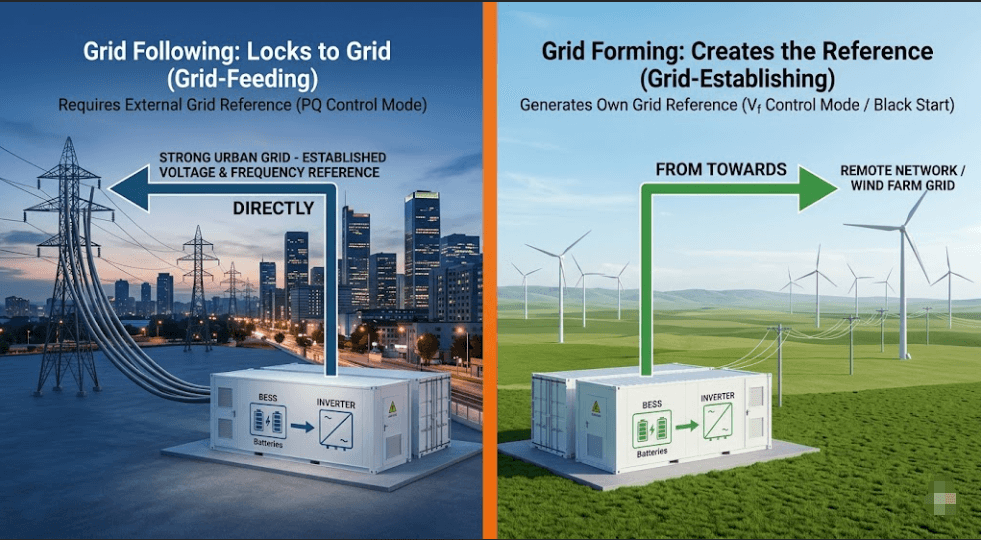
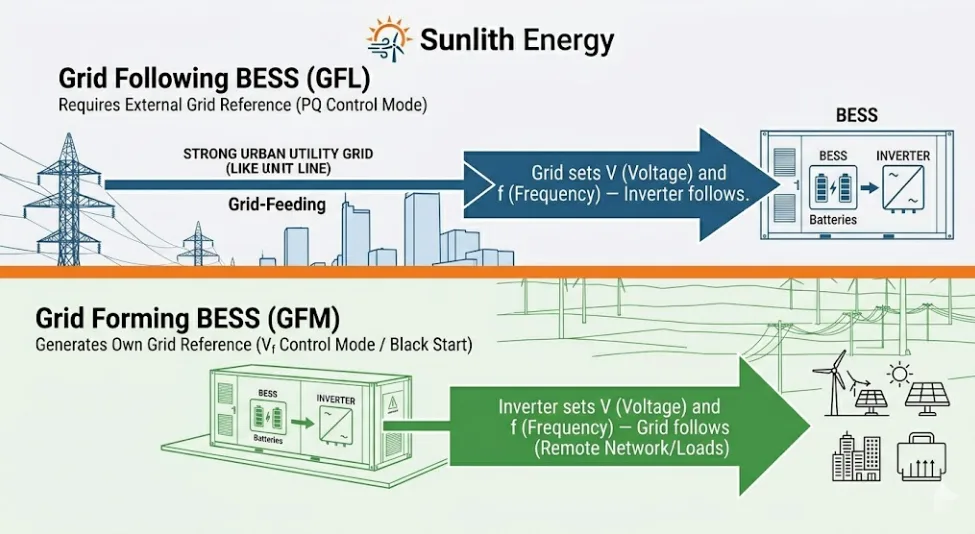
The fundamental difference between grid forming and grid following BESS lies in their reference source. A grid following (GFL) BESS operates as a controlled current source. It requires an existing, stable grid voltage and frequency to lock onto via a Phase-Locked Loop (PLL). Conversely, a grid forming (GFM) BESS acts as an independent voltage source. By synthesising its own internal reference, it can operate on weak grids or completely isolated networks.
That event changed the industry conversation permanently. For developers, engineers, and asset owners, this choice now carries regulatory, financial, and grid-safety consequences — not just technical ones.
This guide covers everything you need to make the right decision. We break down how each inverter type works before comparing them head-to-head. From there, you will explore optimal applications, hybrid architectures, 2025 mandates, and real-world case studies.
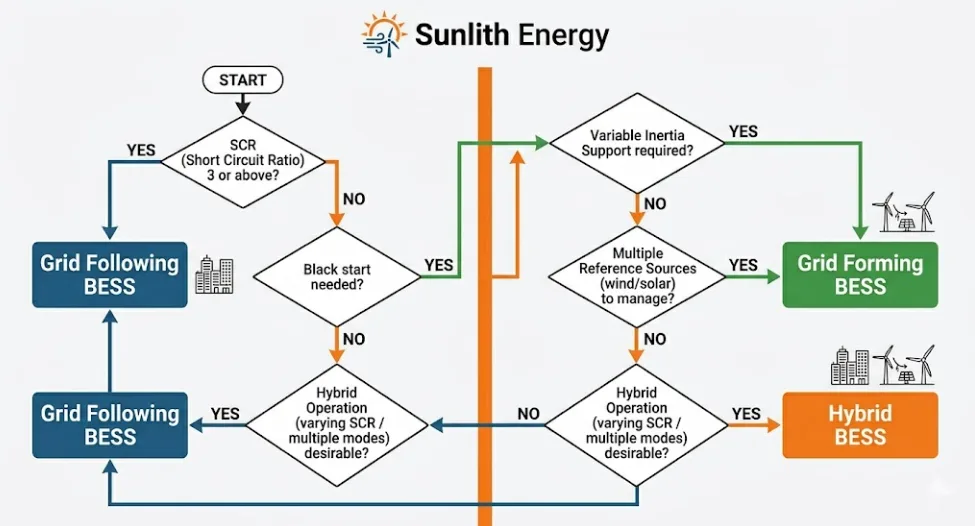
Most developers already know both technologies exist. So start here, not with theory. Answer these five questions — each answer points to the right grid forming vs grid following BESS choice.
Question 1 — Short Circuit Ratio (SCR): Choosing Grid Forming vs Grid Following BESS
Question 2 — Does Your BESS Project Need Black Start or Islanding?
- No — grid following BESS is sufficient
- Occasional backup power only — grid following plus STS works well
- Sustained islanding or off-grid — grid forming BESS is required
Question 3 — What Is the Renewable Penetration at Your Grid Connection?
- Below 50% IBR penetration — grid following BESS is fine
- 50 to 70% IBR penetration — hybrid grid forming and grid following is recommended
- Above 70% IBR penetration — grid forming preferred; may be mandated
Question 4 — Is a Grid Forming BESS Mandate Active in Your Jurisdiction?
- USA (MISO territory), EU, or Australia — check mandate applicability before specifying
- Other markets — monitor; mandates are spreading globally
- No mandate yet — grid following remains fully eligible today
Question 5 — What Is Your BESS Project Timeline?
- 3 to 5 years, strong urban grid, C&I focus — grid following BESS maximises ROI today
- 10 or more years, utility scale — future-proof with grid forming or hybrid
Bottom line: Strong urban grid + no islanding + C&I project = grid following BESS. Weak grid + black start + high-IBR or mandate zone = grid forming BESS. Utility-scale with a long horizon = specify grid forming firmware from Day 1.
- Grid Following BESS: The PLL Control Architecture
- Grid Following BESS: Key Strengths on Strong Grids
- Grid Following BESS: The Fundamental Limitation
- Grid Forming BESS: The Voltage-Source Architecture
- Unique Stability Capabilities of Grid Forming BESS
- Grid Forming BESS: Three Control Strategies Explained
- Grid Forming vs Grid Following BESS — 10-Dimension Head-to-Head Table
- Grid Forming vs Grid Following BESS — EPFL Campus Study Results
- Western Downs Battery: Grid Forming Upgrade Proven at 540 MW Scale
- What the Performance Data Means for Your Grid Forming vs Grid Following BESS Decision
- Why the Grid Forming BESS Cost Premium Is Shrinking in 2025
- Grid Forming vs Grid Following BESS: 10-Year Financial Summary
- Profile 1 — Grid Following BESS for C&I Peak Shaving & Demand Reduction
- Profile 2 — Grid Following BESS for Solar-Plus-Storage
- Profile 3 — Grid Following BESS for Fast Frequency Response Markets
- Profile 4 — Grid Following BESS for Capacity Market Participation
- Profile 5 — Grid Following BESS for Time-of-Use Energy Arbitrage
- Profile 1 — Grid Forming BESS for Weak Grid and Remote Industrial Sites
- Profile 2 — Grid Forming BESS for Island Microgrids and Off-Grid Systems
- Profile 3 — Grid Forming BESS for Black Start Requirements
- Profile 4 — Grid Forming BESS for High-IBR Grid Zones
- Profile 5 — Grid Forming BESS for Stability Market Revenue
- How a Hybrid Grid Forming and Grid Following BESS Architecture Works
- What the Hybrid Grid Forming and Grid Following BESS System Delivers
- Seamless Mode Switching Between Grid Forming and Grid Following BESS
- United States — MISO Grid Forming BESS Mandate (November 2024)
- Europe — EU Grid Forming BESS Rule from 2026
- Australia — Grid Forming BESS Is Now the Industry Default
- United Kingdom — Grid Forming BESS and the Stability Pathfinder
- What is the main difference between grid forming and grid following BESS?
- Can a grid following BESS be upgraded to grid forming later?
- What SCR does a grid following BESS need to work safely?
- Is grid forming BESS now required by regulation in some markets?
- Is grid forming BESS always better than grid following BESS?
- What happens if you use a grid following BESS on a weak grid?
- Related Articles on Sunlith Energy
- External References
Grid Following BESS: The PLL Control Architecture
A grid following BESS inverter acts as a controlled current source. Its job is to inject active power and reactive power into the grid at the exact voltage and frequency already running there. To do this, it relies on a Phase-Locked Loop (PLL). The PLL reads the grid voltage, frequency, and phase angle at the Point of Common Coupling thousands of times per second — then locks the inverter’s internal reference to that signal. Because of this, the inverter follows the grid rather than setting it.
Grid Following BESS: Key Strengths on Strong Grids
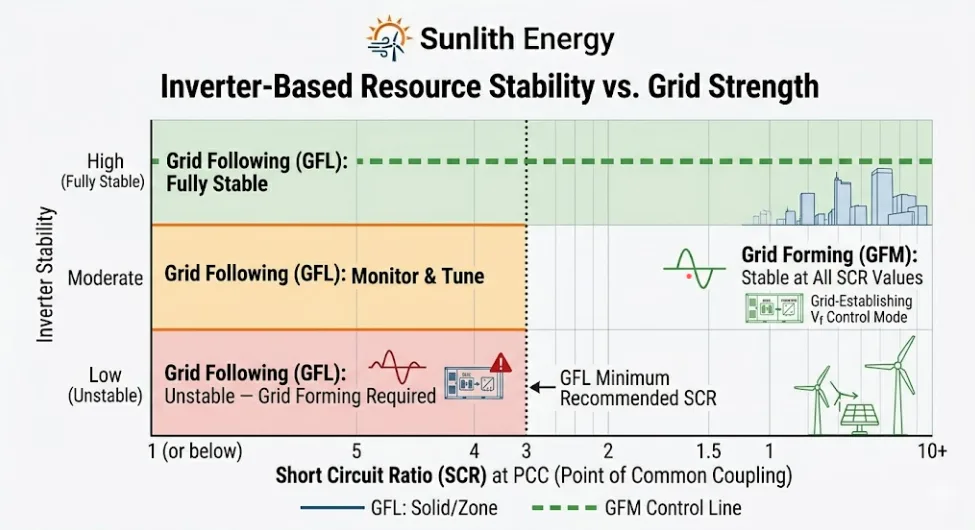
Grid following is the dominant technology today — about 80% of all BESS systems worldwide use this architecture. It is mature, cost-effective, and well-suited to strong-grid environments with a Short Circuit Ratio above 3. Peak demand charge reduction, time-of-use arbitrage, fast frequency response, and solar self-consumption are all well within its capabilities on a strong urban grid.
Grid Following BESS: The Fundamental Limitation
The core limit is simple: a grid following inverter needs the grid to exist. Without a stable voltage reference, the PLL has nothing to lock to. As a result, a grid following BESS cannot black-start a dead network — and it cannot sustain an islanded microgrid on its own.
For a complete technical breakdown, read our comprehensive guide to grid-following BESS.
Grid Forming BESS: The Voltage-Source Architecture
A grid forming BESS inverter acts as a controlled voltage source. Rather than reading and copying the grid signal, it synthesises its own voltage and frequency internally. Everything else on the network — other inverters, loads, generators — synchronises to the grid forming inverter. Because of this fundamental reversal, the inverter can operate with no external grid signal at all.
Unique Stability Capabilities of Grid Forming BESS
Black start, sustained islanding, synthetic inertia, and meaningful fault current contribution are all grid forming only capabilities. None are available from a standard grid following BESS. In Australia, 1,070 MW of grid forming BESS technology is already operating across ten sites as of mid-2025, according to AEMO.
Grid Forming BESS: Three Control Strategies Explained
Three main strategies power grid forming inverters commercially today. Droop control mimics a synchronous generator’s governor — the simplest and most widely deployed approach. Virtual Synchronous Generator (VSG) explicitly emulates inertial response and reacts to both frequency deviation and Rate of Change of Frequency (ROCOF). Power Synchronisation Control (PSC) is the most advanced option, using active power as the sync signal rather than frequency — the most stable choice at very low SCR values below 1.5.
Grid Forming vs Grid Following BESS — 10-Dimension Head-to-Head Table
Use the table below for engineering evaluations and procurement decisions. It covers the ten dimensions that matter most when choosing between grid forming and grid following BESS.
| Dimension | Grid Following BESS (GFL) | Grid Forming BESS (GFM) |
|---|---|---|
| Inverter behaviour | Controlled current source | Controlled voltage source |
| Synchronisation | PLL locks to grid voltage and frequency | Internal oscillator — no external reference |
| Requires grid to operate? | Yes — needs stable voltage reference | No — creates its own reference |
| Black start | None | Full black start capability |
| Sustained islanding | No | Yes — while battery has energy |
| Synthetic inertia | Limited — indirect only | Native — instantaneous ROCOF response |
| Frequency response | 200–500 ms (droop-based) | < 20 ms (voltage-source response) |
| Minimum SCR at PCC | SCR ≥ 3; unstable below 1.5 | Stable at SCR < 1.5; tested at SCR 1.0 |
| Fault current | Very limited | Significant — supports protection coordination |
| Cost vs baseline | Baseline | 0–20% premium (shrinking in 2025) |
Grid Forming vs Grid Following BESS — EPFL Campus Study Results
Real-world data from independent research confirms the performance difference between grid forming and grid following BESS. The most rigorous comparison to date used a 720 kVA / 500 kWh BESS on the EPFL campus in Switzerland. Researchers ran both control modes on identical hardware. The result was clear: grid forming outperformed grid following on every frequency regulation metric tested.
Specifically, the grid forming inverter arrested frequency deviations before they reached protection relay trip thresholds. By contrast, the grid following inverter could only respond after the deviation was already measurable. In low-inertia conditions, those extra milliseconds compound quickly and can cause cascading failures.
Source: EPFL — Performance Assessment of Grid-Forming and Grid-Following BESS on Frequency Regulation in Low-Inertia Power Grids (arXiv, 2021)
Western Downs Battery: Grid Forming Upgrade Proven at 540 MW Scale
At utility scale, the Western Downs Battery in Queensland was upgraded from grid following to grid forming in March 2025. The upgrade used firmware changes — not new hardware. After the upgrade, AEMO confirmed measurable system strength improvements in the surrounding network, with voltage recovery during Fault Ride-Through events confirmed within 300 ms under grid forming control.
Source: ARENA — Australia’s Grid-Forming Battery Revolution, November 2025
What the Performance Data Means for Your Grid Forming vs Grid Following BESS Decision
On strong grids with SCR above 5, the performance gap between grid forming and grid following BESS narrows considerably. For pure peak shaving or energy arbitrage on a strong urban grid, grid following performance is completely adequate. The extra cost of grid forming is not recovered through performance gains in that scenario.
However, in weak or high-IBR grids, grid forming outperforms grid following on every stability metric that matters — exactly the conditions the EPFL and Western Downs data reflect.
Engineering rule: The question is not which is better overall. It is which is better for this specific grid, at this specific node, for these specific services.
Why the Grid Forming BESS Cost Premium Is Shrinking in 2025
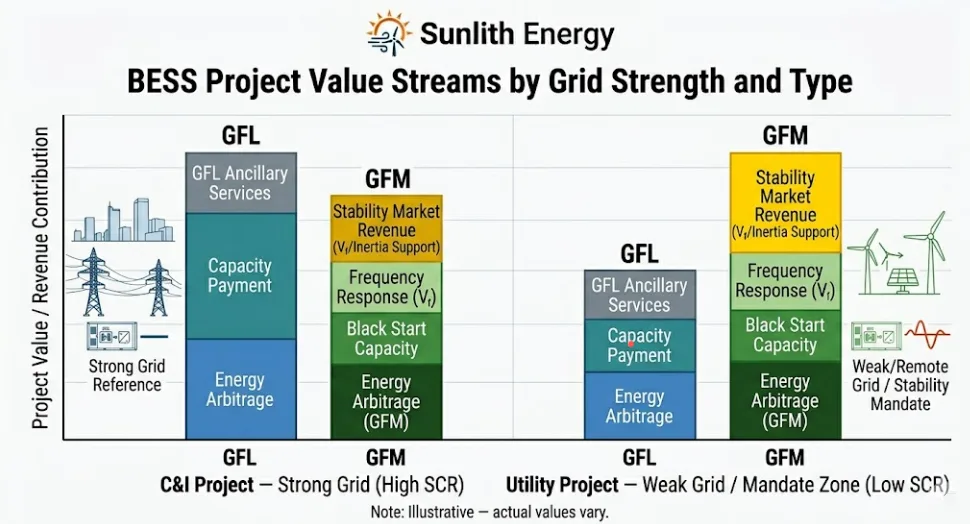
Three factors are compressing the cost gap between grid forming and grid following BESS. First, firmware upgrades now unlock grid forming on existing grid following hardware — exactly as the Western Downs Battery proved in March 2025. Second, manufacturing volume is driving inverter costs down broadly. Third, grid forming BESS earns revenue from stability markets that grid following cannot access.
Modo Energy’s September 2025 analysis of Australia’s NEM found no real cost difference between grid forming and grid following in that market. Meanwhile, National Grid’s Stability Pathfinder programme pays specifically for synthetic inertia and system strength — both grid forming only capabilities. Over a 10-year project life, those payments more than recover any upfront premium in mandate-affected markets.
Grid Forming vs Grid Following BESS: 10-Year Financial Summary
| Cost Factor | Grid Following BESS | Grid Forming BESS |
|---|---|---|
| Upfront capex premium | Baseline | 0–20% (market-dependent; shrinking) |
| Commissioning | Standard | Higher — grid forming tuning required |
| Stability market revenue | None | Significant in UK, Australia, Germany |
| Firmware upgrade path | Available on most modern PCS | Native from Day 1 |
| 10-year value — strong grid C&I | Higher net return | Lower unless stability revenue applies |
| 10-year value — weak grid / utility | Lower (mandate risk) | Higher in mandate-affected markets |
For detailed financial modelling, read our C&I BESS economics and ROI breakdown.
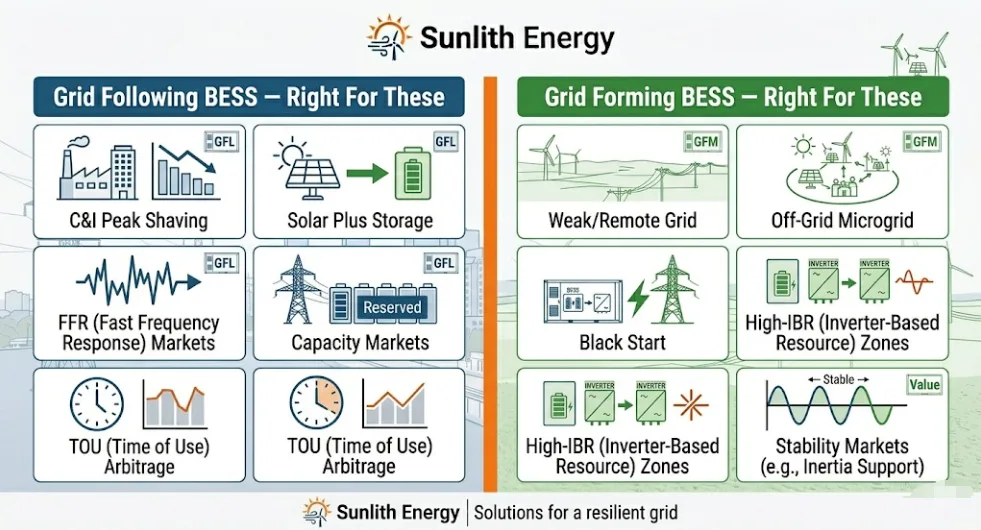
Grid following BESS is the right choice for most projects today. Below are the five scenarios where it delivers the strongest return on investment.
Profile 1 — Grid Following BESS for C&I Peak Shaving & Demand Reduction
Manufacturing facilities, data centres, and logistics hubs on strong urban grids (SCR typically 5 to 20) are ideal for grid following BESS. A well-configured Energy Management System dispatches the battery in real time to prevent demand charge spikes, cutting bills by 30 to 40%. Add a Static Transfer Switch and the same system also delivers seamless backup power.
See also: benefits of C&I BESS for manufacturing facilities.
Profile 2 — Grid Following BESS for Solar-Plus-Storage
In solar-plus-storage systems, the solar PV inverter provides the AC voltage reference. The grid following BESS inverter runs in parallel — absorbing surplus solar and wind generation and discharging when output falls. This is a well-proven configuration deployed across thousands of sites globally.
Profile 3 — Grid Following BESS for Fast Frequency Response Markets
A grid following inverter detects frequency deviation via the PLL and responds in under 200 to 500 milliseconds. That is well within the threshold for FFR products in most grid codes. As a result, grid following BESS is fully eligible and actively operating in FFR markets in Great Britain, Australia, Ireland, and the United States.
Profile 4 — Grid Following BESS for Capacity Market Participation
Grid following BESS can provide committed MW capacity through auctions in the UK, US, and Australia. Combined with energy arbitrage strategies and FFR, capacity payments create a strong multi-revenue stack without requiring grid forming capabilities.
Profile 5 — Grid Following BESS for Time-of-Use Energy Arbitrage
In liquid spot markets — ERCOT, Australia’s NEM, GB day-ahead — significant arbitrage value comes purely from charge and discharge timing. A well-configured Battery Management System and EMS handle this automatically. Grid following is the lower-cost, right-fit choice for this application.
When do you need a grid forming BESS?
A grid forming BESS is technically required or recommended over a grid following system in the following scenarios:
- Weak Grid Integration: When the Short Circuit Ratio (SCR) at the Point of Common Coupling (PCC) falls below 2.0 or 1.5.
- Island Microgrids: For remote, off-grid systems that have no utility grid to provide a voltage reference.
- Black Start Capability: When the battery system must independently energise a completely dead network.
- High Renewable Penetration: In grid zones where inverter-based resource (IBR) penetration exceeds 60% to 70%.
- Stability Market Revenue: To participate in specialised grid services like synthetic inertia and system strength contracts.
Grid forming BESS is not optional in these scenarios. In each case it is technically required or the only viable choice. Here is the detail behind each one.
Profile 1 — Grid Forming BESS for Weak Grid and Remote Industrial Sites
Grid following inverters typically become unstable when the SCR at the PCC falls below 2. In fact, dropping below SCR 1.5 risks triggering sub-synchronous oscillations if multiple grid following units run in parallel — a real engineering risk at remote mining operations, oil and gas facilities, and industrial sites on long radial feeders. For a full breakdown of why this happens, read our comprehensive guide to grid-following BESS stability.
Profile 2 — Grid Forming BESS for Island Microgrids and Off-Grid Systems
An islanded microgrid has no utility grid to provide a voltage reference — so a grid following inverter cannot operate on its own there. The grid forming BESS becomes the grid itself. It creates and holds the voltage and frequency reference that all other devices synchronise to.
Profile 3 — Grid Forming BESS for Black Start Requirements
A grid following inverter cannot energise a dead network. A grid forming inverter can. For any project where black start is a design requirement — contractual, regulatory, or operational — grid forming is the only technology that delivers this capability. There is no workaround or hybrid substitute for this specific requirement.
Profile 4 — Grid Forming BESS for High-IBR Grid Zones
As renewable penetration rises above 60 to 70%, grid following inverters in aggregate no longer have a stable signal to lock to without grid forming support. The April 2025 Iberian blackout was a direct consequence of this imbalance. Grid forming BESS, combined with a well-specified Power Conversion System, is the primary technical response.
Profile 5 — Grid Forming BESS for Stability Market Revenue
Grid forming inverters are the only technology eligible for stability market contracts — synthetic inertia in the UK Stability Pathfinder, System Strength services in Australia’s NEM, and fast FCAS premiums. These revenue streams are grid forming only. If your business model includes stability market products, grid forming is not an optional upgrade. It is the core product.
How a Hybrid Grid Forming and Grid Following BESS Architecture Works
The choice between grid forming vs grid following BESS is increasingly not a binary one. Modern inverter platforms support both control modes in the same hardware, with automatic switching between them.
In a typical hybrid design, 20 to 30% of the BESS units operate in grid forming mode. These units establish and hold the voltage and frequency reference for the whole site. The remaining units run in grid following mode against that reference — maximising total output at lower average cost than an all-grid forming fleet.
When the utility grid is strong, the grid forming units benefit from additional system strength. Should the grid weaken or disconnect, those units hold the microgrid reference autonomously. The grid following units simply continue to follow that reference, unaware that the utility has gone.
What the Hybrid Grid Forming and Grid Following BESS System Delivers
- Lower average cost than specifying all units in grid forming mode
- Full black start capability from the grid forming anchor units
- Seamless islanding with no manual intervention needed
- Stable operation at low SCR where an all-GFL system would oscillate
- Future-proofing — grid forming firmware is already on the hardware, ready when mandates arrive
Seamless Mode Switching Between Grid Forming and Grid Following BESS
Hitachi Energy’s patent filings (WO2024193866A1 and WO2024193867A1) describe supervisory control that switches individual inverter units between VSG (grid forming) and PLL (grid following) modes automatically — based on real-time voltage thresholds — without interrupting power delivery. This is production firmware, not experimental technology.
Sunlith Energy recommendation: For any new BESS project above 5 MW, specify PCS hardware with grid forming firmware capability regardless of Day 1 operating mode. The option value vastly exceeds its marginal cost.
Regulatory requirements for grid forming vs grid following BESS changed substantially in 2024 and 2025. Here is the current status across four key markets.
United States — MISO Grid Forming BESS Mandate (November 2024)
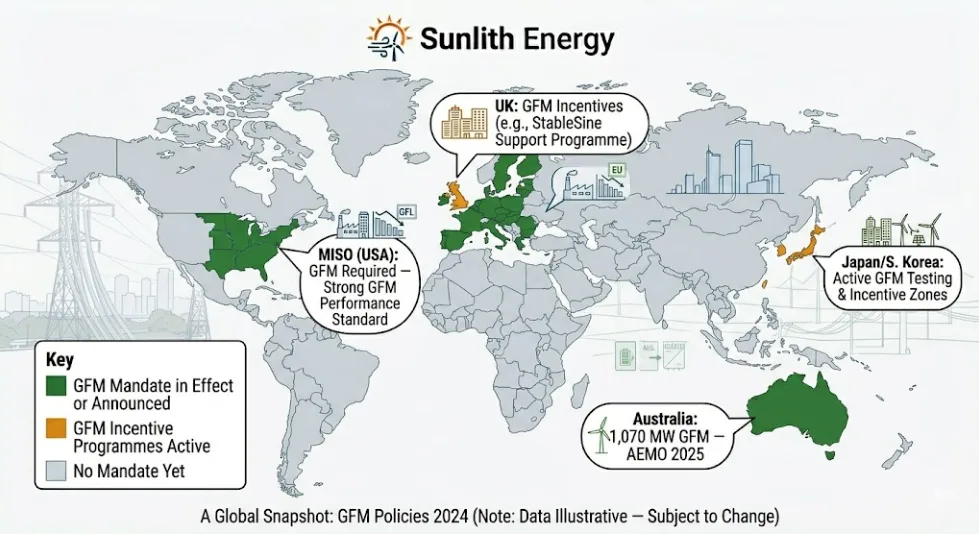
MISO finalised grid forming BESS performance requirements in November 2024. New stand-alone BESS systems seeking interconnection in MISO territory must demonstrate synthetic inertia emulation, fast frequency response, and minimum short-circuit current contribution. Grid following only systems do not meet these requirements.
Source: MISO GFM BESS Performance Requirements Whitepaper, July 2024
Europe — EU Grid Forming BESS Rule from 2026
In November 2025, ENTSO-E and key national regulators announced that all new storage projects above 1 MW must carry grid forming capability from 2026. Germany’s Bundesnetzagentur, France’s RTE, and Spain’s REE all signalled fast-track implementation timelines following the April 2025 Iberian blackout.
Source: ESS News — Europe Moves to Mandate Grid-Forming for New Storage Over 1 MW, November 2025
Australia — Grid Forming BESS Is Now the Industry Default
Australia has no formal mandate, but AEMO’s market design has made grid forming BESS the standard for new large-scale projects. Over 1,070 MW is already operating across ten sites. Modo Energy confirms that Australian developers now treat grid forming as a standard specification rather than an optional upgrade.
Source: ARENA — Australia’s Grid-Forming Battery Revolution, November 2025
United Kingdom — Grid Forming BESS and the Stability Pathfinder
National Grid ESO’s Stability Pathfinder issues multi-year contracts for synthetic inertia and system strength — both grid forming only capabilities. Grid code updates under Engineering Recommendation G99 are underway to formally require grid forming performance specifications.
See also: UL 9540 and IEC certification standards for BESS.
At Sunlith Energy, the grid forming vs grid following BESS decision is an engineering analysis on every project — never a default. Our four-step process ensures every system is specified correctly.
- SCR Analysis — We measure or obtain the SCR at the Point of Common Coupling before writing any specification. This single number anchors the grid forming vs grid following BESS recommendation.
- Revenue Stack Assessment — We model the full value stack — demand charge reduction, arbitrage, FFR, capacity markets, backup power, solar self-consumption, and stability market products. This determines whether grid forming’s cost premium is recovered through incremental revenue.
- Regulatory and Horizon Review — We check the applicable grid code, interconnection requirements, and announced mandates. For projects with a 10-year or longer horizon in MISO, Europe, or Australia, grid forming firmware capability is specified as standard.
- PCS Hardware Specification — We select Power Conversion System hardware from manufacturers that support both grid forming and grid following firmware. This gives the system full flexibility to adapt over its lifetime without hardware replacement.
Related reading: how BMS and EMS work together in a BESS system and our Battery Management System explainer.
What is the main difference between grid forming and grid following BESS?
Grid following BESS reads the grid’s existing voltage and frequency and injects current to match it — it follows the grid. Grid forming BESS synthesises its own voltage and frequency reference internally — it forms the grid. The key result is that grid following needs a strong external grid to operate stably, while grid forming can function with no grid signal at all.
Can a grid following BESS be upgraded to grid forming later?
Yes, in many cases. Australia’s Western Downs Battery proves this at 540 MW scale: the 2025 upgrade used firmware changes, not new hardware. However, not all inverters support grid forming control at the firmware level. When specifying new hardware, always confirm grid forming firmware availability with your PCS manufacturer.
What SCR does a grid following BESS need to work safely?
A minimum SCR of 3 at the PCC is the standard engineering threshold for grid following BESS. A formal stability study becomes mandatory once the system drops below SCR 2. If the node falls past SCR 1.5, specifying a grid forming BESS is strongly recommended. At or below SCR 1.0, a grid forming system using Power Synchronisation Control (PSC) is your only viable option.
Is grid forming BESS now required by regulation in some markets?
Yes. MISO finalised grid forming requirements for new BESS interconnection in November 2024. Europe announced the 1 MW+ grid forming rule for 2026. Australia’s AEMO has made grid forming the de facto standard for new large-scale BESS. Developers in these markets should treat grid forming firmware as a baseline specification.
Is grid forming BESS always better than grid following BESS?
No. On strong grids with SCR above 3 and adequate synchronous generation, grid following BESS performs excellently for peak shaving, arbitrage, and FFR. The additional capabilities of grid forming add no commercial value at a well-connected C&I site. Grid forming is better where it is needed; grid following is the right choice where grid strength is not a constraint.
What happens if you use a grid following BESS on a weak grid?
Below SCR 3, grid following inverters begin to show PLL instability. Below SCR 1.5, multiple units in parallel can enter sub-synchronous oscillations — a condition that can cascade into protection trips across the network. The April 2025 Iberian blackout demonstrated exactly this failure mode at grid scale.
The grid forming vs grid following BESS decision now carries regulatory deadlines, financial consequences, and grid-safety implications. After the April 2025 Iberian blackout, MISO’s November 2024 mandate, Europe’s 2026 rule, and Australia’s operational scale-up past 1,000 MW of grid forming BESS, this is not a decision any project developer can treat as an afterthought.
For most C&I projects on strong grids today, grid following BESS delivers faster payback, lower upfront capital, and all the commercial capabilities the project needs. For weak grids, remote sites, black start applications, high-IBR zones, and stability market participation, grid forming BESS is the technically correct — and increasingly regulatory-required — choice. For utility-scale projects above 5 MW with a long horizon, the hybrid architecture gives both capabilities at the lowest combined cost.
At Sunlith Energy, every project starts with an SCR analysis and a revenue stack model. The right grid forming vs grid following BESS specification follows from that analysis — not from a default catalogue choice.
Talk to the Sunlith Energy Engineering Team →
Related Articles on Sunlith Energy
- BESS Grid-Following (GFL): Complete Guide
- BESS Grid-Forming Technology: The Architecture Stabilising Tomorrow’s Grid
- The Role of Static Transfer Switch (STS) in C&I BESS
- How C&I BESS Peak Shaving Lowers Demand Charges
- How EMS Enables Advanced Grid Services Through BESS
- Power Conversion System (PCS): The Heart of a BESS
- C&I BESS Economics and ROI: Full Breakdown
- How C&I BESS Enhances Solar and Wind Power Integration
- Battery Management System (BMS) Explained
- UL 9540 and IEC Standards Compliance for BESS
- Benefits of C&I BESS for Manufacturing Facilities
- BMS vs EMS: Understanding the Control Layers in BESS
External References
- EPFL — Performance Assessment of Grid-Forming and Grid-Following BESS (arXiv, 2021)
- MISO — GFM BESS Performance Requirements Whitepaper, July 2024
- ARENA — Australia’s Grid-Forming Battery Revolution, November 2025
- Modo Energy — The Rise of Grid-Forming Batteries in the NEM, September 2025
- ESS News — Europe Moves to Mandate Grid-Forming for New Storage Over 1 MW, November 2025
- National Grid ESO — Stability Pathfinder Programme
- IEEE Standard 2800-2022 — Interconnection Requirements for IBRs
- ENTSO-E — Network Code on Requirements for Grid Connection of Generators
- NREL — Grid Integration of Battery Storage Research
- IEA — Batteries and Secure Energy Transitions Report
- BloombergNEF — Energy Storage Market Outlook





Trackbacks & Pingbacks
[…] these relay settings should be checked against which control mode the PCS actually runs — see our grid-forming vs. grid-following BESS guide for the underlying […]
[…] Grid Forming vs Grid Following BESS: What Is the Difference? […]
[…] determines whether the system can operate independently of the utility at all. Our detailed grid-forming vs. grid-following BESS guide covers the full technical comparison, but the key points are summarized […]
[…] true for projects with high renewable penetration or islanded operation. For a full comparison, see Grid Forming vs Grid Following BESS: What Is the Difference?, and our complete reference on Power Conversion System (PCS) for […]
[…] For the full breakdown of inverter control modes, see our guide to grid-forming vs grid-following BESS. […]
Leave a Reply
Want to join the discussion?Feel free to contribute!