
UL 1642 Certification Guide: Lithium-Ion Cell Safety
UL 1642 certification is the core U.S. safety standard for lithium-ion and lithium-metal cells. Underwriters Laboratories publishes this standard. Most cell manufacturers need UL 1642 certification before selling into the North American market. This certification tests the cell itself. It happens before the cell ever becomes part of a battery pack or energy storage system.
This guide explains what UL 1642 actually requires. First, you’ll see the scope and gram limits that define which cells qualify. Next, you’ll learn the four categories of abuse testing. Then, we’ll cover a realistic certification timeline. Finally, we’ll compare UL 1642 to UN 38.3 and IEC 62133. For system-level certifications that come after cell approval, see our UL 1973 certification guide and our full UL certifications overview.
UL 1642 Certification Scope: Which Cells Qualify?
UL 1642 certification applies to lithium-ion and lithium-metal cells. It does not cover complete battery packs, modules, or energy storage systems. This distinction matters, because it determines which certification you actually need.
For user-replaceable applications, the standard sets clear limits. A battery must contain no more than 4.0g of total lithium content. No single cell may exceed 1.0g of metallic lithium. Cells above these limits need additional evaluation. Once a cell earns UL 1642 certification, it becomes the foundation for pack-level certifications. Most manufacturers pursue UL 2054 next for household and commercial packs. Others pursue UL 1973 for stationary and BESS applications.
UL 1642 Certification: The Four Testing Categories
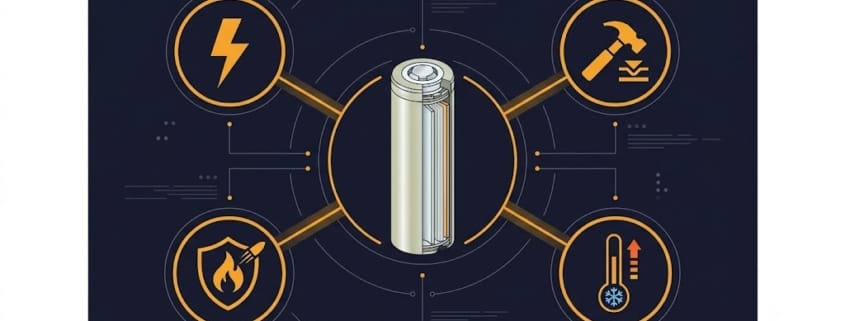
UL 1642 certification evaluates cells across four testing categories. Each one simulates a real-world failure mode.
- Electrical — the lab runs a short-circuit test, an overcharge test, and a forced discharge test.
- Mechanical — technicians perform a crush test, an impact test, a shock test, and a vibration test.
- Environmental — testers apply a heating test, temperature cycling, and a low-pressure altitude test.
- Projectile — this test confirms a failed cell can’t become a projectile that penetrates a surrounding mesh screen.
Together, these tests confirm the cell resists fire, explosion, and leakage. As a result, UL 1642 certification becomes a prerequisite for nearly every downstream battery certification.
How Long Does UL 1642 Certification Take?
The UL 1642 certification process starts with sample submission. Manufacturers typically submit both fresh and pre-aged cells. This approach evaluates performance across the cell’s expected life, not just out of the box. From there, the lab runs the full test suite: electrical, mechanical, environmental, and projectile tests.
Most manufacturers should plan for roughly 8–12 weeks from sample submission to certificate issuance, though lab capacity and sample variants affect the schedule. You can verify any UL certificate directly through UL’s Product iQ database.
UL 1642 vs UN 38.3: Two Different Kinds of Safety
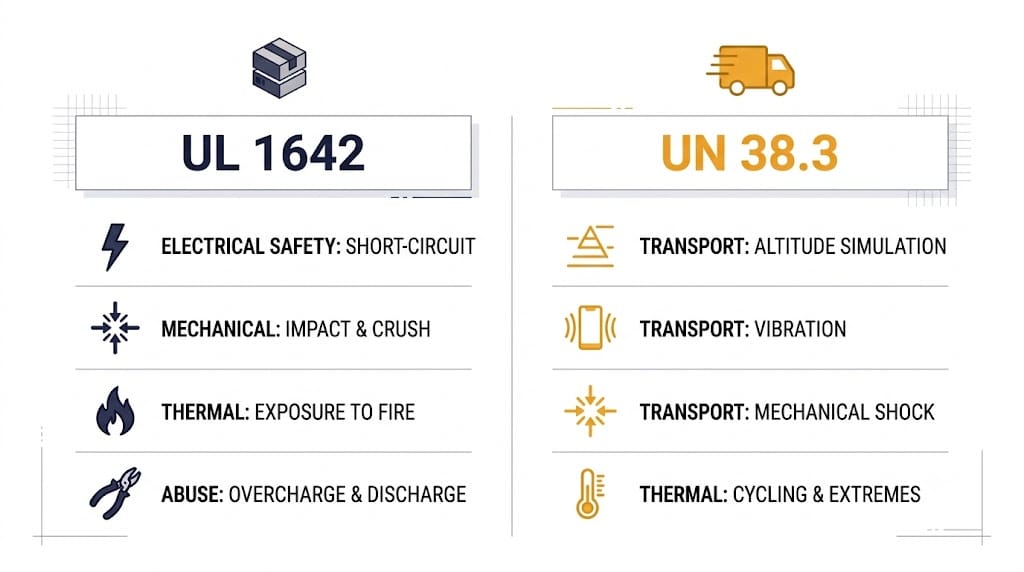
People often confuse UL 1642 with UN 38.3. However, these standards test completely different risks. UL 1642 certification proves product-use safety — it confirms a cell resists short circuits, overcharge, and crush damage. UN 38.3 proves transport safety instead — it confirms a cell survives shipping conditions like altitude changes, vibration, and shock.
Every international lithium battery shipment legally requires UN 38.3 testing. Meanwhile, manufacturers need UL 1642 certification for U.S. market access. In short, most manufacturers need both. Neither certification replaces the other.
| UL 1642 Certification | UN 38.3 | |
|---|---|---|
| What it certifies | Product-use safety | Transport / shipping safety |
| Core tests | Short circuit, overcharge, crush, abnormal charging | Altitude simulation, thermal cycling, vibration, shock, external short circuit |
| Who requires it | OEMs, retailers, and North American market access | Legally required for every international lithium battery shipment |
| Can one replace the other? | No — both are typically required | No — both are typically required |
In practice, a cell manufacturer shipping internationally needs both certifications: UN 38.3 to legally move the product, and UL 1642 certification to sell it into the U.S. market.
UL 1642 vs IEC 62133
IEC 62133 is the closest international equivalent to UL 1642. Companies selling into the EU or Asia usually need IEC 62133 instead. Both standards test similar risks. However, they aren’t interchangeable. IEC 62133 generally covers portable sealed cells across a broader range of chemistries. UL 1642 certification, on the other hand, applies specifically to lithium-ion and lithium-metal cells. Additionally, OSHA-recognized labs in the U.S. reference UL 1642 certification directly. For this reason, manufacturers targeting multiple markets typically pursue both.
UL 1642 Certification in Context: UL 1973 and UL 9540
UL 1642, UL 1973, and UL 9540 often get confused in BESS compliance conversations. However, each standard certifies a different layer of the system.
| Standard | What It Covers |
|---|---|
| UL 1642 | Individual lithium-ion or lithium-metal cells |
| UL 1973 | Complete battery modules and packs for stationary storage, EVs, and light rail |
| UL 9540 | The full energy storage system — batteries, PCS, controls, and enclosure together |
A cell typically earns UL 1642 certification before a manufacturer can integrate it into a UL 1973-certified pack. That pack, in turn, supports UL 9540 certification for the complete system. For the pack-level standard specifically, see our UL 2054 certification guide.
Why UL 1642 Certification Matters
- Market access — most North American retailers require UL 1642 before they’ll sell a product.
- Foundation for downstream certification — UL 2054 and UL 1973 both require cells that already carry UL 1642 certification.
- Liability protection — manufacturers commonly use UL 1642 certification reports as evidence of due diligence.
At Sunlith Energy, we source UL 1642-certified cells as the baseline for every BESS product line. See our full guide to UL certifications for battery systems for how this fits into the complete compliance picture, or our BESS certifications overview for a buyer’s-side breakdown of what to check before purchasing.
Frequently Asked Questions
What does UL 1642 certification cover?
UL 1642 covers individual lithium-ion and lithium-metal cells. It does not cover complete battery packs. Pack-level safety falls under separate standards, like UL 2054 or UL 1973.
W
How long does UL 1642 certification take?
Most manufacturers should plan for 8–12 weeks, from sample submission to certificate issuance. Lab capacity and sample variants can affect the schedule.
How is UL 1642 certification different from UN 38.3?
UL 1642 certification tests product-use safety. UN 38.3 tests transport safety instead. Most manufacturers need both.
Is UL 1642 mandatory for all lithium-ion cells?
UL 1642 is not a legal requirement by itself, but is effectively mandatory for most North American OEMs, retailers, and import channels, and is treated as a baseline by NRTL labs and many corporate safety policies.
Can a pack be UL 2054 or UL 1973 certified if its cells are not UL 1642 certified?
No, a battery pack cannot be UL 2054 or UL 1973 certified unless its constituent cells are UL 1642 certified. Both of these pack-level standards mandate that the internal cells meet the basic cell-level safety standards of UL
What happens if we change cell chemistry after UL 1642 certification?
Changes to chemistry, materials, or manufacturing process must be reported to the lab, can trigger partial re‑testing, and that failing to report changes is a common cause of certification invalidation.
Does UL 1642 cover both lithium-ion and lithium-metal cells?
Yes, it covers both, but still only at the cell level. Battery packs and modules require additional certifications such as UL 1973 for stationary applications and UL 9540 for full energy storage systems.
Related UL Certifications
For the next steps in the certification chain, see our guides to UL 1973 certification, UL 2054 certification, and UL 9540A test methodology. For a full breakdown of testing scope and lab accreditation standards, UL’s own battery safety testing overview is a useful primary source.