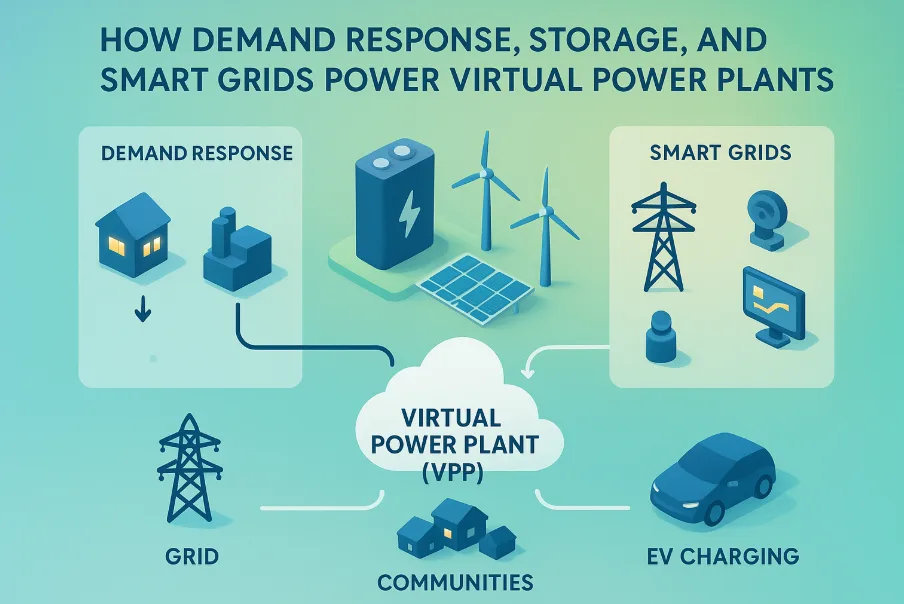
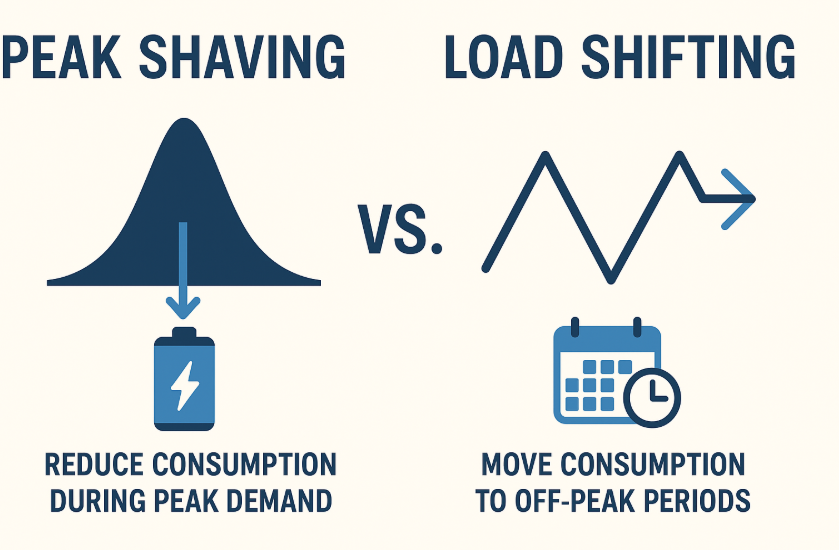
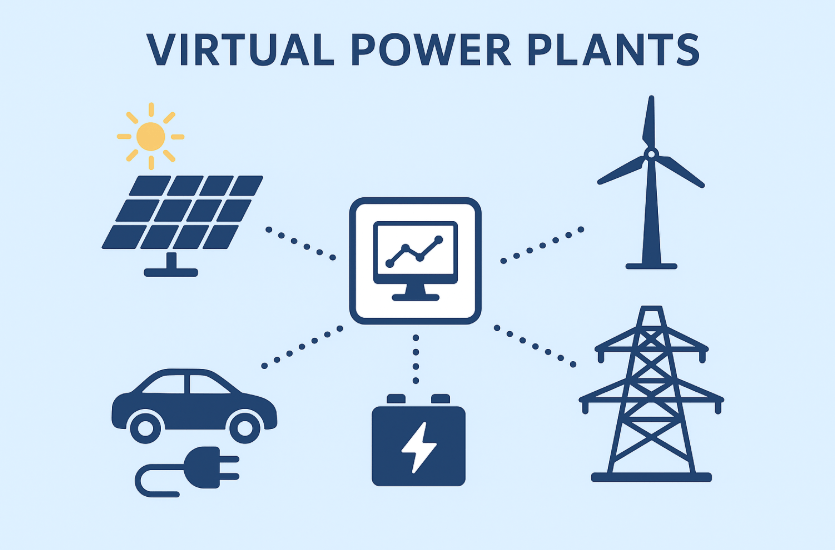
In today’s energy landscape, flexibility is just as important as generation. As renewable energy adoption grows, balancing supply and demand has become a major challenge. Demand Response (DR), when integrated into Virtual Power Plants (VPPs), offers a powerful solution to achieve this balance. By intelligently shifting or reducing electricity usage during peak hours, demand response ensures a more resilient, affordable, and sustainable energy system.
What Is Demand Response?
Demand Response is an energy management strategy where consumers adjust their electricity usage in response to grid conditions, price signals, or incentives. Instead of relying solely on power plants to ramp up supply, DR helps reduce stress on the grid by adjusting demand.
When this capability is connected to a Virtual Power Plant, thousands of distributed assets — from smart appliances to EV chargers — can collectively act as a flexible energy resource.
How Demand Response Works in Virtual Power Plants
Real-Time Monitoring: Smart meters and IoT devices track consumption patterns.
Automated Control: Appliances, batteries, and HVAC systems adjust based on grid signals.
Aggregated Flexibility: Small changes across households and businesses add up to major load reductions.
Bidirectional Benefits: Consumers earn incentives, while grid operators reduce stress on infrastructure.
Decarbonization – Maximizes the integration of renewable energy by reducing reliance on fossil-fuel backup plants.
Resilience – Communities gain more reliable access to electricity during extreme demand peaks.
Real-World Applications
United States: California’s Flex Alert program rewards consumers for reducing usage during peak times, and when tied into VPPs, it supports grid resilience during heatwaves.
Europe: Germany and the UK are experimenting with large-scale DR programs integrated into VPP platforms to balance wind and solar fluctuations.
Asia: Japan’s utilities use DR to manage peak demand from air conditioning loads in summer while leveraging VPP networks.
Demand Response + Smart Grids + Storage
Demand Response becomes even more effective when combined with:
Demand Response is the hidden power of Virtual Power Plants. By engaging consumers and leveraging automation, it transforms passive energy users into active participants in grid management. The result is a system that is smarter, cleaner, and more resilient for everyone.
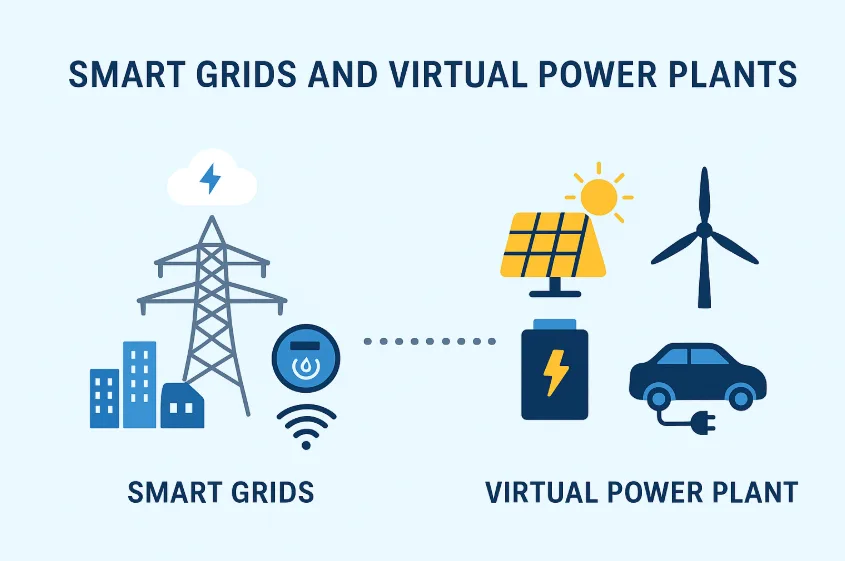
But VPPs cannot function effectively without the digital infrastructure that allows millions of devices to communicate, share data, and respond instantly to grid conditions. That infrastructure is the Smart Grid.
In this article, we explore how smart grids serve as the backbone of Virtual Power Plants, enabling greater efficiency, flexibility, and resilience in modern energy systems. We will dive into the technology, benefits, challenges, and future potential of this synergy — and why it represents a cornerstone of the clean energy future.
A Smart Grid is an advanced electrical grid that uses digital communication technology, sensors, and automation to manage the flow of electricity more intelligently. Unlike traditional power grids, which were designed for one-way electricity delivery from central power plants to consumers, smart grids enable two-way communication between utilities and consumers.
Key Features of Smart Grids:
Advanced Metering Infrastructure (AMI): Smart meters that provide real-time data on energy usage.
Automation and Control: Systems that automatically detect faults, reroute electricity, and balance supply and demand.
IoT Integration: Devices and sensors that communicate across the grid.
Data-Driven Operations: Predictive analytics and AI-based forecasting for better grid planning.
These innovations make smart grids not just more efficient, but also essential for integrating distributed and variable energy sources.
Why Smart Grids Matter for Virtual Power Plants
Virtual Power Plants aggregate thousands of distributed assets — rooftop solar panels, home batteries, EV chargers, and even smart appliances. Managing such a diverse ecosystem requires a grid that is flexible, intelligent, and responsive. This is exactly where SG come into play.
Real-Time Monitoring and Control Smart grids continuously collect data from sensors and smart meters, feeding it into centralized platforms that allow utilities to monitor conditions and make adjustments instantly. This real-time oversight is critical for VPPs, which rely on quick responses to stabilize grid frequency and voltage.
Integration of Renewable Energy Renewables like solar and wind are intermittent. Smart grids enable the smooth integration of these resources by forecasting production, managing variability, and distributing energy where it’s needed most.
By leveraging automation and predictive analytics, smart grids reduce outages and enable quicker recovery during disturbances. VPPs, supported by smart grids, can instantly dispatch distributed resources to fill supply gaps.
2. Greater Flexibility
Smart grids give VPPs the agility to scale up or down depending on real-time conditions, ensuring that renewable integration does not compromise grid stability.
3. Lower Operational Costs
Through automation and reduced transmission losses, smart grids reduce overall operational expenses. Consumers also benefit from dynamic pricing models enabled by smart meters.
Smart grids turn passive consumers into active prosumers. With rooftop solar, home batteries, and EVs, households can not only consume energy but also produce and trade it.
Real-World Case Studies
Case Study 1: Europe’s Smart Grid-VPP Integration
In Germany, one of the leaders in renewable adoption, smart grids are enabling VPP operators to aggregate thousands of residential solar and storage units. These resources are orchestrated in real-time to stabilize the grid and provide balancing services to transmission operators.
Case Study 2: United States – Smart Grids with Battery Storage
In California, utilities are deploying smart grids integrated with VPPs to reduce strain during peak summer demand. By combining smart meters, automated demand response, and residential battery systems, the state avoids rolling blackouts and reduces reliance on fossil fuel peaker plants.
Challenges and Future Outlook
1. Cybersecurity Risks
As more devices connect to the grid, the potential attack surface grows. Cybersecurity will be critical to protect smart grids and VPPs from malicious threats.
2. High Initial Investment
Building smart grids requires substantial capital for sensors, meters, communication infrastructure, and software platforms. However, the long-term savings often outweigh the upfront costs.
3. Regulatory Framework
Policymakers must adapt regulations to enable smart grid investments, incentivize demand response, and allow for energy trading within VPPs.
4. Data Privacy
With vast amounts of data being collected from consumers, utilities must ensure strong protections for privacy and data ownership.
Conclusion
Smart grids are more than just an upgrade to our existing power infrastructure. They are the foundation that enables Virtual Power Plants to function at scale, making renewable integration seamless, improving grid reliability, and empowering communities to take control of their energy.
As the world accelerates toward a clean energy future, the synergy between smart grids and VPPs will become increasingly indispensable. Together, they represent not just technological innovation, but also a pathway to resilience, sustainability, and shared prosperity.