
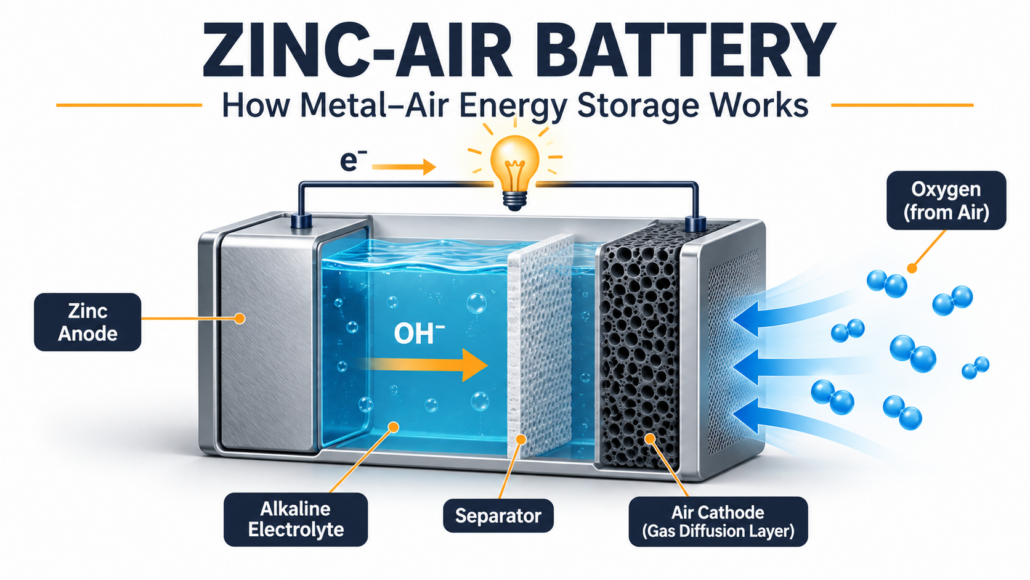
Zinc-Air Battery: How It Works and What Is New in 2026
A zinc-air battery makes power by reacting zinc with oxygen from the surrounding air. In theory, it can store a lot of energy using fairly common materials.
Disposable cells already power hearing aids. But rechargeable versions are far harder to build, so most new research targets that gap.
A U.S. Department of Energy assessment says zinc batteries are still at an early stage. It also names cycle life as the biggest hurdle.
First, this guide explains how the technology works and why recharging is hard. Then it covers what changed in 2025 and 2026, and where it fits next to lithium iron phosphate (LFP).
Quick Answer: What Is a Zinc-Air Battery?
Quick answer: A zinc-air battery makes electricity when zinc reacts with oxygen from the air. Disposable cells are mature and common in hearing aids. But rechargeable versions still lose energy, grow dendrites, and wear out the air electrode. Even so, new catalysts now show thousands of lab cycles.
How a Zinc-Air Battery Works
A zinc-air battery is an open system. Oxygen enters through a porous air electrode, while zinc supplies the electrons.
Discharge Chemistry
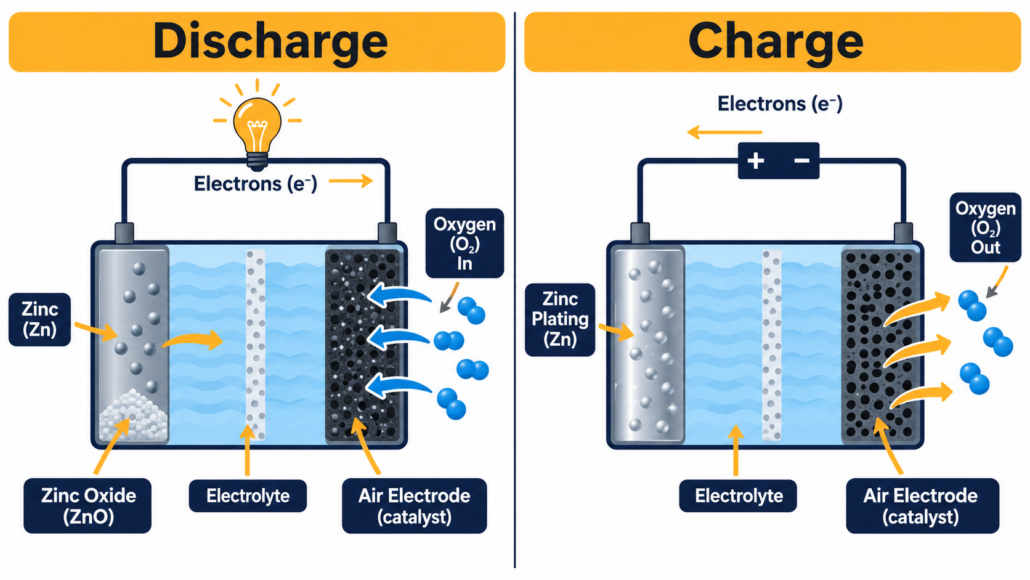
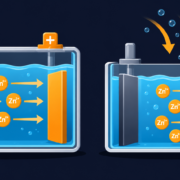
In a standard alkaline cell, zinc oxidizes at the negative electrode. It passes through dissolved zincate and then forms zinc oxide.
Next, oxygen takes up electrons at the air electrode and reacts with water. This makes hydroxide ions, which carry charge through the electrolyte.
Negative electrode: Zn + 2OH⁻ → ZnO + H₂O + 2e⁻
Air electrode: O₂ + 2H₂O + 4e⁻ → 4OH⁻
Overall reaction: 2Zn + O₂ → 2ZnO
Here, e⁻ is an electron and OH⁻ is a hydroxide ion. Also, these equations are simplified, since other electrolytes can follow different paths.
What Happens During Recharging
During charging, outside power pushes zinc back onto the negative electrode. The air electrode then releases oxygen.
On paper, this just reverses discharge. But in practice, zinc rarely redeposits evenly, and the air electrode must handle two hard reactions.
Main Components of a Zinc-Air Battery
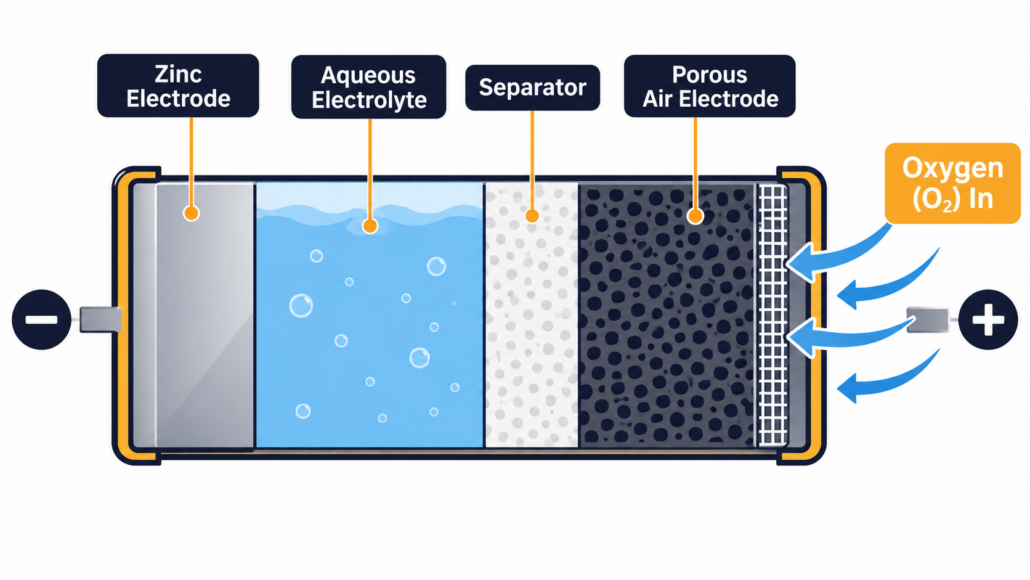
A standard zinc-air cell with liquid electrolyte has four main parts. The table below shows what each part does.
| Component | Function |
| Zinc electrode | Supplies electrons as zinc oxidizes during discharge. |
| Air electrode | Gives oxygen a porous, catalytic surface to react on. |
| Electrolyte | Moves ions between electrodes. Most designs use aqueous potassium hydroxide. |
| Separator | Keeps the electrodes apart while letting ions pass. |
The air electrode typically includes a gas-diffusion layer, a catalyst layer, and a current collector. It must admit oxygen without leaking or flooding.
Some gel designs combine the separator and electrolyte roles.
Because the cell is open, humidity and carbon dioxide can reach it. Both are major causes of performance loss.
Three Types of Zinc-Air Battery Systems
The word “rechargeable” means different things for a zinc-air battery. So it helps to separate three system types.
Primary Cells
Primary cells are designed for a single discharge life, not repeated electrical recharging. This helps them avoid many durability problems.
Electrically Rechargeable Cells
These cells restore energy with electricity. Labs are testing planar, gel, flexible, and flow designs, but each needs better efficiency, life, and stability.
Mechanically Rechargeable Systems
Mechanical recharging swaps in fresh zinc material. Regeneration happens outside the cell, so treat it as fuel replacement, not plug-in charging.
Why the Zinc-Air Battery Attracts Interest
Three traits keep drawing researchers and investors to the zinc-air battery. But each one comes with a caveat.
High Theoretical Energy
A 2024 review in Nano-Micro Letters reports a theoretical specific energy of about 1,218 Wh/kg for zinc-air chemistry.
That is not a complete-cell or pack figure. Practical devices also contain electrolyte, separators, catalysts, and packaging. Incomplete zinc use can also cut delivered energy.
Low-Cost Materials
Zinc is abundant and recyclable, and the cell takes its oxygen from the air. But cheap active material does not guarantee a cheap system.
Still, catalysts, special electrolytes, manufacturing, and short component life can all erase the savings.
Aqueous Electrolyte Safety
Water-based zinc-air cells avoid the flammable organic electrolytes in many lithium-ion cells. But alkaline liquid can be corrosive. Side reactions can make hydrogen, and dendrites can cause internal shorts.
Why a Rechargeable Zinc-Air Battery Is Hard to Build
A rechargeable zinc-air battery must fix several problems at once. These failure modes interact, so fixing one part may not fix the whole cell.
Slow Oxygen Reactions and Low Efficiency
The air electrode must reduce oxygen on discharge and release it on charge. But the best catalyst for one is rarely best for the other.
This creates a voltage gap between charge and discharge. The same review reports energy efficiencies commonly around 55–65%, with research results above 70%.
Results vary with design and test conditions, so treat them as lab values, not guarantees.
Zinc Corrosion, Dendrites, and Shape Change
Zinc reacts with the liquid even when no power is drawn. That wastes zinc and also releases hydrogen.
Next, zinc can grow needle-like dendrites on charging, and these can pierce the separator. Repeated plating also reshapes the electrode and strands active zinc.
Zinc Oxide Passivation
Zinc oxide is the expected product, but it can block further reaction. Good design controls where it forms and how it packs.
Carbon Dioxide and Water Management
Carbon dioxide from the air reacts with alkaline electrolyte to form carbonates. These change the electrolyte and can clog the air electrode.
Water loss or uptake also shifts electrolyte strength. Also, repeated charging wears down the catalysts and carbon parts.
Latest Zinc-Air Battery Developments in 2025 and 2026
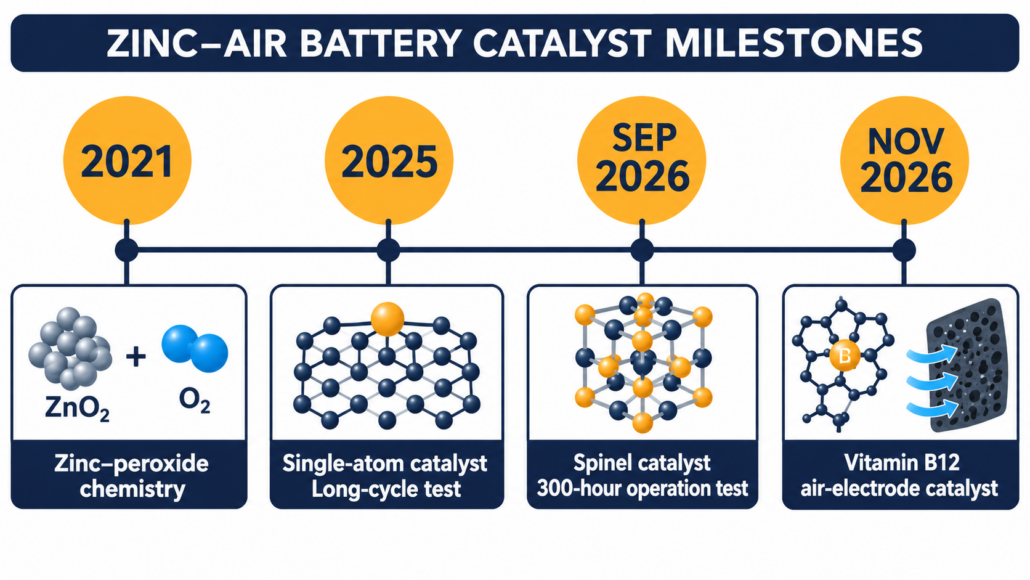
Recent zinc-air battery examples from 2025 and 2026 focus on the air electrode. The results are promising, but they are still lab results.
Atomic-Scale Catalysts Extend Cycle Life
Monash University researchers reported a catalyst of single cobalt and iron atoms on 2D carbon sheets. Their lab cell held stable cycling for 74 days, or 3,552 reported cycles.
The researchers reported better performance than the benchmark catalysts in their own tests. Do not treat the cycle count as a commercial full-depth cycle-life rating without checking the study’s cycling protocol.
Precious-Metal-Free Spinel Catalyst From TU Darmstadt
TU Darmstadt researchers first published a precious-metal-free catalyst on September 27, 2026, in Advanced Science. It pairs nickel ferrite with functionalized carbon nanohorns.
Their lab cell ran for up to 300 hours. The team ties this to a stable “triple junction,” since catalyst, electrolyte, and air must meet there.
A Vitamin B12 Air-Electrode Catalyst
In November 2026, the University of Córdoba shared a new zinc-air prototype. It uses vitamin B12 anchored to single-walled carbon nanotubes as an air-electrode catalyst.
The team reported up to 250 cycles in the Journal of Materials Chemistry A. The vitamin acts as a catalyst, not as fuel, and this is a proof of concept.
These results are not directly comparable. Operating hours and cycle counts depend on current density, cycle length, depth of discharge, and other test conditions.
Alternative Zinc-Air Battery Designs Beyond Catalysts
Some zinc-air battery work changes the chemistry or the cell design, not just the catalyst. These approaches change the reaction pathway, electrolyte, or cell architecture, not only the air-electrode catalyst.
A Different Reaction Path: Zinc Peroxide
A 2021 paper in Science by Wei Sun and colleagues took another route. It used a nonalkaline electrolyte to enable a two-electron zinc–peroxide path.
This changed the reaction itself, not just the catalyst. It improved reversibility, but it did not prove commercial readiness.
Gel and Flow Designs
Gel electrolytes cut leaks and hold water, which suits flexible devices. Flow designs refresh the liquid, which may ease carbonate buildup in fixed systems.
But neither fully solves water balance or durability. Both still need testing at full-system scale.
Zinc-Air Battery Commercial Maturity
Primary and rechargeable zinc-air cells are at very different stages. Treat them apart.
Primary cells are established in uses such as hearing aids. Rechargeable systems still struggle in four areas. These are efficiency, zinc reversibility, electrolyte and water management, and electrode durability.
A 2023 DOE assessment calls the market for zinc batteries still young. A 2021 Sandia handbook chapter lists only a few firms with grid-ready products. Both are background sources, not a 2026 market survey.
When you read a commercial claim, check the chemistry, the deployment scale, and the operating record. Many zinc-based batteries are not zinc-air.
Where a Zinc-Air Battery Could Fit
Each zinc-air battery use case sits at a different stage. Also, do not read primary-cell success as proof that large rechargeable systems are ready.
| Application | Why it fits | Main limit |
| Hearing aids and small devices | Compact primary cells are proven. | Not built for repeated recharging. |
| Stationary storage | Low-cost zinc and scalable designs. | Efficiency, life, and air management. |
| Flexible electronics | Thin zinc and gel electrolytes bend. | Water retention and durability. |
| Electric transport | High theoretical energy; swappable zinc. | Power, rechargeability, and infrastructure. |
Compare zinc-air proposals with alternatives using measured efficiency, operating life, installed cost, and maintenance needs. Our BESS guide covers that field.
For multi-day storage, compare zinc-air with the iron-air battery and other options in our LDES overview. For another emerging chemistry, see the sodium-ion battery guide.
How to Judge a Zinc-Air Battery Breakthrough
Many zinc-air battery headlines quote numbers without context. Ask these questions before you trust a number.
- Is energy density per zinc mass, per cell, or per system?
- How deep was each cycle?
- What current density and active electrode area were used?
- Was the test run in ambient air or pure oxygen?
- Was water, electrolyte, or zinc refilled during the test?
- Did the report give efficiency and capacity retention?
- Did the test use practical material loadings and a representative cell format?
A self-contained device that runs for months without refills answers a harder question than a long, shallow test. So compare conditions, not headlines.
Frequently Asked Questions About the Zinc-Air Battery
These short answers cover common questions about the zinc-air battery.
What is a zinc-air battery?
It pairs a zinc electrode with an air electrode that draws in oxygen. Disposable primary versions are common, and rechargeable versions are an active research area.
Can a zinc-air battery be recharged?
Rechargeable zinc-air batteries have been demonstrated. Their real performance depends on zinc reversibility, air-electrode durability, electrolyte stability, and efficiency. Do not assume primary cells can be recharged.
How does it compare with lithium-ion?
Zinc-air chemistry has high theoretical specific energy. Do not compare it directly with a finished lithium-ion cell. Rechargeable zinc-air systems still face efficiency and durability limits, so compare them under matched conditions.
Are zinc-air batteries safe?
Water-based zinc-air batteries avoid the flammable organic solvents found in many lithium-ion cells, making them inherently safer against thermal runaway. However, they use alkaline electrolytes that can be corrosive, and secondary concerns like hydrogen gas formation or dendrite growth still require proper system design.
Are zinc-air batteries on the market?
Primary zinc-air batteries are already commercial. For rechargeable systems, timing depends on the application and on proof of operating life, efficiency, cost, and scalable manufacturing.
Conclusion: Where the Technology Stands
The zinc-air battery pairs a strong concept with a hard engineering problem. New catalysts in 2025 and 2026 are real progress, but they are not the finish line.
But four things must work together in one device: fast oxygen reactions, reversible zinc, stable water balance, and CO₂ resistance. Until they do, treat zinc-air as a promising family of systems, not a proven replacement.
Further Reading
These SunLith Energy guides add context to the zinc-air battery topic.
- What Is an Iron-Air Battery? A Complete Guide to Multi-Day Energy Storage
- Long-Duration Energy Storage (LDES): Importance and Technologies
- Sodium Ion Battery: Complete Guide to Next-Generation Energy Storage
- Sodium-Ion vs. Lithium-Ion Batteries
- Ultimate Guide to Battery Energy Storage Systems (BESS)
- Grid-Scale BESS: Essential for Grid Stability and Renewable Energy
Sources
These sources support the zinc-air battery research and market points above.
- U.S. Department of Energy: Technology Strategy Assessment, Zinc Batteries (2023)
- Sandia National Laboratories: Energy Storage Handbook, Chapter 5, Rechargeable Zinc Batteries for Grid Storage
- TU Darmstadt: New momentum for the zinc-air battery (October 9, 2026)
- Yadav et al., Advanced Science (September 27, 2026), doi 10.1002/advs.77749
- García-Caballero et al., Journal of Materials Chemistry A (2026), doi 10.1039/d6ta02773c
- Sun et al., Science (2021), doi 10.1126/science.abb9554
- Synergistic electronic interplay between CoFe single atom and nitrogen on 2D carbon boosts bifunctional oxygen redox in metal-air batteries, Chemical Engineering Journal (2025)
- Nazir et al., A Review of Rechargeable Zinc–Air Batteries: Recent Progress and Future Perspectives, Nano-Micro Letters 16, 138 (2024)




Leave a Reply
Want to join the discussion?Feel free to contribute!