

“We Can Offer a Lower Price” Is Not a Business Case
The risks of a price-first pitch from a cheaper supplier who does not know your business
“Hello, we can offer you a better price. Give us a chance.” The message comes from a cheaper supplier you have never worked with, often through WhatsApp, LinkedIn, or another messaging platform.
The salesperson wants a place on your vendor list. They want to compete with your existing suppliers and win your business.
Yet they have asked almost nothing about how your business works.
They do not know your quality needs, delivery promises, approval steps, or tolerance for mistakes. They also do not know what your current suppliers do well, or whether you want a new vendor at all.
Still, they present a lower price as if it settles the question.
The problem is not that they contacted you, or that they claim to be cheaper. The problem is that they propose a solution before they understand your requirements.
Buyers notice this approach. In a survey of 632 B2B buyers by Gartner, 73% said they actively avoid suppliers that send irrelevant outreach.
Is a Cheaper Supplier Worth Considering?
Quick answer: A cheaper supplier deserves a fair hearing, not a free pass. A lower price is only a claim until the supplier shows what it includes and how it achieves it. Compare scope, quality, delivery, payment terms, and switching costs. Then check the supplier’s skills with a small trial.
Yes, a lower quote deserves consideration. It does not deserve an exemption from scrutiny.
This guide also shows how to test a price claim, find the hidden costs, and run a fair trial.
A Cheaper Supplier Quote Is Not Always a Comparable Offer
Before any supplier claims better value, both sides must agree on what they are comparing.
Does the price cover the same specifications, delivery schedule, and quality checks? Does it cover the same payment terms, support, warranty, and responsibility when something goes wrong?
Without those answers, “we are cheaper” may mean little more than “our number is smaller.”
Compare Whole-Life Cost, Not the Headline Price
Good procurement practice looks past the number on the quotation. UK government guidance on should-cost modeling says the key factor is whole-life cost, not the initial purchase price.
The UK Consultancy Playbook (Version 2.0, November 2026) likewise asks buyers to understand the whole-life cost of each delivery option. A supplier review should also weigh quality, on-time delivery, and skill.
A Cheaper Supplier Quote May Hide Different Incoterms
Global quotes add one more trap. The ICC’s Incoterms rules define who handles delivery tasks, costs, and risks under a sales contract.
Under EXW, the seller only makes the goods available at its own premises. Under DDP, the seller delivers the goods cleared for import.
An $880 EXW price and a $1,000 DDP price are not yet comparable.
Worked Example: 12% Cheaper on the Quote, 4.7% Higher in Total
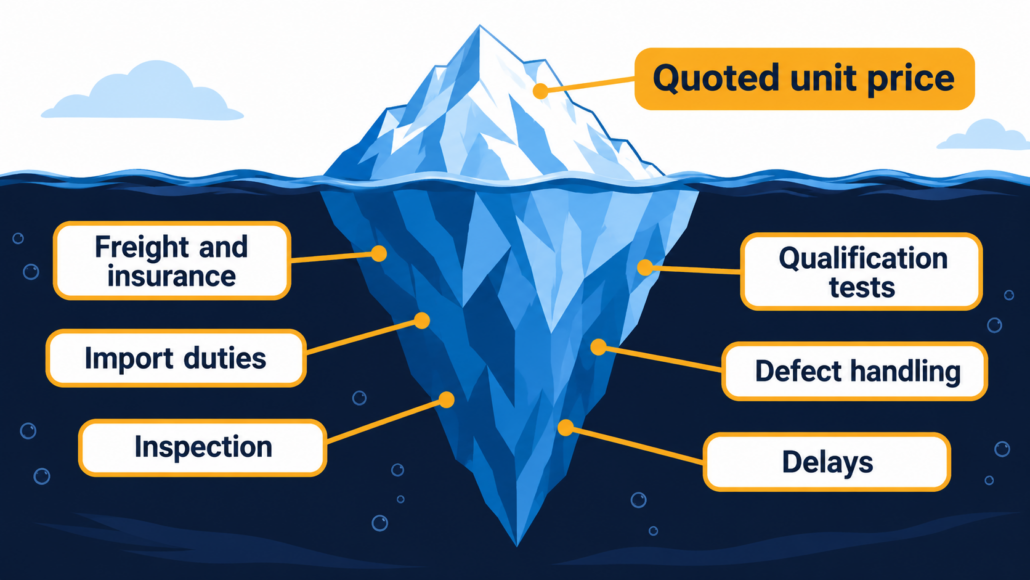
The table below uses illustrative numbers, not market data. Replace them with your own quotes.
| Cost item (order of 100 units) | Current supplier (DDP) | Cheaper supplier (EXW) |
|---|---|---|
| Unit price | $100,000 | $88,000 |
| Freight and insurance to your site | Included | $4,500 |
| Import duties and clearance | Included | $5,000 |
| Pre-shipment inspection | Included | $1,200 |
| Sample approval and qualification tests | $0 (already approved) | $3,000 |
| Defect handling and returns | $1,000 | $4,000 |
| Total comparable cost | $101,000 | $105,700 |
The cheaper supplier is not wrong or dishonest here. Its quote simply leaves more costs with you.
On a one-off order, the new supplier costs more. Spread the qualification cost over repeat orders, and the result may change. But that holds only after quality, delivery, and support are proven.
Why a Cheaper Supplier’s Price-First Pitch Undermines Trust
A salesperson cannot know every detail of your business before first contact. Some information is private, and learning it takes a conversation.
But approaching a buyer to learn differs from approaching a buyer with an unsupported promise. A professional opening might read: “We supply businesses in your sector. I would like to understand your requirements and see whether we can improve cost, delivery, or service.”
But compare that with: “Whatever your current supplier charges, we can do it for less.”
The first message admits uncertainty. The second claims an advantage before anyone has built a basis for comparison.
That survey shows what buyers want instead. They still seek seller input when they need help judging whether a product fits their needs.
It also found that 69% of buyers see gaps between a supplier’s website and what its salespeople say. That gap is a trust problem before the first order.
The messaging platform is not the issue. The quality of the approach is. Asking before promising earns trust, even for a cheaper supplier.
Six Risks Behind an Unexplained Cheaper Supplier Quote
A low price does not prove poor quality or bad intent. Yet a supplier may truly operate more efficiently.
But when a salesperson cannot explain how the price fits your needs, six risks deserve a closer look.
1. Important Requirements May Be Missing From the Quote
A supplier who has not understood the work may underestimate what delivery needs. The quote might leave out inspections, documentation, packaging, revisions, or technical support that your current supplier includes.
Those gaps can later surface as extra charges, reduced service, or disputes over scope.
In battery storage, for example, a quote may exclude commissioning, firmware support, or cell test reports. Our C&I BESS quote checklist lists what a supplier needs before it can price the job.
Ask a better question than “How much cheaper are you?” Try: “What exactly does your price include, and what does it exclude?”
2. Savings May Disappear in Quality Failures
A lower invoice becomes expensive when you must inspect, correct, reject, or replace the supplier’s work. Quality problems also hurt production, returns, and your reputation.
Those costs belong in the comparison, even when they never appear on the supplier’s invoice.
Instead, ask whether the supplier can meet your standard every time, not whether it can make one good sample.
3. Delivery and Capacity May Not Support the Promise
Winning an order and filling it well take different skills. A supplier needs the people, processes, and capacity to back its commitments.
Check delivery history, financial health, and spare capacity. Those checks separate a persuasive promise from a dependable supply.
The UK Consultancy Playbook tells evaluators to check that the bid team does the work. Apply the same test to factories: the plant you audit should build your order.
For time-sensitive operations, one late shipment can cost more than the saving.
4. The Price May Change Once You Depend on the Supplier
An attractive entry price may be temporary. A supplier could later recover margin through surcharges, change orders, or price increases once switching gets costly.
This is a risk to examine, not an accusation that fits every discounted offer.
The Consultancy Playbook raises a related concern. It warns against £1 or free offers on the supplier’s terms. They can create dependency on a supplier whose long-term terms are less favorable. It names the pattern “landing and expanding.”
Before you rely on a saving, confirm how long the price holds. Then check volume commitments, adjustment rules, and exit terms.
Keep at least one approved backup supplier. The Playbook’s taxi-rank model rotates work among several suppliers to preserve competition and avoid lock-in.
5. Switching Creates Work
Replacing a supplier is more than a buying decision. It may need testing, sample approval, system changes, and staff time.
But those transition costs are real. A lower quoted price does not cover them.
Still, an established vendor should not win just because it is familiar. The Playbook itself warns buyers against the trap of only choosing known suppliers.
Instead, judge a challenger against the full cost of changing, not an imaginary world where switching is free.
6. Identity and Payment Risk Rises With Unsolicited Offers
An unsolicited message can also be a fraud channel. In 2025, the FBI logged 24,768 business email compromise complaints. Reported losses reached about $3.05 billion.
The FBI says this scam targets businesses that work with foreign suppliers.
Most cheaper suppliers are honest. Still, verify the company, its factory, and its bank account before money moves. Our supplier red flags guide explains how.
What a Cheaper Supplier’s Pitch Reveals About the Company
First, an uninformed pitch is evidence about the sales interaction. It is not proof that the whole company is incompetent or dishonest.
The rep may be new, poorly trained, or following a generic script. The supplier may still have strong operations.
Still, the pitch gives you a reason to test how the company handles customer requirements. Ask yourself:
- Does the salesperson ask questions before making firm commitments?
- Can the company explain what creates its cost advantage?
- Does it disclose exclusions and limits clearly?
- Can operations staff verify what sales promised?
- Will it follow your formal approval process?
These questions separate a weak opening message from a deeper inability to deliver the work.
The strongest criticism is not that a cheaper supplier is bad. It is that price claims without evidence cannot prove suitability.
Judge Your Current Supplier and the Cheaper Supplier by the Same Rules
A price-first pitch treats your current supplier’s invoice as the whole relationship. Your supplier also brings steady quality, reliable lead times, fast answers, and technical help.
The same discipline applies to incumbents. Being familiar is not proof of value. A long bond does not excuse weak work or high prices.
Use the new quote as a benchmark. Ask your current supplier to itemize its price, then compare line by line.
Treat the cheaper supplier and the incumbent alike. The goal is neither loyalty at any cost nor switching at the first discount. It is fair competition, backed by evidence, on like-for-like terms.
How to Test a Cheaper Supplier’s Price Claim
Governments face this problem daily, so their guidance helps when you assess a cheaper supplier. Their lessons also fit private buyers. The UK Government Commercial Function publishes guidance on abnormally low tenders under the Procurement Act 2023.
Let the Supplier Prove the Price
The guidance starts with fairness. It says not to reject a low price automatically. A supplier may have real efficiencies, supply chain deals, or a better grasp of the buyer’s needs.
What matters is evidence. The supplier must show it can deliver at the price offered. It should share a clear cost model on request.
Section 19(3)(c) of the Act lets an authority disregard an abnormally low tender. Section 19(4) first requires a fair chance for the supplier to show it can perform.
Warning Signs That a Price Does Not Add Up
The same guidance lists indicators that a price may be unrealistic:
- A premium service offered at a budget price.
- An incomplete price breakdown.
- A delivery plan that does not match the resources offered.
- Missing start-up costs, or savings with no credible plan.
- Low supply chain costs without supporting evidence.
Central government buyers must refer any bid over 10% below the average bid, or the should-cost estimate, to the Cabinet Office. Private buyers face no such rule. Still, the idea works as a trigger for a closer look.
What a Credible Cheaper Supplier Should Demonstrate
A serious supplier should move beyond “try us” and give you a basis for evaluation.
Scale the review to the importance and risk of buying from a cheaper supplier. The table shows what to request.
| Area | Evidence or explanation to request |
|---|---|
| Requirements | Written confirmation of specifications, scope, volumes, timelines, and acceptance criteria |
| Cost advantage | A credible cost model that explains how the lower price is achieved |
| Quality | Quality controls, performance records, samples, or test results that match your product |
| Delivery | Lead times, free capacity, delivery history, and contingency plans |
| Commercial terms | Clear inclusions, exclusions, payment terms, price validity, and remedies |
| Business reliability | Checks on legal identity, financial stability, factory ownership, and bank account |
| Trial performance | A limited evaluation with success measures agreed in writing |
Where a trial fits, “give us a chance” should become a defined test, not an open-ended transfer of risk to you.
Set the Quality Threshold Before You Compare Price
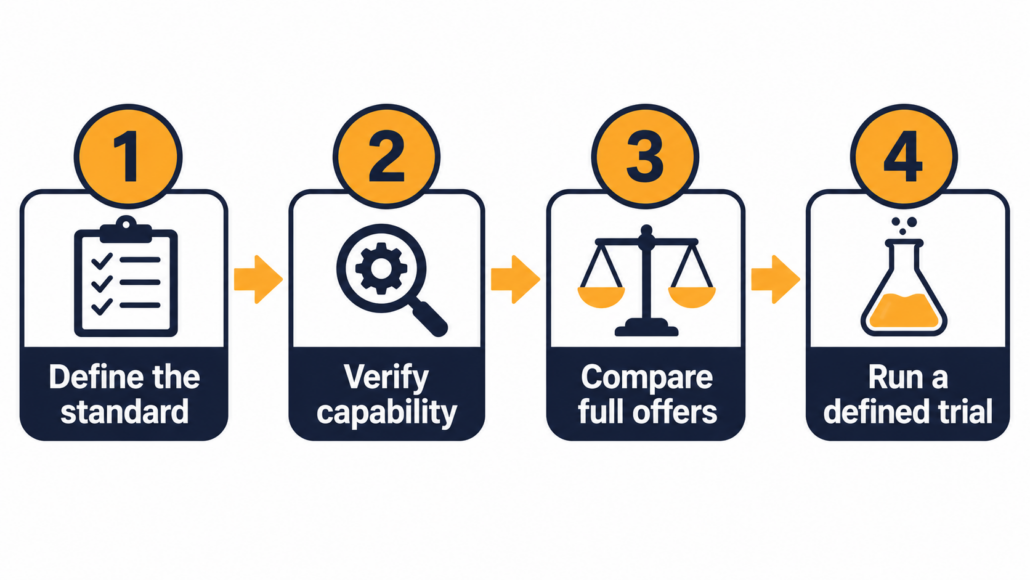
One useful principle is to set a minimum standard before you compare prices.
The Consultancy Playbook says evaluation should balance quality and price. No supplier should bypass quality rules by offering the lowest day rate. Every bid should meet a quality threshold first.
It also advises testing your evaluation to see whether abnormally low bids change the outcome. That advice covers consultancy buying, but the logic fits any vendor decision.
Apply it to any cheaper supplier in four steps:
- Define what acceptable performance requires.
- Establish whether the supplier can meet it.
- Compare the full offers side by side.
- Test what you cannot verify before a big order.
Price still matters. It simply becomes meaningful inside a defined standard of performance.
Give the Cheaper Supplier a Defined Trial, Not an Open-Ended Chance
What a Good Trial Includes
“Give us a chance” should become a short, written test. Agree the scope, volume, schedule, and success measures before the first order from the cheaper supplier ships.
- An order small enough to absorb if the trial fails.
- Written specs and clear pass-or-fail rules.
- Success measures such as on-time delivery, defect rate, and response time.
- A review date and a clear exit.
- Payment terms that avoid a large prepayment.
Keep your current supplier active during the trial. This limits disruption if the trial does not meet the agreed standard.
A Sample Reply to a Price-First Message
You do not need to be rude. A short, firm reply sets the terms.
Sample reply: Thank you for reaching out. Before we compare prices, please send your specifications, certificates, lead times, and payment terms. Please also list what your quote excludes.
If your offer looks suitable, we can discuss a small trial with agreed success measures.
Key takeaway: A lower price can open the conversation. It cannot replace the evidence needed to earn the business.
The Real Question About a Cheaper Supplier Is Not “Can You Charge Less?”
A new supplier has every right to compete. An existing supplier has no automatic right to stay.
Welcome real savings, better service, and strong alternatives. But an invitation to compete is not permission to skip qualification.
The question is not whether a cheaper supplier can charge less. It is whether that supplier can meet your requirements at a lower overall cost, with acceptable risk and clear accountability.
Key takeaway: A lower price can open the conversation. It cannot replace the evidence needed to earn the business.
Need Help Comparing Supplier Quotes?
Are you weighing a cheaper supplier for batteries, BESS, inverters, or PCS? A structured comparison protects your budget.
Contact SunLith Energy to talk through your sourcing needs.
Cheaper Supplier FAQs
These answers cover what buyers ask most about a cheaper supplier.
Should I ignore a cheaper supplier who messages me out of the blue?
No, but do not take the claim at face value. Reply with a request for specifications, an itemized price, and proof of capability.
How much cheaper is too cheap?
No fixed number fits every purchase. Compare the quote with your should-cost estimate and other bids, then look closer at clear outliers.
What should I ask a cheaper supplier first?
First, ask what the price includes and excludes. Then ask how the supplier achieves the lower cost.
Is switching suppliers worth a small saving?
Rarely, unless the saving covers testing, setup, and risk. Compare total delivered cost, with one-time switching costs, over several orders.
How do I run a supplier trial?
First, use a small order, written pass-or-fail rules, and agreed success measures. Keep your current supplier active until the trial ends.
Further Reading
These SunLith guides help you judge a cheaper supplier before you switch.
- Supplier Red Flags: 30 Warning Signs Buyers Should Know
- How to Prepare for a C&I BESS Quote
- C&I BESS Warranty Guide




Leave a Reply
Want to join the discussion?Feel free to contribute!