Supplier response time is not only about speed. The bigger issue is a salesperson who starts a conversation, disappears, and returns later with “Sorry, I was busy.”
You ask a real question about price, specifications, lead time or certification. Then you get one line, such as “Will check.” Then nothing.
Hours or days later, the message arrives: “Sorry, we are very busy.” Nobody expects instant answers. But busy with what?
Also, as a new buyer, you are left wondering whether your inquiry has an owner at all.
What Does Supplier Response Time Tell Buyers?
Quick answer: One slow reply proves little. But repeated, unexplained silence gives a new buyer reason to doubt the company can manage another customer. Supplier response time cannot reveal the cause. Ask for a date and a backup contact, then see if the supplier follows through.
What Supplier Response Time Looks Like in Practice
Supplier response time is more than how fast the first reply arrives. It is also whether the supplier keeps the conversation moving.
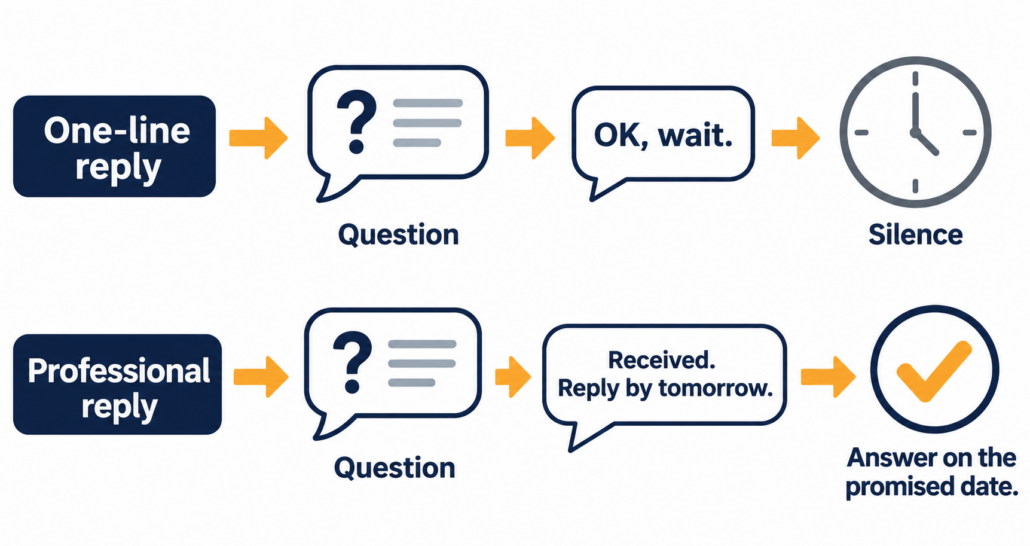
Buyers often describe the same pattern in four steps:
First, you send a detailed question about specifications, price or lead time.
Next, the salesperson replies with one line, such as “Will check.”
Then the conversation stops without an explanation or a date, so you have to chase.
Finally, the salesperson returns with “Sorry, busy” and a partial answer.
Each step looks small. But together they leave the buyer with no update and no clear owner.
Yet this is not only a China problem. A Harvard Business Review audit of more than 2,000 U.S. companies found that many were slow to answer web inquiries.
Some never answered at all. Because of this, judge each supplier by its own pattern, not by its country.
Why Disappearing Is Worse Than a Slow Reply
A slow reply that answers the question is a small problem. Still, you at least know the supplier engaged.
But a disappearing salesperson is different. You cannot tell whether the supplier is working on it, stuck, or has dropped your inquiry.
Because you cannot tell, you must chase. That puts the work on the buyer, which is the wrong way around.
Also, nobody expects 24-hour availability. A technical question may need input from engineering or production.
But needing time is different from leaving a buyer without an update. Good supplier response time means setting expectations, not answering instantly.
What Good Supplier Response Time Looks Like
A simple acknowledgment is enough:
Sample reply: Thank you for your inquiry. I need to check this with our engineer. I will get back to you tomorrow afternoon.
Then the buyer knows the message arrived and when to expect an answer.
Compare that with “Sorry, busy.” Here the first reply sets an expectation, but the second does not.
Use this as your standard when you judge supplier response time.
Is This One Salesperson’s Problem or a Company Problem?
When the same behavior repeats, the question becomes bigger than one employee. Then supplier response time reflects how the company is run.
First, does management know inquiries go unanswered? Next, is anyone tracking open quotations?
Also, is there a backup contact when the salesperson is away? Can it support another customer without neglecting existing ones?
If the Company Is Always Busy, Where Is the Capacity for Your Order?
If demand keeps exceeding the team’s capacity, what is management doing about it? Hiring may be one answer.
But better coordination, clearer responsibilities and a workable follow-up process may be others. What matters to the buyer is whether the company closes that gap.
A company does not have to explain every internal decision. But “we are busy” does not show that it can handle your account.
Could the Team Be Busy With Existing Problems?
A full workload does not tell a buyer what is creating it. Instead, separate what you can observe from what you can only suspect.
What You Can Observe
The conversation stops without an explanation.
No date is given for the next reply, so you cannot plan.
Nobody else steps in when the salesperson is away.
Explanations change from one message to the next.
Then the same pattern repeats.
What You Can Only Suspect
Possible causes include understaffing, poor coordination, delayed shipments, quality complaints, warranty claims or financial constraints. Some may indicate a product or business issue.
But these are possibilities, not conclusions. Slow communication alone does not establish a production problem, a quality failure or cash-flow trouble.
Whatever the cause, supplier response time leaves the buyer with one question: who will take responsibility for this account?
For a new buyer, this matters. Also, communication habits before the order are often the best evidence of how a supplier will handle problems after payment.
Questions That Replace Guesswork
Who will manage the account, and who provides backup?
What delivery commitments can the company realistically make?
How do technical questions and quality complaints get escalated?
What happens if the main contact is unavailable?
Can the company also provide relevant customer references?
How to Test Supplier Response Time Before You Order
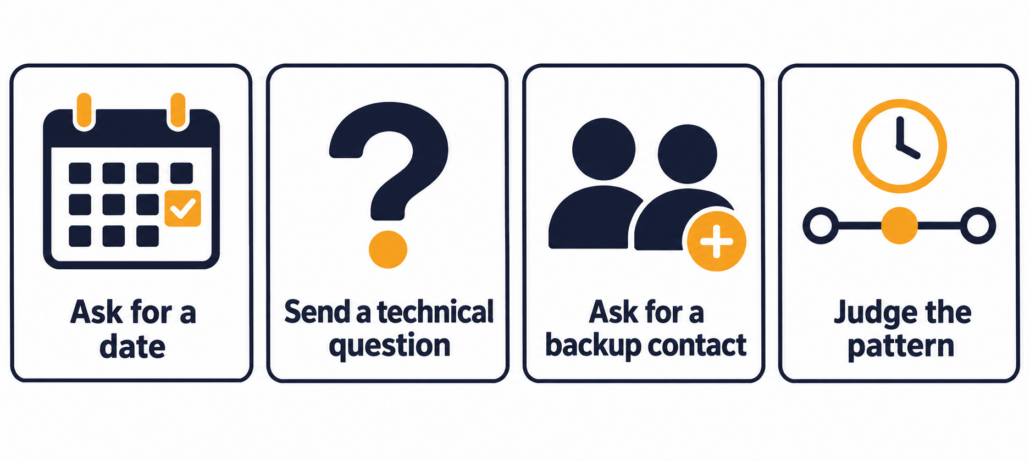
Testing supplier response time takes little effort, and four habits cover most of it.
Ask for a Date, Not a Promise
When a salesperson says “Will check,” reply with one polite line. For example: “Thank you. Can you confirm the date I will receive the answer?”
Then track whether the supplier keeps that date.
Send One Technical Question Early
Choose a question that needs a specific answer, such as cycle-life test conditions or lead time. Then note how fast and how clearly the supplier replies.
Ask Who Owns Your Account
Request a named contact and a backup, such as a sales manager or technical lead. A supplier with a real process will name both.
Judge the Pattern, Not One Delay
One late reply means little. But repeated late replies with no explanation mean a lot.
Check the quality of the answer too. A fast but vague reply is not a good one.
Questions Suppliers Should Ask Themselves
Owners can use the same lens on their own business, because supplier response time affects every inquiry they receive.
How long does your team take to answer a new inquiry?
Today, how many buyers are waiting for a quote or technical answer?
How many inquiries are lost because nobody follows up?
Does anyone review response times each week?
If the team is always busy, who has capacity for a new customer?
Then the answers show whether the company is organized to grow.
Frequently Asked Questions About Supplier Response Time
These answers cover common buyer questions about supplier response time.
What Is a Good Supplier Response Time?
A reasonable target is a first reply within one business day. But if the full answer takes longer, the supplier should confirm receipt and name a date.
Does a Slow Reply Mean the Supplier Is Bad?
Not by itself. A holiday or a technical check can cause a delay. But those delays come with an explanation and a date. Repeated silence does not.
Does Being Busy Mean the Supplier Has Problems?
Not necessarily, since busy can mean healthy demand. But it does not show capacity for your order, so ask for a date and a named contact.
How Many Follow-Ups Are Too Many?
If you must chase twice for a basic answer, note it. Then, if it happens again, treat it as a pattern.
Should Poor Supplier Response Time End the Conversation?
Not always. First, send a polite message asking for a date and a backup contact. If the supplier still goes quiet, look elsewhere or limit your risk with a small trial order.
Final Thoughts on Supplier Response Time
Being busy is understandable. Repeatedly leaving a buyer without an update is the issue.
A new customer should not have to discover a company’s capacity problems after placing an order.
Also, if a company is too busy to develop new business today, how will it manage your business tomorrow?
Have you ever dropped a supplier after a one-line reply and silence? Share your experience in the comments.
Need Help Checking a Supplier?
Are you sourcing batteries, BESS, inverters or PCS from overseas? Supplier response time is one check, but not the only one. Contact SunLith Energy to talk through the rest.
Further Reading
These guides also add context on supplier response time and supplier risk.
The risks of a price-first pitch from a cheaper supplier who does not know your business
“Hello, we can offer you a better price. Give us a chance.” The message comes from a cheaper supplier you have never worked with, often through WhatsApp, LinkedIn, or another messaging platform.
The salesperson wants a place on your vendor list. They want to compete with your existing suppliers and win your business.
Yet they have asked almost nothing about how your business works.
They do not know your quality needs, delivery promises, approval steps, or tolerance for mistakes. They also do not know what your current suppliers do well, or whether you want a new vendor at all.
Still, they present a lower price as if it settles the question.
The problem is not that they contacted you, or that they claim to be cheaper. The problem is that they propose a solution before they understand your requirements.
Buyers notice this approach. In a survey of 632 B2B buyers by Gartner, 73% said they actively avoid suppliers that send irrelevant outreach.
Is a Cheaper Supplier Worth Considering?
Quick answer: A cheaper supplier deserves a fair hearing, not a free pass. A lower price is only a claim until the supplier shows what it includes and how it achieves it. Compare scope, quality, delivery, payment terms, and switching costs. Then check the supplier’s skills with a small trial.
Yes, a lower quote deserves consideration. It does not deserve an exemption from scrutiny.
This guide also shows how to test a price claim, find the hidden costs, and run a fair trial.
A Cheaper Supplier Quote Is Not Always a Comparable Offer
Before any supplier claims better value, both sides must agree on what they are comparing.
Does the price cover the same specifications, delivery schedule, and quality checks? Does it cover the same payment terms, support, warranty, and responsibility when something goes wrong?
Without those answers, “we are cheaper” may mean little more than “our number is smaller.”
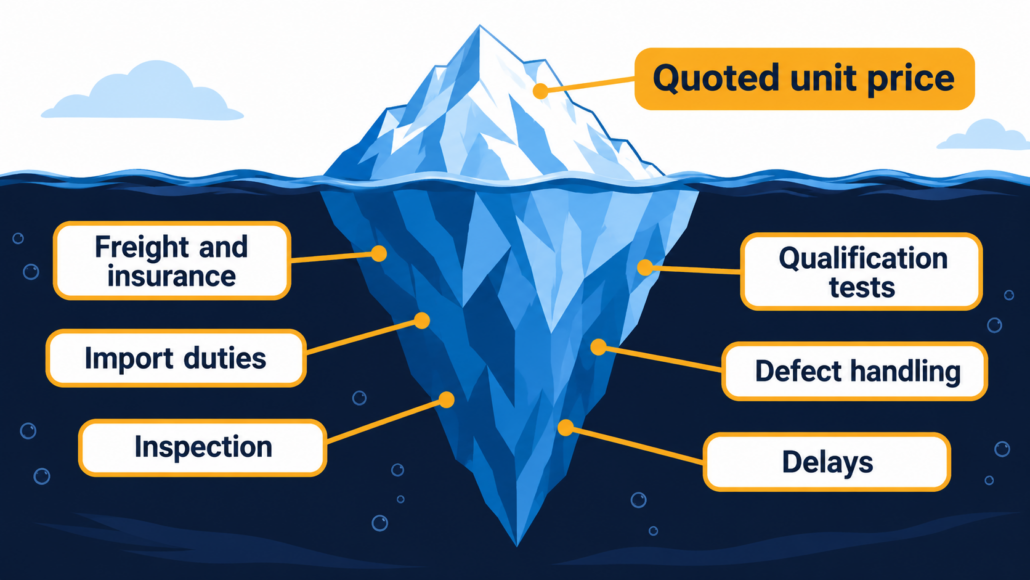
Compare Whole-Life Cost, Not the Headline Price
Good procurement practice looks past the number on the quotation. UK government guidance on should-cost modeling says the key factor is whole-life cost, not the initial purchase price.
The UK Consultancy Playbook (Version 2.0, November 2026) likewise asks buyers to understand the whole-life cost of each delivery option. A supplier review should also weigh quality, on-time delivery, and skill.
A Cheaper Supplier Quote May Hide Different Incoterms
Global quotes add one more trap. The ICC’s Incoterms rules define who handles delivery tasks, costs, and risks under a sales contract.
Under EXW, the seller only makes the goods available at its own premises. Under DDP, the seller delivers the goods cleared for import.
An $880 EXW price and a $1,000 DDP price are not yet comparable.
Worked Example: 12% Cheaper on the Quote, 4.7% Higher in Total
The table below uses illustrative numbers, not market data. Replace them with your own quotes.
Cost item (order of 100 units)
Current supplier (DDP)
Cheaper supplier (EXW)
Unit price
$100,000
$88,000
Freight and insurance to your site
Included
$4,500
Import duties and clearance
Included
$5,000
Pre-shipment inspection
Included
$1,200
Sample approval and qualification tests
$0 (already approved)
$3,000
Defect handling and returns
$1,000
$4,000
Total comparable cost
$101,000
$105,700
The cheaper supplier is not wrong or dishonest here. Its quote simply leaves more costs with you.
On a one-off order, the new supplier costs more. Spread the qualification cost over repeat orders, and the result may change. But that holds only after quality, delivery, and support are proven.
Why a Cheaper Supplier’s Price-First Pitch Undermines Trust
A salesperson cannot know every detail of your business before first contact. Some information is private, and learning it takes a conversation.
But approaching a buyer to learn differs from approaching a buyer with an unsupported promise. A professional opening might read: “We supply businesses in your sector. I would like to understand your requirements and see whether we can improve cost, delivery, or service.”
But compare that with: “Whatever your current supplier charges, we can do it for less.”
The first message admits uncertainty. The second claims an advantage before anyone has built a basis for comparison.
That survey shows what buyers want instead. They still seek seller input when they need help judging whether a product fits their needs.
It also found that 69% of buyers see gaps between a supplier’s website and what its salespeople say. That gap is a trust problem before the first order.
The messaging platform is not the issue. The quality of the approach is. Asking before promising earns trust, even for a cheaper supplier.
Six Risks Behind an Unexplained Cheaper Supplier Quote
A low price does not prove poor quality or bad intent. Yet a supplier may truly operate more efficiently.
But when a salesperson cannot explain how the price fits your needs, six risks deserve a closer look.
1. Important Requirements May Be Missing From the Quote
A supplier who has not understood the work may underestimate what delivery needs. The quote might leave out inspections, documentation, packaging, revisions, or technical support that your current supplier includes.
Those gaps can later surface as extra charges, reduced service, or disputes over scope.
In battery storage, for example, a quote may exclude commissioning, firmware support, or cell test reports. Our C&I BESS quote checklist lists what a supplier needs before it can price the job.
Ask a better question than “How much cheaper are you?” Try: “What exactly does your price include, and what does it exclude?”
2. Savings May Disappear in Quality Failures
A lower invoice becomes expensive when you must inspect, correct, reject, or replace the supplier’s work. Quality problems also hurt production, returns, and your reputation.
Those costs belong in the comparison, even when they never appear on the supplier’s invoice.
Instead, ask whether the supplier can meet your standard every time, not whether it can make one good sample.
3. Delivery and Capacity May Not Support the Promise
Winning an order and filling it well take different skills. A supplier needs the people, processes, and capacity to back its commitments.
Check delivery history, financial health, and spare capacity. Those checks separate a persuasive promise from a dependable supply.
The UK Consultancy Playbook tells evaluators to check that the bid team does the work. Apply the same test to factories: the plant you audit should build your order.
For time-sensitive operations, one late shipment can cost more than the saving.
4. The Price May Change Once You Depend on the Supplier
An attractive entry price may be temporary. A supplier could later recover margin through surcharges, change orders, or price increases once switching gets costly.
This is a risk to examine, not an accusation that fits every discounted offer.
The Consultancy Playbook raises a related concern. It warns against £1 or free offers on the supplier’s terms. They can create dependency on a supplier whose long-term terms are less favorable. It names the pattern “landing and expanding.”
Before you rely on a saving, confirm how long the price holds. Then check volume commitments, adjustment rules, and exit terms.
Keep at least one approved backup supplier. The Playbook’s taxi-rank model rotates work among several suppliers to preserve competition and avoid lock-in.
5. Switching Creates Work
Replacing a supplier is more than a buying decision. It may need testing, sample approval, system changes, and staff time.
But those transition costs are real. A lower quoted price does not cover them.
Still, an established vendor should not win just because it is familiar. The Playbook itself warns buyers against the trap of only choosing known suppliers.
Instead, judge a challenger against the full cost of changing, not an imaginary world where switching is free.
6. Identity and Payment Risk Rises With Unsolicited Offers
Most cheaper suppliers are honest. Still, verify the company, its factory, and its bank account before money moves. Our supplier red flags guide explains how.
What a Cheaper Supplier’s Pitch Reveals About the Company
First, an uninformed pitch is evidence about the sales interaction. It is not proof that the whole company is incompetent or dishonest.
The rep may be new, poorly trained, or following a generic script. The supplier may still have strong operations.
Still, the pitch gives you a reason to test how the company handles customer requirements. Ask yourself:
Does the salesperson ask questions before making firm commitments?
Can the company explain what creates its cost advantage?
Does it disclose exclusions and limits clearly?
Can operations staff verify what sales promised?
Will it follow your formal approval process?
These questions separate a weak opening message from a deeper inability to deliver the work.
The strongest criticism is not that a cheaper supplier is bad. It is that price claims without evidence cannot prove suitability.
Judge Your Current Supplier and the Cheaper Supplier by the Same Rules
A price-first pitch treats your current supplier’s invoice as the whole relationship. Your supplier also brings steady quality, reliable lead times, fast answers, and technical help.
The same discipline applies to incumbents. Being familiar is not proof of value. A long bond does not excuse weak work or high prices.
Use the new quote as a benchmark. Ask your current supplier to itemize its price, then compare line by line.
Treat the cheaper supplier and the incumbent alike. The goal is neither loyalty at any cost nor switching at the first discount. It is fair competition, backed by evidence, on like-for-like terms.
How to Test a Cheaper Supplier’s Price Claim
Governments face this problem daily, so their guidance helps when you assess a cheaper supplier. Their lessons also fit private buyers. The UK Government Commercial Function publishes guidance on abnormally low tenders under the Procurement Act 2023.
Let the Supplier Prove the Price
The guidance starts with fairness. It says not to reject a low price automatically. A supplier may have real efficiencies, supply chain deals, or a better grasp of the buyer’s needs.
What matters is evidence. The supplier must show it can deliver at the price offered. It should share a clear cost model on request.
Section 19(3)(c) of the Act lets an authority disregard an abnormally low tender. Section 19(4) first requires a fair chance for the supplier to show it can perform.
Warning Signs That a Price Does Not Add Up
The same guidance lists indicators that a price may be unrealistic:
A premium service offered at a budget price.
An incomplete price breakdown.
A delivery plan that does not match the resources offered.
Missing start-up costs, or savings with no credible plan.
Low supply chain costs without supporting evidence.
Central government buyers must refer any bid over 10% below the average bid, or the should-cost estimate, to the Cabinet Office. Private buyers face no such rule. Still, the idea works as a trigger for a closer look.
What a Credible Cheaper Supplier Should Demonstrate
A serious supplier should move beyond “try us” and give you a basis for evaluation.
Scale the review to the importance and risk of buying from a cheaper supplier. The table shows what to request.
Area
Evidence or explanation to request
Requirements
Written confirmation of specifications, scope, volumes, timelines, and acceptance criteria
Cost advantage
A credible cost model that explains how the lower price is achieved
Quality
Quality controls, performance records, samples, or test results that match your product
Delivery
Lead times, free capacity, delivery history, and contingency plans
Commercial terms
Clear inclusions, exclusions, payment terms, price validity, and remedies
Business reliability
Checks on legal identity, financial stability, factory ownership, and bank account
Trial performance
A limited evaluation with success measures agreed in writing
Where a trial fits, “give us a chance” should become a defined test, not an open-ended transfer of risk to you.
Set the Quality Threshold Before You Compare Price
One useful principle is to set a minimum standard before you compare prices.
The Consultancy Playbook says evaluation should balance quality and price. No supplier should bypass quality rules by offering the lowest day rate. Every bid should meet a quality threshold first.
It also advises testing your evaluation to see whether abnormally low bids change the outcome. That advice covers consultancy buying, but the logic fits any vendor decision.
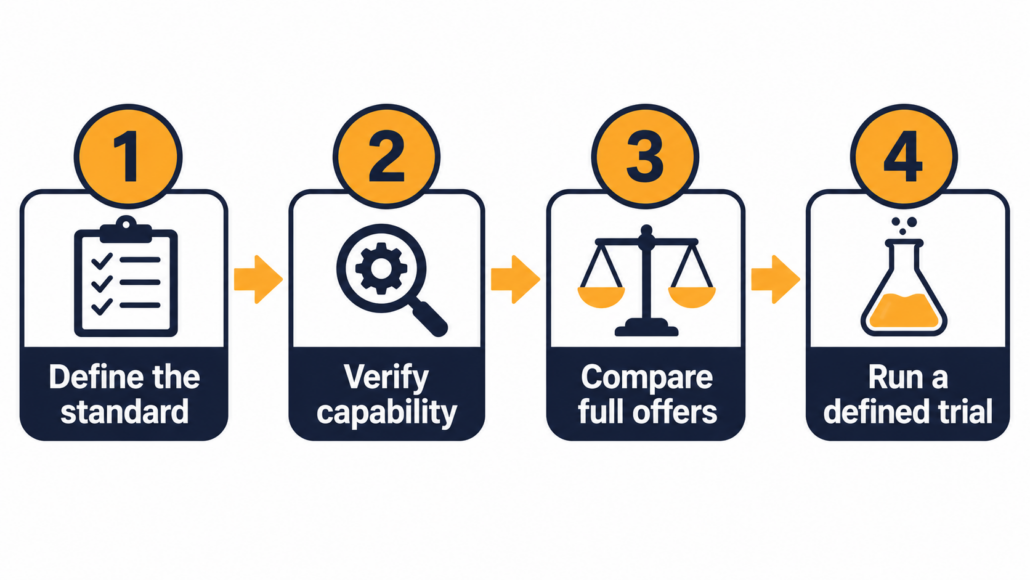
Apply it to any cheaper supplier in four steps:
Define what acceptable performance requires.
Establish whether the supplier can meet it.
Compare the full offers side by side.
Test what you cannot verify before a big order.
Price still matters. It simply becomes meaningful inside a defined standard of performance.
Give the Cheaper Supplier a Defined Trial, Not an Open-Ended Chance
What a Good Trial Includes
“Give us a chance” should become a short, written test. Agree the scope, volume, schedule, and success measures before the first order from the cheaper supplier ships.
An order small enough to absorb if the trial fails.
Written specs and clear pass-or-fail rules.
Success measures such as on-time delivery, defect rate, and response time.
A review date and a clear exit.
Payment terms that avoid a large prepayment.
Keep your current supplier active during the trial. This limits disruption if the trial does not meet the agreed standard.
A Sample Reply to a Price-First Message
You do not need to be rude. A short, firm reply sets the terms.
Sample reply: Thank you for reaching out. Before we compare prices, please send your specifications, certificates, lead times, and payment terms. Please also list what your quote excludes.
If your offer looks suitable, we can discuss a small trial with agreed success measures.
Key takeaway: A lower price can open the conversation. It cannot replace the evidence needed to earn the business.
The Real Question About a Cheaper Supplier Is Not “Can You Charge Less?”
A new supplier has every right to compete. An existing supplier has no automatic right to stay.
Welcome real savings, better service, and strong alternatives. But an invitation to compete is not permission to skip qualification.
The question is not whether a cheaper supplier can charge less. It is whether that supplier can meet your requirements at a lower overall cost, with acceptable risk and clear accountability.
Key takeaway: A lower price can open the conversation. It cannot replace the evidence needed to earn the business.
Need Help Comparing Supplier Quotes?
Are you weighing a cheaper supplier for batteries, BESS, inverters, or PCS? A structured comparison protects your budget.
Contact SunLith Energy to talk through your sourcing needs.
Cheaper Supplier FAQs
These answers cover what buyers ask most about a cheaper supplier.
Should I ignore a cheaper supplier who messages me out of the blue?
No, but do not take the claim at face value. Reply with a request for specifications, an itemized price, and proof of capability.
How much cheaper is too cheap?
No fixed number fits every purchase. Compare the quote with your should-cost estimate and other bids, then look closer at clear outliers.
What should I ask a cheaper supplier first?
First, ask what the price includes and excludes. Then ask how the supplier achieves the lower cost.
Is switching suppliers worth a small saving?
Rarely, unless the saving covers testing, setup, and risk. Compare total delivered cost, with one-time switching costs, over several orders.
How do I run a supplier trial?
First, use a small order, written pass-or-fail rules, and agreed success measures. Keep your current supplier active until the trial ends.
Further Reading
These SunLith guides help you judge a cheaper supplier before you switch.
Supplier red flags often appear long before you place a purchase order. How a supplier behaves after a trade exhibition shows how it may treat your order after it receives your money.
Imagine you meet a supplier at an international exhibition. You explain your requirements, discuss technical specifications, and exchange business cards.
You expect a professional follow-up. Instead, nothing happens.
A week later, a generic catalog arrives with one line: “If you need any products, please feel free to contact us.”
Nothing refers to your discussion. Nobody asks about your project or tries to build a business relationship.
This is more than poor salesmanship, because it may reveal weak management, loose customer processes, and low operational discipline.
Fraud adds another risk. The FBI warns that business email compromise targets businesses that work with foreign suppliers.
In international B2B sourcing, price alone is not enough because you need a partner who delivers what they promise.
This guide covers 30 numbered supplier red flags, eight critical risk areas, and a 9-step qualification process. Use it before your first purchase order (PO).
What Are the Most Important Supplier Red Flags?
Quick answer: The most important supplier red flags include silence after an exhibition, vague answers, hidden subcontracting, uncontrolled design changes, mismatched payment accounts, and weak corrective action. One flag is only a warning. Several together mean you should verify supplier identity, production capacity, documents, and payment details before ordering.
1. Supplier Red Flags After the Exhibition: Poor Follow-Up
These supplier red flags appear right after the show, while your inquiry is still fresh.
Early Supplier Red Flags: Silence and Generic Catalogs
Red flag 1: Complete silence after the exhibition. You showed interest, discussed requirements, and shared contact details. Yet the supplier never contacts you.
What it reveals: Poor lead management, no structured customer relationship management (CRM), and weak sales accountability.
A busy exhibition produces hundreds of leads, so a short delay is fine. Still, continued silence without any acknowledgment is a warning.
If a company cannot manage your inquiry, can you trust it to manage your production schedule?
Red flag 2: The copy-paste catalog approach. You receive a generic catalog unrelated to your discussion. Nobody mentions the product or project you discussed.
What it reveals: The sales representative processes contacts instead of developing opportunities. As a result, your specifications, packaging instructions, and commercial terms may not get the attention they deserve.
Weak Research and Passive Selling
Red flag 3: Zero research about the buyer. The supplier asks basic questions that your business card or website already answers. As a result, they do not understand your business, market, or buying needs.
What it reveals: A lack of preparation and weak B2B account management.
Good suppliers know that buyers differ. For example, importers, distributors, developers, and Original Equipment Manufacturer (OEM) customers need different approaches.
Red flag 4: The passive salesperson. The conversation ends with “If you need anything, please contact us.” Then nothing follows.
There is no follow-up, no talk about your timeline, and no product recommendation.
What it reveals: The company may lack a structured business development process. A professional representative stays in touch without pressuring you.
Red flag 5: The catalog-and-wait mentality. Sending a catalog is not relationship building. Instead, a serious supplier asks about your needs, suggests suitable products, and answers questions.
If the supplier expects you to do all the work, why would it take responsibility when problems arise?
2. Supplier Red Flags You Can Spot at the Exhibition
Your evaluation starts at the booth, not after you return home. Watch for these supplier red flags during the show.
Red flag 6: Booth representatives cannot answer technical questions. Every technical question gets the same reply: “I will check with our engineer.” Involving engineers is fine. But repeated failure to return with answers signals weak coordination or limited product knowledge.
This becomes serious when you buy lithium batteries or battery energy storage systems (BESS). It also applies to solar inverters, power conversion systems (PCS), and battery management systems (BMS).
Red flag 7: The booth does not match the company. The displayed products look impressive, but the website, factory information, and business profile tell a different story.
Ask yourself:
Are these actually their products?
Do they manufacture them?
Do they have their own engineering team?
Can they show their production facilities?
Do the displayed products come from other manufacturers?
However, a polished booth does not prove production skill.
Red flag 8: Nobody owns your inquiry. You talk to one representative, but later you get a different contact and discover nobody knows your discussion.
What it reveals: Poor internal communication and unclear responsibility. Instead, a serious supplier assigns an accountable person to your inquiry.
3. Communication Problems That Predict Operational Issues
Communication habits are supplier red flags too, because they predict how the supplier will run your order.
Red flag 9: Inconsistent response times. The first reply arrives in minutes. The next takes three days, and then another week passes.
A busy sales team is fine. However, unexplained delays create doubt. Our guide to supplier response time explains what one-line replies and silence reveal.
Red flag 10: Vague answers without commitments. You ask about delivery, specifications, or customization. The answer is always “Yes, no problem,” with no numbers, dates, or written commitments.
But a good supplier separates what is possible, what is affordable, and what is confirmed.
Red flag 11: Avoiding written communication. The representative prefers informal chats on instant messaging apps but avoids formal quotations, proforma invoices, specifications, and written agreements.
Informal communication is normal in international trade. However, all important commercial and technical commitments should be documented.
Red flag 12: Contradictory information. The catalog states one specification, the website shows another, and the salesperson gives a third.
This can signal poor document control or outdated product data. Never assume the latest verbal answer is correct. Instead, request an approved technical datasheet.
4. Manufacturing and Technical Capability: What Buyers Should Verify
This is where buyers must be especially careful. Weak answers here are supplier red flags that separate real factories from polished presentations.
Identity and Documentation
Red flag 13: Unclear factory or trading company identity. The supplier presents itself as a manufacturer but avoids direct questions about its production facilities.
Trading companies are not a problem in themselves, and many provide valuable sourcing services. The problem is misrepresentation, so you must know who makes your products.
Red flag 14: No genuine technical documentation. The supplier cannot provide:
Product datasheets.
Material specs.
Certifications and supporting reports.
Quality inspection records.
Product test reports.
Production and process information.
For battery and energy storage projects, also examine cell traceability, BMS specifications, protection functions, cycle-life test conditions, and safety certifications.
But a certificate alone does not prove that the supplied product matches the tested product.
Claims, Audits, and Capacity
Red flag 15: Unrealistic product claims. The supplier promises exceptional performance, extremely long cycle life, or unusually low prices. Yet it cannot provide reliable evidence.
For example, a battery maker claims 8,000 cycles. Yet it cannot explain the test temperature, charge and discharge rate, depth of discharge (DOD), or end-of-life capacity.
Claims without test conditions are marketing, not engineering evidence.
Red flag 16: Resistance to factory audits and video inspections. The supplier makes repeated excuses when you ask for a live video inspection or factory audit. A legitimate manufacturer may have confidentiality limits but should offer a reasonable alternative.
Red flag 17: No clear production capacity. The supplier promises large orders but cannot explain:
Monthly output.
Current production loading.
Available production lines.
Raw-material supply.
Typical production lead times.
Subcontracting plans.
Paper capacity is not free capacity, so check it against your order size and delivery date.
5. Supplier Red Flags in Commercial Behavior
Commercial pressure is one of the clearest supplier red flags. Watch how the supplier handles price, payment, and warranty.
Red flag 18: Price is the only selling point. The supplier focuses on the lowest price. Yet it rarely discusses quality, materials, engineering, certifications, warranty, or support.
An unusually low price deserves investigation, so understand exactly what the quote includes and excludes.
Red flag 19: Pressure for an advance payment. You receive special discounts, urgent payment requests, or claims that prices rise tomorrow. The supplier wants a deposit before technical verification and secure contract terms.
Never let sales pressure replace due diligence, because rushed payments are hard to reverse.
Red flag 20: No meaningful warranty or after-sales support. The supplier speaks enthusiastically about sales but turns vague about defects, replacements, warranty, and technical support.
Ask who handles claims, who pays freight, what evidence is required, and how fast problems get resolved.
Red flag 21: Unclear payment beneficiary. The quotation, company registration, and bank account details do not match. The supplier asks you to pay an unrelated company or an individual without a documented reason.
This is a serious payment-fraud warning, so verify the beneficiary independently before you transfer funds. Section 10 explains how.
6. The Hidden Problem: Order Takers Instead of Business Developers
Many companies employ sales representatives who act as order takers instead of account managers. Order takers create many supplier red flags, because they never look beyond the quotation.
An order taker waits for requests and sends quotations. But a professional B2B salesperson understands your business, finds opportunities, builds relationships, and solves problems internally.
Common skill gaps include:
Weak understanding of customer value: They treat an importer with long-term potential like a one-time retail buyer.
No relationship management: They send a catalog and forget the lead if you do not reply.
Little grasp of vendor onboarding: They expect an immediate PO but ignore supplier qualification, compliance documents, factory audits, and approved vendor list (AVL) procedures.
No ability to add value: They discuss only price and standard products.
No ownership: They cannot coordinate engineering, production, and quality control.
International B2B business is not about sending quotations. Instead, it is about becoming a reliable, approved partner.
7. The Human Factor: When an Unhappy Salesperson Affects Your Business
Not every communication problem comes from company process. Sometimes the salesperson is simply unhappy, and that creates supplier red flags too.
The person may be underpaid, overworked, denied commission, overlooked for promotion, or planning to leave. As a result, disengaged employees may stop following up or give only minimum service.
Possible warning signs include:
Communication was excellent, then suddenly got worse.
Replies become short and mechanical.
Promised quotations, samples, or documents never arrive.
The representative cannot resolve basic issues.
Another employee or a manager answers much faster.
These signs do not prove the salesperson is unhappy. However, other explanations exist.
The real issue is accountability. A well-run company protects customer relationships even when an employee leaves, so your business should never depend on one salesperson. Section 10 also shows how to prevent this.
8. The Root Cause: Companies That Do Not Invest in Their People
A company that will not invest in employees may struggle to invest in customer success. Supplier red flags can appear at every stage of the order.
High employee turnover: The person handling your inquiry leaves. The replacement does not know your history, requirements, or earlier commitments.
No authority to solve problems: The salesperson cannot challenge wrong production decisions, escalate quality issues, or win management support.
This worries buyers most when they order customized products. Therefore, a good salesperson should act as your representative inside the supplier.
9. Additional Supplier Red Flags Many International Buyers Overlook
These supplier red flags matter most when you source from overseas manufacturers.
Identity, Subcontracting, and Quality Control
Red flag 22: Frequent changes in company identity. The company name, registered address, quotation details, or contracting entity change during negotiations without explanation.
Red flag 23: Unapproved subcontracting. The supplier promises in-house manufacturing, then moves production to another factory without your knowledge or approval. Section 10 lists contract terms that prevent this.
Red flag 24: No proper quality-control system. The supplier cannot explain incoming quality control (IQC), in-process quality control (IPQC), final quality control (FQC), or outgoing quality control (OQC).
Red flag 25: No production traceability. The supplier cannot trace materials, components, batches, or finished products when a quality issue occurs.
Change Control, Delivery, and Complaints
Red flag 26: Unclear change-control procedures. The supplier changes components, materials, firmware, cell brands, or processes without telling you.
This is especially dangerous in battery and energy storage projects.
Red flag 27: No realistic delivery planning. The supplier promises very short lead times but has not checked material supply, production schedules, or testing needs.
Red flag 28: Poor packaging and export preparation. The supplier cannot explain export packaging, labeling, shipping documents, or dangerous-goods requirements.
Red flag 29: No clear complaint-handling process. There is no defined procedure for defective products, corrective actions, root-cause analysis, or replacement claims.
Red flag 30: Unwillingness to accept independent inspection. The supplier resists third-party inspection, pre-shipment inspection, or an agreed factory acceptance test (FAT).
A supplier should also prove that delivered products meet the agreed specifications.
10. Eight Critical Supplier Risk Areas Most Buyers Overlook
These eight risk areas reveal deeper supplier red flags than poor exhibition follow-up. Each one hides a risk that only appears after you place the purchase order.
Together, they show whether a supplier can protect your project when people, factories, parts, and payments change.
Account Ownership: Dependence on One Salesperson
Many suppliers run your project through a single salesperson. That works until the person leaves, changes roles, or stops caring.
Then your specifications, price agreements, and promises vanish with them. As a result, a replacement often starts from zero.
Watch for these warning signs:
Only one person knows your technical requirements.
Quotations and approvals sit in private chat threads.
No manager or engineer appears on key emails.
The supplier refuses to name a backup contact.
A colleague cannot answer simple questions about your order.
Ask the supplier to assign three named roles:
A sales contact for commercial questions.
A technical contact for specs and changes.
A senior contact for urgent problems.
Also keep your own project file. Store the approved specification, quotation history, and meeting notes in your records, not only theirs.
Unauthorized Subcontracting: Who Really Builds Your Order?
Some suppliers promise in-house production, then outsource the work to another factory. The quotation looks identical, but quality control changes completely.
Hidden subcontracting also breaks traceability. You cannot audit a factory when you do not know it exists.
Watch for these warning signs:
The factory audit covers a site that never produces your order.
Production photos show a different workshop each time.
The supplier cannot name the plants that make critical components.
Lead times shrink without a clear explanation.
Labels or serial numbers show another factory’s name.
Protect yourself with clear contract terms:
List the approved manufacturing sites in the purchase contract.
Require written approval before the supplier uses another factory.
Reserve the right to audit every site that handles your order.
Define the remedy, such as rejection or replacement at the supplier’s cost.
Ask your legal adviser to review the final wording.
Engineering Change Management: The Silent Risk in Batteries, BESS, and Inverters
Engineering change management controls how a supplier changes materials, parts, firmware, or processes. Without it, the product you approved is not the product you receive.
This matters most when you buy lithium batteries, BESS, solar inverters, PCS, or BMS. For example, a small substitution can change safety, performance, or certification status.
Uncontrolled changes can look like this:
A different cell brand or cell grade.
New BMS firmware without validation.
A replacement contactor, fuse, or sensor.
Altered busbar, enclosure, or cooling design.
A new production line with different process settings.
Look for these good practices:
A formal change request and approval procedure.
A revision-controlled bill of materials (BOM) and datasheet.
Written notice before any change to a critical item.
Retesting after a change.
A check that the change stays inside the certified design.
OEM and Original Design Manufacturer (ODM) projects need extra care. Your custom design stays safe only when the supplier cannot change it without your signature.
Payment Beneficiary Verification: Protect Every Transfer
Payment fraud often strikes right before a deposit or final payment. Fraudsters copy a real supplier’s emails, then swap in a different bank account.
The FBI describes business email compromise (BEC) as a scam that targets businesses working with foreign suppliers. It advises a second sign-off on vendor payment changes and phone checks using previously known numbers.
Watch for these warning signs:
Bank details arrive late, by email, with urgent wording.
The account name differs from the company on the contract.
The payee is a person or an unrelated firm.
Bank details change after the proforma invoice is issued.
The sender uses a look-alike email domain.
Use this simple routine:
Match the beneficiary name to the business license and signed contract.
Confirm any bank detail change by phone, using a number you already know.
Require a second internal approver before you release funds.
Keep bank details inside the signed contract or proforma invoice, not only in a chat message.
Root-Cause Analysis and Corrective Action: Can the Supplier Fix Recurring Problems?
Every factory ships a bad unit sooner or later, but what matters is how the supplier responds.
An 8D problem-solving report is a structured, eight-step method for solving one specific problem. But corrective and preventive action (CAPA) is a wider quality process that fixes the cause and stops it from returning.
Watch for these warning signs:
The supplier blames shipping or the customer without proof.
Replacement parts arrive, but nobody explains the failure.
The same defect returns in the next batch.
Reports are vague, late, or missing photos and test data.
Nobody owns the corrective action.
Before you order, ask for:
A sample 8D or CAPA report with sensitive data removed.
Target response times for containment, root cause, and the final report.
Details of the failure analysis equipment and test records.
The process for tracing a defect to a batch, material lot, and production date.
A strong answer shows evidence, not promises.
Intellectual Property and Design Ownership: Who Controls Your Custom Design?
Custom products create intellectual property (IP) risk. For example, a supplier may reuse your design, share your drawings, or claim ownership of tooling and firmware.
This matters most for OEM and ODM projects. Watch for suppliers that:
Reuse customer designs for other buyers without permission.
Share confidential drawings with subcontractors.
Refuse to clarify who owns tooling, molds, firmware, or custom designs.
Have no NDA or confidentiality process.
Protect yourself with these steps:
Sign a non-disclosure agreement (NDA) before you share drawings.
State ownership of designs, tooling, molds, and firmware in the contract.
Limit which subcontractors may see your files.
Ask a legal adviser who knows local law to review the wording.
Certification Validity and Traceability: Does the Certificate Cover Your Exact Model?
A supplier may show a genuine certificate that does not cover the exact model it offers. Because of this, always match the certificate to the product you will receive.
Verify these points:
Certificate holder and manufacturer identity.
Exact model and product configuration.
Applicable market and standards.
Validity date and issuing organization.
Whether engineering changes affect certification.
Request the full certificate and test report, not only a summary page.
Contingency Planning: What Happens When Production Is Disrupted?
Even good factories face power outages, material shortages, production failures, and logistics delays. A strong supplier plans for these events before they affect your order.
Ask suppliers about:
Alternative material sources.
Business continuity planning.
Emergency production arrangements.
Critical component availability.
Recovery plans for delayed shipments.
This matters most for long-term supply agreements, because delays compound over time.
Key takeaway: None of these eight supplier red flags proves bad intent. Together, they show whether a supplier controls its people, production, design, money, and quality.
11. Why These Supplier Red Flags Become Expensive Problems
Poor exhibition follow-up does not prove poor manufacturing. However, when several supplier red flags appear together, investigate before you proceed.
The potential consequences include:
Wrong product specs.
Delayed production and shipment.
Hidden subcontracting.
Poor material quality.
Certification and compliance problems.
Payment disputes and financial losses.
Unresolved warranty claims.
Broken communication.
Damage to your company’s reputation.
Loss of valuable time and business opportunities.
The real cost of the wrong supplier is often far higher than the gap between two quotations.
12. How to Screen Out Supplier Red Flags: A 9-Step Process
Reliable suppliers pass a structured qualification process, not just a price comparison. Use these steps to screen out supplier red flags early.
Step 1: Evaluate the first response. Did the supplier remember your discussion, understand your requirements, and ask relevant questions?
Step 2: Test technical understanding. Include a specific technical question in your inquiry. Then check whether the answer is accurate, detailed, and documented.
Step 3: Verify company identity. Check business registration, legal entity, factory address, and who actually makes the product.
Step 4: Request supporting documents. Next, obtain datasheets, certificates, test reports, quality documents, and references.
Step 5: Conduct a factory assessment. Arrange a visit or live video inspection. Then evaluate equipment, test facilities, staff, and quality-control procedures.
Step 6: Verify production capacity. Check real workload, material supply, lead times, and subcontracting.
Step 7: Evaluate the commercial proposal. Then compare quotations on an equal technical and commercial basis. Examine payment terms, delivery, warranty, and commitments.
Step 8: Start with a controlled order. Where practical, begin with samples, a pilot order, or a smaller first purchase. Review performance before you raise volumes.
Step 9: Establish communication accountability. Finally, identify the sales contact, technical contact, and management escalation point. Never let your project depend on one person, since staff can leave.
13. The Supplier Evaluation Checklist
Before you add a supplier to your AVL, check each item below. Each unanswered item may be one of the supplier red flags covered above, so note it before you proceed.
Did they follow up after the exhibition?
Do they understand your actual requirements?
Have they researched your company?
Can their representatives answer technical questions?
Is their factory or trading identity transparent?
Can they provide real technical documents?
Are their certificates real and relevant?
Can they show real production capacity?
Is their quality control documented?
Do they have material and product traceability?
Are they transparent about subcontracting?
Do they provide realistic delivery schedules?
Are quotations detailed and consistent?
Have you verified each payee?
Are warranty and after-sales terms clear?
Are they willing to accept independent inspections?
Can they demonstrate export experience?
Do they have a proper complaint-handling process?
Is one person clearly responsible for your project?
Can they maintain consistent communication?
Do they protect your designs and confidential files?
Are their certificates valid for your exact model?
Is there a contingency plan for disruptions?
Important: One red flag does not automatically disqualify a supplier. Judge the severity, frequency, and combination of warning signs. Act at once on fraud, misrepresentation, safety, or payment security issues.
Final Thoughts: Spot Supplier Red Flags Before the First Order
Trade exhibitions are an excellent place to find manufacturers and technologies. However, the best defense against supplier red flags is attention to what happens after the handshake.
A beautiful booth does not guarantee a professional factory. Likewise, a competitive quotation does not guarantee manufacturing capability. Nor does a friendly salesperson guarantee reliable after-sales support.
Ask yourself four questions. Does the supplier remember your requirements? Does it communicate professionally? Can it provide evidence? Does it take responsibility?
Do not choose a supplier for the lowest price or the biggest promises. Instead, choose one that can show what it is capable of delivering.
The best supplier is not the one that promises everything. Instead, it is the one that understands your requirements, proves its capabilities, and takes responsibility for its commitments.
A Question for International Buyers
Which supplier red flags have you seen? Perhaps a supplier looked highly professional at the booth but disappeared afterward.
Or perhaps one was excellent at winning the PO but unavailable when quality or delivery problems appeared. Share your experience in the comments, because your lessons can help other buyers avoid expensive sourcing mistakes.
Need Help Evaluating a Chinese Supplier?
Whether you are sourcing lithium batteries, BESS, solar inverters, PCS, or customized energy solutions, supplier verification and technical due diligence protect your investment.
Contact SunLith Energy to discuss your China sourcing and procurement requirements.
Supplier Red Flags: Frequently Asked Questions
These answers cover the supplier red flags buyers ask about most often.
What are the most serious supplier red flags?
The most serious supplier red flags involve fraud, false claims, safety, and payment security. For example, a mismatched bank account, hidden subcontracting, or unapproved design changes can qualify. Verify these before you pay any deposit.
Do supplier red flags after an exhibition prove a bad factory?
Not always. One slow reply may simply reflect a busy team. However, repeated silence, generic catalogs, and vague answers together suggest weak processes that may also affect production and service.
How do I verify a supplier’s bank account?
Match the beneficiary name to the business license and contract. Then confirm any bank detail change by phone, using a number you already know. Finally, add a second internal approval before you release funds.
What is the difference between 8D and CAPA?
An 8D report is an eight-step method for solving one specific problem. But CAPA is a wider quality process that corrects the cause and prevents it from returning across the system.
How many red flags are too many?
There is no fixed number, so judge severity, frequency, and combination. But one critical issue, such as payment fraud or misrepresentation, can justify walking away.
Further Reading
These SunLith guides complement this list of supplier red flags when you buy battery storage.