
Chinese Supplier Verification: Why You Must Check the Company and Factory Before Ordering
Chinese supplier verification starts with three questions before you pay a deposit. Who are we contracting with, who will make the goods, and what shows they can deliver?
These questions are connected, but they are not interchangeable. A company may be registered without running a factory.
A factory may have equipment but lack the capacity or quality controls your order needs. Some suppliers also sell through a separate trading or export company.
Chinese supplier verification brings these checks together. It covers the legal company, credit and court records, the production site, and the payment arrangements before money moves.
The goal is not a clean-looking profile. It is to spot inconsistencies, learn who controls production, and decide if the risk is acceptable for your order.
Quick answer
Chinese supplier verification works in three layers. First, confirm the legal entity in the official registry. Then check court and credit records. Finally, audit the factory that will make your product. Before paying, match the license name to the invoice, contract, and bank account name.
Why Chinese Supplier Verification Helps Reduce Sourcing Risk
Supplier failures usually become costly after the money is paid. That is why Chinese supplier verification belongs before the deposit, not after the first problem.
A shipment runs late, the product misses the approved sample, or the work moves to a factory you never saw. In the worst case, the company vanishes with your deposit.
In China, the official company registry is the National Enterprise Credit Information Publicity System, known as GSXT. It is free, and every check in this guide starts there or builds on it.
Because each check answers a different question, no single step of Chinese supplier verification is enough. Together, they show who you pay and who makes your goods.
Behavior also tells you something before you verify anything. Our supplier red flags guide lists 30 warning signs buyers can spot early.
Manufacturer or Trading Company? Know Who You Are Buying From
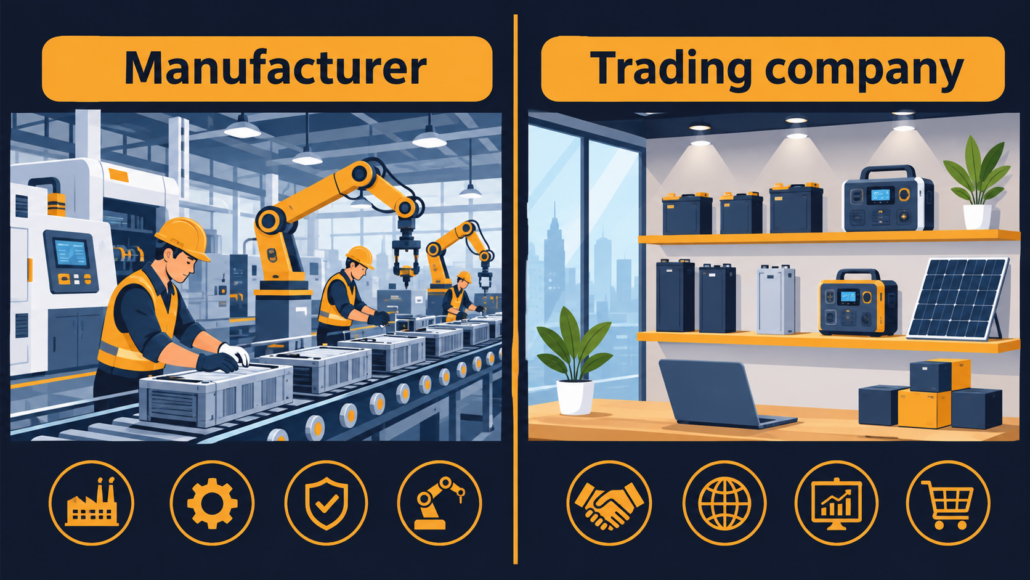
Chinese supplier verification begins by sorting suppliers into two types. A manufacturer owns or runs the production line, while a trading company buys from factories and resells the goods.
Neither type is automatically bad. A trader can help with small orders, mixed products, and combined shipments.
But you need to know which one you have. The type affects price, lead time, quality control, and who answers when something fails.
| Check | Typical manufacturer indicators | Typical trading-company indicators |
| Business scope | License includes production terms such as 生产 or 制造 | License mainly lists sales, wholesale, or import and export |
| Product range | One product family or a related process | Unrelated categories, such as electronics, kitchenware, and toys |
| Technical answers | Specific, consistent answers on materials, molds, machinery, tolerances, and capacity | Delays answers, says it will “check with production,” or gives generic replies |
| Factory evidence | Live video of the relevant line, with equipment, workers, and process flow | A showroom, finished goods, or a generic facility instead of the line |
| Pricing | Closer to factory-gate cost, but order minimums are less flexible | Includes a coordination margin; may accept smaller orders by pooling |
| Accountability | You deal with the party that controls production | Quality depends on the trader’s link to a factory you cannot see |
Many suppliers are both. A factory may run its own lines and also resell goods from partner plants.
Some factories also sell through a separate trading entity for tax or export reasons. If so, ask for both licenses and a written explanation.
Chinese Supplier Verification Step One: Verify the Legal Company
This step of Chinese supplier verification relies on official records, not an English trade name or a storefront. Ask for the business license and its 18-character Unified Social Credit Code.
Search the Official Registry for Chinese Supplier Verification
Enter the code or the exact Chinese name into GSXT. The record shows the status, legal representative, registered capital, address, and business scope.
Active companies appear as 存续 or 在营. Cancelled or revoked ones appear as 注销 or 吊销, and you should stop there.
Next, check the same record for penalties and abnormal-operation listings. Also confirm that the code matches the one on the license.
A code can look valid and still not exist. Always confirm the live record, because a format check alone proves nothing.
Read the Business Scope Closely
The scope lists what the company may legally do. Look for production terms such as 生产 or 制造 that match your product category.
A scope that lists only trading, wholesale, or import and export points to a middleman. Even so, scope shows permission, not skill.
Match Names, Capital, and Dates
Compare the registered name, address, and legal representative with what the supplier told you. Then check the incorporation date against the supplier’s claimed history.
If the company is new but claims many years of experience, ask whether that experience belongs to its team, a predecessor business, or a related factory. Request supporting evidence.
Registered capital is not cash available to fund your order. It is shareholders’ subscribed contributions, which may not be fully paid.
Under China’s revised Company Law, shareholders of new limited liability companies generally must pay subscribed contributions within five years of establishment. Older companies follow transitional arrangements, so do not assume one deadline fits every supplier.
Review subscribed and paid-in capital separately. Neither figure alone proves the supplier can finance your order or repay a deposit.
Last, compare the license name with the proforma invoice, contract, and bank beneficiary. Investigate any unexplained mismatch, since it can signal a middleman or fraud risk.
Check Credit and Legal Risk in Chinese Supplier Verification
A credit record adds a second layer to Chinese supplier verification. It can show financial stress, disputes, and a pattern of poor performance before you commit capital.
- Court judgments: Search the registered Chinese name on China Judgments Online. Look for disputes over contracts, product quality, patents, and labor.
- Enforcement records: Check if the company or its legal representative is a dishonest judgment debtor. Also look for unpaid court-enforced debts.
- Credit and penalty records: Review Credit China and regulatory listings. Look for fraud, tax problems, and administrative penalties.
- Related parties: Search the legal representative’s name too. Repeated disputes across several firms deserve a closer look.
A clean record is not a guarantee, because many disputes settle before judgment. Repeated adverse findings on product quality, unpaid obligations, or IP infringement deserve closer investigation. Ask the supplier to explain the cases and provide supporting documents.
Do not judge a supplier by case count alone. Read whether it was the claimant or defendant, what the dispute concerned, and whether the court found liability.
Also check whether any judgment was paid. Record the case date and amount, and separate allegations from court findings.
Access to some Chinese court and credit sites can be hard from abroad. If so, use a local agent or a commercial credit report.
Such reports can also show ownership and paid-in capital.
Check the Credit Report, Not Just the Score
Ask which organization produced the supplier’s credit score and when the report was last updated. Also ask what information the assessment covers.
Treat the score as a screening tool. It is not a guarantee of financial strength or reliable delivery.
Review the evidence behind it: ownership, available financial information, paid-in capital, penalties, court judgments, and enforcement records. Investigate inconsistencies instead of trusting one rating.
Also separate commercial credit assessments from official records. GSXT shows company disclosures and regulatory information, but it cannot show whether the supplier can perform your contract.
Verify the Production Site as Part of Chinese Supplier Verification
A company can be legally registered and still lack the equipment, staff, or capacity to make your product. Chinese supplier verification should use evidence proportionate to your order risk.
Start with a live walkthrough and supporting records. Arrange an independent on-site audit when the potential loss or technical complexity justifies it.
Start with a Live Video Walkthrough
Ask for an unscripted video of the specific line that will make your product, ideally during a working shift. Then direct the camera yourself.
For example, ask to see a named machine, its nameplate, and a worker station you choose. Prepared footage cannot answer those live requests.
Also ask to speak with the technical or production team. Judge whether answers on materials, tolerances, and capacity are specific, consistent, and backed by evidence.
What an On-Site Audit Should Confirm
- The address is a real industrial site, not only an office or showroom.
- Machinery, staffing, inventory, and production records check out, and available capacity can support your order.
- The factory runs incoming, in-process, and final quality checks.
- You know which stages happen in-house and which go to subcontractors.
- Each batch can be traced back to its materials and test records.
For battery products, also inspect the test equipment and the records behind safety reports. Our guide to evaluating a BESS supplier’s BMS shows what technical evidence to request.
Verify Certificates at the Source
A certificate in a brochure proves nothing by itself. Check that it is current, and that its scope covers your product and the factory address.
For accredited management-system certificates, such as ISO 9001 or ISO 14001, use IAF CertSearch to check the certified company, status, scope, and locations.
This database does not verify product certifications or test reports. Check those separately with the issuing certification body or laboratory.
Certificates from non-accredited bodies may carry little weight.
For product test reports, check the report number and issuing laboratory. Also check the tested model, applicant, manufacturer, standards, and production locations.
Confirm with the laboratory that the report is authentic and covers the product you plan to buy. Our guide to BESS specifications explains which figures to compare.
Use Third-Party Audits for Larger Orders
For a large, custom, or tooling-heavy order, hire an independent auditor before you pay a major deposit. Choose one who works for you, not the supplier.
For social compliance and reputation risk, buyers can use SMETA. It covers labor standards, health and safety, environment, and business ethics.
But SMETA is an assessment, not a certification. It ends in a corrective action plan, not a pass or fail.
It also does not test product quality, so pair it with a technical audit.
Match Payment Details to the Verified Company
Chinese supplier verification should reach the payment step, because that is where fraud pays off. Normally, the payment beneficiary should be the verified contracting company.
Be wary of personal accounts and unexplained accounts in another company’s name. Also treat any late change in bank details as a red flag.
Confirm the change using a previously verified telephone number or an independently established contact. Do not use contact details supplied in the message requesting the change.
If the supplier asks you to pay a separate trading, export, or collection entity, pause and verify that entity too. Get a written explanation of the relationship.
Make sure the contract names the seller, the payment recipient, and the party responsible for delivery, quality, and refunds. Do not accept an unexplained mismatch.
Finally, check that the contract carries the company’s official seal and the name and code you verified.
Match Chinese Supplier Verification Effort to Order Risk
Not every order needs a full audit. Chinese supplier verification should match what you stand to lose.
| Order type | Minimum checks |
| Small or low-value order | Registry check, license match, and a live video walkthrough |
| Repeat or mid-size order | All of the above, plus court and credit search, certificate checks, and a pre-shipment inspection |
| Large, custom, or tooling-heavy order | All of the above, plus an independent on-site audit before the deposit, and contract protections |
These tiers are a starting point, not a rule. Raise the level if any check turns up a mismatch.
Price pressure should raise the level too. If a supplier wins on price alone, read why a lower price is not a business case before you switch.
A Practical Chinese Supplier Verification Checklist
Use this order for Chinese supplier verification so each step builds on the last.
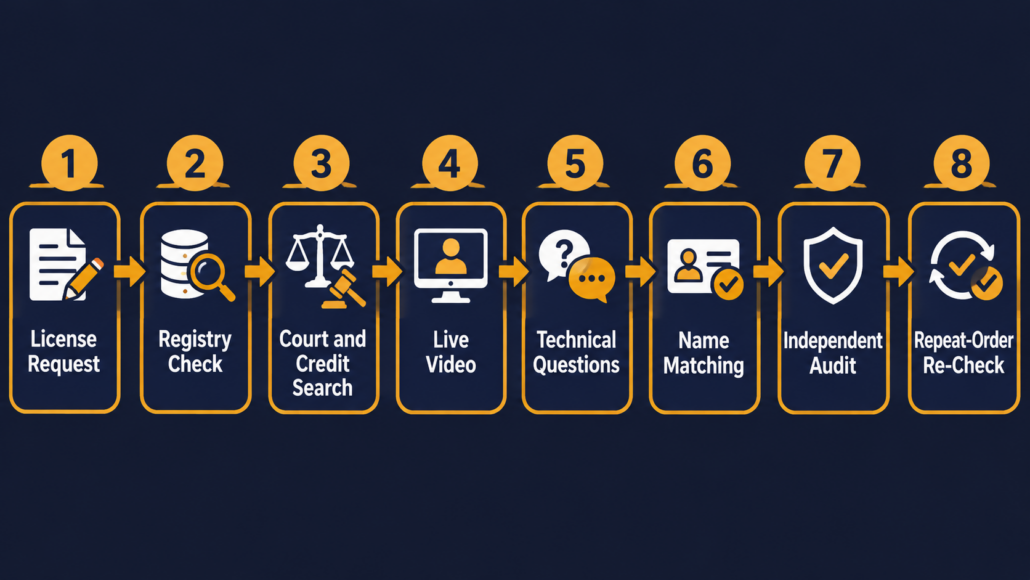
- Request the Chinese business license, Unified Social Credit Code, factory address, and export credentials.
- Verify the legal entity and its manufacturing scope in the official registry.
- Search court judgments, enforcement records, and credit-blacklist databases.
- Request a live, unscripted video walkthrough of the specific production line.
- Ask about materials, machines, capacity, defect rates, and quality checks.
- Compare the license, invoice, contract, and bank beneficiary names, and investigate any unexplained mismatch.
- For large or custom orders, commission an independent audit before the deposit.
- Before each repeat order, re-check the registry for changes in address, capital, or legal representative.
Write the Findings into the Contract
Name the legal entity and the factory address in the contract. Ban unapproved subcontracting, reserve the right to audit, and stage payments against milestones.
Our C&I BESS warranty guide shows how to read performance terms before you sign.
Verification Is About Evidence, Not Assurances
A business license answers one question: is the company registered? A factory audit answers another: does the site have the people, equipment, and systems your order needs?
Credit and court checks add context about the risks of doing business with that company. Chinese supplier verification works only when you use these checks together.
None of them works as a guarantee. Their value comes from investigating inconsistencies before you pay.
A reliable supplier should explain its legal identity and its role in production. It should also explain how the contracting company, factory, and payment beneficiary relate.
Your job is to verify those explanations and document the agreed responsibilities.
Frequently Asked Questions About Chinese Supplier Verification
These answers cover the most common Chinese supplier verification questions.
How Does Chinese Supplier Verification Work?
Confirm the legal entity in GSXT using the Unified Social Credit Code. Then check court and credit records, view the production line live, and audit the factory for larger orders.
How Can I Tell a Manufacturer from a Trading Company?
Read the business scope on the license. Then ask to speak with the technical team and judge whether its answers are specific, consistent, and backed by evidence.
Is a Trading Company Always a Bad Choice?
No. Traders suit small orders and mixed products, but you must know who actually makes your goods.
What Is a Unified Social Credit Code?
It is the 18-character ID assigned to every registered legal entity in China. It appears on the business license and must match the registry record.
When Is Chinese Supplier Verification Worth a Paid Audit?
Commission an independent audit before a major deposit on a large, customized, or tooling-heavy order. It is the most reliable way to confirm production reality.
Further Reading
These guides add technical and contract detail to your Chinese supplier verification.
- Supplier red flags: 30 warning signs buyers should know
- “We can offer a lower price” is not a business case
- Evaluating a BESS supplier’s BMS
- Understanding BESS specifications
- C&I BESS warranty guide





Leave a Reply
Want to join the discussion?Feel free to contribute!