

AS/NZS 3008.1.1:2025: What Changed for Cable Selection
AS/NZS 3008.1.1:2025 changed how engineers size cables across Australia and New Zealand. It’s also the fourth edition of the standard. It replaces the 2017 edition, which ran for eight years. So a cable calculation done today needs the new tables, not the old ones. This guide covers the real changes in AS/NZS 3008.1.1:2025. It also covers the new DC provisions and the transition timeline for each country. It’s one of three standards in Australia’s new battery rules.
| Quick Answer Quick answer: Standards Australia published AS/NZS 3008.1.1:2025 on 19 December 2025. It adds dedicated DC cable rating tables for the first time, covering circuits up to 1500V. Grouping and soil derating factors also got tighter. The standard renames “derating factor” to “correction factor.” Aluminium conductor ratings now extend down to 16mm². Both editions currently remain valid. Western Australia set 19 June 2026 as its full-compliance date. New Zealand expects to withdraw the 2017 edition around November 2026. |
What Is AS/NZS 3008.1.1?
AS/NZS 3008.1.1 sets the current-carrying capacity, voltage drop, and mechanical protection rules for cables in permanent electrical installations up to 0.6/1 kV. It also works alongside AS/NZS 3000, the wiring rules. Every cable has to clear three separate checks under this framework. AS/NZS 3008.1.1:2025 sets the numbers for all three checks.
The Three Checks Every Cable Must Pass
The first check is current-carrying capacity. A cable has to carry its design current continuously, without exceeding its insulation temperature rating. First, that figure comes from the base rating tables. Then the design derates it for ambient temperature, grouping, and depth of burial. Next, the second check is voltage drop. The drop from the supply point to the furthest load can’t exceed 5 percent of nominal supply voltage under AS/NZS 3000. For 230V single-phase, that’s 11.5V. For 400V three-phase, that’s 20V. Finally, the third check is earth fault loop impedance. So the total fault loop has to stay low enough that the upstream protective device disconnects within the AS/NZS 3000 Table 5.1 time limit.
| Check | Requirement |
| Current-carrying capacity (Iz) | Cable must carry the design current continuously without exceeding its insulation temperature rating, after derating for ambient temperature, grouping, and depth of burial |
| Voltage drop (Vd) | Must not exceed 5% of nominal supply voltage under AS/NZS 3000 (11.5V for 230V single-phase; 20V for 400V three-phase) |
| Earth fault loop impedance (Zs) | Total fault loop impedance must let the protective device disconnect within the AS/NZS 3000 Table 5.1 time limit |
Everything AS/NZS 3008.1.1:2025 Changed, at a Glance
| Change | Detail |
| New DC tables | Tables 3.21 and 3.22 cover DC circuits up to 1500V directly — first time in the standard’s history |
| AC tables rebuilt | Updated IEC 60287 thermal models; some ratings up 1-3% where 2017 was overly conservative |
| Aluminium range expanded | Ratings now start at 16mm², down from 25mm² |
| Grouping factors tightened | 6-circuit unperforated tray factor: 0.73 → 0.68 |
| Soil resistivity table | New “very dry soil” row added for desert/remote mining conditions |
| Terminology | “Derating factor” renamed to “Correction Factor (CF)” throughout |
New DC Cable Tables Up to 1500V
The single biggest change in AS/NZS 3008.1.1:2025 is new DC cable tables. Tables 3.21 and 3.22 now cover DC circuits directly. So that’s a first in the standard’s history. Before this edition, engineers sizing DC cables for solar strings, battery racks, or EV charging had no dedicated national table to work from. So they either approximated DC values from the AC tables using a 1.155 conversion factor, or leaned on manufacturer data instead. Now that workaround is gone. The new tables cover DC circuits up to 1500V directly. This matches where utility-scale solar and BESS DC bus voltages have been heading for years.
DC voltage drop also gets a cleaner formula under AS/NZS 3008.1.1:2025. DC has no reactive component. So the calculation is simpler than the AC version: voltage drop equals two times current times resistance times length, divided by 1000. So the factor of two accounts for both the outgoing and the return conductor. For a bipolar system with positive, neutral, and negative rails, the designer calculates each pole separately.
AC Table Changes
AC tables changed too, not just DC. AS/NZS 3008.1.1:2025 rebuilt the 2017 current rating tables using updated IEC 60287 thermal models. Some ratings actually increased, typically by 1 to 3 percent. That happened where the old 2017 figures turned out to be overly conservative. Also, table groupings got reorganised in places. This mainly cuts the risk of picking the wrong column. Aluminium conductor coverage expanded too. So ratings now start at 16mm², down from 25mm² in the old tables. This reflects how aluminium now shows up more in smaller, cost-sensitive solar DC circuits. These new ratings sit alongside the DC provisions covered in our Understanding BESS Specifications guide.
Revised Grouping and Soil Derating Factors
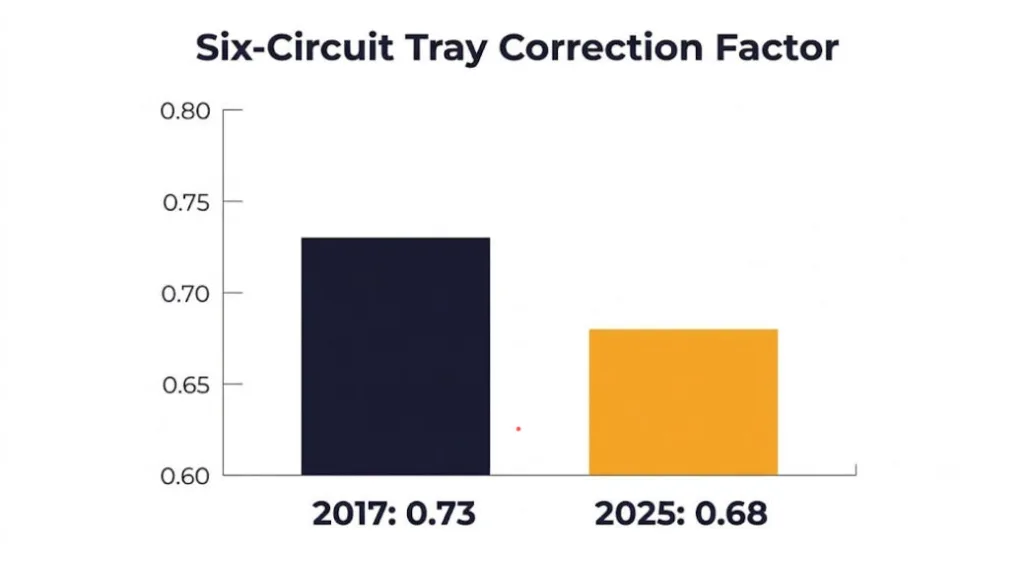
Not every change loosened requirements. Grouping and soil derating factors got tighter under AS/NZS 3008.1.1:2025, not looser. Cables on unperforated trays now carry lower correction factors than before. Take a six-circuit run on a solid tray, for example. It drops from a factor of 0.73 to 0.68. So that single change can push a cable size up a full commercial step on a real job. Field studies and thermal modelling done since 2017 found the old grouping factors weren’t conservative enough. Certain enclosed, tightly packed tray configurations were the main problem.
Soil thermal resistivity got a new addition, not just a tightened number. A “very dry soil” row now appears in the table. It also covers desert and remote mining conditions the 2017 edition never addressed. So that row matters for any underground DC run through genuinely arid ground. The old table simply had no category for it.
Terminology Change: Correction Factor Replaces Derating Factor
The term “derating factor” is gone from AS/NZS 3008.1.1:2025 entirely. It’s now called “correction factor,” abbreviated CF throughout the standard. Still, this is only a naming change, not a calculation change. Still, it matters for documentation. So design calculations and compliance paperwork using the old “derating factor” term should get updated to match.
AS/NZS 3008.1.1:2025 Transition Timeline
Timing differs by country and by state. Both the 2017 and 2025 editions currently remain valid for use. Western Australia’s Building and Energy division set 19 June 2026 as the date full compliance becomes mandatory there. That follows the same six-month transition period that applies to the AS/NZS 5139 battery safety amendment, published the same day. Meanwhile, New Zealand runs on its own clock. The Electrical Workers Registration Board expects the 2017 edition to get withdrawn around November 2026, once the standard 24-month transition period closes.
Mixing editions on one job causes real problems. Some 2017 cable sizes calculate slightly differently under the 2025 tables, even for straightforward AC circuits. So the safest approach for new design work is picking one edition. Size the entire job to AS/NZS 3008.1.1:2025, rather than checking some circuits against 2017 figures and others against 2025 figures.
Compliance Checklist for the 2025 Cable Standard
- Size all new DC circuits (solar strings, BESS DC bus, EV charging) using Tables 3.21 and 3.22, not the old AC-conversion workaround.
- Recalculate any six-or-more-circuit run on an unperforated tray against the tightened correction factors.
- Check underground DC runs in arid conditions against the new “very dry soil” resistivity row.
- Update design documentation and compliance paperwork to use “Correction Factor (CF)” instead of “derating factor.”
- Confirm your state’s specific compliance timeline before assuming both editions remain acceptable indefinitely.
- Size an entire job to one edition of the standard — don’t mix 2017 and 2025 figures on the same project.
Frequently Asked Questions
When was AS/NZS 3008.1.1:2025 published?
It was published on 19 December 2025, the same day as AS/NZS 5139 Amendment 1. Some secondary sources describe it as a late-2024 publication, but the standard’s own front matter and Western Australia’s government notice both confirm the December 2025 date.
Does AS/NZS 3008.1.1:2025 cover DC cable sizing?
Yes, for the first time. Tables 3.21 and 3.22 provide dedicated DC current rating tables for circuits up to 1500V, replacing the previous workaround of approximating DC values from AC tables.
What happened to the term “derating factor”?
AS/NZS 3008.1.1:2025 renamed it to “Correction Factor,” abbreviated CF. It’s the same calculation, just updated terminology that should be reflected in new design documentation.
Do I have to use the 2025 edition right now?
Not everywhere yet. Both editions remain valid during the transition. Western Australia requires full compliance from 19 June 2026. New Zealand expects to withdraw the 2017 edition around November 2026. Check your specific state’s position before assuming a date.
Can I mix 2017 and 2025 cable sizing on the same project?
It’s not recommended. Some cable sizes calculate slightly differently between editions, even for standard AC circuits. Size the entire job to one edition to avoid inconsistent results.
Further Reading
- Australia’s New Battery Rules: The 2026 Compliance Stack
- AS/NZS 5139 Amendment 1: What Changed for Battery System Safety
- AS/NZS 4777.2 Amendment 2: What Changed for Inverter Requirements
- Updated Electrical Installation Standards — WA Government
- AS/NZS 3008.1.1:2025 Updates for Solar Cable Design — GSES
- Understanding BESS Specifications






Trackbacks & Pingbacks
[…] Full guide: AS/NZS 3008.1.1:2025: What Changed for Cable Selection […]
Leave a Reply
Want to join the discussion?Feel free to contribute!