
AS/NZS 5139 Amendment 1: What Changed for Battery System Safety (2025–2026)
AS/NZS 5139 Amendment 1 changed how batteries get installed across Australia and New Zealand. It arrived on 19 December 2025. So if you designed a BESS install before that date, several of your default assumptions just moved. This guide walks through every real change. New definitions. New clearance figures. A genuinely useful garage exception. A new appendix for fault current calculations. It’s one of three standards in Australia’s new battery rules.
| Quick Answer AS/NZS 5139 Amendment 1 updates 18 clauses. It also adds five new figures, plus Appendix I for calculating cell short-circuit current. It’s mandatory now in NSW. Western Australia set a specific deadline of 19 June 2026, after a six-month transition. The headline practical change is a new exception. Batteries can now sit within 600mm of a garage opening wider than 900mm, provided safe egress is preserved. |
What Is AS/NZS 5139 Amendment 1?
AS/NZS 5139:2019 is the standard that governs safety for battery energy storage systems. It covers systems connected to power conversion equipment. It replaced the older AS 4086.2 standard back in 2019. AS/NZS 5139 Amendment 1 doesn’t replace this base standard. Instead, it updates specific clauses. It adds new figures. It also adds one new appendix. The rest of the 2019 standard stays in force. The full amended text is available through the Standards Australia Store.
The full clause list is in the table below. It also touches Figures 2.11 and 2.12, and adds five entirely new figures: 4.1A, 4.1B, 4.1C, 4.1D, and 4.2A. Appendix I is new. So is a set of new Bibliography references.
Everything AS/NZS 5139 Amendment 1 Changed, at a Glance
| Type | Reference |
| Clauses updated | 1.3, 3.2.3.3, 4.2.2.1, 4.2.2.2, 4.2.4.2, 4.2.5, 5.2.2.1, 5.2.2.2, 5.2.4.2, 5.3.1.2.1, 5.3.1.3.8, 6.3.6.4, 7.2, 7.7, 7.8, 7.9, 7.10, 7.11 |
| Figures updated | 2.11, 2.12 |
| Figures added (new) | 4.1A, 4.1B, 4.1C, 4.1D, 4.2A |
| Appendix added (new) | Appendix I — calculating cell short-circuit current |
| Bibliography | New references added |
When AS/NZS 5139 Amendment 1 Takes Effect
Timing isn’t the same in every state. NSW treats the amendment as mandatory right away. Any install that misses the updated requirements no longer complies with the Standard there. WA took a different path. It set a full-compliance date of 19 June 2026, six months after publication. Until then, either the old or the new version is fine. Other states are still working out their own position. So check with your state regulator before you quote a date to a client.
| Jurisdiction | Position | Source |
| NSW | Mandatory immediately on publication (19 Dec 2025) | NSW Building Commission advisory |
| Western Australia | Full compliance required from 19 Jun 2026, after a 6-month transition where either edition is acceptable | WA Building and Energy notice |
| Queensland | Amendment issued and communicated to electricians; specific compliance date not published in the source reviewed | WorkSafe QLD eSafe newsletter |
| Other states/NZ | Not confirmed in this research pass — verify with the relevant state or NZ regulator before quoting a date | — |
New Definitions Under AS/NZS 5139 Amendment 1
Clause 1.3 covers terms and definitions, and it picked up real changes. The main addition is a new definition: a battery energy storage system room. That’s a dedicated room. It holds the battery, the power conversion equipment, and other BESS accessories. A note attached to this definition matters just as much as the definition. It says a multi-purpose room doesn’t count as “dedicated,” just because a battery sits in it. A garage or a general storage room are both good examples.
Three other definitions picked up clarifying notes too, with practical examples. So electricians should still read Clause 1.3 in full. Drawings and compliance paperwork need to use the amended wording exactly.
New Clearance Figures: 4.1A Through 4.2A
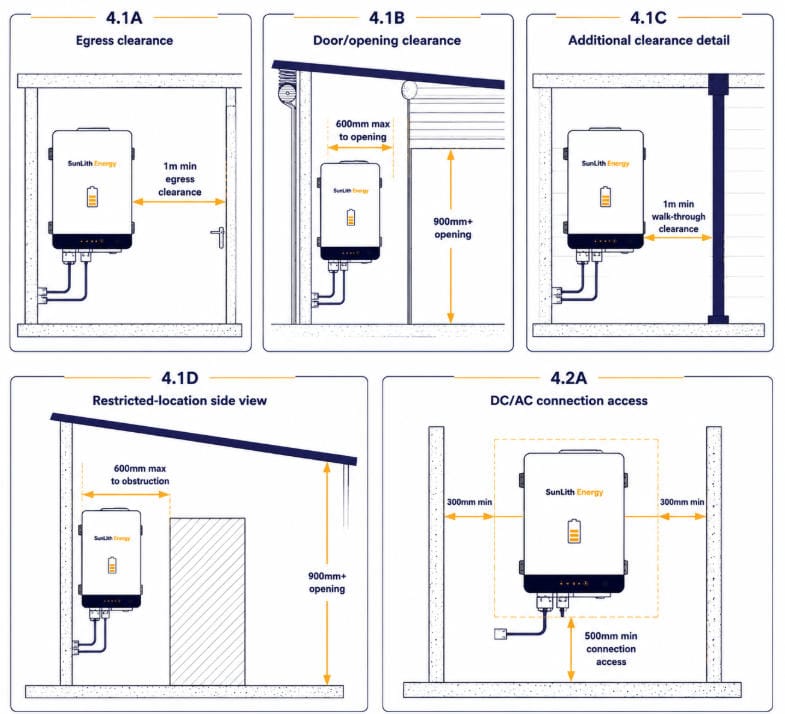
The amendment replaces the old typical BESS installation diagrams with five new figures. First, Figure 4.1A covers egress clearance in a corridor, hallway, or lobby. Then Figure 4.1B covers clearance to doors and openings. Also, Figure 4.1C adds further detail to the clearance picture. Figure 4.1D shows a side-view diagram of clearance from restricted locations, with the familiar 600mm front clearance and 900mm above-battery clearance both drawn out. Finally, Figure 4.2A covers clearances for battery connection access, split by whether the connection is DC or AC.
One structural cleanup came along with the new figures. Also, the standard used to repeat similar diagrams in Section 5. So the amendment removes that duplication. Section 5 now just refers back to the Section 4 figures instead of reprinting them.
The Garage Door Exception — Clause 4.2.2.2
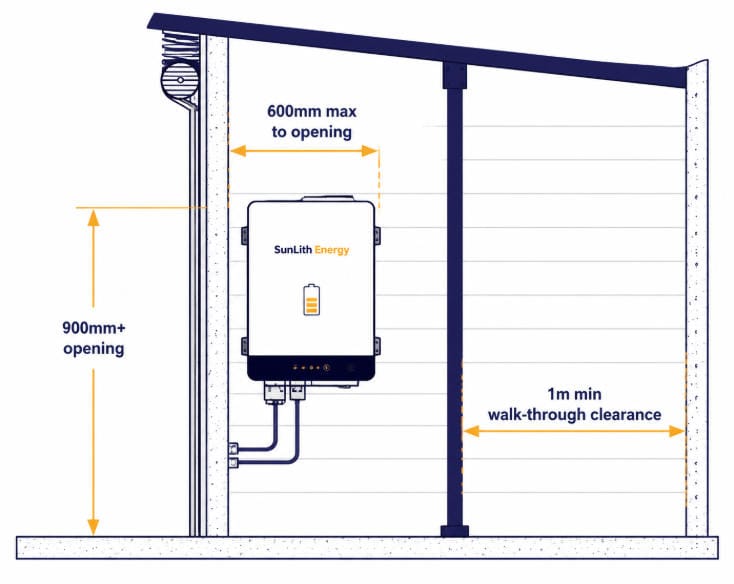
The most talked-about change is a new exception for garage installations. Under the amended Clause 4.2.2.2, a battery can now sit within 600mm of an opening wider than 900mm — a typical garage door, in other words — as long as the opening still allows sufficient clearance for safe egress, and the clearance is no less than 1m from any front or side a person might need to pass through during an exit.
This matters because garages are the preferred spot for a lot of installers. They’re usually not living spaces, they’re weather-protected, often shaded, and close to the switchboard. But the old blanket 600mm rule ruled out a lot of good garage walls, just because of a wide roller door. The amendment keeps the safety goal in place. People still need a safe way out. It just stops punishing a battery for sitting near a large opening when someone could still walk past it safely.
In practice, this means a designer needs two numbers, not one. The first is the 600mm distance to the opening itself. The second is the 1m clearance from whichever front or side edge a person would need to pass. So both conditions have to hold at the same time. A wide garage door with a wall corner narrowing the walk-through space to less than a metre still fails, even if the 600mm figure looks fine on a drawing.
Worked Example
A garage has a 2.4m-wide roller door. The nearest wall section suitable for a battery sits 500mm from the door opening. Under the amended clause, 500mm is within the 600mm allowance, and the door is well over the 900mm width threshold. So far, this passes. But the same wall has a support post 800mm from the door edge, narrowing the usable walk-through space to 800mm at that point. Since 800mm is under the 1m minimum clearance the amendment also requires, this specific layout still fails — even though the headline 600mm number looks fine. Moving the battery, or resolving the post clearance, is the fix.
Inverters as Associated Appliances
The amendment also reclassifies inverters. Power conversion equipment now counts as an associated appliance. So it can go inside a restricted location, where it couldn’t before. That’s a useful change for compact installs, where wall space near the battery is already tight.
Fire Barrier and Overcurrent Protection Changes
Fire barrier requirements moved the other way. Stricter, not looser. So exempt materials used as a barrier to a habitable room now need a minimum thickness of 6mm. Also, building materials within 1 metre of a battery system classed as a chemical hazard pick up new requirements.
Paralleled pre-assembled battery systems get a new rule for overcurrent protection. The protective device’s kA rating now has to cover the combined fault current of every paralleled unit, not just the biggest one. That’s a real change for multi-unit homes and light commercial jobs. Two or three battery modules often get paralleled to hit a target capacity.
To make that calculation possible, the amendment adds Appendix I. It sets out the method for calculating cell short-circuit current within a battery system. So that’s the number a designer needs before sizing the paralleled OCPD correctly. This connects directly to broader short-circuit protection design work on the DC side of a BESS installation. This connects directly to broader short-circuit protection design work on the DC side of a BESS installation.
Safety Data Sheet Requirements
Safety Data Sheet handling picked up a clarification too. A physical copy of the SDS must be provided on site. It also has to stay protected from damage or degradation. The standard specifically mentions storing it in a sealed, durable, clear pouch as an acceptable method. So treat SDS storage as part of the handover package, not an afterthought bolted on at final inspection.
Background: Restricted Locations Under AS/NZS 5139
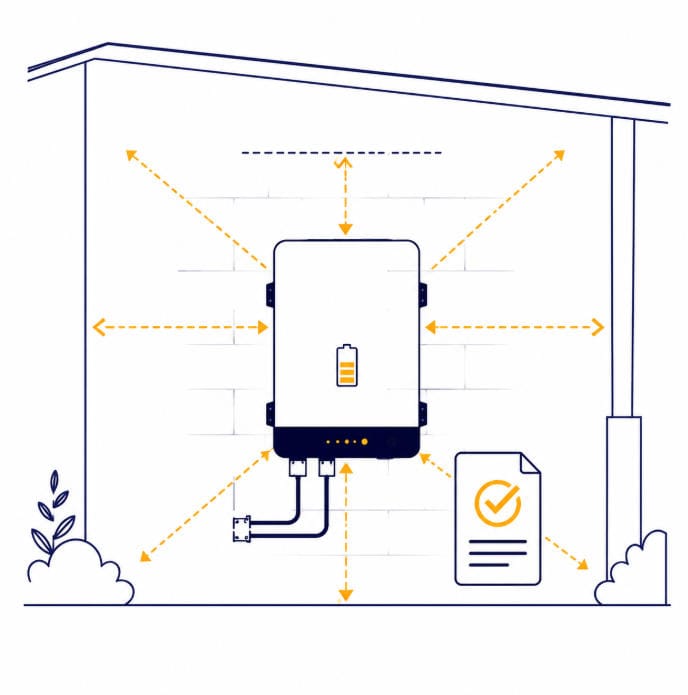
It helps to know what this amendment did NOT change. The base restricted-location rules still apply. Batteries still can’t sit within 600mm of an exit, a window edge, a vent into a living room, or an appliance. They still can’t sit within 900mm below any of those. Ceiling spaces, wall cavities, roofs, stairways, walkways, escape routes, and living rooms themselves are still off-limits. The ERAC Battery Energy Storage System Guideline backs up these same rules. None of this changed. The amendment only added the wide-opening exception above, plus the inverter reclassification.
Restricted Locations — Unchanged by Amendment 1
- Within 600mm of any exit or entry
- Within 600mm of any window’s vertical side, or a ventilation opening into a habitable room
- In an evacuation or designated escape route
- Within 600mm of any appliance
- Within 900mm below any of the items above
- In ceiling spaces or wall cavities
- On roofs
- Under stairways or access walkways
- Within a habitable room itself
AS/NZS 5139 Amendment 1 Compliance Checklist
- Confirm the installation drawings use Clause 1.3’s updated terminology, including the new battery energy storage system room definition.
- Check clearance layouts against the new Figures 4.1A–4.2A, not the pre-amendment diagrams.
- If relying on the garage-door exception, verify both the 600mm opening distance AND the 1m walk-through clearance — not just one of them.
- Confirm inverter placement against the updated associated-appliance classification if it sits in a restricted location.
- Check fire-barrier materials meet the 6mm minimum thickness where used as exempt materials.
- For paralleled pre-assembled battery systems, recalculate the OCPD kA rating against the combined fault current using Appendix I.
- Confirm a physical SDS copy is on site and stored in a protective pouch before handover.
- Verify your state’s specific compliance timeline before telling a client the installation is (or isn’t) required to meet Amendment 1 yet.
Frequently Asked Questions
When did AS/NZS 5139 Amendment 1 take effect?
It was published on 19 December 2025. NSW treats it as mandatory immediately. Western Australia requires full compliance from 19 June 2026, after a six-month transition period. Confirm the position in your own state before quoting a date.
What is the garage door exception under this amendment?
Under the amended Clause 4.2.2.2, a battery can be installed within 600mm of an opening wider than 900mm — such as a garage door — provided safe egress is maintained and clearance is no less than 1m from any front or side a person might need to pass through.
Does this amendment change where inverters can be installed?
Yes. Power conversion equipment is now classified as an associated appliance, which means it can be installed inside a restricted location where it previously couldn’t.
What is Appendix I, and what does it calculate?
Appendix I is a new addition that sets out how to calculate cell short-circuit current within a battery system. It’s needed to correctly size overcurrent protection for paralleled pre-assembled battery systems under the amendment’s new kA rating requirement.
Do the pre-existing restricted-location rules still apply under Amendment 1?
Yes, unchanged. Batteries still can’t be installed within 600mm of exits, windows, ventilation openings, or appliances, within 900mm below those items, or in ceiling spaces, wall cavities, roofs, under stairways, escape routes, or habitable rooms. Amendment 1 only added the specific wide-opening exception and the inverter reclassification — it didn’t touch the base restricted-location list.
Further Reading
- Australia’s New Battery Rules: The 2026 Compliance Stack
- Changes to the Battery Standard — NSW Government
- Updated Electrical Installation Standards for Battery Systems — WA Government
- AS/NZS 5139:2019 (incorporating Amendment 1) — Standards Australia Store
- BESS Short Circuit Protection






Trackbacks & Pingbacks
[…] Full guide: AS/NZS 5139 Battery Safety Standard — Amendment 1 Explained […]
Leave a Reply
Want to join the discussion?Feel free to contribute!