
AS/NZS 4777.2 Amendment 2: What Changed for Inverter Requirements
AS/NZS 4777.2 Amendment 2 changed how Australia approves grid-connect inverters. Standards Australia published it on 23 August 2024. It became mandatory exactly one year later. Also, it now applies to every new grid-connect install. So any inverter installed today needs to meet it. So this guide covers every real change. It also covers the region settings you need to check, and what happened to inverters already on the approved list. It’s one of three standards in Australia’s new battery rules.
| Quick Answer Quick answer: It became mandatory on 23 August 2025, after a 12-month transition. It makes six changes. New supply terms. Fewer tests for battery-only gear. New generation limit rules. Updated Region C set points. New paperwork rules. New clauses for two-way EV charging. Older CEC inverter listings didn’t carry over automatically. So manufacturers had to submit a declaration and evidence of the updated region settings before the deadline, or their models came off the approved list. |
What Is AS/NZS 4777.2 Amendment 2?
AS/NZS 4777.2 is the standard that governs how grid-connect inverters behave once installed. It’s also Part 2 of a two-part standard. Part 1 covers general requirements. Part 2 covers the inverter-specific rules that matter most for design work. AS/NZS 4777.2 Amendment 2 is the second update to the 2020 edition. So it’s formally known as AS/NZS 4777.2:2020 Amendment 2:2024.
The Six Changes in AS/NZS 4777.2 Amendment 2
Six changes make up the bulk of AS/NZS 4777.2 Amendment 2. First, AS/NZS 4777.2 Amendment 2 updates supply type terminology, for clearer alignment with AS/NZS 4777.1. Then second, battery-only products no longer need IEC 62109 testing. That cuts duplicate certification work. Third, generation limit control parameters changed. Fourth, AS/NZS 4777.2 Amendment 2 updates Region C set points. Fifth, documentation and marking rules changed. Sixth, and most talked-about, new clauses cover electric vehicle supply equipment.
| Change | What It Means |
| Supply type terminology | Updated for clearer alignment with AS/NZS 4777.1’s supply-type definitions |
| IEC 62109 removed | Battery-only products no longer need this testing, cutting duplicate certification work |
| Generation limit parameters | Control parameters for generation limiting were updated |
| Region C set points | Updated power quality set points specifically for Region C networks (Horizon Power, TasNetworks, remote Power & Water) |
| Documentation and marking | Updated requirements for product documentation and equipment marking |
| EVSE clauses (new) | New clauses covering electric vehicle supply equipment for bidirectional charging |
When AS/NZS 4777.2 Amendment 2 Took Effect
So Standards Australia set a 12-month transition window. During that time, manufacturers could apply under the old or the new standard. After 23 August 2025, the Clean Energy Council only accepts Amendment 2 products for new listings. The Clean Energy Council runs this through its approved inverter list. Most network operators use that list directly.
What Happened to Existing CEC Inverter Listings
Existing listings didn’t need full re-testing for AS/NZS 4777.2 Amendment 2. Still, manufacturers had to prove compliance. The Clean Energy Council asked for a signed declaration. It also asked for proof of the updated region settings for every model. That proof could be a product manual, an install guide, or a screenshot from a monitoring app. Anything missing by 23 August 2025 meant the model came off the approved list. The Clean Energy Council’s standards-change page has the full manufacturer declaration template and process.
So this matters for anyone still specifying against an old product sheet. An inverter that was genuinely CEC-approved two years ago may not carry that status today. So always check the live CEC list at the point of design, not a cached copy from a previous project.
CSIP-AUS and Smart Communication
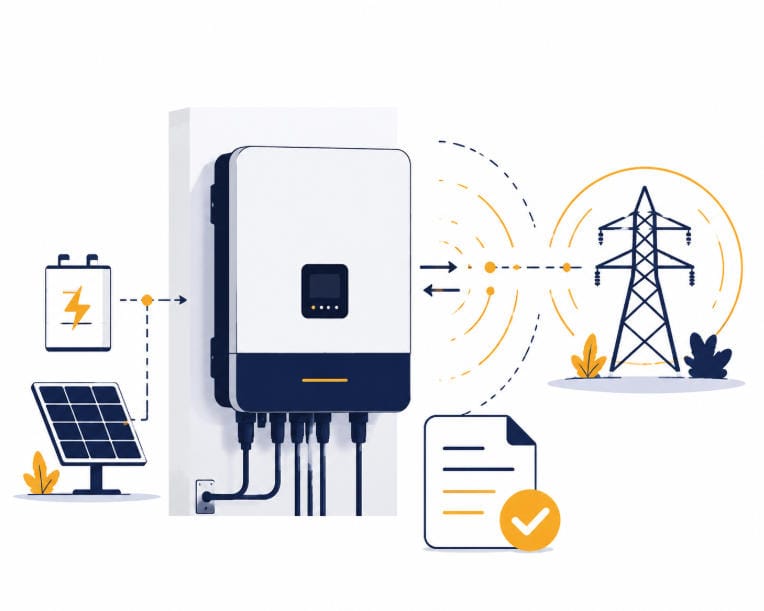
The updated standard introduced CSIP-AUS, the Common Smart Inverter Profile for Australia. Still, this is a communication protocol, not a hardware requirement. It lets network operators manage dynamic export limits, and in some cases apply remote curtailment. A compliant inverter under AS/NZS 4777.2 Amendment 2 lets the grid talk back to it, not just receive power one-way.
Region-Based Power Quality Settings
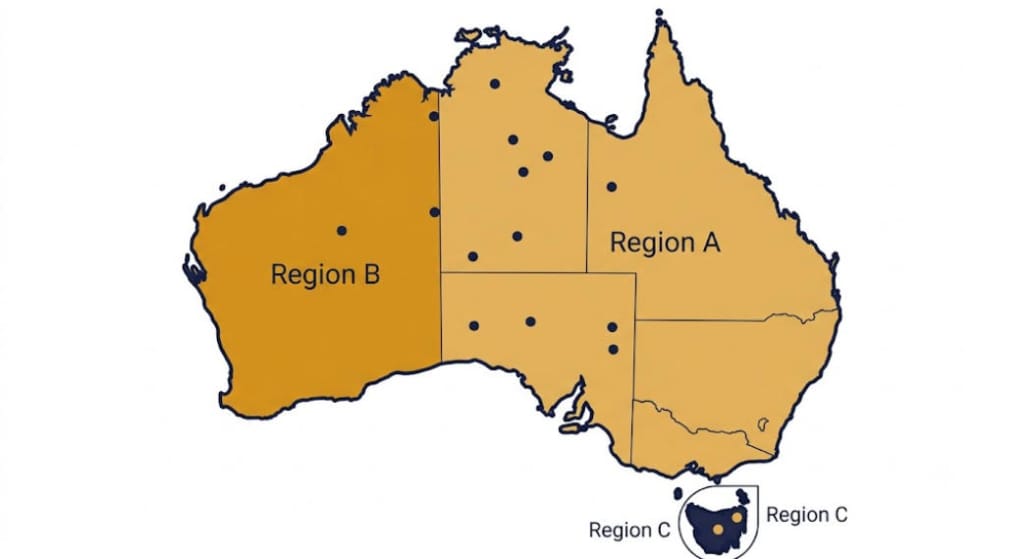
Power quality settings still follow a region-based structure: Australia A, B, or C. Most of the country falls under Region A. Western Power alone makes up Region B. Tasmania and remote areas fall under Region C, covering Horizon Power, TasNetworks, and remote parts of Power & Water. The full list is in the table below. AS/NZS 4777.2 Amendment 2 changed the Region C set points specifically. So a Tasmanian or remote WA install needs extra care here. Energy Networks Australia’s FAQ has the full DNSP contact list for each state.
| Region | Distribution Network Service Providers (DNSPs) |
| Australia A | Ausgrid, AusNet Services, Endeavour Energy, Essential Energy, Ergon Energy, Energex, Evoenergy, Jemena, CitiPower, Powercor, United Energy, SA Power Networks, Power & Water (some areas) |
| Australia B | Western Power |
| Australia C | Horizon Power, TasNetworks, Power & Water (remote networks) |
Warranty Replacement Rules
Warranty replacements get a narrow exception. Owners can still swap in an older-standard inverter under warranty, but only if three conditions hold together. The replacement has to be the same make and model. It has to genuinely be a warranty case. And the inverter has to match the existing connection agreement. Also, DNSPs still need to approve the replacement first. Outside those conditions, a warranty swap needs a current AS/NZS 4777.2 Amendment 2 compliant unit.
Bidirectional EV Charging: Mode 3 vs Mode 4
Bidirectional EV charging is where this amendment gets genuinely new. It’s not just a terminology refresh. So it splits two charging modes apart. Mode 4 charging sends power to and from the vehicle through wall-mounted gear with its own inverter. That gear now falls under AS/NZS 4777.2 Amendment 2 directly. It also sits inside the CEC’s approved inverter list. Mode 3 also sends power both ways, but the inverter lives inside the car instead. The Clean Energy Council is still working out how much of that setup falls under the same listing rules.
AS/NZS 4777.2 Amendment 2 Compliance Checklist
- Confirm the specific inverter model against the live CEC approved list, not a cached spec sheet or marketing page.
- Confirm the correct region setting (A, B, or C) for the installation’s DNSP — Region C set points changed under this amendment.
- Check whether any EV charging equipment on the job is Mode 3 or Mode 4, since that determines which listing requirements apply.
- For battery-only power conversion equipment, confirm whether the IEC 62109 exemption applies to the specific product.
- If proposing a warranty replacement with an older-standard inverter, verify all three conditions: same make and model, genuine warranty case, and matching connection agreement.
- Get DNSP approval before installing any warranty replacement inverter.
Frequently Asked Questions
When did AS/NZS 4777.2 Amendment 2 become mandatory?
Standards Australia published it on 23 August 2024. After a 12-month transition, it became mandatory for new inverter installations from 23 August 2025.
Does an old CEC inverter listing still work after Amendment 2?
Not automatically. Manufacturers had to submit a declaration and evidence of updated region settings before 23 August 2025. Any model without that evidence was removed from the approved list on that date.
What is CSIP-AUS?
CSIP-AUS is the Common Smart Inverter Profile for Australia — a communication protocol introduced with this amendment that lets network operators manage dynamic export limits and, in some cases, apply remote curtailment.
What’s the difference between Mode 3 and Mode 4 EV charging under this amendment?
Mode 4 charging uses wall-mounted Electric Vehicle Supply Equipment with its own inverter, which falls directly under AS/NZS 4777.2 and the CEC’s approved inverter list. Mode 3 charging also flows power both ways, but the inverter sits inside the vehicle instead — how that gets covered by the listing framework is still being finalised.
Can I still install an inverter that only meets the pre-Amendment 2 standard?
Only as a like-for-like warranty replacement, and only if the replacement is the same make and model, is genuinely for warranty purposes, and is set up to match the existing connection agreement. The DNSP still has to approve it first.
Further Reading
- Australia’s New Battery Rules: The 2026 Compliance Stack
- 4777.2 Inverters Standards Change — Clean Energy Council
- FAQ: Changes to Inverter Standards — Energy Networks Australia
- AS/NZS 4777.2:2020 Amd 2:2024 — Standards Australia Store
- PCS Overvoltage Protection
- LVRT and HVRT Ride-Through




Trackbacks & Pingbacks
[…] Full guide: AS/NZS 4777.2 Amendment 2: What Changed for Inverter Requirements […]
Leave a Reply
Want to join the discussion?Feel free to contribute!