AC block addition is one of two ways to carry out BESS augmentation. BESS augmentation, in short, restores capacity a battery loses over time. Every charge and discharge cycle wears the cells down. So, after a few years, the system can no longer deliver its full contracted energy or power. AC block addition fixes this by adding new inverters and battery racks on the AC side. DC shuffling, the other path, instead reallocates existing modules behind the inverters already on site. Each approach, however, solves the same problem differently.
Quick Answer AC block addition installs a new, independent power block behind its own connection point. It costs more and needs more space. However, it works with any battery chemistry, and it skips synchronization headaches with old cells. DC shuffling, by contrast, reorganizes and adds battery modules behind the existing inverters. It costs less, and it often avoids new interconnection permits. But busbar ratings, breaker capacity, and voltage matching all limit how much capacity it can add.
Why BESS Augmentation Needs a Capacity-Adding Strategy
This guide focuses on the technical mechanics of the two paths. For the full picture on BESS augmentation as a strategy, including how it compares to oversizing capacity upfront, see our BESS Augmentation: The Complete Guide.
Lithium-ion cells degrade with use. So does calendar time alone. Each cycle stresses the electrode material. Specifically, the protective SEI layer on the anode cracks and reforms. This, in turn, consumes active lithium every time. High charge rates and cold temperatures make it worse.
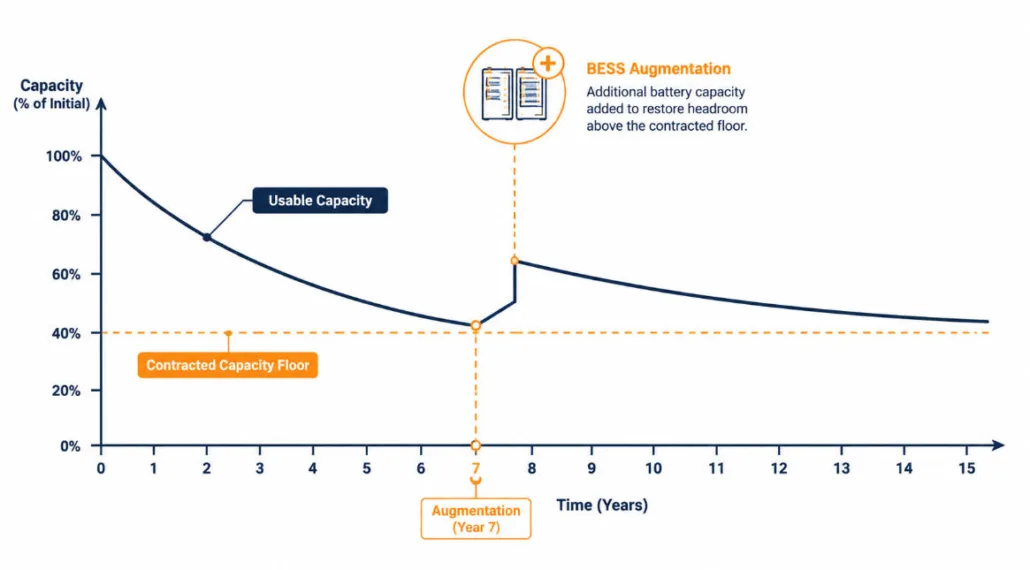
Fade rates vary by chemistry and duty cycle. Many grid-scale LFP systems, for instance, lose roughly 2 to 3 percent of usable capacity per year. As a result, after five to seven years, a project can fall short of its contracted energy or power. That, in turn, threatens revenue under tolling agreements and capacity contracts.
BESS augmentation exists to close that gap. It adds capacity back, either instead of, or alongside, overbuilding extra capacity at day one. Modo Energy’s research on the topic frames it simply: augmentation restores or increases capacity, and both outcomes improve a project’s revenue potential.
Cycle Aging and the Restore Buffer
BESS augmentation is not a one-time fix. Instead, most projects restore capacity to a buffer above nameplate, not just back to nameplate. That buffer, in turn, gives headroom before the next augmentation cycle is needed.
Here is the catch. That buffer is defined in AC terms, at the point of interconnection. See our guide to understanding BESS specifications for how nameplate, usable, and contracted energy differ. But the actual work is a DC decision, since operators install battery cells, not AC megawatts. So, converting between the two requires accounting for round-trip losses across the inverter and transformer.
AC Block Addition Explained
How the AC Path Works
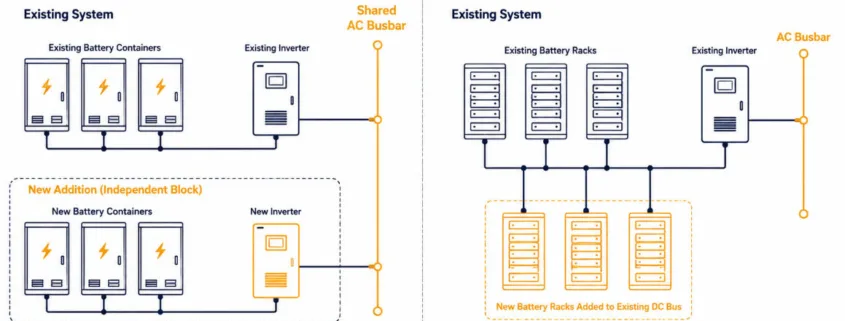
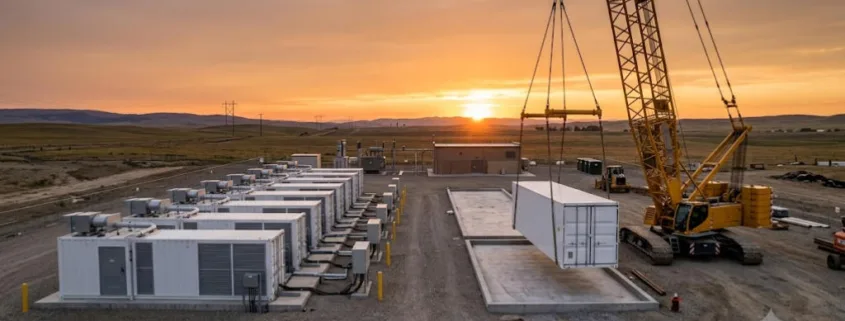
AC block addition adds a self-contained power block next to the existing system. New battery racks, a new PCS, and often a new transformer, arrive as one unit. The block then synchronizes independently at the AC bus, or at a new point of interconnection. Because the new block does not share a DC bus with old batteries, voltage and state-of-charge mismatches between aged and fresh cells never become a problem.
Pros and Cons of the AC Path
Advantages:
Works with any battery chemistry — operators can add a sodium-ion or next-generation LFP block next to an aging system.
Needs no voltage or state-of-charge synchronization with degraded cells.
Offers a chance to upgrade PCS technology, such as adding grid-forming capability, alongside the capacity add.
Creates a clean equipment and warranty boundary between old and new hardware.
Drawbacks:
Costs more, since a new PCS, transformer, and switchgear all add expense.
Needs more physical footprint.
Often triggers a new interconnection study or re-permitting, since new grid-connected hardware is involved.
DC shuffling reorganizes existing battery modules behind the inverters already in service. Modules with similar degradation profiles get grouped together. This, in turn, spreads energy more evenly across the stack. On its own, however, shuffling does not add any capacity. It just rebalances what is already there.
Real capacity gets added only when new racks are added behind the same PCS, after the existing fleet has been shuffled and rebalanced. Because the new capacity shares the existing inverter and bus, the project may be able to avoid a new grid interconnection point. However, permitting and approval requirements still depend on the scope of the modification and the applicable jurisdiction. A DC-to-DC converter can help reconcile the voltage gap between old and new modules. The converter itself, though, adds no capacity on its own.
Technical Limits of DC Shuffling
DC shuffling looks cheap on paper. However, it runs into hard technical ceilings. As Energy-Storage.News has reported, auxiliary load breakers and busbars were sized for the original system. So, adding capacity behind them can exceed that rating.
Adding capacity also raises the available fault current the busbar must survive, measured against its short-time withstand rating. As a result, retrofitting an undersized bus is expensive and disruptive.
Old and new modules, moreover, rarely match perfectly in voltage, capacity, resistance, SOC, or SOH. Without careful matching and appropriate BMS coordination, the newer modules may be limited or taken offline to protect the string. That, in turn, can reduce the usable capacity gain.
Sizing the Restore Buffer: AC Target to DC Install
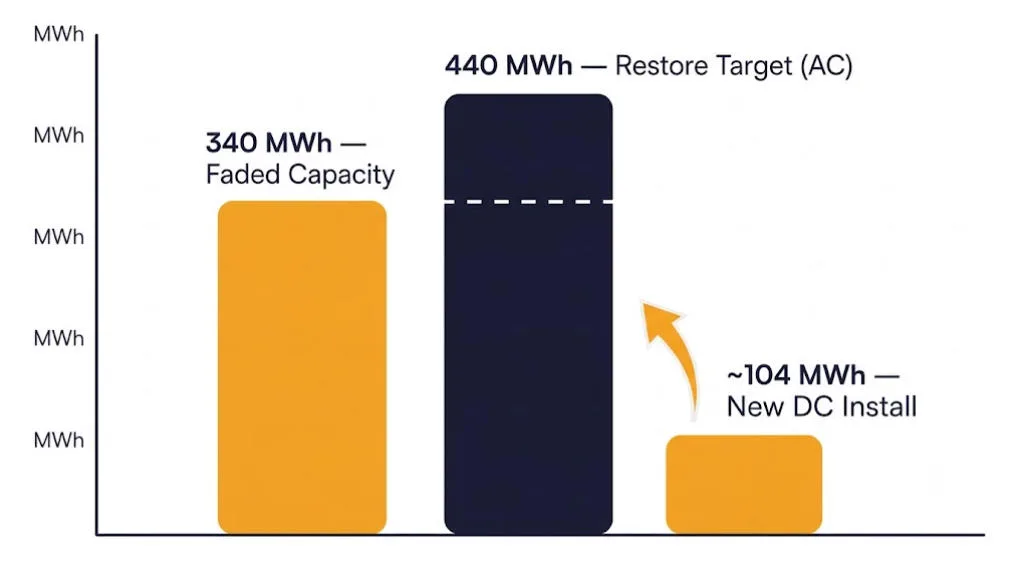
Sizing starts at the point of interconnection, not at the battery rack. Consider a 100 MW, 400 MWh project. After five years, it has faded to 340 MWh of usable energy at the AC side. The operator, in this case, wants to restore headroom to 110 percent of nameplate, or 440 MWh.
That means the project needs 100 MWh of additional AC-side energy. Because DC-to-AC conversion is not lossless, the DC installation must be larger than the AC target. At a typical round-trip factor near 96.5 percent, for example, the operator installs about 104 MWh of new DC capacity to deliver 100 MWh at the AC side.
This buffer-based approach, in short, avoids a common trap. Sizing an augmentation exactly to today’s shortfall just guarantees another shortfall, and another expensive site visit, a year or two later.
AC Block Addition vs. DC Shuffling: At a Glance
Dimension
AC Block Addition
DC Shuffling
New grid connection required
Usually, yes
Usually, no
Typical capital cost
Higher
Lower
Footprint
Larger — new PCS, transformer, switchgear
Smaller — reuses existing enclosures
Chemistry flexibility
Any chemistry
Must match voltage/SOC with existing cells
PCS / protection impact
New PCS; new fault-current source to coordinate
Existing PCS; busbar and breaker ratings cap headroom
Earlier-life projects with headroom in the existing bus
Choosing Between AC Block Addition and DC Shuffling
When AC Block Addition Makes Sense
AC block addition tends to make sense later in a project’s life, once the original PCS is also due for a technology refresh. It is also the better fit when an operator wants to introduce a different battery chemistry, such as pairing a sodium-ion block with an existing LFP fleet.
When DC Shuffling Makes Sense
DC shuffling, on the other hand, fits best earlier in a project’s life, while the existing busbar and breakers still have headroom. It also suits sites where a new interconnection study would be slow or costly. As cell sizes grow past 500 Ah and system voltages rise, some integrators expect DC block designs, and DC shuffling along with them, to look different in the next generation of projects.
Key Takeaways: AC Block Addition vs. DC Shuffling
1. Degradation is inevitable — plan for it before contracted capacity is at risk.
2. Restore buffers are set in AC terms at the point of interconnection, but installed as DC energy.
3. AC block addition costs more but sidesteps chemistry-matching and synchronization limits.
4. DC shuffling costs less but is capped by busbar, breaker, and voltage-matching limits.
5. The right path depends on project age, available headroom, and permitting timeline.
FAQ About AC Block Addition and DC Shuffling
What Is AC Block Addition?
AC block addition is one way to carry out BESS augmentation. It installs a new, independent power block, complete with its own inverters, next to an existing system, to restore or increase capacity lost to degradation.
Does DC Shuffling Alone Add Capacity?
No. Shuffling alone just reorganizes existing modules for better balance. Capacity, however, is only added when new racks get installed behind the shuffled system.
How Much Does This Augmentation Path Cost?
Cost varies by project size, chemistry, and the path chosen. DC shuffling generally costs less per MWh added, since it reuses the existing PCS and transformer. AC block addition, by contrast, costs more, but it includes new power conversion equipment.
Does DC Shuffling Require New Interconnection Permits?
Usually not. Since no new physical connection is made to the grid, DC shuffling can often bypass a fresh interconnection study. AC block addition, on the other hand, usually cannot.
Can AC Block Addition Mix Battery Chemistries?
Yes. Because the new block has its own PCS and DC bus, it does not need to match the voltage or chemistry of the existing system.
BESS augmentation is the process of adding new battery capacity to an existing energy storage system. It restores or increases capacity lost to degradation. Every BESS loses usable capacity over time. Cycling wears down the cells. Calendar aging adds to it too, even when the system sits idle. So, eventually, the project can no longer deliver the energy or power it promised. BESS augmentation exists to close that gap. It does this by restoring nameplate capacity, or by pushing past it.
Quick Answer BESS augmentation adds new battery capacity to an existing system, later in its life, to restore or increase capacity lost to degradation. It differs from oversizing, which installs extra capacity upfront. Owners execute augmentation one of two ways: AC block addition, which adds a new self-contained power block, or DC shuffling, which reallocates and adds capacity behind the existing inverters.
What Is BESS Augmentation?
BESS augmentation and BESS oversizing solve the same problem. However, they act at different points in a project’s life. Oversizing installs extra capacity on day one. This happens before any degradation occurs. BESS augmentation, on the other hand, adds capacity later. It happens once real-world fade has been measured. Our BESS oversizing guide covers that upfront strategy in full. It also covers the trade-off between the two paths. This guide, instead, focuses on the mid-life path. It covers what triggers augmentation, how it works, and how to plan for it.
BESS Augmentation vs. Oversizing: The Short Version
Neither strategy is strictly better. Oversizing locks in capital and tax credits early. But it carries idle capacity for years. BESS augmentation, in contrast, defers that capital. It depends on good execution years later. By then, battery prices, chemistry options, and site conditions may all have changed.
Factor
BESS Augmentation (Mid-Life)
BESS Oversizing (Upfront)
Capex timing
Deferred to year 5-10
Higher Day-1 cost
Section 48E ITC eligibility
Can face reduced eligibility on added capacity
Full credit on entire capacity at commissioning
Execution risk
Depends on future prices, chemistry, site conditions
Lithium-ion cells fade with every charge and discharge cycle. Specifically, the protective layer on the anode cracks and reforms with each cycle. This consumes active lithium. High charge rates and cold temperatures also speed up the damage. Meanwhile, calendar time adds a slower fade on top of cycling.
For some grid-scale LFP projects, usable-capacity fade may average around 2–3% per year, but actual degradation varies substantially with operating conditions, climate, duty cycle, and cell design. As a result, after five to seven years, many projects fall short of their contracted energy or power. That, in turn, threatens revenue directly.
Capacity Guarantees and Tolling Agreements
Most utility-scale BESS projects operate under a tolling agreement or a capacity sale agreement. These contracts are priced against a guaranteed deliverable capacity. This is not simply nameplate capacity at commissioning. So, if degradation erodes that capacity below the contracted floor, trouble follows. The owner then faces liquidated damages or lost revenue. BESS augmentation, therefore, is how owners keep that promise as the asset ages.
These agreements often run 10 to 20 years. So, the augmentation plan is not an afterthought. Instead, it gets built into the financial model at financial close. It sits alongside the degradation curve and the warranty terms.
The Two Paths to BESS Augmentation: AC and DC
There are two ways to physically carry out BESS augmentation. One works on the AC side. The other works on the DC side.
AC Block Addition
First, AC block addition installs a new, self-contained power block next to the existing system. It comes with its own inverters, and often its own transformer too. Because it does not share a DC bus with the old batteries, it avoids voltage and state-of-charge mismatches. It also works with any battery chemistry. As a result, it opens the door to pairing a newer chemistry with an aging LFP fleet.
DC Shuffling
Second, DC shuffling reorganizes existing battery modules behind the inverters already on site. It does not add capacity by itself; additional capacity requires installing new battery modules or racks. It reuses the existing power conversion equipment. This, in turn, keeps costs down. However, busbar ratings, breaker capacity, and voltage matching all place a ceiling on how much it can add.
When new and aged modules share the same DC string, however, the design becomes more complex. For the BMS and string-level considerations, see our guide to Mixed-Age String Design After BESS Augmentation.
For a detailed technical comparison of these two approaches, see our guide to AC block addition vs. DC shuffling guide walks through the full technical comparison. It includes a worked example for sizing the restore buffer. It also covers the busbar and short-circuit limits that cap DC shuffling.
What Triggers a BESS Augmentation Decision?
BESS augmentation planning typically starts at a trigger point. That point is when a site’s measured state of health nears the level needed for its contracted output. Operators track this through periodic capacity tests. In addition, battery management system state-of-health estimates support the tracking. So, neither relies on guesswork.
Typical Timing: Year Five to Year Ten
For most grid-scale LFP projects, that point arrives between year five and year ten. Cycling intensity and climate both affect the timing. For instance, hot climates and aggressive cycling schedules push the timeline sooner. On the other hand, shallow cycling, or oversizing at commissioning, pushes it further out.
Planning early matters a great deal. A reactive BESS augmentation project, ordered only after a shortfall occurs, has far less room to negotiate. Because of that, procurement timelines, chemistry options, and price all suffer.
Battery Chemistry and BESS Augmentation Planning
Battery chemistry affects how easily new capacity can be added. LFP has a relatively flat voltage curve, which can make voltage matching less restrictive than with chemistries such as NMC. However, old and new LFP modules still require careful matching of SOC, SOH, resistance, voltage limits, and BMS behavior before they are combined. This is one reason DC shuffling is more common on LFP systems.
AC block addition, however, removes chemistry matching from the equation entirely. The new block runs its own inverters. So, an operator can add a different chemistry, such as sodium-ion, next to an existing LFP fleet. No voltage curves need to line up.
Tax Credits, Costs, and Procurement for BESS Augmentation
The tax picture for BESS augmentation is less favorable than for oversizing. Under Section 48E, the tax credit applies most cleanly to capacity installed at commissioning. The tax treatment of capacity added through mid-life augmentation can differ from capacity installed at initial commissioning. Project owners should confirm current Section 48E eligibility and applicable requirements with qualified tax advisors before making the augmentation decision. It can also add compliance work. This is a core trade-off against upfront oversizing. So, model it carefully before committing to a mid-life augmentation strategy.
Procurement timelines also differ sharply between the two paths. DC shuffling makes no new grid connection. So, it can often skip a fresh interconnection study. AC block addition, in contrast, usually cannot skip that step, since it adds new grid-connected hardware. That difference alone can add months to the schedule.
Cost varies too. DC shuffling generally costs less per megawatt-hour added. This is because it reuses the existing PCS, transformer, and switchgear. AC block addition costs more. However, it buys a clean equipment boundary. It also adds the option to upgrade power conversion technology at the same time.
A Practical BESS Augmentation Planning Checklist
1. Confirm the site’s actual state-of-health trend against the contracted capacity floor.
2. Model the restore buffer in AC terms, then convert it to a DC installation size, accounting for round-trip losses.
3. Choose between AC block addition and DC shuffling based on busbar/breaker headroom, chemistry needs, and permitting timeline.
4. Reserve physical space for future modules if a DC shuffling path is likely.
5. Model the Section 48E tax credit and financing impact of adding capacity mid-life.
6. Build procurement and, if needed, interconnection lead time into the schedule early.
Key Takeaways on BESS Augmentation
1. BESS augmentation restores or increases capacity lost to degradation, later in a project’s life.
2. Most grid-scale LFP projects need to plan for it between year five and year ten.
3. Tolling agreements and capacity sale agreements make augmentation a contractual necessity, not an option.
4. AC block addition and DC shuffling are the two execution paths, with different cost, timeline, and chemistry trade-offs.
5. Augmented capacity can face reduced Section 48E tax credit eligibility compared to capacity installed at commissioning.
Frequently Asked Questions About BESS Augmentation
When Should a Project Plan for BESS Augmentation?
In short, BESS augmentation planning should begin early. It should start as soon as a site’s degradation curve first threatens a future contract obligation. It should not wait until after a shortfall occurs.
What’s the Difference Between BESS Augmentation and BESS Oversizing?
Oversizing installs extra capacity upfront, before degradation happens. BESS augmentation, by contrast, adds capacity later, once real-world fade has been measured. Oversizing generally captures a fuller tax credit. It also carries lower operational complexity. Augmentation, however, defers capital and can benefit from falling battery prices.
Does Augmented Capacity Qualify for the Section 48E Tax Credit?
Capacity installed at commissioning generally qualifies most cleanly for the Section 48E credit. Capacity added later through augmentation, however, can face reduced eligibility or added compliance work. So, this should be modeled carefully before choosing a mid-life strategy.
How Long Does a BESS Augmentation Project Take?
Timelines vary by path. DC shuffling projects typically avoid a new interconnection study. So, they can often move in weeks to a few months. AC block addition projects, on the other hand, usually require new grid-connected hardware. As a result, they more commonly take several months, due to interconnection and permitting steps.
What’s the Difference Between AC Block Addition and DC Shuffling?
AC block addition installs a new, independent power block with its own inverters. It works with any battery chemistry. DC shuffling, in contrast, reallocates and adds capacity behind the existing inverters. It costs less, but it is limited by busbar, breaker, and voltage-matching constraints.
BESS oversizing — deliberately installing more nameplate energy capacity than your immediate load demands — is one of the most debated decisions in battery storage project design. Therefore, getting this decision right has direct consequences for project ROI, battery longevity, and contracted performance guarantees. Furthermore, as storage markets mature and the Section 48E Investment Tax Credit continues to reshape project economics, understanding when BESS oversizing helps and when it hurts has never been more important.
In this guide, we break down the real pros and cons of BESS oversizing across residential, commercial and industrial (C&I), and utility-scale applications. Additionally, we provide a practical sizing framework, a direct comparison with the augmentation alternative, and clear guidance on how much oversizing is appropriate for each use case. For background on key BESS performance metrics, see our BESS specifications guide.
Key Takeaway BESS oversizing reduces average depth of discharge, extends cycle life, and provides a degradation buffer — but it carries real costs in capex, idle capacity, and calendar aging risk. Consequently, the right answer depends entirely on your use case, load profile, battery chemistry, and project economics.
What Is BESS Oversizing? Definition and Key Drivers
BESS oversizing means installing more nameplate energy capacity (kWh) or power capacity (kW) than the system is expected to dispatch on a daily basis under normal operating conditions. In other words, it is the deliberate act of selecting a battery system larger than the immediate load or solar coupling requirement.
The Four Main Reasons Projects Choose BESS Oversizing
Project developers and system designers choose BESS oversizing for four primary reasons. First, it provides a built-in degradation buffer — batteries lose capacity over time, so installing extra kWh upfront ensures the system still meets its contractual output at end of life (EOL). Second, it reduces the average depth of discharge (DoD), which significantly reduces electrochemical stress and extends cycle life. Third, it future-proofs the system against load growth — a facility adding EV chargers or expanding solar may outgrow a precisely sized BESS within three to five years. Finally, the ITC captures a larger credit on the full installed capacity at commissioning rather than on augmented modules added later.
BESS Oversizing vs Augmentation: Two Different Strategies
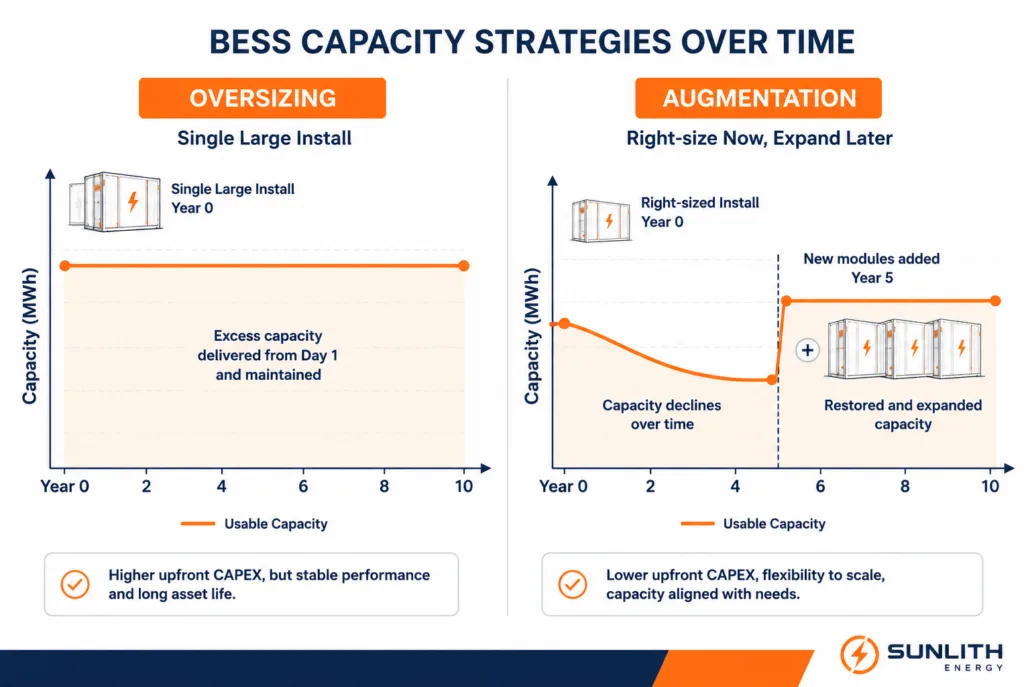
It is important to separate two strategies that are frequently conflated: oversizing (installing more capacity upfront) and augmentation (adding capacity later). Both address the degradation problem, but they carry very different economic and technical profiles. Whereas oversizing locks in capex on Day 1, augmentation defers cost — but at the risk of losing ITC eligibility on the additional modules. We explore this comparison in detail in Section 5.
Pros of BESS Oversizing: 7 Technical and Financial Benefits
1. Extended Cycle Life Through Lower Depth of Discharge
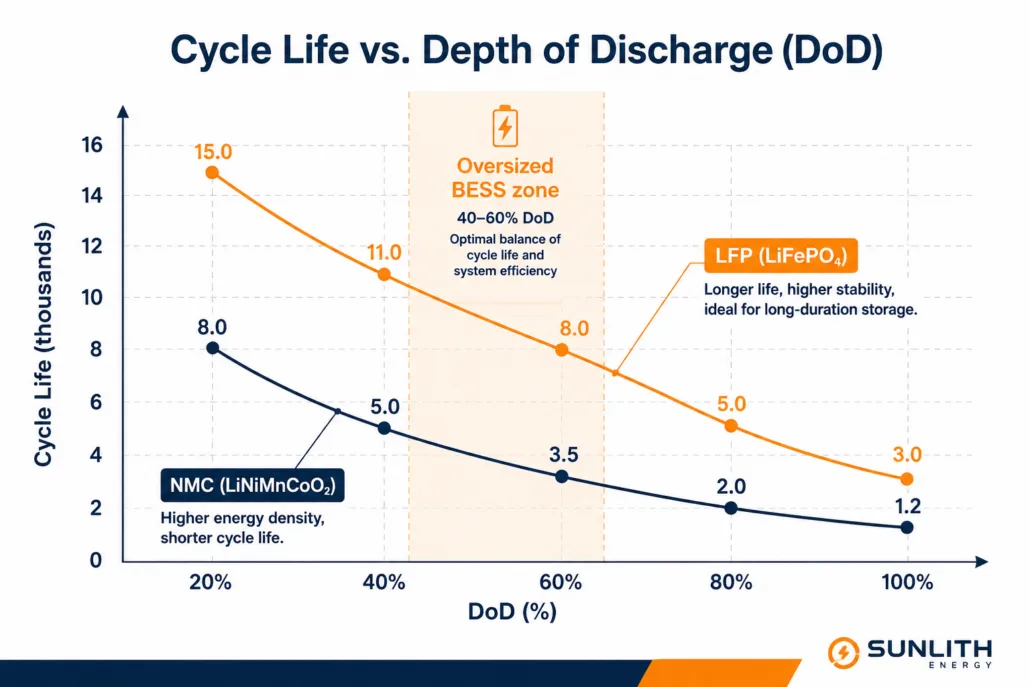
The single most significant technical benefit of BESS oversizing is the reduction in average Depth of Discharge (DoD). Battery cycle life is acutely sensitive to DoD: a LiFePO4 (LFP) cell discharged to 80% DoD typically delivers 3,000–6,000 cycles to 80% capacity retention, whereas the same cell cycled at 40% DoD can exceed 10,000 cycles. Moreover, for NMC chemistry, the spread is even wider. Therefore, oversizing directly reduces the daily DoD, keeping cells in the shallow-cycle, high-longevity operating zone. As a result, the total useful life of the system increases substantially — without any hardware change.
A peer-reviewed sizing study published in MDPI Energies confirmed that an oversized BESS consistently operates at approximately 30% DoD, significantly reducing cycling degradation compared to a precisely sized system. See our BESS cycle life comparison guide for detailed 0.5C vs 1C cycling data across liquid-cooled LFP formats.
2. Built-In Degradation Buffer for End-of-Life Performance
All BESS contracts and revenue agreements are written against end-of-life capacity, not nameplate. Consequently, a project designed to deliver 1 MWh at year 10 must either oversize at commissioning to absorb predicted capacity loss, or augment mid-life. BESS oversizing solves this directly: the 15–20% extra capacity at year 0 becomes the system’s normal operating capacity at year 8–10, after degradation has run its course. In addition, oversizing also enables developers to lock in capital expenditures at project outset, mitigating future cost uncertainty. For a deeper understanding of capacity fade mechanics, see our Battery State of Health (SoH) estimation guide.
3. Improved Round-Trip Efficiency at Partial Loads
Battery inverters and Power Conversion Systems (PCS) operate most efficiently when working well below their rated power ceiling. Therefore, an oversized BESS means the power electronics run at partial load more often, reducing switching losses and thermal stress. Across LFP systems, round-trip efficiency (RTE) typically reaches 90–95% in well-managed partial-load conditions versus 85–88% when the system is pushed to rated limits daily. Furthermore, professional system sizing guidelines recommend oversizing by 5–20% specifically to compensate for RTE losses over the project’s lifetime. For a full breakdown of how RTE impacts your PCS selection, visit our BESS PCS functions and features guide.
4. Future-Proofing for Load Growth
Commercial and industrial facilities are rarely static. An EV fleet charging infrastructure build-out, a new production line, additional HVAC loads, or expanded solar capacity can all push a precisely sized BESS into insufficiency within a few years. As a result, BESS oversizing provides headroom to absorb load growth without a full system redesign or costly inverter upgrades. For residential customers, similarly, oversizing by 10–20% accounts for future appliance electrification — heat pumps, EV charging, induction cooking — that increase household energy consumption over time. This is especially relevant given that electricity rates have increased 32% over the past decade and the trend is expected to continue.
5. Greater Resilience During Extended Outages
An oversized BESS provides substantially longer backup durations during grid outages. For instance, where a precisely sized system may sustain critical loads for 4–6 hours, a 25% oversized system of the same power rating extends that window to 5–7.5 hours without additional hardware. Consequently, for hospitals, data centres, manufacturing facilities, and off-grid microgrids, this resilience buffer is a core design requirement rather than an optional feature. In addition, BESS oversizing enables higher solar self-consumption ratios, because the system can absorb more excess PV generation that would otherwise be curtailed — especially in DC-coupled configurations. Our cylindrical vs prismatic LFP cell guide covers how cell format selection interacts with resilience design.
6. Tax Credit Maximisation Under Section 48E
Under the Section 48E Clean Electricity Investment Tax Credit, the ITC applies to the full installed nameplate capacity at commissioning. Projects beginning construction before 2033 can qualify for a base credit of 6% rising to 30% — or up to 50% with domestic content and labour standards — on the entire installed system. Therefore, oversizing at commissioning rather than augmenting later allows developers to capture ITC on the additional capacity now, when the credit is at its most generous. As documented by Energy-Storage.News, Pivot Energy uses optimisation models specifically to find the ‘sweet spot’ where overbuilding by 15–20% captures the full ITC while also reducing DoD and slowing the degradation curve.
7. Higher Solar Self-Consumption and Clipping Capture
In solar-plus-storage configurations, an oversized BESS absorbs more excess PV generation that would otherwise be curtailed — particularly in DC-coupled systems where the battery captures inverter clipping losses. Projects with aggressively sized solar arrays consequently benefit most from an oversized storage buffer, enabling higher self-consumption ratios and better time-of-use (ToU) arbitrage revenue. Additionally, the flat voltage profile of LFP cells means the battery can accept charge across a wider SoC range without significant efficiency loss, making it well-suited to absorbing variable clipping events.
Cons of BESS Oversizing: 7 Real Drawbacks to Weigh
1. Higher Upfront Capital Expenditure
The most obvious downside of BESS oversizing is cost. At current commercial LFP BESS pricing of $220–$320 per kWh (nameplate, installed), adding 15–25% extra capacity translates directly into a 15–25% larger capital outlay. For example, on a 1 MWh C&I project, the oversizing premium reaches $33,000–$80,000. On a 10 MWh utility-scale project, the figure climbs to $330,000–$800,000. As a result, higher capex extends payback periods, dilutes IRR, and increases financing costs. Moreover, the 20/80 rule for battery SoC management — explored in our 20/80 rule for batteries guide — shows that moving from a 90% DoD strategy to a strict 60% DoD strategy for the same usable energy requires installing roughly 33% more nameplate capacity, at a steep capex premium.
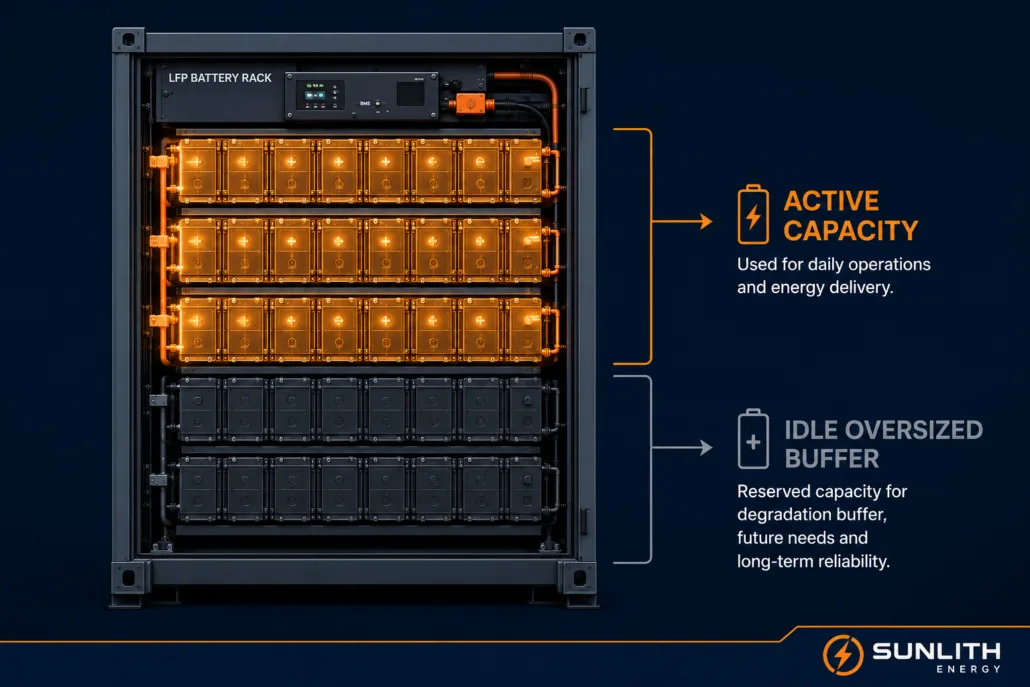
2. Idle Capacity — Stranded Capital
An oversized BESS, by definition, contains capacity that is not used every day. In a system with a 30% oversizing factor, approximately 23% of the installed kWh is functionally stranded under normal operating conditions — generating no direct revenue, not contributing to peak shaving, and not offsetting grid draw. Therefore, for merchant revenue projects where every kWh of contracted discharge must justify its hardware cost, idle capacity directly weakens the financial case. Consequently, a detailed financial model comparing oversized vs precisely sized scenarios is essential before committing to an aggressive oversizing strategy.
3. Calendar Aging at High State of Charge
There is a subtle but real risk in BESS oversizing: a battery that is rarely deeply discharged will consequently spend more time at a high state of charge (SoC) between cycles. For LFP, this matters less due to the flat voltage curve, but for NMC and NCA chemistries, sustained high SoC accelerates calendar aging through lithium plating and electrolyte decomposition. The EMS must therefore be configured with SoC upper limits (typically a 90% ceiling) to mitigate this risk, which further reduces the usable window — partially negating the oversizing benefit.
4. Larger Physical Footprint and Permitting Complexity
A larger BESS means more rack space, additional container units, larger electrical rooms, and more complex fire suppression under NFPA 855 setback requirements. For urban C&I projects, rooftop installations, or sites with constrained footprints, BESS oversizing may simply not be feasible without additional civil and structural engineering. As a result, the incremental cost of accommodating a larger system can erode or eliminate the economic benefit of the additional capacity.
5. Risk of Over-Engineering Against Inaccurate Load Projections
BESS oversizing is typically justified by load growth projections that may not materialise. A facility forecasting 30% energy consumption growth over five years but actually growing 10% has paid a significant capex premium for capacity that will never be fully utilised. Furthermore, the further into the future the projections extend, the less reliable they become — and the weaker the economic case for aggressive oversizing. Therefore, right-sizing discipline, grounded in real interval load data, is essential before committing to an oversizing strategy.
6. Interconnection Limit Conflicts
Utility interconnection agreements define the maximum allowable power at the Point of Common Coupling (PCC). An oversized BESS that exceeds the permitted inverter or PCS rating — or that pushes a project over the interconnection ceiling — may require expensive distribution upgrades, transformer replacements, or grid impact studies. As a result, always validate that the oversized system’s power rating remains within interconnection constraints before finalising the design.
7. Diminishing Returns on ROI for Thin-Margin Projects
For projects where the economics are already marginal — low ToU spreads, limited demand charges, or thin merchant power prices — the additional capex of BESS oversizing may not be recoverable within the project’s financial life. Therefore, a right-sizing discipline, rather than aggressive oversizing, often produces better risk-adjusted returns on projects operating in challenging market conditions. Additionally, if battery prices continue to fall, augmentation at year 5–7 may deliver the same EOL capacity guarantee at a lower total lifecycle cost than oversizing today.
BESS Oversizing Pros and Cons: Quick-Reference Comparison Table
PROS of BESS Oversizing
CONS of BESS Oversizing
Extends cycle life by reducing average DoD
Higher upfront capital expenditure
Slower capacity degradation over project lifetime
Idle capacity — underutilised asset
Buffer for future load growth without re-powering
Larger footprint and space requirements
Improves round-trip efficiency at partial loads
Additional BMS / thermal management complexity
Strengthens resilience during extended outages
Risk of battery sitting at high SoC, accelerating calendar aging
Lock in ITC / 48E tax credits on full capacity now
Diminishing returns if load growth projections are wrong
Reduces depth of discharge and thermal stress
Potentially overshoots interconnection limits
Supports higher solar self-consumption
Makes ROI harder to justify on thin-margin projects
BESS Oversizing vs Augmentation: Which Degradation Strategy Wins?
The BESS oversizing debate is inseparable from its primary alternative: augmentation — the strategy of adding battery modules at year 5 or 7 to restore degraded capacity. However, these strategies are not equivalent, and the right choice depends on several project-specific factors.
Factor
BESS Oversizing (Upfront)
Augmentation (Mid-Life)
Capex Timing
Higher Day-1 cost; lower total lifecycle cost
Lower Day-1 cost; uncertain future capex at year 5–7
ITC Eligibility
Full credit on entire capacity at commissioning
Augmented capacity may miss ITC or face FEOC risk
Degradation Benefit
Reduces DoD and slows degradation from Day 1
Addresses degradation after it has occurred
Space Planning
Must install full footprint upfront
Must reserve physical and electrical space for future modules
Falling Battery Prices
Locks in today’s cost for future capacity
May benefit from lower prices at year 5
Complexity
Lower operational complexity
Requires mid-project procurement and system rebalancing
C&I with budget constraints; markets with falling storage prices
As battery prices continue to fall, augmentation is becoming more attractive for some project types. Nevertheless, as Pivot Energy’s modelling demonstrates, for ITC-sensitive projects, oversizing by 15–20% upfront typically produces better risk-adjusted NPV than augmentation — particularly given the difficulty of qualifying augmented capacity for the same ITC rate under the One Big Beautiful Bill Act.
How Much BESS Oversizing Is Right? A Use-Case Sizing Guide
There is no universal BESS oversizing percentage. Instead, the right buffer depends on your use case, battery chemistry, load profile, and project economics. However, the table below provides a practical reference framework covering the most common project types:
Use Case
Recommended BESS Oversizing
Rationale
Key Risk if Under-Sized
Residential Solar + Storage
10–20%
Compensate for DoD and RTE losses; buffer seasonal variation
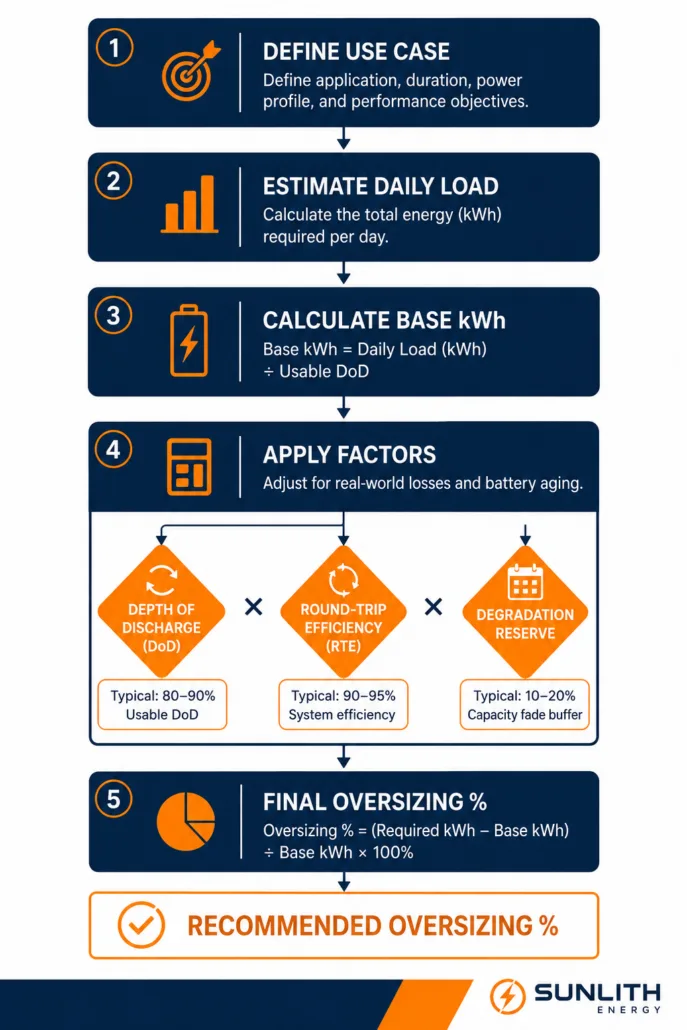
Example: 30 kWh/day load × 2 autonomy days = 60 kWh base ÷ 0.85 DoD × 0.92 RTE = 76.6 kWh nameplate minimum + 15% degradation buffer = approximately 88 kWh recommended nameplate capacity
Note: For LFP chemistry with a 90% DoD operating window, adjust DoD factor accordingly.
For LFP chemistry specifically, the degradation benefit of BESS oversizing is more modest than for NMC or NCA, because LFP already exhibits a flatter voltage curve and superior cycle life at high DoD. Therefore, the most rigorous approach — as recommended in NREL’s Energy Storage Modelling guidelines and the IEA’s Batteries and Secure Energy Transitions report — is to use simulation tools such as NREL’s SAM or PVsyst with real 15-minute interval load data to determine the optimal capacity that minimises LCOE while meeting the contracted capacity guarantee at EOL.
Does Battery Chemistry Change the BESS Oversizing Calculus?
Yes — significantly. However, the extent to which BESS oversizing is beneficial varies considerably by chemistry. Here is how the most common BESS chemistries interact with oversizing strategy:
LFP (LiFePO4): The Most Common Choice for Commercial BESS
LFP already offers exceptional cycle life — 6,000–10,000+ cycles at 0.5C to 80% SoH — a flat voltage curve that reduces SoC-related aging, and thermal stability above 270°C. Therefore, the benefit of BESS oversizing for LFP is real but more modest than for NMC. A 10–15% oversizing factor is typically sufficient for residential and C&I LFP projects, unless extended autonomy is a primary requirement. For a detailed comparison of LFP cell formats, see our cylindrical vs prismatic LFP guide.
NMC (Nickel Manganese Cobalt): Greater Benefit from Oversizing
NMC cells are more sensitive to both high SoC and high DoD. The cycle life penalty for deep discharging is steeper, and calendar aging at high SoC is more pronounced. Consequently, for NMC-based systems, BESS oversizing by 20–30% can provide meaningful cycle life extension. However, the EMS must be configured to avoid sustained high-SoC parking, which otherwise accelerates precisely the degradation the oversizing was intended to prevent.
NCA (Nickel Cobalt Aluminium): Strongest Case for Oversizing
NCA is even more sensitive to DoD extremes than NMC. Therefore, BESS oversizing is strongly recommended for NCA systems, alongside strict SoC window management — typically a 20–90% operational band. As a result, NCA-based utility-scale systems frequently carry 20–30% oversizing factors as a standard design requirement.
When to Choose BESS Oversizing — and When to Avoid It
Oversize Your BESS When These Conditions Apply
Your project carries a 10+ year contract or PPA with capacity guarantee provisions that must be met at end of life
You are qualifying for ITC / Section 48E and want to maximise the tax credit on the full installed capacity at commissioning
The site has a clear load growth trajectory — EV charging, electrification roadmap, or solar expansion planned
You are designing an off-grid or critical backup system where autonomy days are non-negotiable
NMC or NCA chemistry is specified and DoD reduction delivers a significant cycle life benefit
Your DC-coupled solar array is oversized relative to the inverter and the battery can capture clipping energy
The incremental capex of BESS oversizing is recoverable within the project financial model
Avoid BESS Oversizing When These Conditions Apply
Project economics are already thin and additional capex pushes IRR below the acceptable threshold
Load forecasts are highly uncertain and growth projections lack solid 15-minute interval data support
Physical space constraints make a larger system impractical or disproportionately expensive to install
The interconnection agreement caps power capacity at a level that already constrains daily dispatch
Battery prices are falling rapidly in your market and augmentation in year 5–6 will be substantially cheaper
LFP chemistry is specified and daily DoD is already inherently low (below 60%) with proper sizing
The Four-Step BESS Oversizing Decision Framework
Rather than guessing at an oversizing percentage, use this structured four-step framework to determine whether BESS oversizing is appropriate for your project and, if so, by how much. As a result, you will arrive at a defensible, financially grounded nameplate capacity rather than an arbitrary rule of thumb.
Step 1 — Load Analysis: Gather Real Interval Data
First, collect at least 12–24 months of 15-minute interval load data. Identify peak demand events, average daily consumption, and seasonal variation patterns. This step is non-negotiable: BESS oversizing justified by rough annual consumption estimates rather than interval data almost always produces either over-engineered or under-performing systems.
Step 2 — Base Capacity Calculation
Next, apply the standard sizing formula — daily load × autonomy days ÷ (DoD × RTE) — to establish the minimum required nameplate capacity. This gives you the floor, not the target. However, it also reveals exactly how sensitive the result is to your DoD and RTE assumptions.
Step 3 — Apply Chemistry and Use-Case Correction
Subsequently, determine your oversizing factor based on battery chemistry (LFP vs NMC vs NCA), use case (peak shaving vs backup vs grid services), and EOL capacity requirement. Reference the sizing guide table in Section 6 for starting-point percentages, then adjust based on site-specific factors including climate, cycling frequency, and interconnection limits.
Step 4 — Financial Validation: Model Both Scenarios
Finally, model the oversized vs precisely sized scenarios in a full project NPV and IRR analysis, incorporating ITC capture, degradation trajectory, load growth assumptions, and augmentation cost projections. As a result, you will arrive at the scenario that maximises risk-adjusted return while meeting contracted performance obligations. Choose the strategy with the superior risk-adjusted NPV — not the one that simply installs the most battery.
Conclusion: BESS Oversizing Is a Strategy, Not a Default
BESS oversizing is one of the most powerful tools in a storage developer’s arsenal — but only when applied with precision. When the economics support it, oversizing by 10–25% delivers longer cycle life, a built-in degradation buffer, greater resilience, higher solar self-consumption, and maximised ITC capture. Conversely, when applied without a sound load analysis and financial model, it simply commits capital to cells that will never discharge.
The right approach is always project-specific. Therefore, an LFP C&I peak shaving project with a 10-year capacity guarantee may need 15–20% BESS oversizing to meet EOL targets. A residential grid-tied backup system with low daily DoD requirements may need only 10%. An off-grid microgrid with strict autonomy requirements and no grid fallback may need 25–30%. Furthermore, as battery prices continue to fall, the break-even point between oversizing and augmentation will shift — making it essential to rerun the financial model on each new project rather than applying a fixed rule.
At Sunlith Energy, every BESS project we design goes through a rigorous sizing and degradation modelling process — using real interval load data, validated chemistry models, and financial sensitivity analysis. To learn more about how we approach BESS design, explore our BESS specifications guide, our Battery SoH estimation guide, or review the NLR Grid-Scale Battery Storage Technology Basics for independent technical context. The goal is never the largest battery — it is the right battery, sized correctly for your project’s lifetime.
Ready to size your BESS correctly? Contact the Sunlith Energy team for a technical consultation. We combine 14+ years of LiFePO4 expertise with advanced degradation modelling to design storage systems that perform at end of life, not just on commissioning day.