
What is DC Coupled BESS System? Core Components, How It Works & Its Benefits
As the world shifts towards renewable energy, the need for efficient energy storage systems is greater than ever. Battery Energy Storage Systems (BESS) are at the center of this transformation. But not all BESS setups are the same. One important configuration to understand is the DC Coupled BESS. In this blog post, we will explore what it is, how it works, its key components, and why it can be a smart choice for many renewable energy projects.
What is a DC Coupled BESS?
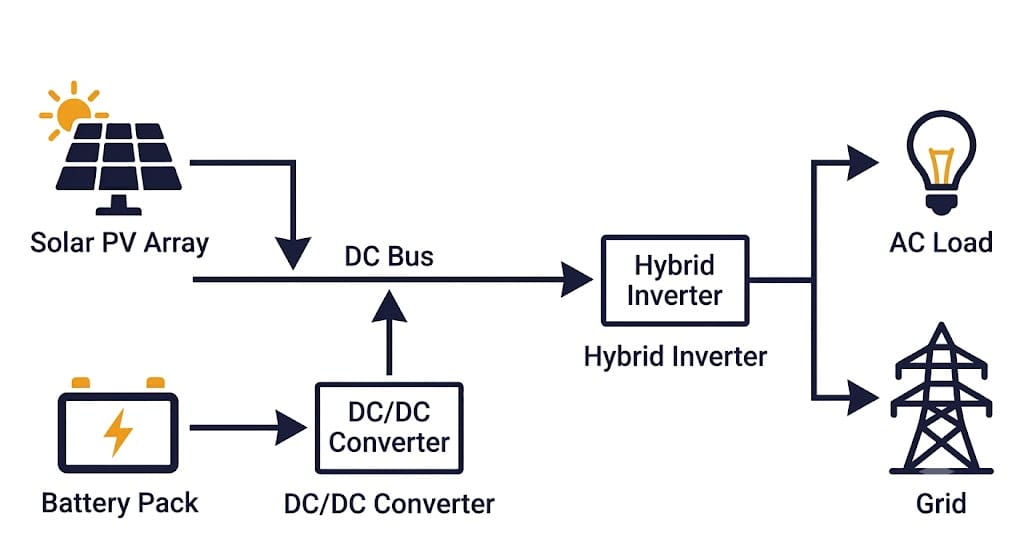
A DC Coupled Battery Energy Storage System (BESS) is an energy storage architecture where both the battery system and solar photovoltaic (PV) panels are connected on the same DC bus, before the inverter. This is different from an AC coupled BESS, where the solar and battery systems are each connected to the AC grid separately via their own inverters.
In simpler terms, in a DC-coupled system, the solar panels and battery share one inverter and connect through a DC/DC converter. This makes the system more efficient, especially in applications where solar generation is paired with energy storage.
Core Components of a DC Coupled BESS System
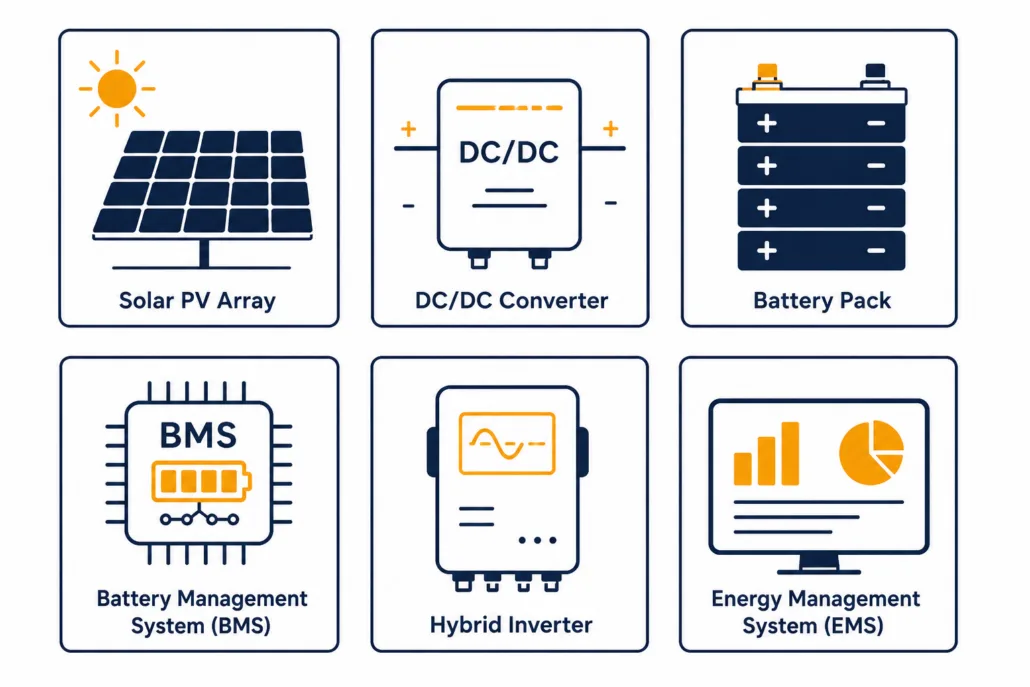
A typical DC coupled BESS includes the following major components:
1. Solar PV Array
Captures sunlight and converts it into direct current (DC) electricity.
2. DC/DC Converter
This device regulates the voltage between the PV panels, battery, and inverter. It allows maximum power point tracking (MPPT) and enables energy flow between the PV and battery.
3. Battery Pack
Stores excess solar energy for use during periods of low generation or peak demand. Common chemistries include Li-ion (NMC, LFP) and semi-solid batteries.
4. Battery Management System (BMS)
Monitors and protects the battery cells. It manages parameters like voltage, current, temperature, and SoC (state of charge).
5. Hybrid Inverter (DC to AC)
Converts DC electricity from the battery or solar panels into AC electricity for use in homes, industries, or to feed into the grid.
6. Energy Management System (EMS)
Controls the operation of the entire system, optimizing charging/discharging, solar usage, and grid interaction based on pre-set algorithms and real-time conditions.
DC-Coupled Battery Storage: Why It’s More Efficient
DC-coupled battery storage keeps the solar array and battery on the same DC bus, so they share one inverter instead of each needing their own. That single shared conversion point is what defines DC-coupled energy storage and separates it from AC-coupled designs.
Because the battery in a DC-coupled battery storage system charges directly from the DC bus, it can also capture solar energy that would otherwise be clipped when panel output exceeds what the inverter can push to the grid — a common limitation in high-output PV arrays. That stored energy would simply be wasted in a system without DC-coupled storage in place. NREL’s 2024 Annual Technology Baseline applies a dedicated “Co-location Savings Rate of DC-Coupled Systems” in its own cost modeling for utility-scale PV-plus-battery projects, reflecting the added value this shared-inverter design captures over standalone PV and storage.
For a full side-by-side comparison against AC-coupled battery storage, see AC-Coupled vs. DC-Coupled BESS: Which Architecture Is Right for Your Project?.
The Role of the BESS Inverter (PCS) in a DC-Coupled System
In a DC-coupled BESS, the shared inverter is often called the Power Conversion System, or PCS, in utility-scale and C&I applications. Because the solar array and battery share the same DC bus, this single BESS inverter has to manage three jobs at once: routing DC power between PV, battery, and loads; converting DC to AC at the one point where stored or generated energy leaves the DC bus; and, in some designs, forming or following grid voltage and frequency.
Because DC-coupled systems route everything through one inverter, PCS sizing and certification carry more weight here than in an AC-coupled design, where the load splits across two smaller units.
For a full breakdown of how the PCS works and what it does in a BESS, see our guide: Power Conversion System (PCS): The Brain Behind Battery Energy Storage Systems.
⚙️ How Does a DC Coupled BESS Work?
Here’s a simplified step-by-step overview of how a DC Coupled BESS operates:
- During Daytime with Sunlight:
- Solar PV generates DC electricity.
- DC power goes to the DC/DC converter.
- Part of the energy is used directly by loads (via inverter).
- Excess energy charges the battery via the same DC bus.
- Only one DC to AC conversion occurs when sending power to the grid or loads.
- During Night or Cloudy Periods:
- Stored energy in the battery is sent through the inverter to supply the AC load or the grid.
- Grid-Tied and Off-Grid Modes:
- Can function in both modes, depending on the design.
- Can seamlessly switch between grid usage, solar generation, and battery power based on EMS logic.
Benefits of DC Coupled BESS
DC coupled systems offer several technical and economic advantages over AC coupled ones:
1. Higher Efficiency
- Fewer conversions (DC-AC-DC in AC coupled vs. just DC-AC here).
- Reduces energy losses, improving overall round-trip efficiency.
2. Lower Equipment Cost
- Only one inverter needed.
- Fewer transformers and conversion stages reduce capital expenditure.
3. Maximized Solar Harvesting
- Allows solar charging even during grid outages.
- Can store excess energy that would otherwise be clipped or curtailed.
4. Improved System Integration
- Easier to integrate solar, battery, and EV charging into one system.
- Easier to control and manage with centralized EMS.
5. Simpler Grid Interconnection
- Since everything passes through a single inverter, grid interconnection rules are simpler.
- Reduces the complexity of interconnection studies and permits.
6. Faster Response Time
- Direct DC connection between battery and PV allows faster power adjustments in response to load changes or frequency events.
When Should You Choose a DC Coupled BESS?
A DC Coupled BESS is ideal for:
- New solar + storage installations where both systems are designed together.
- Remote or off-grid locations where grid stability and efficiency are critical.
- Microgrid systems requiring smooth integration of multiple power sources.
- Commercial and industrial setups looking for energy savings and peak load shaving.
However, if you’re retrofitting an existing solar system, an AC-coupled system is often easier to implement since it doesn’t require touching your existing PV wiring. For the full breakdown of both architectures — cost, efficiency, retrofit fit, and when to choose each — see our complete guide: AC-Coupled vs. DC-Coupled BESS: Which Architecture Is Right for Your Project?
Frequently Asked Questions
What does “DC-coupled” mean?
“DC-coupled” means the solar PV array and the battery connect to the same DC bus, ahead of a single shared inverter, rather than connecting separately on the AC side.
How does DC-coupled energy storage work?
Solar PV generates DC power that flows through a DC/DC converter, where it either charges the battery directly or passes through the shared inverter to supply AC loads or the grid. Because charging and discharging both happen on the DC side, the system converts power to AC only once, which improves efficiency compared to AC-coupled designs.
What does BESS stand for?
BESS stands for Battery Energy Storage System — any system that stores electrical energy in batteries for later use, whether paired with solar, wind, or the grid.
What is a DC-coupled battery?
A DC-coupled battery is a battery wired directly to the same DC bus as the solar array, charging and discharging through a shared DC/DC converter and inverter instead of its own dedicated inverter.
What’s the difference between AC-coupled and DC-coupled BESS?
DC-coupled systems share one inverter between the battery and solar array. AC-coupled systems use two separate inverters, one for each. See our full comparison in AC-Coupled vs. DC-Coupled BESS: Which Architecture Is Right for Your Project?.
Conclusion
A DC Coupled BESS offers a more efficient, cost-effective, and integrated approach to combining solar and battery storage. By reducing the number of conversions and simplifying system design, it ensures higher performance and better return on investment, especially in new or greenfield projects.
As energy needs evolve and distributed energy resources grow, understanding these architectures becomes critical. Whether you’re a developer, EPC, or energy investor—DC coupled systems could offer you the next level of performance and reliability.




Trackbacks & Pingbacks
[…] DC-Coupled Solar + BESS […]
[…] In DC-Coupled BESS, the battery and solar PV share a common inverter. The PV array and battery are c… […]
Leave a Reply
Want to join the discussion?Feel free to contribute!