C&I BESS peak shaving is rapidly becoming one of the most effective strategies for commercial and industrial (C&I) facilities to lower electricity costs. By leveraging battery energy storage systems (BESS), businesses can reduce demand charges, optimize energy usage, and unlock significant long-term savings.
Understanding Demand Charges
Demand charges are fees utilities impose based on the highest level of electricity a facility consumes during a billing cycle. For businesses with large equipment or fluctuating energy needs, these charges often make up 30–70% of total electricity bills.
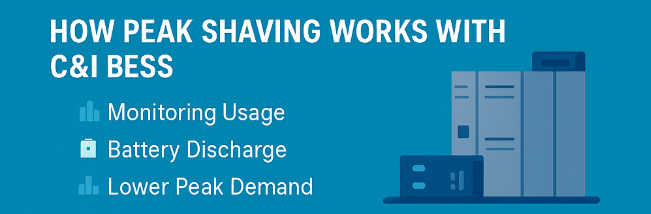
How Peak Shaving Works with C&I BESS
Monitoring Usage: Smart systems track real-time energy demand.
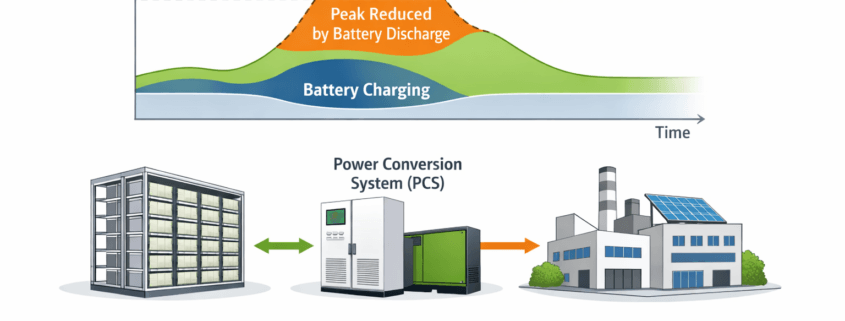
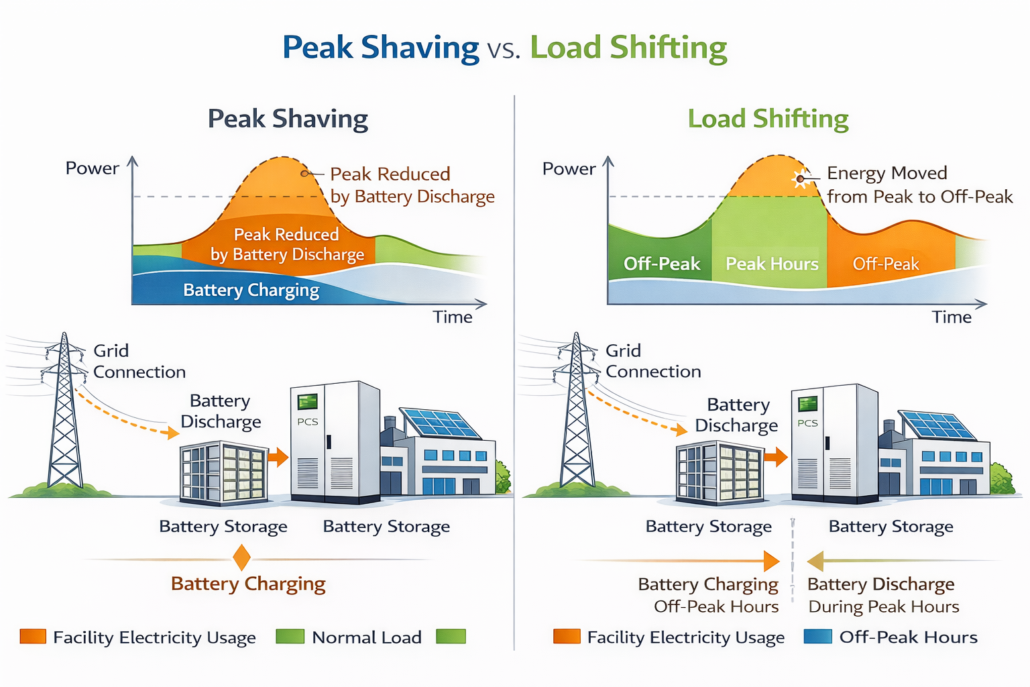
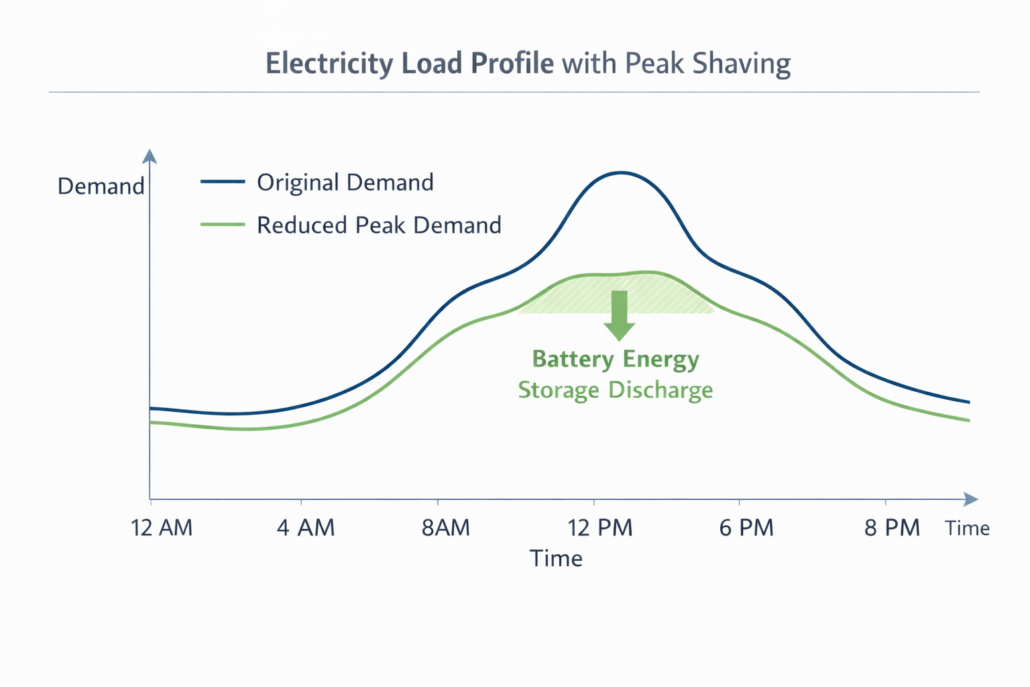
Battery Discharge: During peak load times, stored energy is released to reduce grid reliance.
Lower Peak Demand: Utilities see a reduced maximum load, leading to lower demand charges.
This process allows companies to maintain operations while avoiding costly spikes in utility bills.
Improved Energy Reliability during high-demand periods.
Optimized Equipment Usage by reducing grid strain.
Increased Flexibility for energy-intensive operations.
👉 Learn more about the broader Benefits of C&I BESS, including resilience and sustainability.
Case Example: Peak Shaving in Manufacturing
A large manufacturing facility with heavy machinery faced monthly demand charges of over $50,000. By installing a 5 MW / 10 MWh C&I BESS, the facility:
Cut demand charges by 35%.
Saved over $500,000 annually.
Recovered the investment within 4 years.
Future Outlook: Peak Shaving as a Business Imperative
As electricity rates rise and utilities implement more time-based pricing, C&I BESS peak shaving will shift from an optional strategy to a business necessity. Companies adopting this approach early will gain a competitive advantage in cost control and sustainability goals.
Conclusion
C&I BESS peak shaving is a proven solution to reduce demand charges, optimize energy use, and drive long-term savings. For businesses in manufacturing, retail, healthcare, or data centers, investing in battery storage is not just about energy—it’s about financial resilience and operational efficiency.
Peak shaving is a widely used strategy for reducing electricity demand charges in commercial and industrial facilities. Many businesses experience short periods of very high electricity demand. These spikes often increase monthly power costs.
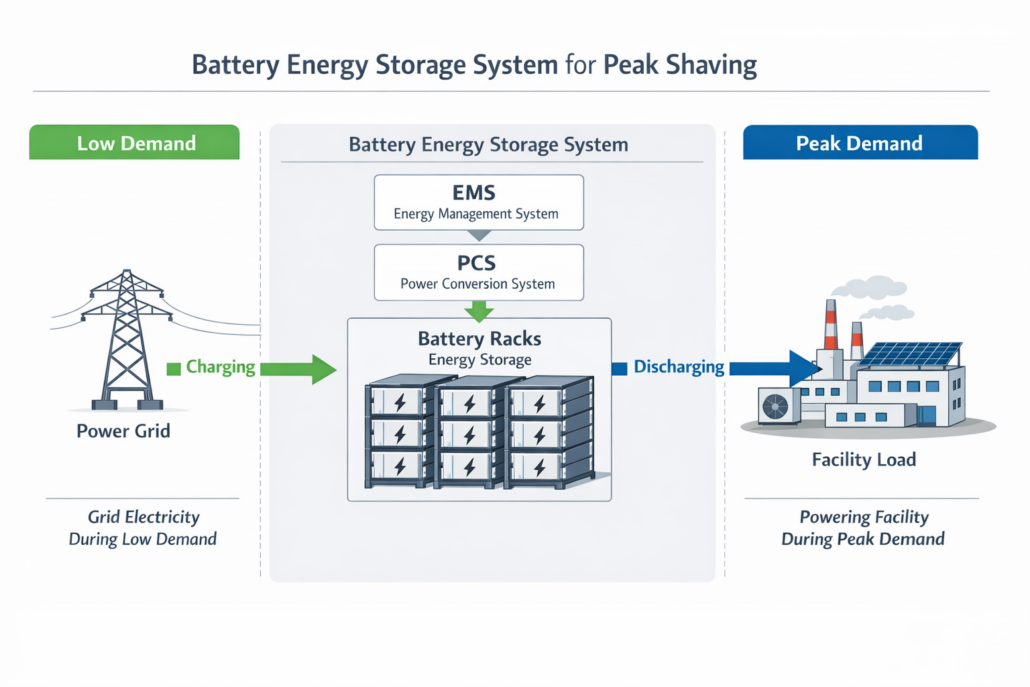
However, companies can control these costs with peak shaving energy storage and commercial and industrial battery energy storage systems that store electricity during low-demand periods . Battery energy storage systems store electricity during periods of low demand. Later, the stored energy is released when power demand rises. As a result, the facility draws less electricity from the grid.
This approach lowers demand charges and improves energy efficiency. In addition, it helps utilities balance electricity supply and demand more effectively.
What Is Peak Shaving?
Peak shaving is an energy management strategy that reduces electricity demand during periods of high consumption. Businesses often use battery energy storage systems to store electricity during low-demand hours and release it when demand increases. As a result, facilities reduce peak power usage and lower demand charges.
According to research from the U.S. Department of Energy, battery energy storage systems can help reduce electricity demand during peak periods and improve grid stability.
What Is Peak Shaving in Energy Management
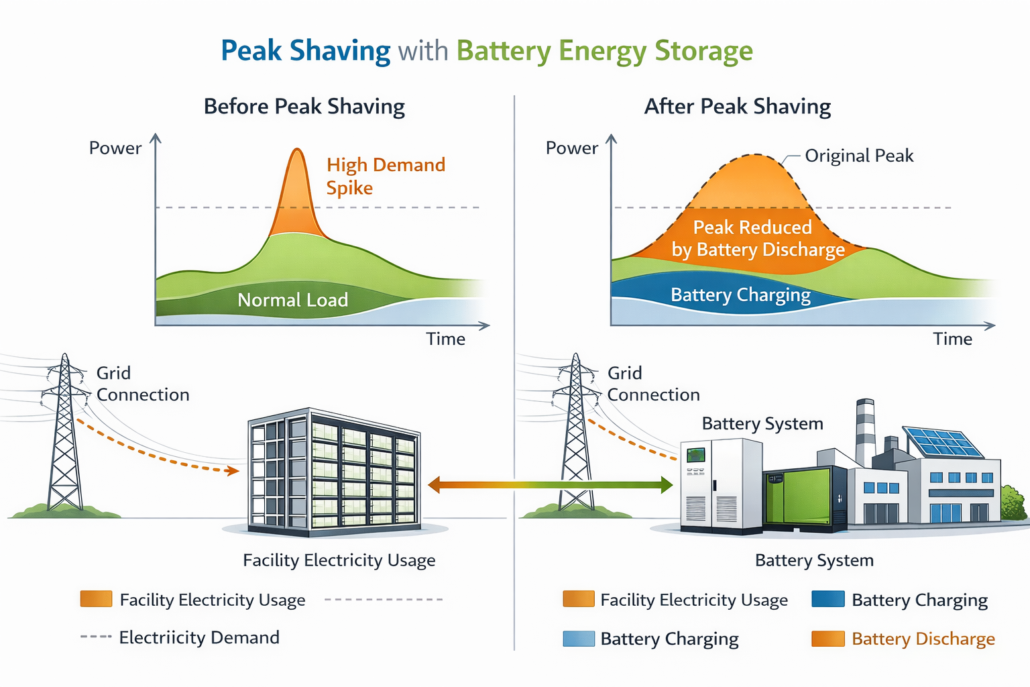
Peak shaving is an energy management technique that reduces electricity demand during high-consumption periods. Instead of drawing all electricity from the grid, a facility uses stored energy or controlled loads to limit demand spikes.
Electric utilities often charge customers based on their highest power demand during a billing cycle. Even a short increase in electricity usage can raise the total cost for the entire month.
This is where peak demand management becomes important.
For example, a factory may run several large machines at the same time. When those machines start simultaneously, electricity demand rises quickly. Without a demand reduction strategy, that spike becomes the facility’s recorded peak demand.
Battery storage can supply part of the electricity during that moment. Consequently, the power drawn from the grid decreases. The result is a lower recorded peak demand and reduced electricity charges.
Why Peak Shaving Is Important for Commercial Energy Users
Electricity pricing structures often include both energy charges and demand charges. Energy charges are based on total electricity consumption. Demand charges, however, depend on the highest power demand during the billing cycle.
Because of this structure, demand charges can represent a significant portion of a commercial electricity bill.
Peak shaving helps businesses control these costs in several ways.
Lower Electricity Costs
Peak shaving reduces the maximum electricity demand recorded by utilities. Consequently, businesses pay lower demand charges each month.
Predictable Energy Expenses
Reducing demand spikes helps stabilize energy costs. Companies can better forecast operational expenses.
Improved Grid Efficiency
Lower peak demand reduces stress on power infrastructure. As a result, utilities can operate generation and transmission systems more efficiently.
Better Energy Optimization
Peak shaving energy storage allows businesses to manage how electricity is consumed throughout the day.
Renewable Energy Integration
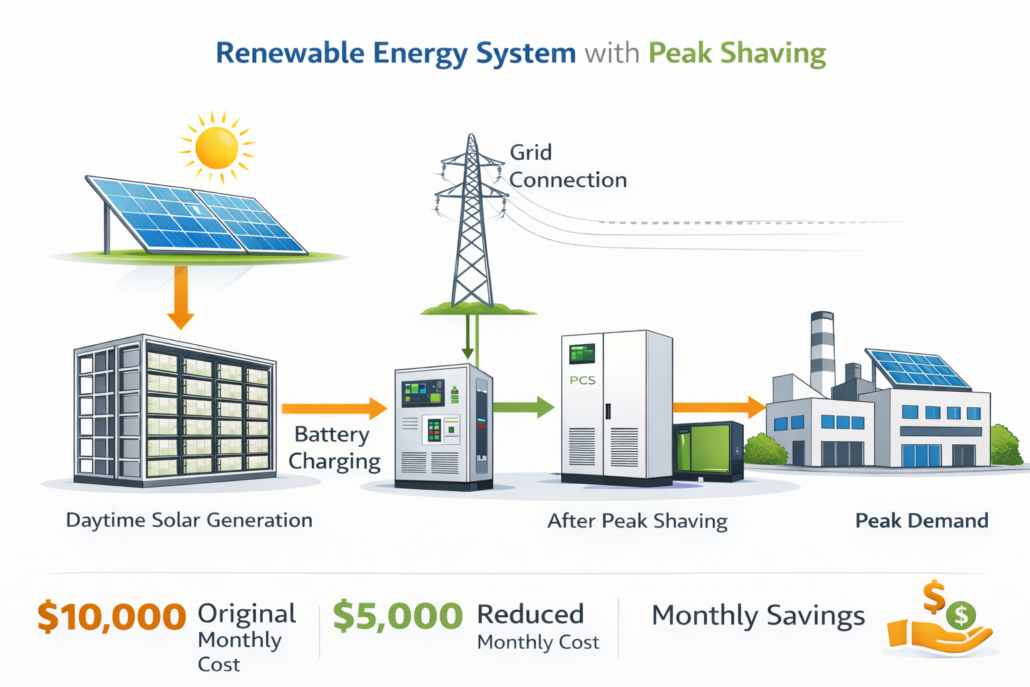
Battery systems can store excess renewable electricity generated by solar or wind systems. Later, the stored energy can support peak demand.
How Peak Shaving Energy Storage Works
Battery systems are one of the most effective technologies for controlling peak electricity demand. These systems store electrical energy and release it when demand increases.
Reducing peak electricity demand can provide significant cost savings.
Utilities typically calculate demand charges based on the highest power demand recorded during the billing period.
Even a brief demand spike can increase the total monthly bill.
peak shaving load profile
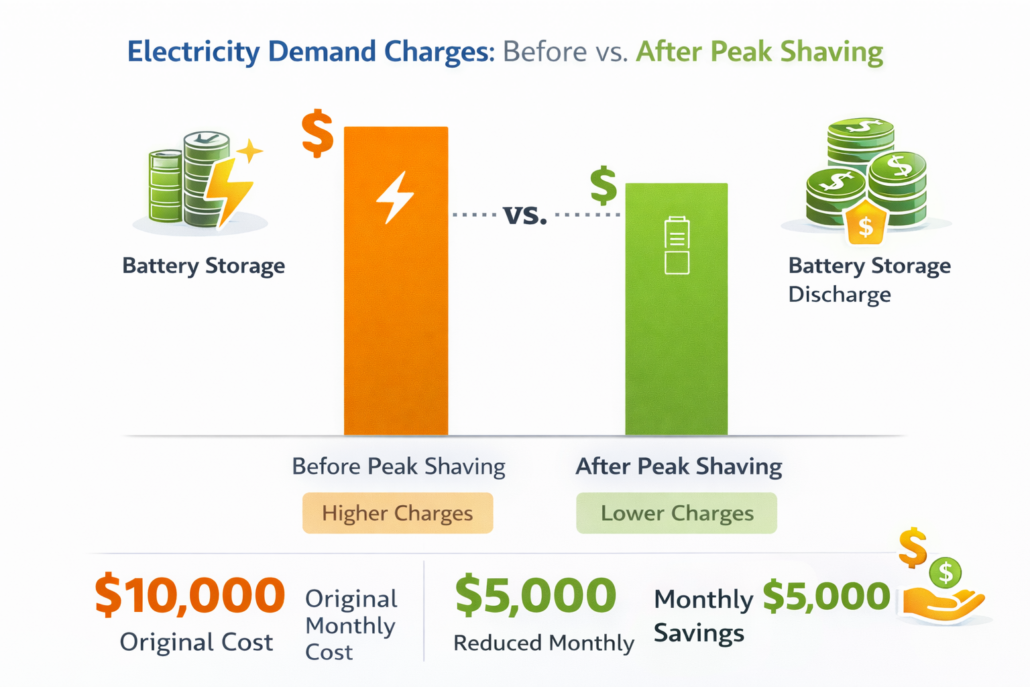
Consider a simple example.
A manufacturing facility has a peak demand of 1000 kW. The utility charges $20 per kW for demand charges.
Monthly demand charge:
1000 kW × $20 = $20,000
Now assume a battery system reduces peak demand to 700 kW.
New demand charge:
700 kW × $20 = $14,000
Monthly savings:
$6,000
Over time, these savings can offset the investment in energy storage.
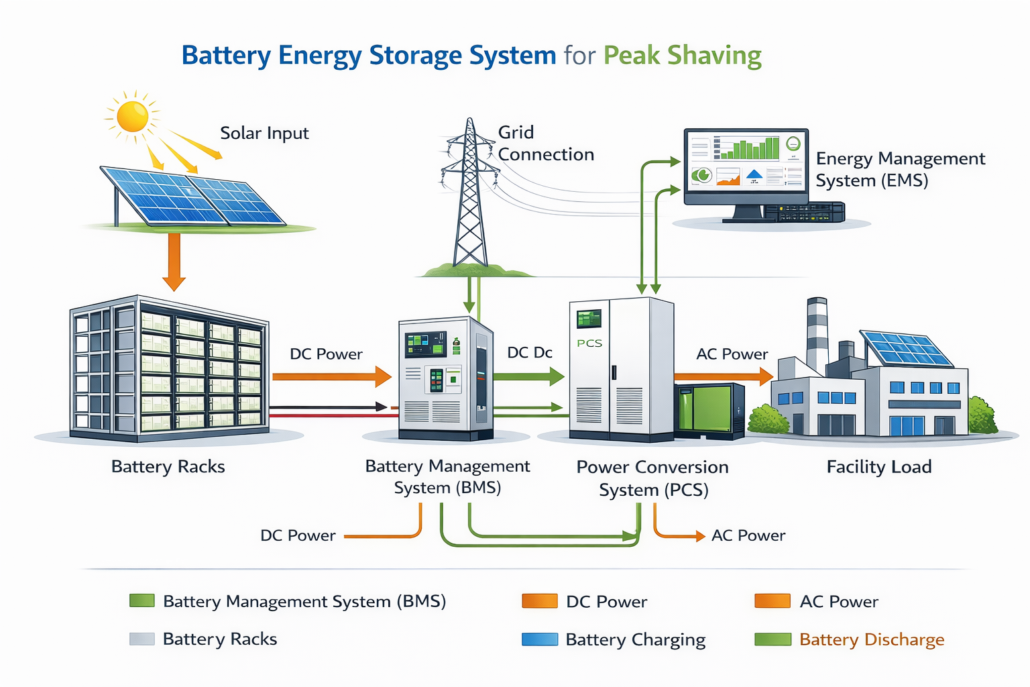
Architecture of a Battery Energy Storage System
A modern battery energy storage system includes several key components.
Battery Modules
Battery modules store electricity and provide the required energy capacity.
Battery Management System
The management system monitors temperature, voltage, and battery health. It ensures safe and reliable operation.
Power Conversion System
This system converts electricity between AC and DC formats. As a result, batteries can charge and discharge efficiently.
Energy Management Platform
The energy management platform monitors electricity demand and controls system operation.
Grid Connection
Finally, the system connects to the facility’s electrical network and the utility grid.
Together, these components enable automated energy management and reliable demand control.
Role of Energy Storage in Renewable Energy Systems
Renewable energy sources such as solar and wind produce variable electricity output. Energy storage helps balance these fluctuations.
When renewable generation exceeds demand, excess electricity can be stored in batteries. Later, that stored energy can supply power during high demand.
This process improves renewable energy utilization and reduces energy waste.
In addition, energy storage supports grid stability by balancing supply and demand.
Studies by the International Energy Agency highlight the growing role of battery storage in balancing renewable energy supply and electricity demand.
Future of Peak Demand Management
Energy systems are becoming more advanced every year. Smart grid technologies now use data analytics and automation to manage electricity demand.
Battery systems are expected to play an important role in these developments.
Future energy systems will combine:
• distributed energy resources • smart grid technology • demand response programs • large-scale energy storage
These technologies will help businesses optimize electricity consumption while maintaining reliable power supply.
FAQ About Peak Shaving Energy Storage
What is peak shaving?
Peak shaving is an energy management strategy that reduces electricity demand during periods of high consumption.
How does peak shaving energy storage work?
Battery systems store electricity during low-demand periods. During high demand, the stored energy is released to reduce grid consumption.
Which industries use demand reduction strategies?
Manufacturing plants, data centers, commercial buildings, and EV charging networks commonly use energy storage solutions.
What battery size is needed for demand reduction?
Battery capacity depends on the facility’s load profile, electricity tariffs, and peak demand levels.
Conclusion
Peak shaving has become an important strategy for managing electricity costs. Businesses can lower demand charges by reducing peak power consumption.
Battery systems make this process more effective. With peak shaving energy storage, facilities can store electricity during low demand and use it during peak periods.
As energy demand grows and renewable generation expands, energy storage will continue to play a critical role in modern power systems.
Modern energy systems increasingly rely on battery energy storage solutions to improve grid reliability and reduce operational costs.