
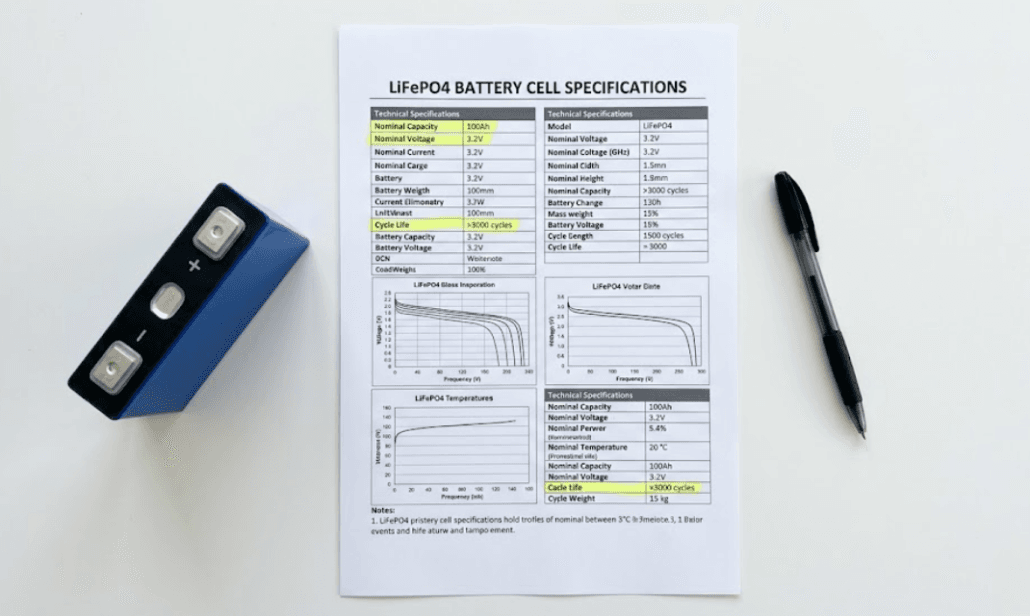
How to Read a LiFePO4 Battery Spec Sheet: A Buyer’s Line-by-Line Guide
Reading a LiFePO4 battery spec sheet correctly is one of the most valuable skills a buyer can have.
However, most spec sheets are written for engineers — not procurement teams.
This guide covers every field of a LiFePO4 battery spec sheet in plain language.
Furthermore, you will learn what each number means and which red flags to watch for.
In addition, understanding your LiFePO4 battery spec sheet is the first step before using our Battery Cycle Life Calculator.
| 📌 Key rule: Two batteries with identical spec sheet headlines can perform very differently.The difference is always in the test conditions — not the headline number.Therefore, always read the conditions first. |
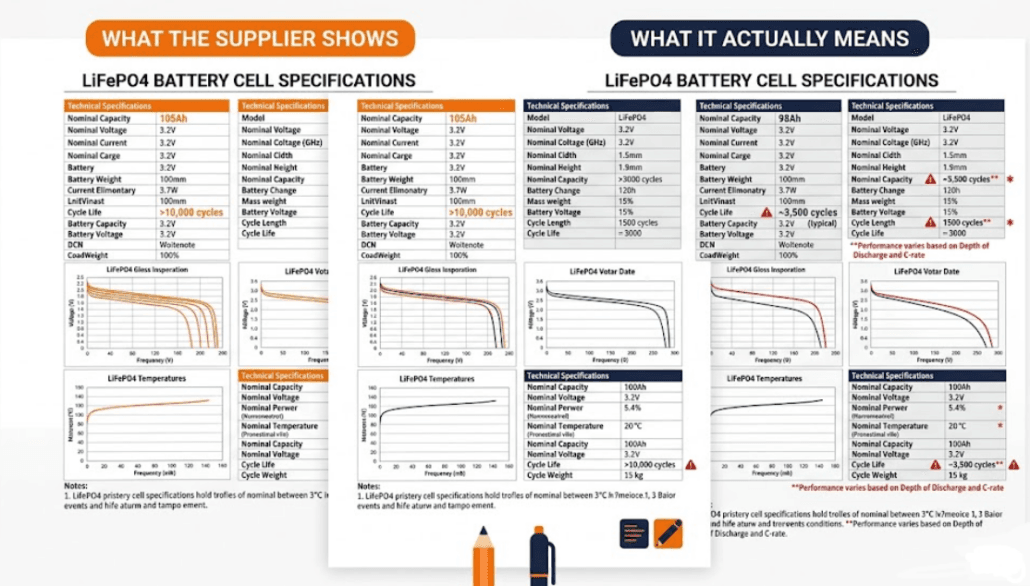
⚠️ Why a LiFePO4 Battery Spec Sheet Can Be Misleading
Spec sheets are marketing documents as much as technical ones.
However, that does not mean the numbers are wrong. As a result, you need to read the conditions — not just the headline.
Three issues cause the most confusion for buyers:
| Issue | What it looks like | Why it matters |
|---|---|---|
| Optimistic test conditions | Cycle life tested at 25°C and shallow DOD | Your real project runs hotter and deeper — so lifespan is lower |
| Inconsistent EOL threshold | One supplier uses 80% SOH, another uses 70% EOL | In other words, the numbers are not comparable |
| Missing test parameters | C-rate, temperature, DOD not stated | Consequently, you cannot verify or compare the number |
According to NREL’s battery field testing data, real-world LiFePO4 performance is typically 10–20% below spec values.
Therefore, always apply a conservative adjustment to any headline number.
📋 Section 1 of Your LiFePO4 Battery Spec Sheet: Cell Chemistry
First, always check the nominal voltage. For LiFePO4, this is 3.2V per cell.
In contrast, NMC cells show 3.6–3.7V. As a result, a wrong voltage means a wrong chemistry.
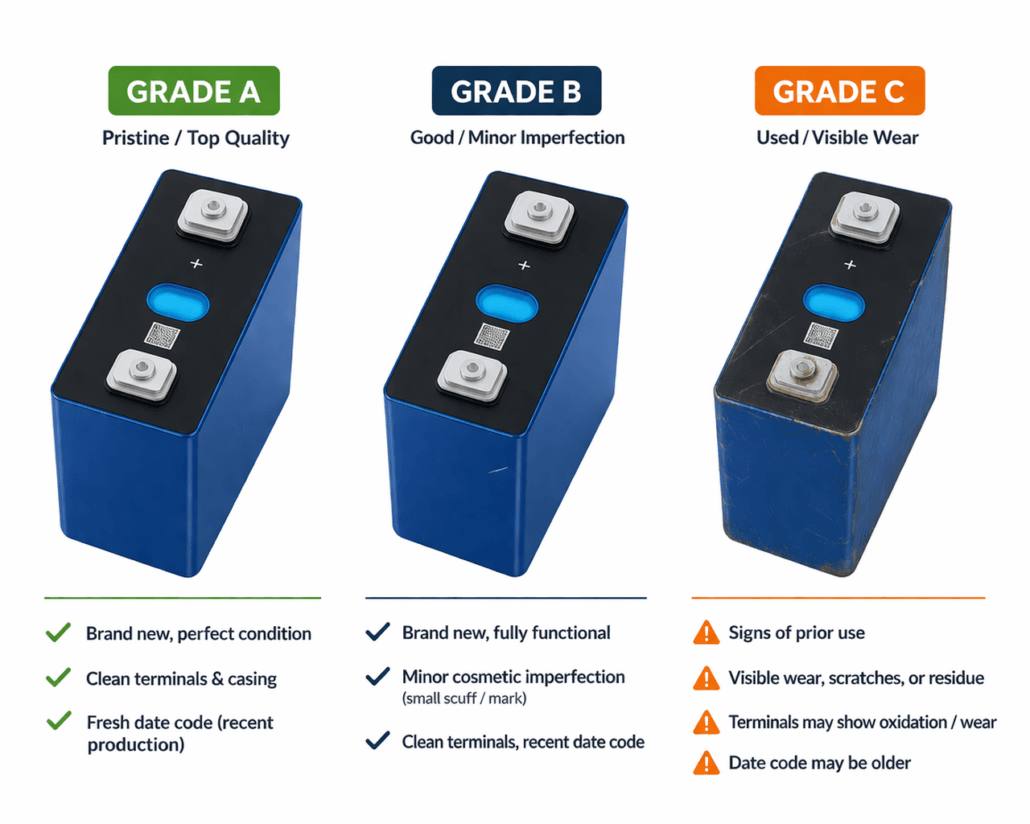
What the LiFePO4 Battery Spec Sheet Shows for Cell Grade
Grade A cells are new and have passed full quality screening.
Moreover, Grade B cells are factory seconds. Consequently, the grade directly determines system reliability.
Always insist on Grade A for any commercial project.
| Field | What to look for |
|---|---|
| Nominal Voltage | 3.2V per cell for LiFePO4. However, if it shows 3.6–3.7V, the chemistry is NMC — not LFP. |
| Nominal Capacity | Rated in Ah at 0.2C. For example, 100Ah at 3.2V = 320Wh per cell. |
| Cell Format | Prismatic, cylindrical, or pouch. Furthermore, format affects thermal design and replacement logistics. |
| Cell Grade | Grade A = new and full-spec. Grade B = factory second. Therefore, always confirm grade before ordering. |
| 🚨 Red flag: A spec sheet that does not state the cell grade is hiding something.Ask directly — and request a grade certificate from the cell manufacturer. |
⚡ Section 2 of Your LiFePO4 Battery Spec Sheet: Electrical Specs
Capacity, Energy, and Internal Resistance
Furthermore, the electrical section contains the numbers most often misread by buyers.
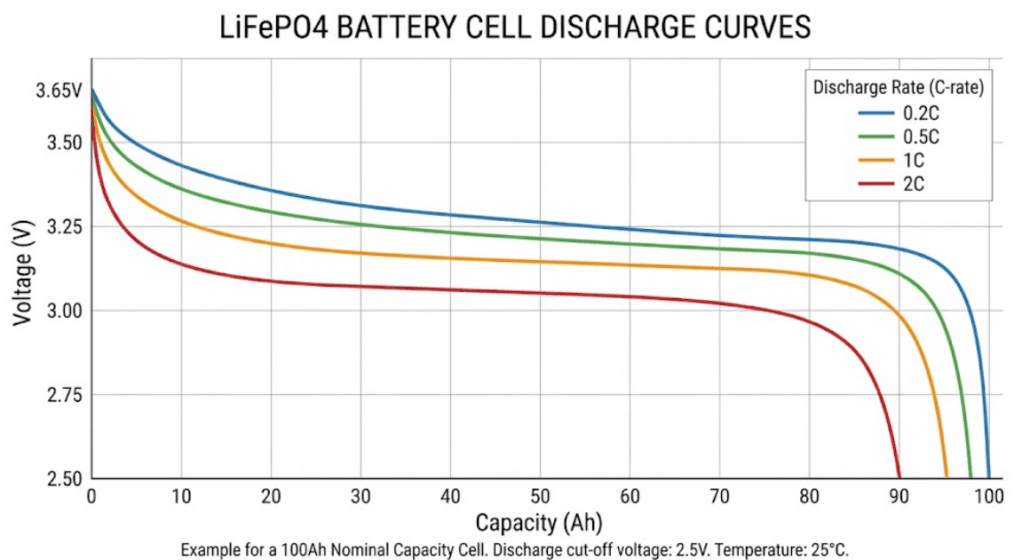
Capacity is stated at 0.2C in the lab. However, your system likely runs at 0.5C or 1C.
In addition, internal resistance is a key quality signal. Consequently, a high value often means an older or lower-grade cell.
| Field | What to look for |
|---|---|
| Capacity (Ah) | Stated at 0.2C. In practice, expect 90–95% of this at 1C. Therefore, ask what C-rate was used. |
| Energy (Wh) | Capacity × Voltage. For example, 100Ah × 3.2V = 320Wh. However, usable energy depends on your cutoff voltage. |
| Internal Resistance | 0.15–0.35mΩ for Grade A 100Ah prismatic. Higher values indicate age or lower cell quality. |
Voltage Range and Self-Discharge
Voltage limits define the safe operating range for each cell.
Moreover, operating outside these limits permanently damages the cell. Consequently, your BMS must enforce both cutoffs at all times.
Self-discharge for LiFePO4 is typically 1–3% per month. In contrast, anything above 5% signals a quality issue.
| Field | What to look for |
|---|---|
| Charge Cutoff Voltage | 3.65V per cell. Overcharging even slightly above this causes permanent capacity loss. |
| Discharge Cutoff Voltage | 2.5V per cell. Over-discharging below this causes irreversible damage. Therefore, BMS protection is mandatory. |
| Self-Discharge Rate | 1–3% per month is normal. However, above 5% per month suggests a cell quality issue. |
| 💡 Pro tip: Ask for the discharge curve chart at multiple C-rates.A supplier confident in their cells will share this without hesitation.In other words, transparency is the strongest quality signal. |
🔋 Section 3 of Your LiFePO4 Battery Spec Sheet: Cycle Life
Cycle life is the most important section of any LiFePO4 battery spec sheet.
However, it is also the most abused. As a result, the headline number alone tells you very little.
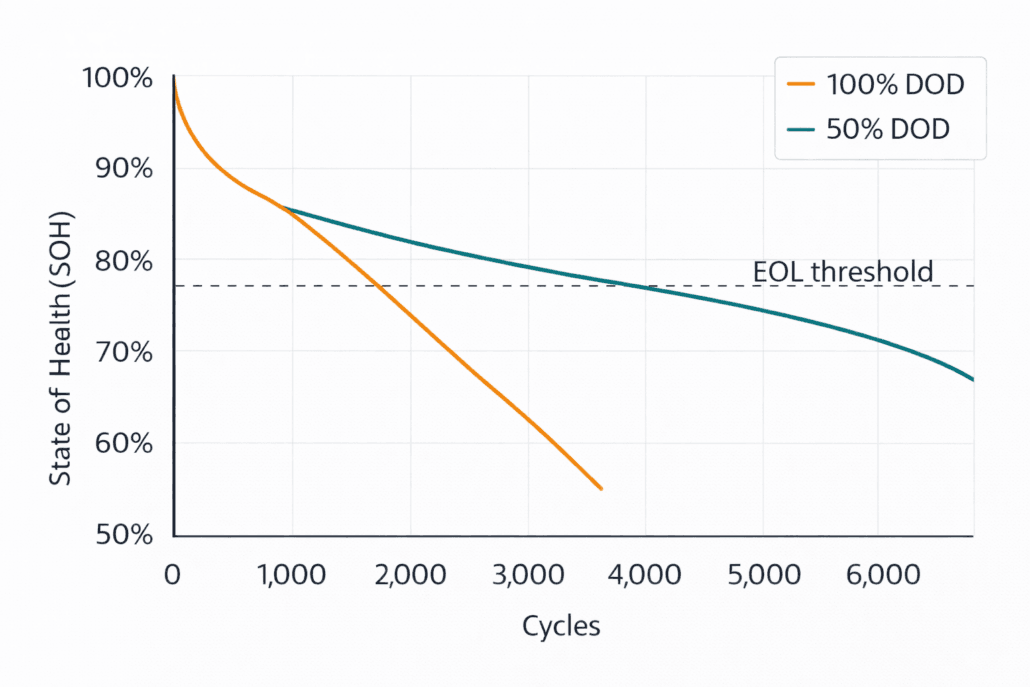
In other words, 6,000 cycles tested at 50% DOD is very different from 6,000 cycles at 80% DOD.
How Cycle Life Is Measured on a LiFePO4 Battery Spec Sheet
Manufacturers test cycle life under the best possible lab conditions.
Consequently, four variables determine whether the number applies to your project.
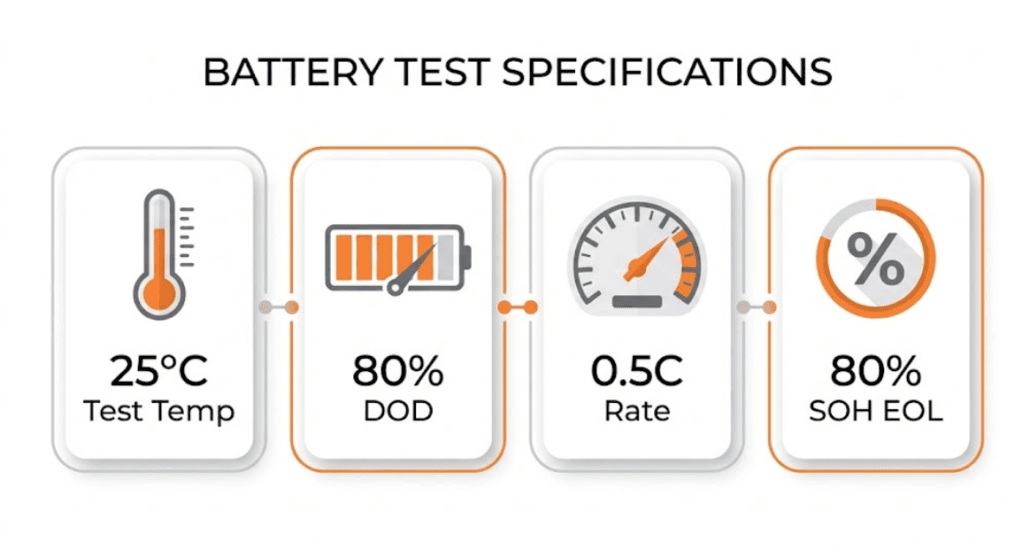
For example, a 25°C test result does not apply to a 38°C deployment. Furthermore, the C-rate and DOD used in testing must match your real use.
| Condition | What to check |
|---|---|
| Test DOD | The discharge depth used in the test. 80% is standard. However, some suppliers test at 50% DOD to inflate cycle counts. |
| Test Temperature | Always 25°C in the lab. However, every 10°C above that reduces effective lifespan by 15–25%. |
| Test C-Rate | 0.5C is standard for both charge and discharge. As a result, tests at 0.2C will show better results than real use. |
| EOL Definition | 80% SOH or 70% EOL? Furthermore, a 70% EOL battery has 10–15% more usable cycles than an 80% SOH one. |
The 4 Questions to Ask About Cycle Life
Before accepting any cycle life number, ask all four questions below.
Moreover, a supplier who hesitates on any of them is a supplier to be cautious about.
| 1. What DOD was used in the cycle life test? 2. What temperature was the test run at? 3. What C-rate was used for charge and discharge? 4. Is the cycle count to 80% SOH or 70% EOL? |
Converting Cycle Life Numbers on a LiFePO4 Battery Spec Sheet
Different suppliers use different EOL thresholds. Therefore, direct comparison is often misleading.
For instance, 6,000 cycles at 80% SOH and 6,000 cycles at 70% EOL are not the same number.
Specifically, use our free Battery Cycle Life Calculator to adjust any spec sheet cycle count to your real DOD.
In addition, see our Battery Cycle Standards Explained guide for a full breakdown of SOH, DOD, and EOL.
🔌 Section 4: Charge and Discharge Specifications
Charge Rate and Voltage Limits
First, check the standard charge rate. For LiFePO4, this is typically 0.5C.
Consequently, charging faster than 0.5C every day accelerates degradation.
Sustained fast charging at 2C+ can cause lithium plating. Therefore, this permanently reduces capacity over time.
| Field | What to look for |
|---|---|
| Standard Charge Rate | Typically 0.5C. This is the recommended daily charge rate for maximum cycle life. |
| Max Charge Rate | Often 1C or 2C. However, sustained 2C+ causes lithium plating and permanent capacity loss. |
| Charge Cutoff Voltage | 3.65V per cell. Furthermore, overcharging even slightly above this causes irreversible damage. |
Discharge Rate and Protection Limits
Standard discharge for BESS is 0.5–1C. Moreover, this is within safe limits for most applications.
Above 3C continuous discharge, significant heat is generated. Consequently, always confirm your BMS has current limiting.
Discharge cutoff is 2.5V per cell. Going below this causes copper dissolution — irreversible damage.
| Field | What to look for |
|---|---|
| Standard Discharge Rate | Typically 1C. Real-world BESS applications discharge at 0.5–1C — therefore, within safe limits. |
| Max Continuous Discharge | Often 2C or 3C. As a result, confirm your BMS has current limiting for grid events. |
| Discharge Cutoff Voltage | 2.5V per cell. Consequently, BMS low-voltage protection must always be active. |
| Peak Discharge Rate | Short-duration maximum — typically 5C for 10 seconds. In particular, important for frequency response. |
| 🚨 Red flag: Any spec sheet showing 3C+ continuous discharge with no temperature derating chart is overstating capability.Furthermore, sustained 3C+ discharge causes heat that accelerates degradation well beyond the spec sheet cycle count. |
🌡️ Section 5 of Your LiFePO4 Battery Spec Sheet: Thermal Specs
Furthermore, the thermal section is the most commonly skimmed. However, for hot climate deployments it is the most critical.
In particular, charging below 0°C causes lithium plating — permanent damage that cannot be reversed.
Above 45°C, electrolyte breakdown accelerates. Therefore, always confirm your BMS has temperature-gated charging.
| Field | What to look for |
|---|---|
| Operating Temp (charge) | 0°C to 45°C is typical. Charging outside this range causes permanent damage. Therefore, BMS temperature protection is mandatory. |
| Operating Temp (discharge) | -20°C to 60°C. However, capacity at -10°C drops to 70–80% of rated. As a result, account for this in cold climates. |
| Storage Temperature | -20°C to 35°C at 50% SOC. Furthermore, storing at 100% SOC above 35°C significantly accelerates calendar aging. |
| Thermal Runaway | Above 270°C for LiFePO4 — compared to 170–210°C for NMC. Consequently, LFP is safer in enclosed environments. |
| IP Rating | IP65 is standard for outdoor BESS. In contrast, anything below IP54 should not be used outdoors. |
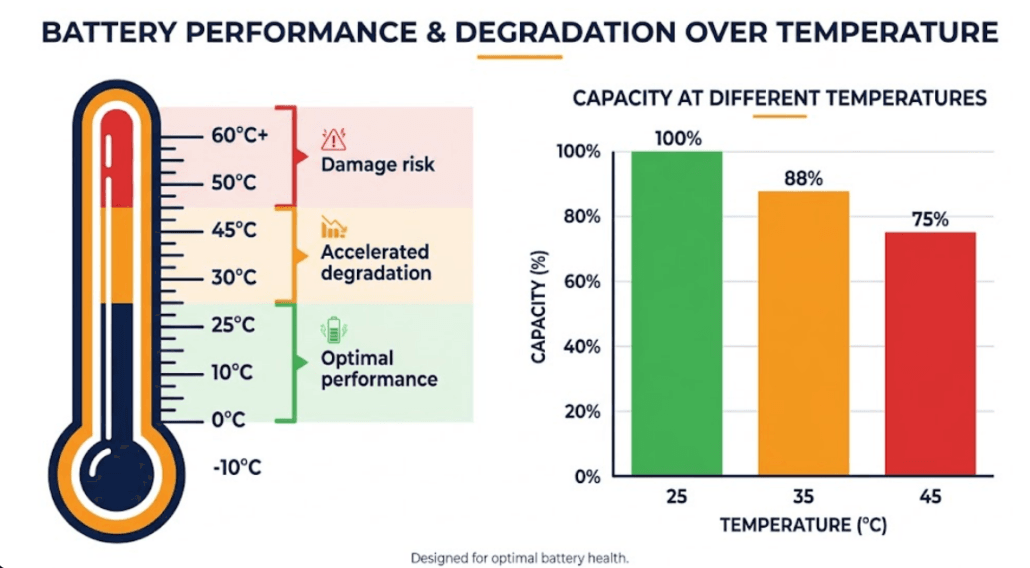
| 💡 For hot climates: the temperature range on a LiFePO4 battery spec sheet is a survival range — not a performance guarantee.As a result, apply a 15–25% cycle life reduction for average ambient temperatures above 30°C. |
🏅 Section 6: Safety Standards and Certifications
Finally, certifications confirm the battery has been independently tested for safety.
However, logos on a spec sheet are not the same as valid certificates. Therefore, always request original test reports.
For example, UL 1973 is required for US grid-tied projects. In addition, CE marking is required for all EU market products.
| Certification | What it covers | Why it matters |
|---|---|---|
| UN 38.3 | Transport safety for lithium batteries | Required for any shipped battery — if absent, insurance may be void |
| IEC 62133 | Cell-level safety standard | Covers overcharge, short circuit, crush, and thermal abuse tests |
| IEC 62619 | System-level safety for stationary storage | Required for most commercial BESS projects |
| UL 1973 | US stationary battery standard | Required for US and Canadian grid-tied projects |
| UL 9540 / 9540A | System-level thermal runaway standard | Required by many US and EU jurisdictions for large BESS |
| CE Marking | European conformity | Required for all products sold into the EU market |
| GB/T Standards | Chinese national standards | Present on most Chinese cells — verify equivalence to IEC |
| 🚨 Red flag: A supplier who cannot provide original certification documents should not be trusted for any commercial project.Moreover, always request the actual test report — not a certificate copy or a logo on a brochure. |
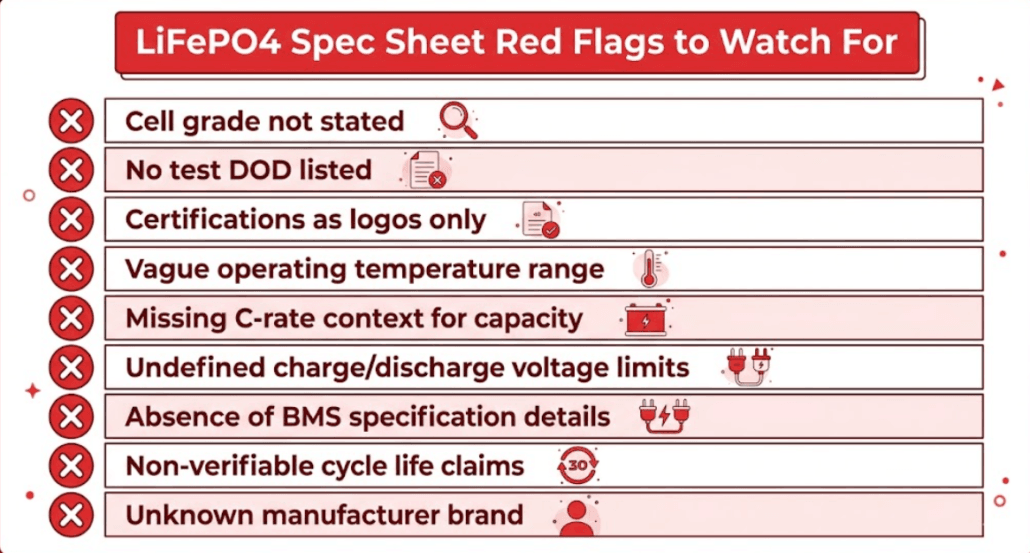
🚩 Complete LiFePO4 Battery Spec Sheet Red Flag Checklist
Use this before approving any LiFePO4 battery spec sheet for procurement.
In addition, if any of these are present, ask for clarification before placing an order.
| Red Flag | Risk | What to request |
|---|---|---|
| Cell grade not stated | Grade B or C sold at Grade A price | Ask for grade certificate from cell manufacturer |
| Cycle life — no test conditions | Cannot verify or plan from the number | Ask for DOD, temperature, C-rate, and EOL threshold |
| DOD 50% or less for cycle test | Inflated cycle count for shallow cycling | Request 80% DOD test data instead |
| No discharge curve chart | Cannot assess real-load performance | Request multi-C-rate discharge curves |
| Certifications as logos only | May be expired or fabricated | Request original test reports from the certification body |
| Calendar life not stated | Unknown degradation for low-cycle use | Ask for calendar aging data at 25°C and 35°C |
| Thermal derating not provided | Performance at high temperature unknown | Ask for capacity vs temperature chart |
| Internal resistance not stated | Cannot assess cell quality | Request DC internal resistance at 50% SOC |
| Warranty threshold not stated | Warranty may cover fewer cycles than spec claims | Confirm warranty EOL matches the spec sheet |
📋 Transparent vs Misleading: Two Real Examples
Here are two examples of how the same LiFePO4 battery spec sheet data can be presented.
Furthermore, the difference in transparency directly affects how accurately you can plan costs.
Example A — A Transparent LiFePO4 Battery Spec Sheet
In this example, all test conditions are clearly stated. As a result, the numbers are fully comparable.
| Field | What it shows |
|---|---|
| Capacity | 100Ah @ 0.2C, 25°C |
| Cycle Life | 6,000 cycles @ 80% DOD, 25°C, 0.5C/0.5C, to 80% SOH |
| Internal Resistance | 0.25mΩ @ 50% SOC, 25°C |
| Certifications | IEC 62133, UL 1973 — original test reports available |
| Calendar Life | 10+ years @ 25°C, 50% SOC storage |
| Assessment | ✅ All conditions stated. Safe to use for planning and comparison. |
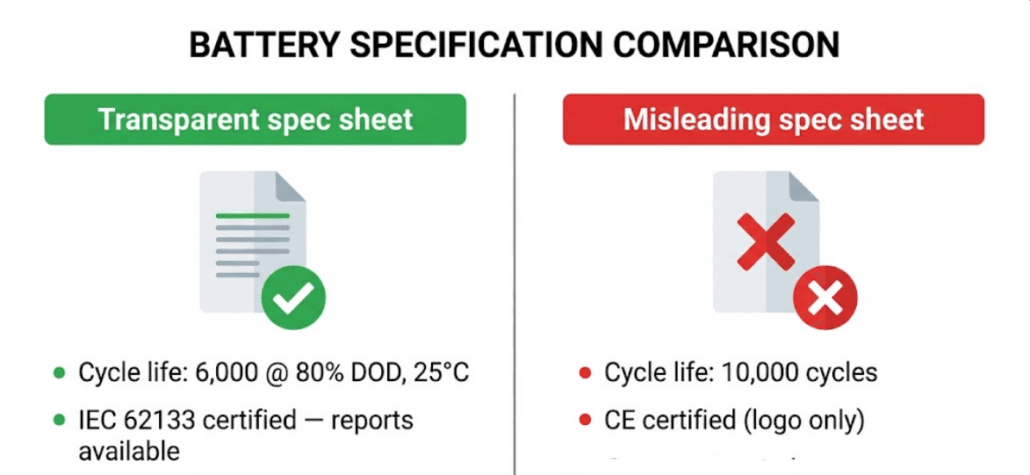
Example B — A Misleading LiFePO4 Battery Spec Sheet
In contrast, this example hides all test conditions. Consequently, none of the headline numbers can be trusted.
| Field | What it shows |
|---|---|
| Capacity | 100Ah |
| Cycle Life | 10,000 cycles |
| Internal Resistance | Not stated |
| Certifications | CE, UL (logos only — no reports) |
| Calendar Life | Not stated |
| Assessment | 🚨 10,000 cycles likely tested at 50% DOD. Cannot verify certifications. Do not use for planning. |
✅ 10 Questions to Ask Before Accepting Any Spec Sheet
Send these questions to every supplier before requesting a quote.
Furthermore, a trustworthy supplier will answer all ten within 24 hours. In other words, their speed and completeness is itself a quality signal.
| 1. | What cell grade is this — A, B, or C? Can you provide the manufacturer’s grade certificate? |
| 2. | What DOD, temperature, and C-rate were used for the cycle life test? |
| 3. | Is cycle life measured to 80% SOH or 70% EOL? |
| 4. | Can you provide the full discharge curve chart at 0.2C, 0.5C, 1C, and 2C? |
| 5. | What is the DC internal resistance at 50% SOC and 25°C? |
| 6. | Can you provide original certification test reports — not just certificate copies? |
| 7. | What is the calendar aging rate at 25°C and at 35°C? |
| 8. | Does the cell have a thermal derating chart showing capacity at different temperatures? |
| 9. | What is the minimum and maximum operating temperature for charging? |
| 10. | Does your warranty cycle count use the same DOD and EOL threshold as the spec sheet? |
🔗 Related SunLith Guides
- Battery Cycle Standards Explained: SOH, DOD, and EOL — understand cycle life standards before reading any spec sheet
- Battery Cycle Life Calculator — adjust your spec sheet cycle number to your real operating DOD
- LiFePO4 Battery Testing: How Manufacturers Grade Their Cells — understand what happens in the factory before a spec sheet is written
- LiFePO4 vs NMC Battery Lifespan Comparison — compare spec sheet numbers across different chemistries
- Impact of Temperature on LiFePO4 Battery Cycle Life — apply temperature corrections to your spec sheet cycle count
| 🔍 Want a second opinion on your supplier’s LiFePO4 battery spec sheet? SunLith’s engineering team reviews spec sheets and flags misleading claims.Furthermore, this service is free for qualified BESS projects above 50kWh.As a result, you go into procurement with full clarity and confidence.→ Request a free spec sheet review: Contact us |
❓ Frequently Asked Questions
What is a LiFePO4 battery spec sheet?
A LiFePO4 battery spec sheet is a technical document from the manufacturer.
However, it is written under optimal lab conditions.
Therefore, real-world performance is typically 10–20% lower than stated.
In other words, always check the test conditions behind every headline number.
What is the most important section of a LiFePO4 battery spec sheet?
Cycle life is the most critical section.
However, it is only useful with all four test conditions stated.
For example, the DOD, temperature, C-rate, and EOL threshold must all be present.
As a result, a cycle count without these conditions cannot be used for planning.
How do I verify a LiFePO4 battery spec sheet is accurate?
First, ask for original certification test reports — not just certificate copies.
Furthermore, request the full discharge curve chart at multiple C-rates.
In other words, transparency is the strongest quality signal from a supplier.
What does Grade A mean?
Grade A cells are new and have passed full quality screening.
In contrast, Grade B cells are factory seconds that failed one or more checks.
Therefore, always insist on Grade A for any commercial BESS project.
Why do two batteries with the same Ah rating perform differently?
Several factors cause this difference.
For example, internal resistance, cell grade, and test C-rate all vary between manufacturers.
Moreover, two 100Ah batteries tested at different C-rates produce incomparable results.
Consequently, always compare capacity figures tested at the same C-rate.




Leave a Reply
Want to join the discussion?Feel free to contribute!