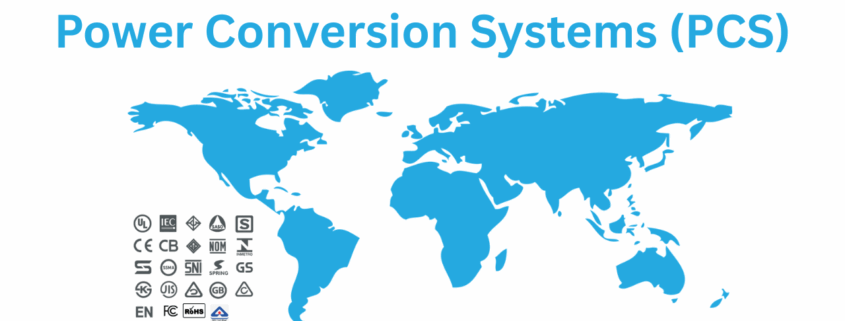
PCS Certification Guide: In the booming Battery Energy Storage System (BESS) market, the Power Conversion System (PCS) plays a crucial role. It acts as the bidirectional bridge between batteries, renewable energy sources, and the electrical grid—converting DC to AC and vice versa.
However, no PCS can be legally sold or installed without meeting strict certification requirements. These certifications ensure:
- Safety – Protecting operators, assets, and the grid.
- Compliance – Meeting local and international regulations.
- Market Access – Enabling entry into global markets without costly redesigns.
This guide breaks down worldwide PCS certification requirements, region by region, so manufacturers, EPCs, and integrators know exactly what’s needed.
1. What Is a Power Conversion System (PCS)?
A Power Conversion System is a high-efficiency electronic converter that:
- Converts DC from batteries/PV to AC for the grid or loads.
- Converts AC from the grid to DC for battery charging.
- Supports grid stability functions such as frequency control and voltage regulation.
If the BESS is the body, the PCS is the heart that pumps energy where it’s needed.
2. Worldwide PCS Certification Requirements
A. International Certifications
| Standard | Scope | Why It Matters |
|---|
| IEC 62109-1 & 62109-2 | Safety of power converters for PV and ESS | Ensures PCS meets operator and installer safety |
| IEC 62477-1 | Safety for power electronic converters | Covers high-power PCS in BESS |
| IEC 61000 Series | EMC compliance | Prevents harmful interference |
| ISO 9001:2015 | Quality management | Ensures consistent production quality |
| IEC CB Scheme | Mutual recognition of test results | Avoids repeated testing for multiple markets |
B. North America
| Standard | Scope | Note |
|---|
| UL 1741 & UL 1741 SB | Inverters, converters, controllers for DER | UL 1741 SB aligns with IEEE 1547-2018 |
| IEEE 1547 & 1547.1 | Grid interconnection | Mandatory for PCS grid connection |
| CSA C22.2 | Safety requirements for Canada | Harmonized with UL standards |
C. Europe
| Standard | Scope | Note |
|---|
| EN 50549-1 / -2 | Generating plant requirements | Covers PCS grid integration |
| EN 62477-1 | Safety for power electronics | Required for high-voltage PCS |
| EN 61000 | EMC compliance | Prevents interference |
| G99 (UK) | Grid code compliance | UK-specific requirement |
D. Australia & New Zealand
| Standard | Scope | Note |
|---|
| AS/NZS 4777.2 | Grid-connected inverter requirements | Includes PCS |
| RCM Mark | EMC & safety | Required before market entry |
E. South Africa
| Standard | Scope | Note |
|---|
| NRS 097-2 | Grid connection rules | Addresses voltage, frequency, harmonics |
F. China
| Standard | Scope | Note |
|---|
| GB/T 34120 & GB/T 34133 | PCS safety & performance | Required for ESS & PCS |
| GB/T 29319 | EMC standards | Local testing required |
G. India
| Standard | Scope | Note |
|---|
| BIS IS 16221 & IS 16270 | PCS safety | Mandatory BIS registration |
| CEA Grid Code | Interconnection rules | Adapted for Indian grid |
H. Japan
| Standard | Scope | Note |
|---|
| JIS C 8961 & C 8999 | PCS performance & safety | Japanese Industrial Standards |
| JET Certification | Electrical & performance safety | Required for PCS sales |
| PPSA Compliance | Grid approval | Utility-specific process |
I. South Korea
| Standard | Scope | Note |
|---|
| KS C 8567 / KS C 8568 | PCS safety standards | Korean Standards |
| KC Mark | EMC & safety | Mandatory product mark |
| KEPIC / KERI Testing | Grid compliance | Overseen by KESCO |
J. Southeast Asia
Thailand
| Standard | Scope | Note |
|---|
| TISI Certification | PCS safety | Thailand Industrial Standards Institute |
| MEA/PEA Grid Code | Utility approval | For PCS connection to the grid |
Singapore
| Standard | Scope | Note |
|---|
| SPRING / Enterprise SG | Electrical safety | National compliance mark |
| EMA Grid Connection | Energy Market Authority approval | Required for grid-tied PCS |
Indonesia
| Standard | Scope | Note |
|---|
| SNI Certification | Indonesian National Standard | Safety & quality compliance |
| PLN Grid Code | Utility connection rules | Approval from PLN |
K. Middle East
United Arab Emirates (UAE)
| Standard | Scope | Note |
|---|
| ESMA Certification | Safety & EMC | Emirates Authority |
| DEWA / ADWEA Grid Code | Utility compliance | Grid-tied PCS requirement |
Saudi Arabia
| Standard | Scope | Note |
|---|
| SASO Certification | Safety & quality | Saudi Standards Org. |
| SEC Grid Connection | Utility approval | Saudi Electricity Company rules |
Qatar, Oman, Kuwait
- Typically adopt IEC standards + local utility grid codes.
L. Latin America
| Country | Standard | Note |
|---|
| Brazil | INMETRO + ONS Grid Code | Safety & grid compliance |
| Chile | SEC Approval + Grid Code | Energy regulatory approval |
| Mexico | NOM + CFE Grid Rules | Safety & interconnection |
3. International Certification Pathways
The IECEE CB Scheme simplifies global compliance:
- Test once in a CB-certified lab.
- Use the report for multiple country approvals.
- Cuts time-to-market significantly.
4. PCS Certification Process
- Identify Target Markets
- Match Applicable Standards
- Pre-Test in Internal Lab
- Submit to Accredited Testing Body
- Receive Certificates
- Maintain Compliance via periodic re-testing.
5. Challenges & Future Trends
Challenges
- Varying grid codes by region
- Rapid updates to standards (e.g., IEEE 1547)
- New cybersecurity requirements
Trends
- Cybersecurity Compliance (IEC 62443)
- Green Certification Labels
- Gradual harmonization of standards globally
Conclusion
The PCS is the gateway between your Battery energy storage system and the grid—but without the right certifications, it’s just an expensive box.
By understanding global PCS requirements early, manufacturers and integrators can avoid delays, reduce costs, and enter multiple markets faster.