
Can You Do Peak Shaving and Load Shifting at the Same Time?
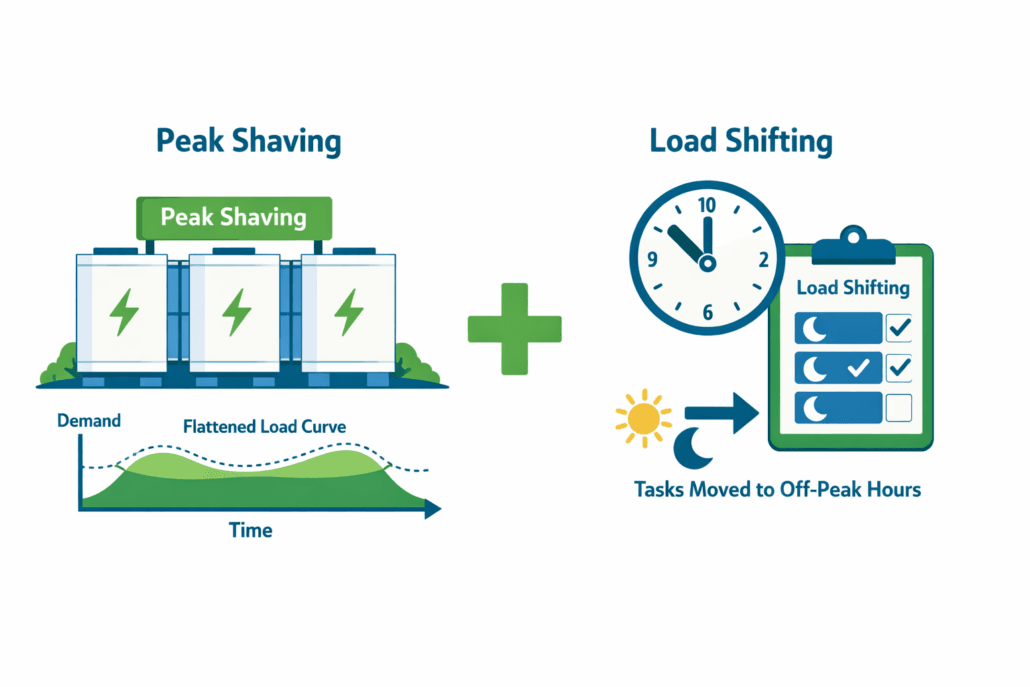
Yes — peak shaving and load shifting can work at the same time. In fact, combining both is one of the most effective ways to cut commercial electricity costs.
However, many businesses use only one approach. As a result, they leave significant savings on the table every month.
In this guide, you will learn how each strategy works, why they complement each other, and how to run both together — with examples from India and global markets.
Can You Do Peak Shaving and Load Shifting at the Same Time?
The short answer is yes. These two strategies target different parts of your electricity bill. Because of this, they do not compete — they complement each other.
- Peak shaving cuts your highest power demand in any 15-minute billing window.
- Load shifting moves energy-heavy tasks to cheaper, off-peak hours.
Together, peak shaving and load shifting attack your bill from two sides at once. One flattens demand spikes. The other cuts energy costs during expensive periods.
Therefore, any business running both will always save more than one using just one strategy.
What Each Strategy Does on Its Own
Before combining them, it helps to understand what each approach does separately.
What Is Peak Shaving?
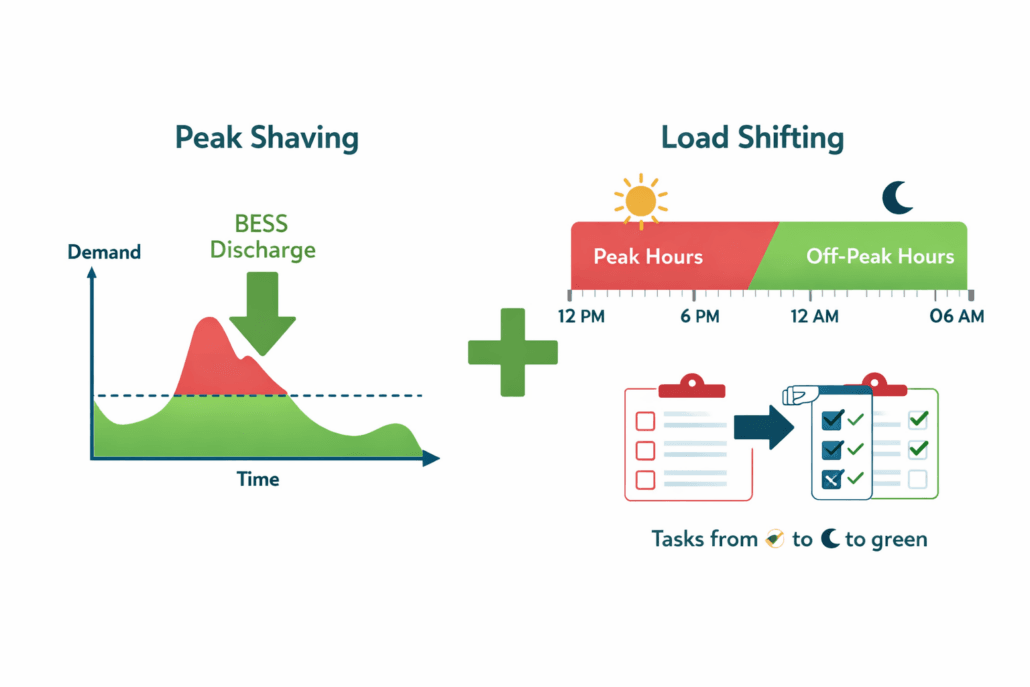
Peak shaving cuts your highest power draw during the billing period. Most businesses use a Battery Energy Storage System (BESS) to do this.
Your BESS charges during low-demand periods. It then discharges during spikes. As a result, your utility records a lower peak — and your demand charge drops.
For a full explanation, read our guide on C&I BESS peak shaving and demand charge reduction.
What Is Load Shifting?
Load shifting reschedules energy-heavy tasks to times when electricity is cheaper. For example, you might run heavy machinery at night instead of during peak afternoon hours.
Moreover, in markets with Time of Use (TOU) tariffs — including many Indian states — this directly lowers your energy charge.
Not sure which strategy suits your facility better? Read our comparison of peak shaving vs load shifting.
How Peak Shaving and Load Shifting Work Together
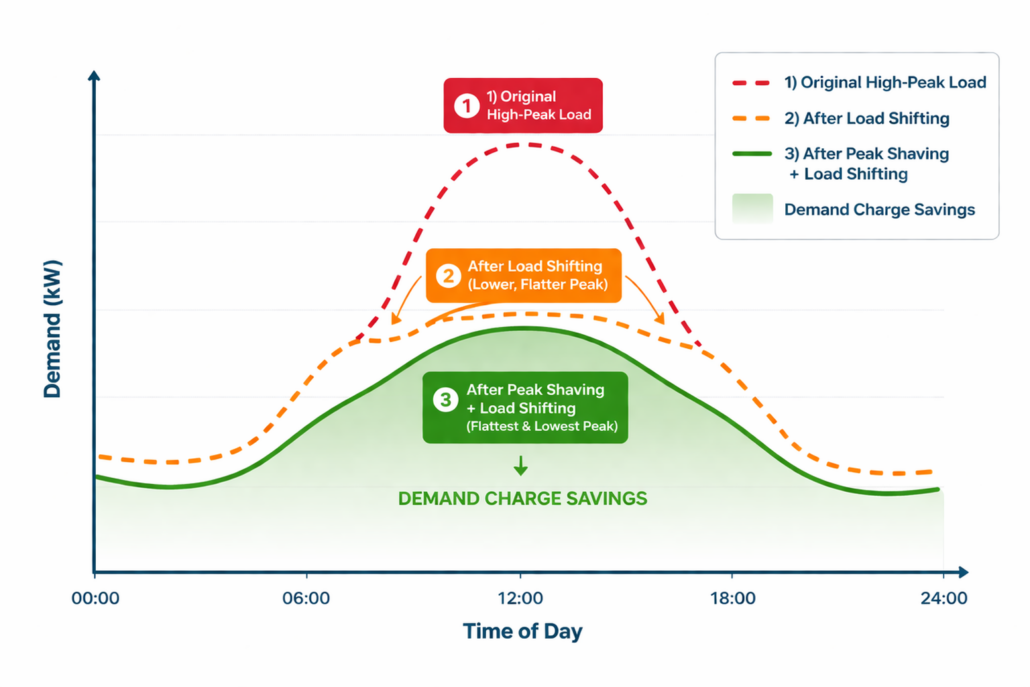
When you combine peak shaving and load shifting, each strategy makes the other more effective.
Load Shifting Reduces the Work Your BESS Has to Do
If you shift heavy loads to off-peak hours, you create fewer spikes during peak periods. That means your BESS has less work to do.
Your system can then be smaller — and cheaper. As a result, upfront investment drops and payback time improves.
Peak Shaving Covers the Spikes Load Shifting Cannot Plan For
Not every power spike is predictable. For example, emergency equipment, HVAC surges, or unplanned production runs can create sudden peaks.
This is where peak shaving steps in. Your BESS responds automatically — even when load shifting cannot plan ahead.
Together They Cut Both Parts of Your Bill
Load shifting lowers your energy charge — the cost per kWh consumed. Peak shaving lowers your demand charge — the cost based on your peak kW.
In contrast, using only one strategy leaves one part of your bill untouched. That means you are always leaving savings behind.
| Combined Savings Example A manufacturing facility shifts startup loads to 6 AM (off-peak). This drops their afternoon peak from 800 kW to 600 kW. Their BESS then shaves that 600 kW peak down to 420 kW. Result: demand charge falls by 47% and energy charges drop by 18% — a combined saving of over Rs 3.2 lakh per month. |
Peak Shaving and Load Shifting in India
In fact, combining both strategies is especially powerful in India. This is because Indian tariffs penalise peak demand heavily — and TOU pricing is now common across most major states.
How TOU Tariffs Make Load Shifting More Valuable
Many Indian DISCOMs now apply Time of Day (ToD) tariffs. These charge higher rates during peak grid hours — typically 6 PM to 10 PM.
For example, in Maharashtra (MSEDCL), peak-hour energy rates can be 20–50% higher than off-peak rates. Therefore, shifting loads out of these hours directly cuts your energy bill.
How MD Charges Make Peak Shaving Essential
Indian DISCOMs charge Maximum Demand (MD) fees in Rs/kVA or Rs/kW per month. A single high-demand event sets your fee for the whole month.
Importantly, exceeding your contracted MD even once triggers a penalty of 1.5x to 2x the standard rate. As a result, BESS-based peak shaving protects against both the base MD charge and unexpected penalties.
The Recommended Approach for Indian Businesses
First, use load shifting to move planned loads out of ToD peak hours. This reduces your demand before it even registers on the meter.
Then, size your BESS to handle only the remaining unplanned spikes. This minimises both capital cost and your monthly bill at the same time.
| India Strategy Tip Apply load shifting first — it is low-cost and takes effect in the very first billing cycle. Then right-size your BESS based on what peak demand remains. This order gives you the fastest payback and the lowest upfront investment. |
How to Combine Peak Shaving and Load Shifting in Your Facility
Running both strategies does not have to be complex. Modern energy management systems (EMS) can automate them both at the same time.
Step 1 — Map Your Load Profile for Peak Shaving and Load Shifting
First, get a clear picture of when and how your facility uses electricity. Your utility meter data or an energy audit will show your daily load curve.
Look for two things: predictable high-load events and unpredictable spikes. This step tells you where to apply load shifting and how large a BESS you need.
Step 2 — Apply Load Shifting to Cut Planned Peaks
Move every predictable high-load task out of peak pricing windows. For example, pre-cool your facility before peak hours start, or reschedule batch production to night shifts.
Moreover, this step costs very little to implement. It also reduces the size — and cost — of the BESS you will need in the next step.
Step 3 — Install a BESS to Handle Remaining Demand Spikes
After load shifting, review what peak demand remains. Size your BESS to shave those remaining spikes down to your target peak level.
A well-designed system handles both planned and unplanned spikes automatically. As a result, you get consistent savings every month — with no manual work required.
| Step | Action | Targets | Typical Saving |
| 1 — Load audit | Map your full load profile | Understanding baseline | — |
| 2 — Load shifting | Move predictable loads to off-peak | Energy charge + smaller peaks | 10–20% on energy charge |
| 3 — BESS install | Shave remaining demand spikes | Demand / MD charge | 20–40% on demand charge |
| Combined result | Both strategies running together | Full bill optimisation | 25–50% total bill saving |
FAQ — Peak Shaving and Load Shifting
Q: Do peak shaving and load shifting work for all business sizes?
A: Yes. Load shifting suits almost any business with flexible operations. Peak shaving with BESS is most cost-effective above 100 kW demand, but smaller systems are now available for mid-sized businesses too.
Q: Can I use solar to support both peak shaving and load shifting?
A: Yes. Solar charges your BESS during the day. Your BESS then discharges during evening demand peaks — supporting peak shaving. At the same time, solar reduces daytime energy consumption, which complements load shifting.
Q: Is a BESS required to combine both strategies?
A: Load shifting does not need a BESS — it is a scheduling strategy. However, peak shaving requires a BESS to be effective. Combining both gives you the greatest savings and the most flexibility.
Q: How do Indian DISCOM tariffs affect the combined strategy?
A: Indian ToD tariffs make load shifting highly valuable. Moving loads out of peak hours (6–10 PM) saves 20–50% on energy charges in many states. BESS peak shaving then handles MD charges and unplanned spikes — covering both main cost components of an Indian electricity bill.
Q: How quickly will I see savings from combining both strategies?
A: Load shifting savings appear in your very first billing cycle — within 30 days. BESS payback takes 4–6 years, but monthly savings begin immediately after installation.
Sources and Further Reading
The data and benchmarks in this article are drawn from:
U.S. Department of Energy — Load Flexibility in the Grid
Lawrence Berkeley National Laboratory — Demand Charges and the Value of Battery Storage
Conclusion
Peak shaving and load shifting are not competing strategies. So using both at the same time always delivers better results than using just one.
However, the order matters. Start with load shifting — it is low-cost and cuts peaks right away. Then use a BESS to handle what remains.
Together, these strategies can cut your total electricity bill by 25–50%. For Indian businesses, the combination is especially powerful — ToD tariffs reward load shifting, and MD charges make peak shaving essential.

| Want to Run Both Strategies in Your Facility? Sunlith Energy designs integrated C&I energy systems that combine BESS peak shaving and load shifting — built for Indian commercial and industrial businesses. Get a free energy assessment and find out how much your facility could save. |
Related Articles
- What Is a Demand Charge and Why Is It So Expensive?
- C&I BESS Peak Shaving: Cut Demand Charges by Up to 35%
- Peak Shaving vs Load Shifting: Which Saves Your Business More?




Leave a Reply
Want to join the discussion?Feel free to contribute!