
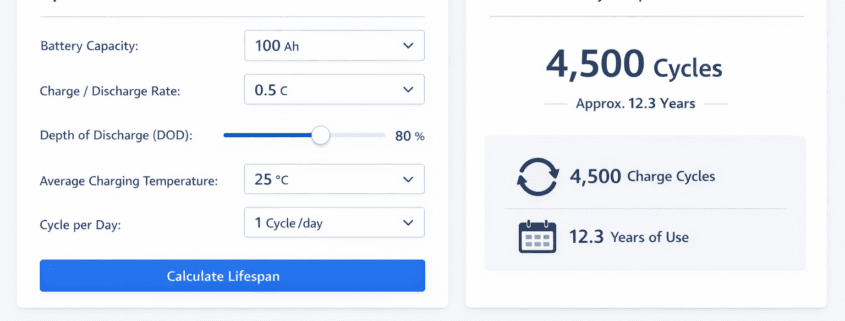

Battery Cycle Life Calculator: Find Your Real LiFePO4 Battery Lifespan
A battery cycle life calculator helps you estimate the real lifespan of a LiFePO4 battery.
Most datasheets show ideal lab values. However, real systems behave differently.
For instance, suppliers often test batteries at 25°C and 80% DOD.
In real projects, conditions vary. As a result, actual lifespan is often lower.
Because of this, using a battery cycle life calculator is important. It helps you plan costs and avoid early battery replacement.
🔢 How to Calculate Battery Cycle Life
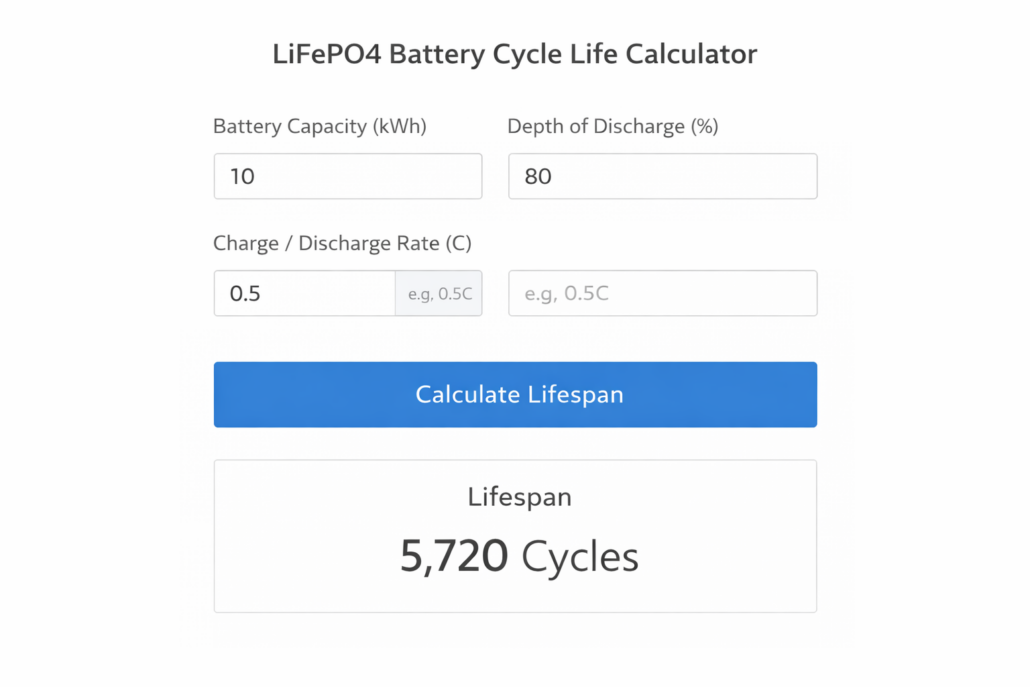
Battery lifespan depends mainly on depth of discharge (DOD).
So, a correction formula is used to estimate real cycles.
Steps:
First, take rated cycles from the datasheet.
Next, check the test DOD value.
Then, enter your actual DOD.
After that, apply the formula.
Finally, adjust for temperature if needed.
As a result, you get a realistic estimate. In fact, this is what a battery cycle life calculator does instantly.
⚡ What Is Battery Cycle Life?
A battery cycle is one full charge plus one full discharge. However, cycle life numbers on spec sheets are almost never tested under your real conditions. Instead, they are tested under the best possible lab conditions to produce the highest possible number.
Most manufacturers test under fixed conditions. For example:
- 25°C temperature
- 80% DOD
- Standard charge rate
Even so, these conditions rarely match real use.
Because of this, datasheet values can be misleading.
In other words, the real lifespan depends on your application.
Three variables change everything:
- DOD (Depth of Discharge) — How deeply you drain the battery before recharging. Deeper DOD means fewer total cycles.
- Temperature — Every 10°C above 25°C accelerates degradation. Because of this, hot climates can lose 15–30% of rated cycle life.
- EOL threshold — Is the cycle count measured to 80% SOH or 70% EOL? In other words, these are not the same number.
| 📌 The rule: Always compare cycle life at the same DOD, temperature, and EOL threshold. If even one differs, the numbers are not comparable. |
Furthermore, according to NREL’s battery degradation research, real-world LiFePO4 cycle life under field conditions is typically 10–20% lower than laboratory spec sheet values. Therefore, always treat spec sheet numbers as a starting point — not a guarantee.
🔢 Battery Cycle Life Calculator
Use this battery cycle life calculator to estimate your actual lifespan.
LiFePO4 Battery Cycle Life Calculator
Adjust spec sheet numbers to your real operating conditions
[
📖 How to Read Your Results
Adjusted Cycle Life
This is your estimated real-world cycle count at your actual DOD. The calculator uses the standard power-law formula for LiFePO4 cells:
| Formula: Adjusted Cycles = Rated Cycles × (Spec DOD ÷ Your DOD)^0.55Exponent 0.55 is calibrated for LiFePO4 chemistry based on published degradation studies. |
The exponent 0.55 is a conservative estimate for LiFePO4 chemistry. In contrast, NMC typically uses 0.6–0.7. As a result, NMC degrades faster with deeper discharge than LiFePO4.
Estimated Years
Calculated as: Adjusted Cycles ÷ (Daily Cycles × 365). It assumes consistent daily use. However, for seasonal solar storage, winter months may see fewer cycles. Therefore, adjust your planning accordingly.
The Warning Badge
- Green — Your shallower DOD gives you more cycles than the spec sheet claims. This is good news for your project budget.
- Amber — Your DOD is close to the test DOD. Therefore, expect near-spec real-world performance.
- Red — Your deeper DOD will significantly reduce lifespan. As a result, factor this into your replacement cost schedule.
| ⚠️ Note: This battery cycle life calculator covers DOD correction only. For projects above 30°C, apply an additional 10–25% reduction. See the SunLith temperature impact guide for exact correction factors:https://sunlithenergy.com/impact-of-temperature-on-lifepo4-batteries-cycle-life/ |
📸 Image 2 — DOD Curve
Prompt:
LiFePO4 battery cycle life vs depth of discharge graph clean minimal technical chart
Alt Text: cycle life vs depth of discharge LiFePO4 graph
File Name: cycle-life-vs-dod-graph.jpg
Placement: after this section
🌡️ What Affects Battery Lifespan Beyond DOD?
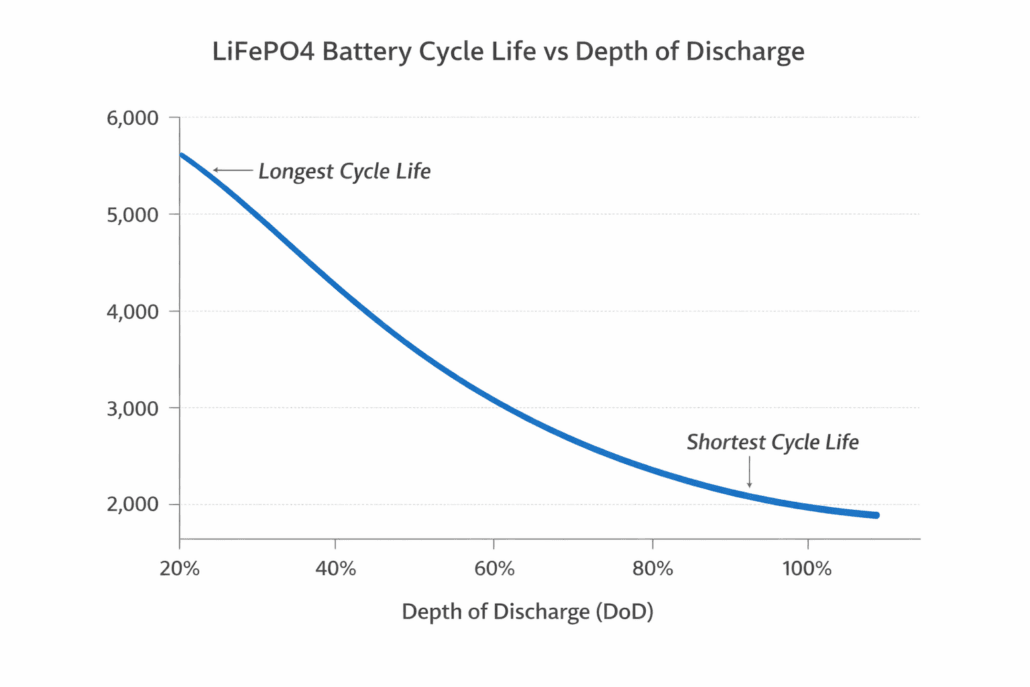
DOD plays a major role. Still, other factors also matter.
1. Temperature
Heat speeds up battery aging.
For example, every 10°C rise reduces lifespan.
As a result, systems in hot climates degrade faster.
📚 See our detailed guide on Impact of Temperature on LiFePO4 Battery Cycle Life
2. C-Rate
C-rate shows how fast the battery operates.
Higher rates increase internal stress.
Consequently, the battery wears out faster.
3. Calendar Aging
Batteries age over time, even without use.
This effect is called calendar aging.
Therefore, backup systems still lose capacity.
4. End-of-Life (EOL)
Different suppliers define end-of-life differently.
Some use 80% SOH, while others use 70%.
Because of this, cycle numbers may not match.
📚 Related reading: Battery Cycle Standards Explained: SOH, DOD, and EOL
📊 Quick Comparison Table
| Factor | Impact | Typical Loss |
|---|---|---|
| High Temperature | High | 15–30% |
| Deep DOD | Very High | 20–50% |
| High C-rate | Medium | 10–25% |
| Calendar Aging | Time-based | 2–5% yearly |
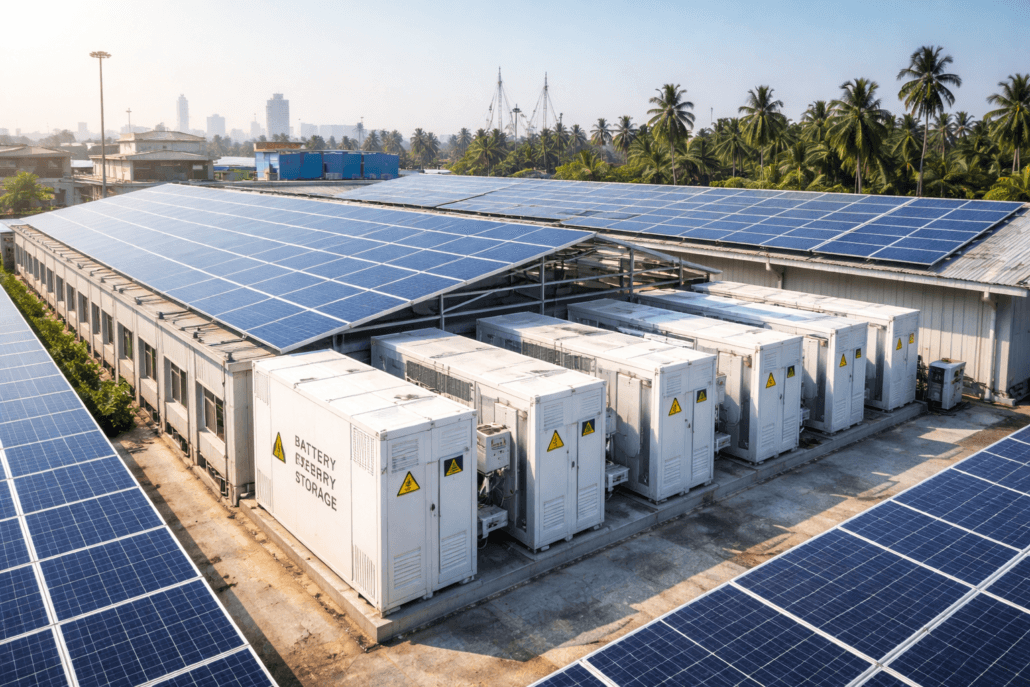
🏭 Real-World Examples: Same Calculator, Three Projects
To show how the battery cycle life calculator works in practice, here are three real deployment scenarios. Each uses different inputs and produces a very different result.
Example 1 — C&I Solar + Storage, India (Rooftop, 100kWh)
| Spec sheet cycles | 6,000 (80% SOH) |
| Spec sheet DOD | 80% |
| Actual daily DOD | 70% |
| Daily cycles | 1 |
| Adjusted cycle life | ~6,560 cycles |
| Estimated lifespan | ~18 years |
Lower DOD improves lifespan.
However, high temperature reduces it.
As a result, both factors must be balanced
However, ambient temperature is 38°C — not 25°C. Applying a 20% temperature correction brings realistic lifespan closer to 14–15 years.
Example 2 — EV Fleet Depot, Night Charging
| Spec sheet cycles | 5,000 (70% EOL) |
| Spec sheet DOD | 80% |
| Actual daily DOD | 70% (charges 90% → 20%) |
| Daily cycles | 1 |
| Adjusted cycle life | ~5,480 cycles |
| Estimated lifespan | ~15 years |
Moderate DOD gives stable performance.
In addition, daily cycling remains predictable.
Example 3 — Telecom Tower Backup, Float Use
| Spec sheet cycles | 6,000 (80% SOH) |
| Spec sheet DOD | 80% |
| Actual daily DOD | 20% (float, rare deep discharge) |
| Daily cycles | 0.5 average |
| Adjusted cycle life | ~10,800 cycles |
| Estimated lifespan | ~59 years (cycle-limited) |
Very low DOD increases cycle life.
Even so, calendar aging becomes the main limit.
For this use case, calendar aging dominates long before cycle life is reached. Therefore, plan for a 12–15 year calendar life regardless of cycle count.
Very low DOD increases cycle life.
Even so, calendar aging becomes the main limit.
✅ Questions to Ask Your Supplier Before Signing
Use this checklist when reviewing any battery spec sheet or tender response. A trustworthy supplier will answer all seven without hesitation.
| 1. | What DOD was used during the cycle life test? |
| 2. | What temperature was the test run at? |
| 3. | What C-rate was used for charge and discharge? |
| 4. | Is the cycle count measured to 80% SOH or 70% EOL? |
| 5. | Can you provide the full cycle-life test chart — not just the headline number? |
| 6. | Does your warranty use the same EOL threshold as the spec sheet? |
| 7. | Has the cell been tested to IEC 62933-2 or UL 1973 standards? |
If your supplier cannot answer all seven clearly, that is a red flag. In addition, always request the full test report — not just the summary slide.
📚 Related Terms You Will See on Spec Sheets
| Term | What it means | Why it matters |
|---|---|---|
| C-Rate | Charge/discharge speed relative to capacity | Higher C-rate during testing means fewer real-world cycles |
| Calendar aging | Degradation over time, without cycling | Dominates in low-cycle, high-temperature applications |
| SOP | State of Power — max power at current SOH | Drops as battery ages; critical for peak-shaving |
| IEC 62933-2 | International ESS performance testing standard | Confirms the supplier used a recognised test method |
| UL 1973 | US standard for stationary battery systems | Required for US and Canadian grid-tied projects |
| SOC | State of Charge — current charge level | Operating between 20–90% SOC extends cycle life |
📚 Related SunLith Guides
- Battery Cycle Standards Explained: SOH, DOD, and EOL — start here if you are new to these terms
- Impact of Temperature on LiFePO4 Battery Cycle Life — apply temperature corrections to your calculator result
- LiFePO4 Battery Testing: How Manufacturers Grade Their Cells — understand what testing actually looks like
- LiFePO4 vs NMC Battery Lifespan Comparison — see how chemistry affects cycle life
- The Economics of BESS: Calculating ROI — plug your adjusted cycle life into a full cost model
🤖 Summary
A battery cycle life calculator estimates real battery lifespan.
It adjusts cycles based on DOD.
In addition, temperature affects degradation.
Lower DOD increases lifespan.
Therefore, always compare real use with datasheet values.
❓ FAQ
Is this battery cycle life calculator accurate for all chemistries?
The DOD correction formula is calibrated for LiFePO4 / LFP chemistry. This is the most common for stationary BESS, solar storage, and commercial EV applications. However, for NMC chemistry, the exponent is typically 0.6–0.7. As a result, DOD changes affect NMC cycle life more dramatically. The calculator is not suitable for lead-acid batteries.
Why does my result show more cycles than the spec sheet?
If your actual DOD is shallower than the test DOD, you will get more real-world cycles. This is correct — shallower cycling is gentler on the cell. For example, if the spec was tested at 100% DOD but you discharge to only 60%, you will significantly outlast the rated cycle number.
How do I find what DOD my supplier used for testing?
It should be stated on the spec sheet under Test Conditions or Cycle Life Test Parameters. If it is not stated, ask your supplier directly and request the full test report. Furthermore, a reputable supplier will provide this without hesitation. If they cannot, that is a warning sign.
Should I use this battery cycle life calculator for warranty planning?
Use it as a planning estimate — not a warranty substitute. Your warranty terms define the legal obligation. Therefore, check whether the warranty cycle count uses the same DOD and EOL threshold as the spec sheet. Many warranties use different thresholds that result in fewer covered cycles than the headline spec implies.
What if I have multiple daily cycles?
Enter your average daily cycle count in the Daily cycles field. A solar + storage system with a morning charge and evening discharge counts as approximately 1 cycle per day. In contrast, a grid frequency response system may accumulate 2–4 partial cycles per day. In that case, enter the total equivalent full cycles.
📞 Need Expert Help?
If your project is large, basic estimates may not be enough.
In that case, expert review is useful.