

The Economics of BESS: A Practical Guide to Calculating ROI
Battery Energy Storage Systems (BESS) are a smart solution for businesses that want to cut electricity costs, avoid peak charges, and get more from renewable energy. But before you invest, you must know the economics of BESS — and how to calculate your Return on Investment (ROI).
This guide explains the costs, savings, and key steps to help you decide if a BESS makes good financial sense for your business or large-scale project.
What Does a BESS Cost?
Understanding BESS costs is the first step in calculating ROI. Here’s what’s involved:
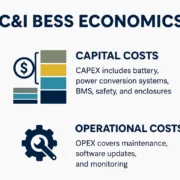
✔️ Capital Expenditure (CAPEX)
- Battery modules (like lithium-ion, sodium-ion, or flow batteries)
- Inverters or Power Conversion Systems (PCS)
- Energy Management Systems (EMS) and Battery Management Systems (BMS)
- Installation and grid connection fees
✔️ Operating Expenditure (OPEX)
- Regular inspections and maintenance
- Software updates and monitoring fees
- Insurance costs
- Replacements for battery modules or inverters over time
✔️ End-of-Life Costs
- Decommissioning and recycling fees
How BESS Saves or Earns You Money
The economics of BESS depend on how much you can save or earn over time.
⚡ Energy Arbitrage
Store energy when it’s cheap and use or sell it when prices spike.
⚡ Demand Charge Reduction
Cut peak demand charges by using stored energy during expensive hours.
⚡ Backup Power Savings
Avoid costly downtime during blackouts.
⚡ Grid Services Revenue
Some businesses earn money by helping stabilize the grid.
⚡ Renewable Energy Integration
Store surplus solar or wind energy instead of wasting it.
The Economics of BESS: Steps to Calculate Your BESS ROI
Here’s a clear, practical way to work out if BESS is worth it for you:
✅ 1. Define Your Project
- System size (kWh/kW)
- Expected charge/discharge cycles
- BESS Round Trip Efficiency (RTE)
- Local energy rates and demand charges
✅ 2. Estimate Total Costs
- Gather quotes for equipment, installation, and grid connection.
- Include yearly O&M costs for the entire lifespan.
✅ 3. Project Savings and Revenue
- Use your energy data to estimate savings from lower peak charges.
- Check if your area pays for grid services.
- Add any government incentives or tax credits.
✅ 4. Build a Simple Cash Flow
- Compare annual costs vs. annual savings/revenue.
- Run it for the entire expected lifespan (typically 10–20 years).
✅ 5. Calculate Payback Period and ROI
- Payback Period = Total Investment ÷ Annual Net Savings
- ROI = [(Total Net Savings – Total Cost) ÷ Total Cost] × 100%
Example:
If your BESS costs $400,000 and saves you $80,000 per year, your payback is 5 years. If the system lasts 15 years:
($80,000 × 15 – $400,000) ÷ $400,000 × 100% = 200% ROI.
Higher BESS RTE directly improves a Battery Energy Storage System’s (BESS) Return on Investment (ROI) by maximizing usable energy, reducing operational costs, and shortening the payback period. Because RTE measures the ratio of energy discharged to energy charged, even a 1% increase in efficiency can significantly impact lifetime revenue at grid scale.
The Economics of BESS: Tips for Better BESS ROI
✔️ Be realistic: Use conservative savings estimates.
✔️ Factor in battery aging: Storage capacity drops over time.
✔️ Know your local policies: Incentives vary by country or state.
✔️ Get expert help: A reliable consultant can build a strong financial model.
“Before calculating ROI, get your realistic cycle life estimate using our Battery Cycle Life Calculator.”
Final Thoughts
The economics of BESS can make a huge difference to your bottom line. Taking time to calculate your ROI properly helps you invest wisely and unlock long-term savings. For businesses serious about energy resilience and cost control, BESS can be a profitable piece of your energy strategy.
Frequently Asked Questions (FAQ) about The Economics of BESS
Q1: What’s a typical payback period for BESS?
A: Many businesses see a 5–7 year payback, but it depends on system size, local energy costs, and incentives.
Q2: Do BESS really last 15 years?
A: Good-quality BESS can last 10–20 years with proper maintenance, but performance slowly degrades.
Q3: Can I get tax credits for BESS?
A: Some regions offer grants, rebates, or tax credits. Check your local government’s energy programs.
Q4: Is BESS only for big companies?
A: Not at all! Small businesses, farms, and communities can benefit too — especially when paired with renewables.
Q5: Is BESS better suited for businesses with renewable energy?
A: Yes! Pairing BESS with solar or wind generation maximizes savings by storing excess energy for use during non-generating hours.
Q6: Are there any hidden costs in BESS projects?
A: Sometimes, grid interconnection fees, software subscriptions, or unexpected permitting costs can arise. Always add a contingency buffer.







Trackbacks & Pingbacks
[…] The Economics of BESS: Calculate ROI for Your Energy Storage […]
[…] The Economics of BESS: Calculate ROI for Your Energy Storage […]
[…] The Economics of BESS: Calculate ROI for Your Energy Storage […]
[…] guide to calculating BESS ROI covers the standard model: capex, opex, revenue streams, payback period. This piece covers a […]
[…] Utility-scale projects, by contrast, raise money as standalone infrastructure assets. Developers combine tax equity, debt from infrastructure lenders, and a long-term PPA that underwrites the debt. Because no single host’s bill defines success, the economics depend on wholesale market forecasts and interconnection terms. Investment horizons commonly run 10–15+ years. For the full framework on calculating storage ROI, see our guide to the economics of BESS. […]
[…] To understand how BESS economics work in practice, see our guide on calculating BESS ROI. […]
[…] The Economics of BESS: Calculating ROI — plug your adjusted cycle life into a full cost model […]
[…] The Economics of BESS: A Practical Guide to Calculating ROI […]
[…] https://sunlithenergy.com/economics-of-bess-calculate-roi/ […]
[…] Businesses can significantly reduce electricity bills through demand charge reduction using battery storage. […]
[…] applications are an exciting example of how we can combine smart technology, sustainability, and practical economics. Next time you think your EV battery is ready for retirement, remember: with the help of accurate […]
[…] Cycle Life […]
Leave a Reply
Want to join the discussion?Feel free to contribute!