
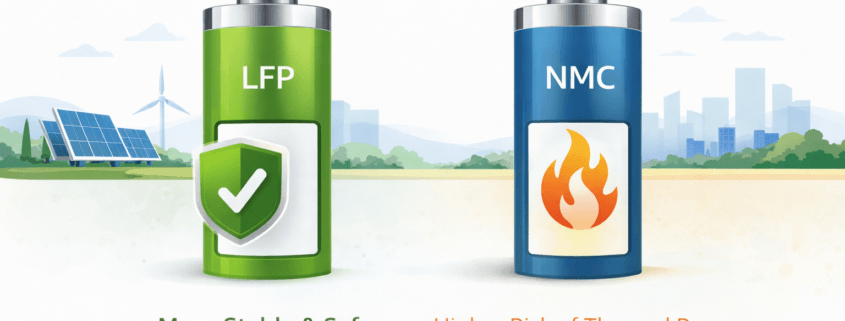

NMC Battery vs LFP Safety: The Complete BESS Risk Breakdown
The NMC battery vs LFP safety gap starts with one number: LFP triggers thermal runaway at 270–300°C — NMC reaches it at just 150–210°C. That 150°C difference determines fire risk, toxic gas exposure, BMS complexity, and real installation cost for any BESS project.
This guide covers the full NMC battery vs LFP safety comparison. Specifically, we look at thermal runaway, fire risk, gas emissions, BMS needs, and real-world installation differences. By the end, you will know which chemistry is safer — and why.
Already comparing cycle life and cost? Read our full LiFePO4 vs NMC battery comparison guide first. This post focuses on safety only.
Why Chemistry Determines Safety
Lithium-ion batteries store a lot of energy in a small space. So when something goes wrong, the results can be severe. However, not all chemistries fail the same way.
The cathode material is the key factor. It determines how much heat is released during failure. Fire spread speed also depends on the cathode. Therefore, picking the right chemistry is a safety decision — not just a performance one.
NMC Battery vs LFP Safety: Thermal Runaway Risk
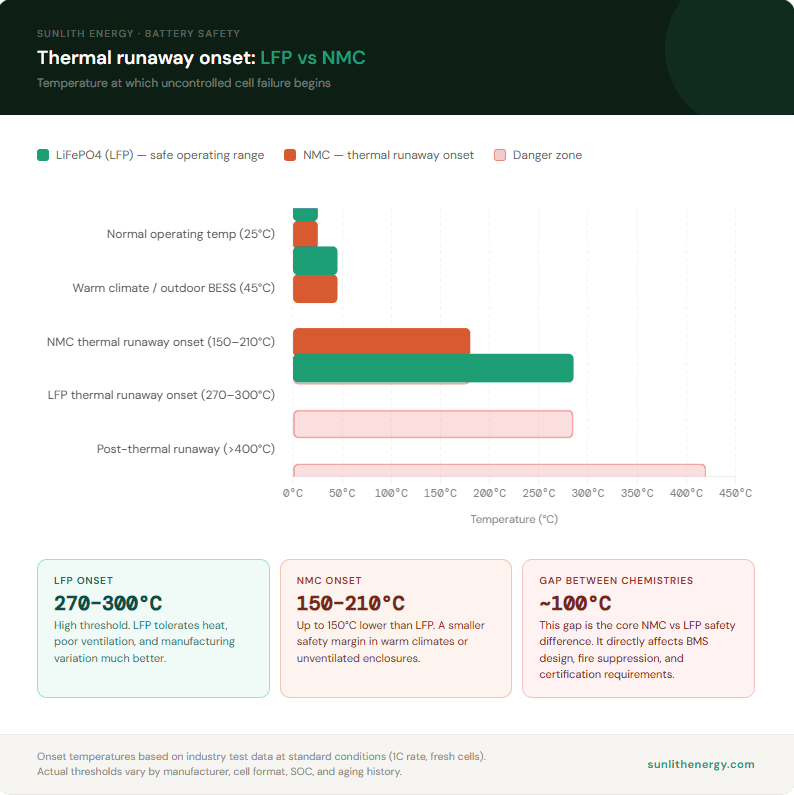
Thermal runaway is the main safety hazard in lithium-ion batteries. Specifically, it happens when a cell overheats and starts a chain reaction. As a result, the cell releases heat, gas, and possibly fire — faster than any cooling system can stop.
What causes thermal runaway?
Common causes include:
- Overcharging — voltage pushed above the safe limit
- External heat — high ambient temperature or nearby fire
- Internal short circuit — from a defect or physical damage
- Deep over-discharge — damages the anode structure
- Mechanical abuse — crushing, puncture, or impact
Both LFP and NMC can suffer thermal runaway. However, the temperature at which it starts — and what happens next — is very different.
NMC battery vs LFP safety: thermal runaway temperature
LFP cells begin thermal runaway at around 270°C–300°C. This is a high threshold. Because of this, LFP handles heat, poor ventilation, and temperature spikes much better.
NMC cells, on the other hand, begin thermal runaway at around 150°C–210°C. At up to 150°C lower than LFP, NMC reaches the danger zone much faster under the same conditions.
This gap matters a lot in practice. For example, a BESS in a warm climate or a poorly ventilated enclosure can easily reach 40°C–50°C. LFP handles that temperature comfortably. NMC, however, has a much smaller safety margin at that point.
✅ For outdoor BESS, rooftop solar, or any site without active cooling — LFP’s higher thermal runaway threshold is a critical safety advantage.
NMC Battery vs LFP Safety: Fire Risk and Propagation
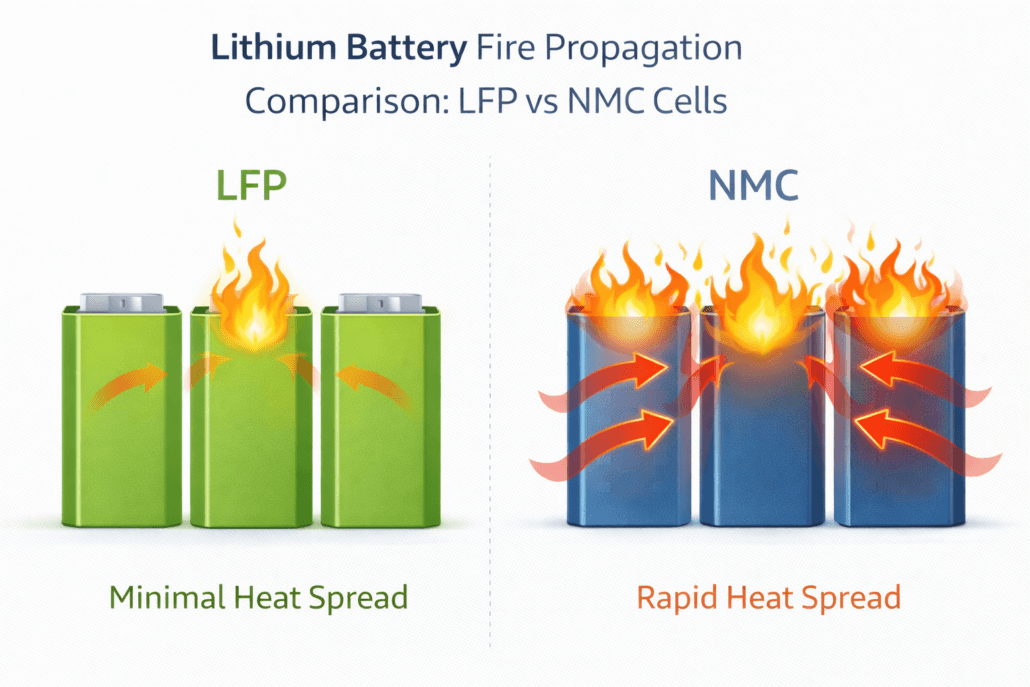
Even if one cell enters thermal runaway, a good system should stop it from spreading. However, chemistry determines how hard that containment is.
LFP fire risk
When an LFP cell fails, the reaction is relatively slow. In addition, the iron-phosphate cathode releases very little oxygen. As a result, fire spreading to nearby cells is much less likely — especially with proper spacing and thermal management.
LFP fires can still happen. Nevertheless, they are generally manageable with standard fire suppression systems. This includes systems required under NFPA 855 and UL 9540A.
NMC battery fire risk
NMC thermal runaway is more energetic. Notably, the cathode releases oxygen as it breaks down. That oxygen feeds the fire directly. As a result, NMC fires can spread to adjacent cells very fast. Experts call this thermal runaway cascade or cell-to-cell propagation.
NMC fires also burn hotter and produce more toxic smoke. Therefore, they need stronger fire suppression, more cell spacing, and better containment in module design.
This is exactly why UL 9540A testing exists. In short, it measures how far a fire can spread in a battery system. For more on certifications, see our guide to UL certifications for battery systems.
NMC Battery vs LFP Safety: Toxic Gas Emissions
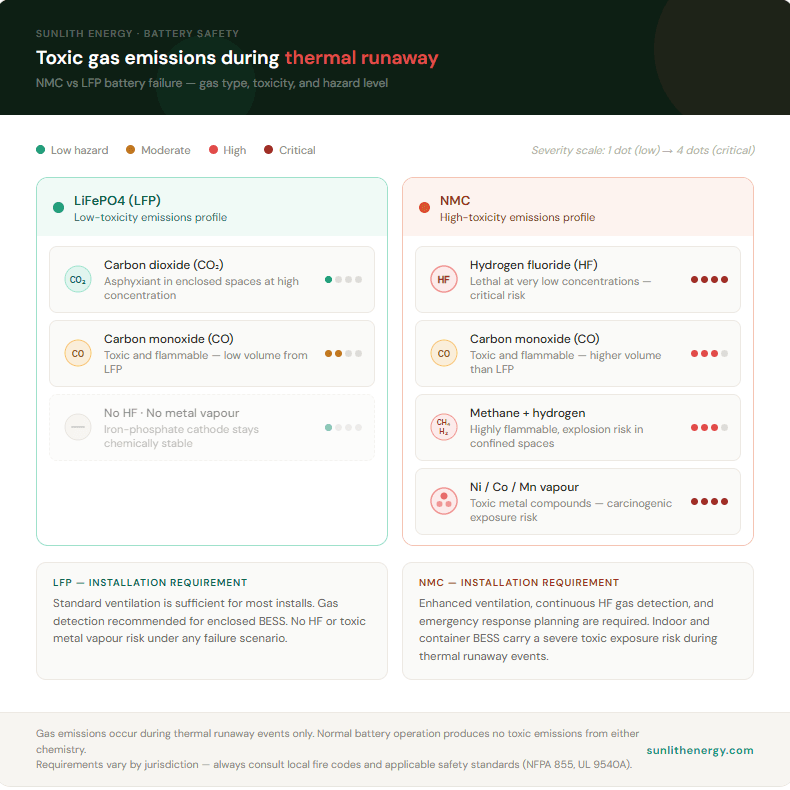
Battery failures produce dangerous gases. Importantly, the type and amount of gas depend on the chemistry.
LFP gas emissions
LFP cells mainly release carbon dioxide (CO₂) and small amounts of carbon monoxide (CO) during failure. Both are hazardous in enclosed spaces. However, LFP produces much lower volumes of toxic or flammable gas than NMC.
NMC battery gas emissions
NMC cells release a more dangerous mix of gases, including:
- Hydrogen fluoride (HF) — highly toxic even at low levels
- Carbon monoxide (CO) — toxic and flammable
- Methane and hydrogen — highly flammable
- Nickel and cobalt compounds — toxic metal vapours
Because of this, NMC failures in enclosed spaces carry a much higher toxic exposure risk. Container BESS, basement installs, and indoor commercial storage all fall into this category. Therefore, NMC systems need better ventilation and gas detection than LFP.
NMC Battery vs LFP Safety: BMS Requirements
A Battery Management System (BMS) is the main electronic protection against battery failure. However, NMC and LFP place very different demands on the BMS. For a full overview, see our BMS monitoring and protection guide.
LFP BMS needs
LFP has a flat charge-discharge voltage curve. Consequently, this makes State of Charge (SOC) harder to measure. However, the chemistry is stable. So the BMS has more time to catch a developing fault before it becomes dangerous.
Key BMS functions for LFP:
- Cell balancing — important due to the flat voltage curve
- Temperature monitoring — less critical than NMC, but still needed
- Overcharge and over-discharge protection
NMC battery BMS needs
NMC is far more sensitive to voltage and temperature changes. Speed and precision matter more. As a result, the BMS must react faster and with tighter tolerances. In particular, NMC requires:
- Tighter voltage windows — NMC is damaged more easily by overcharge or deep discharge
- Continuous temperature monitoring — the low thermal runaway threshold means any heat spike is a risk
- Faster fault response — the BMS must disconnect the system quickly
- Cell-level monitoring — NMC cells age unevenly, so individual cell data matters
Therefore, NMC-based BESS systems need a more advanced BMS than LFP. Consequently, this adds cost, complexity, and more potential points of failure in the safety chain. The BMS is just one piece — but it is the one that ties all the others together.
NMC Battery vs LFP Safety: Certification Standards
Safety certifications test how battery systems behave under fault conditions. Because NMC and LFP behave so differently, the effort required to pass differs too.
Key standards for NMC battery vs LFP safety
| Standard | What it covers | Key note |
|---|---|---|
| UL 9540 | Complete BESS system safety | Both chemistries must comply for US market |
| UL 9540A | Fire propagation testing | Harder to pass for NMC |
| UL 1973 | Stationary battery safety | Cell and module level |
| IEC 62619 | Lithium-ion battery safety | International standard for both |
| NFPA 855 | Fire code for energy storage | Stricter spacing often needed for NMC |
| IEC 62933-5 | ESS safety framework | Applies to both |
Why NMC faces a harder certification path
UL 9540A tests fire propagation. Specifically, it checks whether a thermal runaway event in one cell can spread to the rest of the system. Oxygen is released by NMC during failure. Because of this, fire propagation is more likely. As a result, systems using NMC often need more cell spacing, stronger thermal barriers, and better fire suppression to pass.
NFPA 855 also applies stricter spacing rules to higher-hazard systems. In practice, this means NMC BESS may need more floor area and more separation from occupied spaces. For a full overview, see our guide to IEC 62933-5 safety standards.
UL 9540 overview → https://www.ul.com
NFPA 855 code → https://www.nfpa.org
NMC Battery vs LFP Safety: Real-World Installation Differences
The NMC battery vs LFP safety difference is not just theory. It shows up in real project decisions every day.
Outdoor and warm-climate BESS
LFP is strongly preferred for outdoor BESS and warm-climate deployments. In particular, its high thermal runaway threshold means it handles heat without the active cooling NMC needs.
NMC in warm or outdoor settings, on the other hand, needs robust thermal management. Active liquid cooling or high-capacity HVAC is usually required. Therefore, the safety system becomes more complex and more expensive.
Indoor and occupied-building storage
NMC’s higher gas toxicity and fire spread risk make it harder to use near occupied spaces. In contrast, LFP’s lower emissions and slower failure mode make it a better fit for behind-the-meter C&I storage in commercial buildings.
Moreover, insurers and building inspectors are increasingly aware of the chemistry difference. As a result, LFP installations often get through planning and permitting faster than NMC.
Container-based utility-scale BESS
For large container BESS, both chemistries are used. However, NMC containers need more fire suppression, more cell spacing, and more thermal management. As a result, LFP containers can be packed more efficiently and at lower cost — while still meeting the same safety standards.
NMC Battery vs LFP Safety: Head-to-Head Summary
| Safety factor | LFP | NMC |
|---|---|---|
| Thermal runaway threshold | ~270–300°C | ~150–210°C |
| Oxygen release during failure | Very low | High |
| Fire propagation risk | Low | High |
| Toxic gas emissions | Low (CO, CO₂) | High (HF, CO, metal vapour) |
| BMS complexity needed | Standard | High |
| UL 9540A difficulty | Lower | Higher |
| NFPA 855 spacing | Standard | Often stricter |
| Outdoor BESS suitability | Excellent | Moderate — needs active cooling |
| Indoor / occupied-space use | Good | Needs extra mitigation |
| Overall BESS safety risk | Lower | Higher |
Which Is Safer? The NMC Battery vs LFP Safety Verdict
For stationary energy storage — BESS, solar storage, C&I, utility-scale — LFP is the safer choice. Its higher thermal runaway threshold makes it more tolerant of heat. Lower fire spread risk and reduced toxic emissions add to that advantage. Overall, every key safety dimension favours LFP.
NMC is not unsafe when it is designed and installed correctly. However, it needs more thermal management, a more advanced BMS, stronger fire suppression, and stricter installation controls to reach the same safety level as LFP. As a result, the cost of making NMC safe for stationary storage is higher.
Most utility-scale and C&I BESS projects globally now specify LFP for exactly this reason. Indeed, the safety profile — combined with longer cycle life and lower lifetime cost — makes LFP the dominant choice for stationary storage.
Frequently Asked Questions
Is NMC battery vs LFP safety a big difference in practice?
Yes. The gap is significant. A thermal runaway threshold up to 150°C lower than LFP is a major difference. More oxygen, more toxic gas, and faster fire spread come with it. Therefore, NMC needs more safety infrastructure to reach the same risk level as LFP.
Is NMC dangerous for BESS?
Not inherently — when properly designed, certified, and installed, NMC is manageable. However, the lower thermal runaway threshold and higher fire risk compared to LFP mean more work is required. As a result, more sophisticated thermal management and fire suppression are needed.
Why does LFP have a higher thermal runaway threshold than NMC?
The iron-phosphate bond in LFP is chemically more stable than the nickel-cobalt-manganese structure in NMC. Consequently, LFP needs much more heat to trigger decomposition and thermal runaway.
Can NMC pass UL 9540A?
Yes. Many NMC systems have passed UL 9540A. However, passing often requires more cell spacing, thermal barriers, and fire suppression than LFP needs. As a result, NMC certification takes more effort and cost.
Is LFP safe for indoor BESS installations?
Absolutely. LFP’s lower fire spread risk and reduced toxic gas profile make it more suitable than NMC for indoor and occupied-building installs. However, all BESS installations must still comply with local fire codes and applicable standards.
What happens if a single NMC cell fails in a large BESS?
In a well-designed NMC system, a single cell failure should be contained by the BMS, thermal management, and module-level barriers. However, because NMC releases oxygen during thermal runaway, fire can spread to adjacent cells if containment is not strong enough. Specifically, this is what UL 9540A testing is designed to evaluate.
Final Thoughts
The NMC battery vs LFP safety comparison has a clear result for stationary storage. Overall, LFP wins on thermal runaway threshold, fire propagation, toxic gas emissions, and BMS simplicity. As a result, it is the safer and more practical choice for BESS, solar storage, and C&I projects.
NMC works well where energy density is the top priority and where the extra safety infrastructure can be justified. However, for most stationary storage projects, LFP is the lower-risk option — in safety terms and in cost terms.
One final rule: always evaluate safety at the system level. Chemistry is just one piece. The BMS, thermal management, fire suppression, and installation conditions all matter equally. Therefore, always check that your supplier’s certification covers the full installed system — not just individual cells.
Related reading:
- LiFePO4 vs NMC Battery: Cycle Life, SOH, and Real-World Use
- IEC 62933-5 Safety Standards: Complete ESS Safety Framework
- BMS Explained: Real-Time Monitoring, Key Protections, and SOC/SOH Algorithms
- UL Certifications for Battery Systems: A Complete Guide
- Battery Cycle Standards Explained: SOH, DOD, and EOL