
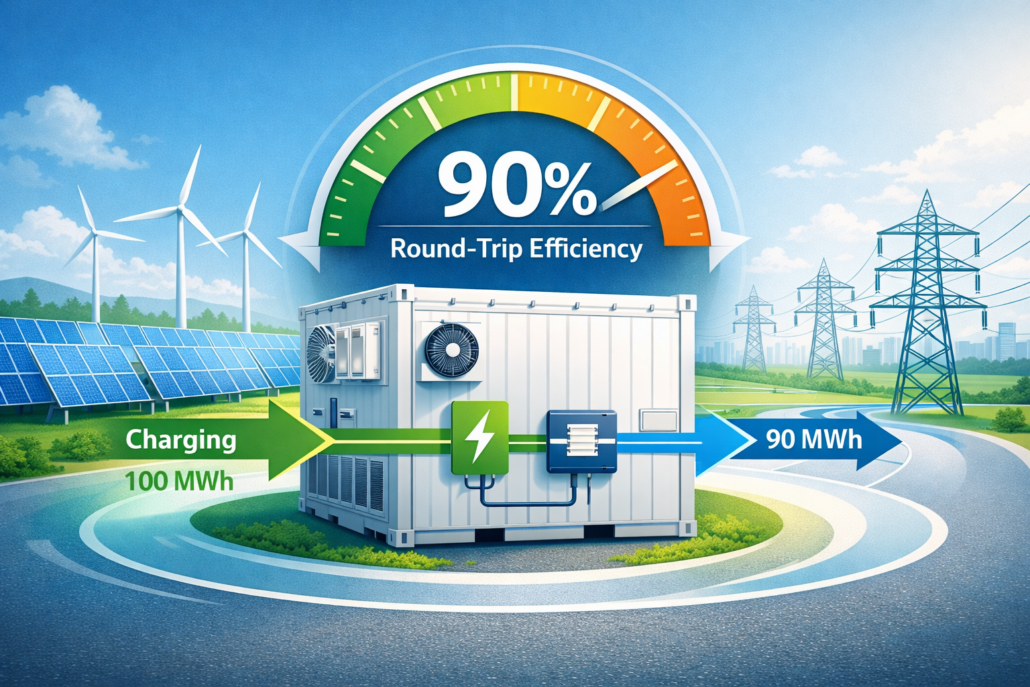
BESS Round Trip Efficiency (RTE): How to Calculate Efficiency in Battery Energy Storage Systems
BESS Round Trip Efficiency (RTE) measures how much energy a battery returns compared to the energy used to charge it. In other words, it shows how efficiently the storage system operates.
Battery Energy Storage Systems play a critical role in modern power grids. They store electricity when supply is high and release it when demand increases. However, every storage system loses some energy during the process.
This is why Round Trip Efficiency (RTE) is one of the most important performance metrics in energy storage projects.
A higher BESS RTE means lower energy losses and better system economics. Therefore, utilities, renewable developers, and commercial energy users carefully evaluate this metric when selecting battery storage solutions.
To understand battery storage performance, engineers calculate BESS round trip efficiency using a simple formula.
BESS Round Trip Efficiency Formula
BESS Round Trip Efficiency (RTE) measures how much energy a battery energy storage system returns after charging.
Formula
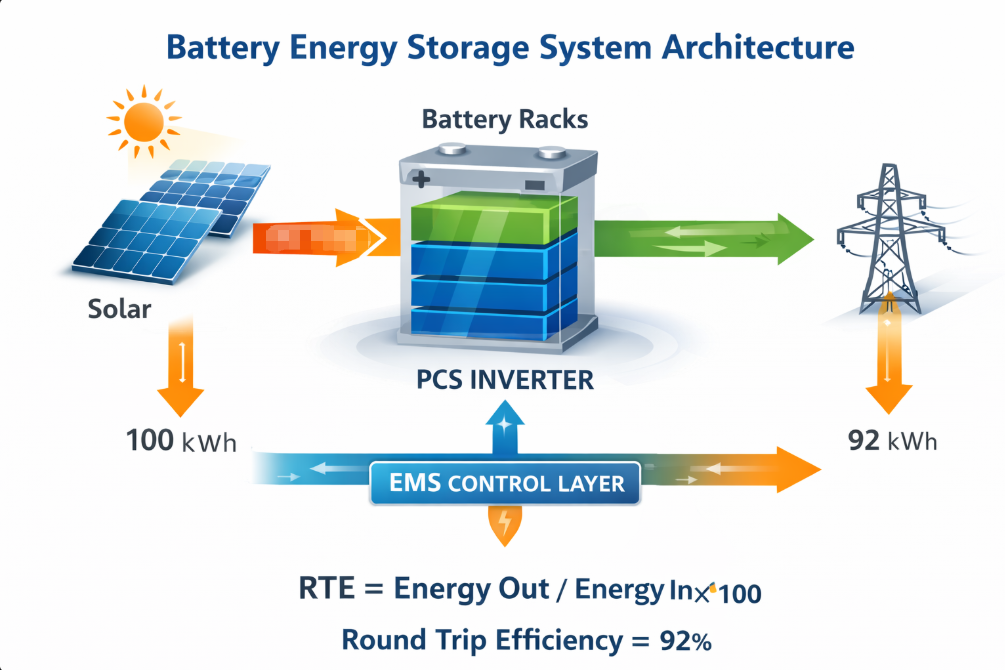
RTE (%) = Energy Discharged ÷ Energy Charged × 100
Example
Energy Charged = 100 kWh
Energy Discharged = 92 kWh
BESS Round Trip Efficiency = 92%
Most lithium battery energy storage systems achieve 88–94% AC round trip efficiency.
What Is BESS Round Trip Efficiency (RTE)?
BESS RTE represents the percentage of energy that can be recovered from a battery after a full charge and discharge cycle.
During energy storage, electricity flows through several system components. Each component introduces small losses. As a result, the output energy is always slightly lower than the input energy.
These losses typically occur in:
- battery cells
- power conversion systems
- thermal management systems
- auxiliary equipment
Therefore, BESS round trip efficiency reflects the combined efficiency of the entire storage system.
Why BESS Round Trip Efficiency (RTE) Matters
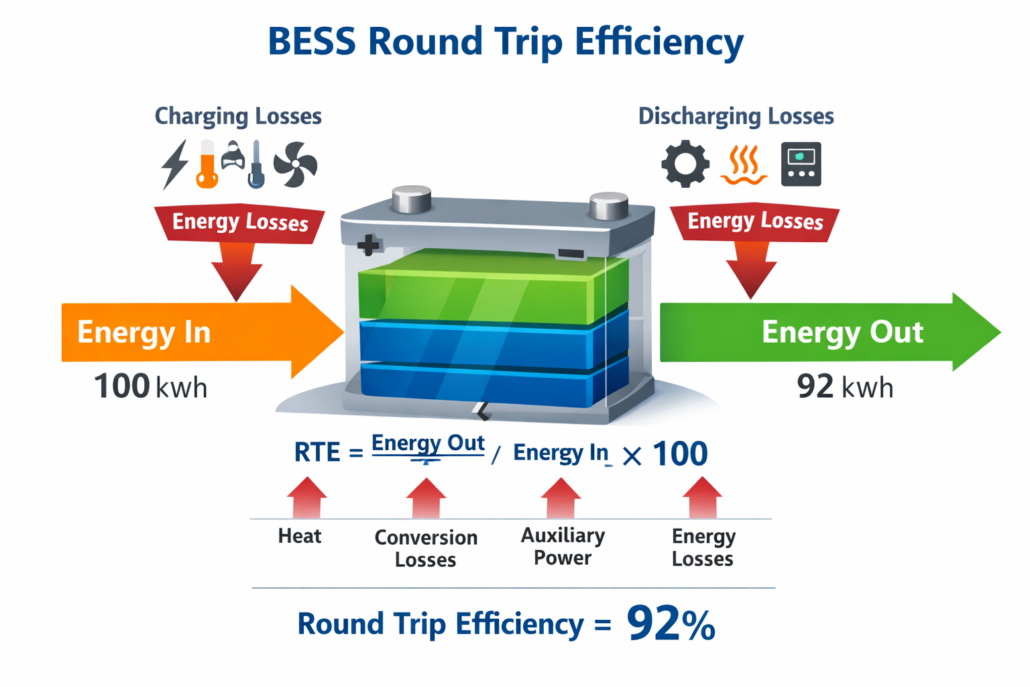
Understanding BESS round trip efficiency is important because it directly affects project performance and profitability.
First, higher efficiency means more usable electricity. This improves overall system performance.
Second, improved BESS RTE reduces operational energy losses. As a result, storage projects can generate higher revenue from energy trading and peak-shaving services.
In addition, efficient battery systems support grid stability. They store renewable energy during periods of excess generation and release it during high demand.
Modern energy storage solutions such as those offered by SunLith Energy are designed to maximize efficiency through advanced battery design and system integration.
How to Calculate BESS Round Trip Efficiency
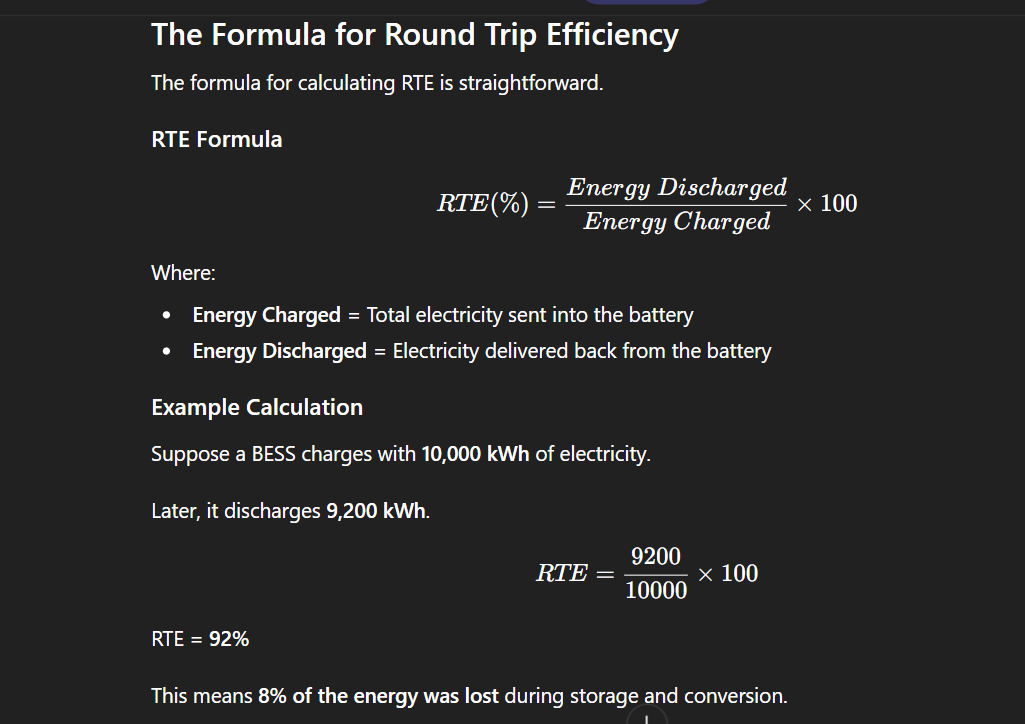
The calculation of BESS round trip efficiency is straightforward. However, engineers must carefully measure the energy entering and leaving the system.
BESS Round Trip Efficiency Formula
RTE (%) = Energy Discharged ÷ Energy Charged × 100
Where:
- Energy Charged = total electricity stored in the battery
- Energy Discharged = electricity delivered from the battery
This formula helps determine the overall efficiency of the storage cycle.
Step 1: Measure Charging Energy
First, record the total electricity supplied to the battery system during charging.
This measurement usually occurs at the grid connection point or the inverter input.
Example:
Energy charged = 5 MWh
Step 2: Measure Discharge Energy
Next, measure the electricity delivered by the battery during discharge.
Example:
Energy discharged = 4.6 MWh
Step 3: Calculate BESS Round Trip Efficiency
Using the formula:
RTE = 4.6 ÷ 5 × 100
Result:
BESS Round Trip Efficiency = 92%
Therefore, the system lost 8% of energy during the storage cycle.
AC vs DC BESS Round Trip Efficiency
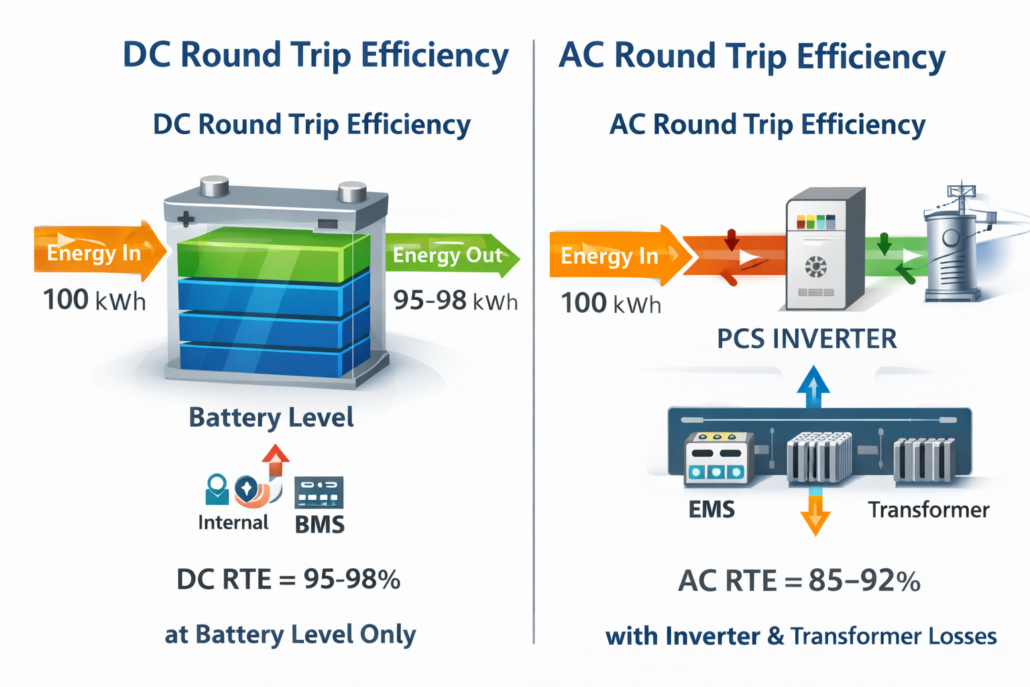
Engineers often calculate BESS round trip efficiency using two different system boundaries.
These measurements are known as DC efficiency and AC efficiency.
Read more about AC vs DC BESS Round Trip Efficiency
DC Round Trip Efficiency
DC efficiency measures performance at the battery level.
It includes losses from:
- battery cells
- internal resistance
- battery management systems
However, DC efficiency does not include inverter losses.
Typical DC BESS round trip efficiency:
95–98%
AC Round Trip Efficiency
AC efficiency measures performance at the grid connection level.
It includes losses from:
- batteries
- inverters
- transformers
- auxiliary systems
Therefore, AC efficiency represents real-world performance.
Typical AC BESS round trip efficiency:
85–92%
Because it reflects system-level performance, AC efficiency is the metric most often used in commercial BESS projects.
Factors That Affect BESS Round Trip Efficiency
Several technical factors influence BESS round trip efficiency.
Understanding these factors helps engineers design more efficient systems.
Battery Cell Efficiency
Battery chemistry strongly influences system performance.
Lithium iron phosphate batteries are widely used because they offer:
- high efficiency
- long cycle life
- strong thermal stability
These characteristics help maintain high BESS RTE over many operating cycles.
Power Conversion Systems
Power conversion systems convert electricity between AC and DC.
During charging:
AC → DC conversion occurs.
During discharge:
DC → AC conversion occurs.
Each conversion introduces small energy losses. Therefore, inverter efficiency plays an important role in overall BESS round trip efficiency.
Modern PCS systems typically achieve 96–99% efficiency.
Thermal Management Systems
Thermal management systems may include:
- HVAC units
- cooling fans
- temperature monitoring sensors
Although necessary, these systems consume energy and slightly reduce BESS RTE.
Auxiliary Power Consumption
Battery containers use additional electrical loads such as:
- control systems
- lighting
- safety equipment
While these loads are relatively small, they still contribute to energy losses during storage operations.
Typical BESS Round Trip Efficiency by Battery Type
Different battery technologies have different efficiency levels.
Below is a comparison of common energy storage technologies.
| Battery Technology | DC Efficiency | AC Efficiency |
|---|---|---|
| Lithium Iron Phosphate | 96–98% | 88–94% |
| Lithium NMC | 95–97% | 87–92% |
| Sodium-ion | 90–94% | 82–90% |
| Flow Batteries | 70–85% | 65–80% |
| Lead-Acid | 80–90% | 70–85% |
Lithium-based batteries dominate modern energy storage because they deliver high BESS RTE and long operational life.
More details about integrated storage technology can be found on our Blogs
Example: Solar + Battery Storage Efficiency
Consider a commercial solar project combined with battery storage.
System Scenario
Solar generation: 20 MWh
Battery charging energy: 10 MWh
Battery discharge energy: 9.1 MWh
Efficiency Calculation
RTE = 9.1 ÷ 10 × 100
BESS RTE = 91%
Although the loss appears small, repeated cycles can create significant energy losses over time.
Therefore, improving BESS RTE is critical for long-term project economics.
How to Improve BESS Round Trip Efficiency (RTE)
Energy storage developers use several strategies to improve efficiency.
Use High-Efficiency Inverters
Modern power conversion systems reduce conversion losses significantly. High-efficiency inverters improve overall BESS round trip efficiency.
Maintain Optimal Battery Temperature
Battery performance declines when temperatures become too high or too low.
Proper thermal management helps maintain consistent BESS RTE.
Reduce Auxiliary Energy Consumption
Efficient system design minimizes energy used by cooling systems and control equipment.
As a result, the overall storage efficiency improves.
Implement Smart Energy Management Systems
Energy Management Systems optimize charging and discharging schedules.
They also help reduce unnecessary energy losses. Consequently, advanced control systems can improve BESS RTE in real-world operations.
Why BESS Round Trip Efficiency Impacts Project Economics
Energy efficiency has a direct impact on battery storage revenue.
For example, consider a 100 MWh battery system operating with 90% round trip efficiency.
Each cycle loses 10 MWh of energy.
If the battery cycles 300 times per year, the total annual energy loss becomes:
3,000 MWh
Therefore, improving BESS RTE can significantly increase project profitability.
Summary
What is BESS Round Trip Efficiency?
BESS RTE measures how much stored electricity a battery returns after charging.
Formula
RTE (%) = Energy Discharged ÷ Energy Charged × 100
Example
If a battery stores 100 kWh and delivers 92 kWh:
BESS Round Trip Efficiency = 92%
Typical Efficiency
- Lithium battery systems: 88–94% AC efficiency
- Flow batteries: 65–80%
- Lead-acid batteries: 70–85%
Higher BESS RTE means lower energy losses and better storage economics.
FAQ About BESS Round Trip Efficiency (RTE)
What is a good BESS Round Trip Efficiency (RTE)?
A good BESS RTE for lithium-ion battery storage systems is typically 88% to 94% AC efficiency.
At the battery level, DC efficiency can reach 95–98% depending on battery chemistry and inverter performance.
Does battery aging affect BESS round trip efficiency?
Yes. As batteries age, internal resistance increases. This can slightly reduce BESS RTE over time.
Why do lithium batteries have higher efficiency?
Lithium batteries have lower internal resistance and more efficient electrochemical reactions compared with older battery technologies.






Trackbacks & Pingbacks
[…] BESS Round Trip Efficiency Explained […]
[…] This metric is widely used in energy storage project evaluation. If you want to understand how this value is calculated in detail, see our guide on BESS Round Trip Efficiency calculation. […]
Leave a Reply
Want to join the discussion?Feel free to contribute!