

Ah vs Wh Battery Capacity Explained: What Is the Difference?
The Ah vs Wh debate comes up every time you shop for a battery. You see both numbers on every spec sheet. However, most buyers ignore one of them. That is a costly mistake. Ah and Wh measure different things. Confusing them leads to choosing the wrong battery size.
In this guide, Sunlith Energy breaks down both measurements. You will learn the formula that links them. Additionally, you will see real conversion examples. Furthermore, we share a step-by-step method to size your own battery system correctly.
According to the International Energy Agency, battery storage is central to the global clean energy transition. Therefore, understanding how battery capacity is measured matters more than ever. Every buyer deserves to get this right.
| ⚡ Quick Answer: Ah vs Wh Ah measures electric charge — how much current a battery delivers over time. Wh measures actual energy — charge multiplied by voltage. The formula: Wh = Ah × Voltage. For example, 100 Ah at 48V = 4,800 Wh. In contrast, 100 Ah at 12V = only 1,200 Wh. As a result, Wh is always the better metric for comparing batteries across different systems. |
What Does Ah Mean? The Charge Side of Ah vs Wh
Ah stands for Amp-hours. It measures electric charge. Specifically, it tells you how many Amps a battery delivers and for how long.
The rule is simple. One Ah means 1 Amp delivered for exactly 1 hour. However, it could also mean 2 Amps for 30 minutes. Alternatively, it could be 10 Amps for 6 minutes. The total charge is always the same — only the rate changes.
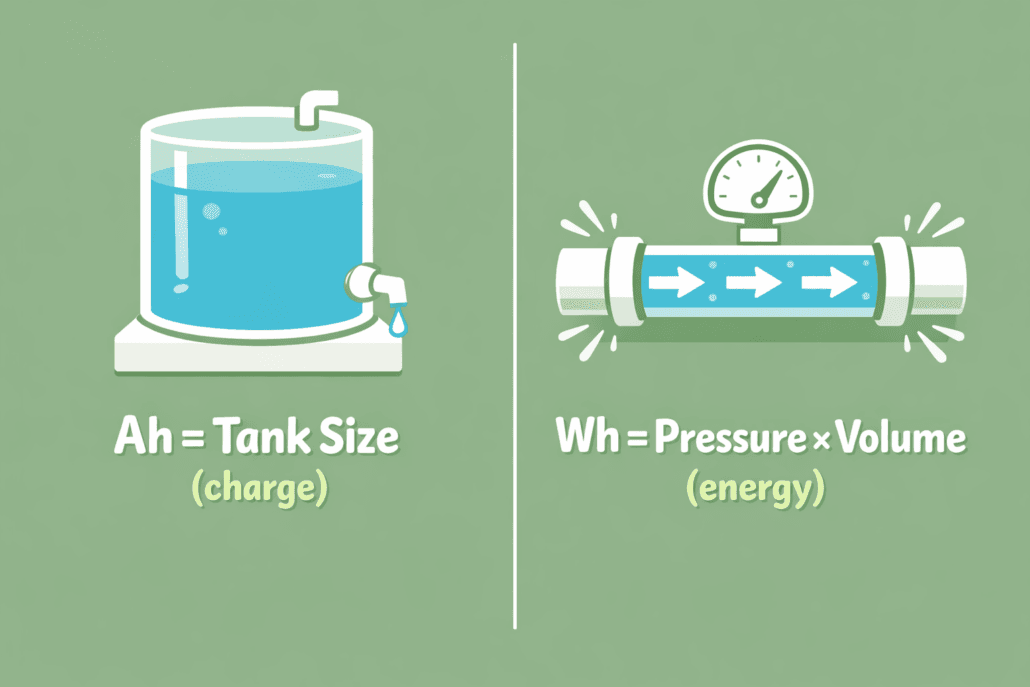
| 🚿 Think of Ah Like a Garden Hose Ah is the tank size. A 100 Ah battery holds enough charge for 100 Amps over 1 hour. Turn the tap up — it drains faster. Turn it down — it lasts longer. However, the total water in the tank stays the same. |
When to Use Ah in the Ah vs Wh Decision
- Calculating runtime — how long a battery powers a fixed-current device
- Setting charge rates — C-rate is always expressed relative to Ah
- Designing battery banks — when all batteries share the same voltage
- Comparing batteries of identical voltage side by side
There is one important limitation. Ah is voltage-independent. Therefore, a 100 Ah battery at 12V and a 100 Ah battery at 48V have the same Ah rating. Even so, they store very different amounts of energy. That is the most common battery-buying mistake.
For more on DoD and cycle life, read our guide: Battery Cycle Standards — DoD, SOH, and EOL Explained.
What Does Wh Mean? The Energy Side of Ah vs Wh
Wh stands for Watt-hours. It measures actual energy. Because it accounts for voltage, Wh is the more complete measurement.
Furthermore, battery energy density is expressed in Wh/kg. So understanding Wh also helps you compare weight-to-energy ratios across different chemistries.
| 💧 Wh = Pressure × Volume If Ah is the tank size, Wh is the total force the water delivers. That force depends on volume AND pressure (voltage). In contrast to Ah, Wh gives you the full energy picture. More voltage means more energy for the same Ah. |
When to Use Wh in the Ah vs Wh Decision
- Comparing batteries at different voltages — for example, 12V vs 48V
solar or backup battery system by daily kWh usage
- Calculating how long a battery runs a watt-rated appliance
- Airline carry-on compliance — IATA uses Wh limits, not Ah limits
advantages of BESS across commercial system voltages
The Ah vs Wh Formula — One Equation to Know
Good news: only one formula connects Ah and Wh. Voltage is the bridge between them.
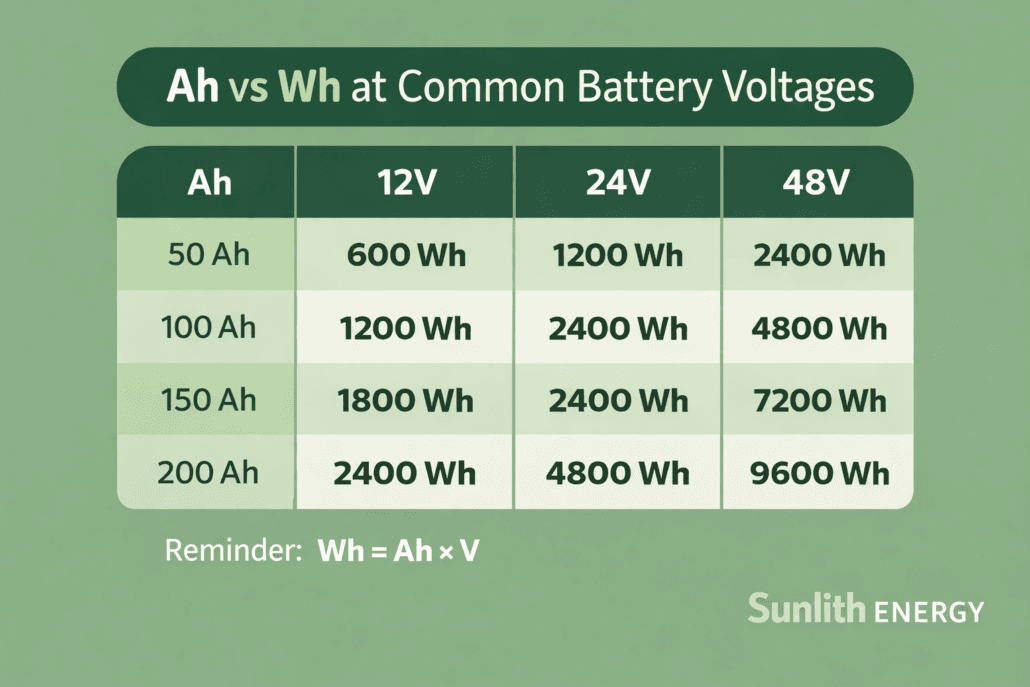
| Wh = Ah × Voltage (V) Reversed: Ah = Wh ÷ Voltage For mAh: Wh = (mAh ÷ 1000) × Voltage |
This explains why two batteries with the same Ah can store very different energy. Higher voltage multiplies charge into more usable Wh. As a result, 48V systems deliver far more energy per Ah than 12V setups. That is why 48V has become the standard for modern residential solar.
Ah vs Wh Conversion Examples — Real Numbers
Below are three practical examples. Each one shows how to apply the Ah vs Wh formula step by step.
| Example 1 — Home Solar Battery (LiFePO4, 48V) → Battery rated: 100 Ah at 48V nominal → Formula: Wh = 100 × 48 ✅ 4,800 Wh (4.8 kWh) — runs a full-size fridge for about 2 full days |
| Example 2 — Portable Power Station (12V) → Battery rated: 50 Ah at 12V nominal → Formula: Wh = 50 × 12 ✅ 600 Wh — charges a laptop approximately 10 times |
| Example 3 — Smartphone Battery (mAh to Wh) → Battery rated: 5,000 mAh at 3.7V → Step 1: 5,000 ÷ 1,000 = 5 Ah → Step 2: Wh = 5 × 3.7 ✅ 18.5 Wh — a typical mid-range smartphone battery |
| ⚡ Quick mAh Shortcut For 3.7V lithium cells: Wh ≈ mAh × 0.0037. Therefore, a 10,000 mAh power bank ≈ 37 Wh. Never compare mAh values from batteries with different voltages. Because voltage differs, the mAh number alone tells you nothing about energy. |
Ah vs Wh — Which Metric Should You Use?
Both measurements are useful. However, the right choice depends on your question. Use this table as a quick reference:
| Your Question | Use | Why |
| How long will my device run? | Ah | Runtime = Ah ÷ current draw |
| Which battery stores more energy? | Wh | Wh compares across voltages |
| Can I run a 100 W device for 3 hrs? | Wh | 300 Wh needed — easy math |
| How fast can I charge this battery? | Ah | C-rate is always Ah-based |
| LiFePO4 vs NMC — which has more? | Wh | Different voltages make Ah wrong |
| Sizing solar panels and controller? | Ah | Fixed-voltage design uses Ah |
| Airline carry-on battery limits? | Wh | IATA rules: 100 Wh / 160 Wh |
In summary: use Ah for current and time calculations within a fixed-voltage system. For everything else, use Wh. Comparing batteries across voltages or chemistries? Wh is always the right choice.
Same Ah, Very Different Energy — Why Voltage Changes Everything
Many buyers compare batteries on Ah alone. This is a common and expensive mistake. Voltage changes everything. Below is a clear example:
| Battery | Ah | Voltage | Energy (Wh) | Powers… |
| Van / camping pack | 50 Ah | 12V | 600 Wh | Laptop ~10× |
| Home 12V bank | 100 Ah | 12V | 1,200 Wh | Fridge ~12 hrs |
| Home 24V bank | 100 Ah | 24V | 2,400 Wh | Fridge ~24 hrs |
| Solar 48V system | 100 Ah | 48V | 4,800 Wh | Fridge ~2 days |
| C&I 48V system | 200 Ah | 48V | 9,600 Wh | Office ~1 day |
As the table shows, identical Ah ratings hide very different energy levels. Consequently, always convert to Wh before comparing. For more on how chemistry affects this, see our LiFePO4 vs NMC battery guide.
What Reduces Your Real-World Ah vs Wh Capacity?
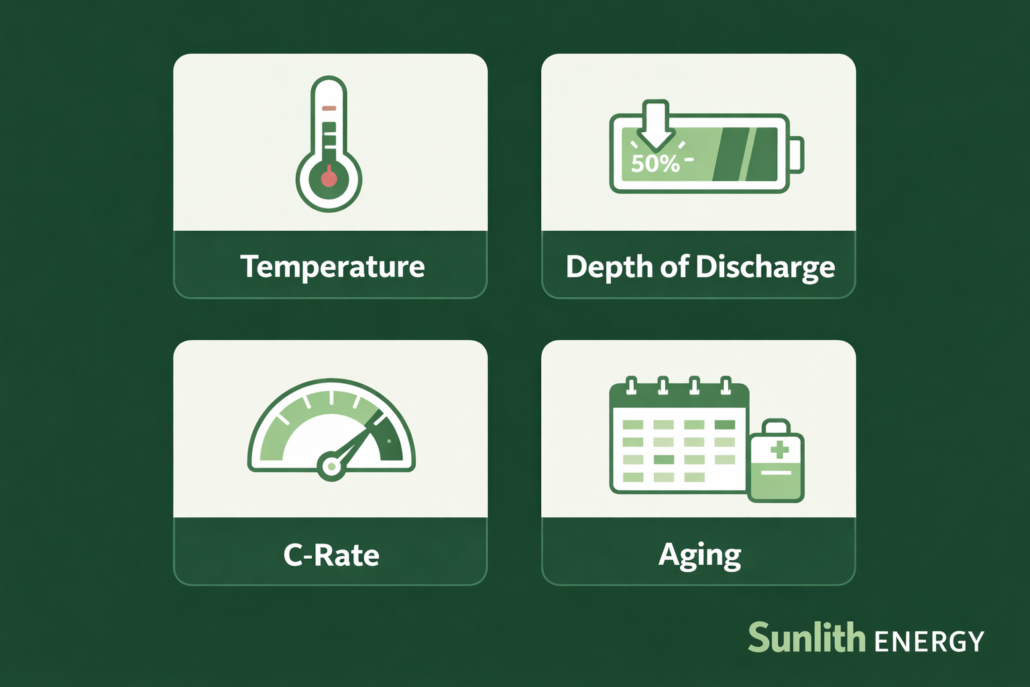
Battery labels show the theoretical maximum. In practice, usable capacity is always lower. Several factors reduce what you actually get. Understanding them is essential for accurate sizing.
1. Depth of Discharge (DoD)
Most batteries should not be fully drained. Doing so permanently damages cells. The safe depth of discharge varies by chemistry:
- LiFePO4: 80–90% DoD — consequently, usable Wh = 80–90% of rated Wh
- Lead-acid: only 50% DoD — therefore, you lose half your rated capacity
- NMC: typically 80–85% for a long cycle life
2. Temperature
Cold weather hurts batteries significantly. Below 10°C, deliverable Ah drops by 20–30%. Temperature directly impacts LiFePO4 cycle life — a rise of 10°C above 25°C can halve total cycle life. Heat, on the other hand, temporarily boosts apparent capacity. However, it accelerates permanent degradation at the same time.
3. Discharge Rate (C-Rate)
Drawing current too fast reduces total Wh delivered. For example, a battery discharged at 2C gives fewer Wh than the same battery at 0.5C. Always check the C-rate used during the manufacturer’s Ah test. Because a 0.2C rating looks far better than real-world 1C performance.
4. Battery Aging
Every cycle causes a small, permanent capacity loss. At 500 cycles, most batteries retain about 90%. At 1,000+ cycles, the best LiFePO4 cells still retain 70–80%. Consequently, factor aging into your long-term Wh budget when sizing.
5. System Efficiency Losses
Inverters, charge controllers, wiring, and BMS all consume energy. Modern lithium systems typically achieve 85–95% round-trip efficiency. Therefore, add a 10–15% buffer on top of your calculated Wh need. This protects you from real-world losses.
How to Size Your Battery System Using Ah vs Wh
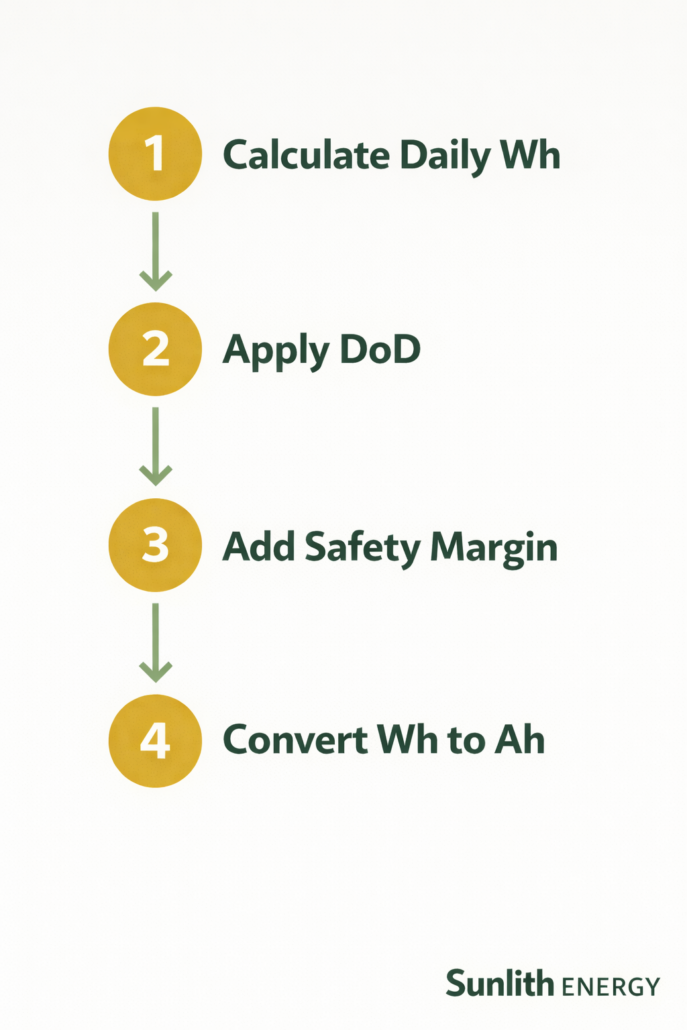
Now let’s put it all together. Below is a simple four-step sizing method. It is the same approach used in our solar battery sizing guide.
Step 1 — Calculate Your Daily Wh Requirement
List every appliance you want to power. Write down its wattage and daily run hours. Multiply watts by hours for each device. Then add them all together. For example: a 50W fridge runs 24 hours = 1,200 Wh. Four 25W LED lights run 5 hours = 500 Wh. Total: 1,700 Wh per day. Additionally, add 10% for hidden standby loads — bringing the total to about 1,870 Wh.
Step 2 — Apply the Depth of Discharge
Divide your daily Wh by the safe DoD. For LiFePO4 at 80% DoD: 1,870 ÷ 0.80 = 2,338 Wh of rated capacity needed. This step is essential. It ensures you never drain the battery below its safe limit. As a result, both lifespan and warranty are protected.
Step 3 — Add a Safety Margin
Multiply your result by 1.15 to 1.20. This covers system losses, aging, and seasonal variation. In our example: 2,338 × 1.20 = 2,806 Wh minimum rated capacity. Therefore, look for a battery bank rated at or above 2,800 Wh.
Step 4 — Convert Wh Back to Ah
Use Ah = Wh ÷ Voltage. At 48V: 2,806 ÷ 48 ≈ 58 Ah. At 24V: 2,806 ÷ 24 ≈ 117 Ah. At 12V: 2,806 ÷ 12 ≈ 234 Ah. As a result, higher-voltage systems need far fewer Ah. That is why 48V has become the industry standard for residential solar.
| ☀️ Sunlith Off-Grid Tip For solar or off-grid systems, size for at least 2 days without sun. Multiply your daily Wh by 2 before applying DoD and the safety margin. This protects against cloudy days and seasonal dips. → Read more: Ultimate Guide to Battery Energy Storage Systems (BESS) |
Ah vs Wh — Frequently Asked Questions
Q: Is a higher Ah battery always better?
No — not always. A higher Ah means more charge, not more energy. Voltage is the missing piece. For example, 200 Ah at 12V = 2,400 Wh. However, 100 Ah at 48V = 4,800 Wh. Therefore, always compare Wh — not Ah alone.
Q: Can I compare a 12V 100 Ah battery with a 24V 100 Ah battery?
No — not on Ah alone. Convert both to Wh first. 100 × 12 = 1,200 Wh. In contrast, 100 × 24 = 2,400 Wh. The 24V battery stores twice the energy. For a full chemistry breakdown, see our LiFePO4 vs NMC battery guide.
Q: What does 100 Ah mean in practical terms?
A 100 Ah battery delivers 100 Amps for 1 hour. Alternatively, it delivers 10 Amps for 10 hours. Furthermore, it delivers 1 Amp for about 100 hours. In a 12V system, 100 Ah = 1,200 Wh. In a 48V system, 100 Ah = 4,800 Wh. Additionally, apply the DoD to find the safe, usable portion.
Q: How many Wh do I need for an off-grid solar system?
A small cabin typically needs 1–3 kWh per day. A home averages 10–30 kWh per day. Furthermore, size for 2 days of autonomy for cloudy periods. Our detailed solar sizing guide walks through the full calculation with examples.
Q: Does temperature affect Ah vs Wh?
Yes — it affects both. Cold temperatures reduce deliverable Ah. Consequently, usable Wh also drops. High heat temporarily boosts apparent capacity. However, it causes permanent degradation over time. LiFePO4 handles temperature extremes better than NMC. For the full data, see our post on temperature impact on LiFePO4 cycle life.
Q: What is the difference between mAh and Ah?
mAh means milliamp-hours. There are 1,000 mAh in 1 Ah. Consumer devices use mAh because the numbers are easier to read. To convert: divide mAh by 1,000 to get Ah. Then multiply by voltage to get Wh. For example: 5,000 mAh ÷ 1,000 × 3.7V = 18.5 Wh.
Q: What Wh limits apply to lithium batteries on aeroplanes?
According to IATA’s Lithium Battery Guidance, passengers may carry batteries up to 100 Wh without airline approval. Batteries between 100 Wh and 160 Wh require specific approval. Batteries above 160 Wh are generally not allowed in carry-on. Because rules vary by carrier, always confirm with your airline before travelling.
Q: Is LiFePO4 better than NMC for solar storage?
In most cases, yes. LiFePO4 offers better thermal safety and a longer cycle life. Its thermal runaway threshold is ~270–300°C, versus ~150°C for NMC. Furthermore, LiFePO4 performs more consistently in extreme temperatures. In contrast, NMC offers higher energy density — so it suits weight-constrained applications better. Compare both in our NMC vs LFP safety guide.
Q: Do BESS systems need certifications?
Yes — especially for commercial or grid-connected installations. Key certifications include UL 9540, IEC 62619, and CE Marking. Our BESS certifications guide covers every major standard required in 2026, what each tests, and the cost of skipping them.
Q
Conclusion — Ah vs Wh Made Simple
Knowing the Ah vs Wh difference saves you from bad battery decisions. Ah measures charge. Wh measures energy. The formula Wh = Ah × Voltage connects them. Use Ah for runtime and charge rate calculations. For everything else — especially cross-voltage comparisons — use Wh.
Additionally, always apply DoD, temperature effects, C-rate, and aging when estimating real-world usable capacity. The number on the label is a theoretical maximum. Your actual usable capacity will always be lower.
Whether you are planning a home solar install or a commercial BESS project, the Ah vs Wh distinction is the right place to start. Get it right — and every other sizing decision becomes easier.
| Need Help Choosing the Right Battery? Our Sunlith Energy experts size your system — solar, BESS, off-grid, or C&I. No jargon. No pressure. Contact us: sunlithenergy.com/contact Browse our solutions: sunlithenergy.com |