
Peak Shaving Battery Sizing: kW and kWh Guide
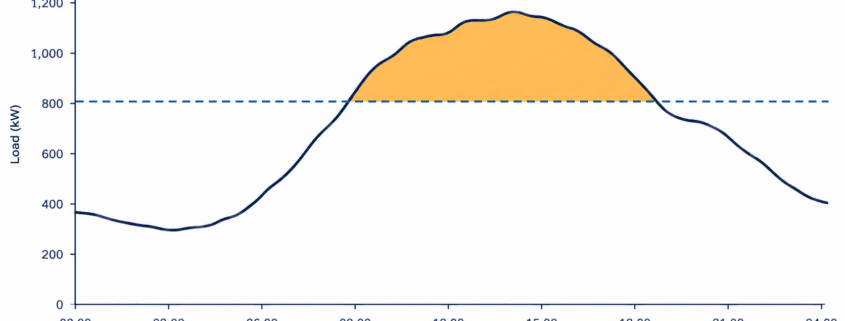
Peak shaving battery sizing starts with two questions. How much power must the battery discharge? For how long? First, choose the maximum grid demand you want your facility to draw. Then analyze your interval load data. The highest load above that target sets the discharge power, in kW. The area above the target sets the delivered energy, in kWh.
Quick Answer
Peak-shaving battery sizing starts by subtracting the selected grid-demand target from site load in each interval. The highest result is the preliminary battery discharge-power requirement in kW. Add the interval discharge energy to estimate delivered kWh, then adjust for defined discharge efficiency and permitted usable capacity.
Those two numbers are only a starting point, though. A workable design must also account for discharge losses and the battery’s allowed operating range. It also needs to handle repeated peaks, charging opportunities, and how your utility calculates billed demand. Peak shaving means discharging a battery to cut peak grid demand. That is different from shifting energy use to another time, or sizing a battery for outage backup.
For a broader explanation of BESS components, operation, and applications, see SunLith’s Battery Energy Storage System (BESS) guide.
The Peak Shaving Battery Sizing Formulas at a Glance
Peak shaving battery sizing follows four simple steps for each interval in your load data. Confirm the measurement boundary, such as battery DC terminals, PCS AC output, or site meter, before applying efficiency assumptions.
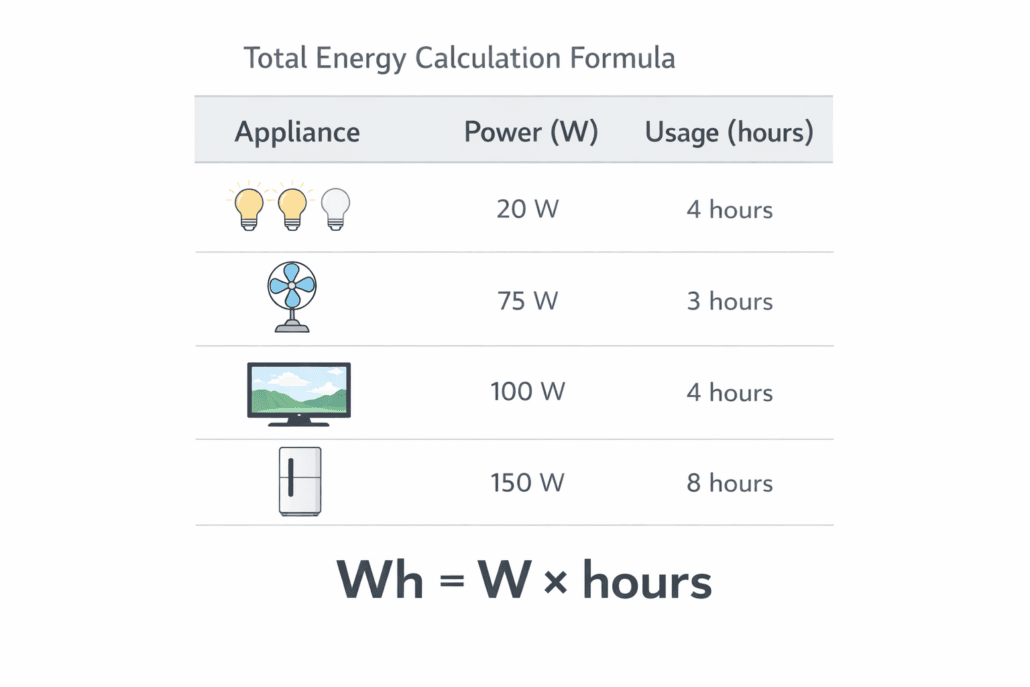
New to these units? SunLith’s Ah vs Wh battery capacity guide covers the Wh = Ah × voltage relationship behind every kWh figure below.
Key Sizing Formulas
First, find the battery discharge required, in kW. Take site load, subtract the grid-demand target, and floor the result at zero. A 700 kW load against a 600 kW target needs 100 kW of discharge. A 550 kW load against the same target needs none.
Pbattery,i = max(0, Li − T)
Next, find the largest required discharge across every interval. That becomes your preliminary AC discharge-power requirement.
Prequired = maxi(Pbattery,i)
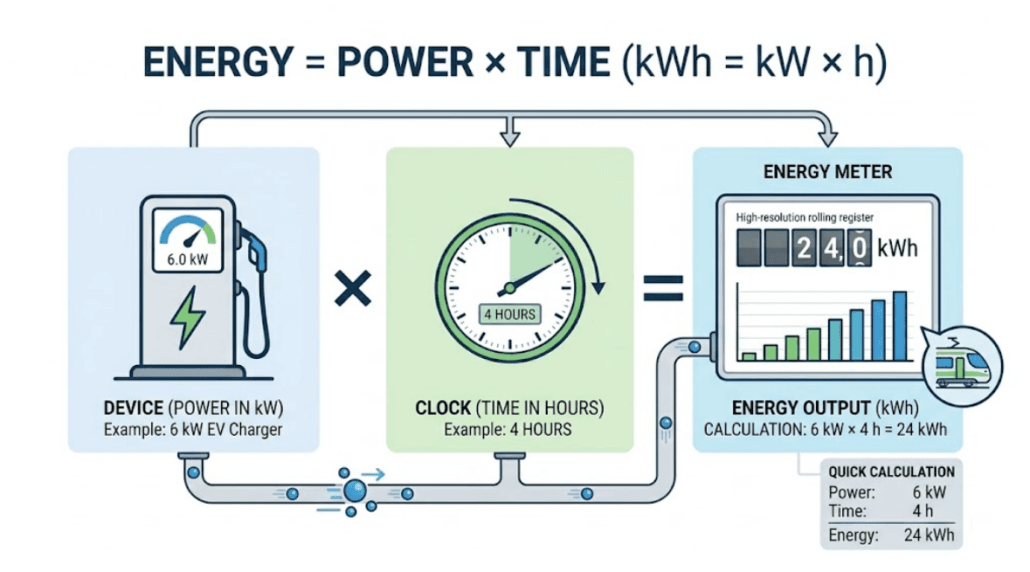
Then find the delivered energy, in kWh. Add up, across every interval in one peak event, the discharge required multiplied by the interval length in hours.
Edelivered = Σi(Pbattery,i × Δti)
Finally, estimate nominal battery capacity. Divide delivered energy by discharge efficiency, then by the usable fraction of nominal capacity. Discharge efficiency is the assumed efficiency from the battery’s energy boundary to the AC delivery point. The usable fraction is the share of nominal capacity available for this duty. Define both terms before you apply the formula, since this is only an event-level estimate. It is not a substitute for simulating state of charge over time.
Enominal = Edelivered ÷ (ηdischarge × fusable)
Where: Pbattery,i is the required battery discharge during interval i; Li is site load; T is the selected grid-demand target; Δti is interval duration in hours; ηdischarge is defined one-way discharge-path efficiency; and fusable is the permitted usable share of nominal capacity.
Step 1: Gather Load Data and the Tariff
First, ask your utility or metering provider for interval demand data covering representative operations and seasons. You need to see the shape of each peak, not just the highest number on a bill. A 100 kW exceedance lasting 15 minutes requires far less delivered energy than the same exceedance lasting three hours.
Also collect the tariff alongside the data. Identify the demand-measurement interval. Check which periods carry demand charges. Look for other billing provisions that affect the value of reducing a peak. The target should be based on how demand is measured and billed under the applicable tariff, not a generic assumption about demand charges.
One MDPI-published study of low-voltage commercial users evaluated battery energy capacity against measured customer-load data and the resulting peak reduction over time. The principle for a single facility is the same: use interval data rather than a monthly peak alone.
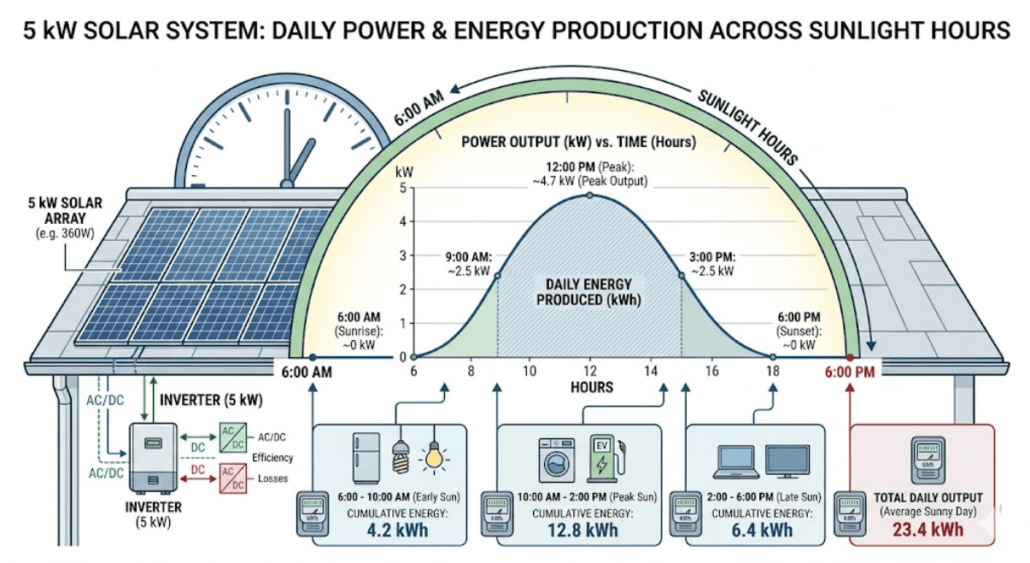
If the site has solar, use net demand at the relevant meter. Also model how solar output varies during likely peak events. A sunny-day profile alone may understate the battery needed on a cloudy day.
Step 2: Choose a Grid-Demand Target
Suppose a facility’s load sometimes reaches 700 kW. You could test targets of 650 kW, 600 kW, and 550 kW. Generally, a lower target asks the battery to provide more power, more energy, or both. However, whether that extra capacity pays off depends on the tariff and the full pattern of peaks.
Do not pick the target from the single highest reading alone. A battery might shave the largest peak successfully. Then it may exhaust its usable energy during a longer, lower peak later that day.
Step 3: Calculate Required Battery Power
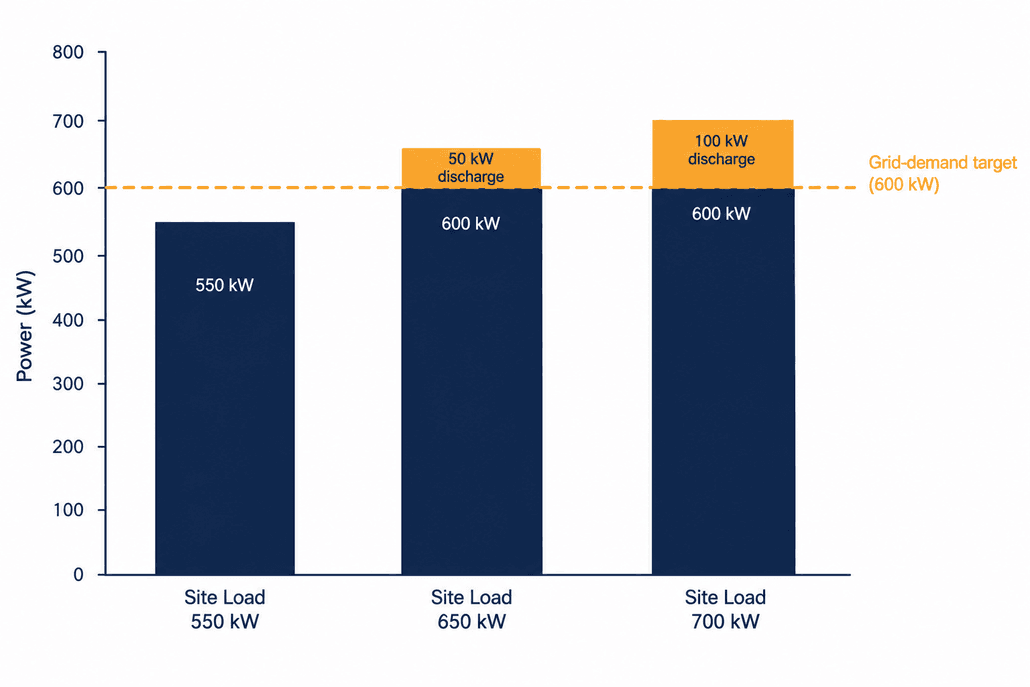
For each interval, subtract the target from site load. If the result is negative, set the discharge requirement to zero. The table below shows this for a 600 kW target.
Example: discharge needed to hold a 600 kW target
| Site load | Discharge needed to hold 600 kW |
| 550 kW | 0 kW |
| 650 kW | 50 kW |
| 700 kW | 100 kW |
The preliminary requirement here is 100 kW of AC discharge power, measured at the point where the battery offsets meter demand. An engineer must then confirm that the chosen power conversion system and installation can sustain that output under real operating conditions.
Step 4: Calculate the Delivered Energy for Each Peak
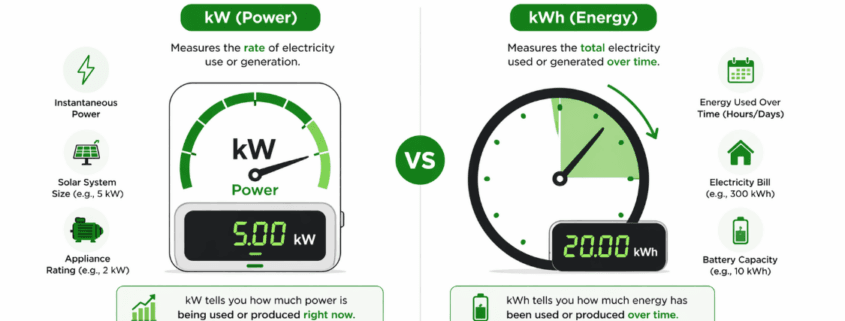
Power tells you how fast the battery must discharge, while energy tells you how much it must deliver over the whole event.
For preliminary analysis, define a peak event as consecutive metering intervals where site demand stays above the selected grid-demand target. If demand drops below the target and the battery can begin recharging, treat the next exceedance as a separate event. Verify that the available recharge time and charging-power limit are sufficient.
Assume the facility stays at 700 kW for one hour. Then it drops to 650 kW for two hours, still against a 600 kW target. That gives 100 kW for one hour, plus 50 kW for two hours. The total is 200 kWh delivered.
So this event requires 100 kW of maximum discharge and 200 kWh of delivered AC energy. A battery rated for 100 kW but able to deliver only 100 kWh would not cover the whole event at this target.
Repeat this calculation for other days and seasons. The event with the highest instantaneous discharge sets one constraint. The event with the greatest delivered energy may set the energy-capacity requirement.
Step 5: Estimate Nominal Battery Capacity
The battery must store more energy than it ultimately delivers. Discharge is not lossless, and the full nominal capacity may not be available for the chosen operating strategy.
For illustration, assume 200 kWh of required delivered energy. Assume a 90% one-way discharge-path efficiency and an 80% permitted usable fraction of nominal capacity. Divide 200 by 0.90, then by 0.80. That gives roughly 278 kWh of nominal capacity.
That figure is only an initial estimate, not a recommended product size. First, check the vendor’s capacity definition. Then account for state-of-charge limits, expected end-of-life capacity, temperature effects, auxiliary consumption, warranty commitments, and the manufacturer’s defined AC or DC capacity boundary before choosing a product.
Accounting for Discharge Losses vs. Round-Trip Efficiency
Do not treat round-trip efficiency as one-way discharge efficiency. Round-trip efficiency includes losses across both charging and discharging. Applying it as a discharge factor, then adding separate discharge losses on top, counts losses twice. A preliminary sizing tool may use round-trip efficiency as a simplified assumption. Final peak shaving battery sizing should still call out discharge-path losses on their own.
SunLith’s guide to understanding BESS specifications explains how vendors actually define usable capacity and efficiency, both needed for this step.
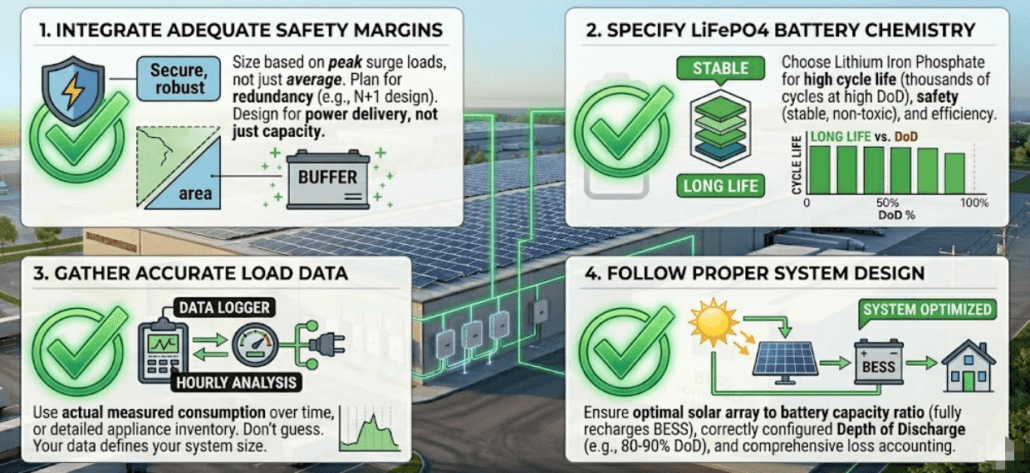
Step 6: Test Repeated Peaks and Recharging
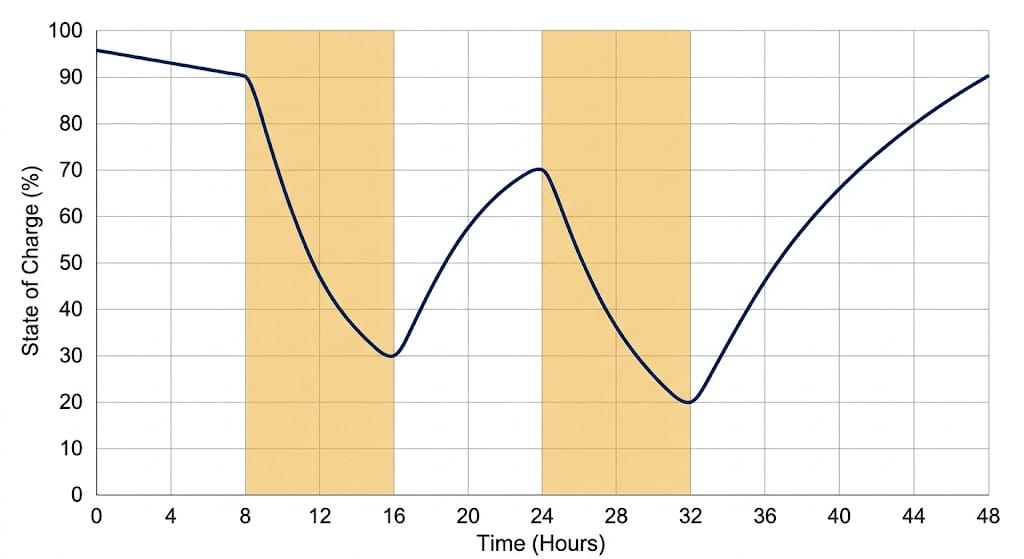
The example above assumes the battery has enough charge when the event begins. Real facilities may see several peaks a day, peaks on consecutive days, or an unusually long stretch above the target. Charging too aggressively can itself create a new metered peak.
Run the load profile forward, interval by interval, using these five steps.
- Begin with an assumed battery state of charge.
- Discharge whenever load would otherwise exceed the chosen target.
- Track remaining energy and all applicable losses.
- Allow charging only when it fits the tariff, site load, and equipment limits.
- Check whether the battery is ready for the next event.
This simulation may reveal that a seemingly adequate 100 kW / 278 kWh preliminary configuration needs more capacity. Or it may show that a different demand target produces a better project. Model peak-shaving dispatch and resulting bill impacts together this way, instead of inferring them from a single peak value.
Sample Interval-Data Worksheet Columns
A simple spreadsheet makes this simulation easier to run and easier to hand to an engineer. Track these six columns for every interval in the load dataset.
| Column | What it records |
| Timestamp | Date and interval start time |
| Site load (kW) | Measured or forecast demand for the interval |
| Target (kW) | The grid-demand target being tested |
| Discharge required (kW) | Site load minus target, floored at zero |
| Delivered energy (kWh) | Discharge required times interval hours |
| Simulated state of charge (%) | Running battery charge after each interval |
Step 7: Check Whether the Battery Size Makes Financial Sense
A technically workable target is not always the most economical one, though. Compare several combinations of battery power, energy, and target demand against the real tariff and a no-storage baseline. Include the cost of charging, equipment and installation, operating costs, and expected capacity changes over the project life.
SunLith’s peak shaving vs load shifting guide explains the two strategies and where they overlap. Use it to understand the value stream, not as an interval-based sizing tool.
For the financial modeling itself, SunLith’s guide to calculating BESS ROI walks through the cash-flow side. Use it once the power and energy numbers from this sizing exercise are in hand.
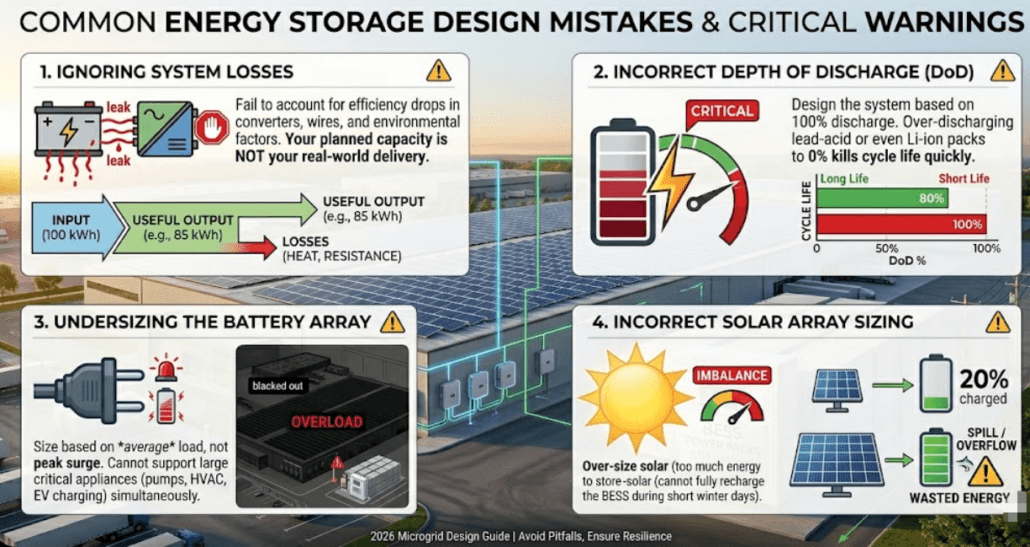
Common Peak Shaving Battery Sizing Mistakes
Because these errors repeat across projects, they turn a sound peak shaving battery sizing exercise into an undersized or overpriced one.
Using only the monthly peak: It does not show how long or how often demand exceeds your target.
Confusing kW with kWh: The maximum exceedance sets discharge power. Duration and shape set delivered energy.
Sizing from one favorable day: Solar production, weather, occupancy, and operations can all change the peak profile.
Ignoring the next event: The battery may suit one peak but fail to recharge before another.
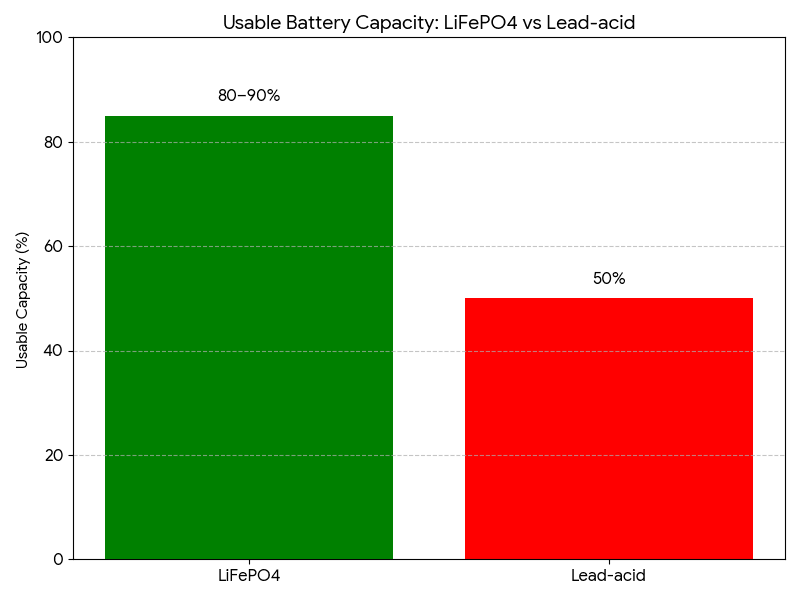
Assuming every kWh of nameplate capacity is usable: Operating limits and performance requirements must be checked against the proposed product.
Treating demand-charge savings as guaranteed: Actual savings depend on successful dispatch and the applicable tariff.
Frequently Asked Questions About Peak Shaving Battery Sizing
These questions come up often once a facility starts peak shaving battery sizing from its own interval data.
Can I size a peak shaving battery from a utility bill?
A bill shows billed demand and charges, but it usually will not show the full duration and shape of the peaks. First, use interval data for a credible power-and-energy estimate. Then apply the tariff to evaluate savings.
Is a 100 kW battery enough to reduce my peak by 100 kW?
Not necessarily. First, it must deliver that power at the relevant point in the electrical system. Also, it needs enough energy and state of charge for the whole event. Finally, it must stay available for other peaks that affect the bill.
How many hours of battery storage do I need for peak shaving?
There is no universal duration. First, calculate the energy above your chosen demand target across actual events. Then test whether the proposed power and energy ratings can meet those events repeatedly.
Is peak shaving battery sizing the same as backup sizing?
No. Peak shaving battery sizing follows measured site demand above a grid-import target. Backup sizing starts instead with the critical loads that must run during an outage, and the required backup duration. It is a different starting point and a different formula set. For preliminary outage-backup estimates, use SunLith’s C&I BESS sizing calculator. It uses critical-load and backup-duration inputs, so it should not be used to size a peak-shaving system.
This article gives a preliminary sizing method, not an equipment specification or a savings guarantee. Final selection still needs interval-data and tariff analysis, electrical design, and product-specific validation.
Need a Peak-Shaving BESS Assessment?
A preliminary battery size should be tested against your actual interval demand data, tariff rules, charging windows, and operating priorities. Send SunLith your site load profile and utility tariff for an initial C&I BESS assessment.
Request a Preliminary Peak-Shaving BESS Assessment
SunLith can provide a preliminary assessment; final system design requires site-specific electrical, tariff, interconnection, and safety review.
Further Reading on Peak Shaving Battery Sizing
These SunLith guides cover the cost and strategy questions that follow once preliminary power and energy numbers are in hand.
- Ah vs Wh Battery Capacity Explained — the unit basics (Wh = Ah × voltage) behind every kWh figure in this guide
- Peak Shaving vs Load Shifting — how the two demand-management strategies differ and where they overlap
- C&I BESS Sizing Calculator — for outage-backup sizing, not peak shaving — a different formula set entirely
- Understanding BESS Specifications — how vendor capacity, power, and efficiency figures are actually defined
- BESS CAPEX Calculation — how to build the total investment cost once a preliminary size is set
- BESS OPEX and Operating Cost Model — the recurring costs that affect whether a sized system pays back