

BMS SOC Estimation Methods Explained: OCV vs Coulomb Counting vs Kalman Filter
| ⚡ Quick Answer: Which BMS SOC Estimation Method Is Best? For LiFePO4 systems, Coulomb counting with OCV resets is the minimum standard. The Extended Kalman Filter (EKF) is the most accurate option — particularly for LFP’s flat voltage curve. OCV lookup alone is unreliable for LFP during operation. For NMC, OCV lookup is more viable but still benefits from Coulomb counting in real-time use. EKF suits any system where SOC accuracy directly affects revenue, safety, or EU Battery Passport compliance. |
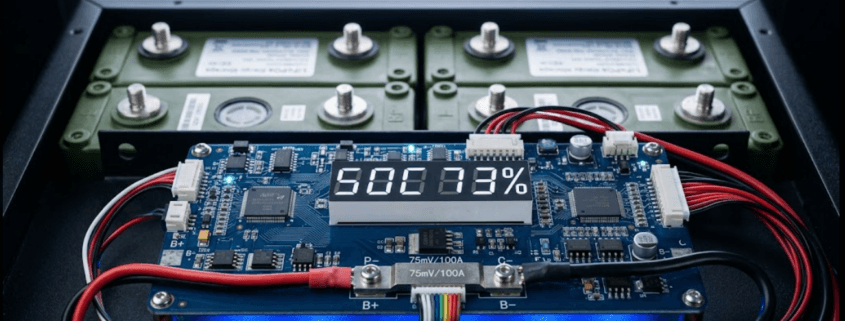
BMS SOC Estimation: State of Charge (SOC) is the most important number a battery management system produces. It is the fuel gauge of your BESS. Every dispatch decision, every protection threshold, and every warranty calculation depends on it being accurate.
Yet SOC cannot be measured directly. It must be estimated from voltage, current, and temperature data. The method used for BMS SOC estimation determines how accurate the reading is, how quickly it drifts, and how well it handles different conditions.
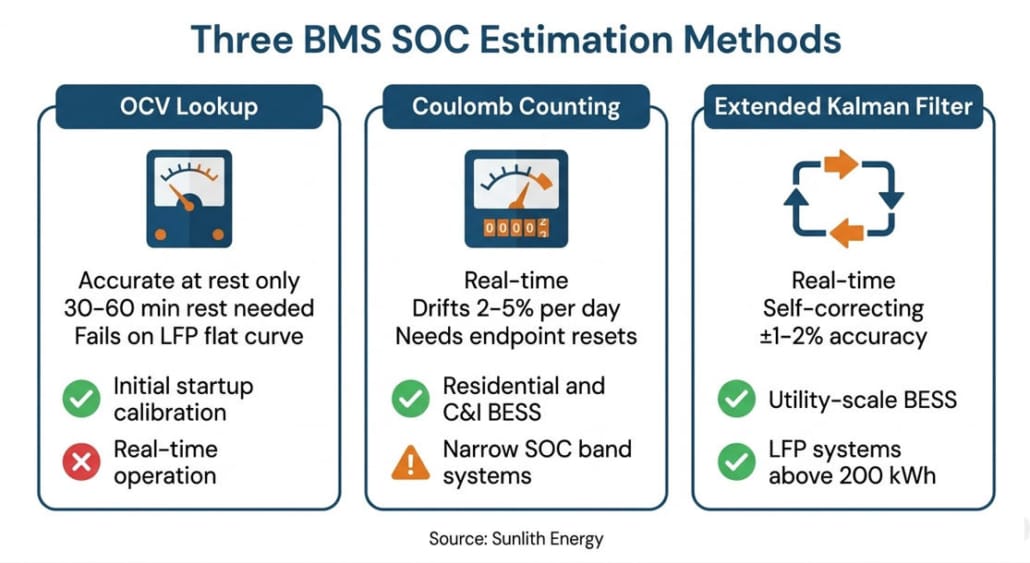
There are three main BMS SOC estimation methods: OCV lookup, Coulomb counting, and the Extended Kalman Filter (EKF). Each works differently and suits different chemistries. Choosing the wrong method is one of the most common and costly BMS mistakes in BESS procurement.
This guide explains how each BMS SOC estimation method works, where it succeeds, and where it fails. For the full context on how SOC fits into everything the BMS does, read our complete battery management system guide first.
1. Why BMS SOC Estimation Is Harder Than It Looks
SOC tells you what percentage of a battery’s full capacity is currently stored. A battery at 100% SOC is fully charged. At 0% SOC it is empty. In theory this sounds simple. In practice it is one of the hardest measurements in battery engineering.
The difficulty comes from two factors. First, SOC is an internal state — there is no sensor that reads it directly. Second, the relationship between measurable quantities and SOC changes with temperature, aging, load rate, and cell chemistry. As a result, every BMS SOC estimation method is an approximation.
The consequences of poor SOC accuracy are serious. An overestimate means the battery appears fuller than it is — causing unexpected shutdowns. An underestimate wastes usable capacity through early cutoff. In grid-connected systems, inaccurate SOC directly affects dispatch revenue and contract compliance.
Furthermore, from February 2027, the EU Battery Passport requires accurate SOC and SOH history logging. A BMS with poor SOC estimation will produce unreliable passport data. For more on the passport requirements, see our EU 2023/1542 compliance guide.
2. Method 1: Open Circuit Voltage (OCV) BMS SOC Estimation
OCV lookup is the simplest BMS SOC estimation method. When a battery has rested with no current flowing, its terminal voltage settles to its Open Circuit Voltage. This OCV value maps to a specific SOC via a pre-built lookup table derived from cell tests.
The method is straightforward and requires no current sensor. It is also highly accurate — but only under the right conditions.
When OCV SOC Estimation Works
OCV is reliable when the battery has truly rested. A 30–60 minute rest lets the voltage fully settle after any charge or discharge event. During this rest, the BMS reads the terminal voltage and looks up the corresponding SOC value.
This makes OCV most useful for setting the initial SOC at startup. After a BESS has been idle overnight, an OCV reading at power-on gives an accurate starting point. Furthermore, OCV works well as a periodic recalibration anchor — resetting Coulomb counting drift when the battery reaches a known full or empty state.
Why OCV SOC Estimation Fails for LiFePO4
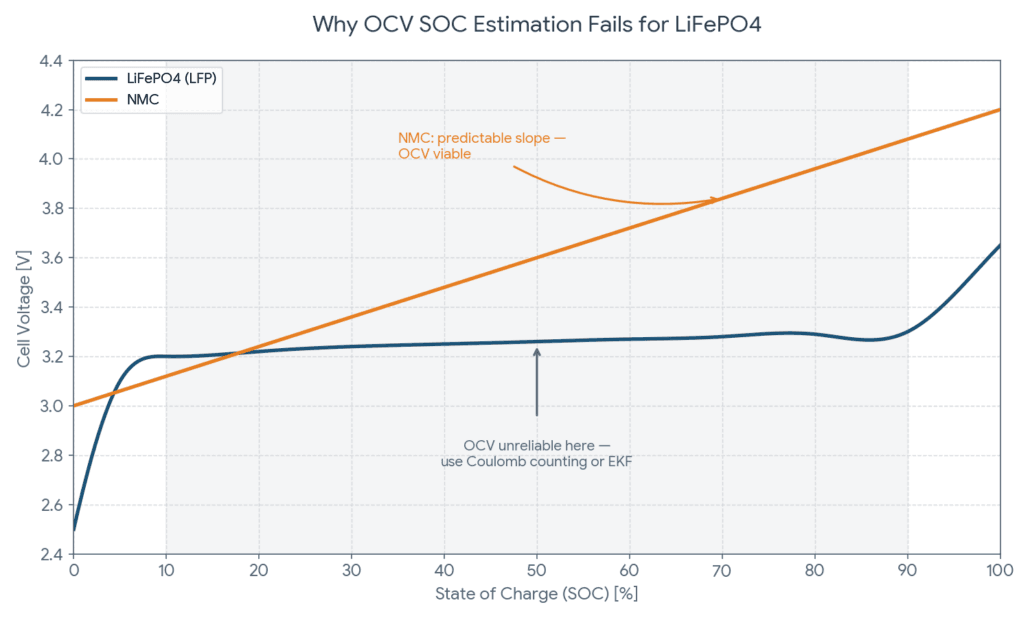
LFP is the dominant chemistry for solar storage and BESS. Unfortunately, it is also the worst candidate for real-time OCV SOC estimation. The reason is LFP’s flat voltage curve.
LFP cells sit near 3.2V–3.3V across roughly 80% of their usable SOC range — from about 10% to 90% SOC. A cell at 30% SOC and a cell at 70% SOC look almost identical on OCV. The BMS cannot distinguish between them during operation.
Consequently, an OCV-based BMS on LFP shows SOC readings that jump erratically. The estimates are only accurate near the very top and bottom of the charge range. In the flat middle region — where the battery operates most of the time — OCV is essentially useless for real-time SOC tracking.
OCV SOC Estimation for NMC
NMC has a more sloped voltage curve. Its voltage drops more steadily and predictably from around 4.2V fully charged to 3.0V at empty. This makes OCV-based SOC estimation more viable for NMC than for LFP.
However, even for NMC, OCV alone is not sufficient for real-time SOC tracking during active charge and discharge. The cell voltage under load differs from OCV due to internal resistance effects. As a result, most NMC BMS platforms combine OCV with Coulomb counting rather than relying on OCV alone.
3. Method 2: Coulomb Counting in BMS SOC Estimation
Coulomb counting is the most widely used BMS SOC estimation method in real-time operation. It tracks the net charge flowing in and out of the battery and uses that to update the SOC estimate continuously.
The name comes from the coulomb — the unit of electric charge. Counting coulombs in and out gives a running tally of how full the battery is.
How Coulomb Counting BMS SOC Estimation Works
The BMS measures current using a shunt resistor or Hall-effect sensor. It samples current at regular intervals — typically every 100ms to 1 second. It calculates the charge added or removed in each interval, then updates the SOC accordingly.
If the battery starts at 80% SOC and 10 Ah of charge is removed from a 100 Ah pack, the BMS calculates the new SOC as 70%. The arithmetic is simple. The challenge is keeping it accurate over time.
Coulomb Counting Accuracy and Drift
Coulomb counting is accurate over short periods. Over longer periods, however, it drifts. Several factors cause this drift:
- Current sensor error — a small measurement offset accumulates with each sample. A 1% sensor error builds up steadily over hundreds of cycles
- Temperature effects — battery capacity changes with temperature. A cell at 0°C holds less charge than at 25°C. The same Coulomb count means different SOC at different temperatures
- Self-discharge — batteries lose a small amount of charge over time even with no load. The BMS current sensor does not measure this internal loss
- Coulombic efficiency — not all charge put into a battery comes back out. The BMS must account for this charge efficiency factor to avoid overestimating SOC on each cycle
Over several days without recalibration, Coulomb counting drift typically reaches 2–5%. In some systems it reaches 10% or more — particularly if the sensor quality is low or the efficiency model is poorly set up.
Resetting Coulomb Counting Drift in BMS SOC Estimation
The fix for Coulomb counting drift is periodic recalibration using known anchor points. When the battery reaches full charge, the BMS resets SOC to 100%. When it reaches the discharge cutoff, the BMS resets SOC to 0%.
These anchor points are highly reliable. Any accumulated error is corrected at each full cycle. Systems that rarely reach full charge or full discharge — such as those staying in a partial SOC band — need additional recalibration strategies.
For LFP-specific Coulomb counting requirements, see our BMS for LiFePO4 guide.
4. Method 3: Extended Kalman Filter BMS SOC Estimation
The Extended Kalman Filter (EKF) is the most accurate BMS SOC estimation method available. It is also the most complex. Understanding how it works helps you spot genuine EKF from marketing language.
How EKF BMS SOC Estimation Works
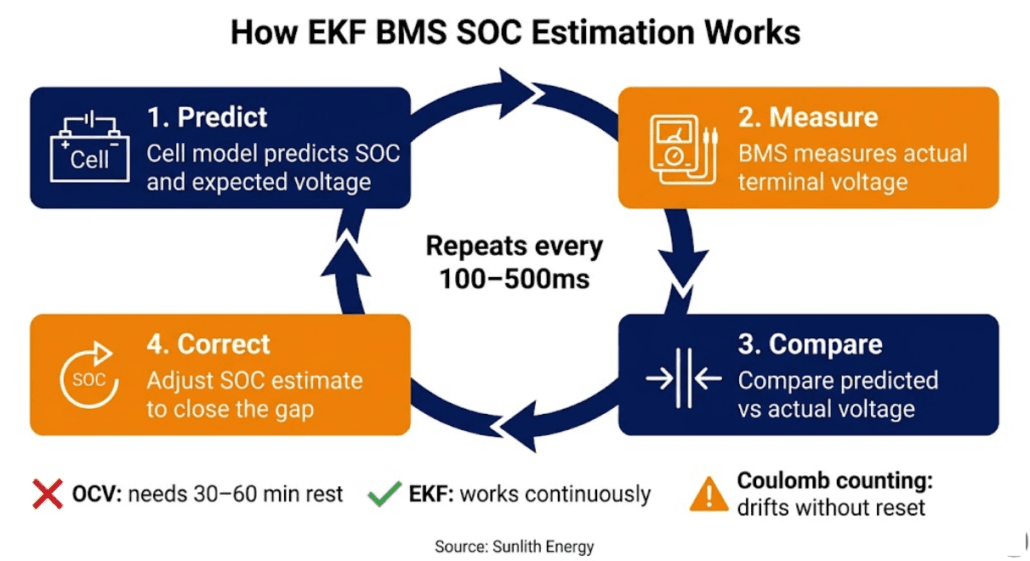
EKF combines two things: a mathematical model of the battery’s behaviour and real-time measurements from the BMS sensors. It works in a continuous loop of prediction and correction.
First, the model predicts the current SOC and expected terminal voltage. It uses the last known state, the measured current, and the cell model to do this. Second, the BMS measures the actual terminal voltage. Third, the EKF compares predicted to measured voltage. Any gap triggers an SOC adjustment. This cycle repeats every few hundred milliseconds.
The result is an SOC estimate that self-corrects in real time. Unlike Coulomb counting, EKF does not accumulate drift — it continuously anchors its estimate to the measured voltage. Unlike OCV lookup, it does not need the battery to be at rest.
Why EKF BMS SOC Estimation Handles LFP So Well
The flat voltage curve that makes OCV unreliable for LFP does not stop EKF from working. The EKF does not try to read SOC directly from voltage. Instead, it uses the voltage measurement as a correction signal for the cell model.
Even a small voltage deviation from the model prediction provides useful information. The EKF extracts SOC data from tiny voltage changes that OCV lookup would treat as noise. Furthermore, as the cell ages, adaptive EKF variants update the cell model parameters in real time to maintain accuracy throughout the battery’s life.
EKF Limitations and What to Ask Suppliers
EKF is powerful but has real requirements. First, it needs a cell model specifically calibrated for the cell chemistry, capacity, and temperature range of the actual cells in the system. A generic EKF with a poorly matched model is often less accurate than good Coulomb counting.
Second, EKF requires more processing power than OCV or Coulomb counting. This is manageable on modern BMS hardware but is a cost factor in low-end systems.
Third, EKF accuracy degrades as cells age if the model is not updated. The best EKF implementations use adaptive Kalman filtering — continuously refining the cell model as the battery ages. This is the gold standard for long-life BESS applications.
When evaluating a supplier, ask specifically: is the EKF model calibrated for the exact cells in this system? Can you show me the SOC accuracy data under dynamic load conditions? These two questions separate genuine EKF implementations from marketing claims.
Want to see this built out in practice? Our EKF SOC estimation design guide walks through the equivalent circuit model, HPPC-based parameterization, and Q/R covariance tuning behind a real implementation.
5. BMS SOC Estimation Methods Compared: Full Head-to-Head
| Factor | OCV Lookup | Coulomb Counting | Extended Kalman Filter |
|---|---|---|---|
| How it works | Maps resting voltage to SOC via lookup table | Integrates current over time to track charge change | Combines cell model + real-time voltage correction |
| Accuracy on LFP | Poor — flat curve makes lookup unreliable | Good short-term — drifts without recalibration | Excellent — handles flat curve, self-correcting |
| Accuracy on NMC | Good at rest — unreliable under load | Good short-term — drifts without recalibration | Excellent — most accurate under all conditions |
| Real-time use | No — needs 30–60 min rest period | Yes — works continuously during operation | Yes — works continuously, self-corrects |
| Drift over time | None — but only valid at rest | 2–5% per day without recalibration | Minimal — self-correcting via voltage feedback |
| Hardware needed | Voltage sensor only | Needs voltage + current sensor | Voltage + current + temperature sensor |
| Processing demand | Very low | Low | Medium to high |
| Cost | Lowest | Low to medium | Medium to high |
| Best application | Initial SOC at startup / recalibration anchor | Residential and C&I BESS — minimum standard | Utility-scale BESS, high-accuracy and EU Passport systems |
| ⚠️ The Supplier Red Flag to Watch For Some BMS suppliers claim EKF but implement only Coulomb counting with a lookup table correction. Ask for the SOC accuracy specification under dynamic load — not just at rest. Genuine EKF achieves ±1–2% accuracy under active charge and discharge. If a supplier cannot provide dynamic load SOC accuracy data, the EKF claim should be treated with scepticism. |
6. Combining BMS SOC Estimation Methods: The Hybrid Approach
In practice, most well-designed BMS platforms combine more than one method. Each method has complementary strengths. Using them together produces better SOC accuracy than any single method alone.
Coulomb Counting with OCV Resets — The Standard Hybrid
The most common combination is Coulomb counting for real-time tracking, with OCV resets at known charge endpoints. This is the minimum acceptable standard for any serious BESS application.
During operation, Coulomb counting tracks every charge and discharge event. When the battery reaches full charge or full discharge, the BMS resets the Coulomb count to 100% or 0%. This corrects drift and keeps the long-term SOC estimate accurate.
The weakness of this hybrid is that it only corrects drift at the endpoints. Systems within a narrow SOC band — staying between 20% and 80% — may go many days without hitting a reset point. Drift can therefore accumulate. However, for most solar storage applications, a full charge event happens every few days, keeping drift within acceptable limits.
EKF with Coulomb Counting — The Premium Hybrid
The best BMS SOC estimation systems use EKF as the primary method with Coulomb counting as a supporting input. Coulomb counting data feeds the EKF’s prediction step, providing a continuous current-based SOC estimate. EKF then corrects this estimate in real time using the actual measured voltage.
This hybrid gets the best of both worlds. Coulomb counting provides a stable, low-noise baseline. EKF then provides continuous self-correction and adapts to temperature changes, aging, and varying load profiles. As a result, this combination achieves ±1–2% SOC accuracy under most real-world conditions.
Premium BMS platforms use this EKF-plus-Coulomb-counting design, typically reserved for higher-end automotive and utility-scale systems where the extra estimation accuracy justifies the added processing cost. It is the right choice for utility-scale systems, high-frequency cycling, and any BESS needing SOC accuracy for grid services or EU Battery Passport compliance.
7. BMS SOC Estimation Accuracy: What the Numbers Mean in Practice
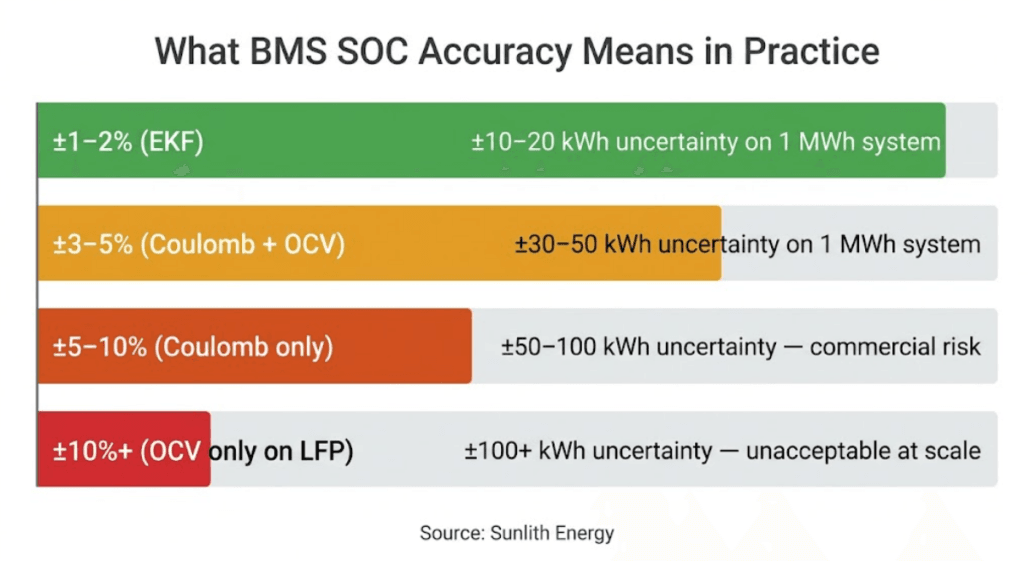
SOC accuracy is stated as a percentage error. Understanding what these numbers mean for your system helps you decide how much BMS SOC estimation quality you actually need.
| SOC Accuracy | Method Typical Range | Impact on 100 kWh System | Impact on 1 MWh System |
|---|---|---|---|
| ±1–2% | EKF (premium) | ±1–2 kWh uncertainty | ±10–20 kWh uncertainty |
| ±3–5% | Coulomb + OCV reset | ±3–5 kWh uncertainty | ±30–50 kWh uncertainty |
| ±5–10% | Coulomb (no reset) | ±5–10 kWh uncertainty | ±50–100 kWh uncertainty |
| ±10%+ | OCV only (LFP) | ±10+ kWh uncertainty | ±100+ kWh uncertainty — unacceptable |
For a residential solar storage system, ±5% SOC accuracy is generally acceptable. The system rarely needs precise SOC accounting. The cost premium of EKF over Coulomb counting is hard to justify at this scale.
For a commercial BESS providing grid services, ±3–5% may be the minimum. Dispatch contracts require specific energy delivery. Poor SOC accuracy means the system either under-delivers — breaching the contract — or over-reserves buffer, leaving revenue on the table.
For a utility-scale BESS above 1 MWh, ±1–2% from EKF is strongly preferred. At this scale, a 5% SOC error represents 50 kWh of uncertainty. Over a year of daily cycling, that uncertainty compounds into meaningful commercial and compliance risk.
8. BMS SOC Estimation and LFP: Special Considerations
LFP’s flat voltage curve makes it the hardest chemistry for BMS SOC estimation. This is covered in depth in our BMS for LiFePO4 guide. Here is a summary of the key points for context.
Why OCV SOC Estimation Fails on LFP
LFP cells show almost no voltage change between 20% and 80% SOC. This flat region covers most of the battery’s working range. An OCV lookup here produces a highly uncertain SOC estimate — the voltage gap between 30% and 70% SOC is smaller than most sensor noise floors.
The practical consequence is large SOC jumps. A BMS relying on OCV for LFP may show the SOC drop from 60% to 20% almost instantly as the battery moves off the plateau. This causes unnecessary alarms, early shutdowns, and confused dispatch logic.
The Correct BMS SOC Estimation Approach for LFP
For LFP, the minimum acceptable approach is Coulomb counting with OCV resets at the charge and discharge endpoints. This gives accurate real-time tracking with periodic recalibration at known states.
For LFP systems above 200 kWh or cycling more than once daily, EKF is strongly recommended. Its self-correcting design keeps SOC accurate even when the system stays within a narrow SOC band and rarely reaches the reset endpoints.
9. Questions to Ask Your BMS Supplier About SOC Estimation
Most BMS suppliers will claim accurate SOC estimation. Asking specific questions separates genuine capability from marketing language. These five questions reveal what is actually under the hood.
Questions on Method and Accuracy
- Which SOC estimation method does the BMS use — OCV, Coulomb counting, EKF, or a hybrid?
This is the foundational question. OCV-only on LFP cells is a dealbreaker — walk away. For Coulomb counting, ask about the drift rate and recalibration strategy. For an EKF answer, proceed to question 2.
- What is the SOC accuracy under dynamic load — not just at rest?
Many suppliers quote SOC accuracy measured at rest, where OCV is reliable. Genuine EKF accuracy should be ±1–2% under active charge and discharge. Ask specifically for dynamic load accuracy data. If they can only provide resting accuracy, the EKF implementation is likely superficial.
- Was the cell model calibrated for the specific LFP or NMC cells in this system?
A generic EKF with a poorly matched cell model is often less accurate than good Coulomb counting. The cell model must be calibrated for the specific cell chemistry, capacity, and temperature range. Ask for a test report showing SOC accuracy on the actual cells being supplied.
Questions on Long-Term Performance
- How does the BMS SOC estimation handle cell aging?
Cell capacity decreases as the battery ages. A BMS using a fixed capacity value will overestimate SOC as the cells degrade. The best systems use adaptive EKF or periodic capacity recalibration to track fade. Ask whether the BMS updates its capacity estimate over time.
- How is the SOC estimate logged and exported for EU Battery Passport compliance?
From February 2027, BESS sold into the EU must provide SOC history, energy throughput, and SOH data as part of the Digital Battery Passport. The BMS is the primary data source. Ask how the SOC log is stored, how long it is kept, and what format it exports in. A BMS without adequate data logging creates EU compliance risk from 2027.
Conclusion: Choosing the Right BMS SOC Estimation Method
BMS SOC estimation is not a detail — it is the foundation of everything your BESS does. A poor SOC estimate causes early shutdowns, wasted capacity, bad dispatch decisions, and EU compliance problems.
The right BMS SOC estimation method depends on your system:
- Residential and small C&I (under 100 kWh): Coulomb counting with OCV resets is the minimum standard. It is reliable, cost-effective, and accurate enough for most solar storage applications
- Commercial BESS (100 kWh–1 MWh): Coulomb counting with OCV resets is acceptable. However, EKF is preferred for systems providing grid services or operating within a narrow SOC band
- Utility-scale BESS (1 MWh+): EKF is strongly recommended. At this scale, a 5% SOC error is too large for safe and profitable operation
- LFP systems at any scale: OCV-only is never acceptable. Coulomb counting with resets is the minimum. EKF is best for daily-cycling systems above 200 kWh
The five questions in Section 9 will reveal whether a supplier uses genuine BMS SOC estimation or a basic method relabelled with technical language. Ask them before you sign.
For a complete overview of all BMS functions beyond SOC estimation, see our battery management system guide. To understand how SOC accuracy affects real-world cycle life and cost, use our Battery Cycle Life Calculator.
| ☀️ Need a BMS SOC Estimation Review for Your BESS Project? Sunlith Energy reviews BMS SOC estimation methods and accuracy data for BESS projects from 50 kWh upward. We check whether the method suits your chemistry, cycling profile, and EU compliance needs — before you commit to a supplier. Contact us |
Frequently Asked Questions About BMS SOC Estimation
What is SOC in a battery management system?
SOC stands for State of Charge. It is the BMS’s estimate of how much energy is currently stored in the battery, expressed as a percentage of full capacity. A battery at 100% SOC is fully charged. At 0% SOC it is empty. The BMS uses voltage, current, and temperature data to calculate this estimate continuously during operation.
Why is Coulomb counting the most common BMS SOC estimation method?
Coulomb counting is widely used because it works in real time and requires only a current sensor. It is accurate over short periods and does not need the battery to rest — unlike OCV lookup. It is also computationally simple, making it cost-effective for residential and commercial BMS platforms. Its main weakness is drift, which is corrected by OCV resets at known charge endpoints.
Is Kalman filter SOC estimation worth the cost for a small BESS?
For residential systems under 30 kWh, EKF is generally not worth the cost premium. Coulomb counting with OCV resets delivers adequate accuracy at lower cost. However, for systems above 100 kWh that cycle daily or use LFP in a narrow SOC band, EKF’s self-correcting accuracy pays for itself quickly in reduced dispatch errors and avoided shutdowns.
How does SOC estimation affect EU Battery Passport compliance?
The EU Digital Battery Passport, mandatory from February 2027, requires historical SOC data, energy throughput, and State of Health records. The BMS is the primary data source for all of these. A BMS with poor SOC accuracy produces unreliable passport data — and creates regulatory risk. For EU market access after 2027, accurate SOC logging is not optional.
What SOC accuracy should I expect from my BMS?
A Coulomb counting BMS with regular OCV resets should achieve ±3–5% in normal operation. An EKF-based BMS with a well-calibrated cell model should achieve ±1–2% under dynamic load conditions. SOC accuracy worse than ±10% typically indicates OCV-only estimation on LFP — or a poorly calibrated system that needs attention.
Can the BMS SOC estimation method be changed after installation?
In most systems, the SOC estimation method is set in the BMS firmware. It cannot be changed in the field without a firmware update. Some premium BMS platforms support OTA updates, allowing the SOC algorithm to be improved remotely. For long-life BESS projects, OTA capability is worthwhile — it lets the cell model be refined as the battery ages.
Sources and Further Reading
NLR Battery Degradation and SOC Research
IEC 62619 — Safety requirements for secondary lithium cells and batteries
EU Batteries Regulation 2023/1542 — Digital Battery Passport
Related Reading from Sunlith Energy
Battery Management System (BMS) Explained — Complete Guide
BMS for LiFePO4 Batteries: Requirements and Parameters
LiFePO4 vs NMC Battery: Why LFP Delivers Lower Lifetime Cost
Battery Cycle Standards Explained: SOH, DOD, and EOL
EU 2023/1542: Compliance Deadlines and Battery Passport Guide