


EU 2023/1542: Compliance Deadlines, Battery Passport & What Changes by 2027
Comprehensive compliance requires mastering the standard Batteries Regulation (EU 2023/1542) framework. This legislation officially came into force in August 2023, replacing the old Battery Directive 2006/66/EC across all EU member states. It sets binding rules on carbon footprint, recycling targets, battery passports, and producer responsibility — with deadlines running from 2024 through to 2031. If you sell batteries or BESS into the EU market, this regulation applies to you directly.
1. Scope and Timeline of EU Batteries Regulation (EU 2023/1542)
This regulation applies to almost all types of batteries, including:
- Portable batteries in electronics and appliances
- Industrial batteries used in storage systems
- Automotive batteries
- Electric vehicle (EV) batteries
- Light means of transport (LMT) batteries, such as e-bikes and e-scooters
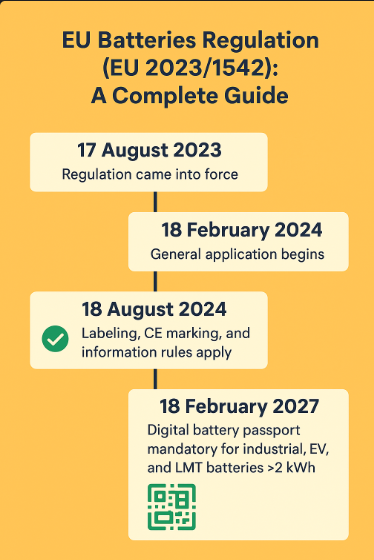
Key deadlines to note:
- 17 August 2023 – Regulation entered into force
- 18 February 2024 – General rules started to apply
- 18 August 2024 – Labeling, CE marking, and consumer information requirements
- 18 August 2025 – Waste battery management obligations
- 18 February 2027 – Digital battery passport becomes mandatory for industrial, EV, and LMT batteries above 2 kWh
🇪🇺 Interactive EU 2023/1542 Compliance Roadmap
Click on any deadline phase below to view mandatory requirements for manufacturers, importers, and BESS operators.
February 2027: Digital Battery Passport & Repair Rules
- Digital Battery Passport: Becomes strictly mandatory for all EV, LMT, and industrial batteries above 2 kWh. Must be accessible via an external QR code.
- Right to Repair: Portable appliance batteries must be easily removable and replaceable by consumers or independent technicians.
- Collection Targets: 63% collection efficiency path must be achieved for standard portable battery variants.
👉 Related reading: Timeline of EU Battery Regulations Implementation
2. Main Objectives of the EU Batteries Regulation (EU 2023/1542)
The regulation is designed to:
- Ensure sustainable battery production and reduce environmental impact
- Improve safety, transparency, and compliance
- Support resource recovery and battery recycling targets
- Give consumers clear information on carbon footprint and performance
- Establish the EU as a global leader in green battery standards
3. Core Provisions of EU Batteries Regulation (EU 2023/1542)
a) Sustainability Rules Under EU 2023/1542
The regulation sets strict limits on heavy metals:
- Mercury ≤ 0.0005%
- Cadmium ≤ 0.002%
- Lead ≤ 0.01% (exceptions apply until 2028)
These limits reduce toxic waste and push producers toward eco-friendly battery chemistry.
b) Carbon Footprint & Labelling
From 2024, manufacturers must include:
- Carbon footprint declarations based on EU methodology
- CE marking and hazard icons
- Identification of battery type and chemical composition
By 2026, labels must also state capacity, lifespan, and proper disposal methods.
c) Digital Battery Passport (2027 Onwards)
One of the most innovative elements is the digital battery passport.
- Applies to EV, LMT, and industrial batteries above 2 kWh
- Accessible via QR code
- Contains data on raw materials, lifecycle, recycling, and performance
This tool will increase traceability, reuse, and recycling efficiency.
d) EPR Rules in the EU Batteries Regulation
Producers must take back used batteries and ensure proper recycling.
- Collection targets: 63% for portable batteries by 2027, rising further by 2030
- Recycling efficiency goals:
- Lithium: 50% by 2027, 80% by 2031
- Cobalt, nickel, copper, lead: 90% by 2027, 95% by 2031
e) Removability & Repair Obligations
- By 2027, portable device batteries must be easily removable by consumers.
- LMT batteries must be replaceable by independent professionals.
This ensures longer product lifespans and supports the right to repair movement.
f) Supply Chain Due Diligence
Battery manufacturers must assess and address environmental and social risks, especially concerning critical raw materials like lithium, cobalt, and nickel.
g) Enforcement & Penalties
EU member states must set effective and dissuasive penalties for non-compliance by 2025. Companies failing to meet obligations risk heavy fines and restricted market access.
4. Why the EU Batteries Regulation Matters
The EU Batteries Regulation 2023/1542 is a turning point for the industry:
- It creates a circular economy for batteries
- Pushes innovation in recycling and green chemistry
- Protects consumers with clear labels and sustainability standards
- Forces global suppliers to comply if they want access to the EU market
👉 You may also like: New EU End-of-Life Battery Regulations Create Legal and Commercial Complexities
Conclusion
The EU Batteries Regulation (EU 2023/1542) is more than just another piece of legislation. It sets the foundation for a sustainable battery market, from design and labeling to recycling and reuse. For businesses, early compliance is not optional—it’s the only way to remain competitive in Europe’s fast-changing energy landscape.
Frequently Asked Questions
Q1: What is EU 2023/1542?
EU 2023/1542 is the EU Batteries Regulation adopted in July 2023. It replaces the Battery Directive 2006/66/EC and sets binding rules on battery design, carbon footprint, labelling, recycling targets, and the digital battery passport. It applies directly across all EU member states without requiring national legislation.
Q2: Who does EU 2023/1542 apply to?
EU 2023/1542 applies to any manufacturer, importer, or distributor placing batteries on the EU market. This includes portable batteries, industrial batteries, EV batteries, LMT batteries such as e-bikes, and BESS above 2 kWh. If you sell into the EU market, the regulation applies to you regardless of where you are based.
Q3: What are the key deadlines under EU 2023/1542?
The main compliance deadlines are: August 2023 — regulation entered into force; February 2024 — general rules apply; August 2024 — CE marking and labelling requirements; August 2025 — waste battery management obligations; February 2027 — digital battery passport mandatory for industrial, EV, and LMT batteries above 2 kWh.
Q4: What is the digital battery passport under EU 2023/1542?
The digital battery passport is a QR-code accessible record that must accompany industrial, EV, and LMT batteries above 2 kWh from February 2027. It contains data on raw materials, carbon footprint, lifecycle performance, and recycling information. It is designed to improve traceability, support reuse, and increase recycling efficiency across the supply chain.
The battery management system is the primary data source for the passport — it logs SOH, cycle count, and temperature history throughout the battery’s life
Q5: What are the recycling targets under EU 2023/1542?
The regulation sets material-specific recycling efficiency targets. For lithium, the target is 50% recovery by 2027 rising to 80% by 2031. For cobalt, nickel, copper, and lead, the target is 90% by 2027 rising to 95% by 2031. Producers are also required to meet portable battery collection targets of 63% by 2027.
Q6: What happens if a company does not comply with EU 2023/1542?
Non-compliant companies face penalties set by individual EU member states, which must be effective and dissuasive under the regulation. Consequences include heavy fines and restricted access to the EU market. Member states were required to establish their penalty frameworks by 2025.