
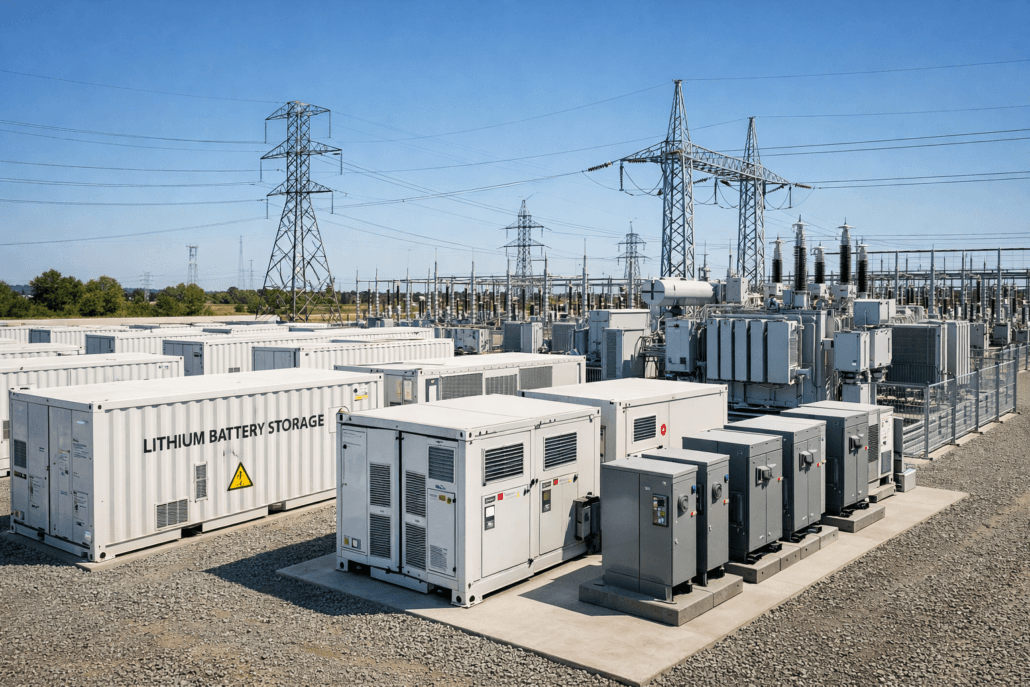
How to Calculate the Cost of Storing Energy
The cost of storing energy is one of the most important metrics when evaluating a battery energy storage project. Utilities, developers, and investors rely on this calculation to determine whether a Battery Energy Storage System (BESS) is economically viable.
The cost of storing energy cannot be determined by battery price alone. A complete calculation must include system investment, electricity used for charging, operational costs, efficiency losses, and the total energy delivered during the system lifetime.
In large renewable energy projects, this metric is commonly measured using the Levelized Cost of Storage (LCOS).
Understanding how this calculation works helps project developers compare storage technologies and optimize system design.
What Is the Cost of a Battery Energy Storage System (BESS)?
The cost of a Battery Energy Storage System (BESS) refers to the total investment required to install and operate a battery system capable of storing and delivering electricity.
A complete BESS includes several major components:
• Battery cells and modules
• Battery racks and containers
• Power conversion system (PCS)
• Thermal management systems
• Electrical infrastructure
• Monitoring and control systems
For large utility-scale projects, the installed cost of a BESS typically ranges between $300 and $600 per kWh of storage capacity.
Typical BESS Cost Breakdown
| Component | Share of Total Cost |
|---|---|
| Battery cells | 50–65% |
| Power conversion system | 10–15% |
| Container and cooling system | 10–15% |
| Balance of system | 10–20% |
This breakdown shows that battery cells dominate the overall economics of energy storage projects.
Quick Summary
The cost of storing energy measures the total lifetime cost required for a battery system to store and deliver electricity.
This value is commonly calculated using Levelized Cost of Storage (LCOS).
Major cost factors include:
• Battery system capital cost
• Operating and maintenance expenses
• Electricity used for charging
• Battery degradation and replacement
• Total lifetime energy delivered
The simplified LCOS equation is:
Lower LCOS values indicate more efficient and economically competitive energy storage systems.
Why the Cost of Storing Energy Matters
Battery storage projects require significant upfront investment. Therefore, evaluating lifetime economics is essential before building a system.
Calculating the cost of storing energy helps developers:
• compare battery technologies
• optimize project design
• evaluate long-term profitability
• estimate electricity arbitrage revenue
• forecast operational costs
For example, a battery system with lower upfront cost may become more expensive if it degrades faster or has lower efficiency.
For a financial perspective on project returns, see:
https://sunlithenergy.com/economics-of-bess-calculate-roi/
Key Components of Energy Storage Cost
Several technical and financial factors influence the cost of storing energy.
1. Capital Expenditure (CAPEX)
CAPEX represents the initial investment required to build the storage system.
Typical components include:
• battery cells and modules
• battery racks and containers
• battery management system (BMS)
• power conversion system (PCS)
• cooling and thermal management
• transformers and electrical equipment
• installation and engineering
In most utility-scale projects, battery cells represent more than half of total system cost.
Global battery cost trends are tracked by the International Energy Agency:
https://www.iea.org/reports/batteries-and-secure-energy-transitions
Need to build an early-stage estimate from battery, PCS, thermal management, EPC, grid connection, and contingency cost layers? See our BESS CAPEX calculation guide.
2. Operating Expenses (OPEX)
Operating costs occur throughout the project lifetime.
Typical OPEX includes:
• system monitoring
• preventive maintenance
• cooling electricity consumption
• insurance and site maintenance
Although smaller than CAPEX, these costs still affect the final cost of storing energy.
3. Charging Electricity Cost
Energy storage systems must purchase electricity before they can discharge power.
Charging cost depends on:
• electricity market price
• time-of-use tariffs
• renewable energy availability
Charging electricity can represent 20–40% of total project costs over the system lifetime.
4. Battery Degradation and Replacement
Battery performance declines due to cycling and calendar aging.
Typical lithium battery performance includes:
• 6,000–10,000 cycles
• 10–15 year lifetime
• 80% end-of-life capacity
Once capacity drops below this threshold, partial battery replacement may be required.
More information about battery cycling standards:
https://sunlithenergy.com/battery-cycle-standards-explained/
For a detailed breakdown of recurring BESS costs — including O&M, charging electricity, insurance, software, and augmentation planning — see our BESS OPEX and operating cost model.
Levelized Cost of Storage (LCOS)
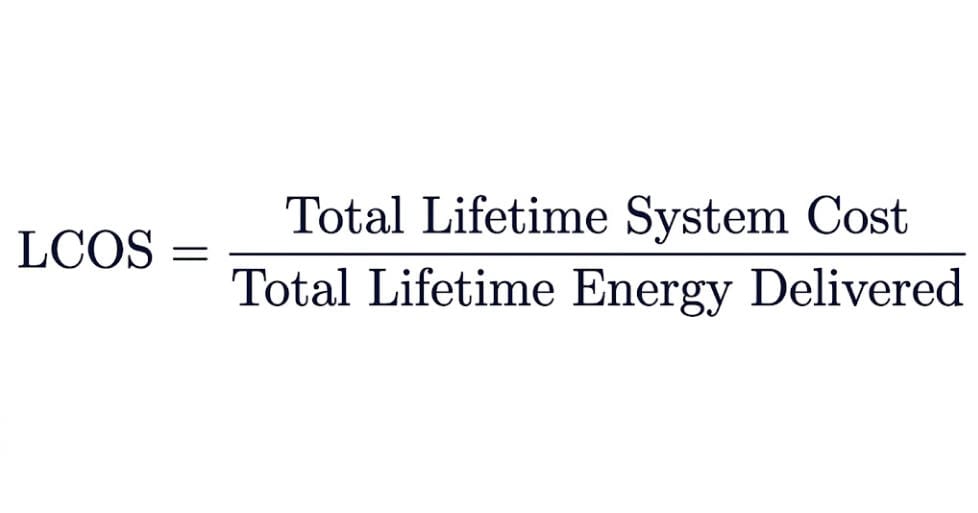
The most widely used metric for evaluating storage economics is Levelized Cost of Storage (LCOS).
LCOS measures the average lifetime cost per unit of electricity delivered by a battery storage system.
The National Laboratory of the Rockies (NLR) provides a widely used methodology for LCOS calculations:
https://docs.nlr.gov/docs/fy19osti/73222.pdf
Example Utility-Scale BESS Calculation
Example project:
System capacity: 100 MWh
Lifetime: 15 years
Cycles per year: 300
Efficiency: 90%
Step 1 — Calculate Lifetime Energy Delivered
100 × 300 × 15 = 450,000 MWh
Accounting for efficiency:
450,000 × 0.90 = 405,000 MWh
Step 2 — Estimate Total Lifetime Cost
Example cost structure:
CAPEX = $40 million
OPEX = $6 million
Charging electricity = $12 million
Total lifetime cost:
$58 million
Step 3 — Calculate Cost of Storing Energy
58,000,000 ÷ 405,000 = $143 per MWh
= $0.143 per kWh
Analyzing the Cost of Storing Energy per kWh
The battery storage cost per kWh represents the average cost required to store and deliver one kilowatt-hour of electricity.
Typical ranges include:
| Storage Type | Cost per kWh |
|---|---|
| Utility-scale lithium BESS | $0.10 – $0.20 |
| Commercial battery storage | $0.15 – $0.30 |
| Residential battery storage | $0.25 – $0.50 |
These values represent the levelized cost of storage rather than the battery hardware price.
Battery Storage Cost Calculator (Example)
A simplified method to estimate the cost of storing energy is:
Cost per kWh = Total Lifetime Cost ÷ Total Lifetime Energy Delivered
Example inputs:
| Parameter | Value |
|---|---|
| System capacity | 100 MWh |
| Lifetime | 15 years |
| Cycles per year | 300 |
| Efficiency | 90% |
| Total lifetime cost | $58 million |
Result:
$0.143 per kWh
🧮 Levelized Cost of Storage (LCOS) Calculator
Calculate the true lifetime cost of storing energy per kWh for your BESS project.
*Formula applies standard NREL mathematical boundaries: LCOS = Total Lifetime Costs / Total Lifetime Delivered Energy (adjusted for degradation & conversion efficiency variables).
LCOS vs Battery Cost per kWh
Many readers assume battery price equals the cost of storing energy. However, these values measure different things.
| Metric | Meaning | Typical Value |
|---|---|---|
| Battery price | Hardware cost | $100–$200 / kWh |
| BESS system CAPEX | Installed system cost | $300–$600 / kWh |
| LCOS | Lifetime electricity cost | $0.10–$0.20 / kWh |
LCOS provides a more accurate estimate of real project economics.
Confused by the difference between an upfront BESS quote in $/kWh and a lifetime LCOS value in $/MWh? Read our BESS CAPEX vs LCOS guide for a practical comparison of the two metrics, current benchmark context, and questions to ask a vendor.
Factors That Influence Storage Cost
Several technical factors affect the cost of storing energy.
Depth of Discharge
Higher depth of discharge increases usable capacity but may reduce cycle life.
Round-Trip Efficiency
Lithium battery systems typically achieve 88–92% efficiency.
Learn more here:
https://sunlithenergy.com/bess-round-trip-efficiency-rte/
Cycling Strategy
Energy storage systems may cycle daily for arbitrage or multiple times per day for grid services.
Peak shaving and load shifting strategies can improve storage economics:
https://sunlithenergy.com/peak-shaving-vs-load-shifting/
Real-World BESS Project Scale
Utility-scale battery storage projects commonly include:
• 50 MW / 200 MWh
• 100 MW / 400 MWh
• 200 MW / 800 MWh
These systems support:
• renewable integration
• peak demand reduction
• frequency regulation
• electricity arbitrage
Understanding the cost of storing energy allows developers to design more profitable energy storage projects.
Related Energy Storage Guides
If you want to understand battery storage economics and system design in more detail, the following technical guides explain key concepts used in modern energy storage projects.
Understanding Battery Energy Storage System Architecture
Learn how a Battery Energy Storage System (BESS) is designed, including battery racks, power conversion systems (PCS), energy management systems, and grid integration. This guide explains the core components of modern containerized energy storage systems.
https://sunlithenergy.com/understanding-energy-storage-system-bess-architectures/
BESS Round-Trip Efficiency Explained
Round-trip efficiency directly impacts the cost of storing energy. This article explains how charging losses, inverter efficiency, and battery chemistry affect the overall performance of a battery energy storage system.
https://sunlithenergy.com/bess-round-trip-efficiency-rte/
Peak Shaving vs Load Shifting in Battery Storage Systems
Battery storage systems are widely used to reduce electricity costs through peak shaving and load shifting strategies. Learn how these energy management techniques improve grid stability and reduce demand charges.
https://sunlithenergy.com/peak-shaving-vs-load-shifting/
How to Calculate Battery Energy Storage ROI
Before investing in a battery energy storage project, developers must evaluate financial returns. This guide explains how to calculate BESS return on investment (ROI) using real project cost and revenue models.
https://sunlithenergy.com/economics-of-bess-calculate-roi/
BESS CAPEX vs LCOS: What Cost per kWh Really Means
Understand the difference between upfront installed cost and the lifetime cost of energy discharged, with a C&I example and vendor-comparison checklist.
https://sunlithenergy.com/bess-capex-vs-lcos/
Conclusion
The cost of storing energy is a key metric for evaluating battery energy storage projects.
Using Levelized Cost of Storage (LCOS) allows developers to compare technologies, optimize system design, and estimate long-term project economics.
LCOS measures the cost of stored electricity, but it does not show the revenue and avoided-cost opportunities that determine project returns. For arbitrage, capacity, demand-charge savings, and other value sources, see our BESS revenue streams and value-stacking guide.
Key variables influencing storage cost include:
• battery capital cost
• electricity charging price
• system efficiency
• cycle life and degradation
• total energy delivered over the system lifetime
As battery technology continues to improve and manufacturing scales globally, the cost of storing energy will continue to decline, accelerating renewable energy adoption worldwide.
FAQ
What is the cost of storing energy?
The cost of storing energy represents the total lifetime expense required for a battery system to store and deliver electricity.
What is LCOS?
LCOS stands for Levelized Cost of Storage. It measures the average cost per unit of electricity delivered by a storage system over its lifetime.
What is the battery storage cost per kWh?
Utility-scale battery storage systems typically achieve $0.10 to $0.20 per kWh depending on system size, efficiency, and electricity price.
Why is LCOS more useful than battery price?
Battery price reflects only hardware cost. LCOS includes installation, charging electricity, maintenance, and battery degradation.
What is the difference between BESS CAPEX and LCOS?
CAPEX is the upfront installed cost per kWh; LCOS is the lifetime cost per kWh actually delivered. See our BESS CAPEX vs LCOS guide for the full comparison.





Trackbacks & Pingbacks
[…] these delays feed directly into project economics. See our BESS CAPEX calculation, OPEX model, and LCOS guide for how interconnection cost and delay risk shows up in the […]
[…] For context on how revenue and savings interact with costs, see our CAPEX vs LCOS guide, our BESS OPEX model, and our LCOS calculator guide. […]
[…] Cost of Storing Energy guide walks through how these pieces combine into a full LCOS […]
[…] vs LCOS guide explains why these two numbers differ. It also covers 2025-2026 price benchmarks. Our LCOS Calculator Guide walks through the full cost formula step by […]
[…] Which one should you use? Use CAPEX to compare build costs. Then use LCOS to compare long-term value. For a full LCOS walkthrough with formulas and worked examples, see our Cost of Storing Energy: BESS LCOS Calculator Guide. […]
[…] shaving savings breakdown for how demand charge reduction stacks alongside this strategy, or our BESS cost per kWh and LCOS guide for the full project economics […]
[…] cost ranges reflect LFP BESS pricing; see our BESS cost per kWh breakdown for the full cost […]
[…] Cost of Storing Energy — LCOS Guide for BESS Projects […]
Leave a Reply
Want to join the discussion?Feel free to contribute!