
The Cost of 100-Hour Energy Storage: Breaking Down Iron-Air LCOS
Iron Air Battery LCOS: Why This Number Defines Grid Storage Economics
Iron air battery LCOS — the Levelised Cost of Storage — is the single most important number for evaluating 100-hour grid energy storage. Most analysts start with capital cost per kWh. However, capital cost alone tells only part of the story. LCOS captures everything: upfront cost, operating expenses, charging cost, efficiency losses, and project life. Together, these inputs produce one number: the minimum revenue per MWh a storage project must earn to break even.
Iron-air batteries target an LCOS of $20–40/MWh for 100-hour discharge. That figure would place iron-air below natural gas peaker plants, below pumped hydro in most regions, and at roughly one-fifth the LCOS of lithium-ion at equivalent duration. Furthermore, it would do this without relying on lithium, cobalt, or any scarce critical mineral.
This article breaks down the iron air battery LCOS from first principles. Specifically, it covers the formula, each cost component, how iron-air compares to competing technologies, and what real-world project data shows. For a foundation on how iron-air cells work, see our guide on what is an iron-air battery.
Why Iron Air Battery LCOS Matters More Than CapEx
Capital expenditure is easy to compare. Iron-air targets $20/kWh system cost. LFP lithium-ion costs $125–200/kWh fully installed. That gap is real. However, CapEx alone does not drive the right procurement decision.
Four Costs CapEx Misses in Iron-Air Battery LCOS
Consider what CapEx fails to capture:
- Round-trip efficiency (RTE) penalty: Iron-air runs at 50–60% RTE. Consequently, developers must buy roughly twice the charging energy to deliver each MWh.
- Charging cost: A gas generator pays for fuel only when it runs. A battery must purchase or generate the electricity it stores. Therefore, charging cost per MWh delivered rises as RTE falls.
- Cycle count: Lithium-ion cycles 250–365 times per year. Iron-air cycles just 20–50 times. As a result, each dollar of iron-air CapEx spreads across far less energy throughput.
- Project life: A 20-year asset life spreads CapEx further. Nevertheless, O&M costs accumulate and must be discounted. Net present value of all costs determines the true LCOS.
How LCOS Combines All Four Factors
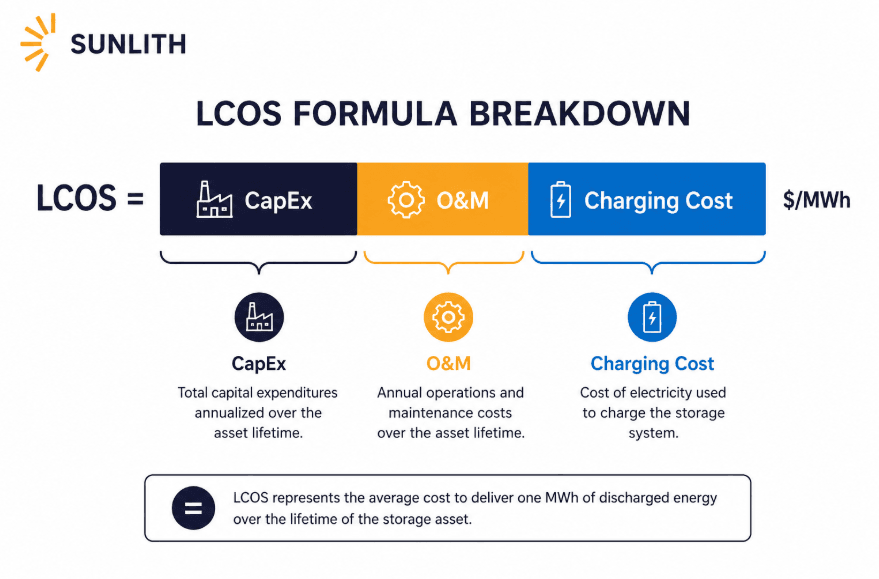
LCOS captures every dynamic in one number. According to PNNL’s LCOS Estimates database, LCOS equals total lifetime costs divided by cumulative delivered energy — both discounted to present value. In other words, it shows the minimum revenue per MWh the system must earn to achieve a net present value of zero.
This makes LCOS the right basis for comparing iron-air to gas peakers. Developers compare the iron air battery LCOS against the LCOE of the asset the battery replaces. For more context on how long-duration energy storage (LDES) technologies compete with firm generation assets, see our full LDES guide.
The Iron Air Battery LCOS Formula: How Costs Break Down
The LCOS formula — as applied by Lazard, NREL, and PNNL — follows this structure:
LCOS ($/MWh) = [CapEx + NPV(O&M) + NPV(Charging Cost) + NPV(Augmentation)] ÷ NPV(Total Energy Discharged)
Each component carries a specific cost for battery energy storage systems (BESS). The table below maps each LCOS input to its iron-air battery value.
| LCOS Component | Description | Iron-Air Battery Value / Note |
| CapEx — Cell Stack | Cost of iron anode, bifunctional air cathode, aqueous KOH electrolyte, and cell housing | ~$7–10/kWh at commercial scale — iron’s material abundance is the primary cost driver |
| CapEx — Balance of System (BOS) | Civil works, cabling, switchgear, structural enclosures, transformers | ~$5–8/kWh — land footprint is larger than lithium-ion, raising civil costs per kWh |
| CapEx — PCS | Power Conversion System: inverters, controls, grid interconnection hardware | ~$3–5/kWh — standard utility PCS; chemistry places no special requirements |
| CapEx — EPC & Soft Costs | Engineering, procurement, construction, permitting, grid studies | ~$2–4/kWh — currently elevated; limited LDES-experienced EPC firms exist in 2026 |
| O&M — Fixed Annual | Scheduled maintenance, airflow management, electrolyte monitoring, insurance | ~$3–6/kW-year — lower than lithium-ion; no thermal runaway risk or flammable electrolyte |
| O&M — Variable | Electrolyte replenishment, electrode inspection, SCADA/EMS licensing | Estimated $1–3/MWh discharged over a 20-year project life |
| Charging Cost | Cost of electricity used to charge the system — critical because 50–60% RTE means 40–50% is lost | Iron-air targets curtailed renewable charging at near-zero marginal cost: $5–15/MWh |
| Cycle Life / Utilisation | Annual full discharge cycles × project life = total energy throughput denominator | 20–50 full cycles per year (event-based, not daily); 20+ year design life |
| Augmentation / Replacement | Mid-life stack or electrode replacement to maintain rated capacity | Currently unvalidated at commercial scale — key uncertainty in early project finance models |
| Discount Rate | Cost of capital applied to future cost streams in NPV calculation | 7–10% for US utility storage; 10–12% for early-commercial technology with limited track record |
Why Charging Cost Dominates Iron-Air LCOS Calculations
💡 Key insight: Iron-air batteries target curtailed renewable energy for charging — solar and wind output that grids would otherwise waste. In high-renewable regions, curtailed energy costs $3–15/MWh. This near-zero charging cost is the assumption behind the $20–40/MWh LCOS target. If iron-air must charge from the wholesale grid at $40–60/MWh instead, LCOS rises to $80/MWh or above.
The BESS PCS functions that manage charge/discharge cycles also affect LCOS. Specifically, PCS efficiency losses add to the effective charging cost per MWh delivered. Modern utility PCS units achieve 97–98.5% efficiency at full load, contributing a small but measurable input to the total LCOS calculation.
Iron-Air Battery CapEx: Where the $20/kWh Target Comes From
Form Energy targets a system cost of approximately $20/kWh. This is a system-level figure — it includes not just cell hardware, but civil, interconnection, and soft costs. Below, the table shows how iron-air’s $20/kWh cost divides across components, and where it differs from lithium-ion.
| CapEx Component | Estimated Share | Iron-Air vs LFP Difference |
| Cell Stack (iron anode + air cathode + electrolyte) | 35–45% | Iron-air cells target ~$7–10/kWh vs LFP’s $55–110/kWh. This cell-level gap is the entire basis of iron-air’s cost case. |
| Balance of System (civil, cabling, enclosures) | 20–28% | Higher for iron-air due to larger land footprint and more enclosures per kWh. This partially offsets the cell cost advantage. |
| Power Conversion System (PCS) | 12–18% | Similar to LFP. Standard utility PCS equipment applies to both chemistries. No meaningful difference exists at this layer. |
| EPC & Engineering (permitting, studies, labour) | 10–15% | Currently elevated for iron-air. The limited pool of LDES-experienced EPC firms drives up soft costs. Costs will normalise as deployments scale. |
| Grid Interconnection | 8–12% | Identical to LFP. ISOs charge the same interconnection fees regardless of storage chemistry or duration. |
| Contingency & Financing Costs | 5–8% | Higher for iron-air. Lenders apply a technology risk premium to early-commercial assets. This premium will fall as operating data accumulates. |
The Cell Stack Is Where Iron-Air Wins
Iron-air’s cost advantage concentrates almost entirely at the cell level. For context, iron metal costs roughly $0.10–0.15/kg. The quantity of iron per kWh of capacity is modest. As a result, cell stack cost targets $7–10/kWh at commercial scale. By contrast, LFP cells alone cost $55–110/kWh — six to fifteen times more.
However, the BOS cost per kWh runs higher for iron-air than for lithium-ion. Lower energy density means more land, more enclosures, and more civil work per kWh of capacity. This partially offsets the cell-level advantage. According to NREL grid storage benchmarks, balance-of-system costs represent 20–28% of total installed cost for utility-scale storage. For iron-air, the larger footprint pushes this toward the upper end of that range.
The full BESS specifications guide covers how system-level specs — including C-rate, DoD, and RTE — shape total project cost at the procurement stage.
Iron Air Battery LCOS vs Lithium-Ion, Flow, and Gas Peakers
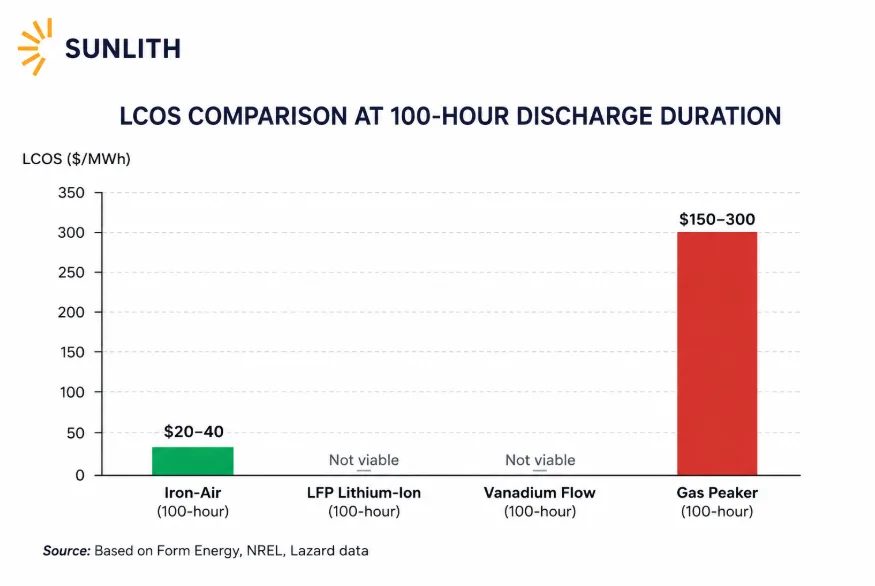
The table below compares iron-air battery LCOS against three competing technologies. Importantly, the comparison centres on the 100-hour discharge window — the duration iron-air specifically targets.
| Metric | Iron-Air | LFP Li-ion (4hr) | Vanadium Flow (10hr) | Gas Peaker |
| System CapEx ($/kWh) | ~$20 (target) | $125–200 | $300–500 | $800–1,200/kW |
| Discharge Duration | 100+ hours | 4–8 hours | 8–12 hours | Unlimited (fuel-dependent) |
| Round-Trip Efficiency | 50–60% | 85–95% | 65–75% | N/A (heat rate ~7–10 MMBtu/MWh) |
| Cycles per Year | 20–50 | 250–365 | 200–300 | As dispatched |
| Project Life (years) | 20+ | 15 | 20+ | 30+ |
| Annual O&M | Low — no thermal management cost | $6–10/kW-year | $8–12/kW-year | $15–25/kW-year + fuel |
| LCOS at 4hr / daily ($/MWh) | Not applicable | $78–150 | $110–190 | $120–200 |
| LCOS at 100hr / event-based ($/MWh) | $20–40 (target) | Not viable | Not viable | $150–300+ incl. carbon |
| Carbon Cost Risk | None | None | None | High — stranded asset risk |
| Critical Mineral Risk | None — iron, air, water only | Moderate — lithium supply | Moderate — vanadium supply | High — gas price exposure |
Technology Selection Is Entirely Duration-Dependent
Importantly, no single technology dominates across all discharge durations. LFP lithium-ion, in particular, suits 2–8 hour daily cycling well. Its high RTE and mature supply chain produce an LCOS of $78–150/MWh for 4-hour discharge, according to BloombergNEF’s 2026 LCOE report. However, at 100-hour durations, lithium-ion CapEx is simply too high. The low cycle count of multi-day storage events cannot spread that cost across enough energy throughput.
Iron-air, by contrast, carries low enough CapEx that even 20–50 full cycles per year produce a competitive iron air battery LCOS. This is the same logic that makes pumped hydro economic: low capital cost per kWh and low-cost energy input outweigh moderate efficiency losses. For a broader view of how grid-scale BESS procurement decisions frame technology selection, see our grid-scale BESS guide.
⚖️ The gas peaker comparison: Gas peaker LCOE runs $120–200/MWh for short-duration peak events. Add fuel volatility, carbon pricing, and stranded asset risk over a 20-year horizon and the figure rises to $150–300/MWh. Iron-air’s $20–40/MWh target for 100-hour discharge represents an 80–90% cost reduction against that benchmark. This is the commercial case behind Xcel Energy and Georgia Power’s agreements with Form Energy.
Iron Air Battery LCOS Sensitivity: Bear, Base, and Bull Cases
The $20–40/MWh iron air battery LCOS target is not guaranteed. It depends on specific assumptions — some within developers’ control, others not. The table below shows the full range of outcomes.
| Variable | Bear Case | Base Case | Bull Case |
| Cell Stack CapEx | $30/kWh | $20/kWh | $12/kWh |
| Round-Trip Efficiency | 45% | 55% | 65% |
| Charging Cost (curtailed renewables) | $20/MWh | $10/MWh | $3/MWh |
| Discount Rate (cost of capital) | 12% | 9% | 7% |
| Full Cycles per Year | 15 | 30 | 50 |
| Project Life | 15 years | 20 years | 25 years |
| Resulting LCOS ($/MWh) | $55–80 | $20–40 | $10–20 |
Cell Stack CapEx: The Biggest Lever
Cell stack CapEx and charging cost drive the widest LCOS range of any variable. Essentially, manufacturing scale determines cell cost. As Form Energy’s Weirton, WV facility ramps production, learning-curve effects push costs from $12–18/kWh toward the $7–10/kWh long-run target. LFP manufacturing achieved a 90% cost reduction over 15 years of scaled production. Iron-air follows a similar trajectory, though the timeline remains uncertain.
Charging Cost: A Market Design Question
Charging cost depends on grid design, not just battery technology. Iron-air generates its strongest economics when developers site projects near solar or wind assets that regularly produce curtailed energy. In California, ERCOT, and parts of the Midwest, curtailment already exceeds 10–15% of generation. The near-zero charging cost assumption holds in those regions. Where iron-air must charge from the wholesale market, LCOS rises toward the bear case.
Round-Trip Efficiency: The Medium-Term Opportunity
RTE improvement offers a clear LCOS reduction path. Research at Argonne National Laboratory and MIT targets bifunctional air cathode catalyst improvements. A 10 percentage point RTE gain — from 55% to 65% — reduces LCOS by roughly $5–8/MWh at the base charging cost. Furthermore, the DOE long-duration energy storage programme sets 70%+ RTE by 2030 as an explicit target under the Long Duration Storage Shot initiative.
Real-World Iron Air Battery LCOS: Projects and Commercial Data
As of mid-2026, iron air battery LCOS remains largely a projection. However, the first commercial deployments now generate real operating data. Specifically, these projects will either validate or revise the $20–40/MWh target.
| Project | Capacity | Partner | LCOS Significance |
| Cambridge Energy Storage (MN) | 150 MWh | Great River Energy | First commercial iron-air system; commissioned late 2025. Multi-year performance study generates real cycle efficiency, degradation, and O&M cost data — the bankability foundation for all future projects. |
| Sherco Coal Plant Replacement (MN) | 10 MW / 1,000 MWh | Xcel Energy | Flagship 100-hour GWh-scale deployment replacing retiring coal. Sets the real-world LCOS benchmark for US utility procurement decisions. |
| Darbytown Station (VA) | TBA | Dominion Energy Virginia | PJM market test alongside Eos zinc-hybrid batteries. Generates direct comparative performance data vs alternative LDES technologies. |
| Crusoe AI Data Center Portfolio | 12,000 MWh (12 GWh) | Crusoe Energy Systems | March 2026 — largest single iron-air deal globally. Demonstrates firm power for AI data centers as a new iron-air use case at undisclosed but commercially agreed LCOS. |
Why the Cambridge Project Matters for LCOS Validation
The Cambridge Energy Storage Project with Great River Energy is the most important near-term data source. Great River Energy runs a multi-year performance study. Specifically, this study measures cycle efficiency, degradation rates, and O&M costs under real grid conditions. Additionally, lenders need this data to move from technology-risk financing (10–12% discount rate) to infrastructure-grade terms (7–8%). That shift alone reduces iron air battery LCOS by $4–8/MWh at the base case.
The Crusoe AI data center agreement signals a new application for iron-air. AI data centers need continuous, uninterrupted power — not just grid firming. Notably, iron-air’s 100-hour duration enables it to bridge multi-day grid contingencies for critical infrastructure. According to Form Energy’s battery technology overview, those grid studies show that hitting cost targets unlocks tens of GWh of multi-day storage demand in the US alone.
IRA Incentives: How Tax Credits Reduce Iron Air Battery LCOS
Notably, the US Inflation Reduction Act (IRA) improves iron air battery LCOS through two direct mechanisms. Together, these credits can reduce effective project cost by 30–40%.
Investment Tax Credit (ITC) for Standalone Storage
The IRA provides a 30% ITC for standalone battery storage. Consequently, iron-air projects qualify without needing solar co-location. At $20/kWh system cost, the credit equals $6/kWh. Effective CapEx therefore falls to approximately $14/kWh. In turn, this reduces iron air battery LCOS by $5–8/MWh at the base case.
Advanced Manufacturing Production Credit (45X)
Additionally, the 45X credit provides per-component tax credits for domestically manufactured battery parts. Form Energy’s Weirton, WV facility qualifies for these credits on cell components, electrodes, and modules. As a result, the credit compresses the gap between early-commercial pricing and the long-run $7–10/kWh cell target. Furthermore, it supports factory ramp-up economics during the period when production volumes remain low.
📋 ITC note: The 30% ITC applies to the full installed system cost — including BOS, PCS, and interconnection, not just the battery cells. For a 100 MWh system at $20/kWh ($2M total), the ITC reduces net project cost to $1.4M. Most iron-air projects at this stage will use tax equity partnerships to monetise the credit fully.
Iron Air Battery LCOS: Frequently Asked Questions
What is the LCOS of an iron-air battery?
Iron-air batteries target an LCOS of $20–40/MWh for 100-hour discharge. This estimate comes from Form Energy’s commercial targets and NREL benchmarking. Specifically, it assumes $20/kWh system cost, 50–60% RTE, near-zero-cost curtailed renewable charging, and a 20-year project life with 20–50 full cycles per year.
How does iron-air LCOS compare to lithium-ion?
For 4-hour daily cycling, LFP lithium-ion achieves a lower LCOS of $78–150/MWh. However, at 100-hour discharge, lithium-ion CapEx is too high. Its cost cannot spread across the low cycle count of multi-day storage events. By contrast, iron-air’s low CapEx is specifically optimised for that window. Therefore, the two technologies do not compete — they serve different duration needs.
Why is iron air battery LCOS low despite poor round-trip efficiency?
Cell-level CapEx of $7–10/kWh is the answer. That is 6–15× lower than LFP. Furthermore, iron-air charges from near-zero-cost curtailed renewables. Consequently, the efficiency penalty costs relatively little. The same logic applies to pumped hydro: low capital cost and cheap energy input outweigh moderate efficiency losses.
What are the biggest risks to the $20/MWh LCOS target?
Three risks stand out. First, slower manufacturing scale-up could keep cell CapEx above $25/kWh longer than planned. Second, higher charging costs apply if projects must buy wholesale grid electricity rather than curtailed renewables. Third, lenders may maintain technology-risk discount rates of 10–12% until operating data accumulates — raising iron air battery LCOS by $5–10/MWh versus the base case.
Is iron-air LCOS competitive with gas peaker plants?
Yes, for multi-day firming applications. Gas peakers cost $120–200/MWh for short-duration events. Add fuel volatility, carbon pricing, and stranded asset risk and that figure rises to $150–300/MWh over a 20-year horizon. Iron-air’s $20–40/MWh target therefore represents an 80–90% cost reduction. As a result, Xcel Energy and Georgia Power have both signed commercial agreements with Form Energy.
Conclusion: What the Iron Air Battery LCOS Target Means for Grid Planning
The $20–40/MWh iron air battery LCOS target is the most compelling cost proposition in long-duration storage today. No other commercially advancing technology combines 100-hour discharge, Earth-abundant materials, and a cost structure that undercuts gas peakers. Moreover, iron-air achieves this without geographic constraints — unlike pumped hydro, which needs specific terrain.
However, the target remains a projection. The Cambridge and Sherco projects generate cycle efficiency, degradation, and O&M data. That data transforms iron-air from a technology-risk asset to a bankable one. A move from 10–12% to 7–8% discount rates alone reduces iron air battery LCOS by $6–10/MWh. It therefore determines whether the base case or the bear case prevails.
For grid planners, the right framework is not ‘can iron-air hit $20/MWh?’ Instead, ask: ‘What LCOS does our procurement model require, and does our site provide high-curtailment renewable charging?’ In regions with strong IRA access, high curtailment, and multi-day capacity market products, iron-air economics already work — even at current early-commercial pricing. As Form Energy scales production through 2026–2030, iron air battery LCOS will converge on the low end of the $20–40/MWh range. Consequently, the largest shift in grid storage economics since lithium-ion displaced pumped hydro for short-duration storage may be underway.




Leave a Reply
Want to join the discussion?Feel free to contribute!