
0.5C vs 1C Cycle Life in Liquid-Cooled BESS (LFP Data)
Choosing a charge rate for a battery energy storage system affects more than dispatch speed; it determines how long the asset lasts and what it costs to keep running. This comprehensive engineering guide compares liquid-cooled BESS 0.5C vs 1C cycle life using published LFP cell data, real thermal load calculations, and DCIR degradation analysis to give EPCs, developers, and asset managers the technical foundation they need to write a bankable specification. All cycle figures refer to LFP prismatic cells — the dominant technology in grid-scale and C&I liquid-cooled BESS today.
C-rate is defined here using the standard BESS C-rate definition — the ratio of power to energy capacity expressed as a multiple per hour. A 1C rate on a 1,000 kWh BESS means the system draws or delivers 1,000 kW. A 0.5C rate on the same system means 500 kW over two hours.
What Is C-Rate and Why Does It Matter for Cycle Life?
Why 1C Heat Generation Grows Faster Than 0.5C BESS Expectations
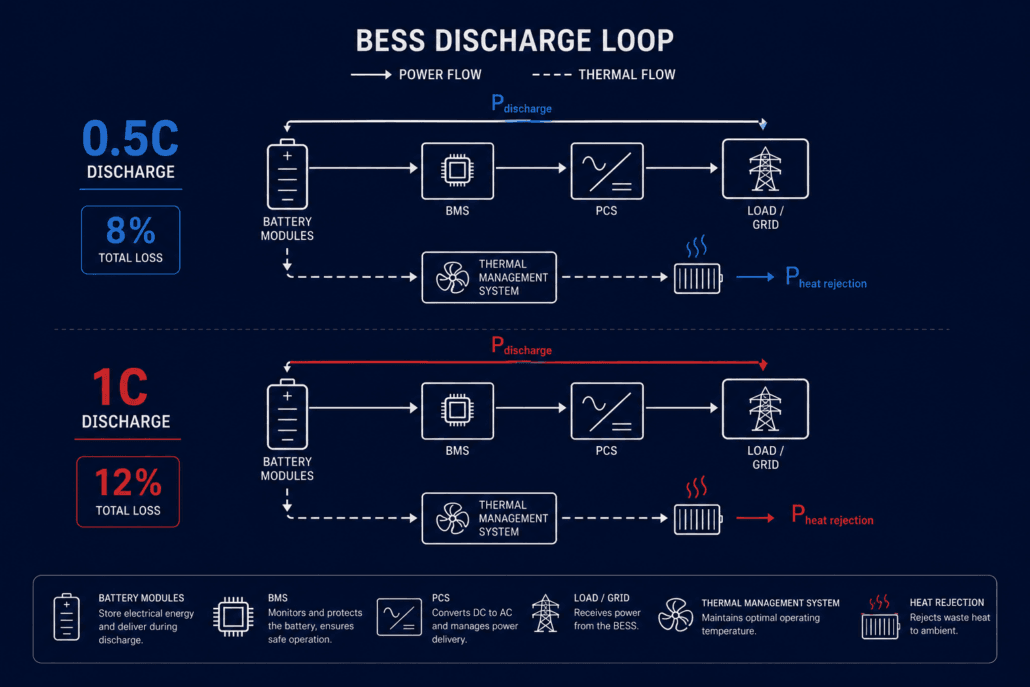
Heat inside a lithium-ion cell scales with the square of current. This is the I²R relationship. Doubling the C-rate from 0.5C to 1C therefore quadruples cell-level heat generation — not doubles it. Moreover, liquid cooling becomes essential above 0.5C because air cooling cannot remove heat fast enough to keep cells below the 35°C threshold needed for rated cycle life.
However, the heat penalty does not stop at the cell level. System efficiency also falls at higher C-rate. Both effects compound simultaneously. The formula below shows how to size the thermal management loop for each rate.
Where:
Pheat = Thermal power the cooling loop must reject (kW)
Pdischarge = Rated discharge power (kW) = C-rate × Capacity (kWh)
ηone-way ≈ √RTE (One-way efficiency, from round-trip efficiency)
At 0.5C:
RTE ≈ 92% → ηone-way ≈ 0.959 → Pheat = Pdischarge × 0.041
At 1C:
RTE ≈ 88% → ηone-way ≈ 0.938 → Pheat = Pdischarge × 0.062
Result: Moving from 0.5C to 1C increases continuous thermal rejection by ~50% per second.
Consider a 1 MWh system. At 0.5C, P_discharge = 500 kW and the cooling loop must reject roughly 20.5 kW. At 1C, P_discharge = 1,000 kW and the cooling load rises to roughly 62 kW — a 3× increase in absolute thermal load, not 2×. Both the power level and the efficiency penalty increase together. Consequently, a cooling system sized for 0.5C is materially undersized when the operator later dispatches the same asset at 1C.
Practical Takeaway: Sizing the Cooling Loop
Cold-plate loops for 0.5C typically need 8–15 litres per minute per module. At 1C, that requirement rises to 15–25 L/min. Furthermore, the heat exchanger, pump, and glycol reservoir must all be upsized accordingly. Under-specifying the cooling loop is one of the most common causes of field degradation exceeding warranted projections.
Therefore, always specify the maximum continuous C-rate in the thermal management scope of work — not the average dispatch rate. For detailed TMS component sizing, see the C&I BESS thermal management guide.
How Liquid Cooling Interacts with C-Rate Stress
0.5C Operation: Steady-State Thermal Comfort
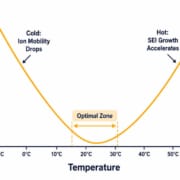
When evaluating liquid-cooled BESS 0.5C vs 1C profiles, the 0.5C operation represents a state of steady thermal comfort where a well-designed cooling loop easily keeps module temperatures in the 20–30°C optimal band. It does this with low coolant flow rates and minimal pump parasitic load. Heat generation is steady. The electrochemical stress on the LFP cathode, graphite anode, and separator stays well within the cell design envelope. Consequently, cycle life aligns closely with manufacturer specification.
1C Operation: Where the Cooling Loop Is Tested
At 1C, heat generation rises substantially. Looking at liquid-cooled BESS 0.5C vs 1C dynamics, the formula shows that moving to a 1C rate increases thermal strain by more than a simple doubling. The coolant loop must run harder. Higher flow rates, lower coolant inlet temperature, and more frequent pump cycling are all necessary. Additionally, any partial blockage of a cold plate channel creates a localised hot spot. The BMS may not detect this fast enough to prevent accelerated cell ageing.
| Key Engineering Specification for 1C Liquid-Cooled BESS The cooling system must reject up to 50% more thermal energy per second than a 0.5C equivalent. All cells must stay below 35°C. Module-level ΔT must remain ≤3°C at peak ambient temperature (typically 40–45°C for outdoor containerised systems). A cooling loop sized only for 0.5C will deliver shorter cycle life when dispatched at 1C. |
Liquid-Cooled BESS 0.5C vs 1C Cycle Life: The Data
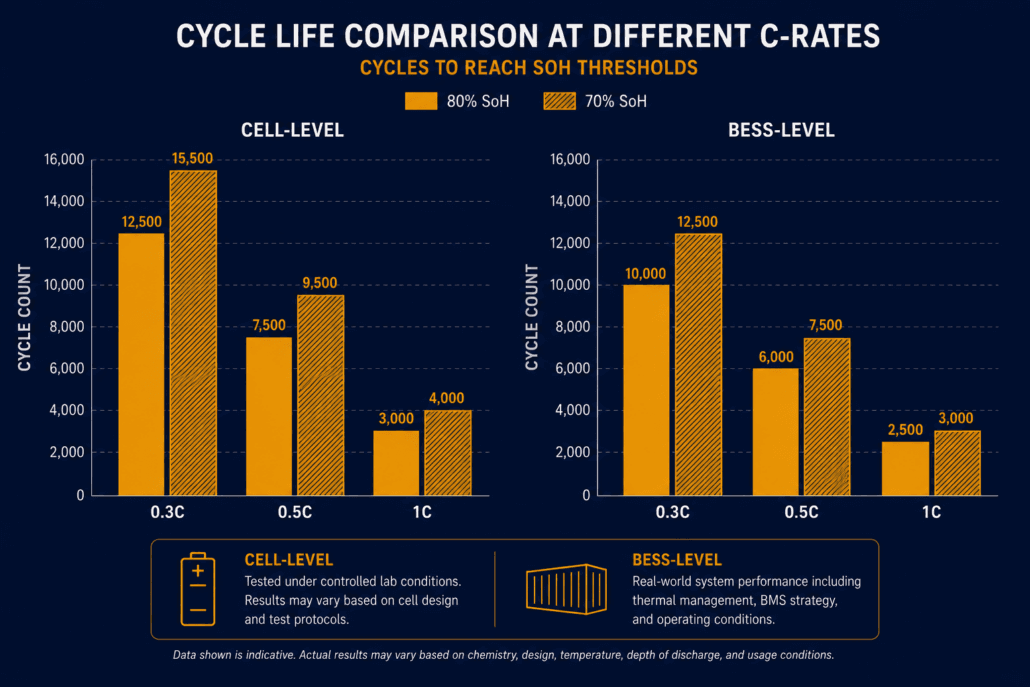
The table below draws on manufacturer specifications for 280Ah and 314Ah LFP prismatic cells, including the EVReporter BESS cycle-life dataset. Values marked (*) are interpolated from published trend data. Note that 1C BESS-level specifications are less commonly published because most manufacturers rate their systems at 0.5C.
| Parameter | 0.3C/0.3C | 0.5C/0.5C | 1C/1C | Notes |
| Cell-level cycles to 80% SoH (100% DoD, 25°C) | 10,000 | 8,000 | ~4,000–5,000* | Manufacturer datasheet |
| Cell-level cycles to 70% SoH (100% DoD, 25°C) | 15,000 | 12,000 | ~6,500* | Cell level only |
| BESS-level cycles to 70% SoH (90% DoD, ≤35°C) | 8,000 | 6,000 | ~3,500–4,000* | Includes calendar ageing |
| Calendar life at BESS level | Up to 20 yrs | Up to 15 yrs | ~10–12 yrs* | Liquid-cooled, ≤35°C |
| Heat generated per cycle | Low | Moderate | High | Scales with I²R |
| DCIR rise rate (relative to 0.3C baseline) | Baseline | +15–25% | +30–50%* | SEI-driven resistance growth |
| Cell ΔT in liquid-cooled system | <3°C | <3°C | 3–6°C* | Higher at 1C without adequate flow |
| Round-trip efficiency (liquid-cooled) | ~92–93% | ~91–92% | ~88–90% | Lower at 1C due to I²R |
| Typical grid application | Arbitrage (4-hr) | Frequency reg. / solar | Fast-response / C&I peak shaving |
* 1C BESS-level figures are extrapolated from cell-level trend data and peer-reviewed fast-charging studies. DCIR rise values are relative to 0.3C baseline; absolute values vary by manufacturer and operating temperature.
Three findings stand out. First, moving from 0.5C to 1C cuts cell-level cycle life by roughly 37–50% at the 80% SoH threshold. Second, the BESS-level penalty is proportionally worse. Calendar ageing, thermal gradients, cell imbalance, and DCIR rise all compound the stress at system level. Third, DCIR grows 30–50% faster at 1C than at baseline. This matters because rising DCIR causes voltage sag — an effect that reduces usable capacity well before the cell reaches 80% SoH.
Consider a 10 MWh BESS cycled once per day. At 0.5C, it accumulates 7,300 equivalent full cycles over 20 years. The 6,000-cycle BESS warranty covers most of that period. However, at 1C, the ~3,500–4,000-cycle BESS warranty runs out after roughly 10–11 years. Mid-life augmentation then becomes unavoidable — and expensive.
Four Degradation Mechanisms in 0.5C vs 1C BESS Assets
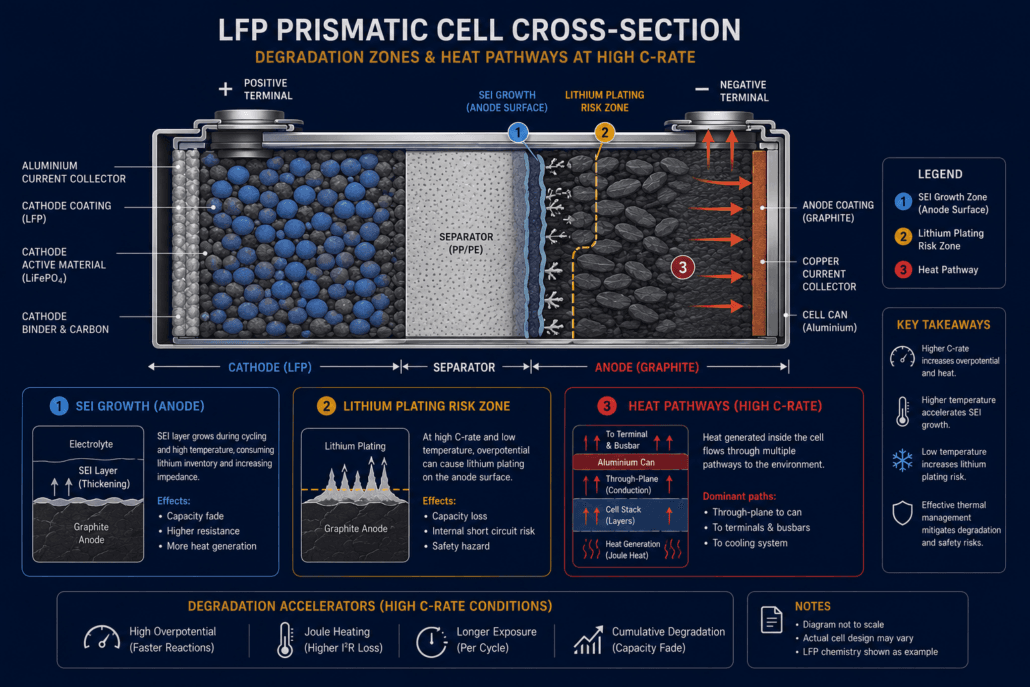
Understanding why 1C cycling degrades LFP cells faster helps with both cell selection and BMS configuration. According to Energy-Storage.News, higher C-rates drive four distinct degradation pathways.
1. SEI Layer Growth
The solid electrolyte interphase (SEI) forms on the graphite anode during the first cycle. It keeps growing throughout cell life. SEI growth consumes lithium irreversibly, reducing usable capacity. Higher C-rates accelerate this in two ways. They raise cell temperature and increase local current density at the anode. Both effects thicken the SEI faster. As a result, liquid cooling’s primary role in 1C BESS is to suppress the temperature component of this growth.
For the full mechanism behind SEI growth — including why it never fully stops — see our dedicated guide on SEI layer growth and lithium plating in LFP cells.
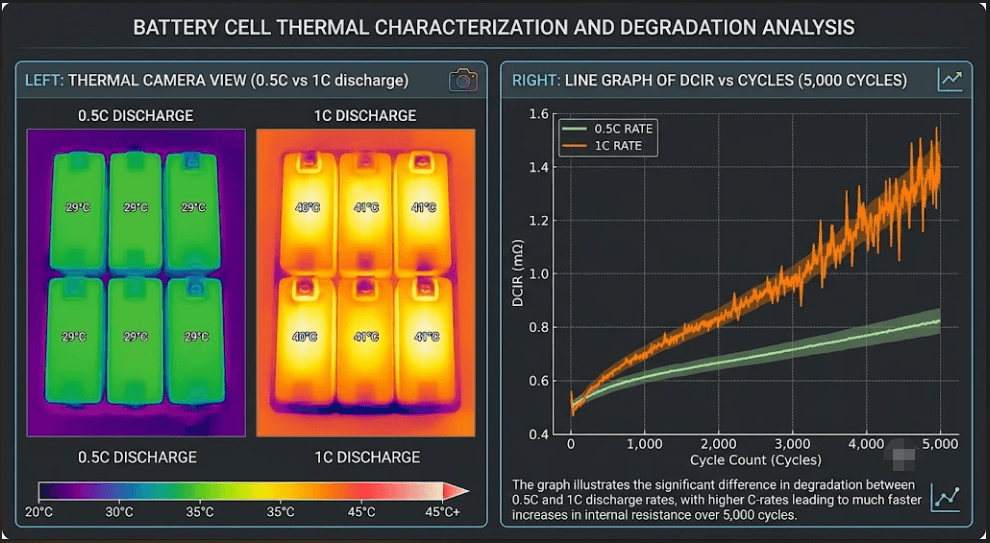
2. DCIR Rise and Voltage Sag — the Hidden Cycle Life Cost
Direct Current Internal Resistance (DCIR) is the most operationally significant metric for a deployed BESS. It combines ohmic resistance, charge-transfer resistance at the electrode-electrolyte interface, and diffusion polarisation. In a new LFP prismatic cell, DCIR typically sits at 0.10–0.25 mΩ per Ah of rated capacity. The Sunlith DCIR technical article covers IEC 61960-standard measurement in detail.
At 1C, SEI growth accelerates — and each nanometre of additional SEI adds ionic transport resistance. DCIR rises faster as a result. Moreover, elevated temperature (harder to suppress at 1C even with liquid cooling) further accelerates this resistance drift.
Rising DCIR causes voltage sag. The voltage drop under load equals V_sag = I × DCIR. At 1C, discharge current is double that of 0.5C. Therefore, the same DCIR increase produces twice the voltage drop. In practice, this triggers the inverter’s low-voltage cutoff — typically 2.5–2.8V per cell — at a higher residual SoC than intended. The discharge cycle ends early. Consequently, the usable SoC window shrinks from, say, 10–90% to roughly 15–85%. That lost throughput compounds over project life, reducing effective revenue by 10–15% before the cell even reaches 80% SoH.
| DCIR → Voltage Sag → Effective SoC Shrinkage A BMS that tracks per-cell DCIR and adjusts the voltage cutoff dynamically can recover a significant portion of this lost SoC window. This DCIR-adaptive cutoff is one of the highest-value firmware configurations for 1C liquid-cooled BESS assets. |
3. Lithium Plating on the Anode
When charge current exceeds the anode’s intercalation rate, metallic lithium plates on the graphite surface instead of inserting into it. This is irreversible. It can also lead to dendritic growth that eventually penetrates the separator — the main path to internal short circuits. At 0.5C, LFP cells stay well within the safe intercalation envelope. At 1C, that margin narrows. Furthermore, if the cooling system is undersized, elevated temperature narrows the margin further, making thermal management the deciding factor in liquid-cooled BESS 0.5C vs 1C longevity.
For the electrochemistry behind why plating happens, and how it interacts with SEI growth over a cell’s life, see our guide on SEI layer growth and lithium plating in LFP cells.
4. Mechanical Stress and Electrode Cracking
LFP cathode particles expand and contract as lithium ions move in and out. Higher C-rates speed up this mechanical cycling. Cumulative electrode stress rises as a result. Research in ScienceDirect confirms that fast-charging produces macroscopic electrode detachment and microscopic particle cracking alongside SEI growth. LFP’s olivine structure resists this better than NMC. However, the effect is still measurable at sustained 1C operation.
Together, these four mechanisms explain why the cycle-life gap between 0.5C and 1C is not linear. Liquid cooling suppresses the thermal contribution. However, it cannot eliminate the electrochemical stress, DCIR accumulation, or mechanical fatigue that higher current imposes on the cell.
How Liquid Cooling Mitigates 1C BESS Cycle Life Degradation
What the TMS Controls
Liquid cooling does not eliminate the 1C cycle-life penalty, but it cuts it significantly compared to air-cooled 1C operation. Research shows that liquid cooling reduces peak cell temperature by approximately 3°C at moderate C-rates. Additionally, it nearly doubles attainable cycle life versus unmanaged thermal conditions. However, the margin shrinks at 1C, so correct TMS sizing becomes critical.
For a 1C liquid-cooled LFP BESS, four parameters determine how well the TMS performs: inlet coolant temperature (target 20–25°C), coolant flow rate sized to keep ΔT below 3°C, cold plate contact area and thermal resistance, and BMS curtailment of discharge above 38–40°C per cell.
| Industry Benchmark — CATL EnerOne CATL’s EnerOne liquid-cooled system limits cell-to-cell ΔT to 3°C across the module stack. This enables a warranted 10,000-cycle life at 1C for the 280Ah cell. Achieving comparable performance at 1C with a less capable TMS is not supported by published data. |
Immersion vs Cold Plate at 1C
Immersion cooling — direct cell contact with a dielectric fluid — reduces degradation further than cold-plate systems at high C-rates. Data from EticaAG’s immersion cooling research shows a 22% battery life extension versus cold-plate cooling. Moreover, immersion eliminates localised hot spots entirely by surrounding every cell surface with fluid.
Nevertheless, immersion cooling carries higher capital cost. It is therefore used primarily in data centre UPS and research installations rather than grid-scale BESS. For most C&I projects, cold-plate liquid cooling is the appropriate balance of cost and performance. The C&I BESS thermal management guide covers sizing requirements in detail.
Which C-Rate Fits Your Application?
C-rate selection must match the application’s power-to-energy ratio — not simply the lowest purchase price. A system specified at 0.5C and dispatched at 1C will fail to meet its warranted cycle life. Conversely, a 1C system used only for overnight arbitrage at 0.25C wastes capital on oversized power electronics.
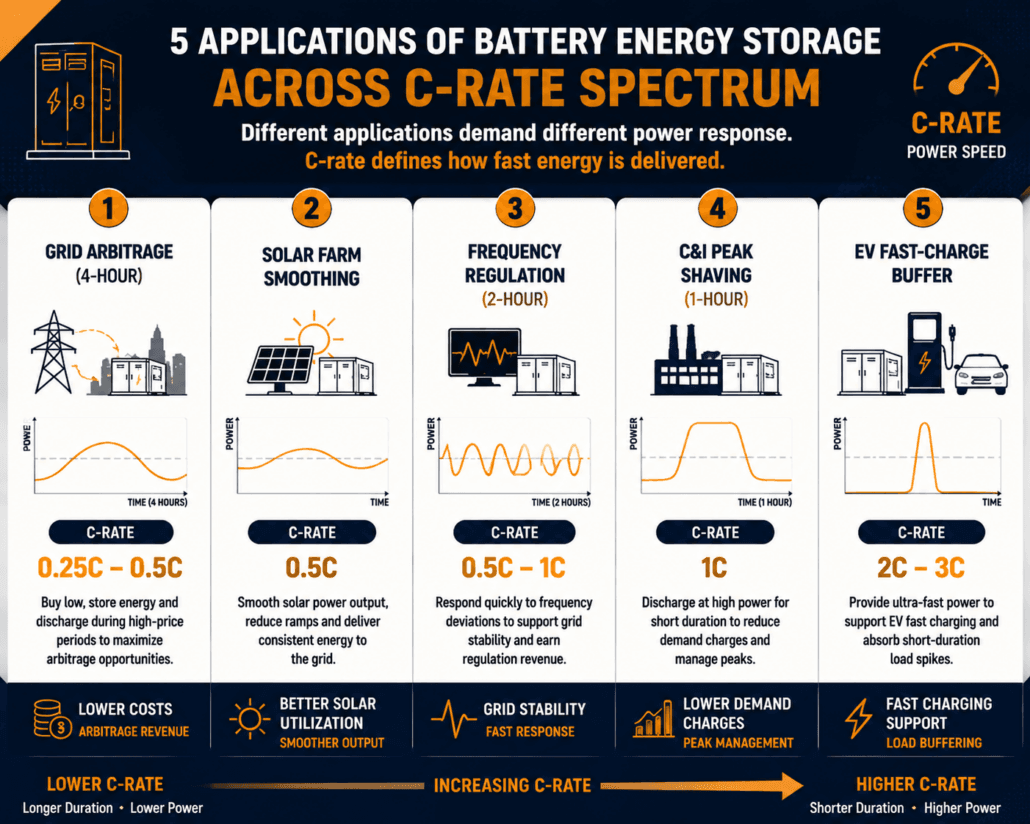
| Application | Recommended C-Rate | Expected BESS Cycles | Liquid Cooling Tier |
| Grid arbitrage (4-hour) | 0.25C–0.5C | 8,000–10,000+ cell-level | Cold plate, ΔT <3°C |
| Solar farm smoothing | 0.5C | 8,000 cell / 6,000 BESS | Cold plate, ΔT <3°C |
| Frequency regulation (2-hour) | 0.5C–1C | 5,000–8,000 BESS | Cold plate or enhanced liquid |
| C&I peak shaving (1-hour) | 1C | 4,000–5,000 BESS | Cold plate, higher coolant flow |
| EV fast-charge buffer | 2C–3C | <3,000 BESS | Immersion or high-flow cold plate |
Frequency regulation sits at 0.5C–1C because market requirements vary. UK FFR and Australian FCAS markets need sub-second response, so 1C is justified. US CAISO and MISO markets are often serviceable at 0.5C. Always confirm the specific market’s power-to-energy ratio before finalising the C-rate specification. For a full breakdown, see the BESS C-rate guide.
LCOS and Project Finance: The Cost of Getting C-Rate Wrong
Augmentation Timing
LCOS depends on total energy throughput divided by lifetime cost. That lifetime cost includes capital, augmentation, and O&M. A system that exhausts its warranted cycle count in half the intended project life triggers mid-life augmentation — typically 20–35% of original capital cost. This single event can materially damage project returns.
Consider a 10 MWh system at $250/kWh installed ($2.5M total). At 0.5C with 6,000 BESS-level cycles, augmentation is deferred to roughly year 16–18. At 1C with ~3,500–4,000 BESS-level cycles, augmentation arrives at year 9–10. That earlier event costs approximately $600,000–$850,000. Furthermore, it must be modelled in the financial plan from day one.
RTE and DCIR Revenue Loss
Round-trip efficiency differences also compound over time. A liquid-cooled LFP BESS achieves roughly 91–92% RTE at 0.5C versus 88–90% at 1C. Over 20 years at one cycle per day, a 2-percentage-point gap represents approximately 1,460 MWh of lost throughput on a 10 MWh system.
Additionally, DCIR-driven voltage sag reduces the effective SoC window by 10–15% in mid-to-late project life at 1C. This compounds the revenue shortfall beyond what the RTE difference alone would predict. Consequently, LCOS models that account only for RTE — and not DCIR-driven capacity erosion — will consistently underestimate the true cost of 1C operation. For a project-level cost breakdown, see the C&I BESS thermal management article.
BMS and EMS Settings That Protect Cycle Life
The battery management system (BMS) is the first line of defence for cycle life at any C-rate. At or near 1C, these six settings directly affect degradation rate:
- Temperature de-rating: Automatically derate current when any cell exceeds 35°C. Step down to 0.5C above 38°C. Halt discharge above 45°C. Without this, summer peak events push cells into the accelerated degradation zone.
- DCIR-adaptive voltage cutoff: Adjust the discharge termination voltage in real time based on measured DCIR. As DCIR rises over thousands of cycles, this prevents the inverter from cutting off early due to resistive voltage sag — recovering up to 10% of effective throughput in mid-to-late project life.
- SoC window management: Restrict operation to 10–90% SoC rather than 0–100%. The marginal capacity gained by widening the SoC window at 1C does not offset the electrode stress cost.
- Cell-to-cell voltage balancing: Set balancing thresholds to ±5mV rather than ±10mV. At 1C, voltage polarisation amplifies cell divergence during high-rate events and can mask true SoC.
- Coolant temperature monitoring: Log and alarm on coolant inlet temperature deviations. A 3°C rise in inlet temperature at 1C translates to a 5–7°C rise in peak cell temperature — enough to push the system outside the warranty envelope.
- Cycle and throughput logging: Track both cycle count and energy throughput (MWh) alongside DCIR trend data. Use these to trigger augmentation planning before field performance diverges from the financial model.
For grid-scale projects, the EMS dispatch algorithm should include a C-rate override that blocks 1C dispatch when ambient conditions prevent the TMS from maintaining ΔT below 3°C. This is especially important during summer peaks, when grid dispatch urgency and ambient temperature peak together. For more on how BMS, EMS, and TMS integrate at the system level, see the microgrid BESS technical guide.
Frequently Asked Questions
Does liquid cooling eliminate the 0.5C vs 1C cycle life gap?
No. Liquid cooling reduces the thermal component of degradation at 1C. However, it cannot eliminate the electrochemical stress — SEI growth, DCIR rise, lithium plating risk, and electrode mechanical strain — that increases with current. Published LFP data consistently shows a 37–50% reduction in cell-level cycle count at 80% SoH when moving from 0.5C to 1C, even with best-in-class liquid cooling.
What cycle life does a liquid-cooled LFP BESS achieve at 0.5C?
Published data for 280Ah and 314Ah LFP prismatic cells shows approximately 6,000 BESS-level cycles to 70% SoH at 0.5C/0.5C, 90% DoD, and ambient temperatures up to 35°C — with calendar ageing included. At the 80% SoH threshold, cell-level data shows 8,000 cycles at 25°C.
How does DCIR rise affect a 1C liquid-cooled BESS over time?
As DCIR grows from SEI accumulation, the voltage drop under 1C discharge doubles versus 0.5C for the same resistance increase. The inverter’s low-voltage cutoff triggers at a higher residual SoC. This shrinks the usable SoC window by 10–15% in mid-to-late project life. A DCIR-adaptive voltage cutoff in the BMS firmware can recover a significant portion of this lost throughput.
How do I calculate the cooling load difference between 0.5C and 1C?
Use P_heat = P_discharge × (1 − √RTE). At 0.5C with 92% RTE, a 1 MWh system rejects roughly 20.5 kW. At 1C with 88% RTE, that rises to roughly 62 kW — a 3× increase, not 2×. Always size the cooling loop for the maximum continuous C-rate, not the average dispatch rate.
Which applications justify 1C despite the shorter cycle life?
Applications with revenue tied to peak power — frequency regulation in FFR or FCAS markets, C&I peak demand charge reduction, and high-power grid-stabilisation services — can justify 1C. The key test is whether the revenue uplift from 1C dispatch outweighs the higher LCOS from shorter cycle life, earlier augmentation, and DCIR-driven SoC shrinkage.
Conclusion
The comparison of liquid-cooled BESS 0.5C vs 1C cycle life reveals a clear and consequential difference. Moving from 0.5C to 1C cuts cell-level cycle count by 37–50% at the 80% SoH threshold. The BESS-level penalty is larger still because calendar ageing, thermal gradients, and DCIR accumulation all compound on top of the C-rate stress.
Liquid cooling is essential for any BESS operating above 0.5C. However, it mitigates the degradation penalty — it does not eliminate it. The thermal sizing formula in this guide gives procurement teams a concrete starting point. The DCIR-adaptive BMS setting gives asset managers a practical tool to recover lost throughput in mid-project life.
Sunlith Energy provides technical consultancy for BESS specification, thermal management design, and lifecycle modelling. Contact us to discuss the right C-rate design for your project.




Trackbacks & Pingbacks
[…] 30% DoD, significantly reducing cycling degradation compared to a precisely sized system. See our BESS cycle life comparison guide for detailed 0.5C vs 1C cycling data across liquid-cooled LFP […]
Leave a Reply
Want to join the discussion?Feel free to contribute!