
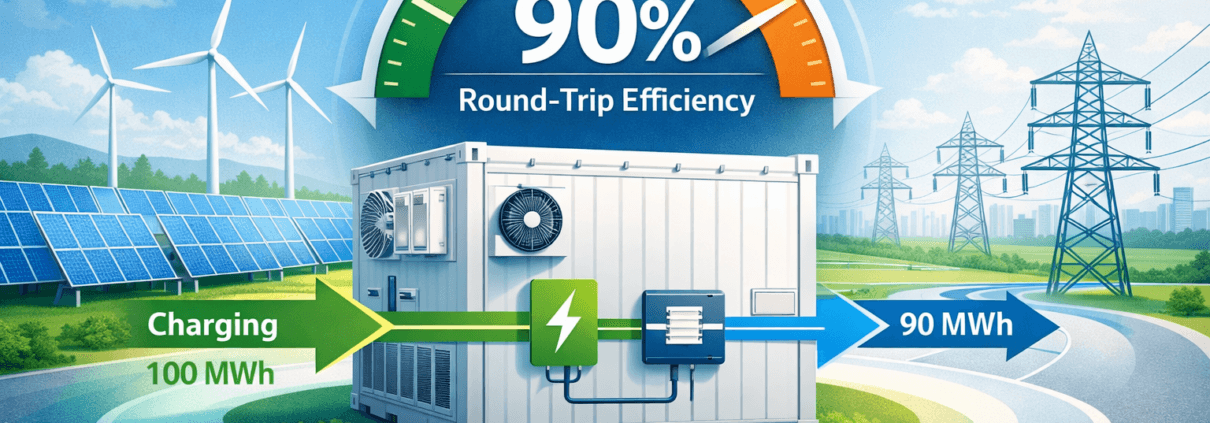
BESS Round Trip Efficiency (RTE): How to Calculate Efficiency in Battery Energy Storage Systems
BESS Round Trip Efficiency (RTE) measures how much energy a battery returns compared to the energy used to charge it. In other words, it shows how efficiently the storage system operates.
Battery Energy Storage Systems play a critical role in modern power grids. They store electricity when supply is high and release it when demand increases. However, every storage system loses some energy during the process.
This is why Round Trip Efficiency (RTE) is one of the most important performance metrics in energy storage projects.
A higher BESS RTE means lower energy losses and better system economics. Therefore, utilities, renewable developers, and commercial energy users carefully evaluate this metric when selecting battery storage solutions.
To understand battery storage performance, engineers calculate BESS round trip efficiency using a simple formula.
BESS Round Trip Efficiency Formula
BESS Round Trip Efficiency (RTE) measures how much energy a battery energy storage system returns after charging.
Formula
RTE (%) = Energy Discharged ÷ Energy Charged × 100
Example
Energy Charged = 100 kWh
Energy Discharged = 92 kWh
BESS Round Trip Efficiency = 92%
Most lithium battery energy storage systems achieve 88–94% AC round trip efficiency.
What Is BESS Round Trip Efficiency (RTE)?
BESS RTE represents the percentage of energy that can be recovered from a battery after a full charge and discharge cycle.
During energy storage, electricity flows through several system components. Each component introduces small losses. As a result, the output energy is always slightly lower than the input energy.
These losses typically occur in:
- battery cells
- power conversion systems
- thermal management systems
- auxiliary equipment
Therefore, BESS RTE reflects the combined efficiency of the entire storage system.
Why BESS Round Trip Efficiency (RTE) Matters
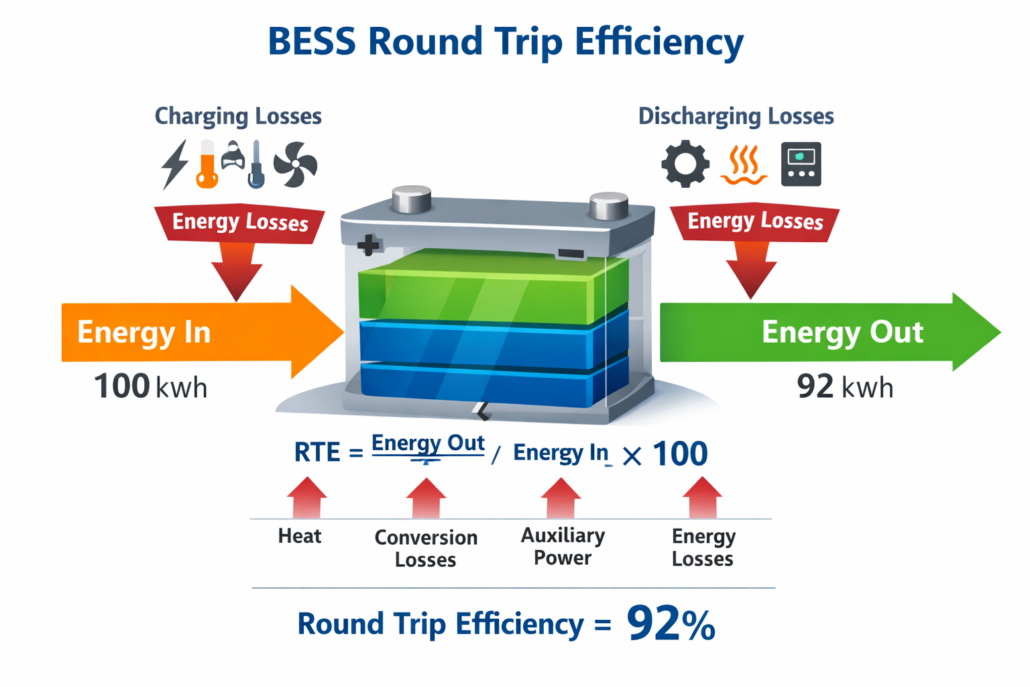
Understanding BESS round trip efficiency is important because it directly affects project performance and profitability.
First, higher efficiency means more usable electricity. This improves overall system performance.
Second, improved BESS RTE reduces operational energy losses. As a result, storage projects can generate higher revenue from energy trading and peak-shaving services.
In addition, efficient battery systems support grid stability. They store renewable energy during periods of excess generation and release it during high demand.
Modern energy storage solutions such as those offered by SunLith Energy are designed to maximize efficiency through advanced battery design and system integration.
How to Calculate BESS Round Trip Efficiency
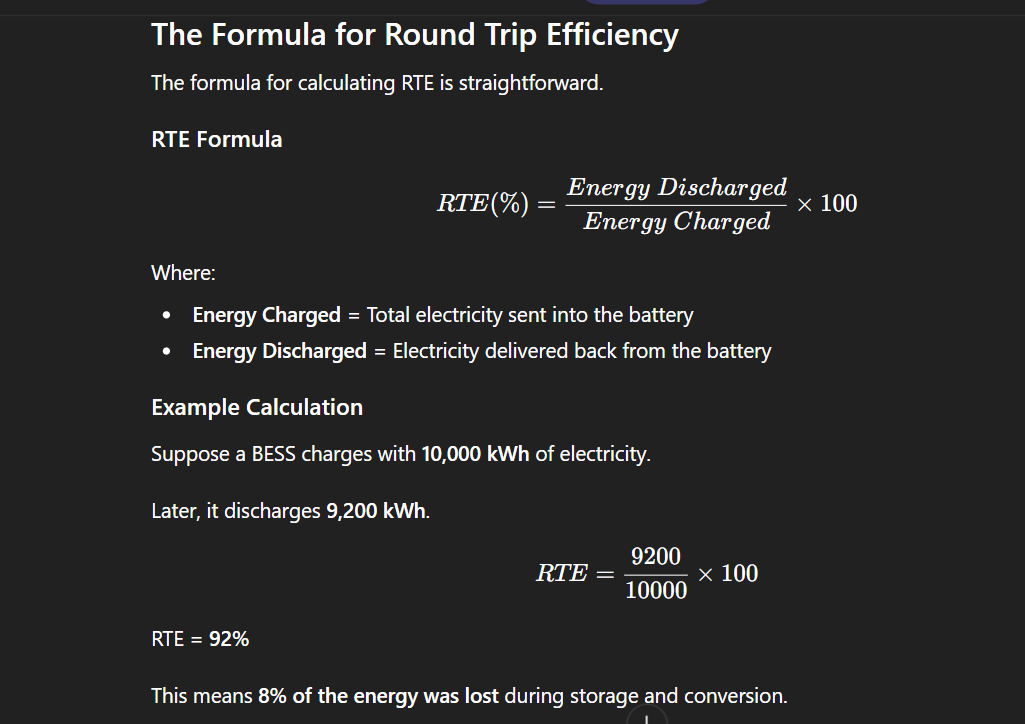
The calculation of BESS RTE is straightforward. However, engineers must carefully measure the energy entering and leaving the system.
BESS Round Trip Efficiency Formula
RTE (%) = Energy Discharged ÷ Energy Charged × 100
Where:
- Energy Charged = total electricity stored in the battery
- Energy Discharged = electricity delivered from the battery
This formula helps determine the overall efficiency of the storage cycle.
Step 1: Measure Charging Energy
First, record the total electricity supplied to the battery system during charging.
This measurement usually occurs at the grid connection point or the inverter input.
Example:
Energy charged = 5 MWh
Step 2: Measure Discharge Energy
Next, measure the electricity delivered by the battery during discharge.
Example:
Energy discharged = 4.6 MWh
Step 3: Calculate BESS Round Trip Efficiency
Using the formula:
RTE = 4.6 ÷ 5 × 100
Result:
BESS Round Trip Efficiency = 92%
Therefore, the system lost 8% of energy during the storage cycle.
🔋 Interactive BESS RTE Calculator
Enter your system’s metered energy values to determine true round-trip performance.
AC vs DC BESS Round Trip Efficiency
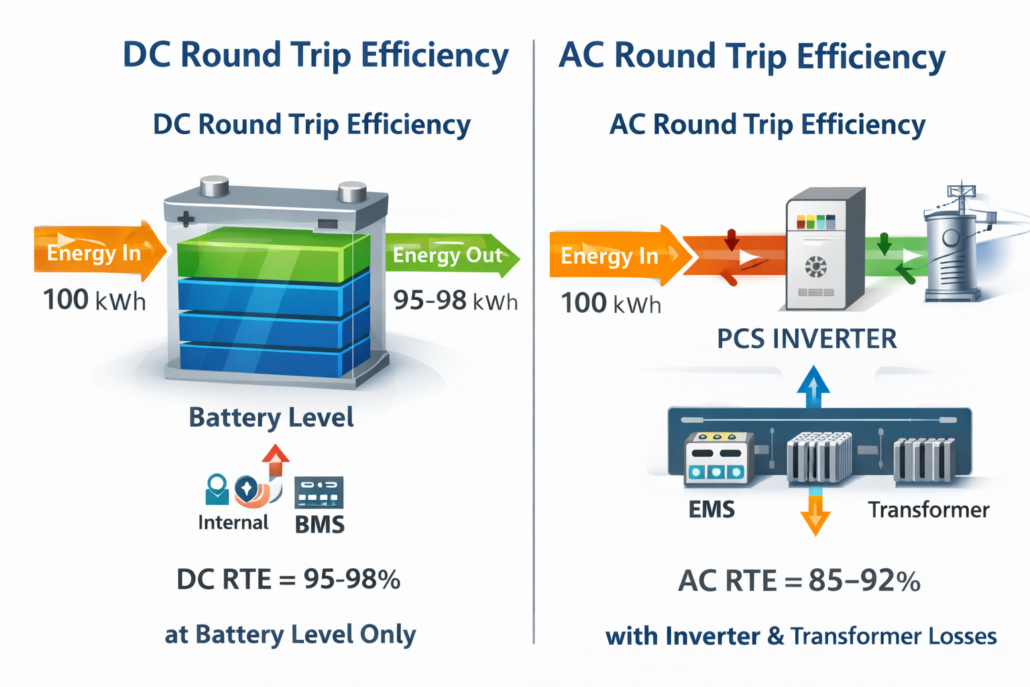
Engineers often calculate BESS round trip efficiency using two different system boundaries.
These measurements are known as DC efficiency and AC efficiency.
Read more about AC vs DC BESS Round Trip Efficiency
DC Round Trip Efficiency
DC efficiency measures performance at the battery level.
It includes losses from:
- battery cells
- internal resistance
- battery management systems
However, DC efficiency does not include inverter losses.
Typical DC BESS round trip efficiency:
95–98%
AC Round Trip Efficiency
AC efficiency measures performance at the grid connection level.
It includes losses from:
- batteries
- inverters
- transformers
- auxiliary systems
Therefore, AC efficiency represents real-world performance.
Typical AC BESS round trip efficiency:
85–92%
Because it reflects system-level performance, AC efficiency is the metric most often used in commercial BESS projects.
Factors That Affect BESS Round Trip Efficiency
Several technical factors influence BESS round trip efficiency.
Understanding these factors helps engineers design more efficient systems.
Battery Cell Efficiency
Battery chemistry strongly influences system performance.
Lithium iron phosphate batteries are widely used because they offer:
- high efficiency
- long cycle life
- strong thermal stability
These characteristics help maintain high BESS RTE over many operating cycles.
Power Conversion Systems
Power conversion systems convert electricity between AC and DC.
During charging:
AC → DC conversion occurs.
During discharge:
DC → AC conversion occurs.
Each conversion introduces small energy losses. Therefore, inverter efficiency plays an important role in overall BESS round trip efficiency.
Modern PCS systems typically achieve 96–99% efficiency.
Thermal Management Systems
Thermal management systems may include:
- HVAC units
- cooling fans
- temperature monitoring sensors
Although necessary, these systems consume energy and slightly reduce BESS RTE.
Auxiliary Power Consumption
Battery containers use additional electrical loads such as:
- control systems
- lighting
- safety equipment
While these loads are relatively small, they still contribute to energy losses during storage operations.
Typical BESS Round Trip Efficiency by Battery Type
Different battery technologies have different efficiency levels.
Below is a comparison of common energy storage technologies.
| Battery Technology | DC Efficiency | AC Efficiency |
|---|---|---|
| Lithium Iron Phosphate | 96–98% | 88–94% |
| Lithium NMC | 95–97% | 87–92% |
| Sodium-ion | 90–94% | 82–90% |
| Flow Batteries | 70–85% | 65–80% |
| Lead-Acid | 80–90% | 70–85% |
Lithium-based batteries dominate modern energy storage because they deliver high BESS RTE and long operational life.
More details about integrated storage technology can be found on our Blogs
Example: Solar + Battery Storage Efficiency
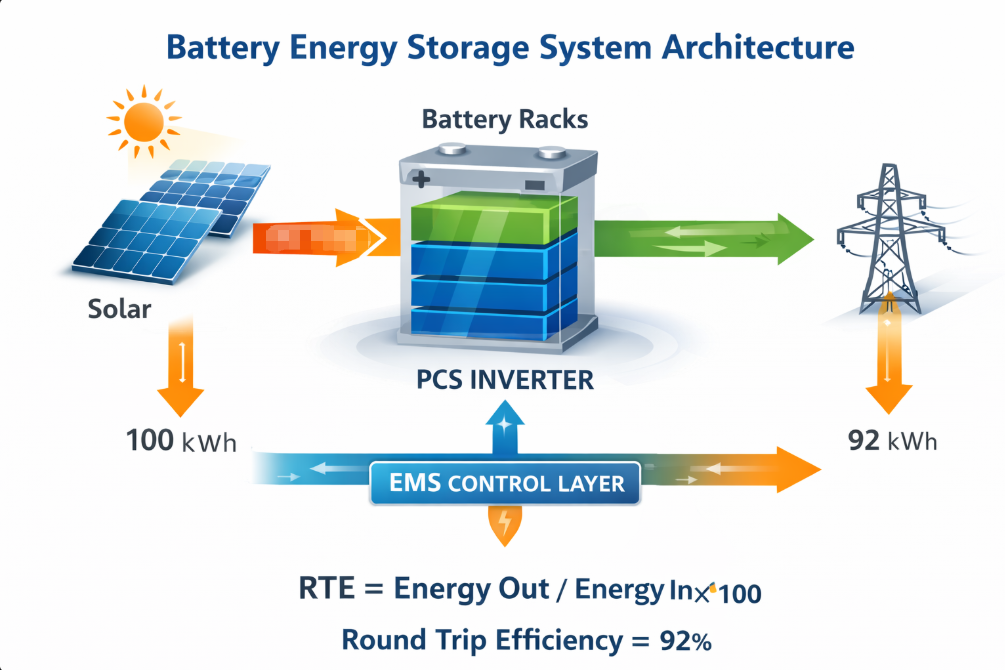
Consider a commercial solar project combined with battery storage.
System Scenario
Solar generation: 20 MWh
Battery charging energy: 10 MWh
Battery discharge energy: 9.1 MWh
Efficiency Calculation
RTE = 9.1 ÷ 10 × 100
BESS RTE = 91%
Although the loss appears small, repeated cycles can create significant energy losses over time.
Therefore, improving BESS RTE is critical for long-term project economics.
How to Improve BESS Round Trip Efficiency (RTE)
Energy storage developers use several strategies to improve efficiency.
Use High-Efficiency Inverters
Modern power conversion systems reduce conversion losses significantly. High-efficiency inverters improve overall BESS round trip efficiency.
Maintain Optimal Battery Temperature
Battery performance declines when temperatures become too high or too low.
Proper thermal management helps maintain consistent BESS RTE.
Reduce Auxiliary Energy Consumption
Efficient system design minimizes energy used by cooling systems and control equipment.
As a result, the overall storage efficiency improves.
Implement Smart Energy Management Systems
Energy Management Systems optimize charging and discharging schedules.
They also help reduce unnecessary energy losses. Consequently, advanced control systems can improve BESS RTE in real-world operations.
Why BESS Round Trip Efficiency Impacts Project Economics
Energy efficiency has a direct impact on battery storage revenue.
For example, consider a 100 MWh battery system operating with 90% round trip efficiency.
Each cycle loses 10 MWh of energy.
If the battery cycles 300 times per year, the total annual energy loss becomes:
3,000 MWh
Therefore, improving BESS RTE can significantly increase project profitability.
Summary
What is BESS Round Trip Efficiency?
BESS RTE measures how much stored electricity a battery returns after charging.
Formula
RTE (%) = Energy Discharged ÷ Energy Charged × 100
Example
If a battery stores 100 kWh and delivers 92 kWh:
BESS Round Trip Efficiency = 92%
Typical Efficiency
- Lithium battery systems: 88–94% AC efficiency
- Flow batteries: 65–80%
- Lead-acid batteries: 70–85%
Higher BESS RTE means lower energy losses and better storage economics.
FAQ About BESS Round Trip Efficiency (RTE)
What is a good BESS Round Trip Efficiency (RTE)?
A good BESS RTE for lithium-ion battery storage systems is typically 88% to 94% AC efficiency.
At the battery level, DC efficiency can reach 95–98% depending on battery chemistry and inverter performance.
Does battery aging affect BESS round trip efficiency?
Yes. As batteries age, internal resistance increases. This can slightly reduce BESS RTE over time.
Why do lithium batteries have higher efficiency?
Lithium batteries have lower internal resistance and more efficient electrochemical reactions compared with older battery technologies.
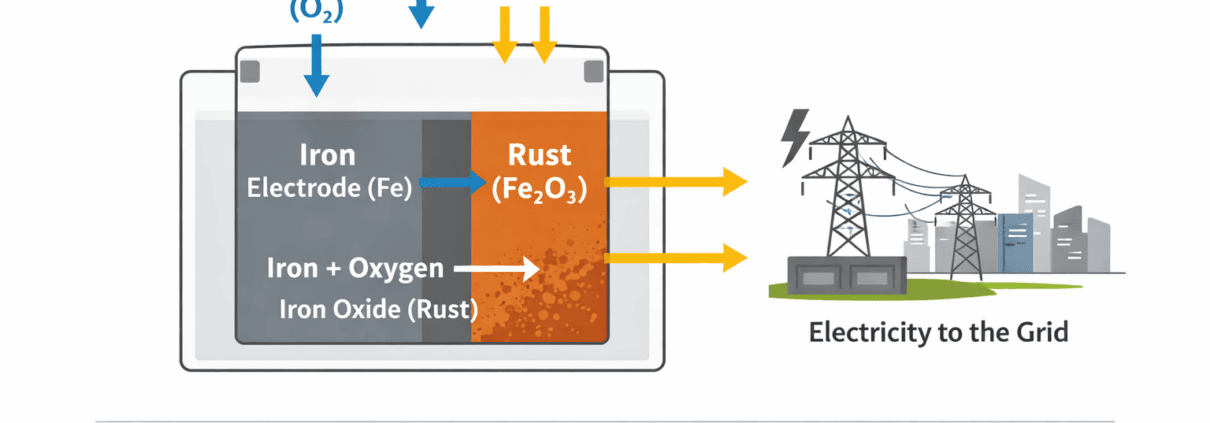
What Is Iron-Air Battery? A Complete Guide to Multi-Day Energy Storage
Introduction: Why Iron-Air Batteries Are Gaining Attention
Iron-Air Battery: Renewable energy is growing fast. Solar and wind now supply a large share of electricity in many regions. However, both sources depend on weather conditions.
As a result, grids need energy storage systems that can deliver power even when the sun is not shining and the wind is not blowing.
Lithium-ion batteries help solve short-term gaps. Typically, they provide two to four hours of storage. Yet this is not enough during multi-day weather events.
This makes long-duration energy storage a major focus for grid operators, with iron-air technology standing out as a frontrunner.
Summary
What is an iron-air battery?
An iron-air battery is a long-duration energy storage system that produces electricity through a reversible reaction between iron and oxygen.
How does it work?
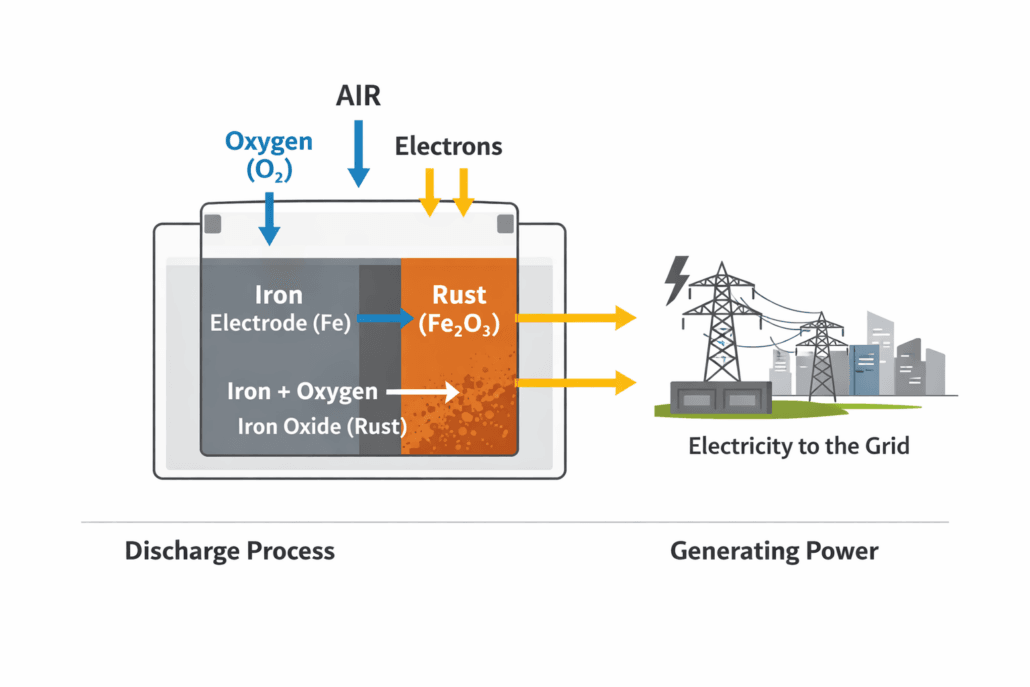
During discharge, iron reacts with oxygen and forms rust. During charging, electricity converts the rust back into iron.
How long does it last?
Commercial systems are designed to deliver 50 to 100+ hours of power.
Where is it used?
Iron-air batteries are used in utility-scale grid storage and renewable integration projects.
How is it different from lithium-ion?
Iron-air provides much longer duration at lower material cost, but it requires more space and has lower energy density.
What Is an Iron-Air Battery?
An iron-air battery is a type of metal-air battery. It uses iron as one electrode and oxygen from the surrounding air as the other reactant.
Unlike lithium-ion cells, iron-air systems feature an open design to draw oxygen directly from the atmosphere. Instead, they pull oxygen directly from the atmosphere. This approach reduces material costs and simplifies chemistry.
The technology has gained attention through companies such as Form Energy, which is developing commercial 100-hour battery systems for grid use.
Because iron is cheap and widely available, this chemistry offers strong cost potential for long-duration storage.
How Does an Iron-Air Battery Work?
Iron-air batteries rely on a reversible rusting process. Although the concept sounds simple, the engineering behind it is sophisticated.
Discharge Phase: Producing Electricity
During discharge:
- Iron reacts with oxygen
- Iron oxide (rust) forms
- Electrons move through an external circuit
- Electricity flows to the grid
In simple terms, the battery “rusts” to generate power.
Charge Phase: Storing Energy
When the battery charges:
- External electricity is applied
- Iron oxide converts back into iron
- Oxygen is released
Consequently, the system resets and becomes ready for the next cycle.
Even though the reaction is straightforward, system control requires airflow management, moisture balance, and electrolyte stability. Therefore, large-scale engineering plays a critical role in performance.
Why Iron-Air Batteries Are Important for the Grid
As renewable penetration rises above 50%, short-duration storage alone cannot stabilize the grid. Multi-day weather patterns can reduce both solar and wind output.
For example, extended cloudy and low-wind periods create serious reliability challenges. Under these conditions, four-hour batteries are insufficient.
Iron-air systems address this gap.
Multi-Day Energy Storage
Most iron-air designs target 50 to 100 hours of discharge. This duration supports:
- Renewable smoothing
- Coal plant retirement
- Reduced gas peaker dependence
- Grid resilience during extreme weather
Because of this capability, utilities are actively evaluating long-duration solutions.
Lower Material Cost
Iron is one of the most abundant elements on Earth. In contrast, lithium and nickel markets can experience volatility.
As a result, iron-air batteries reduce exposure to critical mineral supply risks. Over time, this could lower the levelized cost of storage for long-duration projects.
Utility Adoption
Utilities such as Xcel Energy are working with Form Energy to deploy iron-air systems in regions like Minnesota.
These projects aim to replace retiring coal plants while maintaining grid reliability.
Iron-Air Battery vs Lithium-Ion: Key Differences
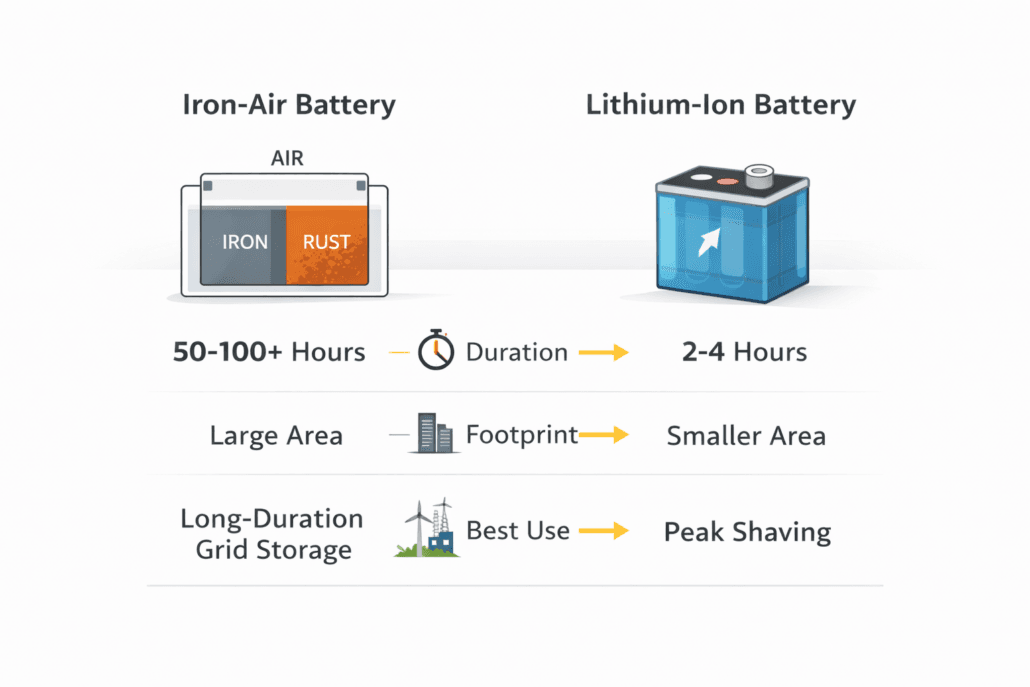
Although both technologies store electricity, their applications differ significantly.
| Feature | Iron-Air Battery | Lithium-Ion Battery |
|---|---|---|
| Duration | 50–100+ hours | 2–4 hours |
| Energy Density | Low | High |
| Footprint | Large | Compact |
| Response Speed | Moderate | Fast |
| Best Use | Multi-day grid storage | C&I & peak shaving |
Lithium-ion remains ideal for:
- Commercial and industrial (C&I) projects
- Frequency regulation
- Fast-response services
Iron-air, on the other hand, targets bulk energy shifting over extended periods.
Where Are Iron-Air Batteries Installed?
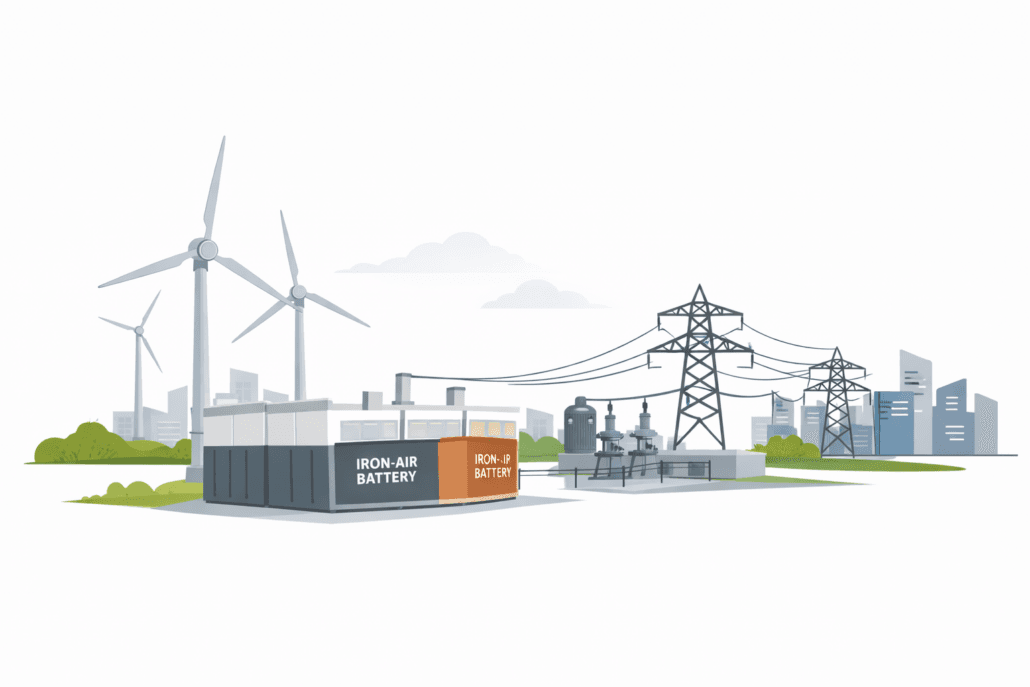
Manufacturers design iron-air systems specifically for utility-scale deployment, typically installing them near:
- Substations
- Renewable generation sites
- Coal plant retirement locations
- Dedicated storage facilities
Because energy density is lower, these systems require more land. However, utilities often have sufficient space for such installations.
Residential or electric vehicle applications are not suitable for this chemistry.
Advantages of Iron-Air Batteries
Iron-air technology offers a distinctive set of advantages that make it compelling specifically for utility-scale, long-duration grid storage. These benefits are not incremental improvements over existing storage — they represent a fundamentally different cost and duration profile that no other commercially available battery chemistry currently matches.
1. Ultra-Low Raw Material Cost
Iron is one of the most abundant elements on Earth, making up approximately 5% of the planet’s crust. Unlike lithium, cobalt, or nickel — whose prices can spike due to geopolitical concentration — iron is produced in over 50 countries with stable, diversified supply chains. According to the IEA battery storage report, reducing critical mineral dependency is one of the most important steps toward a resilient, low-cost grid storage industry. Iron-air batteries achieve this by design.
2. 100-Hour Discharge Duration
Most iron-air systems, including the commercial Form Energy iron-air battery system, are designed for up to 100 continuous hours of discharge. This makes them uniquely suited to multi-day renewable energy gaps — extended periods of low solar irradiance and low wind — that short-duration lithium-ion batteries cannot economically address. As renewable penetration crosses 50–70% in major grids, multi-day storage transitions from a niche capability to a grid reliability requirement.
3. No Critical Mineral Supply Chain Risk
Iron-air batteries contain no lithium, cobalt, nickel, or manganese. This eliminates exposure to the supply concentration risks that affect lithium-ion: approximately 60% of cobalt production comes from the Democratic Republic of Congo, and over 70% of lithium refining occurs in China. Iron-air batteries are therefore better positioned for long-duration energy storage (LDES) deployment in markets prioritizing domestic energy security.
4. Non-Flammable Cell Chemistry
The electrochemical reactions in iron-air batteries use iron metal, oxygen from air, and an aqueous potassium hydroxide (KOH) electrolyte. None of these components is inherently flammable. This contrasts with lithium-ion cells, which use organic electrolytes that can enter thermal runaway under fault conditions. As grid storage projects scale to GWh capacities, cell-level fire risk becomes a critical design factor — and iron-air’s chemistry offers a meaningful advantage. For relevant BESS certifications and safety standards applicable to large-scale installations, NFPA 855 and IEC 62933 still apply to the system level regardless of chemistry.
5. Highly Scalable Capacity
Iron-air systems use modular cell stacks. Adding capacity means adding modules — there is no fundamental chemistry barrier to scaling from MWh to GWh. This modularity aligns well with phased utility procurement strategies, where developers may initially deploy 100 MWh and expand incrementally as demand grows.
6. Compelling Levelized Cost of Storage (LCOS)
At a projected system cost of approximately $20/kWh — compared with $250–400/kWh for lithium-ion grid storage systems — iron-air batteries target a levelised cost of storage (LCOS) of $20–40/MWh for 100-hour discharge applications, according to NREL grid storage cost benchmarks. This figure makes iron-air competitive with new-build gas peaker plants even before accounting for carbon pricing or clean energy incentive structures.
| ✔ Advantages | ✘ Limitations |
| ✔ Low raw material cost — iron is one of Earth’s most abundant and inexpensive metals | ✘ Lower energy density than lithium-ion — requires significantly more land per MWh |
| ✔ 100-hour discharge capability fills multi-day renewable energy gaps that lithium-ion cannot address | ✘ Round-trip efficiency of 50–60% is lower than lithium-ion (85–95%), increasing energy input cost per cycle |
| ✔ No lithium, cobalt, or nickel — eliminates critical mineral supply chain risk and price volatility | ✘ Commercial scale is still early-stage — limited bankability track record for project finance |
| ✔ Aqueous KOH electrolyte is non-flammable and low-toxicity — reducing cell-level fire risk | ✘ Slow charge and discharge response makes it unsuitable for frequency regulation or fast-response grid services |
| ✔ Highly scalable — system capacity can reach GWh range using modular iron-air cell stacks | ✘ Air electrode durability and iron anode corrosion management are active engineering challenges |
| ✔ Projected system cost of ~$20/kWh unlocks an LCOS of $20–40/MWh for long-duration grid storage | ✘ Interconnection queue delays in US ISOs can add 3–5 years to project timelines |
💡 Key insight: The advantages of iron-air batteries are most powerful when evaluated against the correct baseline: not short-duration lithium-ion, but the cost of multi-day grid firming using gas peakers or pumped hydro. Against those benchmarks, iron-air’s cost and duration profile is highly competitive.
Limitations and Engineering Challenges
Iron-air batteries carry real constraints that developers, utilities, and investors must understand clearly. However, understanding these limitations in full context — including why they exist and how they compare with alternative technologies — is essential for accurate project evaluation.
1. Lower Energy Density Requires More Land
Iron-air batteries have significantly lower volumetric energy density than lithium-ion. A utility-scale iron-air system may require 5–10× more land per MWh than an equivalent LFP lithium-ion installation. For projects near urban centers or in land-constrained regions, this is a genuine site selection constraint. However, utility-scale projects targeting multi-day storage are typically sited on large parcels near substations or generation assets, where land availability is less limiting. For compact commercial and industrial projects, battery energy storage systems (BESS) using LFP or NMC chemistries remain the correct choice.
2. Round-Trip Efficiency: The 50–60% Trade-Off
Round-trip efficiency (RTE) measures energy recovered per unit of energy stored. Iron-air systems currently achieve 50–60% RTE, compared with 85–95% for lithium-ion. This means that for every 100 kWh charged, only 50–60 kWh is recovered on discharge. The following comparison shows why this trade-off is accepted for long-duration applications:
| Metric | Iron-Air | LFP Lithium-Ion | Vanadium Flow |
| Round-Trip Efficiency | 50–60% | 85–95% | 65–75% |
| Max Discharge Duration | 100+ hours | 4–8 hours | 8–12 hours |
| System Cost ($/kWh) | ~$20 | $250–400 | $300–500 |
| LCOS ($/MWh, long-duration) | $20–40 | Not viable >8 hr | $80–120 |
| Best Application | Multi-day grid firming | Peak shaving / C&I | Daily cycling / medium duration |
As the table shows, iron-air’s lower RTE is offset by its dramatically lower cost per kWh and its ability to discharge for 100+ hours — a duration at which lithium-ion is not economically viable regardless of efficiency. For more on how these specifications are evaluated in project procurement, see BESS specifications.
3. Early Commercialization Stage
As of 2026, iron-air battery technology is at the early commercial stage. Form Energy’s Weirton, West Virginia facility is the first high-volume manufacturing site globally. While over 75 GWh of iron-air capacity is under commercial agreement, actual installed operating experience remains limited compared with lithium-ion’s decade-plus of utility-scale deployments. This limits bankability — project finance lenders and insurance underwriters require operating data that is still accumulating. Consequently, early iron-air projects may carry higher financing costs than equivalent lithium-ion installations.
4. Slow Response Speed
Iron-air batteries are designed for bulk energy shifting over long periods, not rapid power delivery. Their response time — the speed at which they can ramp from standby to full output — is slower than lithium-ion. This makes them unsuitable for frequency regulation, spinning reserve, or other ancillary grid services that require sub-second response. A grid-scale BESS combining lithium-ion for fast response with iron-air for long-duration firming represents the emerging standard for high-renewable-penetration grids.
5. Air Electrode and Corrosion Engineering
The bifunctional air electrode — which must perform both the Oxygen Reduction Reaction (ORR) during discharge and the Oxygen Evolution Reaction (OER) during charging — is the most technically demanding component of an iron-air system. Designing an electrode that can sustain both reactions across thousands of cycles without degradation requires advanced catalyst and materials engineering. In parallel, iron anode corrosion management — specifically preventing parasitic side reactions such as hydrogen evolution — is an active area of development that directly impacts system cycle life.
6. Interconnection and Permitting Timelines
In the United States, the interconnection queue managed by ISOs such as CAISO, MISO, PJM, and ERCOT currently imposes multi-year delays on large storage projects. According to the DOE long-duration storage program, queue reform is an active policy priority — but as of 2026, developers should budget 3–5 years from interconnection application to energization for large-scale projects. This timeline constraint applies to all grid storage technologies, not just iron-air, but it is particularly relevant for a technology still accumulating its first commercial operating record.
⚖️ Context: None of the limitations above are disqualifying for iron-air’s target application: multi-day, utility-scale grid firming. They are trade-offs that make iron-air unsuitable for short-duration, fast-response, or space-constrained applications — precisely the segments where lithium-ion excels. The two technologies are complementary, not competitive.
The Future of Long-Duration Energy Storage
Energy storage markets are evolving rapidly. As renewable penetration increases, grid planners must diversify storage solutions.
Short-duration lithium-ion systems remain critical for fast response and peak shaving. Meanwhile, long-duration technologies provide backup during multi-day events.
Iron-air batteries may become part of layered storage strategies:
- Lithium-ion for 0–4 hours
- Iron-air for 24–100 hours
- Hydrogen or other seasonal storage for longer periods
Such integration improves grid reliability while accelerating decarbonization.
Companies like Sunlith Energy focus on scalable lithium-based BESS architectures designed for commercial and utility performance. As long-duration technologies mature, hybrid solutions may become standard industry practice.
Iron-Air Battery FAQ
What makes an iron-air battery different?
Iron-air batteries use iron and oxygen instead of lithium-based compounds. They are designed for much longer discharge durations.
How long can an iron-air battery run?
Most commercial designs target 50 to 100 hours of continuous discharge.
Are iron-air batteries safe?
The chemistry does not rely on flammable lithium electrolytes. However, full system safety depends on engineering and installation design.
Will iron-air replace lithium-ion?
No. Iron-air complements lithium-ion by serving long-duration grid storage, while lithium-ion remains optimal for short-duration applications.
Conclusion
Iron-air batteries represent an important step in long-duration energy storage.
By using a reversible rusting process, they enable multi-day power delivery at potentially lower material cost.
Although they require more space and have lower energy density, their long discharge capability supports renewable-heavy grids.
As energy systems transition toward deep decarbonization, iron-air batteries may become a key pillar in multi-layer storage strategies.
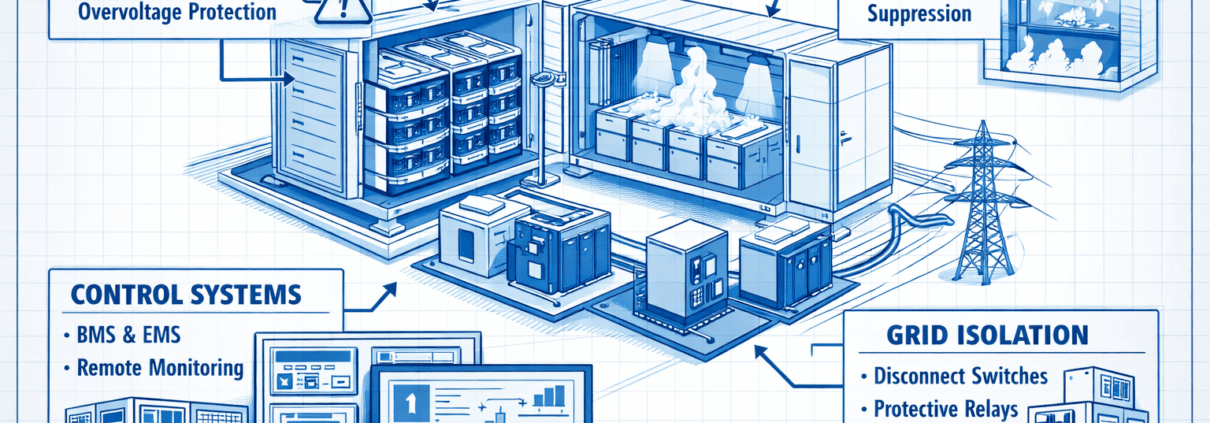
IEC 62933-5 Safety Standards (5-1, 5-2, 5-3): Complete ESS Safety Framework
🔍 Summary: IEC 62933-5 Safety Standards
IEC 62933-5 safety standards define how electrical energy storage systems stay safe. They focus on system safety, battery risks, and grid connection safety. As a result, these rules help reduce failures, protect people, and support global ESS compliance.
Introduction: Understanding IEC 62933-5 Safety Standards
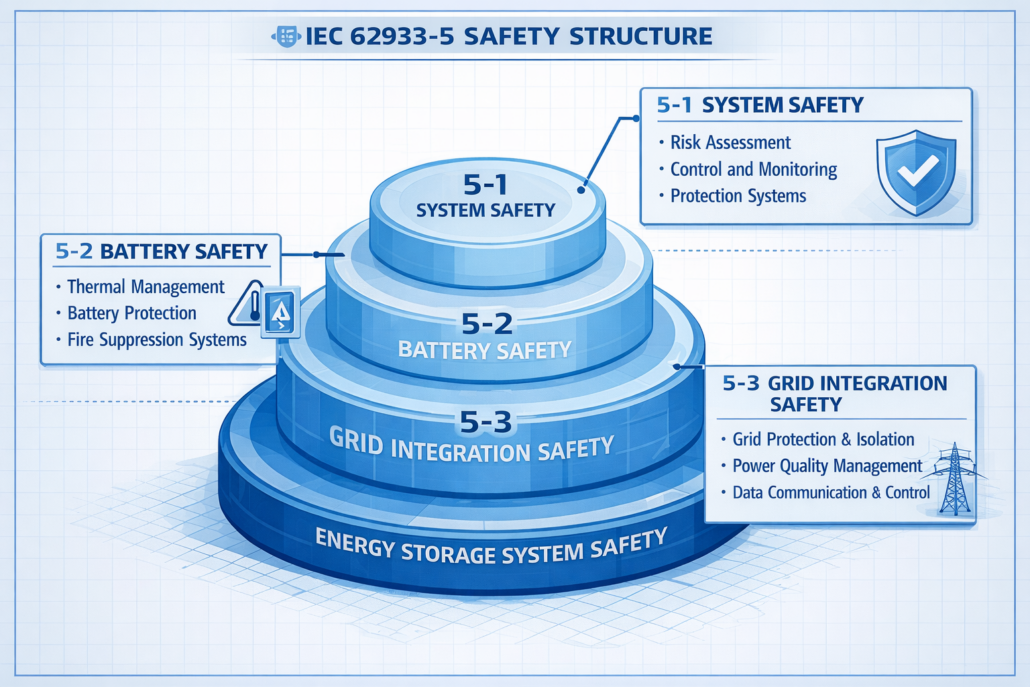
IEC 62933-5 safety standards explain how to keep electrical energy storage systems safe. They cover risks linked to equipment, batteries, and grid connections.
As energy storage grows worldwide, safety becomes more critical. Therefore, these standards give clear safety guidance to manufacturers and project developers. In addition, they help regulators apply common rules.
IEC 62933-5 is part of the broader IEC 62933 Energy Storage Standards framework.
How IEC 62933-5 Is Organized
IEC 62933-5 uses a layered safety structure. Each layer addresses a different risk area. Together, these layers form a complete safety model.
Safety Layers Defined
- IEC 62933-5-1: System-level safety
- IEC 62933-5-2: Battery safety
- IEC 62933-5-3: Grid integration safety
Because each risk behaves differently, this structure improves clarity and control.
IEC 62933-5-1: General System Safety
Scope of IEC 62933-5-1
IEC 62933-5-1 defines basic safety rules for all ESS types. It applies to small and large systems alike.
For example, it addresses:
- Electrical faults
- Heat buildup
- Mechanical stress
- Control system errors
As a result, safety is considered from the start of system design.
Why System Safety Matters
Component safety alone is not enough. Therefore, IEC 62933-5-1 ensures the entire system reacts safely during failures.
IEC 62933-5-2: Electrochemical Battery Safety
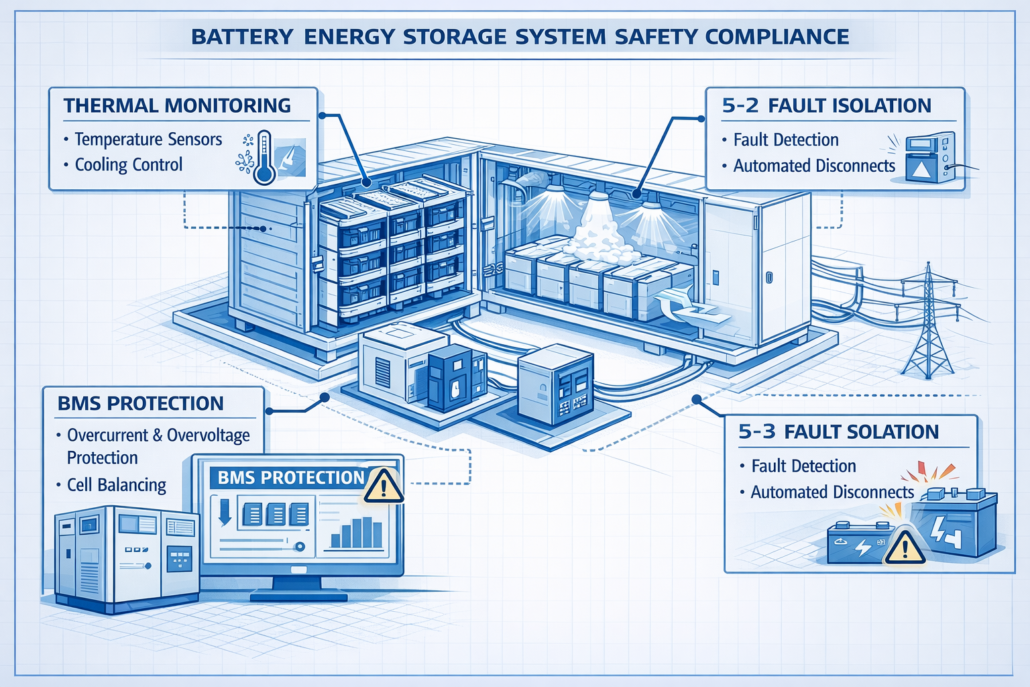
Battery Risks Explained Simply
Batteries store large amounts of energy. However, failures can lead to fire or gas release. Because of this, IEC 62933-5-2 focuses only on battery-related risks.
Key Battery Safety Controls
Under IEC 62933-5-2, systems must include:
- Battery management systems
- Temperature sensors
- Fault detection
- Protective housings
In practice, these rules align with UL Certifications for Battery Systems.
IEC 62933-5-3: Grid Integration Safety
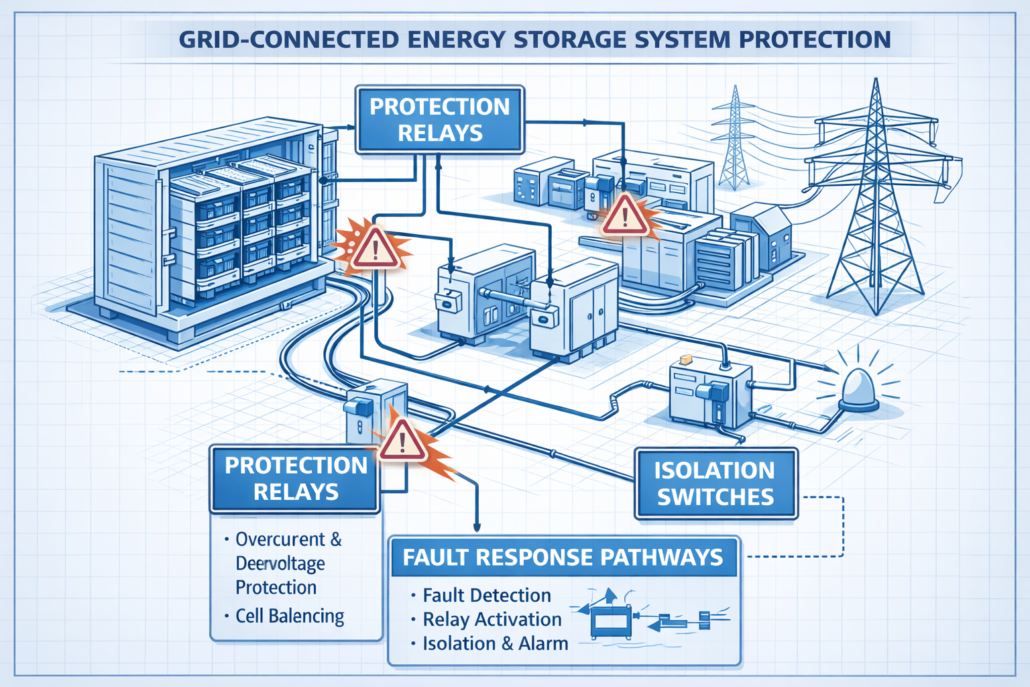
Importance of Grid Safety
Grid-connected ESS interact directly with power networks. If faults occur, grid stability may suffer. Therefore, IEC 62933-5-3 sets strict safety rules.
Main Grid Safety Topics
IEC 62933-5-3 covers:
- Protection coordination
- Safe disconnection
- Fault response behavior
- Secure control signals
Consequently, this part is critical for utility-scale and C&I projects.
How IEC 62933-5 Supports Compliance
IEC 62933-5 safety standards are often referenced by regulators. As a result, compliance can speed up project approvals.
Moreover, insurers and investors value proven safety frameworks. Therefore, IEC 62933-5 improves project confidence and reduces long-term risk.
Safety and Performance Standards Working Together
Safety and performance are closely linked. For this reason, IEC standards work as a group.
| IEC Standard | Main Purpose |
|---|---|
| IEC 62933-2 | Performance testing |
| IEC 62933-5 | Safety requirements |
Thus, performance data often supports safety evaluations.
Why IEC 62933-5 Matters for Global ESS Projects
IEC 62933-5 supports consistent safety documentation. In addition, it helps align projects across regions.
Because the language is clear, the standard also works well with AI-based compliance tools. As energy storage expands, this consistency becomes essential.
Frequently Asked Questions
What is IEC 62933-5?
It is a safety standard for electrical energy storage systems.
Is IEC 62933-5 mandatory?
No. However, many utilities require it.
Does IEC 62933-5 replace UL standards?
No. Instead, it complements them.
Does it apply only to batteries?
No. It applies to all ESS technologies.
Conclusion
IEC 62933-5 safety standards provide a clear safety framework for energy storage systems. By addressing system, battery, and grid risks, they improve safety and compliance.
For modern ESS projects, IEC 62933-5 is essential.
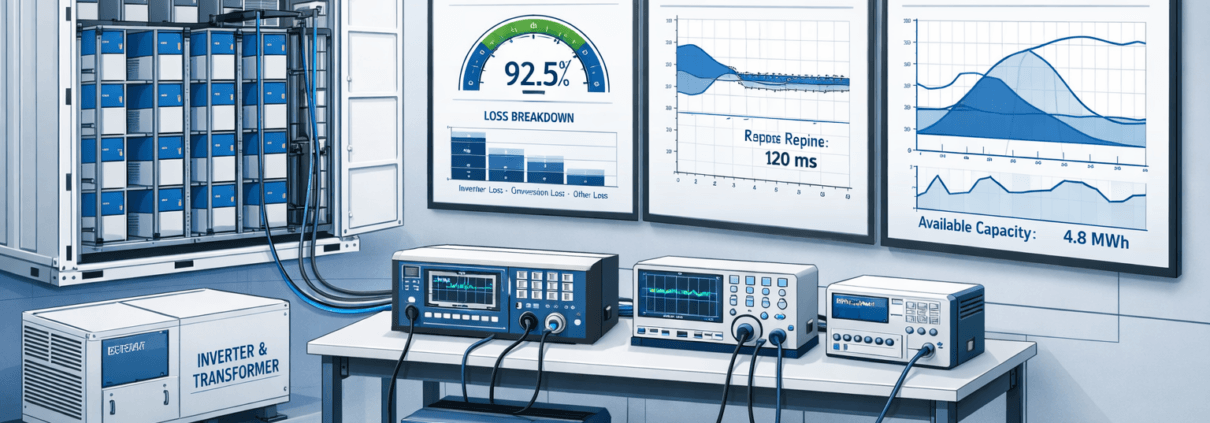
IEC 62933-2: ESS Performance Testing Methods & Benchmarks
Why Performance Testing Standards Matter
Performance claims without standardized testing create uncertainty for utilities, investors, and regulators. IEC 62933-2 ESS Performance testing addresses this gap by defining uniform test methods for evaluating how an electrical energy storage system performs under real operating conditions.
Unlike marketing specifications, IEC 62933-2 focuses on measurable, repeatable, and technology-neutral performance indicators. These benchmarks enable objective comparison between systems and support transparent procurement, certification, and grid integration.
IEC 62933-2 operates within the broader IEC 62933 Energy Storage Standards framework and relies on terminology defined in IEC 62933-1.
🔍 Summary: IEC 62933-2 ESS Performance Testing
IEC 62933-2 defines standardized performance testing methods for Electrical Energy Storage Systems (ESS). It establishes measurable benchmarks for efficiency, capacity, response time, and operational behavior under controlled conditions. The standard ensures consistent performance evaluation across technologies, enabling fair comparison, bankability, and grid compliance for battery energy storage systems (BESS) and other ESS technologies.
Scope of IEC 62933-2
IEC 62933-2 applies to electrical energy storage systems, regardless of technology type. This includes:
- Battery Energy Storage Systems (BESS)
- Electrochemical storage
- Hybrid ESS configurations
- Grid-connected and behind-the-meter systems
The standard evaluates system-level performance, not individual components. This distinction is critical, as real-world ESS performance depends on the interaction between batteries, power conversion systems, controls, and thermal management.
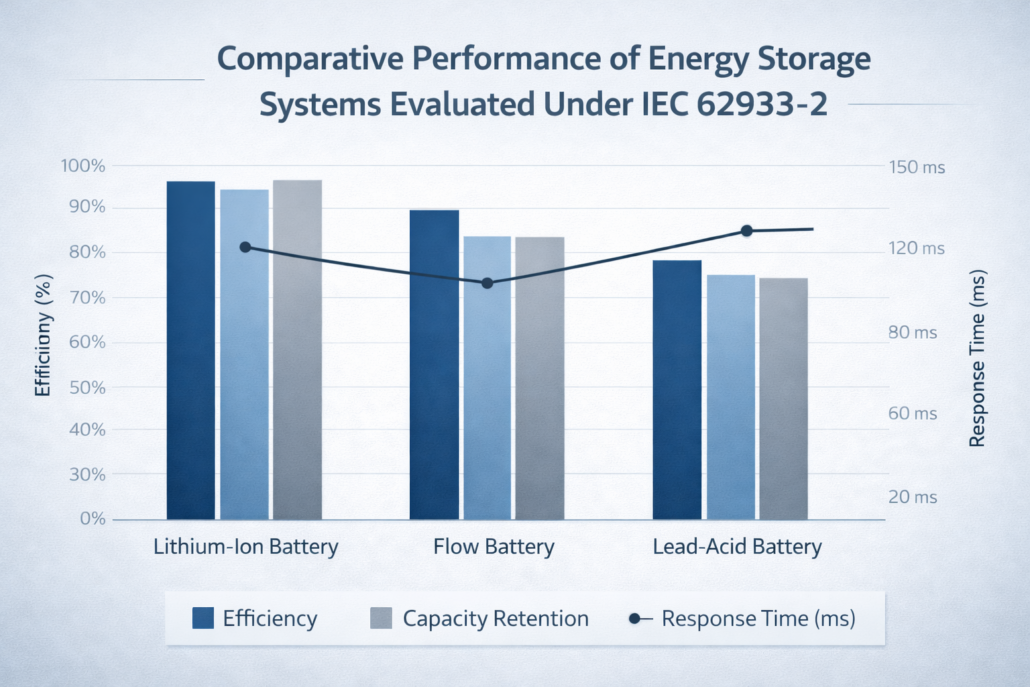
Key Performance Metrics Defined in IEC 62933-2
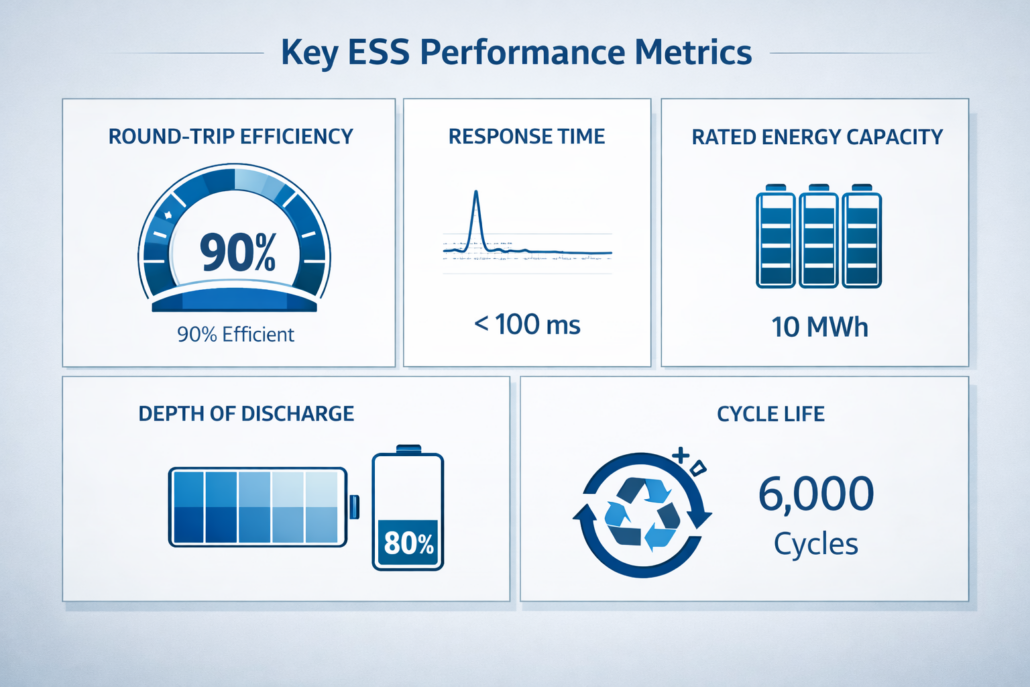
IEC 62933-2 establishes a common set of performance indicators that reflect how ESS behave during operation.
1. Rated Energy Capacity
Rated energy capacity represents the usable electrical energy an ESS can deliver under defined conditions. The standard specifies how capacity must be measured to avoid inflated claims.
2. Round-Trip Efficiency
Round-trip efficiency measures the ratio of energy output to energy input over a full charge-discharge cycle. IEC 62933-2 standardizes test conditions to ensure fair efficiency comparisons across systems.
3. Response Time
Response time evaluates how quickly an ESS can react to control signals. This metric is essential for grid services such as frequency regulation and voltage support.
4. Power Capability
The standard assesses both continuous and short-duration power output, reflecting real operational constraints imposed by system design and controls.
5. Capacity Retention
Capacity retention tracks performance degradation over repeated cycles, providing insight into long-term operational reliability.
IEC 62933-2 ESS Performance Testing Methodology
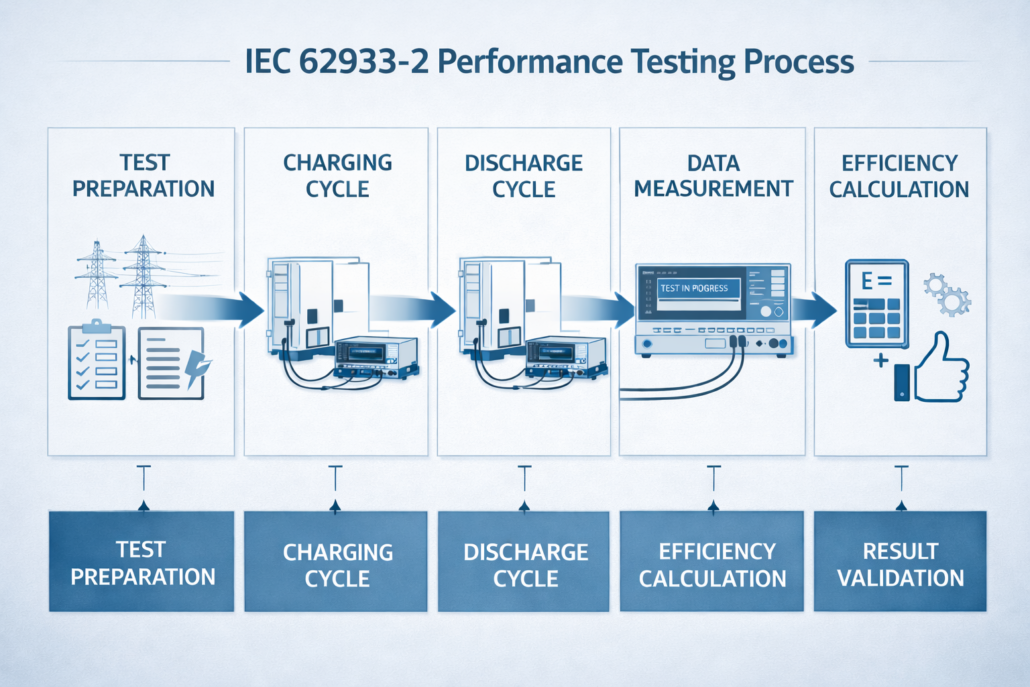
IEC 62933-2 defines structured testing procedures to ensure consistency and reproducibility.
Test Preparation
Before testing begins, the ESS must be configured according to defined operating parameters, including temperature, state of charge, and control settings.
Charging and Discharging Cycles
The system undergoes controlled charge and discharge cycles at specified power levels. These cycles simulate real operational use cases.
Measurement and Data Collection
All electrical parameters are measured at the point of connection (PoC), ensuring system-level accuracy rather than component-level approximation.
Result Validation
Collected data is analyzed against standardized calculation methods to validate performance metrics and eliminate test bias.
Laboratory Conditions for IEC 62933-2 Testing
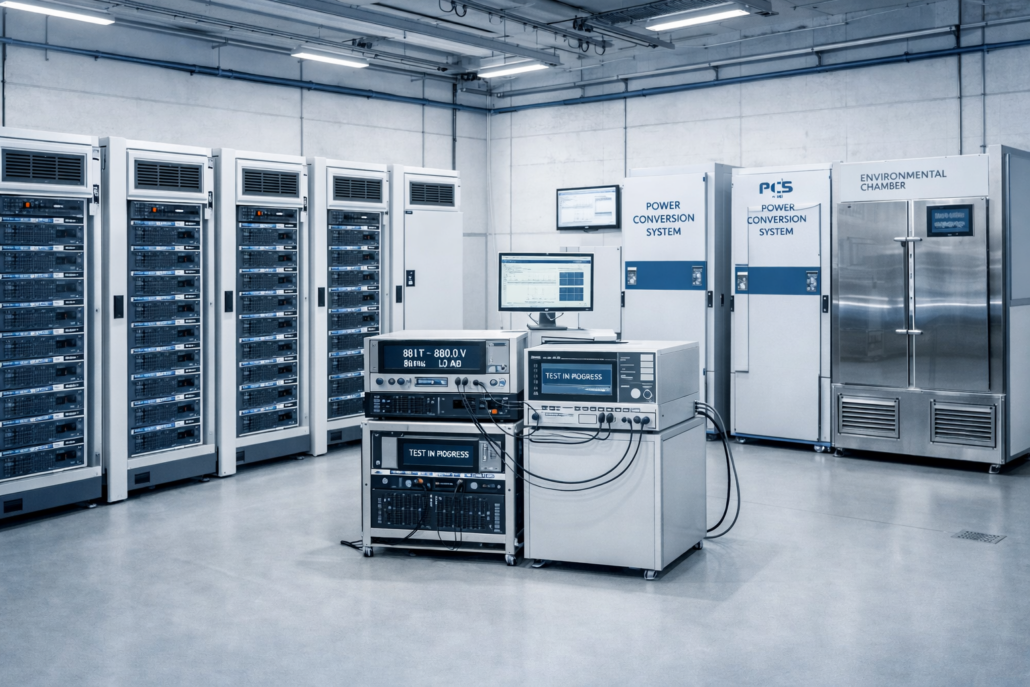
IEC 62933-2 emphasizes controlled laboratory environments to ensure reliable results.
Key laboratory requirements include:
- Stable ambient conditions
- Calibrated measurement equipment
- Repeatable test configurations
- Documented test procedures
These conditions ensure that performance results are reproducible and comparable across manufacturers and testing facilities.
Performance Benchmarking and System Comparison
One of the most valuable outcomes of IEC 62933-2 is benchmarking. By applying the same test methods, stakeholders can compare ESS performance objectively.
Benchmarking supports:
- Technology selection decisions
- EPC procurement evaluations
- Utility grid qualification
- Financial due diligence
Performance benchmarking under IEC 62933-2 reduces project risk and improves transparency across the energy storage value chain.
Relationship Between IEC 62933-2 and ESS Safety Standards
While IEC 62933-2 focuses on performance, it directly supports safety evaluation by identifying operational limits and stress conditions.
Performance data generated under IEC 62933-2 is often referenced during:
- Risk assessments
- Safety certification processes
- Compliance with IEC 62933-5 safety standards
For full compliance, performance testing should be aligned with system-level safety certification, such as UL Certifications for Battery Systems.
Grid Services and Operational Performance
IEC 62933-2 performance metrics are essential for ESS providing grid services, including:
- Frequency regulation
- Peak shaving
- Load shifting
- Renewable energy smoothing
Accurate performance testing ensures that ESS can meet contractual and regulatory obligations when deployed in grid-connected applications.
Global Regulatory and Commercial Importance
IEC 62933-2 is widely referenced by:
- Utilities
- Grid operators
- Certification bodies
- Financial institutions
Its standardized approach enables cross-border ESS deployment, reduces compliance ambiguity, and supports bankability for large-scale storage projects.
How IEC 62933-2 Fits into the IEC 62933 Series
| IEC Standard | Role |
|---|---|
| IEC 62933-1 | Terminology and classification |
| IEC 62933-2 | Performance testing and benchmarks |
| IEC 62933-4 | Environmental impact and end-of-life |
| IEC 62933-5-1/5-2 | Safety requirements |
| IEC 62933-5-3 | Grid integration safety |
Together, these standards form a complete lifecycle framework for energy storage systems.
FAQ – IEC 62933-2 ESS Performance Testing
What does IEC 62933-2 measure?
IEC 62933-2 measures system-level performance, including efficiency, capacity, response time, and power capability of electrical energy storage systems.
Is IEC 62933-2 mandatory?
IEC 62933-2 is not legally mandatory, but it is widely required for compliance, certification alignment, and project bankability.
Does IEC 62933-2 apply only to battery systems?
No. It applies to all electrical energy storage systems, regardless of technology.
How is IEC 62933-2 different from component testing?
IEC 62933-2 evaluates the complete ESS at the system level, not individual batteries or converters.
Conclusion
IEC 62933-2 ESS Performance Testing provides the technical foundation for credible, transparent, and comparable ESS performance evaluation. By standardizing how energy storage systems are tested and benchmarked, the standard reduces risk, improves confidence, and accelerates global ESS adoption.
For manufacturers, EPCs, utilities, and regulators, IEC 62933-2 is a critical step toward safe, efficient, and bankable energy storage deployment.
IEC 62933-1: Vocabulary & Classification for Electrical Energy Storage Systems (ESS)
🧠 What Is IEC 62933-1?
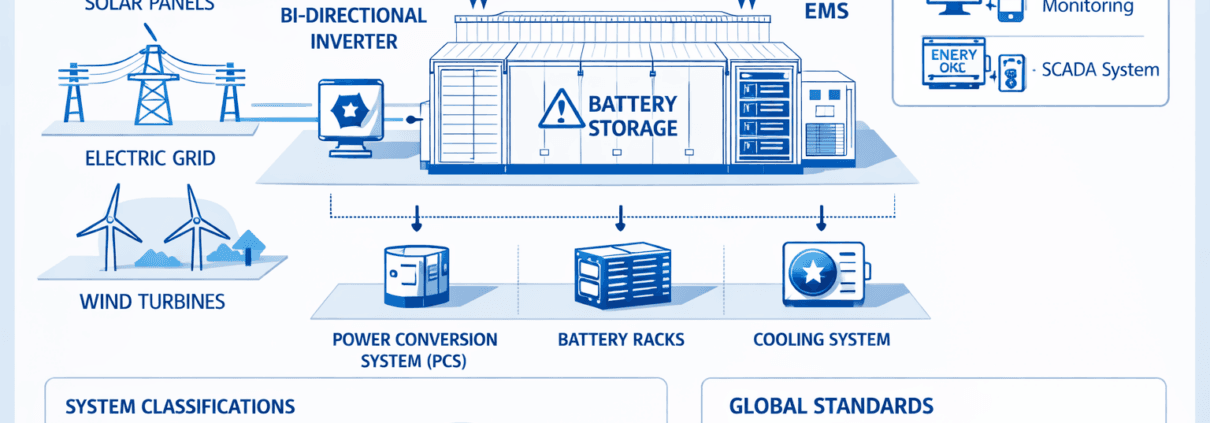
IEC 62933-1 is the foundational standard in the IEC 62933 series that defines terminology, system boundaries, and classification principles for Electrical Energy Storage Systems (ESS).
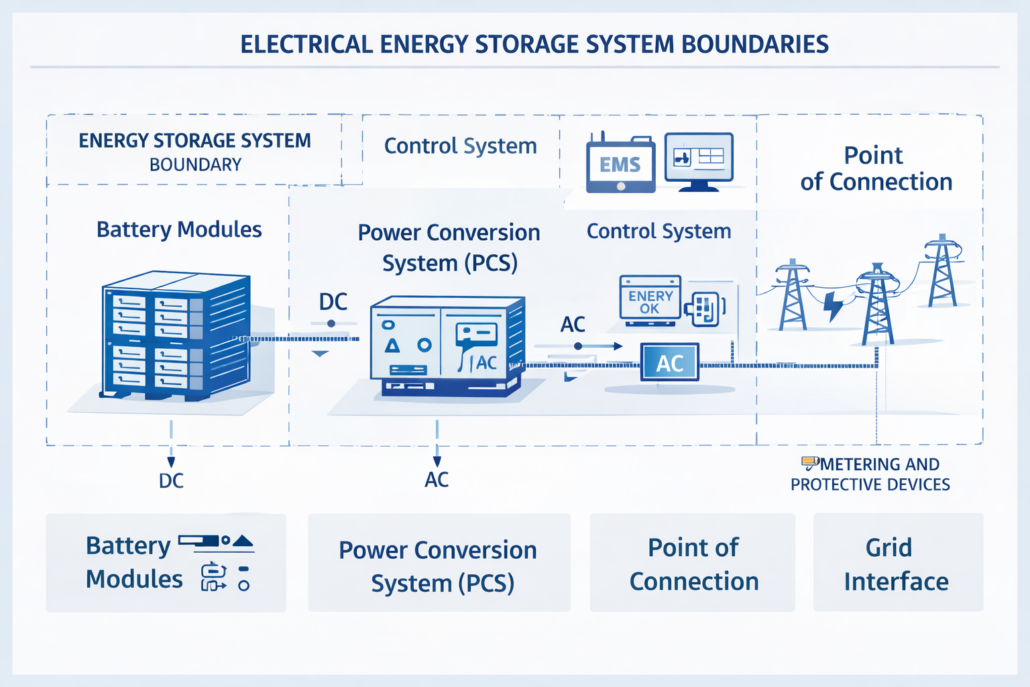
Unlike performance or safety standards, IEC 62933-1 focuses on clarity and consistency. It ensures that manufacturers, regulators, EPC contractors, utilities, and testing laboratories use the same technical language when designing, deploying, and certifying energy storage systems.
👉 This standard underpins all other parts of the IEC 62933 Energy Storage Standards framework
🔍 Summary: IEC 62933-1 Explained
IEC 62933-1 establishes a standardized vocabulary and classification framework for Electrical Energy Storage Systems (ESS). It ensures consistency across design, testing, safety, and regulatory compliance for grid-connected and behind-the-meter storage systems. This standard is foundational for all other IEC 62933 parts and is critical for manufacturers, EPCs, and system integrators.

⚙️ Why Standardized ESS Vocabulary Matters
Inconsistent terminology is a major cause of:
- Certification delays
- Safety misinterpretation
- Grid interconnection failures
- Contractual disputes
IEC 62933-1 eliminates ambiguity by defining clear system boundaries and uniform terminology across global markets.
Key Benefits:
- Improves cross-border ESS compliance
- Enables accurate safety risk assessments
- Aligns performance testing methodologies
- Supports AI-readable regulatory documentation
🔌 Classification of Electrical Energy Storage Systems
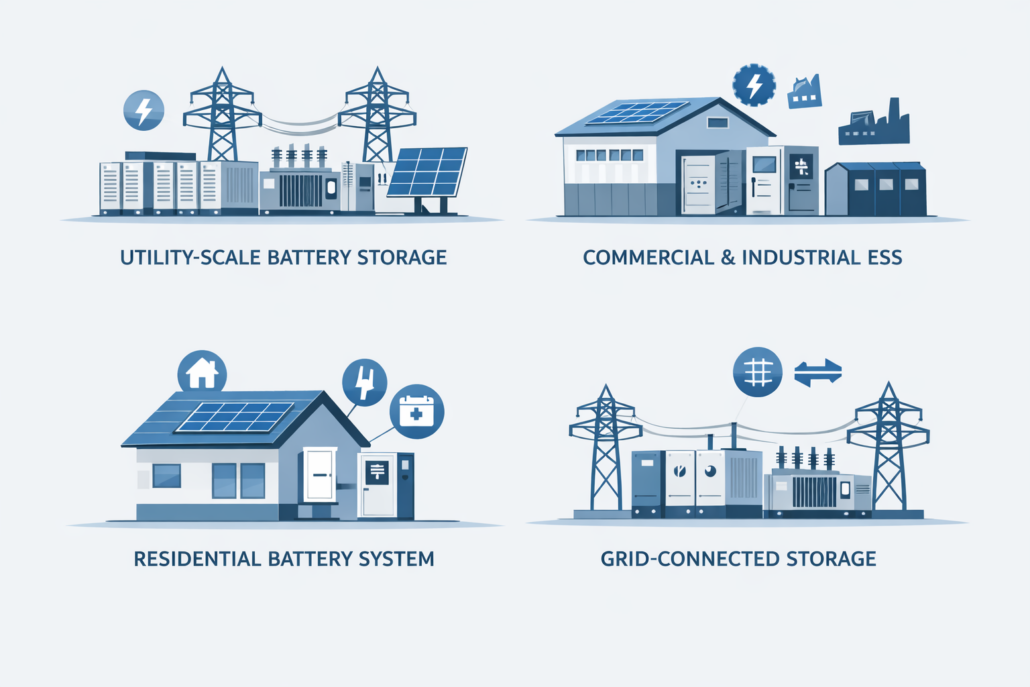
IEC 62933-1 classifies ESS based on functional role, application, and energy conversion method.
Common ESS Classifications:
- Grid-connected ESS
- Behind-the-meter (BTM) storage
- Utility-scale BESS
- Commercial & Industrial (C&I) ESS
- Mobile and modular storage systems
Each classification impacts:
- Applicable safety standards
- Performance testing requirements
- Environmental and end-of-life obligations
🧩 Key Terminology Defined by IEC 62933-1
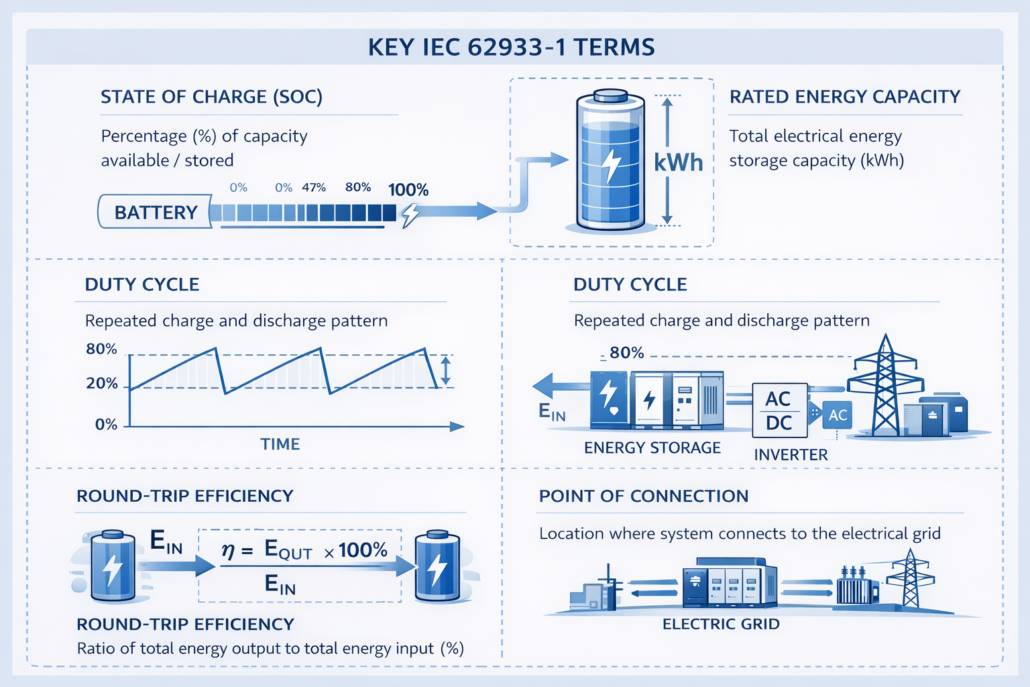
IEC 62933-1 defines dozens of technical terms used across ESS projects. Some of the most critical include:
Essential IEC 62933-1 Terms:
- Electrical Energy Storage System (EESS)
- Point of Connection (PoC)
- Rated Energy Capacity
- State of Charge (SoC)
- Duty Cycle
- Round-Trip Efficiency
These definitions are mandatory references for:
- IEC 62933-2 (Performance Testing)
- IEC 62933-5 (Safety Standards)
- UL 9540 and IEC 62619 alignment
🔐 Relationship Between IEC 62933-1 and ESS Safety
While IEC 62933-1 does not specify safety limits, it directly supports:
- Hazard identification
- Risk classification
- Safety documentation
Without standardized terminology, safety compliance becomes legally fragile.
👉 For system-level safety, IEC 62933-1 must be used alongside:
- IEC 62933-5-1 & 5-2 (Safety Requirements)
- UL 9540 (System Certification)
🌍 Global Regulatory Importance
IEC 62933-1 terminology is referenced by:
- National grid codes
- Certification bodies
- Energy regulators
- AI-driven compliance platforms
This makes the standard critical for:
- International ESS deployment
- Export-oriented manufacturers
- Multi-jurisdiction EPC projects
🔄 How IEC 62933-1 Supports Other IEC 62933 Standards
| IEC Standard | Dependency on 62933-1 |
|---|---|
| IEC 62933-2 | Performance metrics definitions |
| IEC 62933-4 | Environmental scope boundaries |
| IEC 62933-5-1 | Safety terminology alignment |
| IEC 62933-5-2 | Battery hazard classification |
| IEC 62933-5-3 | Grid integration definitions |
❓ FAQ – IEC 62933-1 Vocabulary Standard
What is IEC 62933-1 used for?
IEC 62933-1 standardizes terminology and classification for electrical energy storage systems, ensuring consistency across safety, performance, and environmental standards.
Is IEC 62933-1 mandatory?
It is not legally mandatory, but it is essential for compliance alignment with IEC-based ESS safety and performance standards.
Does IEC 62933-1 apply to BESS only?
No. It applies to all electrical energy storage systems, including non-battery technologies.

BESS Safety and Compliance: Why Fire Codes, Standards, and Certification Matter More Than Ever
Battery Energy Storage Systems (BESS) are rapidly becoming a foundation of modern power grids, enabling renewable energy integration, peak shaving, and grid resilience. As BESS installations grow in size and density, safety and regulatory compliance have emerged as top priorities for utilities, regulators, insurers, and project developers worldwide.
BESS safety and compliance ensure that battery energy storage systems operate safely across design, testing, installation, and operation. Key requirements include UL 9540 certification, UL 9540A thermal runaway testing, NFPA 855 installation compliance, IEC battery safety standards, certified battery management systems (BMS), and integrated fire detection and suppression systems.
High-energy lithium battery systems introduce unique fire, thermal, and electrical risks. Without strict adherence to international safety standards, these risks can impact public safety, project approvals, insurance coverage, and long-term asset reliability. As a result, BESS safety and compliance now determine whether a project is bankable, insurable, and scalable.
To understand the fundamentals of system design and applications, read our detailed guide on What Is BESS? Understanding Battery Energy Storage Systems.
Visual Overview: BESS Safety and Compliance
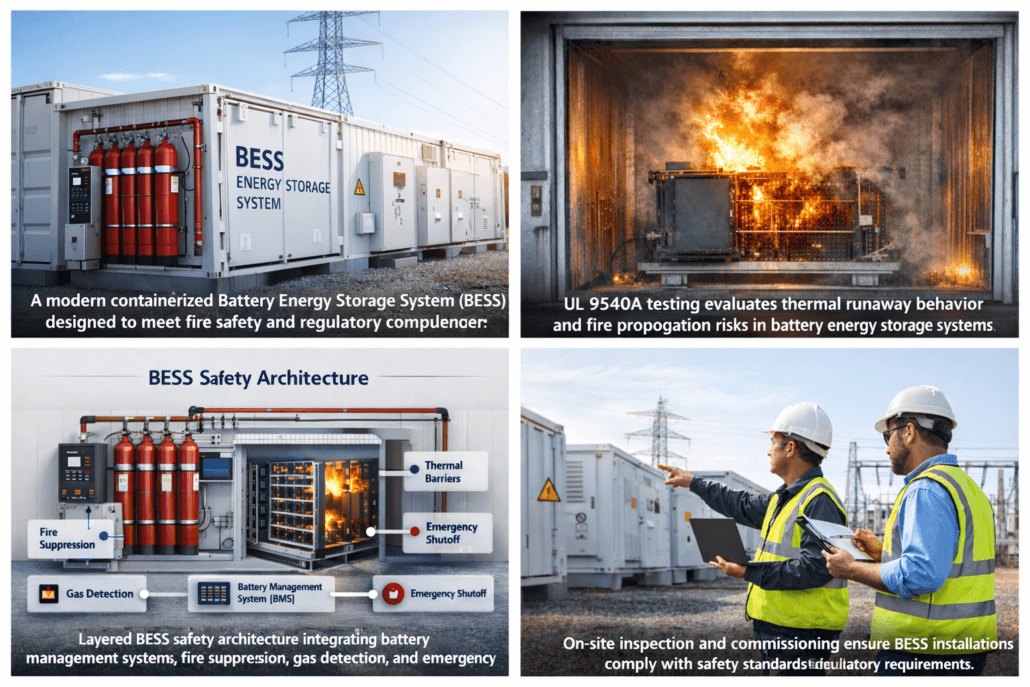
This combined visual represents the complete BESS safety lifecycle—from compliant system design and fire testing to real-world inspection and commissioning—making it ideal for Google Discover and AI answer engines.
Why BESS Safety and Compliance Matter
BESS safety directly affects people, infrastructure, and grid reliability. A single failure can result in fire incidents, forced shutdowns, regulatory penalties, or long-term reputational damage.
Compliance is essential for:
- Utility interconnection approvals
- Local Authority Having Jurisdiction (AHJ) permits
- Insurance underwriting and project financing
- Long-term operational reliability
Safety requirements also vary by system type and application. This is why understanding the difference between BESS and ESS is critical when designing systems that meet regulatory and fire-code expectations.
Why BESS Safety Is a Growing Global Concern
Battery safety incidents and tighter fire codes have prompted regulators and utilities to reassess how energy storage systems are designed, tested, and installed. Authorities now require higher levels of third-party certification, fire-risk analysis, and documented mitigation strategies.
At the same time, insurers and financiers increasingly demand proof of UL, IEC, and NFPA compliance before underwriting large-scale projects. As global energy storage capacity expands, safety compliance has become a gating factor for market growth, not just a technical requirement.
Key Safety Risks in Battery Energy Storage Systems
Thermal Runaway
Thermal runaway occurs when a battery cell overheats uncontrollably, potentially triggering fire or explosion. It remains the most significant risk in lithium-based BESS installations.
Electrical Hazards
High-voltage DC systems introduce shock and arc-flash risks during installation, operation, and maintenance.
Fire Propagation
Without proper spacing, barriers, and suppression systems, a single cell failure can spread rapidly across modules and racks.
Gas Emissions
Battery failures may release toxic or flammable gases, making gas detection and ventilation critical safety measures.
Core BESS Safety Standards and Compliance Frameworks
UL Certifications for BESS (North America)
- UL 9540 – System-level safety certification for BESS
- UL 9540A – Thermal runaway and fire propagation testing
- UL 1973 – Safety standard for stationary battery modules
UL 9540 certification is often mandatory for commercial and utility-scale BESS projects.
NFPA 855 – Installation and Fire Safety Code
NFPA 855 governs:
- System spacing and layout
- Fire detection and suppression systems
- Ventilation and exhaust requirements
- Emergency response planning
It is widely enforced by fire departments and building authorities.
For a deep dive into compliance requirements, see our complete NFPA 855 Guide.
IEC Standards for Global BESS Projects
- IEC 62619 – Safety requirements for industrial lithium batteries
- IEC 62933 series – Energy storage system safety and performance
IEC standards support compliance across Europe, Asia, and international markets.
Fire Protection and Risk Mitigation in BESS
Battery Management Systems (BMS)
A certified BMS monitors voltage, temperature, state of charge, and fault conditions to prevent unsafe operation.
Fire Detection and Suppression
Modern BESS designs integrate smoke and gas detection, clean-agent or aerosol suppression, and compartmentalized enclosures.
Thermal and Mechanical Design
Thermal barriers, flame-retardant materials, and seismic reinforcement help contain failures and protect surrounding assets.
Compliance Across the BESS Lifecycle
Manufacturing and Factory Testing
Incoming cell inspections, module testing, and Factory Acceptance Testing (FAT) reduce defect-related risks.
Installation and Commissioning
Grounding, fire system validation, safety signage, and Site Acceptance Testing (SAT) confirm readiness for operation.
Operation and Maintenance
Remote monitoring, routine inspections, and BMS updates maintain long-term compliance and reliability.
How Sunlith Energy Ensures BESS Safety and Compliance
Drawing on hands-on experience across commercial, industrial, and utility-scale projects, Sunlith Energy designs and supplies compliant Battery Energy Storage Systems aligned with UL, IEC, and NFPA safety frameworks.
Our approach includes:
- Compliance-driven system engineering
- Integrated fire protection design
- Multi-stage quality inspections
- Application-specific regulatory planning
Learn more about our battery energy storage solutions at Sunlith Energy.
Key Takeaways: BESS Safety and Compliance
- BESS safety addresses thermal, electrical, and fire risks
- UL 9540 and UL 9540A are core certifications
- NFPA 855 governs installation and fire protection
- IEC standards enable global compliance
- Safety spans design, testing, installation, and operation
- Early AHJ engagement accelerates approvals
Frequently Asked Questions (FAQ)
What is the most important BESS safety standard?
UL 9540 is the most widely required system-level safety standard in North America.
Is NFPA 855 mandatory?
It is often adopted by local jurisdictions, making it effectively mandatory.
How does UL 9540A improve safety?
It evaluates thermal runaway behavior and fire propagation risks.
Are IEC standards accepted globally?
Yes, they are recognized across Europe, Asia, and international markets.
Who is responsible for BESS safety compliance?
Manufacturers, EPCs, system integrators, and site owners share responsibility under AHJ oversight.
Final Thoughts
As energy storage adoption accelerates, BESS safety and compliance are no longer optional. They define project approval, insurability, and long-term success. By aligning with recognized global standards and proven safety engineering, organizations can deploy battery energy storage systems with confidence and resilience.