
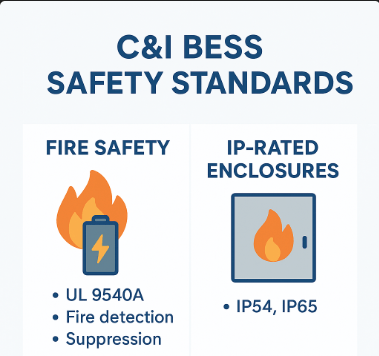
C&I BESS Safety Standards: Ensuring Reliability, Compliance, and Protection
C&I BESS Safety Standards: Commercial and Industrial Battery Energy Storage Systems (C&I BESS) are becoming indispensable for businesses looking to reduce costs, enhance resilience, and integrate renewable energy. Yet, the growth of these systems comes with a critical requirement: safety.
Without robust safety measures, risks such as fire incidents, electrical faults, or environmental hazards could undermine the very benefits C&I BESS offers. This is where C&I BESS Safety Standards come into play. They provide the guidelines and certifications that ensure every component — from battery modules to enclosures — operates safely and reliably under demanding conditions.
In this post, we’ll explore the key safety standards for C&I BESS, including fire safety protocols, IP-rated enclosures, testing procedures, and compliance frameworks.
1. Battery Safety: The Foundation of Protection
The battery modules are the heart of every C&I BESS. Most systems today use lithium-ion technology, which offers high efficiency and long cycle life but requires strict adherence to safety protocols.
Key Safety Standards for Batteries:
- UL 1973: Governs battery systems for stationary and motive applications, ensuring safe design and performance.
- IEC 62619: International standard for rechargeable lithium batteries used in industrial applications.
- Thermal Runaway Protection: Advanced designs integrate shutdown separators, flame-retardant electrolytes, and pressure relief valves to minimize risks.
By meeting these battery safety standards, C&I BESS providers can prevent catastrophic failures and improve system reliability.
2. Fire Safety Measures: Preventing and Containing Hazards
One of the most discussed topics in C&I BESS Safety Standards is fire protection. Given the energy density of modern batteries, the risk of overheating or thermal runaway is real — and prevention is critical.
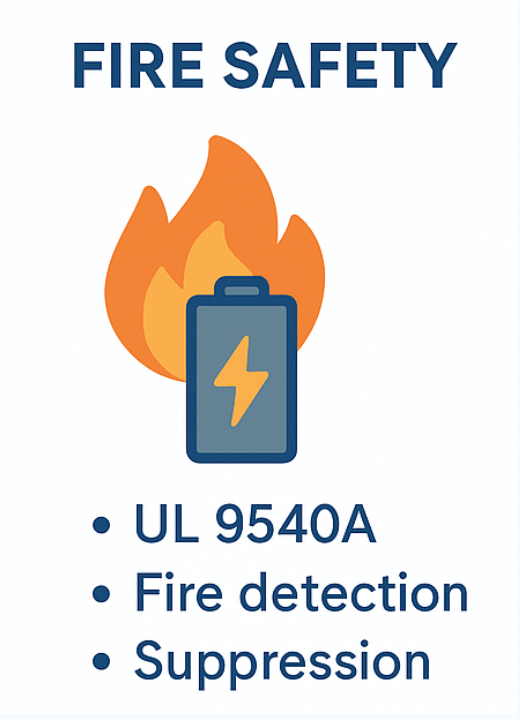
Fire Safety Practices in C&I BESS:
- UL 9540A Test: Evaluates fire propagation risk in battery systems.
- Automatic Fire Suppression: Systems often use clean agent gases (like Novec 1230) or water mist technologies.
- Fire Detection Sensors: Smoke and gas detectors installed inside enclosures ensure early warning.
- Emergency Venting: Proper ventilation prevents gas buildup during overheating events.
With these safeguards, facilities can minimize the risk of fire spreading and protect both infrastructure and personnel.
3. IP-Rated Enclosures: Shielding Against Environment
Environmental protection is another core aspect of C&I BESS Safety Standards. Since many C&I systems are installed outdoors, they must withstand dust, water, and harsh weather.
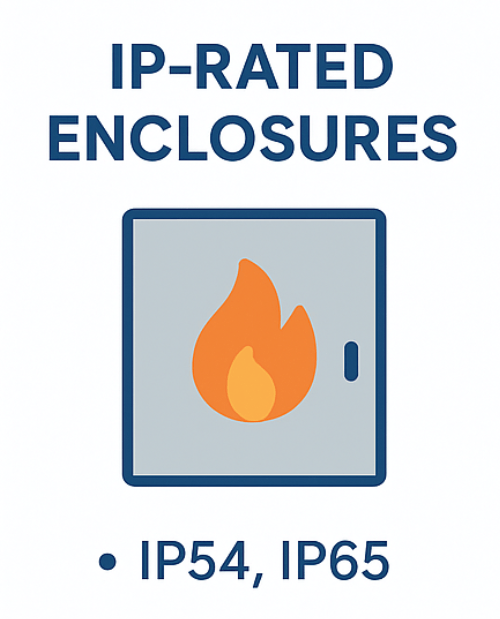
Common IP Ratings for C&I BESS:
- IP54: Protects against limited dust ingress and water spray.
- IP65: Dust-tight and protected against water jets.
- IP67: Offers full dust protection and resistance to temporary immersion.
A properly rated enclosure ensures batteries and electronics remain safe from external hazards, extending system life and reducing failure risks.
4. Electrical Protection and Circuit Breakers
Electrical faults are another potential hazard in BESS installations. To meet C&I BESS Safety Standards, robust electrical protections must be integrated.
Key Components:
- Circuit Breakers and Fuses: Prevent damage from overcurrent and short circuits.
- Surge Protection Devices (SPD): Safeguard equipment from voltage spikes caused by lightning or grid disturbances.
- Grounding and Isolation: Ensure personnel safety and fault clearance.
These protections create multiple layers of safety, ensuring both the equipment and people remain secure.
5. Thermal Management Systems
Maintaining the right temperature is essential for battery safety. Overheating accelerates degradation and raises fire risks, while extreme cold reduces performance.
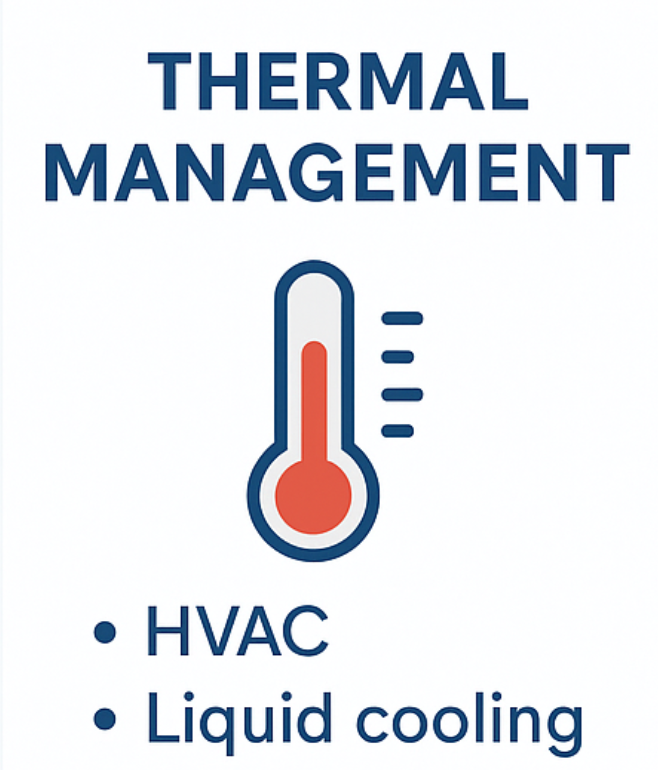
Thermal Management Standards:
- HVAC Integration: Ensures optimal airflow and cooling.
- Liquid Cooling Systems: Offer higher efficiency for large-scale C&I BESS.
- Temperature Monitoring: Real-time sensors alert operators to abnormal heat levels.
Complying with these thermal management protocols ensures safe operation across varying climates and load profiles.
6. Monitoring, EMS, and Communication
The Energy Management System (EMS) plays a crucial role in meeting C&I BESS Safety Standards. Beyond optimizing performance, it ensures early detection of anomalies.
Safety Functions of EMS:
- State-of-Charge Management: Prevents overcharging and deep discharging.
- Remote Monitoring: Enables 24/7 visibility of system health.
- AI-based Fault Detection: Modern EMS platforms use predictive analytics to anticipate failures.
When integrated with communication protocols, EMS ensures smooth interaction with the grid while maintaining safety compliance.
7. Compliance and Certifications
To build trust and ensure safe operation, C&I BESS solutions must comply with international and regional certifications.

Key Certifications:
- UL 9540: Overall safety standard for energy storage systems.
- IEC 62933: Safety and performance requirements for grid-connected storage.
- NFPA 855: Fire protection standards specific to stationary energy storage installations.
Compliance with these certifications not only ensures safety but also makes projects easier to finance, insure, and operate.
Conclusion: Building Trust with Safety First
The success of energy storage in the C&I sector depends not only on performance but also on trust and safety. By adhering to strict C&I BESS Safety Standards — covering batteries, fire safety, IP-rated enclosures, electrical protections, thermal management, and compliance — businesses can deploy storage systems that are both reliable and secure.
As demand for clean energy grows, these standards will remain the backbone of safe innovation, ensuring that C&I BESS continues to empower industries without compromising protection.
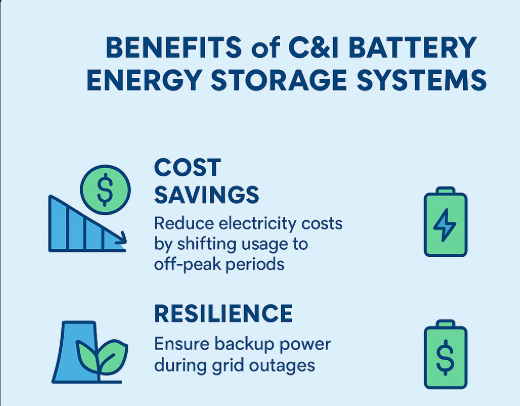
Key Benefits of C&I Battery Energy Storage Systems (C&I BESS) for Enterprises
C&I BESS Benefits: The adoption of Commercial & Industrial Battery Energy Storage Systems (C&I BESS) is accelerating as businesses seek smarter energy solutions. While the technology itself is impressive, the real value lies in the benefits it brings to organizations.
From lowering energy bills to improving power resilience and supporting sustainability goals, a C&I BESS is more than just a storage system—it’s a business enabler. Let’s explore the key benefits that make C&I BESS essential for modern enterprises.
1. C&I BESS Benefits: Significant Cost Savings
One of the biggest benefits of C&I BESS is reducing energy costs. With applications such as peak shaving and load shifting, businesses can:
- Avoid high demand charges
- Buy energy at off-peak rates
- Optimize usage during expensive periods

These savings can quickly add up, delivering a strong return on investment for businesses of all sizes.
2. C&I BESS Benefits: Energy Resilience and Reliability
For industries where downtime is not an option, a C&I BESS provides uninterrupted power supply during outages. Unlike traditional generators, BESS systems deliver instant backup without noise or emissions.
This benefit is particularly critical for:
- Manufacturing plants
- Data centers
- Healthcare facilities
- Logistics hubs

With a C&I BESS, businesses gain confidence in maintaining smooth operations even when the grid is unstable.
3. C&I BESS Benefits: Sustainability and Carbon Reduction
C&I BESS is a key driver of sustainability. By storing energy from renewable sources like solar or wind, businesses reduce reliance on fossil fuels and cut carbon emissions.

This not only improves environmental impact but also strengthens corporate ESG (Environmental, Social, and Governance) performance, which is increasingly important to investors and customers.
4. Revenue Opportunities
Beyond savings, a C&I BESS can generate new revenue streams. Through demand response programs, businesses can supply energy back to the grid during peak times and earn incentives from utilities.

This transforms the C&I BESS into an active energy asset that contributes to financial growth.
5. Scalability and Flexibility
A major benefit of C&I BESS is its scalability. Systems can be tailored to fit specific needs, whether for small commercial operations or large-scale industrial facilities.
As energy demands grow, additional capacity can be added, ensuring businesses always have a solution that adapts to their needs.
6. C&I BESS Benefits: Support for EV Charging Infrastructure
With the rise of electric vehicles, businesses are increasingly installing charging stations. A C&I BESS helps manage charging loads by reducing strain on the grid and lowering infrastructure costs.
This benefit makes C&I BESS especially valuable for fleet operators, transport companies, and commercial charging hubs.
7. Enhanced Grid Participation
C&I BESS benefits extend beyond the facility itself. By supporting grid stability functions such as frequency regulation and voltage control, businesses contribute to a stronger, more reliable energy network.
This not only benefits utilities but also enhances the reputation of the business as a proactive energy leader.
Conclusion
The benefits of a C&I BESS go far beyond storage. From cost savings and resilience to sustainability, scalability, and new revenue opportunities, these systems offer long-term value to businesses across industries.

As energy demands grow and sustainability targets tighten, investing in a C&I BESS is not just a strategic decision—it’s a competitive advantage.
👉 Curious about real-world uses? Explore the Top Applications of C&I BESS to see how businesses are already leveraging these benefits.
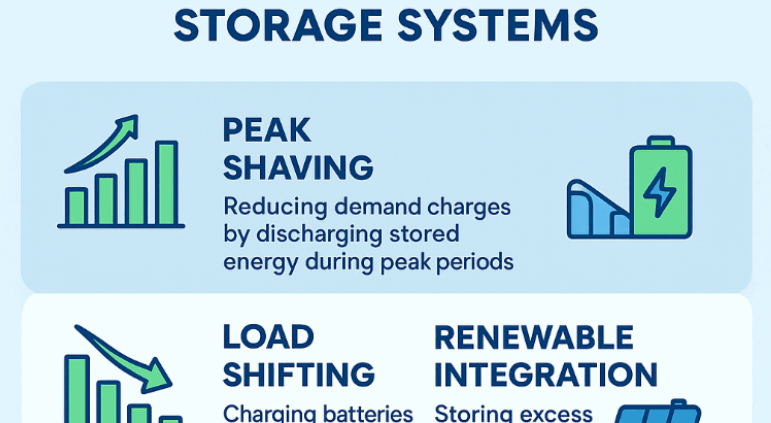
Top Applications of Commercial & Industrial Battery Energy Storage Systems (C&I BESS)
Top applications of C&I BESS: As energy costs rise and power reliability becomes a growing concern, businesses are turning to Commercial & Industrial Battery Energy Storage Systems (C&I BESS). These systems go beyond storing electricity — they provide flexible solutions that help companies cut costs, enhance resilience, and meet sustainability goals.
Here, we explore the top applications of C&I BESS that are transforming the way businesses manage energy.
1. Peak Shaving – Reducing Demand Charges
One of the most common applications of C&I BESS is peak shaving. Utilities often charge businesses based on their highest electricity demand during peak periods. By discharging stored energy at these times, a C&I BESS reduces demand charges significantly.
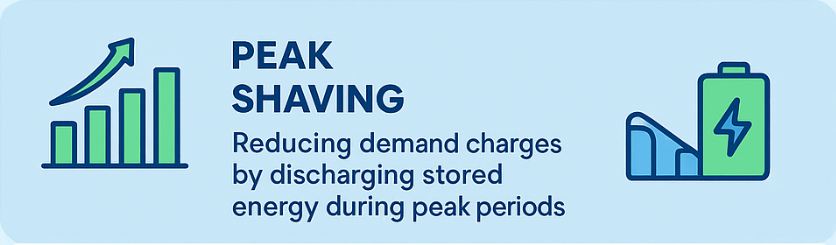
This translates to major cost savings, especially for manufacturing plants, data centers, and large commercial facilities with fluctuating power needs.
2. Load Shifting – Smarter Energy Use
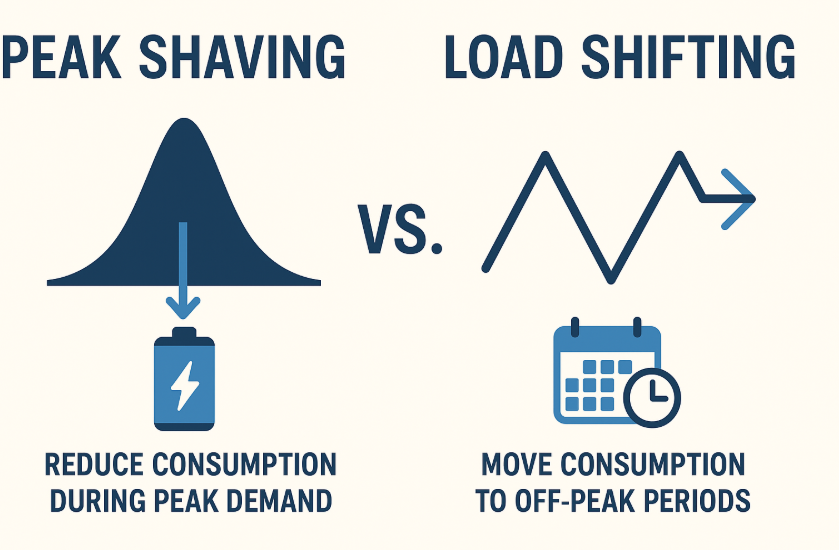
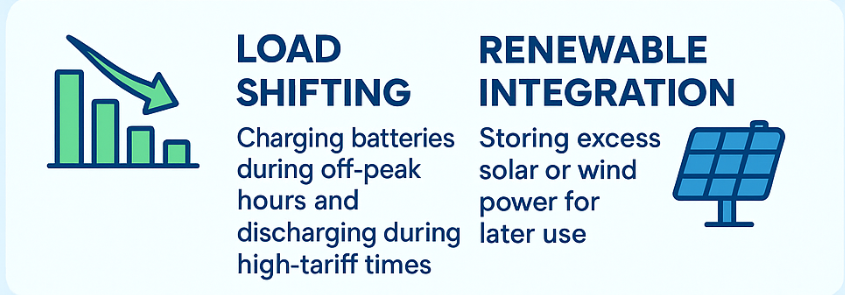
A C&I BESS enables smarter energy usage, ensuring businesses maximize cost efficiency while maintaining reliable operations.
3. Renewable Energy Integration – Unlocking Sustainability
C&I BESS plays a crucial role in making renewable energy sources like solar and wind more reliable. Since renewables are intermittent, storage ensures that excess generation can be stored and used later.
This makes it easier for businesses to rely on clean energy, reduce dependence on the grid, and achieve sustainability targets.
4. Backup Power & Resilience – Business Continuity
Power outages can disrupt operations, damage equipment, and cause financial losses. A C&I BESS provides backup power, ensuring continuity during grid failures.
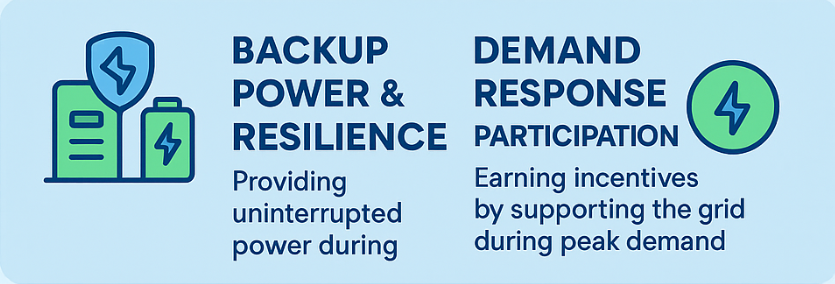
Unlike traditional diesel generators, BESS offers silent, clean, and instant backup, making it a better long-term solution for critical facilities such as hospitals, factories, and logistics hubs.
5. Demand Response Participation – New Revenue Streams
With demand response programs, businesses can use a C&I BESS to support the grid during peak times. By discharging energy when the grid is strained, companies not only contribute to stability but also earn incentives from utilities.
This turns a C&I BESS into a revenue-generating asset, not just a cost-saving one.
6. Electric Vehicle (EV) Charging Support – Fast & Efficient
As EV adoption grows, many businesses are installing charging infrastructure. However, fast charging requires significant power, which can strain the grid.
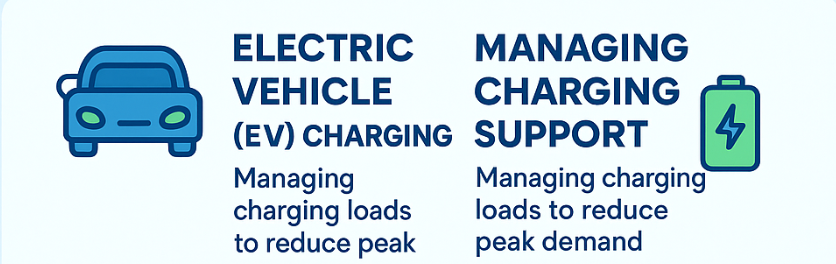
A C&I BESS helps smooth EV charging loads, reducing peak demand and ensuring consistent charging availability. This makes it ideal for fleet operators, logistics companies, and commercial charging stations.
7. Microgrid & Grid Support – Local Energy Independence
In regions where the grid is unstable, a C&I BESS enables microgrids — self-sufficient energy systems that can operate independently.
By integrating renewables, storage, and local generation, businesses gain energy independence while also supporting grid functions like voltage regulation and frequency balancing.
Conclusion
The applications of C&I BESS extend far beyond energy storage. From peak shaving and load shifting to renewable integration, backup power, EV charging support, and microgrid participation, these systems deliver unmatched flexibility and value.
For businesses seeking to cut costs, increase reliability, and move toward sustainability, a C&I BESS is no longer optional — it’s essential.
👉 Want to understand how these applications connect to the system itself? Read our detailed guide on the Key Components of a C&I BESS.
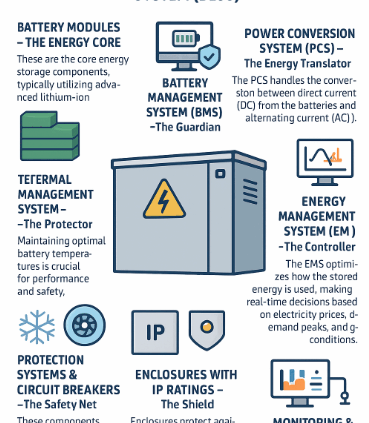
Key Components of a Commercial & Industrial (C&I) Battery Energy Storage System (BESS)
As businesses look for smarter energy solutions, Commercial & Industrial Battery Energy Storage Systems (C&I BESS) are leading the transformation. These systems help companies cut electricity costs, improve power reliability, and integrate renewable energy sources.
A Commercial & Industrial BESS is more than just a battery—it is a complex system built with advanced components that ensure performance, safety, and resilience. Let’s explore the key components of a C&I BESS, including the protective enclosures and fire safety systems that make them robust for industrial use.
1. Battery Modules – The Energy Core
The battery modules are the foundation of every C&I BESS. They store excess electricity from renewable energy sources such as solar or from the grid during off-peak hours.
Most C&I BESS installations use lithium-ion technology, particularly Lithium Iron Phosphate (LFP), because it delivers high efficiency, fast response times, and longer cycle life. These modules provide reliable storage while meeting the high demands of industrial operations.
2. Battery Management System (BMS) – The Guardian
Within a C&I BESS, the Battery Management System (BMS) ensures the safe and efficient operation of every cell. It monitors:
- Voltage and current
- State of charge (SOC) and state of health (SOH)
- Temperature variations across modules
By preventing overcharging, deep discharging, and overheating, the BMS extends battery life and safeguards the entire C&I BESS against failures.
3. Power Conversion System (PCS) – The Energy Translator
- Inverter: DC to AC during discharge
- Rectifier: AC to DC during charging
With bidirectional flow, the PCS allows the C&I BESS to provide services like peak shaving, load shifting, and grid support, ensuring seamless energy transitions.
4. Energy Management System (EMS) – The Controller
The Energy Management System (EMS) is the control center of a C&I BESS. It manages when to store or release energy based on demand, pricing, and renewable generation.
Key EMS functions in a C&I BESS include:
- Peak shaving to reduce costly demand charges
- Load shifting for off-peak savings
- Renewable integration for solar and wind energy
- Grid support through voltage and frequency stabilization
The EMS ensures that the C&I BESS not only stores power but also strategically enhances efficiency and sustainability.
5. Thermal Management System – The Protector
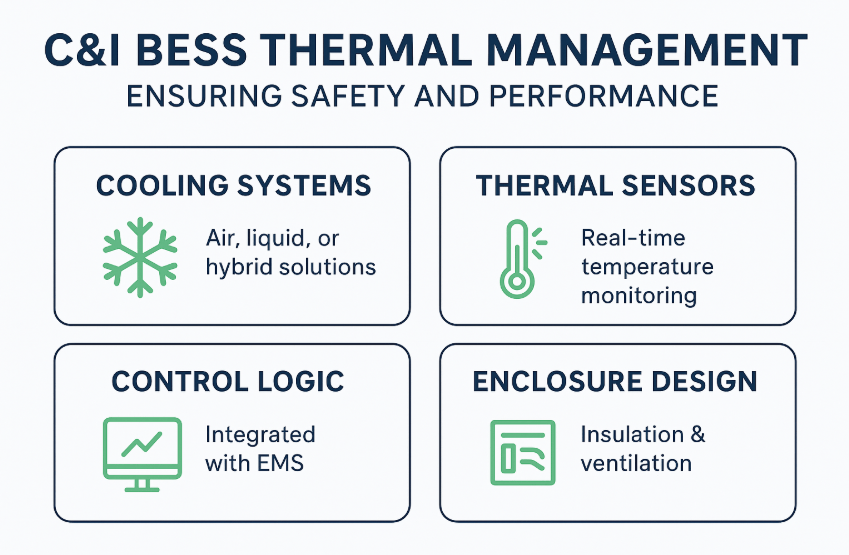
For safe and efficient operation, a C&I BESS requires precise temperature control. The thermal management system maintains battery modules within safe operating ranges using:
- Forced air cooling
- Advanced liquid cooling systems
- Phase change materials (PCM) for high-performance applications
These solutions prevent overheating, extend battery life, and ensure the C&I BESS can perform reliably under demanding industrial conditions.
6. Protection Systems & Circuit Breakers – The Safety Net
Every C&I BESS must withstand electrical challenges. Protection systems include:
- Circuit breakers to isolate faults
- Surge protectors to handle voltage spikes
- Overcurrent protection for high-load safety
These safeguards ensure the C&I BESS remains reliable, even in complex grid or facility environments.
7. Enclosures with IP Ratings – The Shield
The enclosures of a Commercial & Industrial BESS are not just protective shells—they are engineered shields that keep the system safe from environmental threats.
Most enclosures meet IP54 to IP66 ratings, ensuring resistance to dust, water, and extreme conditions. For example:
- IP54/IP55: Protection from dust and water spray (suitable for indoor or mild outdoor environments)
- IP65/IP66: Fully dust-tight and resistant to strong water jets (ideal for harsh outdoor conditions)
With corrosion resistance, robust construction, and climate protection, IP-rated enclosures enable C&I BESS systems to deliver reliable performance in diverse locations.
8. Fire Safety Systems – The Last Line of Defense
Safety is a defining factor of any Commercial & Industrial BESS design. To prevent hazards such as thermal runaway, modern systems include:
- Early smoke and gas detection
- Automatic fire suppression systems (clean agent, inert gas, or aerosol-based)
- Fire barriers and controlled venting to contain emergencies
These features align with UL 9540A fire testing and IEC standards, making C&I BESS installations safe and compliant with global regulations.
9. Monitoring & Communication Systems – The Connectors
Advanced monitoring and communication systems give operators real-time visibility into the performance of a C&I BESS.
With IoT-enabled dashboards, operators can:
- Track state of charge and performance trends
- Perform predictive maintenance
- Integrate the Commercial & Industrial BESS with building energy management systems (BEMS) and utility controls
This connectivity ensures the C&I BESS remains intelligent, efficient, and adaptive to evolving energy needs.
Conclusion
A Commercial & Industrial BESS is a highly engineered energy solution that combines battery modules, BMS, PCS, EMS, thermal management, protection systems, IP-rated enclosures, fire safety, and communication platforms.
Every component in a C&I BESS plays a vital role in delivering efficiency, safety, and reliability. By investing in well-designed systems, businesses can unlock cost savings, improve resilience, and contribute to a sustainable energy future
Demand Response in Virtual Power Plants: Balancing Energy Supply and Demand
In today’s energy landscape, flexibility is just as important as generation. As renewable energy adoption grows, balancing supply and demand has become a major challenge. Demand Response (DR), when integrated into Virtual Power Plants (VPPs), offers a powerful solution to achieve this balance. By intelligently shifting or reducing electricity usage during peak hours, demand response ensures a more resilient, affordable, and sustainable energy system.
What Is Demand Response?
Demand Response is an energy management strategy where consumers adjust their electricity usage in response to grid conditions, price signals, or incentives. Instead of relying solely on power plants to ramp up supply, DR helps reduce stress on the grid by adjusting demand.
When this capability is connected to a Virtual Power Plant, thousands of distributed assets — from smart appliances to EV chargers — can collectively act as a flexible energy resource.
How Demand Response Works in Virtual Power Plants
- Real-Time Monitoring: Smart meters and IoT devices track consumption patterns.
- Automated Control: Appliances, batteries, and HVAC systems adjust based on grid signals.
- Aggregated Flexibility: Small changes across households and businesses add up to major load reductions.
- Bidirectional Benefits: Consumers earn incentives, while grid operators reduce stress on infrastructure.
Benefits of Demand Response in VPPs
- Grid Stability – Reduces blackouts and stabilizes renewable variability.
- Cost Savings – Consumers and businesses lower bills by shifting use to off-peak hours.
- Decarbonization – Maximizes the integration of renewable energy by reducing reliance on fossil-fuel backup plants.
- Resilience – Communities gain more reliable access to electricity during extreme demand peaks.
Real-World Applications
- United States: California’s Flex Alert program rewards consumers for reducing usage during peak times, and when tied into VPPs, it supports grid resilience during heatwaves.
- Europe: Germany and the UK are experimenting with large-scale DR programs integrated into VPP platforms to balance wind and solar fluctuations.
- Asia: Japan’s utilities use DR to manage peak demand from air conditioning loads in summer while leveraging VPP networks.
Demand Response + Smart Grids + Storage
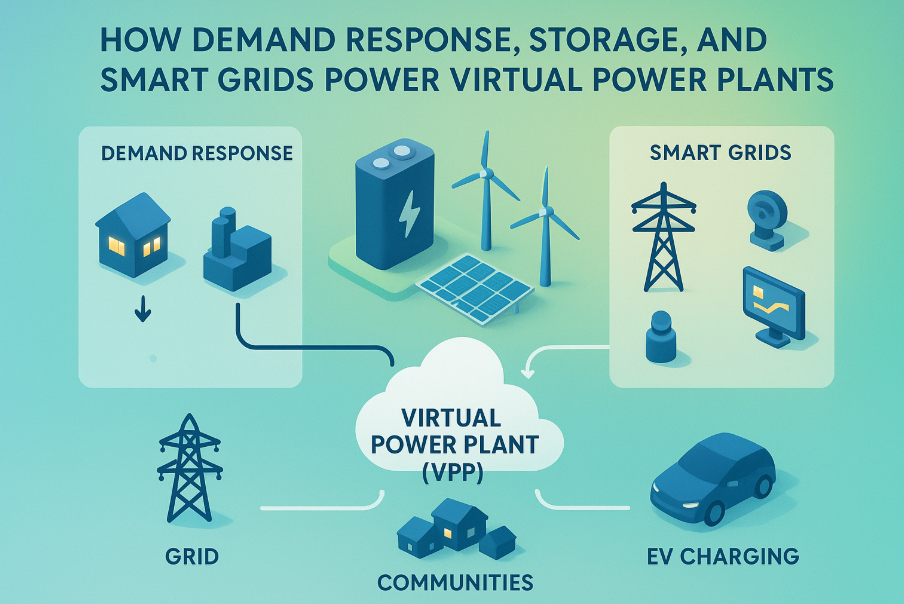
Demand Response becomes even more effective when combined with:
- Smart Grids, which provide the intelligence to coordinate energy flows.
- Battery Storage, which captures excess energy and releases it during peak demand.
- Renewables, ensuring cleaner, more sustainable demand-shifting solutions.
Conclusion
Demand Response is the hidden power of Virtual Power Plants. By engaging consumers and leveraging automation, it transforms passive energy users into active participants in grid management. The result is a system that is smarter, cleaner, and more resilient for everyone.
Peak Shaving vs Load Shifting: Key Energy Management Strategies
Peak Shaving vs Load Shifting: Electricity demand is becoming increasingly dynamic as renewable energy adoption grows and electricity consumption patterns change.
Businesses and utilities must manage demand efficiently to avoid high electricity costs and maintain grid stability.
Two important strategies used in energy management are peak shaving and load shifting.
Understanding the difference between peak shaving vs load shifting helps organizations optimize energy use, reduce electricity costs, and maximize the value of battery energy storage systems.
Peak Shaving vs Load Shifting (Quick Comparison)
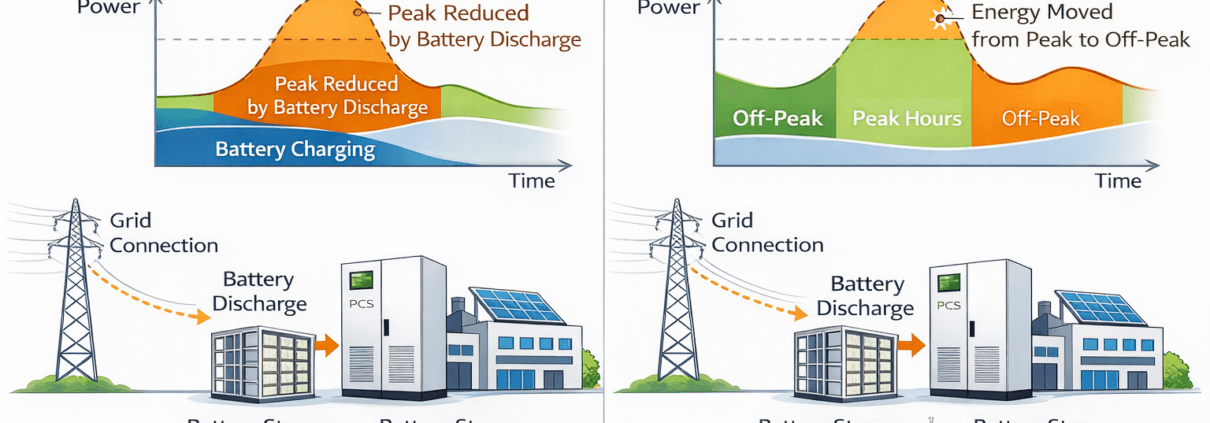
Peak shaving and load shifting are energy management strategies used to reduce electricity costs. Peak shaving lowers electricity demand during peak hours by using stored energy or reducing loads. Load shifting moves energy consumption to off-peak periods when electricity prices are lower. Many businesses combine both strategies using battery energy storage systems.
| Strategy | Main Goal |
|---|---|
| Peak Shaving | Reduce demand spikes |
| Load Shifting | Move demand to cheaper hours |
What Is Peak Shaving?
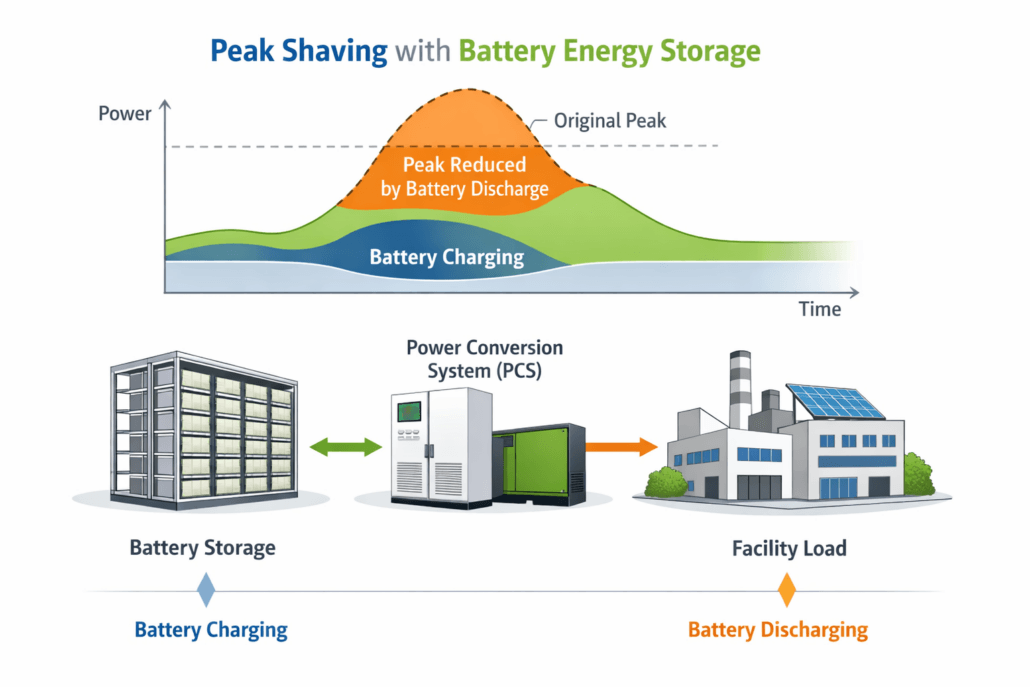
Peak shaving is the process of reducing electricity consumption during peak demand periods.
Utilities often charge commercial customers based on their maximum demand (kW) during a billing cycle. These are known as demand charges.
According to the U.S. Department of Energy, demand charges can represent a significant portion of industrial electricity bills.
Peak shaving reduces this maximum demand by supplying energy from alternative sources.
Common Peak Shaving Methods
Organizations use several technologies to perform peak shaving:
- Battery Energy Storage Systems
- On-site backup generators
- Smart energy management systems
- Temporary load reduction strategies
For example, a manufacturing facility may use stored battery energy between 4 PM and 8 PM, when electricity demand is highest.
Instead of drawing power from the grid, the battery supplies electricity to the facility.
This reduces peak demand and lowers electricity costs.
What Is Load Shifting?
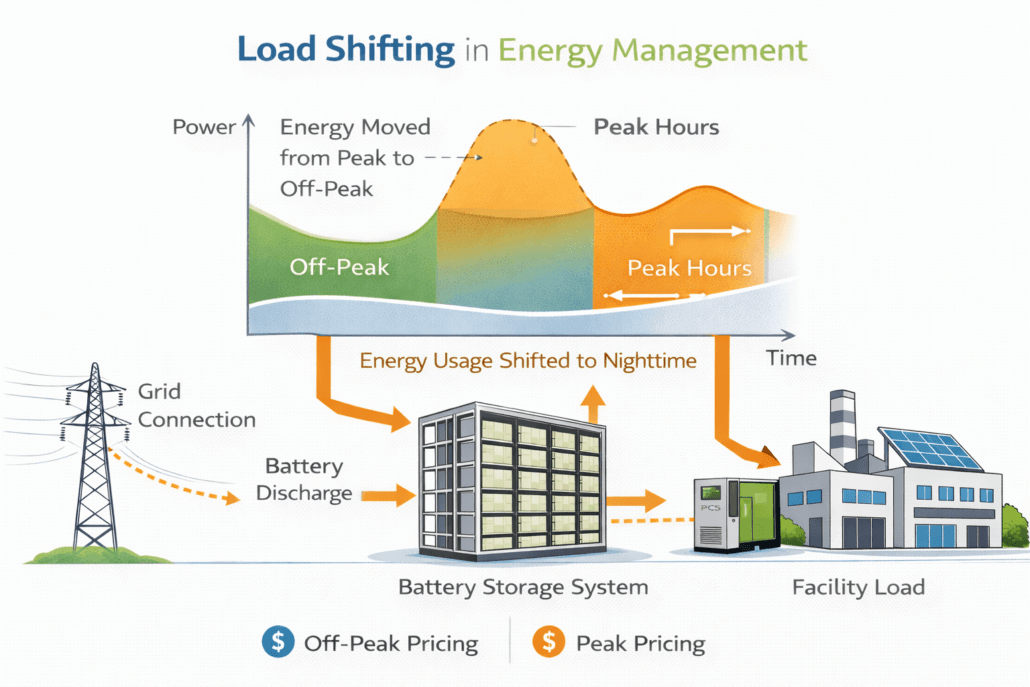
Load shifting is an energy management strategy that moves electricity consumption from high-price periods to lower-price periods.
Unlike peak shaving, load shifting does not necessarily reduce total energy consumption. Instead, it changes when electricity is used.
Time-of-use electricity pricing encourages this behavior by charging different rates depending on the time of day.
Energy market analysis from the International Energy Agency shows that flexible demand strategies like load shifting play an important role in modern electricity systems.
Examples of Load Shifting
Common load shifting strategies include:
- Charging electric vehicles overnight
- Running industrial processes during off-peak hours
- Pre-cooling commercial buildings early in the day
- Scheduling data processing tasks overnight
By shifting energy usage to cheaper periods, businesses can significantly reduce electricity costs.
Peak Shaving vs Load Shifting: Key Differences
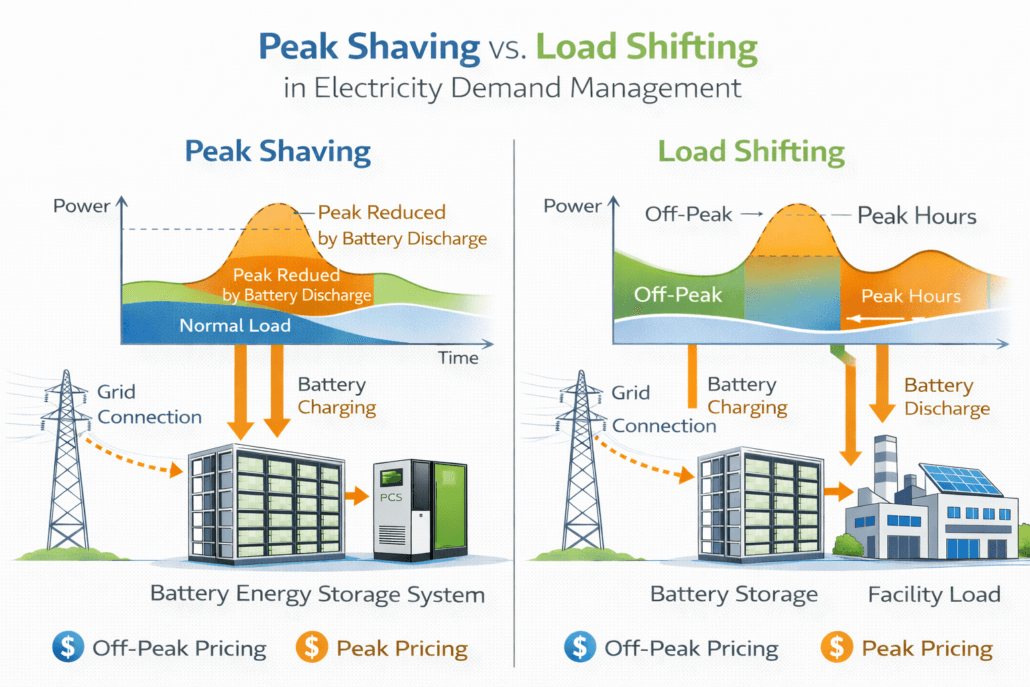
Although both strategies improve energy efficiency, they address different energy management objectives.
Peak Shaving vs Load Shifting Comparison
| Feature | Peak Shaving | Load Shifting |
|---|---|---|
| Primary goal | Reduce maximum demand | Move consumption timing |
| Electricity usage | Reduced during peak | Similar total usage |
| Cost savings | Lower demand charges | Lower energy charges |
| Technologies | BESS, generators | Automation, scheduling |
| Typical duration | Short peak events | Several hours |
Peak shaving focuses on reducing demand spikes, while load shifting focuses on changing consumption patterns.
How Battery Energy Storage Enables Both Strategies
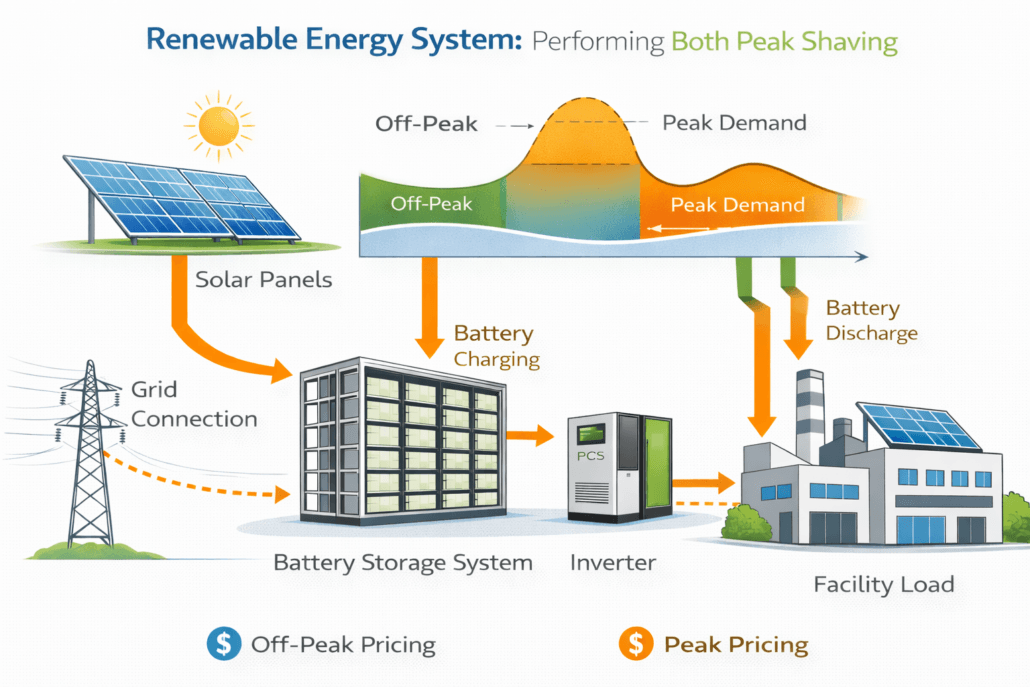
Battery energy storage systems are one of the most effective tools for modern energy management.
Batteries can perform both peak shaving and load shifting simultaneously.
Peak Shaving with Batteries
During periods of high demand, stored electricity is discharged to supply facility loads.
This reduces the amount of power drawn from the grid.
Load Shifting with Batteries
During low-price periods, batteries charge using grid electricity or renewable energy.
The stored energy is then used later when prices increase.
Advanced energy management platforms automatically control charging and discharging schedules.
For a deeper explanation, see Energy Management Systems in BESS on the Sunlith Energy website.
Why Peak Shaving Matters for Businesses
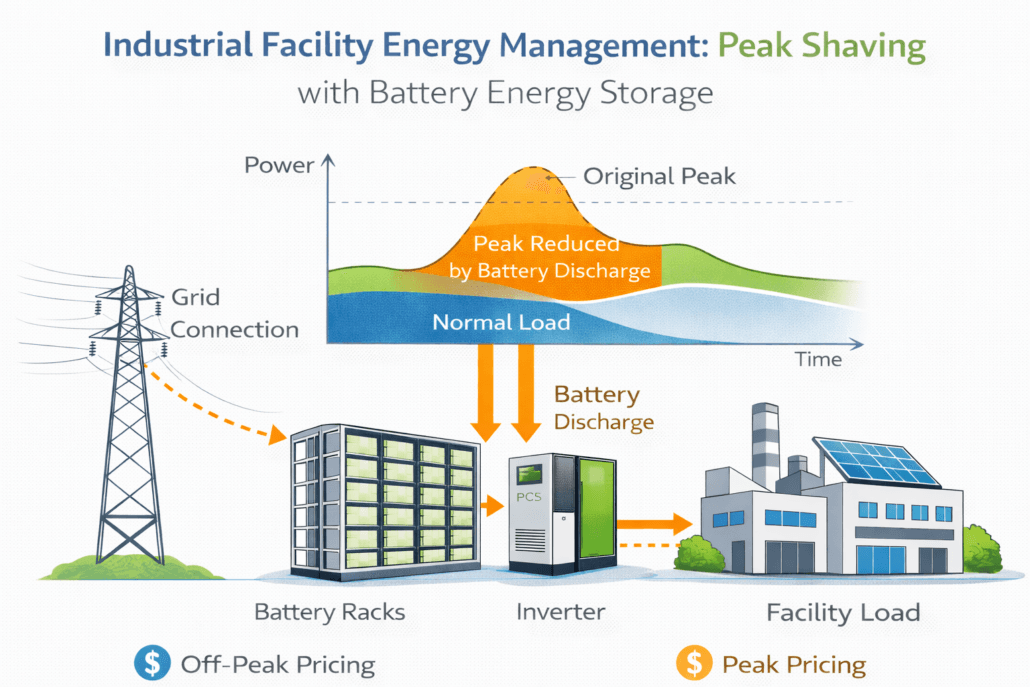
Peak shaving delivers several financial and operational benefits.
Lower Electricity Bills
Demand charges can account for up to 30–70% of commercial electricity bills.
Reducing peak demand can significantly lower operational costs.
Improved Grid Reliability
High demand periods place stress on power infrastructure.
Peak shaving reduces the load on the grid during these critical periods.
Better Renewable Energy Integration
Battery storage allows renewable energy generated earlier in the day to be used during peak demand periods.
Benefits of Load Shifting
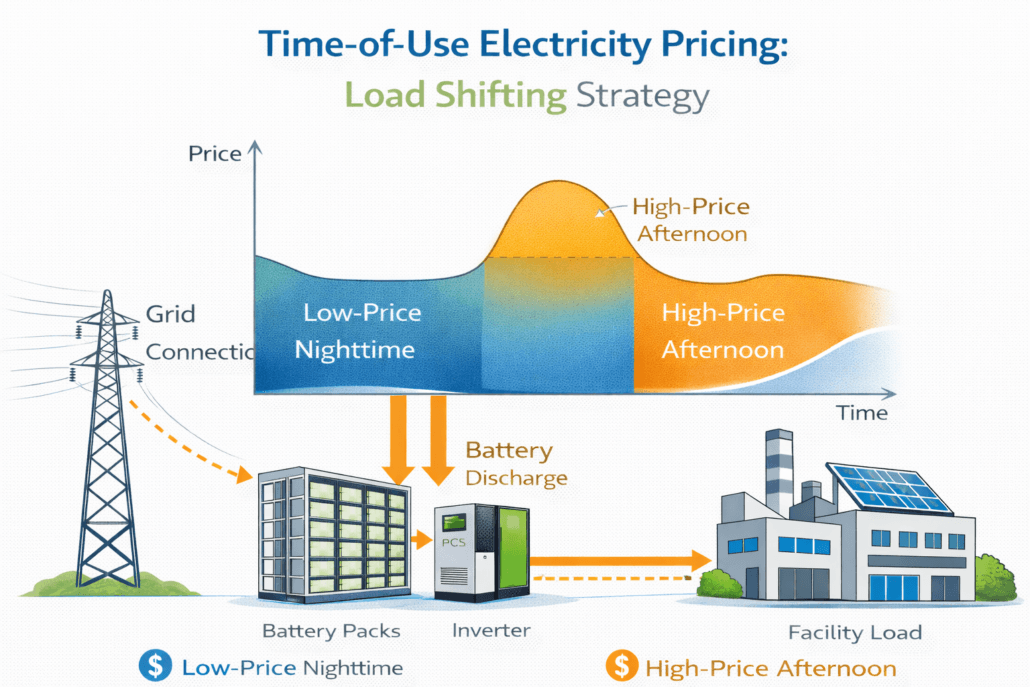
Load shifting complements peak shaving by optimizing energy consumption timing.
Reduced Energy Costs
Electricity prices are typically lower during off-peak hours.
Moving consumption to these times reduces energy expenses.
Improved Operational Flexibility
Facilities can schedule energy-intensive operations during periods of lower electricity prices.
Support for Renewable Energy
Load shifting allows electricity demand to align better with renewable energy generation patterns.
This improves overall energy efficiency.
Peak Shaving vs Load Shifting Real-World Example
Consider a large commercial data center.
Cooling demand rises significantly during the afternoon when electricity prices are highest.
The facility uses two strategies:
Peak Shaving
Battery storage supplies electricity during the highest demand hours.
Load Shifting
Non-critical computing workloads are scheduled overnight.
By combining these strategies, the data center reduces electricity costs and improves energy efficiency.
When Should Businesses Use Peak Shaving?
Peak shaving is most effective when:
- Demand charges dominate electricity costs
- Facilities experience short demand spikes
- Battery storage is available
- Operations cannot easily be rescheduled
Industries that commonly use peak shaving include:
- Manufacturing plants
- Data centers
- Commercial buildings
- Industrial processing facilities
When Should Businesses Use Load Shifting?
Load shifting is ideal when:
- Electricity pricing varies by time of day
- Operations are flexible
- Energy-intensive processes can be scheduled
- Smart automation systems are available
Industries benefiting from load shifting include:
- Warehousing operations
- Water treatment facilities
- Agricultural irrigation systems
- Electric vehicle charging infrastructure
Combining Peak Shaving and Load Shifting
The most effective energy management strategies often combine both approaches.
Load shifting reduces energy costs by moving demand to cheaper hours.
Peak shaving then minimizes remaining demand spikes.
When integrated with advanced energy management systems, this combined strategy creates a flexible and efficient energy system.
For more insights on grid optimization strategies, explore Demand Response Energy Management on the Sunlith Energy knowledge hub.
Conclusion
Peak shaving and load shifting are essential tools for modern energy management.
Peak shaving reduces electricity demand during high-load periods to avoid costly demand charges.
Load shifting moves electricity consumption to lower-cost periods.
Together, these strategies help businesses:
- Reduce electricity costs
- Improve grid stability
- Optimize renewable energy usage
- Increase energy efficiency
With the growing adoption of battery energy storage systems, organizations can implement both strategies effectively and create more resilient energy systems.
Peak Shaving vs Load Shifting FAQ
What is peak shaving in energy management?
Peak shaving is the process of reducing electricity demand during the highest consumption periods. Businesses typically use battery energy storage systems or on-site generation to supply electricity during peak hours and avoid demand charges.
What is load shifting in electricity systems?
Load shifting is an energy management strategy that moves electricity consumption from high-cost peak periods to lower-cost off-peak hours.
What is the difference between peak shaving and load shifting?
Peak shaving reduces electricity demand during peak hours, while load shifting changes when electricity is consumed to take advantage of lower electricity prices.
Can battery energy storage systems perform both peak shaving and load shifting?
Yes. Battery energy storage systems can charge during off-peak periods and discharge during peak demand, enabling both strategies.
Why do utilities charge demand charges?
Utilities charge demand charges to encourage customers to reduce peak electricity demand and maintain grid stability.