
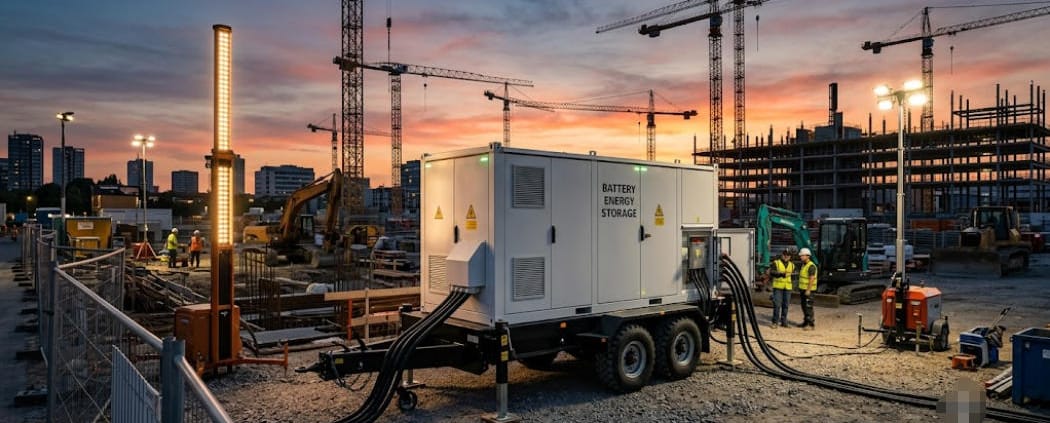
Mobile BESS: The Complete Guide to Trailer-Mounted Battery Storage
| ⚡ Quick Answer A Mobile BESS is a battery energy storage system built onto a trailer, truck bed, or skid. It stores electricity and discharges it on demand, so it can power a site with no fuel, no exhaust, and almost no noise. |
What Is a Mobile BESS?
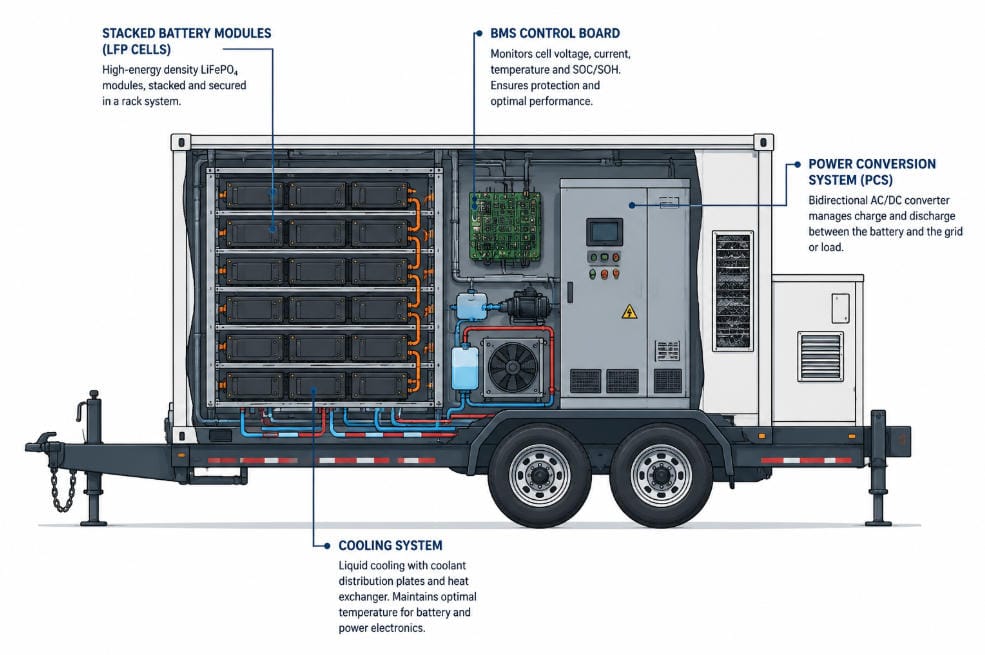
A Mobile BESS packs the same core parts as a fixed installation into a towable unit. Battery modules sit inside a weatherproof enclosure. Meanwhile, a power conversion system (PCS) turns stored DC energy into usable AC power, and a battery management system (BMS) tracks voltage, temperature, and charge level in real time.
In some designs, manufacturers split the battery pack and the PCS into separate trailers. As a result, an operator can pair several battery trailers with one shared PCS unit and add capacity without buying a new inverter each time.
Mobile BESS vs. Diesel Generators
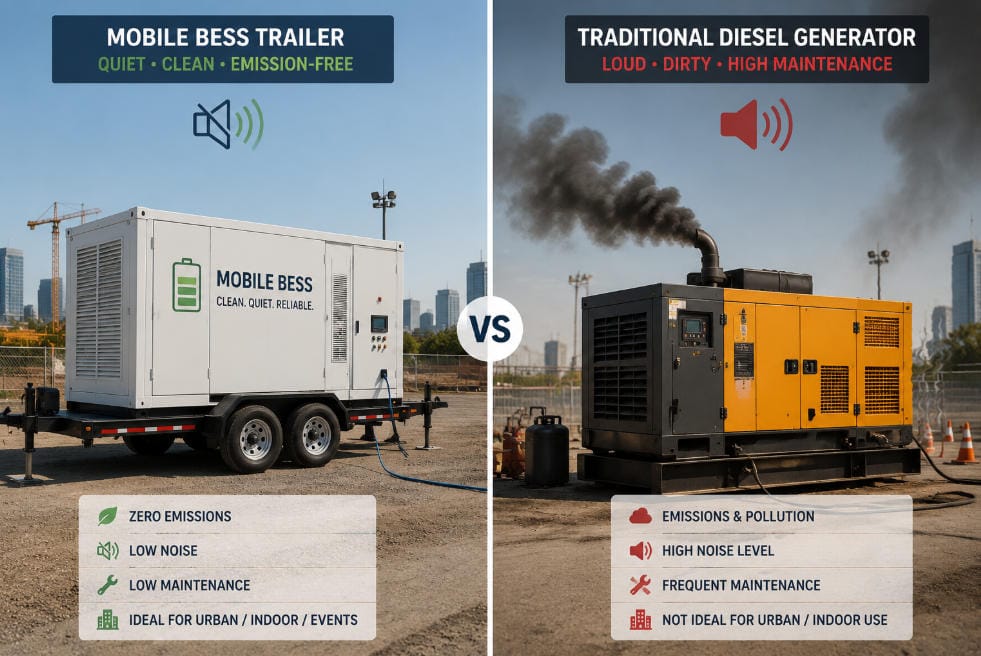
Diesel generators have powered temporary sites for decades. Today, though, a Mobile BESS competes for many of the same jobs. Since it works in a very different way, the table below compares the two side by side.
| Factor | Mobile BESS | Diesel Generator |
| Emissions | Zero exhaust during discharge | Combustion exhaust, particulates, NOx |
| Noise | Near-silent operation | 60-90+ dB at typical load |
| Fuel logistics | None during discharge; recharges from grid or solar | Ongoing diesel delivery and storage |
| Response time | Instant power, no warm-up | Seconds to minutes to reach stable output |
| Runtime | Fixed by battery capacity, then needs recharge | Runs as long as fuel supply lasts |
| Best fit | Short-duration, indoor, or noise-restricted sites | Long, continuous loads with no grid access |
In practice, many sites pair the two instead of choosing one. First, a generator recharges the battery at its most efficient load point. Then it steps back while the Mobile BESS carries the load alone.
Because of this, the hybrid pattern can cut diesel use by roughly half. A generator that idles at partial load burns fuel poorly, so shifting the everyday load onto the battery saves real money over a multi-week job.
Mobile BESS Use Cases
Mobile BESS units solve an old problem in a new way. They provide temporary power where the grid hasn’t arrived yet, isn’t reliable, or isn’t allowed. Overall, six use cases account for most deployments today.
Construction Sites
Construction is the largest single market for mobile storage. Grid interconnection applications often take three to nine months, so a Mobile BESS closes that gap right away.
It can power tower cranes, welding gear, site offices, and electric machinery from day one. Because it makes no exhaust, crews can also run it in tunnels and basements, where diesel fumes would be unsafe.
Events and Film Production
Concerts, festivals, and film sets need power that stays out of the way. A Mobile BESS delivers clean sine-wave output and stays under roughly 55 dB, so it won’t hum in a live recording or flicker a sensitive light rig.
Simply put, a generator can’t match that at the power levels these shoots need.
Mobile BESS for Disaster Relief
When storms or wildfires knock out power lines, crews can truck in units within hours. They power emergency radios, medical gear, and temporary shelters, often arriving before utility crews finish permanent repairs.
Data Center Maintenance Windows
Data centers sometimes need to take a UPS or switchgear segment offline for maintenance without losing backup coverage. A Mobile BESS can stand in during that window, then leave once the permanent system is back online.
Mobile BESS for Grid Support
Utilities and developers increasingly use these units for temporary grid services: voltage support, short-term capacity, or bridging power for a solar or wind project still waiting on its permanent interconnection agreement. As a result, a finished generation asset keeps earning instead of sitting idle.
EV Charging Support
Pop-up EV charging is one of the fastest-growing uses. Because a Mobile BESS can buffer a weak grid connection, it can still deliver fast-charging bursts at events or in areas the grid hasn’t fully reached.
Mobile BESS Sizing and Chassis Configurations
Capacity varies widely, and the right size depends entirely on the job. Understanding a few typical bands makes it much easier to spec the right unit.
Chassis Types and Capacity
Compact truck-mounted units typically sit around 90 kWh. Power Up Connect’s Green Grid trailer is a good example: it carries UL 9540 and UL 9540A certification, and operators can daisy-chain up to 10 units for bigger jobs.
Meanwhile, mid-size trailer units generally run from about 250 kWh to 650 kWh. This band covers most construction and event work.
Utility-scale trailers sit at the top end. They often exceed 800 kWh and sometimes reach 2 MWh per unit. These usually ride on a 20-foot container platform or a dedicated semi-trailer, so teams can string several together for multi-megawatt-hour jobs.
| Chassis Type | Typical Range | Best Fit |
| Compact flatbed / skid | ~90 kW – 300 kWh | Small job sites, single-piece equipment, light-load events |
| Drawbar trailer | ~250 kW – 650 kWh | Mid-size construction sites, festivals, multi-generator replacement |
| Container semi-trailer | 800 kWh+ up to ~2 MWh | Utility-scale temporary power, large events, grid-support deployments |
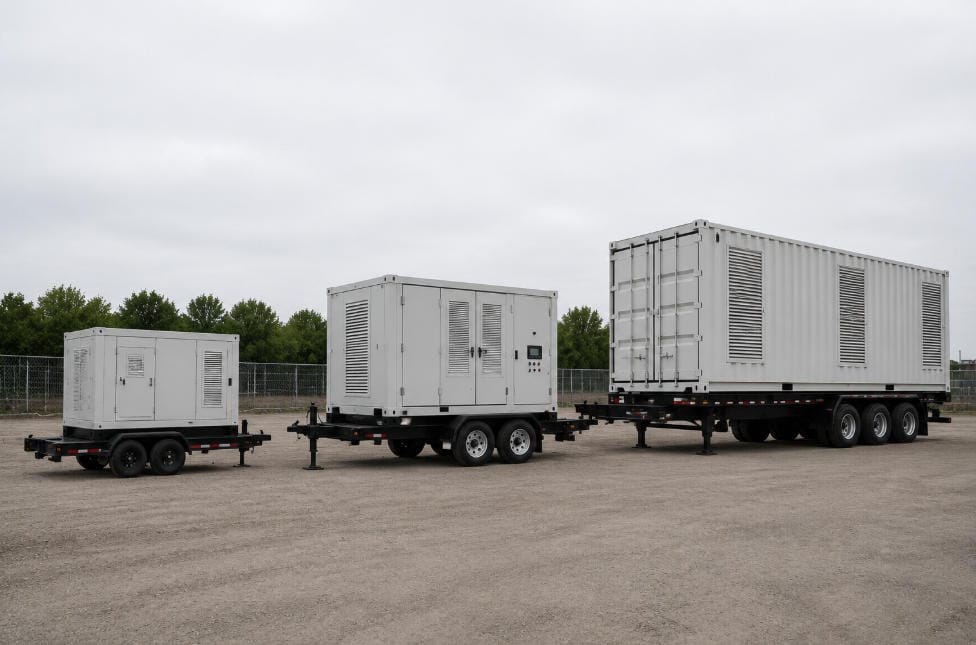
Road weight limits usually cap a single trailer’s size, not the battery technology itself. So past roughly 1-2 MWh, it’s typically easier to deploy multiple units side by side than to push one chassis larger.
Battery Chemistry and Cooling
LFP (lithium iron phosphate) leads this segment for good reason. It handles the shaking and heat swings of repeated transport well. Plus, its long cycle life (commonly rated 6,000-8,000+ cycles) suits frequent redeployment far better than higher-energy but less forgiving chemistries.
Smaller units, roughly under 300 kWh, typically use air cooling. It keeps the system light and easy to fix in the field.
Larger, higher-power trailers, however, generally switch to liquid cooling instead, since it manages heat better. This is the same crossover point used in stationary BESS design.
Chassis engineering: Dual-axle running gear, mechanical braking, and vibration-dampening brackets protect the battery pack through highway travel and rough job-site terrain. The chassis itself needs proper axle load ratings, DOT-compliant lighting and braking, and secure tie-down points.
Mobile BESS Safety and Compliance
A Mobile BESS still has to meet the same fire-safety and transport rules as any lithium battery system. However, it does earn a few specific carve-outs because it moves.
NFPA 855 Rules
NFPA 855, the Standard for the Installation of Stationary Energy Storage Systems, defines mobile ESS in Section 3.3.9.5. It then sets installation rules in Section 4.5. The most important carve-out is this: wheeled or trailer-mounted units don’t need to meet the seismic and structural load rules that apply to permanent installations.
Even so, standard separation distances still apply. Deployments need at least 10 ft (3 m) from public ways, stored combustibles, and hazardous materials. They also need 50 ft (15 m) from tents or seating areas holding 30 or more people.
That said, an Authority Having Jurisdiction (AHJ) can reduce these distances if large-scale UL 9540A fire test data backs it up. Regardless, deployed mobile ESS still can’t go indoors, in covered parking garages, on rooftops, below grade, or under building overhangs.
UL 9540 Listing for Mobile BESS
Mobile units still need UL 9540 listing, the core safety standard for energy storage systems. They typically undergo UL 9540A large-scale fire testing too, just like a stationary installation.
In short, mobility doesn’t exempt the battery system from certification — it only changes the foundation and seismic rules. For the full installation breakdown, see our NFPA 855 guide.
Transport Testing Under UN 38.3
Before a Mobile BESS can ship, its cells and battery packs must pass UN 38.3. This set of eight tests simulates real transport conditions: altitude, thermal cycling, vibration, mechanical shock, short circuit, impact, overcharge, and forced discharge.
The vibration test alone runs a sweep from 7 Hz to 200 Hz for three hours. Next, a shock test simulates a 150g/6ms or 50g/11ms impact. That’s a tough bar, since this system gets driven over real roads again and again, not installed once and left in place.
Road Transport Rules
In the US, moving an assembled lithium battery system by highway falls under 49 CFR 173.185, part of the DOT’s Hazardous Materials Regulations. Since it classifies lithium batteries as Class 9 dangerous goods, compliance means UN-spec packaging, correct labels, and proper shipping papers.
A good provider keeps UL 9540 listing documents and UN 38.3 test summaries ready on request. You shouldn’t have to wait while a provider scrambles for paperwork after a jurisdiction asks for it.
Certification Varies by Export Market
It’s also worth noting that certificates differ by market, not just by product. US and Canadian buyers look for UL 1973, UL 9540, and UL 9540A. EU buyers need CE marking plus IEC 62619 or IEC 62933. China requires CCC, Korea requires KC, India requires BIS, and Japan requires PSE. UN 38.3 applies everywhere, since it covers transport rather than installation. For the full regional breakdown, see our BESS certifications guide.
Mobile BESS vs. Stationary BESS
| Factor | Mobile BESS | Stationary BESS |
| Installation | Deployed in hours; no permanent foundation | Weeks to months; foundation and permitting |
| Relocation | Built to move between sites | Fixed for the life of the asset |
| Typical use case | Temporary power, events, emergency response | Long-term grid support, solar firming |
| Seismic requirements | Exempt when on a wheeled chassis | Full seismic design required |
| Capacity ceiling | Practical limit near 1-2 MWh per trailer | Scales to tens or hundreds of MWh |
| Cost structure | Often rented per deployment | Capital asset with long depreciation |
Choosing a Mobile BESS Provider
Providers increasingly sell Mobile BESS as a service rather than as a capital purchase. Because of that, the ownership model matters just as much as the hardware spec sheet.
- Rental / deployment-based pricing — pay per project or per month, and the provider handles maintenance and recharge logistics
- Battery-swap service — the provider delivers a fully charged replacement unit and takes the depleted one away, so on-site recharging is never your problem
- Hybrid generator pairing — for sites where full battery replacement isn’t practical yet, running the BESS alongside a generator can still cut fuel use by roughly half
- Outright purchase — makes sense when your organization deploys often enough that utilization beats rental economics
Before committing, it’s worth asking any provider a few direct questions:
- Is the unit UL 9540 listed and UN 38.3 tested, with documentation available on request?
- What is the actual site commissioning time, door-to-power-on, not just “rapid deployment” marketing language?
- What is the noise rating at rated load, and is it independently measured or a vendor estimate?
- Is the enclosure rated for indoor or enclosed-space use, or is it outdoor-only?
- What happens if the unit needs service mid-deployment? Is there a swap or backup unit guarantee?
- What’s included in the rental rate: transport, commissioning, decommissioning, and recharge, or are these billed separately?
- Does the chassis carry standard DOT lighting, braking, and axle certifications for your transport route?
Mobile BESS Market Outlook
Fortune Business Insights values the mobile energy storage system market at $58.28 billion in 2025, and projects it will reach $207.03 billion by 2034. That’s a compound annual growth rate above 15%.
Several trends are driving this growth. For one, utilities and developers are swapping out diesel generators to cut emissions and noise complaints. At the same time, falling LFP battery costs make the switch more affordable each year.
Longer grid interconnection queues are pushing more projects toward temporary bridging power, too. And a growing rental and battery-swap model is lowering the barrier for construction and events firms that don’t want to own the asset outright.
So for project developers, the takeaway is simple. Mobile BESS has moved from a niche disaster-relief tool to a mainstream option, one worth considering any time a site needs power before, instead of, or alongside a permanent grid connection.
Mobile BESS Key Takeaways
| Aspect | Key Point |
| Definition | A Mobile BESS is a trailer-, truck-, or skid-mounted battery storage system built for temporary deployment. |
| Chemistry | LFP dominates for thermal stability and 6,000-8,000+ cycle life. |
| Cooling | Air cooling under ~300 kWh; liquid cooling for larger, high-power units. |
| Sizing | Ranges from ~90 kWh truck units to 2 MWh utility-scale trailers. |
| Safety code | NFPA 855 Section 4.5 governs mobile ESS; seismic rules are waived on wheeled chassis. |
| Listing | UL 9540 listing and UL 9540A fire testing still apply. |
| Transport | Cells must pass UN 38.3 testing; US highway moves follow 49 CFR 173.185. |
| Market | Projected to grow from $58.28B (2025) to $207.03B (2034), a 15%+ CAGR. |
Frequently Asked Questions
What Is a Mobile BESS Used For?
A Mobile BESS gives temporary, emission-free power for construction sites, live events, film sets, disaster relief, data center maintenance, EV charging, and short-term grid support. In short, it fits anywhere a diesel generator would normally go, but noise, exhaust, or setup speed favor a battery instead.
How Long Does a Mobile BESS Run Before Recharging?
Runtime depends on the battery’s energy capacity relative to the connected load, not a fixed number. Typically, a mid-size unit in the 250-650 kWh range can run critical loads for several hours to a full day before it needs recharging.
Providers usually size the system to match the job’s load profile. Many also offer battery-swap or hybrid generator support for jobs that need power longer than a single charge allows.
Is It Safe to Transport on Public Roads?
Yes, as long as the system carries the right certification. Cells and battery packs must pass UN 38.3 testing before they ship. In the US, road transport then falls under 49 CFR 173.185, which classifies lithium batteries as Class 9 hazardous material.
The chassis itself also needs standard DOT lighting, braking, and axle certifications. A reputable provider keeps this paperwork ready on request.
Does NFPA 855 Apply to a Mobile BESS?
Yes. NFPA 855 defines and regulates mobile energy storage systems directly in Section 4.5. It exempts wheeled, trailer-mounted units from seismic and structural load rules, but UL 9540 listing, minimum separation distances, and site-specific electrical rules still apply.
What Battery Chemistry Do Most Units Use?
Lithium iron phosphate (LFP) leads this segment. It handles the shaking and heat swings of repeated transport well, and its long cycle life suits frequent redeployment better than most alternatives.
Further Reading
C&I vs. Utility-Scale Solar and BESS — how deployment scale shapes technology and economics.
Fast Frequency Response (FFR) — how BESS delivers grid ancillary services.
NFPA 855 Guide — full breakdown of the stationary and mobile ESS installation standard.
Understanding BESS Specifications — how to read capacity, power, and cycle-life ratings.
BESS PCS Functions and Features — what the power conversion system does inside any BESS, mobile or fixed.
BESS Certifications Guide — how UL, IEC, CE, and other regional certifications compare across export markets.
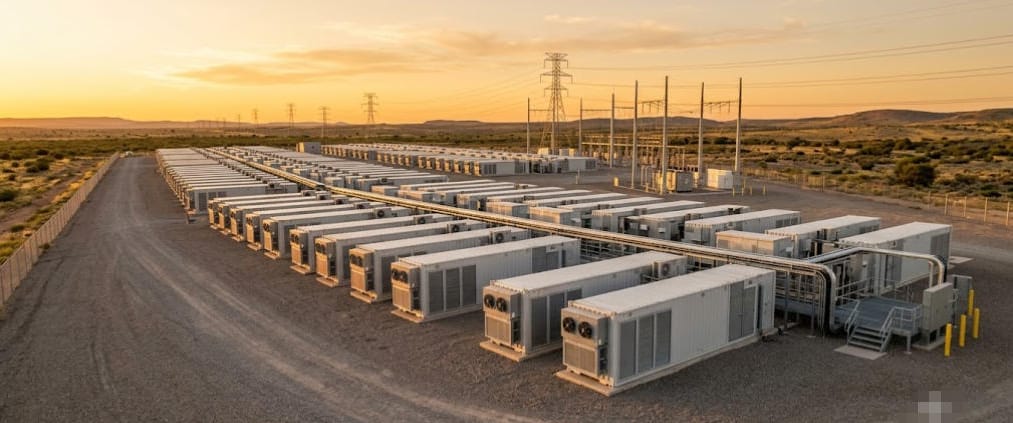
LVRT and HVRT: Voltage Ride-Through for BESS and Solar
LVRT and HVRT are the two grid rules that keep BESS and solar inverters online during a short voltage sag or spike, instead of letting them shut off and add to a larger grid failure.
| Quick Answer LVRT (Low Voltage Ride Through) and HVRT (High Voltage Ride Through) are grid-code requirements that require inverters on BESS and solar plants to remain connected and support the grid during short voltage sags and swells. Under LVRT, inverters must stay online and typically inject reactive current when voltage dips, often down to about 0–0.5 per unit for a few hundred milliseconds to a few seconds, depending on the standard and DER category. Under HVRT, they must tolerate overvoltage, often up to about 1.2–1.3 per unit, and may absorb reactive power. In the US, these rules are defined mainly by IEEE 1547-2018 for distribution-connected DER and IEEE 2800-2022 for transmission-connected plants. The result is that inverters do not trip immediately during faults; instead, they ride through the event within a defined mandatory operating region and only disconnect if voltage moves outside that envelope. |
This guide explains what the terms mean, why they exist, and how BESS developers can meet them.
What LVRT and HVRT Mean
Voltage ride-through means an inverter stays online through a short grid event. LVRT covers sags, when voltage drops below normal. HVRT covers swells, when voltage rises above normal. Faults, lightning, switching, and sudden load shifts can all cause these events.
Older rules worked the other way. Under IEEE 1547-2003, inverters tripped off the moment voltage moved outside a narrow band. A National Renewable Energy Laboratory review calls this “sensitive voltage tripping.” That rule was fine when solar made up a tiny share of power. However, it became a problem once solar and storage grew large. At that scale, one fault could knock out a big share of regional power in seconds.
Why LVRT and HVRT Matter More for BESS
A battery system feels both sides of this problem more than solar alone. During a sag, a BESS can discharge to help voltage recover. During a swell, it can charge to soak up the extra energy. Because of this two-way skill, LVRT and HVRT rules shape how much a storage asset can help, not just how well it survives.
Why LVRT and HVRT Became Mandatory
Grid operators did not add these rules for fun. Instead, they added them after real failures. On August 16, 2016, the Blue Cut Fire in Southern California triggered a transmission fault that knocked out about 1,178 MW of solar PV output, per a NERC/WECC disturbance report. On October 9, 2017, the Canyon 2 Fire caused a separate set of faults that cut roughly 900 MW of solar PV output, per a second NERC disturbance report. In both cases, inverters shut off during brief voltage dips instead of riding through them.
Those failures changed the rules. Now, most DER must stay connected through defined voltage swings. It must also help the grid during that time. As a result, ride-through moved from a nice-to-have feature to a hard certification requirement.
Balancing Worker Safety With Grid Stability
Utilities still need inverters to trip for real faults on their own lines. This is because a downed line stays dangerous to line workers if power keeps flowing. Grid codes solve this with clear voltage-and-time limits. Inside the limit, the plant must ride through. Outside it, tripping is allowed. That line is the whole point of an LVRT and HVRT curve.
How Ride-Through Curves Work
Every LVRT and HVRT rule is drawn as a curve. The curve plots voltage against time. A voltage of 1.0 p.u. is normal. A voltage of 0.0 p.u. is a dead short at the terminals. For each voltage level, the curve sets the shortest time an inverter must stay connected.
Mandatory Operation, Momentary Cessation, and Trip
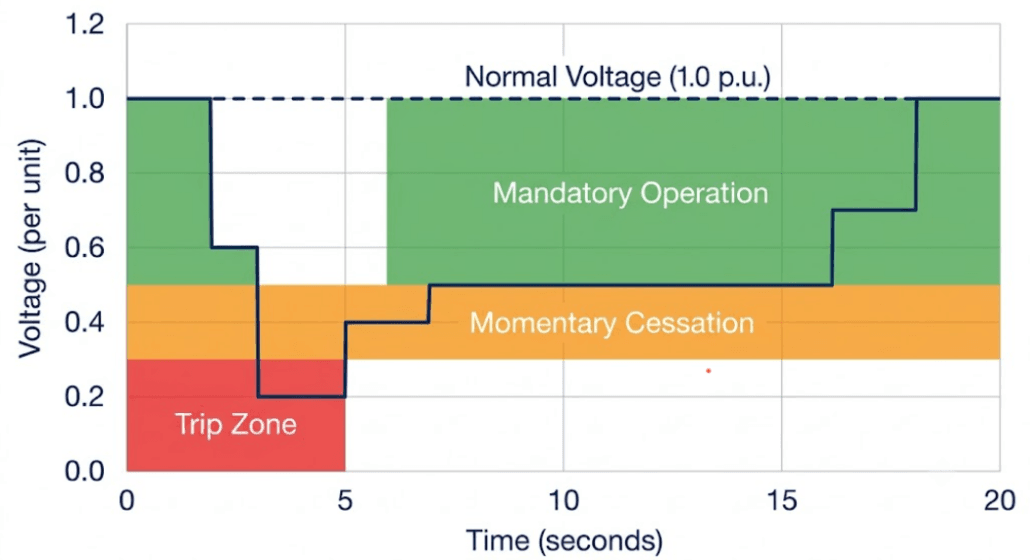
IEEE 1547-2018 names three responses inside this curve. First, mandatory operation. The inverter must keep sending active and reactive current as set by the rule. Second, momentary cessation. The inverter can pause briefly, usually below 0.5 p.u., then restart fast once voltage returns. Third, trip. This is only allowed once the event falls outside both zones. Meanwhile, IEEE 2800-2022, the newer rule for large plants, limits momentary cessation even further. That pause behavior helped cause the California events.
Reactive Current Injection Under LVRT and HVRT
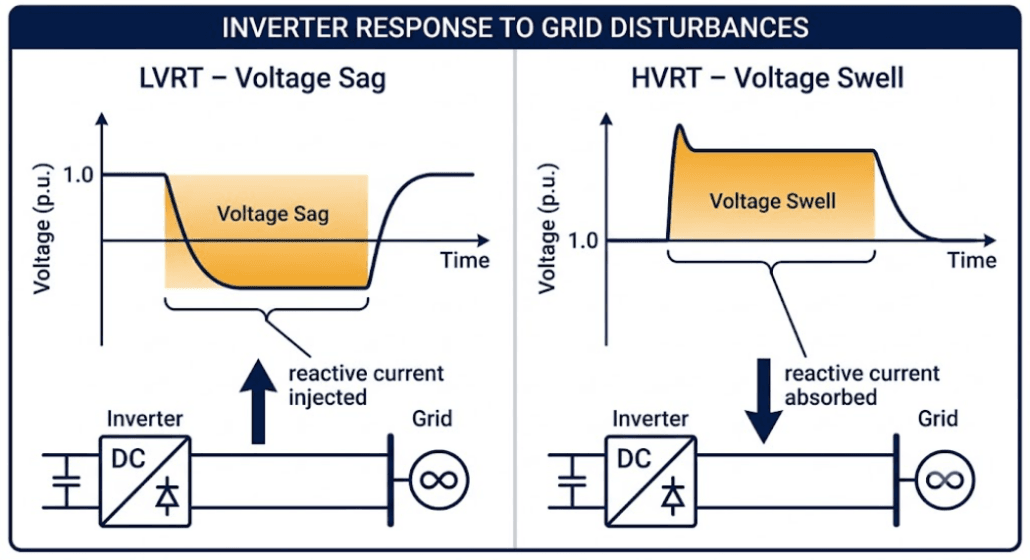
Modern codes ask for more than staying online. During a sag, the inverter must push extra reactive current to help raise local voltage. During a swell, it pulls reactive current to help bring voltage back down. This response is set by a gain value, called a k-factor. Most codes set k between 2 and 6. As a result, a bigger sag gets a bigger response, up to the inverter’s current limit.
IEEE 1547-2018 and IEEE 2800-2022: The US Framework
In the US, smaller grid-connected systems follow IEEE 1547-2018. Meanwhile, large, transmission-connected plants follow IEEE 2800-2022. Both set clear LVRT and HVRT rules. NERC PRC-024 sets outer voltage and frequency limits. Therefore, no bulk-system plant may trip inside those limits. It acts as a backstop for both standards.
DER Categories and LVRT and HVRT Coverage
IEEE 1547-2018 splits inverters into three groups. Each group has its own ride-through table.
| Category | Typical Use Case | Ride-Through Behavior |
|---|---|---|
| Category I | Legacy, minimal support | Narrowest band, simple and low-cost |
| Category II | Moderate DER growth | Wider band, some pause allowed at low voltage |
| Category III | High-growth areas, utility-scale BESS and solar | Widest band, longest hold time, built for grid reliability |
A utility or public commission picks the category for each project. Today, most utility-scale BESS projects use Category III. That is because it gives the longest ride-through time and the most grid support.
Global LVRT and HVRT Codes Compared
Exact limits shift by country. The core idea stays the same everywhere. In the US row below, remember that IEEE 2800-2022 applies specifically to transmission-connected plants, not smaller distribution-tied systems.
The same distribution-versus-transmission split applies to Europe — EN 50549-1 governs smaller distribution-connected plants, while ENTSO-E RfG governs transmission-connected ones, similar to the US split between IEEE 1547-2018 and IEEE 2800-2022.
| Region | Governing Code | Representative LVRT/HVRT Envelope |
|---|---|---|
| United States (distribution) | IEEE 1547-2018 | Ride through down to 0.0-0.5 p.u. for up to several hundred milliseconds, by category |
| United States (transmission, ERCOT) | IEEE 2800-2022, ERCOT NOG | Legacy and voltage-dip profiles, tested via Model Quality Test |
| Great Britain | National Grid ESO Grid Code (CC.6.3.15) | Active power recovery within 0.5s for faults cleared in ≤140ms, or within 1s for longer faults |
| Germany | VDE-AR-N 4110 (MV) / 4120 (HV) | Fault current must start within about 30 milliseconds |
| Europe (LV/MV distribution) | EN 50549-1 | Must stay operational down to 0.8 p.u.; resumes at least 90% of pre-fault power within 1s of voltage recovery |
| European Union (transmission) | ENTSO-E RfG (Regulation 2016/631) | Minimum zero-voltage ride-through period of ~150ms for Type C/D generating modules; local rollout of shared profiles, tested per FGW TR3 or similar |
Germany and the EU tend to demand a faster fault-current response than the US baseline. Their grids already carry more inverter-based power, so the margin for delay is smaller. ERCOT asks for two test profiles from both BESS and solar: a legacy dip and a step-by-step voltage-dip curve. Because of this, a plant controller must line up the reactive response from every inverter at one shared point.
For a country-by-country overview of BESS interconnection requirements—including US, EU, UK, Australia, and India frameworks—see our BESS grid codes and compliance guide.
Why Project-Specific Studies Still Matter
A generic grid-code curve sets the floor. However, it is not the final word. The interconnection study for one project can tighten that curve. Specifically, it looks at local grid strength, fault current, and protection settings. For that reason, developers should treat the study, not the general code, as the rule that governs a live project.
LVRT vs. HVRT: Key Differences
LVRT and HVRT share one framework. They differ in cause and response.
- Trigger: LVRT reacts to sags from faults or heavy switching. HVRT reacts to swells, often from sudden load loss or capacitor switching.
- Reactive response: LVRT asks for pushed current to raise voltage. HVRT asks for pulled current to lower it.
- Typical severity: LVRT events tend to run deeper and happen more often. Short circuits are simply more common than large load losses.
- BESS behavior: A BESS can discharge to help LVRT and charge to help HVRT. A solar-only plant cannot do both.
How BESS Inverters Achieve LVRT and HVRT Compliance
Meeting a curve on paper is easy. Meeting it in the field, under a real fault, depends on how the inverter is built.
Grid-Following vs. Grid-Forming Response
Most inverters today are grid-following. They read grid voltage and frequency through a phase-locked loop, then respond with current. Grid-following units can meet LVRT and HVRT rules. However, their speed is capped by how fast that loop can track a distorted wave during a fault. Grid-forming inverters work differently. Instead, they set their own voltage reference, which gives a faster LVRT and HVRT response. They act more like a spinning generator. Increasingly, more grid codes now favor this design in high-growth areas.
Reactive Current Priority and Current Limits
During a deep sag, an inverter’s total current is capped by its hardware. So, the control system must split that limited current between active power and reactive support. Most codes put reactive current first, since it does the most to fix voltage. Any leftover current then goes to active power. Getting this order wrong is a common reason inverters fail a compliance test, even when the timing is correct.
Testing and Certification
LVRT and HVRT compliance is tested, not assumed. In the US, UL 1741 certification checks baseline inverter behavior. Meanwhile, large projects also need project-specific Model Quality Testing. ERCOT now requires this test for both solar and BESS plants.
What Model Quality Testing Covers
This test runs the full LVRT and HVRT curve under controlled conditions. It starts with a flat-start check and a small voltage test. Next comes LVRT testing under both a legacy curve and a voltage-dip curve. HVRT testing follows the same pattern. Other tests check small frequency shifts during charge and discharge, and grid strength across several fault levels. Finally, a phase-angle-jump test, run in software like PSCAD, closes out the sequence. Importantly, the plant controller is tested with every inverter together, not alone. Otherwise, the combined response at the shared connection point can differ from any single unit’s result.
Design Considerations for LVRT and HVRT Compliance
Treat LVRT and HVRT compliance as a design choice, not a final checklist item.
- Confirm the DER category early. The utility’s choice of Category I, II, or III sets both the inverter type and the ride-through curve. This choice is hard to change later.
- Size reactive headroom on purpose. Saving current for reactive support cuts the active power on hand during a fault. This shapes how you manage state of charge.
- Coordinate the plant controller model. For hybrid solar-plus-storage sites, test the plant controller with every inverter together. Do not test each unit alone.
- Track changing standards. IEEE 2800 updates and ERCOT’s guide keep shifting. A BESS built to an old curve may fail today’s interconnection study.
LVRT/HVRT compliance is one part of the broader interconnection pathway. For the full sequence from application and network studies to commissioning and permission to operate, see our BESS interconnection process guide.
Key Takeaways
| Point | Why It Matters |
|---|---|
| LVRT and HVRT keep inverters online during grid events | Stops a single fault from cascading into a large power loss |
| IEEE 1547-2018 sets three DER categories | Category III applies to most utility-scale BESS today |
| Reactive current support is required, not optional | A k-factor of 2-6 sets how much support is needed |
| Grid codes shift by region | Germany and the EU ask for a faster fault response than the US |
| Compliance is tested, not assumed | UL 1741 and Model Quality Testing both apply |
Frequently Asked Questions
What Does LVRT Stand For?
LVRT stands for low-voltage ride-through. It is a grid-code requirement that requires inverters on BESS and solar plants to stay connected and support the grid during short voltage sags. Under LVRT, inverters must typically inject reactive current when voltage dips, often down to about 0–0.5 per unit for a few hundred milliseconds to a few seconds, depending on the standard and DER category. Instead of tripping immediately, inverters ride through the event within a defined mandatory operating region and only disconnect if voltage moves outside that envelope.
What Is the Difference Between LVRT and HVRT?
LVRT deals with low-voltage events, such as faults that cause voltage to drop, while HVRT deals with high-voltage events, such as switching transients or sudden loss of load that cause voltage to rise. Under LVRT, inverters typically inject reactive current to support voltage; under HVRT, they must tolerate overvoltage, often up to about 1.2–1.3 per unit, and may absorb reactive power. Both requirements aim to keep inverters connected during short disturbances instead of tripping and worsening the event.
Is HVRT Required for BESS as Well as Solar?
Yes. Any grid-tied inverter, including battery storage, must generally meet both LVRT and HVRT rules as a condition of interconnection. In the US, IEEE 1547-2018 applies to most distribution-connected DER, and IEEE 2800-2022 applies to transmission-connected plants. Smaller or legacy systems may be governed by older interconnection agreements, but new projects should expect to demonstrate ride-through capability in studies and commissioning tests.
What Happens if an Inverter Fails to Ride Through a Fault?
If an inverter or plant cannot meet LVRT/HVRT requirements, it may trip offline during a fault or system disturbance. Widespread tripping can add to larger power losses, similar to the 2016 and 2017 California solar-loss events that helped drive stricter ride-through rules. Repeated failures or non-compliance can also put a project’s interconnection agreement at risk, leading to export limits, required hardware or control changes, or refusal of permission to operate until the issue is resolved.
How Is LVRT and HVRT Compliance Verified?
Compliance is verified through a combination of product certification and plant-level testing. Individual inverters are typically certified to standards such as UL 1741 (which references IEEE 1547 ride-through curves). For larger plants, system operators often require Model Quality Testing or equivalent studies to confirm that the combined response of all inverters and the plant controller meets the applicable grid code at the point of common coupling. Together, these confirm that the plant controller and every inverter meet the required voltage ride-through curves and reactive current behavior.
Do LVRT and HVRT Requirements Differ Between the US and Europe?
Yes. LVRT and HVRT requirements vary by country, region, and connection voltage. The US uses IEEE 1547-2018 for distribution-connected DER and IEEE 2800-2022 for transmission-connected plants. The EU follows the ENTSO-E RfG framework, applied locally through national codes such as Germany’s VDE-AR-N 4110, which often expects faster fault-current response and tighter ride-through behavior than the current US baseline. The general principle—ride through short voltage events and support the grid—is similar, but the exact voltage ranges, time durations, and reactive current requirements differ.
Are LVRT and HVRT Requirements the Same in Every Country?
No. Requirements differ by market and grid code. Beyond the US and Europe, regions such as Australia, India, and others define their own ride-through profiles and testing rules, often tailored to local network conditions. Developers should always check the applicable distribution or transmission code and the project’s interconnection agreement, rather than assuming a single global LVRT/HVRT standard.
Further Reading
- Fault Ride-Through Features: The PCS Hardware and Control Functions Behind LVRT/HVRT Compliance
- BESS PCS Functions
- Understanding BESS Specifications
- Fast Frequency Response (FFR)
- PCS Overvoltage Protection — overvoltage thresholds and trip coordination
- C&I vs. Utility-Scale BESS
- AI Data Center Energy Storage
Sources
Great Britain (National Grid ESO / NESO Grid Code CC.6.3.15): NESO Grid Code Workshop — Fault Ride Through Background — National Grid ESO has since rebranded to NESO (National Energy System Operator); the old nationalgrid.com URL for this document no longer resolves, so this link has been updated to the current neso.energy address. Confirms the 140ms fault duration threshold and the 0.5s/1s active power restoration windows directly.
EN 50549-1 (0.8 p.u. operational threshold, 90% power resumed within 1s): Intertek EN 50549-1:2019 Test Report (Report No. 210500399TPE-001) — an accredited third-party certification test report, stronger than a preprint. It directly quotes the standard’s requirement text and confirms it against real test data.
ENTSO-E RfG (~150ms Type C/D): ENTSO-E NC RfG Implementation Guideline and ENTSO-E IGD — Parameters related to voltage issues, which confirms the 150ms fault clearance figure applies specifically to Type C and D power park modules.
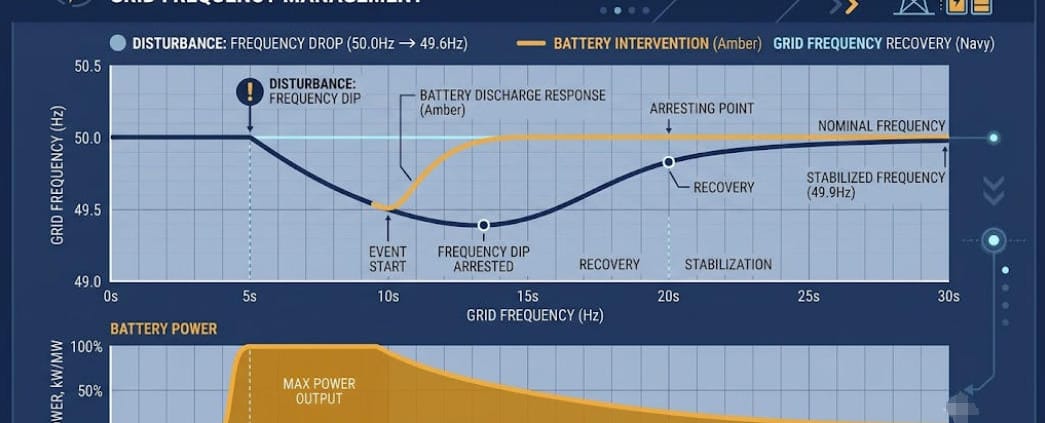
Fast Frequency Response (FFR): How BESS Stabilizes Grid Frequency in Milliseconds
| Quick Answer Fast Frequency Response is a grid ancillary service that automatically injects or absorbs power within milliseconds to a few seconds after a frequency deviation. Essentially, it arrests a frequency drop before automatic load shedding kicks in. Battery energy storage systems deliver Fast Frequency Response faster than traditional generators. Specifically, inverter-based controls detect frequency changes and respond in tens to hundreds of milliseconds. A gas turbine, by contrast, often needs many seconds just to begin ramping. |
What Is Fast Frequency Response?
Fast Frequency Response is the rapid, automatic adjustment of active power output that keeps grid frequency inside safe limits. Typically, it activates after a sudden supply-demand imbalance. When a large generator trips offline or demand spikes without warning, frequency starts to fall immediately. Consequently, grid operators need resources that react before the frequency nadir reaches a level that triggers under-frequency load shedding.
Notably, a widely cited technical review in IEEE Transactions on Smart Grid classifies FFR resources by response speed, deadband, and droop coefficient. Interestingly, it finds battery storage consistently outperforms thermal generation on all three measures.
Traditional frequency response came from the physical inertia of spinning turbines inside coal, gas, and nuclear plants. As renewable generation displaces these machines, however, grid operators lose that natural inertia buffer. This is exactly where Fast Frequency Response and synthetic inertia products step in. In effect, they replace a mechanical property with a fast control loop.
Why Grid Frequency Stability Is Getting Harder to Maintain
Every megawatt of wind or solar that replaces a synchronous generator removes physical inertia from the grid. Britain’s system operator, NESO, currently maintains a minimum system inertia of 120 GVA·s. That is down from 140 GVA·s just a few years earlier, reached in phases through 2024. NESO has proposed lowering the floor further, to 102 GVA·s. However, Ofgem’s official decision on the proposal was inconclusive. In December 2025, it requested further supporting information from NESO, due by March 2026. Consequently, lower inertia means frequency falls faster and further after any given disturbance. As a result, operators have less time to react.
To counteract this, grid codes worldwide are tightening. Increasingly, regulators require new wind, solar, and storage assets to prove FFR capability before they can connect. IEEE Std 2800, published for inverter-based resources, now formally defines four distinct FFR categories. Ultimately, this lets planners match response types to specific grid vulnerabilities.
Meanwhile, data centers and other large, fast-ramping loads add a second source of volatility. Indeed, a single GPU cluster can swing megawatts of demand in milliseconds. That volatility compounds the inertia problem rather than replacing it.
How Battery Energy Storage Systems Deliver Fast Frequency Response
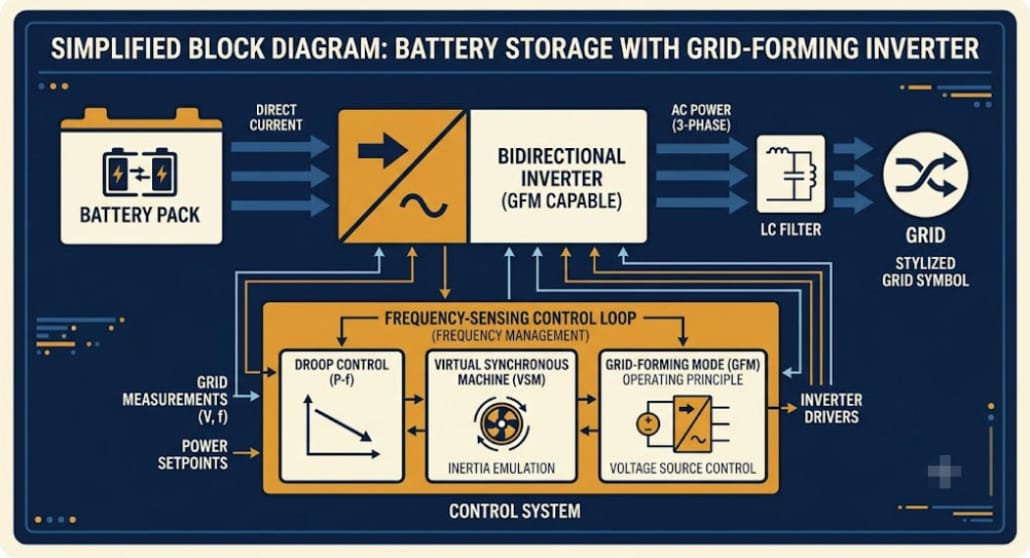
Overall, BESS installations rank among the most effective technologies for Fast Frequency Response. Specifically, their inverters can sense a frequency deviation and change output almost instantly. Typical BESS response times fall between tens and a few hundred milliseconds, well inside the windows most grid operators require.
Three control approaches make this possible. First, droop-based control adjusts output proportionally to the size of the frequency deviation, similar in concept to a generator’s governor response but far quicker. Second, virtual synchronous machine control emulates the inertial behavior of a spinning generator using software rather than a rotating mass. Third, grid-forming inverter control goes further still, letting the BESS set its own voltage and frequency reference instead of simply following the grid.
However, batteries alone do not guarantee good FFR performance. Instead, response quality depends heavily on the control architecture and the state-of-charge headroom reserved for the service. Similarly, it depends on how the inverter is tuned against the local grid’s short-circuit strength. Poorly tuned droop settings can even introduce subsynchronous oscillations. In fact, recent field tests of a 49.5 MW BESS operating in Great Britain documented exactly this issue. For a deeper look at how the inverter stage manages this behavior, see our guide to BESS power conversion system functions.
The Four FFR Types Under IEEE Std 2800
IEEE Std 2800 groups Fast Frequency Response into four categories. Essentially, this helps utilities match resource capability to grid need.
Dynamic FFR (FFR1)
This is bidirectional, droop-based response delivered by BESS and renewable resources with some deloading headroom. Specifically, it scales output continuously with the size of the frequency deviation.
Inertia-Based FFR (FFR2)
Wind turbines with inertial control, or any grid-forming inverter, emulate the release of rotational inertia. In turn, this slows the initial rate of change of frequency rather than only correcting the eventual nadir.
Fixed-Response and Staged FFR (FFR3 and FFR4)
The remaining two categories cover resources that deliver a fixed power block once frequency crosses a threshold. Additionally, they cover staged responses that layer in additional blocks as the deviation deepens. Generally, these types suit demand response and simpler inverter-based assets that cannot modulate output continuously.
Fast Frequency Response Markets Around the World
Market rules for Fast Frequency Response vary by region, and the differences matter for anyone sizing or bidding a BESS asset.
For instance, in Texas, ERCOT folded FFR into its Responsive Reserve Service after major frequency events exposed a gap in fast-acting reserves. For 2026, ERCOT caps the FFR contribution to Responsive Reserve at 450 MW. Specifically, resources providing FFR must respond within roughly a quarter of a second of a frequency excursion.
Great Britain replaced its legacy Firm Frequency Response product with a family of dynamic services: Dynamic Containment, Dynamic Regulation, and Dynamic Moderation. Notably, each targets a different band of frequency deviation. Today, NESO, the system operator, procures these dynamic services because BESS response has become the principal source of FFR-type performance on the GB grid.
Meanwhile, Australia’s frequency control ancillary services market and several U.S. ISO territories run comparable but not identical structures. Generally, they distinguish fast, slow, and delayed contingency response by required speed.
| Market | Product / Service | Response Window | Notes |
|---|---|---|---|
| ERCOT (Texas) | FFR within Responsive Reserve | ~0.25 sec | 450 MW cap on FFR share of RRS (2026) |
| Great Britain (NESO) | Dynamic Containment / Regulation / Moderation | ~1 sec | Replaced legacy Firm Frequency Response |
| Australia (AEMO) | Fast/Slow/Delayed FCAS | ~1-6 sec | Contingency FCAS tiered by speed |
FFR vs. Other Frequency Response Services
Fast Frequency Response is often confused with related grid services. In fact, each one serves a different role in the frequency-recovery sequence.
Generally, inertial response happens first, within the first second or two, and resists the initial rate of change of frequency. Then, primary frequency response, sometimes called governor response, follows over several seconds to arrest the nadir. Fast Frequency Response sits alongside or slightly after inertial response, typically completing within one to ten seconds. Frequency regulation, by contrast, operates continuously on a slower cycle to keep frequency near its target. Meanwhile, spinning reserve is the slowest of the group, often taking ten minutes or more to fully deploy. Ultimately, it exists mainly to replace the capacity that FFR and primary response held in reserve.
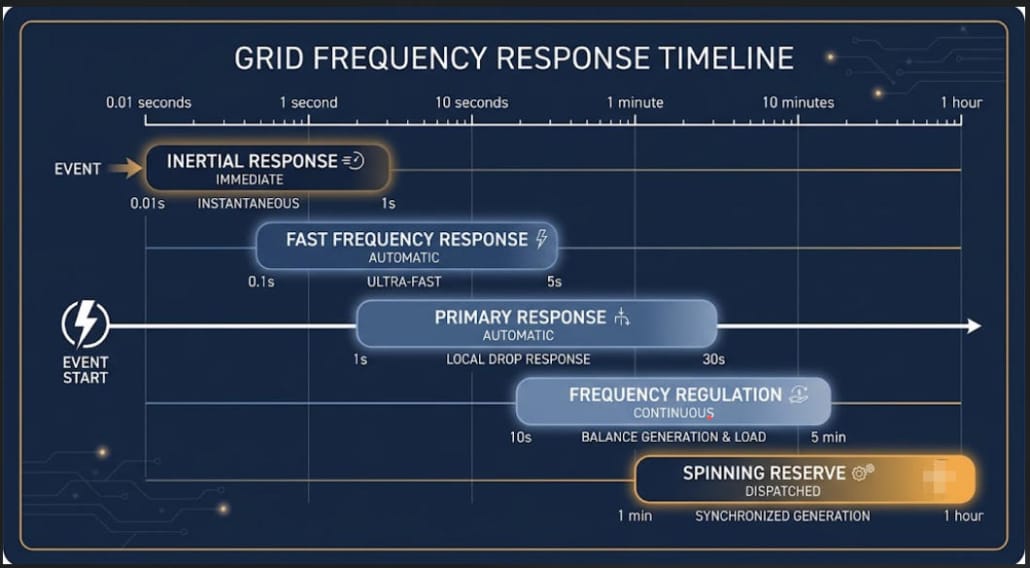
| Service | Typical Response Time | Primary Role |
|---|---|---|
| Inertial response | < 1-2 sec | Resists initial rate of change of frequency |
| Fast Frequency Response | 1-10 sec | Arrests the frequency nadir |
| Primary / governor response | Several sec | Stabilizes frequency after the nadir |
| Frequency regulation | Continuous | Holds frequency near target in normal ops |
| Spinning reserve | 10+ min | Replaces capacity FFR held in reserve |
Designing a BESS for Fast Frequency Response Duty
Sizing a BESS for Fast Frequency Response duty starts with power capability, not energy capacity. Typically, most FFR events last only seconds to a few minutes.
Even so, the system still needs enough state-of-charge headroom to guarantee bidirectional response at any moment it might be called. Often, operators reserve a fixed SOC band exclusively for FFR duty. Then, they dispatch the remaining capacity for services like peak shaving or energy arbitrage. This layered approach improves the economics without compromising reliability.
Additionally, LFP chemistry suits FFR applications well because of its high cycle life and stable behavior under frequent, shallow cycling. Notably, our guide to understanding BESS specifications covers the C-rate and round-trip efficiency figures that matter most when evaluating a system for this duty.
Key Takeaways
| Point | Detail |
|---|---|
| What it does | Arrests grid frequency drops within milliseconds to a few seconds, before load shedding triggers |
| Why BESS wins | Inverter controls react in tens to hundreds of milliseconds, far faster than thermal generation |
| IEEE Std 2800 | Defines four FFR types: dynamic droop-based, inertia-based, fixed-response, and staged |
| ERCOT rule | Caps FFR contribution to Responsive Reserve at 450 MW; requires ~0.25 sec response |
| GB rule | Dynamic Containment, Regulation, and Moderation replaced the legacy Firm Frequency Response product |
| Sizing driver | Power capability and reserved SOC headroom matter more than total energy capacity |
Frequently Asked Questions
What response time counts as Fast Frequency Response?
Most grid codes define Fast Frequency Response as full delivery within one to ten seconds of a frequency event. However, some markets like ERCOT require an initial response within a quarter of a second. Ultimately, the exact window depends on the operator’s grid code and its severity threshold.
Is Fast Frequency Response the same as synthetic inertia?
No. Synthetic inertia specifically emulates the physical inertia of a spinning generator by reacting to the rate of change of frequency within the first second. FFR is a broader category. Specifically, it includes inertia-emulating responses alongside droop-based and fixed-block responses that arrive slightly later.
Does every BESS qualify for FFR programs automatically?
Not without qualification testing. Instead, grid operators typically require a resource to pass performance tests confirming response time, ramp rate, and accuracy. In addition, the inverter firmware often needs specific grid-code-compliant settings.
How does FFR differ from frequency regulation?
Frequency regulation runs continuously to hold frequency near its target during normal operation. FFR, by contrast, only activates after a significant contingency event. Still, a BESS can typically provide both, but usually not from the same reserved capacity block at the same time.
Can a BESS earn steady revenue from FFR alone?
FFR revenue tends to be volatile, since payments often depend on scarcity and event frequency rather than guaranteed dispatch. As a result, most operators stack FFR with other services, such as regulation or arbitrage, to smooth overall project revenue.
Further Reading
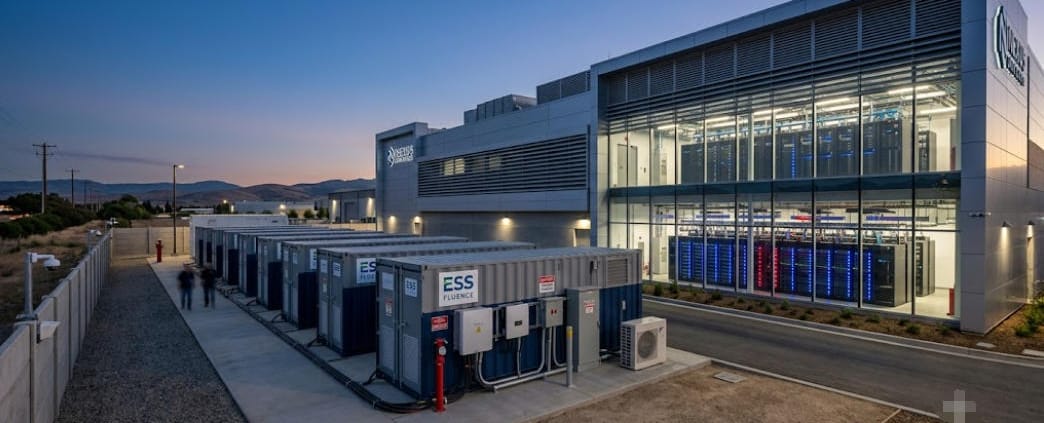
AI Data Center Energy Storage: Why BESS Is Critical
| Quick Answer AI data centers strain power grids in two ways. First, they need massive amounts of power. Second, that power swings wildly, second to second. In practice, training a large GPU cluster can shift facility power by tens or hundreds of megawatts within milliseconds. AI data center BESS, battery storage deployed on-site, solves both problems. It absorbs these swings, bridges long grid connection delays, and cuts peak demand charges. As a result, it often costs far less than building new on-site generation. |
1. The Power Problem Driving AI Data Center BESS
AI data center BESS has moved from a niche add-on to a core design requirement. Specifically, global data center electricity demand is set to top 1,000 TWh in 2026. That is roughly double the 2023 level. In the United States, data center power demand should climb by 400 TWh by 2030. That works out to about 23% growth each year. In fact, AI workloads alone could drive 30% to 40% of that new demand.
This growth has outpaced what utilities can build. Hyperscalers now sign gigawatt-scale power deals faster than new transmission lines can go up. As a result, a widening gap has formed. AI facilities need power on day one, but the grid often cannot deliver it on schedule. That is why AI data center BESS increasingly closes the gap, both on-site and in front of the meter.
2. Why Volatility Matters More Than Total Power
#image_title
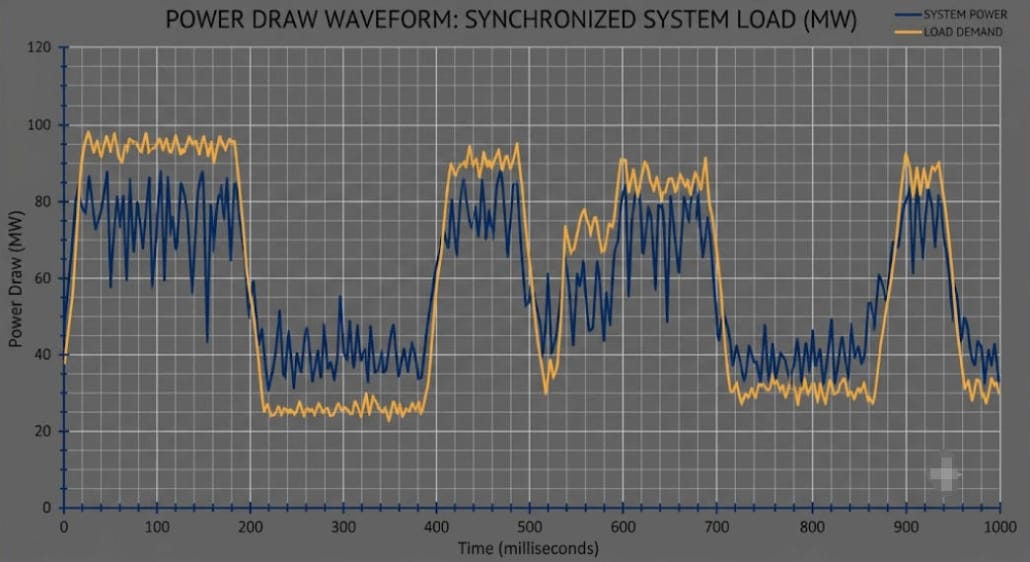
Consequently, most conversations about AI data centers focus on total megawatts. However, the harder problem is how unevenly that power arrives. For example, a traditional data center runs thousands of small, unrelated tasks. Therefore, those tasks average out into a fairly flat load. In contrast, an AI training cluster works quite differently. Specifically, tens of thousands of GPUs execute in lockstep. As a result, they synchronize computation and communication in cycles that last just milliseconds.
A large training job often pauses for a checkpoint or a data-sync step. When it does, GPU power can fall from full load to near idle in a split second. Then it snaps back just as fast. At scale, these swings can move tens or even hundreds of megawatts almost instantly. For example, Meta’s own engineers have described this exact problem on a 24,000-GPU cluster pulling roughly 30 MW. Notably, they say the problem only grows as clusters get bigger.
According to Uptime Institute, these swings can push AI compute clusters to about 150% of their normal power draw. That strains transformers, UPS units, and protection gear never built for this kind of stress. Left unmanaged, the swings can trip upstream protection or shake grid equipment through resonance. In response, fast-responding battery storage can absorb or release power within milliseconds. So, AI data center BESS is one of the few tools that can smooth these swings before they reach the utility line.
3. Interconnection Queues Are the Real Bottleneck
Even a fully funded data center still has to wait in line to connect to the grid. As of late 2025, about 2,600 GW of generation and storage capacity sat in U.S. interconnection queues. Today, the median project takes close to five years to reach commercial operation. Some PJM-area projects have waited more than eight. Meanwhile, ERCOT alone had 143.5 GW of data center load seeking connection as of October 2025. That is well above the grid operator’s all-time peak demand of 85.9 GW.
In short, only a small share of queued capacity ever gets built. In fact, Lawrence Berkeley National Laboratory found that just 13% of capacity that applied for interconnection between 2000 and 2019 had reached commercial operation by the end of 2024. For a developer who needs power within 18 to 24 months, a five-to-eight-year queue is not a delay. It is a dealbreaker. Because of this, an estimated 50 GW of behind-the-meter data center power capacity was announced in 2025 alone. Most of it pairs on-site generation with co-located battery storage. This is exactly the gap AI data center BESS is built to bridge, until the grid connection is ready.
4. Where AI Data Center BESS Fits: Four Key Roles
AI data center BESS is not a single application. Instead, it covers four distinct jobs. Often, all four stack on the same battery asset.
Sub-Second Power Smoothing
Specifically, rack-level and facility-level battery banks can absorb a sudden GPU load drop. Then they discharge just as fast when demand snaps back. This turns a millisecond-scale spike into a gradual ramp. As a result, grid equipment and on-site generators can actually keep up. Chipmakers now pair this storage with power capping and staged ramp-up controls. Together, these keep facility-wide swings within a range utilities can tolerate.
Bridge Power for AI Data Center BESS
A co-located BESS can start covering peak loads the day a facility opens. This happens long before a full grid connection is approved. So, it buys time for transmission upgrades to catch up. The project does not have to sit idle for years waiting on first power.
Peak Shaving and Demand Charge Management
Typically, utilities bill large loads heavily for their single highest demand spike each month. By charging the battery during cheap, low-demand hours and discharging during peak windows, a facility can shave that spike. This can meaningfully cut a facility’s monthly bill. For more detail, see Sunlith’s guide to peak shaving and demand charge reduction.
Grid Services and Energy Arbitrage
Additionally, a stand-alone BESS in front of the meter can also earn revenue on its own. It charges when wholesale prices are low. Then it discharges, or provides frequency regulation, when prices spike. In turn, this transforms backup infrastructure into a second income stream, not just a cost center.
5. BESS vs. Alternative Power Strategies for AI Facilities
Data center developers rarely choose one power strategy alone. Instead, the table below compares how AI data center BESS stacks up against other tools developers are using in 2026.
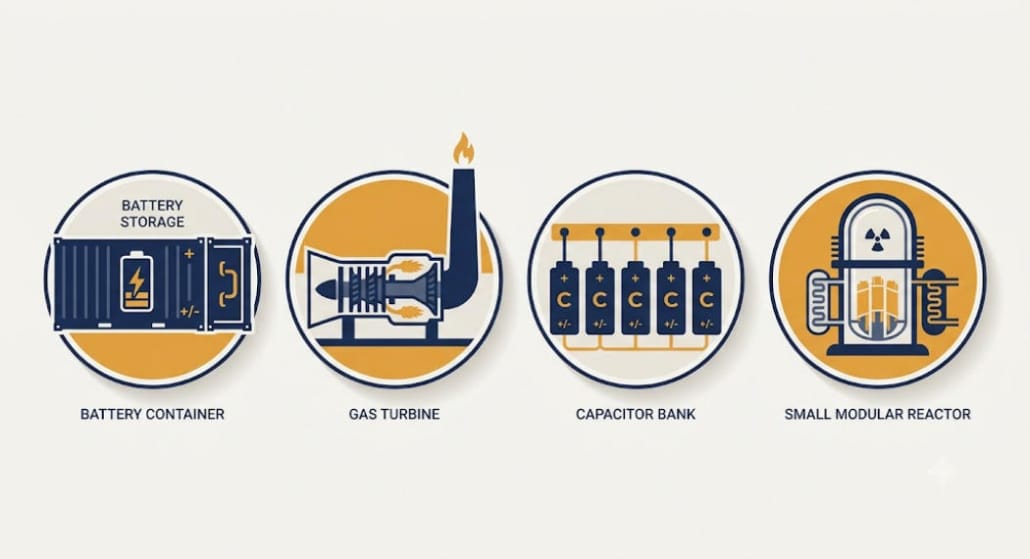
| Strategy | Response Time | Deployment Timeline | Best For |
|---|---|---|---|
| BESS | Milliseconds to seconds | 6–18 months | Power smoothing, peak shaving, bridge power |
| On-site gas generation | Seconds to minutes | 12–24 months | Sustained bridge power at large scale |
| Grid-forming UPS / capacitor banks | Microseconds | Built into facility design | Ride-through for the shortest transients |
| Small modular reactors (SMRs) | Not applicable (baseload) | 5+ years | Long-term, always-on capacity |
6. Sizing AI Data Center BESS: What to Consider
Not every BESS deployment looks the same. Sizing one for an AI data center starts from a different set of questions than a typical grid-scale project.
Response Time and C-Rate
Smoothing millisecond-scale GPU swings needs a battery and inverter rated for very fast response. This matters more than raw capacity. It is a different design target than a system built purely for hours-long peak shaving.
Duration: Burst Smoothing vs. Bridge Power
A system built to absorb short, sharp swings needs little energy capacity but very high power. By contrast, a system meant to bridge months or years of interconnection delay needs the opposite. It needs sustained duration to cover real load, not just brief spikes.
AI Data Center BESS Placement: Rack vs. Facility
Some operators deploy smaller battery banks close to the rack to catch the fastest transients. They pair these with a larger facility-scale BESS for peak shaving and bridge power. The two serve different timescales. So, they are rarely substitutes for each other.
Battery Chemistry for AI Data Center BESS
AI data center duty cycles involve frequent, partial charge-discharge events, not one clean cycle a day. Lithium iron phosphate, or LFP, tends to hold up well under that kind of irregular cycling. It also offers strong thermal stability. That matters for compliance with codes covered in Sunlith’s NFPA 855 guide for large-format stationary storage.
Key Takeaways on AI Data Center BESS
| Point | Why It Matters |
|---|---|
| AI data centers strain the grid two ways | Total demand is high, but the bigger design problem is millisecond-scale power swings during GPU training |
| Interconnection queues now stretch 5–8 years | AI data center BESS and other behind-the-meter resources bridge the gap until full grid connection |
| BESS covers four distinct jobs | Power smoothing, bridge power, peak shaving, and grid services can stack on one battery asset |
| Sizing depends on the job | Smoothing needs fast response and modest duration; bridge power needs sustained duration and real capacity |
| LFP suits AI data center duty cycles | Frequent partial cycling and thermal stability requirements favor LFP over other lithium chemistries |
Frequently Asked Questions About AI Data Center BESS
What Is AI Data Center BESS?
BESS stands for battery energy storage system. AI data center BESS refers to on-site or co-located batteries. These batteries smooth GPU power swings, bridge grid connection delays, and manage peak demand charges.
How Much Power Do AI Data Centers Actually Use?
Individual GPU racks now draw 50 to 100 kW. That is up from just 5 to 10 kW for older server racks. At the facility level, large training clusters can pull tens to hundreds of megawatts. Notably, swings of similar size can occur within milliseconds.
Can Batteries Really Respond Fast Enough for GPU Power Swings?
Yes, when purpose-built for it. Battery and inverter combinations designed for fast response can absorb and release power within milliseconds. That is exactly the timescale GPU training swings operate on.
How Long Does BESS Deployment Take?
A dedicated BESS deployment typically takes 6 to 18 months, from order to commissioning. That is far faster than the five-plus-year interconnection queues many large loads now face.
Is BESS a Permanent Fix or a Bridge to Something Else?
It can be both, depending on the role. For instance, peak-shaving and power-smoothing functions are usually permanent.
Further Reading
Battery Pack Busbar Welding: Laser vs Ultrasonic vs Resistance Welding
| ⚡ Quick Answer: Which Busbar Welding Method Is Best? Battery pack busbar welding uses three main methods: laser, ultrasonic, and resistance welding. Overall, laser welding gives the strongest, lowest-resistance joint and suits high-current packs. By contrast, ultrasonic welding avoids melting the metal, which makes it a strong fit for thin foils and aluminum. Resistance welding costs less to set up, but it tolerates dissimilar, highly conductive metals less well at scale. Ultimately, the right choice depends on your busbar material, current load, and production volume. |
1. Why Battery Pack Busbar Welding Quality Determines Pack Reliability
Battery pack busbar welding turns individual cells into an electrically connected string. Every joint in that string carries real current, often 200 amps or more in a BESS pack. A single weak weld raises resistance at exactly the point where the pack can least afford it.
Peer-reviewed research on tab-to-busbar joints backs this up. One study in the journal Batteries found that resistance and temperature rise at a weld joint varied by material choice and weld parameters. In short, busbar welding is not a cosmetic step. Instead, it is an engineering decision with real safety and performance consequences. Below, the sections cover busbar types first, then compare the three welding methods manufacturers actually use.
2. Types of Battery Pack Busbars: Material, Size, and Thickness
Copper vs. Aluminum: The Core Material Choice
Busbar choice starts with the metal. Copper carries current more efficiently than aluminum. As a result, a copper busbar can run thinner than an aluminum busbar rated for the same current. A 300A pack, for example, might use a 3mm-thick copper bar. An aluminum bar for the same job would need to be about 5mm thick.
However, aluminum costs less. It also weighs about half as much as copper at equal current rating. That is why some large-format packs use it despite the bulkier cross-section. On the other hand, aluminum forms a natural oxide layer that raises joint resistance if it is not managed. This is one reason ultrasonic welding, which does not melt the metal, pairs well with aluminum busbars.
Why Nickel-Plated Copper Is Standard for Lithium Packs
For lithium battery packs specifically, nickel-plated copper is the most common busbar choice. The nickel layer resists corrosion. It also helps the busbar hold a stable, low resistance across thousands of thermal cycles. Because copper melts predictably under a controlled beam, nickel-plated copper busbars suit laser welding well. In addition, they weld cleanly with ultrasonic methods on thinner gauges. Overall, this material choice is one of the first decisions in any battery pack busbar welding project.
Matching Busbar Thickness to the Battery Pack Busbar Welding Method
Thickness follows current, not cell format. Many LiFePO4 prismatic cells use busbars around 25mm wide. Their thickness scales with the amperage the joint has to carry. Generally, thin busbars under roughly 3mm favor ultrasonic welding, since there is little material to melt safely. By contrast, thicker busbars above 3mm favor laser or resistance welding, since they can absorb more heat without damage. Getting this pairing right is a core part of planning battery pack busbar welding before production starts.
Overall, the table below summarizes how material and thickness map to welding method.
| Busbar Type | Typical Thickness | Best Welding Match | Why |
|---|---|---|---|
| Bare or tinned copper | 2-6 mm | Laser or resistance | Best conductivity; carries high current in a thin profile |
| Nickel-plated copper | 2-5 mm | Laser or ultrasonic | Standard for lithium packs; corrosion resistance plus a stable, low-resistance weld |
| Aluminum | 4-10 mm | Ultrasonic | Needs a larger cross-section; oxide layer favors a non-melting method |
| Copper-aluminum transition | Varies | Specialized ultrasonic or bonded | Prevents galvanic corrosion where dissimilar metals meet |
3. Laser Welding for Battery Pack Busbars
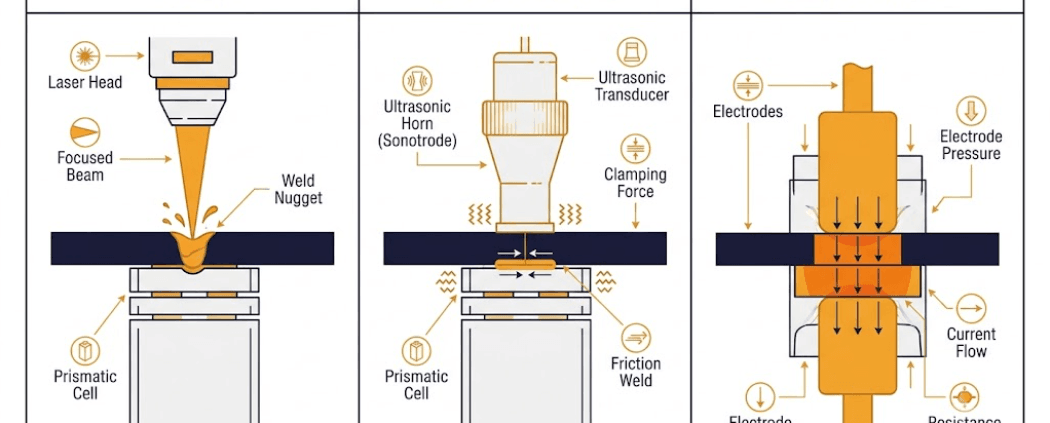
Laser welding uses a focused, high-energy beam to melt and fuse the busbar to the cell terminal. The joined metal resolidifies almost instantly. As a result, there is very little time for oxygen or contaminants to weaken the weld.
Overall, this method produces deep, strong joints, sometimes reaching close to the strength of the base metal. It also creates a smaller weld spot than ultrasonic welding, which allows tighter cell packing. However, laser systems cost more upfront. In addition, the process needs tight control over spot size, power, and scan speed, since a poorly tuned laser can damage nearby cells.
4. Ultrasonic Welding for Battery Pack Busbars
Ultrasonic welding joins metal without melting it. Instead, mechanical vibration creates friction at the joint, bonding the surfaces together. Because there is no melting involved, the heat-affected zone stays small, which protects nearby cells and thin materials.
Consequently, this makes ultrasonic welding a common choice for aluminum busbars and thin foils, where excess heat could easily cause damage. However, the tradeoff is that the bond mostly occurs at the surface, with limited penetration into the material. For very high current paths, manufacturers sometimes need multiple ultrasonic joints where a single laser weld would do the job.
5. Resistance Welding for Battery Pack Busbars
Resistance welding passes a high current through the joint, and the resulting heat fuses the metal together. It is the simplest and least expensive of the three methods. Therefore, some lower-volume or cost-sensitive lines still use it.
That said, resistance welding tolerates dissimilar, highly conductive materials less well at scale. It also generally produces more spatter than laser or ultrasonic methods. For high-reliability BESS packs, most manufacturers reserve resistance welding for less current-critical connections rather than the main busbar string.
6. Laser vs Ultrasonic vs Resistance Welding: A Side-by-Side Comparison
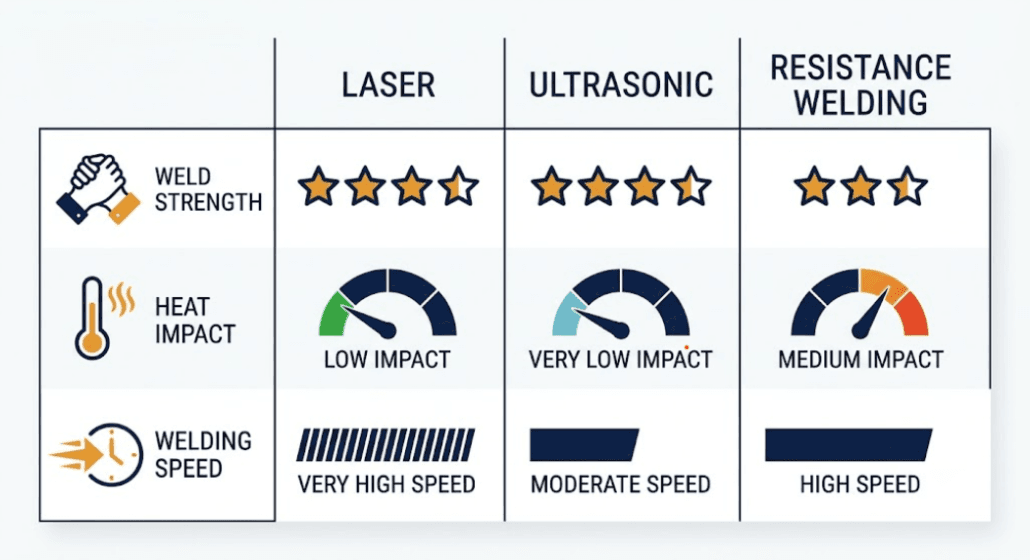
Overall, the table below summarizes how the three methods stack up on the factors that matter most for battery pack busbar welding.
| Factor | Laser | Ultrasonic | Resistance |
|---|---|---|---|
| Joint strength | Up to ~90% of base metal | 85-95% conductivity, surface bond | Moderate, material-dependent |
| Heat impact | Low, tightly controlled | Very low, no melting | Higher, more spatter risk |
| Typical speed | ~50 ms per joint | ~100 ms per joint | Fast, but less precise |
| Best material fit | Copper, nickel | Aluminum, thin foils | Similar, conductive metals |
| Equipment cost | High | Moderate | Low |
7. How Manufacturers Verify Battery Pack Busbar Welding Quality
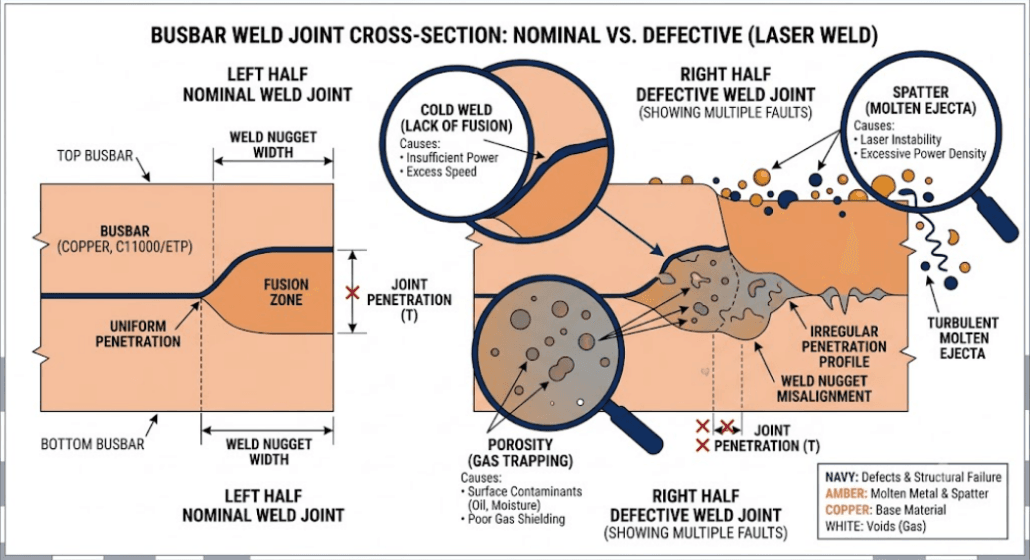
A weld can look clean and still carry too much resistance. That is why pull-force testing happens right after welding on most production lines. This check confirms that each joint meets a minimum mechanical strength standard before the pack moves forward.
Many manufacturers also retest DCIR after welding, since resistance mismatches introduced at this stage become measurable immediately. In addition, some lines add X-ray inspection or cross-section sampling on a batch basis. This checks weld penetration depth directly, rather than relying on surface appearance alone.
8. Common Busbar Welding Defects and What They Cause
Generally, these defects trace back to one of four causes on the production line.
- Cold welds: too little heat or energy reaches the joint, leaving high resistance behind a surface that still looks connected.
- Spatter contamination: molten particles land on nearby cells or contacts, risking short circuits or corrosion over time.
- Porosity and voids: trapped gas weakens the joint internally, even when the surface passes a visual check.
- Misalignment: a poorly stacked module (see our module stacking guide) creates weld gaps before the welding stage even begins.
9. Questions to Ask About a Manufacturer’s Battery Pack Busbar Welding Process
- Which welding method do you use for busbars, and why did you choose it for this product?
- What busbar material and thickness do you use, and how did you size it for our current rating?
- What pull-force or peel-strength standard does every weld have to meet?
- Do you retest DCIR after welding, and can you share that data for our batch?
- How do you inspect for spatter contamination and porosity, and how often?
Conclusion: Battery Pack Busbar Welding Sets the Electrical Backbone of the Pack
Every welding method involves tradeoffs. Laser welding offers strength and low resistance, at a higher equipment cost. Meanwhile, ultrasonic welding protects heat-sensitive materials, but needs more joints for high current. By contrast, resistance welding costs less, but performs worse on dissimilar, highly conductive metals.
Ultimately, no single method is right for every product. What matters is whether a manufacturer chose their method deliberately. It also matters whether they can prove weld quality with real test data. That, in the end, is the real signal of a controlled battery pack busbar welding process, not the method name on a spec sheet.
| ☀️ Evaluating a Pack Supplier’s Weld Quality? Sunlith Energy reviews welding QC records, pull-force data, and DCIR retest results for BESS projects from 50 kWh upward. Contact us before you finalize a pack supplier. |
Method Comparison at a Glance
| Method | Best For | Watch Out For |
|---|---|---|
| Laser Welding | High-current packs needing deep, strong joints | Higher equipment cost, needs tight process control |
| Ultrasonic Welding | Thin foils, aluminum, low heat-affected zone | Surface-only bond, more joints for high current |
| Resistance Welding | Lower-cost, simpler production lines | Struggles with dissimilar, highly conductive metals |
Frequently Asked Questions About Battery Pack Busbar Welding
What metal is best for a battery pack busbar?
It depends on the application. Copper carries the most current for its thickness, which suits high-current BESS packs. However, aluminum costs less and weighs less, though it needs a larger cross-section for the same current. Overall, nickel-plated copper is the most common choice for lithium packs, since it resists corrosion and welds well.
What is the best welding method for battery pack busbars?
There is no single best method. Instead, laser welding suits high-current packs that need deep, strong joints. Ultrasonic welding, meanwhile, suits thin foils and aluminum, where low heat matters most. Resistance welding fits lower-cost lines joining similar, conductive metals.
Why does battery pack busbar welding matter for safety?
A poor weld raises resistance at the joint. As a result, higher resistance means more heat under load. Over time, that heat can age one section of the pack faster than the rest. In the worst case, a weak joint can fail outright and create a safety event.
How do manufacturers test busbar weld quality?
Most run a pull-force test right after welding, since a joint that looks fine can still carry too much resistance. In addition, many also retest DCIR after welding. Some lines add X-ray or cross-section sampling to check penetration depth on a batch basis.
Is laser welding always better than ultrasonic welding?
Not always. Laser welding generally produces a stronger, lower-resistance joint. However, ultrasonic welding avoids melting the metal entirely, which some manufacturers prefer for thin or heat-sensitive materials. Ultimately, the right choice depends on the busbar material and current load.
What causes a cold weld in battery pack busbar welding?
A cold weld happens when the process delivers too little heat or energy to fully fuse the joint. In addition, contamination, surface oxidation, and misaligned parts can all contribute. The result is a joint that looks connected but carries far more resistance than it should.
Should I ask my battery pack supplier about their welding process?
Yes. Specifically, ask which welding method they use and what pull-force standard they test to. Also ask whether they can share weld QC data for your batch. Overall, a supplier who answers clearly is usually running a controlled battery pack busbar welding process, not just an assembly line.
Further Reading
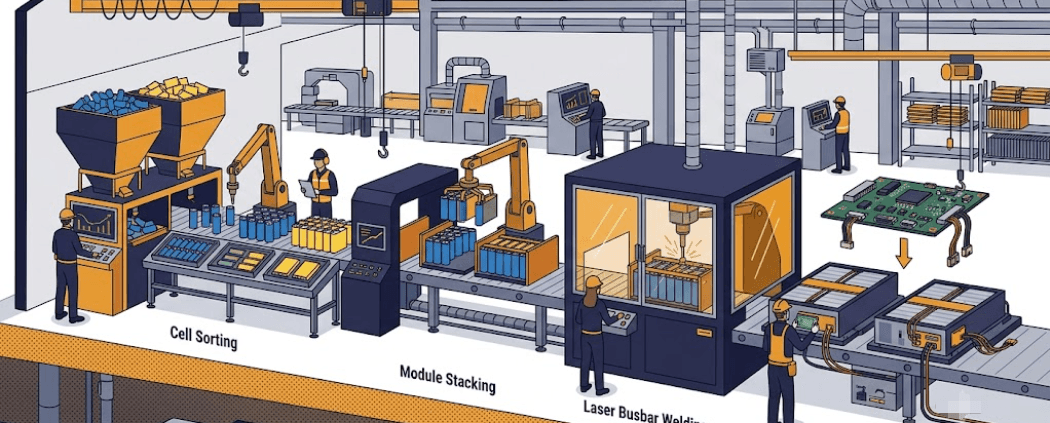
Battery Pack Assembly Process: From Cell Sorting to Finished BESS Pack
| ⚡ Quick Answer: What Is the Battery Pack Assembly Process? The battery pack assembly process turns screened cells into a finished, protected energy storage unit. It moves through six stages: cell sorting and matching, module stacking and compression, busbar welding, BMS integration, enclosure sealing, and aging or burn-in testing. Each stage sets a ceiling that later stages can’t fully recover from. A pack that skips or rushes an early stage rarely fails outright. Instead, it simply delivers less capacity and a shorter cycle life than its datasheet promised. |
1. Why the Battery Pack Assembly Process Is a Manufacturing Discipline, Not a Wiring Job
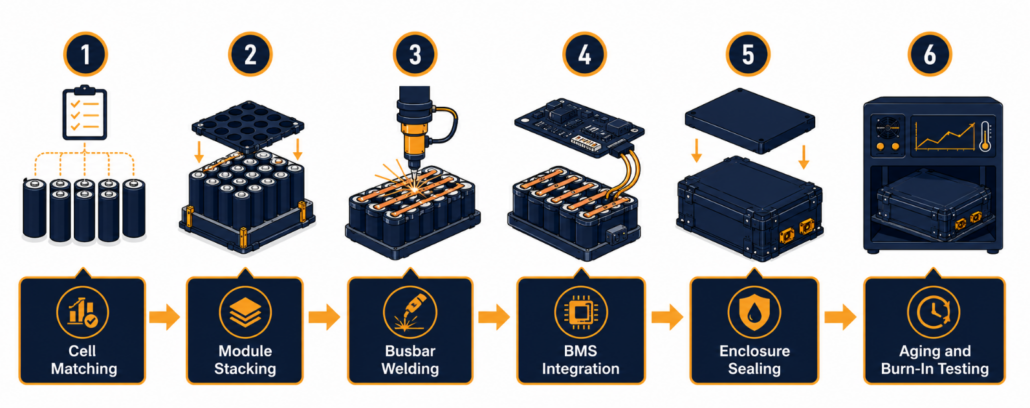
Building a battery pack looks simple from the outside. You connect a group of cells, add a control board, and close the case. In practice, however, the battery pack assembly process works more like precision manufacturing than basic wiring. Small tolerances stack up at every stage. A cold weld here and an uneven compression force there can add up fast. As a result, the finished pack can fall short of the capacity and cycle life its datasheet promised.
This gap matters more for a BESS than for a small consumer device. That’s because a stationary pack runs thousands of cycles over 10 to 20 years. In fact, international safety standards such as IEC 62619 exist precisely because assembly quality drives real-world safety, not just performance. For a broader view of how pack assembly fits within a complete system, read our guide to key components in a BESS architecture. Below, the sections walk through each stage in the order it happens on a production line.
2. Stage 1 of the Battery Pack Assembly Process: Cell Sorting and Matching
Before a single cell reaches the assembly line, workers sort it by voltage, capacity, and internal resistance. Even cells from the same production batch vary slightly. Therefore, grouping similar cells together reduces how much correcting the BMS has to do later. Typically, manufacturers run a fast ACIR screen first, then confirm with DCIR pulse testing before final grouping.
For a full breakdown of this step, read our complete cell matching before pack assembly guide. It covers how internal resistance affects series versus parallel groups. In short, this is the foundation stage of the entire battery pack assembly process. Every later stage inherits whatever variation this one leaves behind.
3. Stage 2: Module Stacking and Mechanical Compression
Once cells are sorted, they move into module stacking. End plates and pressure plates apply a controlled compression force across the stack. This keeps prismatic and pouch cells in steady contact. It also leaves room for the swelling that naturally happens over a cell’s charge cycle. Before this step locks in, a CCD vision system checks tab and terminal alignment. A misaligned cell here creates a welding problem two stages later.
Adhesives also enter the process at this stage, and they do two separate jobs. On one hand, a compliant thermal interface material carries heat away from the cells. On the other, a smaller, targeted structural adhesive bead helps hold the stack together, without resisting the swelling that compression plates already accommodate. Our guide to gluing cells in a battery pack covers which adhesive chemistry fits which job. It also explains why a rigid, full-face bond causes many long-term pack failures.
Afterward, steel straps or plastic-steel banding secure the stack for transport to the welding station. Bottom flatness matters here too, since an uneven module base creates gaps against thermal pads or cooling plates further downstream. Eventually, that gap shows up as an uneven temperature distribution, a problem we cover in our guide to cell temperature gradients in BESS.
4. Stage 3: Busbar Welding and Electrical Interconnection
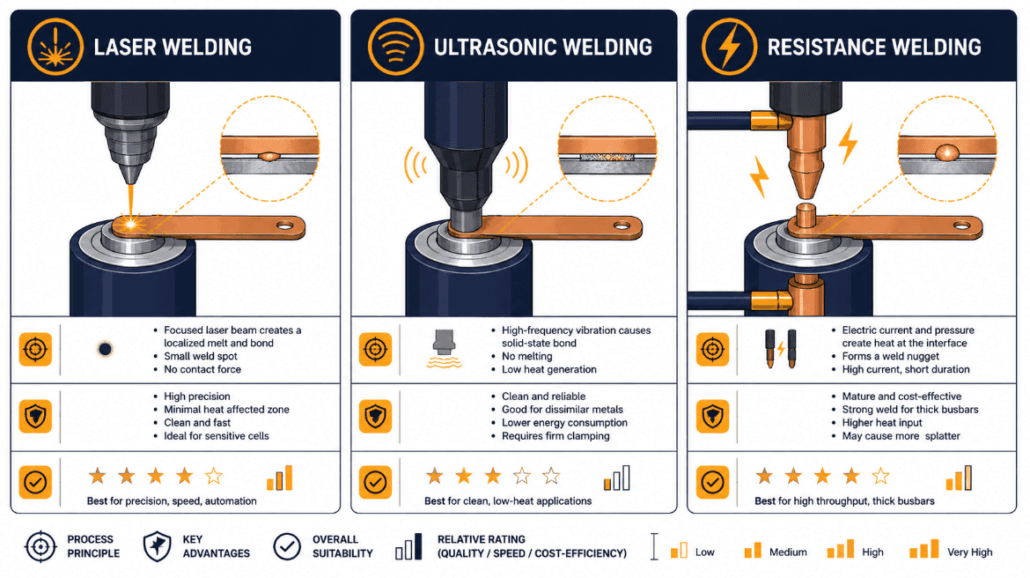
Busbar welding turns individual cells into an electrically connected string. Three welding methods dominate this stage of the battery pack assembly process. First, laser welding offers high precision and low thermal impact. Meanwhile, ultrasonic welding works fast and handles dissimilar metals without melting either surface. By contrast, resistance welding is the simplest method, but it tolerates dissimilar, highly conductive materials less well at scale.
Right after welding, technicians verify weld quality with a pull-force test, since a joint that looks fine can still carry excessive resistance. For instance, a cold weld or particulate spatter left uncleaned can pierce a cell casing. It can also create a resistance hotspot, which then ages that section of the pack faster than the rest. Because this stage feeds directly into DCIR verification, any resistance mismatch becomes measurable before the pack moves forward.
5. Stage 4: BMS Integration and Wiring Harness
With the electrical interconnections complete, the battery management system goes in next. Technicians install cell supervision circuit (CSC) boards and connect sensor and communication wiring harnesses. In larger packs, they also wire multiple slave boards to a central master BMS. Because the busbars still sit at low voltage at this point, manufacturers deliberately install the BMS before final busbars bring the pack to full voltage. Consequently, this keeps the line safer for technicians.
For a full explanation of how the BMS monitors and protects the pack once assembly finishes, see our guide to how a battery management system works. Similarly, our comparison of centralised, modular, and wireless BMS architecture explains how this stage differs across pack sizes.
6. Stage 5 of the Battery Pack Assembly Process: Enclosure Sealing and IP Rating
Once the BMS and wiring harness are in place, workers close the pack into its enclosure. They apply sealant, torque the lid to specification, and then run a leak-rate test to confirm the rated IP class. Generally, indoor commercial installs target IP65, while outdoor and utility-scale deployments exposed to rain, dust, or coastal humidity typically need IP66 or IP67.
At this stage, fire code compliance also starts to matter directly. Specifically, enclosure integrity, safety distances, and installation clearances feed into requirements covered under NFPA 855. Even so, a leak-tested but poorly torqued enclosure can pass an initial inspection and still fail years later, once gasket materials age and compress.
7. Stage 6: Aging, Burn-In, and Factory Acceptance Testing
The final stage of the battery pack assembly process is checking the work. First, the sealed pack goes through insulation resistance and withstand voltage testing. It then runs charge and discharge cycling that mirrors real operating conditions. Notably, this aging or burn-in period surfaces problems that earlier QC checks can miss. For example, a weak cell or a marginal weld connection can look fine under static testing. It may only reveal itself once the pack cycles under load.
For BESS-scale packs, this step overlaps with formal factory acceptance testing, which also verifies alarm thresholds, protection logic, and communication protocols before the pack ships. Our guide to BESS safety and compliance explains how factory-level testing connects to the certification requirements a finished system needs.
8. Cell-to-Pack vs Module-Based Assembly: A Quick Note on Architecture
Most of the stages above describe a module-based process: cells become modules, and modules become a pack. Alternatively, cell-to-pack (CTP) design skips the module step entirely and bonds cells directly to the pack structure and cooling plate instead. Because this removes an entire layer of module casings and interconnections, it can reduce weight, part count, and cost.
Still, the tradeoff is real. CTP removes the module-level buffer between a single bad cell and the whole pack. This places even more weight on the cell sorting and matching stage covered above. As a result, buyers evaluating a CTP-based product should ask harder questions about incoming cell grading. A module-based pack has more structural redundancy if a cell underperforms.
9. Quality Control Checkpoints in the Battery Pack Assembly Process
Overall, a well-run battery pack assembly process builds in a verification step after every major stage, not just at the very end. The table below summarizes what each checkpoint is designed to catch.
| Stage | QC Checkpoint | What It Catches |
|---|---|---|
| Cell sorting | Voltage, capacity, DCIR/ACIR grading report | Mismatched cells before they ever reach a module |
| Module stacking | CCD alignment check, compression force verification | Misaligned tabs, uneven pressure, weld gap errors |
| Busbar welding | Pull-force test, weld seam inspection, DCIR retest | Cold welds, spatter contamination, high-resistance joints |
| BMS integration | Insulation resistance, withstand voltage test | Wiring faults, sensor placement errors |
| Enclosure sealing | IP-rated leak test, torque verification | Seal failures that let in moisture or dust |
| Aging & burn-in | Charge/discharge cycling, capacity verification | Weak cells or joints that only surface under load |
10. Questions to Ask a Manufacturer About Their Battery Pack Assembly Process
- Do you test and match cells by voltage, capacity, and internal resistance before assembly?
- Which busbar welding method do you use, and what pull-force standard do welds have to meet?
- What IP rating does the sealed enclosure achieve, and is it leak-tested on every unit or by sample?
- Do you run aging or burn-in cycles before shipment, and can you provide that data for our batch?
- Is this a module-based or cell-to-pack design, and how does that affect your cell grading tolerance?
Conclusion: The Battery Pack Assembly Process Sets What the Finished Pack Can Deliver
Ultimately, no single stage of this process works in isolation. Cell matching sets the ceiling the BMS has to work within. Meanwhile, module compression and busbar welding determine how evenly that ceiling holds up over years of cycling. Finally, enclosure sealing and burn-in testing confirm, before the pack ships, whether earlier stages were done properly.
Therefore, when you evaluate a cell or pack supplier, ask about each stage specifically. Don’t just accept a general assurance that “the BMS handles it.” Instead, look for a manufacturer who can walk through their process stage by stage, with documentation at each checkpoint. That is what a genuinely controlled battery pack assembly process looks like, not a finished product with an unverifiable history.
| ☀️ Need Help Evaluating a Pack Manufacturer’s Assembly Process? Sunlith Energy reviews cell sorting data, weld QC records, enclosure test reports, and burn-in results for BESS projects from 50 kWh upward. Contact us before you finalize a cell or pack supplier. |
Key Takeaways
| Stage | What Happens |
|---|---|
| 1. Cell Sorting & Matching | Workers grade cells by voltage, capacity, and internal resistance before assembly. |
| 2. Module Stacking & Compression | Machines stack, compress, and mechanically retain cells to control swelling and vibration. |
| 3. Busbar Welding | Laser, ultrasonic, or resistance welding connects cells in series and parallel. |
| 4. BMS Integration | Technicians install and connect sensor wiring, CSC boards, and the master BMS. |
| 5. Enclosure Sealing | Workers seal the pack to its rated IP class and leak-test it. |
| 6. Aging & Burn-In Testing | Charge and discharge cycling, plus insulation tests, confirm the pack before shipment. |
Frequently Asked Questions About the Battery Pack Assembly Process
What are the main stages of the battery pack assembly process?
Six stages make up the battery pack assembly process: cell sorting and matching, module stacking and compression, busbar welding, BMS integration, enclosure sealing, and aging or burn-in testing. Each stage builds on the one before it, so a defect introduced early is much harder to catch later.
Is battery pack assembly the same as cell manufacturing?
No. Cell manufacturing produces the individual lithium cells, tested and graded before they reach a pack line. By contrast, battery pack assembly starts once those finished cells arrive, and it covers sorting, stacking, welding, BMS integration, sealing, and testing. For the step that happens first, see our cell matching guide.
Why does battery pack assembly quality matter more for BESS than for a small consumer battery?
A stationary BESS pack runs thousands of cycles over 10 to 20 years, often at higher currents than a consumer device. Because of this, small defects that would go unnoticed in a phone battery compound over years of daily cycling. For example, a slightly cold weld or a poorly matched cell can turn into measurable capacity loss, or in the worst case, a safety event.
What is the difference between cell-to-pack and module-based assembly?
Module-based assembly groups cells into modules first, then combines modules into a pack. Cell-to-pack assembly, on the other hand, skips the module step and bonds cells directly to the pack structure. This can reduce weight and cost, but it also removes the module-level buffer between a bad cell and the full pack.
How long does battery pack assembly typically take?
For a utility-scale BESS pack, sorting, stacking, welding, and BMS integration can finish in hours on an automated line. However, aging and burn-in testing often adds one to several days, since full charge and discharge cycles take time but properly verify the pack before shipment.
What should I ask a manufacturer about their battery pack assembly process?
Ask which welding method they use for busbars, and whether they match cells before assembly. Also, find out what IP rating the enclosure achieves, and request burn-in test data for your specific batch. Overall, a manufacturer who answers all three with documentation is running a genuinely controlled battery pack assembly process.
Further Reading
- Cell Matching Before Pack Assembly
- Cell Internal Resistance: What It Is and How to Measure It
- Battery Pack Busbar Welding: Laser vs Ultrasonic vs Resistance
- Cell Temperature Gradients in BESS
- Gluing Cells in a Battery Pack: Heat, Swelling, and Long-Term Reliability
- Battery Management System (BMS) Explained
- BMS Architecture: Centralised vs Modular vs Wireless
- How to Evaluate a BESS Supplier’s BMS
- NFPA 855 Guide
- BESS Safety and Compliance
- Understanding BESS Specifications
- BESS Certifications Explained